APPRECIATIVE INQUIRY
FACTORS THAT DETERMINE THE SUCCESS OF AI CHANGE PROCESSES
Master thesis, Msc BA, specialization Change Management University of Groningen, Faculty of Economics and Business
August 5, 2009 IRIS MULDER Student number: 1462385 Fuik 33 8081 KC Elburg tel.: +31 (0)6-30869848 e-mail: [email protected] University supervisor: dr. C. Reezigt prof. dr. J.I. Stoker
Company supervisor: J.E.M. van de Wetering
TNO Management Consultants, Apeldoorn
Acknowledgment: helpful comments on earlier drafts of this thesis were given by my supervisor C. Reezigt. I thank all the respondents of various organizations for cooperating and providing the information necessary for writing this Master thesis. I especially thank Annet van de Wetering and other colleagues, for providing me access to the people and documents of TNO MC and for giving me helpful advice and comments.
APPRECIATIVE INQUIRY
FACTORS THAT DETERMINE THE SUCCESS OF AI CHANGE PROCESSES
ABSTRACT
This research concerns the change methodology Appreciative Inquiry (AI). It can be described as a methodology that takes a positive stance towards changing and developing organizations. The main research question is: Which factors determine the success of an Appreciative Inquiry change process?
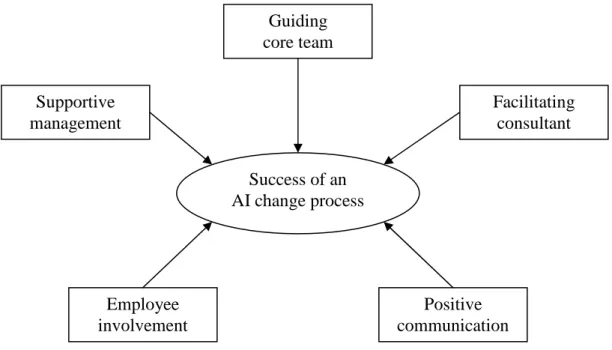
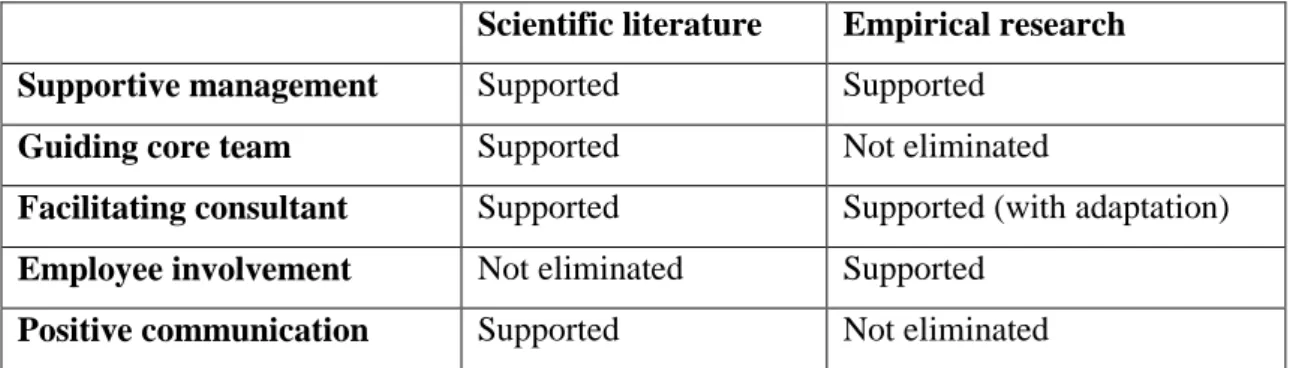
AI literature, written by its proponents, provides five success factors; these are summarized in a conceptual model. The suspected success factors (‘supportive management’, a ‘guiding core team’, a ‘facilitating consultant’, ‘employee involvement’, and ‘positive communication’) are evaluated by exploring the scientific literature and on basis of interviews with 18 people who were involved in six AI change processes.
Scientific literature supports all success factors, except for one: ‘employee involvement’, which is not eliminated. The analysis of the interviews indicate that a ‘guiding core team’ and ‘positive communication’ are not eliminated; the remaining three success factors are supported. In addition, the role of the consultant has to be adjusted: from ‘facilitating consultant’ to ‘guiding consultant’. Moreover, based on the interviews, one success factor is added to make AI literature more comprehensive: the ‘institutionalization of the change process’. Therefore, the factors that determine the success of an AI change process are ‘supportive management’, a ‘guiding consultant’, and ‘institutionalization of the change process’. The factors ‘employee involvement’, a ‘guiding core team’, and ‘positive communication’ are not eliminated.
Key words: Appreciative Inquiry, organizational change, management, core team, consultant,
TABLE OF CONTENTS 1. INTRODUCTION 3 2. AI LITERATURE 6 2.1APPRECIATIVE INQUIRY 6 2.2 SUCCESS 7 2.3 SUCCESS FACTORS 7 2.4CONCEPTUAL MODEL 12 3. RESEARCH METHODS 13 3.1LITERATURE STUDY 13 3.2 EMPIRICAL RESEARCH 14
4. SCIENTIFIC FOUNDATIONS OF SUCCESS FACTORS 18
4.1 SUCCESS FACTORS 18
4.2 SUMMARY 23
5. RESULTS 25
5.1SUCCESS OF AI CHANGE PROCESSES 25
5.2 SUCCESS FACTORS 26
5.3 WAYS TO STRENGTHEN THE AI CHANGE METHODOLOGY 32
5.4 SUMMARY 33
6. DISCUSSION 34
6.1CONCLUSIONS 34
6.2THEORETICAL AND PRACTICAL IMPLICATIONS 36
6.3 LIMITATIONS AND FUTURE RESEARCH 37
REFERENCES 39
APPENDIX A: LIST OF INTERVIEWED PEOPLE 43
1. INTRODUCTION
“We cannot solve problems by using the same kind of thinking we used when we created them”, is something Albert Einstein once said. This quote describes the essence of the Appreciative Inquiry (AI) change methodology and highlights the difference with other approaches of change processes. Since the eighties of last century, AI is used to emphasize that in every organization there are things that work and change can be managed through the identification of what it is that works, and consequently analyze of how to further develop and apply the things that have effect (Hammond, 1998). A piece of research presented in this paper fits the field of organizational change management, as it unveils the factors that determine the success of an AI change process.
According to Cooperrider and Srivastva (1987) the contrast between problem-solving techniques and Appreciative Inquiry starts at the basis. Problem-solving techniques attempt to analyze deficits. The identification of a problem leads to the analysis of the causes; after that an analysis of possible solutions will be performed, and it ends with action planning: the treatment. AI perceives an organization as a mystery to be embraced. It starts with appreciating and valuing (“what is”); followed by envisioning (“what might be”); after that dialoguing (“what should be”) and ends with innovating (“what will be”).
For more than 50 years, many authors have written articles and books about change management in an attempt to help organizations to implement change successfully (Walker, Armenakis, & Bernerth, 2007). Lewin (1947) argued that a successful change must involve three distinct phases: unfreezing, moving, and freezing. Building on this model, several researchers have described steps one can employ in implementing organizational change (Judson, 1991; Kotter, 1995; Galpin, 1996). However, these models do not guarantee successful organizational change.
With regard to Appreciative Inquiry and change management quite a lot is written. According to its proponents, AI is one of today’s most popular change methods (Cooperrider, Whitney, & Stavros, 2005). The question arises which factors determine its success?
This research contributes to the existing literature, because it not only provides an overview of the factors that determine the success of AI change processes according to its proponents, but also considers the scientific and empirical evaluation of these success factors. In that way, AI literature will be enriched.
The research objective of this research therefore is: “to provide insight in the factors that determine the success of an Appreciative Inquiry change process”.
AI studies and literature can be scientific, because AI makes an observation of what is, and may also be metaphysical, because it has ideals of what might be (Cooperrider, & Srivastva, 1987). This consequently makes AI literature quite subjective, because it is often about positive changes. Hence, in this research there is a distinction between AI literature and scientific literature. AI literature is the subjective, unilateral literature, written by AI proponents, whereas scientific literature is the ‘classical’ change literature that claims to be objective and non-metaphysical.
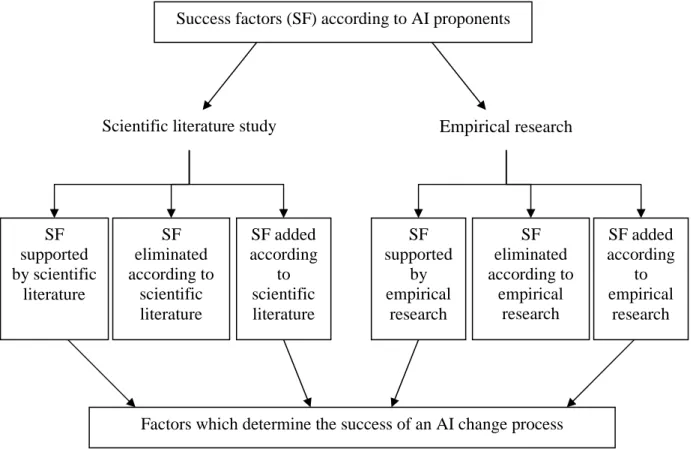
Data will be collected by literature study (secondary data sources) and by interviews with persons who were involved in an AI change process (primary data sources by case studies). The literature study aims to identify what the most important success factors are for AI change processes, according to its proponents. These expected success factors will be evaluated by exploring the scientific literature and on basis of interviews with people who were involved in AI change processes. Scientific literature will be used to find supporting evidence of these factors, evidence that specific factors are not supported by science, or factors which can be added to AI literature. The first part of the interviews includes ‘open’ questions, in the second part AI data functions as input for the formulation of the questions. The case studies can provide empirical evidence for the success factors, eliminate some factors, or provide additional factors. So, in case of missing factors in the conceptual model, these are added to the model, thus making AI literature more comprehensive. Figure 1 on the next page provides an overview of the different parts of this research.
The research question is:
“Which factors determine the success of an Appreciative Inquiry change process?” The following sub-questions were formulated:
• What are the success factors for AI change processes according to AI literature?
• Which success factors for AI change processes are supported or eliminated by scientific literature?
• Is there empirical evidence for these success factors, or do they have to be eliminated according to empirical research?
• What are additional success factors for AI change processes that strengthen the existing AI literature?
It is possible that AI literature, scientific literature and experience support each other, because the existing AI literature is also partly based on science and practice, but it is expected that AI literature, scientific literature and the empirical research do not agree on all success factors, because they have a very different point of view.
FIGURE 1: Research overview
The research is performed for TNO Management Consultants (TNO MC), a consultancy organization in Apeldoorn (the Netherlands). It is affiliated with TNO, the Netherlands Organization for Applied Scientific Research, with a particular focus on quality and change in organizations. One of the methodologies used by TNO MC is Appreciative Inquiry.
The next chapter provides a theoretical overview of AI literature. It explains the principles of AI and its success factors for change, according to its proponents. The conceptual model will be presented after this literature section. In chapter three the research method is outlined. Thereafter, success factors will be evaluated by exploring the scientific literature. The fifth chapter shows the results of the empirical research. Finally, the discussion chapter provides a conclusion, theoretical and practical implications, and limitations, and closes with recommendations for future research.
Scientific literature study
SF supported by scientific literature SF eliminated according to scientific literature SF supported by empirical research Empirical research SF added according to empirical research SF eliminated according to empirical research
Factors which determine the success of an AI change process Success factors (SF) according to AI proponents
SF added according
to scientific literature
2. AI LITERATURE
This chapter provides a theoretical overview of the AI methodology and the factors that determine the success of an AI change process, according to its proponents. All factors together lead to the conceptual model, presented at the end of this section. There are many quotations in this chapter, because AI proponents speak and write unilateral about it. Not knowing whether these statements are scientifically right or wrong, results in many quotes.
2.1 Appreciative Inquiry
In a period of 20 years, “AI has developed from a relatively obscure process shared by a small group at Case Western Reserve University to a major technique for positive change, with applications ranging from small group team developments to worldwide initiatives” (Sorensen, & Yaeger, 2004: 229). AI is based on the assumption that “every organization has something that works well and these strengths can be the starting point for creating positive change” (Cooperrider et al., 2005: 3). It is a broadly spread assumption that we can improve things by focusing on what is not going well. “It never comes up in our minds that the inverse also could be true sometimes (and perhaps it is even more true). By focusing on what goes well, we can multiply our successes and use them consciously on a larger scale” (Van Domburg, 2008: 25).
The theoretical underpinnings of AI can be traced back to two central themes: the philosophical school of social constructionism and the theory of positive expectancy (Fitzgerald, Murrell, & Miller, 2003). Social constructionism states that people have “considerable influence over the nature of the realities they perceive and experience and that to a great extent they create realities through shared symbolic and mental processes” (Fitzgerald et al., 2003: 5). It provides the foundation for three of the five principles central to AI. The constructionist principle states that reality is socially constructed. Knowledge and organizational destiny are therefore interwoven. As we talk, so we make. That is why people need to “think of words as actions, as powerful tools that do things” (Barrett, & Fry, 2005: 43). The second principle is the principle of simultaneity. Inquiry and change occur simultaneously. “The moment we ask a question, we begin to create a change” (Whitney, & Trosten-Bloom, 2003: 54). The moment one starts to explore a topic, respondents recall such moments; questions can stimulate ideas and generate possibilities. The poetic principle is the third principle that is based on social constructionism. “A useful metaphor in understanding this principle is that human organizations are an open book. An organization’s story is constantly being co-authored. The important implication is that one can study virtually any topic related to human experience in any human system or organization” (Cooperrider et al., 2005: 8).
The second foundation of AI is positive expectancy. It is based on “the formidable power of creating images of the future to stimulate and direct organizational action” (Fitzgerald et al., 2003: 6). Positive imagery leads therefore to positive action. On this foundation are the last two principles of AI based. The fourth principle is the anticipatory principle. “The organization’s collective image of the future, as projected in ongoing conversations and categories of discourse, guides what there is to notice in the present, and by doing so, structures action” (Barrett, & Fry, 2005: 47). The last principle is the positive principle. It holds that organizations are responsive to positive images and positive language. “The more positive the questions we ask, and the longer we can retain the spirit of inquiry, the more long lasting and successful the organizational change efforts” (Fitzgerald et al., 2003: 6).
An AI change process is described as comprising what is referred to as the AI 4-D cycle (Cooperrider et al., 2005: 5). The four phases are as follows:
• Discovery: collecting data about an organization’s strengths, successes and special competencies. It can be done within and across organizations and across time.
• Dream: sharing the stories and propositions in a large group setting. A vision of the future of the organization emerges: a future of what is possible.
• Design: the creation of an organization design, based on the positive future vision. “Participants co-construct the future” (Cooperrider et al., 2005: 6).
• Destiny: the stage concerned with action planning, implementing strategy and sustainability.
2.2 Success
Success is the outcome of a process, the target or goal. It is what all efforts are for; what they are designed to accomplish. It may be an increase in sales, the development of a new product, or a decrease in employee absenteeism (Buzan, Israel, & Dottino, 1999). Successful change according to Oakland & Tanner (2007) is there when predetermined plans or goals are achieved.
2.3 Success factors
The following factors, that determine the success of an AI change process, are presented in AI literature.
Supportive management. Within an AI change process commitment of top management is important, and “a condition for a successful change process” (Ahaus, & Van de Wetering, 2008: 125). Especially in case of large-scale interventions and involvement and cooperation of all involved.
During a change process at British Airways (Cooperrider, & Whitney, 2005), employees collectively and emphatically agreed upon the two essential factors for success, and management commitment was one of them.
Organizational leaders have to be sponsors, or “positive change catalysts” (Cooperrider, & Whitney, 2005: 45). Characteristic for AI change processes, is that managers participate in the process, just like everyone else. By doing so, they get the opportunity to listen to and hear the creative ideas, hopes, and dreams of their colleagues and organizational stakeholders. On top of this they have to provide the conditions, such as the necessary resources which are needed to execute the change process and to follow up on the results of the process (Masselink, 2008).
The managers have to be curious concerning the hopes and dreams of organizational members (Cooperrider, & Whitney, 2005). And, following the AI mindset, “they have to be willing to accept the solutions developed by their employees, even if those solutions do not fit their agenda” (Masselink, 2008: 36). “They need to let go some certainties and just be curious to the results” (Ahaus, & Van de Wetering, 2008: 111). The power they usually have, is something to put aside for a while, because “there is not just one truth” (Reijerse, & De Bruin, 2008: 83).
To be supportive, trust is a key principle (Ahaus, & Van de Wetering, 2008). What will happen exactly, how the process will be shaped, and what the exact outcomes are: it is not possible to foresee that in advance (Masselink, & De Jong, 2008). Management has to trust on the self-steering course of the change process. In addition they have to trust their employees: trust on their qualities, and count on “the wisdom of the crowd”. (Ahaus, & Van de Wetering, 2008: 110).
Management with an open mind is what supports the AI change process most. It is an “attitude of not knowing, of curiosity, and frankness to what is coming” (Masselink, 2008b: 173). Management has to allow improvements bottom up and support this by giving people space to launch ideas (Masselink, 2008b).
Guiding core team. As soon as an AI change process starts in an organization, it is a good thing to establish a core team. Ideally, this group will be drawn from a variety of functions, levels, and disciplines that collectively represent the entire organization. “Their multiple backgrounds will promote more depth and breath of thinking. Their multiple skills will promote creativity and diversity in delivery of the process. Their multiple perspectives will allow them to design an initiative that engage the most people possible, in meaningful and inspiring ways” (Whitney, & Trosten-Bloom, 2003: 109).
“The core team plans, designs, and oversees the entire process” (Cooperrider, & Whitney, 2005: 47). “It is their responsibility to being sure that all members of the organization are well
informed about the process and their opportunities to participate. In essence, the core team guides the overall AI initiative and monitors its effect” (Cooperrider, & Whitney, 2005: 48).
“The first step they (the members of the core team) have to take in an AI intervention, is selecting the affirmative topic. This is, in short, the selection of the topic(s) that will become the focus of the intervention” (Cooperrider et al., 2005: 31). Because these people are representatives of departments which have a direct merit in the outcomes of the change process, “this is the way to create a basis for the introduction of the changes within the organization” (Masselink, 2008: 37).
At British Airways (Cooperrider, & Whitney, 2005), the core team first decided whether or not to bring AI into the organization. After they decided to go forward, their work served as the foundation for the whole-system inquiry that followed. During the change process, they served as designers, champions, and supporters of the overall process. Made up of line managers, executives, employees, and the AI consultant, “the team’s high performance served as a benchmark for the entire initiative” (Cooperrider, & Whitney, 2005).
Facilitating consultant. In former times, organizations would typically avoid using external consultants unless absolutely necessary. Nowadays, it is generally recognized that a lack of technical and project management expertise are barriers to successful change. Many organizations realize that their only way to gain access to such expertise is through the use of consultants. An external consultant can support the change process, add value in managing change, and transfer knowledge (Oakland, & Tanner, 2007).
According to Lippitt and Lippitt (1978), roles of a consultant in a change intervention can be placed on a continuum based on the activity level of the consultant. The roles range from a process role in which the client does most of the problem-solving to a resource role in which the consultant does most of the problem-solving. In much of conventional organizational development (OD) practice, consultants bring new ideas in the form of knowledge, tested by practice and research, into the organization so that the focus is more on implementing externally validated knowledge than on creating internally generated knowledge (Bushe, & Kassam, 2005). The role of the consultant in an AI intervention is mostly on the side of the process role, because people themselves, not consultants, generate the system-wide organization analysis (Cooperrider, & Whitney, 2005).
The consultant is the facilitator of the change process: introducing AI to the organization and supporting the process. The consultant has to seek ways to give the process away continually, to support organizational members in making it their own (Cooperrider, & Whitney, 2005).
According to Masselink and De Jong (2008) the consultant has to arrange the process with “a minimum of structures and a maximum of autonomy, a minimum of rules and bureaucracy, and a maximum of independence and individual responsibility” (Masselink, & De Jong, 2008: 34).
Employee involvement. At British Airways (Cooperrider, & Whitney, 2005), people agreed upon the two essential factors for success: management commitment is already mentioned; the second one is involvement of the entire workforce. It has been emphasized that without either of these, the effort would not make a bit of difference. “For Appreciative Inquiry to be a viable philosophy and tool to revitalize the culture of passion for service, whole-system involvement was needed. Everyone, at all levels throughout the entire organization, had to be invited to participate in such a way as to rally their support and involvement” (Cooperrider, & Whitney, 2005: 22).
By using a large-scale intervention, one can be “ascertained of richer plans, more ownership, and a faster implementation of the change process” (Ahaus, & Van de Wetering, 2008: 134). There is a rule of thump for communicating a change process: three months, three weeks, three days. It means that top-management needs three months to ‘sell’ a change process to the organization, middle-management needs three weeks to convey it; but through participation and involvement of the employees, only three days are needed at shop floor level. “Because of these advantages, a large-scale intervention seems attractive” (Ahaus, & Van de Wetering, 2008: 134). Because so many people are involved, “it is easier to make more rapid decisions, and to make commitments to action in a public way, in an open way that everyone can support and help make happen” (Barrett, & Fry, 2005: 110).
According to Whitney and Trosten-Bloom (2003) involvement of the whole system means involving a group as diverse as possible. “At the very least, include both traditional leaders and informal opinion leaders. At best, involve a small microcosm of the organization, including people from a variety of functions, levels, tenures, socio-ethnic communities, and interest groups. By engaging the whole system, it gives people an experience of the power of full-voice participation” (Whitney, & Trosten-Bloom, 2003: 105).
“AI gives everyone the opportunity to share their knowledge thus leading to meaningful change” is written by Masselink (2008b: 183). According to him, it is not needed to let external specialists create a vision if people who are performing the activities on a daily basis know perfectly well which improvements are possible. “The risk of ‘not invented here’ is much bigger when it is put forward by someone else, not because it would not be a good solution, but simply because people who have to use it were not involved in the process” (Masselink, 2008b: 183).
“One of the fundamental facts about human beings is equality. Equality means that we each want to share our voices. People must feel that they have a right and a responsibility to lift up their
visions of a better world” (Salopek, 2006: 22). “In a significant AI change process, all players provide an equal share in the change process about subjects of the desired situation and the execution of tasks which are needed to get there” (Masselink, 2008b: 171). All employees are exceptions to the rule. No two human beings are exactly alike. “AI tries to measure each person’s uniqueness, and people resonate and respond to that. Management methods that see people as interchangeable cogs create resistance to change” (Salopek, 2006: 22).
Positive communication. AI makes use of dialogue instead of problem-solving as the main tool (Barrett, & Fry, 2005). “An open dialogue makes it possible for people to let others listen to their voice and to say what they want to say without any restrictions” (Masselink, 2008b: 171). It concerns “really listening to the stories of others and suspend one’s own opinion at least temporary” (Ahaus, & Van de Wetering, 2008: 113). “Take stories of others serious, listen carefully, and if the same happens with our stories, then it is possible with respect and in a professional way to arise new things” (Masselink, & De Jong, 2008: 34). With the practice of AI “conversations transform one-way, top-down communication into open, whole-system dialogue. It dramatically shifts who talks to whom about what, involves genuine, two-way inquiry and dialogue among improbable pairs of people (senior managers and machine operators, customers and employees, functional departments and their merging counterparts), and focuses people’s energies and efforts on what they value” (Whitney, & Trosten-Bloom, 2003: 79).
This appreciative way through the use of positive language comes to action in: “the affirmative topic choice, which puts the subject in another perspective; the appreciative questions during the AI interviews; and the fact that the interviewer can only ask questions and is not allowed to discuss the answers” (Ahaus, & Van de Wetering, 2008: 124). “Positive interview questions bring out the best in people, inspire positive action, and create possibilities for positive futures. They unleash enthusiasm within human systems, because they amplify the organization’s positive core” (Whitney, & Trosten-Bloom, 2003: 67).
People can be skeptical sometimes. All the positive thinking and elements like dreaming and appreciating do not always appear to be appropriate in organizations. Then it is the task of the consultant to provide a different perspective. Discussing the things that go well in an organization. Even then, people can be skeptical because they think they are not allowed to talk about things that bother them. Of course people may have concerns and they can share them, but “it is not allowed to give those topics any energy. It is needed to make a positive turn, otherwise the organization keeps focusing on that problem” (Diepenmaat, & Van der Woude, 2007: 1).
2.4 Conceptual model
All the factors mentioned in this chapter are integrated into the following conceptual model.
FIGURE 2: Conceptual model
Success of an AI change process Supportive management Guiding core team Positive communication Employee involvement Facilitating consultant
3. RESEARCH METHODS
The previous chapters concerned the subject and theoretical base of this research. The following chapter deals with the methodology underlying this research. The goal of this research is to provide scientific and empirical evidence of the success factors according to AI proponents. The research methods used to accomplish the literature study and the empirical research will be addressed in this chapter.
3.1 Literature study
The literature study consists of two parts: AI literature and scientific literature. The collection and the analysis of this data will be clarified.
Data collection. Purpose of the literature study was to find out more about AI and to identify what the success factors for AI change processes are. Besides, scientific literature is used to find supporting evidence for the success factors. Literature has been gathered using books and scientific articles through databases on the Internet. Most of the American AI literature used, are books of authors like Cooperrider, Whitney, Barrett, Fry, and Trosten-Bloom. For example, Dutch authors are: De Jong, Masselink, Van Domburg, Van de Wetering, and Ahaus.
EBSCO Business Source Premier was used frequently to find articles. For example, keywords used are: Appreciative Inquiry, AI, organizational change, successful organizational change, supportive management, management, core team, preparations, consultant, facilitator, positive psychology, and a lot of combinations between words like these.
PurpleSearch (a database of the library of the University of Groningen) was used to search for interesting books. Then the library of Economics and Business could be visited. Sometimes parts of the book which were needed could be read on the Internet as well. Google Books and Amazon gave the opportunity to browse a book online. The same keywords to find articles were used to find books.
Data analysis. To decide if an article or a book could be used for this research, some criteria were applied. If it is AI literature or not depends mostly on the author(s). Authors named above are known as AI proponents. A foreword of a book by Cooperrider was also enough to know it was AI literature. To select the success factors according to AI proponents, AI literature with parts about success factors was analyzed. Six books and four articles mentioned factors that determined the success of AI change processes. These factors were written down and counted. The five factors cited most are called the success factors according to AI proponents.
Scientific literature concerning these five success factors of supporting or opposing nature was analyzed approximately in the same way. Clear arguments were written down and the total numbers of proponents and antagonists were counted. As a result, the success factors were supported (an evident majority of proponents), eliminated (an evident majority of antagonists), or not eliminated (mixed results: as much proponents as antagonists).
3.2 Empirical research
The empirical research concerns interviews with persons who were involved in an AI change process.
Data collection. The first part of the interviews included ‘open’ questions, in the second part collected data derived from the AI literature study functioned as input for the formulation of the questions. The interviews concerning some cases provided empirical evidence which can be used to examine which success factors are important in an AI change process. Multiple comparative cases have been selected in order to provide more validity and overcome the vulnerabilities associated with single case studies (Yin, 2003).
Semi-structured, open-ended, in-depth interviews were conducted, which is known as qualitative research. This kind of research gives the opportunity to ask “how?” and “why?” questions, and therefore makes it possible to hear people’s opinions and ideas about the subject (Baarda, De Goede, & Teunissen, 2005). By means of interviewing, this research adopted a retrospective approach which means that the focus was on looking back at how the selected cases have been perceived.
Case selection. When one is testing theoretical hypotheses it is used to use a random group of respondents. With case studies this is not needed or even preferable (Eisenhardt, 1989). In this research six AI change processes are selected carefully because of their characteristics, in an attempt to provide a comprehensive picture of AI change processes. Besides, to ensure that the cases generated the required research data, several selection criteria were applied.
Firstly, the change process should be an AI change process. When the consultant stated that he or she used the method, the project could be used as a case. Only applying the AI philosophy was therefore not enough. When the 4D-cycle was explained and used, it was called an AI change process.
Secondly, the interviewees needed to have enough knowledge of the change process and the method used. This means that the respondent had to be working within the organization during the change process. In each case three people were interviewed. One of them was the initiator for this
change process and/or the one who led the change process. The other two persons were also involved in the process. One time the consultant was interviewed, because of the objectiveness he could add in a really complex project (Case 6).
The final selection criterion was the variety of the projects. Six cases were involved that vary on the following aspects: duration, consultant, profit versus not-for-profit, and number of people involved. Concerning the duration: the shortest change process took one day and some preparation (Case 2), but the longest is an ongoing process which started eleven years ago (Case 4). The consultant leading the change process was not always someone of TNO Management Consultants, but also of Play to Change: Ronald van Domburg (Case 5) and Alter Conflictmanagement: Chris Bos (Case 6). A not-for-profit organization is case 3; an example of a profit organization is case 2. At case 5 almost 300 people were attending the large-scale intervention, at case 2 just 15. Appendix A provides an overview of the people who were interviewed.
Selected Cases. Case 1: In 2006, about ¾ years after the start of the new organization, they wanted to talk about the opportunities to improve the collaboration. Their goal was to create a common culture. Two days long, all members of the organization (140 people) came together and talked about that theme. The consultant was Annet van de Wetering of TNO Management Consultants.
The second case is a small intervention guided by Annet van de Wetering of TNO Management Consultants. For some time they were thinking about how to develop the collaboration. One AI day at the end of 2008 was organized to bring the 15 trainers/coaches together to think about the core qualities of their organization.
At case 3 an appreciative way of internal auditing has been introduced. Annet van de Wetering and Wil Swinkels of TNO Management Consultants have trained two groups of internal auditors: one in 2006 and another in 2008. They saw this kind of appreciative auditing as a way to get auditing out off the negative atmosphere. They were working with AI before and wanted to apply this to the internal auditing process.
Since 1998, AI has been applied as much as possible at case 4. The director wants to create an environment where people feel empowered and valued for their contribution. The management style used up to 1998 can be described as really directive and poor delegation. Since then, an ongoing AI change process is finding its way within this division.
How do I encounter my passion?, was the question on which a large-scale intervention of the fifth case. Ronald van Domburg of Play to Change let all of the 300 people work with this question. Spread over four days in June 2008, people were invited to inspire each other and to
consider how to combine their passion with their work. In advance, facilitators were trained to help guiding the process.
The last case is no organizational change, but a change process in which several governments and occupants of 115 houseboats were involved. AI is used there from 2005 to 2006 to let the different parties talk with each other instead of fighting. Chris Bos and Belinda van Riesen of Alter Conflictmanagement got the opportunity to guide the process of legalization of the moorings in the canal.
Interviews. During two months 18 people who were involved in AI change processes have been interviewed. Participation in the research was entirely voluntary. The process leaders were contacted face-to-face, by e-mail, and by telephone. The e-mail contained information about the research, the interviews, and about confidentially. The estimated time was an hour for each interview, but naturally some deviations occurred. Each interview was recorded and also notes were taken during the interviews. The interviewees were promised confidentiality. Interviews were written out as soon as possible, and the interviewees received a copy of their own interview to check it for accuracy and verify their responses. In this way they got the chance to give comments and approval. This enabled the verification of the findings from the interview. Validity and accuracy of the gathered data are partly assured in this manner. After that, the data could be analyzed. Appendix B contains some important statements in Dutch of the interviewees.
Data analysis. To analyze qualitative data, Baarda et al. (2005) make use of labeling: giving a name, description, or other code to text sections.
Baarda et al. (2005) use seven steps: 1. Label the data
2. Organize labels and look for connections 3. Interpret and name the label structure 4. Determine the validity of the labeling 5. Define core labels
6. Determine the inter subjectivity 7. Answer the research questions
The first step (the labeling process) exists of searching for an important term (label) that characterizes the text section and is relevant for answering the research question. Organizing labels and looking for connections (step two), means that you have to look for some structure around the total of labels. This makes it possible to discover possible connections between the
different data sets. After organizing the labels it is necessary to find out which labels are more or less synonyms of each other. Sections with a comparable content are combined. This makes it possible to interpret and name the label structure (step three). The next step takes into account the determination of the validity of the labeling. As a minimum you need ten to fifteen interviews. In this research 18 interviews were included, so the validity can be determined. As part of the fifth step, a definition of the core labels is needed. In this research, the core labels were: goals, success, management, core team, consultant, employees, communication, impact, satisfaction, and different same change process. The inter subjectivity (step six) is not tested by another researcher, but because I have discussed it with a colleague how to do this and because he helped me with the first labeling, another researcher would probably use more or less the same labels. The final step: answers to the research question, are provided in the conclusion.
As a result, the success factors were supported (all interviewees thought it was important and decisive for the success to a greater or lesser extent), eliminated (all interviewees stated it was important but not decisive for the success, or not important and also not decisive for the success), or not eliminated (mixed results: interviewees gave supporting and eliminating answers).
4. SCIENTIFIC FOUNDATIONS OF SUCCESS FACTORS
In the second chapter, the success factors of an AI change process according to AI proponents are mentioned. In this chapter scientific literature about these factors will be analyzed.
4.1 Success factors
Are the success factors supported by scientific literature, is there any evidence that particular factors cannot be supported by science, or are there factors which can be added to the existing AI literature?
Supportive management. According to AI literature, ‘supportive management’ is a success factor, because managers have to participate in the change process; they have to provide the conditions, like the resources, which are needed to execute the change process and to follow up on the results of the process; they have to be willing to accept the solutions developed by their employees; they have to trust on the self-steering course of the change process and count on the wisdom of the crowd; so they have to allow improvements bottom up.
In scientific literature, management support and commitment to change play a crucial role in success (Burke, 2002; Carnall, 2007; Greiner, 1967; Kotter, 1995; Yukl, 2002). Case study research of Young and Jordan (2008) provides evidence that top management support is the most important critical success factor for project success and is not simply one of many factors.
For example, commitment and support for the implementation of a decision are crucial factors. “Decisions are not complete until the necessary resources are applied in the appropriate manner” (Carnall, 2007: 18).
Another example of the importance of ‘supportive management’ is a research to determine whether characteristics of management driven change activities contribute to successful change, conducted by Rafferty and Griffin (2000). Results indicated that characteristics of management and the extent and intensity of management driven change activities, had a positive impact on organizational climate and morale. On top of that, they got strong positive results for supportive leadership interventions. The number and mix of leadership interventions adopted was significantly positively associated with supportive leadership.
Logan and Ganster (2007) tested the efficacy of empowerment interventions on attitudes and performance. There were positive results, but only for those who felt that their supervisors were supportive. The effect of the intervention on control and self-efficacy perceptions is moderated by perceived supervisor social support, having a significantly greater effect for those participants who report high levels of support.
Oakland and Tanner (2007) make a case for the fact that management has a key role to play, both in setting direction, inspiring change throughout the organization and ensuring that change is implemented.
Leadership is important according to Beer and Nohria (2000). They define two types of leaders: leaders who subscribe to Theory E, and leaders who are more likely to adopt an O strategy to change. Theory E is change based on economic value. Those leaders manage change top down. They set goals with little involvement from their management teams and certainly without input from lower levels or unions. Theory O is change based on organizational capability. Participation is what counts for those leaders. Efforts are made to get all the employees emotionally committed to improving the company’s performance. Change is started bottom up. The combination of the two theories is even better. This would be like setting direction from the top and engaging the people below. In an AI change process, the factor ‘supportive management’ has to have the combination of the two theories, because managers set the direction, but allow the improvements bottom up.
Guiding core team. According to AI proponents, a ‘guiding core team’ is a success factor, because it plans, designs, and oversees the entire process; monitors its effect; and is the basis for the introduction of the changes within the organization.
In the main, all organizational change involves three phases: preparation, followed by the implementation and, finally, a period of consolidation. During stage one the organization articulates the challenges that are motivating it to change. It designs a response and establishes goals. Change efforts will fail, when the design is poor, according to Morgan (2001). It includes the failure to address the underlying processes used to get the work done.
Preparation is the key to successful change, argues Thompson (1994), but does one need a core team? He confirms that. A discovery team (as he calls it) is a team whose members represent all levels of management and employees from different departments and processes. Their purpose is to do a reality check on the need for change. After that, they have to describe the effects in detail. The discovery team’s charge is to gather and analyze information from the internal and external environments of the organization. If the conclusions indicate a need for change, the organization will be in alignment and ready to implement change.
Indeed, it is necessary that the guiding coalition includes members who are not part of senior management. If the existing hierarchy were working well, there would be no need for a major transformation. However, a guiding coalition does need some power. “In the most successful cases, the coalition is always pretty powerful – in terms of titles, information and expertise,
reputations and relationships” (Kotter, 1995: 62). When the coalition is not powerful enough, sooner or later, the opposition stops the change (Kotter, 1995).
Facilitating consultant. According to AI proponents, a ‘facilitating consultant’ is a success factor, because they can support the change process, add value in managing change, and transfer knowledge; they can let people themselves generate the system-wide organization analysis; and they can seek ways to give the process away.
According to Zeira and Avedisian (1989) one of the chances to success is fit in some aspects between the client and the consultant. One of them is the fit in the client’s perception of the required knowledge, experience, education, and discipline of the consultant. When the clients thinks that these aspects are appropriate to their situation, confidence of the client can be increased significantly. “The better the fit between the organization and the consultant, the greater the chance that the planned change effort will succeed” (Zeira, & Avedisian, 1989: 33).
As mentioned in chapter 2, Lippitt and Lippitt (1978) place a number of consultative roles along a directive and non-directive continuum. Which role is appropriate depends on the needs of the client. When a consultant proposes guidelines, persuades, or directs in the problem-solving process, he or she has a directive role. The consultant tells the client what to do and influences the client. In the non-directive role the consultant raises questions for reflection. He or she provides information for the client to use or not. Consequently, when the client does not have the required skills, knowledge and/or experience needed, a directive consultant can help. When it is only necessary to stimulate the client to make decisions, a non-directive consultant may be a respondent who experiences jointly with the client the blocks that provoked the situation initially. Of course, there are many roles between these two and the roles are not mutually exclusive. A consultant can play more roles simultaneously, or switch from one role to another.
There are many people who call themselves consultants. But which consultant will support in making the change process to a success? The ABC Consulting Committee identified seven elements that make up a good consultant. No matter what kind of consulting one does, certain characteristics emerge as essential for the consultant to be truly effective. It states that characteristics of good consultants include being a good listener, being a facilitator, recognizing the difficulties inherent in advocating change, respecting the expertise, knowledge, and skills of a client, focusing on the goals of the company, and a willingness to break the paradigms (Wootton, 1995). With regard to the role of the facilitator, she says that the best consultants do not say how to do it right, but they help people to do it better themselves. Therefore, they have to listen carefully and they need to recognize the problems unique to that organization. “They must be
willing to become team members, working alongside employees to solve a problem” (Wootton, 1995: 61).
A method for achieving sustainable process changes is called ‘FEEL IT’. The method uses six principles: facilitation, engagement 1, engagement 2, linkages, iteration, and technology. It embraces dialogue and autonomy. The ‘F’ is of ‘contract an able facilitator’. The facilitator ensures that people keep their focus on the future and on what the group needs to create together (Rein, 2004). This author confirms how a facilitating consultant is part of the change process and the success.
Employee involvement. According to AI literature, ‘employee involvement’ is a success factor, because one can be ascertained of richer plans, more ownership, and a faster implementation of the change process; one can make commitments to action in a public way, in an open way that everyone can support and help make happen; it gives people an experience of the power of full-voice participation; and people who are performing the activities on a daily basis know perfectly well which improvements are possible.
Many writers state that change processes require extensive participation by members at multiple levels of the organization during all stages of implementation (Bunker & Alban, 1997; Greiner, 1967; Pasmore, 1994). The main assumption tends to be that individuals “develop more commitment to action when they have a voice in the decisions that affect them” (Greiner, 1967: 121).
A study of Dirks and Ferrin (2002) represents a review of empirical evidence for antecedents of trust. Participation in decision making leads to increasing trust in leadership. Although participative decision making is related to trust in both direct and organizational leaders, it had a larger relationship with the former.
One of the key principles of transformation, according to Kizer is that the change process should be broadly inclusive. He states that the managers should allow all employees to have their say in some form of forum. What they say should be taken serious (Young, 2001). Eventually, according to Pasmore (1994), participation in change will allow people to develop the knowledge and skills they need to become real contributors to organizational success.
However, bottom up strategies are not always successful. At NASA Goldin wanted the organization to reach a consensus and then interact with the public in creating an even larger consensus for change. Unfortunately, this participative strategy was coupled with too many financial costs (Abramson & Lawrence, 2001). Besides, widespread participation does not overcome resistance to change (Shareef, 1994).
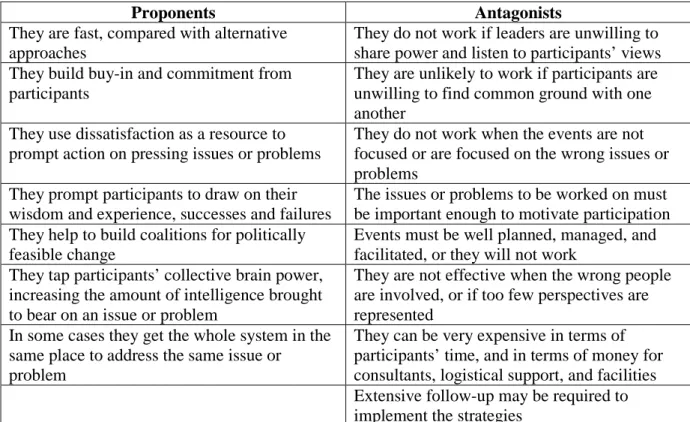
Bryson and Anderson (2000) examined the advantages and disadvantages of large-group methods used to diagnose problems and implement changes in organizations. Table 1 shows what proponents and antagonists say about large-group interaction methods. Proponents give examples of advantages of large-group methods: why they lead to success. Antagonists give examples of situations in which the change process will not be successful. In addition, they provide disadvantages: like the costs and the time needed. When money and time restrictions are given in advance, and these limits are exceeded, change processes can be evaluated as unsuccessful.
TABLE 1: Opinions about large-group methods
Proponents Antagonists
They are fast, compared with alternative approaches
They do not work if leaders are unwilling to share power and listen to participants’ views They build buy-in and commitment from
participants
They are unlikely to work if participants are unwilling to find common ground with one another
They use dissatisfaction as a resource to prompt action on pressing issues or problems
They do not work when the events are not focused or are focused on the wrong issues or problems
They prompt participants to draw on their wisdom and experience, successes and failures
The issues or problems to be worked on must be important enough to motivate participation They help to build coalitions for politically
feasible change
Events must be well planned, managed, and facilitated, or they will not work
They tap participants’ collective brain power, increasing the amount of intelligence brought to bear on an issue or problem
They are not effective when the wrong people are involved, or if too few perspectives are represented
In some cases they get the whole system in the same place to address the same issue or problem
They can be very expensive in terms of participants’ time, and in terms of money for consultants, logistical support, and facilities Extensive follow-up may be required to implement the strategies
Bruhn, Zajac, and Al-Kazemi (2001) advise that participation should be widespread and span all phases of the change process, because respondents of their survey about participation in planned organizational change were not satisfied with the extent of their participation. Respondents believed that employees should be permitted to participate to a greater extent in planned organizational change, especially in implementing change. Respondents were concerned, however, that participation might raise unrealistic employee expectations and that dissension, fragmentation, and cynicism might result from frustrated expectations.
Therefore, opinions about employee involvement are quite mixed: some authors underline the importance of it and state that the advantages will lead to a successful change process; others see more disadvantages and think that employee involvement will not do any good.
Positive communication. According to AI proponents, ‘positive communication’ is a success factor, because an open dialogue makes it possible for people to let others listen to their voice and to say what they want to say without any restrictions; it focuses people’s energies and efforts on what they value; and it brings out the best in people, inspires positive action, and creates possibilities for positive futures.
Next to a poor design, Morgan (2001) states that poor communication is another reason why change efforts fail. A change initiative is like the start of a marathon: change will be occurring rapidly in some units, whereas in others it will not even have gotten under way. Change leaders need to be prepared to provide the same speech at least six times or it will not get heard. Unclear intent can also be a communication problem. Change leaders must explain the specific initiative thoroughly, letting employees hear the arguments for and against the options that were rejected. In addition, they must address employees’ fears: “People want to know why you think they can make it through the change”, Garvin (a Professor of Business Administration at Harvard Business School) observes. “They also want to know how you are going to help them through it”.
The previous part concerns the importance of communication in general, but AI considers positive communication. Psychologists Fredrickson and Branigan (2005) have done research about it and they have shown that, compared to a neutral state, positive emotions broaden the scope of attention and thought-action repertoires. Negative emotions, relative to a neutral state, narrowed thought-action repertoires. Although positive emotions are short-lived, the broaden-and-build theory states that the coordinated changes they produce in people’s thoughts, actions, and physiological responses have long-lasting consequences.
A paper of Di Virgilio and Ludema (2009) offers a model how to generate energy for action by engaging people in conversations. Positive emotions broaden the scope of attention, cognition and action and build physical, intellectual and social resources, which lead to increased energy for action. Energy is expressed in the form of support, time, money and resources, which contribute to the success of the work. Continuous attention to conversations about desired futures creates upward spirals of energy and increases the probability of successful change over time.
“The thing that makes an unmanageable problem is your belief that it is that”, is a statement of Marshall Sashkin, Ph.D. at the George Washington University. He suggests positive thinking as an effective tool in solving seemingly unmanageable problems at work. Managers have to change their attitude towards problems, is his opinion (Allen, 1996).
4.2 Summary
An evident majority of scientific literature supports the factors ‘supportive management’, a ‘guiding core team’, a ‘facilitating consultant’, and ‘positive communication’ as success factors in
all kind of change processes. Concerning the factor ‘employee involvement’ the opinions are mixed: there are as much proponents as antagonists. No success factors are added according to scientific literature.
5. RESULTS
In this chapter the results of the research are discussed. The outcomes of the interviews are presented in three sections: the success of the change process according to the interviewees; the success factors as perceived by the interviewees (including the five success factors: ‘supportive management’, ‘guiding core team’, ‘facilitating consultant’, ‘employee involvement’, and ‘positive communication’); and the ways to strengthen the AI change methodology. The results are visualized in graphs per subject.
5.1 Success of AI change processes
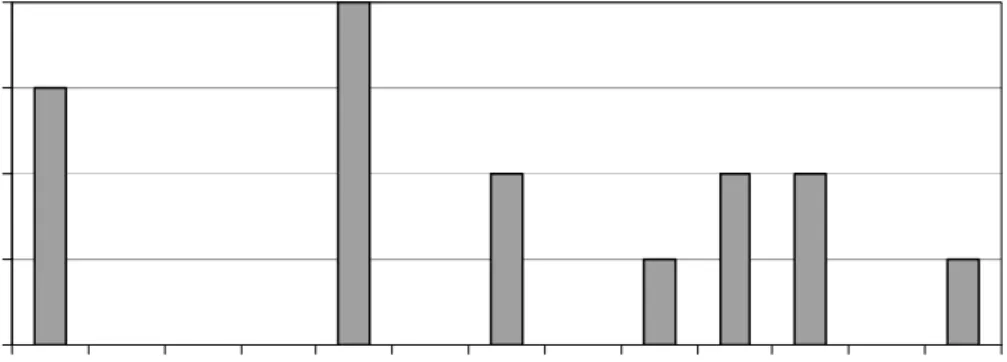
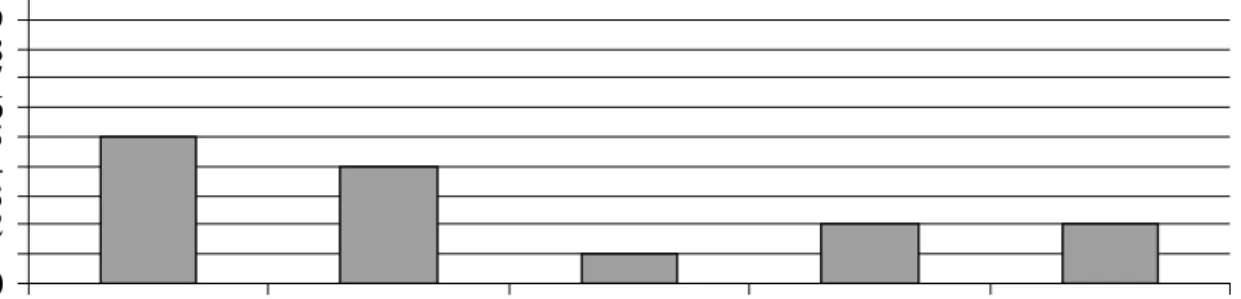
The success of the six different AI change processes can be measured with a grade given by the interviewees. Figure 3 shows the grades given by 15 interviewees. Two interviewees were not asked to give a grade because they did not perceive AI as a change process (Interviewee 2 and 3, Case 2), and one was not asked to give a grade, because she did not work for the company when the change process started (Interviewee 3, Case 4).
The average grade given by the interviewees of case 1 is a 7-. At case 3, interviewees gave an 8. The two people of case 4 graded the change process with a 9-. The interviewees of case 5 gave an average of 6+. Case 6 is graded with a 7,5. Case 2 is not successful as a change process, because except for the initiator, nobody perceived the intervention as a change process. Therefore a grade is not relevant.
Respondents who gave an eight or a higher grade mention that one can see, for example in the enthusiasm of people, that AI works, because it is informal. Appreciative change is a lot easier in comparison to imposed or forced change, which is bound to lead to resistance (Interviewee 2, Case 3). Another reason to be positive can be the impact on the organization. If you are successful
FIGURE 3: Grades (out of 15 interviews)
0 1 2 3 4 6 7 7,5 8 8+ 8,5 9 Grades Number of interviewees
in business, with satisfied customers, and you do everything the first time right, that is unique. Low turnover and low sickness absenteeism are impacts of that (Interviewee 1, Case 4).
People who were less positive about their change process said that a lot of things changed in the organization. For example, some people who were involved, left the organization. Then it is hard to guarantee the continuity of the process (Interviewee 3, Case 1). Someone else said that goals formulated at the start, were not realized (Interviewee 2, Case 5). Or stated a bit more positive: “I think it is good, but it can be better” (Interviewee 1, Case 6).
At case 2, there was no need to change. The AI day was perceived by participants as a familiarization with AI, but not as a change process as such. One needs a sense of a burning issue to create readiness to move and to call it a change process, but there was no perception of a burning issue. Secondly, you have to make some clear agreements concerning what to do with it (Interviewee 2, Case 2). It could have been a success if there had been a shared sense of urgency. Besides, there is a need for a starting point that is known by everyone (Interviewee 3, Case 2).
5.2 Success factors
One of the first questions asked concerned the factors that ensured the success of the change process. The success factors mentioned by the interviewees were mostly related to the process and the AI change methodology. The interaction with each other in small groups (Interviewee 3, Case 1; Interviewee 1; Case 2; Interviewee 1, Case 5), that it took place outside the workplace (Interviewee 1, Case 1; Interviewee 1, Case 5), the evaluation days (Interviewee 1, Case 3; Interviewee 2, Case 3), a shared vision (Interviewee 1, Case 4), a future orientation (Interviewee 1, Case 6), the dialogue (Interviewee 2, Case 6), listening carefully (Interviewee 2, Case 3), and discussing best practices (Interviewee 1, Case 3) are examples.
Four interviewees mentioned success factors related to the factor ‘supportive management’. Interviewees told that supporting facilities (Interviewee 1, Case 1), a clear goal (Interviewee 1, Case 1), support of the Board of Directors (Interviewee 3, Case 3), the facilitation of collective leadership (Interviewee 1, Case 4), and support of the director (Interviewee 1, Case 6) are important. One person talked about the factor of a ‘guiding core team’. Their preparations are a success factor (Interviewee 1, Case 5). One interviewee said something about the factor ‘facilitating consultant’. Hiring an external party turned out to be a success (Interviewee 1, Case 6). Three persons mentioned they appreciated the involvement of the employees (Interviewee 1, Case 1; Interviewee 2, Case 1; Interviewee 1, Case 5) and called this a success factor. Another three interviewees talked about aspects of the factor ‘positive communication’. The positive way of looking (Interviewee 2, Case 1), and the bright and open communication (Interviewee 3, Case 3; Interviewee 2, Case 3) were mentioned as success factors.
Supportive management. The first success factor according to the AI proponents is ‘supportive management’. In figure 4, answers are reflected to the question: how important is the support of the management for the success of the change process?
The question is asked to 14 people. Eight of them think it is extremely important and decisive for the success; five say it is very important and decisive for the success; and one says it is quite important and decisive for the success.
At case 1, 2, and 5, interviewees mention that managers were participants like everyone else. “It was not their party, but a party of all of us. The members of the Board of Directors were just participants. They were all present one full day” (Interviewee 3, Case 5). Like three others, interviewee 1 (Case 1) says management has a facilitating role. It is important to offer facilities to sustain the changes. They gave people time to develop and perform their tasks as a result of the project. At Case 5, the director started every day with the same introduction speech. He opened and closed every day to ensure programme similarity (Interviewee 2, Case 5). Some of the people who say ‘supportive management’ is extremely important and decisive for the success, even say “it is one of the conditions for an AI change process” (Interviewee 2, Case 2); “an AI change process is impossible without managerial support” (Interviewee 1, Case 1); and “without managerial support you should not do it. It is essential, so do not do it when they have doubts” (Interviewee 2, Case 6). The one person who said that the factor ‘supportive management’ is quite important and decisive for the success, explained that the factor ‘supportive management’ is important, but less important than the factor ‘employee involvement’, because ultimately change starts at the employees (Interviewee 1, Case 5).
At case 4, the director of a department uses AI in all his work. He is an inspiring manager and AI suits his personality (Interviewee 2, Case 4). The change process of this department is
FIGURE 4: Supportive management (out of 14 interviews)
0 1 2 3 4 5 6 7 8 9 10 Extremely important and decisive for the
success
Very important and decisive for
the success
Quite important and decisive for
the success
Important but not decisive for the
success
Not important and also not decisive for the
success Number of
characterized by AI. If a director uses AI that much, employees will think and act accordingly. “It is ‘lived’ in the department” (Interviewee 2, Case 4).
Guiding core team. A ‘guiding core team’ is the second success factor according to AI proponents. Figure 5 shows the responses to the question: how important is a core team for the success of the change process?
Responses vary more than they did to the previous question. All answer categories are chosen now. Within three projects the core team was called important because it is responsible for the preparations (Interviewees 2 and 3, Case 1; Interviewees 1, 2, and 3, Case 3; Interviewees 2 and 3, Case 5). To make sure the change processes would be guided well, within two projects some people were trained to be facilitators during the large-scale events (Interviewees 1, 2, and 3, Case 5; Interviewees 1, 2, and 3, Case 6).
For every answer one explanation follows. Five people chose extremely important and decisive for the success. One of them says: “the role of the core team is vital. They (the core team members) are the boosters next to the changing agent and they must ensure that it stays alive, that the flame burns continually” (Interviewee 2, Case 1).
Four people say it is very important and decisive for the success. One of them about the role of the core team: “We used a lot of existing documents and asked the consultants to look at our protocols. Therefore, the auditors recognized those during the training” (Interviewee 3, Case 3).
The one person responding with “quite important and decisive for the success”, said that a core team is not necessary in Case there is more time for the change process. “Because there was such a large group involved: 160 people, it was necessary. Otherwise it would take four days certainly, now it took two days. That was already a problem, because we have been closed for two days” (Interviewee 1, Case 1).
FIGURE 5: Guiding core team (out of 14 interviews)
0 1 2 3 4 5 6 7 8 9 10 Extremely important and decisive for the
success
Very important and decisive for
the success
Quite important and decisive for
the success
Important but not decisive for the
success
Not important and also not decisive for the
success Number of
Important, but not decisive for the success, is an answer given by two respondents. Interviewee 3 (Case 6) said that a core team can be very important, but that the core team did not get a really decisive role, because there was no continuation. If more attention was given to it, it would be more important.
The last category is the least positive. One of the interviewees who called the core team not important and also not decisive for the success, says because people were not selected for the core team, some of them failed. The consultants could manage without them. The core team was not important in this Case (Interviewee 1, Case 6).
Facilitating consultant. The third success factor according to AI proponents is the facilitating role of the consultant. Figure 6 shows how the interviewees think about the role of the consultant.
Five people think that the role of the consultant is extremely important and decisive for the success and eight people say the role of the consultant is very important and decisive for the success. This result has to be interpreted with caution, because they did not respond to the question how important the role of the ‘facilitating consultant’ was, but how important the consultant (the person) was in this Case. This section and the graph are called ‘facilitating consultant’, because that is the success factor according to AI literature.
Seven interviewees indicated that the role of the consultant is that of process leader. How the consultant performed this role differs in the projects. At case 1, 2, and 5 the consultant was not present prominently. The consultant was especially important working in the background. For participants, the consultant was not visible, according to interviewee 3 (Case 1). “The consultant was not particularly busy with the content, but with leading the process” (Interviewee 1, Case 2). And at case 5: “His role was not visible, but in the background it was important. He brought a bit
FIGURE 6: Facilitating consultant (out of 13 interviews)
0 1 2 3 4 5 6 7 8 9 10 Extremely important and decisive for the
success
Very important and decisive for the success
Quite important and decisive for
the success
Important but not decisive for the
success
Not important and also not decisive for the
success Number of