ISSN 1749-8279
Working Paper Series
WEF 0012
Openness, Institutions and Financial Development
Siong Hook Law
Panicos Demetriades
May 2006
Openness, Institutions and Financial Development
Siong Hook Lawa Panicos Demetriades♣
Abstract
Using dynamic panel data techniques and data from 43 developing countries during 1980 – 2001, we provide evidence which suggests that openness and institutions are important determinants of financial development. Openness, in terms of trade and capital flows, is particularly potent in promoting financial development in middle-income countries, but much weaker in low-middle-income countries. Our findings are robust to alternative measures of financial and trade openness, as well as estimation method and sample period.
JEL classification: F19 and G29
Keywords: Capital inflows, trade openness, financial development and dynamic panel data analysis
a Department of Economics, University Putra Malaysia.
♣ Corresponding author: Professor Panicos Demetriades, Department of Economics, University of Leicester,
University Road, Leicester, LE1 7RH, UK. Email: [email protected]. Tel: + 44 116 2522835. We are grateful to conference participants at the Money, Macro and Finance (MMF) Research Group 36th Annual Conference held at CASS Business School, London, 6 – 8 September 2004 for helpful comments. We are also grateful to participants at the Royal Economic Society 2005 Annual Conference, held at University of Nottingham, 21 – 23 March 2005 for valuable suggestions. Demetriades acknowledges financial support from the ESRC under the World Economy and Finance Programme (Award RES-156-25-0009).
1.0 Introduction
Financial markets and institutions perform an important function in the economic development process, particularly through their role in allocating finance to productive activities. This role has been well researched and documented in the empirical literature, using a variety of econometric techniques. By and large, this literature suggests that well-functioning financial institutions and markets promote long-run economic growth (King and Levine, 1993a, b; Levine, 1997; Demirgüç-Kunt and Maksimovic, 1998; Rajan and Zingales, 1998, Levine 2003; Demetriades and Andrianova, 2004; Goodhart, 2004). Nevertheless, an interesting question remains why, if financial development is so good for growth, have so many countries remained financially under-developed? More broadly, why have some economies developed well-functioning financial markets and institutions, while others have not? Recent literature emphasises the influence of political economy factors and institutions as the most likely answers to the above puzzle.
Using a political economy perspective, Rajan and Zingales (2003) suggest that special interest group politics, representing established business, can explain the uneven evolution of capital markets. They propose an “interest group” theory of financial development where incumbents oppose financial development because it produces fewer benefits for them than for potential competitors. The incumbents will shape policies and institutions to their own advantage when they have the power. Incumbents can finance investment opportunities mainly with retained earnings, whereas potential competitors need external capital to start up. When a country is open to trade and capital flows, it is more likely to develop its financial system. This is because openness to both trade and finance breeds competition and threatens the rents of incumbents. Thus, open borders help to check the power political and economic elites and promote competitive markets. The Rajan and Zingales hypothesis has very important policy implications, calling for simultaneous trade and financial liberalisation. Its implications, therefore, run contrary to the sequencing literature, which advocates that trade liberalisation should precede financial liberalisation and that capital account opening should be the last stage in the liberalisation process (e.g. McKinnon, 1991).
The uneven development of institutions such as financial regulation and the varying effectiveness of legal systems across countries could provide an alternative,
possibly complementary, explanation of why financial development has been uneven across countries. Arestis and Demetriades (1997), for example, emphasise the importance of institutions in their discussion of the differences between finance-growth causal patterns across countries. The argument is developed further in Demetriades and Andrianova (2004), who argue that the strength of institutions, such as financial regulation and the rule of law, may determine the success or failure of financial reforms. Acemoglu et al (2001), for example, argue that European colonisers’ willingness to develop long-lasting institutions that can help promote economic growth depended on the disease environment they encountered. Colonisers were much more willing to invest in the development of institutions that could enhance long-run growth in countries or regions where the mortality rate was low; in places with high mortality rates they were much more likely to set up extractive institutions.1 This is known as the settler mortality or initial endowments hypothesis.
Empirical evidence on the influence of either political economy factors or institutions, or indeed both, on financial development remains thin. The sample of countries used by Rajan and Zingales, dictated by limited data availability in the pre-World War II period, means that their conclusions are, at best, tentative. Other authors have examined related questions but have not examined the openness hypothesis directly.2 In terms of the links between financial development and institutions, the main focus in the literature until recently has been around the question of whether legal origin has an influence on capital market development (e.g. La Porta et al, 1997). More, recently Beck et al (2003a) extend the focus of the empirical analysis to the settler mortality hypothesis. Their findings, which are drawn from cross-country regressions for 70 countries, provide support for both the legal origins and the settler mortality hypotheses. However, they also find that the initial endowments hypothesis explains more of the cross-country variation in financial intermediary and stock market development. However, Beck et al (2003a) focus their attention on the historical determinants of financial development and do not examine
1
In a similar vein, La Porta et al. (1997) argue that English common law systems offered better investor protection than French civil-law systems, and were, therefore, more conducive to the development of capital markets.
2
Beck (2003) shows that countries with better-developed financial systems have higher shares of manufactured exports in GDP and in total merchandise exports. Svaleryd and Vlachos (2002) find that there is a positive interdependence between financial development and liberal trade policies. Levine (2001), for example, finds that liberalising restrictions on international portfolio flows tends to enhance stock market liquidity, and allowing greater foreign bank presence tends to enhance the efficiency of the domestic banking system. Chinn and Ito (2002) show that there is a strong relationship between capital controls and financial development. Their finding holds for less developed countries in terms of stock market value traded, and even more so for emerging market economies. Klein and Olivei (1999) point out that capital account liberalisation has a substantial impact on growth via the deepening of a country’s financial system in highly industrialised countries, but there is little evidence of financial liberalisation promoting financial development outside members of the OECD.
any of the intermediate linkages. It could be, for example, that the correlation between initial endowments and subsequent financial development reflects factors other than the development of institutions that are conducive to financial development.
This paper provides new evidence that examines the influence of both openness and institutions, as channels of financial development. Specifically, it tests the [Rajan and Zingales, 2003] hypothesis that simultaneous openness to both trade and capital flows has a positive influence on financial development, in tandem with the [institutions] hypothesis that the quality of a country’s institutions has a separate influence on financial development. The paper represents an advance over previous empirical work in the area in several important respects. First, it provides a direct test of both the openness and the institutions hypotheses using appropriately specified financial development equations. Second, it uses a data set that is sufficiently large to enable robust, reasonably generalised, conclusions to be drawn; specifically, the sample consists of annual data from 43 developing countries, covering the period 1980 – 2001. Third, the time dimension of the data set allows examine whether the estimation results are sensitive to the period under consideration, since the 1990s were characterised by increasing degrees of liberalisation of domestic financial markets compared to the 1980s3. Fourth, the paper utilises a variety of financial development and capital inflows measures, which purport to capture various aspects of financial deepening and capital mobility. Finally, it employs two dynamic panel data techniques, namely the GMM estimator (Arellano and Bond, 1991) and the pooled mean group (PMG) estimator (Pesaran et al 1999) - both of which have a number of econometric advantages compared to traditional panel data estimation.
The paper is organised as follows. Section 2 explains the empirical model and econometric methodology. Section 3 explains the data employed in the analysis and Section 4 reports and discusses the econometric results. Finally, Section 5 summarises and concludes.
2.0 The Empirical Model and Methodology
3
Total private capital flows to developing countries increased more than sixfold to reach US$200 billion per year during 1995-97 from around US$30 billion per year during 1984-86 (World Bank, 1997).
We specify the following log-linear equation for financial development:4
ln FDit = β0i + β1i ln RGDPCit + β2i ln INSit + β3i ln CIFit + β4i ln TOit + εit
(1)
where FD is an indicator of financial development, RGDPC is real GDP per capita, INS is institutions, CIF is capital inflows and TO is trade openness. In order to examine directly the hypothesis proposed by Rajan and Zingales (2003), an interaction term between the last two variables is also included in the model as follows:
ln FDit = β0i + β1i ln RGDPCit + β2i ln INSit + β3i ln CIFit + β4i ln TOit + β5i ln (CIF x TO)it
+ εit (2)
Equations (1) and (2) provide the basis for the empirical models that are estimated in this paper. If β5 is found to be positive and statistically significant, then this would
imply that the combination of financial and trade openness exerts an independent influence on financial development, over and above any influence each of these two variables may separately have on financial development. Thus, β5 > 0 provides
support to the Rajan and Zingales (2003) hypothesis.
While cross-sectional estimation methods may, in principle, capture the long-run relationship between the variables concerned, they do not take advantage of the time-series variation in the data, which could increase the efficiency of estimation. In addition, Rajan and Zingales (2003) point out that their theory can go some way in accounting for both the cross-country differences in, and the time series variation of, financial development. It is, therefore, preferable to estimate Equations (2) and (3) using panel data techniques. Two dynamic panel data methods are employed to estimate the two equations, namely (i) the first differenced generalised method of moments (GMM), and (ii) the pooled mean group (PMG) estimations.
Dynamic Panel Data Analysis
4
In preliminary regressions we also included the real interest rate, which had the expected positive sign but was statistically insignificant. This finding is in line with previous empirical findings in the area (e.g. Demetriades and Luintel, 1997 or Arestis and Demetriades, 1997).
Panel GMM Estimation – Whole Sample (N > T)
Equations (1) and (2) are estimated on the entire sample using the GMM estimator proposed by Arellano and Bond (1991). We use 4-year averages of the variables to impact of cyclical factors. Thus we obtain the following 4-year periods: 1981-1984, 1985-1988, 1989-1992, 1993-1996, and 1997-2001. The GMM estimator is a dynamic one that estimates the model in first differences and uses lagged values of the variables as instruments. The starting point is a standard specification in levels, where the financial development (FD) is persistent, i.e. it is a function of its own past values. The model includes a set of independent variables Xit, which are
assumed to be weakly exogenous, and a country fixed effect µI
FDit = τ FDi,t-1 + γXit + εit + µI (3)
After taking first differences, the previous equation yields:
∆FDit = τ∆FDi,t-1 + γ∆Xit + ∆εit
(4)
One result of the transformation is that all variables that are time-invariant, such as the country fixed effects, drop out from the model. A potential problem with the model of Equation (3) is the potential endogeneity of the control variables5 as well as the correlation between the lagged dependent variable FDi,t-1 and the error term εit. This
problem can be solved by using higher-order lags of FDi,t-1 as instruments for FDi,t-1.
For the GMM estimator to yield unbiased and consistent estimates, the validity of the moment conditions is required, as follows:
E [∆εit FDt-k} = E [∆εit Xt-k] = 0 ∀k > 1
(5)
To keep a sensible relationship between the number of cross-sectional observations and the number of overidentifying restrictions, only one lag of the dependent variable is employed as instrument. This implies that E [∆εit FDt-2] = 0 for each of the four time
series observations, so that there are three overidentifying restrictions (4 identifying
5
Recent literature has discussed the possibility of bi-directional causal effect between financial development and economic growth (Demetriades and Hussein, 1996; Luintel and Khan, 1999).
restrictions, and one to identify τ). The validity of these restrictions can then be tested via a Sargan test, using a χ2 distribution with three degrees of freedom.
Pooled Mean Group Estimation – Sub-Sample Countries (T > N)
Since the capital market development indicators and other trade openness proxy variable namely import duties are only available for 16 - 20 countries or N is smaller than T, thus, the parameter estimate of Equations (1) and (2) are obtained by employing the pooled mean group (PMG) estimation proposed by Pesaran et al. (1999). This method is well suited to the analysis of dynamic panels that have both large time and cross-section data fields. In addition, this type of estimation has the advantage of being able to accommodate both the long run equilibrium and the possibly heterogeneous dynamic adjustment process.
Following Pesaran et al. (1999), the unrestricted specification for the autoregressive distributed lag (ARDL) model for the dependent variable y is
(7) i = 1,2, … N; t = 1,2, … T. ∑ ∆ + ∑ ∆ + + + + = ∆ − = − = − − − − 1 1 1 0 , ' , 1 , ' 1 , p j q j ij it j i it j t i ij t i i t i i it y x y x u y φ β λ γ µ
where is a scalar dependent variable, is the k x 1 vector of regressors for group
i,
it
y xit
i
µ
represent the fixed effects, φiis a scalar coefficient on the lagged dependent variable, '’s is the k x 1 vector of coefficients on explanatory variables,i
β λij’s are
scalar coefficients on lagged first-differences of dependent variables, and γij’s are k x 1 coefficient vectors on first-difference of explanatory variables and their lagged values. We assume that the disturbances ’s are independently distributed across i
and t, with zero means and variances > 0. Further assuming that
it
u 2
i
σ φi< 0 for all i
and therefore there exists a long-run relationship between yitand xit:
it it i it x y =θ' +η i = 1,2, … N; t = 1,2, … T. (8)
where θi βi /φiis the k x 1 vector of the long-run coefficients, and
' ' = −
it
η ’s are stationary with possibly non-zero means (including fixed effects). Since Equation (7) can be rewritten as (9) ∑ ∆ + ∑ ∆ + + + = − = − = − − − 1 1 1 0 , ' , 1 , p j q j ij it j i it j t i ij t i iη λ y γ x µ u φ 1 ,t− i ∆yit
where η is the error correction term given by (8), hence φiis the error correction
coefficient measuring the speed of adjustment towards the long-run equilibrium.
The Pooled Mean Group (PMG) estimator proposed by Pesaran et al. (1999) restricts the long-run coefficients to be equal over the cross-section, but allows for the short-run coefficients and error variances to differ across groups on the cross-section; that is, θ =i θ for all i. The hypothesis of homogeneity of the long-run policy
parameters cannot be assumed a priori and is tested empirically in all specifications by a Hausman-type test (Hausman, 1978). The group-specific short-run coefficients and the common long-run coefficients are computed by pooled maximum likelihood estimation. These estimators are denoted by
N i i PMG ∑ = =1 ˆ φ φ N ~ , N N i i PMG ∑ = =1~ ˆ β β , N N ij ∑ 1 ~ λ i PMG j = = ˆ λ , j = 1, …, p –1, (10) N N i ij PMG j ∑ = =1 ~ ˆ δ δ θˆ =θ~ PMG , j = 0, …, q – 1, 3.0 The Data
The data set consists of a panel of observations for a group of developing countries for the period 1980 – 2001. Two groups of financial development indicators are employed in the analysis, namely banking sector development and capital market development. The three conventional variables to measure the banking sector development are liquid liabilities, private sector credit and domestic credit provided by banking sector, whereas the three variables to represent capital market development are stock market capitalisation, total share value traded and number of
companies listed6. All these financial development variables are expressed as ratios to GDP except for the number of companies listed, which is divided by total population. The main sources of these annual data are the World Development Indicators (World Bank CD-ROM 2003) and Beck et al. (2003b).
Annual data on real GDP per capita is obtained from the World Development Indicators (World Bank CD-ROM 2003). The real GDP per capita is converted to US dollars based on 1995 constant prices.
The institutions data set employed in this study was assembled by the IRIS Center of the University Maryland from the International Country Risk Guide (ICRG) – a monthly publication of Political Risk Services (PRS).7 Following Knack and Keefer (1995), five PRS indicators are used to measure the overall institutional environment, namely: (i) Corruption (ii) Rule of Law (iii) Bureaucratic Quality (iv) Government Repudiation of Contracts and (v) Risk of Expropriation. The above first three variables are scaled from 0 to 6, whereas the last two variables are scaled from 0 to 10. Higher values imply better institutional quality and vice versa. The institutions indicator is obtained by summing the above five indicators8.
Two capital inflows proxies are employed to assess whether capital inflows have any impact on financial development, namely private capital inflows and capital account liberalisation indicator constructed by Chinn and Ito (2002)9. The first indicator is obtained from the World Development Indicators.
The following two trade openness proxies are employed in the analysis: total trade as a ratio of GDP and import duties as a ratio of total imports (ID); both are available from World Development Indicators10. Rajan and Zingales (2003) suggest that openness fosters financial development. Therefore, higher import duties would discourage financial development or there is a negative relationship between both variables. As such, the import duties indicator was first converted to (1 – ID/100) in
6
The sample period of the number of companies listed is only covering from 1988 – 2000.
7
We also experienced with (English) legal origin as an alternative or additional institutional quality variable but this was found to be insignificant in all regressions; these results are, therefore, not reported in the paper.
8
The scale of corruption, bureaucratic quality and rule of law was first converted to 0 to 10 (multiplying them by 5/3) to make them comparable to the other indicators. For robustness checks, we also used different weights for each indicator to construct the aggregate index. The estimates are similar and are available on request.
9
The index on capital account openness from Chinn and Ito (2002) is based on the four binary dummy variables reported in the IMF’s Annual Report on Exchange Arrangements and Exchange Restrictions (AREAER). These variables are to provide information on the extent and nature of the restrictions on external accounts for a wide cross-section of countries.
10
order to have consistent positive relationship with trade openness. In other words, the inverse import duties indicator measures trade openness or low trade barriers, thus the interaction term between capital inflows and trade openness can be quantified since this term has positive impact on financial development as highlighted in the theory.
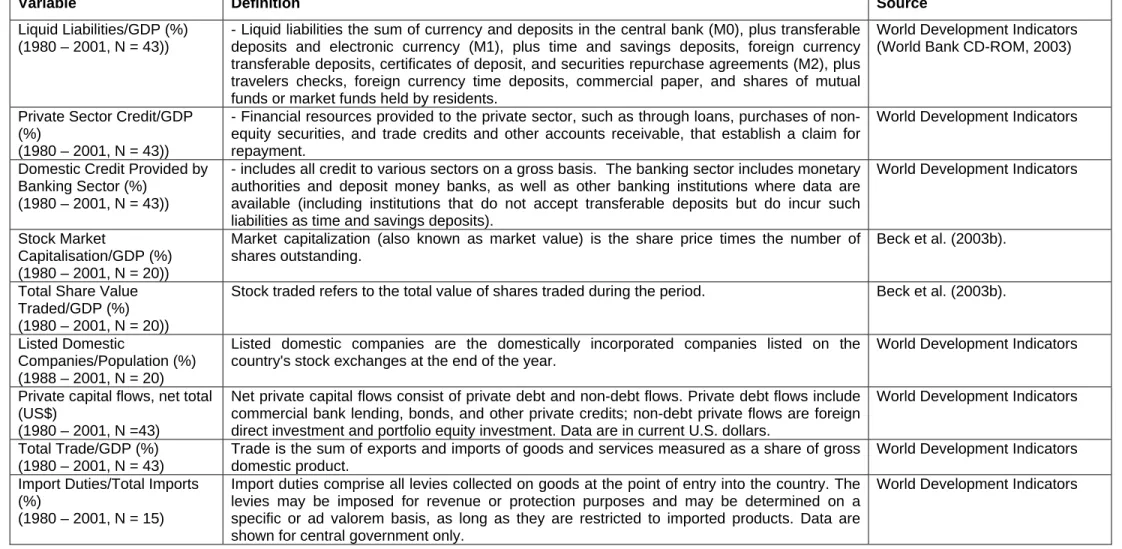
The definitions of the financial development, capital inflows and trade openness indicators above data are presented in Table AI (see Appendix I).
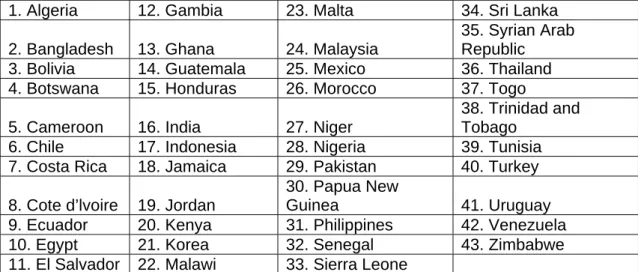
Table 1 reports the summary statistics results of banking sector development indicators (N = 43), capital market development indicators (N = 20) and other variables that employed in the analysis, where the sample period is covering from 1980 – 2001. The list of these countries is presented in Table AII and Table AIII (See Appendix II). There is considerable variation among these variables especially the financial development indicators, real GDP per capita and institutions. Malaysia, one of the developing countries in this group, has the highest private sector credit, domestic credit, market capitalisation, total share value traded, number of companies listed, trade openness and institutions, whereas it ranks second highest in terms of liquid liabilities (after Jordan) and capital inflows (after Chile). These observations indicate that capital inflows and trade openness may be positively correlated with financial development. Table 2 reports the correlation results and this table reveals that capital inflows and trade openness are indeed positively correlated with the financial development indicators. For example, the private capital inflows and trade openness have the highest correlation with stock market capitalisation, with 0.76 and 0.74, respectively.
4.0 Estimation Results
Panel GMM Results
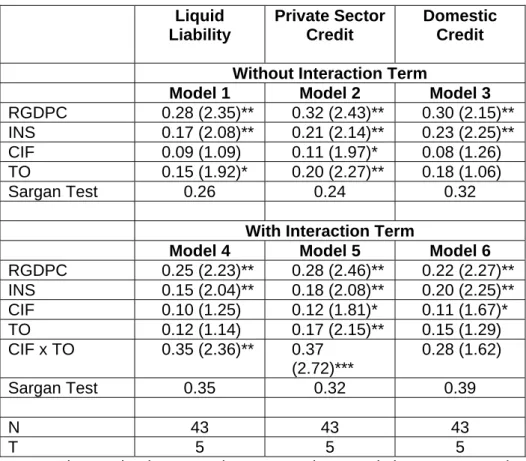
We first estimate equations (1) and (2) for the 43 developing countries using the panel GMM estimator. Two capital inflows proxies are employed namely private capital inflows and capital account liberalisation index. The results are reported in Table 3 and Table 4, respectively. Models 1 – 3 are estimates of Equation (1), utilising alternative proxies for financial development, where Models 4 – 6 are estimates of Equation (2), which includes the interaction term between capital inflows and trade openness.
To start with, it is important to note that the sign of the estimated coefficients on real GDP per capita is consistent with theory. As shown in Table 3 and Table 4, real GDP per capita has a positive relationship with financial development, in all models. The Sargan test does not detect any problem with instrument validity, and the instrumental variables therefore seem to be valid and highly informative.
Examining first Models 1 – 3 in Table 3, where private capital inflows is the proxy for capital account openness and the interaction term is absent, the results reveal that real GDP per capita is a statistically significant determinant of financial development throughout. This result seems to demonstrate that economic performance matters for financial development. Interestingly, the institutions variable is also a statistically significant determinant of financial development in all models. The impact of capital inflows is not significant at conventional levels, whereas trade openness is significant at 5 percent level in Model 2, where the financial development indicator is private sector credit.
In Models 4 – 6 which include the interaction term, real GDP per capita continues to enter as a positive and significant determinant of financial development. The institutions variable remains significant throughout, whereas the capital inflows variable is statistically significant at 10 percent in Models 5 and 6. Trade openness remains significant when the financial development indicator is private sector credit. Interestingly, the coefficient on the interaction term is positive and statistically significant in Models 4 and 5. These findings provide support to both the openness and institutions hypotheses.
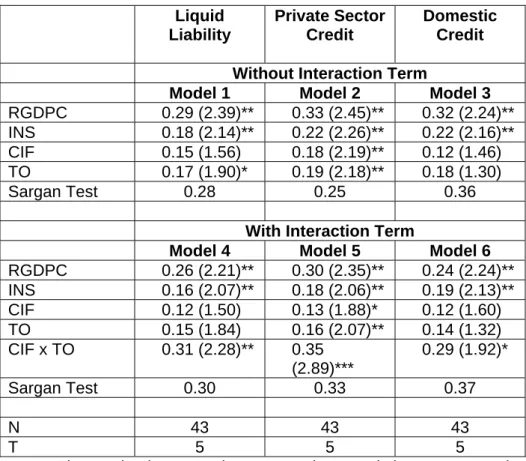
Table 4 repeats the analysis using, however, the capital account liberalisation indicator constructed by Chinn and Ito (2002) as a proxy for capital inflows. The results are broadly similar to those reported in Table 3. The only notable difference is that the interaction term appears significant in all the specifications; the exception is Model 6, where it is only significant at the 10% level.
Pooled Mean Group Estimations Results
Table 5 reports estimates of Equations (1) and (2) that utilize the pooled mean group estimator with three capital market development indicators, namely stock market capitalization, total share value traded and number of companies listed. This table presents estimates of the long-run coefficients, the adjustment coefficients
and Hausman test statistics. The lag order is first chosen in each country on the unrestricted model by the Akaike information criterion (AIC), subject to a maximum lag of 1. Then, using these AIC-determined lag orders, homogeneity is imposed. The results indicate that the joint Hausman test statistic fails to reject the null hypothesis and this reveals that the data do not reject the restriction of common long-run coefficients. In addition, the Hausman test also indicates that the pooling restrictions cannot be rejected for the independent variables. These indicators are only available for 20 developing countries11 and the sample period spans the period 1980 – 2001, except for the number of companies listed, for which data is only available for the period 1988 – 2001.
The coefficients of real GDP per capita are positive and statistically significant throughout. The institutional quality variable is statistically significant in determining market capitalization and total share value traded, but is significant only at the 10% in the regression that explains total number of companies listed. The capital inflows variable is a statistically significant determinant of stock market capitalization and total share value traded. In contrast, trade openness has a significant influence on market capitalization and number of companies listed. In Models 4 – 6, the interaction term is statistically significant at the 1% level in two out of three models and significant at the 5% level in the third. Interestingly, trade openness and capital inflows each have an independent statistically significant influence in two out of three specifications. These findings suggest that the openness hypothesis applies not only to the development of the banking system, but also to the development of the capital market.
The estimated pooled mean group results when import duties indicator12 is employed as an alternative proxy for trade openness are reported in Table 6. This indicator is found to be statistically insignificant while real GDP per capita, institutions and capital inflows are statistically significant in all models. However, models containing the interaction term demonstrate that the interaction between capital inflows and import duties has a positive and highly significant influence on financial development. Table 7 reports the analysis of Table 6 with capital market development indicators as the dependent variable. The import duties and institutions variables are statistically significant for three models, whereas real GDP per capita
11
The cross-country analysis is not conducted for these capital market development indicators - stock market capitalisation, total share value traded and number of companies listed due to small sample size (N = 22).
12
and capital inflows are significant in two out of three models. Again, the estimated coefficients of the interaction term are both large and significant in Models 4 and 6. Thus, our main findings are robust to changes in the measurement of both capital and trade account openness.
Table 8 reports the empirical results when the sample developing countries are further divided into three groups, namely upper income, lower middle-income and low-middle-income. The signs of the estimated coefficients on real GDP per capita, institutions, capital inflows and trade openness are consistent with theory. The real GDP per capita and institutions retain their positive sign, and both are statistically significant determinants of private sector credit in all income groups. The capital inflows and trade openness are also statistically significant in the middle-income countries. The interaction term indicates economically large and statistically significant effect on private sector credit in the upper middle-income countries, followed by lower middle-income and low-income countries.
Table 9 repeats the analysis of Table 8 with the alternative proxy for financial development, namely stock market capitalisation. Again, real GDP per capita remains statistically significant in all three groups, while institutional quality is significant at 5 percent level in two middle-income groups. Interestingly, the capital flows and trade openness are positive and significant determinants of stock market capitalisation in two middle-income groups. In addition, the interaction term is highly significant in two middle-income groups, whereas it is significant at the 5% level in low-income countries. Overall, these findings provide further support to both the openness and institutions hypotheses. They also suggest, however, that openness to trade and capital flows are most potent in promoting financial development in middle-income countries, whereas its influence is relatively weaker in low-income countries.
5.0 Conclusions
The evidence presented utilising panel data analysis in a group of developing countries, provides varying degrees of support to the [Rajan and Zingales, 2003] hypothesis that simultaneous opening of both the capital and trade accounts will promote financial development. The evidence is robust to alternative measures of both trade account and capital account openness. The evidence remains valid for a variety of financial development indicators, including 3 indicators of banking system
development and 3 indicators of capital market development. The findings also suggests that trade openness affects developing countries’ financial development differentially. In middle-income countries, trade promotes financial development; and the effect is smaller in low-income economies. On the other hand, capital inflows have a positive effect in determining financial development, especially capital market development in middle-income countries. Our findings also suggest that institutional quality is a robust and statistically significant determinant of financial development, providing support to the case made by Arestis and Demetriades (1997, 1999).
In terms of policy implications, our findings suggest that simultaneously stimulating foreign capital inflows and trade openness, improving institutions and promoting economic development will encourage the development of both capital markets and financial intermediaries.
References:
Acemoglu, D., Johnson, S. and Robinson, J.A. (2001) The Colonial Origins of Comparative Development: An Empirical Investigation. American Economic Review, 91, 1369 – 1401.
Arestis, P. and P. Demetriades. (1997) Financial Development and Economic Growth: Assessing the Evidence. Economic Journal, 107, 783—799.
Beck, T. (2003) Financial Development and International Trade. Is there a Link? The Work Bank Group Working Paper, No. 2608.
Beck, T., Demirgüç-Kunt, A. and Levine, R. (1999) A New Database on Financial Development and Structure. The World Bank Group Working Paper. No.2784.
Beck, T., Demirgüç-Kunt, A. and Levine, R. (2001) Law, Politics and Finance. The Work Bank Group Working Paper, No. 2585.
Beck, T., Demirgüç-Kunt, A. and Levine, R. (2003a) Law, Endowment and Finance, Journal of Financial Economics, 70, 137 – 181.
Beck, T., Demirgüç-Kunt, A. and Levine, R. (2003b) A New Database on Financial Development and Structure, The World Bank Group Working Paper, No. 2784.
Chinn, M. and Ito, H. (2002) Capital Account Liberalisation, Institutions and Financial Development: Cross Country Evidence. NBER Working Paper 8967.
Demetriades, P.O. and Hussein, K. (1996) Does Financial Development Cause Economic Growth? Time Series Evidence from 16 Countries. Journal of Development Economics, 51, 387-411.
Demetriades, P.O. and Luintel, K.B. (1997) The Direct Costs of Financial Repression: Evidence from India. The Review of Economics and Statistics, 79, 311 – 320.
Demetriades, P. and Andrianova, S. (2004) ‘Finance and Growth: What We Know and What We Need to Know’ in C. Goodhart, (ed), Money, Finance and Growth, Routledge, forthcoming
Demirgüç-Kunt, A. and Maksimovic, V. (1998) Law, Finance and Firm Growth, Journal of Finance, 53, 2107 – 2137.
Demirgüç-Kunt A and Detragiache, E.(1998) The Determinants of Banking Crises in Developed and Developing Countries, IMF Working Paper No.106
Fry, M.J. (1997) In Defence of Financial Liberalisation. Economic Journal, 107, 754 – 770.
Goodhart, C. (2004) Money, Finance and Growth, Routledge, forthcoming (2004)
Hausman, J. (1978) Specification Tests in Econometrics, Econometrica, 46, 1251 – 1271.
King, R.G. and Levine, R. (1993a) Finance and Growth: Schumpeter Might be Right. Quarterly Journal of Economics, 108, 717-737.
King, R.G., Levine, R., (1993b). Finance, entrepreneurship and growth. Journal of Monetary Economics, 32, 1–30.
Klein, M and Olivei, G. (1999) ‘Capital Account Liberalisation, Financial Depth and Economic Growth’. Federal Reserve Bank of Boston Working Paper, 99-6.
Knack, Stephen and Keefer, Philip (1995) Institutions and Economic Performance: Cross-country Tests Using Alternative Institutional Measures, Economics and Politics, 207 – 227.
La Porta, R., Lopez-de-Silane, F., Shleifer, A and Vishny, R. W. (1997) Legal Determinants of External Finance. Journal of Finance, 52, 1131 – 1150.
Levine, R. (1997) Financial Development and Economic Growth: Views and Agenda. Journal of Economic Literature, 35, 688-726.
Levine, R. (2001) International Financial Liberalisation and Economic Growth. Review of International Economics, 9, 688 – 702.
Levine, R. (2003) More on Finance and Growth: More Finance, More Growth? Federal Reserve Bank of St. Louis Review, 85 (4), 31–46.
Luintel, K.B. and Khan, M. (1999) A Quantitative Reassessment of the Finance-Growth Nexus: Evidence from a Multivariate VAR. Journal of Development Economics, 60, 381-405.
McKinnon, R.I. (1973) Money and Capital in Economic Development. Brookings Institution, Washington, DC.
McKinnon, R.I. (1991) The Order of Economic Liberalization: Financial Control in the Transition to a Market Economy. Johns Hopkins University Press.
Pesaran, M.H. and Smith, R.P. (1995) Estimating Long-run Relationship from Dynamic Heterogeneous Panels. Journal of Econometrics, 68, 79 – 113.
Pesaran, M.H., Shin, Y. and Smith, R.P. (1999) Pooled Mean Group Estimation of Dynamic Heterogeneous Panels. Journal of American Statistical Association, 94, 621 – 634.
Rajan, R.G. and Zingales, L. (1998) Financial Dependence and Growth. American Economic Review, 88, 559-586.
Rajan, R. G. and Zingales, L. (2003) The Great Reversals: The Politics of Financial Development in the Twentieth Century. Journal of Financial Economics, 69, 5 – 50.
Saleryd, H. and Vlachos, J. (2002) Markets for Risk and Openness to Trade: How are they Related. Journal of International Economics, 57, 369 – 395.
Shaw, E.S. (1973) Financial Deepening in Economic Development. Oxford Univ. Press, New York.
World Bank (1997) Private Capital Flows to Developing Countries. The Road to Financial Integration. Washington D.C: The World Bank and Oxford University Press.
Table 1: Descriptive Statistics
i. Financial Development: Banking Sector Development Indicators
N = 43 LL PRI DOC RGDP C INS CIF TO Mean 40.62 31.25 45.44 1812.9 4 27.18 2.47 62.61 Std Dev 20.17 19.55 25.18 1810.5 9 4.79 1.77 26.52 Maximu m 102.06 91.80 109.33 7723.2 5 36.06 7.70 144.56 Minimu m 14.88 3.83 -32.27 153.27 18.53 0.18 16.89
ii. Financial Development: Capital Market Development Indicators
N = 20 MC VT NC RGDP C INS CIF TL Mean 21.95 9.08 0.0009 3 2215.5 9 28.75 2.79 66.21 Std Dev 26.39 14.42 0.0008 7 1940.3 9 4.26 1.81 29.43 Maximu m 121.87 54.80 0.0029 6 8082.4 4 36.95 7.53 149.14 Minimu m 0.79 0.04 0.0001 0 250.94 20.43 0.58 19.57 Note: LL = Liquid Liabilities/GDP; PRI = Private Sector Credit/GDP; DOC = Domestic Credit/GDP; RGDPC = Real GDP Per Capita; INS = Institutions; CIF = Private Capital Flows; TO = Trade Openness; MC = Stock Market Capitalisation/GDP; VT = Total Share Value Traded/GDP; NC = Number of Companies Listed/Population
Table 2: Correlation Results
i. Financial Development: Banking Sector Development Indicators
N = 43 LL PRI DOC RGDP C INS CIF TO LL 1.00 PRI 0.70 1.00 DOC 0.89 0.74 1.00 RGDP C 0.37 0.55 0.46 1.00 INS 0.26 0.37 0.35 0.46 1.00 CIF 0.23 0.42 0.29 0.51 0.28 1.00 TO 0.36 0.23 0.13 0.10 0.04 0.07 1.00
ii. Financial Development: Capital Market Development Indicators
N = 20 MC VT NC RGDP C INS CIF TO MC 1.00 VT 0.72 1.00 NC 0.46 0.10 1.00 RGDP C 0.21 0.49 0.42 1.00 INS 0.53 0.64 0.53 0.63 1.00 CIF 0.76 0.40 0.47 0.30 0.51 1.00 TO 0.74 0.43 0.60 0.10 0.27 0.54 1.00 Note: LL = Liquid Liabilities/GDP; PRI = Private Sector Credit/GDP; DOC =
Domestic Credit/GDP; RGDPC = Real GDP Per Capita; INS = Institutions; CIF = Private Capital Flows; TO = Trade Openness; MC = Stock Market Capitalisation/GDP; VT = Total Share Value Traded/GDP; NC = Number of Companies Listed/Population
Table 3: Results of Dynamic Panel Data GMM Estimations (Dependent Variable: Financial Development)
Trade Openness (TO): Total Trade/GDP Capital Inflows (CIF): Private Capital Flows Liquid Liability Private Sector Credit Domestic Credit Without Interaction Term
Model 1 Model 2 Model 3
RGDPC 0.28 (2.35)** 0.32 (2.43)** 0.30 (2.15)** INS 0.17 (2.08)** 0.21 (2.14)** 0.23 (2.25)** CIF 0.09 (1.09) 0.11 (1.97)* 0.08 (1.26) TO 0.15 (1.92)* 0.20 (2.27)** 0.18 (1.06)
Sargan Test 0.26 0.24 0.32
With Interaction Term
Model 4 Model 5 Model 6
RGDPC 0.25 (2.23)** 0.28 (2.46)** 0.22 (2.27)** INS 0.15 (2.04)** 0.18 (2.08)** 0.20 (2.25)** CIF 0.10 (1.25) 0.12 (1.81)* 0.11 (1.67)* TO 0.12 (1.14) 0.17 (2.15)** 0.15 (1.29) CIF x TO 0.35 (2.36)** 0.37 (2.72)*** 0.28 (1.62) Sargan Test 0.35 0.32 0.39 N 43 43 43 T 5 5 5
Notes: Figures in the parentheses are the t-statistics. ***, ** and * denote significant at 1%, 5% and 10%, respectively. The figures reported for the Sargan test are the p-values for the null hypothesis, valid specification.
Table 4: Results of Dynamic Panel Data GMM Estimations (Dependent Variable: Financial Development)
Trade Openness (TO): Total Trade/GDP
Capital Inflows (CIF): Capital Account Liberalisation Index (Chinn and Ito, 2002) Liquid Liability Private Sector Credit Domestic Credit Without Interaction Term
Model 1 Model 2 Model 3
RGDPC 0.29 (2.39)** 0.33 (2.45)** 0.32 (2.24)** INS 0.18 (2.14)** 0.22 (2.26)** 0.22 (2.16)** CIF 0.15 (1.56) 0.18 (2.19)** 0.12 (1.46) TO 0.17 (1.90)* 0.19 (2.18)** 0.18 (1.30)
Sargan Test 0.28 0.25 0.36
With Interaction Term
Model 4 Model 5 Model 6
RGDPC 0.26 (2.21)** 0.30 (2.35)** 0.24 (2.24)** INS 0.16 (2.07)** 0.18 (2.06)** 0.19 (2.13)** CIF 0.12 (1.50) 0.13 (1.88)* 0.12 (1.60) TO 0.15 (1.84) 0.16 (2.07)** 0.14 (1.32) CIF x TO 0.31 (2.28)** 0.35 (2.89)*** 0.29 (1.92)* Sargan Test 0.30 0.33 0.37 N 43 43 43 T 5 5 5
Notes: Figures in the parentheses are the t-statistics. ***, ** and * denote significant at 1%, 5% and 10%, respectively. The figures reported for the Sargan test are the p-values for the null hypothesis, valid specification.
Table 5: Pooled Mean Group Estimation for ARDL
Dependent Variable: Financial Development (Capital Market Development) Trade Openness (TO): Total Trade/GDP
Capital Inflows (CIF): Private Capital Flows
Market Capitalisatio n Total Share Value Traded Number of Compani es Listed Without Interaction Term Model 1 Hausma n Test Model 2 Hausm an Test Model 3 Hausm an Test RGDPC 0.31 (3.35)*** 0.88 (0.35) 0.15 (2.54)** 2.03 (0.15) 0.59 (9.17)*** 0.19 (0.66) INS 0.14 (1.97)** 0.12 (0.73) 0.08 (3.99)*** 0.42 (0.52) 0.08 (1.76)* 0.88 (0.35) CIF 0.40 (2.11)** 0.43 (0.51) 0.33 (4.71)*** 2.23 (0.13) 0.25 (1.07) 1.83 (0.18) TO 0.27 (2.76)*** 0.08 (0.77) 0.05 (1.34) 0.42 (0.52) 0.18 (3.32)*** 3.62 (0.06) Adjustment -0.16 (-5.67)*** -0.03 (-2.19)*** -0.29 (-4.32)*** Joint Hausman Test for long-run homogeneity 9.66 (0.09) 6.98 (0.32) 10.42 (0.06) With Interaction Term Model 4 Hausma n Test Model 5 Hausm an Test Model 6 Hausm an Test RGDPC 0.26 (2.38)** 0.04 (0.84) 0.24 (2.17)** 0.07 (0.79) 0.32 (2.63)*** 0.64 (0.42) INS 0.16 (2.18)** 0.56 (0.45) 0.12 (2.29)** 2.05 (0.15) 0.08 (0.59) 1.06 (0.30) CIF 0.25 (2.32)** 0.59 (0.44) 0.28 (4.47)*** 1.37 (0.24) 0.32 (1.83)* 1.00 (0.32) TO 0.17 (2.38)** 2.06 (0.15) 0.16 (1.71)* 2.05 (0.15) 0.28 (4.16)*** 1.04 (0.31) CIF x TO 0.41 (3.33)*** 0.59 (0.44) 0.44 (3.04)*** 1.47 (0.23) 0.49 (2.62)** 1.00 (0.32) Adjustment -0.33 (-2.77)*** -0.25 (-2.66)*** -0.27 (-4.23)*** Joint Hausman Test for long-run homogeneity 6.90 (0.44) 12.86 (0.05) 5.58 (0.47) N 20 20 20 T 22 22 14
Notes: Figures in parentheses are t-statistic except for Hausman test (H), which is p-value. ***, ** and * indicate significance at the 1%, 5% and 10% levels, respectively.
Table 6: Pooled Mean Group Estimation for ARDL
Dependent Variable: Financial Development (Banking Sector Development) Trade Openness (TO): Import Duties/Total Imports (ID)
Capital Inflows (CIF): Private Capital Flows
Liquid Liabilities Private Sector Credit Domesti c Credit Without Interaction Term Model 1 Hausma n Test Model 2 Hausma n Test Model 3 Hausma n Test RGDPC 0.46 (3.53)*** 0.05 (0.82) 0.27 (2.35)** 2.44 (0.12) 0.21 (2.19)** 1.14 (0.29) INS 0.28 (1.77)* 0.11 (0.74) 0.20 (2.28)** 0.66 (0.42) 0.22 (2.33)** 0.09 (0.77) CIF 0.22 (3.28)*** 0.48 (0.49) 0.24 (2.91)*** 0.08 (0.77) 0.20 (2.07)** 1.62 (0.20) ID 0.13 (0.70) 0.40 (0.53) 0.12 (0.91) 0.47 (0.49) 0.10 (0.98) 2.91 (0.09) Adjustment -0.21 (-4.76)*** -0.36 (-3.51)*** -0.39 (-3.78)*** Joint Hausman Test for long-run homogeneity 3.57 (0.61) 11.36 (0.04)** 8.23 (0.14) With Interaction Term Model 4 Hausma n Test Model 5 Hausma n Test Model 6 Hausma n Test RGDPC 0.39 (3.01)*** 0.81 (0.37) 0.23 (2.27)** 1.33 (0.25) 0.19 (2.41)** 1.08 (0.30) INS 0.30 (2.85)*** 5.39 (0.02)** 0.24 (2.08)** 0.12 (0.72) 0.25 (2.26)** 1.61 (0.21) CIF 0.23 (1.93)* 1.10 (0.29) 0.30 (1.25) 0.16 (0.69) 0.21 (1.66)* 0.01 (0.94) ID 0.11 (1.45) 1.51 (0.22) 0.25 (1.31) 0.00 (0.99) 0.16 (1.28) 0.29 (0.59) CIF x ID 0.48 (2.16)** 0.19 (0.67) 0.42 (2.56)*** 0.13 (0.72) 0.40 (2.89)*** 0.00 (0.98) Adjustment -0.39 (-3.27)*** -0.40 (-3.74)*** -0.32 (-2.76)*** Joint Hausman Test for long-run homogeneity 4.85 (0.56) 3.90 (0.68) 6.50 (0.29) N 15 15 15 T 22 22 22
Notes: Figures in parentheses are t-statistic except for Hausman test (H), which is p-value. ***, ** and * indicate significance at the 1%, 5% and 10% levels, respectively.
Table 7: Pooled Mean Group Estimation for ARDL
Dependent Variable: Financial Development (Capital Market Development) Trade Openness (TO): Import Duties/Total Imports (ID)
Capital Inflows (CIF): Private Capital Flows
Market Capitalisatio n Total Share Value Traded Number of Companie s Listed Without Interaction Term Model 1 Hausma n Test Model 2 Hausma n Test Model 3 Hausma n Test RGDPC 0.53 (5.13)*** 0.32 (0.57) 0.02 (0.33) 0.94 (0.33) 0.62 (3.38)*** 0.56 (0.46) INS 0.15 (2.27)** 0.99 (0.32) 0.15 (5.97)*** 1.79 (0.18) 0.29 (6.39)*** 0.94 (0.33) CIF 0.33 (2.30)** 1.15 (0.28) 0.64 (3.13)*** 0.76 (0.38) 0.08 (0.28) 0.03 (0.86) ID 0.39 (3.39)*** 0.18 (0.67) 0.50 (2.69)*** 0.00 (0.97) 0.73 (4.56)*** 1.50 (0.22) Adjustment -0.20 (-2.28)** -0.20 (-2.26)** -0.31 (-3.62)*** Joint Hausman Test for long-run homogeneity 11.33 (0.05) 7.93 (0.16) 3.39 (0.64) With Interaction Term Model 4 Hausma n Test Model 5 Hausma n Test Model 6 Hausma n Test RGDPC 0.19 (0.58) 0.17 (0.68) 0.02 (0.31) 1.78 (0.18) 0.39 (7.12)*** 0.00 (0.95) INS 0.48 (3.11)*** 0.00 (0.98) 0.15 (6.09)*** 0.21 (0.65) 0.42 (1.79) 0.15 (0.70) CIF 0.23 (2.38)** 5.51 (0.02) 0.54 (2.34)** 1.11 (0.29) 0.25 (1.77) 1.96 (0.16) ID 0.55 (3.16)*** 0.01 (0.94) 0.55 (2.69)*** 0.55 (0.46) 0.46 (4.73)*** 3.44 (0.06) CIF x ID 0.43 (2.49)** 0.17 (0.68) 0.35 (0.65) 0.14 (0.71) 0.57 (3.21)*** 2.43 (0.12) Adjustment -0.30 (-3.72)*** -0.35 (-3.60)*** -0.22 (-2.35)** Joint Hausman Test for long-run homogeneity 9.20 (0.26) 8.93 (0.12) 7.02 (0.32) N 12 12 14 T 22 22 14
Notes: Figures in parentheses are t-statistic except for Hausman test (H), which is p-value. ***, ** and * indicate significance at the 1%, 5% and 10% levels, respectively.
Table 8: Pooled Mean Group Estimation for ARDL from three Income Groups Dependent Variable: Private Sector Credit
Trade Openness (TO): Total Trade/GDP Capital Inflows (CIF): Private Capital Flows
Upper Middle Income Lower Middle Income Low Income RGDPC 0.42 (3.27)*** 0.35 (3.01)*** 0.30 (3.34)*** INS 0.34 (3.54)*** 0.30 (2.28)** 0.20 (2.37)** CIF 0.23 (2.24)** 0.20 (2.18)** 0.16 (1.66)* TO 0.38 (2.09)** 0.27 (1.90)* 0.22 (1.67)* TO x CIF 0.46 (3.37)*** 0.40 (2.32)** 0.32 (2.07)** Error-correction Coefficient -0.59 (-4.59)*** -0.43 (-3.98)*** -0.39 (-3.59)*** Joint Hausman
Test for long-run homogeneity 4.27 (0.51) 9.22 (0.10) 5.57 (0.35) N 12 15 16 T 22 22 22
Notes: Figures in parentheses are t-statistic except for Hausman test, which are p-values. ***, ** and * denote significance at the 1%, 5% and 10% levels, respectively.
Table 9: Pooled Mean Group Estimation for ARDL from three Income Groups Dependent Variable: Stock Market Capitalisation
Trade Openness (TO): Total Trade/GDP Capital Inflows (CIF): Private Capital Flows
Upper Middle Income Lower Middle Income Low Income RGDPC 0.39 (4.40)*** 0.34 (3.64)*** 0.28 (2.66)*** INS 0.30 (3.63)*** 0.27 (2.33)** 0.15 (1.85)* CIF 0.20 (6.85)*** 0.18 (3.50)*** 0.13 (1.87)* TO 0.24 (3.35)*** 0.20 (2.38)** 0.16 (1.68)* TO x CIF 0.48 (4.88)*** 0.38 (4.25)*** 0.23 (2.48)** Error-correction Coefficient -0.41 (-2.74)*** -0.13 (-2.54)** -0.31 (-2.35)** Joint Hausman
Test for long-run homogeneity 5.87 (0.41) 6.22 (0.37) 5.96 (0.41) N 6 8 6 T 22 22 22
Notes: Figures in parentheses are t-statistic except for Hausman test, which are p-values. ***, ** and * denote significance at the 1%, 5% and 10% levels, respectively.
Table AI: Definition and Source of the Data
Variable Definition Source
Liquid Liabilities/GDP (%) (1980 – 2001, N = 43))
- Liquid liabilities the sum of currency and deposits in the central bank (M0), plus transferable deposits and electronic currency (M1), plus time and savings deposits, foreign currency transferable deposits, certificates of deposit, and securities repurchase agreements (M2), plus travelers checks, foreign currency time deposits, commercial paper, and shares of mutual funds or market funds held by residents.
World Development Indicators (World Bank CD-ROM, 2003)
Private Sector Credit/GDP (%)
(1980 – 2001, N = 43))
- Financial resources provided to the private sector, such as through loans, purchases of non-equity securities, and trade credits and other accounts receivable, that establish a claim for repayment.
World Development Indicators
Domestic Credit Provided by Banking Sector (%)
(1980 – 2001, N = 43))
- includes all credit to various sectors on a gross basis. The banking sector includes monetary authorities and deposit money banks, as well as other banking institutions where data are available (including institutions that do not accept transferable deposits but do incur such liabilities as time and savings deposits).
World Development Indicators
Stock Market
Capitalisation/GDP (%) (1980 – 2001, N = 20))
Market capitalization (also known as market value) is the share price times the number of shares outstanding.
Beck et al. (2003b).
Total Share Value Traded/GDP (%) (1980 – 2001, N = 20))
Stock traded refers to the total value of shares traded during the period. Beck et al. (2003b).
Listed Domestic
Companies/Population (%) (1988 – 2001, N = 20)
Listed domestic companies are the domestically incorporated companies listed on the country's stock exchanges at the end of the year.
World Development Indicators
Private capital flows, net total (US$)
(1980 – 2001, N =43)
Net private capital flows consist of private debt and non-debt flows. Private debt flows include commercial bank lending, bonds, and other private credits; non-debt private flows are foreign direct investment and portfolio equity investment. Data are in current U.S. dollars.
World Development Indicators
Total Trade/GDP (%) (1980 – 2001, N = 43)
Trade is the sum of exports and imports of goods and services measured as a share of gross domestic product.
World Development Indicators Import Duties/Total Imports
(%)
(1980 – 2001, N = 15)
Import duties comprise all levies collected on goods at the point of entry into the country. The levies may be imposed for revenue or protection purposes and may be determined on a specific or ad valorem basis, as long as they are restricted to imported products. Data are shown for central government only.
World Development Indicators
Appendix II
Table AII: The List of Developing Countries
Sample of Banking sector Development (N = 43)
1. Algeria 12. Gambia 23. Malta 34. Sri Lanka
2. Bangladesh 13. Ghana 24. Malaysia
35. Syrian Arab Republic 3. Bolivia 14. Guatemala 25. Mexico 36. Thailand 4. Botswana 15. Honduras 26. Morocco 37. Togo
5. Cameroon 16. India 27. Niger
38. Trinidad and Tobago
6. Chile 17. Indonesia 28. Nigeria 39. Tunisia 7. Costa Rica 18. Jamaica 29. Pakistan 40. Turkey
8. Cote d’lvoire 19. Jordan
30. Papua New
Guinea 41. Uruguay 9. Ecuador 20. Kenya 31. Philippines 42. Venezuela 10. Egypt 21. Korea 32. Senegal 43. Zimbabwe 11. El Salvador 22. Malawi 33. Sierra Leone
Sample of Capital Market Development (N = 20) 1. Chile 11. Mexico
2. Cote d'Ivoire 12. Morocco 3. Egypt 13. Nigeria 4. India 14. Pakistan 5. Indonesia 15. Philippines 6. Jamaica 16. Sri Lanka 7. Jordan 17. Thailand
8. Kenya 18. Trinidad and Tobago 9. Korea 19. Turkey