Rogers, Gail and Richmond, Kenny (2016) Fair work and productivity.
Fraser of Allander Economic Commentary, 40 (3). pp. 51-62. ISSN
2046-5378 ,
This version is available at http://strathprints.strath.ac.uk/59112/
Strathprints is designed to allow users to access the research output of the University of
Strathclyde. Unless otherwise explicitly stated on the manuscript, Copyright © and Moral Rights
for the papers on this site are retained by the individual authors and/or other copyright owners.
Please check the manuscript for details of any other licences that may have been applied. You
may not engage in further distribution of the material for any profitmaking activities or any
commercial gain. You may freely distribute both the url (http://strathprints.strath.ac.uk/) and the
content of this paper for research or private study, educational, or not-for-profit purposes without
prior permission or charge.
Any correspondence concerning this service should be sent to Strathprints administrator:
[email protected]
1
Fair work and productivity
Gail Rogers and Kenny Richmond1
Abstract
Fair work can be defined as work that offers effective voice, opportunity, security, fulfilment and respect. Fair work can be a significant driver of productivity for Scotland, and contributing to growth that is inclusive. The available evidence suggests that Scotland’s performance in fair work, as measured across its different elements, is generally mixed to poor. The adoption of fair work practices does not have to involve a cost to employers and indeed there may be financial benefits to them. Employee engagement underpins effective voice, and influences many other fair work elements, and skills utilisation underpins fulfilment. Scotland performs poorly on both these elements, so a specific focus on these could have wide ranging benefits and impacts for Scottish companies and workers.
1. Introduction
Previous research has set out evidence on Scotland’s performance on a range of drivers of productivity2.
This paper considers the evidence on ‘fair work’ as a further driver of productivity. Fair work is also a key
element of Inclusive Growth, as outlined in Scotland’s Economic Strategy3.
This paper outlines evidence on the impact fair work can have on productivity, Scotland’s performance on
the elements of fair work, and the policy implications of performance gaps.
2. What is ‘Fair work’?
There is a growing body of evidence about the importance of fair work practices and its impact on employees, employers and economic performance. Fair work plays a key role in supporting the positive behaviours and attitudes of employees that can lead to improved business performance, innovation and productivity, and can lead to better quality jobs.
In March 2016 the Scottish Fair Work Convention published their Fair Work Framework4 which, while
primarily aimed at business employers (workplaces), is also intended to be used by any employer and organisations that have an interest and/or involvement in the labour market to help direct their activities to
support fair work. Fair work is also a key focus of the Scottish Government’s Labour Market Strategy5.
1Scottish Enterprise is Scotland's main economic development agency and a non-departmental public body of the Scottish Government. It works with partners in the public and private sectors to identify and exploit the best opportunities to deliver a significant, sustainable and inclusive impact on the Scottish economy.
2 For example, see Scotland's productivity performance : latest data and insights. Fraser of Allander Economic Commentary, 39
3Scotland’s Economic Strategy, Scottish Government 4Fair Work Framework
2 The Fair Work Convention’s definition of fair work is:
Work that offers effective voice, opportunity, security, fulfilment and respect; that balances the rights and responsibilities of employers and workers and that can generate benefits for individuals, organisations and society
The Framework highlights five elements of fair work:
1. Effective voice: effective channels of communication in workplaces along with a safe environment that enable workers to contribute to discussions, be listened to and make a difference, promoting an environment of employee engagement.
2. Opportunity: ensuring that everyone who wants to can access work and, in work, can develop and progress.
3. Security of employment: including stability and predictability of employment, working time and income.
4. Fulfilment: developing and utilising skills, career advancement and employee engagement.
5. Respect: ensuring workers are respected in terms of, for example, health, wellbeing and safety regardless of their role or status.
The basis of this definition is that all work should be fair, and that fair work should be available to everyone regardless of their job, industry, age, race, gender and geographic location. Of all of the elements, the Convention considers effective voice to be the most important.
3. Fair work and productivity
While fair work obviously benefits employees there is evidence that it can also increase business / organisational performance and productivity. Productivity is a measure of output relative to inputs, and for very many businesses their most important and costly input is staff. If businesses can get more out of their employees, not through exploitation but by making work fair and fulfilling, their productivity should increase, as should their competitiveness.
A range of evidence shows that a more diverse, skilled workforce (opportunity) is more likely to produce and generate new ideas and insights; increased employee engagement (effective voice) enables these new ideas to be utilised to increase creativity and innovation; and a secure environment (security, fulfilment, respect)facilities and encourages the “discretionary efforts” (‘going the extra mile’) of workers - all of which underpin higher worker performance, innovation and productivity (see Appendix One for more detailed evidence on the links between fair work and productivity).
The evidence on Scotland’s performance across the elements of fair work is limited, and this paper
3 (i) Effective Voice - employee engagement
Research shows that higher levels of employee engagement, a key aspect of effective voice, are strongly linked to higher levels of business financial performance and productivity, reduced staff turnover and absenteeism, and enhanced employee organisational commitment.
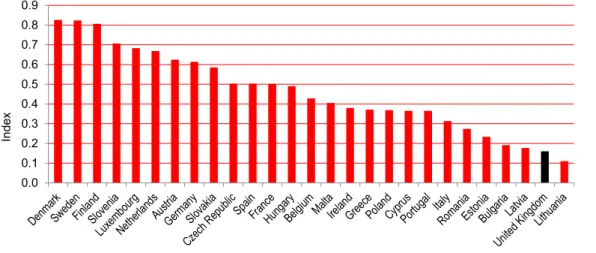
However, the evidence suggests that the UK performs poorly on employee engagement compared with many other EU countries (and it is assumed that Scotland performs similarly to the UK). For example, the European Participation Index6 comprises four indicators of effective voice/employee engagement:
Workplace Representation (presence of a representation body and consultation rights), Board Representation (country level legislation regarding employee representation on boards), Trade Union Density (% of workers that are member of a trade union) and Collective Bargaining Coverage (% of workers covered by a collective bargaining agreement).
Overall, the UK ranked second bottom (26 out of 27) in this index in 2010. For Board Representation, the UK was one of 12 countries with no legislation covering this, and the UK was ranked 24th for Worker
Participation, 21st for Collective Bargaining and 15th for trade union density.
Figure 1: European Participation Index (engagement) 2010
Source: The European Participation Index. Index is a scale of 0 (low) to 1 (high)
Similarly, the Global Perspectives 2015 survey of 20 countries ranked the UK only 12th in terms of
employee engagement, below the global average score7. The survey also examined additional employee
engagement indices linked to Wellbeing, Diversity and Innovation8. The UK was in the 3rd quartile for
Innovation and the 2nd quartile for both Diversity and Wellbeing. This may explain the UK’s overall 3rd
6European Participation Index
7Global Perspectives 2015 Employee engagement measured by a mix of employee views about whether how the workplace is well managed; whether work policies support workers; physical work environment; job security; equality & feeling valued; whether organisation cares about health & wellbeing.
8 Wellbeing = health of the workforce; Diversity = workplace representing the wider labour market profile; Innovation = employees motivated to think creatively and develop new ways of working
0.0 0.1 0.2 0.3 0.4 0.5 0.6 0.7 0.8 0.9 In d e x
4
quartile performance – employees may be less motivated and empowered to think creatively and look for new and better ways of working than those in other countries.
Overall, the evidence suggests low levels of employee engagement in the UK, and by implication Scotland, compared to other countries. If employers are to benefit from the expertise and creativity of their employees, they must allow and encourage employees to voice their opinions and ideas. There needs to be formal channels and a safe environment in more businesses and organisations to allow this to happen, and employees must be able to see the benefits.
Both collective voice, primarily through trade unions (although a trade union presence is not essential to develop a collective voice culture and approaches), and individual voice practices (such as written two way communication and face-to-face meetings between senior managers and employees) within organisations play key roles in increasing engagement. However, collective voice alongside individual voice produces the best outcomes for employees and for businesses in terms of employee commitment9.
(ii) Opportunity - development, diversity, progression
Employers that invest more in employee training tend to have higher productivity, and a more diverse workforce also impacts positively on productivity. Opportunities for progression can boost engagement, job satisfaction and staff retention (all boosting productivity) by giving employees more confidence in their long term career path.
Opportunity, however, is being impacted by job polarisation in Scotland which is restricting career progression as the numbers of mid-skilled jobs are in decline10. This has a higher impact on young people
and women, as they are disproportionately represented at the low wage/low skill end of the jobs spectrum. While job polarisation has been found throughout Europe, the growth in the number of lower skilled/lower paid jobs has been greater in the UK (and most likely Scotland) than in many other European countries
due in part to the UK’s more deregulated ‘flexible’ labour market11.
Learning and development is a key element of Opportunity and data suggests that Scottish employers invest slightly more in learning and development than the UK as a whole, with 70% providing on or off-the-job training (67% for the UK); 48% having training plans in place (44% for the UK); and 32% having a dedicated training budget (30% for the UK)12.
In terms of international comparisons, 80% of employers in the UK provided Continual Vocational Training13 in 2010, ranking the UK 5th out of 28 countries - and higher than the EU-28 average of 66%.14
This suggests that employers in the UK (and likely in Scotland) are more likely to undertake workplace training/development than many other countries.
9Why Should Employers Bother with Worker Voice?” Purcell, j. & Geogiadis, K.
10 Job polarisation is the process by which the shares of total employment accounted for by both high skill/high wage (or non-routine cognitive/interactive) and low skill/low wage (or non-routine, non-skilled) jobs have expanded relative to middle-ranked jobs
11Hollowing out and the future of the labour market 12The UKCES Employer Skills Survey 2013
13 CVT refers to education or training activities which are financed in total or at least partly by the enterprise 14Vocational education and training statistics
5 In considering diversity, Scotland’s female employment rate is higher than the UK and most other
European countries, and Scotland’s youth unemployment rate is one of the lowest in Europe (although it is still above pre-recession levels and the overall unemployment rate). This could suggest that in terms of
gender and age, Scotland’s workplaces are more diverse than in some other countries. However, there is evidence of labour market inequalities for ethnic minorities and the disabled in Scotland. In 2015, the employment rate for those from ethnic backgrounds was 59% compared to 73% for the population as a whole, and the gap has increased slightly since 2013. The employment rate for people with a disability was 42% (in 2014).
This may suggest that while Scotland’s workplaces seem to perform well in terms of employee
development and gender/age diversity, there may remain issues around opportunity and diversity for other groups – particularly ethnic minorities and those with a disability.
(iii) Security - pay and contracts
Job security is a significant aspect of employee engagement, as employees that feel secure are more
willing to adapt and change and to “go the extra mile” than those who feel insecure. It can also increase
commitment, job satisfaction, employer-worker trust and can reduce stress.
The Global Perspectives Survey highlights that although the proportion of employees in the UK that feel
secure in their job has improved, the UK’s performance still lags well behind most other countries: the UK
is ranked 16th out of 2015.
The report does not set out the reasons why the UK lags, but one may be the increase in ‘non-standard’ forms of working, defined as self-employment and part-time and temporary working. Those in ‘non
-standard’ employment tend to receive less training and those on temporary contracts have more job strain and have less job security than employees in standard employment. Their earnings levels are also lower16.
Recent UK jobs growth has been driven by non-standard working17, and around 40% of UK employment is
now in non-standard jobs, giving the UK a mid-table performance compared to other OECD countries.
Job security may also be affected by the use of ‘zero hours’ contracts18. However, recent data shows that
Scotland has the lowest proportion of employees on a zero hours contract of any UK region at 2.2% or 59,000 people in employment, and that this has declined by 0.1 percentage points between 2014 -15, whereas in the UK it increased by 0.3%19.
Pay equality is also an aspect of fair work and although the gender pay gap in Scotland is lower than in the UK, and falling, it still remains high. In 2015, women working full time earned 7.3% less per hour than men (the gap is 9.4% for the UK as a whole). The UK has the 13th highest gender pay gap of 34 OECD
countries, so Scotland’s gap is likely to be larger than the OECD average.
15Global Perspectives 2015
16Non-Standard Work and Inequality
17In It Together: Why Less Inequality Benefits All
18There is no single agreed definition of what “zero-hours contracts” are, however a common element to various definitions is the lack of a guaranteed minimum number of hours.
6
The evidence suggests Scotland performs better than the UK as a whole on job security, but less well than some other OECD countries due to higher levels of non-standard employment contracts and pay inequalities.
(iv) Fulfilment - job satisfaction
Employee job satisfaction (resulting largely from good job design and effectively utilising an employee’s
skills) is positively associated with business performance, productivity and the quality of output and service. This may be partly due to satisfied and engaged employees being more innovative and creative. An OECD survey of adult skills in 22 countries in 2013 found that the UK had the 2nd highest level of skills
underutilisation, with around 30% of workers reporting that they were overqualified for their job. Although the data is only for the UK, performance in Scotland is likely to be similar, as the 2015 Employee Skills Survey highlighted that 32% of Scottish employers reported that they had staff that were underutilised compared to 30% in the UK20.
This suggests that job satisfaction levels in Scotland’s workplaces lag that of other countries. (v) Respect - health, wellbeing, and safety of others
When employees feel respected they display higher levels of commitment to their employer and lower levels of absence, resulting in lower staff turnover, all of which can boost a firm’s productivity.
In considering absence from work due to sickness, in Scotland 2.2% of working hours were lost to sickness versus 2.1% in the UK, and the average number of days lost per employee was 4.7 compared to
the UK’s 4.521. The incidence of sickness absence of employees in the UK is around the OECD average22.
This suggests that in terms of employee health and wellbeing, that Scotland and the UK have a mixed performance compared to other countries.
OECD: Measuring Job Quality
The OECD has recently released new data to assess, in broad terms, job quality across countries23. The
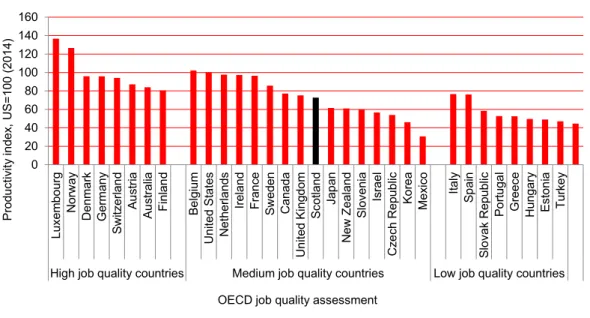
OECD’s job quality themes of earnings quality, labour market security and job strain/quality of the working environment broadly map onto to the elements of fair work and so are a useful way of measuring how Scotland and the UK compare to other OECD countries (refer to Appendix Two for more detail). The OECD categorises countries into high, medium and low performers in terms of job quality, and generally
countries with better quality jobs have higher levels of productivity (Figure 2). The OECD’s assessment is that the UK (and so most likely Scotland), is in the ‘medium’ group of countries in terms of
job quality performance.
20 Employer Skills Survey 2015
21Sickness Absence in the Labour Market, 2014 22Mental Health and Work
7
Across the three OECD job quality themes, the UK performs less well than other countries on labour market security, has average performance for earnings quality, and performs slightly better than many other countries for job strain/quality of the working environment.
(vi) Leadership and management skills
Previous research24 has highlighted that deficiencies in leadership and management skills in the UK, and
especially in SMEs, are a particular factor in the UK’s lower productivity compared to other European
countries and the US. Many managers in SMEs in Scotland and the UK recognise that their skills are undeveloped, and there is a long tail of firms that do not implement management best practices. The research also found a generally low up-take of many ‘high performance’ HR practices such as information sharing with employees, employee participation in decision making, and training - all key components of Effective Voice.
This implies that better leadership and management performance could impact positively on employee engagement which could, in turn, impact positively on productivity.
Figure 2: Productivity of countries with high, medium, low 'job quality performance'
4. Conclusion and implications
This paper adds to our understanding of the factors that affect Scotland’s productivity and inclusive growth
performance. Fair work clearly benefits employees, employers and the economy in a number of ways: productivity is stimulated by a more active and diverse workforce, by creating more equal,
balanced and engaging places to work, and fostering an innovation culture fair work leads to better quality and more fulfilling jobs.
24Leadership and Management Skills and Practices in Scottish Companies: Evidence Update and Potential Implications for SE 0 20 40 60 80 100 120 140 160 L u x e m b o u rg N o rw a y D e n ma rk G e rma n y S w it z e rl a n d A u s tr ia A u s tr a lia F in la n d B e lg iu m U n it e d S ta te s N e th e rl a n d s Ir e la n d F ra n c e S w e d e n C a n a d a U n it e d K in g d o m S c o tl a n d J a p a n N e w Z e a la n d S lo v e n ia Is ra e l C z e c h R e p u b lic K o re a Me x ic o It a ly S p a in S lo v a k R e p u b lic P o rt u g a l G re e c e H u n g a ry E s to n ia T u rk e y
High job quality countries Medium job quality countries Low job quality countries
P ro d u c ti v it y i n d e x , U S =1 0 0 ( 2 0 1 4 )
8
An additional benefit to companies is that there does not have to be a significant (if any) additional cost involved in implementing fair work principles.
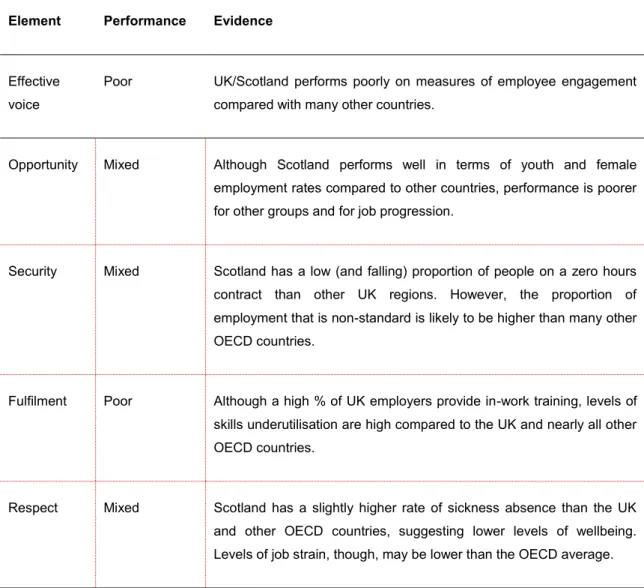
Compared to other countries, the evidence suggests that Scotland’s performance is at best mixed and
often poor for the five fair work elements (see Figure 3):
Figure 3: Scotland’s Fair Work performance, by the five key elements
Element Performance Evidence
Effective voice
Poor UK/Scotland performs poorly on measures of employee engagement compared with many other countries.
Opportunity Mixed Although Scotland performs well in terms of youth and female employment rates compared to other countries, performance is poorer for other groups and for job progression.
Security Mixed Scotland has a low (and falling) proportion of people on a zero hours contract than other UK regions. However, the proportion of employment that is non-standard is likely to be higher than many other OECD countries.
Fulfilment Poor Although a high % of UK employers provide in-work training, levels of skills underutilisation are high compared to the UK and nearly all other OECD countries.
Respect Mixed Scotland has a slightly higher rate of sickness absence than the UK and other OECD countries, suggesting lower levels of wellbeing. Levels of job strain, though, may be lower than the OECD average.
Overall, the analysis in this paper suggests that Scotland’s poor to mixed performance on the five elements of fair work is a real factor in Scotland’s mid-table productivity performance compared to other countries.
Employee engagement is highlighted as a key element of fair work that can drive productivity, and evidence suggests that the UK and Scotland do not perform well in this area. Employee engagement is important to a number of fair work elements including Effective Voice, Fulfilment and Respect, so a focus on increasing levels of employee engagement in Scotland would have a wide impact on fair work performance, and company productivity.
9
As the evidence suggests that fair work practices are not adopted by most employers, a challenge for Scotland is to raise the awareness of benefits of this to more companies – and organisations - and to develop novel approaches to incentivise and support more companies to adopt fair work principles and practices.
This will involve both the public and private sectors working together to generate further evidence of the
benefits of adopting fair work practices, to raise awareness of these benefits and to identify ‘what works’ in
implementing fair work approaches. The Fair Work Convention’s Framework25 will be a key driver of this in
Scotland.
25Fair Work Framework 2016
10 Appendix One: Evidence of the Impact of Fair Work on productivity
Effective Voice
Employee engagement links to higher levels of both productivity and financial performance 2011 Workplace Employment Relations Study
Businesses with employee engagement scores in the top quartile are over 20% more productive than businesses in the bottom quartile and also have significantly lower employee turnover and absenteeism. 2013 Employee Engagement survey
Trade unions can play in effective collective worker voice. Strong trade unions can help deliver a wide range of benefits to employees including higher pay levels, job security, equality and enhanced training, as well as increased innovation and productivity to businesses.
Involvement and Productivity: The missing piece of the puzzle?
Although trade unions are present in almost half of workplaces in Scotland, membership decreased by 9% between 1995 and 2014, a slightly higher picture than in the UK which saw a decrease of 7%. Trade union membership 2014
There has been a significant rise in individual voice practices in UK workplaces (written two way communication, meetings between senior managers and workers, face to face meetings) and these practices are now present in 48% of workplaces in the UK (Scottish figures not available). The 2011 Workplace Employment Relations Study
Research shows that individual voice alongside collective voice produces the best outcomes for workers and for firms in terms of employee commitment.
Scottish Centre for Employment Research (forthcoming)
Arrangements for individual and collective voice are present in only 10% of UK workplaces and are available to only 30% of workers.2011 Workplace Employment Relations Study
Opportunity (development, progression, diversity)
67% of organisations where expenditure on learning & development (L&D) had increased in the previous two years experienced increases in output as opposed to only 29% organisations where expenditure on L&D decreased. Firms where more than 75% of the workforce took part in L&D development activities had higher productivity, other things being equal.
http://www.cipd.co.uk/publicpolicy/policy-reports/investing-productivity-unlocking-ambition.aspx
Job polarisation is affecting opportunity by restricting career progression as the number of mid-skilled jobs are reduced.Scotland's labour market : 'job polarisation' and inclusive growth
11
Productivity: getting the best out of people; Ethnic Diversity and Firms’ Export Behaviour; SME innovation, exporting
and growth; The impacts of migrant worker s on UK businesses
Companies in the top quartile for racial/ethnic diversity in the workforce were 35% more likely to have financial returns above their national industry median, and those in the top quartile of gender diversity were 15% more likely.
Diversity matters
Security (pay and contracts)
64% of the employees identify job security as a key driver in employee engagement as the more secure employees felt the more likely they were to be engaged. This has become a significantly more important driver in recent years.
Global Perspectives 2015
Fulfilment (job satisfaction)
Employee job satisfaction is positively associated with workplace financial performance, labour productivity and the quality of output and service. There may be many reasons for this, but it may be partly due to satisfied and engaged employees being more innovative and creative.Review of evidence on employee wellbeing and its potential impact
on workplace performance.
Over 65% of engaged employees that are more engaged feel that their work brought out creative ideas, whereas less than 5% of less engaged employees agreed with this. The Innovation Equation
Enriched job design offers greater opportunity for workers to make a distinctive contribution and impacts positively on labour productivity, financial competitiveness, performance and quality.
Enriched Job design, High Involvement Management and Organizational Performance
Respect (personal worth)
A range of evidence shows that when employees feel valued they show higher levels of commitment to the business and lower levels of absence and turnover.
Perceived Organizational Support: A Review of the Literature
Employees suffering from high stress levels have lower engagement, are less productive and have higher absenteeism levels than those not working under excessive pressure. The study revealed that over half of those employees claiming to be experiencing high stress levels reported they were disengaged, compared to just one in ten employees claiming low stress levels reported they were disengaged (and half of this group claimed to be highly engaged). The research clearly shows the destructive link between high levels of stress and reduced productivity.
12 Appendix Two
OECD: What makes a good job?
Most people spend a substantial amount of time at work, and work for a significant part of their life. The jobs people hold are therefore one of the most important determinants of their well-being. But what are the features of job quality that affect well-being? The OECD framework for measuring and assessing job quality considers three objective and measurable dimensions of job quality that are both important for worker well-being and relevant for policy. Together, they provide a comprehensive assessment of job quality.
Earnings quality refers to the extent to which the earnings received by workers in their jobs contribute to their well-being. While the level of earnings provides a key benchmark for assessing their contribution to material living standards, the way earnings are distributed across the workforce also matters for well-being. Therefore, the OECD measures earnings quality by an index that accounts for both the level of earnings and their distribution across the workforce.
Labour market security captures those aspects of economic security that are related to the probability of job loss and its economic cost for workers. This is measured by the risk of unemployment which encompasses both the risk of becoming unemployed and the expected duration of unemployment.
It is measured by the degree of public unemployment insurance, which takes into account both the coverage of the benefits and their generosity.
Quality of the working environment captures non-economic aspects of job quality and includes factors that relate to the nature and content of work performed, working-time arrangements and workplace relationships. Jobs that are characterised by a high level of job demands such as time pressure or physical health risk factors, combined with insufficient job resources to accomplish the required job duties, such as work autonomy and social support at work, constitute a major health risk factor for workers. Therefore, the quality of the working environment is measured by the incidence of job strain, which is a combination of high job demands and limited job resources.
Overall, job quality outcomes vary substantially across OECD countries on each of the three dimensions: Australia, Austria, Denmark, Finland, Germany, Luxembourg, Norway, and Switzerland are
among the best performers. These countries do relatively well in at least two of the three dimensions of job quality, without any outcomes in the bottom-10 of the ranking.
Belgium, Canada, the Czech Republic, France, Ireland, Israel, Japan, Korea, Mexico, the Netherlands, New Zealand, Slovenia, Sweden, the United Kingdom, and the United States display average performance. Over the three dimensions of job quality, most of these countries display no more than one outcome in the top-10 or the bottom-10 of the ranking.