The copyright of this thesis rests with the University of Cape Town. No
quotation from it or information derived from it is to be published
without full acknowledgement of the source. The thesis is to be used
for private study or non-commercial research purposes only.
University
of
Cape
University
of
Cape
Town
Page 1 of 45
An analysis of models of branchless banking in
developing countries.
Presented to
UNIVERSITY OF CAPE TOWN for the degree of
Master of Commerce (Financial Management) At the University of Cape Town
By
Dipolelo Makhubedu
Supervisor: Professor Glen Holman Department of Finance and Tax
University of Cape Town 2012
University
of
Cape
Town
Page 2 of 45
1. Abstract
Branchless banking is the distribution of financial services to people who are not reached by traditional bank branch networks. It lowers the cost of delivery to banks, including costs of building and maintaining a delivery channel and to customers of accessing services1. Three distinct models have been identified; Non-bank/ Telecommunications company (Telco)-led, Bank-led, and an Independent “hybrid” version i.e. Bank focused model. The oldest model is the bank-led that was introduced as an extension or add-on to existing services; not for reaching new customer segments. The “hybrid” model comprises a transformed way of offering branchless banking across mobile networks in cooperation with telcos and banks, but spearheaded by a non-incumbent firm.
This paper pays special attention to banking the unbanked population in the developing markets through branchless banking. This form of banking is defined as the delivery of financial services outside conventional bank branches using information and communications technologies and nonbank retail agents. The services offered take a variety of forms including long-distance remittances, micropayments, and informal airtime bartering schemes for example; mobile banking, mobile transfers, and mobile payments.2 Using Kenya’s M-PESA as the lead case study, the impact of combining the use of mobile network operators and banks has proved to be effective. M-PESA is an initiative that allows users to hold money in a virtual ‘stored value’ account maintained in a server by the telecoms provider and operated by users through their mobile phone. Users can deposit or withdraw cash with a local M-PESA agent. More broadly, M-M-PESA affords the scale and efficiencies of corporate capitalism, and the flexibility and contextual appropriateness of informal markets.
This research seeks to shift the debate towards ways in which governmental incentives can tie together the market and technological forces to expand access to financial services for the poor i.e. the full adoption of branchless banking. The paper excludes mobile financial services that are mainly conceived by banks as channel extensions, giving their existing banked customers, a new way to interact with the bank, complementing existing channels such as branches and internet banking.
1
Radix Consulting Services, June 2009, Mobile Banking: Is it Bank versus Non-Bank?
University
of
Cape
Town
Page 3 of 45
2. Acknowledgements
I have been indebted in the preparation of this thesis to my supervisor Professor Glen Holman, whose patience and kindness, as well as his academic experience, has been invaluable to me. My gratitude also goes to my family, friends and everyone who took time to give me guidance, support and the help needed for me to complete this thesis.
This paper is dedicated to the many financially excluded rural and poor people around the world. Although I have been blessed with a better life, I share many similarities with you all. The challenges you face just to survive one day at a time inspire me to keep on learning and seeking solutions to eradicate poverty and seek ways to “pay forward” to ensure a better tomorrow for the next generation.
University
of
Cape
Town
Page 4 of 45 3. Table of contents Abstract 2 Acknowledgements 3 Introduction 5Background of the study 5
Research objectives and motivation 6
Research methodology 8
A review of branchless banking in selected developing countries 9
Defining Branchless Banking 9
The origination of branchless banking 10
Advantages/Benefits of branchless banking to stakeholders 12
Models of Branchless Banking 13
Evaluation of the existing branchless banking initiatives 16 - 30
Branchless banking pricing compared to traditional banking 31 - 33
Government’s role in providing investment in branchless banking 34 - 36
Challenges facing the adoption of branchless banking 36 - 37
Regulation: Banking and telecommunication 37 - 39
Summary of key findings in countries studied: which model is popular and why 40 - 41
Conclusion 41 - 42
University
of
Cape
Town
Page 5 of 45
4. Introduction
4.1.Background of the study
One of the major trends in the remittances market in recent years has been the rapid growth in mobile remittance services. Traditionally, the remittance transfer market has been dominated by funds transfer providers, such as Western Union or Money Gram, or by informal mechanisms, such as hand-delivery. While the more mature remittance avenues, or those with established banking and funds transfer markets, such as USA-Mexico or USA-Philippines tend to be dominated by Money Gram; the less mature markets with more limited banking markets, such as Pakistan-India, tend to be dominated by informal person to person (P2P) transfers. Nevertheless, both methods are imperfect for the user, thus, while funds transfer services proved to be expensive, informal channels are both expensive and risky with some portion of the remittance getting reduced in the process. A further pitfall for the informal methods is that they also lack a paper trail, which is a major concern for governments which are trying to limit the opportunities for money laundering.
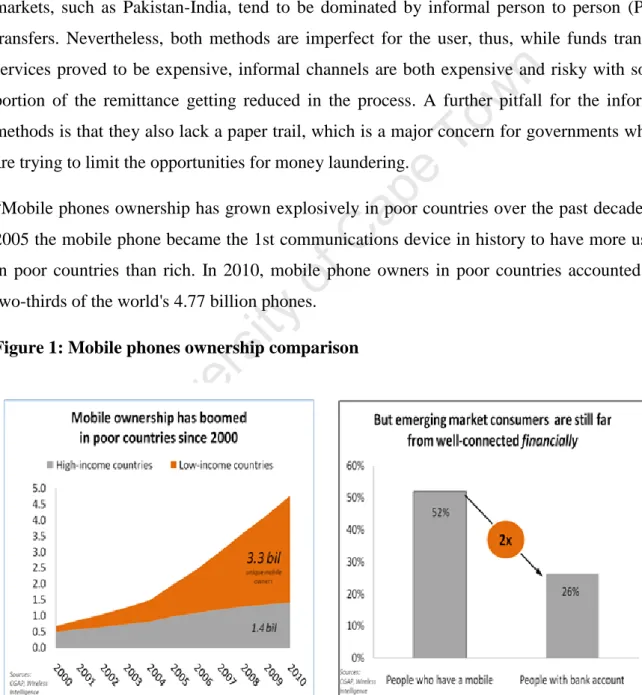
“Mobile phones ownership has grown explosively in poor countries over the past decade. In 2005 the mobile phone became the 1st communications device in history to have more users in poor countries than rich. In 2010, mobile phone owners in poor countries accounted for two-thirds of the world's 4.77 billion phones.
University
of
Cape
Town
Page 6 of 45
But while people in poor countries became increasingly well-connected via mobile telecommunication, they remained much less well-connected financially. An emerging market consumer is less likely to have a bank account in their name than own a mobile phone. Access to financial services enables consumers to smooth unpredictable income, acquire productive assets, invest in health and education, and make other purchases that enrich their lives. This rapid pace of mobile connectivity can be leveraged to also fuel financial inclusion.”3
The rapid acceptance of mobile phones across the world suggests that they will become the operational platform of the masses. Although communication is the key application that is responsible for this dynamic growth, telecom companies and other players recognize the opportunity to leverage this infrastructure to deliver other services. Despite the commercial possibility that is evident in the use of a mobile phone to conduct payment and banking transactions known as m-banking, this service is still at an early stage in quite a number of developing countries.
4.2.Research objectives and motivation
Despite the adoption of technology that facilitates branchless banking in developing countries and the growing impact of this service to the general welfare of society and to the general economic growth, there is a limited amount of research that is directed at banking the unbanked members of society, especially with regards to emerging economies. Evidence provided in the forthcoming sections of this paper show that there is a considerable number of emerging economies (for example South Africa, Kenya, Brazil, Indonesia amongst others) that are using, in addition to traditional banks, the microfinance institutions, mobile phones operators and technology companies to send or receive funds from family, friends or employers.
Furthermore, quite a number of fascinating developments that come with the idea behind branchless banking make this subject appealing to this research. Amongst these developments are that; first, this form of banking does not require the receiver of funds to possess a bank account or to go to the bank but instead to be in possession of a telecommunications device (in this instance a mobile phone). Second, it also does not matter whether the receiver is in
3
University
of
Cape
Town
Page 7 of 45
the city or in the remote rural areas. Third, it does not matter whether the receiver has or does not have a bank account or access to banks but that the individual has a device that allows receiving of funds and that the individual has access to the network.
The paper explores how these developments have made a difference to the lives of many and highlights the benefits and challenges of branchless banking given different environments in terms of regulation, market developments and the costs associated with such a service. The crucial issue is on how to drive more uptake and penetrating usage among low‐income populations where some forms of branchless banking initiatives (BBIs) already exist. Thus, the research seeks to answer four main research questions:
Which models of branchless banking exist in the countries studied? How can government help boost customer base?
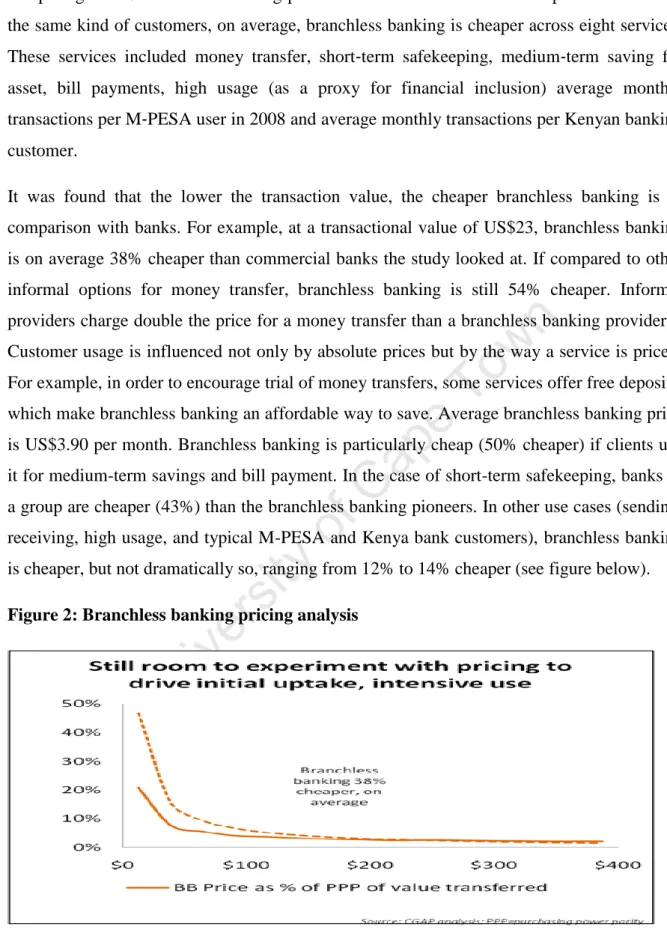
Is branchless banking cheaper than traditional banking for the kinds of transactions low-income and unbanked people want to do?
Are there any concerns which are generally raised by telecommunications and financial regulators?
The outlook regarding this study is that it will contribute hugely to various associates of the world population in terms of invaluable information it will provide. All stakeholders can rely on the key findings to educate themselves on the many facets and platforms that branchless banking can afford them. Furthermore, mobile network operators (MNOs) can use the findings of this study to expand their services in a way geared to economic empowerment to all the stakeholders involved. On the other hand, banks can unlock profits from the existing unbanked population. By combining these services i.e. financial services and MNOs, the objectives of trying to bring financial services to the unbanked poor population and to increase the number of mobile subscribers are more than likely to be realized. Thus with a formal channel available, financial institutions would be able to advance funds to small traders for business development while at the same time having a channel that assists debt repayment conveniently and without delay.
University
of
Cape
Town
Page 8 of 45
4.3.Research methodology
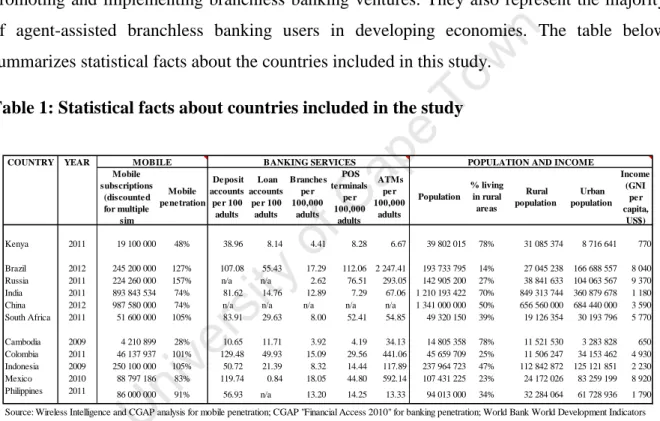
I implemented the archival research method of research. This method involves a review of literature on branchless banking at a general level such as conceptual papers and experiences from other countries mainly in developing countries. The identification and separation of general versus specific issues led to various priorities for the target countries. The literature review then focused on the successful efforts that led to the launch of branchless banking in developing countries, with Kenya as a lead case study. Additional focus is in BRICS economies namely Brazil, Russia, India, China and South Africa. I have also included Mexico, Colombia, Cambodia and the Philippines because of their relative position in promoting and implementing branchless banking ventures. They also represent the majority of agent-assisted branchless banking users in developing economies. The table below summarizes statistical facts about the countries included in this study.
Table 1: Statistical facts about countries included in the study
Kenya was particularly chosen because it has an existing successful mobile payment service offered by Safaricom called M-PESA while South Africa is included in the study because of its role as the major receiver of migrant workers, and therefore its role at the sending end of the remittance corridor. South Africa is also the centre of innovation in Africa: the field of remote access banking and origination of bank accounts by agents operating on behalf of banks is a well-established practice. This research starts by exploring the market for financial services or inclusion, through building on John Caskey’s foundational study of the alternative
Mobile subscriptions (discounted for multiple sim Mobile penetration Deposit accounts per 100 adults Loan accounts per 100 adults Branches per 100,000 adults POS terminals per 100,000 adults ATMs per 100,000 adults Population % living in rural areas Rural population Urban population Income (GNI per capita, US$) Kenya 2011 19 100 000 48% 38.96 8.14 4.41 8.28 6.67 39 802 015 78% 31 085 374 8 716 641 770 Brazil 2012 245 200 000 127% 107.08 55.43 17.29 112.06 2 247.41 193 733 795 14% 27 045 238 166 688 557 8 040 Russia 2011 224 260 000 157% n/a n/a 2.62 76.51 293.05 142 905 200 27% 38 841 633 104 063 567 9 370 India 2011 893 843 534 74% 81.62 14.76 12.89 7.29 67.06 1 210 193 422 70% 849 313 744 360 879 678 1 180 China 2012 987 580 000 74% n/a n/a n/a n/a n/a 1 341 000 000 50% 656 560 000 684 440 000 3 590 South Africa 2011 51 600 000 105% 83.91 29.63 8.00 52.41 54.85 49 320 150 39% 19 126 354 30 193 796 5 770 Cambodia 2009 4 210 899 28% 10.65 11.71 3.92 4.19 34.13 14 805 358 78% 11 521 530 3 283 828 650 Colombia 2011 46 137 937 101% 129.48 49.93 15.09 29.56 441.06 45 659 709 25% 11 506 247 34 153 462 4 930 Indonesia 2009 250 100 000 105% 50.72 21.39 8.32 14.44 117.89 237 964 723 47% 112 842 872 125 121 851 2 230 Mexico 2010 88 797 186 83% 119.74 0.84 18.05 44.80 592.14 107 431 225 23% 24 172 026 83 259 199 8 920 Philippines 2011 86 000 000 91% 56.93 n/a 13.20 14.25 13.33 94 013 000 34% 32 284 064 61 728 936 1 790
COUNTRY YEAR MOBILE BANKING SERVICES POPULATION AND INCOME
Source: Wireless Intelligence and CGAP analysis for mobile penetration; CGAP "Financial Access 2010" for banking penetration; World Bank World Development Indicators for population and income.
University
of
Cape
Town
Page 9 of 45
financial services industry4 and the work of a few other organisations that in recent years have begun to explore the financial services usage of the unbanked population.
5. A review of branchless banking in selected developing countries 5.1.Defining Branchless Banking
Branchless banking, also known as mobile money or m-banking, refers to a bank that does not rely on bricks-and-mortar, or branches. Rather, it makes use of mobile communications technology, and the infrastructure that goes with it, to serve as its “branches.” For customers, mobile money services increases convenience, affordability and security. These services can include:5
Account opening
Person-to-person transfer of funds, such as domestic and international remittances, Person-to-business payments for the purchase of a range of goods and services,
Mobile banking, through which customers can access their bank accounts, pay bills, or deposit and withdraw funds.
Loan disbursements
In developed or advanced markets, branchless banking is primarily an additional channel to existing conventional banking services. In emerging markets, however, it’s a new channel for people to access finance and transform their everyday expectations and opportunities. Similarly, in countries with wide income divides, banking services are primarily for the middle and upper classes. This situation is clearly less than ideal as access to reasonably-priced banking services is one of the first steps toward breaking out of the poverty trap for low-income individuals. But while the benefits of increased access to finance are clear, existing banking business models are yet to fully address the needs of the poor in terms of the products and services on offer, their cost, and the geographical reach of the bank branch infrastructure. This problem has been aggravated by tough anti-money laundering regulations
4
Caskey, 1994, Fringe Banking: Check-Cashing Outlets, Pawnshops, and the poor.
5
Jenkins, 2008. “Developing Mobile Money Ecosystems.” Washington, DC: IFC and the Harvard Kennedy School.
University
of
Cape
Town
Page 10 of 45
requiring proof-of-identity documents that are often prohibitively expensive for low-income customers.6
5.2.The origination of branchless banking
Over the last few years, the mobile and wireless market has been one of the fastest growing markets in the world and it is still growing at a rapid pace7. Mobile phones have become an essential communication tool for almost every individual creating a new, convenient communication and fast financial transactional channel for mobile users which is accessible from anywhere, anytime. As an emerging industry with about 15 years' history, the mobile phone industry’s business model is based on serving all income groups - from teenagers and students to business customers and high-income consumers. This experience of earning money from the least wealthy members of society, combined with the rapid maturity of the sector, has propelled the telecoms sector into the mobile payments business with real enthusiasm. This was motivated by the existing fact that the banking industry is unable or unwilling to serve the unbanked population in poor countries where infrastructure has become a big challenge.
Most payment systems in the developing world enable users to do three things: (a) Store value (currency) in an account accessible via the handset. In the case where the user already has a bank account, this is generally a question of linking the account accessible through a handset to a bank account. If the user does not have an account, then the process creates a bank account for the user or a pseudo bank account that will be held by a third party or the user’s mobile operator. (b) Convert cash in and out of the stored value account. If the account is linked to a bank account, then users can visit banks to cash-in and cash-out. In the most flexible services, a user can visit a corner kiosk or grocery store, perhaps the same one where he or she purchases airtime and transact with an independent retailer working as an agent for the transaction system. (c) Transfer stored value between accounts.8
6
Alazard and Gabaix, 2009, The Internet Seeds Report
7
Mobile Money for the Unbanked Annual Report 2009
8
Donner and Camilo (2008). “Mobile banking and economic development: Linking adoption, impact, and use”, Asian Journal of Communication, 18(4), 318-322
University
of
Cape
Town
Page 11 of 45
Sustained by prepaid cards and inexpensive handsets, hundreds of millions of first-time telephone owners have made voice calls and text messages part of their daily lives. However, many of these same new mobile users live in informal and/or cash economies, without access to financial services that others take for granted. A study by Porteous (2006)9 found that across the developing world, there are probably more people with mobile handsets than with bank accounts. The rapid spread of mobile phones could mean that the number of mobile users may already exceed the number of banked people in many low income countries. These mobile phones can therefore offer a communications channel for initiating and executing on-line financial transactions. This channel may not only reduce the cost of financial transactions for the provider and the customer, but also allow new entrants to the financial sector, and new relationships to be formed for distributing services.
This business model has so far been proven through the launch of M-PESA in Kenya. Although the companies which are currently involved in m-banking are still to make a profit, there is a growing interest in the industry.
The key market factors making branchless banking attractive are:10 wide availability of mobile telecommunications to the target market “SMS economy”
large segment of population with little/no access to financial services need for safe, low-cost money transfers
relative ease with which mobile users could avail themselves of the m-banking services ability to top up mobile accounts –paved way for acceptance of other features
low transaction charges (~ US2¢ to US6¢, see section on costing)
extensive features offered to enable users to pass financial credits between parties ability to withdraw cash (note: cash withdrawal fee applies)
ability to make cashless purchases at participating retail establishments receptiveness of regulators (telecom and central bank)
9
Porteous, 2006, The Enabling Environment for Mobile Banking in Africa (DFID / Bankable Frontier).
10
University
of
Cape
Town
Page 12 of 45
5.3.Advantages/Benefits of branchless banking to stakeholders
In his 2006 study of the Philippines remittance market, Trucano outlined the below advantages:
For users: there is an opportunity to become engaged in the formal banking sector, to facilitate and reduce the costs of remittances, and to enable financial transactions without the costs and risks associated with the use of cash (including theft and travel to pay in person).
For consumers: m-banking is more secure and flexible than cash, allowing consumers to make payments remotely. It further reduces travel time and costs (to travel to bank branch). In Kenya, for example, people may travel 2-3 days by rough road or boat to withdraw salaries. This form of banking may also reduce transaction costs for remittances (1% cash-out for G-cash in the Philippines, compared to higher rates from Western Union) and also reduce opportunities for fraud, counterfeit and theft by providing a secure electronic mode for transferring funds (as opposed to, for example, travelling long distances to transfer cash).
For banks: it provides a platform to move the “unbanked” community toward the “banked” status. It also allows the financial sector to make use of the cash float that would otherwise be invisible to the official systems. The added advantage would also be in the form of reduced errors and increased transparency in the transfer and recording of loan disbursements and payments and savings deposits. Furthermore it provides an easier record keeping on each client through computerization of transactions through mobile phones, thus making it easier for financial institutions to tailor products and services for segments within their large pool of customers. Lastly, branchless banking through retail agents reduces the cost of delivering financial services (potentially radically), relieves crowding in bank branches, and establishes a presence in new areas.
For telecom operators: a significant increase in text messaging revenues and a large drop in customer churn.
For retailers and telecoms service providers: added business opportunities through the sale of prepaid account credits.
For micro-finance institutions: the ability to advance funds into remote areas and receipt of regular repayments that do not significantly inconvenience the user.
University
of
Cape
Town
Page 13 of 45
For service industries and utilities: the ability to get payments electronically from a significant portion of the overall population.
5.4.Models of Branchless Banking 11
According to Consultative Group to Assist the Poor (CGAP), there are already several successful branchless banking models. However, these models differ primarily depending on who would be establishing the relationship (account opening, deposit taking, lending etc.) with the end customer, that is, whether it is the Bank or the Non- Bank/Telecommunication Company (Telco). Another difference lies in the nature of agency agreement between bank and the Non-Bank. Despite these differences, the models can be classified into three broad categories namely; the Bank Focused, Bank-Led and Nonbank-Led models.
The bank-focused model emerges when a traditional bank uses non-traditional low-cost delivery channels to provide banking services to its existing customers. Examples range from use of automatic teller machines (ATMs) to internet banking or mobile phone banking to providing certain limited banking services to the banks’ customers. This model is additive in nature and may be seen as a modest extension of conventional branch-based banking.
The bank-led model offers a distinct alternative to conventional branch-based banking such that a customer can conduct financial transactions using a wide range of retail agents (or through mobile phone) instead of bank branches or through bank employees. This model promises the potential to substantially increase the financial services outreach by using a different delivery channel (retailers/ mobile phones), a different trading partner (telco / chain store) who has the experience and through serving a target market that is distinct from traditional banks and at the same time providing a service that is significantly cheaper than the bank-based alternatives. This model may be implemented by either using correspondent arrangements or by creating a joint venture between Bank and Telco/non-bank. In this model, the customer account relationship rests with the bank.
The non-bank led (telco) model, which is the main focus in this paper, is where a bank does not come into the picture (except possibly as a safe-keeper of surplus funds) and the
11
University
of
Cape
Town
Page 14 of 45
bank (e.g. telecom) performs all the functions. In the typical nonbank-led model of branchless banking, customers do not deal with a bank, nor do they maintain a bank account. A bank may not be involved at all. Instead, customers deal with a nonbank firm—either a mobile network operator or prepaid card issuer—and retail agents who serve as the point of customer contact. Rather than deposit money into and withdraw money from a bank account, customers exchange their cash for e-money stored in a virtual e-money account on the nonbank’s server, which is not linked to a bank account in the individual’s name.
E-money, according to the Basel Committee’s definition, is “a stored value or prepaid product in which a record of the funds or value available to the consumer for multipurpose use is stored on an electronic device in the consumer’s possession.” In other words, customers exchange cash for value stored in a card- or mobile phone-based virtual account. Customers can send this e-money to others, use it to make purchases, or use the e-money account to store funds for future use. They can also convert it back to cash at any participating retail agent.
The nonbank performs a role similar to that of a bank in the bank-led model. It designs financial and payment products, contracts retail agents directly or through intermediaries, and maintain customer e-money accounts. Unlike customers that use payment cards, mobile phone banking customers can conduct transactions wherever they have cell coverage; they need to visit a retail agent only for transactions that involve depositing or withdrawing cash. Retail agents in the nonled model also perform the same basic functions as in the bank-led model. They take in and disburse cash (i.e. they “load” and “unload” e-money, also referred to as “issuing/selling” and “buying” e-money) using mobile phones or point of sale (POS) card readers to record transactions. When a customer hands over cash to increase his/her e-money balance, the retail agent keeps the cash in exchange for some of his/her own e-money. Unlike in the bank-led model, the settlement takes place with e-money, not funds in what would be a bank account. This, however, poses a certain risk for both customer and retail agent. Commercial banks are typically used in the nonbank-led model, but generally only as a place for the nonbank to hold the net proceeds of issuing e-money (and as a convenient means to earn a return for the nonbank on these funds while keeping them highly liquid).12
12
University
of
Cape
Town
Page 15 of 45
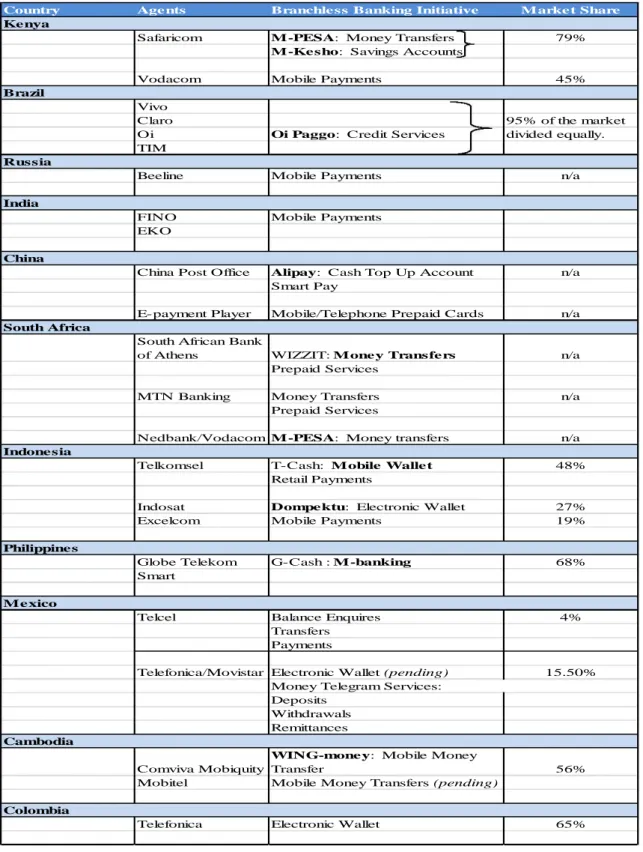
The table below gives a brief summary of the existing branchless banking services in the countries studied. The findings are further discussed in the next section of the paper.
Table 2: Summary of branchless banking services in countries studied
Country Agents Branchless Banking Initiative M arket Share
Kenya
Safaricom M -PESA: Money Transfers 79%
M -Kesho: Savings Accounts
Vodacom Mobile Payments 45%
Brazil
Vivo
Claro 95% of the market
Oi Oi Paggo: Credit Services divided equally. TIM
Russia
Beeline Mobile Payments n/a
India
FINO Mobile Payments
EKO
China
China Post Office Alipay: Cash Top Up Account n/a Smart Pay
E-payment Player Mobile/Telephone Prepaid Cards n/a
South Africa
South African Bank
of Athens WIZZIT: M oney Transfers n/a Prepaid Services
MTN Banking Money Transfers n/a
Prepaid Services
Nedbank/Vodacom M -PESA: Money transfers n/a
Indonesia
Telkomsel T-Cash: M obile Wallet 48%
Retail Payments
Indosat Dompektu: Electronic Wallet 27%
Excelcom Mobile Payments 19%
Philippines
Globe Telekom G-Cash : M -banking 68%
Smart
M exico
Telcel Balance Enquires 4%
Transfers Payments
Telefonica/Movistar Electronic Wallet (pending) 15.50% Money Telegram Services:
Deposits Withdrawals Remittances
Cambodia
Comviva Mobiquity
WING-money: Mobile Money
Transfer 56%
Mobitel Mobile Money Transfers (pending)
Colombia
Telefonica Electronic Wallet 65%
SOURCE:
Amrik Heyer and Ignacio Mas, 2009, Seeking Fertile Grounds for Mobile Money
Ernesto, Flores-Roux and Mariscal, 2010, “The enigma of mobile money systems” published at http://findarticles.com/p/articles/mi_hb5864/is_79/ai_n55501271/pg_9/?tag=content;col1
i'--University
of
Cape
Town
Page 16 of 45
5.5.Evaluation of the existing branchless banking initiatives
A common characteristic of migrants is that they are generally of low income and unskilled or of limited formal education. This is one of the reasons why many people in developing countries resort to informal channels of banking. Most of these unbanked people have no need for a savings account however, they do need a financial service that can allow them to send or receive money. There are several other reasons why many migrants choose to use informal channels rather that the formal financial sector to remit payments:13
Ease of use: Migrants prefer methods with less paperwork
Familiarity: Informal channels have also been used, or have been recommended, by family and friends
Cost: Higher costs in the formal financial sector drive away migrants. Fees in informal networks tend to be lower than at banks or with money transfer operators.
Risk tolerance: There is a perception among migrants that banks are untrustworthy and can lose, or steal, migrants’ money
Access: It can be difficult for migrants to reach the point of delivery Informal employment:
A branchless banking service, thus, needs to be supported by a network of retail agents reaching into the communities where customers live. Agents’ main role will be to provide cash in/out services within easy reach of their customers, which requires them to manage the logistics and risks associated with increased cash flow. However one should consider the risks that may affect the usage of the services. For instance, the greatest risk in the case of the nonbank-led model has little to do with the use of agents. Instead, the risk is that an unlicensed, unsupervised nonbank will collect repayable funds from the public in exchange for e-money and will either steal these funds or will use them recklessly, resulting in insolvency and the inability to honour customers’ claims. Developing country regulators are not alone in facing the challenge of how to deal with “e-money” issuance by parties that are not prudentially licensed. Much of the developed world is grappling with the same dilemma regarding how to unleash the vast potential of this mode of financial service delivery without undue risk, given that e-money issuers often may be parties, such as mobile operators, who are not otherwise subject to prudential regulation and supervision.
13
Maimbo, Strychacz, and Saranga, 2010, Facilitating Cross-Border Mobile Banking in Southern Africa
University
of
Cape
Town
Page 17 of 45
The successful initiatives, like M-PESA in Kenya, or SMART and Globe in the Philippines, highlight the significance of developing a simplified proposal that addresses a customer need, and applicably engaging with the right stakeholders such as banks, agent distribution outlets and technology vendors to execute it. The sustainability of these early deployments is partially attributed to enabling regulatory environments that have made it possible for non-banks to offer basic payments services, but they should equally be attributed to a well-designed and executed business model.
In her study, Carmen Nobel, stated that “the Kenyan experience suggests that the ability of the mobile money industry to leverage on economies of scale largely depends on the provider’s capacity to leverage on the strength of the informal sector (e.g. in relation to its distribution networks), the labour market profile (e.g. demand for remittances generated by rural-urban migration), infrastructural development (including the penetration of the formal financial markets), and the support from the banking regulator. The apparent difficulty of replicating M-PESA’s success even in neighbouring developing countries indicates that some contexts may be more receptive to mobile money offers than others. But it also speaks to the sheer difficulty of ‘pulling off’ a fairly sophisticated business model.”14
In Kenya, Safaricom pools its e-money account proceeds in a wholesale deposit at the Commercial Bank of Africa (CBA). Smart Money, too, has a practice of holding net e-money proceeds in a licensed Kenyan Commercial bank. In some cases, there may be no regulatory barrier to the nonbank holding the net e-money proceeds in some other form of investment (including investments considerably less safe and less liquid than a conventional wholesale bank deposit) or even using them for lending. There are several successful stories for implementing branchless banking services around the world. The Harvard Business School case study Mobile Banking for the Unbanked explores two very different examples of mobile financial service models: Kenya’s M-PESA and South Africa’s WIZZIT.15
M-PESA, as defined earlier in this paper, is an initiative launched by the mobile network operator Safaricom (in conjunction with Vodafone) to offer a new type of financial service to the poor residents of Kenya. Based on its success rate, it seems M-PESA, realized that the
14
Nobel, 2011, HBS Cases: Mobile Banking for the Unbanked
15
University
of
Cape
Town
Page 18 of 45
intended customers didn't really want bank accounts at all but that they wanted effective ways to send money home to their families. The initial concept of M-PESA was to create a service which allowed microfinance borrowers to conveniently receive and repay loans using the network of Safaricom airtime resellers. This would enable microfinance institutions (MFIs) to offer more competitive loan rates to their users, as there is a reduced cost of dealing in cash. The users of the service would gain through being able to track their finances more easily. 16
However, when the service was tested, customers adopted the service for a variety of alternative uses and complications arose with Faulu, the partnering MFI. M-PESA was re-focused and launched with a different value proposition: sending remittances home across the country and making payments. M-PESA quickly captured a significant market share for cash transfers, and grew astoundingly quickly, capturing 6.5 million subscribers by May 2009 with 2 million daily transactions in Kenya alone. As of November 2011, M-PESA has over 14 million subscribers and well over 28,000 agents across the country.17 The growth of the service forced formal banking institutions to take note of the new venture.
In May 2010, Safaricom took it one step further, partnering with Equity Bank and offering M-Kesho, an interest-bearing savings account, to all M-PESA users. Subscribers can now use their cell phones to transfer money from their M-PESA accounts using Safaricom's existing network of nearly 20,000 licensed card vendors into their M-Kesho accounts. M-Kesho users are also able to access mobile micro-insurance and microloan products. By registering SIM cards that double as individualized account numbers, Equity Bank is seeing 8,000 new customers each day, and its CEO, James Mwangi had predicted that, in a few months following the launch of M-Kesho, Kenya will be the most-banked country in Africa and the developing world.
In South Africa for example, WIZZIT Bank, a division of the South African Bank of Athens offers the usual banking services deposit, withdrawal, payments, and airtime purchases through a variety of access points including cell phones, Automated Teller Machines
16
Hughes & Lonie, (2007). M-PESA: Mobile Money for the "Unbanked": Turning Cellphones into 24-Hour Tellers in Kenya. Innovations: Technology, Governance, Globalization, 2(1–2), 63–81.
17
University
of
Cape
Town
Page 19 of 45
(ATMs), post offices and bank branches. WIZZIT is basically a third-party start-up that provides standard banking services via mobile access to impoverished residents of South Africa. WIZZIT, entered the mobile banking market in 2004 because the mobile phone penetration rate in South Africa was greater than 100 percent, largely due part to the onset of prepaid services that offer low-cost handsets and the opportunity to buy airtime in advance. By 2009, WIZZIT was not yet profitable. The banking partnership proved problematic in that it was hard for a second-tier bank to compete with their larger associates, who by 2008 were forced by government mandate to offer low cost banking options for the poor. But WIZZIT also suffered because the founders failed to recognize the true needs of their target customers.
In September 2010 Vodacom and Nedbank announced the launch of the service in South Africa, where it is estimated that there are more than 13 million "economically active" people without a bank account.18 Since 2010, M-Pesa has been slow to gain a toehold in the South African market. When M-Pesa first launched, Vodacom projected that it would sign up 10 million users in the following three years. By May 2011, it had registered approximately 100,000 customers. The gap between expectations for M-Pesa's performance and its actual performance can be partly attributed to significant differences between the Kenyan and South African markets, including the banking regulations at the time of M-Pesa's launch in each country.19 According to MoneyWeb, a South African investment website, "A tough regulatory environment with regards to customer registration and the acquisition of outlets also compounded the company's troubles, as the local regulations are more stringent in comparison to our African counterparts. Lack of education and product understanding also hindered efforts in the initial roll out of the product." In June 2011, Vodacom and Nedbank launched a campaign to re-position M-Pesa, targeting the product to potential customers who have a higher Living Standard Measures (LSM) than were first targeted.
There are several other branchless banking initiatives that were launched specifically in the countries studied. Brazil has long history of banks outsourcing various services to agents (also known as “nonbank correspondents”). The Central Bank of Brazil (CBB) has been progressively expanding the agent model since 1999 by allowing more services to be rendered by agents and expanding the list of financial institutions that may use agents. Any
18
Staff Writer, 2010, "M-PESA launched in South Africa". How We Made It in Africa. Retrieved October 16, 2010
19
University
of
Cape
Town
Page 20 of 45
CBB licensed institution is permitted to partner with any type of legal entity to deliver a wide array of financial services in any location. Brazil’s banking system is one of the most inclusive in Latin America with roughly 43% of its population having a bank account. Currently, there are forty-two commercial banks which operate through more than 10,400 branches. The largest six banks held 82% of all banking sector assets. There are 15 branches and 18 ATMS per every 100,000 residents. Banco Azteca alone owns 11.5 percent of the branch network and has the largest account base with over 12 million account holders. Commercial banks manage 41.8 million demand deposit accounts for an estimated 25 million account holders. Country banking statistics show that less than 50% of the adult population has a bank account.In low-income segments, commercial banks compete with approximately 630 credit and savings organizations.
Although, Brazil was the first Latin American country to adopt specific regulation regarding financial services for non-banking correspondents, there is still no specific regulation for mobile money services. Some entities are working in the implementation of electronic wallets, probably oriented to remittances, given their volume and value. Although they only represent 1% of GDP, (US$7.1 billion in 2010), the majority of these remittances were mainly from the US, Japan, and Europe. Of the people that received remittances in Brazil, 63% already had a bank account, thus leaving a gap of the 37% unbanked.20
The past few years have seen an aggressive growth in the mobile phone industry although the market is still relatively immature. Four operators; Vivo, Claro, Oi, TIM; answer for 95% of the market share (divided roughly equally among them) and Global System for Mobile Communication (GSM) technology dominate the industry. In November 2007, there were 114.7 million cell phones in use, 80% of which were prepaid and every month approximately 1.8 million new clients are added to the system21. It is noteworthy that in contrast to the banking network, which reaches every municipality through bank agents, 2,200 municipalities do not have access to mobile phone services (although more than 90% of the population is covered by the existent wireless network).
20
Ernesto, Flores-Roux and Mariscal, 2010, “The enigma of mobile money systems” published at http://findarticles.com/p/articles/mi_hb5864/is_79/ai_n55501271/pg_9/?tag=content;col1
21
University
of
Cape
Town
Page 21 of 45
Additive branchless banking; where banks, in partnership with the mobile companies started offering basic transactions (transfers, balance inquiries) using WAP technologies has been active in Brazil for over ten years. Nevertheless, it was not until 2007 that more widespread services started being offered. Oi Paggo, a subsidiary of Oi, launched a credit service, initially to buy airtime, but subsequently as a line of credit for general purchases. Oi Paggo operates as a credit card administrator with its own banner, bearing the risk of payment delinquency. It has developed a network of 75,000 establishments that accept payments through the use of mobile phones in twelve cities scattered through the north east of Brazil. The mobile phone user, through a process similar to that used by banks and credit companies for credit scoring; opens a credit account with Oi Paggo, uses the phone to buy airtime (about two thirds of the transactions) and certain products and services, and on a monthly basis receives a billing statement, separate from the phone company statement, which can be paid through the internet, at a bank, or at other payment agencies.
On the receiving end, Oi Paggo facilitates the POS device (a mobile phone) and does not charge for it; it charges typical credit card fees (2.99% on the amount of the transaction, somewhat lower than what other credit card wholesalers charge in Brazil) but no on-going additional charges. Additional services, such as a prepaid service, credit that can only be used for top-up, utilities payments, special top-up programs, and the transfer of money (person-to-person), will be launched in the near future. For the transfer of money, they have offered an initial launching fee of Brazilian Real R$0.99 (US$ 0.56), substantially lower than the current offer by banks and other money-transfer companies. The money can be cashed out at certain banks, some large retail stores, or through their correspondent network.
“By May 2010, Oi Paggo had around 250,000 users, representing about 5% of its user base in the cities where the services are offered. Originally, they launched an above-the-line campaign, which brought in more than 400,000 users, but due to rampant fraud, they have since scaled down, marketing their services through mobile and direct marketing, and, more successfully, telemarketing. They have a preapproved customer base of 2.5 million subscribers on which telemarketers work. The model, successful as it is, has not yet reached enough scale or critical mass to enter into a self-supporting virtuous circle. The establishment network and the user base are still not large enough to enter into reciprocal reinforcement. It is not yet totally transformative, as it offers financial services to people mostly previously banked, only adding convenience and a lower price, but the new features will probably make
University
of
Cape
Town
Page 22 of 45
it more attractive to a substantially larger consumer base, becoming then a transformative model”.22
In contrast to the use of retail agents by banks (known as "bank-based branchless banking"), nonbank-based branchless banking is only in its early stage in Brazil. However, there is remarkable space for nonbanks to compete for customers with low value accounts, since approximately 80 million adults still lack access to bank accounts. Brazil has an excellent opportunity to adjust its regulatory framework to fine-tune the balance between openness, safety and service continuity by (i) taking the necessary measures for retail agents to expand further the access to banking services and (ii) opening the doors to nonbanks while setting adequate minimum requirements and principles for their participation in the supply of low-value financial services.
In Russia interest for branchless banking has dried up since the country ministry of telecommunication shifted priorities in 2009. Currently, the main profit centre and focus for MNOs is communication services, not financial services. Still, there has been activity from MNOs. Beeline, one of the three largest nationwide MNOs, has demonstrated a significant interest in branchless banking by teaming up with Tavrichesky Bank. The partnership designed a similar product as MPESA and WIZZIT product with the intention that it will be offered by various mobile operators. This designated account is a pooled account for Beeline customers. Individual “account” information is held by a processing centre, which is a legal entity separate from Beeline and from Tavrichesky Bank. Although each customer must sign an agreement with Tavrichesky Bank, the customer is not required to open a bank account. There were more than 1 million active users in the fourth quarter of 2009. A similar project was launched by Megafon (a nationwide MNO with approximately 31 million subscribers) in 2009.
India is the world's second largest mobile market, with over 400 million subscribers, but it still only has 20 million to 25 million registered users for mobile banking. The active user base is only about 10 percent of the total user base. Rural India is a huge and challenging market insofar as banking is concerned. The country has close to 600,000 villages, making it
22
Ernesto, Flores-Roux and Mariscal, 2010, “The enigma of mobile money systems” published at
University
of
Cape
Town
Page 23 of 45
difficult to establish brick-and-mortar banks everywhere. According to the Reserve Bank of India (RBI) 40 per cent of Indians lack access to formal financial services and remain largely "unbanked" despite a large banking system and cooperative credit network. Approximately 25 percent of adults have credit accounts in the formal financial sector, and 82 percent of adults have savings accounts. While the government and RBI have taken steps to establish a widely distributed presence of bank branches, India’s large population has made it difficult to ensure financial services are accessible to all those who need them. Building more branches in the countryside may not always be cost-effective and thus banks need to explore other options by developing a better understanding of what rural households need and offer new products and distribution networks that suit them.
Providing banking services through ‘banking correspondents’ represented by self-help groups, NGOs and other approved organizations is one branchless banking mechanism. Touch-points may be set up by such organizations at places commonly visited by the unbanked, such as the village markets or schools. This may be supplemented by outreach teams equipped with hand-held devices on which simple banking transactions can be performed. In September 2007, ABN Amro Bank announced that its microfinance division had provided basic financial support to some 500,000 underprivileged households. Mobile banking is another way of reaching out to such customers and is also a huge opportunity for banks in India. This is on the back of the continuing growth of mobile phone subscribers which is outpacing the growth of banking customers and PC and Internet users in India.
In 2006, banks were allowed to take the help of NGOs and microfinance institutions as intermediaries in offering banking services through the use of correspondents. This was perhaps a factor for many banks that opened six million accounts with low or zero minimum balances between March 2006 and 2007. ICICI Bank, HDFC Bank and Citibank have launched their own microfinance programs. HDFC Bank has tied up with NGOs in Andhra Pradesh and Tamil Nadu to make money accessible to the rural poor. Citibank has linked up with NGOs. Banks are looking at technology to provide banking services at low cost and this includes rural banking too. Citi has set up a bio-metric ATM as a part of its ‘no-frills’ Pragati account for the under-banked. The ATM recognizes the customer through their thumb impression and can interact in regional languages.
University
of
Cape
Town
Page 24 of 45
Three areas of particular concern namely; access to finance, consumer protection, and banking sector stability, have shaped the RBI’s thinking on branchless banking. India’s regulators and policy makers tend to focus on credit and savings services in rural areas and the existing gap between supply and demand. This was the primary focus of Khan, 2005 report on RBI working group on electronic money.23 The Khan report proposed the use of third-party “business correspondents” to assist in the delivery of financial services. RBI has since issued a circular permitting such outsourcing24. The report also highlighted information and communication technology (ICT) as a way to leapfrog the efforts to increase outreach by reducing costs of service delivery. Notwithstanding RBI's focus on serving rural areas, fertile ground for branchless banking may also be found in the need for payment services for the several hundred million urban poor and remittances for India’s 80 million migrant workers from rural areas.
Currently, the bank led model, mCHECK is the leading model. However, mobile transactions are restricted to bank account holders only.
China is the world's largest mobile phone marketplace with 987.580 million subscribers. Rural Chinese are also increasingly using mobile phones for applications targeted to them, such as an Agricultural Information Service and Banking. With mobile penetration of 56 percent and 8.8 million new subscriptions a month, China has one of the most dynamic markets in the world, as well as the fastest-growing major economy. GDP growth of 8 percent in 2010 and rising incomes are increasing the spending power and material wealth. But the picture varies across this enormous country. The urban, rural and youth markets in particular show extreme diversity in user sophistication and demand for services. The People’s Bank of China (PBC) estimates that only 36 percent of Chinese rural households have access to financial services. As one indicator of demand, the informal finance market has been estimated at anywhere between CNY 1 trillion (US$132 billion) to CNY 2 or 3 trillion. However, the bigger Chinese banks have for many years now been moving out of rural areas, motivated by commercialization and competitive pressures. The four big state banks have reduced their presence in rural areas by over 43 percent in ten years, closing
23
Reserve Bank of India; 2005; Report of the Internal Group to Examine Issues Relating to Rural Credit and Microfinance
24
Reserve Bank of India, “Report of the Working Group on Electronic Money” (11 July 2002), Vol 36
University
of
Cape
Town
Page 25 of 45
30,000 branches in the last five years alone. It is for this reason that the Chinese government launched several initiatives to test out new forms of rural financial service providers. Among them:25
The People’s Bank of China in December 2005 launched a pilot initiative to establish Microcredit Companies using commercial licensing
The China Banking Regulatory Commission in December 2006 introduced their own pilot, creating new types of licenses for rural financial institutions
Given the reliance on cash in rural China and given that additional ATMs do not appear to be the answer, the existing mobile Short Message Service (SMS) network is however successfully serving and providing cheaply, an SMS-based payment system in rural areas. The most expensive parts of the infrastructure i.e. the network and phones are already in place, thus this solution is relatively low in cost and can be replicated in other developing countries. Currently, some leading third-party payment providers are adding cash-based and non-bank based payment options to their offerings. These include:
Cash remittance: Alipay is a third-party payment provider, allowing users to top up accounts with cash through China’s postal service. This service was launched in March 2007 in selected China Post Office branches throughout China.
Mobile toll stations: Smartpay, China’s leading mobile top-up company has formed a network of approximately 30,000 dealers. Smartpay dealers allow users with bank accounts to easily use Smartpay’s services, which in turn gives Smartpay access to a much wider range of potential users.
Targeting the unbanked with pre-paid cards: E-payment player IPS uses mobile and telephone prepaid cards in order to reach unbanked users. This service takes advantage of the popularity of prepaid top-up cards used for phone bills, online games, and virtual currencies in China. The cards are usually purchased with cash at newspaper kiosks, small shops, and internet cafes. IPS operates a service called Ipay.
25
Gautam Bandyopadhyay, 2009, One Billion Opportunities: Banking the Unbanked Globally viewed at http://www.infosys.com/finacle/solutions/solutions-kit/Documents/one-billion-opportunuities.pdf
University
of
Cape
Town
Page 26 of 45
In Colombia, there are approximately 25 million mobile phone users. The country has approximately 45.6 million inhabitants, 73 percent of whom live in urban areas, and 64 percent of whom are below the poverty line.26 Three MNOs cover 90 percent of the market and 100 percent of the municipalities. Telefonica occupies 65 percent of the market share and the Telecommunications Regulatory Commission (CRT) is examining this dominant position in order to ensure a healthy competition. Electronic commerce in Colombia is developing slower compared to countries such as Argentina, Brazil, Chile, and Mexico. This is mainly due to low computer and internet penetration and concerns about security. ACH Colombia (the main payment clearing and settlement system) and Certicamara (a digital signature certifying authority), have created a certification process for e-banking transactions to encourage the use of internet banking. A USAID study indicates that opening a bank account is viewed as a difficult and complex process. Moreover, formal financial services are perceived as linked to taxation and traceability, and therefore are not always desirable for unregistered micro-entrepreneurs. The CRT reports that internet penetration reached 13.2 percent of the population in mid-2006 although the current average internet cost of US$30 per month is relatively high for low-income segments. With regards to mobile banking and e-money issuance by nonbanks, client adoption is expected to be a barrier due to a perceived distrust in nonbanks as depositaries of client funds.
Findings in Indonesia showed that an estimated 40 million people have cell phones but no bank accounts.27 According to the World Bank, Indonesia averages 6.7 bank branches for 100,000 adults. Developed economies, like the United States and Europe, average 4-6 times more banks per capita than Indonesia, making it more convenient for customers in those countries to use banking services. In addition, bank customers are not keen to travel a long distance to a bank, and they value having the convenience of a bank that travels directly to them. The Indonesian mobile phone market is dominated by three companies. Telkomsel has 48 percent market share, followed by Indosat with 27 percent, and Excelcom with 19 percent. Four other companies share the remaining 8 percent. There are currently 172 million active SIM cards in service, but one industry source estimates that this represents only 90 million customers, many of which hold multiple accounts. This implies a penetration rate of
26
Aguirre, Dias and Prochaska, 2008, Diagnostic Report on the Legal and Regulatory Environment for Branchless Banking in Colombia
27
Flaming, Prochaska and Staschen, 2009, Diagnostic Report on the Legal and Regulatory Environment for Branchless Banking in Indonesia
University
of
Cape
Town
Page 27 of 45
approximately 38 percent of the population. Ninety-five percent of subscribers hold prepaid accounts. The industry is showing early signs of maturing. Established networks are reaching existing capacity as usage rates have quadrupled since 2007. New MNOs have entered the market, rates per minute have dropped to approximately the regional average of US$0.025– US$0.03 per minute, and customer churn (also known as customer turnover) per year is approximately 12 percent.
The two largest MNOs have each developed an e-wallet service for their mobile phone customers. Telkomsel’s T-Cash, a mobile wallet allowing customers to make retail payments, is available to customers, but industry watchers estimate that T-Cash has no more than 80,000 accounts and that Telkomsel will in fact abandon the service for a bank account-based application in the near future. Even though Telkomsel has received a remittance license from Bank of Indonesia to offer a P2P transfer function with its product, it currently does not offer that function. Indosat has developed, but not yet launched, its Dompetku service. However, Indosat has not been able to qualify for a remittance license, which it needs to add P2P transfer functionality to its e-wallet service. T-Cash and Dompetku offer customers fewer transaction services than existing commercial bank-based m-banking models. Most of these limitations are imposed by regulation (see section on Banking regulations). In this context, a mobile-wallet service does not appear to have significant revenue potential for MNOs as mobile-money issuers, suggesting that MNOs offer mobile-wallets simply to reduce customer churn and facilitate airtime purchases, but fail to expand banking services to the people.
Mexico is a “country with a relatively sophisticated banking sector and looks back on a decade of economic stability. However, only 30 percent of the adult population has access to formal financial services and the reach of electronic payments is low. In the past 3 years, the country has seen a wave of market entrants targeting the lower income segment”.28 The mobile phone industry in Mexico is highly concentrated in a single MNO- Telcel -that has 74.2 percent of the market share, while the second largest – Telefonica/Movistar – has 15.5 percent. Nonetheless, call and handset prices have been dropping considerably in the last few years, hence the growth of mobile phone subscribers has surpassed 100% in the last five years. With an adult population of 107.76 million there are about 79 million active mobile
28
University
of
Cape
Town
Page 28 of 45
phone accounts in Mexico. For the period between 2007 and July 2010, mobile phone subscriptions grew by 14.6%.
While Telcel, the dominant MNO, has partnered with some banks to initially target higher-income bank clients for mobile balance inquiries, transfers, and payments, Telefonica envisions offering an electronic wallet that could be used for purchases and peer-to-peer transfers, with an eye to the remittance corridor from the USA to Mexico. In this view, this could possibly mean that Telefonica’s 13,000 agents could be turned into agents for cash in/cash out transactions. However, this project is still in its infancy because, Telefonica has not yet presented it to the Comisión Nacional Bancaria y de Valores (CNBV) for evaluation from a regulatory standpoint. CNBV is an organisation that monitors and regulates Mexican financial institutions to ensure their stability and proper functioning, maintaining and promoting the healthy and balanced development of the financial system as a whole, while protecting the interests of the public. The CNBV is at the forefront in its thinking about branchless banking and its potential to increase access to finance.
Telecom, the national telegram service, also offers an open agency platform to deliver services such as deposits, withdrawals, and remittances, to six major banks through its network of 1,566 points. This platform has been operational since 2005 and processes approximately four million transactions per year. In the same vein, there is also evidence of possible future growth as suggested by a considerable number of mobile banking initiatives that have been planned or are already under way.
Cambodia, on the other hand, has a population of over 14.805 million but less than 4 percent of the population has a bank account. There are some 13 million active SIM cards in, this equates to mobile penetration of 88 percent of the total population. The country has relatively few ATM machines i.e. 34.13 per 100 000 adults.29 As in many other developing countries, institutional banking infrastructure is highly underdeveloped. With only 500,000 bank accounts and 200 ATMS in the entire country, an approximate 95% of the population has no access to formal banking services. Operating in Cambodia since February 2008, WING, a wholly owned subsidiary of ANZ, one of the top 40 global banks, strives to build a mass-oriented, cost-efficient and inclusive financial services delivery network in the country. In
29
University
of
Cape
Town
Page 29 of 45
December 2008, WING launched WING Money Cambodia’s first mobile payment service powered by Comviva’s Mobile Money platform.
WING uses existing channels on mobile-phone networks – including Hello and Mfone to transfer money from P2P through text or small message system (SMS). After a user sets up a WING account for a subscription fee - their money is held by ANZ bank and moved between WING users by SMS. In its first year of operation, the service attracted 100,000 users – an estimated 56 percent of which were previously unbanked. It is now working with microfinance institutions (MFIs) to expand to loan repayments. For ANZ, the plan gives birth to more financial transactions while MNOs will see SMS traffic and revenue balloon. Furthermore, Mobitel, the largest mobile operator in Cambodia is offering mobile money facilitated by a grant from the GSM Association Foundation. Mobitel, owner of the Cellcard mobile brand, is still finalising the list of services to be offered, but it would include allowing money transfer by mobile phone. Cellcard will be providing much-needed financial services such as money transfer, bill payment and airtime top-up to working-class migrants who need to send money home to families in rural areas.
However, branchless banking also has several features which may restrict its impact. These features are more likely, however, to affect the speed of adoption, rather than limit the potential described.
Branchless banking requires prior access to a mobile phone—however; initiatives are underway to reduce the initial handset cost so that it is not an impediment.
Mobile networks in many low income countries are still enjoying explosive growth in subscribers, and are focused on basic network rollout; even if the additional financial investment required for branchless banking is limited and the revenue positive, they may be less amenable to divert scarce human resources from this core business into other noncore projects.
In the Philippines, at least half the nation own or have easy access to mobile phones. Nearly two million of the active mobile banking users are unbanked, and 26 percent of active users have incomes below P250 (approximately US$5) per day.30 The use of SMS is more widely utilized rather than voice, and for that reason, branchless banking and mobile banking utilizes
30
The Philippine Star, 2010, article byTed P. Torres accessed January 19, 2010 available at http://www.philstar.com/Article.aspx?articleId=541907
University
of
Cape
Town
Page 30 of 45
SMS extensively. CGAP estimates that 98 percent of unbanked Filipinos receive their income in cash, and overwhelmingly use informal saving instruments, such as keeping their money at home in a safe hiding place, giving money to a friend or family to hold, or joining a saving club. Low-income Filipinos save an estimated US$450 million in informal, actively managed with frequent deposits and withdrawa