Capstone Design and ABET Program Outcomes in the U. S.
Paul H. King, Ph.D., P.E.
Department of Biomedical Engineering, Vanderbilt University, VU Station B351631, Nashville
TN 37235-1631, USA ([email protected])
Abstract
The U.S. based accreditation organization, ABET, evaluates in twenty eight areas of specialty of Engineering Curricula. The general criteria applied in these evaluations relate to: Students, Program Educational Objectives, Program Outcomes, Continuous Improvement, Curriculum, Faculty, Facilities, Support, and, as necessary, Program (specific) criteria. Curricula under study generally develop and display coursework and other documentation to demonstrate adequate coverage and measurement of each of these areas. Senior capstone design courses are a primary source of documentation of the achievement of the “Program Outcomes” section of this evaluation, thus special care should be taken when developing these displays.
Program Outcomes are criterion 3 of the ABET criteria. This section requires that engineering programs must demonstrate a list of items (denoted a-k). These items include such measures as: (d) an ability to function on multidisciplinary teams. If desired, any program may add to these criteria, and include items specific to the individual program, such as: (l) a knowledge of biology and chemistry adequate to solve problems involving biomaterials.
This paper will discuss the specific example of items a-k in a Biomedical Engineering program at Vanderbilt University, as well as additional department specific items, and how they relate to work done in a capstone design course.
Keywords: ABET, design, accreditation, quality assurance
1.
INTRODUCTION
ABETi is a US based engineering and technology specialty area accreditation, and therefore quality assurance, agency. It, through its program evaluators, visits programs wishing accreditation in Applied Science, Computing, Engineering, and Technology areas. It currently accredits twenty eight engineering areas, from Aerospace Engineering to Surveying and Geomatics. Accreditation, if earned, generally allows a program to advertise that is has met published standards and is usually valid for a period of up to six years. Graduates seeking professional engineering licensure generally must have this certification for their curricula.
The accreditation process basically involves the following steps: the program in question requests an ABET evaluation, the program and the school in question each prepares a summary document answering specifics about the general criteria. This information is generally mailed to the program evaluator 2-4 months in advance of the visit. Individual faculty (generally) generate course documentation that addresses their course’s content, often both via the generation of a course notebook with relevant assignments and other information, and via the breakout of program outcome data for insertion into outcome notebooks. Course documentation is often an individual instructor’s responsibility, generation of the outcome data books (especially the summaries and the individual program general criteria notebooks) are generally committee efforts. These two sets of notebooks, along with associated materials (such as
copies of the textbooks used), and interviews with relevant faculty and staff and students, and a reading of the above summary document, present the majority of the material from which a program evaluator may conclude that a program is worthy of a full accreditation, or something less. The course outcome notebooks, and the summary outcome notebooks, due to their size, are generally only available on-site and are not mailed to the program evaluators.
It is the contention of the author, elaborated in the remainder of this article, that the most important documentation is that documentation associated with the senior design capstone course. This point will be argued for Biomedical Engineering (the author’s specialty), from the instructors viewpoint (the author teaches senior design), and from the point of view of a program evaluator (which the author also is.)
2.
DESIGN AND ABET STANDARDS, FROM THE INSTRUCTOR’s VIEWPOINT
The senior design course in Biomedical Engineering at Vanderbilt University was first taught as a required course in 1991. Initially a 3 credit hour course, it became a 6 credit full year course (3,3) in 1997, then split to a (2 +1,3) course in 2003. (The current curriculum requires 127 credit hours.) The initial offering of the course was due to planning for future ABET accreditation, the department could not have otherwise met the ABET criteria that “Students must be prepared for engineering practice through the curriculum culminating in a major design experience based on the knowledge and skills acquired in earlier course work.” The 1997 move to a full year course was due in part to a desire to improve the design experience outcomes, a one term lecture/project course did not allow for good effort to be seen on most design projects due to time constraints. In 2003, the first term of the design experience was remapped to a two hour design courseii with a required one hour design seminariii. The one hour design seminar was the result of the collaboration of the design instructors in Mechanical Engineering, Electrical and Computer Engineering, and Biomedical Engineering - each extracted one credit hour of “generic engineering design” topics from our design classes and put these into a common design seminar which was then required by all students in these departments. As much as possible, we invited our best “internal” or “external” speakers to cover these topics. The primary coordination for the class rotates between the departments each year. One of the conditions of the seminar agreement which has proven most valuable was that the students in the three departments were free to join design groups in any major, rather than being constrained to stay within their own major under their own design instructor. Part of the seminar time has been allotted to group formation; a common design project website has also been utilized to advertise multidisciplinary design projects. Students are required to pick design projects by late October, thus the design seminar lectures relevant to design team formation and conduct were are usually scheduled in advance of this date. Lectures in the formal design classes end at this time, students are expected to work from late October until the end of the school year (April) on their design projectsiv.As part of the ABET requirements the organization states that:
“Engineering programs must demonstrate that their students attain: (a) an ability to apply knowledge of mathematics, science, and engineering
(b) an ability to design and conduct experiments, as well as to analyze and interpret data
(c) an ability to design a system, component, or process to meet desired needs within realistic constraints such as economic, environmental, social, political, ethical, health and safety, manufacturability, and sustainability
(d) an ability to function on multi-disciplinary teams
(e) an ability to identify, formulate, and solve engineering problems (f) an understanding of professional and ethical responsibility (g) an ability to communicate effectively
(h) the broad education necessary to understand the impact of engineering solutions in a global, economic, environmental, and societal context
(i) a recognition of the need for, and an ability to engage in life-long learning (j) a knowledge of contemporary issues
In addition, an engineering program must demonstrate that its students attain any additional outcomes articulated by the program to foster achievement of its education objectives.”
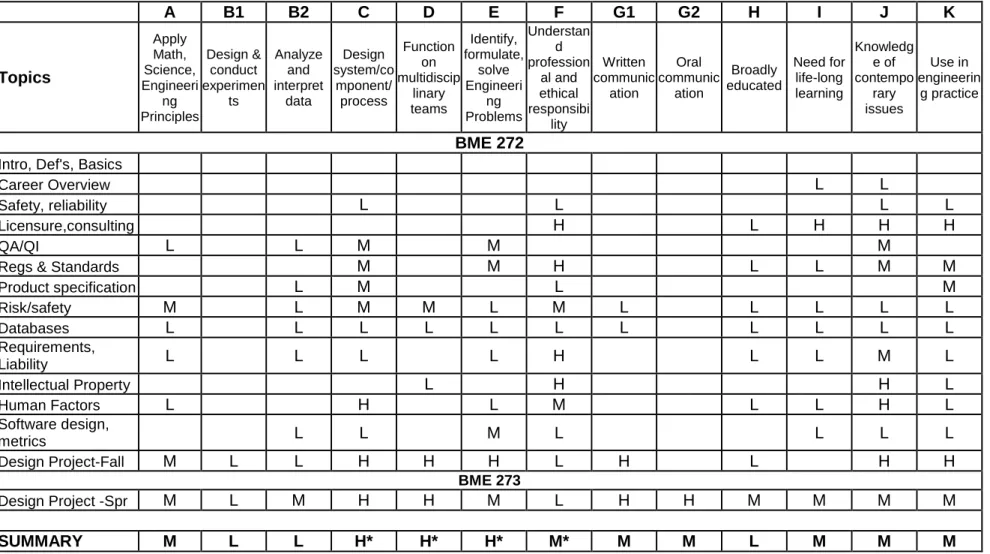
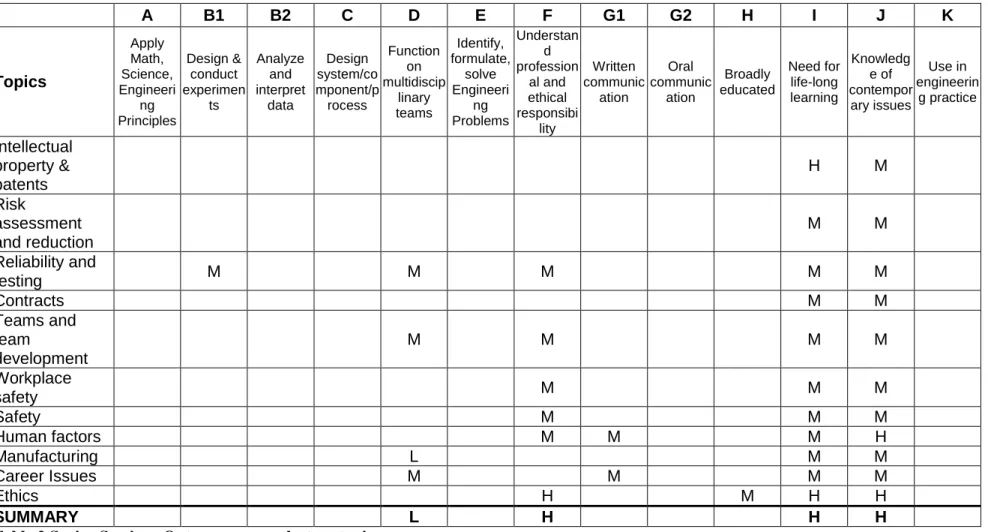
The Biomedical Engineering Program at Vanderbilt University has documented this attainment in at least two ways. First, in the summary documentation, the individual courses are documented by presenting course content versus outcomes, with an overall summary of the level of stress of each outcome at the bottom of the page. The summary page for the lecture and project portion of the Vanderbilt design sequence may be seen on the following page. The summary page for the seminar class follows. Second, course outcomes are documented through course notebooks and through “outcome notebooks”, which are made available for the ABET program evaluator. A photograph of the course documentation and outcome evaluation books for our program may be seen in figure 1.
The course outcome charts may be interpreted as follows: across the top of the chart are the ABET a-k outcomes (this can be a department’s augmented listing of the same material.) The left hand side of the chart lists the primary lecture or other activities pursued during the term of the course. The element at the intersection of these two parameters indicates the instructor’s evaluation of the coverage of this outcome with the class material (blank indicates none or minor, L indicates “low coverage”, M indicates “medium coverage”, and H indicate “high coverage.) The summary line(s) at the bottom of the page indicates the overall coverage of outcomes via this course, an outcome with an asterisk indicates (for our process) that this particular outcome will be documented in both the course and outcome books.
The course and outcome books that are prepared for the ABET evaluator may be quite extensive. The upper two shelves in the bookcase in figure 1 are our department’s “outcome exhibit file, generally comprising one notebook per outcome as listed in table one and two. The lower three shelves contain notebooks documenting each of our courses – required and elective, potentially taken by our students.
The amount of documentation gives a hint as to the areas stressed by the program. There are 13 outcome objectives stated by this program, these map into the 19 large notebooks on the top two shelves. “Apply math, science, and engineering principles (a)” and “written communication (g1)” each comprise three large notebooks, “analyze and interpret data (b2)”, “design system, component, process (c)” each comprise two notebooks. There are 27 course notebooks on the lower three shelves that cover both required and elective courses, the design sequence required of all students comprises 4 of them and is the only multi-book documentation of required or elective courses.
The above information regarding design suggests that the design sequence generates a significant amount of documentation with respect to the ABET evaluation of the program, as is the contention of this article. One way of verifying this, other than as done above, is to look at the coverage of each outcome for each of the required courses in the department. Doing so gives rise to the data shown in table two. Coverage may be defined by the number of non-blank lines in the summary statement of coverage of the 13 department specified outcomes (a-k) of our curriculum. This coverage, as may be seen below, ranges from a low of 38% in our second semester physiological systems course to 100% in both our design sequence and our physiological transport phenomena course. For those elements that are non-blank, if one assigns a 1 for low coverage, a 2 for medium, and a 3 for high, the sum of these terms might be termed the course intensity and is shown in the table (with respect to coverage of objectives.) The overall impact on the documentation of the course outcomes, termed “impact”, will be the product of these variables times the number of terms taught. As may be seen, once again the design sequence dominates this viewpoint of the ABET presentation of data for this curriculum.
From the above, and from this instructor’s viewpoint, the design sequence in this major is of critical importance to the ABET process.
BME 272-273 Design of Biomedical Engineering Devices and Systems I & II
Outcomes
A
B1
B2
C
D
E
F
G1
G2
H
I
J
K
Topics
Apply Math, Science, Engineeri ng Principles Design & conduct experimen ts Analyze and interpret data Design system/co mponent/ process Function on multidiscip linary teams Identify, formulate, solve Engineeri ng Problems Understan d profession al and ethical responsibi lity Written communic ation Oral communic ation Broadly educated Need for life-long learning Knowledg e of contempo rary issues Use in engineerin g practiceBME 272
Intro, Def's, Basics
Career Overview
L
L
Safety, reliability
L
L
L
L
Licensure,consulting
H
L
H
H
H
QA/QI
L
L
M
M
M
Regs & Standards
M
M
H
L
L
M
M
Product specification
L
M
L
M
Risk/safetyM
L
M
M
L
M
L
L
L
L
L
DatabasesL
L
L
L
L
L
L
L
L
L
L
Requirements, LiabilityL
L
L
L
H
L
L
M
L
Intellectual PropertyL
H
H
L
Human FactorsL
H
L
M
L
L
H
L
Software design, metricsL
L
M
L
L
L
L
Design Project-FallM
L
L
H
H
H
L
H
L
H
H
BME 273 Design Project -SprM
L
M
H
H
M
L
H
H
M
M
M
M
SUMMARY
M
L
L
H*
H*
H*
M*
M
M
L
M
M
M
BME 297 Senior Engineering Design Seminar
Outcomes
A
B1
B2
C
D
E
F
G1
G2
H
I
J
K
Topics
Apply Math, Science, Engineeri ng Principles Design & conduct experimen ts Analyze and interpret data Design system/co mponent/p rocess Function on multidiscip linary teams Identify, formulate, solve Engineeri ng Problems Understan d profession al and ethical responsibi lity Written communic ation Oral communic ation Broadly educated Need for life-long learning Knowledg e of contempor ary issues Use in engineerin g practiceIntellectual
property &
patents
H
M
Risk
assessment
and reduction
M
M
Reliability and
testing
M
M
M
M
M
Contracts
M
M
Teams and
team
development
M
M
M
M
Workplace
safety
M
M
M
Safety
M
M
M
Human factors
M
M
M
H
Manufacturing
L
M
M
Career Issues
M
M
M
M
Ethics
H
M
H
H
SUMMARY
L
H
H
H
Figure 1 The author with his department’s 2007 ABET documentation
Impact Analysis for Required BME Courses at Vanderbilt University
Course Name
Coverage (%) Intensity # terms, yr
Impact
Introductory Biomechanics
92
16
1, So
15
Biomedical Materials
85
20
1, So
17
Biomedical Instrumentation
92
21
1, Jr
19
Analysis of Biomedical Data
92
18
1, Jr
17
Physiological Transport Phenomena
100
24
1, Jr
24
Systems Physiology I
70
18
1, Jr
13
Systems Physiology II
38
10
1, Jr
4
Biomedical Engineering Laboratory
54
19
1, Sr
10
Senior Design
100
29
2, Sr
58
3.
DESIGN AND ABET EVALUATIONS, FROM A PROGRAM EVALUATOR’S
POINT OF VIEW
This author is an ABET program evaluator, a design instructor, and a registered Professional Engineer. The material that follows is this author’s approach to an ABET visit and must not be construed as official ABET doctrine.
Biomedical Engineering is a relatively new field, currently experiencing fairly rapid growth. About half of all current undergraduate programs are already accredited; many will be requesting this in the near future. The criteria for accreditation for an existing program are no different than that for an already accredited program; it is the approach to an analysis of the data presented that might differ between the two.
The initial approach to novice versus established programs will be the same – a review of the pre-visit documentation. There will generally be some noticeable difference between first and successive visit documentation, the entire process of ABET visits and documentation takes some time to get used to. This will generally translate into additional pre-visit emails requesting elaboration of details, but generally no major surprises for the novice programs. Most of the time, when a Biomedical Engineering program requests accreditation, they have the ability to obtain assistance from other departments and personnel who have been through the exercise.
For revisits, I will look for unique qualities and strengths of the program, rather than necessarily starting with the design sequence. For a first on-site visit to a program I prefer to go directly to the ABET documentation relating to the capstone design sequence. I will read through this material before attempting to read other materials. I will look at the quality of the (hopefully) exhibited final design reports. I will look at the course outline to determine topical coverage. I will look at the team composition – can I determine that the teams are interior multidisciplinary in nature? Can I find evidence of engineering supervisory input to the projects? Are the projects sufficiently challenging for a one term or two term sequence? Is the instructor qualified by virtue of experience and or licensing to supervise this work, or is the structure highly reliant on project supervisors from industry? Do the projects rely on prior coursework? Is the entire experience sufficiently broad in its coverage of the outcomes listed in the documentation given here for the design sequence? Would I, as an engineer, consider hiring the person(s) whose documentation I have just read on their senior design project? (The answer even in my own class will occasionally be no, but in less than 6% of the teams.) In interviews with student groups, it is further my experience that the design sequence is a major concern to the students; a poorly run class will generally engender comments.
As may be seen above, the senior design sequence is of critical importance to me as an ABET inspector.
4.
CONCLUSION
The senior design sequence, as presented above from the viewpoints of a course instructor and an ABET program evaluator, is critical to the overall evaluation of all Biomedical Engineering undergraduate programs during evaluation. It must be a primary source of documentation when one is preparing program data for perusal by a program evaluator.
2,862 words.