E
xEcutivES
ummaryCost-sensitivity and top-down pressure on the finance organization for greater efficiency are the new normal. In the accounts payable department, technology and innovation continuously challenge the status quo, as forward-thinking manag-ers adopt practices to automate the entire process. Indeed, the recent development of enhanced invoice recognition and data capture solutions (“invoice capture”) is a breakthrough in purchase-to-pay automation. Supplying a 56% cost advantage over paper-based invoice processing, invoice capture enables organizations to raise productivity, improve invoice match rates, capture more early-pay discounts and achieve greater spend visibility.
i
ntroductionEvery CFO dreams of the elusive “triple crown” of world-class accounts payable (AP) performance: minimal errors, maximum cash flow and optimized processes. In actuality, each of these objectives, and their resulting financial impact, can be achieved with a robust invoice automation strategy. Yet, despite a compelling business case for change, many AP organizations still manually process their con-ventional paper invoices and lack the enabling technology to efficiently handle electronic ones.
In the past, cost and performance targets drove many companies to explore invoice scanning as a cure-all for their “paper problem” and gateway to further automation. Unfortunately, the value promised by these first-generation optical character recog-nition (OCR) solutions seldom materialized. Confronted with high error rates and insufficient business systems integration, stakeholders quickly reduced their expec-tations about invoice OCR initiatives.
Thankfully, data capture and invoice processing solutions have improved signifi-cantly in recent years. Information accuracy has greatly increased with the intro-duction of technology that can “learn” to recognize supplier invoice layouts and “verify” document details against data elements from the ERP and purchasing system. Indeed, invoice capture is a technology that finally delivers on the threefold promise of AP automation.
By Phil Chambless, Kurt Albertson and Pierre Mitchell
Purchase-to-Pay Process Perspective
Feb. 18, 2012Management Issue For Current Members of Hackett Process Advisory Programs
T
he
C
ase
for
I
nvoICe
C
apTure
: T
ransform
a
CCounTs
p
ayable
wITh
T
hese
5 s
Imple
T
ruThs
How automated invoice recognition and capture solutions are driving out cost and redefining the value proposition of the purchase-to-pay process
In this research we explore the five principal aspects of an invoice capture
solution framework: 1. Strategy: Leverage multiple
forms of automation for maximum impact.
2. Function: Demand genuine invoice recognition and validation.
3. Process: Seize efficiency opportunities across accounts payable.
4. Impact: Raise the value propo-sition of purchase-to-pay. 5. Evaluation: Don’t make the
d
Efiningi
nvoicEa
utomationandc
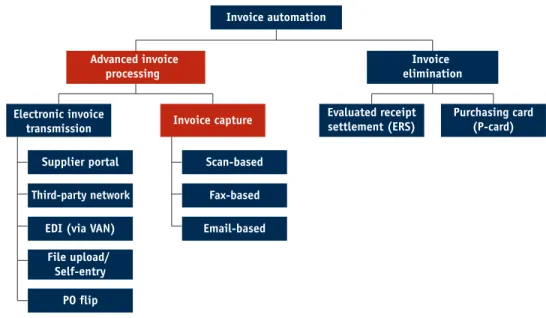
apturE“Invoice automation” can refer to any solution that is designed to mitigate the inef-ficiency of traditional paper invoice processing. The term encompasses a broad set of practices and technologies, which can be segmented across a basic hierar-chy (Fig. 1). At a high level, all invoice automation strategies achieve efficiency through either (a) advanced invoice processing or (b) elimination of the invoice requirement altogether. Most advanced invoice processing solutions incorporate data-validation logic, approval and payment workflow, and discrepancy-resolution coding to automate the process. Alternatively, invoice elimination strategies (such as ERS and certain P-card transactions) completely bypass the invoice requirement throughout the P2P lifecycle.
FIG. 1 Invoice automation technologies
Source: The Hackett Group
Invoice automation Advanced invoice processing Electronic invoice transmission Supplier portal Third-party network
EDI (via VAN) File upload/
Self-entry PO flip
Evaluated receipt
settlement (ERS) Purchasing card(P-card) Invoice capture Invoice elimination Scan-based Fax-based Email-based
As highlighted in Fig. 1, this research focuses on advanced invoice processing and the particular sub-category of invoice capture, which has undergone a tremendous amount of technological progress over the last five years. This generation of imag-ing technology is sometimes referred to as intelligent data capture (IDC), advanced recognition (AR) or intelligent document recognition (IDR) in Hackett research and elsewhere. In a nutshell, invoice capture includes imaging of a physical docu-ment (transmitted via mail, fax, email), enhanced recognition of the image, extrac-tion and validaextrac-tion of digital informaextrac-tion, and workflow connectivity with down-stream systems.
In the following pages, we present five basic ideas that organizations should con-sider when addressing the business case for invoice capture.
#1. f
orm
aximumi
mpact, L
EvEragEm
uLtipLEf
ormS ofa
utomationA significant challenge for most organizations in developing an optimal automa-tion strategy is determining how to move forward within the current process and technical environment, given the multitude of different offerings available. Many organizations focus on point solutions that address only one aspect of the invoicing process, a narrow view that ultimately limits the value and impact of investments in invoice automation. For example, many have invested heavily in e-invoicing, which allows invoice data to be transmitted through a host of different mechanisms (e.g., third-party supplier networks, EDI, supplier portals, etc.). Consequently, these companies often assume that invoice capture technology is inconsistent with their business strategy.
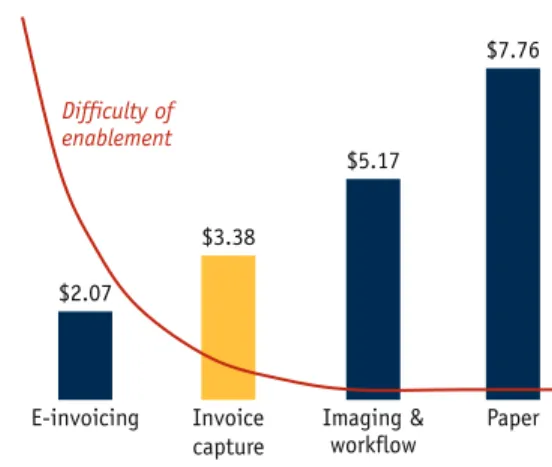
While it is true that the AP process cost per invoice associated with e-invoicing is lower than other forms of automation (Fig. 2)1, the notion that leading organiza-tions are pursuing only e-invoicing, to the exclusion of other forms of AP automa-tion, is not supported by the evidence. According to our 2011 Purchase-to-Pay Performance Study, the median AP department has migrated only 25% of its trans-action volume to an e-invoicing platform, and top performers are just above a 50% adoption rate.
The simple truth is that most leading organizations have opted to leverage a com-bination of invoice automation strategies to achieve the maximum impact across their supply base. For example, a basic automation strategy might leverage P-cards to eliminate invoices for certain spend categories, self-service automation technolo-gies to enable low-volume suppliers, invoice capture for medium-volume suppliers, and EDI or similar technology for high-volume suppliers. Other companies might view invoice capture as the cornerstone of their automation strategy and only lever-age electronic invoicing for certain strategic suppliers.
FIG. 2 Process cost per invoice
Source: Purchase-to-Pay Performance Study, The Hackett Group, 2011
0 1 2 3 4 5 6 7 8 $2.07 $3.38 $5.17 $7.76 E-invoicing Invoice
capture Imaging &workflow Paper
Difficulty of enablement
The reality is that several practical, technical, and legal hurdles exist which limit electronic invoice adoption. In many instances, the “tail” of supplier adoption can be overcome by an alternative and complementary form of automation. For example, consider the advantages that invoice capture presents in contrast to EDI (thereby lending credibility to a blended approach):
• Scope: The entire supply base can be targeted. With EDI invoicing, a seg-mentation analysis must be performed to narrow the scope to high-volume suppliers that justify the costly on-boarding effort.
• Deployment: Collaboration with suppliers and analysis of competing tech-nology standards are not necessary. With EDI invoicing, careful planning and negotiation must be undertaken to ensure compatibility and supplier acceptance.
• Flexibility: The incremental effort required to switch or add key suppliers is minimized. With EDI invoicing, friction can develop between sourcing and AP over high supply-base changeover.
• Compliance: Regulatory requirements of countries that require a physical invoice document are satisfied. In these cases, EDI invoicing is not even an option.
Finally, an optimized automation strategy should also include overarching controls to ensure end-to-end information quality. Integrated data validation, outlined in greater detail in the following section, is vital for the processing of all invoice docu-ments, as electronic documents are still subject to data error. It is therefore an estab-lished best practice for all invoices to follow a single, consistent process, irrespective of whether they are electronic or captured from paper. Likewise, it is critical that organizations leverage a coherent platform, process and set of technologies across all business units, physical locations and geographies.
#2. d
Emandg
EnuinEi
nvoicEr
Ecognition andv
aLidationDocuments that flow through a business process like AP are typically categorized as either structured, semi-structured or unstructured. Documents that follow a fixed, standard layout (e.g., government tax forms) are referred to as structured docu-ments. Those that contain common types of data but vary in layout (e.g., invoices) are referred to as semi-structured documents. Finally, unstructured documents vary in both layout and the types of data contained therein (e.g., legal contracts). In a traditional solution environment, structured documents are normally easier to process because the system “knows” where to look for certain data types. Semi-structured documents, however, pose more of a challenge. On an invoice, for example, information such as price or vendor name can reside in various locations, and thus, recognition rates for invoices and similar documents tend to be much lower. Historically, to address the challenges of semi-structured invoice documents, software providers and their customers would create templates for each supplier. Unfortunately, template configuration and maintenance is a time-consuming and costly process. In addition, traditional imaging solutions typically require the batching of invoices by supplier family for pre-processing activity, due to a lack of precise document classification technology.
Invoice capture: A game-changing advance
Fortunately, the evolution toward enhanced invoice recognition and data capture has changed the automation landscape entirely. Instead of using discrete, manually built extraction templates, invoice capture solutions establish connectivity with purchasing and ERP systems to intelligently identify information contained in semi-structured documents.
These solutions leverage that information to develop a knowledge base of heu-ristics used to interpret invoice data in real-time. For example, by identifying the purchase order (PO) number on the invoice, the solution can access the purchas-ing system and make use of information on the PO to correct the date format (e.g., “9 Jan 2012” versus “1/09/2012”) or help identify and pre-populate the invoice with the correct routing and approval information, regardless of document location or typographical errors. This process of automatically cross-checking and correcting of information is referred to as integrated invoice validation, a key com-ponent of all advanced invoice processing solutions.
Additionally, invoice capture solutions contain logic to identify the probability of a data record being misread and notify the user when the probability reaches a certain threshold. The user can then update highlighted data records, supported by additional functionality of the solution to accelerate the update process. The user does not have to key all the data into the system, but can access a graphical interface to “lasso” the data from the image (i.e., “point-and-click capture”). Additionally, a validation database lookup can be used, giving the vendor master file a cue to search based on a partial string and populate multiple data fields with only a few keystrokes. The user can also use auto-complete functionality, which presents a list of alternatives after typing the first few characters within a data field.
As the user performs these updates, the validation system begins to “learn” based on patterns, which increases the accuracy each time a similar document or data field is encountered. This capability is known as “invoice learning” and is a critical component of any enhanced recognition system that helps minimize ongoing con-figuration and maintenance costs. Invoice capture solutions also provide tools that facilitate account coding and approvals for non-PO invoices based on information in the document.
This functionality allows the solutions to broaden the automation of activity across the AP process. For example, the system can pre-populate account codes based on supplier, approver and item, highlighting the recommendation to the user for approval. Each time the user updates information, the system continues to learn and increase the accuracy of the integrated validation function, saving time and drawing closer to a truly touch-less invoice processing system.
Nevertheless, system effectiveness will vary widely across organizations and invoice capture solutions. Overall recognition accuracy can be affected by the number of different suppliers from which a company receives invoices, the quality of the invoices, variations in invoices from the same supplier, the availability of PO infor-mation (e.g., higher PO transaction usage), the accuracy of integrated master data,
and the effectiveness of the invoice learning system. This list highlights the necessity of implementing best practices across the P2P process in order to achieve the maxi-mum return on investment from invoice capture. In addition, the critical impor-tance of performing due diligence in selecting an automation provider cannot be overstated.
#3. S
EizEE
fficiEncyo
pportunitiESa
croSSa
ccountSp
ayabLEOne of the most commonly cited reasons to adopt invoice capture is process opti-mization, and the associated cost savings. However, organizations investigating these solutions often focus exclusively on the opportunity to reduce manual invoice processing time, when in fact invoice capture has the potential to improve the effi-ciency of six different AP sub-processes:
• Pre-processing: By automatically sorting paper documents and eliminating the need for batching of invoices, invoice capture solutions reduce pre-processing activity compared to traditional imaging solutions and manual processes.
• Verification/approval: Many invoice capture solutions have the functional-ity to assist in this sub-process by automating the identification of approval flows, verifying accounting codes and providing activity reports associated with approvals.
• Processing: Through validation capabilities that integrate with purchasing and master data management systems, invoice capture solutions support auto-matching of PO-based invoices and touch-less processing of non-PO invoices. This significantly streamlines what has traditionally been the most resource-intensive AP sub-process.
• Discrepancy resolution: By validating invoice information against purchas-ing and master data systems and increaspurchas-ing overall recognition rates, invoice capture solutions enable higher first-pass match rates (Fig. 3), thereby reducing discrepancy resolution costs.
• Inquiry response: Additional functionality built into some invoice capture solutions increases the efficiency of inquiry response activity. Self-service functionality allows suppliers and internal users to look up the status of any invoice online rather than placing a call or sending an email to an inquiry response resource.
• File/store/retrieve: By imaging the invoice on the front end, most organiza-tions will be able to adopt a policy of destroying the physical invoice after two to three months. This eliminates physical storage costs as well as the cost of sending the physical invoices for approval, storage or use in an audit. FIG. 3 Overall first-pass match rate
Source: Purchase-to-Pay Performance Study, The Hackett Group, 2011
Invoice capture 80% Paper 76% 0 20 40 60 80 100
#4. r
aiSE thEv
aLuEp
ropoSition ofp
urchaSE-
to-p
ayThe individual business case for implementing enhanced invoice recognition and data capture depends on a significant number of variables, including a company’s current invoice processing system, solution functionality, achievable levels of auto-mation and level of best-practice adoption. These variables should all be evaluated when analyzing return on investment. Returning to Fig. 2, the process cost per invoice for an organization that is pre¬dominantly paper-based ($7.76) is more than double the cost of an organization that relies on invoice capture ($3.38), and overall productivity levels associated with invoice capture are much higher (Fig. 4).
Working capital
Beyond the cost savings that invoice capture solutions can deliver, Hackett research has found that organizations successfully leveraging this technology are able to evolve the overall value proposition of the P2P process in order to meet strategic, enterprise-level goals. For example, while invoice capture solutions do not directly improve the efficiency of the payment sub-process, they do provide greater vis-ibility to invoice status and assist in prioritizing workflow and payments. This is done through reporting and the ability to analyze invoices based on such factors as due date and available early-payment discounts. This visibility helps companies optimize working capital, minimize late payments and develop a decision-based platform for dynamic discounting. Organizations that use invoice capture solutions are in a better position to capitalize on early-payment discounts than those using paper-based invoice processing (Fig. 5).
Spend visibility
Another key strategic capability that AP can enable is spend visibility. Our 2011 Purchase-to-Pay Performance Study results indicate that invoice capture solutions enable very high levels of spend visibility (Fig. 6). For non-PO invoices, where asso-ciated line item-level information is not maintained in the purchasing system, data must be captured directly from line items on the invoice. Invoice capture automates the collection of this spend data, and such visibility enables procurement to deliver on strategic sourcing initiatives and monitor compliance. The spend-savings advan-tage enjoyed by those with good spend visibility is compelling.
Enterprise scalability
Lastly, invoice capture provides organizations with a highly adaptable form of auto-mation. As growth accelerates, organizations must be able to respond rapidly and scale critical business processes, including invoice processing, to meet new levels of demand. But with persistent cost sensitivity, AP managers will continually be asked to deliver greater levels of process efficiency for the foreseeable future. Compared to both manual invoice processing and other automation solutions, invoice capture adapts quickly to changes in business climate (e.g., growth, supply base movement, hiring freezes, service placement migration) without compromising on speed-to-value. A flexible approach in automation technology, with real-time invoice learn-ing capabilities, is essential to meetlearn-ing future challenges.
FIG. 6 Percent of spend with line-item visibility
Source: Purchase-to-Pay Performance Study, The Hackett Group, 2011
Invoice capture 99% Paper 63% 0 20 40 60 80 100 FIG. 5 Early-pay discounts taken,
as a percent of available discounts
Source: Purchase-to-Pay Performance Study, The Hackett Group, 2011
Invoice capture 83% Paper 72% 0 20 40 60 80 100 FIG. 4 AP productivity: Number of
invoices processed annually per FTE
Source: Purchase-to-Pay Performance Study, The Hackett Group, 2011
Invoice capture 16,287 Paper 5,373 0 5000 10000 15000 20000
#5. d
on’
tm
akE thEb
uSinESSc
aSE in av
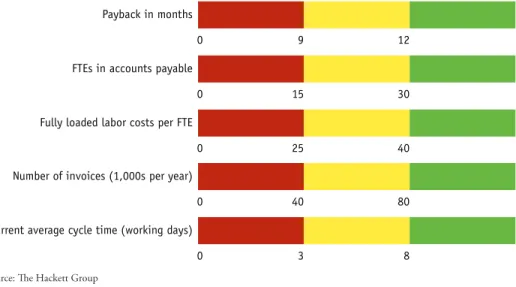
acuumThere are a number of guidelines to consider when assessing whether an invoice capture solution will be a good fit: expected payback period, the number of FTEs supporting the AP process, fully loaded labor costs, annual invoice volumes and processing cycle times. Fig. 7 provides a high-level assessment tool for a potential invoice capture solution implementation. The more strongly the criteria fall into the green zone, the greater the benefits that can be expected.
If the initial analysis determines that invoice capture is an appropriate automation candidate, the selection of a particular solution ought to reflect the strategy and operating environment of the AP department under consideration. Specifically, the following decision aspects should be evaluated:
• Ease of integration with existing applications (e.g., processing, workflow).
• Overall solution functionality and how this supports requirements (e.g., invoice recognition and data capture accuracy, integrated validation, out-of-the-box workflow, inquiry automation, dynamic discounting).
• The solution’s ability to drive touch-less processing (e.g., pre-populating account codes based on intelligent learning and integrated validation).
• In-house experience with the solution and vendor, and the vendor’s in-house expertise in developing and supporting AP automation.
• Solution pricing, taking into account the total cost of ownership.
• Time and cost to implement and ramp up to support a high volume of invoices, and to maintain the system when new suppliers are introduced and existing supplier invoices change.
• System and process performance at high invoice volumes.
• Usability of the solution for AP specialists, project designers, system admin-istrators, executive management and suppliers.
FIG. 7 High-level break-even and reasonable automation potential
Source: The Hackett Group
Payback in months
9
0 12
FTEs in accounts payable
15
0 30
Fully loaded labor costs per FTE
25
0 40
Number of invoices (1,000s per year)
40
0 80
Current average cycle time (working days)
3
L
ookinga
hEadWhile the focus of most automation solutions has traditionally been on streamlining the entry of invoice data, ultimately the greatest value will be created through touch-less processing of invoices, regardtouch-less of process design or automation approach. In fact, The Hackett Group foresees that invoice capture and other automation approaches (e.g., EIPP networks, EDI and XML document exchange, PO flip) will soon converge as solution providers continue to migrate core technologies into the cloud and take a service-driven approach to invoice processing and P2P transactional connectivity more broadly. Indeed, some providers have already moved in this direc-tion, offering a unified automation service to validate and transmit all company orders and invoices through the most efficient process available.
Still, invoice capture solutions continue to evolve. The ultimate goal is for all PO-based invoices, regardless of format, to flow through the matching process without manual intervention unless a true discrepancy occurs, and even then, it will be properly coded and routed for resolution. The same will be true for non-PO invoices, as learning systems use invoice information to enable integrated valida-tion decisions around proper coding and approval routing. As touch-less processing becomes foundational, the role of the AP organization will shift from one of tactical processing to the strategic management of working capital objectives, dynamic pay-ment discounts and global enterprise compliance.
r
ELatEdh
ackEttr
ESEarch“Intelligent Data Capture Solutions Drive Value Beyond the Traditional Optical Character Recognition Approach,” April 2010
“Building the Foundation for Dynamic Discounting Through Invoice Automation at Procter & Gamble,” February 2009
“Automating the Invoice Process: Optimizing the Approach and Building the Business Case,” October 2008
“Enabling the Purchase-to-Pay Process through Imaging and Workflow Auto-mation,” March 2006
a
bout thEa
dviSorSPhil Chambless
Program Leader, Purchase-to-Pay Process Advisory Program
In his current role, Mr. Chambless counsels executives on strategic initiatives, advises on best practices, produces topical research and leads client events. His work frequently involves guiding P2P leaders in establishing performance benchmarks and quantifying the value of process improvements. He has wide-ranging expertise in end-to-end requisition and payment practices, including P2P channel strategy, accounts payable auto-mation and process effectiveness. Previously, Mr. Chambless worked for nearly seven years leading Fortune 500 companies through transformational changes in procurement, supply chain and enabling technology.
Kurt Albertson
Senior Director of Advisory Services – Procurement
In his current role, Mr. Albertson advises leaders of Global 1000 organiza-tions on procurement and purchase-to-pay strategy, process, technology and organizational issues, conducts research to promote thought leader-ship, and leads client events promoting world-class performances, best practices and peer-to-peer learning. He has over 15 years of experience in procure-ment and purchase-to-pay. He offers a blend of consulting and industry experience, having served a wide variety of clients across many industries.
Pierre Mitchell
Senior Research Director, Procurement Executive Advisory Program
Mr. Mitchell has over 20 years of industry and consulting experience in procurement, supply chain and information technology. Mr. Mitchell is quoted widely in the press and speaks at numerous industry events on supply management trends and technologies. Previously he was vice president of supply management research at AMR Research and a manager at Arthur D. Little, where he led numerous supply chain and procurement transfor-mations at Fortune 500 companies. Other industry positions include manufactur-ing project manager at The Timberland Company, materials manager at Krupp Companies and engineer at EG&G Torque Systems.
About The
Hackett Group
The Hackett Group, a global strategic advisory firm, is a leader in best prac-tice implementation, advisory, bench-marking, and transformation consulting services, including shared services, offshoring and outsourcing advice. Utilizing best practices and implemen-tation insights from more than 5,000 benchmarking engagements, execu-tives use Hackett’s empirically based approach to quickly define and priori-tize initiatives to enable world-class performance. Through its REL brand, Hackett offers working capital solutions focused on delivering significant cash flow improvements. Through its Arch-stone Consulting group, the company offers Strategy & Operations consult-ing services in the Consumer and Industrial Products, Pharmaceutical, Manufacturing and Financial Services industry sectors. Through its Hackett Technology Solutions group, Hackett offers business application consulting services that helps maximize returns on IT investments. Hackett has worked with 2,700 major corporations and government agencies, including 97% of the Dow Jones Industrials, 84% of the Fortune 100, 80% of the DAX 30 and 49% of the FTSE 100.
Founded in 1991, The Hackett Group was acquired by Answerthink, which was renamed The Hackett Group in 2008. The Hackett Group has global offices in the United States, Europe, Australia and India and is publicly traded on the NASDAQ as HCKT.
The Hackett Group
Email: [email protected]Atlanta +1 770 225 3600 London +44 20 7398 9100
www.thehackettgroup.com Atlanta • New York • Chicago San Francisco • London • Paris
Frankfurt • Amsterdam Hyderabad • Sydney