Scholarworks@UAEU
Theses Electronic Theses and Dissertations
11-2016
Early Packet Rejection Using Dynamic Binary
Decision Diagram
Vasiqullah Molvizadah
Follow this and additional works at:https://scholarworks.uaeu.ac.ae/all_theses Part of theInformation Security Commons
This Thesis is brought to you for free and open access by the Electronic Theses and Dissertations at Scholarworks@UAEU. It has been accepted for inclusion in Theses by an authorized administrator of Scholarworks@UAEU. For more information, please [email protected]. Recommended Citation
Molvizadah, Vasiqullah, "Early Packet Rejection Using Dynamic Binary Decision Diagram" (2016).Theses. 450.
wu:u
United Arab Emirates U�iversity
United Arab Emirates University
College oflnformation Technology Department of Information Systems and Security
EARLY PACKET REJECTION USING DYNAMIC BINARY DECISION DIAGRAM
Vasiqullah Molvizadah
This thesis is submitted in partial fulfilment of the requirements for the degree of Master of Science in Information Security
Under the Supervision of Dr. Zouheir Trabelsi
Copyright© 2016 Vasiqullah Molvizadah All Rights Reserved
Advisory Committee
1) Advisor: Dr. Zou heir Trabelsi Title: Associate Professor
Department of Information Systems & Secu rity College of Information Technology
2) Member: Dr. Ezedin S. Baraka Title: Associate P rofessor
Department of Information Systems & Secu rity College of Information Technology
Approval of the Master Thesis
This Master Thesis is approved by the following Examining Committee Members:
I) Advisor (Committee Chair): Dr. Zouheir Trabelsi
Title: Associate Professor
Department of Information Systems & Security College of Information Technology
Signature
�
2) Member: Dr. Ezedin S. Bm·aka Title: Associate Professor
Department of Information Systems & Security College of Information Technology
Signature
� ��h
3) Member (External Examiner): Dr. Fatma Outay Title: Assistant Professor
Department of Innovative Technology Institution: Zayed University
_r}p!t;t
�Signature __
.,-'!!
-
��
�
���=======-
-Date
/.C
/Jg /�/£
� I
Date
I
/2.f
I )-{
Sl� [._
This Master Thesis is accepted by:
Dean of the Colleg e ofl nformation Technology: Professor Omar El-G ayar
Signature Date
---Dean of the Colleg e of the Gradu ate Stu dies: ProfessorNagi T. Wakim
Signature
�
Copy
_7_
of_z_
Declaration of Original Work
I, Vasiqullah Molvizadah, the undersigned, a graduate student at the United Arab Emirates University (UAEU), and the author of this thesis entitled “Early Packet Rejection using Dynamic Binary Decision Diagram”, hereby, solemnly declare that
this thesis is my own original research work that has been done and prepared by me under the supervision of Dr. Zouheir Trabelsi, in the College of Information Technology at UAEU. This work has not previously been presented or published, or formed the basis for the award of any academic degree, diploma or a similar title at this or any other university. Any materials borrowed from other sources (whether published or unpublished) and relied upon or included in my thesis have been properly cited and acknowledged in accordance with appropriate academic conventions. I further declare that there is no potential conflict of interest with respect to the research, data collection, authorship, presentation and/or publication of this thesis.
Abstract
A firewall is a hardware or software device that performs inspection on a given incoming/outgoing packets and decide whether to allow/deny the packet from entering/leaving the system. Firewall filters the packets by using a set of rules called firewall policies. The policies define what type of packets should be allowed or discarded. These policies describe the field values that the packet header must contain in order to match a policy in the firewall. The decision for any given packet is made by finding the first matching firewall policy, if any.
In a traditional firewall, the packet filter goes through each and every policy in the list until a matching rule is found, the same process is again repeated for every packet that enters the firewall. The sequential lookup that the firewall uses to find the matching rule is time consuming and the total time it takes to perform the lookup increases as the policy in the list increases. Nowadays, a typical enterprise based firewall will have 1000+ firewall policy in it, which is normal.
A major threat to network firewalls is specially crafted malicious packets that target the bottom rules of the firewall’s entire set of filtering rules. This attack’s main objective is to overload the firewall by processing a flood of network traffic that is matched against almost all the filtering rules before it gets rejected by a bottom rule. As a consequence of this malicious flooding network traffic, the firewall performance will decrease and the processing time of network traffic may increase significantly
The current research work is based on the observation that an alternative method for the firewall policies can provide a faster lookup and hence a better filtering performance. The method proposed in this research relies on a basic fact that the policy can be represented as a simple Boolean expression. Thus, Binary Decision Diagrams (BDDs), are used as a basis for the representation of access list in this study.
The contribution of this research work is a proposed method for representing firewall policies using BDDs to improve the performance of packet filtering. The proposed mechanism is called Static Shuffling Binary Decision Diagram (SS-BDD), and is based on restructuring of the Binary Decision Diagram (BDD) by using byte-wise data structure instead of using Field-wise data structure. Real world traffic is used during the simulation phase to prove the performance of packet filtering. The numerical results obtained by the simulation shows that the proposed technique improves the performance for packet filtering significantly on medium to long access lists. Furthermore, using BDDs for representing the firewall policies provides other useful characteristics that makes this a beneficial approach to in real world.
Keywords: Firewall, Packet Filter, Binary Decision Diagram, Early Rejection, Packet Matching.
Title and Abstract (in Arabic)
يئانثلا رارقلا مسر مادختساب تانايبلا دورطل رّكبملا ضفرلا
خلملا صةدراولا تانايبلا دورط صحفب موقي جمانرب وأ زاهج وه يرانلا رادجلا
امإ ررقي مث ،ةجراخلاو
روبعلا نم اهعنم وأ اهل حامسلا
.
ىمست دعاوق مادختساب تانايبلا دورط يرانلا رادجلا حّشري
يرانلا رادجلا تاسايس
.
لثامت يتلا تانايبلا درط ةئداب يف لوقحلا ميق تاسايسلا هذه فصت
ةقباطتم ةسايس لوأ ىلع ًءانب رارقلا يرانلا رادجلا ذختيو ،ةسايسلا
.
ف
ىتح ىرخلأا ولت ةدحاو ،تاسايسلا لك ىلع تانايبلا درط رمي ،ةيديلقتلا ةيرانلا ردجلا ي
ةقباطم ةسايس دوجو فداصي
.
ءانثتسا لاب دورطلا لكل ةيلمعلا هذه رركتت
.
ثحبلا ربتعيو
ةبسنلاب ًادرط دادزي ةقباطملل مزلالا تقولا نأ امك ،تقولل ًاكلهتسم ةقباطتم ةسايس نع لسلستملا
دعل
ةطوبضملا تاسايسلا د
.
هذه يف ةطوبضم ةسايس فلأ نم رثكأ ىلع ةيرانلا ردجلا يوتحتو
مايلأا
.
ةسايس رخآ ةثيبخلا دورطلا هذه فدهتست ثيح ،ةيرانلا ردجلا ىلع ًارطخ دورطلا ضعب لكشت
لواحيو دورطلا هذه يرانلا رادجلا جلاعي نيح يف ،يرانلا رادجلا قهرت يكل ةطوبضم
ك عم اهتقباطم
اهرخآ ىلإ لصي ىتح ةطوبضملا تاسايسلا ل
.
هذه نم ٍضيف لاسرإ ّنإو
ةجلاعملا تقو يف ةظوحلم ةدايزو يرانلا رادجلا ءادأ يف صقن ىلإ يدؤي ةثيبخلا دورطلا
.
ءادأ ىلإ يدؤي فوس ثحبلل عرسأ قرط مادختسا نأ ةظحلام ىلع ينبم يلاحلا ثحبلا ّنإ
ا نأ ةقيقح ىلع ًاضيأ ينبم وهو ،لضفأ
ةيقطنم تاريبعتك اهليثمت نكمي تاسايسل
Boolean
expressions.
يئانثلا رارقلا مسر مادختسا مت ،كلذ ىلع ءانبو
BDD
ةساردلا هذه يف
.
مسر مادختساب يرانلا رادجلا تاسايس ليثمتل ةحرتقم ةقيرط ربع لمعلا اذه يف ماهسلإا ىّلجتيو
يئانثلا رارقلا
BDD
تانايبلا دورط حيشرت ءادأ نيسحتل
.
رارقلا مسر ةمدقملا ةقيرطلا ىّمستو
نوكسب طّلخُملا يئانثلا
SS-BDD.
يئانثلا رارقلا مسر بيترت ةداعإ ةقيرطلا هذه مدختستو
تيابلا ىلع ينبم تانايب نيوكت مادختساب
byte
لقحلا نم ًلادب
.
تانايب دورط مادختسا مت دقو
لإ ةاكاحملا يف ةيقيقح
ةقيرطلا هذه نأ رهظت ةجرختسملا تاسايقلا نأ امك ،ةقيرطلا ةيلاعف تابث
ةليوطلاو لوطلا ةطسوتم تاسايسلا يف ظوحلم لكشب ءادلأا نسحت
.
ةيسيئرلا ثحبلا ميهافم
:
ضفرلا ،يئانثلا رارقلا مسر ،تانايبلا دورط حيشرت ،يرانلا رادجلا
تانايبلا دورط ةقباطم ،رّكبملا
.
Acknowledgements
Firstly, I would like to express my sincere gratitude to my advisor Dr. Zouheir Trabelsi for the continuous support of my study and related research, for his patience, motivation, and immense knowledge. His guidance helped me in all the time of research and writing of this thesis. I could not have imagined having a better advisor and mentor for my Master’s study.
I would like to thank the chair and all members of the Department of Information Systems & Security at the United Arab Emirates University for assisting me all over my studies and research. My special thanks are extended to Dr. Mehedy Masud for providing me with the relevant reference material.
Special thanks go to my family: my parents and to my brothers for supporting me throughout writing this thesis and my life in general.
Dedication
Table of Contents
Title ... i
Declaration of Original Work ... ii
Copyright ... iii
Advisory Committee ... iv
Approval of the Master Thesis ... v
Abstract ... vii
Title and Abstract (in Arabic) ... ix
Acknowledgements ... xi
Dedication ... xii
Table of Contents ... xiii
List of Tables... xvi
List of Figures ... xvii
Chapter 1: Introduction ... 1
1.2 Firewall Basic Approaches ... 2
1.2.1 Circuit level firewall ... 3
1.2.2 Application-level firewall ... 3
1.2.3 Packet filtering firewall ... 3
1.3 Firewall Policy ... 4
1.4 Problem Statement ... 5
Chapter 2: Related Work ... 7
Chapter 3: Using Binary Decision Diagram for Packet Filtering ... 8
3.1 Binary Decision Diagram ... 8
3.2 Ordering and Reducing ... 9
3.3 The Variable Ordering Effect... 10
3.4 Binary Decision Diagram Packet Filter ... 11
3.4.1 Boolean Variables ... 12
3.5 Example of Firewall Policy list conversion ... 12
3.7 Issues Field-wise lookup ... 15
Chapter 4: Static Shuffling Binary Decision Diagram (SSBDD) ... 18
4.1.1 Policy Representation Phase ... 20
4.1.2 Packet Filtering Phase ... 21
4.2 Field Ordering ... 22
4.2.1 Field Count Distribution ... 24
4.2.2 Rule Reordering vs Field Reordering ... 25
Chapter 5: Implementation ... 26
5.1 Policy Representation using SSBDD ... 26
5.1.1 Input the Firewall Rules ... 26
5.1.2 Rule to Binary Format ... 28
5.1.3 SSBDD Generation ... 30
5.2 SSBDD Packet Filtering ... 31
5.3 BDD Packet Filter vs SSBDD Packet Filter ... 33
5.3.1 BDD Packet Filter ... 34
5.3.2 SSBDD Packet Filter ... 35
Chapter 6: Analytical Discussion of the SSBDD ... 37
6.1 SSBDD Representation of Access List ... 37
6.1.1 The Effect of Rule Structure ... 39
6.1.2 The Effect of Variable Ordering ... 39
6.2 Performing Lookup on a SSBDD ... 40
6.2.1 Worst Case Analysis ... 40
6.2.2 Best Case Analysis ... 41
6.3 Memory Usage of SSBDD ... 42
Chapter 7: Architecture and Simulation ... 43
7.1 System Implementation ... 43
7.1.1 Packet Filter Specification ... 43
7.2 Coding and Modules ... 44
7.2.1 RunMe.py ... 45
7.2.2 Formula.py ... 46
7.2.3 MatchRule.py ... 47
7.4 Simulation Environment ... 48 7.5 Simulation Dataset ... 49 7.6 Simulation Framework ... 49 Chapter 8: Statistics ... 51 8.1 Simulation Results ... 51 8.1.1 Experiment A ... 52 8.1.2 Experiment B ... 52 8.1.3 Experiment C ... 53 8.1.4 Experiment D ... 53 8.1.5 Experiment E ... 54
Chapter 9: Conclusion and Future Work ... 55
9.1 Future Work ... 55
9.1.1 Variable Ordering and Reordering Prediction ... 55
9.1.2 Updating the SSBDD ... 56
9.1.3 Considering more Parameters for Performance ... 56
9.2 Conclusion ... 56
List of Tables
Table 1: The Boolean variable required for BDD representation ... 12
Table 2: Sample Firewall Policy List ... 13
Table 3: Rules ... 16
Table 4: A Sample Policy List ... 20
Table 5: Variable Ordering ... 22
Table 6: Binary equivalent of a rule ... 34
Table 7: Sample Access List ... 38
List of Figures
Figure 1: Binary Decision Diagram ... 9
Figure 2: Two BDDs for the function x1y1 V x2y2 V ... V xnyn for n=3 ... 11
Figure 3: BDD Lookup ... 15
Figure 4: BDD Tree of Table 3 ... 16
Figure 5: SSBDD Architecture ... 19
Figure 6: BDD Representation ... 21
Figure 7: BDD Packet Filter ... 34
Figure 8: SSBDD Packet Filter ... 35
Figure 9: Modules of SSBDD implementation ... 45
Figure 10: Other Coding Modules. ... 48
Figure 11: Simulation Framework Overview ... 50
Figure 12: Experiment A Result ... 52
Figure 13: Experiment B Result ... 52
Figure 14: Experiment C Result ... 53
Figure 15: Experiment D Result ... 53
Chapter 1: Introduction 1.1 Overview
The Internet has come a long way since its inception, the accomplishment in terms of data accessibility and availability has been growing exponentially over the couple of decades (Cheswick, 2003). Today every other business is now reorganizing itself to utilize the power of the Internet to connect to its users. The type of services and application available on the Internet have become more powerful – starting from a simple static webpage in the 1990s to online banking, shopping. The fact of increasing number of users using the Internet implies an increasing number of malicious attacks, which means that systems and their networks require protection from unintentional incidents as well as malicious acts (Nikolaidis, 2000).
The increasing complexity of the Internet makes the solution of computer network security more complex, which is why organization does not use just one solution instead they apply layers of security to protect themselves. The best way of ensuring security is by using a network firewall. A firewall is a computer, router, or other communication device that filters access to the protected network (Nikolaidis, 2000). Cheswick and Bellovin (Cheswick, 2003) (Ballew, 1997) define a firewall as a collection of components or a system that is placed between two networks and possesses the following properties:
All traffic from inside to outside, and vice-versa, must pass through it.
Only authorized traffic, as defined by the local security policy, is allowed to pass through it.
Firewalling is the easiest method of all used by the network administrator to control the access between networks (Ballew, 1997). The idea to use firewall to protect the network, is that controlling access to the network and its resources by protecting each host is difficult and does not scale (Oppliger, 1998). Firewall solves this issue by creating a single connection point for multiple network and providing a single security checkpoint. This single checkpoint will have a security policy that defines what type of connection is allowed or rejected. It can be assumed that the firewall itself is immune to penetration.
One of the main criticism of firewalls is that they often create bottlenecks (Nikolaidis, 2000). The reason of this bottleneck is mainly how the firewall policies are constructed. If the policies are not constructed properly then it may cause loss of network performance. This motivates the need for faster firewall technologies, keeping in mind that there is a tradeoff between performance and security.
1.2 Firewall Basic Approaches
Firewall is usually installed at the edge of the network where the private or the Intranet connects to the public network, making it easier for the firewall to monitor all the traffic at once. Although firewall may also be placed between departmental networks within a company. The level of security and behavior exhibited by the firewall depends on the type of firewall used but for this research is focused on the Packet Filter Firewall. There are three basic approaches that a firewall uses to protect the network: packet filtering, circuit level firewall, and application level firewall (Cheswick, 2003)
1.2.1 Circuit level firewall
Circuit level firewall is a type of firewall that works at the session layer of the OSI model, between the application layer and the transport layer of the TCP/IP stack. They monitor the handshaking between two systems and decided whether a request session is legitimate or not. It filters the packet, by relying on the data contained in the packet headers for the TCP session-layer protocol. These type of firewalls usually operates two layers higher than a packet-filtering firewall does. It determines if the requested session is legitimate or not by checking the SYN flags, ACK flags, and the sequence numbers are involved in the TCP handshaking or not. The issue with circuit-level proxy is that it has no understanding of the application protocols they support. They cannot scan application data for dangerous commands or executable contents.
1.2.2 Application-level firewall
Application-level proxy operates at the application layer of the firewall. An application-level runs a proxy server for each application that it supports. The proxy request on behalf of the user to the destination host. Proxy server has some understanding of the application it is supporting and can be configured to reject malicious content packets. Application level firewall are not easy to scale.
1.2.3 Packet filtering firewall
Packet filtering firewall operates at the network layer and is the simplest type of firewall. Since, the firewall operates at the network layer so it has no idea of the content of the packets like the other type of firewall mentioned above. The packet filtering firewall works on the concept of policies. The policies use the information –
source port, destination port, source ip, destination ip, and protocol – to filter malicious traffic from the network.
Security is provided by comparing the packets against the list of the firewall rules and deciding whether to allow or deny the packets based on the action defined in the matched rule. Packet filtering firewall is widely used as a first line of defense in any enterprise. There are numerous reason for it (Cheswick, 2003) (Oppliger, 1998)
Faster than other firewall technologies
It is a low-cost technology. Many commercial routers have the packet filtering capabilities in it. There is various free open-source packet filtering firewall available.
It is normally transparent to applications and users.
1.3 Firewall Policy
The packet filter firewall is usually specified by a set of rules. The rules are a simple if-then-else structure with each rule defining the action that should be taken, if any packet matches. A set of rules in the firewall is known as access control list, policy list or rules (Ballew, 1997). The firewall traverses the rules sequentially to find the matching rule for any given packet.
Defining the firewall policy is simple for any user but it has its own disadvantages if they are not defined properly. The order of how the rules are inserted and represented in the firewall is of high importance which can affect the overall performance of the firewall. For this reason, the packet filtering implementation represents the list of policies in the firewall in a linear fashion. The decision making process called lookup
goes through each rule one at a time in a linear fashion and decided whether the packet should be accepted or rejected until a matching rule is found. The time taken to perform the lookup is clearly proportional to the number of rules in the firewall.
1.4 Problem Statement
The main aim of this research is to propose a new representation technique called Static Shuffling Binary Decision Diagram or SSBDD for the access list of the firewall. The reason to propose a new representation technique is because the firewall rules are consulted more frequently and they are modified less frequently. There are many representation techniques for the firewall policies which are discussed briefly in the Related Work Section but for this research, Binary Decision Diagram or BDD is chosen as the base for the representation of the access list. SSBDD is a modified version of the regular BDD. Using BDD as the representation technique has its own advantages such as: -
Each of the rule in the firewall is simply a logical expression that is based on the values in the rule. If any packet satisfies the condition in the rule, then the packet is either accepted or rejected based on the action in the rule.
The entire firewall access list is represented as a single Boolean expression that describes (Gupta, 2001) (Trabelsi, 2014) what condition each packet must meet. BDD is a very well-known data structure for storing and manipulating Boolean expressions compactly and efficiently.
This research addresses the following question:
How to perform an early packet rejection using Binary Decision Diagram as its data structure?
Chapter 2: Related Work
Packet filtering consists into performing a sequential lookup for each network packet against the rule list until a matching rule is found. Due to the sequential lookup nature of the firewall, the performance of the firewall will degrade over the time if the size of the rule list of the firewall increases. Different approaches have been proposed to improve firewall performance, using mainly, specialized data structure (Srinivasan, 1999) or heuristics solutions (Gupta, 2001).
The idea of firewall optimization using data mining is discussed in (Trabelsi, 2014). The proposed technique uses classifier for packet filtering. At first, the technique tries to get the matching classifiers. If it is unable to get any classifier, then it will use the firewalls sequential lookup to find the matching rule.
Another approach is discussed in (Boutaba, 2009), which uses BDD to generate a relaxed version of the firewall rules that can be evaluated more quickly. After processing a packet, the proposed technique will conclude to one of the three following options: accept, reject, or more filtering is required. In case of more filtering, the original policy will be used to look for a matching rule in the list, if any. In (Zeidan, 2012), Splay Tree based technique (Statistical Splay Filtering with Binary Search on Prefix Length) is used to improve the firewall performance. The optimization technique allowed the firewall to perform an early packet rejection through multilevel filtering process including field and intersection filtering modules.
Chapter 3: Using Binary Decision Diagram for Packet Filtering
The original idea of BDD packet filter was developed by (Hazelhurst, 1998) (Bryant, 1992). BDD provides a powerful and flexible way to represent the policies of the firewall. Each policy of the firewall can be represented using BDD via a simple Boolean expression. Boolean expression is simply consisting of a number of predicates, where each predicate shows what path to follow in the BDD.
Since, in BDD each policy of the firewall is represented as a Boolean expression and as the number of policy increases the size of the BDD will increase as well. However, BDDs are well-known for its compact representation of Boolean expression. So using BDD as a packet filtering approach can provide an advantage in terms of performance, which is the most important factor for any firewall. This chapter is devoted to describing the BDD approach to packet filtering in detail.
3.1 Binary Decision Diagram
Binary Decision Diagram represent Boolean functions as rooted, directed acyclic graphs (Bryant, 1992). In a non-technical term, a BDD can look like a decision tree, as shown in Figure. 1. Each non-terminal node in a BDD represents a value to a particular variable, and each non-terminal node has two children representing the possible value for the non-terminal node (0 or 1). The dashed edge corresponds to the case where the variable is assigned 0 and the solid edge corresponds to the case where the variable is assigned 1. A BDD has two terminal nodes which are Boolean constants and has a value of 0 and 1.
Figure 1: Binary Decision Diagram
3.2 Ordering and Reducing
The issue with BDD representation is, as the number of policy increases in the firewall the size of the BDD also increases as it will increase the Boolean expressions. To overcome this problem, (Bryant, 1992) introduced the concept of reduced, ordered binary decision diagrams (ROBDDs) that potentially provide a much more compact representation for many Boolean expressions. ROBDDs are basically a compact version of a BDDs due to the following restrictions on it (Bryant, 1992).
The variables of a ROBDD must obey a total ordering, so that for any vertex labelled u and any of its children labelled v, u appears before v along any path from the root of the graph to a leaf.
A ROBDD may not contain duplicate terminals. This leaves a ROBDD with a two terminal vertices (one labelled 0 and the other labelled 1).
A ROBDD may not contain duplicate non-terminals. Duplicate non-terminals are those that represent the same variable where the corresponding branches lead to the same place.
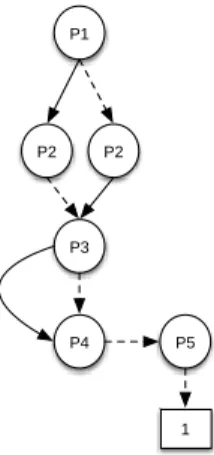
P1 P2 P4 P2 P5 1 P3
A ROBDD may not contain redundant tests. If, at a particular vertex in the graph, both possible values lead to the same place, then this test is unnecessary.
These restrictions result in ROBDDs possessing some useful properties. Firstly, they provide compact representations of Boolean functions. Although in the worst case, their graph size can be exponentials in the number of variables, many non-trivial Boolean functions have a polynomial size ROBDD (Bryant, 1992). Since ROBDDs offers so many advantages over unrestricted BDDs, most applications that use BDDs actually use ROBDDs, so it is very common to simple refer ROBDDs as BDDs (Andersen, 1997).
3.3 The Variable Ordering Effect
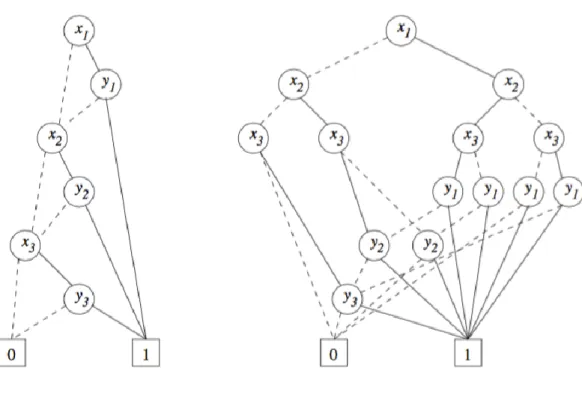
The variable ordering chosen for a BDD has a strong impact on its shape and size (Bryant, 1992). If the variable order is not chosen correctly, then it can make the BDD for the same Boolean function from a linearly sized to an exponentially sized BDD as show in Figure 2.
Figure 2: Two BDDs for the function x1y1 V x2y2 V ... V xnyn for n=3 For a function that cannot be represented in a compact format, it is best to choose an optimal variable ordering for it. However, finding an optimal variable ordering for a BDD is a NP-complete problem (Bollig, 1996). As a result, variable order are often chosen manually or using some heuristics.
3.4 Binary Decision Diagram Packet Filter
In a BDD as a packet filter, a BDD is used to represent the firewall’s entire policy list, and the same BDD is then used to perform lookup on the incoming packets. The representation of the BDD is stored in the memory and whenever a new policy is added to the list the BDD is then regenerated again. The BDD is a representation of the Boolean expression that describes exactly what packets must be accepted or rejected. In simple words, all paths through the BDD that lead to the terminal labelled 1 represent the types of packets that are accepted, and the opposite is true for
all paths leading to the terminal labelled 0. Each node or variable in the BDD refers to a specific bit in the packet header.
3.4.1 Boolean Variables
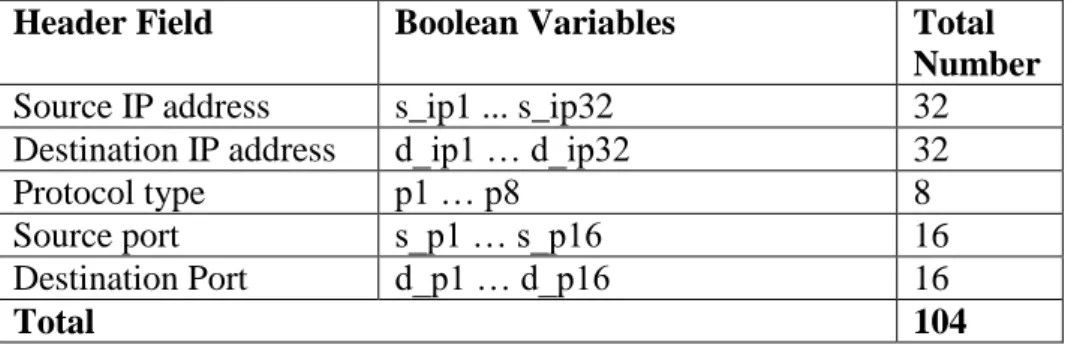
To represent a firewall policy as a BDD it is important to know what variable in the BDD refers to which field in the packet header, as each variable in the BDD corresponds to a specific bit in the packet header itself. A BDD’s Boolean expression will consist of multiple variable; in a normal case each policy is represented by at least 104 Boolean variables. Below is the table that describes the variable naming that will be used throughout this work.
Header Field Boolean Variables Total
Number
Source IP address s_ip1 ... s_ip32 32
Destination IP address d_ip1 … d_ip32 32
Protocol type p1 … p8 8
Source port s_p1 … s_p16 16
Destination Port d_p1 … d_p16 16
Total 104
Table 1: The Boolean variable required for BDD representation
3.5 Example of Firewall Policy list conversion
The example below demonstrates how a firewall policy list can be converted into a Boolean expression. The policy list to be used for the conversion process is shown in the Table 2. This BDD has its protocol variables ordered first, followed by the variables corresponding to destination information, followed by the variables corresponding to the source information. The default policy of the firewall is to deny all packets.
Rule Proto Source IP Source Port Destination IP Destination Port Action
1 TCP 172.21.1.89 9070 10.2.12.98 80 Permit
2 TCP 172.25.12.1 7788 81.23.1.87 443 Permit
Default Policy.
Table 2: Sample Firewall Policy List
Step 1: Defining the Boolean Variables
The following 5 fields - source address, destination address, source port, destination port, and protocol – are used by the packet filter on the incoming packets. By summing up all the field sizes of the header gives a total of 104 bits, so a total of 104 variables are required to represent the BDD of this access list. The variable naming to be used for the BDD representation is shown in Table 1.
Step 2: Converting Individual Rules
This step involves in converting the give policy into a Boolean expression. This is accomplished by forming a conjunction of each predicate. Let Ri denote the Boolean representation of Rule I. To convert the first rule:
Let p = Protocol = TCP
= p8’ p7’ p6’ p5’ p4’ p3 p2 p1’ Let s_p = Source Port = 9070
= s_p16’ s_p15’ s_p14 s_p13’ s_p12’ s_p11’ s_p10 s_p9 s_p8’ s_p7 s_p6 s_p5’ s_p4 s_p3 s_p2 s_p1’
Let d_p = Destination Port = 80
= d_p16’ d_p15’ d_p14’ d_p13’ d_p12’ d_p11’ d_p10’ d_p9’ d_p8’ d_p7 d_p6’ d_p5 d_p4’ d_p3’ d_p2’ d_p1’
Let s_ip = Source IP = 172.21.1.89
= s_ip32 s_ip31’ s_ip30 s_ip29’ s_ip28 s_ip27 s_ip26’ s_ip25’ s_ip24’ s_ip23’ s_ip22’ s_ip21 s_ip20’ s_ip19 s_ip18’ s_ip17 s_ip16’ s_ip15’ s_ip14’ s_ip13’ s_ip12’ s_ip11’ s_ip10’ s_ip9 s_ip8’ s_ip7 s_ip6’ s_ip5 s_ip4 s_ip3’ s_ip2’ s_ip1
Let d_ip = Destination IP = 10.2.12.98
= d_ip32’ d_ip31’ d_ip30’ d_ip29’ d_ip28 d_ip27’ d_ip26 d_ip25’ d_ip24’ d_ip23’ d_ip22’ d_ip21’ d_ip20’ d_ip19’ d_ip18 d_ip17’ d_ip16’ d_ip15’ d_ip14’ d_ip13’ d_ip12 d_ip11 d_ip10’ d_ip9’ d_ip8’ d_ip7 d_ip6 d_ip5’ d_ip4’ d_ip3’ d_ip2 d_ip1’
Then R1 = p s_p d_p s_ip d_ip
The expression is constructed similarly for the other rules.
Step 3: Combining all the rules
Using the steps shown above the expression can be generated for all the rules in the same way and once it is done, the next step is generating a single expression for all the rules. The expression is generated as follows:
Final expression = (R1 R2)
The final expression says that the incoming packets are either accepted by Rule R1 or Rule R2.
3.6 Performing a Lookup
In a linear or classic BDD, once generated, performing a lookup on the given incoming packet is simply a comparison. The comparison starts from the top node or root node of the BDD and continues till it reaches a terminal node either 0 or 1. In case if it reaches terminal node 0, then the given packet is rejected. However, if it reaches the terminal node 1, then the given packet is accepted.
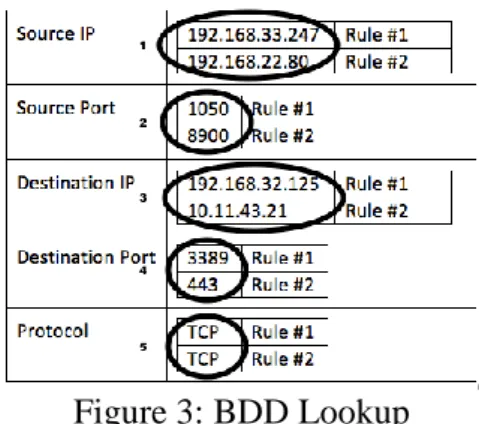
Figure 3 shows how a regular BDD performs a lookup upon receiving an incoming packet. In this paper, this search will be referred as Field-wise search since it checks one entire field at a time.
Figure 3: BDD Lookup
3.7 Issues Field-wise lookup
Field-wise lookup gives acceptable performance when the ratio of the accepted traffic is higher than the ratio of the rejected traffic. But, if the ratio of accepted traffic is very less, compared to the rejected traffic’s ratio, the field-wise search performance will degrade. This is because in attacks, like DoS, the traffic usually gets rejected at the bottom rules of the firewall.
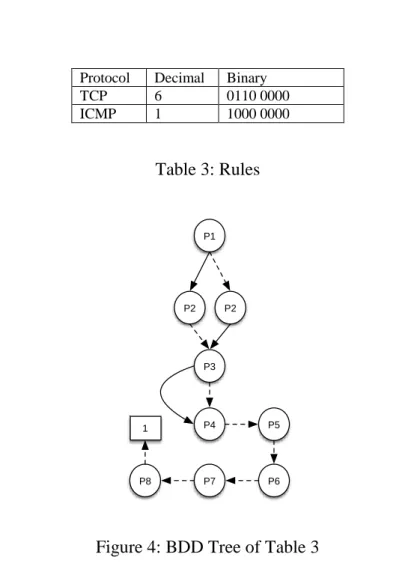
To understand the issues of field-wise BDD lookup, let’s take an example of two filtering rules with a protocol field, as shown in Table 3, whose BDD is shown in Figure 4.
Protocol Decimal Binary TCP 6 0110 0000 ICMP 1 1000 0000
Table 3: Rules
Figure 4: BDD Tree of Table 3
Considering DoS – it mainly targets the firewall by sending malicious traffic targeting the bottom rules of the firewall – the higher the rejection ratio the more likely the BDD performance is going to degrade. This is due to the fact, the entire BDD will be traversed to reach the final decision.
The issue of the Field-wise lookup can be solved by simply shuffling the field-order. For example, instead of checking the IP fields of the packet, it’s much better to check the protocol field of the incoming packets. As the field-size is of 8-bit, and a high
P1 P2 P4 P2 P5 P6 P7 P8 1 P3
amount of packet rejection occurs at this field. This solution won’t help the firewall to maintain it’s performance for a long period. The traffic received by the firewall are random in nature, so relying on one field for early rejection won’t work.
The solution is interesting but in-order to maintain the performance, the firewall needs more information, but not about the firewall rules, it needs information about the traffic. The traffic always gives you more information about why and how the firewall is not performing well. The type of characteristics that can help the BDD to perform well, are the high rejection nodes. Rejection nodes are the nodes in the firewall, that keeps track of all the nodes in the BDD tree that has the highest number of rejection. This rejection could be either due incoming packet not matching any specific field in the firewall or incoming packet not matching any rules at all in the firewall.
In a linear-based BDD, the rejection nodes won’t be of much use, as the BDD is generated only once, the regeneration only happens when a new rule is either added or deleted from the firewall. To overcome this problem, two new approach is proposed and explained in detail in the following section. The approach is basically based on using the traffic characteristics of the firewall and then generating a new BDD from time-to-time.
Chapter 4: Static Shuffling Binary Decision Diagram (SSBDD)
In this chapter a new method is proposed and it is called Static Shuffling Binary Decision Diagram or SSBDD. SSBDD is an improvement over a regular Binary Decision Diagram Packet Filter. The proposed method improves the performance of the firewall specially when the traffic it is receiving has a high rate of rejection packets. SSBDD uses the BDD as its base.
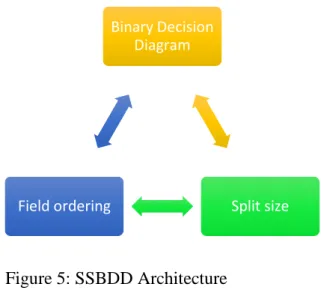
It also adds two more properties on top of regular BDD to improve the performance; the Field Ordering and the Split size as shown in Figure 5, both of them will be discussed extensively in the coming chapters. Together with these two properties an efficient and optimized BDD is generated. The name Static Shuffling comes from the idea of the way it generates and parse the packet headers; instead of following the traditional way of reading the entire field, it reads n bits from each field. One of the advantage of this method, it is not affected by the dependency of rules in the firewall because it relies on traffic log instead of rule analysis
There have been various studies conducted on the improvement of the firewall’s packet filter. Most of the research focused on the rule analysis of the firewall or rejection traffic of the firewall. In our case, SSBDD is focused on rejection traffic because in any BDD, the acceptance traffic will always traverse the entire BDD, which is not the case in rejection traffic.
Figure 5: SSBDD Architecture
4.1 Split Size
Split size in the context of BDD defines how many bits the BDD should traverse in each field before moving on to the next field. In the previous chapter, the importance of the traffic characteristics was discussed. For e.g. the Protocol Distribution section showed that checking 4 bits of protocol field will give the result more quickly than checking the 8 bits of the field. Split size property is defined at the beginning of the BDD generation. It is not only used at the parsing phase but it also used during the policy representation phase of the BDD. The use of the split size in the two different context of BDD is explained in the coming sections. The only downside of the split size, is it cannot be an odd number and the value cannot be more than 8, this is not due to a performance issue but it is merely due to programming limitations.
The idea of split size is not the first time it is used in firewall packet filtering; the same technique is described (Boutaba, 2009). There’s no need for the BDD packet filter to go through an entire field before moving on the next field. Separating them into a non-contiguous block can be useful too. For example, the protocol numbers might be best represented if it’s bits be mapped from P0-P4 then P5-P8. So instead of
Binary Decision Diagram
Split size Field ordering
checking the entire 8 bits’ fields from P0-P8, it is a good idea to check the first 4 bits and then the rest of the bits later.
4.1.1 Policy Representation Phase
Choosing the right split size for the BDD generation is as same as choosing a right variable ordering for a BDD, which is an NP-complete problem. But based on the analysis, it is possible to decide the split size to be used for the BDD. For e.g. based on the Protocol Distribution section, it is shown that high number of traffic were related to the TCP protocol. The split size can then be changed easily by analyzing the traffic characteristics but it can only be changed once during the BDD generation phase.
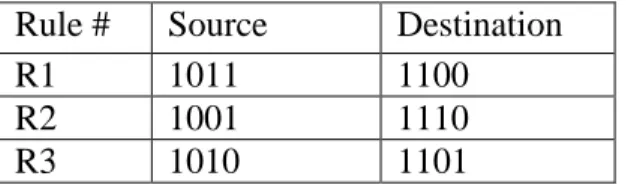
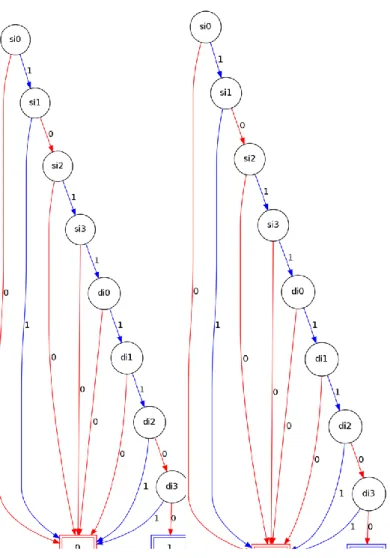
For example, assume having a simple packet header that consist of only source and destination fields each is just 4-bits long with all the rule’s decision is Allow. Table 4 shows the demo packet header converted into Binary equivalent. Assuming the split size is set to 2. The Fig 6 shows how the Rule 1 will be represented.
Rule # Source Destination
R1 1011 1100
R2 1001 1110
R3 1010 1101
Table 4: A Sample Policy List
The left figure in Figure 6 shows the BDD representation of the firewall when the split size is considered and the figure on the right in Figure 6 shows the BDD representation of the firewall when the split size is not considered.
Figure 6: BDD Representation
4.1.2 Packet Filtering Phase
In the BDD packet filtering phase the split size defines the number of bits that must be checked by the packet filter before moving on to the next field in the firewall. So instead of considering the entire field of the firewall as one contiguous block, it is better to consider them as a non-contiguous block. For e.g. if a split size of 8 is chosen then the bits of the fields will be represented as shown in Table 5.
Field Field bits BDD variable Proto (0,7) 0,7 Source IP (0,7) 8,15 Destination IP (0,7) 16, 23 Source Port (0,7) 24, 31 Destination Port (0,7) 32,39 Source IP (8,16) 40, 47 Destination IP (8,16) 48, 55 Source Port (8,16) 56,63 Destination Port (8,16) 64, 71 Source IP (16,24) 72, 79 Destination IP (16, 24) 80, 87 Source IP (24, 32) 88, 95 Destination IP (24, 32) 96, 103
Table 5: Variable Ordering
4.2 Field Ordering
Majority of the packet filtering devices like firewalls do not give specific consideration for optimizing packet rejection. If a packet does not match any of the rules in the policy, then it is discarded because the default rule (last rule) is assumed to be deny (Hamed, Discovery of policy anomalies in distributed firewalls, 2004). It is highly crucial for any firewall to implement a successful packet filtering. However, most of the packet filtering research done by authors focuses on exploiting the characteristics of filtering rules and ignores to consider the traffic behavior as another factor for optimization (Al-Shaer, 2006) schemes.
Optimization of the firewall packet filtering can be done at various stages during packet filtering process. Since, our work focuses only on BDD, so only the optimization technique related to BDD is discussed in this research. One of the most important optimization technique is field order, field order plays a very important role in the firewall. During network attacks such as DOS, the traffic is created in
such a way, that packets will always get rejected by the bottom rules or the last field of the bottom rules. If the fields are ordered in an optimal way, then the chance of packets being rejected at early stage increases which will then improve the performance of the firewall. But in a traditional firewall packet filter, the field order is fixed, which causes the performance to degrade during such network attacks.
As the networking speed increases, it is very important for the firewall to improve its packet filtering performance. Time is an important factor when considering the performance of the packet filter. To improve the performance, it is much more important to focus on the rejection packets of the firewall because if the rejection packets are rejected by the deny-all rule then it can cause more harm to the performance. Thus, it is more important to focus on early packet rejection.
There is an extensive amount of research work done on packet classification. The basic approach is to search the rules sequentially till a match is found. This approach is not time efficient because as the rule list increases the search time increases as well. So the performance of the basic approach is proportional to the length of the rule list in the firewall. Research on improving the search time for packet filtering uses one or more of the following approach: hardware-based solutions, specialized data structures, geometric algorithms, and heuristics (Al-Shaer, 2006).
Our study of the network traffic collected from (CADA, n.d.) shows that the major portion of the traffic flows gets rejected at a field in the firewall rules. It is also observed that this distribution is likely to stay for a time interval, if this distribution property is considered then it is highly likely that it can improve the performance of the packet filter. Therefore, a new method is proposed in this research, that uses the field distribution as one of the factor to improve the performance of the packet filter.
The proposed method called, Static Shuffling BDD [SSBDD] uses a typical Binary Decision Diagram as its base. The tree is mainly focused to reject the traffic as early as possible because a rejected packet might traverse long decision path of rule matching before getting rejected by the default-to-deny rule in the firewall. As the number of rejection packets increases the performance degrades as it causes significant overhead on the firewall. The implementation of SSBDD does not require any sort of special support from the firewall.
The SSBDD relies on field ordering for its optimization. Early rejection is possible in firewall if the field order is chosen efficiently. But choosing an optimal field order is an NP complete problem as the traffic is always random in nature. Predicting the type of traffic is not possible but a few assumptions can be made for any traffic based on the traffic characteristics.
4.2.1 Field Count Distribution
Another study conducted on the traffics to see the distribution of field counts. This study provides much more detailed overview into at which bit or node level of the field the packet got rejected. This data at first seems not useful but when collected from time to time can provide an overview into which fields is more important and can help to prioritize one field over other. It can also provide information to BDD, whether the BDD should start reading the packet headers from MSB to LSB or the other way around.
For e.g. given any network traffic that is received from the router to the firewall, it is safe to assume that all the traffic reaching the firewall will belong to the network. Since, the organization has LAN network, so they’ll be having Private Address space. In that case, it is always best to start the search from MSB to LSB instead of
LSB to MSB. So it is suggested that depending on the traffic specifications the less important fields should be checked later in order to speed up the performance of the packet filter.
4.2.2 Rule Reordering vs Field Reordering
Rule reordering is the most focused area in the field of packet filtering. There has been various research work done on it. Based on the analysis shown above in Rule hit distribution, it is visible that reordering of the rule can have an impact on the packet filtering performance. But the success of rule reordering is mainly dependent on the how interconnected the rules are in the firewall rule list. If the majority of the rules are dependent, then rule reordering will not improve the firewall performance.
On the other hand, field reordering seems like a good alternate solution. The main advantage of field reordering, it is not affected by the rule dependency. Because the field ordering happens at the search time. If given enough information about the traffic log, then an optimal field reordering can be achieved which can improve the performance of the firewall overall.
Chapter 5: Implementation
In this chapter we will discuss about the implementation part of our proposed method. The implementation is applied once during the packet generation phase and then during the packet filtering phase, both of them are explained in detail. At last we check out the lookup comparison between the two of them.
5.1 Policy Representation using SSBDD
To generate an SSBDD for a given set of firewall rules, it has to go through 4 stages which starts from the taking the rule set as an input and onto the final stage that converts the rules into the final SSBDD. The chart below gives you the overview of what happens at each and every stage of the SSBDD generation.
The final SSBDD which is generated is in a graphical format i.e. DOT format, the DOT format is only the user but the generation of the DOT format file is disabled as it increases the CPU processing time. The another format which is generated is a tuple set for each node in the BDD, this format is used for the parsing.
5.1.1 Input the Firewall Rules
The input file used by the program which contains the rule set or the traffic is in CSV format. The packets were collected from CAIDA. The metadata contains more information than it is needed so only the necessary information is collected from the
Input the
Firewall
Rules
Rules to
Binary
format
Binary to
Formula
format
SSBDD
generation
file; source ip, source port, destination ip, destination port, and protocol. The format of the file for both the traffic and the firewall rule set is given below.
<ip.proto,ip.len,ip.src,ip.dst,tcp.srcport,tcp.dstport,tcp.flags,udp.srcport,udp.dstport, icmp.type,icmp.code>
The above is the algorithm for reading the rules from the CSV file is given below. The file is opened in a reading mode and the code goes through the file line-by-line as each line contains one firewall rule in it. For every firewall rule that is read from the file is converted into first binary equivalent and then it is converted into the formula format. Once the above code is executed, the code will have the entire rule set converted into the formula format which is then written to the CSV file.
with open(ruleFile, "rb") as csvfile:
pkt_reader = csv.reader(csvfile)
del dyn_order_var[:] # Resetting the dyn_order_var now ... read_config_file()
for pkts in pkt_reader: newPkt = {}
for order in ruleConf.order: if order == 'p':
newPkt['p'] = pkts[field_pos['p']] elif order == 's_ip':
newPkt['s_ip'] = pkts[field_pos['s_ip']] elif order == 's_p':
newPkt['s_p'] = pkts[field_pos['s_p']] elif order == 'd_ip':
newPkt['d_ip'] = pkts[field_pos['d_ip']] elif order == 'd_p':
newPkt['d_p'] = pkts[field_pos['d_p']]
5.1.2 Rule to Binary Format
In order for the BDD to be generated the values must be in binary format, so it is necessary to convert each and every rule or packet header into the equivalent binary format. The discussion on Binary conversion is also discussed in more detail in the Chapter BDD. This step is basically a conversion of the decimal values to the binary format. The algorithm for the binary conversion is shown below.
def ruleToBin(pktRule): """
Takes the entire rule and then convert the rule into a binary format given below
[src-ip] = 00011100 """
ruleBin = {}
for key, value in pktRule.iteritems(): if int(key == "s_ip") | int(key == "d_ip"): tmp = value.split('.')
ruleBin[key] = "" for x in tmp:
ruleBin[key] += padding(((bin(int(x))).replace('b','')), 8) elif int(key == "s_p") | int(key == "d_p"):
if len(value) > 0:
ruleBin[key] = (padding(((bin(int(value))).replace('b','')),16)) else:
print "\tEither the Source or Destination Port is not given, skipping this rule ..." return False elif key == "p": if (value.isdigit()): ruleBin[key] = padding(((bin(int(value))).replace('b','')[::-1]),8) else: ruleBin[key] = padding(((bin(protocol[value])).replace('b','')[::-1]),8) return ruleBin
A. Binary to Formula Format
This is an important stage in the SSBDD generation process, once the rules are converted into its binary equivalent the next stage is to convert the rule into a formula format. The formula format shows what does each and every node in the BDD contains. Below is the algorithm that shows how the binary equivalent rules are converted into the formula format.
def dyn_ruleFormula(ruleBin):
# Convert the Binary rule format into a formula s_ip_len = 33 d_ip_len = 33 s_p_len = 17 d_p_len = 17 p_len = 9 s_ip_tracker = 1 d_ip_tracker = 1 s_p_tracker = 1 d_p_tracker = 1 p_tracker = 1 tmp_s_ip = {} tmp_d_ip = {} tmp_s_p = {} tmp_d_p = {} tmp_p = {} for j in ruleBin['s_ip']: if s_ip_len != s_ip_tracker: tmp_s_ip['s_ip'+str(s_ip_tracker)] = j s_ip_tracker += 1 for k in ruleBin['d_ip']: if d_ip_len != d_ip_tracker: tmp_d_ip['d_ip'+str(d_ip_tracker)] = k d_ip_tracker += 1 ……
5.1.3 SSBDD Generation
The final phase of the SSBDD generation is simple writing the formula generated above into a formula file. This formula file is then used to generate the graphical BDD, which is disabled in this stage as it increases the CPU processing time. Below is an example f what exactly does the formula file contains.
for m in ruleBin['d_p']: if d_p_len != d_p_tracker: tmp_d_p['d_p'+str(d_p_tracker)] = m d_p_tracker += 1 for n in ruleBin['p']: if p_len != p_tracker: tmp_p['p'+str(p_tracker)] = n p_tracker += 1 s_ip_tracker = 1 d_ip_tracker = 1 s_p_tracker = 1 d_p_tracker = 1 p_tracker = 1 ruleFormula = collections.OrderedDict() for tmp in dyn_order_var: tmp_field = tmp['og'] if tmp['field_name'] == 's_ip': ruleFormula[tmp_field] = tmp_s_ip[tmp_field] elif tmp['field_name'] == 'd_ip':
ruleFormula[tmp_field] = tmp_d_ip[tmp_field] elif tmp['field_name'] == 's_p': ruleFormula[tmp_field] = tmp_s_p[tmp_field] elif tmp['field_name'] == 'd_p': ruleFormula[tmp_field] = tmp_d_p[tmp_field] elif tmp['field_name'] == 'p': ruleFormula[tmp_field] = tmp_p[tmp_field] return ruleFormula
Let p = Protocol = TCP
= (p1 &p2 &p3 &p4 &p5 & ~p6 & ~p7 &p8)
The above example shows how the binary equivalent of the TCP protocol will be written in the formula file in the end.
5.2 SSBDD Packet Filtering
Packet filtering is the next stage of SSBDD, at this stage the packet is received by the packet filter which is then used to traverse the SSBDD to determine whether or not to accept or reject the packet. The step-by-step flow diagram is given below; it is same as the one described in the SSBDD generation phase. The only difference is in the last stage, instead of generating the BDD it will traverse the BDD. The final stage is merely a comparison stage where each node value is compared to see if it matches or not. The earlier stages of the SSBDD Packet Filter has been explained before.
Below is the implementation of SSBDD traversal that traverses the SSBDD tree once it receives a packet.
Input the
Firewall
Rules
Rules to
Binary
format
Binary to
Formula
format
Find
matching
rule
def pktMatcher(pktBin, ruleBDD): global nextNode global matchHit global tmpRuleBDD tmpRuleBDD = ruleBDD tmp_h_table = {}
for data in ruleBDD['h_table'].items(): tmp_h_table[data[1]] = data[0] for pktData in pktBin.items(): if str(nextNode) == "1":
log_data = "\tPacket has been accepted now ... and the hit count is "+str(matchHit) + "\n"
writeLog(log_data) matchHit = 0 return
elif str(nextNode) != "-1":
if (db._get_var_name(ruleBDD, nextNode)) == pktData[0]: if str(pktData[1]) == "0": indice = int(pktData[1])+1 elif str(pktData[1]) == "1": indice = 2 if not is_matching(tmp_h_table[nextNode][indice]): return else: nextNode = nextNode - 1 while True:
if (db._get_var_name(ruleBDD, nextNode)) == pktData[0]: break; else: nextNode = nextNode - 1 if str(pktData[1]) == "0": indice = int(pktData[1])+1 elif str(pktData[1]) == "1": indice = 2 if not is_matching(tmp_h_table[nextNode][indice]): return
5.3 BDD Packet Filter vs SSBDD Packet Filter
The explanation of SSBDD generation and traversal is done in the previous section in detail. To see the practical approach of SSBDD, a single rule is provided to both the BDD’s – BDD packet filter and SSBDD packet filter. This provides a clear overview of how the packet filter works at the filtering level. Since the BDD requires the rule to be converted into binary format so the binary equivalent of the rule is written instead of it’s decimal format. The Table 6 contains the Binary equivalent of the rule.
if not is_matching(tmp_h_table[nextNode][indice]): return
elif str(nextNode) == "-1":
nextNode = len(tmp_h_table)+1
if (db._get_var_name(ruleBDD, nextNode)) == pktData[0]: if str(pktData[1]) == "0": indice = int(pktData[1])+1 elif str(pktData[1]) == "1": indice = 2 if not is_matching(tmp_h_table[nextNode][indice]): return else: nextNode = nextNode - 1 while True:
if (db._get_var_name(ruleBDD, nextNode)) == pktData[0]: break; else: nextNode = nextNode - 1 if str(pktData[1]) == "0": indice = int(pktData[1])+1 elif str(pktData[1]) == "1": indice = 2 if not is_matching(tmp_h_table[nextNode][indice]): return
Protocol 0000 0110
Source IP 11000000 10101000 00100001 11110111
Destination IP 11000000 10101000 00100000 01111101
Source Port 00000100 00011010
Destination Port 00001101 00111101
Table 6: Binary equivalent of a rule
5.3.1 BDD Packet Filter
In a regular BDD packet filter, the traversal is done by going from one field to the another field like a regular firewall. Below is a single packet converted into its binary equivalent. Once converted it starts from the first field and takes the entire field and starts the traversal. In a regular BDD packet filter, the field order is fixed so they cannot be changed. This is the limitation of this BDD because several traffic can be rejected earlier or may be some bits are not needed to be checked in order to get the decision.
5.3.2 SSBDD Packet Filter
In SSBDD filter since the field order can be changed based on the traffic analysis which shows what fields are more important than the other. Another important factor which was discussed in detail in Chapter Split Size, deciding how many bits to check from each field before moving on to the another field.
Since at the beginning there’s no traffic log to analyze so SSBDD will go with a default option of setting the property to the following values
<field order = protocol, source ip, destination ip, source port, destination port> <split size = 8>
Figure 8: SSBDD Packet Filter
In Figure 8 it is visible that instead of checking the entire field at a time, SSBDD takes 8 bits from each field and then goes to another field. The advantage here over the BDD packet filter is the necessary bits are not checked at the first stage instead they are delayed for the next stage. This gives a performance improvement to SSBDD which can be very useful when there’s a high amount of rejection traffic. An interesting question about the BDD approach is with regard to how robust the BDDs are to the access list rule structure. Techniques such as RFC, cross-production
and the tuple space search rely heavily on structured access lists for good performance – some even become unusable in extreme conditions. This question is tackled in Chapter 6 once the experimental evidence has been presented.
Chapter 6: Analytical Discussion of the SSBDD
The previous chapter provides a framework for the construction of SSBDD, representations of access lists and using them to perform lookup in packet filters. This chapter presents an analytical discussion into SSBDD approach to packet filtering. The main reason behind this chapter is to discuss the computing aspects of the SSBDD packet filter and get an overview of the lookup time.
The discussion begins into what SSBDD representations of access lists look like and what determines the structure of these SSBDDs, since the shape and size of a SSBDD directly affects its time and space performance. Then the discussion goes into the bounds for, as well as factors affecting, the lookup time of the BDD packet filter, while the next section discusses factors affecting memory usage.
6.1 SSBDD Representation of Access List
The SSBDD representation of an access list is a regular BDD and it describes at a lowest level of what packets are accepted or rejected by the packet filter. SSBDD contains two nodes 1 or 0 which are the terminal nodes, where 1 means the packet is Accepted and 0 means the packet is Rejected. Every node in the SSBDD refers to a particular bit in the packet header. Reaching to the terminal node 0 – rejection node – has more than one path and the same applies to the acceptance traffic as well, so these complete set of paths for rejection and acceptance is the entire search space of the SSBDD.
To understand the concept of the access list in SSBDD let’s consider a demo access list shown below in Table 7. This list accepts only TCP and UDP type traffic and from the certain IP address as mentioned in the access list itself. Although this is a somewhat an unlikely access list in a real world scenario, it does share some properties with real access lists which is important to understand the sections to be
discussed ahead. This access list is going to be used in the rest of this chapter to explain the sections ahead.
Rule #
Source Addr Destination Addr Source Port Destination Port Protocol 1 192.168.1.10 10.23.12.43.2 9000 80 TCP 2 172.16.2.12 80.75.45.3.12 10234 80 TCP 3 192.168.3.10 98.3.12.5 8769 878 UDP
Table 7: Sample Access List
There are many factors that can affect the structure of the SSBDD, not all the factors can be controlled but there are few factors which can be controlled. Those factors were discussed in detailed in the Chapter Packet filter optimization and Chapter Split size. Field ordering is one factor that can improve the performance of the firewall’s packet filtering. If the field order is chosen correctly, then it can improve the performance of the packet filter. In a regular BDD based packet filter the field order is fixed and cannot be changed so the factor of field ordering is not considered. The shape and size of a BDD representing an access list are affected by various factors such as the number of nodes, number of variables and BDD depth, which in turn affects the performance of the SSBDD packet filter.
Of the factors affecting the structure of the BDD, some can be controlled and others cannot. The two main factors involved are the access list itself and the variable ordering of the BDD. The variable ordering of the BDD can be manipulated to improve the performance of the packet filter, whereas the access list is generally fixed. Variable orderings can also often be chosen to take advantage of the rule structure in the access list. The next two sections discuss how these factors affect the structure of the BDD.
6.1.1 The Effect of Rule Structure
SSBDD consist of number of variables and these variables are reference to the packet header bits of the access list. This illustrates two points. Firstly, during the SSBDD construction the variables that are not needed are automatically excluded in the construction process. This optimization is very useful as it can affect the performance of the SSBDD overall. Second point, the number of variable in SSBDD is completely dependent on the complexity of the access list. The more specific the rule is the more variables an SSBDD will need.
Common values in the field is also another factor that can affect the SSBDD of the access list. Rule that share common values with another rule can often help the SSBDD to generate less variable. For example, Rule # 1 and Rule # 2 shares the same destination port i.e. 80, so during the SSBDD generation time both the rule will share the variables but will have different exit points. This aggregation of similar values greatly affects the size of the BDD, since the degree to which expression in the BDD can be shared determines the number of nodes required for the BDD. In a simple statement, the more data the rules share the less variables the SSBDD will need.
6.1.2 The Effect of Variable Ordering
The variable ordering chosen for the example has the source address first followed by the source port then destination address then destination port and then protocol at the end. During the lookup the source address will always be checked first but what if the packet that is coming is not a TCP or a UDP protocol. Even though if the addresses the packet will still have to go through the first field and then get rejected at the end. If a different variable ordering is used – for example having the protocol