The Effect of Website Age on Reported Cash Flows
Abstract
Websites are one of the most debated technologies in business. After the recent dotcom bust, many argue that websites lack value in commercial environments. Cash flow, essential to a business' health, is often a reliable indicator of income opportunities. Yet the link between cash flows and website ownership has never been satisfactorily made.
This paper explores the relationship between cash flows, website use and maturity by examining factors such as website age, number of IT employees, total assets and market capitalisation. The study finds that website ownership and maturity do not explain cash flows, except for companies in IT industries.
Introduction
A number of technological innovations have caught the attention of businesses in the past. The IS research community has accordingly afforded much coverage to these technologies, including the microcomputer (Olson 1982), MRP, ERP and enterprise systems (Cooper and Zmud 1990) and telecommunications systems (Kriebel and Strong 1984). This technology ostensibly produces benefit to these firms (Frambach and Schillewaert 2002). However, there is debate as to how this benefit should be measured. This is in the light of evidence that electronic commerce is being treated like any other technology asset.
Ein-Dor and Segev (1993) and Swanson (1994) offer excellent discussion of the progression of these technologies in commercial environments, highlighting the effect of a technology’s age to its degree of exposure and diffusion in commercial environments. One underlying argument of these authors is that technology products mature over time. This echoes the work of Nolan (1973), who argued that IT development in firms tended to develop in stages (specifically, initiation, contagion, control, and maturity). As the technology product ages, firms should become better at managing the technology’s idiosyncrasies and can consequently understand its benefits and pitfalls.
In the late 1990s, firms began viewing the Internet with increasing interest. Firms ostensibly saw this new electronic frontier as a promising avenue for information dissemination, market management, and customer acquisition (Zwass 1996, Ranganathan and Grandon 2002). However, the dotcom meltdown of early 2000 saw many firms fail in the light of poor returns to investment and unfeasible business plans. Cheng et al. (2003) describe the effect of poor operating equipment, ineffective debt management and inappropriate investment write-off strategies. Shama (2001: 101) argues that, “dotcoms have been failing because they regard sales revenues and profits as a distraction to their business”. While many observers may be soured at these events, researchers still stand to learn much from these events (Loebbecke and Powell 2002). An analysis of Internet commerce using theory from more traditional systems literature may assist researchers in understanding the idiosyncrasies of the technology now that much of the original market hype has evaporated.
The concept of maturity, however, has been somewhat contentious. Authors such as Benbasat et al. (1984) presented conflicting evidence of this phenomenon, arguing that maturity analysis was likely to depend on the methods used to measure the construct. In particular, a single item measure was unlikely to be sufficient in this regard: the authors wrote, “more work needs to be done to address the obvious measurement problems thus far encountered”. This problem is further heightened when viewed in context of the
dearth of maturity research with respect to the World Wide Web. Clearly, this area requires attention.
Research of this nature is valuable for several reasons. First, the Accounting Information Systems research literature would benefit from this study. The subject of success in Information Systems continues to receive considerable scholarly attention, and it has been examined in areas such as database systems (Grover and Teng 1992), Electronic Data Interchange (Bergeron and Raymond 1997) and decision support systems (Bart and Huff 1985). Despite this research, the field is very much open and some argue that traditional success measurement methods are ineffective when applied to many system types. However, published research suggests that the World Wide Web may possess qualities that make it different to other types of Information System. Numerous authors (such as Earl 1993) argue that the Information Systems discipline would benefit from an examination of the applicability of IS success measures to this new technology.
There is considerable published evidence to suggest that business and personal use of the World Wide Web is growing at a rapid rate. Liu et al. (1997) note that the World Wide Web currently has over 20 million users, and that this figure is growing by the thousands every month. Figures such as this are likely to differ from source to source as differing estimation techniques are used: Vadapalli and Ramamurthy (1998), for instance, estimate over 100 million users. Estimates such as this should be treated with some caution. Tan and Teo (1998) note that few other technological developments have received such popular business patronage. Despite this adoption, the benefits and success of this technology are yet to be quantified (Vadapalli and Ramamurthy 1998). Further analysis of this technology and its success in commercial environments would be of benefit to both business and the research literature.
There has been little empirical evidence on the importance of cash flows and website adoption in Australia. As a result, the relevance and utility of cash flow reporting in relation to website adoption decision-making has not been demonstrated empirically. In Australia, AASB 1026 requires the preparation of Cash Flow Statements. Although adoption of this standard was initially slow, Funds Statements were replaced as a reaction to the stock market crash of the late 1980s, and the subsequent corporate collapses. There was a definite rise of cash flow reporting in Australia in the early 1990s (Jones et al. 1995), yet its relevance in measuring the commercial value of IT, in terms of revenue generation, has not been adequately explored. Given that business and personal use of the World Wide Web is growing at a rapid rate, we would expect website adoption and maturity to have a positive impact on reported cash flows. This discussion leads to the paper’s central research question:
Is there a significant association between reported cash flows and website ownership and maturity? This paper documents the findings of an ongoing study into the value and effectiveness of IT installations, with particular reference to the dotcom crash, and is structured as follows. The next section provides a brief overview of cash flow research and identifies “potentially useful predictor variables” (Hildebrand and Ott 1987:521) by exploring theory from the published research literature. The study’s research method is then presented. The paper then discusses the results, which is followed by analysis and implications. Finally, conclusions and areas for further research are explored.
Theoretical Framework
Cash Flows
ownership interaction is less likely to exist for firms with high levels of debt. OLS regression analyses of 157 and 140 low growth Australian firms audited by Big 6 auditors for the years 1992 and 1993 provide support for the hypotheses. This is one of the first Australian that uses an agency cost measure such as cash flow, so there definitely needs to be more research in this area.
Web Age
Authors such as Kowtha and Choon (2001) observe important effects of website age. Consistent with Aldrich et al. (1986), an older website should suggest greater sophistication of operations. The firm’s competency with the technology should be heightened in this regard.
The study uses a number of control variables in model development, as follows.
Number of Employees
Number of Employees has, in the past, been held as a metric for organisational size (as in Goode 2001, Teo and Pian 2004) and an indicator of potential growth in a firm (as in Davila et al. 2003).
Market Capitalization
Market capitalisation may act as an indicator of capacity, market preference and opinion. Increases in this factor create “a more favorable environment for investors in general” in this regard (Jeng and Wells 2000).
Length of Employment
The length of time for which the staff have been employed in the current managerial role may also have an effect on website performance. This would indicate greater maturity and wider appreciation of the overall technology strategy.
IT Department
The existence of a dedicated IT department has been found to influence business adoption of technology (Ball et al. 1988). Businesses with IT departments may be better equipped to assimilate new technology into their operations (Bergeron et al. 1990). Also, the staff of the IT department may positively influence technology adoption by acting as “champions” for the new technology (Jarvenpaa and Ives 1996). The existence of such a department may indicate a progressive attitude towards technology (Cohn 1980).
Profit:
Given accounting profits are not the same as reported cash flows, they are still linked, and therefore profits are included as an explanatory factor.
Total Assets:
Fama and Jensen (1983) argue that larger-sized companies in general have greater agency problems and hence are more likely to benefit from additional cash flows. Therefore as company size increases, there will be a greater demand for technology that increase reported cash flows.
Proportion of Assets Committed to Investment Assets Variable
Companies that have invested heavily in various assets, are also most likely to have invested significant amounts into IT adoption. The more funds tied up in fixed assets will mean there is less free cash flows available to pay short term debts. One would expect to find that the proportion invested on investment assets, affects reported cash flow.
Leverage:
Generally the leverage variable is used in research involving agency theory (eg. Parkash and Venable 1993, amongst others). Woo and Koh (2001), Francis and Wilson (1988) and DeFond et al., (2000) measure leverage as long term debt to total assets. With higher
debt, there will be a greater need for free cash flows to pay debts as they arise.
Percentage shares owned by the substantial shareholder:
Prior research (such as DeFond 1992) has focused on management ownership of shares as a proxy of external ownership’s concentration, however because lack of data availability, the current study does not focus on this proxy, instead on ownership by the key shareholder. Francis and Wilson (1988) measure the diffusion of ownership and proxy it by the percentage of outstanding shares owned by the largest single shareholder (1 if greater than ten percent, 0 if less). The current study assumes that when outside investment is concentrated, agency conflict is reduced, and this may affect reported cash flows.
Research Model
Cash Flow Model developed:
CASHFW = WEBAGE + NUM-EMPLOY + LENGTH-EMPLOY + MARKETCAP + IT_DEPT + PRODINVEST + TOTPROFIT + LEVDA + LOWNSH + TOTASSET + e
Where:
CASHFW (dependant variable)= cash flows from operations at end of period
WEBAGE (hypothesis variable) = period of time a company’s website has been online (mths).
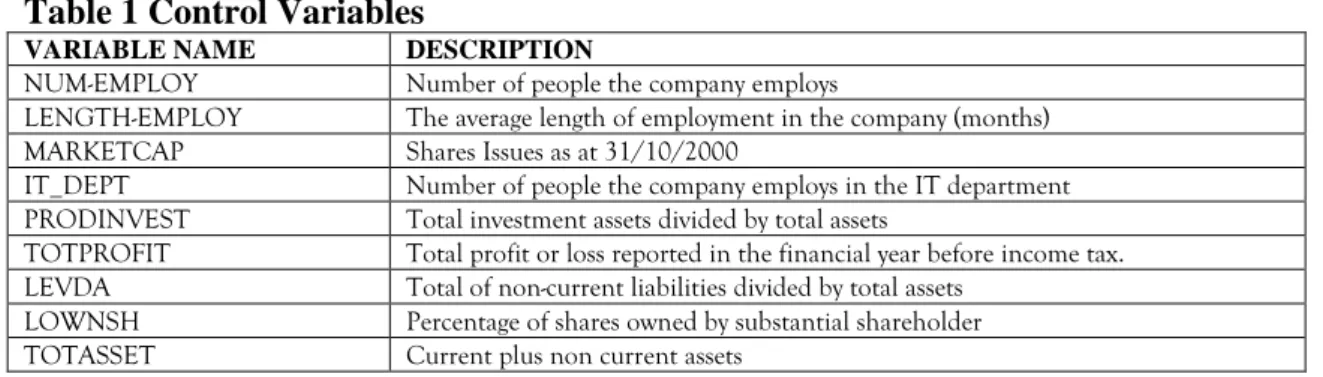
Table 1 Control Variables
VARIABLE NAME DESCRIPTION
NUM-EMPLOY Number of people the company employs
LENGTH-EMPLOY The average length of employment in the company (months) MARKETCAP Shares Issues as at 31/10/2000
IT_DEPT Number of people the company employs in the IT department PRODINVEST Total investment assets divided by total assets
TOTPROFIT Total profit or loss reported in the financial year before income tax. LEVDA Total of non-current liabilities divided by total assets
LOWNSH Percentage of shares owned by substantial shareholder TOTASSET Current plus non current assets
Research Method
A number of research methods are available to the Accounting Information Systems scholar. This research is concerned with the ex post facto analysis of a particular phenomenon. Cook and Campbell (1979) argue the importance of sound method with respect to such research: ex post facto analysis makes no use of pre-testing, hence the inference of causality of the findings can be threatened. Galliers (1992) analyses the approaches to social measurement within the Information Systems discipline. These approaches include the lab experiment, archival research, the case study and survey methods. Within the Information Systems discipline, the survey method has received the most use, and has been found to provide consistently usable results (Straub 1989). Consistent with the inference vulnerabilities of ex post facto research discussed by Cook and Campbell (1979), Galliers argues that the survey method may give little insight into causal relationships, can be open to respondent and researcher bias, and only portrays the state of affairs at a single point in time. However, Galliers also argues that a large number of variables can be examined in under real world conditions in a short space of time. Kerlinger (1986) argues that behavioural survey research can be divided into two main types, being explanatory research and exploratory research. The former seeks causal and correlative relationships between variables within a given phenomenon. Often, this method seeks to test hypotheses that have been developed over some time. The latter aims to better understand a phenomenon within the formative stages of a topic area (Malhotra and Grover 1998). Such research acknowledges that, for any phenomenon,
there may be multiple objective points of view. Such perspectives may exhibit differences, however each may be intrinsically valid (Walsham 1993) and is hence particularly useful in the early stages of research (Dubin 1978).
Malhotra and Grover (1998) argue that while exploratory survey research may lack causal rigour, the method’s power can be augmented using longitudinal analysis, whereby a given phenomenon or unit of analysis can be revisited over time in order to better quantify any changes taking place. Such an approach also assists in triangulating the research findings and serves to improve the value of the research study for the wider research community. This paper admits the shortcomings of exploratory research, however observes the immaturity of research in the area.
Administration
When administering the surveys, recommendations from other researchers in the area were taken into account. Before surveying began, a list of potential questions and prepared answers was generated so that each respondent would be given the same information about the study (Dillman 1978). This information sheet contained pre-written answers to potential questions concerning anonymity (Stanton 1998), the origin of the survey (Schneider and Johnson 1995, Fraser et al. 1988), the eventual destination of the results, and a brief overview of the legislation. The answer sheet also included a “Don’t Know” (DK) option, which Graeff (2002) and Hawkins and Coney (1981) argue can reduce uninformed response bias. Where possible, the CIO or CTO was sought to answer questions (Frohlich 2002), and all survey respondents were given the opportunity of receiving a copy of the final research report (Katzer et al. 1982). Respondents were reminded that this was an independent study being sponsored by an established academic institution (Schneider and Johnson 1995, Bruvold and Comer 1988), and care was taken to avoid leading respondents or otherwise biasing their replies (Klassen and Jacobs 2001).
As Straub (1989) advocates, the survey was pilot tested for accuracy and ease of use before it was put into operation. The first version of the survey was administered to two local firms who were selected at random from the local business telephone directory. This pre-test stage proved worthwhile as it showed a general reluctance or inability on the part of respondents to answer questions concerning market capitalisation and cash flows. Based on this finding, the survey was restructured so as to put less sensitive questions first, and care was taken to remind respondents that these questions were optional. The same basic instrument was reused so as to make good use of the pilot testing undertaken in the first round of surveying. Accordingly, the authors decided to supplement the data set with additional data items after the survey program had been completed (similar to Cragg and King 1993).
The other variables such as profit, proportion invested in investment assets, total liabilities, and percentage owned by largest shareholder were obtained from company annual report data, collected through archival data collection, from websites such as Connect4 and Aspect Financial. This archival data was separately collected from the survey data used here.
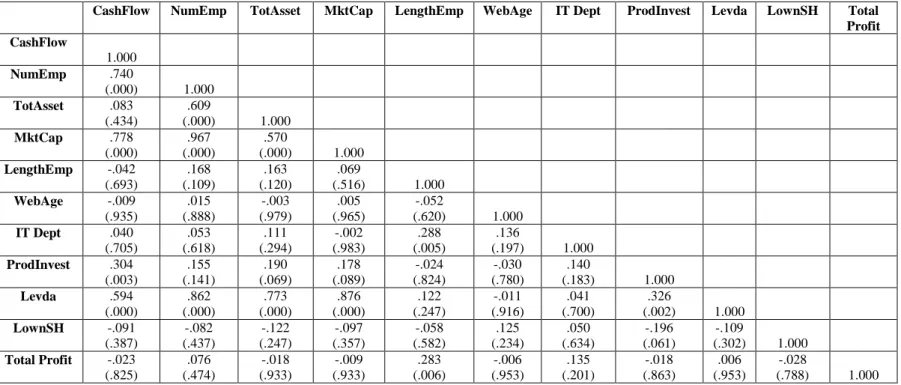
Table 2: Research Variable Correlation Matrix (2-tailed Pearson correlations)
CashFlow NumEmp TotAsset MktCap LengthEmp WebAge IT Dept ProdInvest Levda LownSH Total
Profit CashFlow 1.000 NumEmp .740 (.000) 1.000 TotAsset .083 (.434) .609 (.000) 1.000 MktCap .778 (.000) .967 (.000) .570 (.000) 1.000 LengthEmp -.042 (.693) .168 (.109) .163 (.120) .069 (.516) 1.000 WebAge -.009 (.935) .015 (.888) -.003 (.979) .005 (.965) -.052 (.620) 1.000 IT Dept .040 (.705) .053 (.618) .111 (.294) -.002 (.983) .288 (.005) .136 (.197) 1.000 ProdInvest .304 (.003) .155 (.141) .190 (.069) .178 (.089) -.024 (.824) -.030 (.780) .140 (.183) 1.000 Levda .594 (.000) .862 (.000) .773 (.000) .876 (.000) .122 (.247) -.011 (.916) .041 (.700) .326 (.002) 1.000 LownSH -.091 (.387) -.082 (.437) -.122 (.247) -.097 (.357) -.058 (.582) .125 (.234) .050 (.634) -.196 (.061) -.109 (.302) 1.000 Total Profit -.023 (.825) .076 (.474) -.018 (.933) -.009 (.933) .283 (.006) -.006 (.953) .135 (.201) -.018 (.863) .006 (.953) -.028 (.788) 1.000
The correlation matrix in Table 2 reveals three independent variables have significant correlation with cash flows (the dependent variable), and they are the number of employees (.740), market capitalization (.778), and long term debt (.594). The number of employees, total assets, market capitalisation and long term debt all exhibit results that raise concerns that there might multi-colinearity problems between some of the independent variables. In light of this evidence, the researchers conducted additional testing, including the omitted variables test, the Cook-Weisberg test for heteroscedasticity, and variance inflation factors test. These tests indicated no concerns or problems in the diagnostics specified for the fitted model. There are no other significant correlations, so there does not seem to be a problem in this respect.
Results
The authors received one hundred and twelve responses to the survey, yielding a response rate of 19%. Five envelopes were returned empty and three respondents declined to participate in the survey, leaving 104 responses in the dataset. Two missing data items were coded with the mean value for each particular item (Cohen and Cohen 1983). Analysis across industry groups revealed generally proportional representation and suggested that no industry was significantly under or over represented.
Response bias analysis was conducted, based on the arguments of Fuller (1974). Responses of earlier respondents were compared to those of later respondents on the basis that later respondents may have similar characteristics to those that did not respond (Filion 1975; Grover et al. 1993). Respondents were split about the mean response date and Pearson Chi-Square analysis of these response dates suggested that little, if any, bias existed.
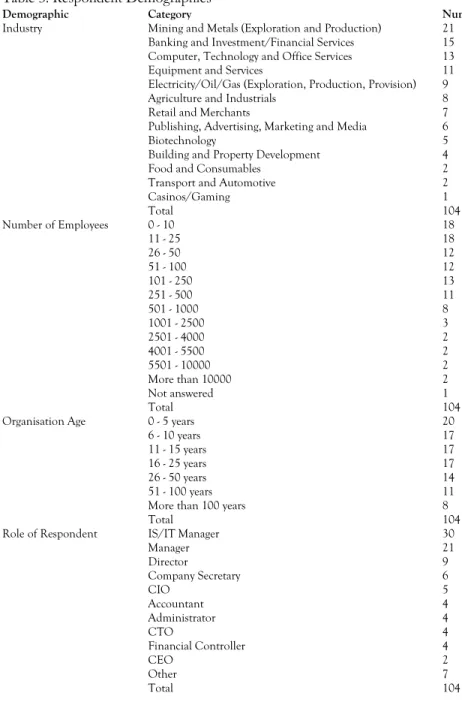
Table 3: Respondent Demographics
Demographic Category Number
Industry Mining and Metals (Exploration and Production) 21 Banking and Investment/Financial Services 15 Computer, Technology and Office Services 13
Equipment and Services 11
Electricity/Oil/Gas (Exploration, Production, Provision) 9
Agriculture and Industrials 8
Retail and Merchants 7
Publishing, Advertising, Marketing and Media 6
Biotechnology 5
Building and Property Development 4
Food and Consumables 2
Transport and Automotive 2
Casinos/Gaming 1 Total 104 Number of Employees 0 - 10 18 11 - 25 18 26 - 50 12 51 - 100 12 101 - 250 13 251 - 500 11 501 - 1000 8 1001 - 2500 3 2501 - 4000 2 4001 - 5500 2 5501 - 10000 2 More than 10000 2 Not answered 1 Total 104
Organisation Age 0 - 5 years 20
6 - 10 years 17
11 - 15 years 17
16 - 25 years 17
26 - 50 years 14
51 - 100 years 11
More than 100 years 8
Total 104
Role of Respondent IS/IT Manager 30
Manager 21 Director 9 Company Secretary 6 CIO 5 Accountant 4 Administrator 4 CTO 4 Financial Controller 4 CEO 2 Other 7 Total 104
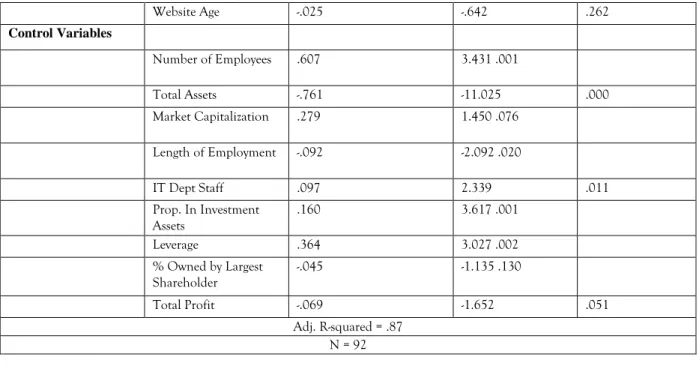
Table 4 reveals that website age was insignificant in explaining company cash flows (t = -.642, p = .262). When earnings before income tax (EBIT) was used as a dependent variable, website age was also insignificant in explaining profitability (t = -.193, p = .423). Thus, it appears that although website ownership and maturity is important to many companies, it is not necessarily impacting on reported cash flows as expected and profitability.
Table 4: The Impact on Cash Flows of IT Implementation
VARIABLE UNSTANDARDIZED
COEFFICIENTS (B)
T SIG.
(1-TAILED) Hypothesis Variables
Website Age -.025 -.642 .262 Control Variables Number of Employees .607 3.431 .001 Total Assets -.761 -11.025 .000 Market Capitalization .279 1.450 .076 Length of Employment -.092 -2.092 .020 IT Dept Staff .097 2.339 .011 Prop. In Investment Assets .160 3.617 .001 Leverage .364 3.027 .002 % Owned by Largest Shareholder -.045 -1.135 .130 Total Profit -.069 -1.652 .051 Adj. R-squared = .87 N = 92
Table 5: The Impact on Cash Flows of IT Implementation: Industry Breakdown
INDUSTRY VARIABLE T SIG. (1-TAILED)
Mining Website Age -0.692 .250
Financial Services Website Age .380 .385 Technology/
Computing
Website Age - 15.489 .020
Table 5 indicates that, out of the largest industries represented by the sample of 92 companies, IT implementation significantly explains company cash flows only in the Technology/Computing industry (t = -15.489, p = .020). This was not the case in the Mining (t = -0.692, p = .250) and Financial Services (t = .380, p = .385) although because of the small sample size there were not enough listed company observations in other industries like Media, Retail, Manufacturing, to run the model.
This finding is not surprising given that larger companies such as those in the Mining industry might use Electronic Data Interchange (EDI) to strategically operate and improve cash flows, rather than websites. Therefore, the impact of IT adoption on companies reported financial performance, is determined more by the industry and nature of that company’s business activities and services.
Discussion and Conclusions
There is evidence presented in this study that the impact of website ownership and maturity on both reported cash flows and profitability will depend on the given company’s business activities, (or industry). However, in the context of the original research question:
Overall there is little evidence to suggest that website adoption and age affect a given company’s reported financial performance.
This study used traditional Information Systems theory as the basis for an initial investigation into website maturity, observing that some of the expected factors did emerge from the data analysis but others did not. It is not possible to say, from this work, whether this might be a reflection of an intrinsic difference between IT or website maturity, or a more general effect that was influenced or caused by the dot.com crash mentioned earlier. It would be interesting to see a similar but deeper study done in the context of traditional information technology maturity in the post tech-wreck environment to see which of these might be the case. Finally, the focus of this study was the Australian commercial environment and it would be interesting to see if the findings extend beyond this to other national or cultural contexts.
References
Aldrich, H., Auster, E. R., (1986) “Even Dwarfs Started Small: Liabilities of Age and Size and their Strategic Implications”, in: Research in Organizational Behavior, Vol. 8, JAI Press, Greenwich, CT, 165–198
Ball, L. D., Dambolena, I. G., Hennessey, H. D., (1988) “Identifying Early Adopters of Large Software Systems”, Data Base, Fall/Winter
Bart, H., Huff, S., (1985) “Change, Attitude to Change, and Decision Support System Success”, Information and Management, Vol. 9, No. 5
Benbasat, I.; Dexter, A.S.; Drury, D.H; Goldstein, R.C., (1984) “A Critique of the Stage Hypothesis: Theory and Empirical Evidence”, Communications of the ACM, 27, 5, 476 – 485
Bergeron, F. Raymond, L., (1997) “Managing EDI for Corporate Advantage: A Longitudinal Study”, Information and Management, Vol. 31, 319-333
Bergeron, F., Rivard, S., De Senne, L., (1990) “Investigating the Support Role of the Information Centre”, MIS Quarterly, September
Cheng, J. Z., Tsyu, J. Z., Hsiao-Cheng, D. Y., (2003) “Boom and Gloom in the Global Telecommunications Industry”, Technology in Society, Vol. 25, No. 1, 65-81
Cohn, S. F., (1980) “Characteristics of Technically Progressive Firms”, Omega, Vol. 8, No. 4 Cook, T. D., Campbell, D. T., (1979), Quasi-Experimentation: Design and Analytical Issues for
Field Settings, Rand McNally Publishers, Chicago
Cooper, R. B., Zmud, R. W., (1990), “Information Technology Implementation Research: A Technological Diffusion Approach”, Management Science, Vol. 36, No. 2, 123-139 Cragg, P.B., King, M. (1993), “Small Firm Computing: Motivators and Inhibitors”, MIS
Quarterly, Vol. 17 No. 1, 47-60
Davila, A., Foster, G., Gupta, M., (2003), “Venture Capital Financing and the Growth of Startup Firms”, Journal of Business Venturing, Vol. 18, No. 6, 689-708
DeFond, M., (1992), “The Association Between Changes in Client Firm Agency Costs and Auditor Switching”, Auditing: A Journal of Practice and Theory, Vol. 11, No. 1, 16-31 Dillman, D. A., (1978), Mail and Telephone Surveys: The Total Design Method, John Wiley and
Dubin, R., (1978), Theory Building, Free Press, New York
Earl, M. J., (1993) “Experiences in Strategic Information Systems Planning”, MIS Quarterly, Vol. 17, No. 1
Ein-Dor, P., Segev, E., (1993), “A Classification of Information Systems: Analysis and Interpretation”, Information Systems Research, Vol. 4, No. 2, 166-204
Fama, E., Jensen, M., (1983), “Separation of Ownership and Control”, Journal of Law and Economics, Vol. 26, 301-326
Frambach, R. T., Schillewaert, N., (2002), “Organizational Innovation Adoption: a Multi-level Framework of Determinants and Opportunities for Future Research”, Journal of Business Research, Vol. 55, No. 2, February, 163-176
Francis J.R., Wilson, E.R., (1988), “Auditor Changes: a Joint Test of Theories Relating to Agency Costs and Auditor Differentiation”, The Accounting Review, Vol. 63, No. 4, October, 663-682.
Galliers, D., (1992), Information Systems Research, Blackwells, Oxford, UK
Goode, S. (2001), “Organisational Size Metrics in IS Research: A Critical Survey of the Literature 1989-2000”, Australian Conference on Information Systems (ACIS) 2001 Proceedings, 29
Grover, V., Teng, J. T. C., (1992), “An Examination of DBMS Adoption and Success in American Organizations”, Information and Management, Vol. 23, 239-248
Gul F.A., Tsui, J., (1999), “Free Cash Flow, Debt Monitoring, and Audit Pricing: Further Evidence on the Role of Director Equity Ownership”, Auditing: A Journal of Practice and Theory, Vol. 20, No. 2, 71-84.
Hildebrand, D. K., Ott, L., (1987) Statistical Thinking for Managers, 2nd Ed., Duxbury Press, Boston
Jarvenpaa, S. L., Ives, B., (1996), “Introducing Transformational Technologies - The Case of Web Technology”, International Journal of Electronic Commerce, Vol. 1, No. 1
Jeng, L. A., Wells, P. C., (2000), “The Determinants of Venture Capital Funding: Evidence Across Countries”, Journal of Corporate Finance, Vol. 6, No. 3, 241-289
Jones, S., Romano C., and K. X. Smyrnios, (1995), “An Evaluation of the Decision Usefulness of Cash Flow Statements by Australian Reporting Entities”, Accounting and Business Research, Vol. 25, No. 98, 115-129
Kerlinger, F. N., (1986), Foundations of Behavioural Research, Holt, Rinehart and Winston, New York
Kowtha, N. R., Choon, T., (2001) “Determinants of Website Development: A Study of Electronic Commerce in Singapore”, Information & Management, Vol. 39, No. 3, 227-242
Kriebel, C. H., Strong, D. M., (1984), “A Survey of the MIS and Telecommunications Activities of Major Business Firms”, MIS Quarterly, Vol. 8, No. 3, September, 171-178 Loebbecke, C., Powell, P., (2002), “E-business in the Entertainment Sector: the Egmont
Case”, International Journal of Information Management, Vol. 22, No. 4, 307-322
Malhotra, M. K., Grover, V., (1998), “An Assessment of Survey Research in POM: From Constructs to Theory”, Journal of Operations Management, Vol. 16, No. 4, July, 407-425
Nolan, R.L. (1973), “Managing the Computer Resources: a Stage Hypothesis”, Communications of the ACM, Vol. 16, No. 7, 399-405
Olson, M. H., (1982), “New Information Technology and Organizational Culture”, MIS Quarterly, Vol. 6, December, 71-92
Parkash M., Venable, C., (1993), “Auditee Incentives for Auditor Independence: The Case of Nonaudit Services”, The Accounting Review, Vol. 68, 113-133
Ranganathan, C., Grandon, E., (2002), “An Exploratory Examination of Factors Affecting Online Sales”, The Journal of Computer Information Systems, Vol. 42, No. 3, 87-93
Shama, A., (2001), “E-Coms and their marketing strategies,” Business Horizons, Vol. 44, No. 5, September-October, 14-20
Straub, D. W., (1989), “Validating Instruments in MIS Research”, Management Information Systems Quarterly, June
Swanson, E. B., (1994), “Information Systems Innovation Among Organizations”, Management Science, Vol. 40, No. 9, 1069-1092
Tan, M., Teo, T. S. H., (1998) “Factors Influencing the Adoption of the Internet”, International Journal of Electronic Commerce, Vol. 2, No. 3
Teo, T. S. H., Pian, Y., (2004) “A Model for Web Adoption”, Information and Management, Vol. 41, No. 4, 457-468
Vadapalli, A., Ramamurthy, K., (1998), “Business Use of the Internet: An Analytical Framework and Exploratory Case Study”, International Journal of Electronic Commerce, Vol. 2, No. 2
Walsham, G., (1993), Interpreting Information Systems in Organisations, Wiley Publishing, Chichester, UK
Woo E., Koh, H.C., (2001), “Factors Associated With Auditor Changes: a Singapore Study”, Accounting and Business Research, Vol. 31, No. 2, 133-144.
Zwass, V., (1996), “Electronic Commerce: Structures and Issues”, International Journal of Electronic Commerce, Vol. 1, No. 1, 3-23