
SURVEYING & MAPPING
GENERALThere are many definitions of surveying. One of them is as follows: Surveying is the science or art of making the measurements necessary to determine the relative positions of points above, on, or beneath the surface of the earth, or to establish such points. The work of the surveyor consists largely in making such measurements and can be divided into three parts - Field Work, Computing and Mapping.
Some of the more important classifications of surveying include: 1) Plane Surveying, 2) Geodetic Surveying, 3) Land Surveying, 4) Topographic Surveying, 5) Route Surveying, 6) Hydrographic Surveying, 7) Construction Surveying, and 8) Photogrammetric Surveying.
Surveying is one of the oldest arts practiced by man, and is indispensable in all branches of engineering. All field operations and office computations are governed by the constant fight to eliminate or at least reduce errors. Every measurement contains an error. No measurement can ever be exact because of natural, instrumental, and personal errors, therefore, the exact answer for a measured angle or distance is never known. It is, thus, necessary to arrange computations and field work so that errors are minimized and mistakes readily uncovered.
An important feature to be observed in surveying (and all engineering) is the matter of significant figures and the rounding off of numbers. The number of significant digits recorded and used in computations is important in conveying a true picture to users of the data. A distance measured with a 100-ft. steel tape graduated to tenths of a foot can be given as 236.47. It has 5 significant figures, the “7" being an estimated or interpolated number. A distance recorded as 376.2 does not mean 367.20 unless the value has been measured to hundredths, in which case the zero should have been recorded.
The number of digits in a computed result depends upon the certainty of the digits in the measurements. Thus, the sum of 428.61, 25.13, and 4.2 can be carried only to 457.9. The product of 16.71 and 5.8 provides only 2 significant figures in the answer if the last digit in each factor is an estimated one. The same is true if 5.8 is divided by 16.71. Two apples means 2.00000 apples, carried to any number of decimal places. Conversely, a distance measured as 2 ft. Does not mean 2.00000 ft. unless some sort of scale which could provide that number of places was used - and again, in that case, the number should be recorded with the proper number of decimal places, not just at “2.”
Some simple relationships between angles and distances are helpful (and necessary) in office and field work to keep errors in their proper perspective. These relationships will solve many problems in this book, and in the field, without the use of tables.
Nat. sin of 1 min = nat. tan 1 min = 0.000 291 (use 0.000 3 for quick approx.) Nat. sin of 1° = nat. tan 1° = 0.017 452 (use 0.0175 or 0.01 3/4 for quick approx.)
Although natural sins and tangents do not vary in straight line fashion, close approximate solutions can be obtained by assuming such a relationship over a limited span. Thus, the nat. sin of 10° is approx. = 10 x 0.01745 = 0.1745. The correct tabular value is 0.173648, hence, the error is only about 0.5 of 1% in the range from 1° to 10°.
Two practical field relationships are: 1 min. of arc = 0.03 ft. At 100 ft. (approx.)
1 min. of arc = 1 inch at 340 ft. (approx.), or simpler, 1 min. = 1" at 300 ft. In triangulation work, 1 sec. of arc = 1 ft. At 40 miles (approx.)
Example: What is the approximate error in the measured value of an angle if the back sight is mistakenly taken on a point 6 inches off line, the back sight being 800 ft.?
1 inch = 1 min. at 300 ft. = 3/8 min. at 800 ft.
Then 6 inches = 6 x 3/8 min. = 2 1/4 min. or approximately 2+ minutes.
(1) Plane Surveys:
(a) are made to locate precisely the points for horizontal control.
(b) cover limited areas and disregard the earth’s curvature.
(c) are conducted by means of a plane table.
(d) are used to locate ground points for aerial photography.
(2) Geodetic Surveys:
(a) are conducted from an aeroplane for the purpose of mapping.
(b) involve large areas and take the earth’s curvature into account.
(c) are made with the surveyor’s compass. (d) are a type of hydrographic survey.
(3) Topographic Surveys are surveys for:
(a) determining land boundaries and areas.
(b) determining the shape of the bottom of rivers, lakes and harbors. (c) locating objects below the earth’s surface.
(4) A term used to describe an apparent movement of the cross-hairs over the image, due to a slight movement of the eye from side to side is called:
(a) astigmatism. (b) myopia. (c) parallax. (d) refraction.
(5) The condition of parallax occurs in a transit or level telescope because:
(a) the eyepiece is focused for infinite distance.
(b) the intersection of the cross-hairs is not on the longitudinal axis of the telescope. (c) the cross-hairs and the image from the objective lens are in the same plane.
(d) the cross-hairs are not in the focal plane of the eyepiece.
(6) In order to avoid repeating an error of the original computer, calculations should be checked by:
(a) repeating the operations of the original computer.
(b) computing by a different method than the original computer. (c) checking the original data.
(d) reviewing the transcription of data and checking the calculation by independent methods.
(7) An auxillary scale which slides along the main scale of a transit permitting the smallest divisions of the main scale to be subdivided is called a:
(a) micrometer (b) planimeter (c) Vernier (d) declinator
(8) The least count of a vernier is the:
(a) number of divisions on main scale divided by number of divisions on vernier. (b) difference in number of divisions on main scale and vernier.
(c) value of smallest division on main scale divided by number of divisions on vernia.
(d) smallest value that can be read directly from the scale.
(9) A supervisor’s relations with his subordinate chief of party should be:
(a) standardized and uniform for each case in order to be fair.
(b) varied depending upon circumstances (d) serious and determined in each case.
(c) controlled with no show of emotion (e) personal in each case.
(10) The most important job of a supervisor of field survey parties is to:
(a) make himself liked.
(b) get work done efficiently. (d) impress his men with his ability. (c) enforce discipline (e) build a reputation for fairness.
(11) Before making a survey between certain points for a possibly highway location, the first step is to obtain:
(a) any state road maps covering the general area.
(b) a quadrangle map of the USGS and any serial photos and check them.
(c) locations of any benchmarks in the area. (d) locations of any statewide coordinate points.
(12) In highway surveys, to determine drainage requirements, if quadrangles and air photos are not available:
(a) the perimeter of larger drainage areas may be traversed.
(b) small areas visible from centerline can be fanned from points on it.
(c) high water marks are sometimes accepted based upon physical evidence only.
LINEAR MEASUREMENTS:
Linear measurements are required in every phase of surveying and engineering - in fact, in every branch of human behavior. Surveying measurements have been made with poles, rods, Gunter’s chains, Engineer’s chains, braced wooden panels, steel wires, steel tapes, etc. Measurements of long lines are now being made with various electronic devices - the geodimeter (using the speed of light), and the tellurometer (using the speed of a high frequency radio wave).
Lengths associated with the various measuring instruments are as follows:
1 pole = 1 rod = 1 perch = 16 ½ ft. 1 Gunter’s chain = 66 ft. = 100 links = 4 rods 1 meter = 39.37 inches = 3.2808 ft. 1 Engineer’s chain = 100 ft. = 100 links 1 vara = 33" in Cal. = 33 1/3 in Texas 1 mile = 5,280 ft. = 80 Gunter’s chains
Nine sources of errors are present in taping: 1) Incorrect tape length, 2) Temperature, 3) Tension, 4) Sag, 5) Alignment, 6) Tape not level, 7) Plumbing, 8) Marking, 9) Reading or Interpolation. Formulas for computing corrections arising from these sources are listed for convenient use.
Incorrect length T = RC T = true length, R = recorded length, C = tape constant
Temperature Ct = 0.000 0065 (Tt-T)R Tape standard temperature, usually 68°F in U.S.
Tt - temperature of tape during measurement, R = recorded length of line
Tension (Pull) Cp = (P1-P)L/AE P1 = tension applied in lbs., P - standardization pull in lbs., A =
cross sectional area of tape in sq. Ins., E = modulus of elasticity of steel in lbs. per sq. in. (usually taken as 29,000,000 #/sq.in.)
Normal Tension Pt = 0.2W (AE)/(Pt-P) W = total weight of tape in lbs, Pt = total pull on tape in lbs, P,
A, and E as above. Sag Cs = L - d = W
2
L/24P2 = w2L3/24P2 w = weight of tape in lbs per ft,
L = length in ft of curved tape between supports, d = chord distance in ft. between supports. Alignment Ca = d
2
/2L d = distance one end of tape is off line.
Slope Cs = h2/2L h = difference in elevation between two ends of tape.
Useful approximate relationships are as follows: 1) A 0.01 ft change in length of the standard 100-ft steel surveyor’s tape is produced by 1) 15°F change in temperature, 2) 15 lbs. Difference in pull based on the typical cross section, 3) 7 3/8 inches sag at the center, 4) 8 ½ inches off line at midpoint, 5) one end 1.4 ft. too high or 1.4 ft. off line.
All taping errors produce the same result in effect - they make the tape too long or too short - and consequently, all taping problems can be reduced to 4 basic situations: 1) Measuring a distance with a tape that is too short, 2) Measuring a distance with a tape that is too long, 3) Laying out a distance with a tape that is too short, 4) Laying out a distance with a tape that is too long. “Measuring” a distance means determining the length between fixed points, whereas “Laying Out” a distance means setting one point at a particular distance from a fixed point.
It is easy to become confused in mentally making corrections for any of the four conditions but a simple sketch as shown in Example 1 will always clarify the problem.
Example 1: A distance of 278.31 ft. is to be laid out with a tape that is 99.88 ft. long between end graduations because of manufacture, temperature, tension, sag, etc. - any of the various types of error. What distance must be used?
In the sketch, the fixed point A, and the point to be established, B, are shown. True 100-ft. lengths are indicated by the long dashes, actual tape lengths by the short lines (the difference in the true and tape lengths being exaggerated as it always should be for clarity in illustrating problems). It is obvious that because the tape is too short and the third length laid out will not reach the point it should, hence a distance longer than 78.31 ft. must be used with this tape. The distance to be marked with the tape is 278.31 x 100/99.88 = 278.64 ft.
Or more simply, 278.31 + 2.78 (100.00 - 99.88) = 278.31 + 2.78 (0.12) = 278.64 ft.
Example 2: A standardized steel tape 100.13 ft. long at 68°F is used to measure a line when
the temperature is 14°F. The recorded length is 874.32 ft. What is the true length? Tape length correction = 8.7432 x 0.13 ft. = +1.137 Temperature correction = 874.32 x 0.0000065 x 54° = - 0.307
Total correction = + 0.830
Recorded length = 874.32 True length = 875.15 ft.
Comparison of the precision of measurements made of the same or different lines is made by means of the “ratio of error.” Ratio of error is computed by taking the difference in two measurements of the same line and dividing it by the average of the lengths, the answer being given as a ratio.
Example 3: The length of a series of connected lines (a traverse) is found to be 1,247.62 ft. in the forward direction, and 1,247.85 ft. in the reverse direction. What is the ratio of error?
The ratio of error is (1,247.85 - 1,247.62)/1,247.74 = 0.23/1,247.74 = 1/5,400. Note that there are only two significant figures in 0.23, and therefore, there can be only 2 in the answer. Since the two measurements did not agree within 0.23 ft., a slight difference making the value 0.22 or 0.24 would change the ratio of error to 1/5,700 or 1/5,200, much too large a variation to worry about more than two significant figures in what is intended to be only a comparative value.
Example 4: A base line was measured using a 100 ft. steel tape with standardization data as follows: interval 0 mark to 100 ft. mark, 15 lb. tension, supported throughout, 100.008 ft.; interval 0 mark to 100 ft. mark, 15 lb. tension, supported at ends only, 99.963 ft. Measured average distance (9 sections) = 870.564 ft. Average temperature - 59.3°F.
The four corrections are:
a) Inclination: total using formula Cg = h 2
b) Temperature: Ct = (59.3 - 68) (0.0000065)(870.24) = -0.049
c) Standard length for full tape lengths: CL = 8(-99.963 + 100.000) = -0.296
d) Standard length & sag for partial tape length:
length portion 0.008(70.216)/100.000 = +0.006 = +0.006 sag effect for full tape length = 99.9633 - 100.008 = -0.045
for partial length = (70/100)3 (-0.045) = -0.015
Total Correction -0.494 ft.
True length = 870.564 - 0.494 = 870.070 ft.
Example 4.1: A slope measurement of 29.954 m was made between two points which has a slope angle of 4°30'. Determine the horizontal distance.
SOLUTION Using Ex. (4.1) yields
H = (29.954)(Cos 4°30')=(29.954)(0.996917) = 29.862 m
Example 4.2: It is desired to set point D a horizontal distance of 195.00 ft. from point E along a line which has a slope angle of 5°30'. What slope distance should be measured in the field?
SOLUTION Using Eq. (4.1), we obtain S = H = 195.00 = 195.90 ft. Cos_ 0.995396
Reduction of slope to horizontal distances can also be determined by using the difference in elevation between the two ends of the line. Referring to Fig. 4.9 yeilds
H2 - s2 - h2 from which
S = (H2+h2) ½ (4.2)
and H = (s2-h2)1/2 (4.3)
which are the direct relations for the slope and horizontal distances, respectively. Expanding the right side of Eq. (4.3) with the binomial theorem yields
H = s + ( - h2 - h4 - ...)
Traditionally, the quantity enclosed by parentheses in Eq. (4.4) is designated the slope correction, labeled Ch in Fig. 4.9. The same equation can be used to calculate the slope distance
necessary to lay out a given horizontal distance.
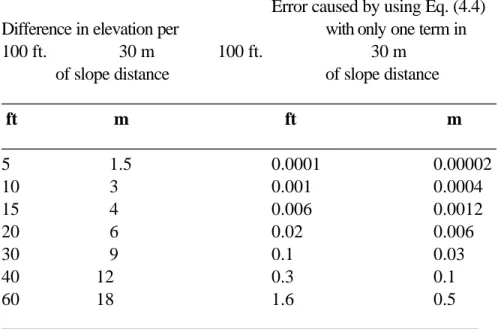
For moderate slopes, the first term within the parentheses of Eq. (4.4), h2/2s, is usually adequate. The error introduced by Eq. (4.4) using only the first term is negligible for ordinary slopes. The degree of approximation is shown in Table 4.2.
Thus, for slopes not exceeding 15 percent, the second term is not significant unless relative precisions of 1:15,000 or better are required.
Fig. 4.9 Slope Correction
Example 4.3: A distance of 130.508 m was measured over terrain with a constant slope along a sloping line which has a difference in elevation between the two ends of 5.56 m. Calculate the horizontal distance between the two points.
SOLUTION By Eq. (4.3),
H = [(130.508) 2 - (5.56) 2] ½ = 130.390 m
Table 4.2
_________________________________________________________ Error caused by using Eq. (4.4) Difference in elevation per with only one term in 100 ft. 30 m 100 ft. 30 m
of slope distance of slope distance
_______________________________________________________ ft m ft m _______________________________________________________ 5 1.5 0.0001 0.00002 10 3 0.001 0.0004 15 4 0.006 0.0012 20 6 0.02 0.006 30 9 0.1 0.03 40 12 0.3 0.1 60 18 1.6 0.5 _____________________________________________________
Example 4.4: Point R is to be set at a horizontal distance of 98.25 ft. from point Q along a sloping line where the difference in elevation between R and Q is 4.35 ft. Calculate the slope distance to be measured in the field.
SOLUTION Using Eq. (4.2) yields s = [98.25) 2 + (4.35) 2]1/2 = 98.35 ft.
Example 4.5: A distance was measured over irregularly sloping terrain. Slope distances and
differences in elevation are tabulated in the two columns on the left of the following table. Calculate the horizontal distance.
_____________________________________________________ Slope Difference in Horizontal
distance_____ elevation,____ distance,_____Ch = h2 / 2s,_
ft. ft. ft. ft. _____________________________________________________ 100.00 3.50 99.94 0.06 100.00 5.30 99.86 0.14 80.50 4.20 80.39 0.11 100.00 8.05 99.68 0.32 62.35 5.25 62.13 0.22 442.85 442.00 0.85 - 0.85 442.00 ____________________________________________________
SOLUTION: H is calculated using Eq. (4.3), individually for each length and tabulated in the third column. The total horizontal distance is the sum of the calculated H’s. An alternative is to compute the correction Ch from Eq. (4.4) using only one term, since the slopes are less than 15 percent. These
corrections are tabulated in the fourth column. In this procedure, the pocket calculator or the slide rule may be used. The horizontal distance is then computed by either subtracting the sum of the corrections, Ch, from the total distance; or applying individual corrections to corresponding slope distances and
taking the sum of the horizontal distances.
Precision required for 0 and h: The relative precision of a measured line is usually expressed as the ratio of the allowable discrepancy to the distance measured. Thus, a relative precision of 1 in 10,000 implies a discrepancy of 1 unit in 10,000 or 0.01 unit in 100 units. Required relative precisions in measured distances for various classes of work are given in Chaps. 8 and 10. Ordinary taping is generally said to have a relative precision of 1 part in 1000 to 1 part in 5000.
1) The Gunter’s or Surveyor’s chain is:
(a) extensively used for accurate measurement of distances.
(b) the unit of measure for Surveys of the Public Lands.
(c) a continuous flat steel ribbon 100 ft. long. (d) preferred for use in flag open country.
2) When measuring with the steel tape over rough or sloping ground by holding the tape horizontally, the greatest error results from:
(a) holding the tape out of level. (c) too great tension. (b) careless plumbing (d) too much sag.
3) When measuring with the steel tape, the head chainman should have:
(a) the zero end ahead.
(b) the 100 ft. end ahead.
(c) the end ahead which is best adapted to the procedure. (d) no preference as to which end is ahead.
4) When measuring with the steel tape, it is important at the very beginning of the survey for the chainmen to:
(a) put the zero end ahead. (b) put the 100 ft. end ahead.
(c) note the exact location of the zero and 100 ft. marks.
(d) note the method of marking the 5 ft. intervals.
5) The usual manner of supporting a steel tape when using it under general conditions is:
(a) at both ends. (c) at ends and center.
(b) at ends and quarter points (d) throughout its length on a level surface.
6) A “station” as used in measuring linear distances is considered to be any point on a line:
(a) occupied by an instrument.
(b) at a multiple of a full tape length established by continuous chaining from a point of beginning.
(c) where a rod reading is to be taken.
7) The most serious errors in ordinary taping are caused by:
(a) holding one end of the tape too high or too low and not making the slope correction.
(b) temperature variation.
(c) errors in alignment. (d) errors in plumbing.
(e) supporting the tape at ends only when standardized for support throughout.
8) A chaining party measures a distance AB along a slope with a 100 ft. tape which is known to be too long by 0.04 ft. The distance from A at the base of the slope to B at the summit is recorded as 416.85 ft. Levels run from A to B establish a difference in elevation of 24.50 ft. The true computed distance from A to B is:
(a) 416.30 ft. (b) 416.13 ft. (c) 415.96 ft. (d) none of these
9) A line measured on a 4°° 30' slope was found to be 700.25 ft. long. The horizontal distance is:
(a) 702.37' (b) 701.37' (c)700.00' (d) 698.09 (e) 689.37'
10) It is desired to lay out a line 400.00 ft. long. The ground slopes uniformly 3 feet in 100. The slope distance to be laid out is:
(a) 402.61' (b) 400.18' (c)400.00' (d) 396.72' (e) 396.27'
11) A 100 ft. tape is 1.00 ft. too long. A line measured with that tape is found to be exactly seven tape lengths. Corrected distance is:
(a) 693.00' (b) 699.00' (c)700.70' (d) 707.00' (e) 714.07'
12) A hundred-foot tape is 100.00 ft. long at 15 lbs. tension; at 25 lbs. tension it is used to measure the length of a line. Measured length = 500.00 ft. Tape is 0.020 in. X 0.20 in. in cross-section. E = 25,000,000 p.s.i. Length corrected for tension is:
(a) 499.90' (b) 500.04' (c)499.95' (d) 499.96' (e) 500.05'
13) Measurement of distances by means of the Geodimeter involves use of the principle
based upon a:
(a) microwave impulse (c) modulated light-wave impulse
LEVELING:
Leveling is an important part of surveying and provides data and control for maps, construction, layout and operation of manufacturing processes and equipment, etc. Fundamentally it consists in measuring the vertical distance from a point of known elevation (or assumed elevation) - a bench mark, B.M., or a turning point, T.P. - to the line of sight of an instrument to get the height of instruction (H.I.), then measuring the vertical distance from the H.I. to another point to obtain a new elevation (a T.P., B.M. or perhaps an intermediate sight, I.S.). This process is repeated as many times as may be necessary, in fact all leveling is expressed by the two equations.
Elevation + Back Sight (B.S.) = H.I. H.I. - Fore Sight (F.S.) = Elevation
Note that the back sight, also called the plus sight, is usually a plus value, but it can be minus, as in the case of a rod held against the ceiling of a room, or the roof of a tunnel, so that it is on a point above the H.I. Likewise, the foresight, although normally a minus value, can be plus under certain conditions.
The elevation of a point means the vertical distance above a datum. The most commonly used datum is Mean Sea Level, the average elevation of the ocean for all stages of the tides. The U.S.C. & G.S. has established almost 500,000 B.M.s for reference throughout the United States, and
descriptions and elevations of them are made available free. Changes in the adjusted elevations of the benchmarks have been made several times, the last and final one for most marks having been completed in 1929. Thus, an elevation can be given as 1427.638 ft. mean sea level datum, 1929 adjustment.
Among the various types of leveling are differential (ordinary, precise, and three-wire), reciprocal, profile, barometric, trigonometric, and borrow-pit or cross-section leveling. Levels are classified as hand levels, farm levels, engineers’ levels, semi-precise levels, precise levels, and self-leveling levels.
The spacing of graduations on level vials is either 0.01 ft., 0.1 inch, or 2 mm. The sensitivity of a level vial is determined by the radius of curvature provided in the grinding of the tube, the larger the radius, the more sensitive the bubble (a drop of water runs more freely on a flat table than in a saucer). In a properly designed instrument, the sensitivity of the level vial is correlated with the magnification of the telescope so that a slight movement of the bubble is accompanied by a slight change in the apparent position of the cross-hair on a rod held perhaps 150 to 200 ft. away.
Example 1. A reading of 5.876 ft. is obtained on a rod held 300 ft. away, the bubble being centered. The bubble is then moved exactly 5 divisions by means of the leveling screws and a new reading of 6.198 is made. What is the average angular value (sensitivity) of a 0.01 ft. division on the level vial? What is the radius of curvature of the vial?
The arc for 1 division at 300 ft. = (6.198 - 5.876)/5 = 0.322/5 = 0.0644 ft. Sensitivity, sin s = 0.0644/300 = 0.000215
s = (0.000215/0.00029) x 60 sec. = 45 sec. Radius = 0.01 ft./0.000215 = 46 ft. approx.
Some practical suggestions on leveling:
1 Check bubble centering immediately before and after taking an important reading. 2 Read rod quickly, do not continue to stare at it and change your mind.
3 In profile leveling, do not use a station as a T.P. - it tends to confuse the notes. 4 Be certain the tripod is in as good condition as the head of the instrument.
5 In hilly terrain, avoid wasting time leveling and then missing the rod by first using a hand level, or by first sighting the rod with the bubble in the rear of the tube for uphill sights, and in the front of the tube on downhill sights, as a safety factor.
1. A level surface which is used as a reference for measuring vertical distances is called a:
(a) bench mark (b) grade surface (c)datum plane (d) horizontal surface
2. The term “back sight” in leveling means:
(a) a sight in the general direction to the rear.
(b) the vertical distance from the line of sight to a point whose elevation is to be determined.
(c) a rod reading on a point whose elevation is known.
(d) a rod reading on a turning point.
3. The height of instrument as used in leveling means the:
(a) distance from the ground to the line of sight.
(b) elevation of the line of sight above the datum plane.
(c) height of the line of sight above the turning point or bench mark. (d) overall height of the tripod and level combined.
4. Reciprocal leveling is used when:
(a) it is necessary to correct for curvature and refraction.
(b) a line of levels is run in one direction only and a check on accuracy cannot be made by rerunning in the opposite direction.
(c) the distance between two points exceeds the maximum length of sight and the instrument cannot be set up between the points to keep the back sights and foresights balanced.
(d) the elevations of the ground surface along a definite line are desired.
5. The dumpy level differs from the wye level chiefly because it:
(a) is more accurate.
(b) has the telescope removable from its supports. (c) can be adjusted more readily.
(d) has the telescope rigidly attached to its supports. 6. A double rodded line of levels means a line run:
(a) in only one direction using two rods. (b) twice in the same direction using two rods.
(c) using two turning points for each set up of the instrument.
(d) in both directions using only one rod.
7. A Philadelphia leveling rod is a:
(a) target rod. (c) target and self reading rod.
8. A double rodded line of levels is a line which is run:
(a) from one bench mark to another and back using a single rod and rod man.
(b) from one bench mark to another in one direction only using two rod men and rods, as in precise work.
(c) from one bench mark to another either in one direction or in both directions.
(d) as an especially long line which does not close on a previously established B.M. where the elevation is known.
9. In leveling operations, the practice of keeping distances to the back sights and the foresights equalized eliminates the error caused by the:
(a) bubble tube not being perpendicular to the vertical axis.
(b) axis of the bubble tube and the line of sight not being in the same vertical plane. (c) horizontal cross-hair not being truly horizontal.
(d) line of sight not being parallel to the bubble tube axis. 10. The most important characteristic of contour lines on a map is that:
(a) they never cross each other.
(b) they always close on each other within the limits of the map.
(c) all points on any one contour are in the same direction.
(d) they are not equally spaced on uniform slopes.
11. On a contour map, closely spaced contour lines indicate:
(a) flat slope. (c)A relatively sharp slope.
(b) very irregular land. (d)a change in slope.
12. The grid or cross-section method of locating contours in the field is especially well adapted to:
(a) small areas, contour intervals 1-2 ft., accurate location important.
(b) small areas, such as city lots, accurate location of contours not important. (c) large areas, large contour interval, map small scale.
(d) large areas, large contour interval, irregular ground.
13. The interpolation method of locating contours in the field is preferable when the:
(a) ground surface is gently sloping. (c)area is small.
(b) scale of the map is large (d)contour interval is large, ground is irregular.
14. Elimination of the errors due to curvature and refraction in leveling operations is accomplished by keeping:
(c) level bubble accurately centered without regard to distances. (d) axis of line of sight perpendicular to the vertical axis.
15. A point observed by a level or transit appears to be higher than it really is because of:
(a) curvature of the earth’s surface. (b) parallax of the telescope.
(c) refraction of the air.
(d) convergence of light rays within the telescope.
16. The most accurate of the following methods of leveling is:
(a) reciprocal. (b) profile. (c)barometric. (d) differential. 17. A vertical section of the line of a survey showing elevations is a:
(a) plan. (b) cross-section. (c) profile. (d) detail.
18. A sewer invert at sta. 38+00 has an elevation 386.27. The gradient or rate of grade to sta. 46+00 is -1.00%. The elevation at 46+00 is:
(a) 386.19 (b) 378.27 (c) 306.27 (d) none of these.
19. In leveling, which of the following errors is more serious over several set-ups?
(a) personal errors (c) instrumental defects
(b) errors due to natural sources (d) settling of the level or rod
20. In ordinary differential leveling, the elevation of any ground point is found by:
(a) adding the B.S. to the elevation of the previous point. (b) subtracting the F.S. from the elevation of the previous point. (c) adding the F.S. to the H.I.
(d) adding the B.S. to the H.I.
(e) subtracting the F.S. from the H.I.
21. If the bubble leaves the vial center a slight amount between the B.S. and F.S., the:
(a) foresight should be taken without releveling. (b) back sight reading should be repeated.
(c) level tube must be adjusted before work proceeds. (d) level must be moved to another spot for the set-up.
(e) bubble should be centered before taking the F.S. reading.
22. A line of levels of 4 set-ups is run between 2 points using a 13-ft. level rod. The rod used has 0.1 ft. sawed off the bottom. Observed differences in elevation is 38.92 ft. Correct difference in elevation is (in ft.):
23. Contour lines which cross each other indicate:
(a) an absolutely flat plane (d) an overhanging cliff
(b) a peak (e) the bottom of an enclosed valley (c) a vertical cliff
24. In differential leveling, a sight on a point of known elevation is called a back sight (B.S.). In all types of surveys, land, tunnel, surveying, etc., a B.S.:
(a) is always a plus value (c) could be a minus value
(b) is always a minus value (d) none of answers given
25. In leveling, if the rod is not held vertical, the reading is:
(a) usually too small (c) equally too large or small
D-TRANSIT, STADIA:
The primary angle-measuring instrument for ordinary work has been the one-minute engineers’ transit, with the 30-second and 20-second instruments quite common. Some 15-second and 10-second transits have been employed, mainly for triangulation, along with theodolites reading to
5-seconds. European theodolites reading to 1 second, or 0.1 second, and interpolated to 0.1 second and 0.01 second respectively, are in use in the U. S. today. Since 1 second = 1 foot at 40 miles, the required precision of construction of equipment to theoretically measure the angle between two points 0.01 ft. apart and 40 miles away, is evident. Accurate set-up over the stadium and perfect leveling are obviously necessary to preserve the rated reading accuracy.
Assuming that a transit is properly leveled, set exactly over the station occupied, and in proper adjustment, only two sources of error are present in measuring an angle-pointing and reading. Tests show that an experiences observer can point a 1-minute transit with an accuracy of about 5 seconds. The reading from a 1-minute instrument should be correct within 30 seconds, i.e., if the actual position of the index mark is between, say, 18'31" and 19'29", theoretically a value of 19 minutes would be read. The maximum number of repetitions of an angle feasible to correlate pointing and reading accuracy of a 1-minute transit is, therefore, approximately 30"/5" = 6.
Comparable precision of angle and stadia distance readings is given in Example 1 below. Frequently, for record and computation purposes, angles and/or distances are measured more precisely than they can be mapped, thus each case must be analyzed individually.
Example 1: How close should transit angles be read if stadia distances of approximately 300 ft. are read to the nearest foot?
Distances to the nearest foot mean they are within +/- 0.5 ft. The permissible lateral error as defined by the angles is, therefore, also +/- 0.5 ft. for consistency in plotting points or computing.
1 min. = 0.03 ft. @ 100 ft. = 0.09 ft. @ 300 ft. (approx.) Read angles to 0.5/0.09 = 5 or 6 min. (5 min.by estimation of the index mark w/o using the vernier for American Insts.)
A vernier is an auxiliary scale used to measure a fractional part of the smallest division on the main scale without interpolation. A vernier has “n” divisions in a space equivalent to (n-1) spaces on the main scale. The “least count” of a vernier is the smallest direct reading obtainable with it.
least count 1. C. = value of the smallest division on the main scale number of divisions on the vernier
Transit scales are normally divided into 30, 20, 15, or 10-minute spaces. Verniers usually have 30, 40, 45, or 60 divisions. Direct (single), double, and folded verniers are used, the double vernier having two sides of which only one is used at a time, and the number of divisions in the formula is that for the individual side being employed.
Example 2: An instrument has a scale graduated in 1/2° spaces, and the vernier has 30
divisions (in a length corresponding with 29 spaces on the scale). What is the least count? Least count = 30 min./30 = 1 minute.
Verniers should be read by looking along the divisions from directly above to avoid parallax. Lining up coincident lines is best done by observing the small differences between the second scale and second vernier division lines on each side of the graduations estimated to be coincident, to see if they are equal. In measuring direct angles, better results are obtaining by taking the initial reading already on the plates instead of trying to set them to 0°00'00".
Example 3: Six repetitions of a 30-second transit are turned, the initial reading being 7°20'30",
the first turning giving 72°27'00" and the final reading after six repetitions being 38°00'30". What is the value of the angle?
The approx. angle (determined by one turning) = 72°27'00" - 7°27'30" = 65°06'30". Six repetitions represent approx. 390°39' or 1+ revolutions.
Actual final reading is 360°00' + 38°00'30" = 398°00'30" Average angle = (398°00'30" - 7°20'30")/6 = 65°06'40"
Note that the fractional part of 30" which could not be read in one turning, has been
mechanically added on the plates and made evident in the repetition method. Note, also that in dividing 390°40'00" by 6, division of 390° comes out even to 65°. Division of 40' by 6 gives a quotient of 6 minutes with 4 to carry. This 4 is carried directly down as 40 seconds without first converting to seconds by multiplying by 60 and then dividing by 6. Thus, any angle divided by 6, such as 11°14'36" is 11°
1° + 50'
Example 4: The plumb bob of a transit is 1/4 inch off center 14' 2'+20" at right angles to the foresight line. What angular error does this 36"______ 06"
represent on a 100-ft. sight? On a 900-ft. sight? 1° 52' 26" 1 inch = 1 min. @ 300 ft. approx. 1/4" = 1/4 min. @ 300 ft. = 3/4 min. @ 100 ft.
= 1/12 min. @ 900 ft. Angles closing the horizon must, of course, total 360°. For a closed traverse, the sum of the direct (interior) angles equal (n-2)180° where n is the number of sides in the traverse. Another way of expressing the condition is that the sum of the angles in a triangle = 180°00'00", and for each additional side, 180° is added.
If the angles do not total exactly (n-2)180°, they must be adjusted to obtain a closed figure for deed description and other purposes. Unlike taped distances where an additional opportunity for error exists each time the tape is laid down, the error in an angle is independent of its size. If the sum of the four angles in a quadrilateral is 360°02', the adjustment of each angle should be -30 seconds unless this carries the answers beyond the precision consistent with the field work. In that case, 1 minute might be subtracted from each of two angles most suspect because of short sights, phase, sighting into the sun or high on the rod, etc. In effect, this is one means of giving certain angles greater weight.
Adjustment of the angles does not make them correct - it merely provides results adding to the correct geometric total. A “pattern” type adjustment is desirable in a long traverse to expand or contract the traverse somewhat symmetrically, instead of applying all of the corrections to a few adjacent angles, unless knowledge of field conditions indicates the latter arrangement is closest to the probable truth. Angles must be adjusted before computing bearings, otherwise the bearings will not close the figure.
Some practical suggestions on transit work:
1. Center the instrument carefully over the station and level the head, then do not relevel between back sight and foresight.
2. Align the vertical wire quickly, do not continue to stare at the target and change your mind. 3. Make final setting with the tangent screw by means of clockwise turning to prevent backlash. If
overrun, back off and turn clockwise again to compress spring. 4. Always check vertical arc for index error before starting work.
5. Close the horizon when reading several important angles from one station.
6. Always double-center important line prolongations, and measure deflection angles by repeating an even number of times (2, 4 or 6).
7. When progressing generally in a straight line, have one pair of leveling screws along that line so that cross leveling can be done with the other pair (the cross pair being the more important unless vertical angles are to be read).
8. Keep tripod legs tightened properly so there is neither play or strain.
9. Avoid sighting close to the ground, buildings and even bushes in generally open areas to prevent unequal refraction bending the line of sight.
TRANSIT, STADIA
1. The surveyor’s compass is an instrument which:
(a) reads horizontal angles.
(b) gives the horizontal direction of a line.
(c) is relatively free of all types of errors. (d) is an essential part of the engineer’s transit.
2. Accurate setting of the transit plates at zero is accomplished by means of the:
(a) upper tangent screw (c) lower tangent screw
(b) upper clamp (d) lower clamp
3. When setting a transit over a tack point, by moving the leg of the tripod toward or away from the plumb bob, the instrument man will:
(a) change the level of the head considerably.
(b) change the position of the plumb bob considerably. (c) change the position of the plumb bob slightly.
(d) cause no change in the level of the head.
4. To read an angle by re petition, it is necessary to:
(a) set plates at zero before back sighting for each turning of the angle.
(b) keep plates set at the value of the angle already turned when back sighting for each turning.
(c) turn angles with the telescope in the direct (normal position).
(d) turn angles with the telescope in the direct and in the reversed (inverted position).
5. The most important detail to be observed in the procedure for measuring angles by repetition with a transit is to:
(a) turn the angle the same number of times with the telescope in the direct and the reversed position.
(b) turn the angle with the telescope in the direct position and the reversed position as many times as are required, the precision varying directly with the number of
repetitions.
(c) retain on the plates the value of the angle already turned when back sighting for each successive turning.
(d) always point the telescope on the object sighted by a clockwise motion of the upper tangent or slow motion screw.
6. Turning angles with the transit telescope first in the normal or direct position and then in the reversed position corrects the error due to the:
(a) plate bubbles not being at right angles to the vertical axis. (b) vertical hair not being truly vertical.
(c) horizontal axis not being truly horizontal.
(d) plates not being truly horizontal.
7. Prolonging a straight line with a transit by double centering or double reversing nullifies the error caused by:
(a) the vertical cross hair not being perpendicular to the horizontal axis. (b) the line of sight not being parallel to the axis of the telescope bubble.
(c) the line of sight not being perpendicular to the horizontal axis.
(d) the vertical cross hair not being truly vertical.
8. A random line in surveying is:
(a) an offset line for locating buildings.
(b) a line produced to intersect a traverse line, or some other line.
(c) a trial line run near a true line.
(d) a line established by swinging a tape from a point to another line.
9. The stadia is a method for measuring:
(a) horizontal angles. (c) distances.
(b) vertical angles. (d) differences in elevation.
10. The stadia method of surveying is used when:
(a) a rapid method of measuring distances over rough ground is required.
(b) an accurate representation of a great amount of detail in a small area is required. (c) the survey is in open country.
(d) the area surveyed is to be reproduced on a small scale map.
11. The stadia ratio or interval of a transit is:
(a) a constant quantity for all instruments and any one instrument.
(b) the distance from the cross-hairs to the objective lens divided by the distance from the center of the instrument to the cross-hairs.
(c) the distance on the rod intercepted by the stadia hairs.
(d) the focal length of the objective lens divided by the distance between the stadia hairs.
12. The “stadia constant” of a transit is the distance from:
(a) the cross-hairs to the principle focus of the objective lens. (b) the cross-hairs to the objective lens.
(c) the instrument center to the principle focus of the objective lens.
(d) the instrument center to the objective lens.
13. In stadia surveying, the height of instrument must be known in order to determine the:
(a) elevation of the line of sight. (c) elevation of the observed point.
(b) vertical angle to the observed point. (d) distance to the observed point.
14. Stadia readings can be taken with the rod held:
(a) plumb. (c) horizontal.
(b) perpendicular to the line of sight (d) any of the above.
15. An error of 1 minute in the final reading of an angle means that the point is off per 100 ft. length approximately:
(a) 3.0 (b) 0.3 (c) 0.03 (d) 0.003
16. Interior angle traverses are best suited to:
(a) route surveys.
(b) property surveys of high precision.
(c) topographic surveys for locating much detail. (d) stadia topography.
17. If it is necessary to climb over a fence in a field while carrying a transit or level, the instrument man should:
(a) lean the instrument against the fence, then climb over. (b) lay the instrument on the ground, then climb over the fence.
(c) place the instrument on the other side of the fence with the tripod legs well spread, then climb over.
(d) remove the head of the instrument and place it on the other side of the fence.
18. The safest way to carry an engineer’s transit or level to prevent accidents under various conditions encountered in the field is to:
(a) keep the instrument head on the tripod with all clamps loose. (b) keep the instrument head on the tripod with all clamps tight. (c) keep the instrument in its box with all clamps loose.
(d) keep the instrument in its box with all clamps tight.
19. The chief advantage of the transit-stadia method of surveying is the:
(a) the small size of party required.
(b) the accuracy with which detail can be located.
10. A transit has a stadia interval of 101.0. For a distance of 100' but with the line of sight inclined downward at an angle of 12°°-00', the length intercepted on the rod will be most nearly:
(a) 1.01 tan 12°. (b) 1.01 Cos 12°. (c) 1.01 (1/Cos2 12°°) (d) 1.01 Cos212°
21. Lines AB and BC are two sides of a traverse being run by deflection angles from A to B to C. The deflection angle at B is:
(a) 36°45' R (c) 143°15' R (b) 36°35' L (d) None of these.
22. The bearing of AB is S 7°°12' W, and the bearing of BC is N 86°°13' W. The deflection angle at B is:
AZIMUTHS & BEARINGS
An azimuth is an angle measured clockwise from a meridian. The bearing of a line is the acute horizontal angle between the meridian and the line. A meridian is a reference line and may be the direction of true north or true south, magnetic north or south, or any assumed line. The true (geodetic) north-south line is commonly used because it can be checked and re-established by observations on the sun and stars.
The following problems arise in connection with azimuths and bearings: 1. Conversion of azimuths to bearings, and vice versa.
2. Conversion of true bearings to magnetic bearings, and fice versa.
3. Conversion of a magnetic bearing at some past date to that for the present time, or vice versa, the declination (angular difference between the lines to true north and magnetic north) being different for the two dates.
4. Computation of the bearings of lines, given the actual or assumed bearing of one line and the angles between successive lines.
5. Correction of magnetic bearings effected by local attraction.
All of these problems are readily solved by means of a simple sketch or sketches. Keeping in mind these properties of azimuths and bearings will help avoid mistakes:
Azimuths Bearings
1) Values between 0° and 360° Values between 0° and 90° 2) Require numerical values only Require 2 letters and value 3) Can be true, magnetic, calculated, forward, back Same
4) Measured clockwise only Clockwise and counterclockwise 5) Measured from north only (or south only) in any survey Measured from north and south
Example 1: Convert an azimuth of 160° from north to its equivalent bearing.
The bearing angle is 180° - 160° = 20° The bearing is S 20°E
Example 2: The magnetic bearing of a line AB is N 27°10'W. The
declination is 2°05'E. What is the true bearing of AB? (Note: True north is shown by a full-headed arrow, magnetic north by a half-headed arrow, the head being on the declination side to get it out of the way of the true north arrowhead. The true bearing=N25°05'W.
Example 3: The magnetic bearing of a property line in 1870 was recorded as N47°28'E. What is the magnetic bearing in 1959 if the magnetic
Example 4: The bearing of AB, the west side of a subdivision forming a regular pentagon is due north. Compute the bearings of the other sides.
The short-hand method of computation shown is based upon having 1) a starting or reference line, 2) a direction of turning, 3) an angular distance. Clockwise angles are considered plus, and counterclockwise angles minus. At B, the angle is turned from the line BA as a back sight, therefore, the back bearing letters for AB are shown as SW in parentheses. The first letter, S, is then brought down to give the direction from which an angular distance of 108° is measured in a minus direction. This places the line BC in the NE quadrant with a bearing of N 72°00'E. The bearing of the first line should be computed as a check. If the bearing letters are not reversed as noted in the parentheses, alternate bearings will be correct, the others incorrect, even though a check on the computations appears to have been obtained.
AZIMUTHS, BEARINGS
1) The magnetic bearing of a line is:
(a) the total horizontal angle measured from the south end of the magnetic meridian. (b) the total horizontal angle measured from the north end of the magnetic meridian.
(c) the acute angle which the line makes with the meridian.
(d) The azimuth of the line minus 90°.
2) The angle between the geographic meridian and the magnetic needle at any point is
known as:
(a) deviation (b) variation (c) declination (d) deflection
3.) The clockwise angle which a line makes with any reference-line, is called the:
(a) bearing (b) declination (c) deflection (d) azimuth
4) A tangent line connecting Sta. 462+86.25 and Sta. 498+89.26 of a highway location survey has a magnetic bearing of S 87°°15' E. At Sta. 478+89.26 it crosses an existing highway whose bearing is S 62°°15'W. The acute angle between the two alignments is:
(a) 25°00' (b) 27°45' (c) 30°°30' (d) none of these.
5) The bearing of a line AB is S 11°°28'E. The interior angle at B turned clockwise to the point C is 72°°26'. The interior angle at C turned clockwise to the point D is 117°°27'. The bearing of the line CD is:
6) An instrument man set up at point B of a traverse takes a back sight to point A and then reads a deflection angle to the line BC as 87°°26' left. He checks the compass needle and reads the magnetic bearing of BC as N 72°°30'E. The magnetic bearing of line BA is:
(a) S14°56'E (b) N20°°04'W (c) N14°56'W (d) none of these.
7) The magnetic bearing of a line forming part of a property survey in 1870 was recorded as N46°°28'W. At that time, the magnetic declination was 2°°30'E. If the magnetic declination in 1943 is 1°°15'W, the magnetic bearing of the line at the later date is:
(a) N42°°43'W (b) N45°13'W (c) N47°43'W (d) N50°13'W
8) The process of determining direction on a map relative to the earth’s surface is generally called:
(a) bearing (b) direction (c) geodetic (d) orientation (e) magnetic
9) An azimuth is always:
(a) equal numerically to the bearing of a given line. (b) 90° larger or smaller than the comparable bearing. (c) 180° larger or smaller than the comparable bearing.
(d) between 0°° and 360°° (e) answer not given.
10) The angle between the geometric meridian and magnetic needle direction of a line is the:
MAPPING
A map is a representation on a plane surface, at an established scale, of the physical features (natural, artificial, or both) of a part of the whole of the earth’s surface, by the use of signs and symbols, and with the method of orientation indicated. Map scales may be given in three ways: 1) as an equality such as 1" = 400 ft.; 2) by a ratio or representative fraction such as 1:4,000; or 3) by a graphical scale (preferable scaled distances at right angles in diagonally opposite corners of the map.
Maps are classified as small scale (1" = 1,000 ft. or more), intermediate scale (1" = 100 ft. to 1" = 1,000 ft.), and large scale (1" = 100 ft. or less). The scale to be used depends upon the purpose of the map, size (dimensions) of a standard sheet, the type and number of topographic symbols to be shown, required plotting precision, etc.
Map drafting of small area maps consists of four phases: 1) plotting the traverse or control; 2) plotting the details; 3) plotting the topography and special data; and 4) finishing the map. Angles may be plotted by coordinates, tangents, protractor, or plotting machine. The coordinate method of laying out angles and distances for a traverse has the advantage that any error in plotting one point is not carried along into the next line.
Standard topographic symbols can be found in various manuals and publications and should be used on all maps. The meridian arrow selected should be simple and blend into the sheet. True north is indicated by an arrow with full head, full feather; magnetic north by half head, half feather, placed on the declination side of true north to provide maximum drafting clearance.
Titles of maps for individual organizations are standardized, but in general include the area location, scale, dates of field survey and map drafting, pertinent personnel, etc. Any notes required to outline special features of the map, and perhaps a legend, should be placed near the title to insure that they receive attention.
Example 1: What is the smallest unit of distance that can be plotted by a draftsman using ordinary equipment, on a map having a scale of 1" = 100 ft.?
Smallest scale distance generally plottable = 1/50" to 1/100" = 2 to 1 ft.
Example 2: If it is desired to keep plotting errors within 20 ft., what is the smallest scale that should be used?
20 ft. = approximately 1/50 inch. Then scale is 1" = 1,000 ft.
Example 3: Why do the features shown on a topographic map of a large area differ from those on a map of small scale?
Maps of large areas are probably to a small scale, thus making it impossible to depict some topographic features without considerable and undesirable exaggeration.
Example 4: A traverse with all topographic details inside looks best on a sheet if the border distance to traverse corners is the same on the top, bottom, and left side. Determine the position for a 5-sided traverse on an 18" x 24" sheet having a 1" border on the left side and ½" on the other 3 sides. Coordinates of hubs are: A(0,0), B (+225.60, + 270.45), C(+78.76, +774.25), D(-67.34, + 564.58), and E(-405.57, +440.02).
Maximum possible scale = 774.25'/22.5" or 1" = 34 ft. Use 1" = 40 ft. For the Y-direction, 631.17/40 gives 15.8" required with 16 ½" available.
Then the border distance on 3 sides = ½ [17 - (631.17/40)] = 0.61". (ref. C p 300).
1. Maps are drawn to small scale when:
(a) the area to be represented is small (c) there is much detail to be shown.
(b) there is little detail to be shown. (d) the size of the sheet is large.
2. A scale of 1" = 1000' would be called:
(a) a large scale (c) a small scale
(b) an intermediate scale. (d) a natural scale
3. A scale of 1/20,000 would be called:
(a) an equivalent scale (c) a large scale
(b) an intermediate scale (d) a natural scale
4. Graphical scales are shown on maps because:
(a) they enable the reader to determine distances more easily than with an equivalent scale.
(b) they give a more easily understood method of determining distances.
(c) they improve the appearance of the map and serve to balance the meridian arrow.
(d) maps are subject to change in scale.
5. In mapping, the term relief refers to such features as:
(a) rivers, lakes, harbors. (c) man made features. (b) vegetation. (d) shape of the ground. 6. In mapping, interpolation is the process of:
(a) spacing contour lines by proportion between lines.
(b) drawing smooth freehand contour lines. (c) tracing contours on a plotted map. (d) connecting points of equal elevation.
CONTOURS & CONTOUR LINES:
A contour is an imaginary line of constant elevation on the ground surface. It may be thought of as the trace formed by the intersection of a level surface with the ground surface, for example, the shore line of a still body of water.
If on a drawing are plotted the locations of several ground points of equal elevation, say, 720 ft. above sea level, a line on the map joining these points is called a contour line. Thus, contours on the ground are represented by contour lines on the map. Loosely, however, the terms contour and contour line are often used interchangeably. On a given map, successive contour lines represent elevations differing by a fixed vertical distance called the contour interval.
The use of contour lines has the great advantage that it permits the representation of relief with much greater facility, and with far greater definiteness and accuracy, than do other symbols. It has the disadvantage that the map is not so legible to the layman.
TOPOGRAPHIC MAPS:
Characteristics of Contour Lines: The principle characteristics of contour lines can be illustrated by reference to Fig. 24-2. For the purpose of this discussion, the slope of the river surface is
disregarded. The stage of the river at the time of the field survey was at an elevation of 510 ft., hence the shore line on the map marks the position of the 510 ft. contour line. For this map, the contour interval is 5 ft. If the river were to rise through a 5 ft. stage, the short line would be represented by the 515 ft. contour line; similarly, the successive contour lines at 520 ft., 525 ft., etc., represent short lines which the river would have if it should rise farther by 5 ft. Stages.
The principle characteristics of contour lines are as follows:
1) The horizontal distance between contour lines is inversely proportional to the slope. Hence on steep slopes (as at the railroad and at the river banks in Fig. 24-2), the contour lines are spaced closely.
2. On uniform slopes, the contour lines are spaced uniformly.
3. Along plane surfaces (such as those of the railroad cuts and fills in Fig. 24-2), the contour lines are straight and parallel to one another.
4. As contour lines represent level lines, they are perpendicular to the lines of steepest slope. They are perpendicular to ridge and valley lines where they cross such lines.
5. As all land areas may be regarded as summits or islands above sea level, evidently all contour lines must close upon themselves either with or without the borders of the map. It follows that a closed contour line on a map always indicates either a summit or a depression. If water lines or the elevations of adjacent contour lines do not indicate which condition is represented, a depression is shown by a hachured contour line, called a depression contour, as shown at M in Fig. 24-2.
6. As contour lines represent contours of different elevation on the ground, they cannot merge or cross one another on the map, except in the rare cases of vertical surfaces (see bridge
abutments of Fig. 24-2) or overhanging ground surfaces as at a cliff or a cave.
7. A single contour line cannot lie between two contour lines of higher or lower elevation.
CONTOUR INTERVAL:
The appropriate vertical distance between contours, or contour interval, depends upon the purpose and scale of the map and upon the character of terrain represented. For small-scale maps of rough country, the interval may be 50 ft., 100 ft., or more; for large-scale maps of flat country, the interval may be as small as ½ ft. For maps of intermediate scale, such as are used for many engineering studies, the interval is usually 2 or 5 ft.
CONTOUR MAP CONSTRUCTION:
Normally the construction of a topographic map consists of three operations: (1) the plotting of the horizontal control, or skeleton upon which the details of the map are hung; (2) the plotting of details, including the map location of points of known ground elevation, called ground points, by means of which the relief is to be indicated; and (3) the construction of contour lines at a given contour interval, the ground points being employed as guides in the proper location of the contour lines. A ground point on a contour is called a contour point.
1. Interpolation in topographic mapping means:
(a) connecting points of the same elevation. (b) blowing up or reducing the map scale.
(c) spacing contour lines by proportionate measurements.
(d) drawing contour lines through points of known elevation. (e) drawing smooth freehand contour lines.
2. A closed hachured contour line represents a:
(a) ridge (b) valley (c) saddle (d) summit (e) depression
3. The sides of a highway tangent fill shown on a topographic map by contour lines are: (a) straight, parallel and equally spaced.
(b) straight but not parallel.
(c) straight and parallel, but not equally spaced. (d) parallel and equally spaced, but not straight.
4. For a given map scale and contour interval, concentric circular contour lines might indicate a relatively:
(a) inclined plateau (b) great elevation (c) irregular or broken surface. (d) deep river valley (e) high isolated hills.
5. On a map drawn to a scale of 1" = 200 ft., contour lines are 3/8 in. apart at a certain place. Contour interval is 10 ft. Ground slope in % at the place is:
(a) 13.3 (b) 10.0 (c) 7.5 (d) 5.0 (e) 1.33
6. Contour interval is the:
(a) horizontal distance between adjacent contours.
(b) elevation above sea level.
(c) difference in elevation between adjacent contours.
TRIANGULATION:
Triangulation is a method of surveying in which the station points are located at the vertices of a chain or network of triangles. The angles of the triangles are measured by transits or theodolites and the sides determined by computation from selected sides termed base lines. The base lines are measured directly on the ground.
Triangulation permits the selection of sites for stations and base lines suitable from both
topographic and geometric considerations, the latter involving choice of points which will give “strong” figures having angles larger than 30° if possible. The method is well adapted to the use of precision instruments and methods, and the production of accurate results. Triangulation is generally used where the area surveyed is large and the employment of geodetic methods desirable. It includes the operations of observing angles, measuring base lines, their mathematical processing, the reconnaissance which precedes these operations, and the astronomic observations required to establish a geodetic datum and control the triangulation.
Triangulation is now classified as 1st, 2nd and 3rd or lower order with appropriate specifications for each class. To obtain the results shown in the table, most work is done at night by sighting on lights and utilizing towers and mounting tops to get long sights. In the early haste to cover the United States, observations of 100 miles were not unusual and a maximum sight of 160 miles was taken. Most present day lines are probably closer to 25 miles. The wooden towers used in the past have been replaced by steel towers (actually 2 towers are used, the inner one for the instrument and a separate outer tower for the observer and the signal mounted above).
FIRST SECOND THIRD FOURTH
Average triangle closure, seconds 1 3 6 6+
Maximum triangle closure, seconds 3 8 12 ---
Check on base 1/25,000 1/10,000 1/5,000 1/5,000+ Triangulation results in the U. S. are reduced to the mathematical figure defined by the Clarke Spheroid of 1866. The basic point for the U. S. Is triangulation station Meade’s Ranch in Kansas which has the following position: Latitude 39°13'26.686", Longitude 98°32'30.506", Azimuth to station Waldo = 75°28'14.52". In 1927, the western half of the control net was adjusted, and the eastern half was similarly adjusted later. To identify positions and avoid confusion with older data, descriptions are noted as “North American Datum of 1927.” This is proper since the triangulation net has been
extended both north and south of the U. S. Border. The symbol for a triangulation station is ∇.
Stations established by the U.S.C.&G.S. are identified by circular bronze markers and their descriptions and positions made available free of charge to anyone who may wish to use the stations for control points.
Single triangles, central point figures, or quadrilaterals can be used for small areas, but generally chains or arcs of these figures are employed, as in Figure 1. A new based line is measured after about 10 to 30 triangles on 1st, 2nd and 3rd order work.
The U.S.C.&G.S. net for the U.S. includes the equivalent of about 13 east-west areas and about 30 north-south areas with various crossings, internal areas, etc. Several electronic instruments now being used provide the means of measuring the lengths of long lines as accurately as it is possible to measure short base lines by older methods. As a result, trilateration, the measurement of all 3 sides of a triangle and computation of the angles may be employed in place of triangulation for some control purposes. A new electronic device for more accurately pointing theodolites is now being developed and should increase the precision of direction instrument sighting.
1. The main disadvantage of a precise traverse compared with triangulation is that:
(a) the accuracy is not of as high an order.
(b) more calculations are required to determine all parts of the traverse. (c) a large field party is required to carry out the work.
(d) the traverse usually is more expensive and all distances must be measured.
2. Disadvantages of a precise traverse compared with triangulation are:
(a) all angles must be measured by more repetitions for precise traverse.
(b) all distances must be measured.
(c) size of party is large.
(d) fewer points are made available for the local surveyor.
3. Small angles are undesirable in triangulation because: (a) they decrease the stre ngth of figure.
(b) they make computations more difficult.
(c) they increase the cost of extending a chain of figures. (d) the intersection of the sides is poor thus increasing errors.
4. Since it is essential to keep horizontal refraction to a minimum, 1st and 2nd order triangulation can best be done:
![Improvements for Kosovo's spatial planning system / [presentation given in May 2011]](data:image/gif;base64,R0lGODlhAQABAIAAAP///wAAACH5BAEAAAAALAAAAAABAAEAAAICRAEAOw==)