Using
Multi-Criteria Optimization
Rajesh Kudikala
Department of Automatic Control and Systems Engineering
The University of Sheffield
A thesis submitted for the degree of
Doctor of Philosophy
I would like to express my deepest and sincere gratitude to my super-visor, Professor Peter J Fleming, for the help and support he has given me throughout my Ph.D. research. I feel very privileged to have him as my supervisor. This thesis would have not been possible without his vision, motivation, guidance and supervision. I am very thankful to him for his time, support, patience and encouragement.
I would like to take this opportunity to thank Rolls-Royce plc and EPSRC for the financial support through a Dorothy Hodgkin Post-graduate Award (DHPA).
I would also like to express my sincere thanks to system engineering experts from Rolls-Royce plc, Graham Tanner, Jonathan Holt, Dr. Ian Griffin, Dr. Vijay Patel, Adam McLoughlin, and Peter Beecroft for providing necessary models and information needed for my re-search work and for their reviews and support.
I am very thankful to Professor Haydn A Thompson, Professor Visakan Kadirkamanathan, Dr. Andrew R Mills, Dr. Robin C Purshouse, Dr. Korak Gosh and Dr. Ioannis Giagkiozis for their invaluable advice and comments throughout my Ph.D. research work. I am extremely grate-ful to all the people that I have had the pleasure of working with in Rolls-Royce UTC, Rui, Vignesh, Martha, Maszatul, Renata, Mathew and to all my friends, who have been very helpful and friendly to me throughout the time of my study. During my research work I received many helps from colleagues and staff at the University of Sheffield. I thank the University of Sheffield for giving me this great opportunity. I feel proud to have been part of this excellent institution.
in my thesis.
I would also like to express my thanks to Professor Kalyanmoy Deb and Professor Bishakh Bhattacharya from IIT Kanpur for inspiring me to pursue Ph.D. research study, and to Dr. Chandra Shekhar Nyalapogula for providing a great encouragement during my Ph.D. Many thanks to my friends Ramesh, Rajesh, Purna, Ravikiran, Somu, Chandu, Pawan, RamaRao, Roopa, Pradeep, Ravi, Dattu, Sujan, Chenna, Ravitej, Sunith, Eashwar, Anil, Monalisa, Rathod, Lucky and Deva. I feel very lucky to have them in my life. Special thanks to Rajendra and Keerthi, who helped me and made my stay in Sheffield so enjoyable. I would also like to express my gratitude to Rajesh, Vishnuji and members of JET UK for sharing with me, their invalu-able insight into Vedic principles and ethical values.
Deeply from my heart with love, I would like to thank my beloved parents Satyanarayana and Bhagya Lakshmi for their encouragement and prayers throughout my life. My dearest love and thanks to my wife Kiranmai for her patience, support, love and for being there in my life. I could not have wished for a more understanding and more loving wife than her. My profound thanks to my dear parents-in-law Sudhakar, Lalitha, my dear brother Harish and brother-in-parents-in-law Aashish for their unconditional support. I am truly indebted to all their patience, support and understanding. Thank you all very much! All praise and glory is due to Almighty Lord Sri Laxmi Narayana, the lord of the universe, whose mercy and blessings have been bestowed constantly upon me, along with mangalashasanams from Acharya His Holiness Sri Sri Sri Tridandi Srimannarayana Ramanuja Chinna Jee-yar Swamiji.
“Serve all beings as service to God. Worship your own..Respect all.”
System architecture is defined as the description of a complex system in terms of its functional requirements, physical elements and their interrelationships. Designing a complex system architecture can be a difficult task involving multi-faceted trade-off decisions. The system architecture designs often have many project-specific goals involving mix of quantitative and qualitative criteria and a large design trade space. Several tools and methods have been developed to support the system architecture design process in the last few decades. However, many conventional problem solving techniques face difficulties in deal-ing with complex system design problems havdeal-ing many goals.
In this research work, an interactive multi-criteria design optimization framework is proposed for solving many-objective system architecture design problems and generating a well distributed set of Pareto opti-mal solutions for these problems. The optimization framework sup-ports the decision maker by providing a facility for progressive prefer-ence articulation, empowering closely coupled user and optimization process interaction. A novel Pareto estimation (PE) method is in-troduced for increasing the density of the available Pareto optimal solutions with reduced computational expense and further extended to multi-objective multi-modal problems.
System architecture design using multi-criteria optimization is demon-strated using a real-world application of an aero engine health man-agement (EHM) system. A design process is presented for the optimal deployment of the EHM system functional operations over physical ar-chitecture subsystems. The EHM system arar-chitecture design problem
optimal architecture solutions for the EHM system, which provides valuable insights into the design trade-offs. Uncertainty analysis is implemented using an efficient polynomial chaos approach and robust architecture solutions are obtained for the EHM system architecture design. Performance assessment through evaluation of benchmark test metrics demonstrates the superior performance of the proposed methodology.
Contents vi
List of Figures x
List of Tables xiv
Nomenclature xviii
1 Introduction 1
1.1 Introduction and Motivation . . . 1
1.2 Research Objectives . . . 3
1.3 Outline of the Thesis . . . 4
1.4 Research Contributions . . . 7
1.5 Publications and Research Reports . . . 8
2 Literature Review 10 2.1 Introduction . . . 10
2.2 System Architecture Design . . . 10
2.3 Introduction to Multi-Objective Optimization (MOO) . . . 11
2.3.1 Goals of Multi-Objective Optimization . . . 13
2.3.2 General Optimization Process . . . 15
2.3.3 Classical Optimization Approaches . . . 16
2.3.4 Evolutionary Computation Methods . . . 17
2.4 Review of System Architecture Design using Optimization Methods . . . 18
2.5.1 Background . . . 23
2.5.2 Methods for Increasing Selective Pressure . . . 24
2.5.2.1 Modification of Pareto-dominance . . . 24
2.5.2.2 Assignment of different ranks . . . 25
2.5.3 Indicator Based Methods . . . 26
2.5.4 Decomposition Based Methods . . . 27
2.5.5 Preference Articulation Methods . . . 27
2.5.5.1 A-priori Preference Articulation . . . 27
2.5.5.2 A-posteriori Preference Articulation . . . 28
2.5.5.3 Progressive Preference Articulation . . . 28
2.5.6 A Co-Evolutionary Approach using Preferences . . . 29
2.5.7 Multi-Objective Multi-Modal Optimization . . . 29
2.5.8 Visualization Methods . . . 31
2.5.8.1 The Cartesian Co-ordinates Plot and Scatter-Plot 32 2.5.8.2 The Parallel Co-ordinates Plot . . . 32
2.6 Uncertainty Analysis and Robust Design Optimization . . . 33
2.7 Research Gaps . . . 33
2.8 Summary . . . 36
3 Interactive Multi-Criteria Design Optimization Framework 37 3.1 Introduction . . . 37
3.2 Interactive Multi-Criteria Design Optimization Framework . . . . 38
3.3 Pareto Estimation Method . . . 44
3.3.1 Motivation . . . 44
3.3.2 Radial Basis Function Neural Networks . . . 45
3.3.3 Pareto Estimation - General Procedure . . . 47
3.3.4 Limitations of Pareto Estimation Method . . . 49
3.4 Extended Pareto Estimation Method with Clustering . . . 50
3.5 Visual Assessment of Cluster Tendency (VAT) Algorithm . . . 52
3.6 Experimental Setup . . . 55
3.6.1 Test problem 1 . . . 56
3.6.1.1 CASE I . . . 56
3.6.2 Test problem 2 . . . 63
3.7 Summary . . . 70
4 System Architecture Design: An Aero Engine Health Management System Case Study 72 4.1 Introduction . . . 72
4.2 Aero Engine Health Management System Architecture Design . . 73
4.2.1 Stakeholder Identification and Requirement Analysis . . . 74
4.2.2 EHM System Functional Decomposition . . . 76
4.2.3 EHM System Physical Architecture Decomposition . . . . 78
4.2.4 EHM System Physical Architecture Subsystems Limitations . . . 80
4.2.5 EHM System Functional Operations Deployment . . . 82
4.3 Multi-Criteria Optimization Formulation for EHM System Architecture Design Problem . . . 83
4.3.1 Decision Variables . . . 84
4.3.2 Constraints . . . 84
4.3.3 Objective Functions . . . 85
4.3.4 Optimization Problem Formulation . . . 85
4.3.5 Integration of the Architecture Models into the Optimization Framework . . . 86
4.3.6 Evaluation of Criteria Values for a Sample EHM System Deployment Solution . . . 87
4.4 Multi-Criteria Optimization of EHM System Architecture Design Problem . . . 90
4.5 Cluster Analysis and Pareto Estimation . . . 94
4.6 Statistical Performance Evaluation . . . 98
4.7 Exploring What-If Design Scenarios . . . 106
4.8 Summary . . . 107
5 Uncertainty Analysis and Robust Optimization of EHM System
5.1 Introduction . . . 108
5.2 Uncertainties in EHM System Architecture Design . . . 109
5.3 Robustness Metric . . . 110
5.4 Polynomial Chaos Expansion Approach . . . 111
5.5 Uncertainty Analysis and Robust Optimization of EHM System Architecture Design . . . 113
5.6 Validation of the EHM System Architecture Design Optimization 118 5.7 Summary . . . 125
6 Conclusions and Future Work 126 6.1 Research Objectives . . . 126
6.2 Research Contributions . . . 127
6.3 Future Work . . . 132
2.1 Pareto optimal solutions on a Pareto Front for a two objective minimization problem. . . 13 2.2 Goals of a multi-objective optimization algorithm. . . 14 2.3 Components of an optimization problem. . . 15 2.4 Regions of non-domination in a two-objective minimization problem. 23 2.5 Multi-modal Pareto optimal solutions in a multi-objective
opti-mization problem. . . 30
3.1 Ranking of solutions with (i)an unattainble goal and (ii)an at-tainble goal, using the progressive preference articulation PPAFF
(Fonseca & Fleming, 1998a) technique. . . 39 3.2 Flowchart of multi-objective genetic algorithm (MOGA) with PPAFF
and Crowding distance operator. . . 41 3.3 Interactive optimization framework with progressive preference
ar-ticulation technique. . . 42 3.4 MOGA trade-off graph with progressive preference articulation
window. . . 44 3.5 The Pareto estimation method (Giagkiozis & Fleming, 2012). . . 47 3.6 The normalization and projection of a two-objective Pareto front
(Giagkiozis & Fleming, 2012). . . 48 3.7 A many to one mapping of decision vectors to Pareto front in
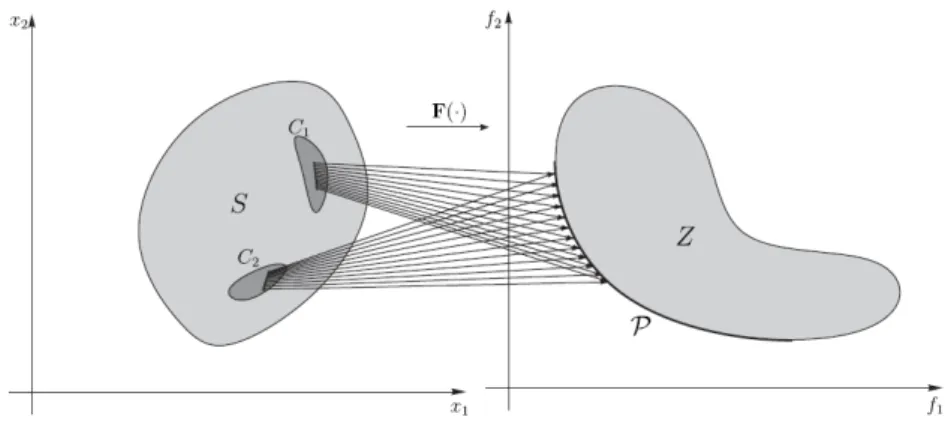
multi-objective multi-modal problems (Kudikala et al., 2013b). . . 50 3.8 The extended Pareto estimation method. Clusters the Pareto
op-timal decision variable vectors and identifies a mapping for every cluster (Kudikala et al., 2013b). . . 51
3.9 Flowchart of the proposed interactvie multi-criteria design opti-mization framework incorporating the MOGA optimizer, the clus-tering analysis and the Pareto estimation method. . . 54 3.10 Case I: Non-dominated solutions obtained for the test problem 1
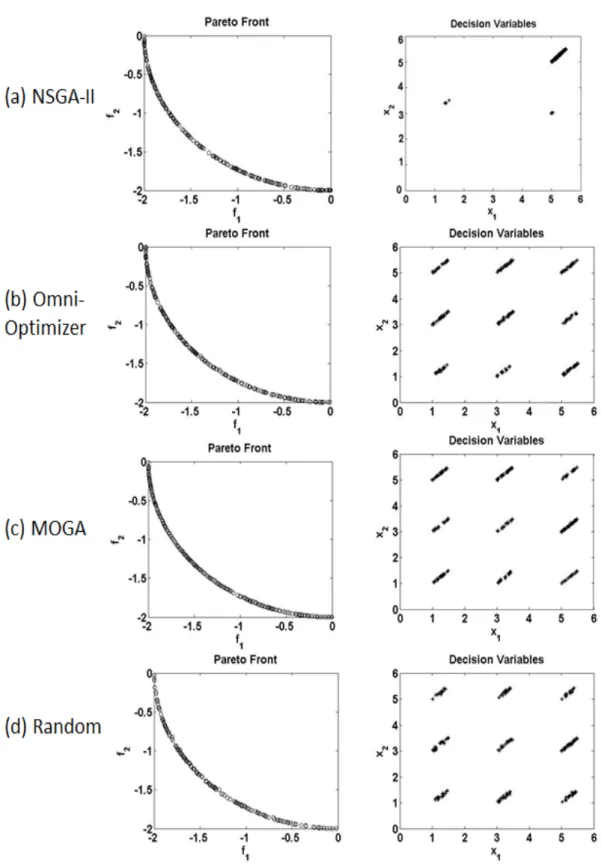
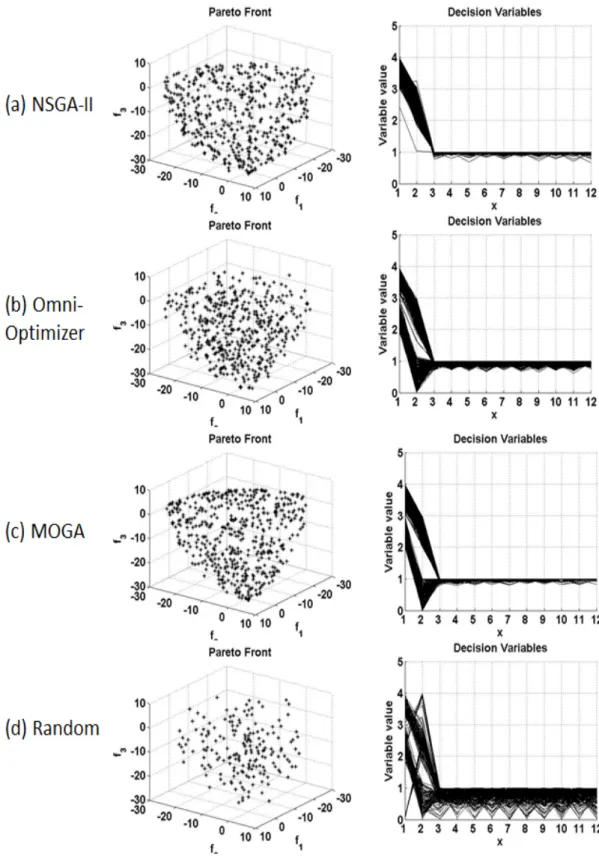
(equation 3.10) with 2 variables using NSGA-II, Omni-Optimizer, MOGA and RANDOM search methods. . . 57 3.11 Case I: Non-dominated solutions obtained for the test problem 1
(equation 3.10) with 2 variables using the MOGA optimizer (top) and the Pareto estimation method (bottom) in objective space, decision variable space and image of clusters. . . 58 3.12 Case II: Non-dominated solutions obtained for the test problem
(equation 3.10) with 3 variables using NSGA-II, Omni-Optimizer, MOGA and RANDOM search methods. . . 61 3.13 Case II: Non-dominated solutions obtained for the test problem
(equation 3.10) with 3 variables using the MOGA optimizer (top) and the Pareto estimation method (bottom) in objective space, decision variable space and image of clusters. . . 62 3.14 Non-dominated solutions obtained for the DTLZ3 test problem
with 3 objectives from NSGA-II, Omni-Optimizer, MOGA and RANDOM search methods. . . 65 3.15 Non-dominated solutions obtained for the DTLZ3 test problem
with 4 objectives from NSGA-II, Omni-Optimizer, MOGA and RANDOM search methods. . . 66 3.16 Non-dominated solutions obtained for the DTLZ3 test problem
with 6 objectives from NSGA-II, Omni-Optimizer, MOGA and RANDOM search methods. . . 67 3.17 Non-dominated solutions obtained for DTLZ3 problem with 3
ob-jectives using the MOGA optimizer (top) and the Pareto estima-tion methods (bottom) in objective space, decision variable space and image of clusters. . . 68
3.18 Non-dominated solutions obtained for DTLZ3 problem with 4 ob-jectives using the MOGA optimizer (top) and the Pareto estima-tion methods (bottom) in objective space, decision variable space and image of clusters. . . 68 3.19 Non-dominated solutions obtained for DTLZ3 problem with 6
ob-jectives using the MOGA optimizer (top) and the Pareto estima-tion methods (bottom) in objective space, decision variable space and image of clusters. . . 69
4.1 Aero Engine Health Management System. . . 73 4.2 Stakeholders and use-cases identified in EHM system design
(Tan-ner 2010). . . 75 4.3 EHM system functional decomposition and operational attributes. 76 4.4 EHM system functions and functional operations. . . 77 4.5 EHM system physical architecture decomposition and subsystems. 79 4.6 EHM system physical architecture subsystem limitations elicited
from interviews with GTE System experts. . . 80 4.7 EHM system architecture multi-criteria optimization problem
com-ponents: Decision variables, OPs Deployment Model, Constraints and Objective functions. . . 83 4.8 Integrating the system architecture SysML model to optimization
platform. . . 86 4.9 Evaluation of constraints and objective functions values for a
sam-ple solution. . . 88 4.10 EHM system architecture solutions in MOGA parallel coordinates
trade-off graph with preference articulation. . . 91 4.11 VAT clusters image with four clusters (dark blocks) in EHM system
non-dominated solutions. . . 94 4.12 Clusters of non-dominated solutions after the Pareto estimation
for EHM system architecture design. . . 96 4.13 VAT Image of clusters of non-dominated solutions after the Pareto
4.14 Comparison of non-dominated solutions obtained from NSGA-II, Omni-Optimizer, MOGA and RANDOM search methods. . . 99 4.15 Box plots of the (i) HV and (ii) IGD metric values computed for
the solutions obtained in 25 runs by the optimizers. . . 103 4.16 Box plots of the (i)SR and (ii)C−metric values computed for the
solutions obtained in 25 runs by the optimizers. . . 103 4.17 Trade-off solutions with increased dataflow rate to the on-ground
station. . . 105 4.18 Trade-off solutions with increased processor limit on the EMU. . 105 4.19 Optimal deployment solution with four objectives satisfied. . . 105
5.1 EHM system architecture Pareto optimal solutions with robustness metric values. . . 115 5.2 Robust EHM system architecture Pareto optimal solutions
ob-tained by expressing preferences on criticality and robustness met-ric objectives. . . 116 5.3 Criteria scores for robust EHM system architecture Pareto optimal
solutions. . . 117 5.4 Robust solution 1 EHM system architecture with functional
de-ployment. . . 119 5.5 Robust solution 2 EHM system architecture with functional
de-ployment. . . 120 5.6 Baseline EHM system architecture with functional deployment. . 121 5.7 Criteria scores for the baseline EHM system architecture. . . 122 5.8 Baseline EHM system architecture criteria scores on MOGA
par-allel co-ordinates graph. . . 122 5.9 Comparison of Robust EHM system architecture solutions obtained
from the optimization process with the baseline EHM system ar-chitecture. . . 122
4.1 Hypervolume (HV) andD(A,P?) values of the obtained solutions by the optimizers, where A is the obtained set in each run, P? is the considered PF. . . 102 4.2 SR(A,P?) and C−Metric values of the solutions obtained by the
optimizers, where A is the obtained set in each run, P? is the
Symbols
A, B Sets of Non-dominated Solutions Obtained from an Optimizer
α Coefficients of Polynomial Chaos Expansions
C C-metric Value
Cm Clusters of Multi-Modal Decision Vectors
D Pareto Optimal Decision Vectors
DE Estimated Decision Vectors from Pareto Estimation Method ¯
dh Mean Distance of Solutions to their Nearest Neighbour
Dr Data Flow Rate Resource Constraints
E Attribute Excess Requirement Objectives for EHM System
E Uniformly Distributed Points on (k−1)-Dimensional Simplex
f Vector of Objective Functions
h Order of Polynomial Chaos Expansion
k Number of Objectives
µ Mean
N Number of Samples in Polynomial Chaos Expansion
P Pareto Optimal Objective Vectors
p Uncertain Design Parameter
PE Projection Matrix
φi Basis Function in Radial Basis Function Neural Networks
π '3.14. . .
˜
P Transformed Pareto Optimal Objective Vectors
Pi(x) Orthogonal Polynomials
Ps Size of Pareto Set
RF Robustness Metric
S Feasible Set in Decision Space
σ Standard Deviation
SR Mean Neighbourhood Distance Metric
u Number of Uncertain Parameters
w Weights of Neurons in Neural Networks
x,y Decision Variable Vectors
Z Feasible Set in Objective Space
¯
z Dominated Reference Objective Vector
znd Nadir Objective Vector
z? Ideal Objective Vector
Acronyms
ACARS Aircraft Communications, Addressing and Reporting System
AEDN Architecture Design Environment
BB Broadband
DACS Data Accumulation and Counting System
DCS Distributed Control System
DHP A Dorothy Hodgkin Postgraduate Award
DM Decision Maker
DT LZ Deb, Thiele, Laumanns and Zizler Test Problems
EA Enterprise Architect software
EAs Evolutionary Algorithms
EEC Engine Electronic Controller
EHM Engine Health Management
EM O Evolutionary Multi-objective Optimization
EM U Engine Monitoring Unit
F D Feature Detector
F F T Fast Fourier Transform
GAs Genetic Algorithms
GT E Gas Turbine Engine
HV Hypervolume
HypE Hypervolume Based Evolutionary Algorithm
IGD Inverted Generational Distance
IP Intellectual Property
LRU Line Replaceable Units
M AT E Multi Attribute Trade Space Exploration
M C Monte Carlo Method
M CDM Multi-Criteria Decision Making
M F LOP S Mega Floating-point Operations Per Second
M OEA Multi-Objective Evolutionary Algorithm
M OEA/D Multi-objective Evolutionary Algorithm based on Decomposition
M OGA Multi-Objective Genetic Algorithm
M OGAC Multi-Objective Genetic Algorithm for Hardware Software Co-synthesis
M OO Multi-Objective Optimization
M SOP S Multiple Single Objective Pareto Sampling
N N Neural Network
N P V Net Present Value
N SGA Non-Dominated Sorting Genetic Algorithm
N SGAII Non-Dominated Sorting Genetic Algorithm - II
ODM S Oil Debris Monitoring System
OEM Original Equipment Manufacturer
OP s Operations
P CE Polynomial Chaos Expansions
P CM Palladio Component Model
P E Pareto Estimation
P ICEAs Preference Inspired Co-Evolutionary Algorithms
P P A Progressive Preference Articulation
P P AF F Progressive Preference Articulation method of Fonseca and Fleming
(1998a)
QF D Quality Function Deployment
RBF N N Radial Basis Function Neural Network
ROI Region of Interest
SP EA2 Strength Pareto Evolutionary Algorithm 2
SysM L System Modelling Language
U T C University Technology Centre
V AT Visual Assessment of Cluster Tendency Method
V EGA Vector Evaluated Genetic Algorithm
V OES Vector Optimized Evolutionary Algorithm
Introduction
1.1
Introduction and Motivation
This chapter provides a brief introduction followed by motivation for the research work presented in this thesis.
System architecture is defined as the description of a complex system in terms of its functional requirements, physical elements, and their interrelationships. System architecture design is concerned with exploring the trade space of early, high-level, system design decisions. System architecture designs often have many goals: performance, reliability, cost, flexibility, security. Design requirements also include safety, functional and non-functional requirements, mix of qualita-tive and quantitaqualita-tive objecqualita-tives, project-specific goals and through-life costs. A large number of stakeholders and design experts are involved in the design process.
Since the goal of a system engineer is to find the best possible system ar-chitecture, the architecture design process can be formulated as an optimization problem, where the variables are the alternative architectural options, and the objective functions capture design requirements and project goals. Constraints can also be added to capture the various resource limitations. In the last few years, several tools and methods have been developed to support the system architecture design process. Unfortunately many conventional problem solving
techniques have difficulty when dealing with complex system design problems having many goals. In particular, optimization problems that appear in system architecture design are typically very hard to solve because:
(1) they are non-convex problems and they have multiple local and global opti-mal solutions.
(2) they are integer, mixed-integer, or most often combinatorial problems.
(3) they are non-linear, both in the objective functions and in the constraints.
(4) they may be computationally expensive and large-scale high dimensional problems.
Many real-world engineering problems often have multiple competing objec-tives to be optimized within the constraints of their resource limitations (e.g. Fleming et al., 2005). For these multi-objective optimization problems, there is no one single optimal solution. Instead, there is a family of solutions, where each solution represents a compromise, or trade-off, between the competing objectives, and which cannot be improved upon with respect to all objectives. Historically, multi-objective optimization problems were solved using classical optimization methods, e.g. gradient based weighted sum approaches. In these methods the multiple objectives were aggregated to form a single objective using weights. However, these approaches have several weaknesses. They are very sensitive to the choice of weights and starting point. They have tendency to get stuck in local optima. They require multiple runs to generate a family of trade-off solutions as required for a multi-objective optimization (Deb, 2001).
In recent times, Evolutionary Algorithms (EAs) have been developed to solve multi-objective optimization problems. EAs work with a population of solutions and mimic the principles of biological evolution, i.e., survival of the fittest. They can search for global optima without getting stuck in local optima and find a diverse set of optimal trade-off solutions called a Pareto optimal front in a single run of the optimization algorithm. EAs have mainly been applied to optimization problems having single, two or three objective functions. The Pareto optimal solu-tions can be visualized using simple scatter plots to assist in selecting a preferred
solution for these problems. However, many real-world engineering problems can comprise significantly more than three objective functions to be optimized. These are called many-objective optimization problems. EAs face several dif-ficulties and challenges for solving many-objective optimization problems, most importantly the inefficient search and convergence of solutions towards the Pareto front. The optimal trade-off surface of a multi-objective optimization problem can contain a potentially infinite number of Pareto-optimal solutions. For solving many-objective optimization problems, EAs require large population sizes which lead to increased computational expense. Visualization of the high dimensional Pareto optimal solutions for many-objective functions becomes difficult (Fleming
et al., 2005). In the case of multi-modal multi-objective problems, there exist multiple local and global optima. EAs have issues in finding multi-modal Pareto sets and fail to maintain diversity in both objective and decision variable space. Finding these multi-modal Pareto sets would give the decision maker a greater choice when choosing between optimal solutions.
This thesis addresses this research gap in system architecture design by propos-ing an interactive multi-criteria design optimization framework which can solve many-objective optimization problems and find diversified multi-modal Pareto optimal solutions. The optimization framework supports the decision maker by providing a facility for progressive preference articulation, empowering closely coupled user and optimization process interaction. The proposed methodology is applied to several real-world system architecture design applications related to aero gas turbine engines.
1.2
Research Objectives
The main goals of this research work are:
• To develop a methodology for system architecture design that addresses multiple design criteria, and
• To demonstrate the application of the methodology on a real-world system architecture design.
In order to achieve the goals, this research work has accomplished the following objectives:
• Development of a multi-criteria design optimization framework, which can solve many-objective system architecture design problems and facilitate a decision maker to interact with the optimization process and express design preferences.
• Development of a methodology for increasing the density of optimal solu-tions in a decision maker’s (DM’s) preferred region in the objective space with reduced computational cost.
• Application of multi-criteria design optimization framework to many-objective real-world system architecture design problem.
• Investigate different groups of solutions available in the obtained Pareto op-timal solutions using clustering analysis revealing important design features for the system architecture design.
• Perform uncertainty analysis for the real-world system architecture design problem, considering the uncertainties involved in the architecture design process in order to find less sensitive robust optimal system architecture solutions.
1.3
Outline of the Thesis
The previous section outlined the overall objectives of the research. Next, the structure of the thesis is presented.
Chapter 2 provides a critical review of the literature relevant to this research. An introduction to the system architecture design process is presented. A brief history of the development of the evolutionary computing and multi-objective optimization techniques is given. Based on the review of the literature, weak-nesses of existing approaches in solving many-objective optimization problems are summarized and research opportunities are discussed.
In Chapter 3, an interactive multi-criteria design optimization framework for solving many-objective optimization problems is proposed. The framework uses a multi-objective genetic algorithm with a unique progressive preference articu-lation technique. The optimization algorithm is further enhanced with archiving and crowding distance operators to maintain the diversity in both objective and decision vector spaces in order to find multi-modal Pareto optimal solutions. A novel Pareto estimation method for increasing the available Pareto solutions is presented. The method uses an efficient clustering algorithm and neural networks to estimate a large number of multi-modal global optimal solutions with reduced computation cost. A rigorous performance evaluation of the proposed method-ology is described by solving a variety of multi-objective test problems that are commonly used in the literature.
In Chapter 4, the system architecture design process is illustrated with a case study of an aero gas turbine engine health management (EHM) system. De-composition of the EHM system functional operations and physical architecture subsystems limitations is presented. The system architecture design problem involving deployment of EHM system functional operations onto physical archi-tecture components nodes is formulated as a multi-criteria optimization prob-lem. Functional operations need to be deployed in order to satisfy operational attribute requirements within the constraints of resource limitations. Excess re-quirements, in terms of operational attributes, are considered as multiple objec-tive functions/criteria to be minimized in the optimization process. Challenges in solving the system architecture design optimization problem are discussed. The proposed methodology is applied to the EHM system architecture design problem and optimized with respect to many qualitative criteria in terms of operational attributes within the constraints of resource limitations. The optimization algo-rithm has produced a family of Pareto solutions which provide valuable insight into design trade-offs. Using the progressive preference articulation technique, the optimization search is focused for the industrial decision maker, onto a region of interest in the objective space. Using this approach it was possible to identify the most significant design constraints (“hot spots”) and the opportunities af-forded by either the relaxation or the tightening of these constraints, along with
their performance implications. Performance of the optimization framework is assessed by evaluating test metrics and comparing with popular multi-objective optimization algorithms using established statistical methods.
Chapter 5 presents an uncertainty analysis performed for the EHM system architecture design using the polynomial chaos expansion method for estimating the sensitivities of objectives. In the EHM architecture design study, in order to integrate the EHM architecture models into the optimization platform and to evaluate the various objective functions, the qualitative functional attribute requirements are transformed to suitable numeric values. The obtained Pareto optimal solutions are sensitive with respect to the chosen numerical parameter values. An efficient uncertainty quantification technique using polynomial chaos expansions is integrated within the optimization process. The approach generates a design of experiments with respect to the parameter uncertainties. A robust-ness metric is calculated using the variations of the criteria values with respect to variations in the parameter values. A parallel processing facility available in MATLAB is utilized for evaluating the robustness metric for each candidate ar-chitecture solution over the number of samples from the design of experiments. In the optimization framework using, progressive preference articulation, the de-cision maker can specify the level of sensitivity that can be allowed in the design. Finally, a set of robust non-dominated solutions are obtained using the proposed approach for the EHM system architecture design. The EHM system architec-ture design process using the proposed multi-criteria optimization methodology is further validated by comparing with a baseline aero engine EHM system architec-ture. This demonstrates that the proposed multi-criteria optimization approach for system architecture design is successful in obtaining the best Pareto optimal architecture solutions for the EHM system architecture.
Finally, Chapter 6 provides conclusions and summarizes the work presented in the thesis and the results obtained. Some advantages and shortcomings of the methods described in the thesis are discussed and opportunities for future work are highlighted.
1.4
Research Contributions
This thesis describes the following research contributions:
1. Development of a methodology for system architecture design
using a multi-criteria optimization formulation with many conflicting ob-jective functions and constraints. Integration of system models into an optimization framework and evaluation of architecture alternatives using attributes information. Investigation of clusters of solutions resulted in identifying the most significant design features and constraints and the opportunities afforded by either the relaxation or the tightening of these constraints along with their performance implications. This contribution is demonstrated in Chapter 4 of the thesis by applying developed method-ology on a real-world aero engine health management system architecture design.
2. An interactive multi-criteria design optimization frameworkwith a progressive preference articulation technique and a crowding distance oper-ator which can handle many-objective optimization problems and maintain diversity in objective space and decision vectors space in order to find di-verse sets of multi-modal Pareto optimal solutions. This contribution is presented in Chapter 3 of the thesis and it is used for solving several test problems and a real-world aero engine health management system architec-ture design. Evaluation of the performance test metrics demonstrated the superior performance of the proposed methodology with good convergence, diversity and repeatability.
3. A novel methodology to find the mapping between Pareto-optimal objective vectors and decision vectors using neural networks and an efficient clustering algorithm, which has been proven useful in increasing the density of multi-modal Pareto solutions in the preferred regions to the decision maker with reduced computation effort. The contribution is pre-sented in Chapter 3 of the thesis and it is used for estimating a large number of multi-modal Pareto solutions for several test problems and a real-world aero engine health management system architecture design.
4. Sensitivity analysis approach to system architecture designwhich takes into account the uncertainties involved in parameter assumptions and expert judgements for criteria evaluations of the system architecture alter-natives in the optimization process. An efficient uncertainty quantification technique using polynomial chaos expansions is integrated into the opti-mization process. The polynomial chaos expansions technique generates a design of experiments with respect to parameter uncertainties and computes the robustness metrics with lower computational cost compared to standard approaches such as Monte Carlo sampling technique. This contribution is presented in Chapter 5 of the thesis and it is applied finding robust solu-tions for a real-world aero engine health management system architecture design. A validation process using a baseline system demonstrates success of the proposed methodology for the system architecture design.
1.5
Publications and Research Reports
Material from this thesis has formed the basis for the following Rolls-Royce Uni-versity Technology Centre (UTC) research reports and international conference publications:
1. Kudikala R., Mills A.R. and Fleming P.J. System Architecture Design of an Aero Engine Health Management (EHM) System. Rolls-Royce University Technology Centre (UTC) Research Report, Number: RRUTC/Shef/R/10602, Issue 1, 2010.
2. Kudikala R., Mills A.R. and Fleming P.J. Multi-Criteria System Architec-ture Design Optimization: an Engine Health Management (EHM) System Case Study. Rolls-Royce University Technology Centre (UTC) Research Report, Number: RRUTC/Shef/R/10902, Issue 1, 2010.
3. Kudikala R., Mills A.R. and Fleming P.J. A Proposed Interactive Multi-Criteria Optimization Framework for Gas Turbine Engine System Archi-tecture Design Optimization. Rolls-Royce University Technology Centre (UTC) Research Report, Number: RRUTC/Shef/R/11601, Issue 1, 2011.
4. Kudikala R., Mills A.R., Fleming P.J., Tanner G.F. and Holt J.E. An En-gine Health Monitoring System Architecture Design using Multi-Criteria Optimization Techniques. International Workshop on Health Monitoring Systems and Multi-Criteria Optimization (sponsored by UK-India Educa-tion and Research Initiative (UKIERI)), Indian Institute of Technology Kanpur, India, 21-34, 2012.
5. Kudikala R., Giagkiozis I. and Fleming P.J. Increasing the Density of Multi-Objective Multi-Modal Solutions using Clustering and Pareto Estimation Techniques. InProceedings of the 10th International Conference on Genetic and Evolutionary Methods GEM 2013, Las Vegas, USA, 10-16, 2013.
6. Kudikala R., Giagkiozis I. and Fleming P.J. Estimation of Pareto Optimal Solutions for Multi-Objective Multi-Modal Problems. In Proceedings of 19th International Conference on Soft Computing - MENDEL2013, Brno, Czech Republic, 25-30, 2013.
7. Kudikala R., Mills A.R., Fleming P.J., Tanner G.F. and Holt J.E. An Aero Engine Health Management System Architecture Design Using Multi-Criteria Optimization. In Proceedings of the Genetic and Evolutionary Computation Conference - GECCO 2013, ACM, Amsterdam, The Nether-lands, 180-186, 2013.
8. Kudikala R., Mills A.R., Fleming P.J., Tanner G.F. and Holt J.E. Real World System Architecture Design Using Multi-Criteria Optimization: A Case Study. Advances in Intelligent Systems and Computing, EVOLVE - A Bridge between Probability Set Oriented Numerics and Evolutionary Computation IV, LEIDEN, The Netherlands, Springer, Vol. 227, pp 245-260, 2013.
Literature Review
2.1
Introduction
The purpose of this chapter is to review the relevant technical literature to estab-lish the ‘state-of-the-art’ and in particular, to identify any existing weaknesses. This will provide a reference framework against which the value of the research can be assessed.
In this Chapter, initially a definition of system architecture is presented and the process of system architecture design optimization is described. An introduc-tion to multi-objective optimizaintroduc-tion and the goals of a multi-objective optimizer are presented. In the following section a review of the literature relevant to the architecture design optimization methods is presented. Then there is a discus-sion of current issues in high dimendiscus-sional or many-objective optimization. This is followed by sections describing methods for addressing the many-objective op-timization problems that arise in system architecture design.
2.2
System Architecture Design
System architecture is defined as “an abstract description of the entities of a system and the relationships between those entities, where the entities could be physical components or functions of the system” by Crawley et al. (2004). The
architecture of a complex system can be described in terms of its functional re-quirements, physical elements, and element interrelationships. The architecture of a system represents a blueprint of the overall system or its highest level of design. Designing a complex system architecture is a difficult task involving multi-faceted trade-off decisions. The design process often needs to consider ex-perience, models and data from many design disciplines.
System architecture design is generally described by large multidisciplinary design phases. A typical architecture design process starts by identifying the main functional requirements and follows a process of decomposition. The top level system functional requirements (use cases) are divided into several sub-functions. The physical form of the system is also divided into sub-systems and components. Designers try to map the functionalities onto the physical hardware components. Designers then iterate between the upper and lower levels of the system decomposition to optimize the deployment of functional operations onto physical systems. However, due to the large and discontinuous design search space and the many qualitative and quantitative criteria or objectives, it is difficult for the designer to obtain optimal architecture designs. Designers have considered various optimization methods and tools for exploring the trade-offs in the system architecture design space.
2.3
Introduction to Multi-Objective
Optimiza-tion (MOO)
Real-world engineering problems often involve several competing objectives and constraints (e.g. Fleming et al., 2005). When there are conflicting objectives improving one objective will lead to the worsening of one or more of remaining objectives. Thus, for problems with multiple conflicting objectives, there is no one single optimal solution. Instead, there is a family of solutions, where each solution represents a compromise, or trade-off, between the competing objectives, and which cannot be improved upon with respect to all objectives. To distinguish these solutions from inferior ones, many multi-objective optimization algorithms
make use of the principle of Pareto-dominance, which is initially introduced by Edgeworth (1881) and further studied by Pareto (1896).
A general definition of a multi-objective optimization problem is defined as:
min
x f(x) = (f1(x), f2(x), . . . , fk(x)) ,
subject tox∈S,
(2.1)
where k describes the number of objectives fi in an objective vector f(x) and x
is a decision vector with in a feasible region S in the decision space.
Definition 1. In a minimization problem, a decision vector x ∈ S feasible de-cision space, is said to dominate a decision vector y if and only if fi(x) <
fi(y), ∀i∈ {1,2, . . . , k}.
Definition 2. In a minimization problem, a decision vector x∈S feasible deci-sion space, is said toweakly dominatea decision vectoryif and only iffi(x)≤
fi(y), ∀i∈ {1,2, . . . , k} and fi(x)< fi(y),for at least onei∈ {1,2, . . . , k}. Definition 3. In a minimization problem, a decision vector x ∈ S feasible de-cision space is called a Pareto optimal solution if and only if, it satisfies that fi(x) ≤ fi(y), ∀i ∈ {1,2, . . . , k} and fi(x) < fi(y), for at least one i ∈
{1,2, . . . , k} for all other decision vectors y and there exist no other decision vector which dominates x in the feasible decision space S. The set of Pareto optimal solutions is called a Pareto-optimal surface or Pareto Front (PF).
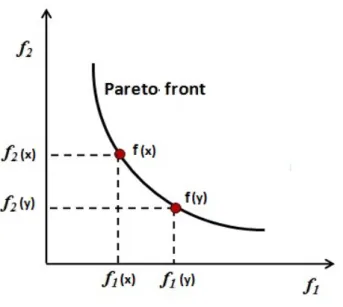
A Pareto front for a two-objective minimization problem is shown in Fig-ure 2.1. Two solutions x, y and their objective vectors f(x), f(y) are shown as two examples of non-dominated solutions on the Pareto-optimal surface. Neither solution is preferred to the other. Solution x has a smaller value of objective function f1(x) than solution y, but a larger value of objective function f2(x).
Correspondingly, solution y has a smaller value of f2(y) than solution x, but a
larger value of objective function f1(y). Neither solution x nor solution y
Figure 2.1: Pareto optimal solutions on a Pareto Front for a two objective mini-mization problem.
and y on the Pareto-optimal front. These are Pareto-optimal (or non-dominant) solutions, that is, solutions which dominate all other candidate solutions in the decision space.
2.3.1
Goals of Multi-Objective Optimization
In solving the multi-objective optimization problems using an optimizer, three main goals of optimization need to be achieved by the optimizer (Purshouse, 2003 and Fleming et al., 2005). The goals of multi-objective optimization are shown in Figure 2.2 and described below:
• Convergence: The approximated non-dominated solutions set obtained by the optimizer is required to be as close as possible to the true Pareto-optimal front of the multi-objective optimization problem.
• Diversity: In a multi-objective optimization with many competing ob-jectives there is no ideal single optimal solution for the problem, and the global trade-off surface can potentially have an infinite number of solutions.
Figure 2.2: Goals of a multi-objective optimization algorithm.
The obtained Pareto optimal solutions are required to be well spread and uniformly covering wide areas of the Pareto front. Diversity is convention-ally preferred in the objective space in order to present the DM with a well-distributed set of solutions to choose from, based on certain prefer-ences such as objective priorities or region of interest (ROI). Diversity of solutions is however not restricted to the objective space; it is a desired requirement in the decision space also.
• Pertinence (Purshouse, 2003): As the number of objectives in the multi-objective problem increases, the visualization of the optimal solutions be-comes difficult. In the decision-making process a decision-maker (DM) is usually interested in sub-regions of the search space which makes the op-timization process more practical and efficient. Therefore, the convergence and the diversity of the solutions are particularly required in the pertinent areas of the decision space, i.e., in the decision-makers’s region of interest.
2.3.2
General Optimization Process
Optimization, by search, is an iterative process. Optimization of a system/model design involves searching for optimum solutions which will maximize or mini-mize certain objectives by varying system parameters iteratively. In general, to formulate an optimization problem it is necessary to identify the following key components: a model of the system to be optimized; its decision variables; the objective functions to be optimized; and the system constraints.
Figure 2.3: Components of an optimization problem.
In the system architecture design process, formulation of an optimization problem begins by identifying the decision variables which are key parameters of the system or model available for variation. A search is conducted over the decision variable space which, typically, have lower and upper bounds. In system architecture design constraints associated with the optimization problem must be identified. These constraints include the resource limitations of the system. The goals of system design optimization are formulated as objective functions. The components of an optimization problem: a model of the system, its decision vari-ables, the objective functions and the system constraints are shown in Figure 2.3. An optimization algorithm generates candidate solutions at each iteration by se-lecting different values for the decision variables. The constraints and objective functions are evaluated for the values of decision variables of the candidate solu-tions chosen by the optimization algorithm. If a candidate solution satisfies the
system constraints, then that solution is treated as a feasible solution. If it does not satisfy the constraints, then the solution is treated as infeasible solution. At each iteration a suitable approach is utilized in which the solutions are sorted in terms of their objective function values and constraint violation values and ranked accordingly. The information from the best solutions in each iteration tend to be used to progress towards new solutions for the next iteration.
2.3.3
Classical Optimization Approaches
Classical optimization approaches have been used to solve multi-objective opti-mization problems in the past (Deb, 2001). Usually in these approaches, the multiple objective functions were aggregated using weights to form a single ob-jective function. These weights are chosen according to the relative importance of the objective functions. Examples include the weighted sum approach, as used in linear quadratic regulator design (Athans & Falb, 1966; Rockafellar, 1987), gradient based methods (Curry, 1944; Fletcher, 1980; Snyman, 2005) and the goal attainment method (Gembicki, 1974). An extensive review of classical op-timization methods is given in Rao (2009) and Ravindran et al. (2006). Integer linear programming (Heady & Candler, 1963; Murty, 1983; Nemhauser & Wolsey, 1988) is another classical approach used for solving convex integer optimization problems. These techniques require linearization of the objective functions and constraints. Few examples for linear programming approaches are simplex-based methods (Murty, 1983), cutting planes method (Kelley, 1960), and Lagrangian relaxation method (Fisher, 2004).
However, classical optimization approaches have a number of weaknesses for solving multi-objective optimization problems with conflicting objectives:
• These approaches work with a single solution, not multiple solutions, in their iterations to find the optimal solutions.
• The choice of starting position may have a strong influence on convergence to an optimal solution. A poor choice may result in the optimizer getting stuck at local optima, which often exist in engineering problems.
• Aggregation methods can be very sensitive to the chosen weights and start-ing point in the iterative search.
• These methods require multiple runs of the optimizer to generate sufficient solutions to adequately represent the Pareto-optimal front.
• There is no guarantee with such approaches that multiple runs with various aggregations of objectives will produce the desired diversity in the Pareto-optimal front.
2.3.4
Evolutionary Computation Methods
An alternative approach to solve the multi-objective optimization problems is the class of algorithms known as Evolutionary Algorithms (EAs). They are founded on the principles of natural selection (Darwin, 1858), biological evolution (Hol-land, 1975; Rechenberg, 1973) and population genetics (Fisher, 1930). EAs are population-based meta-heuristic optimization algorithms. They comprise a pop-ulation of solutions, which is evolved or improved over a number of generations to search for the non-dominated trade-off solutions and generate the Pareto-optimal front in a single run of the algorithm. Furthermore, the population-based ap-proach can be used to emphasize all the solutions equally and thus produce a diverse set of optimal solutions. Evolutionary algorithms (EAs) are very popular in solving complex design problems. They are global, parallel, search and opti-mization methods. In addition, various preference articulation methods have been developed and applied to allow the decision-maker to focus the population on the ROI. Multi-Objective Evolutionary Algorithms (MOEAs) are thus well suited to meet the goals of a multi-objective optimization algorithm. There has been much research in the field of evolutionary multi-objective optimization (Coello-Coello
et al., 2007; Deb, 2001).
One of the most popular evolutionary computation methods is Genetic al-gorithms (GAs) popularized by Goldberg (1989). GAs have found applications and very useful in solving problems which are non-convex, discontinuous, multi-modal and difficult to formulate mathematically. These problems are difficult to
solve using conventional numerical optimizers. GAs can handle problems with non-numeric and mixed-type variables. GAs support parallel computing, objec-tive functions can be evaluated on parallel connected processors, thus minimizing the total elapsed computational time. These algorithms apply select, crossover and mutation operator to create new solutions in the non-standard combinatorial search spaces taking into account domain specific characteristics of the problem. These features confer considerable flexibility for addressing the complex require-ments of system architecture design.
There are other groups of meta heuristic methods based on biology available in addition to GAs. They are ant colony optimization (Dorigo, 1992; Dorigo
et al., 1991) and particle swarm optimization (Kennedy & Eberhart, 1995) based on swarm intelligence, developed for combinatorial optimization. These methods model the behaviour of animals or insects for finding the optimal solutions. A good survey of population based meta-heuristics for multi-objective optimization can be found in (Bianchi et al., 2009; Giagkiozis et al., 2013).
2.4
Review of System Architecture Design
using Optimization Methods
Complex trade-offs between various conflicting design objectives exist in the sys-tem architecture design. Designers have considered different optimization tech-niques for exploring these trade-offs in the design space (Gries, 2004; K¨unzli, 2006; Thiele et al., 2002).
Over a decade earlier, Thompsonet al.(1999) explored the architecture design optimization of deployment of smart sensors and actuators in future distributed control system (DCS) architectures for aero-engines. Fonseca & Fleming (1993) had introduced the first multi-objective evolutionary algorithm in the early 1990s. Their multi-objective genetic algorithm (MOGA) was used by Thompson et al.
(1999), to generate and assess candidate architectures. Competing designs were evaluated with respect to a number of parameters, such as risk, weight,
acqui-sition cost, complexity, diagnostic capability and availability. Baseline architec-tures were defined so that changes made could be compared in a relative manner. In particular, this approach enabled justification to be provided that an optimal system architecture solution was found to be better than the previously existing solution.
Blickle et al. (1998) explored an approach to system-level synthesis for opti-mally mapping an algorithm-level specification onto a software architecture. In the initial step, a hardware architecture is selected with a set of processors, mem-ories and buses. In the second step, in order to map the algorithm onto the selected architecture, the design space is explored with an MOEA with the goal of finding architecture implementations that satisfy a number of constraints on cost and performance. The key outcome of this paper is that it demonstrates that evolutionary algorithms are well suited for system architecture design, in particular, for the selection of architectures and binding the specification to the hardware architecture.
Dick & Jha (1997) presented a multi-objective genetic algorithm for hardware-software co-synthesis (MOGAC). The application of a multi-objective optimiza-tion strategy allows a single co-synthesis run to produce multiple designs that trade off different architectural features. Price and power consumption of the hardware system are optimized while constraints are satisfied.
Armstrong et al. (2008) developed a tool-set for function-based architecture design exploration. This included function decomposition, adaptive function mapping and complex inter-relations between architecture elements. This in-formation aids in architectural definition and trading of architecture alternatives using an MOEA. They created an Architecture Design Environment (ADEN) to manage the complex inter-relationships between architectural elements, which guides the designer in evaluating the performance of candidate architectures.
Martens et al. (2010), developed an evolutionary multi-criteria optimization approach to generate optimal software architectures with respect to goals of
per-formance, reliability, and cost. They applied a multi-criteria optimization algo-rithm based on genetic algoalgo-rithms for the software architecture design. Here, the software architecture is modelled with the Palladio Component Model (PCM) (Reussner et al., 2007). Starting with a given initial architectural model, the multi-criteria genetic algorithm iteratively modifies architectural models and eval-uates them in pursuit of better performance measures. This approach proved to be successful in systematically exploring the design space spanned by different design options. The PCM approach could be useful in creating software architec-tures and evaluation of various success criteria for real-world system architecture design problems.
Osekita and Holt (2009) presented a system architecture trade study which considered the integration of an engine health management system as part of a gas turbine engine control system. Eleven candidate architectures were consid-ered for the trade study. They considconsid-ered four architecture metrics: recurring cost; non-recurring cost; weight; and reliability as objective functions for the trade study and estimated the values of objectives for a baseline architecture, and converted these metrics into a single aggregated cost objective. The values of the objective metrics for the candidate architectures are estimated in a rel-ative manner comparing with the baseline architecture in terms of the changes and complexity of development needed in the candidate architectures. They per-formed a sensitivity analysis with respect to the weight exchange rate and fleet size. However, the result of this trade study varies with respect to the changes in the weight exchange rate value. A key limitation identified in this study is its focus on a single criterion of aggregated cost objective; this runs the risk of masking the effects of the different elements which contribute to that criterion. In a multi-criteria optimization framework the multiple criteria can be considered individually without aggregating them into a single criterion, and the trade-off of the candidate architectures in terms of the different criteria can be explored. Using the multi-criteria approach, for example, the sensitivity of the design with respect to chosen aggregation factors can be eliminated.
plat-forms carrying a single instrument versus those carrying multiple instruments. They proposed a methodology for the analysis of design trade-offs in the satellite system architecture problems. Their architecture design methodology involves a historical study to identify specific requirements and learning points from previ-ous architecture designs. The requirements of the stakeholders, expert systems engineers, customers and program managers are captured through several inter-views and qualitative studies. Using this information a quantitative system model is created in order to perform architecture design optimization. They encoded the architecture options and evaluated the candidate architecture alternatives in terms of four objective functions: life-cycle cost, schedule, risk and performance. They performed a multi-attribute trade space exploration (MATE) by using an exhaustive search method and selecting a small number of well balanced architec-ture alternatives. The key areas of interest in this paper are in the formulation of the objective functions for a complex satellite platform system design and the methodology is applicable to other complex system architecture design problems. However, for a large design space exploration, an exhaustive search method is time-consuming and may not be viable.
Value-Driven Design provides a framework to enhance the systems engineer-ing processes for the design of large systems. By employengineer-ing economics in decision making, Value-Driven Design enables rational decision making in terms of the optimum business and technical solution at every level of engineering design. Cheung et al. (2012), applied Value-Driven Design to the aero-engine system through two case studies, which were conducted through Workshops under the Rolls-Royce plc Advanced Cost Modeling Methodologies project. In a value-driven design approach (Collopy & Hollingsworth, 2011), the values of objective functions are converted to a common score using a-priori chosen conversion fac-tors and aggregated by assigning weights to a single score, called Net Present Value (NPV) of the system. The solution arising from this approach, however, is sensitive to the choice of conversion factors and weights.
Bourne et al. (2011) developed a framework for designing a distributed con-trol system (DCS) architecture for gas turbine engines using genetic algorithms in
tandem with systems engineering processes. They developed a database contain-ing information about engine dimensions, components and various sub-systems. In the optimization process, genetic algorithm uses the information stored in the decision variables to build the distributed architectures from the functional in-formation, the properties of the engine and available components stored in the database. They evaluated candidate architectures from three viewpoints which are deemed to be most important to system designers and commercial managers:
• Architectural view • Commercial view • Life-cycle view
The architectural view considers the structural and technical form of the sys-tem. Evaluation functions within this view will analyze the placement of nodes, harness routing, hardware allocation and weight of the system. In the commer-cial view, the acquisition cost and non-recurring cost of the system are evaluated. The life-cycle view aims to capture and evaluate the costs and added value of the control system throughout its life-cycle based on reliability data and the num-ber of serviceable components. Thy proved that a substantial systems modelling method with a Multi-Criteria Decision Making (MCDM) approach has the po-tential to obtain trade-off solutions for the complex system architecture design problems.
From the above review, most of the studies have mainly focused on system architecture design optimization with two or three objectives or design criteria. The optimization algorithms utilized in these studies are suitable for handling multi-objective optimization problems consisting of two to three objectives. The resulting Pareto solutions can be visualized using Cartesian plots or scatter plots and a preferred solution for the optimization problem can be selected from these plots. However, many real-world problems often have more than three objec-tives. These optimization problems are termed as “many-objective optimization” problems (Farina & Amato, 2002).
Figure 2.4: Regions of non-domination in a two-objective minimization problem.
2.5
Many-Objective Optimization
2.5.1
Background
Optimization approaches face a number of difficulties in solving many-objective optimization problems.
• In a many-objective optimization problem a large proportion of the popu-lation becomes non-dominated in the objective space. Figure 2.4 shows the regions of non-domination with respect to an objective vector z in a two-objective minimization problem. The solutions in the green region have lower objective values compared to z, hence they are superior solutions to z. Whereas, the solutions in the magenta region have higher objective values compared toz, hence they are inferior solutions toz. However, solu-tions in the blue regions have at least one objective value lower thanz. In a two-objective optimization problem, there are 2 out of 4(= 22) regions that contain non-dominated solutions. In case the of a three-objective optimiza-tion problem, there are 6 out of 8(= 23) regions that contain non-dominated solutions. In a k-objective optimization problem, there are (2k−2) out of
2k regions that contain non-dominated solutions. Due to this, there is in-sufficient selection pressure to progress the search (Khare et al., 2003; Pur-shouse & Fleming, 2003) and the ability of the optimizer to search towards the Pareto-optimal front can be compromised.
• Large population sizes are required for approximating the Pareto front in many-objective optimization.
• The computational expense of optimization also increases due to an expo-nential increase in the number of objective function evaluations.
• Visualization of optimal solutions in many dimensions becomes difficult. In the recent past, several approaches are proposed for improving the conver-gence of the optimizers for many-objective optimization (Ishibuchi et al., 2008; Zou et al., 2008). In the following sections, potential approaches suitable for many-objective optimization problems are described.
2.5.2
Methods for Increasing Selective Pressure
In evolutionary multi-objective optimization (EMO) problems the lack of effective search, and hence convergence to the Pareto-optimal front, has been attributed to those algorithms based on Pareto-dominance selection (Kukkonen & Lampinen, 2007), e.g. NSGAII (Deb et al., 2002a) and SPEA2 (Zitzler et al., 2001).
2.5.2.1 Modification of Pareto-dominance
The purpose of this approach is to reduce the number of non-dominated solutions in the population by modifying the dominance relation. In the approach of Sato
et al. (2007), the dominance relation was changed to allow the user to contract or expand the dominance area. This was achieved with a user-specified scaling of the fitness value for each objective to weaken or strengthen selection. Another implementation was that of α-dominance (Ikeda et al., 2001) where a solutionx
dominates anotherysuch thatxcan be slightly inferior (by an amount controlled by α) to y in one objective and superior to yin other objectives.
Both approaches are examples of the application of weak dominance, which may increase the selective pressure and hence progress of the search towards the Pareto- optimal front. However, both researchers have observed that the diversity of the resulting population is reduced. In addition, both methods require the user to specify parameters to control the strictness of the dominance relation. In Zou et al. (2004), L-dominance is defined. This is an extended form of Pareto-dominance taking account of the number and value of improved objectives. For most of the DTLZ problems (Deb, Thiele, Laumanns and Zitzler, 2002) tested it outperforms the state-of-the-art algorithms, IBEA (Zitzler & K¨unzli, 2004) and NSGAII (Deb et al., 2002a) in terms of convergence to and diversity in, the Pareto-optimal front. However, it does rely on the additional task of normalizing all objectives within the feasible set of solutions, i.e. the maximum and minimum of each objective must be found.
2.5.2.2 Assignment of different ranks
In these approaches different ranking methods are employed to reduce the non-dominated solutions in the population. In the approach proposed by Drechsler
et al. (2001), they use of a relation called as ‘favour’ to compare solutions. Here, a solutionxis favoured to another solutionyif the number of objectives in which
x is better than y, is greater than the number of objectives for which yis better than x. A more sophisticated version of the relation ‘favour’ called, -preferred was developed by S¨ulflow et al. (2007) to incorporate a user-specified difference in objective values, , between compared solutions and so address a variability issue.
Corne & Knowles (2007) compared different ranking methods and conclude that an average ranking method, such as Weighted Average Ranking (Bentley & Wakefield, 1998), outperformed other algorithms, except for problems comprising many objectives where significant objective conflict exists. Ranking solutions and then aggregating them, described as ranking-dominance, is used to replace non-dominated sorting based on Pareto-dominance in Kukkonen & Lampinen (2007). Two aggregation functions are tested, the sum and the minimum of ranks, on the DTLZ problems on up to fifty objectives. For four of the six problems,
ranking-dominance showed much improved convergence to the Pareto-optimal front. However, for the remaining two problems, ranking-dominance performed worse than Pareto-dominance. This was due to the fact that ranking-dominance generated solutions in which some objectives were deteriorated while others were improved. Another observation was that in some cases, while convergence was much improved, diversity was significantly compromised.
2.5.3
Indicator Based Methods
As an alternative to Pareto-dominance, various fitness evaluation functions have been developed and applied. Indicator-based algorithms are one such approach, in which a single-objective indicator of a desired property of the population is optimized, e.g. the Indicator-Based Evolutionary Algorithm (IBEA) (Zitzler & K¨unzli, 2004). A popular indicator is hypervolume, which measures the volume of objective space dominated by a population (Zitzler & Thiele, 1999). On selected many-objective DTLZ test problems, IBEA is shown to perform well (Wagner
et al., 2007). However, it has the drawback of being computationally expensive to compute hypervolume values and there have been various efforts to address this. Two examples are the iterative approach of Ishibuchi et al. (2007) and the fast hypervolume algorithm (HypE) of Bader & Zitzler (2011). The former only generates one solution per run and so multiple runs are required to generate a Pareto-optimal set of solutions. The latter proposes a fast search algorithm using Monte Carlo approximation of the hypervolume. When evaluated for a constant period of time, HypE outperforms popular MOEAs such as NSGA-II in terms of hypervolume, even though each generation takes longer and hence it processes half the number of generations. The approximation of the Pareto-optimal front depends on the sampling of the Monte Carlo approach. More samples results in a more accurate approximation, but require a longer execution time.
Another fitness evaluation mechanism is that of scalarizing or aggregation functions, which combine multiple objectives into a single objective, often with some form of weighting function. One such approach is Multiple Single Objec-tive Pareto Sampling (MSOPS) by Hughes (2003). It comprises multiple single
objective searches run in parallel, each with a different aggregation of objectives using weight vectors. While this algorithm does not rely on Pareto-dominance to rank solutions and provide selective pressure, it does require specification of weight vectors a-priori.
2.5.4
Decomposition Based Methods
Another promising alternative approach to the Pareto-dominance relation is the weighted Tchebycheff scalarizing function based fitness evaluation approach, e.g. MoEA/D (Zhang & Li, 2007). In this a scalarizing function projects the entire objective space onto a line. Here the multi-objective problem is solved as a collection of a number of single-objective problems with different weight vectors defined by the scalarizing function. It has been demonstrated in the literature (Li & Zhang, 2009; Zhang & Li, 2007; Zhang et al., 2009) that MOEA/D has a high search capability for continuous optimization.
2.5.5
Preference Articulation Methods
In multi-objective optimization, preferences can be used to restrict the search space of the optimizer to find the solutions in a certain region of interest on the Pareto optimal front. In Multi-Criteria Decision Making (MCDM), various ap-proaches have been used for this purpose such as specification of weights, goals and aspirations for the criteria (objectives) and constraints for the decision vari-ables ( Hwang & Masud, 1979; Fleming et al., 2005; Rachmawati & Srinivasan, 2006; Adra et al., 2007).
Different preference articulation techniques used in the multi-objective opti-mization are described below:
2.5.5.1 A-priori Preference Articulation
In this approach, preferences are specified by the DM before starting the optimiza-tion process. A common approach is to specify an aggregating funcoptimiza-tion, which converts individual objectives into a single utility function resulting in a single