Learning-Based Approaches for
Autonomous Manipulation
zur Erlangung des akademischen Grades eines
Doktors der Ingenieurwissenschaften
von der KIT-Fakultät für Informatik des Karlsruher Instituts für Technologie (KIT)
genehmigte
Dissertation
von
Dipl.-Inform. Daniel Kappler
aus KarlsruheTag der mündlichen Prüfung: 19.11.2018
Erster Gutachter: Prof. Dr-Ing. Tamim Asfour
Kollaboration zwischen Menschen und Robotern gewinnt zunehmend an Bedeutung in der Industrie und Forschung. Manipulation ist eine Grundvoraussetzung für eine erfolgreiche Kolla-boration und deshalb eine grundlegende Forschungsfrage in der Robotik. Bei der Manipulation von Objekten, zum Beispiel beim Greifen eines Bohrers, müssen Roboter mit einer dynamischen Umgebungen, partieller Wahrnehmung, Model- und Ausführungsunsicherheit zurechtkommen. In dieser Arbeit identifizieren wir Einschränkungen von modellbasierten Ansätzen des gegen-wärtigen Standes der Technik für Manipulationsaufgaben und untersuchen wie man diese mit Lernverfahren kombinieren und verbessern kann, um autonome Manipulation zu ermöglichen. Maschinelle Lernverfahren wie neuronale Netze, die mithilfe von großen Datenmengen ein gutes Modell lernen, sind sehr geeignet für die Robotik, da Roboter ihre Umgebung mithilfe von einer Vielzahl an Sensoren wahrnehmen und dadurch eine Fülle von Daten erzeugen. Im Gegensatz zu anderen Forschungsgebieten, wie zum Beispiel Sprach- und Bildverarbeitung, interagieren Roboter mit ihrer Umgebung, sodass Vorhersagen einen physikalischen Einfluss auf die Umgebung haben. Aufgrund der Interaktion mit der Umgebung und der kontinuierlichen Wahrnehmung ergibt sich eine Rückkopplungsschleife die neue Herangehensweisen erfordert um Sicherheitsbedenken und Geschwindigkeitsanforderungen zu erfüllen.
Das Ziel dieser Dissertation ist es zu untersuchen, wie man bestehendemodellbasierte Robo-tersysteme mithilfe vonLernverfahrenverbessern kann. Dabei ist es wichtig das vorhandene domänenspezifische Wissen nicht zu vernachlässigen, sondern in dieLernverfahrenzu integrieren. Die Ergebnisse dieser Arbeit zeigen, dasslernbasierteAnsätzemodellbasierteMethoden sehr gut ergänzen und es ermöglichen Probleme, die ansonsten unlösbar wären, zu lösen. Wir zeigen, wie man bestehende Modelle zum Trainieren von Lernverfahren verwenden kann. Dadurch wird problemspezifisches Expertenwissen in den Datengenerierungsprozess integriert und somit an das gelernte Modell weitergegeben. Wir entwickeln außerdem ein neues Optimierungsverfahren, das während der Optimierung etwas über den Vorgang an sich lernt. Ein solches Verfahren ist sehr relevant für eine Vielzahl von Problemen in der Robotik, daautonomeManipulationssysteme kontinuierlich neue Aufgaben lösen müssen.
Im Folgenden stellen wir die Hauptbeiträge dieser Dissertation vor, eingebettet in den Kontext von Manipulationsaufgaben.
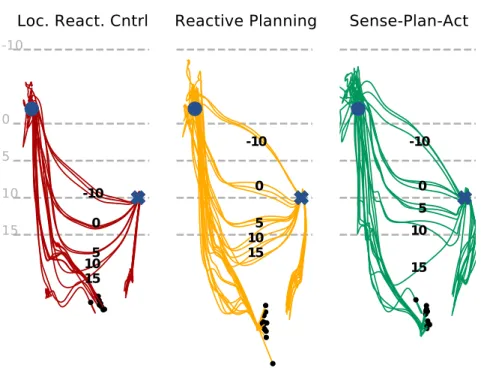
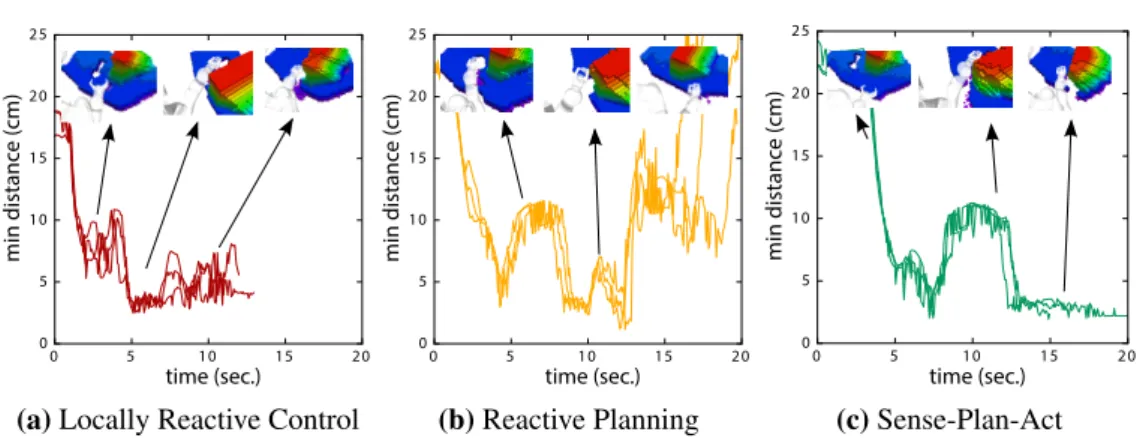
Visuelle Wahrnehmung in Echtzeit trifft auf reaktive Bewegungsplanung Der Hauptbei-trag dieser Arbeit ist ein voll integriertes Manipulationssystem das erste einheitliche Experimente und dadurch empirische Ergebnisse ermöglicht. Diese zeigen eindeutig, dass kontinuierliche, zeitnahe Wahrnehmung und die Integration mit schnellen Verfahren zur Erzeugung von reaktiven Bewegungen essenziell für erfolgreiche Manipulation in dynamischen Szenarien ist. Wir verglei-chen drei verschiedene Systeme, welche die gängigsten Architekturen im Bereich Robotik für Manipulation repräsentieren: (i) Ein traditionellerSense-Plan-ActAnsatz (aktuell am weitesten verbreitet), (ii) einen myopischen Regelungsansatz, der nur auf lokale Veränderungen reagiert und (iii) ein reaktives Planungsverfahren, das auf Änderungen der Umgebung reagiert diese in die Bewegungsplanung einbezieht und den aktuellen Plan transparent an einen schnelleres lokales Regelungsverfahren übergibt. Unser Gesamtsystem ist reinmodellbasiertund umfang-reich auf einer realen Roboterplattform in vier Szenarien empirisch evaluiert worden. Unsere experimentellen Szenarien beinhalten anspruchsvolle Geometrien im Arbeitsraum des Roboters, dynamische Umgebungen und Objekte mit denen der Roboter interagieren muss. Diese Arbeit zeigt den aktuellen Stand der Forschung, der mit einemmodellbasiertenManipulationssystem im Bereich der Robotik unter Verwendung von schnellen Rückkopplungen und langsamerer reaktiver Planung möglich ist. Angesichts des Interesses in der Robotikforschungmodellbasierte
Systeme mitEnde-zu-Ende Lernansätzenganzheitlich zu ersetzen, ist es wichtig ein performantes
modellbasiertesReferenzsystem zu haben um neue Methoden qualitativ in Hinblick auf ihre Fähigkeiten und ihre Generalisierbarkeit zu vergleichen. Weiterhin erlaubt ein solches System Probleme mitmodellbasiertenAnsätzen zu identifizieren und diese mithilfe vonlearnbasierten
Methoden zu verbessern.
Online Entscheidungsfindung für Manipulation Die meisten Robotermanipulationssyste-me verfügen über viele Sensoren mit unterschiedlichen Modalitäten und Rauschverhalten. Die Entwicklung vonModellenfür alle Sensoren ist nicht trivial und die resultierende Modelle zu komplex für Echtzeitverarbeitung inmodellbasiertenManipulationssystem. Planen mit vielen Sensormodalitäten ist besonders komplex aufgrund der vielen Modellunsicherheiten. Dies ist besonders ausgeprägt für Manipulationsaufgaben bei denen Kontakte zwischen Roboter und Objekten von Bedeutung sind. Eine der Hauptherausforderung für autonome Manipulation ist daher die Erzeugung geeigneter multimodaler Referenztrajektorien, die es ermöglichen Steuerbe-fehle für Regelungssysteme zu berechnen die nicht modellierte Störungen kompensieren und damit die Erfüllung der gestellten Manipulationsaufgabe ermöglichen. In dieser Arbeit stellen wir einenlernbasiertenAnsatz zur inkrementellen Erfassung von Referenzsignalen vor, der in Echtzeit entscheidetwann ein Verhalten abgebrochen und zuwelchemVerhalten gewech-selt werden sollte, um eine erfolgreiche Ausführung zu gewährleisten. Wir formulieren dieses Online-Entscheidungsproblem als zwei miteinander verbundene Klassifikationsprobleme. Beide
ständnis, dass stereotypische Bewegungsgenerierung ähnliche Sensordaten erzeugt. Unsere Experimente zeigen, dass dieser Ansatz es ermöglicht schwierige kontextbasierte Aufgaben zu erlernen, die präzise Manipulation von relativ kleinen Objekten voraussetzen. Um eine solche Aufgabe zu erlernen, benötigt ein Benutzer unseres Systems kein Expertenwissen. Das System benötigt nur kinästhetische Demonstrationen und Unterbrechungen in Fehlersituationen. Die gelernte Aufgabenausführung ist robust gegen Störeinflüsse und Sensorrauschen, da unsere Methode online entscheidet, ob sie aufgrund von unerwarteter sensorischer Signale zu einer anderen Ausführung wechseln sollte oder nicht.
Big-Data Greifen Greifen ist ein wichtiges Forschungsproblem in der Robotik, da es eine Grundvoraussetzung für Manipulation darstellt. In dieser Arbeit konzentrieren wir uns auf das Problem der Vorhersage von Position und Orientierung bevor ein Kontakt zwischen Objekt und Endeffektor eintritt. Für diesen grundlegenden Schritt um “erfolgreich zu greifen” stehen nur visuelle Sensordaten wie 2D-Bilder und/oder 3D-Punktwolken zur Verfügung. Die Verwendung vonmodellbasiertenGreifplanern ist in solchen Situationen nicht optimal, da präzise Simulatio-nen zu rechenintensiv sind und alle Objekte bekannt, erkannt und visuell verfolgt werden müssen.
LernbasierteVerfahren die direkt von visuellen Sensordaten stabile Griffe vorhersagen sind sehr effizient in der Auswertung jedoch benötigen die aktuell vielversprechendsten Verfahren, neuro-nale Netze, eine Vielzahl von annotierten Beispielen um diese Abbildung zu lernen. Im Rahmen dieser Arbeit stellen wir eine umfangreichen Datenbank mit einer Vielzahl von Objekten aus sehr unterschiedlichen Kategorien vor. Auf Basis dieser Datenbank analysieren wir drei Aspekte: (i) Eine Crowdsourcing Studie zeigt, dass unsere neu vorgestellte Metrik auf Basis einer physikali-schen Simulation ein besserer Indikator für Greiferfolg im Vergleich zu der bestehenden Standard
ε-Metrik ist. Darüber hinaus deutet unsere Studie darauf hin, dass unsere Datengenerierung
keine manuelle Datenannotation benötigt. (ii) Die daraus resultierende Datenbank ermöglicht die Optimierung von parametrischen Lernverfahren wie neuronale Netze. Dadurch, dass wir eine Abbildung von Sensordaten zu möglichen Griffen lernen, muss das Objekt, seine Position und Orientierung nicht bekannt sein. Darüber hinaus zeigen wir, dass einfachere Methoden wie logistische Regression nicht die Kapazität haben um die Komplexität unserer Daten zu erfassen. (iii) Roboter nehmen ein Szenario typischerweise aus einem Blickwinkel wahr und versuchen ein Objekt mit dem ersten Versuch zu greifen. Klassifikationsverfahren sind nicht speziell für diese Verwendung optimiert, weshalb wir eine neue Formulierung erarbeiten, welche die beste,top-1
Hypothese aus den jeweiligen Teilmengen auswählt. Diese neuartige Optimierungszielsetzung ermöglicht dies selbst auf unserem binären Datensatz, da das Lernverfahren selbst die Daten ordnet und somit einfach zu erkennende Griffe selbst auswählen kann.
Lernen von inversen Dynamikmodellen für Manipulationsaufgaben Sichere Bewegungs-ausführung auf Basis von Regelungskreisen sind entscheidend für Roboter die mit Menschen kollaborativ Manipulationsaufgaben lösen. Daher werden neue Methoden benötigt, die es er-möglichen inversen Dynamikmodelle zu lernen und bestehende Modelle zu verbessern, um Verstärkungsgrößen in Regelungskreisen zu minimieren. Dies ist besonders wichtig, wenn Objek-te manipuliert werden, da sich das bekannObjek-te inverse Dynamikmodell dadurch verändert. Aktuelle Verfahren, welche Fehlermodelle zu bestehendenmodellbasiertenRegler für die inverse Dyna-mik zu lernen, werden auf Basis der erzielten Beschleunigungen und Drehmomenten optimiert. Da die tatsächlich realisierten Beschleunigungen, eine indirekte Datenquelle, jedoch nicht die gewünschten Beschleunigungen darstellen, werden hohe Verstärkungen im Regelkreis benötigt, um relevantere Daten zu erhalten die es erlauben ein gutes Modell zu lernen. Hohe Verstärkung im Regelkreis ist wiederum schlecht für die Sicherheit. In dieser Arbeit leiten wir ein zusätz-liches Trainingssignal her, das auf der gewünschten Beschleunigungen basiert und von dem Rückkopplungssignal abgeleitet werden kann. Wir analysieren die Nutzung beider Datenquel-len in Simulation und demonstrieren ihre Wirksamkeit auf einer reaDatenquel-len Roboterplattform. Wir zeigen, dass das System das gelernte inverse Dynamikmodell inkrementell verbessert. Durch die Kombination beider Datenquellen kann ein neues Modell konsistenter und schneller gelernt werden und zusätzlich werden keine hohen Verstärkungen im Regelungskreis benötigt.
Lernen wie man lernt, während man lernt Menschen sind bemerkenswert gut darin, neue oder angepasste Fähigkeiten schnell zu erlernen. Dies ist darauf zurückzuführen, dass wir nicht jede neue Fähigkeit von Grund auf neu erlernen, sondern stattdessen auf den bereits gewonnenen Fertigkeiten aufbauen. Die meisten robotergestützten Lernaufgaben würden davon profitieren, wenn sie ein solches abstraktes Meta-Lernverfahren zur Verfügung hätten. Ein solcher Ansatz ist von großer Bedeutung für die Robotik, da autonomes Lernen ein inhärent inkrementelles Problem ist. In dieser Arbeit stellen wir einen neuenMeta-Lernansatzvor, der es erstmals ermöglicht die Roboterdynamik online zu erlernen und auf neue Probleme zu übertragen. Während der Optimierung lernt unser Verfahren die Struktur der Optimierungsprobleme, welche für neue Auf-gaben verwendet werden kann, was zu einer schnelleren Konvergenz führt. Das vorgeschlagene
Meta-Lernverfahrenkann zudem mit jedem beliebigen gradientenbasierten Optimierungsansatz verwendet werden. Wir zeigen, dass unser Ansatz die Dateneffizienz für inkrementelles Lernen erhöht. Weiterhin ist unser Verfahren für dasonline Lernenmit korrelierten Daten geeignet, zum Beispiel für inverse Dynamikmodelle. Der vorgestellte Ansatz eröffnet zusätzlich völlig neue Wege um in Simulation gewonnene Erfahrungen in die reale Welt zu transferieren. Dadurch kann möglicherweise bestehendes Domänenwissen in Form vonmodellbasierterSimulation auf völlig neue Weise verwendet werden.
Zusammenfassung iii
1 Introduction 1
1.1 Motivation . . . 1
1.2 Challenges in Autonomous Manipulation . . . 3
1.2.1 Model-Based and Learning-Based Manipulation . . . 5
1.2.2 Limitations of System Architectures . . . 7
1.2.3 Limitations of Model-Based Approaches . . . 9
1.2.4 Limitations of Learning-Based Approaches . . . 10
1.3 Problem Statement . . . 12
1.4 Thesis Structure & Contribution . . . 12
2 Foundations and Related Work 17 2.1 Robotic Manipulation . . . 17
2.1.1 System Architecture . . . 18
2.1.1.1 Sense-Plan-Act . . . 18
2.1.1.2 Behavior-Based System Architecture . . . 19
2.1.2 Perception . . . 19 2.1.3 Planning . . . 21 2.1.4 Control . . . 24 2.2 Learning . . . 26 2.2.1 Supervised Learning . . . 27 2.2.1.1 Dataset . . . 27
2.2.1.2 Models and Methods . . . 28
2.2.1.3 Objective . . . 31 2.2.1.4 Optimizer . . . 34 2.2.1.5 Regression . . . 35 2.2.1.6 Classification . . . 36 2.2.1.7 Structured Prediction . . . 36 2.2.2 Learning Methods . . . 37
2.2.2.2 Naive Bayes . . . 39
2.2.2.3 Logistic Regression . . . 40
2.2.2.4 Deep Neural Networks . . . 40
3 Real-time Perception meets Reactive Motion Generation 45 3.1 System Architectures . . . 47
3.1.1 Sense-Plan-Act . . . 47
3.1.2 Locally Reactive Control . . . 48
3.1.3 Reactive Planning . . . 49
3.2 Real-Time Feedback Modules . . . 50
3.2.1 Visual Tracking of Target Objects . . . 50
3.2.2 Visual Robot Tracking . . . 51
3.2.3 Modeling Unstructured Workspace Obstacles . . . 51
3.3 From Visual Feedback to Continuous Signed Distance Fields . . . 52
3.4 Motion Generation . . . 52
3.4.1 Locally Reactive Control . . . 54
3.4.2 Reactive Planning and Continuous Motion Optimization . . . 54
3.4.3 Grasping . . . 55
3.5 Experiments and Demonstrations . . . 55
3.5.1 System Architecture Realizations . . . 56
3.5.2 Scenarios . . . 57
3.5.2.1 Pick and Place in Static Environments of Increasing Difficulty 57 3.5.2.2 Pick and Place in Dynamic Environments . . . 58
3.5.2.3 Grasping with Dynamic Targets . . . 60
3.5.2.4 Pointing in Dynamic Environments with Dynamic Target . . 61
3.6 Summary and Review . . . 63
4 Online Decision-Making for Manipulation 67 4.1 Related Work . . . 70
4.2 Problem Formulation . . . 70
4.2.1 Manipulation Graph . . . 71
4.2.2 Features . . . 72
4.3 Data-Driven Online Decision Making . . . 75
4.3.1 Representation . . . 75
4.3.2 State Classification . . . 76
4.3.3 Failure Classification . . . 77
4.4 Experiments . . . 80
4.4.1 Task Demonstration and System Parameters . . . 80
4.4.2 State Classification and Feature Importance . . . 82
4.4.3 Robustness through Perception-Action Loop . . . 84
4.4.4 Failure Demonstration and Detection . . . 84
4.4.5 Failure Detection and Recovery . . . 85
4.5 Summary and Review . . . 86
5 Big Data Grasping 89 5.1 Related Work . . . 91
5.2 Model-based Large-scale Grasp Data Generation . . . 93
5.2.1 Database . . . 94
5.2.1.1 Objects . . . 94
5.2.1.2 Grasp Configurations . . . 96
5.2.1.3 Grasp Metrics . . . 96
5.2.1.4 Statistics of the Database . . . 99
5.2.2 Using Crowdsourcing to Verify Grasp Metrics . . . 100
5.2.2.1 Setup . . . 101
5.2.2.2 Analysis . . . 102
5.3 Large-scale Grasp Prediction as Classification . . . 103
5.3.1 Local Shape Representations . . . 103
5.3.2 Learning Methods . . . 105
5.3.3 Experiments . . . 106
5.4 Large-scale Grasp Prediction as Top-1 Prediction . . . 109
5.4.1 Classification Versus Ranking for Top-1 Prediction . . . 109
5.4.2 Top-1 Ranking . . . 110
5.4.3 Efficient First Order Optimization . . . 115
5.4.3.1 Pair-Wise Loss Relaxation . . . 116
5.4.3.2 Loss Optimization using Sampling . . . 117
5.4.4 Experiments . . . 118
5.5 Summary and Review . . . 120
6 Inverse Dynamics Learning 123 6.1 Background . . . 125
6.1.1 Learning Inverse Dynamics Models . . . 126
6.1.2 Indirect vs. Direct Learning of Inverse Dynamics . . . 127
6.2 Combining Indirect and Direct Learning . . . 128
6.2.2 Direct Loss Function . . . 130
6.2.3 Joint Inverse Dynamics Learning . . . 131
6.3 Task Specific Inverse Dynamics Learning . . . 131
6.4 Experiments . . . 133
6.4.1 Simulation Experiments . . . 133
6.4.1.1 System description . . . 133
6.4.1.2 Details of error model learning . . . 133
6.4.1.3 Experimental Setup . . . 135
6.4.1.4 Illustration of Indirect vs. Direct . . . 136
6.4.1.5 Extensive Evaluation . . . 136
6.4.2 Real robot experiments . . . 138
6.5 Summary and Review . . . 140
7 Learning to Learn While Learning 141 7.1 Background . . . 143
7.1.1 Adaptive First-Order Methods . . . 143
7.1.2 Learning to Learn . . . 144
7.2 Learning a Memory for Learning Rates . . . 145
7.2.1 Training Signal for the Learning Rate Memory . . . 145
7.2.2 Learning Rate Memory Representation . . . 147
7.2.3 Multi-Dimensional Learning Problems . . . 147
7.2.4 Implementation Details . . . 149
7.3 Experiments . . . 149
7.3.1 Baselines and Experimental Setup . . . 150
7.3.2 Rosenbrock Problem . . . 151
7.3.3 Binary MNIST Problems . . . 152
7.3.4 Sequential Batch Binary MNIST Problem . . . 152
7.3.5 Sequential Online Binary MNIST Problem . . . 153
7.3.6 Inverse dynamics learning . . . 156
7.3.6.1 Batch Learning . . . 156
7.3.6.2 Sequential Online Learning . . . 157
7.4 Summary and Review . . . 159
8 Conclusion 161 8.1 Scientific Contributions of the Thesis . . . 161
8.2 Limitations and Extensions . . . 163
List of Tables 169
List of Algorithms 169
Own Publications 171
Introduction
1.1 Motivation
Simple, task-specific robotic manipulators were first successfully deployed for car assembly in the 1960s (Nof, Shimon Y. 1999) and have changed industrial manufacturing ever since. Nowadays, robots perform many repetitive, high precision tasks such as welding, part assembly, labeling, packaging, palletizing and quality control (Hägele et al. 2008). Such robotic manipu-lation systems operate on various scales, ranging from large robots moving cars, to small ones performing high precision assembly of electrical sockets. Despite the success of robotic manipu-lation in industry, commercial robots still have to operate in well-structured environments with limited uncertainty and known dynamics to ensure safety and task success. Thus, current robots are designed to be highly specialized for their industrial task and the manufacturing process. The environment must also be adapted to the robot capabilities to ensure high throughput. Setting up such specialized robot-based industrial pipelines requires domain knowledge, problem-specific programming, and design. As a result of the complex setup and limited autonomy, robotic systems are only applicable to industrial high-volume, highly repetitive, easy to isolate and fully observable tasks.
In recent years, the industrial fabrication landscape has drastically changed. There is a new demand for personalized products, resulting in more complicated, often adaptive, manufactur-ing steps. Unfortunately, traditional robot-based manufacturmanufactur-ing processes do not fulfill such requirements. Highly specialized robots, often designed to perform exactly one manipulation step, are not practical for short, low-volume production cycles given the initial cost of buying, commissioning and the required task-specific programming time. Thus, there is an increasing demand for general purpose robots, which are efficiently adaptable to new manipulation tasks and human-in-the-loop setups. Leveraging the strengths of precise and repeatable robotic ma-nipulation systems while being safe in collaborative settings poses new challenges. To address
these challenges, we need to enable robots to performautonomous manipulationin uncertain and dynamic environments.
Aside from industrial applications, progress towardsautonomous manipulationwill also be very advantageous for society. For the first time in human history, the world demographic is going through a remarkable shift thanks to advances in healthcare, improvements in the standard of living and political policy changes (WHO 2011). Further, the study (WHO 2011) predicts that in the coming years the number of people aged 65 and older will for the first time outnumber children under the age of 5 years. With a lack of personnel for geriatric care (Bardach et al. 2012) in these countries, elderly care will become an even more pressing problem in the centuries to come. Autonomous robots could help to alleviate this problem, allowing the elders to stay autonomous in their own home and maintain their independence (Yamazaki et al. 2012). Safe and autonomous manipulation is necessary for robots to assist humans in everyday environments. Such highly unstructured environments pose many challenges. For example, it is impossible to know all the situations a robot manipulation platform will encounter before deployment. Further, a successful assistant will require safe human-robot physical interaction and collaboration. Therefore, robotic manipulation systems have to be adaptive and agnostic to uncertainties in their dynamically changing environments. Importantly, they also require the ability to learn novel tasks.
Similar toautonomous manipulation, autonomous driving has been a continuous research effort since the first prototypical autonomous cars in the 1980s (Wallace et al. 1985; Kanade et al. 1986; Dickmanns et al. 1992). With recent advances in sensor and actuator technology, computational hardware and data storage, both fields have gone through a dramatic shift and have shown tremendous improvements. Previously intractable approaches are now tractable and mature enough to solve the low dimensional control problems such as autonomous driving (Levinson et al. 2011). Fully integrated control system architectures have been developed, allowing to integrate additional perceptual feedback such as obstacle tracking and obstacle detection (Urmson et al. 2008). Computer vision problems, such as perceptual feedback for autonomous driving (Angelova et al. 2015), have been disrupted bylearning-basedapproaches, better leveraging large datasets and increased computational resources.
Despite similar challenges, autonomous driving is on the verge of commercialization while au-tonomous manipulationis still in its infancy. Currently, there exists no high-dimensional general purpose manipulation system capable of handling the inevitable uncertainties in unstructured human environments. Hence, naturally, the question arises: “How can we enable robotic manipu-lations systems to operate autonomously and safely in dynamic, uncertain environments?”.
(a)Perceive the environment and the target object (Pringles box
PB).
(b)Attempt to grasp the PB while avoiding the introduced obstacle.
(c)Successfully grasp the PB after the obstacle was removed.
(d)Lift the PB and plan towards the placing position.
(e)React to the introduced obstacle in real-time and alter the
trajectory.
(f)Place the PB at the desired target.
Figure 1.1:Example pick and place scenario.
1.2 Challenges in Autonomous Manipulation
Here, we discuss important challenges towardsautonomous manipulationwhich hinder similar progress as observed in autonomous driving. We identify open research challenges, to which this thesis contributes novelmodel-basedandlearning-basedapproaches. Thesimplepick and place task in a dynamic environment depicted in Figure 1.1 demonstrates the open research challenges. In order to pick up an object, the robot must first identify, locate, and estimate the pose of the object from partial scene observations (Figure 1.1a). Upon knowing the object pose, possible grasps have to be identified from an infinite amount of possible solutions. Then, the robot has to keep track of the target object and its surroundings while attempting to approach the grasp pose (Figure 1.1b). During the approaching motion, the robot wants to avoid contacts with the environment (Figure 1.1b-1.1c), humans in the scene, in order to make deliberate contact with the object, resulting in a robust and stable grasp (Figure 1.1c). Hence, continuous re-planning and feedback integration is a necessity to achieve robust behaviors in such dynamic and uncertain scenarios. Assuming that we can generate collision-free policies, we need a controller that achieves good tracking performance. When operating in dynamic environments (Figure 1.1a-1.1f), compliant controller design is essential to ensure that the system is inherently safe. With a
sufficiently good controller, tracking of the collision-free and continuously updated trajectory, the robot still has to achieve the desired contact interactions, resulting in a stable grasp such that the object does not slip (Figure 1.1c-1.1f). After the robot successfully grasps the target object, its system dynamics change, posing new challenges for the underlying control system to track the desired trajectories (Figure 1.1d-1.1e). Finally, grasping objects effectively alters the end-effector of the robot, changing the kinematics and often introducing new dynamic constraints (Figure 1.1c-1.1f). For example, a glass filled with water should be kept upright and moved such no contents are spilled.
This example illustrates the key research challenges towardsautonomous manipulation, control-ling high degree of freedom (DoF) robotic manipulation systems: successful object interaction while safely operating in highly dynamic, uncertain, and unstructured environments. A key advantage of autonomous driving is that the task is more structured. For instance, there are traffic laws, unknown objects are to be avoided, and no complicated object interactions are required. Data collection for data-intensivelearning-basedapproaches, allowing for many of the recent breakthroughs in computer vision, natural language processing, and autonomous driving, are another key differentiator forautonomous manipulation. Static, but large labeled and unlabeled datasets are sufficient for computer vision tasks, e.g., image classification and object detection, as well as natural language processing tasks, e.g., translation. The system dynamics for au-tonomous driving and manipulation tasks render static dataset collection approaches impractical. Yet, autonomous driving benefits from the ability of easily obtaining a large data corpus of demonstrations by collecting sensory data and control actions during normal human driving. Forautonomous manipulation, data collection imposes a much more significant overhead since we currently have to solve tasks by remote controlling robots, this is not only less efficient but also requires humans to learn how to operate these systems. Further, measuring human data for manipulation is incredibly difficult, e.g., human grasping data is very complex due to the complex actuation and sensing, the need to measure/account for dynamics at hand-object interactions.
In summary,autonomous manipulationhas to adapt to new tasks, such as establishing contacts with new objects and coping with novel environment properties. The control and planning problems inautonomous manipulationhave a much higher complexity compared to autonomous driving. Data collection requires more effort and has to incorporate system feedback for general-ization. Finally, the set of possible manipulation tasks cannot be known a-priori forautonomous manipulationsystems; thus, autonomously acquiring new skills is a fundamental requirement.
(a)ARMAR-III (Asfour et al. 2006)
(b)TUM-Rosie (Beetz et al. 2011)
(c)ARM-S robot, photo by Luke Fisher Photography.
Figure 1.2:Robotic manipulation systems.
1.2.1 Model-Based and Learning-Based Manipulation
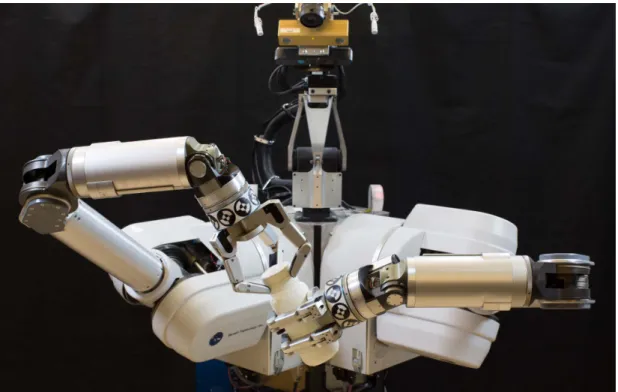
Despite these significant challenges, there has been tremendous progress towardsautonomous manipulationusingmodel-basedapproaches. Robotic manipulation systems are complex and consist of many abstractions which make use of models, e.g., dynamics, contact, kinematic, object and cost/reward models for planning, control, and perception. Models are further used on very different time scales ranging from milliseconds to minutes. Robots such as ARMAR-III (Asfour et al. 2006) (see Figure 1.2a) have been shown to successfully operate in kitchen environments, picking up objects and placing them in a dishwasher. (Beetz et al. 2011) (see Figure 1.2b) presented a system capable of dexterous manipulation tasks such as cooking, performing dynamic pancake flipping. The Darpa Autonomous Robotic Manipulation Software (ARM-S) challenge (see Figure 1.2c) resulted in fully integrated systems (Hudson et al. 2014; Righetti et al. 2014) able to perform difficult manipulation tasks such as opening and closing doors, locating, picking up and placing objects in cluttered environments. Successful demonstrations of dual arm manipulation tasks was another outcome of the ARM-S project. For example, cutting cables with a pruning shear and unbolting, unmounting and bolting of a car wheel using standard work equipment. Nevertheless, all mentioned systems and methods require carefully designed models of the environment and the system itself, task-specific problem programming and manual robustification of environment interactions. Although the presented methods exhibit excellent generalization performance for single tasks, allow introspection and rigorous analysis, there is still a significant gap towards true autonomy. For example, it is not clear how to scale up any of the existing approaches/systems to new tasks without overcoming the manual task description engineering, and error condition tuning that is currently required.
Similar to research in computer vision, natural language processing, and autonomous driving, exploring the use oflearning-basedapproaches towards autonomous manipulation is currently a highly active research field. Data-driven methods are particularly appealing for a multitude of robotics applications including manipulation (Bohg et al. 2014a). Learning-basedmethods
allow solving problems leveraging sensor experience. This is especially useful in cases when no mathematical tools exist, or traditionalmodel-basedapproaches would be computationally intractable. Further, it is unrealistic that we can pre-designall sufficientmodels required to achieve autonomous manipulation, given the need to solve novel tasks with unknown novel objects and unexpected events. Similar tomodel-basedapproaches,learning-basedmethods have been shown to learn single tasks successfully such as inserting a block into a shape sorting cube (Levine et al. 2016a), pick and place and opening doors (Chebotar et al. 2017). These methods often specify tasks in terms of higher level cost functions or demonstrations, often easier to define since they directly describe what we want to achieve, e.g., a binary reward for successfully grasping an object. However, the optimization itself is still an open research problem for such sparse reward settings (Riedmiller et al. 2018).
Hence, the problem of learning to solve tasks has shifted from designing the sufficient underlying models and algorithms, solvable within the system time constraints, to finding the right data representation and generation, learning and optimization method, as well as cost description. Different from autonomous driving (Urmson et al. 2008), state-of-the-artlearning-based ap-proaches in autonomous manipulation focus onend-to-endtask learning (Levine et al. 2016a). Therefore, these methods neglect almost all existing model knowledge, meaning they have to learn how to control a robot from sensory observations alone for every task from scratch. Thus, very basic, fundamental and well-understood components, such as point to point movements, have to be re-learned for each task. Dynamic environments pose further challenges for end-to-endlearning-basedmethods. The relevant information has to be identified automatically, often from weakly supervised data, and the right decision has to be inferred from raw sensory measurements. For example, approaches learning a mapping from pixel to torque/positions have to learn to identify the target object and the manipulator itself (Levine et al. 2016a). The field of computer vision is actively working on efficient and high-performance object detection methods to address this fundamental problem. By formulating robotic tasks as an end-to-end
learning-basedproblems (Levine et al. 2016a), the underlying function approximation problem needs to solve object detection from smaller robotic datasets in dynamic environments with less variation. As a result of the problem complexity, either a significant amount of system executions or problem specific demonstrations are usually required. Finally, state-of-the-artlearning-based
methods in robotics often require an even larger number of system executions to achieve an acceptable task generalization. The resultinglearning-basedsystems function as black boxes, which do not allow introspection of the learned model. Thus, safety guarantees and system insights can only be obtained by observing the system operate.
We argue that bothmodel-basedandlearning-basedapproaches are required towardsautonomous manipulation. We investigate the challenges of current state-of-the-artmodel-basedapproaches face and how to extend them with complementarylearning-basedmethods. We address a diverse
set of the different learning problems posed by robotics systems operating on different time scales and generating feedback loops. For example, a controller should appropriately react to changes in the system dynamics like when picking up an object. Rigid body dynamics for fixed-based manipulation robots are very well understood. A rich set ofmodel-basedtools that generalize well across different free space motion tasks already exist for this problem type. Hence, we do not and should not re-learn inverse dynamics models from scratch for different manipulation problems. Since robots act in the real world, creating feedback loops between our predictions and next observation,learning-basedapproaches in robotics pose additional challenges differing from successful approaches in computer vision and natural language processing. High-frequency inference and learning is a further important distinction from other more established learning problem domains. Besides posing hard constraints on the computational complexity of the learning method, high-frequency continuous data streams result in highly correlated data samples. This property violates the most common assumption of traditional learning-based methods, namely that data is distributed independently and identically. Therefore, we will propose efficient
model-basedandlearning-basedmethods using domain knowledge which cope better with the inherent robotic manipulation constraints. Further, we aim to maintain the generalizability of existingmodel-based approaches, successfully used for locomotion (Herzog et al. 2016) and autonomous cars (Urmson et al. 2008), while being able to incorporate and adapt to new objects and tasks. Ideally, we aspire to build a system which requires minimal model knowledge and allows for automatic bootstrapping of all further enhancements in an autonomous manner using
learning-basedmethods. For example, simulating grasps based on knowledge of the geometric object model, the robot kinematics and contact interactions to optimize alearning-basedmethod which can from then on further improve with every additionally obtained data sample, e.g. on the real system. As we will show in this thesis, simulation can be a great tool to leverage existing model knowledge and explore new solution spaces which can be incorporated using
learning-basedmethods.
In this thesis, we identify current limitations of previous (integrated) manipulation approaches and present novellearning-basedextensions, overcoming the unique robotic challenges. We test our hypotheses on real robotic manipulation systems as well as within simulated environments, providing empirical evidence of the effectiveness of our key contributions.
1.2.2 Limitations of System Architectures
In addition to the challenges as mentioned earlier regardingautonomous manipulation, the system architecture itself poses many challenging research problems. How to best design the system architecture itself is an open problem. In order to cope with the overall problem complexity, system architectures follow a modularization, divide and conquer principle. The main idea of
separation of concernsis to split the overall problem into separateindependentproblems. The most common example of manipulation systems is composed of these three major components,
Sense-Plan-Act(SPA) (Kortenkamp et al. 2016).Perception (Sense)reasons about the system and world state from sensor measurements, observations and is also addressed by the field of computer vision.Planning (Plan)is responsible for generating high-level action sequences based on, e.g. state machines and collision-free trajectories. Control (Act)attempts to generate the right motor commands to follow and track the desired trajectories and apply the desired forces. The limited bandwidth of data exchange between the modules is a major limitation of this particular system architecture. In its most basic form SPA, does not allow for any online adaptation, while this limitation is well known in the field (R. A. Brooks 1990), it is still the most common system architecture used in robotic manipulation research. One argument forSense-Plan-Actis its simplicity. It makes software development very easy and allows research to be focused on well-defined sub-problems without having to deal with the overall system complexity. To allow for some uncertainty and dynamics in the environment,Sequential-Sense-Plan-Act(SeSPA) is used, repeating the SPA steps at a low frequency (in the order of 0.1 Hz). This architecture proved to be very successful for complex manipulation tasks such as those in the Amazon picking challenge and the Darpa ARM-S challenge. Further, the most prominent frameworks for robotic manipulation, such as MoveIT (Chitta et al. 2012), follow this paradigm. Nevertheless, the low bandwidth and resulting limited adaptability to unforeseen environmental changes have recently been identified as a key issue by the teams of the Amazon picking challenge (Correll et al. 2016). Although additional efforts such as special hardware design can increase robustness, closing the perceptual feedback loop is a key component to achieve good performance and robustness. Without closing the perceptual feedback loop, even slight changes in the initial condition, e.g., uncertainty in the object state estimate, can render the initially planned solution, e.g., a trajectory, infeasible. Only when a system continuously updates the world state and re-plans can it react to environmental changes, either rendering current solutions infeasible or allowing for new solutions. Closing feedback loops is by no means a new idea. It has been a long time effort in robotic manipulation, starting with the work on visual servoing by (Shirai et al. 1973) and (Hill et al. 1979). Nevertheless, fully integrated systems with closed loop perception integration are not yet common within the community.
The decomposition of the overall problem into planning and control poses even more funda-mental problems besides low bandwidth communication. Since the communication between the controller and planner has a low bandwidth, it is often not clearwhatinformation should be communicated, and towhichlevel of abstraction in the controller should it be provided. This becomes apparent for contact-based tasks. We will illustrate key issues with a simple object grasping problem, for which the robot has to grasp and lift an object. The grasp controller is responsible for tracking the desired interaction forces and pose trajectories. However, there is an
inherent simulation reality gap for simulating interaction forces. Hence, the information a planner provides to the underlying controller can easily diverge very quickly from the planned trajectory. Whereas, asimplebut well-tuned force controller often results in good grasp performance if the initial end-effector pose isgood. Designing and tuning feedback controller for every task does not scale. Thus, the planner should be aware and choose the right controller parameterization and optimization. This raises the question of what constitutesgoodcontroller parameterizations such that a planner can exploit them.
1.2.3 Limitations of Model-Based Approaches
Robotics has a strongmodel-basedhistory. Models have been extensively used on various time scales, ranging from milliseconds to minutes as well as for perception, planning, and control. Humans design robots, therefore, kinematic models and their geometry is readily available for planning algorithms, computing collision-free trajectories. Nevertheless, planning has been shown to be an algorithmically challenging, an NP-hard problem by (Reif et al. 1985). Geometric simplifications are often required in order to find a feasible path in a reasonable time horizon. The robot’s dynamics model allows to control the system with model predictive control (Allgöwer et al. 2004) or more straightforward inverse dynamics control approaches (Herzog et al. 2016). In order to achieve precise control, the robot’s dynamics model has to be identified. The dynamics models might change over time due to motor heat affecting friction or object interactions such as grasping, requiring online re-identification or a detection mechanism which identifies if the underlying model has changed. This poses further challenges for designingmodel-basedapproaches since observed errors cannot be easily attributed to either imprecise models or algorithmic issues. For many tasks, precise models are not crucial. Rather crude approximations which facilitate fast optimal control approaches are sufficient (Herzog et al. 2016). Yet, determining sufficient partial or approximate models is a difficult manual engineering task, which is not practical for characterizing all required tasks towardsautonomous manipulation.
Geometric environment modeling, as well as interaction planning based on geometric shapes, is another commonmodel-based domain in robotic manipulation. Building an environment model consisting of all objects of interest is necessary to plan for safe trajectories. Therefore objects have to be identified and their pose estimated from noisy 2D/3D observations. This computer vision problem can be further complicated from partial occlusion or varying light conditions, or example. Since new objects are created on any given day, it is not possible to provide a robotic manipulation system with all required object models prior to deployment in a household environment. Fortunately, for many tasks only approximate local models are required. For example, stable grasps can be determined from local shape primitives (Herzog et al. 2014)
which can even generalize to novel objects. Nevertheless, finding the right abstraction is again a manual engineering task, and the resulting solution is not guaranteed to solve novel other tasks since important information has been abstracted away. Additionally, object features such as inertia, the center of mass and friction coefficients, relevant quantities for manipulation tasks, are unknown, unidentifiable, uncertain or dynamically changing for many objects. Interaction is required to estimate such properties. Yet,model-basedapproaches require such features to be known to determine meaningful object interactions.
Computational complexity is one of the most fundamental problems formodel-basedmethods since they are generally designed to perform the main computation at runtime. For example, contact planning is especially challenging mainly since there exists no computationally tractable contact model to date which captures the required real-world interaction dynamics. Strong assumptions are necessary to reduce the problem significantly, otherwise resulting in intractable contact planning. Hence, only a relatively small body of work, attempting to plan contacts for manipulation, exists. (Dogar et al. 2010) plan push-grasps, establishing contacts with an object on a planar surface while pushing it to increase the probability of grasp success.
In summary, successfulmodel-basedapproaches provide new problem insights, achieve great generalization within a task, and allow for rigorous analysis. But,model-basedmethods face fundamental issues towardsautonomous manipulationsince it is simply not possible to know all models and possible tasks a priori. Therefore, we hypothesize thatlearning-basedmethods, improving with new data, are a necessary complement towardsautonomous manipulation.
1.2.4 Limitations of Learning-Based Approaches
Robotic systems create large amounts of interesting data during operation. Therefore, learning-basedmethods have become a very common alternative tomodel-basedapproaches, especially for robotic manipulation tasks. Traditionally, different modules within the SPA system architecture have been replaced with learning approaches by collecting static datasets for learning, e.g., learning how to grasp (Pinto et al. 2016).
However, since the computer visionend-to-endbreakthrough results on the large-scale image classification challenge ImageNet in 2012 (Deng et al. 2009; Krizhevsky et al. 2012), the robotic manipulation research community started to increasingly focus on end-to-enddeep learning approaches to learn robotic skills. Approaches such asguided policy search(Levine et al. 2013) have lead to impressive results, learning control policies directly from pixel-based image inputs (Levine et al. 2016a). Yet, to achieve these impressive results the user must provide either a basic engineered control policy or a sufficiently close demonstration. Further, the learned control policies only perform well in areas around the explored state space and thus, do not generalize
well (Levine et al. 2016a). Conceptually,end-to-endlearning of a robust skill that generalizes to dynamic environments requires solving continuous object detection/identification/tracking and learning dynamics model of the robot manipulator, as well as visual servoing. Thus, it is not surprising thatend-to-endlearning frameworks for robot manipulation, using a general purpose function approximators with almost no explicit prior information and model regularization, cannot learn a general skill from a few examples on a single system. Further, all previously mentioned sub-problems are open research areas on their own.
Although very different learning methods have been used for robot manipulation tasks, deep neural networks represent the most used approach in recent literature. This framework scales well to large datasets and does not require feature engineering since it optimizes a hierarchical function approximator in an end-to-end fashion. Nevertheless, if a manipulation skill has been learned for a particular platform and environment, current state-of-the-art tools and theory do not allow to introspect the learned policies (Lipton 2016) and make no further statements about their region of validity. This issue is typically less severe for computer vision problems since deep neural networks are used for single image classification. In robotics, however, different systems have different kinematics and appearances, making it challenging to transfer learned skills from one system to another. Very different to domains in which deep learning approaches have reached industry grade maturity, robotic systems act according to the predictions, changing the learning problem significantly due to the introduced feedback. Predictions within this feedback loop can drive the robotic system into catastrophic states without the possibility of recovery or result in irreversible environmental changes. Additionally, for problems such as inverse dynamics, there are strict time requirements for inference and online learning which need to be orders of magnitude faster than in traditional supervised learning tasks.
(Pinto et al. 2016) and (Levine et al. 2017) have shown that it is possible to entirely bootstrap grasping tasks autonomously in very structured environments without explicit prior model knowledge. Still, in order to successfully bootstrap such tasks, there are fundamental implicit underlying requirements such as the initial potentiallyrandomactions of the robotic system have to yield a significant amount of successful task outcomes, and the task itself has to be automatically or easily resettable. The reward formulation and data distribution are further crucial aspects to successfully achieve autonomous bootstrapping and require careful tuning. Hence, manipulation tasks, such as stacking blocks in a particular order or opening doors, could not be solved in this manner on real systems without providing initial prior knowledge.
Learning-basedapproaches in robotics require a large amount of diverse data to achieve excellent performance, even in the case of fully supervised tasks (Levine et al. 2017). While robots typically generate lots of data, this data is highly correlated and often not diverse. Further, without strong assumptions on the structure of the system dynamics, a significant fraction of
state space would have to be explored. Due to recent breakthrough results on playing Atari games, (deep) (model-free) reinforcement learning has received renewed attention. Albeit these methods do not need models and task specification is straightforward, e.g., binary rewards for the final task success, millions sometimes even billions of execution (A. Nair et al. 2017) have to be executed to learn elementary concepts. During this process, already solved robotic problems such as trajectory tracking are relearned from scratch as a necessary intermediate solution. Most research in this sub-field oflearning-basedrobotics is based on simulation-based experiments due to the large number of trials required for learning. The simulation reality gap is a key issue for policy learning for real systems. Although the learning approach is model-free, high fidelity models and computationally expensive contact simulation are required to generate the data to optimize these methods.
In summary,learning-basedmethods have been shown to acquire new manipulation skills with self-supervision and allow them to adapt to changing environments. Yet, end-to-end learning is not data efficient enough to be applicable to learn a fully autonomous manipulation system. For new problems, these methods relearn previously solved problems from scratch. Hence, enhancinglearning-basedwithmodel-basedfeedback systems should alleviate these issues.
1.3 Problem Statement
The objective of this thesis is to study howlearning-based methods can improve the system performance by exploiting domain knowledge usually applied inmodel-basedapproaches. There-fore, we identify current limitations in existing state-of-the-artmodel-basedsystem architectures for robotic manipulation tasks and focus on necessary extensions towards autonomous ma-nipulation. Our results demonstrate that learning-based approaches efficiently complement
model-based methods, allowing us to solve problems which are often otherwise intractable. We show how to use existing models to bootstraplearning-based methods, encoding expert problem information in the data generation process. We further introduce a newlearning-based
optimization technique relevant to robotic problems such as continual/online task learning and model predictive control problems.
1.4 Thesis Structure & Contribution
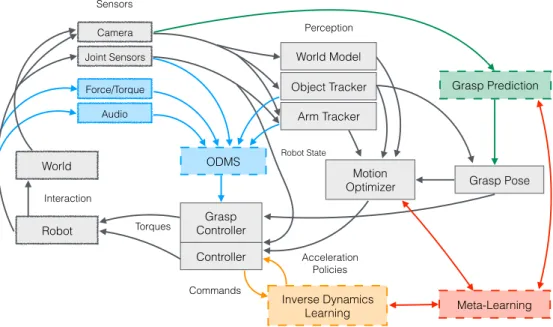
The core contributions of this thesis, embedded in the context of robotic manipulation tasks, are presented here, and their interaction visualized in Figure 1.3. First, we describe the foundations for our contributions, followed by a high-level systems perspective. Next, we focus on three
Controller Robot Torques Robot State Motion Optimizer Acceleration Policies World Interaction Object Tracker Arm Tracker Inverse Dynamics Learning Commands Joint Sensors Camera Force/Torque Audio Meta-Learning Grasp Prediction Grasp Pose ODMS Grasp Controller Sensors Perception World Model
Figure 1.3: Here we embed all thesis contributions into our reactive model-based system
(Chapter 3). All model-based modules are represented by boxes with solid borders. Our
learning-basedextensions have dashed borders and their additional interactions with the baseline
model-basedsystem are added in their respective colors (Chapter 4,Chapter 5,Chapter 6, and
Chapter 7).
progressively more low-level aspects which arise in robotic manipulation tasks. After that, we present an abstract learning approach relevant to applications in robotics, as well as the broader fields of machine learning and optimization. Finally, we discuss the thesis contributions and their impact on the field ofautonomous manipulation.
Chapter 3, Real-Time Perception meets Reactive Motion Generation: The main contri-bution of this work is a fully integrated system, presenting the first coherent empirical results, demonstrating the importance of continuous, real-time perception and its tight integration with reactive motion generation methods in dynamic manipulation scenarios. Three different systems that are instantiations of the most common architectures in the field are compared: (i) a traditional sense-plan-act approach (still most widely used), (ii) a myopic controller that only reacts to local environment dynamics and (iii) a reactive planner that integrates feedback control and motion optimization. The overall system is purelymodel-based and extensively evaluated on a real robotic platform in four scenarios that exhibit challenging workspace geometries and/or dynamic environments. This work shows the performance which can be achieved with a state-of-the-art
learningapproaches in robotic manipulation, neglecting almost all existing domain knowledge (e.g., in the form of models), it is especially important to have amodel-basedreference system. Hence, this work functions as a performance baseline for learning approaches, not only in terms of capabilities but also with respect to generalization. Within the context of this thesis, these results allow identifying problems which arise in purelymodel-basedapproaches and are suitable forlearning-basedextensions. For example, automatic online failure detection, inverse dynamics model learning, data association as well as grasp planning. This chapter is based on (Kappler
et al. 2018).
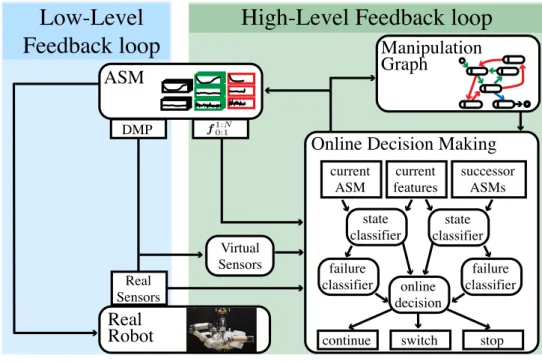
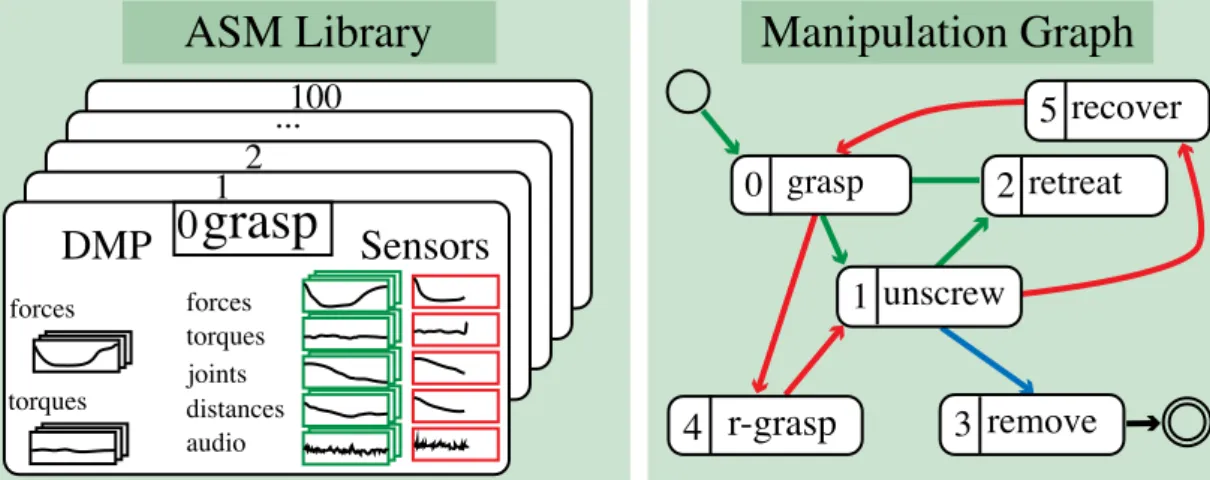
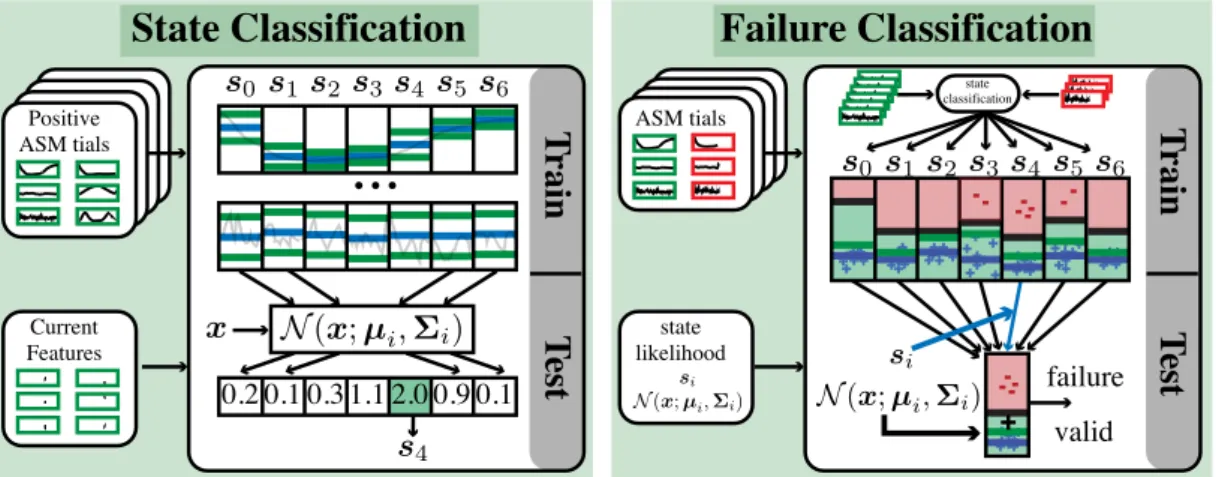
Chapter 4, Online Decision Making for Manipulation: Most robotic manipulation systems have a very diverse set of sensor modalities with different noise characteristics. Often it is not trivial to simulate (model-based) all sensors; thus, it is very hard to plan with such modal-ities. This is especially pronounced in cases when a robotic system makes physical contact with the world, where bidirectional forces are simultaneously applied and felt by the robot. Therefore, one of the main challenges in autonomous manipulation is to generate appropriate multi-modal reference trajectories that enable feedback controllers to compute control commands that compensate for unmodeled perturbations and therefore to achieve the task at hand. In this thesis, we propose a data-driven (learning-based) approach to incrementally acquire reference signals from experience and decide onlinewhen and towhichsuccessive behavior to switch, ensuring successful task execution. The online decision-making problem is reformulated as a pair of related classification problems. Both process the current sensor readings, composed of multiple sensor modalities, in real-time (at 30 Hz). This approach exploits our domain specific problem understanding that movement generation can dictate sensor feedback. Thus, enforcing stereotypical behavior will yield stereotypical sensory events which can be accumulated and stored along with the movement plan. Such movement primitives (DMPs), augmented with sensor experience, are called Associative Skill Memories (ASMs) (Pastor et al. 2013b). Sensor experience consists of (real) sensors, including haptic, auditory information and visual informa-tion, as well as additional (virtual) features. Experiments show that this approach can be used to teach dexterous tasks, e.g., a bimanual manipulation task on a real platform that requires precise manipulation of relatively small objects. Task execution is robust against perturbation and sensor noise because our method decides online whether or not to switch to alternative ASMs due to unexpected sensory signals. In summary, this work demonstrated that we couldlearn simple modelsfor various sensor modalities, which can be evaluated in real-time, to make decisions about the performance of our currently executed task. This chapter is based on (Kappleret al. 2015c).
Chapter 5, Big-Data Grasping: Grasping is a prerequisite for object manipulation, making it an important research problem in the robotics community. In this thesis, we focus on the problem of predicting/planning grasps prior to contact, where only visual information (e.g., 2D images and/or 3d point clouds) is available to infer a grasp pose and configuration. In such settingsmodel-basedapproaches typically suffer from high computational complexity, require model identification from partial noisy sensor observation, and do not scale well due to a large number of available objects in the world. One promising approach is the use of deep neural networks which have been very successful in learning similar mappings, given a large set of examples. We contribute a new large-scale database that contains grasps applied to a broad set of objects from numerous categories. These grasps are generated in simulation, using ourmodel and domain knowledge, and they are automatically annotated with different grasp stability metrics. Three different aspects are further analyzed within the scope of this thesis: (i) Crowdsourcing to investigate the correlation of the metrics with grasp success as predicted by humans. The results show that our proposed metric based on physics simulation is a more consistent predictor for grasp success than the standard analyticalε-metric. Further, our study suggests that human labels are not required for good ground truth grasp data. (ii) Instead, we use our domain knowledge to design a fully automatic data generation process with high-quality labels using a physics-metric that may be used to bootstrap learning in the real world. The resulting rich dataset allows us to optimize highly parametric function approximators, such as deep neural networks, to learn both the partial identification and pose/configuration regression problem. Further, these parametric models allow for very fast and computationally efficient inference. Additionally, we verify that simpler methods, such as logistic regression, do not have the capacity to leverage the large-scale database. (iii) Robots typically observe a scene from one viewpoint when attempting to grasp an object. In general, we strive for a grasp predictor which enables robots to grasp an object on the first attempt successfully. This domain specific observation enables us to reformulate the typical grasp prediction-/classification- into a top-1 prediction-problem, to obtain the best hypothesis from a binary labeled dataset. Our novel loss formulation significantly outperforms previous, more traditional classification and regression formulations by a large margin while still using the same underlying models. This chapter is based on (Kappleret al. 2015b, 2016).
Chapter 6, Inverse Dynamics Learning: Inherently safe robot behavior is crucial for collab-orative humanoid robotic manipulation tasks. Therefore, we need methods to track precisely desired policies while still maintaining system compliance. Our previously presented approaches generate reference policies for typical robot manipulation tasks such as picking up objects. As part of this thesis, we present a novel approach which extends existing model-basedinverse dynamics controllers withlearned error models, translating desired accelerations into torques. Existingmodel-basedapproaches typically suffer from poor performance in cases of significant
system payload changes. This is often the case when grasping and lifting an object. Traditional learning techniques attempt to overcome this limitation by training a full or error model on the actually realized accelerations, an indirect data source, instead of the policy’s desired acceler-ations. We show how an additional training signal — measured at the desired accelerations — can be derived from a feedback control signal. This effectively creates a second data source for learning inverse dynamics models. We analyze the use of both data sources in simulation and demonstrate its effectiveness on a real-world robotic platform. We show that our system incrementally improves the learned inverse dynamics model. By combining both data sources, we further show thaterror model learningconverges more consistently and faster. This perfor-mance improvement is likely due to our domain knowledge and understanding of the robotic task, resulting in the derivation of the proposed additional data source. This chapter is based on (Kappler*et al. 2017).
Chapter 7, Learning to Learn While Learning: Humans are remarkably skilled at quickly acquiring new skills, or adapting existing ones. This ability can be attributed to the fact that we do not learn each new skill from scratch, but instead build upon prior knowledge. Most robotic learning tasks would benefit from being guided by a “meta-learner”, especially given that multiple skill learning is an inherently incremental problem for truly autonomous systems. In this thesis, we present a novel meta-learning approach which learns the robot dynamics online and affords transfer of the learned structure to new tasks, resulting in faster convergence. The proposed meta-learning approach is advantageous because (i) it can be combined with any gradient-based optimizer, (ii) allows learning on the fly, and (iii) can be transferred to new optimization tasks. Model-based control, often used in robotic manipulation, is particularly well suited for our approach since very similar optimization problems have to be solved in a recurrent manner. Further, our approach not only significantly reduces the amount of required observed data samples, a challenge for real robot experiments, but opens up an entirely new avenue to achieve simulation to real-world transfer. Hence, it allows us to exploit existing domain knowledge in the form ofmodel-basedsimulation in entirely novel ways. This chapter is based on (Kappler*et al. 2018).
Foundations and Related Work
In this thesis, we present novellearning-basedmethods to complementmodel-basedapproaches towardautonomous manipulation. Here we introduce the foundations relevant to the contributions of this thesis.
We start out providing an overview of robotic manipulation and present the main building blocks used in current state-of-the-art robotic systems towards autonomous manipulation. After that, we introduce the central machine learning concepts used throughout the thesis. After the general machine learning introduction, we focus on the core methods essential for the thesis contributions.
2.1 Robotic Manipulation
The objective of robotic manipulation is to interact with an object to achieve a desired task. For example, picking up a drill, drilling a hole and afterward placing the tool in a specific pose. Successfulautonomous manipulationrequires the robotic system to understand its environment to the degree that actions can be executed safely and efficiently. Pick and place manipulation tasks have been studied extensively throughout the last decades of robotic manipulation research. Since almost any manipulation task first requires to grasp an object to either use it as a tool or place it in a different location, pick and place is one of the most fundamental manipulation skills also addressed throughout this thesis. Manipulation tasks, in general, pose a very rich and diverse set of challenges ranging from hardware component design, fusing different sensor modalities, precisely actuating the system, and higher level task reasoning. This breadth of research components makes robotic manipulation difficult to tackle at once, even for large teams. Therefore, we first discuss different system architectures, typically used for robotic manipulation, to cope with the aforementioned complexity. The subfields,perception,planningandcontrol, emerging from the inherent robotic system design are presented in more detail hereafter.
2.1.1 System Architecture
Any robotic system is composed of three components: (i) sensors allowing to estimate the system state and perceive their surrounding environment, (ii) computation to interpret and fuse the sensor information and reason about future actions toward desired goals, and (iii) actuators which physically change the system state based on the desired computed control inputs.
Modularization, a common and important abstraction for software-based systems to facilitate code and functionality reuse, component testing andseparation of concerns, is essential for robotic manipulation systems. Manipulation tasks require complex novel research on various abstraction levels. Since robot manipulation systems are composed of distributed sensors and actuators and robotic systems operate on different operation timescales, distributed computation is often necessary to cope with the high-performance demand. In order to fulfill the inherent distributed computation requirements, most robotic system architectures are based on inter-process communication middleware such as ROS (Quigley et al. 2009), YARP (Metta et al. 2006), ARMARX (Wächter et al. 2016; Vahrenkamp et al. 2015), CORBA (Orfali et al. 1998). To simplify the overall system complexity and facilitate reusability, three conceptual system architectures have been developed, as further discussed in (Coste-Maniere et al. 2000) and (Kortenkamp et al. 2008): (i) a top-down hierarchical approach composed of functional modules, (ii) a bottom-up behavioral approach and (iii) a hybrid of behavioral and functional modules.
2.1.1.1 Sense-Plan-Act
The most traditional approach for robotic system architectures (Moravec 1990; Crowley 1985) and more specifically robotic manipulation is Sense-Plan-Act (SPA) (R. Brooks 1986), a hier-archical top-down functional approach (Kortenkamp et al. 2016). In this paradigm,perception
provides a model of the environment, including the robot state, using the latest sensor infor-mation. Aplanneruses the resulting world model to generate desired trajectories to solve the manipulation task. Trajectory planning is mostly concerned with avoiding collisions in free space. Typically, the goal of the planning phase is to find feasible solutions that are optimal with respect to a user-defined cost. In a final step, the systemsactsaccording to the desired trajectories. In order to guarantee precision, stiff but accurate control approaches generate the underlying controls. The main advantage of this paradigm lies in its simplicity, assuming a static world state during planning and control. The subdivision of the complex problem of robotic ma-nipulation into well defined and independent sub-fields allows for module reuse. Yet, in the case of system manipulation failures, it is difficult to attribute errors to a single module, since there exist implicit dependencies which raise questions about the right representations communicated
between modules. Systems that are built according tosense-plan-act(SPA) are perfectly suited for environments that are well-defined, structured, controlled, and not dynamic.
However, SPA struggles to achieve robust manipulation performance in the presence of uncer-tainty and changing environments (Correll et al. 2016). Due to the well-known limitations of
sense-plan-act(R. A. Brooks 1990), robotics researchers have proposed extension, e.g. sequen-tial sense-plan-act(seqSPA), acknowledging the importance of environmental feedback during motion execution. Here, the robot does not only request feedback once at the very beginning but also at deliberately chosen moments during task execution. This approach is more robust against uncertainties in both sensing and actuation than SPA. Some teams competing in the Amazon Picking Challenge and the DARPA ARM Challenge followed seqSPA (Correll et al. 2016; Righetti et al. 2014). However, it is still not able to cope with dynamic environments or target objects.
2.1.1.2 Behavior-Based System Architecture
In the 1980’s the limits of sense-plan-act became apparent (R. A. Brooks 1990) because of dynamic environments, slow reaction times, and system failures due to inaccurate modeling. Therefore, (R. Brooks 1986) proposed thesubsumption architecture, a system composed of hierarchical finite state machines which all operate at the same time, considering the latest sensory feedback and inhibit each other to create complex behaviors. This paradigm, known as the behavior-based system architecture, has shown tremendous success for simple tasks such as fetching and delivering mail. Typically systems controlled with this paradigm exhibit very reactive behavior and can cope with rapidly changing environments. However, designing behaviors, which solve complex tasks such as manipulating objects requiring higher-level reasoning, has proven to be very difficult (Kortenkamp et al. 2008). Hybrid systems have been proposed (Gat 1992; Isla 2005; Colledanchise et al. 2014) to use the best of both worlds, behaviors to react to dynamic environmental changes and planning modules shaping the long-term behavior.
2.1.2 Perception
Perceiving the world is essential for robotic manipulation to build an internal representation of the world, facilitating planning and control. Even Shakey (Nilsson 1984), one of the first mobile robotic platforms, used multiple sensor modalities such as a camera, rangefinder, and haptic bumper sensors to perceive its surrounding. Different sensor modalities with applications in
robotic manipulation are depth cameras, laser- and radio-based rangefinder, proximity, audio, and force/torque sensors, joint encoders, and accelerometers.
A common problem for manipulation tasks is to reliably identify objects in the environment and track their poses and geometries with respect to the manipulator. Ever since the low-cost Kinect (Zhang 2012) became available, RGB-D sensors have become the standard sensor modality to tackle object detection, classification, and tracking. Therefore, we focus on this sensor modality after that. With the recent computation advances and new large-scale image datasets, such as ImageNet (Deng et al. 2009), Pascal VOC (Everingham et al. 2010), and MSCOCO (Lin et al. 2014), deep learning approaches have changed the landscape of computer vision research. All state-of-the-art approaches for 2D image-based bounding box object detection (Redmon et al. 2017; Ren et al. 2017; Liu et al. 2016) and object classification (Krizhevsky et al. 2012; Simonyan et al. 2014; Szegedy et al. 2017) are now based on deep learning methods (LeCun et al. 2015). In robotics, 2D object bounding box detection and tracking (Kragic et al. 2001; Harris et al. 1990; Choi et al. 2010) is used for planning within robotic manipulation applications. Different to the computer vision community, robotics perception typically deals with small amounts of labeled data and limited datasets. Additionally, 2D image-based information is often not sufficient to infer precise object 6D poses or 3D object surfaces which are important formodel-basedcontrol approaches. 3D perception alleviates many issues arising from the 2D ambiguities and allows robots to estimate the 6D pose, position and orientation, of the 3D objects. Depth sensing, readily available on most manipulation platforms, allows to collect 3D object models (Newcombe et al. 2011) and extend existing large-scale 3D object model datasets such as ShapeNet (Chang et al. 2015). For instance, using appearance-based andmodel-basedinformation, (Azad et al. 2006) and (Hinterstoisser et al. 2012) propose a real-time object localization and recognition approach for solid colored known objects. (Brachmann et al. 2014) present a learning-based approach estimating the initial 6D pose of an object from a single RGB-D image. However, manipulation tasks in dynamic environments not only require the initial 6D pose of an object but continuous tracking in order to react and adapt to environmental changes. Manipulation tasks create unique challenges for 6D object tracking such as partial occlusion and rapid movements due to grasping and object interactions. While manipulating an object, the robot end-effector has to be in contact with the object which results in further difficulties for tracking since the resulting observations might be difficult to associate with either the manipulator or the object. Hence,model-based
object tracking remains an active research topic in robotics with very different approaches such as probabilistic formulations (Wüthrich et al. 2013; Wüthrich et al. 2015) and optimization-based methods (Schmidt et al. 2014).
In addition to requirements for real-time 6D object tracking, robotic manipulation needs precise hand-eye coordination such that the desired plan can result in the desired interactions. Conceptu-ally, there are two main approaches to ensure good hand-eye coordination. First, calibrating the