Sublinear Scaling for Multi-Client
Private Information Retrieval
Wouter Lueks1and Ian Goldberg2
1 Institute for Computing and Information Sciences (iCIS) Radboud University Nijmegen
Nijmegen, The Netherlands [email protected]
2 Cheriton School of Computer Science University of Waterloo Waterloo, ON, Canada [email protected]
Abstract. Private information retrieval (PIR) allows clients to retrieve records
from online database servers without revealing to the servers any information about what records are being retrieved. To achieve this, the servers must typically do a computation involving the entire database for each query. Previous work by Ishai et al. has suggested using batch codes to allow a single client (or collaborat-ing clients) to retrieve multiple records simultaneously while allowcollaborat-ing the server computation to scale sublinearly with the number of records fetched.
In this work, we observe a useful mathematical relationship between batch codes and efficient matrix multiplication algorithms, and use this to design a PIR server algorithm that achieves sublinear scaling in the number of records fetched, even when they are requested bydistinct, non-collaboratingclients; indeed, the clients can be completely unaware that the servers are implementing our optimization. Our multi-client server algorithm is several times faster, when enough records are fetched, than existing optimized PIR severs.
As an application of our work, we show how retrieving proofs of inclusion of certificates in a Certificate Transparency log server can be made privacy friendly using multi-client PIR.
1
Introduction
Private Information Retrieval, or PIR, was introduced in the seminal work of Chor et al. in 1995 [3]. In PIR, a client wishes to retrieve information from online database servers while revealing to the database operatorsno informationabout what data she seeks. That
this is even possible is counterintuitive, but consider thetrivial downloadscheme: the
database server sends the entirety of the database to the client, who searches it herself. This is clearly private, but comes at a high communication cost for large databases. Non-trivial PIR schemes aim to achieve the same level of privacy while transmitting far less data. The simplest PIR schemes assume that the database consists of an array of equal-sized blocks, and that the client knows the index of the block she wishes to retrieve. However, previous work showed that this simple query mechanism can be
used as a black box to realize more expressive database search functionality, including search by keywords [4] and private SQL queries [16].
Chor et al.’s original 1995 work showed one cannot have both information-theoretic privacy (i.e., privacy even when the server is computationally unbounded) and a sub-linear (in the size of the database) communication cost if only one server is employed. However, information-theoretic PIR (IT-PIR) schemes circumvent this impossibility re-sult by using multiple database servers and anoncollusionassumption—that at most a
bounded number of servers (less than the total number) will collude against the client. They achieve a communication cost much smaller than the size of the database, and modern ones additionally achieve robustness—even if some of the servers are
unre-sponsive, buggy, or actively malicious, the client can nonetheless retrieve her informa-tion (and identify the misbehaving servers) [2, 7, 9].
If information-theoretic privacy is not required, computational PIR (CPIR) schemes can be used. These schemes rely on computational or cryptographic assumptions to guarantee privacy against a single database server at low communication cost [14]. Devet and Goldberg [6] also recently proposed a hybrid PIR scheme that combines a CPIR scheme with an IT-PIR scheme to achieve some of the desirable properties of both, while hedging against violations of either the computational or noncollusion assumptions.
While much effort has gone into reducing the communication costs of PIR proto-cols, it is also important to consider the computational cost. A PIR server typically must process the entirety (or at least a significant fraction) of the database when handling each query, lest it learn information about what the client is likelynotseeking.
Not all PIR schemes can beat the trivial download approach. Sion and Carbunar [20] found that it would always be faster to simply download the entire database than to use Kushilevitz and Ostrovsky’s CPIR scheme [14]. Later, Olumofin and Goldberg [17] noted that a more modern CPIR scheme by Aguilar Melchor and Gaborit [1], as well as a number of IT-PIR schemes, are orders of magnitude faster than the trivial download scheme. However, the computation costs are still nontrivial, requiring on the order of 1 s of CPU time3per gigabyte of database size, for each IT-PIR query.
In order to reduce the per-query CPU cost, a number of authors have proposedbatch
techniques, in which a PIR server performs a computation over the database and a batch of simultaneous queries, resulting in less work than computing over the database once for each query separately. Henry et al. [12] propose a batching method based onramp schemesparticular to Goldberg’s IT-PIR scheme [9], while Ishai et al. [13] usebatch codes(discussed in more detail below) to provide multi-query computational speedups
for any PIR scheme.
Both of these proposals, however, require that theclientsconstruct their queries in
a special way to achieve the batching speedups. This means that these approaches help only in those scenarios where single clients (or closely cooperating groups of clients) are fetching large batches of queries at the same time.
Our contributions. In this work, we address the more general case in which a PIR server wishes to process a batch of queries simultaneously, whether they were received
3However, this CPU time is almost completely parallelizable if multiple cores or servers are
all from the same client, each query from a unique client, or anything in between. We approach this problem by first observing a mathematical relationship between Ishai et al.’s method of applying batch codes to speed up IT-PIR and a special case of matrix multiplication where the left matrix has a specific structure (§3). We then generalize this observation to the case of general matrix multiplication. In doing so, we remove all restrictions on the structure of the queries to be batched. We accept a more mod-est batching speedup to remove the single (or coordinated) client rmod-estriction and the potentially large amount of communication induced by Ishai et al.’s method.
We apply our new technique to the setting of Certificate Transparency (§4), in which web clients fetch information about TLS certificates from log servers, but should hide from the log servers which certificate’s information it fetches. This appears to be a perfect opportunity to employ PIR, but the large number of non-cooperating clients
expected to use the system makes multi-client batching imperative. We note that while batching queries reduces the total computation time at the cost of increasing the latency for individual queries, this extra latency is not an issue in this particular application. We implement and measure our new technique on top of the open-source Percy++ PIR library [10] (§5).
While our practical improvements—a little more than a 4-fold speedup—are mod-est, we do offer sublinear scaling in the number of queries forindependent clients,
something simpler improvements cannot offer. Additionally, any other system-level op-timizations can easily be used on top of our algorithmic ones.
2
Background
Our construction combines Goldberg’s robust IT-PIR scheme [9] with fast matrix mul-tiplication techniques inspired by batch codes. Therefore, we first review and compare these notions.
2.1 Goldberg’s robust IT-PIR scheme
Goldberg models the database as anr×smatrixDover a finite fieldF. Every row inD
corresponds to a singleblockin the database; every block consists ofsfield elements. To
request blockj(non-privately) the client could simply sendj to the server. However,
as a first step, we express the PIR operation as a vector-matrix multiplication before producing a true privacy-friendly scheme. The client constructs thejth standard basis
vectorejofFr(i.e., the vector of lengthrwith all zeros except for a1in thejthposition) and sends it to the server. The requested block j is then obtained by calculating the
vector-matrix productej·D.
To make the query privacy friendly, the client in Goldberg’s scheme creates a(t+ 1)-out-of-` Shamir secret sharing [19] of this standard basis vectorej. It sends one
share to each of the`database servers, which compute the vector-matrix product with
the database and return the result. Lagrange interpolation of the shared vectors gives the standard basis vector; since matrix multiplication and Lagrange interpolation are linear, interpolation of the results yields thejthblock of the database. The secret sharing
scheme guarantees that as long as at mosttservers collude, they learn nothing about
the target block.
Goldberg’s scheme is robust [7, 9]. It permits some of the servers to misbehave, while still enabling the client to recover her record and identify the misbehavers.
Communication cost. To read a single block, the client sendsrfield elements to, and
receivessfield elements from, each server. For a fixed database size ofnfield elements,
it is best to selectr=s=√n. Henry et al. [12] show how to build on this simple
fixed-block-size PIR primitive to handle more realistic databases with variable-sized records.
Serving multiple simultaneous queries. Suppose a server receives multiple queries
v1, . . . , vqsimultaneously. It could answer them by computing theqvector-matrix
prod-uctsvi·Dindividually. However, it can also first group the queries into one matrixQ
where rowiconsists of queryvi. Then the server computes the matrix-matrix product
Q·D. Rowiof the result is the response to theithquery.
With a naive matrix multiplication algorithm the work the server needs to do is the same in both cases: about 2qrs operations (qrs multiplications, and about the same
number of additions). However, as we will see, using better matrix-multiplication tech-niques will significantly improve the situation.
Ramp scheme. Henry et al. [12] replace the Shamir secret sharing in Goldberg’s PIR
scheme with aramp scheme. In this way, a single client can encode more information
in each server request, and can retrieveqblocks instead of just1withoutincreasing the
per-server computation or communication cost at all. The large drawback to this scheme (in addition to being useful only for single clients making multiple queries, and not for multiple clients making single queries) is that it must trade some of the robustness of Goldberg’s scheme for extra parallel queries, or conversely, that it requiresq−1extra servers in order to maintain the same level of robustness.
2.2 Batch Codes
Batch codes can be used to answer multiple queries efficiently. The idea, proposed by Ishai et al. [13], is to encode the database in a special way, so that a single client can efficiently make multiple queries. This idea is best illustrated using an example. As in the rest of this paper, we apply the batch codes to Goldberg’s IT-PIR scheme.
Suppose we want to prepare a database withrrows for two simultaneous queries.
We create three separate databases:D1, containing the firstr/2rows;D2, containing the lastr/2rows; andD3=D1⊕D2. Any two queries, say for blocksi1andi2, can be answered by making at most one PIR query to each of theDi: if blocksi1andi2are not in the same half of the database, the queries can be answered by making one PIR query toD1and one toD2. Suppose, on the other hand, thati1andi2are both in the first half. Then blocki1can be retrieved directly, while blocki2is obtained by making one query toD2and one toD3. Taking the XOR of the latter two results yields the desired row in the first half. Two queries for the second half are handled similarly.
This procedure reduces the computational cost for the server. As we saw in the previous section, a naive method requires 4rs field operations; in contrast, the batch
Table 1.Summary of batch codes with parameters [13]. The subcube code is parametrized byk and`≥2, while the subset code is parametrized by`,r0and0< α < 1
2, wherew=α`. The parametersrandr0scale the codes to support more blocks, without essentially changing their
structure.
Subcube Subset Number of blocks (r) r r0 w` Sum of subdatabase sizes (N) `+1
` k r r0Pw j=0 ` j Number of queries (q) 2k ≥2w Number of subdatabases (m) (`+ 1)k Pw j=0 ` j
code solution requires only3rsfield operations. (Again, half multiplications and half
additions.)
Note that to hide which indices the client is querying she needs to make a query to each of the three parts, even if two would suffice to get the answer. This means that the client sends 3
2relements to, and receives3selements from, each server. In the naive case she sends2relements and receives only2selements.
In general, an(r, N, q, m)batch code will take a database ofrblocks and createm
subdatabases, such that the total number of blocks in the subdatabases isN. The code
can be used to answerqqueries by making one request to each of themsubdatabases.
The example we sketched before gives an(r,32r,2,3)batch code.
Suppose we use an(r, N, q, m)batch code to speed up PIR queries to a database withrblocks, each consisting ofsfield elements. LetN1, . . . , Nmbe the number of
blocks in themsubdatabases (so thatP
iNi =N). To makeqqueries a client needs
to make one PIR query to each of themsubdatabases with respectivelyN1, . . . , Nm
blocks. The query to subdatabaseicosts2Nisfield operations. Therefore the total
com-putational load on the server is2N s. The client sendsN group elements, and receives mselements.
Subcube batch code Ishai et al. [13] generalize the sketch above as follows. First, instead of splitting the database into2parts, it can be split into`parts. A final`+ 1th part is added, being the XOR of all the previous parts. Again, any two items can be obtained using`+ 1queries, one to each of the subdatabases—if the two items happen to be in the same part it is necessary to retrieve and calculate the XOR of all the other items. This gives rise to an(r,`+1` r,2, `+ 1)batch code. Obviously, this is good for computation, as the server needs to do only2`+1` rsfield operations. While the sending
cost drops to `+1
` relements, the receiving cost rises to(`+ 1)selements. (Note that
the client always needs to retrieve the`+ 1records to protect her privacy.)
For simplicity, let us return to the case where` = 2. The scheme can be applied recursively to answer more queries. Suppose the client makesq = 4queries. Group these into two pairs. Each pair can be answered by making only one query to each of the three partsD1,D2,D3. In total, two queries are made to eachDi, so we can apply
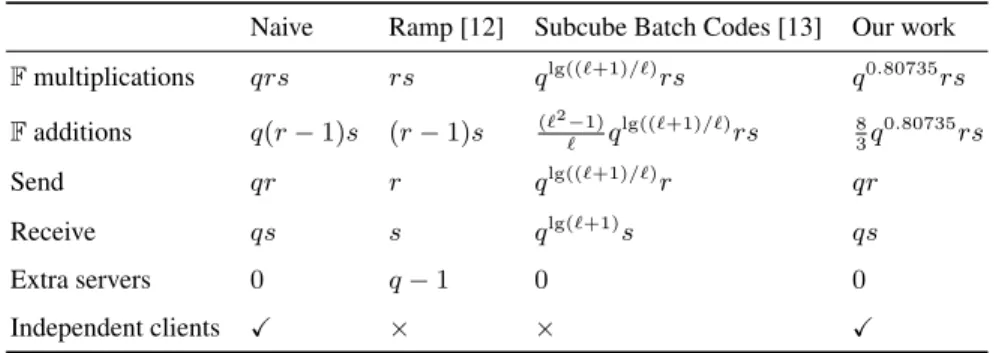
Table 2.Comparison of multi-query PIR schemes. We show counts of per-server field operations,
as well as the number of field elements sent to and received from each server, the number of extra servers the scheme requires to maintain the same robustness level as for a single query, and an indication of whether independent clients can use the method, or whether all queries must be sent by a single client (or coordinated clients). The database consists ofrblocks, each containings field elements. The number of simultaneous queries,q, is assumed to be a power of 2, and much smaller than eitherrors. Note that our work achieves sublinear scaling of computation in the number of queriesq, while also admitting independent clients.
Naive Ramp [12] Subcube Batch Codes [13] Our work Fmultiplications qrs rs qlg((`+1)/`)rs q0.80735rs Fadditions q(r−1)s (r−1)s (` 2−1) ` q lg((`+1)/`)rs 8 3q 0.80735rs Send qr r qlg((`+1)/`)r qr Receive qs s qlg(`+1)s qs Extra servers 0 q−1 0 0 Independent clients X × × X
Recursively applying this scheme gives a system that can handleq = 2k queries.
Table 1 summarizes the important parameters of this scheme. By taking` large, this
scheme gets arbitrarily close to the optimal processing time for the server: it can an-swer2kqueries with only slightly more processing than is required for a single query.
However, the price is a higher communication cost for the client.
The subset batch code Ishai et al. also describe another batch code that has more favourable properties: the subset batch code. It is, however, also more complex. We only summarize the results in Table 1, and refer to their paper [13] for a full description of this scheme. The scheme is parametrized by`,r0, and0 < α < 12. The valuewis
then given byα`.
It can be shown that for this code doingqqueries is approximately(1−α)/(1−2α) times more expensive than doing a single query. Thus, picking a smallαbrings the
com-putational overhead for the server arbitrarily close to optimal. Contrary to the subcube codes the communication overhead is also polynomial in q, however, in practice the
overhead turns out to be rather high, especially whenαis small.
Consider the following example. We wantα to be somewhat small, so we take ` = 20 so that withα = 0.2 we get w = 4. Suppose we make q = 16queries, Then,N/r = 1.279so the computation cost for 16 queries is only27.9%more than for 1 query. However, we need to receivem/q = 387times more data than the naive approach forq = 16queries. So, using this code at low computational cost can incur extremely high communication costs.
Challenges The two main drawbacks of using batch codes for PIR are: (1) the re-quirement that all of the queries be generated by a single client (or by closely
coop-erating clients); and (2) the increased communication cost, which becomes especially prohibitive for large databases.
We will address both of these issues in this work. See Table 2 for a comparison of multi-query PIR schemes. Although we only list the subcube batch code and not the subset batch code in the table for conciseness, the two salient challenges listed above are the same for both types.
2.3 Matrix multiplication algorithms
Naive matrix multiplication of a matrixQof sizeq×rwith a databaseDof sizer×s
requiresqrsmultiplications and at leastq(r−1)sadditions (although most
implemen-tations will actually useqrsadditions). For two square matrices of sizen×nthis boils
down to anO(n3)complexity.
Faster matrix multiplication algorithms exist that have an asymptotic complexity with a better exponent. In this paper we focus on Strassen’s algorithm [21] because of its relative simplicity. This algorithm achieves a time complexity of O(nlg 7) =
O(n2.8074).Faster algorithms exist, such as that of Coppersmith and Winograd [5],
which achieves an even better bound ofO(n2.3729). However, this comes at the cost of
a much larger multiplicative constant.
Strassen’s algorithm is extremely simple. It splits each matrix into four, equal-sized submatrices. A naive block-matrix multiplication of these would require 8 multiplica-tions of the smaller sized matrices. However, using Strassen’s algorithm, only 7 are needed. This technique is then applied recursively to the multiplications of the smaller matrices. (See Appendix A for more detail.)
3
Batch codes as matrix multiplication
We have seen that answering multiple PIR queries in Goldberg’s protocol requires cal-culating the matrix-matrix productQ·D, as the rows of the resulting product are exactly
the responses to the given queries. At the same time, batch codes speed up this com-putation. Hence, batch codes are in some way implementing fast matrix multiplication. In this section we identify this relation, explain the limitations of batch codes in this application, and demonstrate the similarities with Strassen’s algorithm. For simplicity of exposition (and because this is the typical case in practice), we will useFof charac-teristic 2, so that additions are just XORs.
3.1 An example
In Section 2.2 we showed how a batch code can be used to reduce two queries for the full database to three half-sized queries. In terms of matrix multiplication, the client constructs its three half-sized queriesq1, q2, q3and sends them to the server. The server expresses the databaseDas a concatenation of two parts,D=
D1
D2
the matrices Q= q1 0 0 0 q2 0 0 0 q3 3×32r andM= I 0 0 I I I 3 2r×r , so thatM·D= D1 D2 D1⊕D2 3 2r×s ,
whereQis the block-diagonal matrix of the queries,Iis the identity matrix, andM
is the matrix form of the batch code (representing the linear combinations of the parts that make up the resulting subdatabases). (Note that we annotate the matrices with their dimensions.) The server now computes the linear combinations of the parts,M·D, and
multiplies queriesQby them. This results in the familiar response structure
Q 3×32r·M32r×r·Dr×s=Q3×32r· D1 D2 D1⊕D2 3 2r×s = q1·D1 q2·D2 q3·(D1⊕D2) 3×s .
After receiving the results, the client combines the three rows as appropriate to recover the answers to her two original queries.
3.2 General batch codes as matrix multiplication
When using general batch codes to speed up PIR we see a similar structure. Recall that an(r, N, q, m)batch code can answerqqueries to a database ofrrows by splitting the
computation acrossmsubdatabasesK1, . . . ,Kmcontaining a total ofN rows. In the
preceding example—an(r,3
2r,2,3)batch code—these subdatabases wereK1 =D1,
K2 =D2andK3 = D1⊕D2. For general batch codes these subdatabases will be more complicated linear combinations of the partsDi. TheN×rmatrixMrepresents
these linear combinations.
Again, the client first uses the batch code to convert herqqueries intomsubqueries q1, . . . , qm, where eachqiis a row vector of length equal to the number of rows inKi.
She sends these to the server. The server constructs the linear combinations of the parts,
M·D, and applies the queries to them
Qm×N ·(MN×r·Dr×s) = q1 0 ... 0 qm m×N ·(MN×r·Dr×s).
The server can quickly compute this product using the block-diagonal structure ofQ.
The result is anm-row response. The client can combine thosemrows to produce her
desiredqblocks.
Note that it is the special structure ofQ=Q·Mthat enables the server to speed up
the matrix multiplicationQ·D. In the PIR setting, this necessitates thatQbe produced
3.3 Comparison with Strassen’s algorithm
Strassen’s algorithm is similar to the matrix multiplication form of the batch codes above. In particular it also
1. partitions the database into partsDi,
2. forms linear combinations of theDito construct the subdatabasesKi,
3. multiplies parts of the queries with the subdatabases, and
4. computes linear combinations of the products to produce the final result.
However, there are also differences. First, batch codes require the queries to be preprocessed by the client, or alternatively that the query matrixQis given byQ·M
as above. Strassen’s algorithm, on the other hand, works with any matrixQ. Second,
batch codes are essentially one-dimensional; as a result, steps 1, 2 and 3 above for batch codes operate only on complete rows, while Strassen’s algorithmsubdividesand takes linear combinationsof rows in addition to takingsubsetsof rows (in bothQandD).
While Strassen’s algorithm has a higher server computational cost than batch codes, the fact that Strassen’s algorithm can deal withanymatrixQis of tremendous benefit. In
our PIR setting, this means that clients do not need to coordinate their queries. Indeed, they do not need to be aware that the server is implementing this optimization at all.
4
Application of multi-client PIR: Certificate Transparency
We now examine an application where multi-client PIR is particularly useful: Certificate Transparency. Websites use digital certificates to tie possession of a particular private key to their domain name. These certificates are signed by certificate authorities (CAs). To verify the validity of a website the user’s browser checks that a CA it trusts signed the certificate (or that there is a certificate chain from a trusted CA leading to the certifi-cate). Events in recent years, like the hack of the Dutch CA DigiNotar [8], have shown that CAs cannot be trusted unconditionally. When a CA is compromised it can be used to issue false certificates that allow third parties to eavesdrop on the communication between a user and a website. The browser will not detect this as long as the compro-mised CA is still trusted. Certificate Transparency, as described in RFC 6962 [15], aims to detect wrongly issued certificates in a timely manner without introducing extra trust assumptions. It roughly works as follows.
1. Before a certificate is issued it is recorded by one or morelog servers. Each of these
log servers creates a signed certificate timestamp (SCT) for this certificate and will eventually add the certificate to an append-only data structure.
2. When presenting a certificate the website will also send along the SCTs from the log servers. The browser will verify that at least one trusted log server signed the certificate description.
3. The following consistency checks are done asynchronously:
(a) An auditor, usually the browser, will check that the log server signed certifi-cates do indeed appear in the append-only log of the log server.
(b) Auditors and monitors check that the logs are consistent; i.e., that no certificates have been changed or retroactively inserted into the log.
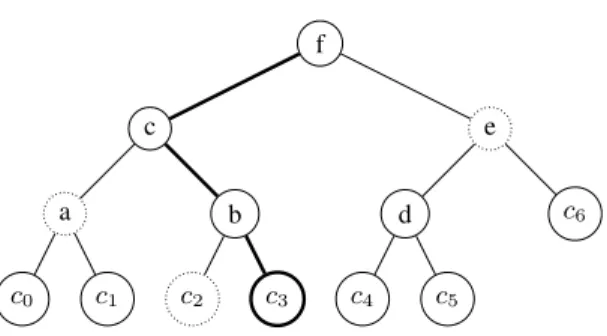
f c a c0 c1 b c2 c3 e d c4 c5 c6
Fig. 1.An example Merkle hash tree for 7 certificatesc0, . . . , c6 encoded into the leaves. For certificatec3the proof of inclusion consists of all the dotted nodes:c2,aande. This proof can be checked as follows. First, calculate the hash of the certificate to getc3. Then,bis the hash of c2andc3;cis the hash ofaandb; and, finally,fis the hash ofcande. If the calculated rootf matched the signed root the auditor is convinced that the tree containsc3.
(c) CAs and webservers monitor the log to detect inconsistencies such as two cer-tificates, by different CAs, for the same domain.
It is essential that the first check is done, because monitors can only detect falsely issued certificates when they appear in the log. However, the first check also reveals to the log server which websites the user is visiting. We will use multi-client PIR to allow many independent clients to query a log server for the proofs of inclusion of certificates.
4.1 Proving that a certificate is included in the log
The certificates are recorded in a Merkle hash tree. A Merkle hash tree is a binary tree, in which every leaf contains the hash of a certificate, while every internal node contains the hash of its children. The root then captures information about all the children. Pe-riodically, log servers will add all the newly logged certificates to the tree and sign the new root.
The number of leaves,n, determines the structure of the Merkle hash tree. Letkbe
the largest power of 2 smaller thann, so thatk < n≤2k. Then the left subtree of the
Merkle hash tree ofnnodes is the full binary tree withkleaves, while the right subtree
is the Merkle hash tree of the remainingn−knodes. See Figure 1 for an example.
This format allows log servers to construct a proof of inclusion of a certificate for an auditor. The auditor already has the certificate, and thus also the leaf corresponding to the certificate. The log server gives the auditor those node hashes needed to recalculate the root of the tree starting with the certificate. The extra nodes needed for this proof are all the siblings on the path from the leaf to the root; see Figure 1. Finally, the auditor compares the calculated root with the signed root from the server.
The length of the proof is no larger than the height of the tree. Therefore, the size of the proof grows only logarithmically in the number of leaves. The specification requires SHA256 as the hash function for the internal nodes, so a node contains 32 bytes of data.
4.2 The number of SSL certificates
To determine the feasibility of retrieving the proofs of inclusion using PIR, we need to estimate the number of active and valid SSL certificates—it does not make much sense to retrieve proofs for expired certificates. We estimate the number of SSL certificates based on the following sources.
EFF SSL Observatory The EFF SSL observatory4 observed about 1.4 million valid certificates in 2010.
Public Netcraft Data In their public sample of May 2013,5Netcraft claimed that Sym-antec at that time had produced more than one third of all certificates. In their April, 2012 press release6Symantec quotes811,511installed certificates. This gives an estimate of approximately 2.4 million certificates in 2012.
Pilot CT server As of early July 2014, Google’s pilot certificate transparency server had logged about 4.5 million certificates.7 It is not clear how reliable this number is, since currently there is no incentive to add all certificates to this list. Also, the log is append-only, so this number is probably higher than it should be.
Given these data points, we estimate that the number of valid SSL certificates is cur-rently around222or approximately 4 million.
4.3 Retrieving proofs of inclusion using PIR
To make privacy-friendly retrieval of the proofs of inclusion possible, we store the proofs as records in a database and use PIR to retrieve them. To retrieve the proof, the client needs to know in which record the proof is stored. In the original system, the proof is usually retrieved from the log server by using the hash of the certificate itself, but that would violate our privacy requirements. Instead, we propose that webserver provides the record indices to the clients (it is not possible to include these in the X.509 certificate as the index is not yet known when the certificate is created). Alternatively, an index structure such as a B+ tree could be used in the typical way that PIR lookups by keywords are done [4, 16].
To check a proof, the auditor needs three things: the certificate itself, the list of sibling hashes, and the signed root. We assume that the auditor has already retrieved the certificate in question. The signed root can be directly retrieved as it does not give any information about the specific certificate. Therefore, the proofs that are stored in the database consist solely of the hashes that help in reconstructing the signed root. We will next consider how these proofs are stored in the database.
4https://www.eff.org/observatory 5http://www.netcraft.com/internet-data-mining/ssl-survey/, accessed July 2014 6 http://investor.symantec.com/investor-relations/press- releases/press-release-details/2012/Symantec-Achieves-Highest-Number-of-SSL-Certificates-Issued-Globally/default. aspx
7Obtained by querying the server’s API:https://ct.googleapis.com/pilot/ct/
Storing proofs in the PIR database We first count the number of proofs that need to be stored. The log is append-only, and will therefore keep growing. However, expired certificates can safely be removed from the database of proofs. Regular clients will not query for expired certificates, so a fallback to identifying methods is not a problem. Therefore, we assume that the database only contains proofs for valid certificates. We estimated this to be about222proofs.
In the following we consider a tree containing2`−1< n≤2`items. The length of the inclusion proofs in such a Merkle tree is at most`hashes. However, it can be less;
for example, the inclusion proof ofc6in Figure 1 consists only of the nodesdandc. For simplicity, we allocate the full`hashes for every proof in the database, resulting in
proofs of32`bytes.
Goldberg’s PIR scheme is most efficient when the number of blocks equals the number of field elements per block [12]. It thus makes sense to bundle multiple proofs into a single block (as the number of proofs is exponential in`, while the length of a
proof is only linear in`). The location of a proof is then given by its block, and its index
within the block (the size of the tree fixes the length of the proofs). When this location is provided by the webserver it should remain fixed while the certificate is valid.
Given the size of a proof and the estimated number of valid SSL certificates we get a storage requirement of32·22·222 ≈0.7·232bytes, or about 3 GiB. Therefore, in the following section, we evaluate our algorithm on databases of sizes 1–4 GiB.
We also note that, if the client is willing to reveal a subset of the database that con-tains the certificate she seeks, she can reduce the server’s computational load at the cost of revealing some information about her query [18]. While trivially downloading the entire subset is one approach, PIR offers a lower communication cost—only about one
blockof information is sent to and from each PIR server—without leaking information
about which certificate within the entire subset the client is querying for.
5
Implementation and Evaluation
We implemented fast matrix multiplication using Strassen’s algorithm as an extension to the Percy++ open-source PIR library [10]. We implemented Strassen for the small fieldsGF(28)andGF(216)as well as the integers modulop. All measurements were
taken in Ubuntu 12.04.4 LTS running on a machine with eight Intel(R) Xeon(R) E7-8870 CPUs, but each PIR server, which used only one core, was assigned to a different CPU.
5.1 Implementation
Strassen’s algorithm works perfectly when multiplying matrices where all the dimen-sions are powers of two. In the PIR setting, however, this need not hold. Whenever one or more of the three matrix dimensions (q,r, ors) is odd, we split off the single excess
row(s) and/or column(s) and use the naive matrix multiplication algorithm for those products. The resulting dimensions are all even, so that we can do another Strassen recursive step.
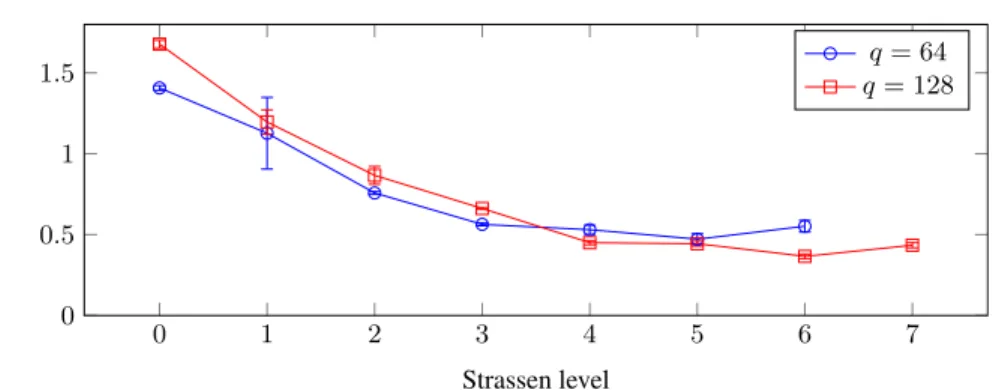
0 1 2 3 4 5 6 7 0 0.5 1 1.5 Strassen level Normalized CPU time per query (s/GiB) q= 64 q= 128
Fig. 2.Normalized CPU time per query (seconds per GiB of database size) for a 1 GiB database
consisting of 32768 32768-byte records over GF(28). We plot different Strassen levels (i.e., depth of recursion in the Strassen algorithm) and two numbers of queries, 64 and 128. Consider theq = 64case. After 6 Strassen steps, the problem size has been reduced to a1×512matrix times a512×512matrix, and the algorithm bottoms out. In both cases it is better to skip this final reduction step. Error bars are shown, but most are small, and may be difficult to see.
Dealing with dimensions that are non-powers of two can be costly. For example, a dimension of2k−1will incur extra calculations at every step, resulting in a larger
com-putation time than if the dimension were2k instead. Hence, our algorithm is designed
to dynamically increase the number of queries (by inserting a dummy all-zeroes query) if this yields better performance.
Every recursion step yields a small overhead. Part of this is mitigated by not allo-cating memory every time, but at small sizes the overhead still trumps the gain possible. We have analyzed when this happens; see Figure 2 for an example. We then tuned our implementation to stop recursing at the optimal depth.
5.2 Experiments
Forqless than about165, the number of additions in Strassen’s algorithm is slightly
larger than for the naive algorithm due to the multiplicative constant of8
3 (see Table 2). However, as explained above, every recursive Strassen step reduces the number of mul-tiplications by a factor of7/8 or 12.5%, starting with the very first. The small fields and the integers modulophave in common that multiplication is a lot more expensive
than addition; therefore, we expect that even one or two recursive steps of Strassen’s algorithm would have a measurable effect on the performance, and the measurements in Figure 2 bear this out. The initial dimensions of the problem dictate how many re-cursive steps of Strassen’s algorithm can be applied, as each dimension is cut in half at each step. In practice, we expect that it is the number of queries that is the limiting factor (that is,qwill be much smaller than eitherrors), so that is what we focus on.
Figure 3 compares the performance of our new algorithm with the one in the 0.9.0 release of Percy++. All measurements are done overGF(28), as that is the most
ef-20 21 22 23 24 25 26 27 28 0 0.5 1 1.5 2 Number of queries (q) Normalized CPU time per query (s/GiB)
Timings for database of size32768×32768overGF(28)
Percy++
Our algorithm using Strassen Analytic Strassen Optimal
Fig. 3.Comparison between the originalGF(28)PIR implementation in Percy++ and our new
version using Strassen. For the first part of the graph, the new and original algorithms give the same results, as the Strassen code is not invoked for small problem sizes. We can also easily see the effect of the hand-optimized loop in Percy++ for handlingq ≤3. We also compare our algorithm to the best theoretical improvements that using Strassen’s algorithm can provide, using the fastest per-query time of the original Percy++ code (q= 3) as a reference point. Error bars are shown, but most are small, and may be difficult to see. The peak memory usage of our algorithm (forq= 256) was 1422 MiB, whereas Percy++ used 1060 MiB.
ficient field supported by Percy++. We notice that Percy++ slows down considerably when more queries are used (we suspect cache issues may be to blame for this, but it was a completely repeatable effect). Our scheme does not suffer from this problem, and indeed produces the desired decreasein per-query cost as the number of queries
increases. We observe a 4.4-fold performance improvement over Percy++ forq= 256 simultaneous queries.
We have also drawn the analytical improvements we expect from using Strassen’s algorithm. Figure 3 shows the theoretical bound of the optimal Strassen gain that would be possible, measured against thefastestper-query time (obtained atq= 3) measured
for the original Percy++ code. For example, for 256 queries, this gain would be(78)8≈ 0.344. We see that we are quite close to this value, even though we always skip the final Strassen step.
For each Strassen recursion step, our algorithm incurs an extra subproblem of 1/4 the size, which needs to be stored in memory. The extra memory consumption as a result of this is at most a factor of 1
4+ ( 1 4)
2+· · ·=1
3. This is confirmed by the memory usage given in Figures 3 and 4.
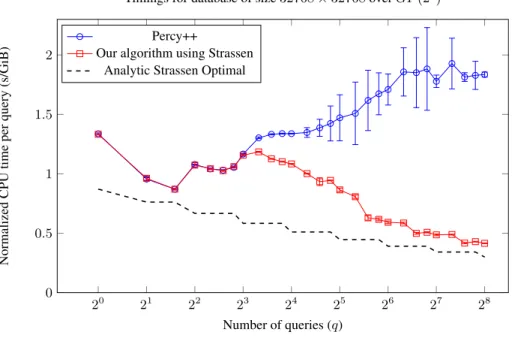
20 21 22 23 24 25 26 27 28 0 0.5 1 1.5 2 Number of queries (q) Normalized CPU time per query (s/GiB)
Timings for database of size65536×65536overGF(28)
Percy++
Our algorithm using Strassen Analytic Strassen Optimal
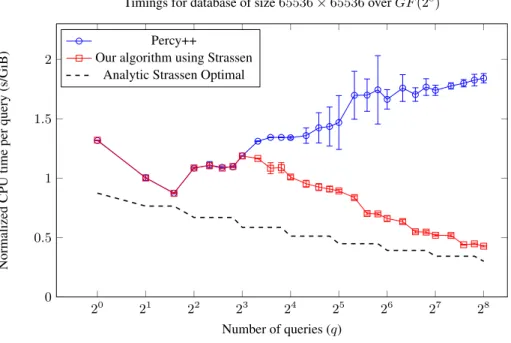
Fig. 4.We repeat the experiment of Figure 3, but with a 4 GiB database consisting of 65536
65536-byte records. The peak memory usage of our algorithm (forq = 256) was 5556 MiB, whereas Percy++ used 4148 MiB.
Certificate Transparency. Figure 4 shows performance measures for a 4 GiB database, a size that nicely matches up with a log server’s database of inclusions proofs. Again we see that using Strassen’s algorithm gives a significant performance gain over just using single queries.
While batching queries results in a significantly lower processing time per query, the latency does increase. However, this is not a problem for auditing proofs of inclusion, as they are performed asynchronously. In particular, the goal is to detect misbehaving log servers, and not to protect users against falsely issued certificates directly. Some latency is therefore acceptable.
If a lower latency is required, the algorithm can easily be parallelized. Each of the seven Strassen subproblems is completely independent from the others, and creating these and recombining the result is very cheap. While we did not implement paral-lelization, we expect the overhead of doing so to be extremely small.
6
Conclusions
In this paper we showed how we can significantly speed up PIR queries if we allow the server to batch queries, and answer them simultaneously. Such an idea was proposed earlier in the setting of batch codes, but that proposal required coordination among the clients, which is not desirable in the PIR setting.
We analyzed batch codes in the setting of Goldberg’s PIR scheme and have shown that essentially they provide a fast method for doing matrix multiplication under specific constraints on the matrices. However, since multi-client PIR in Goldberg’s scheme is essentially a matrix multiplication, we can use our method to obtain sublinear scaling in the number of querieswithoutrequiring the queries to have been created by a single
client or cooperating clients.
We described how multi-client PIR can be used to make certificate transparency more privacy friendly. We implemented Strassen’s algorithm as part of Percy++ and have shown that we indeed manage to get a significant speedup when batching multi-client queries. While further system-level optimizations to Percy++ (which is already heavily optimized) might conceivably give comparable speedups in absolute terms, these will almost surely be a constant factor, whereas our algorithmic improvements
increasewith the number of simultaneous queries. Furthermore, any such system-level
optimizations are likely to be able to be combined with our algorithmic improvements to yield compounded benefits.
Our implementation is open source and has been incorporated into the 1.0 release of Percy++ [11].
Acknowledgements. We thank the anonymous reviewers and Ben Laurie for their helpful feedback. This research is supported by the Natural Sciences and Engineer-ing Research Council of Canada (NSERC) and by the research program Sentinels as project ‘Revocable Privacy’ (10532). Wouter Lueks is a member of the Privacy and Identity Lab (PI.lab). Sentinels is being financed by Technology Foundation STW, the Netherlands Organization for Scientific Research (NWO), and the Dutch Ministry of Economic Affairs. The PI.lab is funded by SIDN.nl (http://www.sidn.nl). This
work benefitted from the use of the CrySP RIPPLE Facility at the University of Water-loo.
References
1. Aguilar Melchor, C., Gaborit, P.: A Lattice-Based Computationally-Efficient Private In-formation Retrieval Protocol. In: Western European Workshop on Research in Cryptology (2007)
2. Beimel, A., Stahl, Y.: Robust Information-Theoretic Private Information Retrieval. Journal of Cryptology 20(3), 295–321 (2007)
3. Chor, B., Goldreich, O., Kushilevitz, E., Sudan, M.: Private Information Retrieval. In: 36th Annual IEEE Symposium on Foundations of Computer Science. pp. 41–50 (1995)
4. Chor, B., Gilboa, N., Naor, M.: Private Information Retrieval by Keywords. Technical Report TR CS0917, Department of Computer Science, Technion, Israel (1997)
5. Coppersmith, D., Winograd, S.: Matrix Multiplication via Arithmetic Progressions. Journal of Symbolic Computation 9(3), 251–280 (1990)
6. Devet, C., Goldberg, I.: The Best of Both Worlds: Combining Information-Theoretic and Computational PIR for Communication Efficiency. In: 14th Privacy Enhancing Technologies Symposium. pp. 63–82 (2014)
7. Devet, C., Goldberg, I., Heninger, N.: Optimally Robust Private Information Retrieval. In: 21st USENIX Security Symposium (2012)
8. Fox-IT BV: Black Tulip: Report of the investigation into the DigiNotar Certificate Authority breach (Aug 2012)
9. Goldberg, I.: Improving the Robustness of Private Information Retrieval. In: 28th IEEE Sym-posium on Security and Privacy. pp. 131–148 (2007)
10. Goldberg, I., Devet, C., Hendry, P., Henry, R.: Percy++ project on SourceForge. http: //percy.sourceforge.net(2013), version 0.9.0. Accessed Sept. 2014
11. Goldberg, I., Devet, C., Lueks, W., Yang, A., Hendry, P., Henry, R.: Percy++ project on SourceForge.http://percy.sourceforge.net/(2014), version 1.0. Accessed Nov. 2014
12. Henry, R., Huang, Y., Goldberg, I.: One (Block) Size Fits All: PIR and SPIR with Variable-Length Records via Multi-Block Queries. In: 20th Annual Network and Distributed System Security Symposium (2013)
13. Ishai, Y., Kushilevitz, E., Ostrovsky, R., Sahai, A.: Batch Codes and Their Applications. In: 36th ACM Symposium on Theory of Computing. pp. 262–271 (2004)
14. Kushilevitz, E., Ostrovsky, R.: Replication Is Not Needed: Single Database, Computationally-Private Information Retrieval. In: 38th Annual IEEE Symposium on Foundations of Computer Science. pp. 364–373 (1997)
15. Laurie, B., Langley, A., Kasper, E.: Certificate Transparency. RFC 6962 (Experimental) (Jun 2013),http://www.ietf.org/rfc/rfc6962.txt
16. Olumofin, F., Goldberg, I.: Privacy-preserving Queries over Relational Databases. In: 10th International Privacy Enhancing Technologies Symposium. pp. 75–92 (2010)
17. Olumofin, F., Goldberg, I.: Revisiting the Computational Practicality of Private Information Retrieval. In: 15th International Conference on Financial Cryptography and Data Security. pp. 158–172 (2011)
18. Olumofin, F., Tysowski, P.K., Goldberg, I., Hengartner, U.: Achieving Efficient Query Pri-vacy for Location Based Services. In: 10th PriPri-vacy Enhancing Technologies Symposium. pp. 93–110 (2010)
19. Shamir, A.: How to share a secret. Communications of the ACM 22(11), 612–613 (1979) 20. Sion, R., Carbunar, B.: On the Computational Practicality of Private Information Retrieval.
In: 14th Network and Distributed Systems Security Symposium (2007)
21. Strassen, V.: Gaussian elimination is not optimal. Numerische Mathematik 13(4), 354–356 (1969)
A
Strassen’s algorithm
Strassen’s algorithm is best explained by looking at matrix multiplication from a block-matrix perspective. For simplicity, assume that all matrices have sizen×nwherenis
even. If Q= Q11Q12 Q21Q22 and D= D11D12 D21D22 ,
then the matrix productR=Q·Dis given by
R= R11R12 R21R22 ,
where
R11=Q11·D11+Q12·D21
R12=Q11·D12+Q12·D22
R21=Q21·D11+Q22·D21
R22=Q21·D12+Q22·D22.
It thus reduces to8matrix multiplications of sizen/2. In Strassen’s algorithm the
fol-lowing 7 matrix products are calculated first (note that in fields of characteristic 2, the +and−operations are of course the same):
M1= (Q11+Q22)·(D11+D22) M2= (Q21+Q22)·D11 M3=Q11·(D12−D22) M4=Q22·(D21−D11) M5= (Q11+Q12)·D22 M6= (Q21−Q11)·(D11+D12) M7= (Q12−Q22)·(D21+D22).
The matrix product is then given by:
R11=M1+M4−M5+M7
R12=M3+M5
R21=M2+M4
R22=M1−M2+M3+M6.
Using this algorithm, only 7 matrix multiplications of sizen/2are necessary. Applying this trick recursively gives a complexity ofO(nlg 7).
![Table 1. Summary of batch codes with parameters [13]. The subcube code is parametrized by k and ` ≥ 2, while the subset code is parametrized by `, r 0 and 0 < α < 1 2 , where w = α`](https://thumb-us.123doks.com/thumbv2/123dok_us/989351.2630020/5.918.293.633.250.354/table-summary-batch-parameters-subcube-parametrized-subset-parametrized.webp)