Intermediaries
Simon Loertscher
∗January 31, 2004
Abstract
We introduce capacity constrained competition between market-making intermediaries in a model in which agents can choose between trading with intermediaries, joining a search market or remaining inactive. Recently, market-making by a monopolistic intermediary has been analyzed by Rust and Hall (2003) and Gehrig (1993). Market-makers set publicly observable ask and bid prices. Because market-making involves price setting, without further restrictions competition between market-making intermediaries is Bertrand-like and yields the Walrasian outcome, where the ask-bid spread is zero (Rust and Hall 2003, Gehrig 1993). However, positive ask-bid spreads and competition between market-makers can be observed in re-ality, e.g. in banking and in retailing. Following Kreps and Scheinkman (1983) and Boccard and Wauthy (2000), we therefore introduce physical capacity constraints. This allows for a gradual transition from monopolis-tic to perfectly competitive intermediation as the number of intermediaries increases. In particular, we show that given Cournot capacities, interme-diaries will set Cournot bid and ask prices in the subsequent subgames, so that the equilibrium of the intermediated market coincides with the Walrasian equilibrium as the number of intermediaries becomes large.
Keywords: Market-making, capacity constrained competition, market mi-crostructure.
JEL-Classification: C72, D41, D43, L13.
∗Economics Department, University of Bern, Vereinsweg 23, CH-3012 Bern
Email: [email protected] This is a preliminary version of chapter 2 of my PhD-thesis. I want to thank Ernst Baltensperger, Esther Br¨ugger, Alain Egli, Thomas Gehrig, Christian Ghiligno, Armin Hartmann, Roland Hodler, Michael Manz, Gerd M¨uhlheusser Jean-Charles Rochet, Yves Schneider and Manuel W¨alti for valuable comments and discussions. Any remaining errors are mine.
1
Introduction
In this paper, we analyze competition between market-making intermediaries. These intermediaries set bid prices on the input market and ask prices on the output market of intermediation. Our starting point is the model developed by Gehrig (1993). According to this model, individual agents who are buyers or sellers can join a search market, join the monopolistic intermediary or remain inactive. In the search market, agents are randomly matched and the price at which exchange takes place is set bilaterally. Because matching is random, the search market does not exhaust all possible gains from trade. If agents join the intermediary, buyers have to pay an ask price set in advance by the intermediary. Likewise, if they decide to deal through the intermediary, sellers are paid the bid price the monopolistic intermediary previously announced. The intermediary trades simultaneously with both buyers and sellers. Gehrig shows that there is an equilibrium in which the search market and the market of the monopolistic intermediary are simultaneously open and where the intermediary makes positive profits because he trades at a positive ask-bid spread. More precisely, the set of individual agents is tripartite: High valuation buyers and low cost sellers deal through the intermediary. Buyers and sellers with average valuations and costs are active in the search market, and low valuation buyers and high cost sellers remain inactive. This model can also be seen as an instance of competing ex-changes. Full efficiency (i.e. the Walrasian or Marshallian market equilibrium) of the more efficient exchange is not established due to limited (i.e. absence of) competition among intermediaries. Two obvious applications are the labor and the housing market, where typically intermediated and search markets co-exist.1
But we may also think of banks and retailers as providing, among other things, the kinds of services intermediaries achieve in this type of model.
We extend the basic Gehrig model in two ways. (1) We impose a sequential structure by requiring that intermediaries first have to buy the good from the sellers (this is called the input market of intermediation) before it can be sold to buyers on what we call the output market of intermediation. (2) We introduce ca-pacity constraints and competition between caca-pacity constrained intermediaries. The most important consequence of (1) is that there is a unique subgame
perfect equilibrium with an active search market, in which the equilibrium ana-lyzed by Gehrig is replicated on the equilibrium path (see Loertscher, 2003). The rationale behind (2) is the following. As is well known, competition among price setting firms is apt to lead to paradoxical results such as the one uncovered by Bertrand, according to which ”two is enough for perfect competition.” The same is true in our model. However, the problem arises not on the output market but on the input market of intermediation, where without additional restrictions bid price competition is (like in Stahl, 1988) a winner-takes-all competition for the monopoly profit accruing on the output market. The most important contribu-tion to solve the Bertrand paradox has been made by Kreps and Scheinkman (1983, KS hereafter) who analyze a two stage game. In the first stage, two firms set capacities and in the second stage, they compete as price setters on a product market. For our purpose, it is therefore quite natural to follow this approach. The regions of pure strategy equilibria in the bid price setting subgame are the same as in KS and Boccard and Wauthy (2000, BW hereafter) (who extend the KS setting to n firms). If no firm’s capacity is strictly larger than its Cournot best response function, given the capacities of all other firms, then there is a pure strategy equilibrium in which all firms set the input market clearing bid price. Therefore, the problem studied by KS and our problem are very similar in that respect.
[to be completed]
Apart from the model developed by Gehrig (1993), our paper is also related to Spulber (1996), Spulber (1999), and to Rust and Hall (2003). The main similarities and differences are best highlighted by briefly commenting on the following quote, taken from Spulber (1996, p.579):
Intermediation between customers and suppliers often is the primary economic activity of firms, whether they are merchants or manu-facturers. The neoclassical model of the firm implicitly recognizes that as intermediaries, firms coordinate input purchases, production, distribution, and output sales. However, since the neoclassical firm takes prices as given, the firm only intermediates on the quantity side by transforming inputs into outputs. In the neoclassical framework, market-making takes place outside the firm though exogenous price adjustment represented by the Walrasian auctioneer. On the other
hand, models of imperfect competition in the field of industrial orga-nization have brought the price setting role of firms to center stage, but ignore the intermediation role of firms by emphasizing competi-tion in product markets.
We focus on the same problem as Spulber, but in a sense we want to go two steps further by (i) introducing (imperfect) competition between a finite number of market-making intermediaries and (ii) allowing prices to exert more power as they are public rather than private signals.
The paper is structured as follows. Section 2 introduces the model. In section 3, we analyze the equilibrium of the output and the input market, and section 4 contains (preliminary) conclusions. Problems concerning the mixed strategy equi-librium on the input market and some further considerations concerning Cournot competition are in the Appendix.
2
The Model
There is a continuum of buyers willing to buy one unit of an indivisible good of homogenous quality, which is known to every one. Their preferences are described by reservation prices r which are uniformly distributed over the unit interval, r ∼ U[0,1]. If a buyer with reservation price r buys the product at price p (where the volunteer nature of exchange and individual rationality requirep≤r), his utility gain is r−p. This generates an aggregate demand schedule D(p) = 1− p, p ∈ [0,1], which can be interpreted as a (Walrasian) market demand. Analogously, sellers’ preferences are described by reservation prices or unit costs of production s which are uniformly distributed on the unit interval [0,1]. If a seller with reservation price s sells the product at price p (where volunteer exchange under individual rationality requires p≥s), his utility gain isp−s,so that the aggregate (Walrasian) supply function is S(p) = p, p ∈ [0,1]. A buyer with reservation price r owns another good that he can exchange for the good in question. This good is called money. We assume that buyers have and sellers accept money in exchange for the good.
Walrasian (or Marshallian) Outcome Given the demand function D(p) = 1−pand the supply functionS(p) =p,the Walrasian market outcome is
charac-terized by pricepW = 1
2 and quantity exchanged QW = 1
2, and buyers withr≥ 1 2
and sellers with s ≤ 1
2 participate in the market, while the other agents remain
inactive.
However, at the core of our model is the assumption that there is no benevolent auctioneer quoting market clearing prices and coordinating trading activities at zero costs. The purpose of our analysis is to study what allocation emerges if agents establish this allocation themselves.
Buyers and sellers can either meet in a decentralized search market where they are randomly matched and where they share the gains from trade evenly. (Alternative bargaining procedures and their consequences are discussed in de-tail by Loertscher (2003).) Or they can join intermediaries or remain inactive. Intermediaries first set a physical capacity constraint. Then they set a bid price at which they are willing to buy from the sellers, and finally they set an ask price at which they are willing to sell what they have previously bought. In the presence of intermediation, buyers and sellers face thus three decisions. They can either join the intermediary, enter the search market or choose to remain inactive. We denote by Iσ (Iβ) the set of all sellers (buyers) who join the intermediation
market. The set of sellers (buyers) active in the search market is denoted by Sσ
(Sβ), and the set of sellers (buyers) who decide not to be active is denoted by
Zσ (Zβ). Finally, we denote by Ωσ (Ωβ) the set of all sellers (buyers), so that by
definition Zσ ≡Ωσ\(Iσ ∪Sσ) and Zβ ≡ Ωβ\(Iβ ∪Sβ). The (Lebesgue) measure
of these sets is denoted by υ(.), e.g. υ(Iσ) is the measure of sellers joining the
intermediated market.
2.1
The Dynamic Intermediation Game
We now describe the dynamic intermediation game with capacity constrained intermediaries. We speak interchangeably of intermediaries and firms. There are n profit maximizing intermediaries, indexed by i = 1, .., n. Each of them is endowed with a physical capacity constraint qi.2 These capacity constraints are
such that intermediary i can trade any quantity q ≤ qi at zero marginal costs, whereas trading any quantity greater thanqi is prohibitively costly. An example
2It would be very desirable if the choice of capacity could be endogenized as e.g. in Kreps
and Scheinkman (1983). However, the mixed strategy equilibrium has turned out to be too complicated to allow for this. See Appendix A.
for a physical capacity constraint is the number of counters of an intermediary or his storage capacity for the input purchased.
The capacities of all firms are observed by all other firms and all individual agents. Given these observations, intermediaries then set simultaneously bid prices bi, which can subsequently not be changed. The legal arrangement is
such that each intermediary is obliged to buy any quantity up to the capacity constraintqi sellers are willing to sell to him at bid price bi. Having observed qi
and bi for all i, sellers decide whether or not to join the intermediated market.
The market where sellers interact with intermediaries is called the input market (of intermediation). All bid prices are public information. If more thanqi sellers want to sell to intermediary i the qi sellers with the lowest cost can sell to i. In other words, we assume that an efficient rationing rule applies. Those sellers who get rationed by intermediary i can then join any other intermediary where again an efficient rationing rule applies. However, joining the intermediation market is an irreversible decision so that sellers who have decided to try to sell to any intermediary but who were rationed cannot subsequently go back to the search market. We assume that agents who cannot expect positive utility gain from joining the intermediated market will not join it. In exchange for the good sellers get money from the intermediary to whom they sell. We assume that all intermediaries have enough money and that sellers are aware of this.3 When all
intermediaries have finished buying, the quantity boughtqb
i by each intermediary
i is observed by all agents. From what has just been said we know that qb i ≤qi.
The sets of sellers joining the intermediary is denoted as Iσ and its (Lebesgue)
measure is denoted asυ(Iσ). For reasons of tractability, we assume also that the
set of sellers joining the intermediated market is observed by all agents remaining in the game.
In the second stage, each intermediaryisets the publicly observable ask price ai and buyers decide whether to join the intermediated market. As with sellers,
buyers who have joined the intermediated market cannot go back to the search market in case they are rationed. In case rationing occurs, an efficient rationing
3The quantity of money an intermediary holds can be regarded as his short-term capital,
while his long-term or fixed capital is embedded in his physical capacity constraintqi. In a richer model, one could endogenize the money or short-term capital an intermediary holds. Thus, short-term capital would be a strategic variable in addition to the capacity constraint and might be used a signalling device to attract customers. Section?? provides a motivation why such an extension might be enriching.
rule applies. The market where buyers interact with intermediaries is called the output market (of intermediation). The legal arrangement is such that at the ask priceai intermediaryiis obliged to sell any quantity q≤qib buyers are willing to
buy from him. If an intermediary cannot sell its whole stockqb
i he can dispose of
the excess quantity for free. However, as on the input market intermediaries are committed to the prices they set. We assume that the setIβ is observable. Like
sellers, intermediaries accept money in exchange for the good they sell.
In the third and last stage, sellers and buyers who have not joined the inter-mediated market decide simultaneously whether to join the search market. We assume that agents join the search market only if their expected utility from doing so is positive. This prevents the search market from being overcrowded with agents who never engage in trade. The set of sellers (buyers) joining the search market is denoted bySσ(Sβ), and their (Lebesgue) measure is denoted by
υ(Sσ) (υ(Sβ)). The matching technology is such that if the number of buyers and
sellers is the same, each buyer (seller) is matched with probability λ to a seller (buyer), whereλ∈[0,1]. If the number (or measure) of, say, sellers active in the search market is larger than that of buyers, the probability of being matched to a buyer is correspondingly adjusted downwards, while the probability of a match for buyers is still λ. That is, the traders on the long side of the search market are matched with probability γiλ, where γi = υυ((IIij)) < 1 with i = σ, β, j 6= i.
There is no further possibility to trade after a match has been established. For those who are not matched, the game is over. As observed by Spulber (1999, p. 561), the search market is static in the sense that search market participants are randomly and pairwise matched at most once. If a buyer with reservation price r and a seller with cost s are matched they share the gain from trade evenly if r−s > 0. That is, they agree on the price p = r−s
2 . After that, the game is
over. If r−s ≤0, the game is over for these agents without trade taking place. Finally, the sets of inactive sellers (buyers) is denoted asZσ(Zβ).
Let us summarize the time structure of the dynamic intermediation game. This structure departs from the one in previous versions of the model (Gehrig, 1993; Freixas and Rochet, 1997; Spulber, 1999), where the game is played in simultaneous moves, but it is the same as in Loertscher (2003). The dynamic intermediation game has three stages.
endowed with capacity constraints qi. Before setting bid prices bi on the
input market, qi is observed by all i and by all sellers and buyers. Up to qi, intermediary i is obliged to buy any quantity sellers want to sell to him
at bid price bi. After observing bi (and qi) sellers decide simultaneously
whether to join the intermediated market. For all those sellers who join the intermediated market, the game is over, regardless of whether they can actually sell or not. The quantity bought by each intermediary, qb
i is
public information, and the set of sellers joining the intermediary is public information, too.
2. Output Market: On the output market, intermediary i sets an ask price ai at which he has to sell any quantity buyers want to buy up to his whole
stock qb
i. In case there is rationing, an efficient rationing rule applies. For
buyers who decide to join the intermediary the game is over, regardless of whether they can buy or get rationed. The set of buyers who have joined the intermediary, Iβ is observed by all players remaining in the game.
3. Search Market: Sellers and buyers who have not joined the intermediary may join the search market. Those who participate in the search market are randomly matched. The matching technology is such that all traders in the search market are matched with probability λ ∈ [0,1] if the set of sellers and buyers active in the search market have the same measure. A buyer r and a seller s who are successfully matched share the gains from trade evenly by agreeing on the price r−s
2 ifr−s >0. If r−s≤0, they do
not exchange the good. After that, the game is over.
2.2
Strategies
There are three types of agents, sellerss, buyers r and intermediariesi= 1, .., n. Letqdenote the n-tuple of capacities (q1, ..., qn), letqb be then-tuple of
quanti-ties bought (qb
1, ..., qnb), and let b= (b1, ..., bn) and a= (a1, ..., an) be then-tuples
of bid and ask prices, respectively. Finally, as with quantities and capacities, we use the subscriptsiand−ito indicate the variable chosen byiand all firms other than i, respectively. For example,bi is intermediary i’s bid price andb−i are the
bid prices of all firms.4 Given these conventions, a strategy for a seller s is
τs = (Is(b,q);Ss(a,b,q, Iσ, Iβ)). (1)
Similarly, for a buyer a strategy is
ρr = (Ir(a,b,q, Iσ,), Sr(a,b,q, Iσ, Iβ)) (2)
where the functions Ik(.) and Sk(.) specify the conditions under which agent k
joins the intermediary or the search market, respectively, k = s, r. Note that both for sellers and buyers, we do not have to specify the decision to be inactive, because it is contained in the case where an agent decides to join neither the intermediary nor the search market. Finally, for intermediaryi, a (pure) strategy is ϕi = ¡ bi(q);ai(qb,b, Iσ) ¢ , (3)
where the qi’s are a real positive numbers and bi(q) and ai(qb, Iσ) are real
val-ued functions. In general, strategies for this game are cumbersome expressions because there are so many states of the world for which each agent must have a complete contingent plan. For example, every small change in the set of sellers deciding to join the intermediary will require a different optimal response by all other players in subsequent periods. Since there is an infinity of such contingen-cies, it would not be possible to write down these strategies in closed forms in general. However, as we show next, the space over which these strategies have to defined can be reduced considerably.
2.2.1 Partitioning of Buyers and Sellers
As it turns out, in any equilibrium with an active search market, the set of individual agents is tripartite: High valuation buyers and low cost sellers deal through an intermediary. Buyers and sellers with average valuations and costs are active in the search market, and low valuation buyers and high cost sellers remain inactive.5 This result is due to Gehrig (1993) and stated formally in
the following Proposition. It is important because it allows us to consider only strategies that are defined for such tripartite sets.
4Note that in contrast to the case of quantities or capacities, where q
−i ≡
Pn
j6=iqj, b−i is
not a sum but a (n−1)-tuple.
Proposition 1 (Gehrig (1993), Proposition 1) In any equilibrium with an active search market,6 there are critical reservation values r and r, such that the
set of buyers can be partitioned into three subsets . If r ∈ [0, r), then r ∈ Zβ;
if r ∈ [r, r], then r ∈ Sβ and if r ∈ (r,1], then r ∈ Iβ. In any equilibrium with
an active search market, there are critical unit costs s and s, such that the set of sellers can be partitioned into three subsets. Ifs∈[0, s), thens ∈Iσ; ifs ∈[s, s],
then s∈Sσ and if s ∈(s,1], then s∈Zσ.
The Proposition is proved with the help of the following three Lemmas.
Lemma 1 (Gehrig (1993), Lemma 1) For any positive ask bid spreada−b > 0, some traders will be active in the search market.
Proof: Buyers with r < a and sellers with s > b can expect positive utility gains from search market participation.¥
Lemma 2 (Gehrig (1993), Lemma 2) In equilibrium, the sets of inactive buy-ers and sellbuy-ers, Zβ and Zσ, are closed and convex sets such that 0 ∈ Zβ and
1∈Zσ.
Proof: Let buyer r be inactive and suppose ˜r < r is active. Then r could imitate ˜r and get at least his payoff, whereas his payoff when inactive is zero. Completely symmetric reasoning applies for sellers. Finally, buyer 0 and seller 1 remain inactive because they never expect a positive gain from trade.¥
Lemma 3 (Modification of Lemma 3, Gehrig (1993)) In any equilibrium with an active search market (i.e. Sσ 6=∅, Sβ 6=∅),
(i) r0 ∈Sβ ⇒r /∈Iβ for r < r0 and
(ii) s0 ∈Sσ ⇒s /∈Iσ for s > s0.
Proof: Parts of the proof very closely mimic the one by Gehrig (1993) and Loertscher (2003). We denote by γi, i =σ, β a seller’s and a buyer’s probability
of being successfully matched in the search market with probabilityλ. Thus, for
6We have added this phrase because there is also an equilibrium where no one joins the
search market. If no one goes to the search market, unilateral deviation to join the search market does obviously not pay. However, as long as there is no fix cost of joining the search market, in this equilibrium, two continua of agents play weakly dominated strategies.
example a seller is matched with probability λγσ = λmin[υυ((SSσβ)),1]. Since each
agent has measure zero, γi fori=σ, β can be taken as given by every individual
agent.
We first consider (ii) of Lemma 3. Because there are n intermediaries ra-tioning can occur either at the level of the individual intermediary i and/or at the intermediated market as a whole. At the individual level, rationing occurs whenever the number (measure) of sellers willing to sell to intermediary iat bid price bi exceeds i’s capacity constraint qi. Because rationing is assumed to be
efficient, theqi sellers with the lowest cost who want to sell to intermediary ican do so in this case. At the market level, rationing occurs if and only if the mea-sure of sellers joining the intermediated market exceeds aggregate capacity, i.e. iff υ(Iσ)>
Pn
i qi. Since we must not restrict ourselves to the case where all
interme-diaries set the same bid prices, rationing at the individual level may always occur. Thus, we are left with the cases with and without rationing at the market level. We first consider the case without. First note thats0 ∈Sσ ⇔γσUσ(s0)≥bi−s0,
whereUσ(s0) is the expected utility gain of sellers0of search market participation
forυ(Sβ) = υ(Sσ) and wherebi is the bid prices0 would get when joining the
in-termediated market. Note also that due to efficient rationing,s > s0 would get a
bid pricebj ≤bi when joining the intermediated market, implyingbi−s0 > bj−s.
Let F(r) be the cumulative distribution function of buyers active in the search market. Then, we have
Uσ(s0) = λ Z s0≤r r−s0 2 dF(r),and (4) Uσ(s) = λ Z s≤r r−s 2 dF(r). (5)
Because s > s0, Uσ(s0)> Uσ(s). Subtracting (5) from (4) we get
Uσ(s0)−Uσ(s) = λ Z s0≤r s−s0 2 dF(r)−λ Z s0≤r≤s sdF(r),or Uσ(s) = Uσ(s0)−λ Z s0≤r s−s0 2 dF(r) +λ Z s0≤r≤s sdF(r). Sinces >0, λRs 0≤r≤ssdF(r)>0, so that Uσ(s)> Uσ(s0)−λ Z s0≤r s−s0 2 dF(r).
Because λRs 0≤r
s−s0
2 dF(r)< s−s0,
Uσ(s)> Uσ(s0)−(s−s0).
Multiplying both sides byγσ, 0< γσ ≤1, we getγσUσ(s)> γσUσ(s0)−γσ(s−s0),
so that
γσUσ(s)> γσUσ(s0)−(s−s0).
However, sinces0 ∈Sσ ⇔γσUσ(s0)≥bi−s0,
γσUσ(s)>(bi−s0)−(s−s0) =bi−s≥bj −s,
where bj −s is the utility gain for s of joining the intermediated market. Thus,
s > s0 will not join the intermediated market if s0 joins the search market, which
proves part (ii) in the case without rationing (at the market level). For buyers, the case (i) without rationing at the market level is completely analogous and will not be treated here.
Now the case with rationing at the market level can be treated fairly easily. Again, consider (ii) and assume first thats0 would get get bi > s0 at the
interme-diated market. That is, s0 would not get rationed at the intermediated market.
Thens > s0 would get at mostbj ≤bi at the intermediated market and at worst
0, the worst case occurring when sis one of the sellers who get rationed. Since s gets at mostbj−s < bi−s0, exactly the same reasoning applies as above. Finally,
assume that s0 would get rationed when joining the intermediated market. Due
to efficient rationing, s would then get rationed, too, so that their utility gain from joining the intermediated market is zero. Thus, they will not join it (recall the assumption made in subsection 2.1 that agents who expect zero gain from joining the intermediated market will not do so), and we haves /∈Iσ. Again, the
case for buyers being completely symmetric, it will not be treated here. ¥ Proof of Proposition 1: These three Lemmas state that the sets of inactive buyers and sellers and the sets of buyers and sellers active in the search market are convex and directed sets. Therefore, only buyers with high reservation prices and sellers with low costs can potentially gain by trading with the intermediary.
2.3
Input Supply and Output Demand Functions
Fora > b, Lemma 1 implies that all buyers withr∈[s, r] and all sellers withs∈
[s, r] are active in the search market so that Sβ =Sσ = [s, r].7 Therefore, in any
equilibrium with a > b, γβ =γσ = 1. Moreover, because reservation prices of all
agents are uniformly distributed on the unit interval, we know that forr ∈Sβ, r∼
U[s, r] and for s∈Sσ, s∼U[s, r]. Therefore, dF(r) = r−1sdr and dG(s) = r−1sds,
where F(r) and G(s) are the cumulative distribution functions of buyers and sellers active in the search market. Since all previous actions are assumed to be observable, sand r will be known when agents decide whether to join the search market. Therefore, it suffices to condition this decision on s and r, so that a strategy for seller s can be written asτs =
¡
Is(b,q);Ss(a,b,qb, s, r)
¢
. Similarly, for a buyer a strategy can be written as ρr =
¡
Ir(a,b,qb, s);Sr(a,b,qb,s, r)
¢ , and for an intermediary i, a strategy simplifies to ϕi =
¡
bi(q);ai(s,qb)
¢ . This allows us to compute explicitly the expected utility gains from search market participation and to characterize completely agents’ equilibrium strategies in the game. This is what we do next.
We begin by briefly describing the equilibrium of the bargaining subgame. With even sharing, a buyer r and a seller s who are matched in the search market share the gains from trader−s equally, providedr−s >0. We will refer to seller s and buyer r as the critical seller and buyer. The expected utility gain for sellers with s∈[s, r] from search market participation is then
Uσ(s) = λ Z r s (r−s) 2 dF(r) = λ 2 1 r−s Z r s (r−s)dr = λ 2 h r2 2 −rs ir s r−s = λ 4 (r−s)2 r−s ,
which is the same as that derived by Gehrig under the alternative bargaining schedule with take-it-or-leave-it offers. Thus, for the critical seller s we have
Uσ(s) =
λ
4(r−s). (6)
7More precisely, because only agents who can expect positive utility gain from search market
participation are assumed to enter the search market, sellers (buyers) withs=r(r=s) will not participate in the search market, and we should write Sβ = (s, r] and Sσ = [s, r) or
Sβ= [s+, r] andSσ= [s, r−], where superscript ”+” (”-”) means marginally ”greater (smaller)
than”. Nonetheless, the search market would be balanced becauseυ(Sβ) = υ(Sσ), implying
Likewise, for a buyer with reservation price r ∈ [s, r] the expected utility gain from being active in the search market is
Uβ(r) = λ Z r s (r−s) 2 dG(s) = λ 2 1 r−s Z r s (r−s)ds = λ 4 (r−s)2 r−s , so that for the critical buyer
Uβ(r) =
λ
4(r−s) = Uσ(s). (7)
Now, the utilities of critical buyers and sellers participating in the search market in equation (7) can be used to derive the reservation prices of these agents for joining the intermediated market.8 If buyer r has to pay the ask price A to get
the good from an intermediary with certainty, he is indifferent between joining the intermediated market and the search market if and only if
r−A= λ
4(r−s). (8)
Likewise, if seller s is paid the bid price B with certainty when joining the in-termediated market, he is indifferent between joining the inin-termediated and the search market if and only if
B−s= λ
4(r−s). (9)
Solving equations (8) and (9) yields A(r, s) = 4−λ 4 r+ λ 4s and B(s, r) = 4−λ 4 s+ λ 4r. (10)
Thus,A(r, s) andB(s, r) are reservation prices of buyerr and sellersfor joining the intermediated market, given alls < sand allr > rhave joined the intermedi-ated market and provided there is no rationing (at the market level). In general, the ask (or bid) prices set by the intermediaries will not be the same. Therefore, the reservation prices in (10) are to be interpreted as follows. Due to Proposition 1, all agents (including buyer r) know that if r joins the intermediated market, allr > r will join the intermediated market, too. Thus, if quantities bought and
ask prices are such that r can buy the good at the ask price ai = A and if all
buyers with higher reservation prices join the intermediated market, too,9 buyer
rwould be indifferent between joining the intermediated market and entering the search market. An analogous interpretation applies for the reservation price B.
Throughout we use upper case lettersAandB to denote the (inverse) demand and supply functions, and lower case lettersaiandbito denote the prices set by an
individual intermediaryi. Similarly, we denote aggregate quantities or aggregate capacities by upper case letters. For example, Q ≡ Pni=1qi denotes aggregate capacity and Qb ≡ Pn
i=1qbi is aggregate quantity bought. Note that Qb is the
quantity boughtby intermediaries. We make also use of the notational convention that subscript i denote the variable of intermediary i and subscript −i denote the variable for all intermediaries other than i. Thus e.g. qi is intermediary i’s capacity and q−i of all intermediaries other than i, so that by definition Q ≡
qi+q−i.
For there to be no rationing on the input market aggregate capacity Q has to be at least as great as s. On the other hand, the quantity intermediaries sell on the output market cannot exceed the quantity bought on the input market, Qb. Clearly, we thus have Qb = min[s, Q], so that without rationing on either
marketr ≥1−Qb. Because there are 1−r buyers whose reservation prices are
greater than or equal torquantity demanded if all intermediaries seta=A(r, s) is therefore 1−r. Let Qd ≡ 1−r denote this quantity and note that this is
quantity demanded at the intermediaries. For the same reasons as for buyers, there are s sellers who are willing to sell at bid price b(r, s), provided the buyer with the highest reservation price in the search market is buyer r. Therefore, s is equal to the quantity the intermediaries can buy at the bid price b(r, s) (if capacities allow them to do so), which is Qb. If we replacer by 1−Qd and s by
Qb in equation (10), we get the inverse output demand and inverse input supply
functions A¡Qd, Qb¢ = 4−λ 4 − 4−λ 4 Q d+ λ 4Q b (11) and B¡Qd, Qb¢= λ 4 − λ 4Q d+ 4−λ 4 Q b. (12)
9This is the case ifa
i= maxj[aj], j= 1, ..., nand if aggregate capacity is equal to or greater
than 1−r, which is the quantity demanded at the intermediated market whenris the indifferent buyer.
The output demand and the input supply functions are D¡a, Qb¢ = 1− 4 4−λa+ λ 4−λQ b, (13) and S¡b, Qd¢=− λ 4−λ + 4 4−λb+ λ 4−λQ d, (14)
respectively. The ask price elasticity of output demand, givenQb, is
ε¡a, Qb¢=− 4a
4−λ−4a+λQb. (15)
Finally, note also that these functions are valid only under the provision that there is an active search market from which some agents can expect positive utility gains. This requires thatr > s. If r≤s, agents lose the outside option of search market participation. In this case, seller s would join the intermediated market whenever b > s and a buyer r will buy from the intermediaries whenever a < r. Graphically, therefore, beyond the point of intersection of the (inverse) output demand functionA¡Qd, Qb¢with the (inverse) Walrasian demand function 1−Qd,
the willingness to pay for intermediated trade is given by the (inverse) Walrasian demand function. Therefore, the reservation prices of buyers for intermediated trade are actually given by the maximum of these two functions
min£A¡Qd, Qb¢,1−Qd¤. (16)
It is easy to verify that the intersection ofA¡Qd, Qb¢ with 1−Qd is at the point
where 1−Qd=Qb. Analogously, the (inverse) input supply functionB¡Qd, Qb¢
in equation (12) is valid only to the left of the intersection withQb. Beyond that
point, expected utility gain from search market participation in not positive, and the reservation prices for trading through the intermediary are given by the (inverse) Walrasian supply function. Hence, the sellers’ reservation prices the intermediary faces are given by the maximum of these two functions
max£B¡Qd, Qb¢, Qb¤. (17)
Again, the point of intersection is where 1−Qd = Qb. Finally, when quantity
bought equals quantity sold, i.e. Qd =Qb =Q, we say that trade in the
interme-diated market isbalanced. In this case, the inverse demand and supply functions are
A(Q) = 4−λ
4 −
2−λ
B(Q) = λ
4 +
2−λ
2 Q. (19)
Below it will be useful to have an expression for the input supply function under balanced trade. This function is
S(b) = 4b−λ
2 (2−λ), (20)
so that under balanced trade the inverse output demand function can be written as a function of b only
A¡Qb(b)¢= 1−b. (21)
Figure ?? depicts the Walrasian demand and supply functions and the search constrained output demand and input supply functions for the intermediaries, under the assumption that intermediated trade is balanced.
[INSERT FIGURE 1 ROUND HERE]
3
Equilibrium
In this section, we show that the dynamic intermediation game with capacity constraints has a subgame perfect equilibrium which replicates the Cournot out-come if firms are given Cournot capacities. We proceed as follows. In section 3.1, we briefly review the basic concepts of Cournot competition and translate their meaning so that they fit to our model. Then in section 3.2, we analyze the output market subgame for any aggregate quantities boughtQb ≤ 1
2 =QW, the quantity
traded under Walrasian conditions. In the unique equilibrium of this subgame, all firms set the market clearing ask price. In section 3.3 we show that the input market subgame has a unique equilibrium if all firms i = 1, .., n have capacities qi smaller than or equal to the capacities given by the Cournot reaction function. In this equilibrium, all firms set a market clearing bid price. In the Appendix, we show that there is no pure strategy equilibrium if one firm has a larger ca-pacity than given by the Cournot reaction function. A proof for the existence of an equilibrium in the mixed strategy region as well as further considerations concerning Cournot competition are also relegated to the Appendix.
3.1
Preliminary: The Cournot Outcome
Since Cournot competition typically refers to competition on a product market organized by a Walrasian auctioneer we have to make clear what we mean by
Cournot competition and Cournot outcome in the present setting. When speak-ing of Cournot competition we henceforth mean that the intermediation industry is organized as a Cournot market. Both on the input and on the output market of intermediation a (Walrasian) auctioneer quotes market clearing ask and bid prices, given the quantities intermediaries want to buy and sell and given the inverse supply and demand functions, constrained by the agent’ outside option of search market participation. Under Cournot conditions, every intermediary quotes the quantity he wants to trade, and the auctioneer then sets market clear-ing prices. As a Cournot competitor, each intermediary i thus maximizes his profits by choosing his optimal quantity q∗
i, given the quantities of all other
in-termediaries, q−i and given the (inverse) supply and demand functions B(Q)
and A(Q). Let πi(qi, q−i) denote firm i’s profits when setting quantity qi. The
maximization problem fori thus is max
qi
πi(qi, q−i) = (A(Q)−B(Q))qi
= (A(qi+q−i)−B(qi+q−i))qi, (22)
which yields the following first order condition 0 = (A0(q∗
i +q−i)−B0(qi∗+q−i))qi∗+A(qi∗+q−i)−B(q∗i +q−i). (23)
The solution q∗
i is called i’s best response or reaction function and denoted as
r(q−i). It is implicitly defined as r(q−i) = A(r(q−i) +q−i)−B(r(q−i) +q−i) −(A0(r(q −i) +q−i)−B0(r(q−i) +q−i)) . (24)
BecauseA(Q) has a negative slope and is (weakly) concave and B(Q) is positive sloped and (weakly) convex the maximization problem (22) is a concave problem so that the solution in (24) is the unique (interior) maximum. The corner solution with r(q−i) = 0 arises only ifq−i is so large that A(q−i)−B(q−i)≤0.
At this point it is convenient to define the spread function Z(Q) ≡ A(Q)−
B(Q). Note that because of the properties of A(Q) and B(Q) just mentioned, Z(Q) is negatively sloped and weakly concave. If we differentiate (23) with respect toq−i and set the result equal to zero, we can solve for drdq(q−−ii) to get
r0(q−i) = −Z
00−Z0
where we have dropped arguments ofr(.) andZ(.). The propertyr0 <0 is readily
established for any concave functionZ. To see this, note that−Z00−Z0 >0 and
rZ00+Z0 <0. Moreover, if Z is a linear function, we haveZ00 = 0, implying that
r0 >−1 and d(r(q−i)+q−i)
dq−i >0.
In our setting, Z(Q) = 2−λ
2 −(2−λ)Q, so thatr(q−i) = 21−q−i−r(q−i). This
permits the explicit definition
r(q−i) =
1
4 −
1
2q−i. (26)
An equilibrium under Cournot competition is reached if and only if all interme-diariesi= 1, .., n trade a quantity equal to their best responses, i.e. if
qi =r(q−i)∀i. (27)
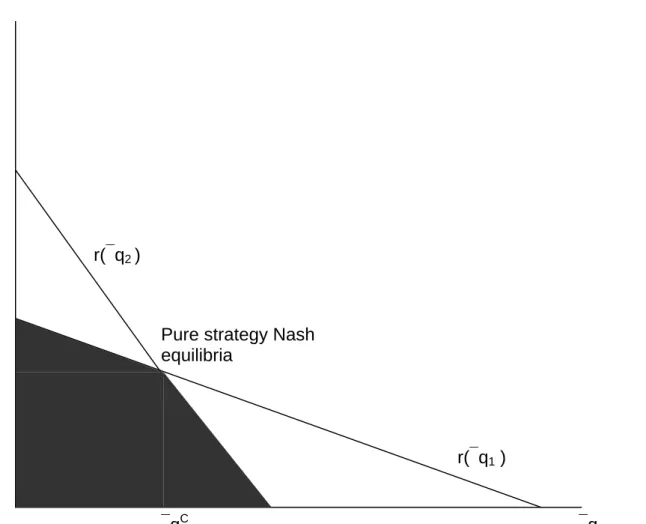
By symmetry, we haveqi =qj =qin any equilibrium. Therefore,q−i = (n−1)qi =
(n−1)q, so that (27) can be written as
q =r((n−1)q)∀i. (28)
Because the left-hand side begins at zero and is increasing in q while the right-hand side begins atr(0)>0 and decreases inq, there is a uniqueq such that this equality is satisfied. Denote by qC the value of q such that equality (28) holds.
Plugging this into (26) and solving yields qC = 1
2(n+1). Thus, QC = 12(n+1)n ,
so that ZC = 2−λ
2 − 2−2λ(nn+1), AC = 4−4λ − 2−4λ(n+1)n and BC = λ4 + 2−4λ(n+1)n .
Note that as n gets arbitrarily large, QC →−= 1
2 ≡ QW, ZC + → 0, AC →+ 1 2 and BC =→− 1 2, where ” −
→ (→+)” means ”approaches from below (above)”. Or put in words: As the number of competing intermediaries gets large, the outcome of Cournot competition converges to the Walrasian market outcome. Finally, note also that forn= 1,QC = 1
4,AC = 34−λ8 andBC = λ8+14, which is the equilibrium
analyzed by Gehrig (1993).
3.2
The Output Market Subgame
We first prove a Lemma that says that in equilibrium, the quantity traded by intermediaries cannot exceed the Walrasian quantity. This seems very intuitive. The proof, though, is not straightforward. The following Lemma is useful because it allows us to concentrate on aggregate quantity bought Qb ≤ 1
Lemma 4 There is no equilibrium in which aggregate quantity boughtQb exceeds
the Walrasian quantity QW = 1 2.
Proof: Consider a monopolistic intermediary. He would sell his quantity bought Qb at the ask price am, which is defined as the ask price for which the
(ask) price elasticity of output demand, ε(a, Qb), is minus one if his quantity
bought allows him to sell that much (i.e. if Qb is large enough). Otherwise, he
would set the market clearing price for Qb, which is above am. Setting ε(a, Qb)
in equation (15) equal to minus one and solving fora yields am = 1
2−
λ
8(1−Q
b), (29)
which is smaller than 1
2 for Qb < 1 and λ > 0. But in order to be able to sell
all that is demanded at am, Qb has to be larger than 1
2. As observed above, for
1−Qd < Qb, the relevant inverse demand function is A = 1−Qd because the
search market shuts down. The elasticity of A = 1−Qd is -1 at a = 1
2. Thus,
for Qb > 1
2, the monopolistic intermediary would set am = 12, and the search
market shuts down for Qb > 1
2. Therefore, the relevant inverse supply function
is B = Qb in this range. Because under efficient rationing aggregate quantity
bought is equal to the aggregate supply S(.) at the lowest bid price for which Qb(.) > 0, all firms must therefore pay a bid price greater than 1
2 in order to
buy Qb > 1
2.10 But the aggregate revenue of competing intermediaries whose
aggregate quantity bought exceeds 1
2 will not be larger than the revenue of a
monopolistic intermediary with such a large quantity bought. The monopoly’s revenue is 1
4(= 12 × 12), while the expenditure needed to acquire Qb is at least
Qb ×Qb > 1
4. Therefore Qb > 12 implies that the intermediation industry makes
negative profits. Because each intermediary has the outside option of making zero profits (e.g. by quoting b= 0), this cannot be an equilibrium. ¥
Now let us turn to the question what the equilibrium of the ask price setting subgame is, given Qb ≤ 1
2. But because Qd ≤ Qb, for Qb the relevant inverse
demand function, i.e. min[A(Qd, Qb),1−Qd] as defined in (11), is A(Qd, Qb).
We first show that ask prices ai < A(Q) (where A(Q) is as defined in (18)) will
not be set in equilibrium. The reason for this is that these prices are strictly
10This is true only under the condition that no intermediary sets a bid price greater than
the one at which aggregate capacity clears, but in equilibrium this condition is satisfied (see section 3.3).
dominated: At the price ai firm i sells qib, no matter what ask prices the other
firms set, whereas by setting a∗ = A(Q) intermediary i would earn a∗qb
i > aiqib
regardless of the prices the other firms set. Thus, ask prices ai < A(Q) can be
ruled out.
What we have not yet shown is whether higher prices than a∗ can occur in
equilibrium. That is, whether in equilibrium intermediated trade can be unbal-anced with Qd < Qb. We now show that this is not the case. To see that,
suppose that all firms other than i set a−i = A(Q) and consider what the best
response ofiis. As we have seen in the proof of Lemma 4, the ask price elasticity of output demand is smaller than minus one for Qb ≤ 1
2. Therefore increasing
the ask price by one percent will result in a decrease of quantity demanded by more than one percent. Therefore, increasing ai will not pay for i. Note that
this is the case regardless of whether a proportional or an efficient rationing rule applies.11 It is also quite intuitive to see that this equilibrium is unique.
Sup-pose that one firm j sets the ask price aj > a∗, where a∗ is clearing price, i.e.
a∗ = A(Q). Then, if Qd(a−
j ) ≷ q−bj, the remaining firms’ best response will be
to set a−j = A(q−j)
¡
a−j =a−j
¢
. In either case, aj is not optimal for j. In the
former case, j sells nothing, in the latter, he could discontinuously increase his profits by underbidding the competitors’ price a−j because he would sell (discon-tinuously) more while the loss due to the lower price is small. Thus, there is no other equilibrium (see also Vives, 1999, ch.5).
The fact that in the unique equilibrium of the output market subgame each intermediary sets the market clearing price a∗ is very useful for us because it
allows us to treat the output market subgame as a parameterized function that depends only on the (aggregate) quantity boughtQb.
3.3
The Input Market Subgame
We now turn to the analysis of the bid price setting (or input market) subgame. We show that there is a unique Nash equilibrium in the bid price setting subgame if all intermediaries have capacities no greater than the Cournot capacities. In this equilibrium all intermediariesi play the pure strategy bi =b∗ ≡B(Q).
11For a brief description and discussion of these rules see e.g. Vives (1999) or the appendix
3.3.1 Pure Strategy Equilibrium for Cournot capacities
Given the (observed) capacity constraints for all i = 1, .., n firms, on the input market each firm sets a bid price bi with the aim of maximizing his profits.
Recall that on the output market no firm will ever set a price below the one at which market clears (see Subsection 3.2). Very similarly, in the bid price setting subgame, no firm will ever want to set a bid priceb > B(Q). An obvious (and in fact the only)12 candidate for a pure strategy equilibrium is the market clearing
bid price b∗ = B(Q). To see whether b
i = B(Q) ≡ b∗ for all i is indeed an
equilibrium, suppose that all firms other than j set b−j = B(Q), and consider
whether (or when) deviation from b∗ pays for j. Bid prices above B(Q) being
strictly dominated, we only have to consider ”downward” deviation. As j sets bj < b∗, he faces a residual supply of max[S(bj) −q−j,0], which will be his
quantity bought qb
j. Note that for qbi > 0, aggregate quantity bought will just
be S(bj). This is convenient, because the ask price resulting from behavior on
the input market will affect the outcome on the output market. Since the unique equilibrium of the ask price setting game is to set ai = A(Qb), the equilibrium
price on the output market is a direct function ofbj. If we assume that all other
agents do not change their behavior, i.e stick to bi = b∗, it is a function only
of j’s bid price. If bj is such that qjb > 0, then A(Qb) = A(S(bj)), while for
qb
j =S(bj)−q−j = 0, A(Qb) = A(q−j). But the latter case will not matter much
to j, since with qb
j = 0, his profits are zero independently of A(.). Therefore,
assuming bj is such that qjb >0, j’s profits when deviating from b∗ are given by
the following equation:
πj(bj) = [A(S(bj))−bj]
¡
S(bj)−q−j
¢
. (30)
Maximizing with respect to bj yields
0 = [A0(S(bj))S0(bj)−1] ¡ S(bj)−q−j ¢ + (A(S(bj))−bj)S0(bj). (31) Dividing byS0(b j)6= 0 yields 0 = · A0(S(b j))− 1 S0(b j) ¸ ¡ S(bj)−q−j ¢ +A(S(bj))−bj. (32)
12Vives (1999, p.129) shows this for the case of capacity constrained price setting under a
Define byx(q−j) the optimal quantityj buys when all other firms setb∗ and have
capacitiesq−j. Obviously,x(q−j) = S(bj)−q−j as given in equation (32). Noting
that with x(q−j) thus defined, bj = B(x(q−j) +q−j), S0(bj) = B0(x(q1
−j)+q−j) and
making the appropriate substitutions, we can write (32) as 0 = £A0(x(q
−j) +q−j)−B0(x(q−j) +q−j)
¤
x(q−j)
+A(x(q−j) +q−j)−B(x(q−j) +q−j). (33)
As noted above, the spread, defined as Z(y) ≡ A(y)− B(y), is a decreasing, (weakly) concave function iny. Therefore we can rewrite the above equation to get
0 =Z0(x(q
−j) +q−j)x(q−j) +Z(x(q−j) +q−j), (34)
from where it becomes clear that x(q−j) is j’s Cournot best response function (with no production cost), i.e. x(q−j) ≡ r(q−j) because x(.) in (34) is defined
by exactly the same condition as r(q−j) in equation (24) above. That is, x(q−j)
is the best response function if both the input and the output market were or-ganized in Cournot-Walras manner. Put differently, if intermediaries brought binding pledges how much they are willing to buy (and subsequently to sell) to the Walrasian auctioneer and the auctioneer then set market clearing prices, intermediaries’ best responses were given by the function x(.) defined above. Therefore, from now on we writer(.) for the Cournot reaction function with zero production cost on the spreadZ(.).
Let us now come back and finally answer the question under what conditions it pays firmjto underbid if all other firms setb∗. Then, wheneverB(r(q
−j)+q−j)≥
b∗ =B(Q),j’s best response is to setb
j =b∗ since bid prices aboveb∗ are strictly
dominated: If firmj could, it would buyr(qj), but because this is more thanqj, it cannot buy that much. Therefore, it does not pay for j to set a price higher thanb∗. Clearly, we therefore have an equilibrium where all firms set b∗ if for all
firmsi, qi ≤r(q−i).13 The argument needed to establish uniqueness is analogous
to the one of the output market subgame. Bid prices above b∗ = B(Q) being
strictly dominated, the only alternative candidates for an equilibrium are bid prices smaller than b∗. However, whenever a firm i sets a bid price b
i < b∗, at
13This condition is exactly the same that has to hold in Kreps and Scheinkman (1983) for
least one other firm, say, j will optimally set a price above bi (but below b∗) so
that firm i’s profits would discontinuously increase by setting a slightly higher price thanj does. Thus, there is no other equilibrium.
Let qC ≡ qC denote the Cournot capacity as defined in (28). Then we can
neatly summarize our findings as follows:
Proposition 2 For capacities qi ≤qC for all i= 1, .., n, there is a unique Nash
equilibrium in the input market subgame, in which all intermediaries set the mar-ket clearing bid priceb∗ =B(Q).
Proof: The proof follows directly from the above analysis.¥
Equilibrium for the full game A question of great interest is of course whether setting Cournot capacities is an equilibrium (or more precisely, part of a subgame perfect equilibrium strategy profile) for the full game. In order to show this we must investigate whether firm i has an incentive to deviate from setting the capacity constraint qC if all −i set q
−i = qC. It is clear from the
results of Cournot competition that deviation to qi < qC will not pay. Why?
Recall from the two previous subsections that in this case, equilibrium prices both on the input and on the output market will be market clearing. Since this is the situation prevailing under Cournot competition, the deviationqi < qC will
not be profitable. Thus the only candidate deviation we have to consider entail qi > qC. In this case, the equilibrium in the bid price setting subgame involves
(non-degenerate) mixed strategies. However, as it turns out it is very hard to characterize the equilibrium revenue (and more so to characterize the equilibrium strategies) for a deviating firm, and thus far we have not been able to pin down this revenue (see also Appendix A).
4
Conclusions
In this paper, we have introduced capacity constrained competition between market-making and price setting intermediaries. Capacity constraints prevent competition between price setters to degenerate into Bertrand-style perfect com-petition. We have shown that intermediaries endowed with Cournot capacities (or with smaller than Cournot capacities) set market clearing bid and ask prices
on the input and output market. Therefore, given Cournot capacities, firms set the same prices and trade the same quantities on the subgame perfect equilibrium path of our game as would be set and traded if input and output market were organized by a Walrasian auctioneer. A corollary of this is that the equilibrium outcome of our model coincides with the Walrasian perfect competition outcome when the number of intermediaries with Cournot capacities becomes large.
The fact that the search market only shuts down completely if the number of intermediaries approaches infinity and if there is no cost associated with inter-mediating may seem somewhat odd. Assuming that these two conditions hold is certainly not less demanding than the the assumptions underlying the Walrasian model. However, this problem can be easily mended by introducing a fix cost to search market participation. Then, the search market shuts down for a quantity traded smaller than the Walrasian one, and firms can make positive profits (or at least set positive ask-bid spreads) in the absence of an active search market.
The paper can also be seen as an attempt to analyze competition between exchange mechanism that differ with respect to their efficiency. In a next step, we consider introducing a minimal size for the search market to be operational.
[To be completed]
Appendix
A
Region of Mixed Strategy Equilibria
We first show that for capacitiesqi > qC andq
−i =qC, there is no equilibrium in
pure strategies. The reason is as follows. Recall from subsection 3.3 that given b−i =b∗ =B(Q), intermediary i’s best response is to set bi =B(r(q−i) +q−i) <
B(Q). Note thatB(r(q−i)+q−i)> B(q−i) because forq−i = (n−1)qC,r(q
−i)>0
and denote the bid price B(r(q−i) +q−i) as b. Now, given that i sets b, setting b−i = b∗ is not a best response for the other firms since each of them can buy
the same quantity qb = qC by setting a lower price. Because b > B(q
−i), the
lowest bid price at which this is possible is b+ for b
i = b. But with b−i = b+,
i’s profits increase if he sets a bid price slightly larger than b+ since by doing
so he can buy a discontinuously larger quantity while the loss due to the higher price is negligible. Because this type of reasoning applies forany constellation of
bid prices, there is no equilibrium in pure strategies for capacities qi > qC and
q−i =qC.
This raises the question whether there is an equilibrium in mixed strategies. Since there are no equilibria in pure strategies and because strategies are contin-uous while firms’ payoffs are discontincontin-uous, it is not a priori clear that the game has an equilibrium.14 Speaking somewhat loosely, we may say that Dasgupta and
Maskin (1986) (DM hereafter) show that sufficient conditions for the existence of a mixed strategy equilibrium in discontinuous games are that
1. discontinuities arise only at particular strategy combinations (e.g. in the Bertrand model when both firms set the same price)
2. the sum of payoff functions is upper semi-continuous (which is the case e.g. in the Bertrand model, where in the absence of production costs aggregate profits are piD(pi) no matter what price firm j sets, provided only pj ≥pi)
3. individual payoff function are bounded and weakly lower semi-continuous (as defined by Dasgupta and Maskin (1986, p.7)
It can be shown that these conditions hold in the present model. However, since we wish to compute expected profits in the region with mixed strategy equilibria, it will not do to know that an equilibrium exists. Rather, we would have to determine the equilibrium strategies, or more precisely, the expected equilibrium revenues in this region (which is in principle possible without an explicit characterization of the equilibrium strategies).
A.1
Existence of an Equilibrium
In order to show that the game we consider has an equilibrium, we must show that the conditions of Theorem 5 of DM are satisfied.
14Nash (1950, 1951)’s proof guaranteed the existence of a (mixed strategy) equilibrium for
finite games, that is for games with a finite number of strategies for each player and finite number of players. Debreu (1952), Fan (1952) and Glicksberg (1952) then proved the existence of an equilibrium for a wider class of games, and some authors, notably the above-mentioned Levitan and Shubik (1972), proved the existence of an equilibrium for particular games. See Dasgupta and Maskin (1986) or Fudenberg and Tirole (1991) for more details. However, general and sufficient conditions for the existence of an equilibrium in discontinuous games had to await the seminal contribution by Dasgupta and Maskin (1986).