DESIGN, DEVELOPMENT AND TEACHING OF INNOVATIVE WEB-BASED
INTRODUCTORY “COMPUTER INFORMATION SYSTEMS” COURSE
Vladimir Uskov
1
1 Dr. Vladimir Uskov, Dept. of Computer Science and Inf. Systems, Bradley University, 1501 W. Bradley Avenue, Peoria, IL 61625 [email protected] Abstract The state-of-the-art InterLabs Web-lecturing
tool has been designed, developed, and tested at the Department of Computer Science and Information Systems and the InterLabs Research Institute, Bradley University, Peoria, Illinois as a part of the National Science Foundation grant # 0196015 (2000-2003) [1,2]. It is based on active utilization of innovative Web-based software engineering, portal, multiagent, streaming multimedia, communication, teaching, learning and information technologies. The introductory “Computer Information Systems” CIS102 course is a required course for all freshman students with major in either Engineering, Business, Science or Education areas. As a result, the innovative Web-based CIS102 course was aimed to 1) provide students of various major areas with highest-possible learning convenience, and 2) meet different requirements for CIS102 course of various Bradley departments. The new CIS102 online course was designed and developed by faculty of the Computer Science and Information Systems department in cooperation with faculty from other Bradley colleges. Student formative and summative evaluations and academic performance clearly demonstrate the advantages of the innovative online teaching and learning technologies based on the InterLabs Web-lecturing tool.
Index Terms Web-based education (WBE), introductory Computer Information Systems online course, student evaluation, student academic performance.
I
NTRODUCTIONThe Internet is changing the very nature of society in ways unparalleled since the industrial revolution. It is affecting local, national and global economies and their infrastructures. Information and learning materials are available at any time from any place to any Internet user. This is creating tremendous opportunities for universities to provide virtual learning environments that are accessible to all. The same time, same place, only some people teacher-centered classroom-based traditional educational environment is giving way to anytime, anyplace and anybody learning models based on the Internet, World Wide Web (WWW) and state-of-the-art information, networking, teaching, learning and communication technologies [3] – [7].
Current authoring tools for WBE were philosophically designed for the learning-by-reading model of education. As a result, existing text -based static online courses are built as large, monolithic structures that are 1) nonflexible for continual updates, 2) difficult to repurpose into searchable self-paced learning objects and learning activities, 3) non-reusable or hard-to-reuse, and 4) fixed in length, sequence and scope.
As a result , the vast majority of existing online courses , usually, do not address the full power of 1) revolutionary
learner-centered paradigm of education, 2) self-controlled and self-paced learning processes, 3) learning-by-doing
model of education, 4) personalized, 5) customized, and 6) collaborative types of learning. They also do not use entirely powerful features of innovative Web-based collaboration and communication technologies, such as audio - and video-conferencing, chat rooms, white board, discussion groups, etc.
Bradley University is a registered corporate user of the BlackBoard tool [8] for online education. It serves more than 150 Bradley academic courses. However, the content of BlackBoard-based online courses is available only in
online mode. It is not always convenient for students because in accordance with results of student surveys they would like to have an opportunity to learn the same course or its parts in offline mode as well (for example, using CD ROMS with the same course content).
All these reasons motivated the author to design, develop and teach conceptually new CIS102 online course that would eliminate the above-mentioned weaknesses of current online learning.
Our approach is based on active utilization of
1) innovative Web-lecturing tool of a new generation that uses streaming multimedia and various communication technologies and is available in both online and offline
modes, and
2) principle of modularity of learning content’s design and development that leads to great flexibility in composition of different customized versions of the CIS102 online course for students of various major areas; this approach is based on active utilization of the so-called reusable learning objects concept.
We wanted the innovative CIS102 online course to meet major requirements of the learner-centered paradigm of education [4, 6] that leads to the highest-possible student convenience of learning and maximum effectiveness and efficiency of online learning.
CIS102 C
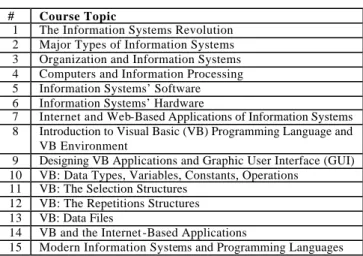
OURSEThe introductory Computer Information Systems CIS102 course at Bradley University is a required course for all freshman students with major in either Engineering, Business, Communication, Sciences or Education areas. This Bradley academic course is offered every semester (Fall and Spring), and every 3-week Interim Session (January and May). A list of main CIS102 course topics is given in Table I.
TABLE I
MAIN TOPICS OF THE CIS102 COURSE
# Course Topic
1 The Information Systems Revolution 2 Major Types of Information Systems 3 Organization and Information Systems 4 Computers and Information Processing 5 Information Systems’ Software 6 Information Systems’ Hardware
7 Internet and Web-Based Applications of Information Systems 8 Introduction to Visual Basic (VB) Programming Language and
VB Environment
9 Designing VB Applications and Graphic User Interface (GUI) 10 VB: Data Types, Variables, Constants, Operations
11 VB: The Selection Structures 12 VB: The Repetitions Structures 13 VB: Data Files
14 VB and the Internet -Based Applications
15 Modern Information Systems and Programming Languages
The components of a new online CIS102 course are given in Table II.
TABLE II
COMPONENTS OF THE CIS102 COURSE
N Type of Course Component
1 15 classes (lectures) ; each class contains 3-5 lessons (modules) 2 15 review exercises (one per each class) with 10-20 relevant
problems/questions in each exercise 3 8-10 homework assignments
4 3-5 quizzes with 20-30 problems of various types (such as True/False, Multiple Choice, Matching and Essay) in each quiz 5 2 course projects (for 2 main part s of the course, specifically
Information Systems and Programming Language) 6 Full list of possible questions for each quiz and final exam 7 Examples of problems and solutions for projects and exams
Each class of the CIS102 online course is based on active utilization of the innovative InterLabs Web-Lecturing tool that provides students with innovative learning technology based on streaming video/audio and synchronized PowerPoint presentations that may include text, figures, pictures, tables, animation, applications, lecture notes, etc.
I
NTERL
ABSW
EB-L
ECTURINGT
OOLThe InterLabs Web-lecturing tool was designed and developed by the author and his students at Bradley
University as a part of the National Science Foundation’s grant # 0196015. Currently, the InterLabs tool (Figure 1) contains most of the usual features and functions of authoring tools of the 3rd generation [9, 10].
FIGURE 1.
INTERFACE OF THE INTERLABS WEB-LECTURING TOOL.
However, the InterLabs tool also offers additional, attractive functions for students and faculty, for example:
1) multiple "student-to-student' and "student-to-teacher" communication functions such as "call an audio-conferencing", "call a data-audio-conferencing", "share an application", "send an email to instructor”, “send email to classmates”, “join a discussion group", "join news group" (see left low part of Figure 2);
FIGURE 2.
2) control functions to download entire course and/or course modules from the InterLabs Web and Video Servers;
3) deliver and watch online course content using one of several available options (Figure 3) such as a) online PowerPoint (PPT) presentation only, b) online PPT presentations and streaming audio only (for 28K and 56K modems), c) online PPT presentations and streaming video/audio (for 56K modem), and d) online PPT presentations and streaming video/audio (for DSL/cable modems or direct connection to the Internet).
FIGURE 3.
MODES OF CONTENT DELIVERY OF THE INTERLABS TOOL.
Another distinctive feature of the InterLabs tool is that it may be used in several possible modes [9], specifically: 1) in combined mode; in this case it works in combination
with the well-known BlackBoard authoring tool of the 2nd generation, and, therefore, creates the powerful multifunctional authoring tool of the 3rd generation (Figure 4);
2) in online (synchronous) mode (via 28K, 56K, DSL and cable modems); in this case it uses the Microsoft Windows Media Player Active X control, Microsoft PowerPoint Player, Java Script, frames, Microsoft NetMeeting, and other tools; it automatically creates versions of online courses for users with 28K, 56K, DSL (128K), and cable (more than 200K) modems; 3) in offline (asynchronous) mode when learning content
is placed on CD ROMs; in this case it uses the Microsoft Windows Media Player Active X control, and other tools ; it good to mention here that the learning content of the entire CIS102 online course requires only 3 standard 640MB CD ROMS.
We wanted students to be “surrounded” by various available resources of the CIS102 course content that can be used in both online and offline modes. As a result, during
2001-2002 academic year there were no “usual” student complains such as “I had no access to the Internet, and, therefore, I could not learn this class”, “the BlackBoard server did not work, and, therefore, I could not learn this class”, “I have 56K modem not DSL or cable modem ”, etc.
FIGURE 4.
INTERFACE OF THE UNITED INTERLABS-BLACKBOARD AUTHORING TOOL.
H
IERARCHY ANDM
ODULARITYOF
CIS102 L
EARNINGC
ONTENTHigh efficiency of modern online courseware is based on principles of hierarchy and modularity of learning content. Both principles were used to create a solid foundation for a conceptual model of the CIS102 online course.
Modularity of Learning Content. Modularity
(granularity) is the foundation for efficient and effective design and development of modern reusable online courseware. Using this principle, designers of online courses and entire online degree or certificate training programs are able easy and quickly to assemble various appropriate curricula from online courses using various models of online learning sequences and learning activities. Online lessons can be constructed from online libraries of standardized reusable learning objects, reusable learning atoms , and reusable information atoms such as texts, pictures, images, figures, graphics, tables, essays, video clips, sound recordings, animations, software applications, etc.
We use the following simple definitions of online course and online lesson. An online course is a sequence of learning experiences enabled by a course designer/instructor and pursued by learners. An online course consists of classes, and each class consists of lessons. Each class and /or lesson is a collection of learning objects and learning activities aimed to accomplish one or several of the sub-goals of the online course.
pretest posttest
RIA RLAs
RIA RIA RIA
FIGURE 5.
A STRUCTURE OF A REUSABLE LEARNING OBJECT FOR THE CIS102 ONLINE COURSE
Content’s Hierarchy. Based on above-mentioned definitions, we use the following hierarchical structure of the CIS102 learning content:
- Curriculum (Degree Program or Training Program), - Courses (for example, CIS102 online course),
- Classes,
- Lessons or Reusable Learning Objects, - Reusable Learning Atoms (RLAs), - Reusable Information Atoms (RIAs).
We also use the following hierarchy of learning process:
- Learning Sequences (LSs), - Learning Activities (LAs),
- Learning Actions.
R
EUSABLE LEARNINGO
BJECTS ANDA
TOMS INCIS102 C
OURSEWe used the following working definition of reusable learning object (RLO) during design and development of the CIS102 online course: RLO is any digital resource that can be reused to support Web-based learning [11, 12]. This definition includes anything that can be delivered across the network on demand, be it large or small. Examples of RLOs may include live or prerecorded video or audio, pieces of text, animations, graphics, web-based applications, web pages, and other pieces that are aimed to deliver complete experiences, such as a lesson [11-13].
The proposed and used RLO’s structure (Figure 5) is based on the idea that RLO is a collection of reusable learning atoms that are grouped together to teach a common task based on a single learning objective [14]. In order to convert the collection of RLAs into a complete learning experience - a lesson or RLO, four other reusable information atoms , specifically, 1) Welcome RIA, 2) Overview or Introduction RIA, 3) Summary RIA, and 4) Assessment RIA , are added to a set of RLAs.
A Reusable Learning Atom is an elementary non-dividable piece of learning that is built upon a single learning objective. Each RLA can be classified as either being a concept, fact, process, or procedure. Each RLA combines three content items, specifically: 1) content items (pieces of learning), 2) practice items (learning activities), and 3) assessment items (tests, quizzes, exams). Table III
contains several types of RLAs that are used in the CIS102 online course.
TABLE III.
TYPES OF RLAS IN CIS102 ONLINE COURSE
Type of RLA Description/Function of RLA
Web-Based Knowledge Resources
Provide pointers and hyperlinks to information on the Internet the student may need before, during and/or after taking a class or a lesson.
Featured Example, Fact, Concept or Statement
Presents a Web-based description of a single example or case study along with commentary about it (a statement, an event, a phenomenon, a table, a picture, an image, a concept, a principle, etc.).
Code Sample Demonstrates a self-contained self-executable hyperlinked fragment of a programming or scripting language that can be executed via the Internet (for example, using a sharing application).
Playback Lets learners review a previously recorded live event in online mode (for example, video lecture using streaming video and audio technologies, chat session, bulletin board, etc.).
Procedure Provides clear instructions on how to do or execute a given fragment, task, code, etc.
Feedback Invites learners to evaluate the effectiveness of the online lesson and to suggest improvements using online evaluation tools.
A Reusable Information Atom is an elementary non-dividable piece of information that is built upon single information objective. The Welcome RIA contains only one content item – Greetings. The Overview/Introduction RIA may contain up to seven different content items, such as: 1) Overview, 2) Introduction, 3) Importance, 4) Objectives, 5) Prerequisites, 6) Scenario, and 7) Outline.
Table IV contains several types of RIAs that are used in the CIS102 online course.
The Summary RIA may contain several content items such as 1) Review, 2) Next Steps, and 3) References/Links/ Additional Knowledge Resources.
The Assessment RIA serves two functions, specifically: 1) pretest: tests learners initial knowledge, determines
gaps in knowledge and skills prior taking the “lesson”, and indicates which RLAs fill those gaps;
2) posttest: ensures the learner has achieved mastery on all objectives for a given “lesson”; determines gaps in
Welcome Overview/
Introduction
…
SummaryAssessment
knowledge and skills after taking the “lesson” and indicates which RLAs learners should review.
TABLE IV.
TYPES OF RIA’S IN CIS102 ONLINE COURSE
Type of RIA Description/Function of RIA
Welcome Greets the learner, tells what the online lesson is about, and makes clear why the learner should take it. Overview Provides hyperlinked general information abo ut
RLO’s goal, objectives, list of topics, learning procedures/functions/methods to be used, Web-based knowledge resources, and anticipated outcomes. Introduction Establishes the subject and characteristics of the
online lesson and prepares the learner to begin the Web-based learning activities.
Summary or Conclusion
Recaps the important ideas of the entire online lesson.
Assessment A collection of online assessment items. Each assessment item is a question or measurable Web-based activity used to determine if the learner has mastered the learning objective for a given RLO.
Different types of assessment items should be supported by the online assessment engine – generator of online assessment RIA s with various types of questions, for example 1) “True and False” questions, 2) “Multiple Choice” questions, 3) “Matching” questions, 4) “Drag and Drop” questions, 5) “Hot Spot” questions, 6) “Fill-In the Blank” questions, and 7) “Essay” questions.
A rational for a utilization of this or that type of assessment items is dictated by 1) RLO’s objective, and 2) what the learner is required to remember or to do in order to demonstrate mastery of a given RLO. In other words, first of all, it is necessary to identify an appropriate cognitive level that identifies how learner will remember or use the skills and knowledge he/she is acquiring by taking a given RLO. A particular method of classifying cognitive levels may be based, for example, on either
1. Dr. Merrill’s taxonomy [15], including 1) Remember
and 2) Use, or
2. Dr. Bloom’s taxonomy [16], including 1) Knowledge, 2) Comprehension, 3) Application, 4) Analysis, 5)
Synthesis, and 6) Evaluation.
S
TUDENTE
VALUATIONS OFCIS102 O
NLINEC
OURSEIn 2000-2002, various formative and summative evaluations have been conducted to assure the quality of the proposed conceptual models of the InterLabs Web-Lecturing tool, the CIS102 online course and its design solutions, quality of the CIS102 learning content, student deliverables (homework, projects, and exams ) and student academic performance.
Different types of evaluators such as 1) students, 2) instructors, 3) focus groups, and 4) independent external evaluators, used qualitative and quantitative measure ments including a) questionnaires, b) interviews, and c)
observations. For example, Bradley students have been asked to provide CIS102 instructors with formative precourse and postcourse evaluations of student skills and experience on online learning.
Precourse Evaluation of Students’ Skills. CIS102 students were asked to identify their initial level of knowledge of online learning environment before taking CIS102 online course. A five-point Likert scale (1 = “Strongly Disagree”, 2 = “Disagree”, 3 = “Neutral”, 4 = “Agree”, and 5 = “Strongly Agree”) was used for that questionnaire. Table V presents a summary of initial skills of CIS102 online students.
TABLE V.
CIS102 PRECOURSE EVALUATION OF STUDENTS’ INITIAL SKILLS IN ONLINE LEARNING
Precourse Student Skill 1 2 3 4 5
I have experience in taking online courses
31% 38% 17% 14% 0%
I feel comfortable to use a computer
0% 0% 5% 32% 63%
I feel comfortable to use CD ROM(s)
0% 0% 7% 22% 71%
I feel comfortable to use email
0% 0% 0% 31% 69%
I feel comfortable to use the Internet and visit various web sites on the Internet
0% 5% 16% 54% 25%
I feel comfortable to download educational materials from the Internet
8% 24% 37% 26% 5%
I feel comfortable to use bulletin board to post messages
19% 42% 16% 23% 0%
I feel comfortable to use electronic chat room and discussion groups
3% 16% 51% 27% 3%
I feel comfortable to use desktop videoconferencing
48% 32% 14% 3% 3%
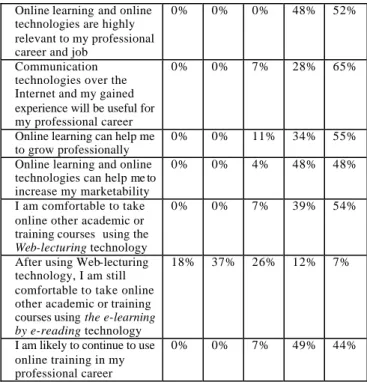
Postcourse Evaluation of Student’s Skills and Experience. At the end of the CIS102 online course students were asked on 1) their postcourse skills and experience in online learning and 2) whether or not they will use their skills and experience in other classes and further professional career. Again, a five-point Likert scale (1 = “Strongly Disagree”, 5 = “Strongly Agree”) was used for that questionnaire. Table VI presents a summary of postcourse skills and experience of CIS102 online students.
TABLE VI.
CIS102 POSTCOURSE EVALUATION OF STUDENTS’ FINAL SKILLS IN ONLINE LEARNING
Postcourse Student Skill 1 2 3 4 5
I believe online learning can help me to improve my skills
0% 0% 31% 32% 37%
Online teaching produces at least the same quality of my knowledge and skills as traditional education
Online learning and online technologies are highly relevant to my professional career and job
0% 0% 0% 48% 52%
Communication technologies over the Internet and my gained experience will be useful for my professional career
0% 0% 7% 28% 65%
Online learning can help me to grow professionally
0% 0% 11% 34% 55%
Online learning and online technologies can help me to increase my marketability
0% 0% 4% 48% 48%
I am comfortable to take online other academic or training courses using the
Web-lecturing technology
0% 0% 7% 39% 54%
After using Web-lecturing technology, I am still comfortable to take online other academic or training courses using the e-learning by e-reading technology
18% 37% 26% 12% 7%
I am likely to continue to use online training in my professional career
0% 0% 7% 49% 44%
CIS102 Students’ Academic Performance. A summary of CIS102 student academic performance during Junuary-2002 Interim Session is presented in Table VII. It proves one more time the so-called “No significant Difference” phenomenon of distance (including, Web-based) education [17] versus academic performance of “traditional” face-to-face classroom-based mode of education.
TABLE VII.
ACADEMIC PERFORMANCE OF CIS102 ONLINE STUDENTS
(2002 JANUARY 3-WEEK INTERIM SESSION)
Final Grade Percentage A 47 %
B 35 % C 12 % D 6 %
F 0 %
Additionally, after taking the innovative CIS102 online course, 79% of non-computer science students and 93 % of computer science/information systems majors prefer to use the innovative InterLabs Web-lecturing tool with various streaming multimedia (video, audio, graphics, etc.) technologies rather than old-fashioned text -based e-learning by e-reading authoring tools for their online learning.
A
CKNOWLEDGEMENTSThe author would like to thank the Course, Curriculum and Lab Improvement (CCLI) Program of the Division of Undergraduate Education at the National Science
Foundation that awarded the author with the NSF grant # 0196015 to perform research on innovative Web-lecturing technology and design and development of the innovative online courseware.
The author also would like to thank Dr. Claire Etaugh, Dean, College of Liberal Arts and Sciences, and Dr. Jim Miller, Chair, Department of Computer Science and Information Systems, Bradley University, for their constant strong support of author’s research activities in the Web-Based Education area.
R
EFERENCES[1] Uskov, Vladimir and Uskov, Alexander. “National Science Foundation Project on Web-Based Undergraduate Education in Information Engineering Technology”, Proceedings of the IASTED International Conference on Computers and Advanced Technology in Education CATE/WBE-2002, Cancun, Mexico, May 20-22, 2002. [2] National Science Foundation grant # 0196015 at http://www.nsf.gov [3] McCormack, Colin and Jones, David, Web-Based EducationSystems,
Wiley Computer Publishing, 1998.
[4] Horton, William, Designing Web-Based Training, Wiley Computer Publishing, 2000.
[5] Aggarwal, Anil (ed), Web-Based Learning and Teaching Technologies: Opportunities and Challenges, Idea Group Publishing, 2000.
[6] Rosenberg, Marc J., E-Learning, McGraw-Hill, 2001.
[7] Ellis, Alan L., Wagner, Ellen D., Longmire, Warren R., Managing Web-Based Training, ASTD Press, 1999.
[8] BlackBoard tool at http://www.blackboard.com and http://blackboard.bradley.edu
[9] Uskov, Vladimir L. “Development of Web-Based Instructional Tool and Online Educational Materials of the Third Generation”,
Proceedings of the World Conference on the Internet and WWW WebNet-2001, Orlando, Florida, October 21-24, 2001.
[10] Brusilovsky, Peter B., “Web Lectures: Electronic Presentations in Web-Based Instructio n”, Syllabus, N 1, 2000, pp. 18-23. [11] Wiley, D. A., South, J. B., Bassett, J., Nelson, L. M., Seawright, L.
L., Peterson, T., Monson, D. W. , “Three common properties of efficient online instructional support systems”, The ALN Magazine, 3(2), 1999, or at
http://www.aln.org/alnweb/magazine/Vol3_issue2/wiley.htm [12] Wiley, D. A. , “Connecting learning objects to instructional design
theory: A definition, a metaphor, and a taxonomy”, in Wiley, D.A. (Ed.), The instructional use of learning objects. Bloomingt on, IN: Association for Educational Communications and Technology, 2000. [13] Longmire, W. “A Primer on Learning Objects”, available at
http://www.learningcircuits.org/mar2000/primier.htm [14] Reusable Learning Object Strategy, http://www.cisco.com [15] Merrill, M. D., “Instructional transaction theory (ITT): Instructional
design based on knowledge object”,inC. M. Reigeluth (Ed.),
Instructional design theories and models: A new paradigm of instructional theory, Hillsdale, NJ: Lawrence Erlbaum Associates, 1999, pp. 397-424.
[16] Bloom, B. S., Taxonomy of educational objectives, handbook 1: Cognitive domain . New York: Longmans Green, 1956. [17] Russell, Tom “No Great Difference” Phenomenon of Distance