TWO ESSAYS ON INCENTIVES
A Dissertation by
BROOKE W. STANLEY
Submitted to the Office of Graduate Studies of Texas A&M University
in partial fulfillment of the requirements for the degree of DOCTOR OF PHILOSOPHY
May 2008
TWO ESSAYS ON INCENTIVES
A Dissertation by
BROOKE W. STANLEY
Submitted to the Office of Graduate Studies of Texas A&M University
in partial fulfillment of the requirements for the degree of DOCTOR OF PHILOSOPHY
Approved by:
Chair of Committee, Shane A. Johnson Committee Members, Anwer Ahmed
David W. Blackwell Michael Gallmeyer Head of Department, Ekkehart Boehmer
May 2008
ABSTRACT
Two Essays on Incentives. (May 2008)
Brooke W. Stanley, B.A., Kenyon College; M.B.A., University of Cincinnati Chair of Advisory Committee: Dr. Shane A. Johnson
I examine two sets of incentives faced by corporate CEOs to determine how they respond to those incentives. I compare firms that restate financial statements to firms that do not restate to test the hypotheses that bank monitoring should provide incentives to deter misreporting. For relatively less (more) severe misreporting, I find the
likelihood of misreporting is positively related (unrelated) to bank borrowing, and that ex ante changes in bank debt are positive (unrelated) for misreporting firms versus control firms. These results suggest that bank monitoring is insufficient to deter or detect misreporting, rather that it may provide incentives for managers to engage in relatively less severe misreporting, consistent with the “debt covenant hypothesis”.
I next examine the incentives that CEOs have to increase firm value that result from their compensation packages and opportunities for advancement in the managerial labor market. Traditional methods for estimating pay-performance sensitivity exclude incentives that derive from opportunities for advancement in the managerial labor market and assume a linear relation between changes in pay and changes in
performance. But results in recent literature imply that advancement opportunities may be a significant source of incentives and that the relation between changes in pay and
changes in performance may depend upon the level of performance. I estimate pay-performance sensitivities that incorporate these results. I find that although pay-performance may be positively related to opportunities for advancement, the contribution to a CEO’s total pay-performance sensitivity is too small to be economically significant. I also find that pay-performance sensitivities vary depending on the level of performance and may be higher or lower than estimates from linear models suggest. In sum, observed CEO pay packages may not be as suboptimal as some prior studies suggest.
DEDICATION
ACKNOWLEDGEMENTS
This work would not be possible without the guidance, advice and support of the faculty and staff of Louisiana State University and Texas A&M University, especially Drs. Anwer Ahmed, David Blackwell, L. Paige Fields, Michael Gallmeyer, Harley Ryan and Myron Slovin. I thank the Rutherford and Waig families for opening their homes and hearts to me. I am most grateful to Shane A. Johnson, for a full decade of service as my advisor and mentor. I will be forever in his debt.
NOMENCLATURE
AGE OF FIRM The first year the firm is publicly traded (from CRSP) subtracted from the current year.
ALTMAN’S Z
SCORE Altman’s (1968) proxy for financial distress risk.
BOARD MEETINGS The number of board meetings held during the fiscal year (Execucomp variable Board meetings).
CEO TENURE The current year less Execucomp variable BECAMECEO. FIXED ASSET RATIO Net property, plant and equipment (Compustat data #8)
divided by total assets (Compustat data #6) (averaged over the five preceding years).
LEVERAGE Is the residual from regressing long-term debt divided by total assets on age, total assets, market-to-book ratio, and fixed asset ratio (averaged over the five preceding years). MARKET-TO-BOOK The ratio of (book value of assets minus book value of
equity plus market value of equity) to book value of assets; Compustat data items [#6 - #216 + (#199 * #25)] / #6 (averaged over the five preceding years).
MERGER An indicator variable that takes the value of one in the event of an acquisition (if Compustat data #249 > 0) and zero otherwise.
OPTION RATIO ONEPCToptions / (ONEPCTstock + ONEPCToptions + salary +
bonus), where ONCEPCToptions is the dollar change in the
value of CEO options holdings coming from a one percent increase in firm’s stock price, as defined in Bergstresser and Philippon (2006), with option values calculated using the Core and Guay (2002) one-year approximation
method.
SALES GROWTH The percent change in sales (Compustat data #12) versus the prior year, measured as of the year preceding the alleged incident for misreporting firms.
STOCK RATIO ONEPCTstock / (ONEPCTstock + ONEPCToptions + salary +
bonus), where ONCEPCTstock is the dollar change in the
value of CEO stock holdings coming from a one percent increase in firm’s stock price, as defined in Bergstresser and Philippon (2006), with option values calculated using the Core and Guay (2002) one-year approximation method.
TOTAL ASSETS The firm’s total assets (Compustat data #6), measured as of the year preceding the alleged incident for misreporting firms.
UNRATED Indicator variable that takes a value of one if the firm has no existing bond rating, zero otherwise.
VOLATILITY The standard deviation of returns over the previous sixty months, the variable BS_Volatility in Execucomp. If this variable is missing, I compute it using returns data from CRSP.
3-yr OIBD/TA The three-year change in operating income before depreciation (Compustat data #13) divided by total assets (Compustat data #6), less the industry median of this ratio
TABLE OF CONTENTS Page ABSTRACT ... iii DEDICATION ... v ACKNOWLEDGEMENTS ... vi NOMENCLATURE ... vii TABLE OF CONTENTS ... ix LIST OF TABLES ... xi 1. INTRODUCTION ... 1
2. AN EMPIRICAL ANALYSIS OF THE RELATIONS BETWEEN FINANCIAL STATEMENT MISREPORTING AND FIRM’S USE OF BANK DEBT…… 3
2.1 Introduction ... 3
2.2 Data and methodology ... 10
2.3 Univariate results ... 18
2.4 Relations between bank debt and the likelihood of misreporting ... 19
2.5 Alternative interpretation ... 23
2.6 Relations between misreporting and changes in bank debt ... 26
2.7 Robustness tests ... 28
2.7.1 Alternative measure of bank debt ... 28
2.7.2 Alternative measure of misreporting ... 29
2.8 Conclusion ... 31
3. CEO PAY: PERFORMANCE INCENTIVES OR TOURNAMENT PRIZE ? . 34 3.1 Introduction ... 34
3.2 Data and methods ... 38
3.2.1 Measuring pay performance sensitivity from changes in own- firm compensation ... 38
3.2.2 Measuring pay performance sensitivity deriving from threat of dismissal ... 41
Page 3.2.3 Measuring pay performance sensitivity deriving from
opportunities for advancement in the CEO labor market ... 42
3.3 Results using traditional methods ... 44
3.3.1 Estimating pay-performance sensitivity deriving from changes in own-firm compensation ... 44
3.3.2 Estimating pay-performance sensitivity deriving from threat of dismissal ... 46
3.3.3 Estimating pay-performance sensitivity deriving from opportunities in the managerial labor market ... 48
3.4 Results using nonlinear methods ... 51
3.4.1 Estimating pay-performance sensitivity deriving from changes in own-firm compensation allowing for nonlinear relations ... 51
3.4.2 Estimating pay-performance sensitivity deriving from threat of dismissal and allowing for nonlinear relations ... 57
3.4.3 Estimating pay-performance sensitivity deriving from opportunities for advancement in the managerial labor market and allowing for nonlinear relations ... 60
3.5 CEOs’ total incentives ... 64
3.6 Conclusion ... 65
4. CONCLUSION ... 68
REFERENCES ... 72
APPENDIX ... 77
LIST OF TABLES
TABLE Page 1 Descriptive Statistics and Difference in Means Tests for Control
and Test Variables ... 77 2 Results of Logit Regressions Comparing GAO Sample to Control
Firms ... 79 3 Results of Multinomial Logit Regressions Comparing GAO Sample,
Distinguishing between Malfesance and other Restatements to
Control Firms. ... 80 4 Results of Logit Regressions Comparing AAER Sample to
Control Firms ... . 81 5 Results of Logit Regressions Comparing GAO Sample, Detected
Versus not Detected Misreporting ... . 82 6 Results of Tobit Regressions Comparing Changes in Level of Bank Debt
for Two Years before Misreporting ... 83 7 Results of Tobit Regressions Comparing Changes in Level of Bank Debt
for Two Years after Misreporting ... 84 8 Robustness - Results of Conditional Logit Regressions Comparing GAO
Sample to Control Firms Using Hand-Collected Bank Debt Data ... 85 9 Robustness - Results of OLS Regressions Examining Relations between
Accruals and Bank Borrowing ... 86 10 Summary Statistics ... 87 11 Estimates of Pay-Performance Sensitivity: Coefficients of Ordinary
Least Squares Regressions of Changes in Compensation on Current and Lagged Changes in Shareholder Wealth ... 88 12 Relation between CEO Turnover and Firm Performance: Estimated
Logistic Models Predicting CEO Turnover Using Current and Lagged
TABLE Page 13 Relation between Advancement in Managerial Labor Market and
Firm Performance: Estimated Logit Models Predicting CEO
Promotions Using Buy-and-Hold Stock Returns and Pay-Performance
Sensitivity from CEO Promotions ... .. 90 14 Coefficients of Piecewise Regressions of Changes in Compensation on
Current and Lagged Changes in Shareholder Wealth; Quintiles by
Current Performance ... 91 15 Estimates of Pay-Performance Sensitivity Based on Coefficients of
Piecewise Regressions of Changes in Compensation on Current and Lagged Changes in Shareholder Wealth; Quintiles by Current
Performance ... 92 16 Relation between CEO Turnover and Firm Performance: Estimated
Log-Log Models Predicting CEO Turnover Using Current and Lagged
Net-of-Market Shareholder Return. ... 93 17 Relation between CEO Turnover and Firm Performance: Predicted
Probabilities and Pay-Performance Sensitivities of Estimated Log-Log Models Predicting CEO Turnover Using Current and Lagged
Net-of-Market Shareholder Return ... 94 18 Relation between Advancement in Managerial Labor Market and
Firm Performance: Estimated Complementary Log-Log Models
Predicting CEO Promotions Using Buy-and-Hold Stock Returns ... 95 19 Relation between CEO Jumps and Firm Performance: Predicted
Probabilities and Pay-Performance Sensitivities by Quintile Based on
Complementary Log-log Results ... 96 20 Total Pay-Performance Sensitivities, Including all Three Sources of
Incentives, Based on Estimates from Linear Versus Nonlinear Models .... 97 21 Information on Future Employment of Departing CEOs ... 98
1. INTRODUCTION
At the heart of finance and economics are questions regarding how people respond to incentives. Questions of this nature are prevalent throughout the literature on agency problems (Jensen and Meckling (1976)), banking (Diamond (1991a)), capital structure (Myers (1977)), and even microstructure (Christie and Schulz (1993)), to name just a few. The purpose of this paper is to consider two sets of incentives that firm managers face, and examine how they respond to those incentives.
The second section considers the incentives to accurately report financial performance that derive from a firm’s use of bank debt in its capital structure. Because banks monitor their borrowers, the use of bank debt should increase the probability that financial statement misreporting is detected, which should therefore decrease the probability that managers choose to misreport. I find instead that managers are
sometimes more likely to misreport if their firms use bank debt financing, because bank loan agreements require firms to uphold certain covenants that are written on financial statement numbers. These covenants provide incentives to misreport if managers cannot uphold them legitimately. Further, if misreporting can give the appearance of financial health, then it can help the firm to reduce its borrowing costs. I find two key sets of results because the costs of misreporting, once it is detected and exposed, depend upon its severity. My results suggest that the benefits of misreporting can exceed the expected costs but only when those expected costs are small, as they are for relatively less severe types of misreporting. I find the likelihood of misreporting is positively related to the use ____________
of bank debt, and that ex ante changes in bank debt are positive for misreporting firms relative to control firms when misreporting is relatively less severe. For relatively more severe misreporting, such as accounting malfeasance that triggers an SEC investigation or filing of an AAER, I find no relation between the use of bank debt and the likelihood of misreporting. The most important result is that I do not find any negative relations between the use of bank debt and the likelihood of misreporting, inconsistent with the extant literature on the value of banks as delegated monitors.
The third section addresses the questions of whether the market for managerial talent provides incentives for CEOs to improve firm performance, and whether these and other incentives are the same for all CEOs. That is, a manager whose performance is very good may face a different set of incentives than one whose performance is poor. I find that although boards of directors may consider past performance when hiring an outside CEO, the magnitude of this incentive is relatively small when compared to the other incentives that CEOs face. Further, I find that the incentives deriving from changes in own-firm pay and the threat of dismissal for poor performance are non-linear across the performance range. In short, a manager whose performance is good faces a different set of incentives than one whose performance is poor.
In sum, these results contribute to the literature by demonstrating that although managers respond rationally to the incentives that they face, those incentives are many and their effects sometimes ambiguous. Shareholders, and the boards of directors that they have elected to serve their interests, must consider all of the incentives that CEOs face when designing executive compensation packages to align the interests of the CEO with their own.
2. AN EMPIRICAL ANALYSIS OF THE RELATIONS BETWEEN FINANCIAL
STATEMENT MISREPORTING AND FIRMS’ USE OF BANK DEBT
“You know, in a collapse of this magnitude the first question becomes the same question we asked about Enron, which is where were the accountants, and where were the banks
where this money was supposed to be? Didn't someone see something irregular going on?” - Gwen Ifill, Senior Correspondent, The NewsHour, January 7, 2004
2.1 Introduction
The act of financial statement misreporting1 represents the outcome of an optimization problem faced by a manager who has weighed the expected costs and benefits of misreporting, and has concluded that the benefits are greater. Ceteris paribus, the use of debt in a firm’s capital structure should increase both the expected costs and benefits of misreporting, due to monitoring by the lender and restrictive covenants in the loan contract, respectively. Because bank debt is subject to greater monitoring and tighter covenants than other types of debt, I argue that the manager of a firm financed with bank debt should face even greater expected costs and benefits of misreporting than a manager of an otherwise identical firm. The purpose of this paper is to test empirically whether the likelihood of misreporting differs at firms that borrow from banks.
To the extent that outside claimants assess a firm’s value based on its financial statements, misreporting can benefit the firm’s managers (and shareholders) by altering this assessment in managers’ favor (Dye (1988); Trueman and Titman (1988)). Thus the benefits of misreporting, if it escapes detection, can include a higher stock price if outsiders overestimate the firm’s true value. If the manager owns stock or options in the firm, this can increase the manager’s personal wealth. Misreporting can also help to _____________
1
I use the terms “misreporting” and “earnings management” interchangeably, and define them as in Healy and Wahlen (1999), “when managers use judgment in financial reporting and in structuring transactions to alter financial reports to either mislead some stakeholders about the underlying economic performance of the company or to influence contractual outcomes that depend on reported accounting numbers.”
lower outsiders’ perceptions of the firm’s degree of risk, and thereby improve contractual terms with employees, suppliers, lenders and others, resulting in lower operating costs. These benefits should be greater at a firm financed with bank debt because most
restrictive covenants in bank loan agreements are written on information gleaned from the borrowers’ financial statements. So managers who find that they are close to a covenant violation may be able to avoid a technical default on an outstanding loan by misreporting. This is referred to in the accounting literature as the “debt covenant hypothesis” (Watts and Zimmerman (1986)). Empirical evidence in support of this hypothesis includes the work of Defond and Jiambalvo (1994), Sweeney (1994) and Dichev and Skinner (2002). In addition, managers may be able to obtain bank debt financing on more favorable terms, such as a lower interest rate, if they can give the appearance of higher credit quality through earnings management.
The expected costs of misreporting are the product of the cost in the event of detection, and the probability of detection. Importantly, the cost in the event of detection can vary depending on the severity of the misreporting. If it is relatively less severe, such as income smoothing, the cost may be negative media attention and a decline in stock price (Palmrose, Richardson and Scholz (2004)). This can reduce the manager’s personal wealth if he has an equity stake in the firm. If the misreporting is relatively more severe, upon detection a manager could face termination, fines, or perhaps even criminal charges and incarceration in addition to his personal wealth loss.
At firms financed with bank debt, these expected costs should be even higher because monitoring by the lending bank should increase the probability that misreporting is detected. A substantial literature demonstrates theoretically and empirically that banks
are effective monitors who add value to borrowing firms (Diamond (1984); Sharpe (1990); James (1987); Lummer and McConnell (1989); Slovin, Johnson and Glascock (1992)). Banks have clear incentives to monitor their borrowers because of their financial stakes in these firms. It is in the best interests of banks to ensure that their borrowers do not take any actions that would reduce the value of their stakes, such as asset substitution or financial statement misreporting. Banks’ incentives to monitor their borrowers’ financial statements in particular derive from covenants in the bank loan agreements, because they are written on information obtained from the borrowers’ financial statements. A covenant violation helps to protect the bank from losses, and allows the bank to force a renegotiation of the loan, thereby shifting bargaining power from the borrower to the lender (Rajan and Winton (1995)). If a borrower’s financial statements are inaccurate, then the bank is deprived of this increased bargaining power and opportunity to protect the value of its assets.
In addition, banks have a unique ability to monitor their borrowers. Recent empirical evidence in Mester, Nakamura and Renault (2007) suggests that the transaction accounts that borrowers hold give banks a comparative advantage over other external monitors. Mester et al. (2007) demonstrate that transaction accounts allow banks to observe the actual cash transactions that generate the figures reported in the borrowing firms’ financial statements, making it more difficult for these firms to misreport.2 “The loan contract… requires the borrower to report shipments to customers that constitute new accounts receivable as well as customer payments on accounts receivable… the loan _____________
2
Virtually all publicly traded firms use accrual accounting methods. Mester et al.. (2007) note, however, that bank loan agreements typically require “the borrower to report shipments to customers that constitute new accounts receivable, as well as customer payments on accounts receivable.” The same is true for inventory, which suggests that even transactions that occur on an accrual basis should be detectable.
officer can do an item-by-item reconciliation of the accounts receivable… The checking account provides a check… on the veracity of the borrower...” Thus, relative to other external monitors, banks have greater incentives and greater abilities to monitor their borrowers, which should increase the probability of the detection of misreporting and thus the expected costs. This should therefore decrease the likelihood that a manager of a firm financed with bank debt chooses to misreport, compared to a manager of an identical firm that does not borrow from banks.
To investigate how managers respond to these potentially higher expected costs and benefits, I use data on misreporting from two sources. I discriminate between misreporting that is relatively more or less severe, because of the different costs that may be imposed upon detection. I use both the GAO restatement database and a sample of AAERs filed by the SEC to identify misreporting firms. In addition, I differentiate the restatements in the GAO sample based on the severity of the accounting irregularities that are restated. I compare firms that restate their financial statements to a set of control firms that do not restate, and importantly, I find that the results of each of these tests differ depending on the severity of the misreporting.
My results suggest that, for firms financed with bank debt, the benefits of
misreporting can exceed the expected costs but only when those expected costs are small, as they are for relatively less severe types of misreporting. I find the likelihood of
relatively less severe misreporting increases with firms’ use of bank debt. This result is consistent with the debt covenant hypothesis and suggests managers may use aggressive accounting techniques to avoid covenant violations or to lower borrowing costs. I find ex ante changes in bank debt are positively related to misreporting. These results are
consistent with the hypothesis that an increased reliance on bank debt increases the benefits of misreporting more than the expected costs. I also find, however, that ex post
changes in bank borrowing are not related to misreporting, suggesting that managers who have misreported do not attempt to avoid monitoring by subsequently reducing their reliance on bank debt.
When the misreporting is relatively more severe, as it was in the spectacular cases of Enron and WorldCom, I find neither a relation between the likelihood of misreporting and the use of bank debt, nor a relation to changes in bank debt. These results suggest that there must be some other benefit, such as the manager’s desire to increase his personal wealth, which provides an incentive to misreport when the expected costs of doing so are large (e.g. Johnson, Ryan and Tian (2007)).
The most important result is that I do not find a negative relation between the use of bank debt and the likelihood of financial statement misreporting, as suggested by the literature on bank monitoring. Together my results suggests that, despite the extant literature on banks as external monitors who increase the value of their borrowers, any monitoring they provide is insufficient to serve as a deterrent to financial statement misreporting or to detect misreporting once it has occurred.
But because I can observe only misreporting that has been detected and restated, these results are open to an alternative interpretation. The positive relations that I find may result because banks have monitored their borrowers and exposed their accounting irregularities. That is, a positive relation could exist because firms with bank debt are more likely to misreport, or because they are more likely to restate. I attempt to address this imperfection of the data in two ways. First, I compare firms whose misreporting is
detected immediately to firms whose misreporting is initially undetected. I find that these firms do not differ in their use of bank debt. When I compare firms whose misreporting is initially undetected to control firms, I once again find a positive relation between misreporting and bank debt. These results suggest that it is misreporting per se, and not its detection and restating, that is related to the use of bank debt. Second, I use
accounting accruals as an alternative proxy for misreporting. This proxy allows for some degree of managerial discretion in reporting to occur at all firms, which need not be detected in order to be measured. Consistent with my other results, I once again find a positive relation between the likelihood of misreporting and firms’ use of bank debt.
In sum, my results lend support to theoretical models developed by Dye (1988) and Trueman and Titman (1988), who predict that managers will manage earnings in order to alter outside claimants’ perceptions regarding firm value. My results are consistent with a broad body of empirical literature that finds evidence suggesting managers use earnings management in order to meet the thresholds set by outside agents such as lenders, analysts and auditors (Degeorge et al. (1999); Kasznik (1999);
Burgstahler and Eames (2006); Abarbanell and Lehavy (2003)). More specifically, my results accord with those of Defond and Jiambalvo (1994), Sweeney (1994) and Dichev and Skinner (2002) who find evidence consistent with earnings management to avoid debt covenant violations. This paper complements the work of Efendi, Srivastava and Swanson (2006), who examine long-term borrowing and find misreporting is more likely when firms are constrained by debt covenants or need to raise new capital.
My paper differs from these by examining bank debt. Although the hypotheses I test should hold for debt in general, the predicted relations are all stronger for bank debt
in particular due to the tighter covenants and greater monitoring imposed by banks. Because bank debt is not reported in firms’ financial statements in a consistent way, I use a measure of short-term debt as a proxy for bank debt. Short-term debt is subject to greater monitoring than long-term debt because it requires periodic re-evaluation of borrowers’ creditworthiness (Fama (1985)), because failure to renew a loan could lead to an inefficient liquidation of the firm (Diamond (1991a)) and because it is less likely to be collateralized (Qian and Strahan (2005)). Thus my proxy for bank debt should be an effective measure of the extent to which the firm incurs external monitoring by banks and other lenders, and much of my interpretation of the results is unchanged if this measure is viewed as simply short-term debt. Nonetheless, for robustness I repeat my key test using hand-collected data on bank debt for a sub-sample of firms, and find consistent results.
This paper also differs by distinguishing between relatively more and less severe types of misreporting, which much of the prior literature has not done. In this way, the paper complements the work of Degeorge, Ding, Jeanjean and Stolowy (2005), who examine analyst following and similarly find two different effects on earnings
management. Their international evidence suggests that analyst following encourages managers to use subtle, short-term earnings management to meet analysts’ forecasts, but discourages more visible earnings management by firms operating in “transparent environments”, those with high disclosure requirements.
Taken together the results of this paper have implications for the design of optimal capital structures and governance mechanisms, as they suggest that bank borrowing may increase certain agency costs for borrowing firms. Firms that rely more
heavily on bank financing may require greater internal monitoring mechanisms in light of the incentives to misreport that derive from bank debt.
The paper proceeds as follows. Section II discusses the data and methodology, and in Section III I present univariate results. The results of the relations between bank debt and the likelihood of misreporting are presented in Section IV. Section V discusses an alternative interpretation of those results. The results for changes in bank debt before and after misreporting are in Section VI. In Section VII I present robustness checks using different methods and data. Section VIII concludes.
2.2 Data and methodology
This paper, like the work of Johnson et al. (2007), Erickson, Hanlon and Maydew (2006), Beasley (1996) and others, is limited to the examination of only misreporting that has been exposed. In the analysis that follows I use data from two different sources, each of which is a noisy measure of misreporting, and might best be considered as simply a proxy for whether misreporting has actually occurred. Further, the control sample to which they are compared is likely to contain some observations on firms whose
misreporting is undetected, but the presence of these firms in the control sample creates a bias against finding any results, and so should bolster confidence in any significant results that are found. Although numerous empirical studies have examined the
likelihood of misreporting using one of these two data sources, to my knowledge this is the first study to perform the same analysis using both sources and to compare the results.
The first source of data is the General Accounting Office. Their sample of restatements includes bona fide errors, earnings management that falls outside of GAAP
(Generally Accepted Accounting Principles), or even within GAAP but is considered to be too aggressive. The GAO examined financial statement restatements from 1997 – 2002.3 Restatements are not uncommon and most are relatively benign. Firms routinely restate financials in response to changes in GAAP, to mergers and acquisitions, or to stock splits. Such restatements are not included in the GAO sample unless they represent some irregularity. Rather, the sample is meant to represent cases of “’aggressive’
accounting practices, intentional and unintentional misuse of facts applied to financial statements, oversight or misinterpretation of accounting rules, and fraud”.4 To generate this sample the GAO searched Lexis-Nexis for press releases including some form of the word “restate”, “adjust”, “amend” or “revise” within fifty words of “financial statement” or “earnings”. As a result, they created a database of firms that announced 919
restatements. Since this database includes the date the restatement is announced, but not of the misreporting itself, I search Lexis-Nexis for press releases to identify the periods that are being restated. I also use these press releases to identify restatements resulting from accounting malfeasance. I follow Efendi et al. (2006) and classify a restatement as resulting from malfeasance if the GAO database records the SEC or auditor as the prompter of the restatement, or if the press release announcing the restatement includes an allegation of fraud or SEC investigation.
The second source I use to identify firms accused of misreporting is the Securities and Exchange Commission. The SEC investigates alleged violations of federal securities _____________
3
This sample was augmented to include restatements beginning in 1994. I thank Sudheer Chava and Shane Johnson for providing this additional data.
4
U.S. General Accounting Office, 2002, Financial statement restatements: Trends, market impacts, regulatory responses, and remaining challenges, Report to Chairman, Committee on Banking, Housing, and Urban Affairs, page 76.
laws, and when it finds sufficient evidence to bring civil charges against a firm for accounting irregularities, it files an Accounting and Auditing Enforcement Release (AAER). Whereas restatements are somewhat common, Palmrose and Scholz (2004) find that only 13% of restatements result in an AAER. The SEC has limited resources, and it selects cases to investigate and prosecute based upon the likelihood of success (Feroz, Park and Pastena (1991)), thus there is clearly a selection bias inherent in this sample. By and large, however, firms that are the subjects of AAERs have committed relatively more egregious types of misreporting (Farber (2005)), and this sample includes the spectacular cases of Enron and WorldCom.
I use the sample of AAERs identified by Johnson et al. (2007). To generate their sample, these authors begin with the Execucomp database and search AAERs for these firms. They require that the misreporting occur between 1992 and 2001. They omit charges of embezzlement by non-executive employees, bribery by such employees of foreign officials or foreign customers, and other cases that do not lend themselves to the study of relations between executive compensation and misreporting. The sample they generate includes 102 firm-year observations on 43 unique misreporting events.
I then collect accounting and governance data for all firms in the Execucomp database for 1992-2004, excluding banks (SIC codes 6000-6199). I omit a firm-year observation if it seems to be erroneous in some way, such as a ratio of bank debt to total debt that is greater than one. All dollar values are adjusted for inflation to 1983 dollars, and most variables are winsorized at the 1% and 99% level to mitigate the influence of outliers. The final sample includes 11,076 firm-year observations on 2,090 firms. Of
these firms, 159 are included in the GAO database and 29 are the subjects of AAERs.5 The remaining firms represent my control sample. When I examine changes in bank debt, I expand the period by four years, resulting in a total sample of 13,828 firm-year observations on 2,164 firms.
Because bank debt is not reported in a uniform way, I use a proxy for bank debt defined by Slovin, Sushka and Hudson (1990). This proxy is calculated as debt in current liabilities (Compustat data # 34) less the current portion of long-term debt (Compustat data # 44). The first term includes most commercial bank debt, but it may also include other forms of short-term debt due to non-bank entities, and should be an effective proxy for the degree to which banks and other creditors monitor the firm. Short-term debt is subject to greater monitoring by the lender for a number of reasons. First, the process of renewing a loan requires the lender to periodically re-evaluate the borrower’s credit worthiness and choose whether or not to provide capital (Fama (1985)). Second, if the lender decides not to renew the loan, the result could be bankruptcy or liquidation of the firm (Diamond (1991a)). Because lenders prefer to lend to creditworthy borrowers and to avoid inefficient liquidation, those who provide short-term financing have greater
incentives to monitor than those who provide long-term debt. Finally, Manove, Padilla and Pagano (2001) argue that collateral and monitoring are substitutes. Berger and Udell (1995) and Voordeckers and Steijvers (2006) find that firms with longer relationships with their lending banks are less likely to pledge collateral. To the extent that reputation and monitoring are substitutable (Diamond (1991b)), this result is consistent with the _____________
5
The GAO specified no restrictions regarding which firms would be included in their database. The sample size declines primarily because I require firms to be in Execucomp. For the AAER sample of Johnson et al. (2007), the sample size declines primarily because I exclude misreporting events in 1992-1993, and because I omit banks and insurance companies.
Manove et al. (2001) model. Because short-term debt is less likely to be collateralized than long-term debt (Qian and Strahan (2005)), it should be subject to a higher degree of monitoring since the lender has no recourse should the borrower become unable to pay. Because of this increased monitoring, much of my interpretation of the results is
unchanged if this measure is viewed as simply short-term debt.
Slovin et al. (1990) then scale this measure by the market value of the firm’s equity. Since in this study I investigate accounting manipulations, such scaling is problematic. If the purpose or consequence of the misreporting is to inflate the firm’s stock price, such an increase will cause a decrease in the ratio of bank debt to market value of equity. This would give the appearance of reducing the firm’s use of bank debt, which would obscure the hypothesized relations between bank debt and misreporting. I therefore scale instead by the book value of the firm’s assets. Although book value of assets can be manipulated through misreporting, the effect should be smaller than it would be for market value of equity. Regardless of the scaling, the resulting ratio provides the same underlying intuition in that a higher value should indicate greater monitoring on the part of banks and other short-term creditors.
To estimate whether the likelihood of misreporting depends on firms’ use of bank debt I estimate logit regressions and control for a number of variables that have been found to influence the likelihood of misreporting. Richardson, Tuna and Wu (2002) find restating firms have higher levels of debt than those that do not restate, therefore
Erickson et al. (2006) include leverage as a control variable in their analysis. Their measure of leverage, total debt (Compustat data # 34 + #9) scaled by total assets, includes the proxy for bank debt described above that is the key variable of interest in this paper.
So to control for the total leverage effect I partition total debt into two parts, the bank debt variable already described plus other debt (long-term debt including the current portion, Compustat data # 44 + #9), which is also scaled by total assets. In addition, I use the following control variables, most of which are described by Erickson et al. (2006).
I include two variables to control for internal monitoring by the board of directors, because this monitoring should decrease the likelihood of misreporting (Beasley (1996)). The first is the number of meetings of the board, as a proxy for direct internal monitoring (Adams (2003) and Vafeas (1999)). Second, Hermalin and Weisbach (2001) argue that a CEO’s power increases over time, and that the board’s effectiveness in monitoring is most influenced by its independence from the CEO. This suggests board monitoring is decreasing in the tenure of the CEO, so I include this as a control variable.
Numerous studies find that the motive for misreporting is to conceal financial distress or declining performance (Johnson et al. (2007)), so I include three performance metrics. I use Altman’s Z to control for financial distress (Altman (1968)), and I control for financial performance using sales growth (measured in the year prior the alleged incident for misreporting firms) and the three-year change in the ratio of operating income before depreciation to total assets (industry-adjusted).
Equity markets have requirements with which firms must comply, and the longer a firm has been publicly traded the more likely it meets these requirements (Beasley (1996)). Alternatively, firms may manage earnings prior to an initial public offering to increase their offer price, and reverse the effects with a restatement following the IPO (Teoh, Wong and Rao (1998)). Diamond (1991b) argues that firms develop reputations by repaying bank loans over time, suggesting that firm age also proxies for reputation.
Young firms, with less reputation, have less to lose so the incentives to report accurately provided by bank monitoring are smaller. These papers all suggest a negative relation between the likelihood of misreporting and firm age, so I include age as a control variable.
Erickson and Wang (1999) suggest that firms manipulate earnings in order to raise stock prices prior to acquisitions, so I include an indicator variable to control for an acquisition having occurred. Larger firms are subject to more attention from outsiders such as analysts and the media. This attention may impact the market reaction to restatement (Palmrose, Richardson and Scholz (2004)), and therefore the likelihood of misreporting. To control for this, I use total assets to proxy for firm size.
Unpredictable environments make monitoring more difficult and expensive, yet more necessary (Demsetz and Lehn (1985)), as such environments can facilitate
misreporting. To control for this lack of predictability, I include the volatility of stock returns for the prior sixty months as a proxy.
Bergstresser and Philippon (2006) find that accounting manipulations in the form of accruals are more common at firms whose CEOs earn more compensation in the form of stock and options, which they measure with an incentive ratio. Because Johnson et al.
(2007) find that the relation between earnings management and compensation differs for stock versus option compensation, I partition the incentive ratio described in Bergstresser and Philippon (2006) into an option ratio and a stock ratio. I use these two ratios to control for the possibility that CEOs are more likely to manage earnings when they have personal financial incentives to increase stock prices.
Diamond (1991b) suggests that reputation can substitute for monitoring by external agents such as banks, both of which should reduce the likelihood of
misreporting. Firms with greater reputation have access to public debt markets, so as an additional proxy for reputation I use an indicator variable defined by Denis and Mihov (2003) that identifies firms that have bond ratings.
To estimate whether changes in bank debt are related to misreporting I estimate tobit regressions and use five control variables that influence firms’ bank borrowing, based on Johnson (1997), that are described below. I also use the proxy for credit quality from Denis and Mihov (2003), because they find that credit quality influences the choice of lender.
Johnson (1997) uses firm age as a proxy for reputation, which influences firms’ access to various debt markets. He uses market-to-book value of assets to proxy for investment opportunities, project quality and project liquidation values. Book value of assets proxies for firm size because lender informedness increases, and monitoring costs decrease, with firm size (Fama (1985)). All of these variables are negatively related to firms’ use of bank debt. The fixed asset ratio is a proxy for asset collateral value and asset substitution problems and is positively related to firms’ use of bank debt. Because there is a relation between total leverage and debt ownership structure, Johnson (1997) creates an instrumental variable for leverage to avoid endogeneity problems, and finds a positive relation between this variable and bank borrowing. Like Johnson (1997), I average each of these variables over the five preceding years to mitigate the influence of extreme values.
If a firm-year observation is missing one of these control variables, I set the variable equal to zero and create a dummy variable that equals one if the variable is missing and zero otherwise. This allows me to retain these observations for the purpose of estimating the effects of the other variables. These dummy variables rarely generate significant coefficients, and so are excluded from the tables in the interest of brevity. Their significance is discussed in the text.
2.3 Univariate results
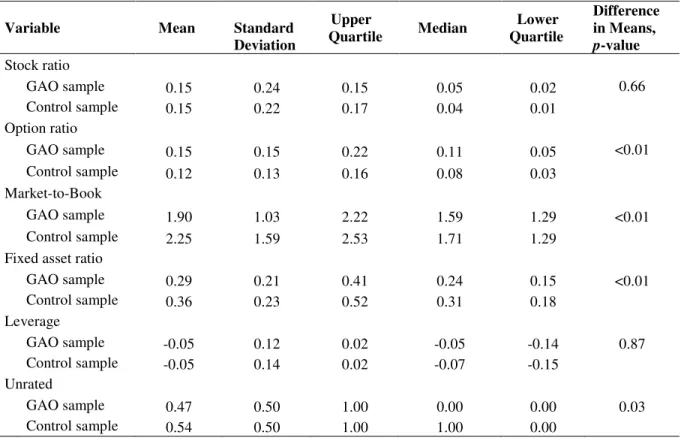
Summary statistics and the results of difference in means tests of firms in the GAO restatement database versus control firms are reported in Table 1. Restating firms differ from control firms for most of the variables I use. There is more bank debt (
p-value<0.01) and more non-bank debt (p-value<0.01) outstanding at misreporting firms, and these firms increase their reliance on bank debt (p-value <0.01) relative to control firms in the years preceding the misreporting. In addition, firms in the GAO sample hold more meetings of the board (p-value<0.01). If boards and lenders serve to monitor activities within the firm, then these results are inconsistent with Beasley (1996) and Dechow, Sloan and Sweeney (1996) who suggest that monitoring and governance decrease the likelihood of misreporting. Alternatively, the latter finding may result from audit committee meetings to investigate or correct accounting irregularities.
Misreporting firms have, on average, lower market-to-book values of assets (p-value <0.01) averaged over the five years preceding the misreporting, but smaller changes in operating income before depreciation to total assets (p-value<0.01) at the time the misreporting occurs. These results suggest that managers use accounting manipulations to inflate equity prices, and are consistent with the results of Johnson et al. (2007), who
find that were it not for accounting fraud, the equity of the firms in their sample would have underperformed.
The average misreporting firm has higher sales growth (p-value<0.01), consistent with the use of aggressive accounting to give the appearance of consistent growth in sales. Firms that misreport are on average older (p-value <0.01) and larger (p-value <0.01) than control firms. If age and size proxy for reputation, then these results are inconsistent with Diamond (1991b) who suggests that reputation reduces the need for external monitoring. Consistent with Diamond (1991b) however is that misreporting firms are less likely to have a bond rating (p-value= 0.03). The CEOs of misreporting firms earn a larger fraction of their total compensation in the form of options (p-value <0.01) than do CEOs of control firms, consistent with Bergstresser and Philippon (2006). Finally, misreporting firms also have more volatile stock returns (p-value= 0.02), and lower fixed asset ratios (p-value<0.01) than control firms on average, both of which are consistent with misreporting being more prevalent when monitoring is difficult either due to an unpredictable environment (Demsetz and Lehn (1985)), or because market value is derived from investment opportunities rather than assets in place (Smith and Watts (1992)).
2.4 Relations between bank debt and the likelihood of misreporting
To estimate whether the likelihood of misreporting is related to firms’ use of bank debt, I use a logit regression analysis. The dependent variable takes a value of one if the firm misreports, and zero otherwise. I report estimated coefficients as well as marginal effects, for which I set all explanatory variables to their sample means except
Table 2 gives the results of estimating the logit model comparing control firms to those in the GAO database. The coefficient on bank debt is positive (p-value <0.01). For a standard deviation increase in bank debt, the predicted probability of misreporting increases by 0.84%, holding all other variables constant. The coefficient on other debt is also positive (p-value <0.01). Holding all other variables constant, a standard deviation increase in other debt increases the predicted probability of misreporting by 0.70%. Each of these represents a substantial increase over the unconditional probability of
misreporting of 2.09%.6 These results are inconsistent with the bank monitoring literature.
The positive coefficient on number of board meetings (p-value= 0.01) may suggest that boards or audit committees hold meetings in response to misreporting. The positive coefficient on the 3-year change in OIBD to total assets (p-value= 0.02) is inconsistent with the use of misreporting to conceal declining performance. The positive coefficient on sales growth (p-value <0.01) is consistent with firms misreporting in order to give the appearance of revenue growth. That age (p-value <0.01) generates a positive coefficient is inconsistent with Diamond (1991b), who suggests reputation can substitute for monitoring. The negative coefficient on the merger indicator variable (p-value <0.01) is inconsistent with the results of Erickson and Wang (1999), who find firms manipulate earnings in order to raise stock prices prior to acquisitions. Consistent with misreporting being more common in unpredictable environments (Demsetz and Lehn (1985)), I find a positive coefficient on the volatility of stock returns (p-value <0.01). Option ratio also
_____________ 6
This calculation is based on firm-year observations. Based on the number of firms in the sample, the unconditional probability of misreporting is 7.61%.
generates a positive coefficient (p-value < 0.01), consistent with Bergstresser and Philippon (2006). Stock ratio also generates a positive coefficient (p-value =0.08), consistent with Johnson et al. (2007). The dummy variable that indicates volatility is missing generates a positive coefficient (p-value =0.06).
Next I follow Efendi et al. (2006) and identify whether each restatement results from malfeasance. When misreporting is detected and exposed, the costs to the manager depend on the severity of the accounting manipulations. In the case of more severe accounting irregularities, the consequences can include fines or even criminal charges in the most extreme circumstances. Although some managers might be willing to risk the negative press associated with a restatement in order to avoid covenant violations or reduce borrowing costs, fewer may be willing to risk prison terms. That is, when the expected costs of detection are high, avoidance of loan default may not offer a large enough benefit to induce misreporting. Managers who choose to engage in more
egregious accounting manipulations may do so for other reasons, such as to increase their personal wealth (Johnson et al. (2007)). This suggests the importance of distinguishing between relatively less and more severe types of misreporting.
I test this distinction with a multinomial logit model, the results of which I report in Table 3. The dependent variable takes a value of two if malfeasance is indicated, a value of one for other restatements, and a value of zero for control observations. For other (non-malfeasance) restatements, I again find a positive relation between bank debt and misreporting, as well as other debt and misreporting (p-values <0.01). These results are reported in Panel A. Among the control variables, number of meetings (p-value=
0.02), sales growth (p-value <0.01), merger indicator (p-value= 0.03) and option ratio (
p-value= 0.02) are again significant, and their signs are consistent with those in Table 2. As reported in Panel B, bank debt generates an insignificant coefficient when malfeasance is indicated (p-value= 0.64), but the coefficient on other debt is still positive (p-value <0.01). Among the control variables, number of meetings (p-value = 0.09), 3-year change in OIBD/TA (p-value = 0.02), sales growth (p-value <0.01), age (p-value <0.01), merger indicator (p-value= 0.10), volatility (p-value <0.01) and stock ratio (p -value = 0.06) are again significant, and their signs are consistent with those in Table 2.
These results are inconsistent with the bank monitoring literature, and suggest that bank monitoring is insufficient to deter misreporting. Instead, bank borrowing may actually provide incentives for managers to misreport. Importantly, however, the benefits that derive from misreporting (avoiding loan default, lowering borrowing costs) are large enough that they outweigh the costs only when the costs are small, as they are for
relatively less severe accounting manipulations.
I next investigate the relation between misreporting and bank debt using the sample of AAERs. Because AAERs frequently represent more egregious accounting manipulations7, the relation between misreporting and bank debt should be stronger for this sample than for the GAO sample. The results of this analysis are reported in Table 4. Using this proxy for misreporting, bank debt has lost its explanatory power (p-value = 0.57). The coefficient on other debt is positive (p-value= 0.04). The coefficient on the merger indicator variable is positive (p-value = 0.05), consistent with Erickson and Wang (1999). All of the other control variables generate insignificant coefficients. These _____________
7
results suggest that bank monitoring is insufficient to prevent the most egregious types of misreporting. Importantly, these results also suggest that the benefits of avoiding default and reducing borrowing costs are insufficient to motivate the most serious types of accounting manipulations. There must be some other benefit to misreporting that provides an incentive when the expected costs of misreporting are large.
Overall the results thus far suggest that not only is bank monitoring insufficient to deter financial statement misreporting by bank borrowers, but that bank debt may even provide incentives for borrowers to misreport. These incentives arise if managers cannot uphold the covenants in their bank loan agreements legitimately, or if they need to reduce the cost of borrowed funds. Finally, the results suggest that the incentives are great enough to induce only relatively less severe types of misreporting.
2.5 Alternative interpretation
Because I use restating as a proxy for misreporting, an alternative interpretation of these results is also possible. That is, data are available only for those firms whose misreporting is detected and exposed. So a positive relation between bank debt and restatements could result because bank monitoring effectively detects misreporting. To unequivocally distinguish between these alternative interpretations requires a sample of firms whose misreporting is undetected, but such a sample does not exist. There are however firms whose misreporting is initially undetected. I use data from the GAO restatement database and Lexis-Nexis newswire searches to identify these firms. Many firms restate in the same year (for misreporting of quarterly financial statements) or the following year, and I use these firms as a sample of detected misreporting. Those firms that restate more than one year after misreporting I use as a sample of initially undetected
misreporting. I compare this sample of initially undetected misreporting to both the sample of detected misreporting, and to the control group (those firms that do not restate), to distinguish between the following:
Alternate Hypothesis 1A: The likelihood of misreporting is increasing in bank debt, because borrowing firms’ managers have incentives to misreport to uphold covenants or to lower borrowing costs.
Alternate Hypothesis 1B: The likelihood of restating is increasing in bank debt, because effective bank monitoring helps to detect and expose misreporting.
If the likelihood of misreporting is positively related to bank debt, consistent with the debt covenant hypothesis, then I should observe no differences in the use of bank debt between the sample of initially undetected misreporting versus the sample of detected misreporting8. I should observe a greater use of bank debt among the sample of initially undetected misreporting compared to the control group.
If the likelihood of restating is positively related to bank debt, consistent with the bank monitoring literature, then I should observe a greater use of bank debt in the sample of detected misreporting compared to the sample of initially undetected misreporting. I should observe no difference in the use of bank debt between the sample of initially undetected misreporting compared to the control group.
I test these relations using a logit regression analysis with the same control variables discussed in the last section. In Table 5 Panel A I compare firms whose misreporting is detected versus firms whose misreporting is initially undetected. The dependent variable takes a value of one if misreporting is detected immediately and a _____________
8
A third scenario is that managers of firms financed with bank debt, knowing they will incur the scrutiny of bank monitoring, must engage in relatively more complex accounting manipulations in order to avoid detection by the bank. If this were the case, I should observe a greater use of bank debt among the group of firms whose misreporting is initially undetected both versus those whose misreporting is detected, and versus the control group.
value of zero otherwise. I find no significant difference in the use of bank debt (p-value = 0.10)9 or other debt (p-value = 0.84) among these firms. The number of board
meetings is positively related to the likelihood of detection (p-value = 0.03), consistent with effective monitoring by the board to detect and expose misreporting, or with meetings of the board in response to misreporting. None of the other control variables generates a significant coefficient.
I next compare the sample of initially undetected misreporting to the control group and report the results in Table 5 Panel B. The dependent variable takes a value of one if misreporting is initially undetected and a value of zero for firms in the control group (those that do not restate). I find a significant difference in the use of bank debt among these firms. Firms whose misreporting is initially undetected use more bank debt and more other debt (p-values <0.01) than control firms. Sales growth (p-value <0.01), firm age (p-value = 0.02), merger indicator (p-value = 0.02), volatility (p-value = 0.09) and stock ratio (p-value = 0.01), generate significant coefficients, the signs of which are consistent with those reported in Table 2. The 3-year change in OIBD/TA generates a negative coefficient (p-value = 0.05). The dummy variable that indicates volatility is missing generates a positive coefficient (p-value < 0.01).
Overall these results confirm the interpretation of the other results presented thus far. Firms that make greater use of bank debt are more likely to misreport, whether that misreporting is detected or not, than firms with less bank debt. And firms whose misreporting is detected do not have more bank debt outstanding than firms whose misreporting is initially undetected, as would be expected if misreporting was being _____________
9
detected through bank monitoring. Together these results suggest that it is misreporting
per se, and not restating, that is positively related to bank debt, which is inconsistent with the bank monitoring literature.
2.6 Relations between misreporting and changes in bank debt
If bank monitoring is an effective deterrent to accounting manipulation, then managers who have increased their reliance on bank debt and are suddenly subjected to more monitoring by banks have increased their incentives not to misreport. In addition, the Bar-Gill and Bebchuk (2002) model predicts that firms make investments ex ante to facilitate fraud, and one such investment may be to reduce the amount of bank
monitoring that the firm must incur. This suggests a negative relation between ex ante
changes in bank debt and misreporting.
On the other hand, if covenants in bank loan agreements provide incentives for managers to misreport, then the managers of firms that have recently increased their reliance on bank debt have also increased their incentives to misreport. This suggests a positive relation between ex ante changes in bank debt and misreporting.
To test these predictions, I use a tobit model and report coefficient estimates in Table 6. I compare annual changes in bank debt for misreporting firms two years before misreporting10 versus annual changes in bank debt for firms in the control group. The results of the analysis using the full GAO sample are given in Panel A. The coefficient on the misreporting dummy variable is positive (p-value <0.01), indicating that ex ante
changes in bank debt are positive for misreporting firms when compared to control firms. This result is inconsistent with the hypothesis that bank monitoring is an effective
_____________ 10
deterrent to misreporting. Age generates a positive coefficient (p-value <0.01), and changes in bank debt are negatively related to the lack of a bond rating (p-value = 0.07).
I next distinguish between restatements that result from malfeasance versus those that do not. These results are reported in Panels B and C of Table 6. When malfeasance is indicated, I find no relations between ex ante changes in bank debt and misreporting (p-value= 0.82). When the misreporting is less severe, however, I find a positive relation between misreporting and ex ante changes in bank debt (p-value <0.01). Age generates positive coefficients, (p-values < 0.01), and the absence of a bond rating generates negative coefficients (p-value = 0.05 and 0.08 respectively) in both sub-samples.
Taken together, these results are inconsistent with the bank monitoring literature. The most important result is that I do not find a negative relation between ex ante
changes in bank debt and misreporting for any sub-sample. That misreporting occurs following increases in the use of bank debt suggests that misreporting may be a last resort for managers with new bank debt, or too much bank debt, facing increased pressure to uphold the covenants in their bank loan agreements, consistent with the debt covenant hypothesis.
My final set of tests examines changes in bank debt following misreporting. Once managers have filed an inaccurate financial statement, if they fear bank monitoring may detect and expose any irregularities, then they may choose to reduce their reliance on bank debt. Or once the irregularities have been exposed, banks may be unwilling to lend additional funds or may demand payment of outstanding balances. This suggests a negative relation between ex post changes in bank debt and misreporting. Alternatively, the motive for misreporting may be to conceal the borrower’s true financial health in
order to obtain financing on more favorable terms. This suggests a positive relation between ex post changes in bank debt and misreporting. I use a tobit model to test these predictions on the same sub-samples of data and report the results in Table 7.
The misreporting indicator variable is not significant in any of these tests. These results suggest that once managers have made the decision to misreport, they do not take steps to avoid being monitored by banks. This could be because managers do not view detection as costly, or do not view banks as being adept at detecting misreporting. Firm age generates positive coefficients in all sub-samples (p-values < 0.01). In the sub-sample of firms accused of malfeasance, the dummy variable indicating the firm does not have a bond rating generates a negative coefficient (p-value= 0.06).
2.7 Robustness tests
2.7.1 Alternative measure of bank debt
A potential criticism of the analysis thus far is that it examines a proxy for bank debt rather than actual bank debt. To address this concern I hand collect data on bank loans from Moody’s Industrial Manuals and 10-Ks for 104 firms in the GAO restatement database 11, as well as a sample of size- and industry-matched firms that do not restate. I match first on size, and require that the matched firm be within 30% of the market value of equity as the sample firm. For industry, I look first for matches within the same three-digit SIC code, and if a match cannot be found then I look within the same two-three-digit SIC code. I use the best match for ninety-seven of my restating firms, and the second-best match for the remaining seven firms due to missing data.
_____________ 11
I use the first year in which the firm misreports and search for data on every firm included in my sample. The sample size decreases because the sample firm’s 10-K cannot be found, an appropriate matched control firm cannot be found, or the control firm’s 10-K cannot be found.
Using this matched pair sample, I repeat the logit analysis from Table 2, and report the results in Table 8. The coefficient on bank debt is positive (p-value <0.01), consistent with and confirming the analysis presented thus far. The coefficient on other debt,
however, is insignificant (p-value= 0.14), highlighting the importance of distinguishing between funds borrowed from banks versus other lenders. Consistent with the results presented in Table 2, the 3-year change in OIBD/TA generates a positive coefficient (p -value = 0.08) The positive coefficient on the merger indicator variable (p-value= 0.04) is consistent with Erickson and Wang (1999), but is of the opposite sign as the results in Table 2. CEO tenure generates a negative coefficient (p-value = 0.01), suggesting that relatively new CEOs may misreport because they are under pressure to perform. The positive coefficient on the dummy variable indicating the lack of a bond rating (p-value = 0.02) is consistent with Diamond (1991b) who argues that reputation can substitute for monitoring. Neither of these variables generates significant coefficients when the proxy for bank debt is used as the dependent variable as in Table 2. The coefficients on the remaining control variables are not significant.
2.7.2 Alternative measure of misreporting
I repeat the analysis from Section IV using accruals as an alternative measure of misreporting. Because the independent variable of interest, the proxy for bank debt, is calculated from balance sheet items, I follow Hribar and Collins (2002) and estimate accruals using items from the statement of cash flows to avoid mechanical relations. This estimate of accruals is calculated as earnings before extraordinary items and discontinued operations, less operating cash flows from continued operations. Unlike the misreporting indicator variables use in the rest of the paper, this variable does not require misreporting
to have been detected, and instead allows for some degree of misreporting (or at least discretion) to take place at every firm in the sample. I estimate OLS regressions with accruals as the dependent variable. Table 9 reports the results. Consistent with the logit results in Table 2, I find a positive relation between accruals and bank debt (p-value <0.01). I find no relation, however, between accruals and other (long-term) debt (p-value = 0.19). Like those of my tests using hand collected bank debt, these results also suggest the importance of distinguishing between loans from banks and other types of debt. The merger indicator variable (p-value = 0.02), 3-year change in OIBD/TA (p-value <0.01), age (p-value = 0.05) and number of meetings (p-value <0.01) generate significant coefficients, whose signs are consistent with those in Table 2. Four other control variables generate significant coefficients whose signs are not consistent with those in Table 2. Sales growth (p-value = 0.06) generates a negative coefficient, as does volatility (p-value <0.01). These results are not consistent with the extant literature. The
coefficients on option ratio and stock ratio are also negative (p-values = 0.02 and <0.01, respectively), inconsistent with Bergrestresser and Philippon (2006). In addition, three control variables are significant in this model but are inconsistent with the results in Table 2. The tenure of the CEO and total assets both generate positive coefficients (p -values < 0.01 and = 0.02, respectively). These results are inconsistent with arguments such as those in Diamond (1991b) regarding the value of reputation. The coefficient on Altman’s Z is also positive (p-value= 0.06), consistent with Johnson et al. (2007) who find evidence consistent with the use of misreporting to conceal financial distress. Finally, the dummy variable that indicates tenure is missing generates a positive coefficient (p-value <0.01).
2.8 Conclusion
Managers weigh expected costs and benefits when choosing to misreport their firms’ financial statements, and I argue that both should be higher at firms that borrow from banks. Misreporting, if it escapes detection, can help managers to avoid loan covenant violations or to reduce borrowing costs (Dye (1988); Trueman and Titman (1988); Defond and Jiambalvo (1994); Sweeney (1994); Dichev and Skinner (2002)). But monitoring by the lender should increase the probability of detection and thereby the expected cost (Diamond (1984); Sharpe (1990); Mester et al. (2007)). Because bank debt is subject to greater monitoring and tighter covenants than other types of debt, managers of firms financed with bank debt should face even greater expected costs and benefits of misreporting than managers of otherwise identical firms. The purpose of this paper is to test empirically whether financial statement misreporting is more likely, due to the greater benefits, or less likely, due to the greater expected costs, that should accompany bank borrowing.
I find two key sets of results because the costs of misreporting, once it is detected and exposed, depend upon its severity. My results suggest that the benefits can exceed the expected costs of misreporting but only when those expected costs are small, as they are for relatively less severe types of misreporting. I find the likelihood of misreporting is positively related to the use of bank debt, and that ex ante changes in bank debt are positive for misreporting firms relative to control firms. These results are inconsistent with the bank monitoring literature, and instead suggest that bank debt can provide incentives for managers to misreport, either to avoid covenant violations or to lower borrowing costs. These results are consistent with a body of literature that includes the
work of Sweeney (1994), Defond and Jiambalvo (1994), Dichev and Skinner (2002) and others.
For relatively more severe misreporting, such as accounting malfeasance that triggers an SEC investigation or filing of an AAER, I find no relation between the use of bank debt and the likelihood of misreporting. I find that changes in bank debt are
unrelated to more severe types of misreporting. These results also fail to support the bank monitoring literature, but suggest that there must be some other benefit, such as the manager’s desire to increase his personal wealth (Johnson et al. (2007)), that provides