Copyright © UNU-WIDER 2007
1 School of Oriental and African Studies, University of London, email: [email protected]; 2 World Trade
Institute, University of Bern, email: [email protected]
This study is a revised version of the paper presented at the 16-17 June 2006 WIDER development conference on ‘Aid: Principles, Policies, and Performance’, directed by George Mavrotas.
UNU-WIDER gratefully acknowledges the financial contribution to the conference by the Finnish Ministry for Foreign Affairs.
UNU-WIDER also acknowledges the financial contributions to the 2006-07 research programme by the governments of Australia (AusAID), Denmark (Royal Ministry of Foreign Affairs), Norway (Royal Ministry of Foreign Affairs), Sweden (Swedish International Development Cooperation Agency—Sida) and the United Kingdom (Department for International Development).
ISSN 1810-2611 ISBN 92-9190-976-9 ISBN 13 978-92-9190-976-6
Research Paper No. 2007/33
Assessing the Aid Allocation
and Debt Sustainability Framework
Working Towards Incentive Compatible Aid
Contracts
Machiko Nissanke
1and Benno Ferrarini
2June 2007
Abstract
This paper criticizes the current International Development Association (IDA) aid allocation and debt sustainability framework on the grounds of their over-reliance on the country policy and institutional assessment (CPIA) as the guiding criterion. It argues that CPIA-centred allocation of aid fails to introduce an incentives structure supportive of a genuine donor-recipient partnership, conducive to development. Further, it claims that the CPIA-dependent debt thresholds—central to the new debt sustainability framework—effectively submit sustainability concerns to the policy performance prerogatives of the aid allocation system. Resting on a thin empirical basis, such approach fails to take due account of low-income countries’ vulnerability to exogenous shocks, as a key determinant of debt distress. As an alternative to the current CPIA-based scheme, the paper outlines the key features of a state-contingent mechanism, guiding both aid allocation and debt sustainability analysis.
Keywords: foreign aid, economic development, aid allocation, debt sustainability JEL classification: F34, F35, O11, O19
The World Institute for Development Economics Research (WIDER) was established by the United Nations University (UNU) as its first research and training centre and started work in Helsinki, Finland in 1985. The Institute undertakes applied research and policy analysis on structural changes affecting the developing and transitional economies, provides a forum for the advocacy of policies leading to robust, equitable and environmentally sustainable growth, and promotes capacity strengthening and training in the field of economic and social policy making. Work is carried out by staff researchers and visiting scholars in Helsinki and through networks of collaborating scholars and institutions around the world.
www.wider.unu.edu [email protected]
UNU World Institute for Development Economics Research (UNU-WIDER) Katajanokanlaituri 6 B, 00160 Helsinki, Finland
Typescript prepared by Liisa Roponen at UNU-WIDER
The views expressed in this publication are those of the author(s). Publication does not imply endorsement by the Institute or the United Nations University, nor by the programme/project sponsors, of any of the views expressed.
Acronyms
ACP signatory countries of the Lomé Convention in Africa, the Caribbean and Pacific
ARPP annual report on portfolio performance BOP balance of payments
CPIA country policy and institutional assessment CDSF contingency debt sustainability framework CPR country performance ratings
DSA debt sustainability analysis DSF debt sustainability framework
EVI economic vulnerability index HIPCs highly indebted poor countries
IDA International Development Association LICs low-income countries
MDGs Millennium Development Goals ODA official development aid
PBA performance-based allocation system PPE pro-poor expenditure
PRSP poverty reduction strategy papers SAPs structural adjustment programmes
1
1. Introduction
In the early 1980s, there was a radical change in aid delivery structure from project aid towards policy-based programme aid. Structural adjustment programmes (SAPs) had become a favoured conduit for both multilateral and bilateral aid, with a string of strict ‘policy’ conditionality instituted. Policy conditionality was justified on the grounds that donors should actively influence the policy and conduct of recipient countries through ‘aid’ leverage. Ex ante conditionality, whereby foreign aid and budget supports were delivered conditional upon the promises of implementation of stabilization-cum-structural reforms, had become a dominant feature in the donor-recipient relationships. As Kanbur (2005) notes, ‘conditionality’ itself is nothing more than the rules and procedures according to which a donor transfers resources to a recipient. What is debated, however, is the nature of conditionality, in particular that of ‘policy’ conditionality, which has been practiced to date in one form or another.
By the mid-1990s, however, despite adding an array of political and economic conditionality, the donor community had to face the uneasy reality: ex ante policy conditionality was not effective in tying the recipient governments to the reform agenda of donors (e.g., Killick 1996, 1997; Collier 1998; Collier and Dollar 2004). This sparked off a new round in the aid-effectiveness debate against the background of declining public support for foreign aid in donor countries (World Bank 1998). The poor record of compliance and enforcement of policy conditionality was recognized in various evaluation reports on World Bank’s adjustment loans (World Bank 2005c).1
Thus, the efficacy of policy conditionality has been a central question in the aid-effectiveness debate over the last decade or so. In the debate, ex ante policy conditionality has been examined largely from a narrow perspective of the moral hazard
problem, i.e., the problem arising from granting foreign aid without a firm commitment on the part of recipient countries to reform programmes. Assessed from this perspective, it has been argued that policy conditionality was faulted on incorrect rationales given to adjustment lending, since an effective mechanism to deal with the moral hazard problem was absent.
Collier (1998) argues, for example, that none of the three rationales for programme lending—namely the use of aid as an incentive for reform, financing the ‘cost of adjustment’, and ‘defensive lending’ to service external debt—are soundly based. Similarly, Easterly (2003) explains the failure of ex ante conditionality in terms of incentive systems affecting donor behaviour. He suggests that despite continuous breach of policy conditionality by recipient governments, donor agencies have kept ‘moving money’ and ‘pushing loans’ under the constant pressure of improving their own performance indicator, assessed in terms of aid disbursements.
With recognition of the difficulty in overcoming the moral hazard problem ex ante, it had been proposed to overhaul the aid allocation rule, so that aid is allocated on an ex post policy performance basis. Thus, while ex ante conditionality is ‘incentives-based’ aid allocation on promises for policy change, ex post conditionality is claimed to be ‘selectivity-based’ on retrospective assessments of performance. That is, instead of
1 See Dollar and Svensson (2000); Alesina and Dollar (2000) and Burnside and Dollar (2000) for a summary of empirical findings.
2
using conditionality to induce policy change, it is suggested that aid should be used to target financial flows on those governments that have already established good policy environments (World Bank 1998). Creating star performers by engineering aid allocation, Collier (1998) further argues, would induce non-reforming governments to change their policies through the pressures of emulation, and would result in enhanced overall aid effectiveness. It has been argued that through the ex post selectivity approach, donors can affect growth and poverty reduction through their allocation of aid and debt relief.
Indeed, the aid effectiveness debate has been conducted in parallel with the search for lasting debt relief measures to deal with the severe debt overhang conditions found in highly indebted poor countries (HIPCs). The donor community launched the HIPC Initiative in 1996 and three years later enhanced its scope and depth, as a real and durable exit option from the protracted debt crisis for HIPCs.2 Under the HIPC
Initiative, the process conditionality is instituted as part of formulating the poverty reduction strategy papers (PRSP), which is supposed to be a recipient-driven process.3
The debt sustainability analysis has been routinely integrated into the PRSP process and the HIPC debt relief negotiations. Finally, the comprehensive development framework, introduced in 1999 in place of structural adjustment programmes, emphasizes the importance of ownership and partnership in the aid relationships. It has been heralded that a new aid architecture has been built, where a selectivity based aid allocation is used ex post policy conditionality and the debt sustainability analysis is integrated into the ‘performance-based’ aid allocation process.
Building on our early work (Nissanke and Ferrarini 2001, 2004), the principal objectives of this paper are (i) to assess the analytical and empirical basis of the aid allocation currently in operation and the associated debt sustainability analysis embedded therein; (ii) to present an alternative framework which could align incentive structures better in aid and debt contracts between donors and recipients. Towards these objectives, the paper is structured as follows. Section 2 evaluates the CPIA-based selectivity approach to aid allocation as ex post policy conditionality in the International Development Association (IDA) facility at the World Bank. Section 3 examines the debt sustainability analysis embedded in the current IDA facility, which determines the outright grant component of the IDA facility. Section 4 presents an alternative aid allocation and debt sustainability framework, which has the potential of making aid and debt contracts more incentive compatible. Section 5 offers concluding remarks.
2 The CPIA-based selectivity approach to aid allocation
as ex post policy conditionality
The donor-recipient aid relationships are usually examined in the principal-agent theoretical model, wherein recipients are agents implementing the conditions desired by donors, i.e., the principals (Killick 1996 and 1997). Conditionality is then the means of using leverage accorded by ‘aid giving’ to promote donor objectives. As such, it can be
2 See Nissanke and Ferrarini (2001, 2004) for our critical evaluation of the HIPC Initiative.
3 Mosley, Hudson and Verschoor (2004) propose a new conditionality to tie aid specifically to poverty reduction in the form of the pro-poor expenditure (PPE) index in the PRSP process.
3
administered in a co-operative manner between the principals and the agents (Killick 1996). However, in reality, there are conflicts and congruence between the objectives and interests of donors and recipients. In particular, it is often assumed that donors have
altruistic preferences (e.g., caring about the voiceless poor), whereas recipient governments are typically constrained in pursuing such objectives by domestic political economy considerations. Furthermore, it is admitted that in the aid relations characterized by asymmetric powers, conditions are more likely to be drafted and imposed by donors and accepted—usually unwillingly—by recipients (White and Morrissey 1997). As a consequence, it is this coercive nature of policy conditionality which has largely shaped the donor-recipient relationships over the recent decades. This can be best illustrated in the ‘languages’ used to analyse the multiple roles of policy conditionality in the aid relationships. For example, Collier and Gunning (1996) classify the objectives of policy conditionality into four categories:
i) paternalism, where donors believe they know what is best for the recipient; ii) bribery, when donors persuade recipients to implement reforms that are
otherwise not undertaken;
iii) restraints, when donors place conditions to prevent the recipient from policy reversal on reforms;
iv) signalling to the private sector and other donors that the reform programme is sincere.
From a similar perspective, World Bank (2005c) discusses rationales for conditionality in terms of:
i) compensation by the donor to the recipient government for adopting the policies preferred by the former, when each party has different beliefs on the appropriateness of the policy;
ii) restraint/counterbalance device for the government in the face of domestic opposition to policy reforms; and
iii) signalling of commitments to reforms to potential private investors.
Using the principal-agent framework, Killick (1996, 1997) explains the inherent tension engendered by policy conditionality in the aid relationships in terms of: the asymmetrical burden of risks between donors and recipient governments; the high short-term economic and political costs associated with reform measures compared with slowly emerging benefits; and the high monitoring and enforcement costs. In particular, he notes that the involuntary nature of policy conditionality undermines the legitimacy of reforms. Thus, when reform measures are not home-grown, recipient governments try to evade commitments and regress when the opportunity arises, as they are supposed to bear political risks and adjustment costs. Yet the incentive structures to monitor and enforce aid contracts are weak when the donor agencies are prone to ‘pro-lending’ ethos, and hence donor commitment to enforce conditionality and sanction is seen not credible. Killick concludes that ‘(ex ante) conditionality does not meet its promise of greater aid effectiveness … A further cost is that conditionality distorts the nature of the discourse between the donors and developing country governments…’ (1997: 493). He suggests that a new model of donor-recipient relationships should be based on ‘selectivity’ along with other principles such as ownership, support and dialogue.
4
In evaluating the efficacy of conditionality when donor and recipient preferences for policy reform and aid vary, White and Morrissey (1997) also show that ex ante conditionality tends to create conflicts between donors and recipients even when recipient governments are sincere about economic reforms. They conclude that conditionality is neither an effective mechanism to induce reform on unwilling governments, nor an appropriate mechanism for genuine reformers. They suggest that the switch to ex post conditionality could reduce such conflicts, if it is solely based on performance measures that are truly independent of external shocks or unavoidable implementation problems that are beyond the control of recipient governments.
Consequently, the new aid architecture, as emerging today from the aid effectiveness debate, has adopted the selectivity rule as a guiding principle for aid allocation. However, it is well-known that the analytical and empirical basis for the selectivity approach rests almost entirely on cross-country regression results of the growth-aid relationship, such as the study by Burnside and Dollar (1997, 2000). They draw a very strong policy conclusion from the significant positive coefficient on the policy-aid interaction term in their cross-country regressions. According to these authors, while aid generally does not have any significant effect on the rate of economic growth or investment, the growth-enhancing effect of aid can be found only in a good policy
environment.4
These empirical studies have been severely challenged on technical grounds. For example, Easterly, Levin and Roodman (2004) argue that the regression results obtained by Burnside and Dollar are not robust as they are extremely sensitive to how the included key variables such as aid, policy and growth are defined and measured. Dalgaard and Hansen (2001) question the theoretical underpinning of the Burnside-Dollar study as well as the sensitivity of their econometric results to the data samples. Guillaumont and Chauvet (2001) argue that aid is most effective when it is available to countries disadvantaged by large external shocks and climatic conditions. Their cross-country pooled regressions show that the external environment factor rather than the policy environment is a determining factor in improving aid effectiveness.
Hansen and Tarp (2001a, 2001b) further challenge the validity of the empirical analysis by Burnside and Dollar, comparing their results with a large number of past and current empirical studies on the aid-growth relationships. They conclude that the difference between the results obtained by Burnside and Dollar and others stems mostly from the model specification and other technical issues.5 Hence, they caution strongly against
basing aid allocation rules on the single-cause explanations. Wangwe (2003), assessing the three criteria adopted by Burnside and Dollar for defining good policies, i.e., budget surplus, inflation and openness, concludes that they are too narrow.
4 They also found that aid is subject to diminishing marginal returns. While Lensink and White (2001) agree on the existence of such an aid-Laffer curve, they suggest that this is due to the limited absorption capacity of recipient countries in using aid productively, and that the threshold level above which aid starts having a negative effect on growth in the Laffer-curve is about 50 per cent of the aid/GDP ratio, much higher than the level suggested by Collier and Dollar (2001, 2002).
5 See also Hudson (2004) and Morrissey (2004) for discussions on econometric issues arising from the differences in model specification, sample size and estimation methods, adopted in these studies.
5
In recognition that the policy-performance indicators used in the original Burnside-Dollar study are too limited, the World Bank subsequently presented a more comprehensive matrix—country policy and institutional assessment (CPIA)—for assessing and ranking countries according to their institutional and policy environment for long-term growth and poverty reduction. Using the CPIA as a screening device, further studies by Collier and Dollar (2001, 2002 and 2004) reiterate the earlier claims by Burnside and Dollar that the aid and policy can interact in such a positive manner for economic growth that ‘aid enhances the growth effect of policy and good policy increases the growth effect of aid’ (Collier and Dollar 2001: 1788).
Acknowledging that aid is used by donors for objectives other than accelerating economic growth, Collier and Dollar (2001 and 2002) extend their analysis to arrive at a
poverty-efficient allocation of aid as a benchmark for assessing the performance of actual allocation in terms of achieving the poverty reduction objective.6 On the basis of
similar cross-country regressions, they advocate that aid should be given to countries with ‘good’ policy while allowing for the differences in the incidence of poverty to arrive at a poverty-efficient allocation as close as possible within the aid-policy configuration. The technical basis of their cross-country regression results on aid-growth-policy trajectory remains rather fragile and unconvincing as the basic thrust of their econometric exercises is the same as the original Burnside-Dollar study. Further, the use of the CPIA index can be objected on several technical grounds, including its endogeneity to the growth process.7 Despite these criticisms, the selectivity rule had a
strong appeal for the donor community as an effective instrument to overcome the moral hazard problems in dealing with recipient governments.
In particular, their poverty-efficient aid allocation proposal has indeed become influential in the policy debate on the feasibility of achieving the Millennium Development Goals (MDGs), where the poverty reduction is singled out as the most important objective of giving aid and publicized as such in order to mobilize public support for securing aid budgets in donor countries.8 On the basis of their simulation
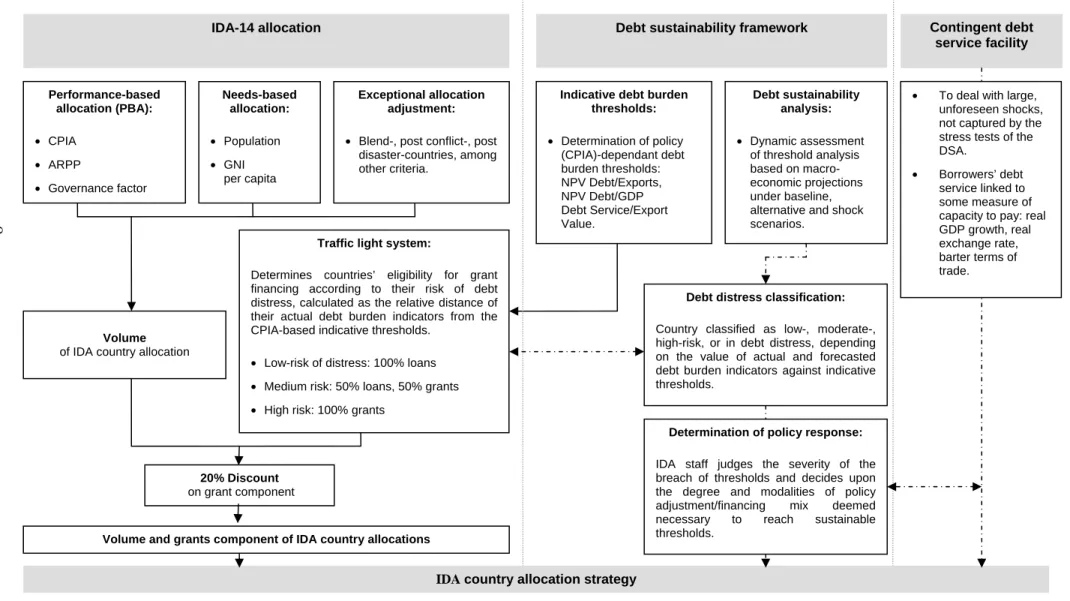
analysis, it is claimed that the MDG target in poverty reduction is more likely met by a combination of more efficient aid allocation, policy reform and more generous aid. Their estimates proclaim, for example, that the proposed poverty-efficient aid allocation would reduce the number of poor people by an extra 18 million per year compared with what can be achieved in the poverty reduction under the allocation practiced hitherto. These optimistic predictions have provided the donor community with a basis of adopting the CPIA-based allocation for IDA loan disbursement and HIPC debt relief as its performance-based allocation system (PBA) at the World Bank since 2002 (IDA-13 and IDA-14). For example, the aid allocation rule used in IDA-14 is shown in the left half of Figure 1. The PBA now uses the CPIA comprising of 16 criteria grouped in four
6 A poverty-efficient allocation of aid is defined as one in which the marginal cost of poverty reduction is equalized across recipient countries. Collier and Dollar (2004) discuss aid-allocation rules for achieving other donor objectives such as a security -efficient allocation.
7 Dalgaard, Hansen and Tarp (2004) suggest using instrument such as ‘the fraction of land in tropics’ for the CPIA index for the regression analysis, so that the endogeneity problem of the CIPA index is dealt with. See discussion below for further critical issues on the construction of the CPIA index. 8 Their proposal was, for example, used as a guide in US aid allocation of the Millennium Challenge
6
equally weighted clusters: (i) economic management; (ii) structural policies; (iii) policies for social inclusion and equity; (iv) public sector management and institutions (Appendix Table A1). In IDA-14, the country performance ratings (CPR) is arrived at by using the composite index (the CPIA is given 80 per cent, with 20 per cent weight allocated to the annual report on portfolio performance (ARPP) for assessing Bank’s own project performance). The composite index is further moderated by a governance factor (GOV)9 for reaching the final CPR (World Bank 2005a). Only in
exceptional circumstances is the performance-based country allocation adjusted in light of countries’ access to alternative financial sources or their emergence from conflict or severe natural disaster.
The IDA loan allocation to country i, as a share of the total IDA envelope, is determined by the following formula:10
[
]
[
]
{
CPIA ARPP GOV POP GNIPC}
TotalIDAEnvelopeGNIPC POP GOV ARPP CPIA PBA n i i i i i i i i i i i ⋅ ⋅ ⋅ ⋅ ⋅ + ⋅ ⋅ ⋅ ⋅ ⋅ + ⋅ =
∑
− − 1 125 . 0 2 125 . 0 2 ) 2 . 8 (. ) 2 . 8 (. (1)Clearly, this formula makes the CPIA the dominant factor in the IDA allocation, while variables such as population (POP) and gross national income per capita (GNIPC) are merely a moderating factor. This is implicitly confirmed by the World Bank, stating that ‘there is a modest bias in favour of the IDA eligible countries with a lower GNI per capita’ (World Bank 2005a-Annex: 4). Thus, as Kanbur (2005: 5) notes, ‘the performance rating has a much higher weight than the measure of the need’, where ‘the need’ is captured by the income criterion. In short, ‘aid productivity’ is given precedent over the ‘need’ in the donor’s impact analysis (ibid. 11).
In assessing the selectivity aid allocation rule, it is therefore critical to examine how the CPIA itself is constructed in relation to a more fundamental question as to who defines (and how to define) good policies for country-specific conditions. In particular, it is important to note that the CPIA is not an objective measure of the quality of policies and institutions, but is a set of subjective scores (1-6 rating scores) by Bank staff, based on questionnaires organized with country teams at the World Bank (World Bank 2005b). Furthermore, the CPIA is constructed in terms of mixed score parameters: while some parameters rank policy choices and institutional quality, others rather reflect outcomes
or, more often, both outcomes and policy choices. Hence, the World Bank’s assertion that policies and institutional arrangements assessed through the questionnaires can be classified as input, which are within the country’s control, as opposed to outcome (e.g., the growth rate), which is influenced by elements beyond the country’s control, should be seriously questioned. In reality, such a separation is often fictitious, as is apparent upon a closer inspection of score guidelines listed under each of the CPIA categories (World Bank 2005d).
9 The governance factor itself is derived as the average rating of the five criteria constituting cluster D of the CPIA (public sector management and institutions), plus the procurement element of the ARPP portfolio rating, raised to the power 1.5.
7
Many indicators can be seen as reflecting outcomes influenced by exogenous events. For example, the ability of governments to pursue aggregate demand policy or fiscal policy, consistent with price stability and achieving external and internal balances, is often undermined in the face of large external shocks typically facing fragile low-income countries. The aptitude of governments in providing public goods depends also on their revenue-raising capacity, which, in turn, is affected by exogenous events outside their control. Thus, what is assessed is often endogenous to growth, contrary to the claim that the criteria used in the CPIA are ‘in principle independent of growth outcomes’ (Collier and Dollar 2004: F255). At the same time, some scores are distinctly related to policy choice variables, as illustrated in rating score under trade policy, which is based mostly (75 per cent) on the ‘trade restrictiveness’ measured in terms of tariff and non-tariff barriers deployed.
While many of the criteria used are not necessarily controversial in their own light and terms (e.g., those listed under policies for social inclusion/equity), it should also be recognized that the quality of institutions and the implemental capacity for socioeconomic policies, evaluated under the CPIA, are often a reflection of structural characteristics of low-income economies. Hence, they should be treated as a manifestation of their stage and level of economic development rather than that of societal subjective preferences or simple choice parameters of recipient governments. These structural characteristics should evolve and change as development proceeds. For example, all three dimensions, listed as criteria upon which financial sector policy is assessed (financial stability; the sector’s efficiency, depth, and resource mobilization strength; and access to financial services) are a function of the level and stage of economic development. The financial sector develops in tandem with the real sector activities as demand and supply for financial services interact dynamically over time (Nissanke and Aryeetey 1998; Nissanke 2004).
Thus, the CPIA-based aid allocation formula cannot be seen as a fair rule, since it gives a common scoring for all countries with the equal weighting of the different factors, irrespective of the level of development and structural characteristics of each country.11
Indeed, a closer evaluation of the criteria listed in the CPIA reveals that these scores overlap largely with those included in the extended policy conditionality list that the recipient governments had to comply in return for aid disbursements under the SAPs. The nature of policy conditionality remains largely intact. What has changed is the method of aid allocation mechanisms from ex ante conditionality to performance-based ex post conditionality. This is not surprising, since the CPIA is based on the premise that ‘the broad thrust of World Bank policy advice over the last two decades has been correct’ (Collier and Dollar 2004: F246).
While concepts such as ownership and partnership are recognized and promoted as an important dimension for success in producing the desired development outcomes
11 With reference to his criticism of the CPIA, Kanbur (2005) also remarks that a common scoring for all countries is justified only if we endorse the assumption of ‘a common development model for all countries’, postulated in a cross-country ‘average relationship’.
IDA-14 allocation Debt sustainability framework Performance-based allocation (PBA): • CPIA • ARPP • Governance factor Exceptional allocation adjustment:
• Blend-, post conflict-, post disaster-countries, among other criteria.
Volume
of IDA country allocation
Needs-based allocation:
• Population • GNI
per capita
Indicative debt burden thresholds: • Determination of policy (CPIA)-dependant debt burden thresholds: NPV Debt/Exports, NPV Debt/GDP Debt Service/Export Value.
Traffic light system:
Determines countries’ eligibility for grant financing according to their risk of debt distress, calculated as the relative distance of their actual debt burden indicators from the CPIA-based indicative thresholds.
• Low-risk of distress: 100% loans • Medium risk: 50% loans, 50% grants • High risk: 100% grants
Debt sustainability analysis: • Dynamic assessment of threshold analysis based on macro-economic projections under baseline, alternative and shock scenarios.
Contingent debt service facility
Volume and grants component of IDA country allocations 20% Discount
on grant component
Debt distress classification:
Country classified as low-, moderate-, high-risk, or in debt distress, depending on the value of actual and forecasted debt burden indicators against indicative thresholds.
Determination of policy response:
IDA staff judges the severity of the breach of thresholds and decides upon the degree and modalities of policy adjustment/financing mix deemed necessary to reach sustainable thresholds.
IDA country allocation strategy
Figure 1: Schematic illustration of the buildingblocks of the aid allocation and debt sustainability frameworks of IDA & IMF
Note: Implemented in IDA14 Envisaged for future allocations
• To deal with large, unforeseen shocks, not captured by the stress tests of the DSA.
• Borrowers’ debt service linked to some measure of capacity to pay: real GDP growth, real exchange rate, barter terms of trade.
9
through aid delivery, the selectivity rule- and performance-based aid allocation, as practiced today, is still an imposition of one particular development model by the donor community on recipient countries as an uniquely appropriate, universal model to be adopted by all development countries. From this perspective, the CPIA cannot be treated as truly performance-based parameters measured in terms of development outcomes, as claimed. It is instead a matrix contaminated with ‘intermediate variables’ that measure the extent to which a recipient accepts policy choice parameters as seen desired by donors (Kanbur 2005).
Consequently, the aid relationships emerging under the ‘new aid architecture’ are far from ideal for making incentive structures efficient for neither donors nor recipient governments. Nor are they conducive to forging a genuine partnership between donors and recipients in their common efforts for building local institutions and capabilities to overcome the technical and financial constraints to sustainable development in the light of locally prevailing conditions and characteristics, i.e., in a country-specific context.
3 The CPIA-based debt austainability analysis
In early 2004, with the sunset of the HIPC Initiative approaching amidst widespread recognition about its limited achievements in providing a lasting exit to HIPCs’ debt problems, the IDA and IMF presented their new debt sustainability framework (DSF). A series of joint staff papers introduced the notion of policy-dependent debt thresholds, referring to a method according to which the indicative threshold values of a country’s external debt burden indicators are set in relation to the CPIA (IMF-IDA 2004a, 2004b, 2005). With negotiations for the 14th replenishment of IDA financing well under way at the time of its release, the DSF proposal also included a strong lender focus, elaborating on the options for making debt sustainability considerations functional to the IDA lending process. Concomitant to the DSF papers, a series of IDA background papers further elaborated on the operational aspects for incorporating the proposed CPIA–debt burden thresholds nexus into a formula determining the grants share of the overall IDA country financing envelope (IDA 2004a, 2004b, 2005).
We illustrate in Figure 1 how the DSF is linked to the IDA-14 aid allocation system. The box indicative debt burden thresholds relates to the central pillar of the DSF. Thresholds are expressed in terms of the ratios of net present value (NPV) of debt to exports, NPV debt/GDP and the debt service/exports. Classifying countries into poor, medium or strong quality in terms of their CPIA score (see Appendix Table A2), these analyses establish the upper limits of the debt burden ratios that each category of countries can sustain with a 75 per cent likelihood of not falling into debt distress at any given year.
The traffic light system combines actual debt burdens and CPIA-dependent thresholds into a ranking of countries according to categories of distress risk. This is done by calculating the percentage distance of a country’s actual debt burden indicators from the indicative thresholds associated with its performance category.12 Against these
thresholds, the grants/loan mix of IDA country allocation is determined: 100 per cent
12 These thresholds are set on empirical grounds that are identical to the DSF thresholds, but using different cut-offs in the CPIA classification, leading to a substantial downward revision.
10
for high-risk countries; 50 per cent for medium-risk; and zero per cent for low-risk countries (see Appendix Table A3). The last step of IDA allocation involves the application of an upfront discount of 20 per cent to the grant component, to address the incentive distortions implicit in this allocation mechanism. An important set-back arises from this discount in terms of the detraction of overall financial flows to a country with high risk, as we further argue below.
Despite their significance as crisis predictors in WB/IMF empirics, countries’ vulnerability to external shocks is left out of the process of defining indicative thresholds.13 Therefore, the DSF features as its second pillar so-called forward-looking
debt sustainability analysis (DSA) to assess debt burden indicators over time (20 years) and under alternative scenarios of key macroeconomic, fiscal and external debt factors determining debt dynamics. More specifically, the DSA includes scenarios that incorporate variations in the key macroeconomic variables affecting debt sustainability, and which occur with an average 25 per cent probability over a simulation period of ten years. This ex ante approach to dealing with ‘plausible shocks’ is operated by ‘bound tests’, simulating a two-year one-standard deviation from historical averages of key macroeconomic variables.14 Once available, IDA-14 envisages such DSA exercises to
yield more dynamic country debt distress classifications, integrating the static traffic light system approach.
By design, the two pillars of the DSF fail to account for exceptionally large and infrequent shocks, i.e., occurring with probability lower than 25 per cent. In recognition of this, as well as the historical importance of such type of shocks as a key determinant to debt distress, a recent World Bank (2005b) report presents several proposals for a contingent debt service facility. As their common feature, the proposed schemes entail debt service rescheduling according to some measure of a debtor nation’s capacity to pay.
In a detailed assessment of the DSF and its main buildingblocks, Ferrarini (2007) points out a number of shortcomings. First, the empirical basis underlying the DSF is remarkably thin, relying exclusively on the empirical results reported in a preliminary World Bank working paper by Kraay and Nehru (2004), and the IMF replication of similar analysis (IMF-IDA 2004a). The approach adopted in these studies to predicting debt distress fails to capture earlier signals of illiquidity, which are a precursor to the occurrence of distress. Furthermore, the significance of CPIA in their specifications is driven by the omission of aid disbursement or volatility, which could have explained, appropriately lagged, a high portion of illiquidity and repayment problems. Finally, the proxies for shocks employed in both studies are grossly inadequate. Real GDP growth, used as an encompassing measure, is unsuitable for distinguishing between exogenous shocks and endogenous factors. Indeed, our empirical re-assessment of their empirical exercises demonstrates that the inclusion of the UN’s economic vulnerability index
13 More precisely, a cross-country average vulnerability to external shocks is considered insofar it is indirectly reflected in the indicative thresholds derived from probabilistic regressions including both CPIA and shock variables. However, the degree to which shocks are reflected by the indicative thresholds is marginal, and depends on the exact specification used in the empirical exercises determining the coefficient on CPIA.
14 For a detailed description of the proposed DSA, see World Bank (2005) and IMF and IDA (2004a). For a technical review of debt sustainability assessment methods, see Ferrarini (2007).
11
(EVI), or alternative shock measures, undermines CPIA’s significance as a predictor of debt distress (Ferrarini 2007). This finding sheds serious doubts upon the central position assigned to CPIA score in the extant debt sustainability framework.
Second, while the empirical analyses in the two studies show that both CPIA and shocks are significant predictors of debt distress, the DSF assigns the central role in determining sustainable thresholds to CPIA, not to shocks. Thereby, the DSF distorts aid allocation even further in favour of ‘high-performing’ countries, at the cost of foregoing the provision of effective protection against shock-induced illiquidity. In Figure 2 we highlight the centrality of the CPIA in the current IDA allocation and debt sustainability framework.
In Figure 2, each box represents stylized elements of the DSF/IDA-14 framework, and the arrows indicate the direction of causal relationships between these elements, assuming away, for convenience, any multiple feedback effects. This shows how a country’s CPIA score determines the amount of IDA country allocation, and, together with the country’s debt burden indicators, the grant share it is deemed to be eligible for. For example, the lower a country’s CPIA ranking, the lower its relative share of aid within the IDA envelope, and the higher its risk classification. As a consequence, the overall volume of aid flow to the country is further reduced in proportion to the discount applied to the higher grant share established by the traffic light system. Hence, it can be argued that by trying to address longer-term debt stock solvency concerns through increased grant financing, the DSF/IDA-14 framework introduces a perverse liquidity effect, generating a debt distress condition in short term. In fact, with a 20 per cent upfront reduction in overall aid allocation, the DSF reduces current net IDA transfers to a country with a lower CPIA score by the amount equivalent to the grace period of IDA loans (10 years, typically). Ultimately, to the extent that it is illiquidity, rather than insolvency that determines a country’s debt sustainability, the CPIA focus of the DSF makes the latter to succumb to theprerogatives of the extant IDA allocation framework, at the cost of losing its effectiveness in dealing with low-income countries’ debt crisis. In contrast to CPIA, vulnerability to external shocks enters the DSF merely via the forecasting exercises constituting its second pillar, while being left out the core IDA
Figure 2
The CPIA-centred aid allocation and debt sustainability framework
Higher Lower CPIA Higher Lower IDA volume Higher Lower IDA grant share Higher Lower Risk of distress: Debt burden indicators vs. debt H L H L Higher Debt burden Lower Vulne-rability
12
allocation process. The outer left box of Figure 2 illustrates the marginal weight assigned to vulnerability to shocks, which enters the DSF exclusively through the assessment of forecasted effects from simulated changes to the denominator variables of the debt burden indicators. Indeed, the DSF-IDA-14 has left the key ‘vulnerability’ component to future work on contingent instruments. Our simulations applied to a country-case study of Uganda reveals the overall ineffectiveness of the currently proposed schemes (Ferrarini 2007) because they are based on modulation indices that fail to distinguish appropriately exogenous from endogenous determinants of a country’s capacity to pay that is affected by the ‘state of nature’.
The failure of the current framework to assign a more central role to vulnerability in guiding both the aid allocation and debt sustainability process remains largely unjustified. While the commodity issues were not featured in the early debate on the causes for the debt crisis inflicting commodity-dependent low-income countries (Nissanke and Ferrarini 2001), there is by now almost unanimous agreement—including the World Bank and IMF—that vulnerability to external shocks represents a major factor behind the low-income country debt crisis and the renewed accumulation of unsustainable external debt stocks despite the HIPC Initiatives. Demonstrating the depth of the ‘commodity’ crisis in the 1980s, Maizels (1992) convincingly reveals how the beginning of the debt crisis of poor countries in the late 1970s coincided exactly with that of the ‘conveniently forgotten’ commodity crisis.
Drawing on Maizels’ empirical research and Krugman’s classical analysis on debt overhang and forgiveness (1988), we argued previously that a state-contingent debt contract is required as ex ante debt relief mechanism to deal with the debt crises facing commodity-dependent, low-income countries (Nissanke and Ferrarini 2001, 2004). More recently, Cohen, Jacquet and Reisen (2005) also argue that subsidized contingent loans are superior over outright grants in financing productive investment in countries facing high vulnerability to external shocks such as natural resource price volatility. Yet, donors have failed so far to devise an effective mechanism of protecting vulnerable countries against the negative impacts from external shocks on economic growth and debt sustainability.
Insofar as vulnerability to shocks represents a key determinant of debt distress, any DSF that does not effectively translate vulnerability assessments into appropriate policy responses in terms of volume and timing of aid is bound to fail in providing a lasting solution to debt distress of low-income countries.
4 Contingency mechanisms as incentive-compatible contracts
As discussed above, both the CPIA-based aid allocation rule and the CPIA-based debt-sustainability framework do not satisfy the conditions required for making aid really effective and debt truly sustainable as well as for improving donor-recipient relationships. The CPIA is not a truly performance-based, outcome-centred assessment. In reality, the selectivity applies at least partly on the basis of the policies implemented that donors deem appropriate. The CPIA-based selection in aid allocation and debt relief is at best an ‘eclectic mix’ of outcome-based selectivity and policy conditionality. Yet, the present system is seen and promoted as ‘programmatic policy-based lending offering a particularly promising way to reconcile the debate between the traditional ex
13
ante approach and the aspirations of a results-based approach to conditionality’ (World Bank 2005c: 20).
In reality, the current system of aid allocation and debt sustainability framework leaves many critical issues unresolved. First, policy-related selectivity criteria continue to be set by donors. This mechanism would surely undermine the ‘ownership’ of policies and reform programmes, as recipient governments in the need for foreign aid and debt relief would have strong incentives to opt for policies prescribed by donors rather than alternative policies they might have chosen otherwise. Second, the mechanical ‘programmatic’ application of the selectivity rule is problematic, since the relationships between the quality of policies and institutions on one hand, and developmental outcomes on other, are much more tenuous in a short-term framework than implicitly assumed under the current framework. It often takes considerable lead time for changes in policies and institutions to produce tangible results in development indicators, including poverty indicators. Third, the performance-based system could heavily penalize fragile low-income countries which are more exposed to exogenous shocks, since their performances are more likely to be influenced by many factors beyond the control of governments, such as terms of trade shocks or climate-related conditions. Critically, the new selectivity approach fails to offer incentive-compatible, state-contingent aid contracts which would allow an automatic access to contingency financing when recipient countries are hit by adverse unforeseen events. In our view, it is critically important to establish genuinely flexible, state-contingent aid and debt contracts in order to align incentives of borrowers/recipients and lenders/donors. As Krugman (1988) notes, the trade-off between debt forgiveness and financing in a typical negotiation can be improved by indexing repayment to the ‘state of nature’. This is because the state-contingent schemes could make a distinction between the consequences of a debtor’s own efforts and events beyond its control.
In reality, in the absence of efficient state-contingent contracts and without due attention to critical unresolved issues in the performance-based system, the aid relationships as emerged today under the selectivity rule are still predominantly characterized by donors taking very short-leash approach with intensive monitoring. Aid is disbursed in small tranches with the use of performance indicators as monitoring device to measure progress. For example, the European Union adopted performance-based conditionality at least partially in 28 budgetary aid programmes in 2001 and introduced a ‘variable financing tranche’ as a part of financing conventions with ACP countries (Africa, the Caribbean and Pacific) (Adam et al. 2004a). These authors observe that while this mode may have promoted a ‘culture of results’, it has not succeeded in shifting responsibility for policy formulation to recipient countries (ibid.).
In a more detailed study of Uganda, where foreign aid has finance about a half of government expenditure over the recent decade, Adam and Gunning (2002) argue that the use of sector-specific detailed performance indicators, chosen jointly by the government and the EU, has changed donor-recipient relations with beneficial effect. However, they note several difficulties encountered, not only in deciding on genuine outcome indicators and verifying them, but also in dealing with the tension between the monitoring and incentive functions of performance indicators. In the end, the donors had to rely on short-run critical process undertaking, and to lock into micro-management, based around a large number of input or process indicators, which were discredited under traditional ex ante conditionality. This inevitably undermined genuine
14
programme ownership and narrowed the space for effective policy debate. Furthermore, it is clearly acknowledged that the weak and uncertain link between inputs (i.e., efforts undertaken by a recipient) and outcome indicators, upon which aid disbursement is based, makes it difficult incentive structures to work in aid contracts.
There is clearly a critical gap between the rhetoric and the practice under the new aid architecture. The performance-based aid disbursements requiring close monitoring on the part of donors could easily result in a high volatility in aid flows and severe disruptions to the development process in low-income recipient countries, whose aid dependence is overwhelming. Despite the claim that greater ownership and partnership have been achieved under the new aid architecture, the donor-recipient relationships are still built on shaky ground, where recipient governments and donors tend to position themselves in an ‘aid power’ game, which could result in an inferior non-cooperative equilibrium.
Furthermore, certain presumptions incorporated in the principal-agent framework should be critically re-evaluated in its application to the analysis of aid relationships. For example, recipient governments are often assumed to change their behaviour only for getting more aid in future, as if they do not have a stake in enhancing the welfare of their domestic agents. It is not unusual to start discussion with the assumption that donors are always benevolent, and development-minded, acting on pure altruism, while recipient governments are seen as untrustworthy towards the international agencies as well as predatory towards domestic agents, using re-distributional fiscal instruments largely for political and personal gains. This assumption is not only too restrictive for the model to be of general use as an analytical tool, but also not reflective of the reality in which aid relationships should be contextualized in much more wider, complex international political and economic relations. It is true that some recipient governments with politically narrow-based regimes may well behave in a predatory manner towards domestic agents. However, this would not justify the assumption that all recipient governments are characterized by such attributes.
In our view, there is an urgent need to make aid and debt contracts incentive compatible by providing contingent financing facility to low-income countries which are often susceptible to large exogenous shocks. The recent debate on grants-versus-loans has been triggered by the desire on the part of some donors to eliminate the recurrent problems of debt overhang by providing official development aid (ODA) in outright grants only.15 However, as Cohen, Jacquet and Reisen (2005) note, such a debate is
somewhat misleading and largely irrelevant if we can properly address the key issues of maintaining debt sustainability of these low-income countries.
In Figure 3, we outline a contingency debt sustainability framework (CDSF) as alternative to the current framework discussed above.16
15 See Odedukun (2004), Bulow and Rogoff (2005), Nunnemkamp et al. (2005), and Cohen, Jacquet and Reisen (2005) for detailed discussion on the grants-versus-loans debate.
16 The CDSF is a shortened and modified extract from Ferrarini (2007), where a more comprehensive description of the CDSF and its main implications on aid allocation and debt sustainability is presented.
15
4.1 Endogenous versus exogenous balance-of-payments determinants
The central feature of the CDSF lies in the distinction between factors affecting a debtor country’s balance of payments (BOP). By applying a specifically devised accounting methodology, on the basis of consolidated BOP data at the end of each period t, a crucial distinction is drawn between factors of exogenous and endogenous nature. The former are defined as being beyond the power of influence of a debtor country, such as world demand and prices, while the latter are at least in part, or potentially, subject to the country’s control.
The lower left-side of Figure 3 shows a further disaggregating of exogenous factors into trend and shock components. While both components are externally determined variables insofar as they lie outside the country’s influence, trend effects are assumed to be internalized in the country’s expectations regarding future BOP realizations, while shocks are not. That is, the country is assumed to formulate its macroeconomic configurations according to trend expectations, thereby internalizing historical trends of exogenous BOP effects in its policy decisions. For example, the amounts produced and exported of a particular crop may be adjusted as a deliberate policy choice in the face of an observable price trend. Therefore, export earnings from that particular crop are exogenous only with regard to the actual price trend and the effects from natural factors on yields, but not with regard to volume adjustments made in response to those external forces. Exogenous shocks, in contrast, are defined as random realizations around trend and are, as such, unforeseeable. It will be argued below, in relation to the CDSF performance assessment, that it is crucial for such a distinction to be made in the context of a contingency scheme, for the latter not to distort incentives for low-income countries (LICs) towards emancipation from a condition of vulnerability to exogenous shocks.
Exogenous
factors explaining the BOP change in net official financial transfers - Vulnerability - Endogenous and mixed factors explaining
the BOP change in net official financial transfers Volume and concessionality of aid allocation Debt relief facility
(ex ante grant conversion) Performance assessment (against contractual obligations) Figure 3
Contingency DSF and aid allocation
Contingent credit line (ex-ante credit allocation) Trend component Period t Period t + 1
Contingent assessment and compensation Discretionary assessment & allocation
Exogenous shocks component Assessment of aeeds and debt sustainability
16
The upper left-side box of Chart 3 represents all non-exogenous determinants of the balance of payments. These include endogenous factors, which are deemed to be in the domain of policies adopted by recipient governments, as well as all the BOP effects resulting from complex interrelations between external shocks and policy reactions to the latter. We call the latter mixed, or indeterminate, effects. The multitude of interactions between external factors and internal policy measures makes it difficult to identify clear-cut causal relationships, or to disentangle and measure the single forces constituting mixed effects. Despite the difficulties implicit in any such identification exercise, the accounting methodology underlying the CDSF allows for a sufficiently accurate ex post extrapolation of all the balance-of-payments determinants that can be clearly qualified as exogenous price shocks or trend factors, on the basis of consolidated data observable by both the borrower and the lenders at the end of period t.17 To the
contrary, all the other BOP effects, whether endogenous or mixed, are dealt with as a residual within the CDSF framework.
4.2 The contingent credit line
The contingent credit line constitutes the CDSF instrument to adjust a low-income country’s BOP cashflow in response to exogenous shocks, by modulating net official transfers. Upon identification and measurement of the realized effects of shocks on a debtor country’s balance of payments, the contingency mechanism involves the automatic disbursement or amortization of interest-free top-up funds in proportion to their net overall direction and magnitude. In order to be effective in filling the liquidity gap ensuing from negative shocks, such disbursements are to occur periodically, at the end of period t, or with higher frequency, depending on the feasibility to conduct an immediate impact assessment. By definition, shocks are identified as random events around trend and should, as such, be mean-reverting. Hence, there may not be a prior justification for the contingency mechanism to disburse grants, instead of credits. Nevertheless, the scheme should be made flexible to include periodical grant-conversions of debts accumulated by the credit line, to the extent that the cumulative effects from these events over the longer term should not revert to trend, or should have resulted from large real shocks such as natural disasters.18
4.3 Performance assessment against contractual obligations
The upper central box of Figure 3 represents the central mechanism of the CDSF in relation to the treatment of non-shock factors determining a country’s balance of payments during t. According to the above definition, both exogenous trend and mixed endogenous components are at least in principle amenable by the effect of deliberate policy choices. Therefore, a compensatory mechanism that were to extend the treatment accorded to fully exogenous shocks to these factors would introduce a potential for incentive distortions affecting a recipient’s efforts aimed at consolidating its
17 The ex post nature of the CDSF assessment is not to be confused with the ex-ante nature of its compensatory function.
18 It is assumed that real volume shocks due to natural disasters are unlikely to be offset by positive real shocks. Of course, the events referred to are related to the exceptional occurrence of disasters with significant impact.
17
balance-of-payments position over time. We thus envisage the CDSF to include a domestic policy performance assessment against pre-defined country-specific benchmarks. The latter should be set in relation to each period t and define a detailed country policy agenda, in lieu of an underlying contract between the country authorities and the donor community.19
At the end of each period t, the CDSF assesses a country’s compliance with regard to the actual enactment of policies and actions agreed upon for that period, but not on the basis of their outcomes. To the extent that domestic policy implementation relates to observable actions such as decrees and laws, the CDSF thereby avoids the identification problem of policy effects and sets the pre-condition for the scheme to operate on an ex ante basis, i.e., regulated by the terms set out in the underlying contract. That is, in contrast to many on-going policy assessment exercises such as IMF’s PRGF review, which makes periodical disbursements of IMF credit-tranches conditional upon a recipient country meeting quantitative performance criteria and benchmarks relating to policy results, we propose that the CDSF assert a country’s qualification for continued support on the basis of policy-enactment alone. Therefore, the CDSF would ensure a performance assessment to be made independent of exogenous factors affecting outcomes, and borrowers to be unduly held accountable for neither exogenous factors nor the actual development effectiveness of agreed-upon policies. At the same time, the CDSF performance assessment should be made in a manner to control for a recipient’s moral hazard implications by effectively providing the donor community with the enforcement instrument necessary to hold countries accountable for their policy commitments.
Performance assessment has different implications with regard to various components of the CDSF, not all of which can be addressed here. In relation to both the category of mixed-endogenous and trend BOP factors, the performance assessment ascertains a LIC’s fulfilment of conditions laid out for the period t, as one input informing the lenders’ decision concerning the volume of aid allocation in period t+1. Such decision would ultimately have to rely on a broad assessment of LIC’s specific needs for official development assistance, with a particular focus on requirements arising out of its fiscal performances as well as ongoing and planned development projects supported by foreign aid. However, the performance assessment envisaged in the CDSF would be very different from the one conducted as part of the CPIA-based allocation process, where a particular set of policies selected by the donor community is deemed uniquely appropriate and universally applicable to all development countries.
4.4 The debt relief mechanism
Only with regard to the category of BOP trend factors has the CDSF performance assessment ex ante implications on the grant share of aid allocation in period t. As discussed above, BOP trend factors are identified as originating from conditions exogenous to the country, but whose magnitude is susceptible to change effected by deliberate policy reactions. By classifying policy actions according to their contractual
19 The contract should be an expression of a genuinely cooperative approach between the parties to the contract. It would also be able to overcome the coordination problems affecting the donor community in setting often conflicting policy prerogatives.
18
legitimacy, the performance assessment validates the component of trend factors that is (potentially) under government control. Hence, to the extent that a LIC is found in compliance with policy obligations, the CDSF can provide a distinct treatment to the category of trend effects, and yet avoid introducing incentive distortions. More specifically, we envisage the CDSF to incorporate an automatic conversion of an official credit flow equal to the adverse trend factors during period t into grants, i.e., to relief. The rationale for such a debt relief operation is that LICs typically face negative trend factors—most notably in form of deteriorating terms of trade—as a reflection of underlying structural deficiencies, which cannot be overcome in the short and medium term by domestic policy alone. To the extent that such trend factors heavily bear on LICs need for official development assistance, the achievement of debt sustainability requires the latter not to be contributing towards the increased build-up of external debt, and be relieved instead.
By according ex ante debt relief to a country’s observed degree of exposure to exogenous trend factors, the CDSF can be seen in a sharp contrast to the IFI-DSF. For, the latter pre-determines a country’s grant share according to the perceived risk of debt distress, and thus lacks the necessary flexibility to adjust the grant share of ODA to actual circumstances affecting a debtor’s balance of payments. However, to the extent that the debt distress forecasts within the IFI-DSF only poorly reflect the actual BOP implications of unfavourable trends, which could have a significant bearing on a debtor’s overall risk of distress, the CDSF approach to ex ante debt relief should constitute an essential component towards averting the emergence of debt distress situations.
4.5 Debt sustainability analysis
Lenders’ willingness to roll over existing debt and to supply fresh credits is informed by their own perceptions regarding a debtor’s capacity to carry debt. In this sense, the debtor’s payment capacity, to a large measure, depends on the lenders’ perceptions and actions. That is, a country’s debt will be sustainable as long as lenders consider it to be so in their assessment and show the willingness to enact the necessary lending decisions and overcome the coordination problems among themselves.20 Thus, the CDSF debt
sustainability analysis would have to depart on several grounds from the DSA as currently conducted within the IFI-DSF.
The IFI-DSF crucially relies on average CPIA-based debt indicators to pre-determine the aid allocation and grant share in any period t, as well as to assess the country’s debt sustainability prospects in the face of changing circumstances during subsequent periods. Lacking any contingency mechanism, a LIC’s debt sustainability assessment thus results from estimated changes in future debt ratios against benchmarks. In contrast, the CDSF operates a country-specific contingent adjustment to the amount and composition of aid flows in any period t, which not only precludes any cross-country benchmark assessment, but also relegates the debt sustainability concerns to a projection of the future debt emanating from those factors that are not dealt with by the contingency mechanisms.
20 Such a self-fulfilling characteristic of lenders’ attitude towards a borrower’s sustainability is described in Ferrarini (2007).
19
Consequently, Figure 3 shows the debt sustainability assessment exercise to be located outside the narrow context of the contingency assessment and compensation mechanism of the CDSF. Instead, under the CDSF regime, debt sustainability concerns will be internalized in the lending decisions relating to future periods t+1, in relation to the estimated debt flow and stock effects resulting from endogenous and mixed BOP effects. The pre-determined volume and grant mix of aid allocation relating to period
t+1will therefore be the result of the lender community’s discretionary decision process involving the combined assessment of needs, sustainability and policy performance relating to a specific country. The debt sustainability assessment exercise highlights a particular need for specific amendments of the CDSF contract’s terms of coverage during future periods of application. It would emerge as an outcome of negotiations between the donor community and the borrowing country. We also propose estimates of contingent debt ratios to be free from the use of arbitrary net present value calculations as practised by IFIs so far.
5 Concluding remarks
Aid effectiveness is known to rest critically on the nature of recipient-donor relationships as well as on trained and experienced staff and efficient aid channelling procedures. The non-compliance of traditional ex ante conditionality can be explained by the development of unfortunate aid relationships in which policy conditionality was dictated by the donor community. Clearly, the issue of aid effectiveness or aid dependence and debt sustainability cannot be effectively analysed and debated without reference to the unequal aid relationships. Equally, the appropriateness of economic policies and political institutions cannot be judged or assessed in isolation from prevailing country-specific conditions. While blame for the policy failure has been placed too readily on recipient governments and institutions in terms of poor policy environments and their incapacity, the donor community has to take a fair share of responsibility for the poor relationships that have evolved over the last few decades. In many cases, policy reforms were forced upon recipient countries under the SAPs as stringent conditions in return for debt relief and foreign aid. Recipient governments often found it impossible to implement these policies in their domestic political economy context, as they were certain to generate a sharp configuration of winners and losers. The timeframe for implementation was often unrealistic. These reform packages were sometimes so contentious that donor governments themselves would have found them hard to implement or to sell to their own domestic constituencies. Thus, the donor-recipient relationships have been severely impaired by the two-decade long experiences with policy conditionality, whereby a series of restrictive policy conditionality was imposed as a universally applicable basis for reforms. Yet, the conventional way of debating the effectiveness and enforcement problems of policy conditionality has been inhibiting, for it has hardly departed from the assumption that policy reforms recommended by donors are generally appropriate for dealing with economic problems facing developing economies.
The weaknesses associated with the past practice of policy conditionality have been debated and the new emerging aid architecture is supposed to address these issues. As the debate on aid effectiveness and conditionality has evolved and unfolded, the need for forging effective partnerships between the donor community and the government
20
and the civil society of recipient countries has increasing been recognized as one of conditions for increasing aid effectiveness and the ownership of aid programmes by the recipient countries.
However, in many low-income countries, it has not been easy to work towards a new aid relationship based on a genuine partnership and ownership of policy reforms. Instead of providing aid for enhancing recipients’ efforts in building an institutional foundation with the necessary technical capacity for developing their own ‘home-grown’ strategies and policies, donors continue to police over whether recipient governments adopt, and adhere to, economic policies and institutional governance structures recommended by donors.
Yet, unless a uncompromised ‘policy space’ is accorded to recipient countries in setting their own development agenda and policy strategy, the real ownership of economic reform programmes cannot be bestowed in the hands of recipient countries. The lack of sense of ownership and partnership could propagate and promote a ‘cheating’ behaviour on the part of the agents-recipients. Rather than impose monolithic models, there should be a room for open discussions and debate on different development models. In this context, Morrissey (2004) emphasizes the importance of allowing a process of policy learning and policy experimentation and leaving the policy choices to recipient governments for the sake of establishing ownership as well as encouraging partnership. Donors should play the role of ‘second fiddle’ in this policymaking process, providing technical assistance and information services.
There should also be policy space for institutional innovations. In this context, Rodrik (2004) argues that ‘effective institutional outcomes do not map into unique institutional designs’ and that:
there is no unique, non-context specific way of achieving desirable institutional outcomes. Since what works will depend on local constraints and opportunities, we should bear in mind that institutional prescriptions should be contingent on the prevailing characteristics of the local economy and that institutional design has to be context-specific (Rodrik 2004: 9).
What is urgently required is mutual respect so that the two parties could fully and truly engage in learning from each others’ development experiences, taking into account their different historical and cultural backgrounds. Recipient governments are increasingly demanded to be accountable to the donor community. This by itself may not pose a problem, but high pressures from donors on important policy matters could place recipient governments in conflict with the responsibility towards their own citizens. Such situations can easily undermine the democratic credentials of recipient governments. It is a high time to depart from unproductive aid relationships and to work towards cultivating mutual trust and respect, conducive to producing positive global public goods, sustainable economic development and enduring political stability in recipient countries.
On reflection, it can be said that the aid effectiveness debate conducted mainly at the aggregate macro-relationships may not shed real insight on how to make foreign aid effective for economic growth and poverty reduction. Remarking that aid is given for many different purposes and in many different forms, Hansen and Tarp (2001a, 2001b) suggest that the unresolved issue in assessing aid effectiveness is not whether aid works,