Servicing & Maintenance of
Fire Alarm Systems
By CK Diong Devices World Sdn. Bhd.
Paper presented at IEM / MFPA Seminar on Fire Alarm and Detection Systems
Kuala Lumpur Golf & Country Club (KLGCC), 22nd July 2004
Abstract
Being the central component of any fire protection installation, the Fire Alarm System deserves the highest level of care and maintenance achievable. The prevalent trend is for property owners to outsource this technically demanding task. However, the highly competitive environment and the expectation of unrealistically low prices by property owners often prevented maintenance contractors from delivering the expected level of service. As a result, the level of care and maintenance delivered may deteriorate to an extent that compromises the integrity of the system, thereby compromising the safety of occupants and property.
In view of the disturbing trend, this paper aims to re-visit some pertinent issues of Fire Alarm System maintenance management. These include formulation of a good fire maintenance policy, drafting of an appropriate Service Level Agreement (SLA) that maximizes the value of outsourcing and a candid discussion on “tricks of the trade” and some reasons why some contractors resort to these.
Electronic Maintenance, where locally supervised fire alarm systems are Internet-enabled and globally networked to deliver maintenance alerts and Key Performance Indicators is proposed as a tool to enhance the standard of maintenance.
Keywords – Fire, maintenance, maintenance program, Service Level Agreement, Key Performance Indicators, eMaintenance, embedded Internet, globally networked.
1.0 Introduction - Important functions of a Fire Alarm System
The single most important factor in surviving a fire incident is a timely and orderly evacuation. The single most important factor in that evacuation is early notification of the existence of fire.
The most effective way of receiving early notification is in the form of a fire detection and alarm system. Besides providing early notification, the fire alarm system also performs the following critical functions, whenever applicable:
• Shuts down AHUs to limit the spread of fire and minimize smoke exposure of occupants
• Closes fire doors held open electrically to limit the spread of fire
• Starts pressurization fans to clear stairways of smoke for occupants to escape
• Stops ventilation fans in car parks to contain the spread of fire
• Closes roller shutters to provide fire barriers and limit the spread of fire
• Automatically alerts the fire brigade to reduce attendance time
• Brings passenger lifts to the ground floor and prevent them from further use
• Monitors sprinkler, pressurized hydrant and hose reel pumps
• Monitors CO2 or other total flooding systems
Being the central component of any fire protection installation, the fire alarm system deserves the highest level of care and maintenance achievable. It is only as effective as the quality of care and maintenance the system receives. Due to system complexity and specialized expertise required to maintain this life-safety system, the maintenance task is often outsourced to a supplier, manufacturer or specialized contractor.
2.0 Recommended Maintenance Program
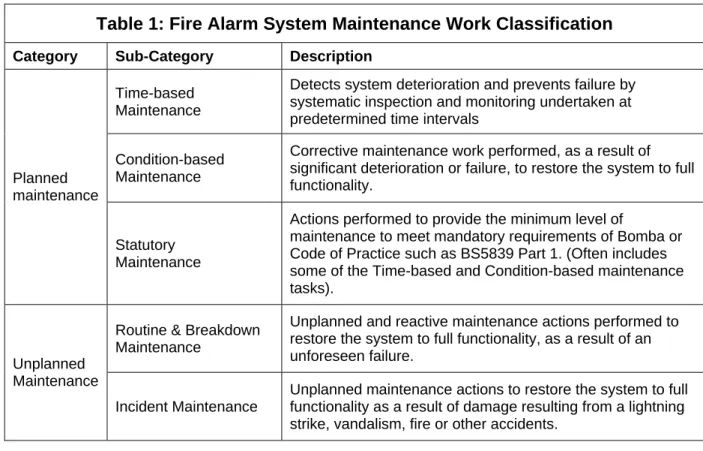
Maintenance tasks are generally classified according to the table below1.
Table 1: Fire Alarm System Maintenance Work Classification
Category Sub-Category Description
Time-based Maintenance
Detects system deterioration and prevents failure by systematic inspection and monitoring undertaken at predetermined time intervals
Condition-based Maintenance
Corrective maintenance work performed, as a result of significant deterioration or failure, to restore the system to full functionality.
Planned maintenance
Statutory Maintenance
Actions performed to provide the minimum level of
maintenance to meet mandatory requirements of Bomba or Code of Practice such as BS5839 Part 1. (Often includes some of the Time-based and Condition-based maintenance tasks).
Routine & Breakdown Maintenance
Unplanned and reactive maintenance actions performed to restore the system to full functionality, as a result of an unforeseen failure.
Unplanned Maintenance
Incident Maintenance
Unplanned maintenance actions to restore the system to full functionality as a result of damage resulting from a lightning strike, vandalism, fire or other accidents.
Servicing & Maintenance of
Fire Alarm Systems
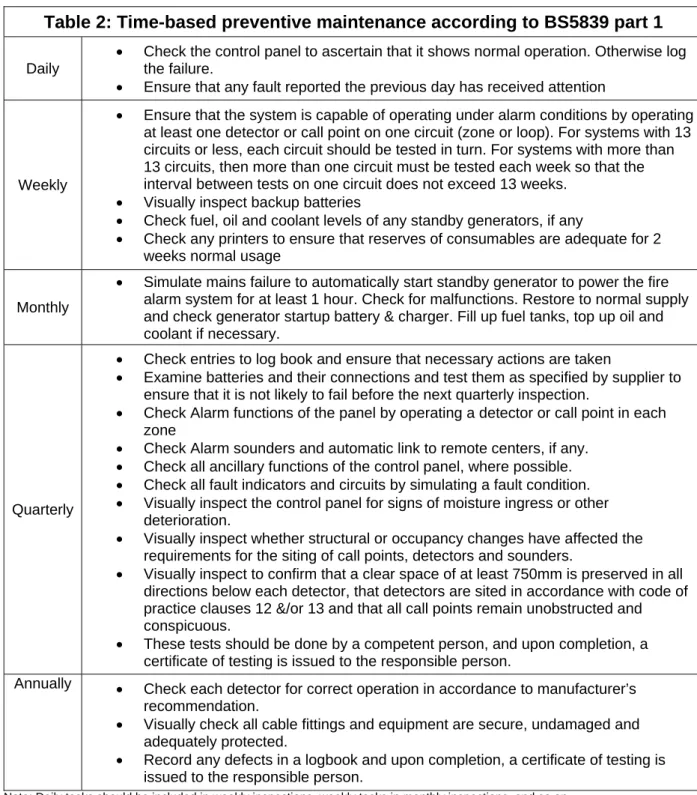
Generally, the more rigorously planned maintenance, and in particularly time-based preventive maintenance is implemented, the less likely is the need for costly and disruptive unplanned maintenance. The code of practice for system design, installation and servicing of a fire detection and alarm system, BS5839 Part 1, lists the recommended tasks to be performed as part of the time-based preventive maintenance program. The fire alarm system is most likely to perform its critical life-safety functions at all times if these maintenance tasks are performed dutifully. Tasks from clauses 29.2.3 – 29.2.7 of the code of practice are summarized below.
Table 2: Time-based preventive maintenance according to BS5839 part 1
Daily• Check the control panel to ascertain that it shows normal operation. Otherwise log the failure.
• Ensure that any fault reported the previous day has received attention
Weekly
• Ensure that the system is capable of operating under alarm conditions by operating at least one detector or call point on one circuit (zone or loop). For systems with 13 circuits or less, each circuit should be tested in turn. For systems with more than 13 circuits, then more than one circuit must be tested each week so that the interval between tests on one circuit does not exceed 13 weeks.
• Visually inspect backup batteries
• Check fuel, oil and coolant levels of any standby generators, if any
• Check any printers to ensure that reserves of consumables are adequate for 2 weeks normal usage
Monthly
• Simulate mains failure to automatically start standby generator to power the fire alarm system for at least 1 hour. Check for malfunctions. Restore to normal supply and check generator startup battery & charger. Fill up fuel tanks, top up oil and coolant if necessary.
Quarterly
• Check entries to log book and ensure that necessary actions are taken
• Examine batteries and their connections and test them as specified by supplier to ensure that it is not likely to fail before the next quarterly inspection.
• Check Alarm functions of the panel by operating a detector or call point in each zone
• Check Alarm sounders and automatic link to remote centers, if any.
• Check all ancillary functions of the control panel, where possible.
• Check all fault indicators and circuits by simulating a fault condition.
• Visually inspect the control panel for signs of moisture ingress or other deterioration.
• Visually inspect whether structural or occupancy changes have affected the requirements for the siting of call points, detectors and sounders.
• Visually inspect to confirm that a clear space of at least 750mm is preserved in all directions below each detector, that detectors are sited in accordance with code of practice clauses 12 &/or 13 and that all call points remain unobstructed and conspicuous.
• These tests should be done by a competent person, and upon completion, a certificate of testing is issued to the responsible person.
Annually • Check each detector for correct operation in accordance to manufacturer’s recommendation.
• Visually check all cable fittings and equipment are secure, undamaged and adequately protected.
• Record any defects in a logbook and upon completion, a certificate of testing is issued to the responsible person.
3.0 Commonly practiced maintenance programs
3.1 Comprehensive maintenance: Outsourced to Facilities Management Companies
Maintenance of the fire alarm system, together with other building services, are managed by a Facilities Management company. For larger facilities, the Facilities Managers (FM) usually have a dedicated on-site maintenance team handling planned and unplanned maintenance tasks. Having a professional maintenance team on-site enables the daily and weekly preventive maintenance tasks listed in table 2 above to be performed more effectively, provided the requirements of the code of practice is defined in the Service Level Agreement (SLA) or contract.
In a scenario where the FM is obligated by such an SLA, the fire alarm system has the best chance of getting the level of care and maintenance it deserves.
3.2 Limited planned maintenance: Outsourced to Fire Maintenance Contractors
A fixed sum contract is established between the property owner and the maintenance contractor covering routine inspections and servicing of the fire alarm system. Typically this covers other systems like hose reel and sprinkler. Frequency of inspections may vary from monthly to annually. When a breakdown or fault is detected during routine inspections, the contractor usually restores the failure following a quotation or charges for repairs according to a pre-determined schedule of rates for material and service.
Daily, weekly or other periodic inspections and tests, as recommended by the code of practice, but not included in the contract have to be carried out by the system owner. In certain cases, these may be totally omitted, with the wrong notion that since a maintenance contract has been signed, everything has been taken care of.
Any system failure occurring in between the contractor’s routine inspections, if detected by the owner, is reported to the maintenance contractor, who will then rectify the fault at an additional expense to the owner. Otherwise, the system failure will be left unattended until the next scheduled inspection.
This mode of maintenance is very commonly practiced due to the relative low cost of signing up such a maintenance contract.
3.3 Zero-based maintenance
Ignorant or low safety-conscious property owners sometimes adopt the zero-based maintenance program, where no maintenance action is undertaken until a breakdown is discovered. In this case, maintenance is totally reactive and unplanned. This form of maintenance strategy is meant for minor non-critical assets and those assets planned for refurbishment, replacement or disposal. Unfortunately, there are cases where a critical life-safety asset like the fire alarm system is being maintained in this manner.
4.0 Challenges faced by system owners
With a few notable and commendable exceptions, for the majority of cases, the quality of care and maintenance given to Fire Alarm systems is not satisfactory.
Despite having a maintenance contract and a maintenance budget, property owners are sometimes faced with the fact that their fire alarm systems remain poorly maintained. For example, a survey of 36 systems in the Klang valley belonging to an owner having a maintenance contract (type 3.2 above) reveals the following:-
• 83% have at least one “fault” condition.
• 28% are in “total failure” condition, i.e. no AC and standby power supply.
• Only 17% are in proper working condition, as indicated by the panel.
A casual system owner may be pleased when the control panel shows “normal” condition. However, this is only “half the battle won”. Many less noticeable system abnormalities can be technically “hidden” from owner’s view, some of which bear potentially life-threatening consequences. For example, it can
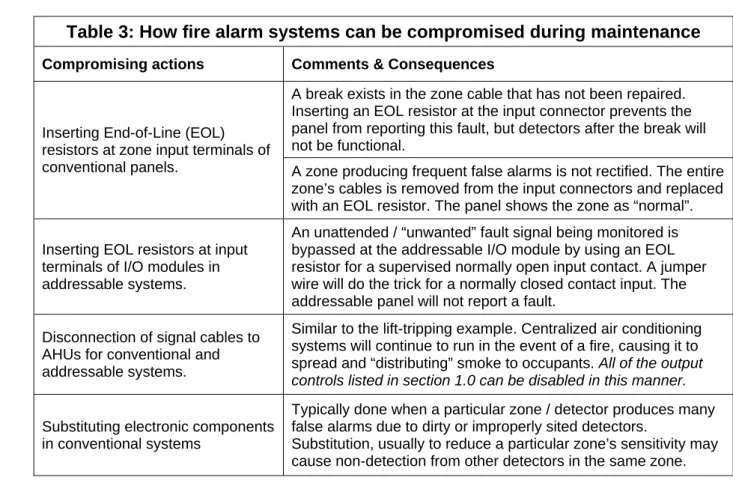
be appreciated from section 1.0 above, the fire alarm system is designed to trip the passenger lifts, bring them to the ground floor and prevent them from further use during a fire. If, due to frequent false alarms and annoyance to occupants, the tripping cable is disconnected from a conventional fire alarm panel, I/O module of an addressable system or the lift control panel, this life-saving function cannot be performed by the fire alarm system. This disconnection will not be annunciated at either control panel. In the course of maintenance, numerous system problems can technically be “hidden”. Listed below are examples of some common or critical situations.
Table 3: How fire alarm systems can be compromised during maintenance
Compromising actions Comments & Consequences
A break exists in the zone cable that has not been repaired. Inserting an EOL resistor at the input connector prevents the panel from reporting this fault, but detectors after the break will not be functional.
Inserting End-of-Line (EOL) resistors at zone input terminals of
conventional panels. A zone producing frequent false alarms is not rectified. The entire zone’s cables is removed from the input connectors and replaced with an EOL resistor. The panel shows the zone as “normal”. Inserting EOL resistors at input
terminals of I/O modules in addressable systems.
An unattended / “unwanted” fault signal being monitored is bypassed at the addressable I/O module by using an EOL resistor for a supervised normally open input contact. A jumper wire will do the trick for a normally closed contact input. The addressable panel will not report a fault.
Disconnection of signal cables to AHUs for conventional and addressable systems.
Similar to the lift-tripping example. Centralized air conditioning systems will continue to run in the event of a fire, causing it to spread and “distributing” smoke to occupants. All of the output controls listed in section 1.0 can be disabled in this manner.
Substituting electronic components in conventional systems
Typically done when a particular zone / detector produces many false alarms due to dirty or improperly sited detectors.
Substitution, usually to reduce a particular zone’s sensitivity may cause non-detection from other detectors in the same zone.
Besides the technical challenges above, system owners also face commercial challenges when managing an outsourced maintenance program. Owners who signed up a planned maintenance contract may initially be very pleased with the apparent low cost of the contract. However, the total cost, inclusive of subsequent unplanned maintenance may end up being much higher than budgeted. In inequitable contracts where the rates are unrealistically low, contractors who sign up such contracts may subsequently try to gain commercial advantage by generating additional revenue through indirect means. It is not uncommon to hear of fire maintenance contracts for a factory going for as low as RM100 per month, which may include monthly inspections of fire alarm systems, hose reel and CO2 systems. Contracts such as these, if entered into, may result in owners spending more than is necessary due to “artificial faults” created, unwarranted recommendations to replace components or to perform upgrades.
In addition, there is little possibility that the contractor is able to perform, even if contracted on paper, the recommended tests during monthly, quarterly and annual inspections given the low prices offered. Larger organizations with multi-tiered management structures may also face some transparency issues. Higher management have little control over dubious work orders and authorizations for artificially created maintenance tasks.
5.0 Challenges faced by the maintenance industry
The fire maintenance industry experienced unprecedented growth over the last several years. This could be attributed in part to new statutory requirements, a greater level of fire safety awareness, and the scarcity of new constructions projects driving more industry players to focus on deriving a more stable and recurring revenue base from the fire maintenance sector.
In an unregulated and highly competitive environment, this rapid growth creates a business environment where contractors are finding it increasingly difficult to render maintenance services professionally while safeguarding their bottom line.
In some cases, unrealistic expectations from clients influenced contractors to veer away from professionalism, with the justification that such inequitable contracts have to be taken up for the sake of “survival”. Price pressures can also come from other players in the industry. Contractors who factor in a professional and high standard of maintenance when bidding for a job may find themselves out priced by others who claim to offer the same service at below market prices. Either way, the result is a general decline in the level of service and professionalism, which ultimately casts a negative image on the fire maintenance industry as a whole.
6.0 Making it work
In the interest of public safety, protection of property and creation of a vibrant and professional fire maintenance industry, owners, contractors and relevant authorities will do well to cooperate on the following issues:-
6.1 Enter into an equitable maintenance contract
The key to a successful maintenance contract is being equitable. The terms, and in particular the price should be reasonable, reflecting the complexity of the task, requirement for technical expertise, time required to physically carry out the inspections in the SLA and the onerous responsibility of taking care of a critical life-safety system. In the long term, owners would benefit by not expecting or imposing an unrealistic price. Likewise contractors would do well to shun contracts that cannot be implemented without compromising on safety, quality and professionalism.
6.2 Create an SLA
When awarding or accepting a fire alarm maintenance contract, create an SLA that clearly defines the planned and unplanned maintenance tasks to be performed. Table 2 above and relevant sections of the Code of Practice could be incorporated. This document could also define, in an objective manner, how the level of service of the contractor could be evaluated through Key Performance Indicators (KPIs). For example, the Response Time of contractor to a request for unplanned maintenance could be defined, together with other KPIs like False Alarms per Detector Year2 and Availability Index3 for the fire alarm system being maintained. With these KPIs,
• owners can appraise their contractors objectively, especially when switching contractors.
• contractors can justify rates charged based on level of service requested.
• authorities have access to objective data and statistics
6.3 Fill in the gaps
When an on-site maintenance contractor team is available, they could be mobilized to physically conduct the daily and weekly inspections as per table 2 above by explicitly including that responsibility in the SLA or contract. In the absence of such an arrangement, the owner has to put in place an in-house maintenance program to conduct the routine inspections in between contractor’s maintenance visits. Otherwise, there is no certainty that the Fire Alarm system remains functional during that interval.
Alternatively, automated fault monitoring and alerting systems may be installed to supervise the fire alarm system on a 24x7 basis. Many such solutions are available, including local area paging systems, auto-dialers, GSM based, and Internet-based solutions.
7.0 Going forward with Electronic Maintenance (eMaintenance)
Many of the challenges faced by owners and contractors discussed above may be attributed in part to the practice that fire alarm system maintenance is usually handled as an after-thought, instead of a built-in feature of the system design. Complex systems are designed, installed, commissioned, and handed over to the owners who often have little expertise in managing the stringent maintenance requirements.
The concept where systems are designed with built-in maintenance facilities can be seen in the telecommunications industry. System designers and manufacturers do not expect telecommunication operators to carry out daily and periodic manual inspections of their network equipment installed in exchanges nationwide. Instead, essential supervisory functions are designed and built-in, such that the operational status down to the lowest or remotest node is readily available centrally.
The same can be achieved for the fire alarm system. Consider the following progression in system design enhancement:
(1) In its most rudimentary form, self-contained smoke detectors are installed in protected areas. These devices are not electronically supervised and require periodic manual inspections and maintenance. Because of this, their use is confined mainly to the protection of homes, and is generally not deployed in commercial assets.
(2) This basic detection and alarm system is greatly enhanced when self-contained smoke detectors are replaced with wired detectors that are continuously supervised by a control panel. The detectors now require manual inspections only once a year, but the control panel now requires daily inspections. This is the existing industry norm.
(3) If the concept of electronic supervision is extended another layer upwards (eMaintenance layer) by treating all control panels as “detectors”, then the overall system is further enhanced with built-in maintenance features. Many of the issues discussed above could be effectively addressed by such a globally networked fire alarm system. It will enjoy the same high level of availability and standard of maintenance as other public utilities like telecommunications and power.
The figure below illustrates one possible embodiment of such a network architecture which may be implemented using low cost embedded Internet technologies for as little as 5% of the cost of a typical fire alarm system.
1Adapted from Maintenance Management Framework Policy of Queensland Government Building Division http://www.build.qld.gov.au/amps/mmfpolicy.asp
2See guidelines from the London Fire & Emergency Planning Authority document http://www.fire.org.uk/papers/4_Consolidated__CACFOA_consultation_documents.pdf 3Concept and implementation of Fire Alarm Availability Index by Devices World http://www.devicesworld.net/download/benchmark.pdf Compartment 1 Detector Compartment n Detector Control Panel Compartment 1 Detector Control Panel Compartment 1 Detector Compartment n Detector Site n Control Panel eMaintenance Server Internet eMaintenance Layer Owner 1 Owner n
Mobile Alerts Mobile Alerts
Compartment n Detector Site 2 Site 1 Internet-enabled control panels
CK Diong, Devices World Sdn Bhd