Executive summary
In 2007, Intel first demonstrated its Eco-Rack Proof of Concept (Eco-Rack 1.0). This was a
real-world test of the power savings possible in rack-mounted servers using available technologies
and making simple changes to existing components. Developed at Intel facilities in both Hillsboro,
Oregon and DuPont, Washington, and inspired by discussions with the U.S. Environmental Protection
Agency (EPA) and Lawrence Berkeley National Laboratory (LBNL), this demonstration showcased
several industry advancements in energy-efficient technology for the data center. The result
was a 16-18 percent total power savings based on workload or configuration.
2For 2008, Intel again assembled a test setup of 30 rack-mounted servers and tested some of
the same, as well as some new, power management technologies and strategies for the data
center. The result? The Intel Eco-Rack 1.5 achieved even better results: 23-30 percent total
power savings, depending on the workload, as measured by running compute-intensive enterprise
applications such as SPECjbb (a warehousing application simulating many transactions at the
same time).
3In this paper, we describe what modifications Intel did to achieve these savings and make recommendations on which ones might be most effective. Some of the technologies and features we tested include:
• DC power delivery to servers
• Enhanced Intel SpeedStep® technology in the BIOS • 2 GB memory modules
• Enhanced HALT state (C1E)
• Quad-Rank Fully Buffered DIMM (FB-DIMM) • FB-DIMM Idle Power Enhancement Driver (FIPE) • Memory refresh
• Closed Loop Thermal Throttling (CLTT)
Achieving 23-30% total power savings with a server rack
designed for excellence in power efficiency
1White Paper
Intel® Eco-RackMost surprising was that, depending on workload, CLTT
alone accounted for 20.5 to 36.6 percent of total overall energy savings.
What makes all these savings so important is that data centers consume a measurable percentage of the world’s energy—despite being such a relatively recent phenomenon in energy consumption. In an age increasingly concerned with carbon dioxide (CO2) emissions and global warming, achieving global goals for environmental protection, conservation and sustainability will require new technological advance-ments in many areas, including the data center. This innovative demonstration serves as an education tool to illustrate:
• The real-world possibilities inherent in using leading-edge technologies
and employing various server-level configuration changes
• The energy savings and financial benefits these technologies and
settings offer data centers
• The productivity gains energy-efficient data centers can deliver
to businesses, governments, and other organizations
The future looks bright for power-saving developments such as the Eco-Rack. Intel and the industry are continuing to address the challenge of powering tomorrow’s data centers and reducing their environmental footprint through a broad set of innovations that enable more work to be done with less power. As Francesco Serafini, VP Hewlett Packard
EMEA, has said:
“ICT [information and communications technology] covers two percent of the global energy consumption. We can
work to halve it to one percent, but the priority is to work to decrease the remaining 98 percent.” 4
The message here is clear. As important as it is for ICT to cut its own consumption, it is even more important for ICT to continue providing valuable productivity gains which will reduce energy consumption in all sectors. These improvements will come in the form of everything from microprocessors in automobiles that improve gas mileage by moni-toring every factor contributing to the efficacy of the fuel/air mixture, to chips in cell phones that may enable video conferencing and potentially reduce the number of plane flights taken for business.
Introduction
As economies around the world depend increasingly on digital information management, data centers housing the electronic equipment used for data processing, data storage, and communications networking have become essential to business, transportation,
communications, government, and academic institutions. Many factors
are driving the demand for more and larger data centers:
• Electronic transactions in financial services, such as
online banking and electronic trading
• Internet communications and entertainment • Electronic record-keeping for healthcare • Global commerce and services
• Satellite navigation and electronic shipment tracking
in transportation
• Emergency, health, and safety services • Information security and national security • High performance scientific computing
• Digital provision of government services, such as electronic
filing of taxes and online postal tracking
The sheer number of people adopting and using Internet and related online services and applications is also driving data center growth. According to Jupiter Research’s “Worldwide Online Population Forecast, 2006 to 2011,” 1.1 billion people currently enjoy regular access to the Internet. This report goes on to predict that a compound annual growth rate of 6.6 percent will increase the number of people with regular online access to approximately 1.5 billion (or 22 percent of the Earth’s population) in 2011.
Powering the data centers serving this growing number of online users is another matter. Data centers are a fast-growing phenomenon in the world of power consumption. According to the U.S. EPA, the nation’s data centers and servers consumed about 1.5 percent of the U.S. total electricity consumption in 2006.5
To put this in perspective, the EPA notes that this is more than the electricity consumed by the nation’s color televisions and is “similar to the amount of electricity consumed by approximately 5.8 million average U.S. households (or around five percent of the total U.S. housing stock).”6
This same EPA report also suggests the problem is going to continue to grow, forcing data centers to compete for increasingly limited power resources with every other electrical user, from heavy industry to home users. The EPA predicts that “under current efficiency trends, national
energy consumption by servers and data centers could nearly double again in another five years (i.e., by 2011) to more than 100 billion kWh, representing a $7.4 billion annual electricity cost” and the addition of 10 power plants to the nation’s power grid.7
But competition for electricity is only one challenge data centers face. The cost of power is also troubling to many data center operators.
According to Gartner, as power requirements continue to grow, energy
costs will emerge as the second highest operating cost (after personnel) in 70 percent of worldwide data center facilities by 2009.8 The average
annual power costs for a 100,000 square-foot data center is nearly USD 6 million.9 Some organizations are already cutting back on
expan-sion because adding more servers would require a complete overhaul of the entire power and cooling infrastructure of their data center.
This is in line with a prediction Gartner made back in 2006 that 50
percent of data centers would have insufficient power and cooling capacity by 2008.10
Microprocessors are an important part
of the solution
What is surprising is that these problems are appearing despite some of the greatest energy efficiency gains per unit of processing power
the world has ever seen. In March 2008, for instance, Intel introduced
two energy-efficient 50-watt server processors that directly benefit companies with power-constrained, high-compute density
environ-ments. These Intel® Xeon® L5400 processors are as much as 25
percent faster11 and have a 50 percent larger cache size than Intel’s previous-generation, low-voltage Intel® Xeon® processors, while at the
same time maintaining the low 50-watt thermal envelope. These pro-cessors use Intel’s hafnium-infused high-k metal gate transistors, an innovation that has enabled Intel’s quad-core 45nm low-voltage server chips to attain new heights in power-efficient performance. Unfortunately, many processor efficiency advances like these are not being capitalized on yet because most data centers still run older equipment. A former director of Intel’s IT operations admits that is true even at Intel, but that the company is moving faster now in taking advantage of its processor advances. He was quoted as saying that “a six-year-old server takes up valuable resources that could be better used, so we [Intel] have accelerated our refresh rate. Refreshing one data center gave us [Intel] three times the performance…”12
Saving energy in data centers requires more than
energy-efficient processors
Replacing older servers with new ones using energy-efficient proces-sors is just one part of the solution. A data center with all its systems for power conversion, distribution, backup storage, and cooling has many other options than just its computing power (processors) for saving energy. So, while much has been done to improve processor performance and efficiency, Intel and other industry leaders believe it is time to take a more holistic approach to planning, designing and laying out the data center to optimize power and cooling capacity. This includes finding ways to optimize all the variables, including build-ing type, buildbuild-ing systems, rack configuration, power conversion and distribution, monitoring and managing workloads, airflow dynamics, and many other energy-consumption factors.
Intel and the industry are addressing these variables through a broad set of innovations designed to enable data centers to do more work with less power. One of Intel’s ongoing efforts is the Eco-Rack Proof of Concept. Eco-Rack Version 1.5 is meant to be a model of what can be achieved today using available technologies and making simple changes to existing components.
This paper will describe the current Eco-Rack’s objectives, setup, and results.
The importance of rack-mounted servers
To understand why Intel chose to focus on server racks, it is important to understand their advantages in the modern data center. Today’s high-density rack-mounted servers reduce space, cooling, networking, cabling and management costs—as well as total power consumption— compared to low-density configurations having far few servers per rack. However, some data center managers fear rack-mounted servers will drive up power density to levels exceeding the limits of their facilities. While the power density of a fully-populated rack of 1U rack-mounted servers may be too high for most data centers,13 many advantages of
these racks—such as the lower power consumption per server—can be gained at lower densities. In fact, the primary total cost of ownership (TCO) benefit related to their use comes from their reduced power consumption, not their reduced space consumption. The use of more efficient cooling designs that concentrate just on the racks (rather than cooling the entire facility) can deliver additional savings. Recent research suggests that by installing rack-mounted servers at various densities, data centers could realize greater TCO benefits.14
standard 75 percent efficient power supplies and 88 percent uninterruptible power supplies) and another watt for cooling the two watts of load (one watt, silicon; one watt, power conversion).
Test setups
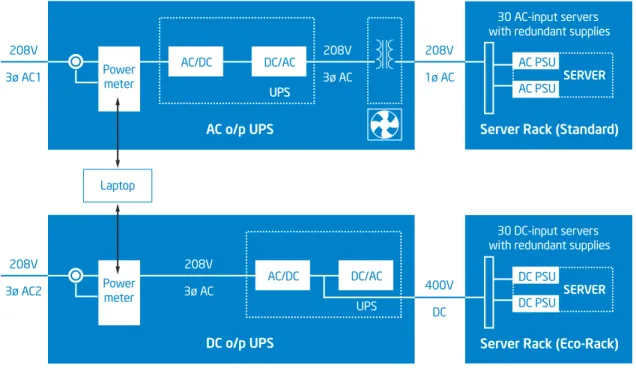
To ensure a fair comparison, Intel set up two test racks—the Eco-Rack
and a typical Modern AC Configuration—each holding 30 1U rack-mounted servers. The typical Modern AC Configuration provided the baseline
for typical power consumption upon which the savings of each Eco-Rack modification was computed.
Each server featured two Intel® Xeon® processors X5355 (2.66 GHz). All
servers were running Fedora Core 5* 64-bit with Kernel 2.6.15-1.2054_
FC5 with IPMI enabled. The power factor for the uninterruptible power supplies (UPS) on the standard rack setup—referred to as the Modern
Alternating Current (AC) Configuration in this paper—was 0.99. This 0.99 power factor was equivalent to the UPS performance of the direct current (DC)-based Eco-Rack setup, which, because it is a DC-based system, required no complex power phasing.
The goal was to compare a typical modern configuration with an Eco-Rack design providing equal performance, but requiring less power. Below we further describe each configuration.
Objectives for the Eco-Rack Proof of Concept 1.5
The Intel Eco-Rack Proof of Concept is a real-world example of the power savings and environmental footprint reduction possible in today’s data centers through the use of rack-mounted servers employing today’s power management technologies and making simple changes to existing components. Developed at Intel facilities in Hillsboro, Oregon and DuPont, Washington, the demonstration showcases industry advancements in the delivery of energy-efficient technology for the data center. It is designed to serve as an education tool to illus-trate the real-world possibilities inherent in leading-edge technologies, the financial benefits their energy savings provide data centers, and the productivity gains that more energy-efficient data centers can deliver to businesses, governments, and other organizations. With the Eco-Rack Proof of Concept Version 1.5, Intel shows how through relatively modest modifications to today’s best-in-class server rack components, the power consumption of rack-mounted
servers can be further reduced. Many of these modifications are
power management features that are not used in the belief that they will affect performance or availability. In most cases, the effect of these features on performance and availability is negligible, while their potential for energy savings is considerable.
It should be noted that any reduction of power consumed in a data center has considerable ramifications in reducing heat and thus cool-ing costs. Every watt of power directly consumed by silicon in a typical data center requires another watt for power conversion (based on
Test Setup
Power meter
Laptop
AC o/p UPS Server Rack (Standard)
UPS UPS
208V
30 AC-input servers with redundant supplies
30 DC-input servers with redundant supplies 3øAC 208V 1øAC 400V DC 208V 3øAC1 DC/AC AC/DC Power meter DC o/p UPS UPS 208V 3øAC 208V 3øAC2 DC/AC AC/DC AC PSU SERVER AC PSU
Server Rack (Eco-Rack)
DC PSU
SERVER
DC PSU
Server Detail Loads 208V 1øAC SERVER Modern AC Configuration AC PSU SERVER AC PSU 410V = PSU DC/DC AC/DC 410V = PSU DC/DC AC/DC Fans PDB VR Loads 400V DC SERVER Eco-Rack DC PSU SERVER DC PSU 12V 12V PSU DC/DC = DC/DC Fans PDB VR 208V 1ø AC 410V DC PSU =
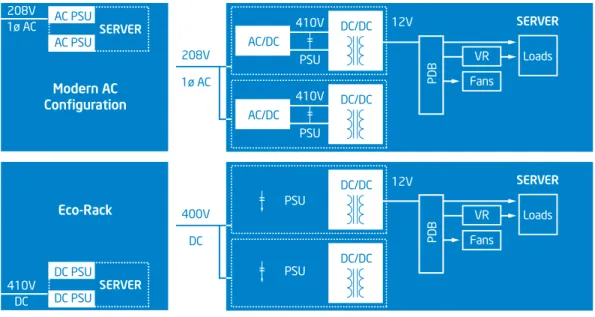
Figure 2. Server detail. These diagrams provide the power distribution details within each server. Note the fewer conversion stages in the Eco-Rack.
Modern AC configuration
This setup featured 30 1U rack-mounted servers equipped with Intel
Xeon Processors X5355 (2.66 GHz, Stepping 11) and 8 GB of memory supplied by eight 1 GB FB-DIMMs. Supported by the Intel® 5000 chipset family and FB-DIMM technology, Quad-Core Intel Xeon processor 5300
series-based platforms deliver exceptional performance with better power efficiency: Up to 1.5 times the performance compared to leading
Intel® Xeon® processor 5100 series in the same power envelope and
up to 2.4 times the performance compared to the best published
results of AMD Opteron* Model 2222.15
To provide the best possible setup for comparison with the Eco-Rack, we configured this modern rack with best-in-class components that are commercially available today. This includes using greater than 90 percent efficient power supply units (PSUs) for both the main
and redundant PSUs for each system. To make the Modern AC
Configuration the best baseline for our Proof of Concept, we turned off most of the selectable processor and chipset power management technologies. To provide the most accurate reading on power draw, we measured current coming directly from the wall rather than after it passed through a UPS.
In a typical data center, 480 volts is stepped down through a power distribution unit (PDU) to 208 volts AC to feed each server in the rack. To simulate this using 208 volts AC, we step across 208 AC through a PDU after it passes through the UPS. The PSUs, and later the voltage regulators, in each server then progressively convert and step down the current to the 12 volts and less DC required by the various server components. While the typical power conversion efficiency for
the conventional architecture is just below 50 percent, a system using best-in-class components like this one can achieve up to 71 percent efficiency.
Eco-Rack Configuration. This setup started out exactly the same
as the typical Modern AC Configuration. We then made a series of
changes (described below) to evaluate the energy savings potential of each modification.
Eco-Rack modifications
In this section, we describe each of the modifications we made and the sequence in which they were done to try to improve energy efficiency. The effect of each modification was measured on four different work-loads: idle, two active cores (25 percent total capacity), four active cores (50 percent), and eight active cores (100 percent).
1. Activating Enhanced Intel SpeedStep® technology
Enhanced Intel SpeedStep technology enables Intel® Server Boards to
dynamically adjust processor voltage and core frequency, which can result in decreased average power consumption and decreased average heat production for a reduction in operating costs. By turning on Enhanced Intel SpeedStep technology through the BIOS, data center managers can reduce server power consumption and cooling costs with little effect on performance.16
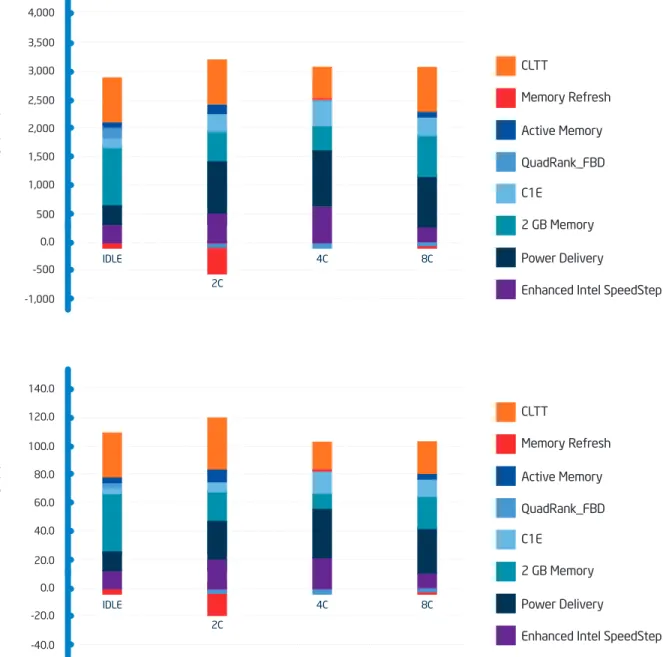
As our first modification, Enhanced Intel SpeedStep technology proved very effective. Depending on workload, it accounted for 9.4 to 22.5 percent of total overall energy savings.
2. Power delivery
The second modification we tried was converting the Eco-Rack setup to DC power. We eliminated the initial power conversion step by using 400 volts DC power directly. This improves energy efficiency by reducing the power losses due to: 1) power conversion, and 2) the need to cool the excess heat that this conversion generates. To use DC power, we deactivated the DC-back-to-AC power conversion in the UPS and sent the 400V DC directly to a DC power strip for the servers. Servers were equipped with DC PSUs to progressively step down the current to the 12 volts and less DC required by the various server components. Again, to provide the most accurate reading on power draw, we measured current coming directly from the wall rather than after it passed through a UPS.
Depending on workload, DC power delivery accounted for 14.1 to 33.8 percent of total overall energy savings.
3. Memory configuration
Our third modification involved memory configuration. Instead of the
eight 1 GB FB-DIMMs used by the Modern AC Configuration, we inserted four 2 GB FB-DIMMs. Using fewer memory modules (four versus eight)
reduces active power consumption, produces less heat, and requires less energy to be spent in cooling. It is important to note that for
optimum performance, FB-DIMM memory modules should be equally
divided between the memory channels (e.g., one memory module for each of four memory channels).
Depending on workload, the switch to 2 GB FB-DIMMs accounted
for 11.2 to 35.3 percent of total overall energy savings.
(Note: Besides capacity, DIMMs can differ in wattage draw, memory
speed, and the number of ranks. All of these can affect both energy consumption and performance. It is smart to compare carefully before making a purchase to ensure goals in energy savings and performance will be met.)
4. Enhanced HALT state (C1E)
C1E reduces processor speed and voltage when the processor is in idle mode, decreasing power consumption and heat generation. The C1E state is invoked when the operating system’s idle process issues a
HALT (HLT) command. Most operating systems do this repeatedly
when not under a full load. The C1E halt state turns down the entire CPU’s clock frequency (via multiplier control) and voltage, squeezing out extra energy savings.
Whether or not the processor actually gets the HLT command is determined by settings related to the chipset. Values are generally set in the BIOS. The setting/value can be enabled or disabled.
Some motherboards BIOS default to preventing the HLT command from being effective. Other motherboards do not even have an option in the BIOS setup to alter the defaults. In such cases, it may be possible to set values through third party software that manipulates the chipset registers.
(In most servers, enabling power management through the BIOS activates all native power management strategies, including C1E, Enhanced Intel SpeedStep technology, and others. Our setup allowed us to isolate each technology to evaluate their effect.)
Depending on workload, setting the C1E state to “enabled” versus “disabled” accounted for between 4.5 to 15 percent of total overall energy savings.
5. Quad-Rank 2 GB FB-DIMMs
For our fifth modification, we tried exchanging the 2 GB FB-DIMMs
used in our third modification (described above) with low-power
quad-rank 2 GB FB-DIMMs. Most 2 GB FB-DIMMs are standard two-quad-rank registered memory. They are high density FB-DIMMs created using high-end chips arrayed across the memory board. Quad-rank FB-DIMMs are twice as tall, with the top set of chips flipped over 180
degrees to reduce latency between top and bottom. This enables
production of 2 GB FB-DIMMs composed of four 512 MB memory chips. These new quad-rank FB-DIMMs include a low-power advanced
memory buffer. Our intent was to reduce the wattage footprint of the Eco-Rack’s memory modules while also using a lower cost memory product. As before, it is important to note that for optimum
perfor-mance, FB-DIMM memory modules should be equally divided between
the memory channels.
This modification did not achieve significant results. In fact, under most workloads it actually was less efficient, accounting for -3.8 to 4.6 percent of total overall energy savings. Only at idle workloads did it have a positive effect. However, if performance is a priority, quad-rank is the way to go.
6. Fully Buffered DIMM Idle Power Enhancement Driver (FIPE) The sixth modification in our progression evaluated FIPE, a software driver available only for Linux.* This software runs continuously querying sequentially each of the four cores in each socket to check how busy they are. If they are not busy, it throttles the memory subsystem down to a lower frequency to save power. We activated this feature by compiling and turning the driver on (insmod method). This modification had its greatest effect at idle and 25 percent workload (3.6 percent and 5.7 percent of total energy savings, respectively). It had zero effect at a 50 percent workload, but then managed 2.7 percent of total energy savings at a full workload.
If we average this, anticipating that the workload will vary throughout the day (which is the case with most data center servers), we could anticipate total overall energy savings of about 3 percent for this modification.
This feature will be in future Linux kernels, and is included natively in
hardware such as dual-processor platforms with Intel® 5400A or
5400B chipsets. 7. Memory refresh
Memory refresh is the process of periodically reading information
from an area of computer memory and immediately rewriting the read information to the same area with no modifications. Each memory
refresh cycle refreshes a succeeding area of memory. Memory refresh
is most often associated with modern dynamic random access memory
(DRAM). Double memory refresh is the default. For this test, we
changed the setting to single memory refresh (forcing it on through the operating system—though in some systems it can be set in the BIOS). Instead of memory being accessed two times for every refresh cycle, it was now only accessed once. The assumption here was that by reducing the number of times memory is accessed for a refresh, we would save power.
This assumption turned out to be wrong. In fact, at 25 percent workload, single memory refresh resulted in a 15.6 percent loss in total overall energy savings. At other workloads, its effect was less dramatic, and at 50 percent workload there was actually a slight improvement (0.7 percent) in total overall energy savings. 8. Closed Loop Thermal Throttling (CLTT)
CLTT is a feature of the Intel® chipset to prevent FB-DIMM memory
from overheating. This is a temperature-based throttling feature used
with variable speed fans. If the temperature of the installed FB-DIMMs
approaches their thermal limit, the system BIOS will initiate memory
throttling. This limits bandwidth to the DIMMs, therefore capping the power consumption and preventing the DIMMs from overheating.
By default, the BIOS will configure the system to support CLTT if it
detects that there are functional Advanced Memory Buffer (AMB) thermal sensors present on all installed DIMMs (though sometimes the
sensors are on the motherboard, or both). In CLTT mode, the system fans run slower to meet the acoustic limits for the given platform, but will also allow the fans to ramp up as needed to maintain the parts within temperature specifications under high stress levels. In a similar way to Open Loop Thermal Throttling (OLTT), the system BIOS utilizes
a Memory Reference Code (MRC) throttling algorithm to maximize memory bandwidth for a given configuration. The MRC code relies on Serial Presence Detect (SPD) data read from the installed DIMMs.
Closed Loop Throttling is autonomous and internal to the MCH
hardware and the throttling algorithm always throttles the minimum amount required to prevent the part from overheating. CLTT is the Intel preferred platform control mechanism as it provides the best memory bandwidth performance while providing the lowest system fan acoustics.
CLTT turned out to be very effective in reducing power consumption. Depending on workload, CLTT accounted for 20.5 to 36.6 percent of total overall energy savings.
The tests
Tests were done under the guidance of the Lawrence Berkeley National Laboratory in California. The test configurations ran JILL5, a version of the industry-standard SPECjbb benchmark that tests Java
Virtual Machine* performance by running a Java-based order fulfillment
warehouse application. SPECjbb is generally regarded by the industry
as being a realistic JVM performance benchmark with a real-world
typical instruction mix. JILL5/SpecJbb does not measure I/O perfor-mance (e.g., disk, network) since all its transaction requests are synthesized internally.
One of the configuration parameters is the number of warehouses to run in parallel. For power-measurement purposes, we did separate runs at two, four and eight warehouses to approximate 200, 400, and 800 percent of normalized single-CPU utilization.
6,459 – 9,640 W
Total Power
23 – 30%
30 servers
Power Savings
Depending on workload and configuration
0 W 15,000 W Eco Rack 9,265 – 12,575 W Total Power 0 W 15,000 W Standard Rack
Since JILL5/SPECjbb is intended to be a benchmark, it is normally run for a fixed amount of wall clock time, after which it reports a result in billions of operations per second (bops). Since we are using it to simulate a continuous system load instead of as a benchmark, we set its run-time to 9...999 minutes instead of the normal benchmark runtime. We never wait for it to finish.
Note that as the number of warehouses-in-parallel approaches the number of logical processors, the CPU utilization drops a bit below
the theoretically attainable amount of 100 percent of X number of
warehouses. This is probably due to the warehouse threads contending with one another for some single resource such as a lock on the results-counter, overall memory contention, other CPU resources, etc.
Test results
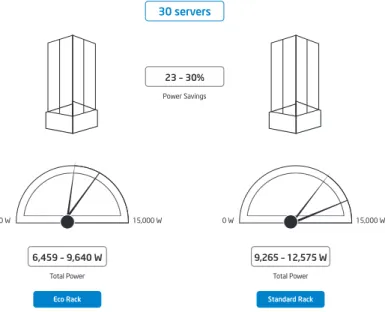
Running JILL5/SPECjbb, the Eco-Rack demonstrated measured total power savings of 23 to 30 percent, depending on workload or config-uration, over a standard data center AC server rack configuration. Projecting even the lowest power savings (23 percent) to a data cen-ter with 1,000 servers and a power cost of USD 0.062 per kilowatt hour, the modest changes represented by the Eco-Rack configuration could annually save a company or organization tens to hundreds of thousands of dollars depending on the size of the data center, the number of racks, and the number of servers per rack.
In a power-constrained environment, these same power savings could also be used to make better use of available power and add more compute cycles. (See hypothetical example below.)
2,500 2,000 1,500 1,000 0.0 IDLE 2C 4C 8C 500 -500 -1,000 3,500 3,000 4,000 Active Memory QuadRank_FBD Memory Refresh CLTT Power Delivery
Enhanced Intel SpeedStep 2 GB Memory C1E Po w er Savings (W att) 100.0 80.0 60.0 40.0 0.0 IDLE 2C 4C 8C 20.0 -20.0 -40.0 140.0 120.0 Active Memory QuadRank_FBD Memory Refresh CLTT Power Delivery
Enhanced Intel SpeedStep 2 GB Memory
C1E
Po
w
er Savings (%)
A hypothetical example of how data center
power constraints affect operations
To see the advantages of something like the Eco-Rack and other data center energy efficiency enhancements, it is helpful to look at a hypothetical example of how the power constraints of a data center might actually hurt a company’s bottom line.
Consider a financial firm that is faced with a data center that has outgrown its power resources. Like many financial companies, this firm has to borrow a certain amount of money at the end of every day to hedge its next day’s loans and other money it needs to have available. If the firm does not have enough power in their data center to run the compute cycles it needs to accurately compute how much it needs to borrow, the firm has to increase this hedge, borrowing
more than necessary to be “safe.” Many financial companies do this,
borrowing and paying for more money than they need to make up for their inability to accurately and quickly calculate what they need for the next day. This directly affects a firm’s profits. By updating their data centers with modifications such as those demonstrated by the Eco-Rack Version 1.5, financial firms could make better use of their available power and potentially gain the compute cycles they need to much more accurately compute their daily hedge. For many, the interest saved on borrowed hedge money would far outweigh the cost of the power to run these compute cycles on the more efficient servers.
Conclusions
The Eco-Rack Proof of Concept demonstrates how server-level changes—such as converting to DC power delivery to servers, activating Enhanced Intel SpeedStep technology in the BIOS, using more efficient
2 GB memory modules, and activating CLTT—can deliver significant
savings at the rack-level for today’s data centers. Incorporating these changes resulted in a measured total power savings of 23 to 30 percent, depending on workload, when running compute-intensive enterprise applications such as SPECjbb, a warehousing application simulating many transactions at the same time.
Many of these “small” changes are things data center managers can
do today. In fact, if we could make just one recommendation from this study, it would be to activate CLTT. Depending on workload, CLTT alone accounted for 20.5 to 36.6 percent of total overall energy savings.
Utilizing power optimization features and settings can go a long way to saving energy and reducing TCO. So can specifying best-in-class, energy-efficient components in everything from server processors to PSUs. Other changes, such as DC power components, will take more time for the industry to adopt. One can also save from 30 to 50 watts per server, depending on workload, by removing the redundant power supply.
The future looks bright. Intel and the industry are continuing to address the challenge of powering tomorrow’s data centers and reducing their environmental footprint through a broad set of innovations that enable more work to be done with less power. We summarize many of these below.
Promising power-reduction technologies and
strategies for data centers
400V DC Distribution
Having each server in the rack accept 400V DC reduces the number of
power conversion stages compared to the Modern AC Configuration.
The AC-to-DC conversion in the UPS, the AC-to-AC conversion in the PDU transformer, and the AC-to-DC conversion in the PSU are eliminated. Fewer power conversion steps reduce energy lost to conversions and result in fewer power conversion components to cool. In addition, since fewer components are required for power conversion, system reliability is expected to increase.
Distribution at 400V DC also allows for a more efficient connection of renewable energy sources to a building since most renewable energy sources (e.g., fuel cells and photovoltaic panels) generate a DC voltage. The use of DC power also eliminates the need for balancing the load across the three phases as required in AC distribution. This saves time and effort and eliminates the need for equipment monitoring the load imbalance.
Overall, the advantages of direct high voltage DC systems (400VDC) include:
• Removes redundant conversion in end-to-end data center
power architecture
• Seven- to 10-percent energy-efficiency gain • 10 times higher availability17
• Commonly available UPS, battery and PSU technology
(just less parts)
• Lower thermal footprint
• No complex power phasing/balancing • Easy-to-parallel power sources
High Performance, Energy-Efficient Quad-Core Processors Based on Intel® Core™ Microarchitecture
For every watt saved in computation, two additional watts are saved—one watt in power conversion and one watt in cooling (the result of no longer having to cool two watts in computation and power conversion). Consequently, big power savings can be gained from small percentages in processor power savings. Information on the latest gains in performance and energy efficiency by
Intel Xeon processors can be found at:
Processor Voltage Optimization
Intel Core microarchitecture’s Intel® Intelligent Power Capability throttles
down processor performance in response to lower demand. This capability enables excellent energy efficiency in a wide variety of loads. Data centers using the latest Intel processors will profit from this technology. Optimizing BIOS and System Firmware Settings
Through Enhanced Intel SpeedStep technology, Intel Server Boards can dynamically ramp processor speed and voltages to minimize power consumption and reduce operating costs. By turning on Enhanced Intel SpeedStep technology through the BIOS, data center managers can reduce server power consumption and cooling costs by up to 25% with little effect on performance.18 Updating system
firm-ware settings to appropriately reflect system components, such as processor number and type and fan speeds, can often reduce the speed at which fans run, providing additional power savings. Greater Than 90 Percent Efficient PSUs
Typical server PSUs (one element in a data center’s power conversion chain) are only 50 percent efficient, yet units can be purchased that are 90 percent efficient or more and pay for their additional cost in less than a year. Depending on the number of servers in a data center, 90 percent efficient PSUs can have a significant effect on power savings.
Improved Rack Design
Cooled doors, chimneys, raised floors, and other data center design improvements increase air flow effectiveness and reduce cooling
costs. Much information is already available from Intel and other
sources on ways to design data centers so cooling is directed at the components putting out the heat and not at the facility at large.19
Server Consolidation
In many data centers, more servers are running than necessary for the work being done. A study by Hewlett Packard Lab of six corporate data centers studied 1,000 servers and found that most were using only 10 to 25 percent of their capacity.20 To combat this trend, a major
Intel focus is promoting better server utilization through server consolidation. Consolidation through virtualization reduces the number of physical servers required, thereby helping to minimize
floor space, cooling, and capital costs. Many data center operators
are responding to the call for consolidation by installing virtual
machine software on powerful Intel®-based servers equipped with Intel® Virtualization Technology (Intel® VT). This enables a single
server to run multiple operating systems and applications.
An important benefit of server consolidation is greater energy efficiency. Having fewer servers do more work reduces both the number of servers drawing power and the number of servers that need cooling.
Intel IT did a benchmarking study comparing two- and four-socket
servers with Intel® quad-core processors in a virtualized environment
(see: http://communities.intel.com/docs/DOC-1512). The study found that in memory-intensive deployment scenarios, a four-socket server
based on the Intel® Xeon® processor 7300 series can support approxi -mately 15 percent more virtual machines for the same TCO than a deployment based on two-socket servers. For scalability-focused scenar-ios, the four-socket server offered nearly twice the scalability. The
Quad-Core Intel Xeon processor 7300 series provides up to 1.9x scal
-able performance improvement over two-socket Intel Xeon processor
5300 series-based servers.21 Only in situations where server demand
was limited by business policy or other factors was the two-socket
server (based on the Quad-Core Intel Xeon processor 5300 series)
more cost-effective.
For those situations such as license restrictions or more modest
virtu-alization workloads, the Intel® Xeon® processor 5300 and 5400 series
are excellent choices. This processor series delivers four energy-efficient processor cores and Intel VT to deliver the most headroom for virtual-ization on a two-socket server, all while providing record-setting performance. (See performance site for full details: www.intel.com/ performance/server/xeon/vt_vcon1.htm.)
Some of the acronyms used in this paper
AC Alternating Current
AMB Advanced Memory Buffer
CLTT Closed Loop Thermal Throttling C1E Enhanced HALT State
DC Direct Current
DRAM Dynamic Random Access Memory
EPA U.S. Environmental Protection Agency FB Fully Buffered
FIPE Fully Buffered DIMM Idle Power Enhancement Driver
HLT HALT
ICT Information and Communications Technology
Intel® VT Intel® Virtualization Technology
LBNL Lawrence Berkeley National Laboratory OLTT Open Loop Thermal Throttling PSU Power Supply Unit
SPD Serial Presence Detect TCO Total Cost of Ownership UPS Uninterruptible Power Supply
Find out about Intel’s Eco-Technology Innovation at
www.intel.com/technology/index3.htm
Download the Intel white paper “The State of Data Center Cooling” at
http://download.intel.com/technology/EEP/data-center-efficiency/state-of-data-center-cooling.pdf
Download the Intel white paper “Turning Challenges into Opportunities in the Data Center” at
www.intel.com/technology/eep/data-center-efficiency/dcwhpaper.pdf
Functionality, performance or other benefits will vary depending on hardware and software configurations and may require a BIOS update. Software applications may not be compatible with all operating systems. Please check with your application vendor.
Intel® processor numbers are not a measure of performance. Processor numbers differentiate features within each processor series, not across different processor sequences. See www.intel.com/products/processor_number for details.
1. Based on workload or configuration.
2. “Intel® Eco-Rack: Achieving 16-18% total power savings with a server rack designed for excellence in power efficiency,” Intel white paper, 2007.
3. SPECjbb2005* is slightly different than SPECpower_ssj2008* (a simulation we intend to use for future benchmarking). 4. “EU plans mandatory energy-efficiency standards for ICT,” EurActiv.com, February 22, 2008.
5. Report to Congress on Server and Data Center Energy Efficiency Public Law 109-431, US EPA, ENERGY STAR Program, August 2, 2007, pp. 10-11. 6. Ibid.
7. Ibid.
8. Gartner Says 50 Percent of Data Centers Will Have Insufficient Power and Cooling Capacity by 2008, Gartner Inc. press release, November 29, 2006. 9. Mark, Roy, House Green Lights EPA Data Centers Study, Internetnews.com (July 13, 2006)
10. Gartner Says 50 Percent of Data Centers Will Have Insufficient Power and Cooling Capacity by 2008, Gartner Inc. press release, November 29, 2006.
11. 25% claim based on performance comparison on SPECpower*_ssj2008 benchmark. Comparison details: Baseline: SuperMicro X7DBE+ Server platform with 2 x Intel® Xeon® processor L5335 2.0 GHz, 8 M L2 Cache, 1333 MHz FSB, Intel®
5000P chipset, 4x2 GB FBDimm 667 MHz memory, Microsoft Windows Server 2003 Enterprise x64 Edition SP1*, BEA JRockit JVM*. New platform measurement: Same configuration as the baseline except with 2x Intel® Xeon® processor
L5420 2.50 GHz, 12 M L2 Cache. Intel internal measurement. March 2008. 12. Intel Pushes Denser Data Centres, The Register (February 24, 2007).
13. 1U is a unit of measure used to describe the height of a server or other device mounted on a rack. 1U is 1.75 inches high.
14. Source: Cooling Strategies for Ultra-High Density Racks and Blade Servers, APC White Paper #46, by Neil Rasmussen: www.apcmedia.com/salestools/SADE-5TNRK6_R4_EN.pdf
15. 1.5 times or 50% performance claim based on performance with measured SPECint*_rate_base2000 benchmark results comparing Intel® Xeon® Processor 5345 and Intel® Xeon® Processor 5160. Published/measured results as of Sept 21,
2006. 2.4 times or 140% over Opteron performance claim based on published results on SPECjbb*2005 benchmark on Intel® Xeon® processor 5365 and AMD Opteron* Model 2222SE. Results are best published as of August 7, 2007. For
more information about server performance, visit www.intel.com/performance/server.
16. Source: Intel White Paper: With Intel® Server Technologies Built In, You Have Flexibility and Savings Built In, 2006.
17. Marquet, D., et al., “New flexible powering architecture for integrated service operators”, IEEE Intelec Conference, 2005. Also, T. Yamashita, et al., ”270 V DC – A Highly Efficient and Reliable Power Supply System for Both Telecom and Datacom Systems,” IEEE INTELEC Conference, 1999.
18. Source: Intel White Paper: With Intel® Server Technologies Built In, You Have Flexibility and Savings Built In, 2006.
19. See Intel White Paper: D.G. Costello, P. F. Grimm, M. Loeffler, M.K. Patterson, “Data Center TCO: A Comparison of High-density and Low-density Spaces” (Thermes, 2007)
20. A. Andrzejak, M. Arlitt and J. Rolia, “Bounding the resource Savings of utility Computing Models,” working paper HPL-2002-339, Hewlett-Packard Laboratories, Palo Alto, California, November 27, 2002. as cited in Nicholas G. Carr, “The End of Corporate Computing,” MIT Sloan Management Review, Volume 46, Number 3, Spring 2005, pp. 67-73.
21. Performance measured using the TPC-C* benchmark. Intel internal, early platform measurements (June 2007) comparing system configurations of four Quad-Core Intel Xeon processor 2.66GHz or 2.93GHz, with 2x4M L2 Cache, 1066 MHz system bus, Clarksboro Chipset with two Intel® Xeon® processor X5355, 2.66 GHz with 2x4M L2 Cache, 1333 MHz system bus, Blackford Chipset.
INFORMATION IN THIS DOCUMENT IS PROVIDED IN CONNECTION WITH INTEL® PRODUCTS. NO LICENSE, EXPRESS OR IMPLIED, BY ESTOPPEL OR OTHERWISE, TO ANY INTELLECTUAL PROPERTY RIGHTS IS GRANTED BY THIS DOCUMENT. EXCEPT AS PROVIDED IN INTEL’S TERMS AND CONDITIONS OF SALE FOR SUCH PRODUCTS, INTEL ASSUMES NO LIABILITY WHATSOEVER, AND INTEL DISCLAIMS ANY EXPRESS OR IMPLIED WARRANTY, RELATING TO SALE AND/OR USE OF INTEL PRODUCTS INCLUDING LIABILITY OR WARRANTIES RELATING TO FITNESS FOR A PARTICULAR PURPOSE, MERCHANTABILITY, OR INFRINGEMENT OF ANY PATENT, COPYRIGHT OR OTHER INTELLECTUAL PROPERTY RIGHT. UNLESS OTHERWISE AGREED IN WRITING BY INTEL, THE INTEL PRODUCTS ARE NOT DESIGNED NOR INTENDED FOR ANY APPLICATION IN WHICH THE FAILURE OF THE INTEL PRODUCT COULD CREATE A SITUATION WHERE PERSONAL INJURY OR DEATH MAY OCCUR.
Intel may make changes to specifications and product descriptions at any time, without notice. Designers must not rely on the absence or characteristics of any features or instructions marked “reserved” or “undefined.” Intel reserves these for future definition and shall have no responsibility whatsoever for conflicts or incompatibilities arising from future changes to them. The information here is subject to change without notice. Do not finalize a design with this information.
The products described in this document may contain design defects or errors known as errata which may cause the product to deviate from published specifications. Current characterized errata are available on request. Contact your local Intel sales office or your distributor to obtain the latest specifications and before placing your product order. Copies of documents which have an order number and are referenced in this document, or other Intel literature, may be obtained by calling 1-800-548-4725, or by visiting Intel’s Web site at www.intel.com.
Copyright © 2008 Intel Corporation. All rights reserved. Intel, the Intel logo, Intel Core, Intel SpeedStep and Xeon are trademarks of Intel Corporation in the U.S. and other countries. *Other names and brands may be claimed as the property of others.