www.ijecs.in
International Journal Of Engineering And Computer Science ISSN:2319-7242
Volume 4 Issue 2 February 2015, Page No. 10367-10374
Credit Card Fraud Detection Using an Efficient Enhanced K- Mean
Clustering Algorithm
1
Madhav Prasad Namdev,
2Anil Kumar,
3Varun Bansal
123s
Asst. Prof, School of Computer Engineering & Information Technology
Shobhit University Gangoh (India)
ABSTRACT
The purpose of this paper is to study the Different types of frauds in credit card industry and the, effect of creditcard frauds on card holders, merchants, issuers.As credit card becomes the most prevailing mode of payment for both online as well as regular purchase, fraud relate with it are also accelerating. Fraud detection is concerned with not only capturing the fraudulent events, but also capturing of such activities as quickly as possible. The use of credit cards is common in modern day society. Fraud is a millions dollar business and it is rising every year This will also signify how a comprehensive fraud detection system could help maintain the cost of detecting fraud, and Losses due to fraud, i.e., the total cost of fraud, under manageable levels. The main focushere will be mostly on Visa and MasterCard type transactions.
Keywords
Fraud detection; Electronic Commerce; Credit card fraud, Spending pattern; Credit card, fraud detection techniquesI. INTRODUCTION
Credit Card Fraud is one of the biggest threats to business establishments today.However, to combat the fraud effectively, it is important to first understand themechanisms of executing a fraud. Credit card fraudsters employ a large number ofmodus operandi to commit fraud. In simple terms, Credit Card Fraud is defined as:When an individual uses another individuals’ credit card for personal reasons while theowner of the card and the card issuer are not aware of the fact that the card is being used. Further, the individual using the card has no connection with the cardholder or issuer, and has no intention of either contacting the owner of the card or making repayments for the purchases made.
Contrary to popular belief, merchants are far more at risk from credit card fraud than the cardholders. While consumers may face trouble trying to get a fraudulent charge reversed, merchants lose the cost of the product sold, pay chargeback fees, and fear from the risk of having their merchant account closed. Increasingly, the card not present scenario, such as shopping on the internet poses a greater threat as the merchant (the web site) is no longer protected with advantages of physical verification such as signature check, photo
identification, etc. In fact, it is almost impossible to perform any of the ‘physical world’ checks necessary to detect who is at the other end of the transaction. This makes the internet extremely attractive to fraud perpetrators. According to a recent survey, the rate at which internet fraud occurs is 12 to 15 times higher than ‘physical world’ fraud. However, recent technical developments are showing some promise to check fraud in the card not present scenario.
The Credit Card is a plastic card issued to number of users as one of the mode of payment. It allows cardholders to purchasing goods and services based on the cardholders promise. In China, credit card users are growing rapidly, but only a very few creditcard holders use credit cards for paying for day-to-day purchase comparatively with confidence and a sense of security. Reason is, credit card holder has no enoughconfidence to trust upon the payment system. Secure credit services of banks and development of E-business a reliable fraud detection system is essential to support safe credit card usage, Fraud detection based on analyzing existing purchase data of cardholder (current spending behavior) is a promising way for reducing the rate of credit card frauds. Fraud detection systems come into scenario when the fraudsters
exceed the fraud prevention systems and start fraudulent transactions. Along with the developments in the Information Technology and improvements in the communication channels, fraud is spreading all over the world with results of large amount of fraudulent loss. Anderson (2007) has identified and described the different types of fraud. Credit card frauds can be proceed in many different ways such as simple theft, counterfeit cards, Never Received Issue (NRI), application fraud and online/Electronic fraud (where the card holder is not present). Credit card fraud detection is dreadfullydifficult, but also common problem for solution. As there is limited amount of data with the transactions being confided for example, transaction amount, merchant category code (MCC), acquirer number and date and time, address of the merchant. Various techniques in Knowledge Discovery, such as decision tree, neural network and case based reasoning have broadly been used for forming several fraud detection systems/ models. These techniques usually need adequate number of normal transactions and fraud transactions for learning fraud patterns. However, the ratio of fraudulent transactions to its normal transactions is low extremely, for an individual bank.
2. VARIOUS FRAUD TECHNIQUES
As indicated above, there are many ways in which fraudsters execute a credit card fraud. As technology changes, so do the technology of fraudsters, and thus the way in which they go about carrying out fraudulent activities. Frauds can be broadly classified into three categories, i.e., traditional card related frauds, merchant related frauds and internet frauds. The different types of methods for committing credit card frauds are described below:
2.1. CARD RELATED FRAUDS
2.11. Application FraudThis type of fraud occurs when a person falsifies an application to acquire a credit card.Application fraud can be committed in three ways:
Assumed identity, where an individual illegally obtains personal information of another individual and opens accounts in his or her name, using partially legitimate information.
Financial fraud, where an individual provides false
information about his or herfinancial status to acquire credit.
Not-received items (NRIs) also called postal intercepts occur when a card is stolenfrom the postal service before it reaches its owner’s destination. 2.1. 2. Lost/ Stolen Cards
A card is lost/stolen when a legitimate account holder receives a card and loses it orsomeone steals the card for criminal purposes. This type of fraud is in essence the easiestway for a fraudster to get hold of other individual's credit cards without investment intechnology. It is also perhaps the hardest form of traditional credit card fraud to tackle.
2.1.3. Account Takeover
This type of fraud occurs when a fraudster illegally obtains a valid customers’ personalinformation. The fraudster takes control of (takeover) a legitimate account by eitherproviding the customers account number or the card number. The fraudster then contactsthe card issuer, masquerading as the genuine cardholder, to ask that mail be redirectedto a new address. The fraudster reports card lost and asks for a replacement to be sent.
2.1.4. Fake and Counterfeit Cards
The creation of counterfeit cards, together with lost / stolen cards poses highest threat incredit card frauds. Fraudsters are constantly finding new and more innovative ways tocreate counterfeit cards. Some of the techniques used for creating false and counterfeitcards are listed below:
Erasing the magnetic strip: A fraudster can tamper an existing card that has been acquired illegally by erasing the metallic strip with a powerful electro-magnet. The fraudster then tampers with the details on the card so that they match the details of a valid card, which they may have attained, e.g., from a stolen till roll. When the fraudster begins to use the card, the cashier will swipe the card through the terminal several times, before realizing that the metallic strip does not work. The cashier will then proceed to manually input the card details into the terminal. This form of fraud has high risk because the cashier will be looking at the card closely to read
the numbers. Doctored cards are, as with many of the traditional methods ofcredit card fraud, becoming an outdated method of illicit accumulation of either funds or goods.
(ii) Creating a fake card: A fraudster can create a fake card from scratch usingsophisticated machines. This is the most common type of fraud though fake cardsrequire a lot of effort and skill to produce. Modern cards have many security featuresall designed to make it difficult for fraudsters to make good quality forgeries.Holograms have been introduced in almost all credit cards and are very difficult toforge effectively. Embossing holograms onto the card itself is another problem for card forgers.
(iii) Altering card details: A fraudster can alter cards by either re-embossing them — byapplying heat and pressure to the information originally embossed on the card by alegitimate card manufacturer or by re-encoding them using computer software that encodes the magnetic stripe data on the card.
(iv) Skimming: Most cases of counterfeit fraud involve skimming, a process where genuine data on a card’s magnetic stripe is electronically copied onto another. Skimming is fast emerging as the most popular form of credit card fraud. Employees/cashiers of business establishments have been found to carry pocket skimming devices, a battery-operated electronic magnetic stripe reader, with which they swipe customer's cards to get hold of customer’s card details. The fraudster does this whilst the customer is waiting for the transaction to be validated through the card terminal. Skimming takes place unknown to the cardholder and is thus very difficult, if not impossible to trace. In other cases, the details obtained by skimming are used to carry out fraudulent card-not-present transactions by fraudsters. Often, the cardholder is unaware of the fraud until a statement arrives showing purchases they did not make.
(v) White plastic: A white plastic is a card-size piece of plastic of any colour that afraudster creates and encodes with legitimate magnetic stripe data for
illegal transactions. This card looks like a hotel room key but contains legitimate magnetic stripe data that fraudsters can use at POS terminals that do not require cardvalidation or verification (for example, petrol pumps and ATMs).
3. MERCHANT RELATED FRAUDS
There are two types of frauds in this category. 3.1. Merchant Collusion
This type of fraud occurs when merchant owners and/or their employees conspire tocommit fraud using their customers’ (cardholder) accounts and/or personal information.Merchant owners and/or their employees pass on the information about cardholders tofraudsters.
3.2. Triangulation
The fraudster in this type of fraud operates from a web site. Goods are offered at heavilydiscounted rates and are also shipped before payment. The fraudulent site appears to bea legitimate auction or a traditional sales site. The customer while placing orders onlineprovides information such as name, address and valid credit card details to the site. Oncefraudsters receive these details, they order goods from a legitimate site using stolencredit card details. The fraudster then goes on to purchase other goods using the creditcard numbers of the customer. This process is designed to cause a great deal of initialconfusion, and the fraudulent internet company in this manner can operate long enoughto accumulate vast amount of goods purchased with stolen credit card numbers.
4. INTERNET RELATED FRAUDS
The Internet has provided an ideal ground for fraudsters to commit credit card fraud inan easy manner. Fraudsters have recently begun to operate on a truly transnational level. With the expansion of trans-border or 'global' social, economic and political spaces, the internet has become a New World market, capturing consumers from most countries around the world. The most commonly used techniques in internet fraud are described below.
4.1. Site cloning: Site cloning is where fraudsters clone an entire site or just the pages from which you place your order. Customers have no reason to believe they are not dealing with the company that they wished to purchase goods or services
from because the pages that they are viewing are identical to those of the real site. The cloned or spoofed site will receive these details and send the customer a receipt of the transaction via email just as the real company would. The consumer suspects nothing, whilst the fraudsters have all the details they need to commit credit card fraud.
4.2. False merchant sites: These sites often offer the customer an extremely cheap service. The site requests a customer’s complete credit card details such as name and address in return for access to the content of the site. Most of these sites claim to be free, but require a valid credit card number to verify an individual age. These sites are set up to accumulate as many credit card numbers as possible. The sites themselves never charge individuals for the services they provide. The sites are usually part of a larger criminal network that either uses the details it collects to raise revenues or sells valid credit card details to small fraudsters.
4.3. Credit card generators: Credit card number generators are computer programs thatgenerate valid credit card numbers and expiry dates. These generators work by generating lists of credit card account numbers from a single account number. The software works by using the mathematical Luhn algorithm that card issuers use to generate other valid card number combinations. The generators allow users to illegally generate as many numbers as the user desires, in the form of any of the credit card formats, whether it be American Express, Visa or MasterCard.
5. FRAUD PREVENTION TECHNOLOGIES
While fraudsters are using sophisticated methods to gain access to credit cardinformation and perpetrate fraud, new technologies are available to help merchants todetect and prevent fraudulent transactions. Fraud detection technologies enablemerchants and banks to perform highly automated and sophisticated screenings ofincoming transactions and flagging suspicious transactions.
The various fraud prevention techniques are discussed below: 5.1. Manual ReviewThis method consists of reviewing every transaction manually for signs of fraudulentactivity and involves a exceedingly high level of human intervention. This can prove to bevery expensive, as well as time consuming. Moreover, manual review is unable to detectsome of the more prevalent patterns of fraud, such as use of a single credit card
multipletimes on multiple locations (physical or web sites) in a short span.
5.2. Address Verification SystemThis technique is applicable in card-not-present scenarios. Address Verification System(AVS) matches the first few digits of the street address and the ZIP code informationgiven for delivering/billing the purchase to the corresponding information on record withthe card issuers. A code representing the level of match between these addresses isreturned to the merchant. AVS is not much useful in case of international transactions.
5.3. Card Verification MethodsThe Card Verification Method3 (CVM) consists of a 3- or 4-digit numeric code printed onthe card but is not embossed on the card and is not available in the magnetic stripe. Themerchant can request the cardholder to provide this numeric code in case of card-not-present transaction and submit it with authorization. The purpose of CVM is to ensurethat the person submitting the transaction is in possession of the actual card, since thecode cannot be copied from receipts or skimmed from magnetic stripe. Although CVMprovides some protection for the merchant, it doesn’t protect them from transactionsplaced on physically stolen cards. Furthermore, fraudsters who have temporarypossession of a card could, in principle, read and copy the CVM code.
5.4. Negative and Positive ListsA negative list is a database used to identify high-risk transactions based on specific datafields. An example of a negative list would be a file containing all the card numbers thathave produced chargebacks in the past, used to avoid further fraud from repeatoffenders. Similarly a merchant can build negative lists based on billing names, streetaddresses, emails and internet protocols (IPs) that have resulted in fraud or attemptedfraud, effectively blocking any further attempts. A merchant/acquirer could create andmaintain a list of high-risk countries and decide to review or restrict orders originatingfrom those countries.
Positive files are typically used to recognize trusted customers, perhaps by their cardnumber or email address, and therefore bypass certain checks. Positive files represent animportant tool to prevent unnecessary delays in processing valid orders.
5.5. Payer AuthenticationPayer authentication is an emerging technology that promises to bring in a new level ofsecurity to business-to-consumer internet commerce. The first
implementation of thistype of service is the Verified by Visa (VbV) or Visa Payer Authentication Service (VPAS)program, launched worldwide by Visa in 2002. The program is based on a PersonalIdentification Number (PIN) associated with the card, similar to those used with ATMcards, and a secure direct authentication channel between the consumer and the issuingbank. The PIN is issued by the bank when the cardholder enrolls the card with theprogram and will be used exclusively to authorize online transactions.
5.6. Lockout MechanismAutomatic card number generators represent one of the new technological toolsfrequently utilized by fraudsters. These programs, easily downloadable from the Web, areable to generate thousands of ‘valid’ credit card numbers. The traits of frauds initiated bya card number generator are the following:
• Multiple transactions with similar card numbers (e.g. same Bank Identification Number (BIN))
• A large number of declines
5.7. Fraudulent MerchantsBoth MasterCard and Visa publish a list of merchants who have been known for beinginvolved in fraudulent transactions in the past. These lists (NMAS - from Visa and MATCH- from MasterCard) could provide useful information to acquirers right at the time ofmerchant recruitment preventing potential fraudulent transactions.
6. DEVELOPMENT IN FRAUD MANAGEMENT
The technology for detecting credit card frauds is advancing at a rapid pace – rules basedsystems, neural networks, chip cards and biometrics are some of the popular techniquesemployed by Issuing and Acquiring banks these days.6.1. Simple Rule SystemFraud rules enable to automate the screening processes leveraging the knowledge gainedover time regarding the characteristics of both fraudulent and legitimate transactions.Typically, the effectiveness of a rule-based system will increase over time, as more rulesare added to the system. It should be clear, however, that ultimately the effectiveness ofthe system depends on the knowledge and expertise of the person designing the rules.The disadvantage of this solution is that it can increase the probability of throwing manyvalid transactions as exceptions, however, there are ways by which this limitation
can beovercome to some extent by prioritising the rules and fixing limits on number of filteredtransactions.
6.2. Risk Scoring TechnologiesRisk scoring tools are based on statistical models designed to recognize fraudulenttransactions, based on a number of indicators derived from the transactioncharacteristics. Typically, these tools generate a numeric score indicating the likelihood ofa transaction being fraudulent: the higher the score, the more suspicious the order.
6.3.Neural Network TechnologiesA neural network is a computerized system that sorts data logically by performing the following tasks:
Identifies cardholder’s buying and fraudulent activity patterns.
Processes data by trial and elimination (excluding data that is not relevant to the pattern).
Finds relationships in the patterns and current transaction data.
The advantages neural networks offer over other techniques are that these models areable to learn from the past and thus, improve results as time passes. They can alsoextract rules and predict future activity based on the current situation. By employingneural networks effectively, banks can detect fraudulent use of a card, faster and moreefficiently.
6.4.Biometrics is the name given to a fraud prevention technique that records a uniquecharacteristic of the cardholder like, a fingerprint or how he/she sign his/her name, so that it can be read by a computer. The computer can then compare the storedcharacteristic with that of the person presenting the card to make sure that the rightperson has the right card.
There are many types of biometrics systems under development such as finger printverification, hand based verification, retinal and iris scanning and dynamic signatureverification.
6.5.Smart cardsTo define in the simplest terms, a smart card is a credit card with some intelligence in theform of an embedded CPU. This card-computer can be programmed to perform tasks andstore information, but the intelligence is limited – meaning that the smart card's powerfalls far short of a desktop computer.
7.Our Objectives
State of the credit card industry,
Different types of frauds,
How fraudsters attempt to take advantage of loopholes,
Impact of credit card fraud on card holders, merchants, issuers,
How a comprehensive fraud detection system could help maintain the cost of detecting fraud, and Losses due to fraud, i.e., the total cost of fraud, under manageable levels.
While the focus of the document will be mostly on Visa and MasterCard type transactions,
the concepts and ideas generally prove valid with other credit cards such as American Express and Discover also.
7.1 Informal Explanation of Luhn Algorithm
The formula generates a check digit, which is usually appended to a partial account number to generate the full account number. This account number must pass the following algorithm (and the check digit chosen and placed so that the full account number will)Starting with the second to last digit and moving left, double the value of all the alternating digits. For any digits that thus become 10 or more, add their digits together. For example, 1111 becomes 2121, while 8763 becomes 7733 (from (1+6)7(1+2)3). Add all these digits together.
For example, 1111 becomes 2121, then 2+1+2+1 is 6; while 8763 becomes 7733, then 7+7+3+3 is 20.
If the total ends in 0 (put another way, if the total modulus 10 is 0), then the number is valid according to the LUHN formula, else it is not valid. So, 1111 is not valid (as shown above, it comes out to 6), while 8763 is valid (as shown above, it comes out to 20).
In the two examples above, if a check digit was to be added to the front of these numbers, then 4 might be added to 1111 to make 41111, while 0 would be added to 8763 to make 08763. It is usually the case that check digits are added to the end,
although this requires a simple modification to the algorithm to determine an ending check digit given the rest of the account number.
Algorithm
The algorithm proceeds in three steps. Firstly, every second digit, beginning with the next-to-rightmost and proceeding to the left, is doubled. If that result is greater than nine, its digits are summed (which is equivalent, for any number in the range 10 though 18, of subtracting 9 from it). Thus, a 2 becomes 4 and a 7 becomes 5. Secondly, all the digits are summed. Finally, the result is divided by 10. If the remainder is zero, the original number is valid. The following is wikicode, a proposed pseudocode for use in many articles.
function checkLuhn(string purportedCC) { int sum := 0
int nDigits := length(purported CC) int parity := nDigits modulus 2 for I from 0 to nDigits - 1 {
int digit := integer(purportedCC[I]) if I modulus 2 = parity
digit := digit × 2 if digit > 9 digit := digit - 9 sum := sum + digit }
return (sum modulus 10) = 0 }
8. K-MEAN CLUSTERING TECHNIQUE
The following algorithm makes k-means more efficient by removing the first limitation i.e. it limits the number of computations to some extent. The idea makes k-means more efficient, especially for dataset containing large number of clusters. Since, in each iteration, the k-means algorithm computes the distances between data point and all canters, this
is computationally very expensive especially for huge datasets. Therefore, we do can benefit from previous iteration of k-means algorithm. For each data point, we can keep the distance to the nearest cluster. At the next iteration, we compute the distance to the previous nearest cluster. If the new distance is less than or equal to the previous distance, the point stays in its cluster, and there is no need to compute its distances to the other cluster centres. This saves the time required to compute distances to k−1 cluster centres.
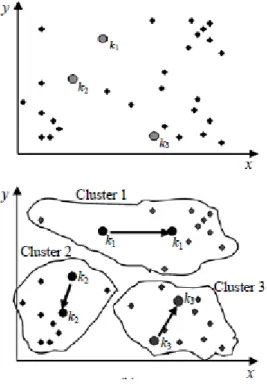
Following fig. explains the idea.
Figure 8 (a) : Initial Cancroids to a dataset
Figure 8 (b) : Recalculating the position of the cancroids
Figure 8 (c) : Final position of the Cancroids
When we examine Fig. 8 (b), in Clusters 1, 2 we note that, the most points become closer to their new centre, only one point in Cluster 1, and 2 points in Cluster 2 will be redistributed (their distances to all cancroids must be computed), and the final clusters are presented in Fig. 8 (c). Based on this idea, the proposed algorithm saves a lot of time.
In the proposed method, we write two functions. The first function is the basic function of the k-means algorithm, that finds the nearest centre for each data point, by computing the distances to the k centres, and for each data point keeps its distance to the nearest centre.
8.1Algorithm-
An
Efficient
Enhanced
k-Mean
Clustering Algorithm
Function distance()//assign each point to its nearest cluster 1. For i = 1 to n
2. For j = 1 to k
3. Compute squared Euclidean distance d2(xi, my); 4.end for
5. Find the closest centredmyto xi; 6.mj = mj+xi; nj = nj+1;
7. MSE = MSE + d2(xi, mj);
8.Clustered[I] = number of the closest centred;
9. Point is[I] = Euclidean distance to the closest centred; 10. endfor
11. For j = 1 to k 12. mj = mj/nj; 13.end for
V. CONCLUSION
As card business transactions increase, so too do frauds. Clearly, global networkingpresents as many new opportunities for criminals as it does for businesses. While offeringnumerous
advantages and opening up new channels for transaction business, theinternet has also brought in increased probability of fraud in credit card transactions.The good news is that technology for preventing credit card frauds is also improvingmany folds with passage of time. Reducing cost of computing is helping in introducingcomplex systems, which can analyse a fraudulent transaction in a matter of fraction of asecond.
It is equally important to identify the right segment of transactions, which should besubject to review, as every transaction does not have the same amount of risk associatedwith it. Finding the optimally balanced ‘total cost of fraud’ and other measures outlined inthis article can assist acquiring and issuing banks in combating frauds more efficiently.
REFERENCES
[1] Duncan M D G. 1995. The Future Threat of Credit Card Crime, RCMP Gazette, 57 (10): 25–26.
[2] P Chan, W Fan, A Prodromidis & S Stolfo. 1999. Distributed data mining in credit card fraud detection, IEEE Intelligent Systems, 14(6): 67–74.
[32001. Fraud Prevention Reference Guide, Anonymous, Certegy, September 2001.
[4] Bill Rini. 2002.White Paper on Controlling Online Credit Card Fraud, Window Six, January
2002.http://www.windowsix.com
.
[5] Austin Jay Harris & David C Yen. 2002. Biometric Authentication- Assuring access to Information,Information Management & Computer Security, 10(1): 12–19.
[6] Maguire S. 2002. Identifying Risks During Information System Development: Managing theProcess, Information Management & Computer Security, 10(3): 126–134.
[7] 2002. Card Fraud Facts 2002, APACS (Administration) Ltd, Association for Payment ClearingServices (APACS), April 2002.http://www.apacs.org.uk.
[8]Neural Network Basics Datasheet, IBEX Process
Technology Inc,july 2002,
http://www.ibexprocess.com/solutions/datasheeet_nn.pdf
.
[9]ClearCommerce Fraud Prevention Guide, ClearCommerce Product Management,ClearCommerce Corporation, August 2002.http://www.clearcommerce.com.[10] 2002. White Paper on Efficient Risk Management for Online Retail, ClearCommerce ProductManagement, Clear
Commerce Corporation, September
2002.http://www.clearcommerce.com.
[11] Van Leuven. 2002. A Surge in Credit Card Fraud, H. Financial Review, 24 September, p.49.
[12] 2002. Online Fraud Report – Online Credit Card Fraud Trends and Merchant’s Response, Mind wareResearch Group, Cyber Source.http://www.cybersource.com.