Broadband Network
Deployment
3.1 INTRODUCTION
The NII is the U.S. government’s vision of the future advanced public telecom-munications network system. The international counterpart of the NII is the Global Information Infrastructure(GII), to which the ITU (the United Nations organization responsible for global standards and policy coordination for pub-lic telecommunications authorities worldwide) often refers. To see just how un-defined both those visions are, you need only review two documents, both of which are available on the WWW:
• The Telecommunications Act of 1996 (ftp://ftp.loc.gov/pub/thomas/ c104/s652.enr.txt);
• The ITU’s World Telecommunications Development Report: Information Infrastructures World Telecommunication Indicators (http//www.itu.ch/ WTDR95/).
While the vision of a broadband network infrastructure may not be well defined, most observers would agree that the future of the telecommunications business will be driven largely by consumer demand for multimedia service. Convergenceis the industry buzzword that refers to the multimedia trend. On the demand side of the business equation, convergence means combining vari-ous communications media, including voice, text, data, and video, in a wide variety of consumer applications such as learning and working from the home. On the supply side, convergence refers to the delivery of various media to con-sumers via a common digital technology. To meet mass market demand for multimedia telecommunications, a public high-speed (i.e., broadband) digital network is required. The costs of constructing such a network and the prospects for financing it are the focus of this chapter.
53
Ubiquitous broadband networks are the ultimate distributors of informa-tion. As digital processing, switching, and transmission are being standardized, it is increasingly evident that basic network technology for telecommunica-tions, computing, and electronic mass media (including broadcasting and cable television) are converging to form a homogeneous digital genre. Rapid advances in digital radio, photonic technologies, and fiber optic transmission systems represent a technological paradigm shift in the information processing and transmission industry, allowing for transmission and switching speeds in mil-lionths (megabits), bilmil-lionths (gigabits), and even trilmil-lionths (terabits) of sec-onds. Network hardware and basic control software eventually may provide for a standardized general-purpose information highway on which any conceiv-able telecommunication service can travel. The least common denominator of very high speed digital encoding and signaling will allow many simultaneous services to be integrated onto the same physical transmission link without per-ceptible loss of speed to the end user. That is the technological goal of would-be broadband network infrastructure providers, including telephone companies (often referred to as “telcos”), cable companies (often referred to as “cablecos”), new digital wireless network providers, and other media enterprises (e.g., broadcasting, movie, and computer companies). Although the direction of the basic technology push is becoming known, there is still uncertainty about con-sumer demand and unsettled institutional and public policy issues. Thus, it is not yet clear how, when, or to what extent physical network integration will ultimately occur.
There are substantial differences of opinion among academics and practi-tioners regarding the financial viability of residential broadband telecom-munication networks. Generally speaking, most market research to date has concluded that there is insufficient demand to justify the massive investment required by telcos, cable television companies, and others to deploy broadband networks for the mass market of residential subscribers. Thus, to the extent that those players decide to deploy residential integrated broadband networks, they do so for strategic reasons, not because it is cost justified.1
In the future competitive telecommunications marketplace, telcos will find it extremely difficult to justify the financial investment necessary for new digital fiber optic subscriber access lines, sometimes referred to asfiber to the
1. Many analyses of the revenue andnet present value(NPV) potential of broadband infrastruc-ture network construction projects show that, even under a fairly optimistic demand scenario, the recovery of the initial investment would take 7–15 years. For example, see G. Kim, “The Revenues of the Infobahn,”Fiber in the Local Loop: Business, Economic, and Technical Chal-lenges (International Engineering Consortium, Chicago, 1995); Residential Video Dial Tone Network Service Prospectus, Bellcore, Special Report SR-TSV-002373, Issue 1, Dec. 1992; and B. Egan, “Economics of Wireless Communications Systems in the National Information Infra-structure” (U.S. Congress Office of Technology Assessment, draft, November 1994) and the ref-erences therein.
home (FTTH). FTTH systems would allow telcos to provide new services, in-cluding interactive video telephony and other high-bandwidth telecommunica-tion services, but at an almost prohibitively high cost. Due to the difficulty in financing FTTH technology, local telcos and, to a lesser extent, cable television companies are pursuing a less expensive alternative called fiber to the curb (FTTC). (FTTC is also referred to asfiber in the loop, or FITL).2But even that proposition is expensive relative to the technological alternatives used by niche market players such as new digital wireless networks (e.g.,personal communi-cation networksorsystems, or PCNs/PCSs; “wireless” cable; and global satellite networks). Thus, the critical question remains: Can profit opportunities for new multimedia telecommunication services justify the substantial financial invest-ment to deploy a broadband public network infrastructure?
3.2 MULTIMEDIA NETWORK INFRASTRUCTURE TECHNOLOG AND COSTS
To evaluate the relative costs and service capabilities of alternative broadband network technologies, it is useful to benchmark them against the technol-ogies and costs of some of the narrowband and “mediumband” technology alternatives.
3.2.1 Evolution of POTS and CATV to Multimedia Networks
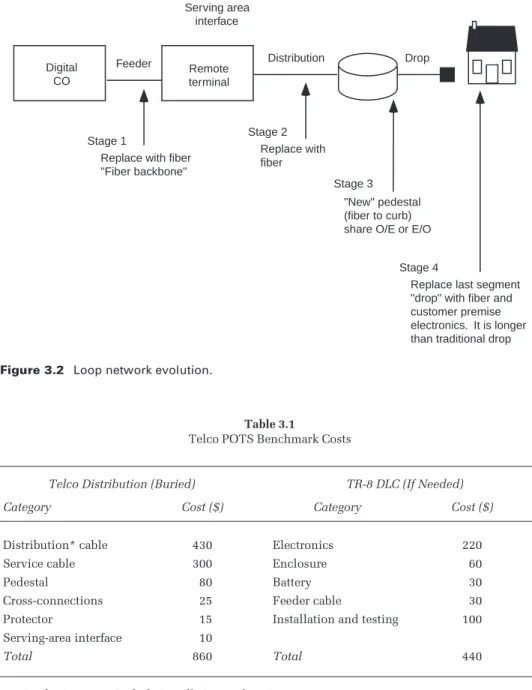
Of the approximately 100 million households in the United States, about 94% of them get their plain old telephone service (POTS) on the public switched telephone network(PSTN). To provide some context for the process of upgrad-ing traditional telephone lines for digital and multimedia capability, Figure 3.1 presents a stylized illustration of the current analog telephone network, includ-ing the proportion of total investment for each major portion of the PSTN. Figure 3.2 depicts a single residential access connection to the PSTN (loop) and indicates the various stages for upgrading that loop for digital multimedia ser-vice. The average cost for installing one additional residential POTS line is about $900 for a subscriber access line or loop, both of which are relatively 2. A summary tutorial of broadband network alternatives is available in presentations by P. Shu-mate, “Broadband Access Networks,” “Broadband Subscriber Access Architectures and Tech-nologies,” “First Costs, Operations Costs, and Network Comparisons,” and “First Costs, Operations Costs, and Network Comparisons—Summary” (Bellcore, 1995). Also see T. Darcie, AT&T Bell Laboratories,Proc. Optical Fiber Conference, San Jose, CA, 1996. A recent discus-sion of residential broadband network alternatives can be found inAnnual Review of Commu-nications(International Engineering Consortium, Chicago, 1995), especially the articles by Acosta (pp. 63–67), Davidson and Cohen (pp. 69–80), Jones and Schmania (pp. 105–110), and McConnell (pp. 203–206).
short (the nationwide average loop is about 10,000 ft long), and about $1,200 for longer loops (e.g., greater than 18,000 ft) because they require longer ca-ble spans and remote electronic equipment (e.g., a remote terminal, or RT).-Table 3.1 gives estimates of telco POTS costs by major category of investment for loops with and without remote electronics (digital loop carriers, or DLCs) [1].
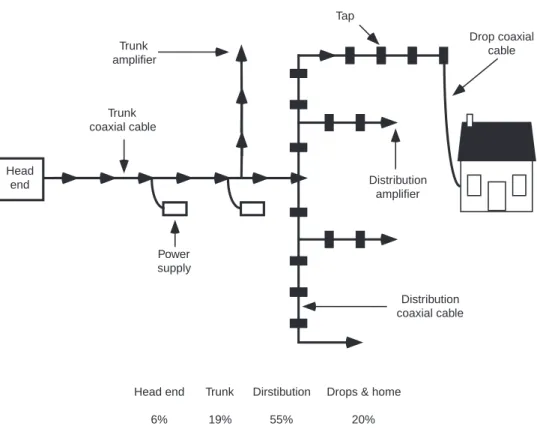
Traditionalcable television(CATV) operators offerplain old cable service (POCS), which is the analog counterpart of telco POTS service. Figure 3.3 is a stylized view of a typical CATV network for POCS and provides the proportion of investment by major category of investment. The average cost of a single POCS connection is about $300–$500 per home passed by the cable system (not all homes subscribe). Since about 60% of U.S. households subscribe to CATV service, the average cost per subscriber is in the range of $600–$900.
Central office Feeder cable Interface Distribution cable Homes Drops Large business customers Percent investment in:
Switch (CO) Inter office Feeder Local dist. 40% 11% 19% 25%
Table 3.1
Telco POTS Benchmark Costs
Telco Distribution (Buried) TR-8 DLC (If Needed)
Category Cost ($) Category Cost ($)
Distribution* cable 430 Electronics 220
Service cable 300 Enclosure 60
Pedestal 80 Battery 30
Cross-connections 25 Feeder cable 30 Protector 15 Installation and testing 100 Serving-area interface 10
Total 860 Total 440
* Distribution costs include installation and testing. Source:Bellcore.
Digital CO
Serving area interface
Feeder Distribution Drop
Stage 1
Replace with fiber "Fiber backbone" Remote terminal Stage 2 Replace with fiber Stage 3 "New" pedestal (fiber to curb) share O/E or E/O
Stage 4
Replace last segment "drop" with fiber and customer premise electronics. It is longer than traditional drop
Figure 3.4 depicts the network upgrade process for CATV networks to evolve to interactive multimedia service capability. Bellcore estimates that the cost of upgrading a POCS subscriber connection to provide basic telephone service would be about $400 per subscriber, for a total average system cost of about $1,125 per subscriber. Table 3.2 provides a breakdown of POCS costs for major categories of investment, and the upgrade costs for POTS to achieve POCS and POTS service capability.
As will be discussed in Section 3.3, upgrading a traditional POTS network to provide basic POCS would cost about $300–$500 per subscriber, for a total system cost of about $1,200–$1,500 per subscriber. Thus, for now, telcos are at a cost disadvantage for upgrading their systems to provide POCS relative to the cost of a CATV operator to upgrade its cable network to provide POTS.
Trunk amplifier Trunk coaxial cable Tap Drop coaxial cable Distribution amplifier Distribution coaxial cable Power supply Head end Head end 6% Trunk 19% Dirstibution 55%
Drops & home 20%
Table 3.2
Tree-and-Branch/HFC Costs per Subscriber With Two-Way Capability
Feeder Plant Items Cost per Mile ($) Feeder cable 32,000 Two-way upgrade 2,000 Uninteruptible power 1,800
Total 35,800
Cable Service Cost ($)
100 homes passed/mile 358/home passed 65% penetration (take) 550/subscriber Distribution amplifier Distribution coaxial cable Optical fiber Optical receivers Head end Trunk amplifier Trunk coaxial cable Cascade: 32 actives 4,200 passings 42-dB C/N Distribution amplifier Distribution
coaxial cable Tap
Cascade: 4 actives 1,000 passings
50-dB C/N
Table 3.2(continued)
Cable Service Cost ($)
Drop cable 75/subscriber Addressable converter 100/subscriber
Total 725/subscriber
Telephony interfaces $400/POTS subscriber Cable + telephony service $1,125 Source: Bellcore.
In the future, those average system costs will tend to equalize as fully in-teractive multimedia systems are offered by either telcos or cablecos. The rea-son is that the digital technology for multimedia systems will be equally available to any would-be network operator, and cost differences among opera-tors will be a function of a particular network architecture and technology type as opposed to a function of the embedded base of historical investments, as depicted in Figures 3.1 (for telcos) and Figure 3.3 (for cablecos).
3.2.1.1 Narrowband ISDN
The current generation of digital telecommunication technology for residential customers is callednarrowband ISDN(N-ISDN). N-ISDN allows most local tele-phone lines to be used for digital information services without the use of a modem.
A single N-ISDN subscriber connection can provide at least three times the communications capability of today’s analog telephone line at higher speeds and equal or better quality. Today, transmitting or receiving digital data signals on normal copper phone lines requires a modem, and reliable transmis-sion speeds are limited to 9,600–14,400 bps (9.6–14.4 (Kbps)), and then only if the phone line is in good physical condition. That limitation will become in-creasingly problematic as higher speed modems become available to the mass market. Already, 28.8-Kbps modems are being mass produced and are priced at about $200; 14.4-Kbps modems can be purchased for about $100. But as data rates increase, so do error rates, so the nominal speed of a “high-speed” modem is cut down in actual use due to error corrections. Traditional copper telephone lines and the telephone network itself were never designed for high-speed digi-tal data services, and the network will require substantial upgrades to accom-modate mass market connections for two-way high-speed digital data services.
A single N-ISDN connection provides a total bandwidth of 144 Kbps and is akin to having three phone lines with only one phone number. A single cop-per N-ISDN phone line allows a household to use two digital channels (64 Kbps each) and one data channel (16 Kbps) simultaneously for any given service. In the context of normal voice telephone service, one of the 64 Kbps channels would be used just as a normal analog phone line is used today. The difference would be that an N-ISDN subscriber, while making a voice call, could also be using a PC online connection (e.g., surfing the Internet) and sending a fax. The two 64-Kbps channel connections arecircuit switched, which means that the channel is dedicated to the circuit connection between the calling and the called parties that is established when the call is made. The single 16-Kbps “D” channel is packet switched, which means that it can be used to carry packet data traffic for any type of message being sent and is not necessarily used only for one message at a time or by one user at a time. Packet switched networks can be shared by more than one user or between more than one service at the same time (until the channel is fully utilized—then some queuing of messages will occur). The Internet is a good example of a packet switched network—it employs the statistical sharing techniques typical of computer data networks generally.
Telecommunications requirements for SOHOs are the early demand driv-ers for data services, as is the mass market demand for the WWW, the multime-dia part of the Internet. For the SOHO market segment, narrowband ISDN service is, at the present time, a good cost-effective alternative to modem-based telecommunications.3However, at only 144 Kbps, basic N-ISDN service is rela-tively slow compared to other business LANs. Even theprimary rate(PRI) ver-sion of N-ISDN, which operates at 1.5 Mbps, is slow compared to Ethernet (10 Mbps), the most popular LAN technology. Thus, for home office workers and others in the SOHO market who are used to working at LAN speeds back in the office, N-ISDN may not be fast enough.
By applying advanced digital signal processing techniques, digital mes-sages can be compressed to fit on an ISDN line. In particular, slow-scan digital video signals and high-quality images can be transmitted over ISDN lines. Fur-thermore, it has always been known that twisted-pair copper wires used for ISDN could operate at digital signal speeds well in excess of ISDN rates. In-deed, most LAN installations use twisted-pair copper in buildings and campus environments. Copper wire LANs usually operate at speeds up to 100 Mbps. There will continue to be tremendous advances in digital signal processing technology, video signal compression, and coder/decoder devices (codecs) to allow higher bandwidth signals and higher resolution video signals to be 3. Because an ISDN line is already digital, there is no need for a modem—unless, of course, a nondigital telephone or other terminal is being used, in which case a modem will still be required.
“squeezed” onto a single ISDN line. The problem is distance, which is being addressed by other, new mediumband technological alternatives.
3.2.1.2 N-ISDN Costs
N-ISDN requires that consumers be able to convert their access lines to digital service. About 60% of the lines in the United States are served out of digital central offices (COs), leaving some 40%4 to be upgraded. The per subscriber costs of converting the nationwide telephone network to ISDN is about $200-$600 per household depending on the level of deployment.5 This figure in-cludes the costs of upgrading both the subscriber access line and the core signaling network. It does not include the cost of the subscriber terminal(s), which must be added. For the entire United States, then, it would cost some-what less than $30 billion to $60 billion to upgrade all households to ISDN service ($300–600 times 100M households), because only 40% of COs need to be upgraded. While the cost appears to be high, it is, in fact, only about one-sixth the cost of installing fiber optic broadband phone lines. The cost break-down is as follows.
First, traditional analog copper telephone lines must terminate at a digital CO switch. At today’s cost levels, it is estimated that all analog CO switches could be upgraded to digital for about $150–$300 per residential phone line. That translates into a total cost of between $8 billion and $16 billion for all lines not currently served by digital switches.
Second, costs associated with upgrading those embedded copper loops that will not support N-ISDN, either because they are too long (in which case, they have signal repeaters or load coils on them) or because the cable is of poor quality making the noise level higher than that tolerated by ISDN, must be con-sidered. Generally speaking, customer lines less than 18,000 ft in length are compatible with ISDN requirements. The vast majority of existing customer lines are shorter than that and will work with ISDN. Problem lines are those that are in poor physical condition, are too long and hooked up to digital loop concentrators (remote nodes containing electronic equipment, such as multi-plexers, which connect with trunk lines to a CO switch), or have been “treated” with loop electronics, such as signal repeaters or boosters. To get ISDN service, subscribers with problem loops will have to be upgraded on a location-by-location basis.
4. Based on 1994 FCC data, the seven RBOCs, which represent about 80% of the total United States, report that 75.3% of all switching offices are digital. However, only about 60% of ac-cess lines are served from digital switches because analog switches were originally deployed in dense urban areas and they continue to serve more subscribers per switch on average. 5. Partial deployment in a CO is more expensive per line than full conversion, because with full
Third, electronic signaling equipment and ISDN software must be added to the digital CO to support ISDN signaling and control protocols, and electron-ics must be applied to the phone line itself. This situation generally refers to a CO digital termination, orline card, which handles the signals and condition-ing for the phone line to provide a high-quality digital connection. The ISDN line connections (line cards) are about $100 per subscriber line. The frame on which the lines terminate is also different from those used for analog service, but that cost is not substantial in volume applications. The per-line software upgrade costs will vary.6
Fourth, as of 1994, the regional Bell operating companies (RBOCs) had equipped only 54% of their COs forsignaling system number 7(SS7). In addi-tion, only 24% of COs were ISDN capable, with a mere 1.7% of subscriber lines being equipped for ISDN. Therefore, the costs of a COpacket handler, an elec-tronic device required to handle the ISDN line D channels for message control and data services, must also be added.
The telcos also need to deploy a core intelligent network to provide for end-to-end ISDN connections and to support the various information services that are contemplated. That requires the installation of network SS7, including signal transfer and control points for message routing and database memory “look-up” type functions. The installation of fiber optic backbone networks can significantly lower the operating costs of the shared interoffice network. It is estimated that the construction costs for fiber optic trunk (backbone) network facilities is about $100 per residential subscriber, for a total cost of about $10 billion for the nation as a whole (100 million lines × $100). The intelligent in-teroffice signaling and transmission network requires the placement of switch-ing nodes, or signal transfer points, and network database nodes, or signal control points. All of these nodes are connected to the interoffice signaling net-work using theintelligent network(IN) technology known as SS7. The total cost of placing those nodes and installing SS7 is estimated to be about $5 billion.
Last, consumers would need to purchase a digital telephone or other ISDN-compatible digital terminal or an adaptive device for existing analog tele-phones or terminals. Little work has been done to estimate terminal design and production costs, but such purchases could easily exceed $1,000. Terminal adapters, like computer modems, are not very expensive, but they also do not provide consumers with new service capabilities. For example, the many con-sumer devices with built-in modems (e.g., fax machines) currently connected to the telephone network would not work with ISDN and would need to be re-placed or equipped with adapters. However, prices for new ISDN-compatible terminal devices, once they are manufactured on a mass scale, are expected to fall precipitously. The future public network must be able to support whatever 6. In many cases, because of vendor pricing practices, the fixed costs of CO software upgrades
terminal devices are created, and the more intelligent the network infrastruc-ture, the lower the basic terminal cost should be.
3.2.1.3 Total N-ISDN Cost
At today’s cost levels, a reasonable “ballpark estimate” of the total cost of widely available N-ISDN is about $45 billion. That figure is much lower than the costs of broadband network systems, which are estimated at $200 billion to $1 trillion, depending on the capability of the network system.
Viewed in perspective, the $45 billion cost for N-ISDN is not very high. Local telcos are already spending about $22 billion annually on new construc-tion, a significant portion of which is allocated to digital switching and fiber optic trunk cable.
3.2.1.4 N-ISDN Capital Recovery and Cost Sharing
The $45 billion cost estimate is not out of reach. In fact, the entire N-ISDN infra-structure deployment project would be paid back over 10 years at an interest rate of 12%, for only $7 per subscriber per month (in addition to current monthly charges). This figure assumes that all of the money is borrowed imme-diately, which of course would not be the case. If the project costs were treated in the context of an ongoing construction program over a reasonable time inter-val of 10 years or so, the monthly per-subscriber costs to support such a pro-gram would be only about $3.50 per subscriber in current dollar terms.
These figures assume no new revenues, which is unlikely considering projected demand for digital services. Furthermore, the average residential phone bill is about $45 a month, and the increase to cover the cost of N-ISDN is less than 10% of the total monthly bill. If you view a 10% increase as substan-tial, consider the fact that local telephone rates have risen more than 40% since the AT&T divestiture in 1984, mostly due to theFederal Communications Com-mission(FCC) access charge program, which added about $3.60 per line—and yet telephone penetration is up almost 2%, from 92% to about 94%. For those rate payers who cannot afford to pay more for telephone service, subsidized “lifeline” service will still be available.
There is substantial evidence that thelocal exchange carriers(LECs) will experience cost decrementsdue to operating-cost savings over the traditional analog network. Capacity costs of plant expansion are also lower with digital facilities, which generally come in larger investment “lumps” than analog equipment because of economies of scale. Advanced digital networks are more easily maintained, and realtime error detection and correction are enhanced. Furthermore, these costs include the cost of upgrading remaining analog CO switches to digital. This cost is not really an incremental cost of ISDN, since this conversion is already considered in the fundamental network plans and
construction budgets of all large LECs and simply represents the next-genera-tion switching plant.
3.2.2 Mediumband Network Systems
There is a huge difference between the international standards for N-ISDN and broadband ISDN (B-ISDN). N-ISDN is a circuit switched 144-Kbps network, and B-ISDN is a 155-Mbps packet switched network. In between these two low-and high-blow-andwidth systems are “mediumblow-and” network systems. Because the technology of digital signal processing advances incrementally, the bandwidth performance and costs of many network systems are best viewed as evolutions of existing narrowband networks. Many next-generation network systems are upgrades to, or overlays on, existing telephone and cable networks. Further-more, there is a huge gap in the costs and performance of narrowband and broadband systems, and some mediumband alternatives could fill that gap.
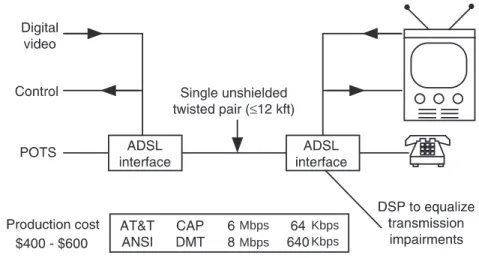
Asymmetrical digital subscriber line(ADSL) andhigh-bit-rate digital sub-scriber line(HDSL) are two rapidly evolving mediumband technologies.7Both systems require high-speed modems/transceivers on both ends of a subscriber’s phone line (i.e., one at the subscriber’s location and one at the telco CO switch). Figure 3.5 presents a stylized view of an ADSL system.
The first generation of ADSL systems were designed to be a short-term, relatively inexpensive method of providing one-way (i.e., asymmetrical) video service on a standard copper telephone line. ADSL systems, which enhance the POTS network with sophisticated electronics, cost about $500–$600 per sub-scriber as long as the subsub-scriber’s copper loop meets the minimum system requirements. In particular, the subscriber loop should be less than 12,000 ft in length. Early versions of HDSL were a symmetrical counterpart to ADSL targeted to business-market users as a substitute for high-speed private line connections (e.g., T1 1.5-Mbps two-way channels).
Through the use of advanced digital signal processing and multiplexing techniques, early ADSL systems were capable of providing both analog tele-phone service and one-way mediumband digital service to support video dial tone and video on demand VOD applications (technically a 1.5-Mbps down-stream channel for single-channel VCR-quality video service). It turns out that demand for multimedia information service on the Web is far outstripping that for VOD (which is becoming available from cable and satellite broadcasters anyway), and it now appears that Web multimedia is the golden opportunity for this technology. ADSL offers an intriguing solution to increasing the bandwidth 7. A special volume from the IEEE provides a detailed technical discussion of the state of the art in ADSL and HDSL technology:IEEE Journal on Selected Areas in Communications: Copper Wire Access Technologies for High Performance Networks, Vol. 13, No. 9, December 1995. Also seeIEEE Journal on Selected Areas in Communications: High-Speed Digital Subscriber Lines(Vol. 9, No. 6, August 1991).
of narrowband telephone lines to meet the demand from the SOHO market and for anyone else who wants high-speed access to the Web.
Second-generation ADSL systems will offer even more downstream band-width, from 4 Mbps up to about 10 Mbps—an important goal considering that Ethernet operates at 10 Mbps. The lower value of 4–6 Mbps is, itself, an impor-tant performance objective, because it allows the line to accommodate high-quality digital video service using a standardized compression technique called MPEG 2.8But the use of MPEG 2 also requires a video decoder box, which will cost about $400 (that price is predicted to fall to $200 or less by the end of the decade).
In the upstream direction, ADSL systems will offer between 64 and 640 Kbps. As is the case for most of these systems, the primary limiting factor is the length of the phone line itself. Transmission on unshielded twisted pair copper lines will be limited to about 12,000 ft for second-generation systems operating at about 3–4 Mbps, less for future higher bandwidth systems.
The reason that ADSL is so unique and intriguing as a multimedia net-work alternative is that it is a modem-based technology. The beauty of this from a business and a consumer perspective is twofold: (1) modems can be quickly provisioned (relatively speaking) to subscribers wanting to purchase service; and (2) the modem equipment itself is portable and can be recovered and reused when a subscriber terminates service. It also makes network upgrades
Mbps Kbps Kbps Mbps
Figure 3.5 Asymmetric digital subscriber line (ADSL).
8. For an excellent tutorial on this subject, see “Video on Phone Lines: Technology and Applica-tions” (IEEE Proc., Vol. 83, No. 2, February 1995).
less problematic (although planned obsolescence can shorten capital recovery times and end up being expensive).
The nature of multimedia demand, which is pretty much dictated by the Web, is that asymmetrical traffic flows are typical. Downstream traffic, or data flowing from Internet service providers to individual subscribers, is about 20 to 1. E-mail is about the only widely used symmetrical service application on the Internet, and it represents very little total bandwidth because it is used mostly just for low-bandwidth text transmissions. As more Web users’ PCs are equipped with high-speed modems and connected to high-speed data lines, the asymmetry of traffic flows on the Web will become even more skewed, with downstream traffic flows equal to 100–200 times the amount of upstream band-width. But that is due more to the fact that consumers do not have fancy termi-nal devices (e.g., videophones) or persotermi-nal databases and video collections to demand much upstream bandwidth. That will change in the future of video telephony. To meet the need for a more symmetrical bandwidth capability, newer ADSL and HDSL systems will offer a generous amount of bandwidth in each direction.
Future mediumband network systems, likevery-high-rate DSL(VDSL) and broadband digital subscriber line (BDSL), will approach broadband system speeds, but these systems will not be available to the mass market of residential subscribers because of the short transmission distances involved. For example, phone lines equipped with newer ADSL systems operating at about 25 Mbps will be limited to about 4,000 feet, and 50-Mbps systems will only work at about 1,000 ft (well below the average line length in the United States of 10,000 ft). Planned systems with the highest bit rates (e.g., 155 Mbps) will be limited to very short distances of about 100m, while the lower rate systems (between 10 and 26 Mbps) will work for distances up to 1 km [2].
3.2.3 Fiber Backbone Networks
Both telcos and cablecos can deploy fiber backbone networks at a fraction of the cost of FTTH or even FTTC, because fiber is exceptionally well suited for high-capacity shared (nondedicated) plant and likely will be preferred to copper or coaxial cable in new construction for trunk and feeder network facilities based on cost savings alone.
Both telcos and cablecos can upgrade their local distribution networks (depicted in Figures 3.1–3.4) with a fiber optic backbone for about $50–$100 per subscriber. That, however, is where the good news ends for telcos. Even though cableco and telco fiber backbone costs are about the same per residen-tial subscriber, the difference in quality, reliability, and future functionality leaves no comparison—cablecos win hands down. A telco fiber backbone, while perhaps more reliable and of higher quality from a network engineering and maintenance perspective, holds virtually no service advantage for
consum-ers. Subscribers are still limited to two-way narrowband telecommunications due to the limitation of the existing copper loops. On the other hand, when cablecos deploy fiber optic backbones, the major sources of cable system fail-ures and the major obstacle to providing telephone services (electronic signal amplifiers) are removed (see Figure 3.4).
Similar to the way in which telcos will utilize modem-based ADSL sys-tems to upgrade their networks for video and interactive multimedia services, cable systems will utilize digital cable modems to achieve a rapid upgrade of their systems to provide telephone and interactive multimedia services. It is technically difficult to provide upstream channels to support telephone service on traditional cable systems, because they were optimized for one-way broad-cast services. That means that cable system operators must first upgrade their systems with fiber optic trunk cable and reliable two-way optoelectronic signal-ing equipment. This can be achieved for about $200–$400 per subscriber, de-pending on subscriber density factors and how far downstream into the cable system the fiber optic trunk and feeder lines are extended. (Remember, this a system upgrade, not an entirely new system, which would cost about $600–$800 per subscriber). In addition, the digital cable modem, offering up to a 10-Mbps upstream channel, will itself cost about $500–$600 per subscriber (1996), but that price could fall to about $250 by the end of the decade [3].
3.3 BROADBAND NETWORK UPGRADES
On the horizon for residential phone lines is digital broadband technology, which will provide for a wide range of multimedia applications, ultimately in-cluding such services as high-resolution full-motion entertainment video, video telephony, and bandwidth on demand. Broadband technology generally requires the use of digital fiber optics, coaxial cable, or radio channels instead of the traditional copper telephone lines used for narrowband and medium-band technologies. Symmetric broadmedium-band digital service is an expensive propo-sition that costs five to six times that of N-ISDN and perhaps double that of mediumband alternatives.
Most broadband network architectures are based on fiber optic transmis-sion systems, both in the shared trunk network and sometimes in the dedicated subscriber loop plant (including FITL, FTTH, and FTTC systems). Broadband systems exhibit deployment costs in the range of $1,500 to $5,000 per residen-tial subscriber access line.9 With about a hundred million residential access 9. For more detail on these types of broadband network systems, see B. Egan,Information Super-highways: The Economics of Advanced Public Communication Networks (Norwood, MA: Artech House, 1991); B. Egan, “Economics of Wireless Communications Systems in the Na-tional Information Infrastructure” (draft, U.S. Congress Office of Technology Assessment, No-vember 1994); D. Reed, “Putting It All Together: The Cost Structure of Personal
lines in the United States, that amount implies a total cost for residential broad-band networks in the range of $150 billion to $500 billion.
The two main incremental cost factors for broadband network systems are the initial engineering and construction costs for laying fiber and coaxial cable to the subscriber premises and the costs of optoelectronic components and de-vices required to allow existingcustomer premises equipment(CPE) to inter-face with and operate on the photonic distribution network. Fiber optic system deployment costs are substantial for all vendors (telcos, cablecos, and others) who are considering entry into the broadband infrastructure network business. However, fiber optic system costs are continually falling. Even though fiber costs have stabilized at about $.06 per meter (single-mode fiber) and about $.13 per meter (fiber optic cable), the unit costs of other fiber optic system compo-nents and optoelectronics (e.g., connectors, transceivers, amplifiers) continue to fall dramatically [4].
3.3.1 Fiber to the Home
Engineering cost estimates for telco FTTH systems yield a wide range of per-subscriber costs depending on the system architecture, functionality, and de-mand assumptions. None of the cost estimates presented herein includes CPE or other types of costs incurred on or inside a customer’s premises. The most often quoted forward looking (1998–2000) average cost numbers are in the range of $1,500–$3,000 per subscriber line. The cable industry has not shown any significant interest in FTTH since they view their broadband coaxial cable subscriber loops as being adequate for two-way residential broadband service when fiber optics is deployed in their trunk networks.
Figure 3.6 shows a stylized FTTH access line architecture in a residential setting. Figure 3.7 shows various subscriber loop architectures for both busi-ness and residential customers and indicates the data rates that loop optoelec-tronics may provide. The distinguishing characteristic of a full-fledged FTTH system is that the fiber optic loop is dedicated to a single subscriber, and the optoelectronic interface is located at the subscriber premises. This Cadillac of multimedia systems has the potential capacity to provide virtually limitless bandwidth on demand. It is also the most expensive type of system because the loop and loop electronics are dedicated to a single subscriber. The most popu-lar type of FTTH system is apassive optical network(PON), which means that it is a nonswitched network architecture. Depending on the loop plant design,
Communications Services” (Working Paper No. 28, FCC Office of Plans and Policy, Washing-ton, D.C., 1991); and D. Reed, “The Prospects for Competition in the Subscriber Loop: The Fi-ber-to-the-Neighborhood Approach” (FCC Office of Plans and Policy, presented at 21st Annual Telecommunications Policy Research Conf., September 1993) and the references therein.
it is possible to have a host digital terminal for extended systems to allow for some sharing of trunk cable plant in the feeder portion of the network (Figure 3.6). Sharing of common feeder trunk lines, distribution cables, and optoelec-tronic equipment among subscribers can allow considerable cost savings in FTTH systems. It is possible in such systems to modularize the construction, so that as more subscribers sign up for service, system capacity can be expanded by adding optoelectronic components.
The estimated per-subscriber cost of a POTS fiber access line is about $3,000 for this stylized suburban residence network service configuration. No-tice that, for this particular loop architecture, the feeder portion of per-sub-scriber costs is only about $100—about 3% of the total costs of subper-sub-scriber loop plant, (which is about two-thirds the total per-subscriber costs) and associated electronics (which are about one-third the total per subscriber costs).
Notice that the underlying cost structure of FTTH systems is fundamen-tally different from that for current analog telco networks (shown in Figure 3.1). In fact, it is very nearly the opposite, which serves to stand traditional engineer-ing economics on its head. In traditional telephone networks, 75% of the total system investment cost is in the outside-plant facilities portion of the loop (the feeder and distribution cable). In FTTH systems, it is not uncommon for 75% of the costs to be in the inside-plant portion (switching and electronics).
Central office Fiber Feeder Fiber Distribution Remote terminal Serving area interface Optical network interface Drop Fiber Pedestal Drop Fiber Optical network interface To CATV provider
With continued progress in lasers and specialized microchip design, this system cost could be reduced considerably. The target cost of such systems is about $1,000 per subscriber after the year 2000.
3.3.2 Fiber to the Curb
There is a big difference in the cost of fiber backbone networks and FTTC (also called FITL andfiber to the node, or FTTN), whether for cablecos or telcos. In fact, most available estimates of per-subscriber costs of telco FTTC for two-way broadband networks are in the range of $1,000–$1,500—over 10 times those of per-subscriber fiber backbone costs (though some newer vendor systems do claim lower costs for mass deployment).
Remote terminal Central office Remote terminal Trunks > 2.4 Gb/s ~ Feeder~2.4 Gb/s Subscriber lines ~150 or ~600 Mb/s LAN ~150 and ~600 Mb/s ~600 Mb/s <10 km ~
Figure 3.7 Business and residential subscriber loop architectures and associated data rates.
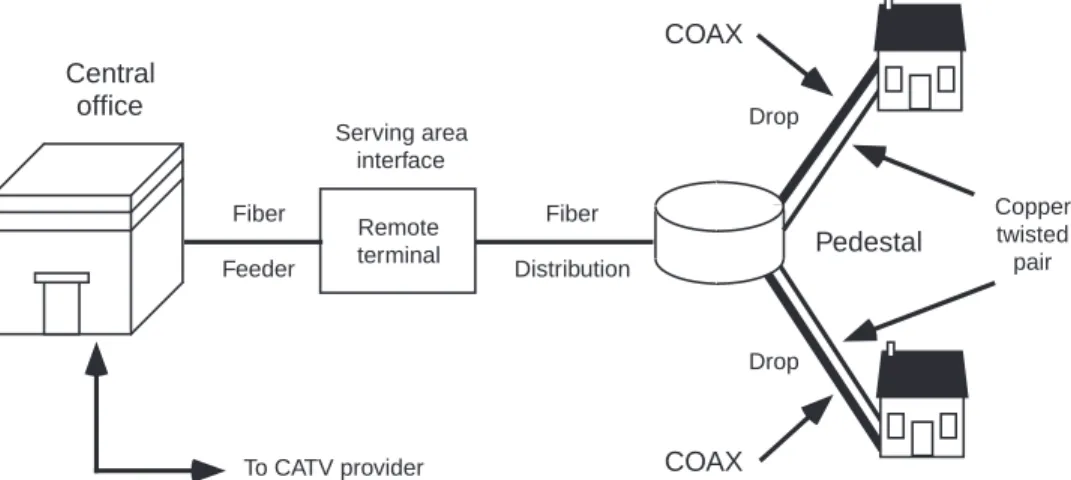
Figure 3.8 is a stylized view of a telco FTTC network. FTTC loop network architectures come in many flavors, so many that there are now several differ-ent classifications in the vernacular of telecommunications managers. The dis-tinguishing feature of FTTC systems is that they utilize both fiber optic and metallic (i.e., coaxial and copper) cables. In that manner, FTTC systems use fiber optic cables in the high-capacity trunk backbone portion of the network system connected to lower capacity metallic feeder and distribution cables, which themselves are connected directly to subscribers. Compared to an all– fiber optic system, FTTC allows a system operator to take advantage of the rela-tive cost efficiencies of optical fiber (the required optoelectronic components for high-capacity shared plant), while using metallic cable facilities and the simple electronics for the lower capacity distribution cables and dedicated sub-scriber connections.
The combination of increased sharing of common plant facilities and the use of relatively inexpensive metallic facilities for dedicated subscriber connec-tions makes the per-subscriber costs of FTTC systems considerably lower than those for FTTH. In FTTC systems, about 40% of the per-subscriber system costs are for inside plant, including optoelectronic components, as opposed to 75% in FTTH systems. Figure 3.9 is a broad-gauge average cost comparison for most popular types of FTTC systems [1].
Hybrid fiber coax(HFC) (see Figure 3.9) is the most popular current FTTC system. The reason for HFC’s near-term popularity is that this system maintains analog video capability, which, in its current analog form, is very convenient and relatively inexpensive to provide because the costly digitization process of existing broadcast signals is avoided. The deployment of HFC systems also minimizes up-front investment costs among other residential broadband
sys-Central office Fiber Feeder Fiber Distribution Remote terminal Serving area interface Drop Pedestal Drop To CATV provider COAX COAX Copper twisted pair Figure 3.8 FTTC network.
tems because it allows for a pay-as-you-go approach to system deployment. In other words, system investment costs rise as more homes that are passed by the network choose to subscribe. This allows for a better matching of revenues and cost streams. Figure 3.10 presents estimates of the costs per home passed of deploying an HFC system and shows how that cost changes as subscription rates rise. Figure 3.11 illustrates how corresponding monthly revenues per home passed also rise as system subscription rates rise.10
Switched digital video (SDV) systems (see Figure 3.9) exhibit the same types of service capabilities as HFC systems but usually deliver video signals in digital format, potentially allowing for a more flexible video services format for such things as video dial tone (VDT),11 interactive video, virtual VCR, and video signal editing. SDV systems are also better suited to providing interactive
$1,000 $1,000 $1,000 $1,250 FTTC HFC (2-way system) SDV (FTTC + 1-way HFC) FTTH-PON Node Node
ONU Coax + copper pair
Coax bus RF modems ONU Coax bus Copper pair S 1 x 16 Typical Fiber
Figure 3.9 Cost breakdown for most popular FTTC systems.
10. These HFC costs and revenues are from the vendor of a branded system called Homeworx, by ADC Telecommunications, Inc. See also J. Cadogan, “Hybrid Fiber Coax: Today’s Broadband Solution” (1993–1994 Annual Review of Communications, International Engineering Consor-tium, Chicago); also see the Homeworx presentation by J. Lehar, of ADC at the OFC ’96, San Jose, CA, February 28, 1996.
11. VDT refers to a unique type of video system. It connotes a “common carrier” type video system in which third parties may provide whatever programming they wish by purchasing capacity from the VDT network operator. Such a system is similar to the Internet’s WWW, in which third-party information and programming providers give users access to a variety of informa-tion over phone lines. In the case of VDT, the desired informainforma-tion is video.
switched broadband services like video telephony. In the short term, SDV sys-tems are more expensive to deploy than HFC syssys-tems, especially if the system
Transport Switching Access 500 550 650 850 5% 15% 25% 50% 0 200 400 600 800 1000
Interactive services penetration (%)
Cost
per
home
passed
Figure 3.10 Estimates of the costs per home passed of deploying an HFC system.
Telephony Basic/premium Interactive 13 15 17 23 5% 15% 25% 50% 0 5 10 15 20 25
Interactive services penetration (%)
Monthly tr anspor t re v e n u es per h ome p assed
is to be used primarily for broadcast video services like traditional cable net-works. HFC systems are also easier to deploy and cost less than SDV systems if the system is used as an upgrade or as an overlay to an existing state-of-the-art telephone or cable network. In the case of new system construction, the target per-subscriber costs of both HFC and SDV systems is similar, at about $1,000. If, however, the network operator sees the most revenue potential coming from VDT, video on demand, and other point-to-point video services, then an SDV system may be the best investment, since this is its relative service advantage.12 Tables 3.3 and 3.4 provide a comparison of FTTC and FTTH systems based on technical features, service capability, and service demands. The dif-ferent hybrid fiber/metallic network delivery systems present so many engi-neering possibilities that it would be presumptuous to assume that any category of systems (i.e., FTTC, HFC, SDV) could or could not be designed to support any particular type of service (e.g., analog video, video telephony). That is espe-cially true considering that, given the right combination of optoelectronic com-ponents, any of these systems can be transformed to perform whatever network function is required and to deliver any given service that subscribers want [3,5]. Suffice it to say that both HFC and SDV systems are upgradable to fully interac-tive digital broadband networks.
Table 3.3
Comparison of Broadband Access Networks
Criterion HFC SDV FTTC FTTH
Analog capability High High None High Video reliability High High Higher Highest Voice/data compatibility High High Higher Higher Voice/data compatibility Lower High High High Video quality High High High Highest Voice/date blocking Possible No No No Maintenance Higher Higher Lower Lowest First cost per subscriber (SDV) (HFC) Lower* Higher Installation Time Fast/Slow† Slow Slow Slow
* Depends on set-top cost and number required. † Fast if coaxial plant is already in place.
12. For a comparison of the per-subscriber costs and revenues between HFC and SDV network sys-tems and, for that matter, a good background discussion of issues, see J. Jones, “Video Dial-tone: Choosing the Right Network Architecture” (Broadband Technologies, Inc., April 1993).
Table 3.4
Network Choice Depends on Service Plans and Customers
Criterion FTTC HFC SDV FTTH
Voice telephony service Yes No No No Broadcast television service No Yes No No Broadcast + interactive TV No Yes Yes No Telephony + interactive TV Yes Yes Yes No Broadband ISDN services Yes No Yes Yes Operator with coaxial plant No Yes Yes No Business + residential services Yes No Yes Yes Source:[1].
Most of the discussion until now has focused on telco network upgrades. Some cable network operators have already deployed fiber optic backbone net-works for only $30–$40 per subscriber in early applications. Extending the ca-ble network fiber trunks into the feeder portion of caca-ble plant can add substantially to that cost (about $150–$250 per subscriber). Figures 3.3 and 3.4 illustrated the difference between traditional coaxial cable systems and systems that have been upgraded with fiber optic trunks. It should be noted that fiber optic cable trunk and feeder networks generally do not imply extension of the fiber cable as far downstream in the network to the subscriber as is implied by telco FTTC. The typical telco fiber/copper “node” in FTTC systems may be placed at the point of existing copper drop lines. This point, called the pedes-tal, will often serve only 4 to 16 homes. In the case of cable television, current hybrid network designs allow the fiber/coax “node” to serve about 250 to 500 homes. Thus, the functionality of telco FTTC systems and the cable hybrid net-works may be quite different, making per-subscriber costs difficult to compare.
3.4 COMPETITIVE ADVANTAGE
FTTC systems cost only about one-third to one-half per subscriber what an FTTH would. In the case of telcos, at least, FTTC may offer a significant in-crease in network functionality for subscribers that fiber feeder backbones do not. As a result, there is substantial interest in telco deployment of FTTC. A host of telco FTTC network architectures have been proposed by a number of vendors and no doubt more will be announced.
Reliable cost data are sparse, although some major industry sources put the total per-subscriber costs of FTTC at nearly equal to the costs of new resi-dential copper access lines. This is not surprising considering the cost advan-tages of fiber in shared network facilities. It is, after all, the dedicated subscriber portion of the loop and optoelectronic equipment that make FTTH so expen-sive. FTTC allows for sharing of optoelectronic network interface devices and components among many subscribers.
Telcos must consider deployment of FTTC since fiber feeder backbones simply do not offer much in terms of value added for customers. With FTTC, a high-quality broadband capability may be achieved by interconnecting to coax-ial cable for the final subscriber loop segment. Initcoax-ially, only POTS and one-way video will be likely in telco FTTC networks, but that is the minimum configuration necessary to match the potential functionality of advanced two-way cable television networks. It is not that they would not rather provide real-time two-way broadband functionality. Rather, the costs of doing so are so high that this capability will be deferred until the second (or third) generation of local networks is contemplated. In fact, as of this writing, almost all major LECs have endorsed a policy of FTTC instead of FTTH for their next generation of broadband-capable subscriber loop plant.
Cablecos also need to deploy FTTC to be able to match the potential sub-scriber network functionality of telco FTTC. However, it is somewhat easier for cablecos since the critical (and relatively expensive) last network segment—the subscriber connection—is already broadband coaxial cable. There may be cost-effective ways to connect cable fiber optic backbones to telco switched network facilities to achieve a high-quality two-way telecommunication capability. The cost data available to date, however, indicate that cableco FTTC deployment costs could also be quite high ($1,000 per subscriber or more) if switched two-way digital telecommunication functionality is required.
If the demand for interactive multimedia ever lives up to the industry hype, there are two potentially important shortfalls in many of the telephone and cableco FTTC systems: (1) a lack of switching for point-to-point connectiv-ity; and (2) the capacity to handle real-time interactivity (including the capacity to handle increased demand for symmetric broadband services like video te-lephony). Most vendor FTTC systems being considered for the next generation of residential broadband networks do not use switching for some, or even most, network services because of the relatively high up-front costs. The result is a relatively passive network architecture for one-way video distribution that is limited in terms of functionality compared to an all-switched video system. The bandwidth offered on the coaxial cable portion of the network in FTTC systems may not be able to support real-time subscriber interaction with the communication media, especially in an integrated environment.
3.5 LONG-TERM INFRASTRUCTURE NETWORK OPTIONS
There is still the possibility that the deployment of a fully switched broadband network infrastructure would be a serious mistake from a cost perspective. Some experts remain convinced that the cost advantage in a future broadband multimedia marketplace will accrue to those network operators who rely on transmission capacity to provide bandwidth on demand and that the preoccu-pation of most telecommunications engineers is misguided. That preoccupa-tion is partly due to inertia caused by the fact that telephone networks have historically evolved as circuit switched point-to-point and point-to-multipoint, operations. It is also partly due to the historical telephone monopoly’s preoccu-pation, reinforced by regulators nationwide, with the ultrahigh quality service that only a circuit switched network can provide. Circuit switching means that the entire bandwidth of any given telecommunications channel is surrendered to only a single application (e.g., voice phone call). Regardless of the actual bandwidth necessary for the call, the entire end-to-end circuit connection be-tween the calling and the called party is dedicated to that single use for the entire duration of the call. That design is essentially the opposite of statistically shared computer networks and, in particular, is not consistent with fast packet asynchronous transfer mode(ATM) networks, which are expected to become the PSTN of the future.13
The coexistence of the various types of networks may not be as inconsis-tent as it seems. Most networks will be able to interconnect and “interwork” with one another (of course there is a cost associated with such interworking). In fact, one can take comfort in the fact that, even now, the circuit switched PSTN is providing end-to-end connectivity for the leading public packet net-work protocols used by the Internet (TCP/IP) and is net-working well with the lead-ing LAN protocol used by the Ethernet’s token rlead-ing network (10baseT). That is not to say that things could not be moving in a more effective direction.
Never having been a monopoly or even regulated, computer networks typically have not employed switched point-to-point architectures and the dedicated circuits typical of the PSTN circuit switched network architectures. But computer networks are for data communications either between machines or between people and machines. In the world of voice telephony, where delay times and busy signals are annoying (at least to humans), it is understandable that telcos and their regulators did not deploy facilities in the manner used by computer networks. Nevertheless, in the future world of multimedia, where public network communications increasingly involve machines, there is
cer-13. For a tutorial on network fundamentals that summarizes the basic distinctions between differ-ent types of network architectures, see J. Berthold, of Bellcore, “Fundamdiffer-entals of Networks” (OFC ‘96, San Jose, CA, February 27, 1996).
tainly something to be said for the computer network model and the cost effi-ciency of statistical sharing.
That raises the question of whether it even makes sense to combine voice telephony or any other type of telephony on the same network with machine telecommunications. Perhaps (just perhaps), it makes no sense from a network cost and service provisioning perspective to integrate human-sensitive services with computer data services.
One thing is certain, if it is desirable to integrate all services on the digital network information superhighway, then the engineering solution must lie in a fast packet network solution like ATM, which still leaves open the question as to whether the ATM network infrastructure itself should be switched or non-switched. That remains a question of the relative costs of switching versus transmission. If and when switched point-to-point networks like the PSTN be-gin to employ superfast electronic or optical switching devices so that signal speeds become as fast (in terms of data throughput) as passive fiber optic trans-mission network systems employing fiber ring and bus architectures, it does appear that a network infrastructure based on the latter is more cost effective, both in terms of initial deployment costs and in terms of the costs of system capacity expansion. In any event, it will be a very expensive proposition to make ATM access available to all households the way that the PSTN is now.
The risk for telcos and cablecos of not investing in an efficient shared net-work infrastructure to support their high digital data traffic is that new players in the market for high-speed public network services, including computer com-panies, may eventually deploy a more efficient network infrastructure, one with which circuit switched networks will have trouble competing.
3.5.1 The Social Costs of Infrastructure
The long transition path from today’s public telecommunications network in-frastructure to an advanced switched digital broadband inin-frastructure capable of delivering interactive multimedia to the mass market raises some important cost issues. While the advancement of fundamental network technology is rap-idly changing, it is not going to be possible, in practice, to minimize the total social cost of technology adoption (due to the long-lived nature of the invest-ments made in the short to medium terms of the transition phase). The econom-ics of technology adoption, especially in a market-driven environment, are partly a process of discovery. Fixing one optimal plan is not possible. Neverthe-less, it is incumbent on the research community to try to identify those genera-tions of technologies that represent socially efficient expenditures. In theory, if one were starting from scratch with what economists call a “scorched Earth,” there is a dollar investment amount that represents thetotal incremental costof deploying a broadband communication network infrastructure based on a least-cost long-run network optimization model. However, because we are not
start-ing from scratch, the relevant cost issue is the expenditure to upgrade the exist-ing infrastructure based on the total incremental cost of the least cost network design.
In practice, many short-run market-driven strategies for network upgrades will not be consistent with the social long-term optimum network; therefore, the sum of the various incremental upgrade costs will exceed, perhaps consid-erably, the theoretical total incremental cost based on a scorched-Earth situ-ation. What short-term strategies fall into this category? The most popular next-generation network vendor systems utilize passive delivery of video com-munications in FTTC local network architectures. Based on the work of Reed, among others, it is clear that the use of passive delivery of video signals in hy-brid broadband networks will increase the total cost of ultimately deploying a fully switched system [6]. There are many reasons for this, not the least of which is the inertia inherent in the existing video technology utilized by cur-rent analog video networks and associated CPE. Deployment of such network systems may raise substantially the total cost of ultimately achieving an ad-vanced two-way switched digital broadband network infrastructure (assuming, for the purposes of this discussion, that this is the way to go). In all probability, this scenario could be avoided only by rapid—and significant—advances in switched network system designs, which are not currently cost competitive with passive systems for the provision of distributive video service. Unfortu-nately, that is not likely.
Reed and other researchers have shown that little is to be gained in terms of engineering economies by combining distributive video service delivery with two-way switched telecommunications on a single fiber optic or coaxial cable access line. If it is true that the economies of scope from physical integra-tion of those two services is very small, deployment of such networks will not be justifiable on the basis of engineering cost savings alone.14
So why do telcos still pursue this short-term strategy? The reason is two-fold. First, even if the preferred long-term vision is a fully switched integrated broadband system, the market for traditional narrowband services is a sluggish one. Everyone who wants a phone has one, and annual growth rates for per-household telephone usage are only slightly higher than population growth rates. On the other hand, new digital video services and digital data services exhibit high growth rates, and forecasts continue to be optimistic. If telcos are going to be players in the high-speed data and video services market, they can-not wait for the technology that is best suited for achieving the long-term vi-sion. They must move soon or risk losing their dominant position in the telecommunications marketplace. Thus, even though there may not be much to 14. Indeed, to this day in the United Kingdom, which has a nascent and vibrant market in which U.S. telcos are allowed to jointly offer both cable television and telephone services, these com-panies have chosen to keep each service on a separate distribution cable.
gain in terms of network cost savings by integrating passive delivery of down-stream video services with the telephone network, it at least represents a step in the direction of network integration, which has become something of a holy grail to telecommunications network engineers.
Second, the only alternative to network integration is to continue the status quo of separate services (e.g., voice, data, video) provided on separate access lines. To telco management, this is not an exciting proposition, because it would force telcos to continue to serve the less than glamorous basic tele-phone service market. Furthermore, without integration with the PSTN, regula-tors might not allow telcos to invest proceeds of the telephone business in other closely related lines of businesses like cable television. Many regulatory agen-cies consider this type of cross-subsidy to be against the public interest they are trying to protect. Regardless of the regulatory treatment of the costs of new con-struction, it is probably true that, in the very long term, demand for real-time two-way multimedia telecommunications will grow to the point that it will be worthwhile for telcos to pursue. It follows that it is best to enter the market early by beginning the network integration process now.
Thus, it is likely that FTTC systems will be widely deployed by telcos. What is, perhaps, most disconcerting about this for the long term is not that passive video delivery will be employed, but that it calls for deployment of “plain old coax” for the subscriber line connection. After all, there is already a coax line for cable television now, and if the long-term vision calls for FTTH systems, is it socially efficient to deploy FTTC for the next generation of resi-dential local networks? In the case of the shared fiber trunk network invest-ments, cost savings alone will justify rapid deployment of fiber optics, which is consistent with the long-term vision for a switched broadband infrastructure. But that is not the case for the coaxial cable access lines.15
Regulators are caught in the middle. They would like to see a strong and progressive telco network, but the costs of the network upgrades, even for FTTC, are substantial. If regulators allow FTTC investments to go into the regu-lated cost base of telcos, subscriber rates may have to rise.
One obvious, albeit partial, solution to some of these problems is to allow the telcos and cablecos to cooperate locally to provide new broadband telecom-munication services. Right now, this is against the law. Neither Bell operating companies nor cable network operators are allowed to have a significant finan-cial or managerial stake in one another’s operations (the legal limit is 10% eq-uity share). They are not even allowed to engage in joint service arrangements,
15. Shumate in particular makes the point that it may be time to reconsider the potential for fiber optic access lines. See P. Shumate, “Broadband Access Networks,” “Broadband Subscriber Ac-cess Architectures and Technologies,” “First Costs, Operations Costs, and Network Compari-sons,” and “First Costs, Operations Costs, and Network Comparisons—Summary” (Bellcore, 1995).
thereby sharing the risk of major investment projects like broadband multime-dia infrastructure networks.
The bottom line is that the institutional and political environment itself is largely responsible for what we observe in terms of suboptimal network tech-nology adoption. Even with the new law that “deregulates” the industry, out-dated regulations will continue to take their toll on deployment of network technology.
In summary, we are moving toward a long-term vision of a fully switched digital broadband network infrastructure, but with suboptimal short- and me-dium-term investments in network upgrades. Market processes are dynamic and full of risk and uncertainty and are therefore a process of discovery. No doubt suboptimal network investment decisions are natural in the short and medium terms, but aggravating the situation with public policies that provide the wrong investment incentives for network operators is shortsighted.
3.5.2 Timing
The hybrid fiber/metallic alternatives for upgrading telephone and cable net-work infrastructures could definitely be available to the mass market within a decade. That may not be enough time for ubiquitous deployment, but it would be enough to make on-demand access to a nearby fiber node affordable for most households.
Widespread deployment of fiber optic interactive two-way broadband net-works (the “second generation”) would probably take another full decade to complete ifa public policy imperative developed. Left to the demand-pull of the marketplace, ubiquitous residential broadband network access could be a full two decades beyond the next generation FTTC networks.
3.6 CAPITAL BUDGETING CONSIDERATIONS
When demand is uncertain and, in any event, significantly lags network con-struction, the decision to invest in capital-intensive construction projects, like fixed-wireline telecommunication networks (whether for initial investment, upgrade, or enhancement), is an extremely difficult one. That is especially true of telecommunications relative to other capital-intensive industries (e.g., auto-mobile manufacturing and petrochemical processing) because many telecom-munication services are public in the sense that demand directly depends on others also being hooked up to the network. Therefore, until the network itself is widely deployed, demand cannot take off.
Demand uncertainties notwithstanding, there are some advantages to pub-lic communication network investments compared to other capital-intensive industries. Multiservice communication network firms feature production
processes characterized by very high joint and common costs. Telephone net-work operators are somewhat unique in that even though capital assets are fixed and immobile (“sunk”), they are also widely dispersed geographically in the network. In many situations, local subscriber distribution plant comprises half, or more, of the total network investment. That provides unique oppor-tunities for flexible technology-adoption strategies. In other capital-intensive industries, such as auto, steel, and energy production, adoption of a new tech-nological paradigm involves major lump-sum investments for large centralized production facilities. Contrast that with telecommunications, for which the spatial distribution of network nodes and transmission facilities is relatively decentralized, allowing for selective upgrading and modernizing of facilities without major production interruptions. However, the slower the rate of net-work technology adoption in response to such fundamental changes as substi-tuting analog copper and coaxial cable with digital fiber optics, the more it will raise the cost of interworking the two technologies during the transition phase. Nevertheless, it is useful from a capital-budgeting perspective to have the flexibility.
It is much easier and less expensive to alter, postpone, or cancel a tele-communication network construction project in response to market conditions than it is to do so for, say, a nuclear power plant. The primary reason is that portions of the network are useful for providing advanced communication serv-ices to customers in a certain geographic area without having to make those services available everywhere. It is not necessary to have the entire network converted to be able to provide new services. New telecommunications services often are phased in gradually, even though, from a demand perspective, it would be preferable to offer new communication services to everyone at the same time.
The risk associated with future demand is lower for telcos than for other capital-intensive firms because of much shorter lead times and greater flexibil-ity in construction. Construction time horizons for telecommunication network facilities are only 1 to 3 years for trunk and switching equipment. Likewise, the financial implications of reaching a point of no return in construction are less treacherous. Half a network node or trunk group, in terms of fungible plant ca-pacity, is better than none at all, but half a nuclear power plant is not. That provides a certain amount of comfort for telco management. Should future cash flows fall short of expectations, heavy borrowing from external sources is not necessarily required. The bottom line is that no investment costs are sunk until actually committed.
Many possible engineering tradeoffs in broadband network design and construction serve to complicate costing out each physical network alternative in a business case analysis. Most important are the tradeoffs among fixed and variable network cost components. For example, two classic alternatives for ca-pacity additions are: (1) to lay more fibers in an initial cable installation; or (2)