The integration of non-Western immigrants
in a Scandinavian labour market:
The Danish experience
Marie Louise Schultz-Nielsen
with contributions by
Olaf Ingerslev, Claus Larsen,
Gunnar Viby Mogensen,
Niels-Kenneth Nielsen, Søren Pedersen and
Eskil Wadensjö
The Rockwool Foundation Research Unit
Copenhagen 2001
The integration of non-Western immigrants in a Scandinavian labour market:
The Danish experience Study no. 7
Published by:
The Rockwool Foundation Research Unit Linguistic adviser:
Steve Churchill Address:
The Rockwool Foundation Research Unit Danmarks Statistik (Statistics Denmark) Sejrøgade 11 DK-2100 Copenhagen Ø Tel.: +45 39 17 38 32 Fax.: +45 39 20 52 19 E-mail: [email protected] Home page: www.rff.dk ISBN 87-90199-24-3 ISSN 0908-3979 October 2001 Print run: 400
Printed by Danmarks Statistik Distributed by: Danmarks Statistik Sejrøgade 11 DK-2100 Copenhagen Ø Telephone +45 39 17 39 17 Fax +45 31 18 48 01
Contents
PREFACE 7
1. INTRODUCTION AND SUMMARY
11
1.1 The Scandinavian research in the area 11
1.2 Living conditions 12
1.3 The ethnic groups 13
1.4 Summary 15
2. THE IMMIGRANTS AND SOME BASIC
LIVING CONDITIONS
19
2.1 The demography of immigrants 19
2.2 Immigrants’ educational background 20 2.3 Transfer payments to immigrants 22
2.4 Immigrants and health 24
2.5 Crime 27
2.6 The relation between immigration and income distribution 29
2.6.1 Income redistribution through the public sector 29
2.6.2 How does immigration affect income distribution? 31
3. INTEGRATION INTO THE LABOUR MARKET - AND
THE IMPORTANCE OF SOCIOECONOMIC FACTORS
33
3.1 Introduction 33
3.2 The participation rate 1985-98 34 3.3 Main areas of employment for immigrants and descendants 40
3.4 The self-employed 43
3.5 Socioeconomic factors which can affect integration 49
3.5.1 Economic incentives for getting a job 53
4. INDIVIDUAL FACTORS OF IMPORTANCE FOR
INTEGRATION INTO THE LABOUR MARKET
61
4.1 Introduction 61
4.2 Personal qualifications 61
4.2.1 Education 62
4.2.2 Knowledge of Danish 64
4.2.3 Job experience from the homeland 67
4.3 Other factors connected to the individual 70
4.3.1 Basis for residence 70
4.3.2 Age 72
4.3.3 Gender and children 73
4.3.4 Networks 74
4.3.5 To what extent are the unemployed available for work? 77
4.4 Overall analysis of the importance of individual factors for integration 82
4.5 Summary 86
5. DATA DESCRIPTION
91
5.1 Introduction 91
5.2 Overview of the data 91
5.3 Design, response, representativeness and non-response in the main survey 93
5.3.1 Design of the main survey 93
5.3.2 Response rate in the main survey 95
5.3.3 Analysis of representativeness in the main survey 95
5.3.4 Analysis of refusals 99
5.4 Representativeness in the omnibus survey 100 5.5 Weighting of data from the main survey 101 5.6 Interviewing immigrant groups – experiences from Statistics Denmark 103 5.7 Representativeness of the register samples 104
REFERENCES 107
PUBLICATIONS FROM THE ROCKWOOL FOUNDATION
RESEARCH UNIT
109
Preface
In 1997, the Rockwool Foundation decided that “immigrants and their living conditions” should be given a higher priority among the areas in which the Foundation seeks to present reliable and balanced social scientific knowledge to political decision-makers and to the public debate.
Some of the major questions to be answered by such research would include how the encounter between the new citizens and their descendants on the one hand and Danish society, including the labour market, on the other takes place – and how it affects living conditions for immigrants and their descendants. An important factor in this connection is how integration into the Danish labour market takes place, which previous experience at the Rockwool Foundation Research Unit and the abundant data possibilities in the official statistics also in-dicated as a good place to concentrate initial efforts.
The demographic part of the study was largely unknown territory for the Re-search Unit. Happily, however, professor Poul Chr. Matthiessen, D.Sc. (Econ), former professor of demography at the University of Copenhagen and now chairman of the board at the Carlsberg Foundation, agreed to act as special ad-viser to the project.
A pilot survey was carried out in the Research Unit in 1998-99 with the partici-pation of several international experts in the field which, through analyses of the global demographic situation in general and immigration to Denmark in parti-cular, was designed to provide a broader background knowledge of the nature of immigration. The results were published in Immigration to Denmark.
Inter-national and Inter-national perspectives, by David Coleman and Eskil Wadensjö
(1999, Aarhus University Press).
The main, quantitative, part of the project has, under my leadership, been carried out by a team of researchers at the Unit in Copenhagen consisting of professor Poul Chr. Matthiessen, Claus Larsen (member of the research staff), Niels-Kenneth Nielsen (economics undergraduate), Søren Pedersen (M.Sc. (Econ)) and Marie Louise Schultz-Nielsen (M.Sc. (Econ)). Olaf Ingerslev, head of de-partment at the National Board of Health, also took part, contributing in parti-cular new knowledge about immigrants’ health.
In addition, Hans Jørgen Nielsen, associate professor at the University of Copen-hagen, carried out a number of in-depth interviews to clarify and elaborate on the results of the main survey.
The results were published in their entirety in Integration i Danmark omkring årtusindskiftet. Indvandrernes møde med arbejdsmarkedet og velfærdssamfundet
en-counter with the labour market and the welfare society) (2000, Aarhus University Press), and in more popular form in Mislykket integration? (Abortive
integration?) by Gunnar Viby Mogensen and Poul Chr. Matthiessen (2000,
Spektrum), with comments and assessments by Marianne Jelved, the Minister of Economic Affairs.
A summary of the results of this project, intended for the international researcher community, is now with this book being published, entitled The integration of non-Western immigrants in a Scandinavian labour market: The Danish ex-perience, by Marie Louise Schultz-Nielsen et al.
As with all major projects from the Rockwool Foundation Research Unit, this project has also benefited from the comments of a reference group consisting of experts from the fields concerned. The group consisted of head consultant Svein Blom, Statistics Norway, professor Peter Gundelach, University of Copenhagen, professor Jens Vedsted-Hansen, Aarhus University, associate professor Troels Østergaard Sørensen, University of Copenhagen, and was headed by associate professor Benedicte Madsen, Aarhus University. The Research Unit has benefited greatly from the many inspiring discussions with the group, and not least from its helpful comments on the various phases of the project. Any errors and opinions expressed in this book are the sole responsibility of the Unit, of course.
Thanks are once again due to Statistics Denmark for a fruitful collaboration, in-cluding the library and the entire leadership, headed by Jan Plovsing, the direc-tor. Two other departments at Statistics Denmark should also be mentioned – the Customer Centre, headed by Isak Isaksen, which carried out the actual inter-viewing, and the Population Office, headed by Lars Borchsenius.
Hans Kurt Kvist, associate professor with the Statistics group at the Copenhagen Business School, has advised on the statistical analyses.
A special thanks to Hanne Lykke, secretary at the Research Unit, who has as-sembled, proof-read and prepared the manuscript for printing. Sebastian Stende-rup, economics undergraduate, has helped check for errors in parts of the data and calculations, while Bent Jensen (MA) has co-ordinated contact with our patient publisher, Statistics Denmark.
The project has, of course, been carried out by the Research Unit in complete scientific independence of both Statistics Denmark and the Rockwool Founda-tion.
That being said, however, it would have been difficult to carry out the project within such a generous financial framework without the helpfulness and interest of the Foundation.
I owe the Foundation’s staff, including its director Poul Erik Pedersen, and not least the Board and its chairman Tom Kähler, warm thanks for the usual high de-gree of co-operation between the Foundation and the Research Unit.
1. Introduction and summary
By Gunnar Viby Mogensen and Marie Louise Schultz-Nielsen
The topic of this book is immigrants and their living conditions, with a special focus on their integration into the labour market. The analyses reported in the book were carried through by the Rockwool Foundation Research Unit in the period 1998 to 2000 and published in Danish in 2000.
1.1 The Scandinavian research in the area
In part, the often extremely emotive debate on the living conditions of immi-grants reflects the difficulties in researchers’ possibilities for analysing the fac-tors which determine the degree of success or failure of efforts to integrate im-migrants from non-Western countries into the labour market of the European countries in question.
In spite of the difficulties of analysis, however, researchers in this area are, in fact, relatively fortunate in those countries which keep national administrative registers containing fairly comprehensive data on the relation to the labour mar-ket of all – immigrants and others – legal residents in the country.
Today, such national statistics are only open to researchers in the Nordic coun-tries, who in recent years have contributed greatly to existing knowledge in the area, cf. f.i. Jan Ekberg & Björn Gustafsson (1995) Invandrare på arbets-marknaden (Immigrants in the Labour Market) and Svein Blom (1997) Tracing the Integration of Refugees in the Labour Market – a Register Approach.
From Denmark Jeanette E. Dahl, Vibeke Jacobsen & Ruth Emerek (1998) Ind-vandrere og arbejdsmarkedet (Immigrants and the Labour Market) should be mentioned, as well as a number of analyses from the new and very active Center for Research in Social Integration and Marginalization (CIM) at the Aarhus School of Business, cf. f.i. Leif Husted, Helena Skyt Nielsen, Michael Rosholm & Nina Smith (1999) Employment and Wage Assimilation of Male First-Gene-ration Immigrants in Denmark, and Michael Rosholm, Kirk Scott & Leif Husted (2000) The Times They Are A-Changin’.
However, the registers contain no information about such presumably important factors as language skills or perceived job discrimination. It can therefore be considered as something of a breakthrough for Nordic research in this area that, in recent years, Norwegian and Swedish researchers – usually in collaboration with these countries’ national statistical offices – have been able to combine ex-tensive questionnaire surveys of both living conditions, language skills and dis-crimination among non-Western immigrants to these countries with the "hard" statistical information on respondents’ situation with respect to, for example, the
labour market and income, contained in the national registers, cf. f.i. Svein Blom (1998) Levekår blant ikke-vestlige innvandrere i Norge (Living Conditions among non-Western immigrants in Norway), as well as Swedish National Board of Health and Welfare (1999) Social och ekonomisk förankring bland in-vandrare från Chile, Iran, Polen och Turkiet (Social and Economic Foundation among Immigrants from Chile, Iran, Poland and Turkey).
In Denmark, the Rockwool Foundation Research Unit established a similar col-laboration with Statistics Denmark in 1999 for a survey of living conditions among non-Western immigrants. For this study, however, a considerable part of the research efforts, including the statistical analyses, were concentrated on the determinants of integration into the labour market.
This book presents the main results of this analysis. The titles of the publications in Danish – written and edited by Gunnar Viby Mogensen and professor Poul Chr. Matthiessen – appear in the publications list at the end of the book.
1.2 Living conditions
By "integration into the labour market" is in this book meant whether a person is employed or not – i.e. in the labour force and actually has a job.
Firstly, among the many other variables that could be taken into account, we have selected two with particular relevance for employment: Education and health. Secondly, we have included immigrants’ use of the social system, which is already highly relevant because of the many unemployed immigrants on social benefits who might later enter the labour market. Apart from this, an analysis of immigrants’ relation to the social system is also of general interest, of course, not least at a time when the system itself is both under review and has daily contact with large numbers of immigrants.
Thirdly, we have included a variable which, though presumably real, has a more ambiguous effect on employment, namely crime. On the other hand, the impor-tance of this factor for people’s perception of immigrants is in itself reason enough to want to obtain first-hand information about it.
While the number of variables is somewhat limited compared, for example, with previous surveys of living conditions of the Danish population carried out by Statistics Denmark and the Danish National Institute of Social Research – housing conditions, for example, are not included – this survey nonetheless covers many of the factors included in these other analyses.
Finally, we have also found it important to try to determine the overall economic consequences for Denmark, including the impact of immigration on general in-come redistribution via the public finances.
The results regarding the traditional measures of living conditions is together with some basic demographic data shortly presented in chapter 2, before chapter 3 and 4 is engaging with the situation on the Danish labour market. Chapter 5 gives the technical and methodological specifications of the project.
1.3 The ethnic groups
Until a few years ago, "the Danish immigrant population" was first and foremost a legal term for all persons of foreign citizenship who were resident in Denmark. For many purposes, however – e.g. integration policy – this definition is too nar-row. In the first place, many immigrants who change from foreign to Danish nationality will not be integrated into Danish society. And secondly, their children will not be counted as part of the immigrant population either.
Since more and more of the immigrants who came to Denmark since the end of the 1960s are becoming Danish citizens, a growing proportion of these will gradually disappear from the statistics. And since at the same time some nationalities apply for Danish citizenship to a greater extent than others, the number and distribution of foreign nationals will give a misleading picture of the size of the various ethnic groups.
The emergence of a Danish integration policy has thus created a need for an al-ternative definition of the ethnic population, one based on characteristics of im-portance for the process of integration, e.g. nationality, language, religion, cul-ture and lifestyle. In principle, however, these criteria cannot be used as a basis for national statistics, which first and foremost build on the Central Civil Re-gister.
The official Danish statistics have therefore proposed an alternative definition of the immigrant population for use in integration policy as consisting of both im-migrants and descendants. The definition of the two groups is as follows:
An immigrant is defined as a person born outside Denmark whose parents are both (or one of them if there is no available information on the other parent) foreign citizens or were both born abroad. If there is no available information on either of the parents and the person was born abroad, the person is also defined as an immigrant.
A descendant is defined as a person born in Denmark whose parents are not Danish citizens born in Denmark. If there is no available information on either of the parents and the person is a foreign citizen, the person is defined as a descendent.
The remaining 93% of the population are neither immigrants nor descendants, i.e. they are "persons where at least one of the parents are of Danish nationality
and born in Denmark", and who in the official Danish statistics are termed "Other". The more idiomatic term "Danes" is used in this book, which is a procedure parallel to the ones used in the official statistics in the other Nordic countries.
The study focuses on immigrants from non-Western countries. Western countri-es are EU countricountri-es, Iceland, Norway, Switzerland, N. America, Australia and New Zealand, while all other countries are termed non-Western.
One of the main reasons for the focus on non-Western countries is obviously that there can be great language and cultural differences, and thus also problems with integration into the labour market.
Secondly, it is immigration from non-Western countries in particular that has been growing the most rapidly in the last few decades, especially since the end of the 1960s.
In 1960, there were just over 40,000 foreign nationals in Denmark, constituting less than 1% of the population. The number of foreigners increased only slowly throughout the 1960s, reaching 60,000 in 1969. This figure grew to over 83,000 over the next three years. While growth slowed somewhat up to the mid-1980s, recent years have again seen a strong rise in the number of foreign citizens, who in 2000 numbered 260,000, or 4.9% of the population. If immigrants and descendants who have become Danish citizens are also included, the figure in 2000 was almost 380,000, corresponding to 7.1% of the total population.
This increasing number of immigrants has come first and foremost from non-Western countries such as Turkey, Pakistan, Ex-Yugoslavia, Iraq and Somalia. Immigration from non-Western countries is subject to strict control, residence permits normally being given on an individual basis. There were over 39,000 in this group in 1974, compared with barely 6,000 around 1960. In 2000, the num-ber of foreign nationals from non-Western countries had grown to around 180,000.
The number of foreigners from non-Western countries rose especially quickly in the years around 1970 and after the mid-1980s, due to the immigration of both
guest workers and refugees, plus associated family reunions. Very few guest workers have come to Denmark in recent years, however. About 47,000 re-fugees, who in practice come from non-Western countries, came to Denmark in the period 1994-99, or about 7,800 a year. With regard to family reunions, about 48,000 family reunion permits were given in the same period, an average of 8,000 a year.
In addition to this, the fertility of many foreign citizens is considerably higher than for Danish women. Thus, in 1996, the total fertility for immigrants and descendants from developing countries (i.e. all countries except the USA, Canada, Japan, Australia, New Zealand, the European countries excluding Tur-key and Cyprus, plus parts of the former Soviet Union) was 3.1, compared with just 1.7 for the population as a whole, cf. Indvandrere i Danmark (Immigrants in Denmark), Marius Poulsen & Anita Lange (1998).
A third reason for the focus on immigration from non-Western countries in parti-cular is that – as pointed out by Dr. David Coleman, Oxford University, in the project’s pre-study (David Coleman & Eskil Wadensjö, (1999) Immigration to Denmark) – there is a huge emigration potential from precisely these countries in coming years. According to Coleman, much of the world’s otherwise de-clining population growth is concentrated in the Third World, i.e. in countries whose economic and social systems are least able to cope with it, and from where immigrants to Western Europe largely come.
1.4 Summary
The reasonably high economic growth in recent years has had a positive effect on employment – and with it on immigrants’ living conditions.
Nonetheless, the overall impression of the trend in the labour market for non-Western immigrants in Denmark during the last 10-15 years is that integration has been extremely slow, so that the proportion of employed immigrants today is only about half that of Danes.
This in turn affects the number of immigrants receiving social benefits. Today, 38% of cash benefits are paid to the 5% of the population who are non-Western immigrants.
Integration into the labour market has in particular been hindered by two factors: Big new immigrant groups have been arriving all the time – and analyses by Dr. David Coleman, Oxford University, show as mentioned that there is an enor-mous emigration potential towards Western Europe from non-Western countries. Added to this is the fact that, in future too, there will be a need to integrate the many new descendants. While fertility among non-Western immigrants shows signs of slowly adjusting to the Danish pattern the birth rate is still much higher than for Danes.
Furthermore, integration is hindered by the fact that the latest arrivals seem to have had more difficulty in finding jobs than the earliest arrivals – perhaps, for example, because job qualifications have been tightened, as they also have for Danes.
The vital factor for many non-Western immigrants being active in the Danish labour market does not seem to be that they have overcome some possible lack of economic incentives or discrimination from Danes: Both obstacles exist, but apparently they do not play a dominant role.
For example, one in three employed non-Western immigrants works despite having a very small economic incentive to do so.
The perceived discrimination in the labour market does exist and often in very unpleasant forms. But it hits less than a majority (39%) of those who have tried to get a job within the last five years – and nearly half of them has anyway got a job. Besides it appeared that also a visible minority of Danish wage earners (20%) had felt discriminated. Recent Danish qualitative analysis (by Hans Jørgen Nielsen, published in Gunnar Viby Mogensen and Poul Chr. Matthiessen (eds.) (2000)) shows that discrimination does, of course, reflect the fact that barriers are erected. But the barriers the various immigrant groups put up be-tween themselves are just as high as those bebe-tween immigrants as a whole on the one side and Danes on the other.
On the other hand, those non-Western immigrants who are employed are better at Danish and have relatively good contact with Danish society: They have a Danish social network and read Danish newspapers, etc.
Conversely, for many immigrant women, having small children who they look after themselves at home has been an obstacle – probably influenced by the traditional perceptions of gender roles and religious persuasion, etc.
While health also plays a role in integration into the labour market, immigrants’ healthier lifestyle as regards, for example, drinking habits, contributes to a state of health for non-Western immigrants which is not unlike that of Danes’. Thus, this factor cannot explain the differences between Danes’ and immigrants’ em-ployment situation either.
Crime might, however, in that the incidence of crime as measured by court deci-sions is appreciably higher for immigrants than for Danes, also when corrected for gender and age differences. However, the analyses show – as the social sciences also show about the labour market in general – that the effect on job possibilities is less unambiguous, and is, moreover, completely absent for women – both Danes and immigrants.
The importance of the weak integration into the labour market is underlined by professor Eskil Wadensjö’s analysis of the socioeconomic consequences, which among other things shows that probably around 40% of the present relatively big overall redistribution of income (via transfers and taxes, etc.) from Danes (and
Western immigrants) to non-Western immigrants is due to the less favourable employment situation.
And even though the recent years’ economic upswing has only slowly benefited non-Western immigrants, the improvement in employment has actually pushed the curve for net transfers to them (unemployment benefit, etc.) in a downward direction.
2. The immigrants and some basic living conditions
ByOlaf Ingerslev, Claus Larsen, Søren Pedersen and Eskil Wadensjö
In the following, some of the main results of the project are presented – original-ly published in Integration i Danmark omkring årtusindskiftet – as regards the demographic background and some of the major living condition parametres, ex-cept integration into the labour market.
2.1 The demography of immigrants
The analysis performed by Søren Pedersen shows that since 1980, the number of immigrants and their descendants in Denmark has more than doubled, from 3% of the population then to 6.8% in 1999, or 363,422 persons. The proportion of men and women among immigrants and descendants is more or less the same as for the population as a whole.
With regard to age, immigrants and descendants are generally slightly younger than Danes.
Immigrants and descendants from non-Western countries in particular have a higher fertility than Danes. Thus, non-Western women had a total fertility rate of 2.8 live births per woman in the period 1994-98, compared with 1.7 live births for Danish women. Especially women from Somalia and Lebanon stand out here, with 5.6 and 5.0 live births per woman respectively.
The higher fertility of immigrants has led to discussions about whether immi-grants adapt their fertility to that of the receiving country after a number of years.
A comparison of the fertility of women from non-Western countries who came to Denmark as children in the 0-17 age group with that of women who came here as adults shows that the former in the period 1994-98 have a lower total fertility rate than the latter, 2.4 against 4.2 live births respectively. This could indicate, therefore, that women who have grown up in Denmark do in fact gradually adapt their total fertility to the same level as Danish women.
It is, however, still above the total fertility rate of Danish women.
The proportion of immigrants and descendants in the population as a whole will probably continue to increase solely as a result of the women’s higher fertility, but also because there are relatively many young women in the fertile ages. In addition to this, a large number of young married immigrants have found their spouses in the native country, which ensures a continuing influx of young women with a relatively high fertility. Thus, of the 18-25-year-old married immigrants who have lived in Denmark for at least 10 years plus descendants
without Danish citizenship, about 70% from ex-Yugoslavia and Pakistan have found their spouses in the native country. The corresponding figures for Turks are about 90% for men and over 80% for women. For non-Western young mar-ried people as a whole, almost 80% of men and just under 70% of women have found their spouses in the country of origin.
Up to now, there have been no reliable figures on how many married immigrants came to Denmark in connection with a new marriage or the reunion of an existing one.
For these analyses, it has been assumed that, where immigrants have been marri-ed up to a year before emigrating to Denmark, it is a new marriage. Addmarri-ed to this are also those who have got married up to 6 months after coming to Den-mark.
Based on these assumptions, almost 29% of married men from non-Western countries have come to Denmark in connection with a new marriage and over 32% have come to be reunited with an existing spouse (the remaining 39% were married more than 6 months after coming to Denmark). For women, on the other hand, more came to Denmark in connection with a new marriage, namely 48%, while 36% came to be reunited with an existing spouse.
In general, about 90% or more of immigrants from ex-Yugoslavia, Pakistan, Somalia and Turkey are married to a fellow countryman. The corresponding figure for all non-Western immigrants is 70-75%, while about 97% of Danes are married to other Danes.
The number of immigrants and descendants who became Danish citizens stayed constant at around 3-4,000 a year between 1980-90. In 1991, this figure rose to over 5,000 and stayed above this level until 1997. The numbers rose strongly again in 1998 and 1999, over 12,000 being naturalised in 1999, the highest figure up to the publication of the project.
A comparison of the number of naturalised immigrants with those who are
eligible for naturalisation (the so-called naturalisation rate) shows that, in 1991, especially refugees who came to Denmark in the 1980s from Iran, Lebanon, Vietnam and, in part, also Poland, took out Danish citizenship. The naturalisa-tion rate was around 40% for immigrants from Iran, Lebanon and Vietnam, and around 20% for Poles. Between 1991 and 1997, the naturalisation rate fell for all nationalities bar Turks.
2.2 Immigrants’ educational background
Claus Larsen is pointing at, that education in a broad sense - including both ac-tual schooling, etc., and knowledge of Danish - could be expected in advance to
have a big influence on immigrants’ and descendants’ possibilities for doing well in Danish society, including their integration into the labour market. Up to the publication of the project, however, official statistics of these factors have been limited, and it has therefore been necessary to collect information on them specially for this study.
As far as school and further education is concerned, the official statistics have up to the publication of this project only included Danish education, while any qualifications immigrants had when they came to Denmark have not been re-gistered. Two thirds of immigrants have therefore had to be placed in the "education unknown" column in the educational statistics. As regards knowledge of Danish, there is not really any other possibility of finding this out than by asking people directly, which is exactly what we have done in this study.
Of the 2,633 persons in the survey who immigrated when they were 13 or older, over 90% said that they went to school before coming to Denmark. Of these, 67% had only attended primary school, 5% had an upper-secondary-school education, 16% vocational training, and 12% a further education.
Especially refugees tend to have a vocational or further education before coming to Denmark – as opposed, for example, to people who come under family re-unification rules. One third of those who have completed a course of education abroad have also been able to use it in Denmark. Remarkably few of those who have not been able to do so give discrimination as the reason.
Thus, by asking about foreign education, the large proportion of respondents with "education unknown" practically disappears. Combined with register data about Danish education for the same persons, this new information gives an overall measure for the level of education.
The educational level of immigrants as a whole is still quite a way under that of the Danish population, particularly with regard to vocational training. However, the differences between the various immigrant groups are even greater. A large majority of immigrants from the "old" immigrant countries of Turkey and Paki-stan in particular have no vocational training or further education. This is especially so for women.
An analysis of which factors in particular determine whether immigrants have a Danish and/or foreign education presents a picture of a heterogeneous group, where e.g. country of origin and a tradition for female education seem to be strongly deterministic. Both male and female immigrants from Poland, ex-Yugo-slavia and Iran are very likely to have an education above primary school level.
Immigrants’ knowledge of Danish is based partly on respondents’ own assess-ment and partly on interviewers’ assessassess-ments. When asked to assess their own knowledge of Danish, 51% replied that they are "very good" (fluent) or "good". However, interviewers’ assessments indicated that some respondents over-estimate their language skills – the corresponding figure here was 46%. And more detailed questions about knowledge of Danish in specific situations also revealed a more nuanced picture, resulting in a convergence of respondents’ own and interviewers’ assessments.
Unsurprisingly, relatively few of the immigrants who came to Denmark as children have a poor or very poor knowledge of Danish compared with those who came at a later age. Furthermore, more women than men have difficulty with Danish.
An analysis of immigrants who were 13 or older when they came to Denmark reveals, firstly, that country of origin plays a role, especially immigrants from Pakistan, Turkey and Vietnam having difficulty with Danish. Secondly, that it is important to participate in social life and mix daily with Danish-speaking people – either through work, education or privately. The latter is particularly important for women’s knowledge of Danish, since relatively few of them work outside the home.
90% of respondents said that they had had Danish lessons, and lack of participa-tion in these lessons cannot by itself explain the relatively poor assessments, both by the respondents themselves and the interviewers, of their knowledge of Danish. The more likely explanation is that they did not get enough out of the courses.
2.3 Transfer payments to immigrants
An analysis of relations to the social system by Søren Pedersen shows that immigrants in Denmark have much the same rights as Danish citizens – though the requirements of eligibility, e.g. for early retirement, means that the starting point for calculating the amount of benefit payable is not the same, of course. Non-Western immigrants receive permanent benefits (pensions, etc.) to a far lesser extent than Danes, also when adjusted for different gender and age distri-butions. An exception is social pension and transitional allowance. One explana-tion for the generally lower take-up of permanent benefits is the requirement of permanent residence in Denmark for a certain number of years. A very large proportion of immigrants who are ineligible for old age pension therefore re-ceive cash benefit instead.
In contrast to the above, large numbers of non-Western immigrants receive provisional benefits. In 1998, for example, 59% (in the 18-66 age group) re-ceived one form of provisional benefit or another – especially cash benefit and unemployment benefit. An adjustment for gender and age distribution reduces the figure only slightly, namely to 53%. If this figure is added to the proportion who receive a social pension, then in 1998 a total of 36% of adult Danes and 65% of adult immigrants from non-Western countries (64% when adjusted for gender and age) received transfer incomes of this kind.
A special analysis of the effect of economic fluctuations on the proportion of passive support (for 25-59-year-olds in 1998) shows that, during the economic upswing of recent years, substantially more non-Western immigrants and descendants than Danes remained on public assistance. And conversely, a larger proportion of Danes remain completely self-supporting than non-Western immi-grants.
However, it cannot be concluded that the boom benefited Danes the most based on this alone. Other analyses show that the participation rate has actually risen more for non-Western immigrants than for Danes – for the simple reason that there relatively were many more immigrants than Danes without work to start with.
A particularly detailed statistical analysis of the factors which determine whether immigrants actually receive cash benefit or not largely reflects the previous analysis, which highlighted the importance of immigrants’ employment status. Especially a statistical model indicates two groups of factors in particular as being crucial. Firstly, being a recent arrival, having a poor knowledge of Danish, and – as regards female immigrants – having a lot of children still living at home. Secondly, nationality has the special effect – which we are at a loss to ex-plain – that women from Vietnam and men from ex-Yugoslavia, Iran, Lebanon or Somalia have an especially high probability of being on cash benefit in Den-mark.
It should be emphasised that the decisive role of employment for immigrants’ use of the social system has strong parallels to Marie Louise Schultz-Nielsen’s analysis of immigrants’ integration into the labour market and Eskil Wadensjö’s analyses of income redistribution via the public sector.
All the indications are that the actual illegal abuse of provisional benefits is not of any great importance – neither for Danes in general nor non-Western immi-grants in particular.
2.4 Immigrants and health
(NHS) data for 1998 and – as regards immigrants’ health situation – data in the National Hospital Discharge Register for 1994-98 show that immigrants make
good use of the Danish health system1. Immigrants from non-Western countries
use most of the analysed health services to the same extent as, or slightly more than, Danes.
Immigrant women from non-Western countries in the 16-55 age group, who have an average of about 7 annual visits to the doctor, have much the same con-tact with their general practitioner (GP) as Danish women. Danish men between 16-55 go to their doctor 3.4 times a year, against 3.9 times for non-Western im-migrant men. Visits to eye specialists and ear-nose-and-throat specialists are more frequent than for Danes. The close contact with GPs and specialists shows that immigrants know their way around the health system and therefore also have a good possibility of using it.
There are parts of the health service that immigrants use less than Danes, how-ever, for example, physiotherapy. It is a reasonable assumption that the payment element in physiotherapy is one of the reasons why it is not used so much by im-migrants. The same applies to check-ups at the dentist’s, where immigrants go to the dentist’s only every other year on average, which is only half as frequent as Danes. Finally, immigrants go to a psychiatrist’s more often than Danes.
As far as the overall health situation is concerned, there are some diseases which immigrants get over better than Danes and some which Danes get over better than immigrants.
As regards births, contact with maternity wards as measured by the number of visits to the midwife is slightly lower for immigrant women than for Danish women. Immigrant women give birth to slightly smaller children, and have Caesareans less often, than Danish women.
There have been fears of an increased risk of birth deformities for some immi-grant groups. The present analysis shows, however, that there are only minor variations in the deformity rates for the various countries. Overall, between 1994-98, 2.7% of Danish children had a deformity against 2.9% of non-Western immigrants’ children. This difference can be attributed to chance.
Non-Western immigrant women have a very high abortion rate. While there were 12 abortions per 1000 Danish women in the fertile age in 1994-98, the figure for women from non-Western countries was 29 per 1000 women. The figure is lower for descendants, though, at 21 abortions per 1000 women, it is still high.
Immigrants are more often admitted to hospital than Danes. If admissions are used to assess immigrants’ health, those that are not a result of deteriorating health, or which do not constitute an appreciable long-term health problem, should be ignored. Here, therefore, admissions due to, for example, pregnancies, are left out. Illnesses that are easily curable, and which are much more common among immigrants than among Danes, are also left out.
The overall conclusion of non-Western immigrants’ health based on admission records from the National Hospital Discharge Register is thus that there is no ap-preciable difference between immigrants’ and Danes’ general health. Figure 2.1 shows the situation for the younger age groups (16-35 years).
Figure 2.1. Proportion of non-Western immigrants and Danes respectively who have been admitted to hospital with a specific diagnosis in 1994-98. 16-35 age group. % 0 5 1 0 1 5 2 0 I n fe c t io u s d is e a s es M a lig n a n t n eo p la s m D is e a s es f o r th e b lo o d , et c . E n d o c r in e d is e a s es M e n ta l d is o r d er s D is e a s es o f th e n en o u s s y s t em E y e d is e a s es E a r d is e a s es C ir c u la to r y d is e a s es R es p ir a to r y d is e a s es D is e a s es o f th e d ig es t iv e s y s tem S k in d is e a s es D is ea s e s in b o n e s a n d m u s c les V en e r e a l a n d u r in a r y d is e a s es O th e r s y m p to m s I n ju r ies a n d p o is o n in g T o ta l a d m is s io n s n o n -W e s te n im m ig ra n t s D a n e s
There are differences between immigrants and Danes with respect to a number of serious illnesses, however.
16-55-year-old Danes have a higher risk of cancer than immigrants in the same age group. The difference is greatest for the 36-55-year-olds, where the risk of being diagnosed cancer in 1994-98 was about 50% higher for Danes than for non-Western immigrants.
The opposite is true for the other large group of diseases, heart diseases, the pro-bability of a heart disease being higher for immigrants from non-Western countries than for Danes. The risk of heart disease for 36-55-year-olds is about 40% higher for men and about 50% higher for women. This is hard to explain, inasmuch as the lower incidence of smoking among immigrants should pull in the opposite direction.
One explanation could be that immigrants, especially immigrant women, exercise less than Danes. The higher ill health resulting from heart diseases is not reflected in a higher mortality, however. Up to the age of 60, heart disease as a cause of death is just as frequent for immigrants as for Danes.
Immigrants have a substantially higher incidence of respiratory diseases than Danes, despite smoking less.
Diagnoses which essentially indicate physical pain, and which are therefore not completely satisfactory from a medical point of view, are far more frequent for immigrants than for Danes. In the period 1994-98, 4.1% of non-Western immigrant women and 2.6% of Danish women received such diagnoses – the corresponding figures for men were 2.4% and 1.6% respectively. The difference can be due to the fact that some immigrants have a lower threshold of pain than Danes, but a contributory reason could be that the health service is relatively poorly equipped to deal with immigrants’ illnesses, e.g. because of communica-tion problems.
As far as lifestyle is concerned, the picture is appreciably more positive for im-migrants than for Danes. Women from Vietnam, Somalia and Pakistan do not smoke, and women from the other countries in the survey smoke less than Danes. Somali, Pakistani and Polish men also smoke considerably less than Danish men, while Lebanese men smoke more. At their first midwife check-up, only 10% of non-Western immigrant women smoked, while all of 28% of Danish women smoked.
Alcohol consumption is a lot lower for immigrants than for Danes. Women from Pakistan, Somalia, Lebanon, Turkey and Vietnam drink hardly at all, while for men, only immigrants from Poland and Iran have a higher consumption than Danish men. This is also reflected in the fact that alcoholic liver disorders are far
more common among Danes than among immigrants, as are also mental dis-orders due to alcohol abuse.
Mortality among 15-60-year-old immigrants is lower than among Danes. There is therefore no excessive mortality among non-Western immigrants, and it can be assumed that immigration will give a (marginally) positive contribution to average life expectancy in Denmark.
Overall, the analysis shows that immigrants are not in poorer health than Danes, but that they have a different medical profile than Danes, which it is important for the health service to be aware of.
2.5 Crime
Claus Larsen points out that "Foreigners and crime" is a controversial topic which is often lively debated in the media. Too lively, say experts in the area, who attack the media for focusing too narrowly on single episodes, which risks give a distorted picture of reality.
However, crime is only another aspect of the living conditions of immigrants, on a par with education and work, illness and health, etc., and is therefore a natural part of this project – as, for example, it also is in comparable Norwegian and Swedish studies.
The connection with the general theme of this book, namely the employment situation, is perhaps less obvious for crime than for other aspects, but just as an employer can require a specific qualification for a job, so can having a clean re-cord also be decisive.
For this project, crime rates for both Western and non-Western immigrants and descendants and Danes have been calculated, based on data from Statistics Denmark on decisions of the state prosecution and courts for violations of criminal, traffic and special laws. In other words, the proportions in the various groups that have been registered for one or more such offences.
The figures are mainly based on the average for the period 1993-98, but in addi-tion, all persons who appeared in the population statistics on January 1st., 1993 have been followed throughout the period.
Decisions must necessarily be based on reported, registered and solved crimes. The results must therefore be qualified by the probable existence of hidden crime and of different detection rates, etc. In other words, not all offences are de-tected or reported, and not all reported offences are recorded by the police. In the same way, detection rates vary for different types of crime.
Like comparable, previously published studies, this study also shows an overre-presentation of especially young non-Western men in crime rates. While Danish men in the 16-29 age group have crime rates of around 8%, non-Western immi-grants and descendants in the same age group have rates of 12-14% and 17-19% respectively. On the other hand, apart from the very young descendants in the 16-19 age group, immigrants and descendants from Western countries have low-er crime rates than Danes in the same age group.
A clear age effect can be seen for all groups, proportions namely falling after the age of 30. The same picture applies when following the same person over a number of years.
Non-Western women also have relatively higher rates than other women, but for both immigrants and descendants and Danes, women have a significantly lower crime level than men.
Furthermore, crime increases with population density, especially for male non-Western descendants. This tendency is not clear-cut, however.
While relatively many Danes have been booked for traffic offences, among non-Western immigrants and descendants it is criminal offences that dominate. This applies to both men and women. The picture for Western descendants and – especially – immigrants resembles more that for Danes.
The most frequent penalty for all groups is fines, but relatively more offenders among non-Western men are given jail sentences.
A breakdown by nationality shows an effect for the group with the highest crime rates, namely men from non-Western countries. Among those with Danish citi-zenship, 7.7% have been registered for violations of criminal, traffic and/or special laws. The corresponding figure for those with a foreign nationality is 9.8%.
The study reflects actual crime rates of the various groups as they appear in the official registers. As all other similar studies point out, however, in addition to gender, age and place of residence, a number of other factors – e.g. family cir-cumstances, receipt of social benefits, income, socioeconomic class and educa-tion – also play a part. Another significant factor, albeit one difficult to measure, is the degree to which people feel isolated personally or in relation to the surrounding society, i.e. whether people have a network.
However, this does not alter the fact that it is actual crime according to the re-cord which may have direct importance for employment.
2.6 The relation between immigration and income distribution
The analysis on this theme was conducted by professor Dr. Eskil Wadensjö from Stockholm University. His work was performed over several years, with the most recent results published in Immigration and the public sector in Denmark
(Aarhus University Press, under publication).
Immigration can influence the economy of the host country in several different ways, both directly and indirectly. Directly, immigration can influence wages and prices. Among the indirect effects of immigration are those which influence the public sector and economic policy. These indirect effects can be divided into two groups.
The first group results from the fact that the public sector redistributes resources among individuals and groups of individuals, on the basis of factors such as family status, age and labour market circumstances. The immigration of a group involves a transfer to and from the group, via taxes, transfers and public con-sumption. This can result in net transfers to and from the rest of the population. The second group of factors affects public policy results by the fact that immi-gration can influence a country’s economy and, thereby, also indirectly influence the circumstances on which economic policy is based, as well as that policy itself.
This part of the chapter presents two analyses: One on income redistribution through the public sector (fiscal effects) between immigrants and non-immi-grants, the other on the income distribution of immigrants compared to that of non-immigrants.
2.6.1 Income redistribution through the public sector
Studies conducted in different countries in recent years indicate that a re-distribution of resources via the public sector to immigrants occurs especially to immigrants who come from countries that differ most from the host country in terms of economy. The studies also indicate that these results are highly de-pendent on the fact that these particular groups of immigrants have a very low rate of employment.
The present study covers four years, 1991, 1995, 1996 and 1997, using data from the Danish Ministry of Economic Affairs Law Model. The Law Model contains information on a sample of the population living in Denmark. The data for 1996 consists of 147,289 individuals.
There was data for each person on taxes paid, transfers received, and public con-sumption. The major part of public consumption is distributed on individuals. The main exceptions are expenditures for defence, and central governmental
administration. The transfers and costs for public consumption of children under 18 are included in that of their parents.
The study on the fiscal effects in Denmark reported here produces results that are similar to earlier studies for other countries. There is a net transfer from im-migrants from Western countries. This pattern appears to have been stable during the 1990s. On the other hand, the transfers to immigrants from non-Western countries, i.e. immigrants from countries other than those with the most highly developed economies, are considerable.
This can be attributed to two factors, the first of which is the age composition. Relatively many non-Western immigrants are young, and many have children, and income redistributed via the public sector goes, as well as elsewhere, to children and families with dependent children. The second factor is the employ-ment rate. Immigrants from non-Western countries are employed to a far lesser extent than Danes, and also appreciably less than Western immigrants.
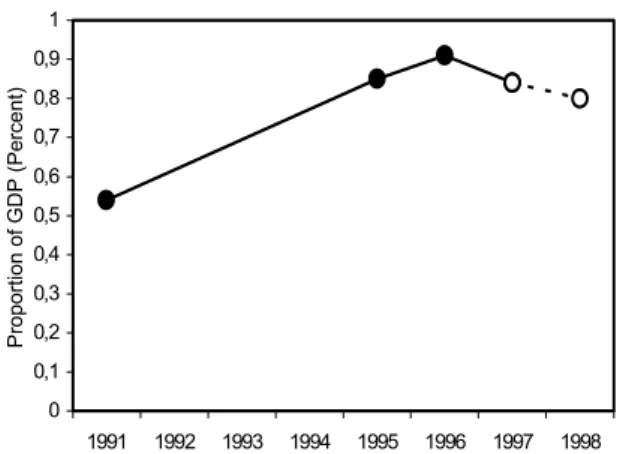
Though transfers per non-Western immigrant decreased somewhat in real terms between 1995 and 1996, since the number of immigrants increased, total transfers have risen in both years. Between 1996 and 1997, both transfers per person and total transfers fell. Measured as a proportion of GDP, these fell from 0.91% in 1996 to 0.84% in 1997. Since the employment situation improved after 1997, net transfers have probably been reduced even further (see also figure 2.2). Calculations based on individual data show the importance of the employment rate for the size of net transfers. At the average employment rate for non-Western immigrants (26.0%), net transfers are DKK -61,000 per person. With an employment rate of zero, it is DKK -113,000, and with an employment rate of 100, it is DKK 87,000 (i.e. in the latter case, to the public sector). Net trans-fers are zero at an employment rate of 56.6%.
The public sector consists of different subsectors, each with its own decision-making competency: The state, local and county authorities, and the unemploy-ment insurance system. Net transfers to non-Western immigrants come first and foremost from local authorities and the unemployment insurance system, and to a lesser extent from the counties.
It is important to note the large net transfers from local authorities to non-Western immigrants. This deficit can make local authorities less willing to ac-cept immigrants from non-Western countries.
While it is true that there is a redistribution system for channelling money from rich local authorities to those with a small tax base and a heavy burden of expen-diture, it is not certain that this is sufficient to cover the extra costs.
Figure 2.2. Net transfers to non-Western immigrants as a proportion of GDP in 1991-98 (the figure for 1998 is estimated)
0 0,1 0,2 0,3 0,4 0,5 0,6 0,7 0,8 0,9 1 1991 1992 1993 1994 1995 1996 1997 1998 P roporti on of GD P (P ercent)
Source: Viby Mogensen and Poul Chr. Matthiessen (2000)
2.6.2 How does immigration affect income distribution?
The next analysis deals with two other distribution questions: 1) How large are immigrants’ disposable incomes compared with Danes’? 2) How does immigra-tion affect Danish income distribuimmigra-tion and wage structure via the market?
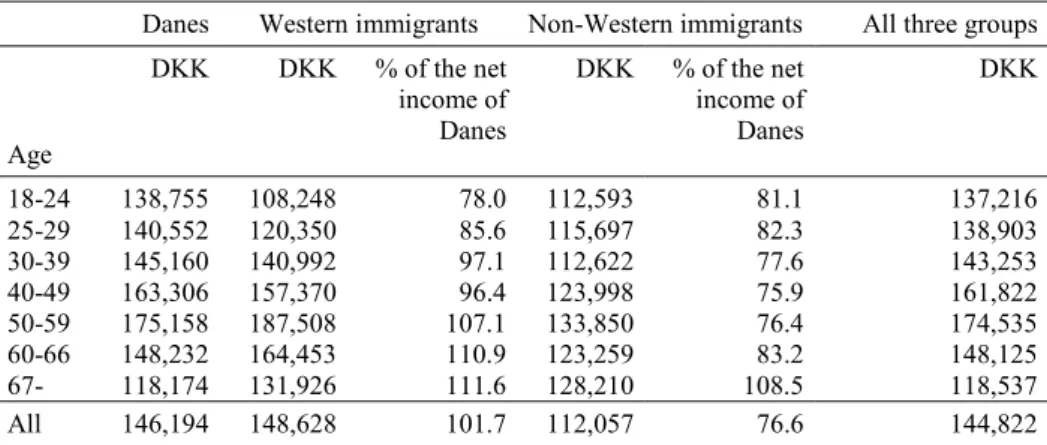
The study shows that, on average, Western immigrants have a slightly higher disposable income than Danes, while non-Western immigrants have decidedly lower incomes (see also table 2.1 below). On average, the disposable incomes of the non-Western group of immigrants are about ¾ of Danes’. The welfare state neutralises much of the differences, due to the market, but not all.
Even though non-Western immigrants are markedly overrepresented among those with the lowest incomes, a very large majority (85%) of those with the lowest incomes are nevertheless Danes.
Immigration can affect Danes’ incomes and wages via the market (via wages and prices). Provided it is not marginal, immigration can, by reducing the com-pensation to labour (i.e. wages), result in an economic surplus which accrues to other agents in the economy, including private and collective owners of capital. All the indications are, however, that this form of economic "surplus" is of minor proportion, but further research is required in order to draw any unambi-guous conclusions.
Until then, the rather considerable welfare gains from improved integration of the non-Western immigrants into the labour market must be one of the central results of the research.
Table 2.1. Net income (DKK) in 1997 according to country of origin and age
Danes Western immigrants Non-Western immigrants All three groups
Age DKK DKK % of the net income of Danes DKK % of the net income of Danes DKK 18-24 138,755 108,248 78.0 112,593 81.1 137,216 25-29 140,552 120,350 85.6 115,697 82.3 138,903 30-39 145,160 140,992 97.1 112,622 77.6 143,253 40-49 163,306 157,370 96.4 123,998 75.9 161,822 50-59 175,158 187,508 107.1 133,850 76.4 174,535 60-66 148,232 164,453 110.9 123,259 83.2 148,125 67- 118,174 131,926 111.6 128,210 108.5 118,537 All 146,194 148,628 101.7 112,057 76.6 144,822 Source: Viby Mogensen and Poul Chr. Matthiessen (eds.) (2000)
3. Integration into the labour market - and the importance
of socioeconomic factors
By Marie Louise Schultz-Nielsen
3.1 Introduction
This and the following chapter deals with the integration of immigrants and descendants into the labour market. The special focus on integration into the labour market is due to the fact that precisely employment is by far the main de-terminant of both immigrants’ and descendants’ living conditions and their general integration into Danish society. First and foremost, of course, work pro-vides an income, which enables the employed to be self-supporting. The very fact of having a job, however, also gives people the feeling of being needed, and means that they have a social network outside the family through which they can increase their knowledge of Danish society.
In the following, being integrated into the labour market is equivalent to having a job. Based on this definition, of course, a lot of Danes are not integrated into the labour market either. Section 3.2 therefore compares the employment rate of immigrants with that of Danes.
This is followed by an analysis of the factors which determine whether immi-grants and descendants get and keep a job. The analyses include all persons of working age, i.e. between 16 and 66 (both years inclusive).
For both Danes and immigrants, some of the persons outside employment will be on early retirement benefit or early retirement pension (collectively: early re-tirers) who have perhaps been active in the labour market for many years. There will also be a lot of students, who are in the process of qualifying themselves for the job market. It might therefore seem reasonable to exclude these groups, and thus limit the population to those actually in the labour force, i.e. the employed and the unemployed. However, this would ignore hidden unemployment, which among others includes immigrants on cash benefits, but who are not yet register-ed as unemployregister-ed at the job centre because they are at a Danish course, etc., cf. Hans Hummelgaard et al. (1995).
Excluding these groups would also ignore the fact that a large proportion of early retirers can indicate that some persons are forced out of the job market against their will. As a rule, therefore, the analyses in chapter 3 and 4 are based on all persons between 16 and 66, but where it can be relevant to include results based on the labour force, this is also done.
In section 3.2, immigrants’ integration into the labour market is illustrated by the employment situation for immigrants in the period 1985-98, distributed by sex
for immigrants and descendants respectively and by country of origin. Section 3.3 analyses how employed wage earners among non-Western immigrants and descendants found jobs, while section 3.4 does the same for the self-employed. Section 3.5 discusses how the employment situation for immigrants and descendants has been affected by various socioeconomic factors. Among other things, this section looks at the employment situation for immigrants who came to Denmark at different periods, and calculates whether employed immigrants are actually financially better off working. Section 3.6 sums up the results of the chapter.
3.2 The participation rate 1985-98
This section takes a closer look at the employment situation among immigrants and Danes on January 1st. in the period 1985-98. The results in this section are based on register data for all immigrants and a 2% sample of Danes.2 The
fol-lowing is based on the participation rate for 16-66-year-olds, defined as the pro-portion of 16-66-year-olds who are employed.3 Employment is partly
deter-mined by the proportion of the 16-66-year-olds in the labour force and partly by the proportion of the labour force who are actually employed.
These two factors can be illustrated by the participation rate and the unemploy-ment rate respectively.4 The participation rate is calculated on the basis of the
register-based labour force statistics per November the previous year, while un-employment is based on average degrees of unun-employment for the year in question in CRAM (the National Labour Market Authority’s Central Register for Labour Market Statistics).
Both sets of figures are calculated using Statistics Denmark’s calculation methods. It should be noted, however, that these methods can slightly under-estimate the labour force insofar as immigrants’ attachment to the labour market improves with length of stay, and economic conditions in general will also have a positive effect on the size of the labour force. The former factor does not apply to Danes, inasmuch as there is no new influx of persons to this group in the same way.
2 For a definition of "Danes", "immigrants", and "descendants", and the division into
"Western" and "non-Western" countries, see the introduction to the book.
3 In practice calculated as: Participation rate * (1 – the average unemployment rate). The
participation rate and unemployment for the period 1985-98 are shown in appendix table 3.1 and 3.2.
4 The employed also include persons in subsidised employment who receive wages
under employment, but not persons in job training schemes, cf. Statistics Denmark, 1999. In November 1998, persons in subsidised employment constituted 1.4% of employed Danes, against 5.1% of employed immigrants and descendants from less developed countries, cf. special data run from Statistics Denmark, published on the Danish Employers’ Confederation's homepage (www.da.dk).
What this means in practice is that, for example, the employment rate for 1997 would increase by up to 3% for non-Western immigrants and 2% for Western immigrants if the labour force had been estimated on the basis of figures per November 1997 rather than per November 1996. That the more recent figures were nonetheless not used is because this would mean departing from the calcu-lation method normally used by Statistics Denmark, and that information for part of the population would be lacking.
Figure 3.1 shows the trend in the employment rate for immigrants and descendants from both Western and non-Western countries and for Danes.
Figure 3.1. The employment rate for immigrants and descendants in the 16-66 age group (inclusive) from Western and non-Western countries, 1985-98
0,0 10,0 20,0 30,0 40,0 50,0 60,0 70,0 80,0 1985 1986 1987 1988 1989 1990 1991 1992 1993 1994 1995 1996 1997 1998 %
Danes non-W estern im m igrants W estern im m igrants non-W estern descendants W estern decendants
Source: Own calculations based on register data from Statistics Denmark.
The employment rate for Danes rose from 73% in 1985 to 75% in 1987, and then fell to 71% in 1993 and 1994. Since then the rate has been rising, reaching 74% in 1998. This should be seen against the background of a participation rate for Danes of about 80% throughout the period – slightly rising up to 1988 and since falling. At the same time, the average number of unemployed persons as a percentage of the labour force fell from 9% in 1985 to 7% in 1987. Unemploy-ment then increased to 12% in 1993, but has since fallen as the economy re-vived. In 1998, unemployment among Danes was 6%.
The employment rate for Western immigrants largely parallels that for Danes, albeit at a rather lower level – 15 percentage point lower in 1998. At the same time, the gap between the employment rate for Danes and Western immigrants widened slightly between 1985 and 1998.
The employment rate is higher for descendants than for immigrants from Western countries, but lower than for Danes.
In 1985, the employment rate was more or less the same for the (relatively few) descendants from Western countries and non-Western countries, but has since fallen sharply for the latter, especially in the period 1987-91. This was not due to rising unemployment, however, which remained unchanged between 1987 and 1990, but to a fall in the participation rate for non-Western descendants.
This fall is to a large extent age-determined, the number of 16-20-year-old non-Western descendants increasing rapidly from the end of the 1980s, and few in this young cohort (like other young persons) being in work yet. If, therefore, the employment rate for immigrants and descendants is calculated as though they had the same age distribution as Danes, the trend in the employment rate among non-Western descendants more or less resembles that for Western descendants, though with a slightly lower rate in the period 1989-94.5 An adjustment for age
does not make much difference to the employment rate for Western descendants and immigrants from Western and non-Western countries.
A change in the age composition among immigrants from non-Western countries thus cannot explain why the employment rate fell from 52% in 1985 to 33% in 1994 and then rose again to 38% in 1998. There was a strong increase in unem-ployment among non-Western immigrants from 1987 to 1994, however, and even though this fell rapidly up to 1998, unemployment is still four times higher than for Danes, compared with barely three times as high in 1985. At the same time, the participation rate for non-Western immigrants fell from 70 in 1985 to 50 in 1998.
In general, therefore, as figure 3.1 shows, the employment rate is significantly lower for immigrants from non-Western countries than for the other groups, and this gap has widened considerably in the period 1985-98. Thus, in 1985, the em-ployment rate was 1.4 times higher for Danes than for immigrants, compared with nearly twice as high in 1998, even after the gap had narrowed somewhat after 1994.
However, it cannot be concluded from this alone whether Danes or immigrants have benefited most from this economic upswing. Even though the employment rate rose more for non-Western immigrants than Danes in 1994-98, the partici-pation rate fell most and unemployment least for immigrants – simply because there was a substantially lower proportion of immigrants in employment to start with.
All in all, however, there has been a strong fall in the employment rate for non-Western immigrants in the period 1985-98. One reason for this could be that a lot of new immigrants have come to Denmark in the same period, and that, to start with, these have a relatively weak attachment to the labour market. Another possible reason is that immigrants who come at different times have also coped differently (cf. the discussion in section 3.5).
Since the attachment to the labour market for immigrants and descendants from Western countries, measured by the employment rate, does not differ greatly from the population as a whole, the following discussion focuses solely on im-migrants and descendants from non-Western countries. As regards descendants, we already know that part of the difference between them and Danes is due to age.
The number of non-Western descendants between 16 and 66 is limited, however, and many of the estimations for descendants will therefore be rather uncertain. Due to both this and reasons of space, therefore, immigrants and descendants will normally be lumped together in the following. Notwithstanding, it should be remembered that the employment situation is generally much better for descendants than for immigrants.
Figure 3.2 shows the employment rate for Danish men and women and men and women from non-Western countries. Here, therefore, immigrants and descend-ants are shown together.
The employment rate for women in Denmark is generally lower than for men, and even more so among non-Western immigrants. Thus, in 1998, the employ-ment rate for Danish men was 79%, compared with 46% for non-Western men, the corresponding figures for women being 69% and 32% respectively. The em-ployment rate for both men and women from non-Western countries fell in the period – it was 1.4 times higher for Danish women than for women from non-Western countries in 1985, but 2.2 times higher in 1998. For men, the rate was 1.3 times higher for Danes than for non-Western immigrants in 1985, against 1.7 times higher in 1998.
The trend in the employment rate is due in part, of course, to the slight fall in the participation rate for Danish men throughout the period and the slight rise for Danish women. Much more important, however, is the fact that, for both men and women from non-Western countries, the participation rate has fallen consi-derably in the period, though most for women. For men, the participation rate fell especially rapidly between 1985 and 1987, while for non-Western women it has fallen steadily throughout the period. Moreover, unemployment among women from non-Western countries is higher than for men, as for the population as a whole.
Figure 3.2. The employment rate for men and women in the 16-66 age group (inclusive) from non-Western countries and Danes, 1985-98
0,0 10,0 20,0 30,0 40,0 50,0 60,0 70,0 80,0 90,0 1985 1986 1987 1988 1989 1990 1991 1992 1993 1994 1995 1996 1997 1998 %
Danish men Danish women non-Western men non-Western women
Source: Own calculations based on register data from Statistics Denmark.
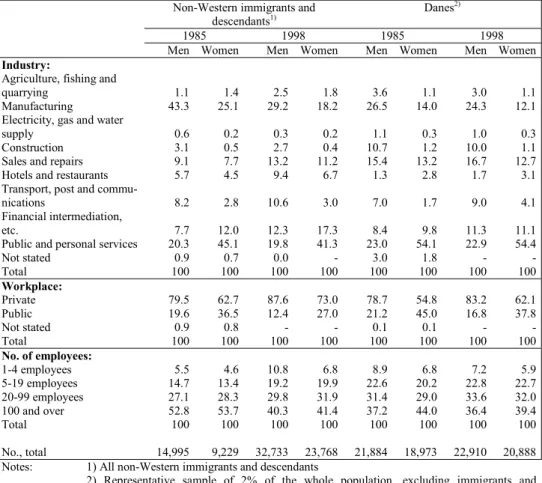
At the same time, unemployment among non-Western men seems to be more cyclical than for women, falling much more rapidly up to 1986 and then rising more swiftly up to 1994. The latter can be due to the fact that men are employed in industries that are more sensitive to economic fluctuations (see section 3.3 below).
Up to now, the focus has been on persons from non-Western countries as a whole. Table 3.1 shows the employment rate by country of origin.
For the sake of clarity, the table is for selected years only, namely 1985, 1991 and 1998. As can be seen, there are considerable variations in the employment rate both between the various countries and over time. The changes over time are connected with the number of new arrivals in each group, of course, since these must be assumed to have a weaker attachment to the labour market than the more established immigrants.
The fall in the employment rate for persons from Ex-Yugoslavia from 49% in 1991 to 32% in 1998 is due to the large number of civil war refugees from that country in 1991-93, which is also reflected in the rise in the number of 16-66-