“Garments Yarn Inventory System”
A Thesis Report Entitle
“Garments Yarn Inventory System”
SUBMITTED BY:
Mayeen Naomee [ID: 01201076]
Md. Ahsanul Alam [ID: 02101084]
SUPERVISED BY:
____________________
Dr. Sayeed Salam
Head of Department of Computer Science and Engineering BRAC University
Declaration
This is to certify that this project is our original work. No part of this work has been submitted elsewhere partially or fully for the award of any other degree or diploma. Any material reproduced in this project has been properly acknowledged.
Students’ names & Signatures.
_________________________________ 1. Mayeen Naomee (ID:-01201076)
_________________________________ 2. Md. Ahsanul Alam (ID:-02101084)
Approval
The Thesis titled “Garments Yarn Inventory System“ has been submitted to the following respected members of Board of Examiners of the Faculty of Computer Science and Engineering in partial fulfillment of the requirements for the degree of Bachelor of Science in Computer Science on 2007 by the following students and has been accepted as satisfactory.
1. Mayeen Naomee (ID:-01201076) 2. Md. Ahsanul Alam (ID:-02101084)
___________________ Dr. Sayeed Salam
Head of the Department of Computer Science & Engineering BRAC University
Acknowledgements
We are grateful to Dr. Sayeed Salam, our thesis supervisor for giving us the chance to work with Garments Yarn Inventory System and for proper guidelines and necessary supports.
We wish to acknowledge BRAC University for its support in providing the various facilities required for preparing and presenting of this project.
We would like to thank our friends for their advices and encouragements.
Table of Contents
Introduction 1
Chapter: 1 Project Proposal 2
1.1 Background of the Project 3
1.2 Aims of the Project 3
1.3 Benefits 4
1.4 Special Requirements 4
1.5 Limitation & Scope 5
Chapter: 2 Initial Study 6
2.1Business Study 7
2.2Planning & Scheduling 8
Chapter: 3 System Analysis 9
3.1 Work Flow Diagram (WFD) 10
3.2 WFD Details 12
3.3 Requirement Analysis 13
3.4 Requirement Specification 14
3.5 System Proposal 15
3.6 Feasibility Study 15
3.6.1 Cost and Benefit Analysis 15
3.6.2 Feasibility study 15
3.6.3 Economical Feasibility 15 3.6.4 Technical Feasibility 16
3.6.5 Behavior Feasibility 16
Chapter: 4 System Design 17
4.1 Use Case Diagram 18
4.2 Class Diagram 19
4.3 Database Diagram 20
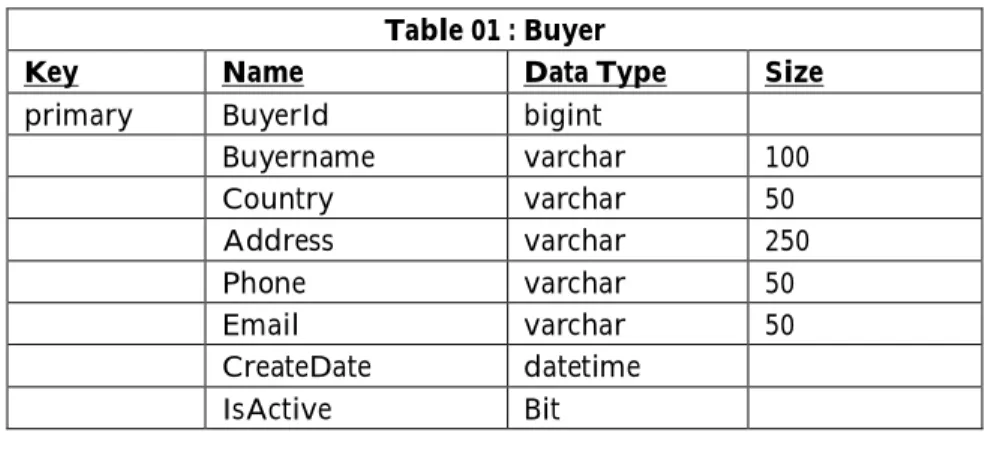
4.4 Database Table 21
Chapter: 5 User Interface Reports 326
Conclusion 39
Introduction:
This is a thesis work carried out by a team of Final-year Computer Science students of BRAC University, working under the supervision of Dr. Sayeed Salam (Head of the CSE Department of BRAC University).
In this report we present a Yarn Inventory System for garments. The main goal of our thesis is to make such an inventory system that will keep track of yarn of the garments company in various sections. This is just a part of the whole system. This system will help the company to increase efficiency and cut costs so that they can provide enhanced services to their buyers.
Our system design consists of four parts. The first part saves the buyers information and all the order information that are needed. The second part contains the winding section in which the employees get all the yarn and they are prepared to do the work. The third part contains the works that are done in knitting section where the employees start the knitting process different parts. All information is stored in a database. At last the system will generate the whole report of the works that are done in previous sections.
We used different tools to implement our system. We have designed our Yarn Inventory System’s interface with C# DotNet. We also used SQL Server for the database.
The Yarn Inventory System will have database integrated with an interactive front end, which will be user friendly and will allow the users of the software to easily carry out all their business functions. Overall reports, production controls can be generated using this software.
CHAPTER:
1
Project Proposal
1.1 Background of the project 1.2 Aims of the Project
1.3 Company Benefits 1.4 Special Requirements 1.5 Limitations & Scope
1.1 Background of the Project:
Garments Industries are one of most important business
industries in Bangladesh. These industries play a vital role in our economic growth. The Garments Industries need an effective inventory system to keep track of their operations. Yarn is the most useful accessory in these garments companies. So they need an efficient Yarn Inventory System so that they can carry on with their work easily. That’s why we have chosen to make a Yarn Inventory System.
1.2 Aims of the Project:
We had to build the system so that it shows the following information: Buyer Information Supplier Information Employee Information Order Information Color Information Size Information Stock Information
1.3 Benefits:
Flexible user interface
Easy to use
Reduce time and cost
Previous Records
Compare with previous condition graphically
Most of the analytical question can be answered
Availability of information for buyer, supplier and employees
Huge data record
Faster data retrieve
Easy to find out information
1.4 Special Requirements:
C# Dot NET
1.5 Limitations & Scope:
We went to different garments industries to observe their system. We observed that it was a huge system. It requires more time to thoroughly study and implement the Yarn Inventory System. For this reason the Yarn Inventory System may not fulfill all the criterions, which general software should have. But we have tried our best to prepare it as neatly as possible in order to complete the project.
We faced lack of availability of necessary books and journals on inventory management system. We also faced some people who were not as co-operative as we expected.
CHAPTER:
2
Initial Study
2.1 Business study
2.1 Business Study:
At first the buyer and company representative negotiate for price. After negotiation they fix the shipment date. If both side agree on everything then the buyer send the order sheet. The buyer order sheet contains buyer name, shipment date, address, LC number, order number, style number, color information and packing details.
Then the company accepts the balance sheet. They also check the payment details. Form then the pan for production starts. They start to divide the task foe different sections. This distribution is done date wise so that they can finish their task in proper time.
After planning for production the company orders the supplier for yarn. When yarn is supplied it goes to the company stock. The stock keeper sends yarn to Yarn controller account for requisition. Then the yarn controller of Winding section accepts the yarn from the stock.
The yarn controller of Winding section accepts bales and opens it. Each bale has one or more lot. The yarn controller distributes the lots to the employees. The employees start to make cones of yarn. When making of cones are finished the employees returns the cones of yarn to the yarn controllers. Then the yarn controller of Winding section sends the cones to the Knitting section.
After receiving the cones of yarn from the Winding Section, the yarn controller of Knitting Section distributes the cones to the employees. The lot number is attached to the cones. Then the employees start to make different parts with the cones of yarn. After finishing their job they return the parts to the yarn controller. They also return the yarn that is left after the main task.
2.2 Planning & Scheduling:
Software Development Life Cycle Model
– Waterfall model Requirements definition System and software design Implementation and unit testing
Integration and system testing
Operation and maintenance
CHAPTER:
3
System Analysis
3.1 Work Flow Diagram (WFD) 3.2 WFD Details
3.3 Requirement Analysis 3.4 Requirement Specification 3.5 System Proposal
3.1 Work Flow Diagram (WFD):
Buyer LC Order No. Style No. Color Stock Size Winding Section Employee Receive/Return Lot No. 1 100 98 2 500 Knitting 10 1 1 3 3 4 98 Supplier10 Distribution Linking Trimming/Continue Mending P.Q.C. Wash Zip/Button Attachment Final P.Q.C. Iron Q.C. Measurement Packing Ship Out
3.2 WFD Details:
Outdoor Process:
When the buyer comes to the company then buyer and company representative negotiate for price. After negotiation they fix the shipment date. If both side agree on everything then the buyer send the order sheet. The buyer order sheet contains buyer name, shipment date, address, LC number, order number, style number, color information and packing details.
Indoor Process:
Then the company accepts the balance sheet. They also check the payment details. Form then the pan for production starts. They start to divide the task foe different sections. This distribution is done date wise so that they can finish their task in proper time.
After planning for production the company orders the supplier for yarn. When yarn is supplied it goes to the company stock. The stock keeper sends yarn to Yarn controller account for requisition. Then the yarn controller of Winding section accepts the yarn from the stock.
The yarn controller of Winding section accepts bales and opens it. Each bale has one or more lot. The yarn controller distributes the lots to the employees. The employees start to make cones of yarn. When making of cones are finished the employees returns the cones of yarn to the yarn controllers. Then the yarn controller of Winding section sends the cones to the Knitting section.
After receiving the cones of yarn from the Winding Section, the yarn controller of Knitting Section distributes the cones to the employees. The lot number is attached to the cones. Then the employees start to make different parts with the cones of yarn. After finishing their job they return the parts to the yarn controller. They also return the yarn that is left after the main task.
After receiving different parts from the Kitting Section all the parts are linked together. Then they are sent to Trimming Section. If there are any faults then necessary steps are taken to mend them. Then the clothes are washed and ironed. After this they are packed. Finally the packs are made ready for the ship out.
3.3 Requirement Analysis:
These following portions of the organization system are required to be automated:
Buyer Order Information:
Buyer name, address, e-mail etc
Size Information Color Information Accessories Information Supplier Information Employee Information Machine Information Stock Information Activity Information
3.4 Requirement Specification:
These following portions of the organization are specified to be automated:
Buyer information:
Add new buyer and his address, country, phone no. and e-mail. Also check if others are active.
Size information:
Add new size for the clothes.
Color Information:
Add new color.
Accessories information:
Add new accessories. But currently Yarn is the only accessory since this is a Yarn Inventory system.
Employee information:
Add new employee and assign him to a specific section. Also check other employee status.
Section information:
Add new section. But currently there is only Winding and Knitting section in the system.
Machine information:
Add new machine. Also check other machines status.
Stock information:
Show all the raw materials that are available. Also show the bales number and lot number.
3.5 System Proposal:
Required Hardware:
Pentium III or higher 256 MB of RAM or Higher
Required Software:
Operating System: Windows 2000, Windows NT, Windows XP Microsoft SQL Server 2005
Microsoft Visual Studio 2005
3.6 Feasibility Study:
3.6.1 Cost & Benefit Analysis:
This software is standard software for test reporting system. For any software it is very important to analysis cost and benefit. Without analysis cost & benefit never possible a comparison between existing system and proposed software.
3.6.2 Feasibility Study:
When approved, the proposal initiates a feasible study that evaluates alternative systems and recommends the system that meets performance requirements. The system, which we are proposing, will be feasible to implement for the company. We have to find out the specific information needs of the organization and whether our system meets its goal. We also have to find out the basic resource requirements, costs, and benefits. There are five phases of feasibility study. They are as follows:
3.6.3 Economical Feasibility:
Also known as cost/benefit analysis, which determines to what a new system, is cost effective. Implementation of our proposed system will ensure the best possible performance from the part of resources. This increase in performance will optimize the overall productivity and
throughput of the mentioned resources. Our system is in economically feasible in this concern.
3.6.4 Technical Feasibility:
It is determined by evaluating the Hardware and supportive Software. The level of access of the technology has a significant impact on how the system is eventually designed. We have used C# .NET and SQL Server which are very much strong and give high security. We are using that kind of hardware elements, which will be very feasible for any organization because they are able to run that software with minimum hardware requirements.
3.6.5 Behavioral feasibility:
It includes the training the user staff on a candidate system. The data entry screen design is similar to other forms being used by the user staff.
CHAPTER:
4
System Design
4.1 Use Case Diagram 4.2 Class Diagram 4.3 Database Diagram 4.4 Database Table
4.1 Use Case Diagram
Login
Generate reports
Check order list Add new order
View current order status
Yearn distribution report Bail reports
Issue yearn
Lot reports
Distributed User
Calculate and store data Issue yearn
Calculate and store data
Server engine Client engine
display
Takes user input and process
Actor <<Uses>> <<Uses>> <<Uses>> <<Uses>> <<Uses>> <<Uses>> <<Uses>>
4.2 Class Diagram
Supplier Issue Stock Buyer Data logic BL Requisition Order Finish product Accessory Employee4.4 Data Base Table
Table 01 : Buyer
Key Name Data Type Size
primary BuyerId bigint
Buyername varchar 100 Country varchar 50 Address varchar 250 Phone varchar 50 Email varchar 50 CreateDate datetime IsActive Bit Table 12 :Accessory
Key Name Data Type Size
primary AccessoryId bigint
AccessoryName varchar 50 IsActive bit
Table 12 :Color
Key Name Data Type Size
primary ColorId bigint
Color Name varchar 50 IsActive bit
Table 01 : Employee
Key Name Data Type Size
primary EmployeeId bigint
Employeename varchar 100
Country varchar 50
Address varchar 200
Phone varchar 50
Email varchar 50
foreign sectionId int MachineId int createDate datetime IsActive bit
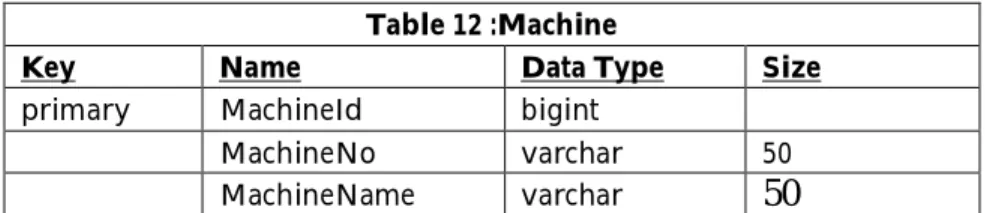
Table 12 :Machine
Key Name Data Type Size
primary MachineId bigint
MachineNo varchar 50 MachineName varchar 50
Table 11 :Order
Key Name Data Type Size
primary OrderId bigint foreign BuyerId bigint
orderDate datetime
LcNumber varchar 15
Table 10 :OrderStyle
Key Name Data Type Size
primary OrderStyleId bigint foreign OrderId bigint
Description varchar 50
SizeId int
ColorId int
Table 01 : Requistion
Key Name Data Type Size
primary RequistuiionId bigint foreign OrderStyleId bigint foreign AccessoryId bigint foreign SupplierId bigint
Qty int
foreign unitId int RequestionDate datetime RequestionStatus int
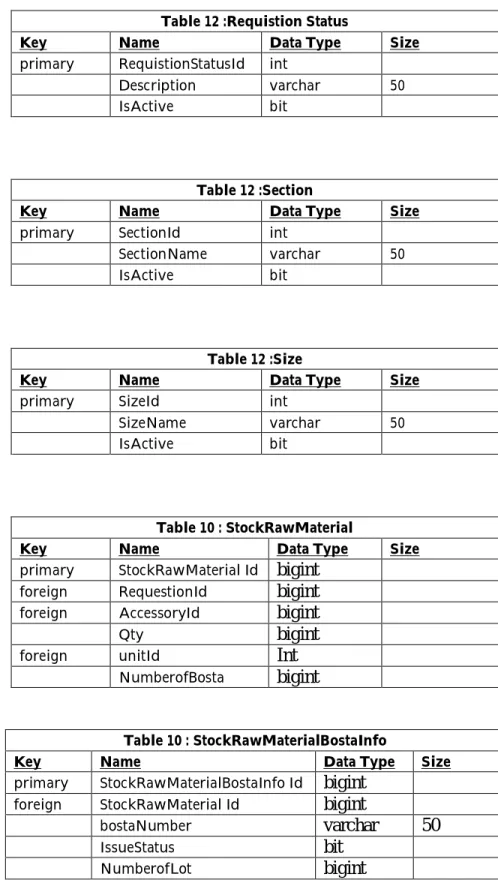
Table 12 :Requistion Status
Key Name Data Type Size
primary RequistionStatusId int
Description varchar 50 IsActive bit
Table 12 :Section
Key Name Data Type Size
primary SectionId int
SectionName varchar 50 IsActive bit
Table 12 :Size
Key Name Data Type Size
primary SizeId int
SizeName varchar 50 IsActive bit
Table 10 : StockRawMaterial
Key Name Data Type Size
primary StockRawMaterial Id bigint foreign RequestionId bigint foreign AccessoryId bigint
Qty bigint
foreign unitId Int NumberofBosta bigint
Table 10 : StockRawMaterialBostaInfo
Key Name Data Type Size
primary StockRawMaterialBostaInfo Id bigint foreign StockRawMaterial Id bigint
bostaNumber varchar 50
IssueStatus bit
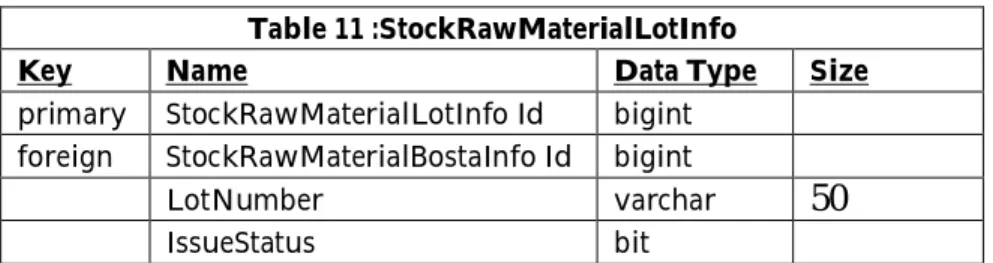
Table 11 :StockRawMaterialLotInfo
Key Name Data Type Size
primary StockRawMaterialLotInfo Id bigint foreign StockRawMaterialBostaInfo Id bigint
LotNumber varchar 50
IssueStatus bit
Table 10 :StockYearnCone
Key Name Data Type Size
primary StockYearnCone Id bigint foreign OrderStyleId bigint foreign WindingIssueId bigint
LotNumber varchar 50 NumberOfCone bigint
Table 11 :StockYearnConeDetails
Key Name Data Type Size
primary StockYearnConeDetails Id bigint foreign StockYearnCone Id bigint
ConeNumber varchar 50
IssueId bit
Table 01 : Supplier
Key Name Data Type Size
primary SupplierId bigint
foreign SupplierId varchar 100
Country varchar 50 Address varchar 250 Phone varchar 50 Email varchar 50 CreateDate datetime IsActive bit
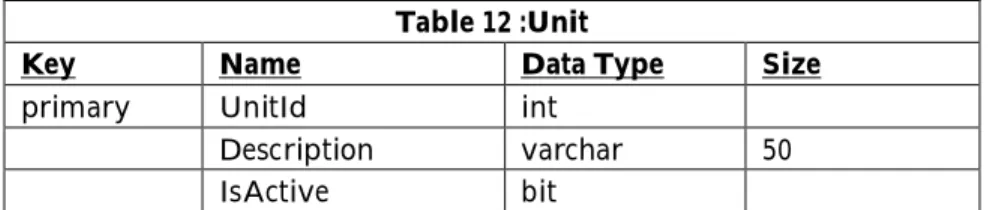
Table 12 :Unit
Key Name Data Type Size
primary UnitId int
Description varchar 50 IsActive bit
Table 01 : WindingYearnIssue
Key Name Data Type Size
primary WindingYearnIssueId bigint foreign EmployeeId bigint foreign OrderStyleId bigint foreign StockMaterialId bigint foreign AccessoryId bigint
IssueDate datetime foreign WindingYearnIssueStatusId int
Table 12 : WindingYearnIssue Status
Key Name Data Type Size
primary WindingYearnIssue Status Id int
CHAPTER:
5
Figure: Yarn Distribution Interface
We have successfully finished our Garments Yarn Inventory System. But we would like to improve our system in future. Our current system is desktop based. We want to turn this system into web based system. Also now a days security is of major importance. So we would like to
tighten up the security of our inventory system. Finally we would like to add few options for editing the information that are already saved into the
inventory system. We sincerely hope that our Garments Yarn Inventory System will help the garments industries to work effectively with their buyers and bring great success to their business.
References:
Books:
– J. Richter, "Applied Microsoft .NET Framework Programming" – J. Richter and F. Balena, "Applied Microsoft .NET Framework
Programming in Microsoft Visual Basic .NET" – T. Thai and H. Lam, ".NET Framework Essentials"
Web Sites:
– http://msdn.microsoft.com/net – http://www.gotdotnet.com/