Web Service Migration using
the Analytic Hierarchy Process
M. Mohanned Kazzaz Department of Information Systems
Faculty of Information Technology Brno University of Technology
Brno, Czech Republic Email: [email protected]
Marek Rychl´y
Department of Information Systems Faculty of Information Technology
Brno University of Technology Brno, Czech Republic Email: [email protected]
Abstract—In this paper we present a framework for Web service migration in Service-oriented Architecture (SOA). The framework allows an automatic discovery of new providers and their services joining a system and extraction of their context, preferences, and rules for a Web service migration ontology. If the preferences and the rules, which specify requirements of each provider to its hosted services and requirements of the services to be hosted by a provider, do not meet the current status and context of providers or services, the framework initiates a Web service migration. In this case, the ontology is added to a core domain model and reasoned together by Jena reasoners to retrieve a set of alternate migration decisions. These are processed by Analytic Hierarchy Process (AHP) decision-making method to find the best possible Web service migrations which modify the status and context of providers and services to better meet their preferences and rules. By the Web service migration, the framework extends significantly the adaptability of SOA systems and helps to keep a required quality of their services (QOS).
Keywords-service-oriented architecture; Web service, service migration, devices profile for web services, Web service discovery.
I. INTRODUCTION
Software mobility [1], which is the ability of moving soft-ware across the nodes of a network, is a very interesting approach addressing many issues of distributed systems such as interoperability, self-adaptivity, fault-tolerance, or load balanc-ing. In Service-oriented Architectures (SOA), software mobility can be comprehended as service migration, which is the ability of services to be moved across the service providers at runtime. As services in SOA should be designed with respect to SOA principles [2], such as re-usability and statelessness, software mobility, that is service migration, in the case of SOA is much easier than in the case of non-SOA distributed systems.
In our previous work [3], we proposed an ontology-based framework for Web service migration in SOA. We defined an ontology-based semantic context model of migratable Web ser-vices and their providers. The context model allows to describe in the OWL/RDF format status properties of migratable Web services, properties of their providers, and also preferences and rules which specify requirements of each provider to its hosted services and requirements of the services to be hosted by a provider. We also proposed utilization of the context model with Apache Jena reasoners and rule engines for RDFS and
OWL inference to make migration decisions, that is (1) to detect a situation when the current status or context of the providers or the services does not meet their requirements and some of the services need to be migrated and (2) to find services which should be migrated and where they should be migrated.
The situation above can arise from two reasons: a migratable service with particular requirements on its runtime environ-ment is currently hosted by a provider which does not meet the requirements, or a provider with particular requirements on hosted services is currently hosting a migratable service which does not meet the requirements. Moreover, this situation results into a set of migration decisions which indicate possible services to migrate and possible destination service providers of the migration. Unfortunately, the reasoners and rule engines for RDFS and OWL inference produce all the feasible migration decisions, i.e., all services which need to be migrated and all providers which are able to host such services after the migra-tion, and are not able to determine which migration decision is best and will fix the most important broken requirements.
This paper deals with the problem of selection of the best service migration decisions from a set of found migration decisions produced by the RDFS/OWL reasoners and rule en-gines. The selection process is based on the Analytic Hierarchy Process (AHP, [4]) multi-criteria decision making method.
The paper is organized as follows. Section II discusses related work on service migration in SOA. In Section III, we describe our Web service migration framework with focus on the migration decision process. Section IV deals with the utilization of AHP method in the best migration selection. An example of the migration decision making and selection process with AHP is provided in Section V. Finally, we draw conclusions in Section VI.
II. RELATEDWORK
Several works directly address or touch on the decision making issues in migration of services in SOA. For example, in [5], a service migration approach was proposed as a solution to maintain continuous service availability with migration deci-sions based on Quality of Service (QOS) goals. In [6], authors introduced a virtual machines migration framework with several
migration decision making strategies for different resource reservations goals and schemes during migration of virtual machines, namely: sequential migration, parallel migration and workload-aware migration strategies. In [7], authors proposed an algorithm for dynamic placement of services to servers based on available server resources (such as CPU or memory) and network performance given by SLAs.
In [8], authors described a framework for service migration in cloud computing environments using a genetic algorithm to search and select possible migrations. The algorithm utilized a cost model with various service migration costs, including the costs of consistency maintenance and communication during migrations, a service table with information of all migrated and replicated services, and a general computing platform registry with information about hosted services. Another approach to selection of migratable services in a cloud was proposed in [9]. The selection process considered pre-defined criteria related to QOS of the migratable services in the cloud, namely: response time, throughput, availability, reliability, and cost, and it utilized the Analytic Hierarchy Process (AHP, [4]) method with comparison matrices defined by a consumer’s judgments on the QOS criteria. Although the AHP method is utilized also in our approach presented in this paper, the comparison matrices are, in our case, defined by the ontology of dynamic properties and preferences of automatically discovered providers and their services, which supports a multi-criteria migration decision making process.
In [10], a decentralized migration approach was introduced based on monitoring of health of Web Services Resource Framework (WSRF) containers [11]. The approach was trying to minimize possible threats of service level agreements (SLA) violations to preserve QOS of provided services by their migra-tion. A service priority was proposed to be used as a weighting factor in migration decisions in addition to a health metric of each WSRF container. However, this approach was limited by the static health metric of WSRF containers based on their available memory and CPU performance factors, while, in our our paper, we are addressing this limitation by dynamic service or provider properties which enable considering property values in different weighting factors during the migration decision process.
III. WEBSERVICEMIGRATIONFRAMEWORK In this section, a Web service migration framework will be introduced with focus on the migration decision process. Other parts of the framework have been already described in more details in [12] and [3].
A. Context Model
Migratable services and service providers which support service migration have to publish status properties to describe their status (e.g., the importance of a service, or available resources of a provider) and preference rules to describe their preferences (e.g., preferred types of services hosted by a provider, or resources required by a service) which should be considered in the migration decision making process. These
Fig. 1. A simplified schema of the partial model for services and providers.
properties and rules are defined in an ontology-based context model [3], which consists of a system core model and partial models of individual services and service providers.
The system core modelprovides the terminology used to define system components of Service and ServiceProvider classes including description of their properties, relationships, and subclasses. The partial models define status properties and preference rules ofServiceandServiceProvider instances representing services and their providers currently available in a system, as it is described in Figure 1.
For a particular service or service provider, thehasProperty element contains a list of status properties of the service or the provider. Each property, which is formally a subclass of thePropertyclass in the service migration ontology, has its data-type, value, and a set of criteria. Each property can be mapped by to several criteria which describe its importance for different parties in service migration and which are used later to select the best migration by AHP method (see Section IV). Besides the hasProperty element, the service or service provider model defines also therules element with a list of preference rules written in the Jena rules language. Each rule defines a pre-condition that has to be met by service providers which will be hosting the service, in the case of the service model, or by services which will be hosted by the service provider, in the case of the service provider model. Finally, the noPreferenceRuleselement just indicates that there are some preference rules in the model (if it is set to true) or there are not any such rules (if it is set tofalse). Existence of the noPreferenceRuleselement, as it does bring any new informa-tion, just improves performance (i.e., decreases complexity) of processing of the model in Jena.
In the case of a service, the information according to the model is integrated in the service’s WSDL description, i.e., a standardized description of a Web service interface which is
managed by common tools of a SOA implementation platform (an application server). In the case of a service provider, the information according to the model has to be published by the provider by getContext method of the provider’s grounding service ProviderContextWS.
B. Service Provider Discovery and Service Migration When a new service provider emerges into a network of a system which is utilizing the framework and the emerging service provider is able to participate in service migration in the system, that means both to pass its migratable services to other available providers and to accept migratable services from other providers if needed, the provider should be automatically discovered and considered in future migration decisions. To enable the automatic discovery of emerging service providers, the Devices Profile for Web Services1 (DPWS) standard has been utilized by integration of WS4D.org Java Multi Edition DPWS Stack2 (WS4D-JMEDS).
DPWS specifies a minimal set of built-in services which needs to be implemented in order to: enable discovery of ser-vice providers; support the meta-data exchange for publishing services provided by individual, previously discovered, service providers; and enable publish/subscribe communication model for producing and consuming asynchronous event messages by the services. WS4D-JMEDS is a light-weight DPWS stack that implements DPWS build-in services mentioned above. By means of DPWS/WS4D-JMEDS, our framework is be able to discover emerging service providers and their migratable services, and to retrieve information about the service providers and services needed to build the context model as it was described in Section III-A and as it will be utilized later during the migration decision making process described in this section. The architecture of the Web service migration framework is depicted in Figure 2. The emerging service providers are discovered by searchForDevices()method of Controller class provided by our framework. In this method, a new instance of JMED DefaultDeviceclass is created for each discovered service provider and a new instance of JMED DefaultService class is created for each service hosted by the provider. Then, the instances of both classesDefaultDeviceandDefaultService are added into the ontology-based context model by calling addDevicesToModelandaddServicesToModel methods, respec-tively.
Later, the ontology-based context model is processed by Jena reasoners. The resulting inferred model contains information on possibleProvidedServicefor each service provider, which lists all known services which can be provided in future by a particular service provider, and possibleDestinationProvider for each service, which lists all known service providers which can provide a particular service in future. Finally, a SPARQL query is used on the inferred model to find such services and providers which satisfy both possibleProvidedServiceand possibleDestinationProvider, i.e., to find providers which can
1http://docs.oasis-open.org/ws-dd/ns/dpws/2009/01 2http://ws4d.e-technik.uni-rostock.de/jmeds/ Controller + searchForDevices() + addDevicesToModel() + addServicesToModel() JMEDS Framework Provider Model Core Model Found migrations Selected migration Migration Unit AHP JENA + SPARQL + setServiceId(serviceId) WSDL + Model Migratable Service IP Network + getContext(deviceName) ProviderContextWS Provider + setFriendlyName(name) + addService(service) + start() + getServiceDeploymentPackage(url) + switchServiceToDestination(url) + deployServiceFromPackage(pkg) + undeployService(url) FrameworkService Context Model
Fig. 2. Architecture and modules of the Web service migration framework.
host given services and also can server in potential service migrations as destinations for the migrating services. In other words, by this query, we find a set of all possible migrations. To find the best migrations in the set of all possible mi-grations, we choose to implement the Analytic Hierarchy Process (AHP, [4]) decision-making method. Application of this method is described later in Section IV. The results of this method, i.e., the best migrations, are processed and their services are migrated to corresponding destination providers. The migration of a migratable service from a source provider to a destination provider is performed in classFrameworkService by calling its methodsgetServiceDeploymentPackageon the source provider, switchServiceToDestination on the service, deployServiceFromPackageon the destination provider, and un-deployServiceon the source provider. These methods are called sequentially to manage packaging the service (i.e., storing its implementation and internal status in a package), moving it to the destination provider (moving the package over network), deploying the service on the destination provider (deploying from the package and restoring the last-known internal state of the service), and removing the original instance of the service from the source provider.
IV. AHPIN THEMIGRATIONDECISIONPROCESS In the migration decision process, the Analytic Hierarchy Process (AHP, [4]) method is utilized to select the best migra-tions in the set of all possible migramigra-tions previously found by
ontology reasoning on the context model. The best migrations are those migrations which address (and fix by the service migration) violations of services or service providers preference rules with the highest priority, i.e., such rules that are based on the most critical properties of the services or service providers, respectively.
To introduce the priorities of the preference rules of services and service providers based on the criticality of their properties, the ontology-based context model described in Section III-A has been further extended bydecision making criteria, which are defined in the system core model and referred from indi-vidual properties in partial models of the services and service providers (we can say that the properties are controlled by referred criteria; see element criteriain Figure 1). Formally, the criteria are instances of CriteriaProperty class with the following attributes: name, owner, valueWithHighestWeight, valueWithLowestWeight, andcriteriaPriority.
For each criterion, thenameattribute contains a name of the criterion (which is utilized in the references from properties in the partial models). Attribute ownercan be one of values ’origin’, ’destination’, and ’service’, and limits possible owners of the properties which are refering a particular criteria (for example, a criterion with the owner value set to ’service’can be referred only from service context models properties, i.e., it can be applied only on services, not on service providers). AttributesvalueWithHighestWeightandvalueWithLowestWeight indicate which values of properties referring a particular criteria are considered to be the most important and the least important, respectively, while attribute criteriaPriorityindicates a general importance of a particular criteria by integer values between 1 and 10. These last three attributes then control the overall importance of properties referring the particular criteria and determine the priority of related preference rules.
To select the best migrations, possible migrations previously found are processed by AHP in the Controllermodule (see Figure 2) that extends each input migration by its weight which is calculated based on the priorities of the preference rules of services and service providers participating in the migration. Controller then selects the migrations with the highest weight. The AHP starts with creating comparison criteria matrix A, which is anm×mmatrix of real numbers wherem is the number of considered criteria. In the matrix, aij is the importance of the ith criterion over the jth one (diagonal entriesaii are set to1). If theithcriterion has the same importance as thejthone,aij entry is set to1, otherwise values ofaij entry range over3,5,7, or9, which indicate that the ith criterion is slightly more important, more important, strongly more important, or absolutely more important, than the jthcriterion, respectively.
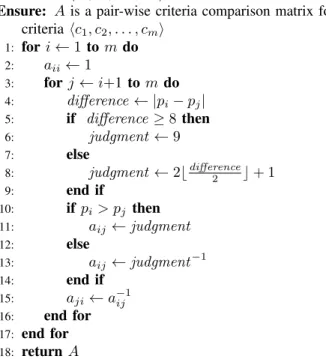
Usually, in existing applications of the AHP method, entries of the matrix above are set directly through a user’s judg-ment. In our case, we can automate this process by utilization of decision making criteria (and the related properties and preference rules published by services and service providers) to compute individual aij entries of the matrix. We use the InitializeCriteriaMatrix algorithm (see Figure 3) to calculate
Require: hp1, p2, . . . , pmi as values of CriteriaPriority of criteria hc1, c2, . . . , cmi
Ensure: Ais a pair-wise criteria comparison matrix for given criteria hc1, c2, . . . , cmi 1: fori←1to mdo 2: aii←1 3: forj←i+1to mdo 4: difference ← |pi−pj| 5: if difference≥8 then 6: judgment←9 7: else 8: judgment←2bdifference 2 c+ 1 9: end if 10: if pi> pj then 11: aij←judgment 12: else 13: aij←judgment−1 14: end if 15: aji←a−ij1 16: end for 17: end for 18: return A
Fig. 3. TheInitializeCriteriaMatrixalgorithm to compute a pair-wise criteria comparison matrix for AHP based onCriteriaPrioritiesof individual criteria.
theaij entries in the upper-right triangular part of matrixA by comparing criteria priorities and in the lower-left triangular part of matrixA as reciprocal values of the symmetric entries in the upper-right triangular part. The algorithm guarantees the consistency of judgments between the criteria and satisfies a consistency ratio condition of comparison matrixA to be less than10% as required for AHP.
After initializing A matrix, AHP computes matrix A¯ by normalizingAentries to make the sum of each column entries equals to1 through equation
¯ aij = aij Pm k=1akj (1) Then, AHP computes weight vectorw of criteria by com-puting the average value of each row of normalized matrixA¯ through equation
wi=
Pm
k=1¯aik
m (2)
Finally, theInitializeMigrationMatricesalgorithm (see Fig-ure 4) is executed for each considered criterion ck, where k= 1, . . . , m, of criteria setC={c1, c2, . . . , cm}. The mul-tiple executions of theInitializeMigrationMatrices algorithm are used to createn×m matrixV = [V(1), V(2), . . . , V(m)],
wherenis the number of possible migrations found before. In the matrixV, each V(k)is a transpose of the weight vector
of matrix S(k) obtained by an individual execution of the InitializeMigrationMatricesalgorithm.
The result of the InitializeMigrationMatrices algorithm, which is matrixS(k), is ann×nmatrix where eachs(ijk)entry
Require: criterion k and its attributes valueWithHighest-Weight(k)and valueWithLowestWeight(k);hp
1, p2, . . . , pni as values of services or service providers properties that considerkas their criterion
Ensure: n×nmatrix S(k) as a migration comparison matrix based on criterionk 1: fori←1 to ndo 2: sii ←1 3: forj←i+ 1 tondo 4: range ← valueWithHighestWeight(k) − valueWithLowestWeight(k) 5: diffValue←pi−pj 6: fifthOfDiff ←range/5
7: ifdiffValue>4∗fifthOfDiff then
8: sij ←9
9: else ifdiffValue≤4∗fifthOfDiff ∧diffValue>
3∗fifthOfDiff then
10: sij ←7
11: else ifdiffValue≤3∗fifthOfDiff ∧diffValue>
2∗fifthOfDiff then
12: sij ←5
13: else ifdiffValue≤2∗fifthOfDiff ∧diffValue>
fifthOfDiff then
14: sij ←3
15: else ifdiffValue≤fifthOfDiff then sij←1
16: end if
17: ifrange∗diffValue<0 then 18: sij ←s−ij1
19: else ifrange∗diffValue= 0 then
20: sij ←1 21: end if 22: sji←s−ij1 23: end for 24: end for 25: returnS
Fig. 4. TheInitializeMigrationMatricesalgorithm to compute a migration comparison matrix based on a given criterion.
represents a judgment value between theithmigration and the jth one based on the criterionk. The algorithm use valueWith-HighestWeightand valueWithLowestWeight criterion attributes to map the judgment into one of values of set{1,3,5,7,9}or their reciprocals, which are accepted by AHP.
By applying the InitializeMigrationMatricesalgorithm for allm considered criteria we getm weight vectors of possible migrations, where each vector is related to one criterion. Finally, AHP computes the composite weight vector pof all possible n migrations through equation
p=V ·w (3)
whereV is then×mmatrix obtained by multiple executions of the InitializeMigrationMatrices algorithm as described before (one execution for each each criterion) andw is the weight vector of criteria from Equation 2.
TABLE I
VALUES OF THE STATUS PROPERTIES PUBLISHED IN PARTIAL MODELS OF THE SERVICE PROVIDERS.
Provider noPreference-Rules Free-Memory Permanent-StorageSize Battery-LifeTime XProvider True 512 MB 512 MB 1 hour YProvider False 2048 MB 2048 MB 2 hours ZProvider True 2048 MB 2048 MB 3 hours
Fig. 5. The partial model for service providerYProviderwith information on the provider’s status properties and preference rules. Preference rule
YProviderPreferencewritten in the Jena rules language allows the provider to host only services withServiceTypeset to value “major” (other providers
XProviderandZProviderdo not have this restriction).
The migration with the highest composite weight entry of the vector pis considered to be the best migration and it is selected to be executed as it is described in Section III-B.
V. ANEXAMPLE
In this section we provide an illustrative example to evaluate the proposed approach. The example presents a system of service providers hosting services which cooperate to achieve a particular business logic. Web service migration allows to migrate services from one provider to another in cases of unex-pected violations of services or service providers preferences. The migration guarantees better availability of the services and increases fault-tolerance of the system. Let us suppose the system consists of the following three service providers: XProvider,YProvider,ZProvider. The status properties of these providers, which are published in their partial context model together with their preference rules (see Section III-A), are listed in Table I. For example, the information published by YProvider service provider, that is its status properties and preference rules, is listed in Figure 5.
For simplicity reasons, let us suppose that there are only two migratable services, namely serviceService1currently provid-ed/hosted by service providerXProviderand serviceService2 currently provided/hosted by service provider YProvider. A partial context model of each of these two services is available as a part of their WSDL description published by their service providers. The status properties published in the context models
TABLE II
VALUES OF THE STATUS PROPERTIES PUBLISHED IN PARTIAL MODELS OF THE SERVICES.
Service noPreferenceRules ServicePriority ServiceType
Service1 False 50% major
Service2 True 20% minor
of these services are listed in Table II. Moreover, in the context model, Service1declares its two preferences described as Jena rules calledService1Preference1 andService1Preference2that, respectively, limit its migration to providers with FreeMemory
≥2048MB andPermanentStorageSize≥2048MB only (in terms of the decision making process described in Section III-B, only providers with status property values meeting the lim-its above can be considered, in the ontology reasoning, as possibleDestinationProvider-s for serviceService1).
According to the properties published by the individual service providers (see Table I and Figure 5), OriginBatteryLife-TimeCriterion and DestinationBatteryLifeTimeCriterion are considered as criteria to be included in the decision mak-ing process dealmak-ing with BatteryLifeTime properties of the providers. Similarly, the services publish theirServicePriority properties as related to criterion ServicePriorityCriterion to make it considered in the decision making process dealing with the properties.
When the service providers are discovered by module Controllerutilizing WS4D-JMEDS stack (see Section III-B), status properties and preference rules of individual service providers are obtained by calling the ProviderContextWS grounding service of each provider. Moreover, for all migratable services hosted by the service providers, status properties and preference rules of the services are extracted from their WSDL descriptions. The resulting status properties and preference rules of both service providers and their migratable services are added into the ontology-base context model for future reasoning based on the information.
Later, when the systems starts to look for possible migrations, it detects two violations, i.e., two cases when the current values of status properties of service providers or services do not meet their preference rules. In the first case, Service1Preference1 andService1Preference2 preference rules of serviceService1 are violated. These preference rules, which permit to host the service only by providers with FreeMemory≥2048MB and
PermanentStorageSize ≥2048 MB, are violated by service
providerXProvider which is currently hosting the service and has its both status propertiesFreeMemoryand
PermanentStor-ageSize set to value 512 MB (see Table I). In the second
case, preference rule YProviderPreferenceof service provider YProvideris violated. This preference rule, which permits the provider to host only services with ServiceType set to value “major” (see Figure 5), is violated by service Service2which is currently hosted by the provider and has status property ServiceTypeset to value “minor” (see Table II).
By ontology reasoning with Jena reasoners, four possible migration decisions are found to fix the violations above when
TABLE III
THE MIGRATIONS FOUND TO FIX THE VIOLATED PREFERENCE RULE. Migration Service Origin Destination
mig1 Service1 XProvider YProvider mig2 Service1 XProvider ZProvider mig3 Service2 YProvider XProvider mig4 Service2 YProvider ZProvider
TABLE IV
THE UTILIZED CRITERIA AND VALUES OF THEIR ATTRIBUTES.
Criteria-Priority owner valueWith- Highest-Weight valueWith- Lowest-Weight ServicePriority-Criterion 7 service 100 0 OriginBattery-LifeTimeCriterion 9 origin 1 5 DestinationBattery-LifeTimeCriterion 3 destination 5 1
performed in the system. These migrations, which are listed in Table III, are mig1,mig2,mig3andmig4. Migrationmig1 suggests to migrate Service1 from XProvider to YProvider; migration mig2suggests to migrateService1from XProvider toZProvider, and so on (see Table III). First two migrations are addressing the first violation (ofService1Preference1and Service1Preference2preference rules of serviceService1), while the other two migrations are addressing the second violation (of preference rule YProviderPreferenceof service provider YProvider).
The list of all possible migrations needs to be processed by AHP to find the best migration to be performed in the system. In order to use AHP, we define the following criteria in the con-text model: ServicePriorityCriterion, OriginBatteryLifeTime-Criterion, andDestinationBatteryLifeTimeCriterion. Values of individual attributes of the defined criteria are listed in Table IV. By application of the InitializeCriteriaMatrixalgorithm (see Figure 3), criteria comparison matrixAis generated as shown in Table V. In the last column of Table V, there are also values of the weight vector for the criteria which is computed by application of Equation 2 on the normalized comparison matrix.
By application of theInitializeMigrationMatricesalgorithm (see Figure 4) on the results above, migration comparison matricesS(1),S(2), andS(3) are generated for criteria Servi-cePriorityCriterion,OriginBatteryLifeTimeCriterion, and Des-tinationBatteryLifeTimeCriterion, respectively. These matrices are listed in Table VI together with their weight vectors. For k∈ {1,2,3}, weight vector v(k)is computed for matrixS(k)
by application of Equation 2 on corresponding normalized matrixS¯(k).
Finally, after generating and computing all required matrices and vectors, AHP computes the composite weight vector p through Equation 3. The resulting vector is
TABLE V
COMPARISON MATRIXAGENERATED BY THEInitializeCriteriaMatrix
ALGORITHM AND WEIGHT VECTORwCOMPUTED FROM THE MATRIX.
λmax= 3.0967;CR= 0.0833<0.1; matrixAis consistent. Service Priority Criterion Origin Battery LifeTime Criterion Destination Battery LifeTime Criterion wi Service Priority Criterion 1.0 0.1428 0.2 0.0737 Origin Battery LifeTime Criterion 7.0 1.0 3.0 0.6433 Destination Battery LifeTime Criterion 5.0 0.3333 1.0 0.2828 TABLE VI
MIGRATION COMPARISON MATRICESS(k)GENERATED BY THE
InitializeMigrationMatricesALGORITHM AND WEIGHT VECTORSv(k)
COMPUTED FROM THE MATRICES.
λmax= 4, CR= 0;matrixS(1)is perfectly consistent. ServicePriority
Criterion mig1 mig2 mig3 mig4 v (1)
mig1 1.0 1.0 3.0 3.0 0.375
mig2 1.0 1.0 3.0 3.0 0.375
mig3 0.3333 0.3333 1.0 1.0 0.1249 mig4 0.3333 0.3333 1.0 1.0 0.1249
λmax= 4, CR= 0;matrixS(2)is perfectly consistent. OriginBattery
LifeTimeCriterion mig1 mig2 mig3 mig4 v (1)
mig1 1.0 1.0 3.0 3.0 0.375
mig2 1.0 1.0 3.0 3.0 0.375
mig3 0.3333 0.3333 1.0 1.0 0.1249 mig4 0.3333 0.3333 1.0 1.0 0.1249
λmax= 4.0575, CR= 0.0213;matrixS(3)is consistent. DestinationBattery
LifeTimeCriterion mig1 mig2 mig3 mig4 v (3) mig1 1.0 0.3333 3.0 0.3333 0.1534 mig2 3.0 1.0 5.0 1.0 0.3889 mig3 0.3333 0.2 1.0 0.2 0.0686 mig4 3.0 1.0 5.0 1.0 0.3889 p= 0.3586 0.376 0.1208 0.1444 (4)
wherep11,p21,p31, andp41 entries represent the weights of mig1,mig2,mig3, andmig4, respectively.
Finally,mig2is chosen to be performed as it has the highest priority (p21 = 0.376) and Service1 will be migrated from
service providerXProviderto service providerZProviderwhich
will fix the violated preference rules of Service1, namely Service1Preference1andService1Preference2, and satisfy them with the currentFreeMemoryandPermanentStorageSizestatus property values of ZProvider.
Please note, that the resulting migration will fix just the most important violations of preference rules found before (not all of those violations), which is exactly the goal of our approach. For example, preference ruleYProviderPreferenceof service providerYProvider is still violated by hosting service
Service2 (see Figure 5 and Table II) and should be fixed
by future migrations. Informally said, migration mig2 was selected by AHP because it deals with Service1 which has greaterServicePrioritythanService2in other migrations and because it has destination service provider ZProviderwhich has the bestBatteryLifeTimein comparison with other possible destination providers (see Tables II and I, respectively). Both of this criteria,ServicePriorityandBatteryLifeTime are listed in Table IV.
VI. SUMMARY
In this paper, we described an extension of Web service migration framework by the AHP method to select the best migrations from a list of all possible migrations previously found by ontology reasoning in a migration decision and selection process. The migration decisions are taken based on status properties and preference rules of service providers and their migratable services which were previously automatically discovered in a system. The framework has been evaluated on an example presented in the paper with focus on the AHP utilization.
In our ongoing work, we are studying possible applications of the framework in the state-of-the-are Web service platforms and trying to improve scalability and performance of the presented solution. Future work mainly cover integration of advanced features into the framework from other existing approaches to software mobility, for example, from agent-oriented approaches or approaches dealing with cloud computing.
ACKNOWLEDGMENT
This work was supported by the research program MSM 0021630528 “Security-Oriented Research in Information Tech-nology” and by the BUT FIT grant FIT-S-11-2.
REFERENCES
[1] A. Fuggetta, G. P. Picco, and G. Vigna, “Understanding code mobility,”
IEEE Transactions on Software Engineering, vol. 24, no. 5, pp. 342–361, May 1998.
[2] T. Erl,Service-Oriented Architecture: Concepts, Technology, and Design. Upper Saddle River, NJ, USA: Prentice Hall PTR, Aug. 2005. [3] M. M. Kazzaz and M. Rychl´y, “Ontology-based context modelling and
reasoning in the Web service migration framework,”Acta Electrotechnica et Informatica, vol. 13, no. 4, pp. 5–12, 2013.
[4] T. Saaty,The Analytic Hierarchy Process: Planning, Priority Setting, Resource Allocation. RWS, 1990.
[5] L. Zeng, B. Benatallah, A. H. Ngu, M. Dumas, J. Kalagnanam, and H. Chang, “QoS-aware middleware for web services composition,” Soft-ware Engineering, IEEE Transactions on, vol. 30, no. 5, pp. 311–327, 2004.
[6] K. Ye, X. Jiang, D. Huang, J. Chen, and B. Wang, “Live migration of multiple virtual machines with resource reservation in cloud computing environments,” inCloud Computing (CLOUD), 2011 IEEE International Conference on. IEEE, 2011, pp. 267–274.
[7] J. Famaey, T. Wauters, F. De Turck, B. Dhoedt, and P. Demeester, “Network-aware service placement and selection algorithms on large-scale overlay networks,”Computer Communications, vol. 34, no. 15, pp. 1777–1787, 2011.
[8] W. Hao, I.-L. Yen, and B. Thuraisingham, “Dynamic service and data migration in the clouds,” inComputer Software and Applications Con-ference, 2009. COMPSAC’09. 33rd Annual IEEE International, vol. 2. IEEE, 2009, pp. 134–139.
[9] M. Sun, T. Zang, X. Xu, and R. Wang, “Consumer-centered cloud services selection using AHP,” inService Sciences (ICSS), 2013 International Conference on. IEEE, 2013, pp. 1–6.
[10] C. Reich, K. Bubendorfer, M. Banholzer, and R. Buyya, “A SLA-oriented management of containers for hosting stateful web services,” ine-Science and Grid Computing, IEEE International Conference on. IEEE, 2007, pp. 85–92.
[11] T. Banks, “Web services resource framework WSRF-primer v1.2,”OASIS committee draft, 2006.
[12] M. M. Kazzaz and M. Rychl´y, “A Web service migration framework,” inICIW’13, The Eighth International Conference on Internet and Web Applications and Services. IARIA, Jun. 2013, pp. 58–62.