Systematic Design of Fully Balanced Differential
Current-Mode Multiple-Loop Feedback Filters Using CFBCCII
Wang Chunhua, Leng Yang, Zhang Qiujing, Fei Yu
School of Computer and Communications, Hunan University, Changsha, 410082, China [email protected], [email protected], [email protected]
Abstract. In this paper, a systematic design method producing balanced current-mode filters is proposed, using current controlled fully balanced second-generation current conveyor circuit (CFBCCII). In this method, many kind of all-pole multiple loop feedback (MF) current mode balanced filters can be obtained, all the produced filters have fully balance structures. Moreover, the frequency of the filters can be electronically adjustable. The produced nth-order filters are constructed by n CFBCCIIs and 2n grounded capacitors, no resistors are needed. The sensitivities of the filters and influences of CFBCCII parasitic elements on filters are analyzed.
Keywords
Fully balanced, current mode, filter,current conveyor,
multiple-loop feedback formatting.
1.
Introduction
Active filters stand very important positions in many areas such as high-speed computer communication trans-ceiver chips, retrieval and storage systems, radio and TV receivers, and analog interface systems in general, numer-ous second-order [1-3] and high-order filters have been reported [4-9]. There are basically three approaches to the design of active filters with a high order: the cascade of biquadratic sections; simulation based on passive LC lad-der prototypes; the multiple loop feedback (MF). Com-pared with cascade structures which have high sensitivity and ladder topologies that can implement only imaginary axis zero, MF active filters have both low sensitivity and arbitrary transmission zeros. In addition, MF filters have simple structure, so the multiple loop feedback is a very
important approach to design nth-order filters [4].
Systematic designs of filters are very important, it can produce multiple structures. Till now some kinds of
sys-tematic designs of MF nth-order filters have been proposed.
For example, papers [5-8] proposed systematic designs of
nth-order MF filters based on OTA (Operational
Transcon-ductance Amplifier). However, they belong to voltage mode filters, and have relative complex structures. In addi-tion, all these circuits but the one in paper [5] have not
fully balanced structure. Paper [9] proposed current mode
nth-order MF filters based on OTA, but it has not fully
balanced structure, too.
Current-mode circuits have obvious advantage by comparison with voltage-mode circuits, current-mode circuits have low impedance, they have high speed and large bandwidth, lower nonlinear distortion and wider dy-namic range, and the power consumption is low.
A fully balanced filter can suppress even order distor-tion and common-mode interference effectively. It has an important application in communication systems. In literature [5], systematic designs of fully balanced filters were proposed. However, it belongs to voltage mode circuit,
too, 2n OTA and 2n capacitors are required to implement
nth order filter. Moreover, the system is implemented by
OTA that has narrow dynamic range and worse linearity compared with second generation current conveyor (CCII).
CCII, as a basic building block in the current-mode signal processing, is widely used in filter design, either single-ended [10-15] or differential [16]. Compared with single-ended circuits, differential current mode circuits have the ability of reducing even harmonics as well as common-mode interference, thus they play an important part in telecommunications. In a previous work, Chiu et al. proposed a differential difference current conveyor (DDCC) and a second-order filter which can realize low-pass and band-pass filtering function [17]. In 1997, Elwan et al. pro-posed two new differential voltage current conveyors
(DVCC)[18], and realized a continuous-time current mode
MOSFET-C filter. A fully differential current conveyor
(FDCCII) [19] was presented by EI-Adawy. The circuit
employs fully differential structure and suppresses
undesir-able common mode signals.A new realization of FDCCII
was proposed by Soliman [20], and the terminals X, Y and Z of this circuit are all differential.
In modern VLSI applications, balanced-mode struc-tures are increasingly used. In a balanced circuit, output common-mode signal is kept constant, and it is entirely independent of the input signal. Therefore, performance of a fully balanced structure (such as dynamic range, noise suppression, and harmonic distortion) can be largely im-proved. A fully balanced current conveyor [21] provides a pair of differential Y terminals and a pair of differential X terminals. The circuit introduces a common-mode feedback
circuit and an RC compensation circuit which keeps the common mode signal constant, while increasing the dynamic range of differential mode signals. In 2004, Alzaher introduced a CMOS fully differential current conveyor [22]. However, in all of these previously reported elements, there exists a relatively significant voltage tracking error from terminal Y to terminal X. The parasitic resistor in terminal X leads to transfer function error in their application circuits. Moreover, these elements lack electronic programmability, which has become a key feature in recent application.
In this paper, by introducing a new element, current controlled fully balanced second-generation current con-veyor circuit (CFBCCII), a systematic design method pro-ducing all-pole MF current-mode filter is proposed. The CFBCCII with fully balanced structure can suppress com-mon-mode signals, and its port relation has electronic pro-grammability. The produced filters from systematic method have fully balanced structure which can reduce even order distortion and common-mode interference effectively. Moreover, the frequency of the filters is electronically adjustable. The sensitivity of the filter is less than 1. In
addition, the structure of the circuit is simple, all the n
th-order filters are constructed by n CFBCCII, 2n capacitors
and no resistors. All capacitors are grounded, so the circuit is convenient for integration.
2.
CFBCCII Circuit and Realization
The circuit symbol of CFBCCII is shown in Fig. 1,
where IB denotes the bias current of CFBCCII. Here, Y+, Y
-are differential voltage input terminals, X+ and X- behave
as differential voltage tracking terminals, Z1+, Z2+ and Z1-,
Z2- are the current output terminals. The number of current
output terminals Z can be extended if necessary. Its ideal port characteristics can be expressed as:
1 1 2 2 0 ( ) ( ) Y Y X X Y Y X X X Z Z Z Z X X I I V V V V I I R I I I I I I (1)
where Rx represents the parasitic resistance of terminal X.
Fig. 1. Symbol of CFBCCII.
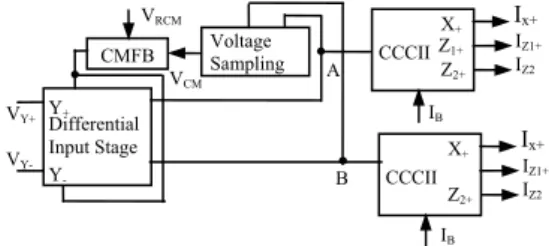
The circuit frame diagram of CFBCCII is given in Fig. 2. The circuit is made up of four blocks: the differen-tial voltage input stage, the second-generation current con-trolled current conveyor (CCCII), voltage-sampling circuit, and the common mode feedback circuit (CMFB).The basic principle of the circuit is analyzed as follows: There are two signal-feed paths in the circuit, the feedforward and the
feedback path. The feedforward path consists of a differen-tial input stage and two CCCIIs. Differendifferen-tial voltage signals are added to the differential input stage, and the voltages would be transferred to the points A and B. The current controlled current conveyors (CCCII) are employed
to transfer VA and VB to the output terminals. The feedback
path consists of voltage sampling circuit and CMFB circuit. The voltages of the points A and B will be sampled in the voltage sampling block, where the common-mode (CM)
voltage VCM is generated. The CMFB circuit is employed
to suppress the CM signals, by comparing VCM and VRCM,
VCM is forced to follow VCM= VRCM, in this way, the CM
signal can be effectively suppressed.
Fig. 2. Frame diagram of CFBCCII.
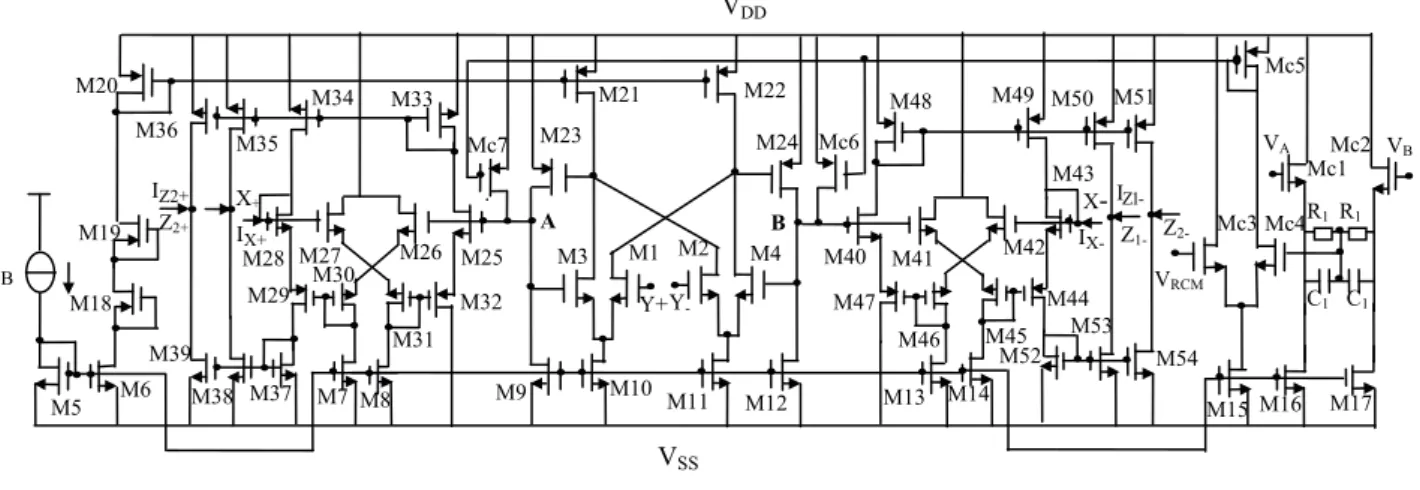
The realization of the CFBCCII circuit is illustrated in
Fig. 3, M1~M4 constitute two pairs of differential inputs, the
parameters of the transistors are symmetric. The circuit has high input impedance as the input voltages are applied to
the circuit by the gates of MOS transistors, so IY+= IY-= 0.
Assuming that all transistors operate in their saturation region, and channel-length modulation effects are not taken into consideration, we get:
2 ) )( / ( GS T M KW L V V I , (2) 5 . 1 , K T L W c K
ox
(3)where K is the transconductance parameter, W and L are the
width and length of the drain channel respectively, VT is the
threshold voltage.
The two pairs of differential transistors are loaded by
M10~M11 which carry equal bias currents (IB). M20~M22
compose current mirrors. So:
B M M M M I I I I I 1 3 2 4 , (4) 3 2 4 1 M M M M I I I I (5)
where ΙΜi(i=1-4) respectively denotes the drain current of
the transistor Mi. From (4), (5), we get:
4 3 2 1 M , M M M I I I I . (6)
If channel dimensions of M1~M4 are: W1/L1=W2/4L2,
W3/L3=W4/4L4, we get: C G B Y T A Y C Y B D T A Y V V V V V V V V V V V V V V 3 2 4 1 2 / ) ( 2 / ) ( (7) IX- IX+ VY+ VY- I Y- CFBCCII Iz1+ Iz2+ Iz1- Iz 2-X+ X- Z1+ Z 1-Z 2-Z2+ Y+ Y -IB IY+ CMFB VRCM Differential Input Stage Y+ Y -VY+ V Y-Voltage Sampling IB IZ2 Ix+ IZ1+ CCCII X+ Z1+ Z2+ A B VCM IB IZ2 Ix+ IZ1+ CCCII X+ Z2+
Fig. 3. Circuit realization of CFBCCII.
Then the expressions for VA and VB become:
) ( 2 1 B Y Y A V V V V . (8)
M25~M32, M40~M44 constitute two CMOS translinear
loops, M25~M32 transfer the voltage from point A to X+,
and M40~M44 transfer the voltage from point B to X-. Now
consider the translinear loop of M25~M32: M25 and M32, M26
and M30, M27 and M31, M28 and M29 constitute four
com-pound transistors respectively. If the channel aspect ratios
W/L of NMOS transistors in the four compound transistors
are identical, and the ratios W/L of PMOS transistors are
alike (all transistors operate in saturation region), we can get [23]: 1 2 (2 2 ) / ( ) X eff B eff n p n p R K I K K K K K (9)
where Kn and Kp are the transconductance coefficient of the
PMOS and NMOS transistor, so Rxcan be adjusted by IB.
From (3) and (9), Rx is increased while temperature
increases.
In Fig. 3, M34~M36, M37~M39, M49~M51, M52~M54 are
four current mirrors respectively, then IZ1+ = IZ2+ = Ix+,
IZ1- = IZ2- = Ix-, so:
Z Z X X
I I I I . (10)
It is clear that the proposed CFBCCII satisfies the characteristics shown in (1). In Fig. 3, the common mode
feedback circuit consists of MC1-MC8 in addition to two
resistors (R) and two capacitors (C). The operation of the CMFB is explained in [2] in detail. The CMFB circuit sup-presses the common-mode and increases the input dynamic range to a great extent, and it can suppress common-mode interference effectively.
CFBCCII is simulated in SPICE using 0.35µm CMOS process parameters for transistors shown in Tab. 1. The dimensions of MOS transistors are listed in Tab. 2. Supply
voltages are
1.65 V..model SEANMOS nmos (level=3 UO=460.5 TOX=1.0E-8 TPG=1 VTO=.62 JS=1.8E-6 +XJ=.15E-6 RS=417 RSH=2.73 LD=0.04E-6 ETA=0 VMAX=130E3 NSUB=1.71E17 PB=0.761
+PHI=0.905 THETA=0.129 GAMMA=0.69 KAPPA=0.1 AF=1 WD=0.11E-6 CJ=76.4E-5 +MJ=0.357 CJSW=5.68E-10
MJSW=0.302 CGSO=1.38E-10 CGDO=1.38E-10 +CGBO=3.45E-10 KF=3.07E-28 DELTA=.42 NFS=1.2E11)
.model SEAPMOS pmos (level=3 UO=100 TOX=1.0E-8 TPG=1 VTO=-0.58 JS=0.38E-6 +XJ=0.1E-6 RS=886 RSH=1.81
LD=0.03E-6 ETA=0 VMAX=113E3 NSUB=2.08E17 PB=0.911 +PHI=0.905 THETA=0.120 GAMMA=0.76 KAPPA=2 AF=1
WD=0.14E-6 CJ=85E-5 +MJ=0.429 CJSW=4.67E-10 MJSW=0.631 CGSO=1.38E-10 CGDO=1.38E-10 +CGBO=3.45E-10 KF=1.08E-29 DELTA=.81 NFS=0.52E11)
Tab. 1. 0.35µm CMOS process parameters for transistors. MOS Transistors W/L (µm) M0S Transistos W/L(µm) M1,M3 2/0.35 M5-M14 16/0.35 M2,M4 8/0.35 M15 80/0.35 M16-M17 M18-M19 10/0.35 M20-M22 14/0.35 M23, M24 20/0.35 M25-M28 M40-M43 10/0.35 M29-M32, M44-M47 40/0.35 M33-M36 M48 -M51 80/0.35 M37-M39, M52-M54 4/0.35 Mc1-Mc4 1/0.35 Mc5-Mc7 2/0.35
Tab. 2. Dimensions of MOS transistors in CFBCCII.
The theoretical result and the simulated result of
relationship between Rx and IB are given in Fig. 4.
Fig. 4. Simulated relationship between Rx and IB.
M9 M8 M21 M23 Z2+ IZ2+ Mc7 Mc1Mc2 R1 R1 C1 C1 Mc3 Mc4 Mc5 M17 M16 VA VB VSS M5 IB M20 M6 M18 M19 A VRCM B M3 M1 M10 M24 VDD Z1- Z 2-I Z1-X -X+ I X-IX+ M13 M7 M14 M33 M48 M34 M49 M25 M26 M27 M28 M29 M30 M31 M40 M41 M42 M43 M44 M45 M46 M47 M35 M37 M36 M39 M50 M51 M52 M53 M54 M15 M32 M2 M4 M11 Y -Y+ M12 M22 M38 Mc6
The relation of Rx and temperature has been given in Fig. 5. From Fig. 5, it can be seen that the influence of
temperature on Rx is very small.
Fig. 5. The influence of temperature on Rx of CFBCCII.
The transconductance common-mode gain (ACM) is
(Iz++Iz-)/(Vy++Vy-). The simulation result of ACM of
CFBCCII is given in Fig. 6. It can be seen from Fig. 6 that
ACM it is equal to 2.710-6 which is very small.
The input and output impedance of CFBCCII can be seen in Fig. 7 and Fig. 8 while bias currents are equal to 40,
50, 65 μA respectively. It is clear that input impedance is
independent of bias currents, but output impedance is influ-enced by bias currents. From Fig. 7, it is known that the
input impedance is larger than 46 M and 4.5 M when
frequency is less than 1 MHz and 10 MHz respectively. From Fig. 8, it is known that output impedance is equal to
1 M approximately when frequency is less than 1 MHz.
Fig. 6. Common-mode gain of CFBCCII.
Fig. 7. Input impedance of Y terminal of CFBCCII.
Fig. 8. Output impedance of CFBCCII.
The stability of CFBCCII is analyzed. From Fig. 3, it is clear that the stability of CFBCCII is determined by the circuit between X and Y where the feedback circuit exist in. According to [27], the stability criteria are as follows: at
the frequency (fc1) with transfer gain = 0 dB, if
-180o < phase < 180o and phase margin (phase shift
distance from ±180°) > 45°, the system is stable. The gain and phase of differential terminal X and Y transfer function
(Vx+-Vx-)/(Vy+-Vy-) with three bias currents are shown in
Fig. 9. It can be seen that at about fc1 = 0.8 GHz, gain
is 0 dB and phase margin > 45°. So the system satisfies stability criteria and is stable.
The differential currents of terminal Z and X with
three bias currents: 30 μA, 65 μA and 100 μA are given in
Fig. 10.
Fig. 11 shows the simulated DC characteristic of dif-ferential voltages between terminal X and Y, the voltage of X terminals is undistorted when the input voltage of Y
terminals is 1.5 V.So the input dynamic range is 1.5 V.
Fig. 9. The gain and phase response of differential voltage transfer between X and Y in CFBCCII.
Fig. 10. Simulated frequency response of Z-X current.
Fig. 11. Simulated Y-X DC characteristics.
From above analysis, it is clear that the CFBCCII with fully balanced structure can suppress common-mode signals, and its port relation has electronic programmability compared with classical fully differential operational amplifiers [17-20]. -2 VY+-VY- (V) Vx+ -V x-(V ) -1 0 1 2 IB=65µ IB=30µ IB=100µ 1 0.5 0 -0.5 -1 0 -10 Phase ((Vx+ -Vx-) / (Vy+ -V y-)) (° ) -4 1 101 102 103 104 105 106 107 108 109 Frequency (Hz) 0.2 0.4 0.6 0.8 1.0 1.2 (V x+ -V x-) / (V y+ -V y-) ((Vx+ -Vx-) / (Vy+
-Vy-phase((Vx+ -Vx-) / (Vy+ -Vy-)) IB=30uA IB=65uA IB=100uA -6 -8 -2 1 10 102 103 104 105 106 107 108 Frequency (Hz ) 0.98 0.96 1 (Iz + -IZ -) / (I Ix+ -Ix -) I B=30uA IB=65uA IB=100uA Inpu t i m ped anc e ( Ω ) 1 10 102 103 104 105 106 107 108 Frequency (Hz) 100K 1.0M 1.0G 100T 1.0T IB=40,50,65μA 1.5 1.0 0.5 0 1 10 102 103 104 105 106 107 108 Frequency(Hz) Output i m ped anc e (M Ω ) IB=65uA IB=40uA IB=50uA 0.0004 0.0002 ACM (S ie me ns ) 0 ACM=0.0000027 1 101 102 103 104 105 106 107 108 Frequency (Hz)
3.
Systematic Design Method of Fully
Balanced Current Mode Filter
3.1
CFBCCII Based Integrator
(a) Structure (b) Symbol
Fig. 12. Structure and symbol of CFBCCII integrator.
The structure of CFBCCII integrator is shown in Fig. 12. (a). Routine analysis based on (1), we can get:
1 0 ( ) ( ) o o X X i i X X X i i i i i i i i R sC . (11)
The symbol of CFBCCII integrator is show in Fig. 12. (b), form (11) we can get:
1 ( ) o o i i X i i H s i i sR C s . (12)
3.2
Model and Relations of the MF Balanced
Current Mode Filter
The model circuit of MF balanced current mode filter based on CFBCCII is shown in Fig. 13. The circuit is con-structed by two parts: The feed-forward circuit consisting
of n CFBCCII integrators and the feed-back network
con-structed symmetrically by links connecting Ifi-, Ifi+, Ioj+ and
Ioj-. From Fig. 13, the feedback equations can be obtained
as follows:
,
f o f o
I FI I FI (13)
Fig. 13. Model circuit of differential MF filters
where Io+= [Io
1+,Io2+...Ion+]T, Io-= [Io1-,Io2-...Ion-]T is the output
vector, and If+= [If
1+,If2+...Ifn+]T, If-= [If1-,If2-...Ifn-]T is the
feedback vector. F= [fij]n×n is the feedback matrix, when i<j,
fij=0, so F is an upper triangular matrix, namely:
1 1 1 2 1 3 1 2 2 2 3 2 3 3 3 0 0 0 0 0 0 n n n n n f f f f f f f F f f f (14)
Based on the model circuit in Fig. 13 and (1), the equations can be derived:
( ) ( ) in in f f o o II II M II (15) where Iin Iin
Ii Ii, 0,0, 0
T , and 1 2 3 0 0 0 1 0 0 0 1 0 0 0 0 n s s M s s .From (13) and (15), the transfer function of systematic model circuit in Fig. 13 can be shown as following: 1 1 ( ) | ( ) | o o in in I I H s I I F M A s (16)
where │A(s)│ represents the determinant of A(s).
3.3
Filter Production and Synthesi
s
To illustrate the general design theory above, we take the design of fourth-order filter as an example. The system
matrix A(s) of the filter is:
1 11 12 13 14 2 22 23 24 3 33 34 4 44 1 ( ) 0 1 0 0 1 s f f f f s f f f A s s f f s f . (17)
From (16) and (17), the transfer function of the four-order filter system can be derived:
4 1 2 3 4 1 2 3 4 4 1 2 4 3 3 3 1 3 4 2 2 2 3 4 1 1 1 2 3 3 4 4 3 4 1 3 2 2 4 4 1 4 2 2 3 3 2 3 2 3 1 1 4 4 2 2 4 1 1 3 3 3 4 1 1 2 2 1 2 1 2 2 3 3 4 4 2 2 3 4 2 3 4 4 2 4 2 1 1 3 3 4 4 1 1 ( ) 1 ( ) ( ) [ ( ) ( ) ( )] [ ( ) ( H s s f f f f s f f f f f f f f f f f f f f f s f f f f f f f f f f f f
3 4 3 1 1 2 2 4 4 1 2 4 4 4 1 1 2 2 3 3 1 1 2 3 1 2 3 3 1 3 1 1 2 2 3 3 4 4 1 1 2 2 3 4 1 1 2 3 4 4 1 2 3 3 4 4 1 1 2 4 1 3 4 4 1 2 3 4 1 4 ) ( ) ( )] ( ) f f f f f f f f f f f f f f S f f f f f f f f f f f f f f f f f f f f (18)We can obtain a variety of fourth-order filters by
selecting different fij, and we will show four kinds of them
arbitrarily. Io Io+ C C Ii Ii+ Y+ X+ X- Y-Z+ Z-IB CFBCCII Io Io+ Ii Ii+ + -+ -1/(sτ) IB
Feedback network F Ifi+ Ioj-(i,j=1,2,3…n; ij)
Feedback network F Ifi- Ioj+(i,j=1,2,3…n; ij)
1/(sτ2) 1/(sτn) 1/(sτ1)
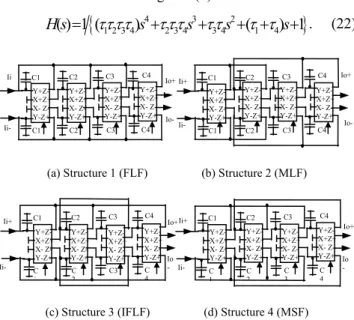
Structure 1: if f11=f12=f13=f14=1, the corresponding
filter circuit is shown in Fig. 14. (a). Its transfer function is:
4 3 2
1 2 3 4 2 3 4 3 4 4
( ) 1 ( ) 1
H s
s
s
s
s . (19)Structure 2: if f11=f12=f23=f24=1, the corresponding
filter circuit is shown in Fig. 14. (b). Its transfer function is:
4 3 2
1 2 3 4 2 3 4 3 4 1 4 1 4
( ) 1 ( ) ( ) ( ) 1
Hs
s
s
s
s . (20)Structure 3: if f11=f12=f23=f14=1, the corresponding
filter circuit is shown in Fig. 14. (c). Its transfer function is:
4 3 2
1 2 3 4 2 3 4 3 4 1 4 4
( ) 1 ( ) ( ) 1
H s
s
s
s
s . (21)Structure 4: if f11=f12=f13=f24=1 the corresponding
filter circuit is shown in Fig. 14. (d). Its transfer function is:
4 3 2
1 2 3 4 2 3 4 3 4 1 4
( ) 1 ( ) ( ) 1
H s
s
s
s
s . (22)(a) Structure 1 (FLF) (b) Structure 2 (MLF)
(c) Structure 3 (IFLF) (d) Structure 4 (MSF)
Fig. 14. Four kinds of MF filters based on CFBCCII.
The four structures belong to follow-the-leader-feed-back (FLF), modified-leap-frog (MLF), inverse FLF (IFLF) and the minimum-sensitivity-feedback (MSF) structure respectively. The structure of FLF is simple; MLF provides the freedom to optimize the filter to meet some require-ments; IFLF can maximize dynamic range; MSF has low sensitivity [26].
It can be seen from Fig. 14 that the fourth-order filter is constructed by 4 CFBCCIIs and 8 capacitors, and we can
get the nth-order filter that is constructed by n CFBCCIIs
and 2n capacitors.
3.4
Design Examples
As an example, we design a fourth-order Butterworth filter. The normalized transfer function of fourth-order Butterworth filter is:
) 1 61313 . 2 4142 . 3 61313 . 2 ( 1 ) ( 2 3 4 s s s s s H . (23)
The structure 1 in Fig. 14. (a) is used to realize the
filter. From (19) and (23), we can get: τ1=0.3827, τ2=0.7654,
τ3=1.3066, τ4=2.61313, and τi=Rx Ci (i=1~4), Ci is the
normalized capacitor. Setting Rx=1 kΩ, then we get IB=65 μA,
1 C = 3.827 10-4 F, C2 = 7.654 10 -4 F, 3 C = 13.066 10-4 F, C4 = 26.131 10-4 F. If cut-off frequency (f c) is equal to 1 MHz,
according (24), we can get: C1=60.90 pF, C2=121.80 pF,
C3=207.93 pF, C4=415.85 pF.
2 ( 1,2,3,4)
i i C
C C
f i . (24)The simulation results are given in Fig. 15. The
curve“□” responds to IB=65 μA, and fc = 1 MHz.
The fc of the proposed MF filters can be tuned by IB of
CFBCCIIs. In order to keep form of fourth-order
Butter-worth filter shown in (23), τ must be invariant. According
to τi=RxCi(i=1~4) , if Rx is decreased, Ci would be
in-creased. According to (24), if Ci keeps invariant, fc will be
increased.
According to above tune principle, when choosing
IB= 30 μA, the Rx is equal to 1.41 kΩ, it can be obtained
fc= 0.82 MHz; when choosing IB= 100 μA, Rx= 0.77 kΩand
fc= 0.82 MHz. The simulation results are shown as “ ” and
“○” respectively in Fig. 15.
Similarly, the stability of the filter can be analyzed. Fig. 15 and Fig. 16 are gain and phase characteristics of
differential current transfer function (Io+ - Io-)/ (Ii+ - Ii) in
structure 1. It can be seen that in Fig. 15, at fc1= 1 MHz
corresponding Gain = 0 dB, phase = 31o which is more than
-180o and less than 180o, and phase margin = 128o which is
more than 45o. The stability criteria [27] are satisfied to the
filter, and it is stable.
The time-domain response and the linearity of the
filter can be seen in Fig. 17 and 18, when setting IB= 65 μA
and the Ci arekept invariant. From Fig. 18, it is known that
the input linear range of the filter is larger than 2 mA.
Fig. 15. Frequency response of the filter of structure 1.
Fig. 16. Phase response of filter of structure 1.
Ii+ C 4 C4 C3 C3 C 2 C2 C 1 C1 Ii- Y+Z- X+Z+ X- Z- Y-Z+ Y+Z- X+Z+ X- Z- Y-Z+ Y+Z- X+Z+ X- Z- Y-Z+ Y+Z- X+Z+ X- Z- Y-Z+ Io+ Io -Y+Z- X+Z+ X- Z- Y-Z+ Io+ C 4 C4 C 3 C3 C 2 C2 C 1 C1 Io -Y+Z- X+Z+ X- Z- Y-Z+ Y+Z- X+Z+ X- Z- Y-Z+ Y+Z- X+Z+ X- Z- Y-Z+ Ii+ Ii- Io+ Ii+ C4 C4 C3 C3 C2 C2 C1 C1 Ii- Io-Y+Z- X+Z+ X- Z- Y-Z+ Y+Z- X+Z+ X- Z- Y-Z+ Y+Z- X+Z+ X- Z- Y-Z+ Y+Z- X+Z+ X- Z- Y-Z+ C4 C4 C3 C3 C2 C2 C1 C1 Y+Z- X+Z+ X- Z- Y-Z+ Y+Z- X+Z+ X- Z- Y-Z+ Y+Z- X+Z+ X- Z- Y-Z+ Y+Z- X+Z+ X- Z- Y-Z+ Ii- Io+ Io- Ii IB=65uA IB=30uA IB=100uA 20lg (( Io + - I o-)/ ( Ii+ - I i-)) (d B) 10 0 -20 -40 -60 -70 Frequency (Hz) 100 101 102 103 104 105 106 107 108 109 fc1(Gain=0dB) -400 Phase o f (Io + -Io -)/ (I i+ -I i -)( °) 1 101 102 103 104 105 106 107 108 Frequency (Hz) 0 -100 -200 -300 fc1( Phase =31o) (Phase Margin=128) Bias current=65 uA
Fig. 17. Time-domain response of the filter of structure 1.
Fig. 18. Linearity of the filter of structure 1.
Harmonic Frequency(Hz) Fourier component
No.1 100K 8.618×10⁻³ No.2 200K 8.611×10⁻⁹ No.3 300K 1.694×10⁻⁷ No.4 400K 6.937×10⁻⁹ No.5 500K 1.189×10⁻⁷ No.6 600K 2.636×10⁻⁹ No.7 700K 7.340×10⁻⁸ No.8 800K 6.875×10⁻¹⁰ No.9 900K 2.975×10⁻⁸
Tab. 3. The even order distortion of filter.
The produced filters from systematic method have fully balanced structure which can reduce even order dis-tortion and common-mode interference effectively. The even order distortion analysis with base frequency 100 kHz is given in Tab. 3 where Fourier components of the first~9th harmonics are given. It is noted that even har-monics are restrained largely. So the filter can reduce even order distortion.
3.5
Sensitivity Analysis
To study the sensitivity in the proposed filter, τj are
important parameters. The definition of sensitivity is:
( ) ( ) ( ) j j H s j H s S H s . (25)
According to [24], it is known that:
1 ( ) 1 | ( ) ( ) | | ( ) | | ( ) ( ) | j jn j H s j j jn j A s A s S s A s s H s A s A s .
(26)The structure 1 in Fig. 14. (a) is analyzed, and the others are similar to it. From (26) and (19), we can get:
1 4 ( ) 1 2 3 4 4 3 2 1 2 3 4 2 3 4 3 4 4 1 H s s S s s s s
,
(27) 2 4 3 ( ) 1 2 3 4 2 3 4 4 3 2 1 2 3 4 2 3 4 3 4 4 1 H s s s S s s s s ,
(28) 3 4 3 2 ( ) 1 2 3 4 2 3 4 3 4 4 3 2 1 2 3 4 2 3 4 3 4 4 1 H s s s s S s s s s ,
(29) 4 4 3 2 ( ) 1 2 3 4 2 3 4 3 4 4 4 3 2 1 2 3 4 2 3 4 3 4 4 1 H s s s s s S s s s s (30)where s=jω. It can be seen in Fig. 19 the sensitivities of τ1,
τ2, τ3, τ4 are very close to each other, and are less than 1.
Fig. 19. Sensitivity of the filter of structure 1.
3.6
Influence of CFBCCII Parasitic Elements
The nonideal CCII model [25] is shown in Fig. 20. The real CCII has parasitic resistors and capacitors from the Y and Z terminals to the ground, and a serial resistor at
the input terminal x. α(s) and β(s) are used to represent the
followers of the CCII, respectively, and they are considered as 1 here.
As a nonideal CFBCCII, parasitic resistors and capacitors of Y (including Y+, Y-) terminals and Z (includ-ing Z+, Z-) terminals are almost the same with Y terminal and Z terminal of CCII respectively, and it is assumed that they all equal to Ry, Cy andRz, Cz respectively.
Fig. 20. Non-ideal CCII with its parasitic resistors and capacitors.
50 0 -50 0 1.0 2.0 3.0 4.0 5.0 Io+ I o-Ii+ I i-Time (ms) I ( uA ) -1.0 -0.5 0 0.5 1.0 0.5 0 -0.5 -1.0 1.0 (Ii+-Ii-)(mA) (Io+ -I o-)( mA )
To study the influence of parasitic elements in CFBCCII, the structure 1 shown in Fig. 14. (a) is consid-ered, and it can be transformed to Fig. 21. Other structures
can be analyzed in this way. We define Gz1, Gz2, Gz3, Gz4,
Cz1, Cz2, Cz3, and Cz4 as the parasitic elements of the z
ter-minals of CFBCCII in Fig. 21, and Gy1, Gy2, Gy3, Gy4, Cy1,
Cy2, Cy3, Cy4 as the parasitic elements of the Y terminals of
CFBCCII respectively. The serial resistance of the x
termi-nals of CFBCCII is considered as Rx.
Fig. 21. Proposed filter of structure 1 including the parasitic elements of the CFBCCII.
Analyzing Fig. 22 yields following equations:
1 1 1 1 2 3 4 1 2 3 4 1 4 4 y z z z z yz yz yz yz y z yz Y j j C C C C C C G G G G j C C C G , (31)
2 2 2 1 1 2 y z yz y z yz Y j j C C C G j C C C G . (32)Similarly, we can get Y3, Y4.
i i y z yz
Y j j C C C G (33)
where Yi=1/Zi, Cy=Cyi,Cz=Czi, Gyz=Gyzi=Gyi+Gzi(i=1~ 4).
It is considered that Cy and Cz are smaller than 10 pF ,
Gyz is smaller than 10-6 S, and the frequency f
c is more than
1 MHz. Therefore, Y1, Y2, Y3, and Y4 can be approximated
by:
1 1 1 1 1 4 4 4 4 1 4 4 y z yz yz y z y z y z Y j j C C C G G j C C C j C C C j C C C , (34)
1 ( 2, 3, 4) i i y z yz yz i y z i y z i y z Y j j C C C G G j C C C j C C C j C C C i . (35)From (31) - (35), it is observed that the parasitic
capacitors are the main influence factor, we define that ci'
(i=1~4) as the capacitors including the parasitic elements of
the CFBCCIIs. Because of Cy and Cz are smaller than
10 pF, the parasitic capacitors can be negligible by
com-parison if Ci>> (Cy+Cz) (i=1~4), and the CFBCCII can be
seen as ideal one.
From (24), (34), (35), we get: ) 4 , 3 , 2 , 1 ( ' ' ' i c c c f f f f i i i c c c c (36)
where fc' is the cut-off frequency of the filter including the
parasitic elements of the CFBCCIIs .
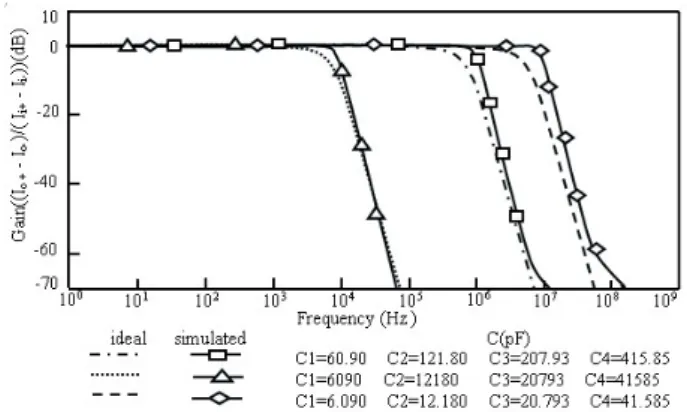
To verify the analysis, we keep IB = 65 μA invariant,
change the capacitors, the simulated results and theoretical ones (from (23)) are given in Fig. 22. It can be seen that the simulated curves are in accordance with theoretical ones when frequency is less than 10 MHz. When frequency is
larger than 10 MHz, the capacitors Ci(i=1~4) are
compara-ble with parasitic capacitors, and non-ideal characteristic of CFBCCII needs to be considered, the frequency modified formula shown in (36) can be used.
Fig. 22. Simulation results of the influence of parasitic elements to the proposed filter.
From above analysis, it can be known that compared with other circuit [5-9], the filter suppresses even order distortion, has wide dynamic range and good linearity, low sensitivity.
4.
Conclusion
This paper proposed a method of designing nth-order
multi-loop feedback filter based on CFBCCII. The method has following advantages: The various current mode bal-anced structures of the low-pass filters can be generated by changing the form of the feedback; fully balanced structure of the filter can reduce even harmonics and common-mode signals effectively; the cut-off frequency of the filter can be controlled by the bias current of CFBCCII. The produced
nth-order filters are constructed by n CFBCCIIs and 2n RC
passive elements; all passive components are grounded, so the filters can be integrated conveniently; the filters are not affected by non-ideal characteristic of CFBCCII when fre-quency is less than 10 MHz.
Acknowledgements
This work is supported by the National Natural Science Foundation of China (No. 60676021).
Z 4 Z 4 Z 3 Z 3 Z 2 Z 2 Z 1 Z 1 Y+ Z- X+ Z+ X- Z- Y- Z+ Ii- Io+ Io- Ii+ Y+ Z- X+ Z+ X- Z- Y- Z+ Y+ Z- X+ Z+ X- Z- Y- Z+ Y+ Z- X+ Z+ X- Z- Y- Z+
References
[1] PAPAZOGLOU, C. A., KARYBAKAS, C. A. Noninteracting
electronically tunable CCII-based current-mode biquadratic filters.
IEEE Proc G, 1997, vol. 144, no. 3, p. 178- 184.
[2] WANG, C. H., ZHOU, L. A new OTA-C current-mode biquad filter
with single input and multiple outputs. International Journal of
Electronics and Communications, 2008, vol. 62, no. 3, p. 232- 234.
[3] CHANG, C. M., AL-HASHIMI, B. M. Single fully differential
current conveyor biquad filters. IEEE Proceedings on Circuit,
Device and Systems, 2003, vol. 150, no. 5, p. 394- 398.
[4] LAKER, K. R., SCHAUMANN, R., GHAUSI, M. S. Multiple-loop
feedback topologies for the design of low-sensitivity active filters.
IEEE Trans. on Circuits and Systems, 1979, vol. 26, no. 1, p. 1-21.
[5] SUN, Y., FIDLER, K. Fully-balanced structures of continuous-time
MLF OTA-C filters. In Proceedings of 1998 IEEE International
Conference on Electronics, Circuits and Systems, 1998, p. 157- 160.
[6] SUN, Y., FIDLER, J. K. Structure generation and design of multiple
loop feedback OTA-grounded capacitor filters. IEEE Transactions
on Circuits and Systems—I: Fundamental Theory and Applications, 1997, vol. 44, no. 1, p. 1-11.
[7] HING-KIT, K., CHUNG-MAN, C., CHI-UN, L., et al. Synthesis of
optimal OTA-C filter structures with arbitrary transmission zeros via
MINLP. In Proceedings of 2008 IEEE Asia Pacific Conference on
Circuits and Systems, 2008, p. 944 - 947.
[8] MOHAMED, O. S., SOLIMAN, A. M., SOLIMAN, A. M.
High-order Gm-C filters with current transfer function based on multiple
loop feedback. In 2007 IEEE International Conference on Signal
Processing and Communications, 2007, p. 85-88.
[9] SUN, Y., FIDLER, J. K. Current-mode multiple-loop feedback
filters using dual output OTAs and grounded capacitors.
International Journal of Circuit Theory and Applications, 1997, vol. 25, p. 69-80.
[10] PAPAZOGLOU, C. A., KARYBAKAS, C. A. Noninteracting
electronically tunable CCII-based current-mode biquadratic filters.
IEE Proc G, 1997, vol. 144, no. 3, p.178- 184.
[11] SUN, Y., HE, Y. Active filters using single current conveyor. In
Proceedings of the 2003 IEEE International Conference on Robotics, Intelligent Systems and Signal Processing, 2003, p. 1130-1134.
[12] KOKSAL, M., SAGBAS, M. A versatile signal flow graph
realization of a general current transfer function. Int. Journal of
Electronics and Communications, 2008, vol. 62, no. 1, p. 33-40.
[13] CHUN-MING, C., SOLIMAN, A. M., SWAMY, M. N. S.
Analytical synthesis of low-sensitivity high-order voltage-mode DDCC and FDCCII-grounded R and C all-pass filter structures.
IEEE Transactions on Circuit and Systems-I: Regular Papers, 2007, vol. 54, no.7, p. 1430-1443.
[14] JIRASEREE-AMORNKUN, A., TANGSRIRAT, W.,
SURAKAMPONTORN, W. Tunable elliptic filters using
multioutput current controlled conveyors. In IEEE Region 10
Conference TENCON, 2004, p. 229-232.
[15] WU J, EI-MAASRYA, E. Current-mode ladder filters using multiple
output current conveyors. IEEE Proc Circuit Devices Syst, 1996, vol.
143, no. 4, p. 218 - 222.
[16] SHI, W.-X., HAN, Q.-Q., WANG, CH.-Y. Fully differential
current-mode filter based on MDDCC. In IEEE Asia-Pacific Conference on
Circuits and Systems. 2000, p. 674-677.
[17] CHIU, W., LIU, S.-I., CHEN, J.-J. CMOS differential difference
current conveyors and their application. IEE Proceedings- G:
Circuits Devices and Systems, 1996, vol. 143, no. 2, p. 91-96.
[18]ELWAN, H. O., SOLIMAN, A. M. Novel CMOS differential
voltage current conveyor. IEE Proceedings-G: Circuits, Devices and
Systems, 1997, vol. 144, no. 3, p. 195-200.
[19]EI-ADAWY, A., SOLIMAN, A. M., ELWAN, H. O. A novel fully
differential current conveyor and applications for analog VLSI. IEEE
Transactions Circuits and Systems-II: Analog and Digital Processing, 2000, vol. 47, no. 4, p. 306-313.
[20]SOLIMAN, A. M. Fully differential CMOS CCII based on
differential difference transconductor. Analog Integrated Circuit and
Signal Processing, 2007, vol.50, no.3, p. 195–203.
[21]ALZAHER, H. A., ELWAN, H., ISMAIL, M. A CMOS fully
balanced second-generation current conveyor. IEEE Transactions on
Circuits and Systems-II, 2003, vol. 50, no. 6, no. 278-287.
[22]ALZAHER, H. A. CMOS highly linear fully differential current
conveyor. Electronics Letters, 2004, vol. 40, no. 4, p. 214-216.
[23]WANG, C.-H., SHE, Z.-X., LIU, H.-G. New CMOS
current-controlled second generation current conveyors. In Proc. 4th IEEE
International Conference on Circuits and Systems for Communications, 2008, p. 333-337.
[24]WYSZYNSKI, A., SCHAUMANN, R., SZCZEPANSKI, S., et al.
Design of a 2.7 GHz Linear OTA and a 250 MHz Elliptic Filter in
Bipolar Transistor-Array Technology. IEEE Transactions on
Circuits and Systems Part II, 1993, vol. 40, no. 1, p. 19-31.
[25]FABRE, A., SAAID, O., BARTHELEMY, H. On the frequency
limitations of the circuits based on second generation current
conveyors. Analogue Int. Circ. & Signal Process, 1995, vol. 7, no. 2,
p. 113-129.
[26]LAKER, K. R., SCHAUMANN, R., GHAUSI, M. S. Multiple-loop
feedback topologies for the design of low-sensitivity active filters.
IEEE Proceedings on Circuit Systems, 1979, vol. 26, no. 1, 1979, p. 1-20.
[27]WILLY, M. C. S. Analog Design Essentials. Springer, 2006, p. 156
to 161.
About Authors...
Wang Chunhua - for biography see p. 184.
Leng Yang was born in Changde, Hunan, China, in 1984. She received the B.S. from Hunan Normal University in 2006. She is studying in Hunan University for master degree now. She is interested in analog IC circuit and filter design.
Zhang Qiujing was born in Jishou, Hunan, China, in 1982. She received the B.S. from School of Computer and Communication, Changsha University of Science and Technology. She is studying in Hunan University for doctor degree now. She is interested in analog IC circuit and filter design.
Fei YU was born in Anqing, Anhui, China, in 1984. He received the B.Sc degree from Anhui Normal University, Anhui, China, in 2007. He is currently a doctor in the School of Computer and Communication in Hunan Univer-sity. He focuses on radio frequency integrated circuit design and UWB communications.