(will be inserted by the editor)
CPU Scheduling and Memory Management for Interactive
Real-Time Applications
Shinpei Kato · Yutaka Ishikawa · Ragunathan (Raj) Rajkumar
Received: date / Accepted: date
Abstract In this paper, we propose, design, implement, and evaluate a CPU
sched-uler and a memory management scheme for interactive soft real-time applications. Our CPU scheduler provides a new CPU reservation algorithm that is based on the well-known Constant Bandwidth Server (CBS) algorithm but is more flexible in al-locating the CPU time to multiple concurrently-executing real-time applications. Our CPU scheduler also employs a new multicore scheduling algorithm, extending the Earliest Deadline First to yield Window-constraint Migrations (EDF-WM) algorithm, to improve the absolute CPU bandwidth available in reservation-based systems. Fur-thermore, we propose a memory reservation mechanism incorporating a new paging algorithm, called Private-Shared-Anonymous Paging (PSAP). This PSAP algorithm allows interactive real-time applications to be responsive under memory pressure without wasting and compromising the memory resource available for contending best-effort applications. Our evaluation demonstrates that our CPU scheduler en-ables the simultaneous playback of multiple movies to perform at the stable frame-rates more than existing real-time CPU schedulers, while also improves the ratio of hard-deadline guarantee for randomly-generated task sets. Furthermore, we show that our memory management scheme can protect the simultaneous playback of multiple movies from the interference introduced by memory pressure, whereas these movies can become unresponsive under existing memory management schemes.
S. Kato and R. Rajkumar
Department of Electrical and Computer Engineering, Carnegie Mellon University, 5000 Forbes Avenue, Pittsburgh, PA 15213 USA
E-mail:{shinpei,raj}@ece.cmu.edu Y. Ishikawa
Department of Computer Science, The University of Tokyo, 7-3-1 Hongo, Bunkyo-ku, Tokyo 113-8654 JAPAN
1 Introduction
Real-time systems perform a significant role in societal infrastructure, with appli-cation domains ranging from safety-critical systems (e.g., cars, aircraft, robots) to user-interactive systems (e.g., consumer electronics, multimedia devices, streaming servers). Safety-critical systems are in many cases hard real-time systems, while user-interactive systems are usually soft real-time systems, in which timing violations de-crease the quality of service (QoS) of applications but do not lead to system failure. In either case, however, timely operation is desirable.
Modern real-time systems have become increasingly resource-intensive and in-teractive. For instance, the state-of-the-art humanoid robots execute both hard and soft real-time applications concurrently (Akachi et al, 2005; Kaneko et al, 2004), and digital high-definition TVs are also expected to display multiple video contents at the same time (Yamashita et al, 2009). Other examples include teleconferencing, video streaming, and 3-D online games. The operating system (OS) for these systems needs to provide resource management schemes that can enhance and maintain the QoS of the overall system even under heavy workloads.
CPU scheduling is a central concept in real-time OSes (RTOSes) to meet tim-ing requirements. In particular, CPU reservation and multicore schedultim-ing are key techniques to further support concurrently-executing multiple interactive real-time applications. CPU reservation is useful to maintain the QoS for soft real-time cations, and it is also beneficial to provide temporal isolation for hard real-time appli-cations. Multicore technology, meanwhile, supplies additional computing power for heavy workloads, and multicore scheduling algorithms determine how efficiently the system can utilize CPU resources.
Unfortunately, there is not much study into the question of how well CPU sched-ulers in existing RTOSes can perform with concurrently-executing multiple inter-active real-time applications on multicore platforms. Consider those in Linux-based RTOSes. Most prior approaches are evaluated by experiments or simulations that sim-ply execute busy-loop tasks (Brandenburg and Anderson, 2009b; Brandenburg et al, 2008; Calandrino et al, 2006; Oikawa and Rajkumar, 1999), or just a few real-time applications on single-core platforms (Palopoli et al, 2009; Yang et al, 2008). Exper-imental results obtained from executing only a few applications may not demonstrate CPU scheduler capabilities under heavy workloads. On the other hand, those obtained from executing busy-loop tasks that consume the same amount of time in each period may not be applicable for real-world scenarios. As a consequence, the scheduling problem for concurrently-executing multiple interactive real-time applications is still left open for multi-core platforms.
The first question we try to address in this paper is how to provide adequate support for scheduling of interactive real-time applications on multi-core platforms.
SCHED DEADLINE(Faggioli et al, 2009a,b) is a real-time CPU scheduler devel-oped for the Linux kernel, which implements (i) Earliest Deadline First (EDF) (Liu and Layland, 1973) as a scheduling algorithm and (ii) Constant Bandwidth Server (CBS) (Abeni and Buttazzo, 1998, 2004) as a CPU reservation algorithm. It is also available for multicore platforms. Our preliminary evaluation on a 2.0 GHz Intel Core 2 Quad processor (Q9650) has demonstrated that the frame-rate of H.264 movies
5 10 15 20 25 0 50 100 150 200
Frames per Second (fps)
Elapsed Time (seconds) Playing four movies
Playing five movies Playing six movies
Fig. 1 Frame-rates of movies playing concurrently underSCHED DEADLINEon a quad-core CPU.
played by theMPlayer open-source movie player could drop below 10 fps under
SCHED DEADLINE, when playing more than four instances of the movie, even though the system is not over-utilized, as shown in Figure 1, where the average-case execution time is used as a reservation capacity for the CBS algorithm. This is largely attributed to the fact that theMPlayertask has a variable execution time for each frame, and hence constant-bandwidth reservation is not able to handle well such frames that try to run out of reservation. The EDF algorithm could also perform poorly on multi-core platforms (Dhall and Liu, 1978). It is not hard to see from this preliminary evaluation that existing real-time CPU schedulers are inadequate when executing multiple interactive applications concurrently on multi-core platforms. To the best of our knowledge, no other scheduler distributions employ both the EDF and the CBS algorithms available for multi-core platforms. We will therefore use
SCHED DEADLINEas a representative of existing real-time CPU schedulers. Memory management is another concern for interactive real-time applications that tend to be memory-intensive. Even though CPU schedulers provide adequate support, the system can still easily become unresponsive by memory-intensive activ-ities. Figure 2 shows the number of swapped-out pages of theMPlayertask, when contending tasks are allocating 2GB of memory resource in total. Some frames have no less than about 400 pages to be forcefully swapped out, whereas no page swapping has been observed when theMPlayertask executes alone. Given that a disk access time to swap out one page could be around a few milliseconds, the traditional least-recently-used (LRU) paging algorithm imposes unacceptable performance penalties to interactive real-time applications.
The second question we try to address in this paper is therefore “What is an appro-priate memory management scheme for interactive real-time applications”? Previous real-time systems conservatively use a memory locking (e.g., mlock) mechanism that pins all the pages used by critical applications (Laplante, 1993). Unfortunately, this approach is not very effective in the above scenario, since some pages still need to be swapped out when locking new pages, if there are no free pages due to mem-ory pressure. Memmem-ory reservation strategies, such as memmem-ory firewalling (Eswaran and Rajkumar, 2005; Hand, 1999) and the Linux memory cgroup, provide better re-sponsiveness for interactive real-time applications. Unlike memory locking, memory reservation ensures that the memory blocks reserved by some applications are never
0 50 100 150 200 250 300 350 400 0 1000 2000 3000 4000 5000
The Number of Swapped-out Pages
Frame Positions
Fig. 2 The number of swapped-out pages in playing the H.264 movie under memory pressure.
accessed by others. However, previous memory reservation mechanisms still have the downside that applications become unresponsive quickly, if all pages in their reserved memory blocks are in use, meaning that they need to swap out some pages.
The primary contribution of this paper is improving the capabilities of a CPU scheduler and a memory management scheme for interactive soft real-time appli-cations. We particularly focus on maintaining concurrently-executing multiple soft real-time applications at the desired frame-rates even in the face of heavy workloads and contending background resource-intensive activities. While our CPU scheduler is based on the well-known EDF and the CBS algorithms, this paper provides new concepts: (i) a CPU reservation algorithm that improves the QoS of the overall sys-tem when multiple applications try to reserve CPU bandwidth concurrently, and (ii) a multicore scheduling algorithms that improves the absolute CPU bandwidth available for these multiple applications to reserve CPU bandwidth. We implement our CPU scheduler usingSCHED DEADLINE, given that (i) it has been actively maintained, (ii) it provides basic EDF scheduling features, and (iii) it is well-aligned with the mainline of the Linux kernel development. We also design and implement a memory reservation mechanism that makes soft interactive real-time applications responsive, even if the pages in memory blocks reserved by these applications are exhausted.
The rest of this paper is organized as follows. Section 2 discusses the related work in this area. Section 3 describes our system model. Section 4 and Section 5 present the CPU reservation and the multicore scheduling algorithms used in our CPU scheduler respectively. Section 6 describes the reservation mechanism in our memory management scheme. The capabilities of our CPU scheduler and memory management scheme are evaluated in Section 7. Section 2 discusses the related work in this area. We provide our concluding remarks in Section 8.
2 Related Work
In this section, we briefly discuss related work with respect to the areas of Linux-based RTOSes, CPU scheduling, and memory management for interactive real-time applications. For CPU scheduling, however, we only focus on those designed based on the EDF algorithm.
2.1 Linux-based RTOSes and CPU Scheduling
SCHED DEADLINE(Faggioli et al, 2009a,b) is an implementation of the EDF algo-rithm for Linux, which is distributed as a kernel patch tightly integrated with the mainline of the Linux kernel. It also incorporates a CPU reservation mechanism and a multicore scheduler that are respectively based on the well-known CBS and the Global EDF (G-EDF) algorithms. Our CPU scheduler is implemented on top of
SCHED DEADLINEto extend the capability of a CPU scheduler for interactive real-time applications.
LITMUSRT(Calandrino et al, 2006) supports various multicore EDF-based sched-ulers. It has been used to discover new results on implementation problems related to multicore real-time schedulers (Brandenburg and Anderson, 2009b; Brandenburg et al, 2008). It has also been used to evaluate QoS management (Block et al, 2008) and resource synchronization (Brandenburg and Anderson, 2009c). Currently, its usage is limited to the Intel (x86-32/64) and Sparc64 architectures. In fact, it was reported in (Brandenburg and Anderson, 2009a) that the LITMUSRT project was launched to
bridge the gap between research results and industry practice. Meanwhile, the mul-ticore scheduling algorithm supported by our CPU scheduler is aimed at improving CPU bandwidth available for applications with their timing requirements.
Redline (Yang et al, 2008) brings first-class support for interactive applications in commodity OSes. It offers memory and disk I/O management as well as CPU scheduling. The control group mechanism adopted in the mainline of the Linux ker-nel and the CPU scheduling algorithms provided bySCHED DEADLINEhave nearly covered the Redline techniques. The primary objective of Redline is to ensure avail-able CPU, memory, and disk resources when applications are assigned sufficient CPU bandwidth in the system, while our CPU scheduler addresses the problem of main-taining the QoS of interactive real-time applications when they require CPU time more than they reserve under heavy workloads.
Linux-based RTOSes that exploit CPU reservation include Linux/RK (Oikawa and Rajkumar, 1999), Linux-SRT (Childs and Ingram, 2001), and AQuoSA (Palopoli et al, 2009). Linux/RK implements both fixed-priority and EDF schedulers, though the EDF scheduler has not yet been extended to work on multicore platforms. It also supports a soft real-time CPU reservation policy. While this policy schedules soft real-time tasks in the background when their budgets are exhausted, our CPU scheduler assigns as early deadlines as possible to schedule these tasks by the EDF policy. Linux-SRT deals with disk I/O scheduling, like Redline, but is not designed to work on multicore platforms and to support an EDF scheduler. AQuoSA dynamically assigns CPU bandwidth to each task at runtime by a feedback controller, and therefore the scheduling performance depends highly on how a control model is suitable for a system. Meanwhile, our CPU scheduler assigns a constant CPU bandwidth to each task, and the tasks cooperate with each other by yielding their remaining budgets.
While the above prior work consider QoS management to ensure temporal isola-tion for applicaisola-tions, our CPU scheduler is aimed at improving the QoS of the overall system and the absolute CPU bandwidth available for applications to perform well.
RTLinux (Yodaiken, 1999), RTAI (Beal et al, 2000), and KURT Linux (Srinivasan et al, 1998) are particularly designed for hard real-time systems. Their requirements
are to minimize the system latency. RED-Linux (Wang and Lin, 1999) provides a flexible framework for extensible scheduler implementation. It is focused on frame-work issues but not on performance issues. On the other hand, we consider QoS management and schedulability improvement.
2.2 Memory Management
Some real-time systems are designed to conservatively pin memory pages so that they cannot be swapped out by others (Laplante, 1993). For example, RT-Mach (Tokuda et al, 1990) introduced such a page-pinning mechanism, and it also enabled on-demand page-pinning for interactive applications (Nakajima and Tezuka, 1997). How-ever, as we stated in Section 1, pinning memory pages is expensive, and it often leads to wasting memory resources.
Memory firewalling (Eswaran and Rajkumar, 2005; Hand, 1999) is a reservation-based approach to ensure that a certain number of pages is preserved for the corre-sponding task, limiting interference to other tasks. In particular, the memory reserva-tion mechanism proposed in (Eswaran and Rajkumar, 2005) was designed for real-time systems and was implemented using the Resource Kernel (RK) abstraction (Ra-jkumar et al, 1997). Our memory management scheme is inspired by these earlier approaches. However, we propose a more flexible approach that can make interac-tive real-time applications responsive even though their own memory reserves are exhausted. Specifically, we introduce another type of memory reserve that can be shared by interactive real-time applications. Although the Redline memory manage-ment scheme (Yang et al, 2008) also leveraged a concept of shared memory reserva-tion, the size of shared memory reserve is static, and it also does not employ mem-ory firewalling. In contrast, our memmem-ory reservation mechanism expands the size of shared memory reserve dynamically on demand to provide better responsiveness for interactive real-time applications, and it also employs memory firewalling to prevent these applications from affecting each other.
Memory management problems in real-time systems are often considered in the programming language domain (Borg et al, 2006; Pizlo and Vitek, 2006; Robertz, 2002), where the Real-Time Specification for Jave (RTSJ) (Gosling and Bollella, 2000) is a primary programming model. Such a language-level support for memory management is, however, not within the scope of this paper, and we only focus on OS-level memory management.
3 System Model
The system is composed of m CPUs,π1,π2, ...,πm. Each application taskτiis a
spo-radic task, which is characterized by minimum inter-arrival time Ti (also called the
period), relative deadline Di, and worst-case computation time Ci. It sporadically
gen-erates a sequence of jobs, each of which must be separated at least by an interval of
Ti. A job ofτireleased at time t has a deadline at time di=t+Di.
A server with a capacity Qi and a period Pi is associated with each task τi to
Table 1 APIs to control real-time applications.
set_period sets the minimum inter-arrival time.
set_deadline sets the relative deadline.
set_runtime sets the amount of CPU time to be reserved per period.
set_memsize sets the size of memory block to be reserved at the beginning of task execution.
wait_period suspends (sleeps) until the next period.
deadline at time si=t+Pi. A job ofτiis scheduled based on server deadline si. Note
that it may be different from the real deadline diofτi. The remaining budget ofτiis
denoted by ei. Like the prior work (Faggioli et al, 2009a,b; Palopoli et al, 2009; Yang
et al, 2008), we associate one server with one task.
A generic hierarchical memory model is adopted. Each CPU has a small L-1 cache. The L-2 cache of relatively large size is shared across all CPUs. The L-3 and L-4 cache could also be accommodated. There is an external storage device to swap pages in to and out from the main memory. We assume that the swap space is large enough to accommodate all swapped-out pages.
Applications use a set of application programming interfaces (APIs) or system calls, supporting at least the functions listed in Table 1. There may be additional APIs that provide other useful functions, such as synchronization, energy management, etc., though they are outside the scope of this paper. It is also not within the scope of this paper to discuss how they should be implemented. For example, some Linux-based RTOSes (Beal et al, 2000; Calandrino et al, 2006; Faggioli et al, 2009a; Oikawa and Rajkumar, 1999; Yang et al, 2008) implement these functions in the kernel, while others (Palopoli et al, 2009; Srinivasan et al, 1998) provide them in the Linux kernel module. In this paper, we implement the bulk of the functionality in the Linux kernel module for portability, and make the necessary changes in the Linux kernel.
4 CPU Reservation
Interactive real-time applications are often resource-intensive. Hence, CPU reserva-tion is useful to ensure the QoS of those applicareserva-tions. As most EDF-based schedulers with CPU reservation mechanisms (Abeni and Lipari, 2002; Faggioli et al, 2009a,b; Palopoli et al, 2009; Yang et al, 2008), our CPU scheduler incorporates the CBS-based algorithm to support QoS management. We however extend the CBS algorithm so that it can flexibly maintain the QoS of the overall system, when multiple real-time applications reserve CPU bandwidth. The idea behind the extension is to reclaim the remaining budget for other tasks to maintain the QoS of the overall system.
4.1 The CBS Algorithm
We briefly describe the reservation policy of the CBS algorithm below. See the orig-inal papers (Abeni and Buttazzo, 1998, 2004) for details.
– When a job of a taskτiis released at time t, if ei≥(si−t)Qi/Pi, it is assigned a
new server deadline at si=t+Pi, and the budget is replenished to ei=Qi.
– eiis decreased by the same amount as the time consumed by the job ofτi.
– When ei=0, it is replenished again to ei=Qi, and a new server deadline is set at
si=si+Pi.
By the above reservation policy, it is guaranteed that a taskτireceives CPU
band-width of at least Qi/Pi. However, the QoS management is restricted within a server.
Even though the budget ei remains when a job ofτicompletes, it is preserved until
the next period forτior it may be just discarded.
4.2 The New Reservation Algorithm
We propose a new CPU reservation algorithm, called Flexible CBS (FCBS). The FCBS algorithm uses a slack-reclaiming approach that has also been considered in previous schedulers (Caccamo et al, 2005; Lin and Brandt, 2005; Marzario et al, 2004). Our approach is however distinguished from these previous work in that (i) it applies exactly the same rule as the CBS algorithm for the budget replenishment and the deadline assignment, (ii) it guarantees each taskτito be assigned CPU
band-width of at least Qi/Pifor each job even if the reclaiming occurs, and (iii) it reclaims
the budget so that the jobs overrunning out of reservation are assigned more CPU bandwidth.
The FCBS algorithm donates the budget left unused by some jobs to either the jobs overrunning out of reservation or the next earliest-deadline jobs. Letτibe a task
whose job completes at time t. The remaining budget is ei. According to the CBS
algorithm, the CPU bandwidth used byτidoes not exceed Qi/Pi, even if the job of
τi is executed for another eitime units, with the current deadline si. Hence, the total
CPU bandwidth used by all tasks do not also exceed∑τk∈τQk/Pk, even though other
jobs ready at time t with deadlines no earlier than siconsume additional eitime units.
In addition, we never steal the budget from the future. As a result, the schedulability associated with the CBS algorithm is preserved.
The above observation implies that we could improve the average QoS of the overall system, if we efficiently reclaim the budget left unused by some jobs, and donate them to other jobs. We therefore consider the following budget-reclaiming algorithm, coordinating with the CBS algorithm. When some job ofτicompletes:
1. If there is a task τk whose server deadline is sk >t+Pk, it means thatτk has
exhausted its budget at some earlier point of time, and is now overrunning out of reservation. In this case, we first save the original budget and the server deadline as ˜ek=ek and ˜sk=sk respectively. We then assign the budget ek=ei and the
deadline sk=sitoτk temporarily, to catch up the EDF schedule. On one hand,
if the job ofτk can complete before exhausting ek, the remaining budget ek is
succeeded to a different job again by the same policy. On the other hand, ifτk
exhausts ek, the original budget and deadline are restored, i.e., ek=e˜kand sk=s˜k.
1: functionbudget_exhausted_fcbs(τi) do
2: if ˜si6=unde f ined then
3: ei←e˜i; si←s˜i; else ei←Qi; si←si+Pi;
4: end if 5: end function
6: functionjob_released_fcbs(τi) do
7: if B>0 then
8: ei←ei+B−min(tnow−tlast,B);
9: B←0; 10: end if 11: s˜i←unde f ined;
12: end function
13: functionjob_completed_fcbs(τi) do
14: if ˜si6=unde f ined then
15: si←s˜i; ˜si←unde f ined;
16: end if 17: j←unde f ined;
18: for eachτkin order of early deadlines do
19: if j=unde f ined then j←k; end if
20: if sk>tnow+Pkthen 21: e˜k←ek; ˜sk←sk; 22: ek←ei; sk←si; 23: return; 24: end if 25: end for
26: if j6=unde f ined then
27: ej←ej+ei; else B←ei; tlast←tnow;
28: end if 29: end function
Fig. 3 Pseudo-code of our CPU scheduler with the FCBS algorithm.
2. If there is no such taskτk, we look for the next earliest-deadline taskτjready for
execution, if any. We then add the remaining budget ei to its budget ej. In this
case, we do not assign the server deadline sitoτj, because it will be scheduled
next. Even though some jobs are released with earlier deadlines before the job of
τjcompletes, it can use the budget by its server deadline sj.
3. Otherwise, we preserve the remaining budget eias a bonus B. B is then decreased
by the same amount of time as consumed by an idle task until a new job of some taskτnis released. When the job of τn is released, we add the bonus B, if any
remains, to the budget ofτn, like the second step described above.
The FCBS algorithm is easily extended to multicore platforms. If tasks are glob-ally scheduled so that at any time the m earliest deadline tasks, if any, are dispatched, the remaining budget can be used for any tasks in the system. Meanwhile, if tasks are partitioned among CPUs, the remaining budget can only be used for the tasks on the same CPU. In Section 5, we will discuss how to implement the FCBS algorithm for multi-core platforms.
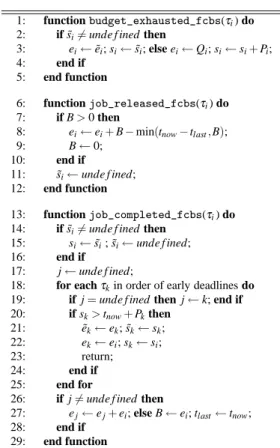
Implementation. Figure 3 illustrates the pseudo-code of the FCBS algorithm
implementation, added toSCHED DEADLINE, where tnowdenotes the current time,
function is called when the budget ofτi reaches zero. This function is inserted at
the end of thedeadline_runtime_exceededfunction inSCHED DEADLINE. The
job_released_fcbsfunction, meanwhile, is called when a job ofτi is released.
This function is inserted at the end of thepick_next_task_deadlinefunction in
SCHED DEADLINE, but is executed only whenτiholds theDL_NEWflag1, meaning
that the task is starting a new period. Thejob_completed_fcbsfunction is called when a job ofτi completes and suspends until the next period. It is inserted at the
end of theput_prev_task_deadlinefunction inSCHED DEADLINE, but is also executed only when the task hold theDL_NEWflag.
5 Multicore Scheduling
Traditionally, there are two multicore scheduling concepts: partitioned and global. To simplify the description, we restrict our attention to the EDF algorithm. In parti-tioned scheduling, each task is assigned to a particular CPU, and is scheduled on the local CPU according the EDF algorithm, without migration across CPUs. In global scheduling, on the other hand, tasks are scheduled so that the m earliest-deadline tasks in the system are executed on m CPUs, and hence they may migrate across CPUs. Ac-cording to (Faggioli et al, 2009a,b),SCHED DEADLINEapplies a global scheduling policy to the EDF algorithm.
It was shown in (Dhall and Liu, 1978) that the EDF algorithm is no longer optimal on multicore platforms whether we apply partitioned scheduling or global scheduling. Consider m+1 tasks on an m-CPU system, all of which require CPU time P/2+ε
every period P, whereεis a small number. Given that the available CPU bandwidth of the system is m, while the total CPU bandwidth required by the m+1 tasks is
m(1/2+ε/P), the system should have enough CPU bandwidth. However, this task set is not schedulable in both partitioned scheduling and global scheduling. For par-titioned scheduling, it is obvious that the utilization of one CPU exceeds 100%. For global scheduling, on the other hand, assume that all the first jobs of the m+1 tasks start at time t. Some m tasks are then dispatched at this time, and their jobs complete at time t+ (P/2+ε). Now, the remaining task misses its deadline, since the laxity to its deadline is only P/2−ε, while it needs to consume CPU time P/2+εby its deadline.
Recently, several authors (Andersson et al, 2008; Bletsas and Andersson, 2009; Kato et al, 2009) have developed a new concept: a semi-partitioned scheduling ap-proach. Particularly, the Earliest Deadline First with Window-constraint Migration (EDF-WM) algorithm (Kato et al, 2009) is a simple design but still outperforms the existing EDF-based algorithms in terms of average schedulability, with a very small number of context switches.
In this section, we extend the EDF-WM algorithm so that it can work with the FCBS algorithm. We also discuss the CPU assignment problem in the partitioning stage to make the scheduler more robust for reservation-based systems as well as mis-specifications of task parameters.
1 We refer to the flag names that were given in the January 2010 version ofSCHED DEADLINE.
π1 π2 C PU Ba n d w id th 0% 100% π3 π4 τk+1 τk τk+2 fixed fixed fixed fixed π1 π2 π3 Dk
release time deadline
Fig. 4 Concept of semi-partitioned scheduling (Kato et al, 2009).
5.1 The EDF-WM Algorithm
We now briefly describe the EDF-WM algorithm. See (Kato et al, 2009) for details. In the following, we assume that no tasks have reserves for simplicity of description. Specifically, Ci, Diand Tiare used to schedule each taskτi.
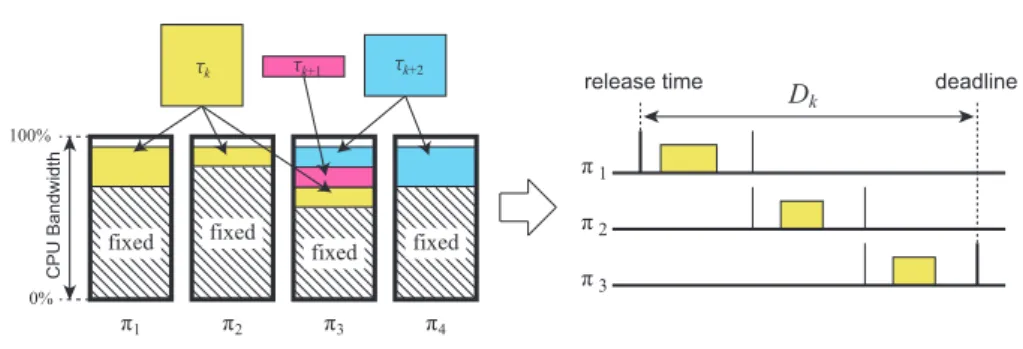
Figure 4 illustrates a concept of semi-partitioned scheduling presented in previous work (Kato et al, 2009). When a new taskτiis submitted to the system, the EDF-WM
algorithm assigns a particular CPU to τi unless the total CPU bandwidth exceeds
100%, andτi never migrates across CPUs, like partitioned scheduling. If no such
CPUs are found, it assigns multiple CPUs toτi. In this case,τiis allowed to migrate
across those CPUs. Since an individual task cannot usually run on multiple CPUs simultaneously, the EDF-WM algorithm guarantees exclusive execution ofτion the
multiple CPUs by splitting its relative deadline into the same number of windows as the number of CPUs. Let nibe the number of the CPUs that are assigned toτi. Hence,
the size of each window is equal to Di/ni. It allocates Ci′,xas the CPU time allowed
forτito consume on CPUπxevery period Ti. Ci′is now given by:
C′i,x=min ( L−∑τj∈Γxdbf(τi,L) ⌊(L−Di/ni)/Ti⌋+1 ) ,
whereΓxis a set of tasks assigned toπx, L is any value equal to the multiple of relative
deadline ofτj∈Γx, and dbf(τj,L) =max{0,⌊(L−Dj/nj)/Tj⌋+1} ×C′j.
At runtime, a job ofτireleased at time t on CPUπxis assigned a pseudo-deadline
d′i=t+Di/niand is locally scheduled by the EDF policy until it consumes the CPU
time Ci′,x. When C′i,x time units are consumed,τi is migrated to the next assigned
CPU (let it be CPUπy), and is again locally scheduled with a pseudo-deadline di′=
d′i+Di/niuntil it consumes Ci′,y time units. If the sum of the assigned CPU time is
less than Ci,τiis not guaranteed to be schedulable.
5.2 The New Scheduling Algorithm
We now modify the EDF-WM algorithm for our CPU scheduler. The modified algo-rithm is called EDF-WM with Reservation (EDF-WMR). We assume that each task
both Diand Tiwith Pi, for each taskτi. That is, ifτiis a task that is allowed to migrate
across multiple CPUs, the maximum CPU time Q′i,x allowed forτi to consume on
CPUπxat every period is given by
Q′i,x=min ( L−∑τj∈Γxdbf(τi,L) ⌊(L−Pi/ni)/Pi⌋+1 ) ,
whereΓx is a set of tasks assigned to CPUπx, L is any value equal to the relative
deadline of any task τj∈Γx, and dbf(τj,L) =max{0,⌊(L−Pj/nj)/Pj⌋+1} ×C′j.
Note that we need not search for those values of L that are the multiples of the relative deadline of each task, if relative deadlines are equal to periods, according to (Kato et al, 2009). Since both Diand Tiare replaced with Piin the FCBS algorithm, we can
have the above definitions.
Reservation for migratory tasks. We first examine how the original EDF-WM
algorithm can work with the FCBS algorithm. Letτi be a task allowed to migrate
across multiple CPUs. We consider the case in whichτi is activated on CPUπxat
time t, either when it is migrated to or is released on the CPU. The budget is set to ei=Q′i,x. That is,τi is allowed to consume Q′i,x time units onπx, with a server
deadline si=t+Pi/ni. Being subject to the original EDF-WM algorithm, when Q′i,x
is exhausted,τi is migrated to another CPUπy. The budget is then replenished to
ei=Q′i,y, and the server deadline is set to si=si+Pi/ni.
We next modify the above reservation policy to improve the runtime perfor-mance, when multiple tasks are scheduled with reserves. When Q′i,x is exhausted on CPU πx, the EDF-WMR algorithm does not migrateτi to another CPU πy but
strictly postpones the migration until t+Pi/ni. It then sets the server deadline to
si=si+Pi=t+Pi/ni+Pi, and holds the budget ei=0. Since the budget is not
re-plenished by Q′i,x, it does not affect the reservation in the next period. Instead, since
si>t+Piis satisfied at any time t<t+Pi/ni, the budget may be replenished by
the remaining budget of another completed job, according to the FCBS algorithm. At time t′=t+Pi/ni, the server deadline is reset to si=t′, andτi is migrated to
another CPUπy. The server deadline is then set to si=si+Pi/nifor the execution
onπy. Note that the schedulability is independently guaranteed on each CPU by the
EDF-WM algorithm. Hence, the schedulability is not affected onπy, even if we reset
the server deadline to si=t′onπxbefore the migration. That is,τiis guaranteed to
be schedulable onπyby the EDF-WMR algorithm, with the arrival time at t′and the
deadline si=t′+Pi/ni.
Heuristics for CPU assignment. The original EDF-WM algorithm uses the
first-fit (FF) heuristic that assigns a new task to the first CPU, upon which the schedula-bility test is passed. In fact, most existing EDF algorithms (Baker, 2006; Bletsas and Andersson, 2009; Lopez et al, 2004) based on partitioned scheduling use the FF heuristic, since it bounds the worst-case schedulability (Lopez et al, 2004). However, in our CPU scheduler, we use the worst-fit (WF) heuristic that assigns the CPU with the lowest utilization to a new task, in order to make the scheduler more robust for reservation-based systems as well as the mis-specifications of task parameters.
The WF heuristic performs load-balancing across all CPUs, while the FF heuristic tries to pack earlier CPUs fully, leaving later CPUs less packed. As a result, under
1: functionbudget_exhausted_wmr(τi) do
2: ifτiis a migratory task then ei←0; end if
3: end function
4: functionjob_released_wmr(τi) do
5: ifτiis a migratory task then
6: ei←Q′i,x;
7: start_timer(migration(τi), tnow+Pi/ni);
8: end if 9: end function
10: functionjob_completed_wmr(τi) do
11: ifτiis a migratory task then
12: migrateτito the first CPU assigned toτi;
13: end if 14: end function
15: functionmigration(τi) do
16: si←tnow+Pi/ni;
17: migrateτito the next CPU assigned toτi;
18: start_timer(migration(τi), tnow+Pi/ni);
19: end function
20: functionstart_timer(func(), t) do 21: run a timer to invokefunc() at time t; 22: end function
Fig. 5 Pseudo-code of our CPU scheduler with the EDF-WMR algorithm.
the WF heuristic, the utilization of each CPU is close to the average utilization, and average response times tend to be better.
Consider a problem in which only one CPUπ1executes real-time tasks and its CPU utilization is U1. Then, a new taskτi is submitted to the system with Qi/Pi=
1−Ux. If we use the FF heuristic, CPUπ1 is assigned toτi. However, Qi may be
much smaller than the actual execution time in a reservation-based system, or with a mis-specification. As a result, CPUπxcan be transiently overloaded at runtime, and
the tasks running onπx may miss deadlines, despite the remaining CPU resources
on m−1 CPUs. On the other hand, the WF heuristic does not assign CPUπ1but another CPU toτi. Hence, unexpected deadline misses are avoided. Even with the
WF heuristic, the schedulability is still guaranteed with Qiand Pi, since the EDF-WM
algorithm is known to be effective for any CPU assignment heuristic. In Section 7, we show that the WF heuristic performs well for our CPU scheduler.
Implementation. Figure 5 illustrates the pseudo-code of the implementation of
the EDF-WMR algorithm, added to SCHED DEADLINE. Note that the FCBS al-gorithm has already been implemented. Since the pseudo-code to assign CPUs to a migratory task was already shown in (Kato et al, 2009), we only focus on the runtime scheduling functions. In the pseudo-code, we assume thatτi is released on
πx. Thebudget_exhausted_wmr,job_released_wmr, andjob_completed_wmr
functions are respectively appended at the ends of thebudget_exhausted_fcbs,
job_released_fcbs, andjob_completed_fcbsfunctions that are listed in Figure
func-tion, provided by the Linux kernel, to migrate tasks. Thestart_timerfunction also uses the timer functions provided by the Linux kernel. Specifically, high-resolution timers are used if enabled. Else, the default tick-driven timers are used.
6 Memory Reservation
While CPU scheduling is a time allocation problem, memory management is a space allocation problem. We propose the Private-Shared-Anonymous Paging (PSAP) al-gorithm for allocating memory pages in interactive real-time systems. The main goal of the PSAP algorithm is making interactive real-time tasks responsive even under memory pressure, while providing sufficient memory resources to best-effort tasks. The PSAP algorithm separates the physical memory space into several blocks. Each interactive real-time task can create a private-reserve block where pages are never stolen by other tasks. There is also a shared-reserve block where pages are shared by all interactive real-time tasks but are never stolen by best-effort tasks. The rest of memory space, which is categorized into neither a private- nor a shared-reserve block, is called an anonymous memory block where any tasks are allowed to get pages.
6.1 Page Allocation
As the three types of memory blocks imply, interactive real-time tasks and best-effort tasks are allocated pages in different ways. Each interactive real-time task can create a private-reserve block that includes a sufficient number of memory pages for executing the first few jobs, e.g., about 32MB (8000 pages) for an MPlayer task performed in our experimental evaluation. We also suggest that system designers allocate a similar number of memory pages as shared-reserve pages.
Interactive real-time tasks first attempt to get pages from their own private-reserve blocks, if any. If there are no free pages in these memory blocks, they next try to get pages from the shared-reserve block, competing with other interactive real-time tasks. If this memory block is also exhausted, they seek expired (or inactive) pages in their own private-reserve blocks, and reclaim these pages. Our page reclamation pol-icy steals pages from the anonymous memory block into the shared memory block to supply additional pages for interactive real-time tasks. See Section 6.2 for a de-scription of the page expiration policy and Section 6.4 for a dede-scription of the page reclamation policy. If expired pages are still not found, they finally reclaim their
ac-tive pages based on a least-recently-used (LRU) policy, contending with themselves.
In contrast, best-effort tasks are allowed to get pages only from the anonymous block. They are simply allocated pages from this memory block in accordance with a traditional LRU-based paging policy.
Implementation: Our implementation simply reuses the alloc_pageand the
__free_pagefunctions provided by the Linux kernel. Specifically, we get the
re-served pages through thealloc_pagefunction when tasks start, and free them through
the__free_pagefunction when tasks exit. These functions itself are also modified
block or the shared-reserve block, if the current task is running under memory reser-vation. Otherwise, it proceeds with the original procedure, i.e., allocating pages from the anonymous block. The__free_pagefunction also checks if the target page is part of the reserve blocks. If so, it does not really free the page but keeps it in the reserve blocks as a free page. Otherwise, it proceeds with the original procedure.
6.2 Page Expiration
We do not prefer to pin pages in physical memory for interactive real-time tasks, since some previously-used pages are not accessed again, being left unfreed, until the tasks exit. In fact, many such pages are observed in executing MPlayer. Meanwhile, we are also not willing to apply an LRU policy to interactive real-time tasks, since their pages may easily be reclaimed and swapped out to an external storage device by best-effort tasks accessing memory frequently. We therefore focus on the length of time during which the pages of interactive real-time tasks are not accessed. If the pages are not accessed for a certain duration, these pages are marked as expired pages that can be reclaimed, even though they are dirty. The length of this duration is configurable. In our implementation, we set the length 10×Tifor each interactive real-time taskτi,
meaning that its pages can be swapped out if they are not accessed while executing 10 successive jobs. We expect that such pages would not be accessed again.
6.3 Reserve Expansion
The private-reserve pages ensure that the corresponding interactive real-time task can get at least the reserved number of pages for itself, and these pages are not used by any other jobs. As mentioned above, we recommend that interactive real-time tasks have private-reserve pages that would be sufficient for serving only their first few jobs. It is over-provisioning to reserve all pages that will be requested by interactive real-time tasks, since some tasks may allocate new pages in every period, while not freeing old pages at all, like MPlayer. However, an under-provisioning reservation could force interactive real-time tasks to exhaust their private-reserve pages, even if some pages are reclaimed by the above page expiration policy.
The shared-reserve block is useful under this circumstance. It provides pages to interactive real-time tasks that have exhausted their private-reserve pages. When some tasks get pages from the shared-reserve block, the shared-reserve block steals the same number of pages from the anonymous block. In other words, it expands dy-namically. Thanks to this reserve expansion, we can likely keep as many free pages as possible in the shared-reserve block, thus preventing interactive real-time tasks from causing pages to be swapped. When the pages allocated from the shared-reserve block are freed, the PSAP algorithm shrinks the shared-reserve block by the same size as the freed pages. It should be noted that the PSAP algorithm creates another very small space (currently set to be 1/2500 of the entire main memory space) as part of the anonymous block, which can only be used by best-effort tasks, in order to prevent them from starving.
The shared-reserve block is useful not only when interactive real-time tasks ex-haust their private-reserve pages but also when these tasks start execution in the face of high memory pressure. Specifically, if there are no free pages in the anonymous block when these tasks try to create their private-reserve blocks, the PSAP algorithm allows them to steal the required size of memory block from the shared-reserve block that will expand later. Page reclamation may eventually be forced, if the required size is larger than the size of the shared-reserve block.
6.4 Page Reclamation
In the PSAP algorithm, there are three possible scenarios where interactive real-time tasks trigger page-swapping. The most likely scenario is that there are no free pages in the anonymous block when the shared-reserve block tries to expand. The second scenario is that when some interactive real-time task attempts to get pages, both its private-reserve and the shared-reserve blocks are filled, and thereby needs to reclaim its expired or active pages. The last scenario is that when some interactive real-time task undertakes to create a private-reserve block, there are no free pages in the anony-mous block, and the shared-reserve block is also not large enough.
Page reclamation could force pages to be swapped, which results in causing tasks to spend additional time on slow disk accesses. We therefore prevent interactive retime tasks from directly invoking page-swapping procedures, unless they need to al-locate pages immediately. Specifically, we focus on the case where the shared-reserve block tries to expand when there are no free pages in the anonymous block. We need some pages to be reclaimed from the anonymous block, and these pages may be swapped out. However, we do not prefer page-swapping to be triggered by interac-tive real-time tasks, since they will be blocked until new pages are swapped in. Hence, in our page reclamation mechanism, we just set a flag to indicate that we want new pages. Every time the CPU scheduler is invoked to switch tasks, it checks the flag
after a context switch takes place. If the flag is set, and the current (new) task is a
best-effort task, then we try to expand the shared-reserve block. The blocking time is thus imposed on this best-effort task.
Our page reclamation mechanism is reasonable in two ways. First, it is less likely that interactive real-time tasks exhaust free pages in the anonymous block at once, as they often request a proper size of memory block in each frame processing. Therefore, page reclamation for expanding the shared-reserve block can usually defer for some interval to trigger when best-effort tasks are dispatched. Second, most interactive real-time tasks have self-suspension real-times due to I/O blocking, meaning that interactive real-time tasks are likely to yield CPU times to best-effort tasks. This fact is important in that page reclamation under the PSAP algorithm should occur when best-effort tasks are dispatched.
7 Evaluation
We now present a quantitative evaluation of our CPU scheduler and memory manage-ment scheme. Our evaluation platform contains a 2.0 GHz Intel Core 2 Quad
0 5 10 15 20 25 30 35 40 45 50 0 1000 2000 3000 4000 5000 Processing Time (ms) Frame Positions
Fig. 6 Frame processing time of the experimental H.264 movie.
2 4 6 8 10 0 500 1000 1500 2000 2500 3000 Processing Time (ms) Frame Positions
Fig. 7 Frame processing time of the experimental uncompressed movie.
sor (Q9650), 2 GB of DDR2-SDRAM, and an Intel GMA 4500 integrated graphics card. The Linux 2.6.32 kernel using the SCHED DEADLINEpatch is used as the underlying OS.
Movie Player: TheMPlayer open-source movie player is used to demonstrate the representative workload of integrative real-time applications. In order to make
MPlayer available with interface of our CPU scheduler and memory management scheme listed in Table 1, its source code is slightly modified, but the modification is limited to only 6 lines of code and one additional header file. TheMPlayertask executes as a real-time task in the Linux kernel so that it is not affected by other background activities.
The MPlayertask plays two types of movies. One is compressed by the H.264 standard, with a frame size of 1920×800 and a frame rate of 24 fps (a period is 41ms). Playing this type of movie evaluates the case in which there are large differ-ences among the average-case, the best-case, and the worst-case execution times. The frame processing time of this movie achieved by theMPlayertask is demonstrated in Figure 6. The other is an uncompressed movie, with a frame size of 720×480 and a frame rate of 29 fps (a period is 33ms). Playing this type of movie evaluates the case in which the execution times of jobs do not vary very much, as its frame processing time is shown in Figure 7. Since the frames are not compressed, the processing times do not fluctuate as much as the H.264 movie.
0 20 40 60 80 0 50 100 150 200
Frames per second (fps)
Elapsed time (seconds) Hard CBS
Soft CBS
Fig. 8 Frame-rate of the H.264 movie under two variants of the CBS algorithm.
CBS variants: It should be noted that there are two variants of the CBS
algo-rithm, as discussed in (Abeni and Buttazzo, 2004). When we reserve CPU time Q per period P for some task, one policy that we refer to as a hard reservation policy allows the task to utilize CPU bandwidth of strictly Q/P, while the other policy that we refer
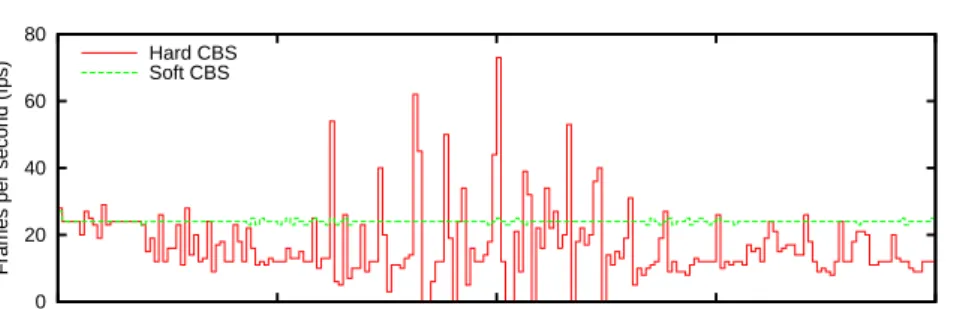
to as a soft reservation policy allows at least Q/P. Figure 8 shows the frame-rate of
the H.264 movie, whose processing time is demonstrated in Figure 6, achieved by theMPlayertask under these two variants of the CBS algorithm implemented using
SCHED DEADLINE. We set 25ms to be the budget, given that the worst-case execu-tion time of around 45ms is too pessimistic for reservaexecu-tion in this case, and it is rather appropriate to reserve the intermediate processing time per period. According to these results, the soft CBS policy ensures stable QoS for the movie playback, whereas the hard CBS policy repeatedly drops and catches up frames. This preliminary evaluation suggests that we use the soft CBS policy for interactive real-time applications with variable execution times. In fact,SCHED DEADLINEnow uses the soft CBS policy, while it used to adopt the hard CBS policy. Our evaluation provided herein uses this new version ofSCHED DEADLINE, using the soft CBS algorithm.
7.1 CPU Scheduling
We first evaluate the capabilities of our CPU scheduler to execute multipleMPlayer
tasks playing the H.264 movie. As observed in Figure 6, a majority of frames are processed within 25ms. We hence set 25ms to be the CPU time reserved per period for both our CPU scheduler andSCHED DEADLINE, in order to ensure the QoS of this majority. As for our CPU scheduler, we prepare three configurations to see how the FCBS and the EDF-WMR algorithms improve the frame-rate respectively. The first configuration uses only the FCBS algorithm, the second uses only the EDF-WMR algorithm, and the last uses both the FCBS and the EDF-EDF-WMR algorithms. When the FCBS and/or the EDF-WMR algorithms are disabled, our CPU scheduler relies onSCHED DEADLINEto reserve CPU bandwidth and/or to migrate tasks.
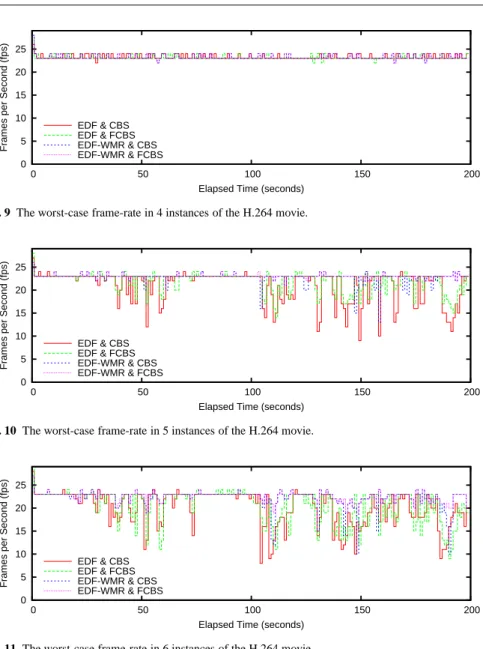
Figure 9 depicts the worst number of frames per second obtained by playing 4 in-stances of the H.264 movie concurrently. Since we pick the worst number among all the movies at every sampling point, the results do not correspond to particular movies
0 5 10 15 20 25 0 50 100 150 200
Frames per Second (fps)
Elapsed Time (seconds) EDF & CBS
EDF & FCBS EDF-WMR & CBS EDF-WMR & FCBS
Fig. 9 The worst-case frame-rate in 4 instances of the H.264 movie.
0 5 10 15 20 25 0 50 100 150 200
Frames per Second (fps)
Elapsed Time (seconds) EDF & CBS
EDF & FCBS EDF-WMR & CBS EDF-WMR & FCBS
Fig. 10 The worst-case frame-rate in 5 instances of the H.264 movie.
0 5 10 15 20 25 0 50 100 150 200
Frames per Second (fps)
Elapsed Time (seconds) EDF & CBS
EDF & FCBS EDF-WMR & CBS EDF-WMR & FCBS
Fig. 11 The worst-case frame-rate in 6 instances of the H.264 movie.
but indicate the QoS of the overall system. In this setup, all CPU schedulers achieve stable frame-rates. Since we have four CPUs available in a quad-core machine, one CPU is exclusively assigned to eachMPlayertask. Therefore, the frame-rates are kept stable. However, the frame-rates occasionally drop below 24 fps, since some individ-ual frames require the processing time more than the period, as shown in Figure 6, since the frame processing time is affected by the resource usage, like a cache status, which is not predictable due to the existence of Linux background jobs.
Figure 10 shows the worst-case frames per second obtained by playing 5 in-stances of the H.264 movie concurrently. In this setup, our CPU scheduler
outper-formsSCHED DEADLINE. Particularly, when both the EDF-WMR and the FCBS algorithms are used, the frame-rate is maintained at nearly 24 fps. Given that there are 5MPlayertasks, each of which reserves CPU bandwidth of 25/41=61%, they apparently need to migrate across CPUs to meet deadlines. In this scenario, the timely migration mechanism provided by the EDF-WMR algorithm correctly allocates the CPU time to each task, while the EDF algorithm implemented inSCHED DEADLINE
causes the tasks to miss deadlines more frequently. Hence, we conclude that a semi-partitioned multicore scheduling approach is effective to support QoS-aware real-time applications. On the other hand, using only one of the FCBS and the EDF-WMR algorithms causes the frame-rate to drop a little. It is however worth noting that these configurations still provide better frame-rates thanSCHED DEADLINE. Therefore, both the FCBS and the EDF-WMR algorithms are useful to improve the QoS of the overall system over the CBS and the EDF algorithms respectively.
Figure 11 shows the worst-case frames per second obtained by playing 6 instances of the H.264 movie concurrently usingMPlayer. In this setup, even our CPU sched-uler using both the FCBS and the EDF-WMR algorithms face degradation in the frame-rate, but still provides the frame-rate of over 20 fps, whereas the frame-rate is severely affected by each other in other configurations. In fact, 6 periodic tasks with computation time 25ms and period 41ms are theoretically schedulable by the EDF-WM algorithm. Furthermore, even though their jobs spend more than 25ms of CPU time, the FCBS algorithm covers up their overruns. As a consequence, these 6MPlayertasks are kept from any fatal timing violation under our CPU scheduler using both the FCBS and the EDF-WMR algorithms.
In our experience, when frame-rates drop below 20 fps, we visually notice that the movies are delayed. When the frame-rates drop below 15 fps, we even start feeling uncomfortable watching the movies. In this regard, our CPU scheduler is useful to provide interactive real-time applications with sufficient QoS.
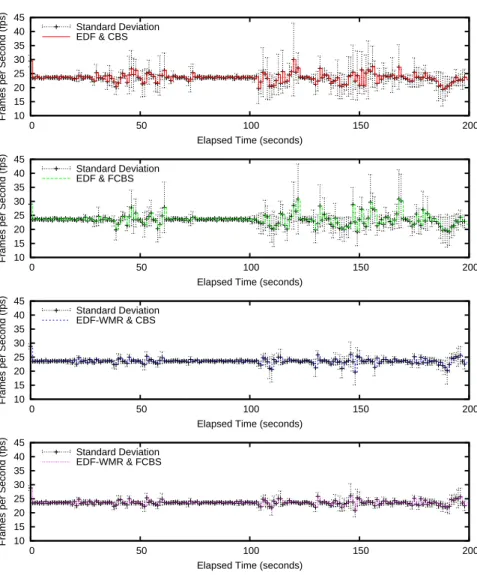
We next evaluate the average-case frame-rate and the associated standard devi-ation rather than the worst-case bursts and drops in the frame-rate. We particularly focus on the case that has demonstrated the most burst interference in the previous experiments, where 6 MPlayertasks execute concurrently, as shown in Figure 12. Interestingly, the average-case frame-rate is not very different among all the con-figurations under consideration. The standard deviation, however, indicates that the frame-rate is not stable underSCHED DEADLINE, while it becomes more stable as our CPU scheduler uses the FCBS algorithm and/or the EDF-WMR algorithm. Thus, our CPU scheduler is beneficial for not only improving the worst-case frame-rate but also providing stable frame-rates on average.
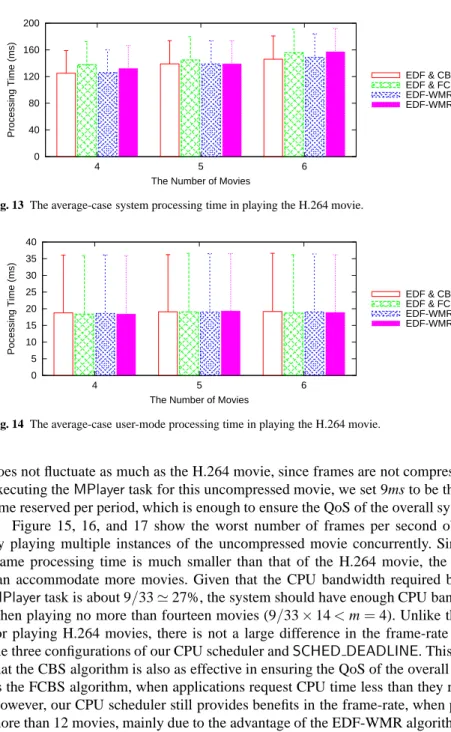
Figure 13 shows the average-case system processing time taken to compute a sin-gle frame of the H.264 movie. It is measured by thestimemember in the Linux task control block. Since the difference among all the configurations is no more than 15µs,
we evince that the additional implementation overhead of our CPU scheduler is neg-ligibly small as compared toSCHED DEADLINE. The fact that the absolute system overhead increases as the number of concurrently-playing movies increases implies that the scheduling decision spends more CPU time to schedule a larger number of tasks, but the amount of increase is trivial. The implementation of the EDF-WMR algorithm even reduces the system overhead in some case, because each local
10 15 20 25 30 35 40 45 0 50 100 150 200
Frames per Second (fps)
Elapsed Time (seconds) Standard Deviation EDF & CBS 10 15 20 25 30 35 40 45 0 50 100 150 200
Frames per Second (fps)
Elapsed Time (seconds) Standard Deviation EDF & FCBS 10 15 20 25 30 35 40 45 0 50 100 150 200
Frames per Second (fps)
Elapsed Time (seconds) Standard Deviation EDF-WMR & CBS 10 15 20 25 30 35 40 45 0 50 100 150 200
Frames per Second (fps)
Elapsed Time (seconds) Standard Deviation
EDF-WMR & FCBS
Fig. 12 The average-case frame-rate in 6 instances of the H.264 movie.
uler only needs to manage the tasks assigned to the corresponding CPU under the EDF-WMR algorithm based on semi-partitioned scheduling. As a result, scheduling decision needs less CPU time thanSCHED DEADLINEbased on global scheduling. Figure 14 shows the average frame processing times of the H.264 movie. We observe that the average frame processing times are almost the same in all cases. This means that memory caches affect all these cases equally. Although we have not traced the cache behavior precisely, we believe that the numbers of context switches and migrations are not so different in those measurements as to change the cache performance, since we run only four to six tasks.
We next evaluate the effectiveness of our CPU scheduler in playing multiple in-stances of the uncompressed movie. As shown in Figure 7, the frame processing time
0 40 80 120 160 200 4 5 6 Processing Time (ms)
The Number of Movies
EDF & CBS EDF & FCBS EDF-WMR & CBS EDF-WMR & FCBS
Fig. 13 The average-case system processing time in playing the H.264 movie.
0 5 10 15 20 25 30 35 40 4 5 6 Pocessing Time (ms)
The Number of Movies
EDF & CBS EDF & FCBS EDF-WMR & CBS EDF-WMR & FCBS
Fig. 14 The average-case user-mode processing time in playing the H.264 movie.
does not fluctuate as much as the H.264 movie, since frames are not compressed. In executing theMPlayertask for this uncompressed movie, we set 9ms to be the CPU time reserved per period, which is enough to ensure the QoS of the overall system.
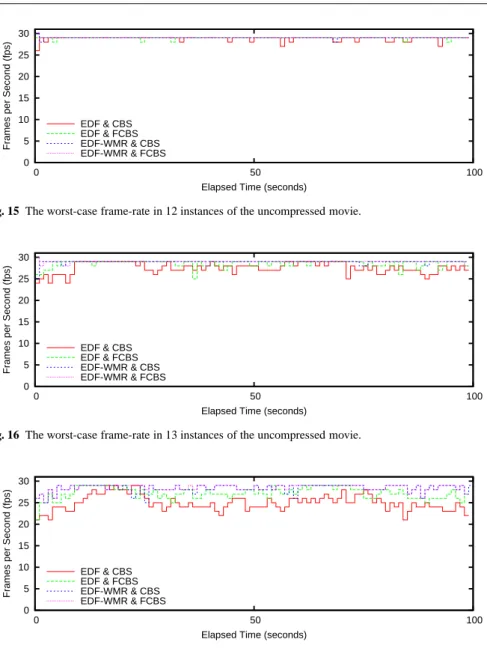
Figure 15, 16, and 17 show the worst number of frames per second obtained by playing multiple instances of the uncompressed movie concurrently. Since the frame processing time is much smaller than that of the H.264 movie, the system can accommodate more movies. Given that the CPU bandwidth required by each
MPlayertask is about 9/33≃27%, the system should have enough CPU bandwidth when playing no more than fourteen movies (9/33×14<m=4). Unlike the case for playing H.264 movies, there is not a large difference in the frame-rate among the three configurations of our CPU scheduler andSCHED DEADLINE. This means that the CBS algorithm is also as effective in ensuring the QoS of the overall system as the FCBS algorithm, when applications request CPU time less than they reserve. However, our CPU scheduler still provides benefits in the frame-rate, when playing more than 12 movies, mainly due to the advantage of the EDF-WMR algorithm over the EDF algorithm. As a consequence, the timely migration mechanism provided by the EDF-WMR algorithm is effective to ensure the QoS of the overall system, even when the frame processing time does not vary a lot.
Figure 18 demonstrates the average-case frame-rate and the associated standard deviation when playing 14 instances of the uncompressed movie. The average-case frame-rate is not very different among our CPU scheduler andSCHED DEADLINE.
0 5 10 15 20 25 30 0 50 100
Frames per Second (fps)
Elapsed Time (seconds) EDF & CBS
EDF & FCBS EDF-WMR & CBS EDF-WMR & FCBS
Fig. 15 The worst-case frame-rate in 12 instances of the uncompressed movie.
0 5 10 15 20 25 30 0 50 100
Frames per Second (fps)
Elapsed Time (seconds) EDF & CBS
EDF & FCBS EDF-WMR & CBS EDF-WMR & FCBS
Fig. 16 The worst-case frame-rate in 13 instances of the uncompressed movie.
0 5 10 15 20 25 30 0 50 100
Frames per Second (fps)
Elapsed Time (seconds) EDF & CBS
EDF & FCBS EDF-WMR & CBS EDF-WMR & FCBS
Fig. 17 The worst-case frame-rate in 14 instances of the uncompressed movie.
However, as compared to those for the H.264 movies depicted in Figure 12, the er-rors from the average-case frame-rate are quite limited, thoughSCHED DEADLINE
still faces variability in the frame-rate. Our CPU scheduler retains such variability, especially when both the FCBS and the EDF-WMR algorithms are leveraged. Thus, it provides a considerable benefit for playing multiple uncompressed movies as well as H.264 movies. It is interesting to observe that the errors from the average-case frame-rate chronically appear on a time, while the range of error value is limited. Since the frame processing time for the uncompressed movie is more constant than
20 25 30 35
0 50 100
Frames per Second (fps)
Elapsed Time (seconds) Standard Deviation EDF & CBS 20 25 30 35 0 50 100
Frames per Second (fps)
Elapsed Time (seconds) Standard Deviation EDF & FCBS 20 25 30 35 0 50 100
Frames per Second (fps)
Elapsed Time (seconds) Standard Deviation EDF & FCBS 20 25 30 35 0 50 100
Frames per Second (fps)
Elapsed Time (seconds) Standard Deviation
EDF-WMR & FCBS
Fig. 18 The average-case frame-rate in 14 instances of the uncompressed movie.
that for the H.264 movie, occasional bursts and drops in the frame-rate are reduced, but instead the frame-rate constantly exhibits some variability.
Figure 19 shows the average-case system processing time taken to compute a single frame of the uncompressed movie. The absolute system processing time is greater than the previous the case for the H.264 movie shown in Figure 13. The increased portion in the system processing time mostly includes scheduling overhead, since there are more than 12 tasks to schedule. However, we claim that the difference between our CPU scheduler andSCHED DEADLINEis still ignorable.
Figure 20 shows the average-case user-mode processing times of the uncom-pressed movie. Surprisingly, our CPU scheduler needs the most CPU time to compute a single frame in spite of limited migrations. Even if the EDF-WMR algorithm is not
0 40 80 120 160 200 240 280 320 12 13 14 Processing Time (ms)
The Number of Movies
EDF & CBS EDF & FCBS EDF-WMR & CBS EDF-WMR & FCBS
Fig. 19 The average-case system processing time in playing the uncompressed movie.
0 2 4 6 8 10 12 14 12 13 14 Processing Time (ms)
The Number of Movies
EDF & CBS EDF & FCBS EDF-WMR & CBS EDF-WMR & FCBS
Fig. 20 The average-case user-mode processing time in playing the uncompressed movie.
used, our CPU scheduler needs more processing time thanSCHED DEADLINE. We reason this fact as follows. First, the FCBS algorithm may suspend and resume the same job repeatedly. When it receives the remaining budget from other completed jobs, it is resumed. When the budget is exhausted, it is suspended. Hence, we con-sider that memory caches affect the processing times due to a number of context switches, unlike the previous cases scheduling no more than six tasks. In particular, our CPU scheduler using both the FCBS and the EDF-WMR algorithms assigns par-ticular CPUs to the tasks. The FCBS algorithm is therefore applied independently on each CPU. As a result, the cache performance is affected more. However, our CPU scheduler still improves the frame-rate.
Experiments with busy-loop tasks. We now assess the capabilities of our CPU
scheduler in terms of the breakdown workload for hard-deadline guarantee, in or-der to show that our CPU scheduler can not only maintain the desired frame-rates of applications for soft real-time setup, but also meet the deadlines of applications for hard real-time setup, where tasks have more constant execution times than in-teractive tasks. Like prior work (Brandenburg and Anderson, 2009b; Brandenburg et al, 2008; Calandrino et al, 2006), we submit many sets of randomly-generated busy-loop periodic tasks to the system, and observe the ratio of task sets successfully scheduled without missing deadlines. The busy-loop tasks used in this evaluation do not access memory to prevent them from affecting execution times. Evaluation for memory-intensive hard-deadline tasks is left open for future work. In the following
0 20 40 60 80 100 200 240 280 320 360 400 Success Ratio (%) Total Workload (%) EDF-WMR & FCBS EDF & CBS
Fig. 21 Hard timing guarantees in scheduling busy-loop tasks with individual utilization[10%s,100%].
0 20 40 60 80 100 200 240 280 320 360 400 Success Ratio (%) Total Workload (%) EDF-WMR & FCBS EDF & CBS
Fig. 22 Hard timing guarantees in scheduling busy-loop tasks with individual utilization[50%s,100%].
0 20 40 60 80 100 200 240 280 320 360 400 Success Ratio (%) Total Workload (%) EDF-WMR & FCBS EDF & CBS
Fig. 23 Hard timing guarantees in scheduling busy-loop tasks with individual utilization[10%s,50%].
experiments, CPU reservation mechanisms are not used since execution times are tightly bounded due to busy-loop tasks.
We submit 1000 sets of periodic tasks, each of which produces the same amount of workload W , to measure schedulability for the given workload. Each task set is generated as follows. The CPU utilization Uiof a newly-generating taskτiis
deter-mined based on a uniform distribution. The range of the distribution is parametric. In our evaluation, we have three test cases:[10%,100%](both heavy and light tasks),
[10%,50%](only light tasks), and [50%,100%] (only heavy tasks). New tasks are created until the total CPU utilization reaches W . The period Ti ofτi is also
uni-formly determined within the range of[1ms,100ms]. The execution time ofτiis set
to Ci=UiTi.
When the task parameters are decided, we measure the count n of busy-loops that consume 1 microsecond. Each taskτithen loops n×Citimes in each period. We
exe-cute these busy-loop tasks for 10 minutes. A task set is said to be successfully sched-uled if and only if all jobs complete within their periods during the measurement. We
0 5 10 15 20 25 30 35 40 0 50 100 150 200
Frames per second (fps)
Elapsed time (seconds) LRU-based Paging
Memory Firewalling w/ 8000 priv pages PSAP w/ 6000 priv pages
PSAP w/ 8000 priv pages
Fig. 24 The worst-case frame-rate in 4 instances of the H.264 movie under memory pressure.
then evaluate by success ratio: the ratio of the number of successfully-scheduled task
sets and that of submitted task sets.
Figure 21, 22, and 23 show the success ratios in scheduling the task sets of differ-ent workloads. We note again that each sampling point runs 1000 task sets. According to the results, our CPU scheduler has an advantage in meeting hard timing guaran-tees, beyond providing soft real-time performance. It is known (Dhall and Liu, 1978) that the EDF algorithm shows worse schedulability when high-utilization tasks exist. Our experimental results truly reflect this effect.
7.2 Memory Management
We now evaluate our memory management scheme. Specifically, we look into the responsiveness of theMPlayertask in the face of memory pressure. To this end, we create a memory bomb task that allocates 500 MB of heap memory, and keeps writing to each page in an infinite loop. We launch four instances of this memory bomb task to burden all space (2 GB) of memory, when we execute theMPlayer task. While we use our CPU scheduler introduced in this paper employing the EDF-WMR and the FCBS algorithms, our memory management scheme can generally be used with any CPU schedulers. We primarily focus on the capability of memory management schemes to protect interactive real-time tasks, i.e., theMPlayertask in this case, from the interference introduced by background memory-intensive tasks. The impact on the performance of such background best-effort tasks could also be of interest to discuss, but we consider that it is out of the scope of this paper.
Figure 24 shows the worst-case frame-rate obtained by playing 4 instances of the H.264 movie under the three memory management schemes. For the memory firewalling algorithm, we reserve 8000 pages for eachMPlayertask, which should be enough for executing the first few frames of the H.264 movie. Meanwhile, we prepare two configurations for the PSAP algorithm to see the impact as a function of different sizes of memory reserves. For each MPlayertask, the first configura-tion reserves 8000 pages, while the second reserves 6000 pages. In either case, 8000 pages are reserved for the shared-reserve block. As depicted in Figure 9, when there is no memory pressure, the frame-rates of 4MPlayertasks are all stable. However,
0 10 20 30 40 50 0 50 100 150 200
Frames per Second (fps)
Elapsed Time (seconds) Standard Deviation LRU-based Paging 0 10 20 30 40 50 0 50 100 150 200
Frames per Second (fps)
Elapsed Time (seconds) Standard Deviation
Memory Firewalling w/ 2400 priv pages
0 10 20 30 40 50 0 50 100 150 200
Frames per Second (fps)
Elapsed Time (seconds) Standard Deviation
PSAP w/ 6000 priv pages
0 10 20 30 40 50 0 50 100 150 200
Frames per Second (fps)
Elapsed Time (seconds) Standard Deviation
PSAP w/ 8000 priv pages
Fig. 25 The average-case frame-rate in 4 instances of the H.264 movie under memory pressure.
theseMPlayertasks are significantly affected by memory bomb tasks under the tra-ditional LRU-based paging algorithm, which is adopted in the Linux kernel by de-fault. The memory firewalling algorithm (Eswaran and Rajkumar, 2005) achieves better frame-rates forMPlayer tasks, but it still decreases frame-rates to about 15 fps in the worst case. This is largely attributable to the fact thatMPlayertasks are occasionally blocked due to page-swapping invoked by themselves, when pages are exhausted in their own reserved memory block. On the other hand, the PSAP algo-rithm successfully isolatesMPlayertasks from memory pressure. Even though pages are exhausted in their own private memory blocks, the tasks can get pages from the shared-reserve block. It can therefore maintain frame-rates to be almost ideal around 24 fps. Although the memory firewalling algorithm could perform better if we assign