Procedia - Social and Behavioral Sciences 186 ( 2015 ) 401 – 409
ScienceDirect
1877-0428 © 2015 The Authors. Published by Elsevier Ltd. This is an open access article under the CC BY-NC-ND license (http://creativecommons.org/licenses/by-nc-nd/4.0/).
Peer-review under responsibility of Academic World Education and Research Center doi: 10.1016/j.sbspro.2015.04.216
5th World Conference on Learning, Teaching and Educational Leadership, WCLTA 2014
Elementary School Teachers’ Views on Game-based Learning as a
Teaching Method
Dr. Sukran Ucus
a*aMinistry of Education, Ankara, 06500, Turkey
Abstract
Game based learning (GBL) help students improve problem-solving skills and make it possible for them to interpret their society, nature and the world around them through experiences. Games provide information in a relevant context or setting. That is why it is very important for the social studies courses, in-class leisure activities, games and physical activities which aim to train students as active members of a classroom. Using games in courses encourage reflection and comprehension of the learning. The purpose of this study is to understand elementary school teachers’ views on GBL related to elementary school courses. 24 elementary school teachers from the schools located in districts with low, middle and high socio-economic levels in Ankara/Turkey participated in this qualitative study. The data of the study were collected by using semi-structured interviews and analyzed using descriptive analysis. According to the findings of the study, the elementary school teachers believe that content of the social studies course; in-class leisure activities, engaging child literature, games and physical activities were suitable for using GBL in the classroom. GBL activities were exemplified as e-learning activities, creative drama activities, digital games, values education and character education. Teachers experienced problems about time planning, students’ non-cooperative behaviors, and teachers’ insufficient background about organizing and designing games as well as economic problems and technical obstacles in related to GBL.
© 2015 The Authors. Published by Elsevier Ltd.
Peer-review under responsibility of Academic World Education and Research Center.
Keywords: Game-based learning, elementary school teachers’ opinions, elementary education
1.Introduction
Game-based learning (GBL) has gained a greater importance in recent years. A game has an important role in a
child’s world. Learning is an internal process and that’s why games are natural learning instruments in a child’s life.
* Sukran Ucus. Tel.:+090 312-341-23-37.
E-mail address: [email protected]
© 2015 The Authors. Published by Elsevier Ltd. This is an open access article under the CC BY-NC-ND license (http://creativecommons.org/licenses/by-nc-nd/4.0/).
Games help students develop necessary knowledge, skills and values in order to be an active member of their
classroom and even in their society. At that point, teachers have a crucial role on students’ learning process with
games. When teachers choose appropriate games related to their teaching goals and when they organize GBL process effectively, permanent learning can be provided, courses can be found enjoyable and interesting by learners
(Gözütok, 2000). However, students who are from elementary schools, have difficulties to concentrate abstract
concepts. That’s why educational games are usually prepared for elementary school students (Sevinç, 2004).
Moreover, games are based on student-centered education approach, students learn by doing and experiencing with interactive practices.
GBL represents a good instrument for fostering creative teaching practices. Indeed, the literature demonstrate that games have qualities that can facilitate student learning by providing challenging experiences that promote intrinsic satisfaction and offer opportunities for authentic learning by enabling learners to freely explore the environment in a risk-free environment (Frossard, Barajas & Trifonova, 2012). Moreover, it is combined with educational and information technology. As the e-learning becomes more popular, the GBL is applied more and more. In GBL, the course content is mapped into the game to provide a virtual environment of learning, the repeated self-learning, and the ongoing interaction and feedback can increase the learning interest and motivation. Hence, GBL could reach the goal of learning effectively. (Ching and Chung, 2012). Besides, it provides authentic tasks and environment, both challenges and supports the learner’s critical thinking processes, and encourages trying out
alternative views or methods without substantial risk to the player (DeKanter, 2005).
The content of the elementary education courses reflects life. Therefore, it should be based on real life. GBL
may influence students’ perceptions towards the courses positively. Moreover, game activities may help students
transfer their knowledge to real life situations. Awareness of elementary school teachers about using games as a teaching method is very important. They are expected to organize GBL activities and to compose games to support effective teaching in the elementary education. Additionally, teaching processes involving games designed by teachers appeared as a stimulus for teachers and students, both in terms of learning outcomes and motivation for both. Games also supported a creative learning environment, in which questions and humor were encouraged (Frossard, Barajas & Trifonova, 2012).
GBL is based on five major dimensions that contributed to the game-based learning efficiency of the students are identified as: learning environment, learner, pedagogy, context, and teacher. The learning efficiency was divided into three domains: affective, cognitive, and psychomotor (Chang, Wu, "n.d.”). Learners’ experience and play time also play a critical role in the success of the GBL efficiency of the students. It is interpreted from that game design strategies should inspire the experiential learning to generate a positive effect in players, and students can be engaged and motivated through direct experiences with the game world (Chang and Wu, "n.d."). It is clear that using such an important method in education will be effective. As children like games and spend most of their time playing with them, games happen to be used in education. This study aims at understanding how elementary school teachers perceive GBL and to collect their views about advantages and problems of GBL. In order to understand
elementary school teachers’ views on game- based learning. The following questions were asked to the participants: 1. How do elementary school teachers define GBL?
2. What do elementary school teachers think about GBL?
3. What are elementary school teachers’ views about subjects in which GBL is used in elementary school
courses as a teaching method?
4. What are elementary school teachers’ views about activities conducted GBL for elementary school
courses?
5. What are elementary school teachers’ views about problems regarding GBL in the elementary school
courses?
6. What are elementary school teachers’ suggestions for the problems about GBL in the elementary school
2.Method
2.1.Research Model
Qualitative research methods were used in the study. Interviews give information about individuals’ experiences, beliefs, values, knowledge and their perceptions about acts and cases (Yıldırım & Şimşek, 2006). Elementary school teachers’ views on GBL were explored through semi-structured interviews in this study.
2.2.Participants
The study group included a total of 24 teachers from elementary schools in different districts of Ankara/Turkey.
Maximum variation sampling (Yıldırım & Şimşek, 2006) was used to select teachers who would be willing to participate in the study. The criteria determined by the researcher included teachers’ years of teaching and different
socio-economic status. A total equal number teachers were chosen from districts with low, middle and high income levels.
2.3.Data Collection
The research data were collected via semi-structured interviews. An interview form was prepared by the researcher. One the interview form was examined by field experts, their recommendations were considered. After the review of the form, a pilot interview was conducted. Questions were redesigned after the pilot interview and the final version of the form is created. The researcher explained the purpose of the research to each participant one by one, and asked them to sign a personal permission document before the interviews. Interviews were conducted in the spring term of 2013-2014 academic years.
2.4.Data Analysis
Descriptive analysis method was used to analyze the data. A framework was formed in research questions and themes were described to organize data of the research. The interview audio-records were transferred to the computer from digital sound recorder and transcribed by the researcher. Participants were assigned code names and their code names were recorded. Analyses were done by the researcher and another field expert independently. Then, researchers exchanged their ideas and reached an agreement on the points they had differing views about. The reliability of the study was calculated with the use of Agreement/ Agreement + Disagreement X 100 suggested by Miles and Huberman (1994) and the reliability of the study was found 93% (Yıldırım & Şimşek, 2006).
3.Findings
Findings which were obtained by analyzing the data were presented in this section. Themes which were based on the opinions of teachers were given separately in the tables. Themes were listed according to teachers’ responses
which were stated from most to least regionally.
Table 1. Elementary School Teachers’ Definitions on GBL
Low Socio-Economic Levels
Learning from media, computers
Sub-branch e-learning Social Learning Active learning Learning from educational games
Middle Socio-Economic Levels
Interactive Learning
Learning by doing, experiencing Cooperative Learning
Improving Strategies
Improving problem solving skills, problem based learning Learning from media, computers
Using Critical Thinking
Learning by doing, experiencing High Socio-Economic Levels
Learning from experiences
Implementations on Drama, Creative Drama Learning with fun
Table 1 shows that elementary school teachers develop different understandings for GBL. Most of teachers who participated from schools in middle and low socio-economic level, defined GBL as learning by doing, experiencing whereas many of teachers who were from schools in low socio-economic level defined GBL learning from media, computers and sub-branch e-learning. All participants stated that GBL was based on active learning and student-centered approach. One participant commented that “Actually games are very important to activate students in the classroom. They enhance their problem solving skills and their strategic thinking skills, in a word, GBL support student-centered approach. Both they are satisfied with learning with fun and they have motivation for learning more.”
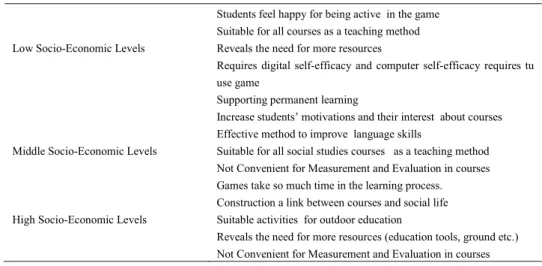
Table 2. Opinions of Elementary School Teachers about GBL as a teaching method
Low Socio-Economic Levels
Students feel happy for being active in the game Suitable for all courses as a teaching method Reveals the need for more resources
Requires digital self-efficacy and computer self-efficacy requires tu use game
Middle Socio-Economic Levels
Supporting permanent learning
Increase students’ motivations and their interest about courses Effective method to improve language skills
Suitable for all social studies courses as a teaching method Not Convenient for Measurement and Evaluation in courses
High Socio-Economic Levels
Games take so much time in the learning process. Construction a link between courses and social life Suitable activities for outdoor education
Reveals the need for more resources (education tools, ground etc.) Not Convenient for Measurement and Evaluation in courses
It is clear from Table 2 that many of teachers who were from schools in low socio-economic levels expressed that GBL was suitable for all courses as a teaching method and it made student feel happy in the learning process. Most of teachers who were from schools in middle socio-economic levels stated that GBL supported permanent
learning and increasing students’ interests and motivation. A major part of teachers who were from schools in high socio-economic levels pointed that using games took so much time in the teaching and learning process. Some teachers also expressed that GBL was Construction a link between courses and social life. One participant commented on this issue as, “Games prepare students for social life and society. Students are actors and actresses
Table 3. Elementary School Teachers’ views about subjects in which GBL is used in courses
Low Socio-Economic Levels
Games and Physical Activities Information technology education Values and character education Social Studies
Engaging literature (narrative, Story, tales..)
Middle Socio-Economic Levels
Engaging literature (narrative, Story, tales..) Social Studies
Reading activities Creative thinking
Games and Physical Activities
High Socio-Economic Levels
Leisure time activities Social Studies
Mathematic Education (It is as an introduction activity in the learning process)
Physical education and game activities Information technology education
All teachers agreed on the idea from table 3 that the content of the social studies and physical education and game activities courses were suitable for GBL. A couple of teachers who were from schools in high and low socio-economic levels expressed that they used GBL in information technology education courses. One participant stated that “I prefer to use video games, computer games, e-learning materials in information technology education courses. Information technology education courses contribute other courses in order to enhance students’ knowledge and to increase their motivations.”
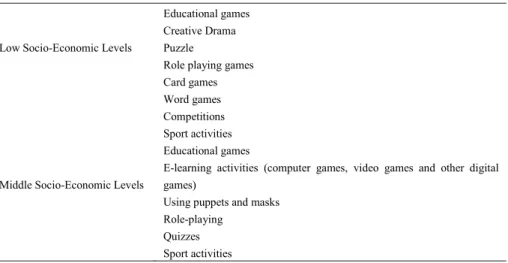
Table 4. Elementary School teachers’ views about activities implemented GBL for the courses
Low Socio-Economic Levels
Educational games Creative Drama Puzzle
Role playing games Card games Word games Competitions Sport activities
Middle Socio-Economic Levels
Educational games
E-learning activities (computer games, video games and other digital games)
Using puppets and masks Role-playing
Quizzes Sport activities
High Socio-Economic Levels
E-learning activities (computer games, video games and other digital games)
Flash cards for concept teaching Traditional children games Cooperative games Lego,tangram,Quizzes
Half of participants who were from schools in low and middle socio-economic schools explained that they used educational games, e-learning games, role-playing games. Nevertheless all participants who were from schools in high socio-economic levels also explained that they used e-learning activities (computer games, video games and other digital games), they needed multimedia materials and they considered themselves in sufficient how to use and develop multimedia materials. They also pointed that they prefer to use traditional children games because of lack of multimedia materials.
Table 5. Elementary School teachers’ views about problems related to GBL in the classroom in the elementary education
Low Socio-Economic Levels
-Time managing and controlling -Inability about participation of students
-Not to know how to benefit from resources for organizing games -Not suitable to give students class grades and to evaluate them -Low motivation of disadvantaged students
Middle Socio-Economic Levels
-Organization problems
-Teachers’ insufficient background about organizing and designing games
-Students’ misbehaviors -Time managing and controlling
High Socio-Economic Levels
-Time managing and controlling -Economical problems
-not to get effective feedbacks from students -not possible to have output for student evaluation -Game organization problems
Table 5 shows that teachers have common idea on problems which were time managing and controlling, game organization problems. A major part of teachers who were from schools in low and high socio-economic schools articulated that GBL did not provide result-based evaluation for students. One participant commented that “It is not
possible in order to give students marks or in order to evaluate them after GBL activities”. Teachers who were from schools in middle socio-economic schools sequenced the other problems related to GBL in the classroom such as
Table 6. Elementary School Teachers’ suggestions for the problems in related to GBL in the elementary education
Low Socio-Economic Levels
-Teachers should cooperate with school management and parents
-Game based activities should be given in the curriculums and course books. -Computer, e-learning and mobile learning self-efficiency should be improved by teachers and students
Middle Socio-Economic Levels
-Designing games considering students’ interests and abilities
-Teacher need in service training for GBL for how to organize games and how to integrate games on the curriculum.
-School managements and parents should support teachers to access resources on GBL.
-Reorganizing class timetable to give place more games
High Socio-Economic Levels
-Student should be asked to create different games to improve development of creative thinking skills.
- Organizing extracurricular activities to use games much more in the classroom. -Cooperation with other courses for using GBL
-Teachers should prefer process-based evaluation to evaluate their students.
Table 6 shows that elementary school teachers’ suggestions for the problems in related to GBL in the
elementary education. Most of teachers who were from schools in low socio-economic levels stated that teachers should cooperate with school management and parents, game based activities should be given in the curriculums and course books. When it comes to teachers who were from schools in middle socio-economic levels, major part of them suggested designing games considering students’ interests and abilities and necessity of teacher in service training for GBL for how to organize games and how to integrate games on the curriculum. Major part of teachers who were from schools in middle socio-economic levels suggested that student should be asked to create different games to improve development of creative thinking skills. They also suggested organizing extracurricular activities to use games much more in the classroom.
4. Result and Discussion
Results of the study revealed that teachers understand GBL as learning from media and computers, using
educational games through social learning, cooperative learning. It can be argued that teachers’ definitions from low
and middle socio-economic status schools regarding GBL overlap much more with the literature. GBL can be defined as learning about learning by doing and cooperation in social medium processes to acquire knowledge, skills and to make students to be active (Squire, 2003). Teachers from high socio-economic status schools defined GBL as learning from experiences. It can be said that this stems from the lack of teachers’ knowledge and experiences on GBL’s scope and its principles.
GBL methods can be implemented in the elementary school courses from the viewpoint of teachers. Teachers explained that students feel happy for being active in the game and games are suitable for all elementary school courses as a teaching method. Teachers usually used learning with games in physical education and its activities,
social studies, children’s literature. Game-based activities were listed as e-learning activities, educational games, role playing and creative drama. In addition they expressed that games are constructing a link between courses and social life and support permanent learning, students feel happy for being active in the game. This result shows that the GBL system obviously improves the learning achievements of students. For long-term learning, the application of the GBL system to a classroom environment is both feasible and useful. In future work, we expect to make more use of multimedia features to enrich the graphics and contents of the game, in order to improve the learning
motivations of students (Ching and Chung, 2012). All of the teachers depicted that they use outside activities mostly in teaching games and physical activities, social studies. Teachers from schools located in middle socio-economic level districts stated that they use GBL activities in subjects about supporting permanent learning, increasing
students’ motivations and their interest about courses. Teachers from schools located in low socio economic level districts indicated that they use in leisure time activities, mathematics education (it is as an introduction activity in
the learning process), social studies. Using games in “leisuretime activities” and in “games and physical activities”
encourage reflection and comprehension of the learning. Leisure time activities were started by the Turkish National Ministry of Education via promulgation in 2010 for the students attending from the 1st to 5th grades of elementary
schools. Moreover Games and Physical Activities were started in 2012 from the 1st to 4th grades of elementary
schools. These activity lessons help in order to engage learners considerably (Ministry of Education Turkey (MEB), 2012).
On the other hand, teachers from low social-economic level schools told that games take so much time in the
learning process. It can be said that games take too much time because of students’ academic and developmental
differences. Besides that, teachers experienced problems about time, students’ behavioral problems, and incapacity
of game organizations and reluctance of students in order to participate. The results of the study showed that organizing time is one of the important problems faced with by teachers. It can be claimed that teachers from schools located in high socio-economic level districts point problems in GBL process. Güneş (2010) states that
outside learning activities should be planned practiced and evaluated carefully to be effective. Teachers from schools located in middle and low socio-economic level districts mentioned the problems about the preparation and planning stages of the outside learning as economic problems, family cooperation and organizational problems. Similarly, the main problems about using games in the class-time are defined as lack of preparation time, poor technical support, outdated technologies and lack of opportunities for collaboration due to the rigid structure and time constraints of formal instruction (Perrotta, Featherstone, Aston & Houghton, 2013). It can be said that all stages of learning with games should be handled in planning practice and evaluation process in detail and necessary measures should be taken to solve the problems.
Teachers put forth suggestions for the problems about GBL such as designing games considering students’ interests and abilities, strengthening elementary school teachers’ self-efficiencies on GBL, organizing extracurricular activities to use games much more in the classroom. Regarding the findings of the study and from
teachers’ ideas on suggestions, following suggestions also can be made; in service training regarding the purpose,
scope, planning, practice of GBL for elementary education can be organized for teachers. Game-based activities should be given in different curricula and course books. Especially, schools located in districts with low and middle socio-economic status can be supported financially to get more resources. School managers and parents can cooperate with teachers for organizing GBL activities.
Helping teachers understand how to use these new pedagogies is important. Successful professional development requires attention to multiple factors including teacher efficacy in using the software, pedagogical issues and school culture (Ketelhult& Schifter, 2011). Moreover, the learner-centered game design methodology appears as a productive and creative approach for teaching and learning, along with difficulties. But, it is worth to explore if we want to promote creative teaching and creative learners (Frossard, Barajas & Trifonova, 2012). Skills which were emphasized in elementary school curriculum such as student-centered approach, social participation, using information technology, problem-based learning, using new strategies experiences, (MEB, 2005) require GBL and using games in the learning environments. It is obvious that interest in GBL for elementary education is growing. Thus, helping teachers understand how to use these new pedagogies is not only important but also crucial.
References
Chang, S.,S.; Wu, C.,T. ("n.d."). Meta-Analysis of the Critical Success Factors for the Students’ Game-Based Learning Efficiency. Unpublished manuscript. From http://120.107.180.177/1832/9901/099-1-16p.pdf on May 1, 2014.
Cheng, C., H.; Chung, H., S. (2012). A Game-based learning system for improving student’s learning effectiveness in system analysis course.
Procedia - Social and Behavioral Sciences31, 669 – 675.
DeKanter, N. (2005). Gaming redefines interactivity for learning. TechTrends: Linking Research & Practice to Improve Learning, 49(3), 26-31. Frossard, F., Barajas, M. and Trifonova, A. (2012). A Learner-Centred Game-Design Approach. Impacts on teachers’ creativity. In: Digital
Gözütok, D. (2000). Ögretmenliğimi Gelistiriyorum, Siyasal Yayınları, Ankara.
Güneş, G. (2010). İlkogretim ikinci kademe matemetik öğretiminde oyun ve etkinliklerin kullanımına ilişkin öğretmen görüşleri(Kars ili örneği). yayımlanmamış yüksek lisans tezi. Kafkas Üniversitesi: Kars.
Ketelhut, D. J.; Schifter, Catherine C. (2011). Teachers and Game-Based Learning: Improving Understanding of How to Increase Efficacy of Adoption. Computers & Education, v56 n2 p539-546 Feb 2011.
MEB (2005). İlköğretim hayat bilgisi dersi öğretim programı. Ankara: Devlet Kitapları Müdürlüğü Basım Evi. MEB (2012). Oyun ve fiziksel etkinlikler dersi öğretim programı. Ankara: Devlet Kitapları Müdürlüğü Basım Evi.
Perrotta, C., Featherstone, G., Aston, H. and Houghton, E. (2013). Game-based learning: Latest evidence and future directions (NFER Research Programme: Innovation in Education). NFER. Published in April 2013.
Sevinç, M. (2004).Erken Çocukluk Gelisimi ve Eğitiminde Oyun, Morpa Yayınları: İstanbul.
Squire, K. (2003). Video games in education. International Journal of Intelligent Simulations and Gaming (2) 1. Yıldırım, A. ve Şimşek, H. (2006). Nitel araştırma yöntemleri. Ankara: Seçkin Yayınları.