Thumbs up? Sentiment Classification using Machine Learning
Techniques
Bo Pang
and
Lillian Lee
Department of Computer Science
Cornell University
Ithaca, NY 14853 USA
{
pabo,llee
}
@cs.cornell.edu
Shivakumar Vaithyanathan
IBM Almaden Research Center
650 Harry Rd.
San Jose, CA 95120 USA
[email protected]
Abstract
We consider the problem of classifying doc-uments not by topic, but by overall senti-ment, e.g., determining whether a review is positive or negative. Using movie re-views as data, we find that standard ma-chine learning techniques definitively out-perform human-produced baselines. How-ever, the three machine learning methods we employed (Naive Bayes, maximum en-tropy classification, and support vector ma-chines) do not perform as well on sentiment classification as on traditional topic-based categorization. We conclude by examining factors that make the sentiment classifica-tion problem more challenging.
Publication info: Proceedings of EMNLP 2002, pp. 79–86.
1
Introduction
Today, very large amounts of information are avail-able in on-line documents. As part of the effort to better organize this information for users, researchers have been actively investigating the problem of au-tomatic text categorization.
The bulk of such work has focused ontopical cat-egorization, attempting to sort documents accord-ing to their subject matter (e.g., sports vs. poli-tics). However, recent years have seen rapid growth in on-line discussion groups and review sites (e.g., the New York Times’ Books web page) where a cru-cial characteristic of the posted articles is their senti-ment, or overall opinion towards the subject matter — for example, whether a product review is pos-itive or negative. Labeling these articles with their sentiment would provide succinct summaries to read-ers; indeed, these labels are part of the appeal and value-add of such sites as www.rottentomatoes.com,
which both labels movie reviews that do not con-tain explicit rating indicators and normalizes the different rating schemes that individual reviewers use. Sentiment classification would also be helpful in business intelligence applications (e.g. MindfulEye’s Lexant system1) and recommender systems (e.g.,
Terveen et al. (1997), Tatemura (2000)), where user input and feedback could be quickly summarized; in-deed, in general, free-form survey responses given in natural language format could be processed using sentiment categorization. Moreover, there are also potential applications to message filtering; for exam-ple, one might be able to use sentiment information to recognize and discard “flames”(Spertus, 1997).
In this paper, we examine the effectiveness of ap-plying machine learning techniques to the sentiment classification problem. A challenging aspect of this problem that seems to distinguish it from traditional topic-based classification is that while topics are of-ten identifiable by keywords alone, sentiment can be expressed in a more subtle manner. For example, the sentence “How could anyone sit through this movie?” contains no single word that is obviously negative. (See Section 7 for more examples). Thus, sentiment seems to require moreunderstandingthan the usual topic-based classification. So, apart from presenting our results obtained via machine learning techniques, we also analyze the problem to gain a better under-standing of how difficult it is.
2
Previous Work
This section briefly surveys previous work on non-topic-based text categorization.
One area of research concentrates on classifying documents according to theirsourceor source style, with statistically-detected stylistic variation (Biber, 1988) serving as an important cue. Examples in-clude author, publisher (e.g., theNew York Timesvs. The Daily News), native-language background, and
“brow” (e.g., high-brow vs. “popular”, or low-brow) (Mosteller and Wallace, 1984; Argamon-Engelson et al., 1998; Tomokiyo and Jones, 2001; Kessler et al., 1997).
Another, more related area of research is that of determining the genre of texts; subjective genres, such as “editorial”, are often one of the possible categories (Karlgren and Cutting, 1994; Kessler et al., 1997; Finn et al., 2002). Other work explicitly attempts to find features indicating that subjective language is being used (Hatzivassiloglou and Wiebe, 2000; Wiebe et al., 2001). But, while techniques for genre categorization and subjectivity detection can help us recognize documents that express an opin-ion, they do not address our specific classification task of determining what that opinion actually is.
Most previous research on sentiment-based classi-fication has been at least partially knowledge-based. Some of this work focuses on classifying the semantic orientation of individual words or phrases, using lin-guistic heuristics or a pre-selected set of seed words (Hatzivassiloglou and McKeown, 1997; Turney and Littman, 2002). Past work on sentiment-based cat-egorization of entire documents has often involved either the use of models inspired by cognitive lin-guistics (Hearst, 1992; Sack, 1994) or the manual or semi-manual construction of discriminant-word lex-icons (Huettner and Subasic, 2000; Das and Chen, 2001; Tong, 2001). Interestingly, our baseline exper-iments, described in Section 4, show that humans may not always have the best intuition for choosing discriminating words.
Turney’s (2002) work on classification of reviews is perhaps the closest to ours.2 He applied a
spe-cific unsupervised learning technique based on the mutual information between document phrases and the words “excellent” and “poor”, where the mu-tual information is computed using statistics gath-ered by a search engine. In contrast, we utilize sev-eral completely prior-knowledge-free supervised ma-chine learning methods, with the goal of understand-ing the inherent difficulty of the task.
3
The Movie-Review Domain
For our experiments, we chose to work with movie reviews. This domain is experimentally convenient because there are large on-line collections of such re-views, and because reviewers often summarize their overall sentiment with a machine-extractable rat-ing indicator, such as a number of stars; hence, we did not need to hand-label the data for supervised 2Indeed, although our choice of title was completely
independent of his, our selections were eerily similar.
learning or evaluation purposes. We also note that Turney (2002) found movie reviews to be the most difficult of several domains for sentiment classifica-tion, reporting an accuracy of 65.83% on a 120-document set (random-choice performance: 50%). But we stress that the machine learning methods and features we use are not specific to movie reviews, and should be easily applicable to other domains as long as sufficient training data exists.
Our data source was the Internet Movie Database (IMDb) archive of the rec.arts.movies.reviews
newsgroup.3We selected only reviews where the
au-thor rating was expressed either with stars or some numerical value (other conventions varied too widely to allow for automatic processing). Ratings were automatically extracted and converted into one of three categories: positive, negative, or neutral. For the work described in this paper, we concentrated only on discriminating between positive and nega-tive sentiment. To avoid domination of the corpus by a small number of prolific reviewers, we imposed a limit of fewer than 20 reviews per author per sen-timent category, yielding a corpus of 752 negative and 1301 positive reviews, with a total of 144 re-viewers represented. This dataset will be available on-line at http://www.cs.cornell.edu/people/pabo/-movie-review-data/(the URL contains hyphens only around the word “review”).
4
A Closer Look At the Problem
Intuitions seem to differ as to the difficulty of the sen-timent detection problem. An expert on using ma-chine learning for text categorization predicted rela-tively low performance for automatic methods. On the other hand, it seems that distinguishing positive from negative reviews is relatively easy for humans, especially in comparison to the standard text catego-rization problem, where topics can be closely related. One might also suspect that there are certain words people tend to use to express strong sentiments, so that it might suffice to simply produce a list of such words by introspection and rely on them alone to classify the texts.
To test this latter hypothesis, we asked two gradu-ate students in computer science to (independently) choose good indicator words for positive and nega-tive sentiments in movie reviews. Their selections, shown in Figure 1, seem intuitively plausible. We then converted their responses into simple decision procedures that essentially count the number of the proposed positive and negative words in a given doc-ument. We applied these procedures to
Proposed word lists Accuracy Ties Human 1 positive: dazzling, brilliant, phenomenal, excellent, fantastic 58% 75%
negative: suck, terrible, awful, unwatchable, hideous
Human 2 positive: gripping, mesmerizing, riveting, spectacular, cool, 64% 39%
awesome, thrilling, badass, excellent, moving, exciting
negative: bad, cliched, sucks, boring, stupid, slow
Figure 1: Baseline results for human word lists. Data: 700 positive and 700 negative reviews.
Proposed word lists Accuracy Ties
Human 3 + stats positive: love, wonderful, best, great, superb, still, beautiful 69% 16% negative: bad, worst, stupid, waste, boring, ?, !
Figure 2: Results for baseline using introspection and simple statistics of the data (includingtestdata). distributed data, so that the random-choice baseline
result would be 50%. As shown in Figure 1, the accuracy — percentage of documents classified cor-rectly — for the human-based classifiers were 58% and 64%, respectively.4 Note that the tie rates —
percentage of documents where the two sentiments were rated equally likely — are quite high5(we chose
a tie breaking policy that maximized the accuracy of the baselines).
While the tie rates suggest that the brevity of the human-produced lists is a factor in the relatively poor performance results, it is not the case that size alone necessarily limits accuracy. Based on a very preliminary examination of frequency counts in the entire corpus (includingtestdata) plus introspection, we created a list of seven positive and seven negative words (including punctuation), shown in Figure 2. As that figure indicates, using these words raised the accuracy to 69%. Also, although this third list is of comparable length to the other two, it has a much lower tie rate of 16%. We further observe that some of the items in this third list, such as “?” or “still”, would probably not have been proposed as possible candidates merely through introspection, although upon reflection one sees their merit (the question mark tends to occur in sentences like “What was the director thinking?”; “still” appears in sentences like “Still, though, it was worth seeing”).
We conclude from these preliminary experiments that it is worthwhile to explore corpus-based tech-niques, rather than relying on prior intuitions, to se-lect good indicator features and to perform sentiment classification in general. These experiments also pro-vide us with baselines for experimental comparison; in particular, the third baseline of 69% might actu-ally be considered somewhat difficult to beat, since 4Later experiments using these words as features for
machine learning methods did not yield better results.
5This is largely due to 0-0 ties.
it was achieved by examination of the test data (al-though our examination was rather cursory; we do not claim that our list was the optimal set of four-teen words).
5
Machine Learning Methods
Our aim in this work was to examine whether it suf-fices to treat sentiment classification simply as a spe-cial case of topic-based categorization (with the two “topics” being positive sentiment and negative sen-timent), or whether special sentiment-categorization methods need to be developed. We experimented with three standard algorithms: Naive Bayes clas-sification, maximum entropy clasclas-sification, and sup-port vector machines. The philosophies behind these three algorithms are quite different, but each has been shown to be effective in previous text catego-rization studies.
To implement these machine learning algorithms on our document data, we used the following stan-dard bag-of-features framework. Let{f1, . . . , fm}be a predefined set of m features that can appear in a document; examples include the word “still” or the bigram “really stinks”. Let ni(d) be the num-ber of times fi occurs in document d. Then, each document d is represented by the document vector
~
d:= (n1(d), n2(d), . . . , nm(d)).
5.1 Naive Bayes
One approach to text classification is to assign to a given document dthe class c∗ = arg max
cP(c | d). We derive the Naive Bayes (NB) classifier by first observing that by Bayes’ rule,
P(c| d) = P(c)P(d|c)
P(d) ,
whereP(d) plays no role in selectingc∗. To estimate the termP(d|c), Naive Bayes decomposes it by as-suming thefi’s are conditionally independent given
d’s class:
PNB(c |d) :=
P(c)¡Qmi=1P(fi |c)ni(d) ¢
P(d) .
Our training method consists of relative-frequency estimation of P(c) and P(fi | c), using add-one smoothing.
Despite its simplicity and the fact that its con-ditional independence assumption clearly does not hold in real-world situations, Naive Bayes-based text categorization still tends to perform surprisingly well (Lewis, 1998); indeed, Domingos and Pazzani (1997) show that Naive Bayes is optimal for certain problem classes with highly dependent features. On the other hand, more sophisticated algorithms might (and of-ten do) yield better results; we examine two such algorithms next.
5.2 Maximum Entropy
Maximum entropy classification (MaxEnt, or ME, for short) is an alternative technique which has proven effective in a number of natural lan-guage processing applications (Berger et al., 1996). Nigam et al. (1999) show that it sometimes, but not always, outperforms Naive Bayes at standard text classification. Its estimate of P(c | d) takes the fol-lowing exponential form:
PME(c|d) := 1 Z(d)exp à X i λi,cFi,c(d, c) ! ,
whereZ(d) is a normalization function. Fi,cis a fea-ture/class functionfor featurefiand classc, defined as follows:6
Fi,c(d, c0) := n
1, ni(d)>0 andc0 =c
0 otherwise .
For instance, a particular feature/class function might fire if and only if the bigram “still hate” ap-pears and the document’s sentiment is hypothesized to be negative.7 Importantly, unlike Naive Bayes,
MaxEnt makes no assumptions about the relation-ships between features, and so might potentially per-form better when conditional independence assump-tions are not met.
The λi,c’s are feature-weight parameters; inspec-tion of the definiinspec-tion ofPMEshows that a large λi,c means that fi is considered a strong indicator for 6We use a restricted definition of feature/class
func-tions so that MaxEnt relies on the same sort of feature information as Naive Bayes.
7The dependence on class is necessary for parameter
induction. See Nigam et al. (1999) for additional moti-vation.
classc. The parameter values are set so as to max-imize the entropy of the induced distribution (hence the classifier’s name) subject to the constraint that the expected values of the feature/class functions with respect to the model are equal to their expected values with respect to the training data: the under-lying philosophy is that we should choose the model making the fewest assumptions about the data while still remaining consistent with it, which makes intu-itive sense. We use ten iterations of the improved iterative scaling algorithm (Della Pietra et al., 1997) for parameter training (this was a sufficient num-ber of iterations for convergence of training-data ac-curacy), together with a Gaussian prior to prevent overfitting (Chen and Rosenfeld, 2000).
5.3 Support Vector Machines
Support vector machines (SVMs) have been shown to be highly effective at traditional text categorization, generally outperforming Naive Bayes (Joachims, 1998). They are large-margin, rather than proba-bilistic, classifiers, in contrast to Naive Bayes and MaxEnt. In the two-category case, the basic idea be-hind the training procedure is to find a hyperplane, represented by vector w~, that not only separates the document vectors in one class from those in the other, but for which the separation, ormargin, is as large as possible. This search corresponds to a con-strained optimization problem; letting cj ∈ {1,−1} (corresponding to positive and negative) be the cor-rect class of documentdj, the solution can be written as
~ w:=X
j
αjcjd~j, αj ≥0,
where theαj’s are obtained by solving a dual opti-mization problem. Thosed~j such that αj is greater than zero are called support vectors, since they are the only document vectors contributing tow~. Clas-sification of test instances consists simply of deter-mining which side ofw~’s hyperplane they fall on.
We used Joachim’s (1999)SV Mlight package8 for
training and testing, with all parameters set to their default values, after first length-normalizing the doc-ument vectors, as is standard (neglecting to normal-ize generally hurt performance slightly).
6
Evaluation
6.1 Experimental Set-up
We used documents from the movie-review corpus described in Section 3. To create a data set with uni-form class distribution (studying the effect of skewed
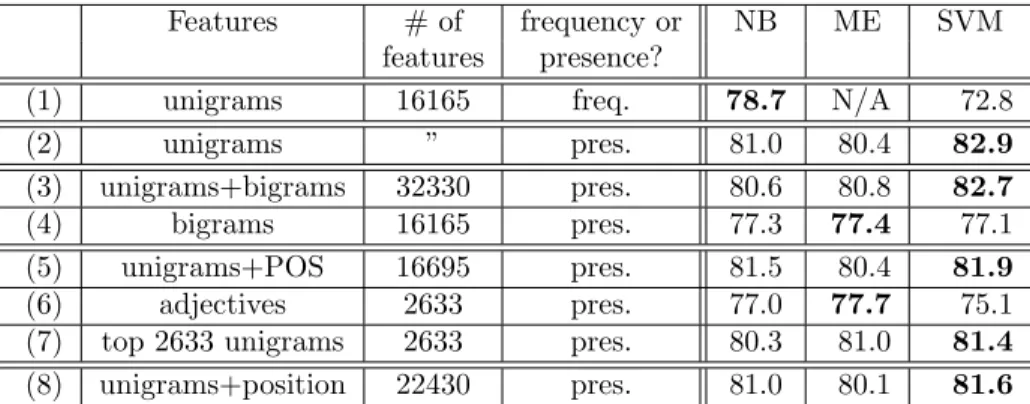
Features # of frequency or NB ME SVM features presence?
(1) unigrams 16165 freq. 78.7 N/A 72.8
(2) unigrams ” pres. 81.0 80.4 82.9
(3) unigrams+bigrams 32330 pres. 80.6 80.8 82.7
(4) bigrams 16165 pres. 77.3 77.4 77.1
(5) unigrams+POS 16695 pres. 81.5 80.4 81.9
(6) adjectives 2633 pres. 77.0 77.7 75.1
(7) top 2633 unigrams 2633 pres. 80.3 81.0 81.4
(8) unigrams+position 22430 pres. 81.0 80.1 81.6
Figure 3: Average three-fold cross-validation accuracies, in percent. Boldface: best performance for a given setting (row). Recall that our baseline results ranged from 50% to 69%.
class distributions was out of the scope of this study), we randomly selected 700 positive-sentiment and 700 negative-sentiment documents. We then divided this data into three equal-sized folds, maintaining bal-anced class distributions in each fold. (We did not use a larger number of folds due to the slowness of the MaxEnt training procedure.) All results reported below, as well as the baseline results from Section 4, are the average three-fold cross-validation results on this data (of course, the baseline algorithms had no parameters to tune).
To prepare the documents, we automatically re-moved the rating indicators and extracted the tex-tual information from the original HTML docu-ment format, treating punctuation as separate lex-ical items. No stemming or stoplists were used.
One unconventional step we took was to attempt to model the potentially important contextual effect of negation: clearly “good” and “not very good” in-dicate opposite sentiment orientations. Adapting a technique of Das and Chen (2001), we added the tag
NOT to every word between a negation word (“not”, “isn’t”, “didn’t”, etc.) and the first punctuation mark following the negation word. (Preliminary ex-periments indicate that removing the negation tag had a negligible, but on average slightly harmful, ef-fect on performance.)
For this study, we focused on features based on unigrams (with negation tagging) and bigrams. Be-cause training MaxEnt is expensive in the number of features, we limited consideration to (1) the 16165 unigrams appearing at least four times in our 1400-document corpus (lower count cutoffs did not yield significantly different results), and (2) the 16165 bi-grams occurring most often in the same data (the selected bigrams all occurred at least seven times). Note that we did not add negation tags to the bi-grams, since we consider bigrams (and n-grams in
general) to be an orthogonal way to incorporate con-text.
6.2 Results
Initial unigram results The classification accu-racies resulting from using only unigrams as fea-tures are shown in line (1) of Figure 3. As a whole, the machine learning algorithms clearly surpass the random-choice baseline of 50%. They also hand-ily beat our two human-selected-unigram baselines of 58% and 64%, and, furthermore, perform well in comparison to the 69% baseline achieved via limited access to the test-data statistics, although the im-provement in the case of SVMs is not so large.
On the other hand, in topic-based classification, all three classifiers have been reported to use bag-of-unigram features to achieve accuracies of 90% and above for particular categories (Joachims, 1998; Nigam et al., 1999)9 — and such results are for
set-tings with more than two classes. This provides suggestive evidence that sentiment categorization is more difficult than topic classification, which cor-responds to the intuitions of the text categoriza-tion expert mencategoriza-tioned above.10 Nonetheless, we still
wanted to investigate ways to improve our senti-ment categorization results; these experisenti-ments are reported below.
Feature frequency vs. presence Recall that we represent each documentdby a feature-count vector (n1(d), . . . , nm(d)). However, the definition of the 9Joachims (1998) used stemming and stoplists; in
some of their experiments, Nigam et al. (1999), like us, did not.
10We could not perform the natural experiment of
at-tempting topic-based categorization on our data because the only obvious topics would be the film being reviewed; unfortunately, in our data, the maximum number of re-views per movie is 27, too small for meaningful results.
MaxEnt feature/class functionsFi,c only reflects the presence or absence of a feature, rather than directly incorporating feature frequency. In order to investi-gate whether reliance on frequency information could account for the higher accuracies of Naive Bayes and SVMs, we binarized the document vectors, setting
ni(d) to 1 if and only feature fi appears in d, and reran Naive Bayes andSV Mlight on these new vec-tors.11
As can be seen from line (2) of Figure 3, better performance (much better performance for SVMs) is achieved by accounting only for fea-ture presence, not feafea-ture frequency. Interestingly, this is in direct opposition to the observations of McCallum and Nigam (1998) with respect to Naive Bayes topic classification. We speculate that this in-dicates a difference between sentiment and topic cat-egorization — perhaps due to topic being conveyed mostly by particular content words that tend to be repeated — but this remains to be verified. In any event, as a result of this finding, we did not incor-porate frequency information into Naive Bayes and SVMs in any of the following experiments.
Bigrams In addition to looking specifically for negation words in the context of a word, we also studied the use of bigrams to capture more context in general. Note that bigrams and unigrams are surely not conditionally independent, meaning that the feature set they comprise violates Naive Bayes’ conditional-independence assumptions; on the other hand, recall that this does not imply that Naive Bayes will necessarily do poorly (Domingos and Paz-zani, 1997).
Line (3) of the results table shows that bigram information does not improve performance beyond that of unigram presence, although adding in the bi-grams does not seriously impact the results, even for Naive Bayes. This would not rule out the possibility that bigram presence is as equally useful a feature as unigram presence; in fact, Pedersen (2001) found that bigrams alone can be effective features for word sense disambiguation. However, comparing line (4) to line (2) shows that relying just on bigrams causes accuracy to decline by as much as 5.8 percentage points. Hence, if context is in fact important, as our intuitions suggest, bigrams are not effective at cap-turing it in our setting.
11Alternatively, we could have tried integrating
fre-quency information into MaxEnt. However, feature/class functions are traditionally defined as binary (Berger et al., 1996); hence, explicitly incorporating frequencies would require different functions for each count (or count bin), making training impractical. But cf. (Nigam et al., 1999).
Parts of speech We also experimented with ap-pending POS tags to every word via Oliver Mason’s Qtag program.12 This serves as a crude form of word
sense disambiguation (Wilks and Stevenson, 1998): for example, it would distinguish the different usages of “love” in “I love this movie” (indicating sentiment orientation) versus “This is a love story” (neutral with respect to sentiment). However, the effect of this information seems to be a wash: as depicted in line (5) of Figure 3, the accuracy improves slightly for Naive Bayes but declines for SVMs, and the per-formance of MaxEnt is unchanged.
Since adjectives have been a focus of previous work in sentiment detection (Hatzivassiloglou and Wiebe, 2000; Turney, 2002)13, we looked at the performance
of using adjectives alone. Intuitively, we might ex-pect that adjectives carry a great deal of informa-tion regarding a document’s sentiment; indeed, the human-produced lists from Section 4 contain almost no other parts of speech. Yet, the results, shown in line (6) of Figure 3, are relatively poor: the 2633 adjectives provide less useful information than uni-gram presence. Indeed, line (7) shows that simply using the 2633 most frequent unigrams is a better choice, yielding performance comparable to that of using (the presence of) all 16165 (line (2)). This may imply that applying explicit feature-selection algo-rithms on unigrams could improve performance.
Position An additional intuition we had was that the position of a word in the text might make a dif-ference: movie reviews, in particular, might begin with an overall sentiment statement, proceed with a plot discussion, and conclude by summarizing the author’s views. As a rough approximation to deter-mining this kind of structure, we tagged each word according to whether it appeared in the first quar-ter, last quarquar-ter, or middle half of the document14.
The results (line (8)) didn’t differ greatly from using unigrams alone, but more refined notions of position might be more successful.
7
Discussion
The results produced via machine learning tech-niques are quite good in comparison to the human-generated baselines discussed in Section 4. In terms of relative performance, Naive Bayes tends to do the worst and SVMs tend to do the best, although the
12
http://www.english.bham.ac.uk/staff/oliver/soft-ware/tagger/index.htm
13Turney’s (2002) unsupervised algorithm uses
bi-grams containing an adjective or an adverb.
14We tried a few other settings, e.g., first third vs. last
differences aren’t very large.
On the other hand, we were not able to achieve ac-curacies on the sentiment classification problem com-parable to those reported for standard topic-based categorization, despite the several different types of features we tried. Unigram presence information turned out to be the most effective; in fact, none of the alternative features we employed provided consis-tently better performance once unigram presence was incorporated. Interestingly, though, the superiority of presence information in comparison to frequency information in our setting contradicts previous obser-vations made in topic-classification work (McCallum and Nigam, 1998).
What accounts for these two differences — dif-ficulty and types of information proving useful — between topic and sentiment classification, and how might we improve the latter? To answer these ques-tions, we examined the data further. (All examples below are drawn from the full 2053-document cor-pus.)
As it turns out, a common phenomenon in the doc-uments was a kind of “thwarted expectations” narra-tive, where the author sets up a deliberate contrast to earlier discussion: for example, “This film should be brilliant. It sounds like a great plot, the actors are first grade, and the supporting cast is good as well, and Stallone is attempting to deliver a good performance. However, it can’t hold up” or “I hate the Spice Girls. ...[3 things the author hates about them]... Why I saw this movie is a really, really, really long story, but I did, and one would think I’d despise every minute of it. But... Okay, I’m really ashamed of it, but I enjoyed it. I mean, I admit it’s a really awful movie ...the ninth floor of hell...The plot is such a mess that it’s terrible. But I loved it.” 15
In these examples, a human would easily detect the true sentiment of the review, but bag-of-features classifiers would presumably find these instances dif-ficult, since there are many words indicative of the opposite sentiment to that of the entire review. Fun-damentally, it seems that some form of discourse analysis is necessary (using more sophisticated tech-15This phenomenon is related to another common
theme, that of “a good actor trapped in a bad movie”:
“AN AMERICAN WEREWOLF IN PARIS is a failed
at-tempt... Julie Delpy is far too good for this movie. She im-bues Serafine with spirit, spunk, and humanity. This isn’t necessarily a good thing, since it prevents us from relax-ing and enjoyrelax-ing AN AMERICAN WEREWOLF IN PARIS as a completely mindless, campy entertainment experience. Delpy’s injection of class into an otherwise classless produc-tion raises the specter of what this film could have been with a better script and a better cast ... She was radiant, charismatic, and effective ....”
niques than our positional feature mentioned above), or at least some way of determining the focus of each sentence, so that one can decide when the author is talking about the film itself. (Turney (2002) makes a similar point, noting that for reviews, “the whole is not necessarily the sum of the parts”.) Further-more, it seems likely that this thwarted-expectations rhetorical device will appear in many types of texts (e.g., editorials) devoted to expressing an overall opinion about some topic. Hence, we believe that an important next step is the identification of features indicating whether sentences are on-topic (which is a kind of co-reference problem); we look forward to addressing this challenge in future work.
Acknowledgments
We thank Joshua Goodman, Thorsten Joachims, Jon Kleinberg, Vikas Krishna, John Lafferty, Jussi Myl-lymaki, Phoebe Sengers, Richard Tong, Peter Tur-ney, and the anonymous reviewers for many valuable comments and helpful suggestions, and Hubie Chen and Tony Faradjian for participating in our baseline experiments. Portions of this work were done while the first author was visiting IBM Almaden. This pa-per is based upon work supported in part by the Na-tional Science Foundation under ITR/IM grant IIS-0081334. Any opinions, findings, and conclusions or recommendations expressed above are those of the authors and do not necessarily reflect the views of the National Science Foundation.
References
Shlomo Argamon-Engelson, Moshe Koppel, and Galit Avneri. 1998. Style-based text categoriza-tion: What newspaper am I reading? InProc. of the AAAI Workshop on Text Categorization, pages 1–4.
Adam L. Berger, Stephen A. Della Pietra, and Vin-cent J. Della Pietra. 1996. A maximum entropy approach to natural language processing. Compu-tational Linguistics, 22(1):39–71.
Douglas Biber. 1988. Variation across Speech and Writing. Cambridge University Press.
Stanley Chen and Ronald Rosenfeld. 2000. A survey of smoothing techniques for ME models. IEEE Trans. Speech and Audio Processing, 8(1):37–50. Sanjiv Das and Mike Chen. 2001. Yahoo! for
Amazon: Extracting market sentiment from stock message boards. In Proc. of the 8th Asia Pacific Finance Association Annual Conference (APFA 2001).
Stephen Della Pietra, Vincent Della Pietra, and John Lafferty. 1997. Inducing features of random fields. IEEE Transactions on Pattern Analysis and Ma-chine Intelligence, 19(4):380–393.
Pedro Domingos and Michael J. Pazzani. 1997. On the optimality of the simple Bayesian classifier un-der zero-one loss. Machine Learning, 29(2-3):103– 130.
Aidan Finn, Nicholas Kushmerick, and Barry Smyth. 2002. Genre classification and domain transfer for information filtering. In Proc. of the Eu-ropean Colloquium on Information Retrieval Re-search, pages 353–362, Glasgow.
Vasileios Hatzivassiloglou and Kathleen McKeown. 1997. Predicting the semantic orientation of adjec-tives. InProc. of the 35th ACL/8th EACL, pages 174–181.
Vasileios Hatzivassiloglou and Janyce Wiebe. 2000. Effects of adjective orientation and gradability on sentence subjectivity. InProc. of COLING. Marti Hearst. 1992. Direction-based text
interpre-tation as an information access refinement. In Paul Jacobs, editor, Text-Based Intelligent Sys-tems. Lawrence Erlbaum Associates.
Alison Huettner and Pero Subasic. 2000. Fuzzy typing for document management. In ACL 2000 Companion Volume: Tutorial Abstracts and Demonstration Notes, pages 26–27.
Thorsten Joachims. 1998. Text categorization with support vector machines: Learning with many rel-evant features. In Proc. of the European Confer-ence on Machine Learning (ECML), pages 137– 142.
Thorsten Joachims. 1999. Making large-scale SVM learning practical. In Bernhard Sch¨olkopf and Alexander Smola, editors, Advances in Kernel Methods - Support Vector Learning, pages 44–56. MIT Press.
Jussi Karlgren and Douglass Cutting. 1994. Recog-nizing text genres with simple metrics using dis-criminant analysis. InProc. of COLING.
Brett Kessler, Geoffrey Nunberg, and Hinrich Sch¨utze. 1997. Automatic detection of text genre. InProc. of the 35th ACL/8th EACL, pages 32–38. David D. Lewis. 1998. Naive (Bayes) at forty: The independence assumption in information retrieval. InProc. of the European Conference on Machine Learning (ECML), pages 4–15. Invited talk. Andrew McCallum and Kamal Nigam. 1998. A
com-parison of event models for Naive Bayes text clas-sification. In Proc. of the AAAI-98 Workshop on Learning for Text Categorization, pages 41–48.
Frederick Mosteller and David L. Wallace. 1984. Ap-plied Bayesian and Classical Inference: The Case of the Federalist Papers. Springer-Verlag.
Kamal Nigam, John Lafferty, and Andrew McCal-lum. 1999. Using maximum entropy for text clas-sification. InProc. of the IJCAI-99 Workshop on Machine Learning for Information Filtering, pages 61–67.
Ted Pedersen. 2001. A decision tree of bigrams is an accurate predictor of word sense. InProc. of the Second NAACL, pages 79–86.
Warren Sack. 1994. On the computation of point of view. In Proc. of the Twelfth AAAI, page 1488. Student abstract.
Ellen Spertus. 1997. Smokey: Automatic recog-nition of hostile messages. In Proc. of Innova-tive Applications of Artificial Intelligence (IAAI), pages 1058–1065.
Junichi Tatemura. 2000. Virtual reviewers for col-laborative exploration of movie reviews. InProc. of the 5th International Conference on Intelligent User Interfaces, pages 272–275.
Loren Terveen, Will Hill, Brian Amento, David Mc-Donald, and Josh Creter. 1997. PHOAKS: A sys-tem for sharing recommendations. Communica-tions of the ACM, 40(3):59–62.
Laura Mayfield Tomokiyo and Rosie Jones. 2001. You’re not from round here, are you? Naive Bayes detection of non-native utterance text. InProc. of the Second NAACL, pages 239–246.
Richard M. Tong. 2001. An operational system for detecting and tracking opinions in on-line discus-sion. Workshop note, SIGIR 2001 Workshop on Operational Text Classification.
Peter D. Turney and Michael L. Littman. 2002. Un-supervised learning of semantic orientation from a hundred-billion-word corpus. Technical Report EGB-1094, National Research Council Canada. Peter Turney. 2002. Thumbs up or thumbs down?
Semantic orientation applied to unsupervised clas-sification of reviews. InProc. of the ACL.
Janyce M. Wiebe, Theresa Wilson, and Matthew Bell. 2001. Identifying collocations for recognizing opinions. In Proc. of the ACL/EACL Workshop on Collocation.
Yorick Wilks and Mark Stevenson. 1998. The gram-mar of sense: Using part-of-speech tags as a first step in semantic disambiguation. Journal of Nat-ural Language Engineering, 4(2):135–144.