D
ivision ofL
ocaLG
overnment& s
chooLa
ccountabiLityo
f f i c e o f t h en
e wy
o r ks
t a t ec
o m p t r o L L e r2012-MS-6
School Tax Relief
(STAR) Program
Table of Contents
Page AUTHORITY LETTER 2 EXECUTIVE SUMMARY 3 INTRODUCTION 5 Background 5 Objective 7Scope and Methodology 8
Comments of Local Officials 8
THE STAR PROGRAM 9
Duplicate and Inappropriate Exemptions 10
Granting the Initial STAR Exemption 13
Monitoring Continuing Eligibility for STAR Exemptions 18
Recommendations 20
APPENDIX A Responses From Local Officials 22
APPENDIX B Audit Methodology and Standards 25 APPENDIX C Relevant STAR Statistics for Audited Municipalities 27 APPENDIX D STAR Program Disbursements 29 APPENDIX E How to Obtain Additional Copies of the Report 30 APPENDIX F Local Regional Office Listing 31
Division of Local Government and School Accountability February 2013
Dear State Policy Makers and Local Officials:
A top priority of the Office of the State Comptroller is to help local government officials manage government resources efficiently and effectively and, by so doing, provide accountability for tax dollars spent to support government operations. The Comptroller oversees the fiscal affairs of local governments statewide, as well as compliance with relevant statutes and observance of good business practices. This fiscal oversight is accomplished, in part, through our audits, which
identify opportunities for improving operations and school district governance. Audits also can identify strategies to reduce costs and to strengthen controls intended to safeguard local government assets.
Following is a report of our audit titled School Tax Relief (STAR) Program. This audit was
conducted pursuant to Article V, Section 1 of the State Constitution and the State Comptroller’s
authority as set forth in Article 3 of the General Municipal Law.
This audit’s results and recommendations are resources for local government officials to use in
effectively managing operations and in meeting the expectations of their constituents. If you have
questions about this report, please feel free to contact the local regional office for your county, as
listed at the end of this report.
Respectfully submitted, Office of the State Comptroller Division of Local Government and School Accountability
State of New York
The School Tax Relief (STAR) exemption in the Real Property Tax Law1 (Law) provides a partial
exemption from school taxes for most owner-occupied, primary residences. Basic STAR is available for an owner-occupied, primary residence where the income of owners and their spouses totals less than $500,000. In the 2010-11 fiscal year, Enhanced STAR provided an increased benefit for the primary residences of senior citizens with qualifying incomes of $74,700 or less. Property
owners are eligible for one exemption for a primary residence only.
Local assessors accept and process residents’ applications for STAR exemptions. The New York State Office of Real Property Tax Services (ORPTS) oversees local property assessment administration, and is responsible for establishing STAR property tax exemption amounts. The STAR program lowers the school real property tax burden for homeowners, and makes up the difference by increasing State aid to school districts. The State’s costs for underwriting this benefit
for taxpayers2 have grown significantly since the program’s inception, from $582 million in
1998-99 to $3.2 billion in 2010-11. In 2010-11, local municipalities granted approximately 3.4 million
STAR exemptions. Scope and Objective
The objective of our audit was to review local assessors’ administration of the STAR Program. Our audit addressed the following related question for the period January 1, 2010, through July 31, 2011:
• Do local assessors ensure that all STAR exemption recipients qualify under State guidelines
to receive such exemptions? Audit Results
Although the STAR program has succeeded in delivering millions of dollars in tax relief, we found that local assessors have granted a significant number of exemptions to individuals or entities not
eligible to receive them. Our tests of one class of potentially ineligible exemptions at 46 sampled 1 Real Property Tax Law Section 425
2 This represents New York State’s cash spending for the STAR program, including exemptions, New York City credits
and rate reduction benefit, and rebates. This information was obtained from the New York State Division of Budget.
State of New York
Office of the State Comptroller
EXECUTIVE SUMMARY
municipalities showed that 19.6 percent of the exemptions should not have been granted because
they were duplicate or improper. We project that the State lost $13 million in the 2010-11 fiscal year – and will lose an additional $73 million through the 2015-16 fiscal year – just for exemptions with this specific risk indicator (i.e., having a mailing address that receives STAR exemptions for
multiple parcels). Because the exemptions we examined represent less than 3 percent of the STAR
exemptions in effect in 2010, the extent of duplicate or improper exemptions is likely significantly higher, and much more costly to the State.
We found that some municipalities have taken proactive steps to reduce homeowner “double-dipping” and other abusive practices. The municipalities that required more stringent proof of
eligibility from STAR applicants and vigorously monitored recipients’ continuing eligibility, using local resources, generally had lower exception rates than municipalities that did not use these best
practices.
However, municipalities, on their own, do not have the tools they need to avoid granting duplicate exemptions: specifically, clear direction in the Law and the ability to perform effective searches for
potential duplicate exemptions. The Law is vague regarding what local assessors are required to
do to verify an applicant’s residency status when granting the exemption. Further, local assessors
do not have the ability to search the ORPTS database of existing STAR exemptions statewide.
But even if they had such access, local assessors would still find it difficult to identify potential duplicates because STAR applicants are not assigned a unique identifier, such as a Social Security number. We also found that New York State does not aggressively partner with other states to
identify individuals who improperly claim a STAR (or similar) exemption in more than one state. We believe there are many ways in which the current loosely-controlled STAR system could be
“gamed” at significant cost to the State. In fact, in a December 2012 media report,3 State officials
acknowledged “rampant double-dipping and abuses in the STAR system.” New York State cannot afford these abuses. It is essential that all the parties involved in administering, monitoring, and
setting guidance for the STAR program cooperate to ensure that the program provides legitimate tax breaks only to those homeowners entitled to receive them.
Comments of Local Officials
The results of our audit and recommendations have been discussed with local officials and their comments, which appear in Appendix A, have been considered in preparing this report.
The School Tax Relief (STAR) exemption in the Real Property Tax Law4 (Law) provides a partial exemption from school taxes for most owner-occupied primary residences5 in New York State. STAR provides homeowners with two types of partial exemptions
from school property taxes: Basic STAR and Enhanced STAR.
Both Basic and Enhanced STAR are available for owner-occupied residential properties. Property owners are eligible for one exemption for a primary residence only.
Basic STAR is available for owner-occupied, primary residences
where the income of resident owners and their spouses totals less
than $500,000. Basic STAR exempts the first $30,000 of the full
value of a primary residence from school taxes. In the
2010-11 fiscal year, Enhanced STAR provided an increased benefit for
primary residences of senior citizen (age 65 and older) owners
with qualifying incomes of $74,700 or less. The income limit
applies to all owners and any owner's spouse who resides at
the property. In 2010-11, Enhanced STAR exempted the first $60,1006 of the full value of a home from school taxes. In
2010-11, STAR provided almost 3.4 million exemptions, which saved homeowners an average of $641 (STAR) or $1,205 (Enhanced
STAR) on their annual school tax bills.
Table 1: Total STAR Exemptions Statewide in 2010-11
Exemption Number of Exemptions
STAR Basic 2,765,194
STAR Enhanced 624,474
Total 3,389,668
The program’s goal is to lower the school real property tax burden, but it does not affect the overall revenue of a given school district. The difference is made up by New York State in the form of increased State aid to the school district. The State’s costs for underwriting this benefit for taxpayers7 have grown significantly, 4 Real Property Tax Law Section 425
5 STAR does not apply to property taxes for other purposes, such as county,
town or city, except in cities where city property taxes fund schools (Buffalo, New York City, Rochester, Syracuse and Yonkers).
6 This is an annually variable amount.
7 This represents New York State’s cash spending for the STAR program
including exemptions, New York City credits and rate reduction benefit, and rebates. This information was obtained from the New York State Division of
Budget.
Background
from $582 million in 1998-99 to $3.2 billion in 2010-11. Over 13
years,8 actual State disbursements for the program totaled $37.6 billion.
STAR exemption disbursements are projected to reach over $3.7 billion by 2015-16.9 From the STAR program’s inception in the
1998-99 fiscal year until the 2015-16 fiscal year, disbursements
will have increased by 552 percent. The chart below details the
growth in STAR’s disbursements, projected through 2015-16.
8 Years 1998-99 through 2010-11
9 These are multiyear projections and disbursement forecast as determined in
the fiscal year 2013 Executive Budget Financial Plan issued by the Governor’s Office dated February 17, 2012.
10 Real Property Tax Law Sections 458, 458-a, and 458-b 11 Real Property Tax Law Section 467
Although New York State law includes over 200 types of real property tax exemptions, the STAR program is unique in two ways. First, it is the only exemption that is funded by the State.
All other exemptions simply shift the tax burden to other real property taxpayers because they increase the tax rate of those not
receiving the exemption. Second, the STAR program is unique
in its scope. Certain other exemption programs have targeted and
benefited sometimes significant numbers of owners. For example, nearly 580,000 veterans exemptions10 and nearly 217,000 senior citizens exemptions11 were granted on 2009 assessment rolls
statewide. However, no other exemption program has come close to the size of the STAR program, which provided almost 3.4
million exemptions in 2010-11.
Local assessors accept and process applications from residents who wish to participate in the STAR program. In addition to
administering the STAR program, local assessors’ duties also include assessing the value of real property, inspecting new construction and major improvements to existing structures, approving and tracking property tax exemptions, attending public grievance hearings regarding assessments, verifying the accuracy of real estate sales, and filing annual report of assessments. The New York State Office of Real Property Tax Services (ORPTS), a division within the New York State Department of Taxation and Finance, oversees local property assessment
administration. ORPTS works directly with county and municipal
officials to improve the fairness of property assessments. One of ORPTS’ responsibilities is establishing the dollar amounts of STAR property tax exemptions that reduce homeowners’ school
tax bills. ORPTS maintains a statewide database of all parcels receiving the STAR exemption. All local assessors annually
report STAR exemption information to ORPTS, which uses the
information to update its database.
We reviewed the records and processes related to the STAR
program at 46 municipalities (38 towns, seven cities and one county) from across New York State (see Appendix B for
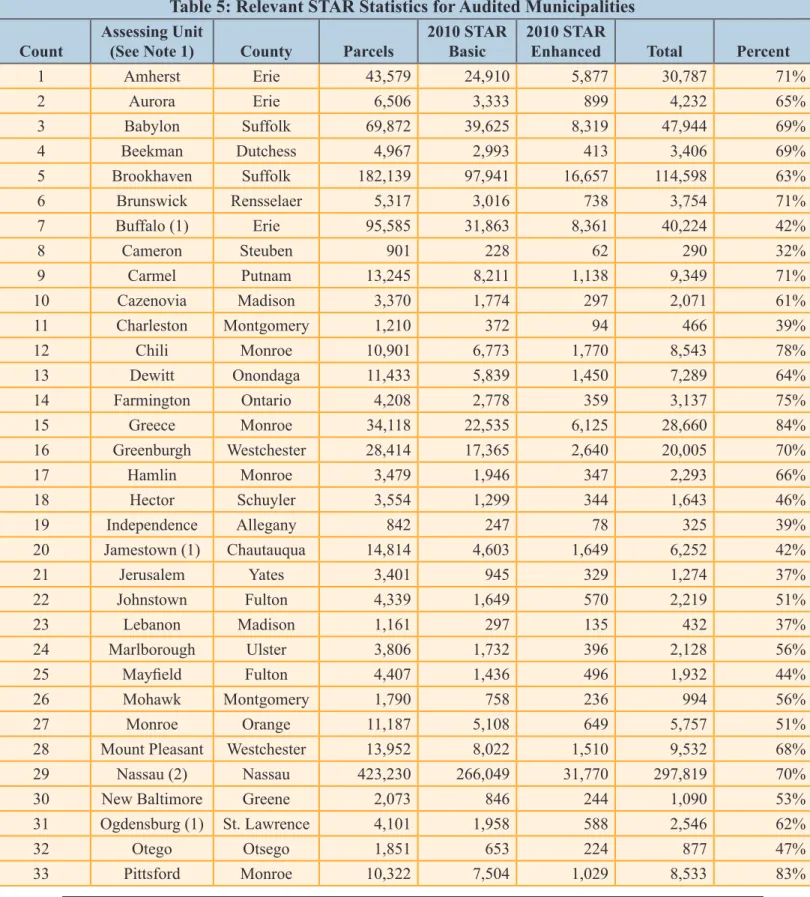
information about how we selected these municipalities). Table 2 provides summary details of the total assessable units of
property (parcels) in all the municipalities, the number of parcels associated with STAR exemptions, and the breakdown by STAR
exemption type.
Table 2: Total Parcels and STAR Exemptions (2010-11)
Parcels Count
Total Parcels 1,178,894
STAR Basic 650,525
STAR Enhanced 117,315
Total STAR exemptions (65%) 767,840
The objective of our audit was to review local assessors’
administration of the STAR Program. Our audit addressed the
following related question:
• Do local assessors ensure that all STAR exemption
recipients qualify under State guidelines to receive such exemptions?
For the period January 1, 2010, through July 31, 2011, we interviewed municipal officials and reviewed STAR applications, supporting documentation, and related policies and procedures. We also conducted tests of STAR exemptions to verify recipients’
eligibility for the exemptions. We reviewed data from previous
years’ tax rolls, as necessary, for historical comparison purposes.
We conducted our audit in accordance with generally accepted government auditing standards (GAGAS). More information on such standards and the methodology used in performing this audit is included in Appendix B of this report.
The results of our audit and recommendations have been
discussed with local officials and their comments, which appear in Appendix A, have been considered in preparing this report.
Scope and Methodology
Comments of Local Officials
The goal of the STAR program is to provide immediate school
tax relief to New York State homeowners as an exemption that applies solely to one property: the homeowner’s primary
residence. Although the program has succeeded in delivering
millions of dollars in real property tax relief, we also found that local assessors have granted a significant number of exemptions
to individuals or entities not eligible to receive them. Our tests of one class of potentially ineligible exemptions at 46 sampled municipalities showed that 19.6 percent of the exemptions should not have been granted because they were duplicate or were
improper for a variety of other reasons. We identified one or more
exceptions at over 80 percent of the municipalities we tested. We found that some of the municipalities we audited have taken proactive steps to reduce homeowner “double-dipping” and other abusive practices. Municipalities that required more stringent proof of eligibility from STAR applicants and vigorously
monitored recipients’ continuing eligibility, using local resources,
generally had lower exception rates than municipalities that did not use these best practices.
However, municipalities, on their own, do not have the tools they need to avoid granting duplicate exemptions: specifically, clear
direction in the Law and the ability to perform effective searches for potential duplicate exemptions. The Law is vague regarding
what local assessors are required to do to verify an applicant’s residency status when granting the exemption. Further, local
assessors do not have the ability to search the ORPTS database of existing STAR exemptions statewide. But even if they had
such access, local assessors would still find it difficult to identify
potential duplicates because STAR applicants are not assigned
a unique identifier, such as a Social Security number. We also found that New York State does not aggressively partner with
other states to identify individuals who improperly claim a STAR (or similar) exemption in more than one state.
Providing STAR exemptions to individuals who should not receive them costs the State a lot of money. We project that the
State lost $13 million in the 2010-11 fiscal year, and will lose an additional $73 million through the 2015-16 fiscal year – for just the one class of ineligible exemptions (i.e., having a mailing
address that receives STAR exemptions for multiple parcels) we
examined. We believe there are many other ways in which the
current loosely-controlled STAR system could be “gamed,” at significant cost to the State. In a December 2012 media report,12
State officials acknowledged “rampant double-dipping and abuses in the STAR system.” New York State cannot afford these abuses. All the parties involved in administering, monitoring, and
setting guidance for the STAR program must cooperate to ensure the program provides only legitimate tax breaks to homeowners entitled to receive them.
The Law allows individual homeowners to receive a STAR
exemption on only their primary residence, so no homeowner
should receive more than one exemption. When we reviewed
2010 STAR exemption data obtained from ORPTS, we found that, for a large number of parcels (approximately 87,000), the taxpayer’s mailing address was the same for more than one parcel,
and sometimes for many parcels. The existence of such a large number of duplicate mailing addresses indicated an increased risk that local assessors were granting some STAR exemptions that were duplicate (more than one to each homeowner) or improper
(e.g., granted to corporations or other non-eligible entities). Therefore, we tested to determine how many of these potentially problematic STAR exemptions were, in fact, actual duplicate or
improper exemptions.
We randomly selected 46 municipalities (units) from throughout
New York State and then randomly selected STAR exemptions
in these units for review.13 Our test of a total of 731 different mailing addresses associated with these STAR exemptions found that improper or duplicate STAR exemptions had been granted to parties at 143 (19.6 percent) of these sampled addresses.14 More than 80 percent of the 46 units we tested had granted one or more duplicate or improper STAR exemptions.
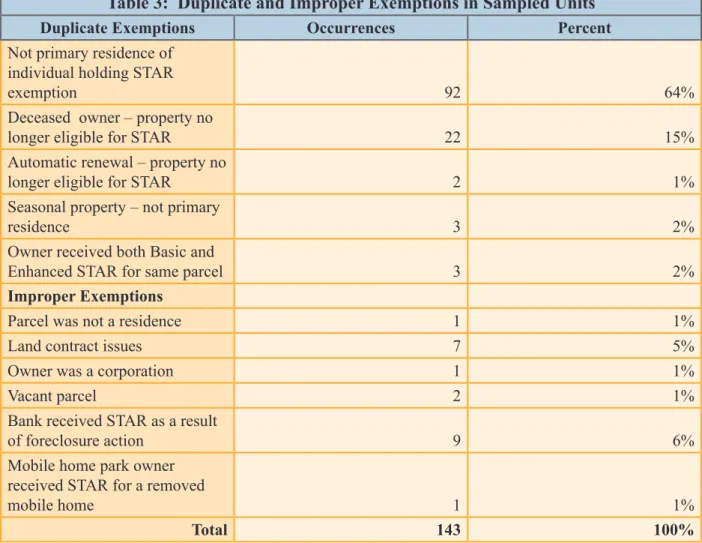
We found 92 instances in which individuals received STAR exemptions for properties that were not their primary residence; we found another 30 instances of duplicate exemptions that occurred for a variety of other reasons. Twenty-one exemptions were improper because the property owner or the property itself was not eligible for STAR. The details of our test results are shown in Table 3.
Duplicate and Inappropriate Exemptions
12 Two STARS for Proctor’s CEO, Times Union, Albany, N.Y., December 4,
2012
13 See Appendix B for detailed methodology.
14 We identified 133 duplicate or improper exemptions at 143 addresses. Ten
of the addresses we tested had more than one improper exemption associated with them.
Table 3: Duplicate and Improper Exemptions in Sampled Units
Duplicate Exemptions Occurrences Percent
Not primary residence of
individual holding STAR
exemption 92 64%
Deceased owner – property no
longer eligible for STAR 22 15% Automatic renewal – property no
longer eligible for STAR 2 1% Seasonal property – not primary
residence 3 2%
Owner received both Basic and
Enhanced STAR for same parcel 3 2%
Improper Exemptions
Parcel was not a residence 1 1%
Land contract issues 7 5%
Owner was a corporation 1 1%
Vacant parcel 2 1%
Bank received STAR as a result
of foreclosure action 9 6%
Mobile home park owner received STAR for a removed
mobile home 1 1%
Total 143 100%
The majority of the duplicate exemptions involved individuals who received exemptions for one or more parcels that were not
their primary residence. For example, a homeowner with a mailing
address and primary residence in Saratoga County received a Basic STAR exemption for the property at that location. This homeowner also received a Basic STAR exemption for a property
in Rensselaer County, which municipal officials confirmed as a
three-family residential rental property.
Other examples of duplicate exemptions included cases in which the owner who was initially granted the STAR exemption was now deceased. The exemption remained with the parcel and
was benefitting a new owner, often a relative, who was already receiving a STAR exemption on another property. For example, in Monroe County, a homeowner who received an Enhanced STAR exemption died in September 2009. The applicant’s spouse was already deceased at that date, so the exemption for 2010 should have been discontinued. However, the property continued to receive an Enhanced STAR exemption in 2010.
We also found that some exemptions were automatically renewed
(although the property was no longer eligible for STAR), some exemptions were for seasonal property (not a primary residence),
and a few cases in which an owner received both Basic and Enhanced STAR exemptions for the same property.
We also found 21 instances in which properties were receiving
improper STAR exemptions. For example:
• An exemption for a land contract15 was improper because the land contract or mortgage agreement was terminated
or had expired, so the property was no longer eligible for
STAR.
• An exemption benefitted a corporation, which is not
eligible for STAR.
• In several instances, banks received exemptions after
foreclosing on property. Banks are not eligible for STAR.
• An exemption remained with a property after it was sold
and converted to commercial use. Commercial property is not eligible for STAR.
• We also found two instances in which vacant land
received an exemption. Vacant land is not eligible for STAR.
We determined that duplicate and improper exemptions were for
parcels in the same municipality as the property owners’ primary residence in some cases (65 percent), and for parcels in a different municipality from the owners’ primary residence in others (35
percent).
Using statistical sampling methods, we projected the number of
improper and/or duplicate exemptions to the entire population of
addresses that we identified as potential duplicates based solely on
examining STAR exemptions for more than one parcel that used
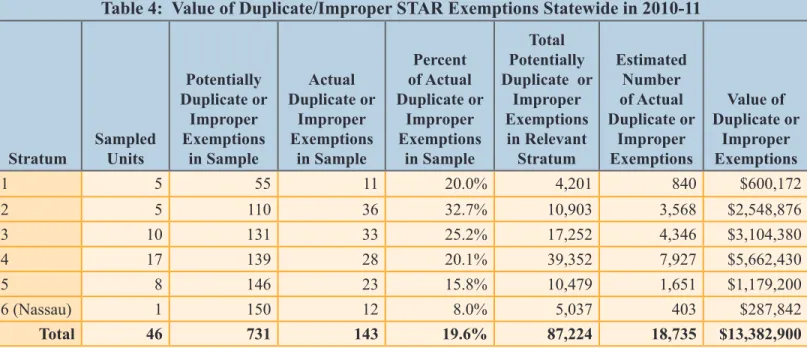
the same mailing address. As shown in Table 4, we estimate that almost 19,000 improper exemptions could have been granted in 2010-11, based on this one risk factor alone, resulting in the State
having spent more than $13 million to subsidize inappropriate exemptions.16 Should this exception rate continue for just this 15 A land contract is an agreement with two or more individuals, where one
individual(s) owns a parcel and another individual(s) resides on the parcel and agrees to pay a monthly installment including taxes to the property owner(s).
limited population of addresses, the State could pay for an
additional $73 million in inappropriate exemptions between 2011-12 and 2015-16.
Table 4: Value of Duplicate/Improper STAR Exemptions Statewide in 2010-11
Stratum Sampled Units
Potentially Duplicate or Improper Exemptions in Sample Actual Duplicate or Improper Exemptions in Sample Percent of Actual Duplicate or Improper Exemptions in Sample Total Potentially Duplicate or Improper Exemptions in Relevant Stratum Estimated Number of Actual Duplicate or Improper Exemptions Value of Duplicate or Improper Exemptions 1 5 55 11 20.0% 4,201 840 $600,172 2 5 110 36 32.7% 10,903 3,568 $2,548,876 3 10 131 33 25.2% 17,252 4,346 $3,104,380 4 17 139 28 20.1% 39,352 7,927 $5,662,430 5 8 146 23 15.8% 10,479 1,651 $1,179,200 6 (Nassau) 1 150 12 8.0% 5,037 403 $287,842 Total 46 731 143 19.6% 87,224 18,735 $13,382,900
It is important to emphasize that this estimate of potential waste of State revenues for inappropriate STAR exemptions pertains
only to the approximately 87,000 STAR exemptions associated with one risk factor: having a mailing address that receives exemptions for multiple parcels. However, this number represents
less than 3 percent of the 3.4 million STAR exemptions in effect
statewide in 2010. For example, some individuals who maintain a primary residence in another state own property in New York State, which they also claim as their primary residence in order
to receive a STAR exemption. These individuals are receiving
a tax break they are not entitled to. Therefore, the number of
inappropriate or duplicate STAR exemptions – and the amount of
wasted State resources – could be significantly greater.
STAR program requirements are outlined in the Law and are also
stated in the Assessors’ Manuals available on the New York State
Department of Taxation and Finance website. According to the
Law, only residential property qualifies for a Basic or Enhanced STAR exemption. The property must be a one-, two-, or
three-family residence; a farm dwelling; residential property held in condominium or cooperative form; or the owner-occupied portion
of mixed-use properties (e.g., apartment buildings and commercial
properties). The property must serve as the primary residence of one or more of the owners listed on the STAR application. All owners of the property who reside at the property seeking a STAR Granting the Initial STAR
exemption must jointly file a STAR application with the assessor
prior to the taxable status date.17 The application also states that individuals who receive the exemption are required to notify the assessor if their primary residence changes.
To qualify for the Enhanced STAR exemption, all of the property owners must be at least 65 years old as of December 31, except
when property is owned by a married couple or by siblings. In that
case, only one of the individuals needs to be age 65 by December 31, and the property must serve as his/her primary residence.
The Law makes local assessors responsible for accepting STAR
applications, and for ultimately determining whether the property is eligible to receive a STAR exemption. However, the Law is
at times vague about what local assessors must do to verify that
property qualifies for the exemption and the related tax reduction benefit. Specifically, the Law does not mandate that local assessors obtain proof of residency; rather, it allows local assessors to
use their discretion in determining whether the property is the
primary residence of the owners. Therefore, while the burden
remains with the owner(s) to establish that the property is the
primary residence, it is up to local assessors to decide what kind of evidence is required, and when it must be submitted (with the application, at a later date, or not at all). Once the applicant has demonstrated to the assessor’s satisfaction that the property is the primary residence of the owners, the local assessor grants the
STAR exemption.
Local Practices to Help Verify Eligibility – We found a wide variance in the practices local assessors follow to ensure that they grant STAR exemptions only for qualifying residential property. All 46 municipalities required some form of proof of residency to be included with a STAR application. Proof of residency varied
from a driver’s license, tax return form, birth certificate, various income statements, voter’s registration card, car registration card or utility bill. However, we found that a number of local assessors took proactive steps to demand specific documentation of residency, and that some municipalities developed procedures for administering the STAR program, including processing
exemptions.
17 The taxable status date is March 1 in most municipalities, but may be a
For example:
• The Nassau County (County) assessor requires each
STAR applicant to provide a Social Security number on
the application, and then does a cross check to determine
if the individual already has a STAR exemption on another parcel in the County.
• The Town of Brunswick has developed a customized form
known as a “residency statement” that must be submitted with each STAR application. By signing and dating
the residency statement, which includes the applicant’s name and the legal address of the applicant’s primary residence, the applicant is attesting to the accuracy of the
information provided.
• The Town of Amherst includes a letter with the STAR
application that provides guidelines about what documentation the applicant must submit with the STAR application. The letter states that at least two different
items are needed for proof of residency, such as a current driver’s license, a voter’s registration card, an automobile registration card, a current New York State tax return form, a current utility (telephone, cable, etc.) bill, a current Social Security statement (1099-SS), or a recent
bank account statement.
• The Towns of Chili and Brookhaven have each assembled
a STAR manual with detailed instructions for processing exemptions and directions about how to verify information included on the STAR applications. The Town of Chili also included instructions on how to do a search to determine whether an applicant is already receiving an out-of-state exemption.
Our test results showed that, generally, the more proof of residency that local assessors required, the fewer duplicate/
improper exemptions they granted. Each of the municipalities above experienced a lower percentage of duplicate/improper exemptions. We found no duplicate/ improper exemptions in
the sample selected for the Towns of Amherst, Brunswick, and Chili. We also identified no duplicate/improper exemptions in another six municipalities: the Towns of Greece, Independence, Mayfield, Salem, Tonawanda, and Wallkill.
We identified just 12 (8 percent) duplicate/improper exemptions in our sample of 150 mailing addresses in Nassau County. We
found only two (11 percent) duplicate/improper exemptions among the 19 addresses we sampled in the Town of Brookhaven. The duplicate/improper exception rate for the remaining 35 municipalities ranged from 5 to 62 percent.
By demanding more stringent proofs of residency from applicants and by developing local procedures for administering
the STAR program, local assessors can reduce the risk of
granting duplicate/improper exemptions. The experience of municipalities that have adopted these best practices suggests that implementing these control measures is both doable and helpful in reducing the incidence of inappropriate exemptions. More Effective Searches to Identify Duplicates – Even with
diligent use of many of these best practices, it would be unrealistic to expect that local assessors’ efforts alone could significantly
reduce the incidence of duplicate/improper STAR exemptions.
At best, local assessors can search for potential duplicate exemptions only in their own, or sometimes neighboring,
municipalities. Although local assessors must report STAR
exemption information to ORPTS, ORPTS does not share
statewide STAR exemption data with the assessing community by giving local assessors access to its database. Local assessors we contacted routinely expressed concern about their inability to
use the ORPTS database. However, given that STAR applicants are not routinely assigned a unique identifier, such as a Social Security number, local searches can still be difficult, even with
access to ORPTS information.
ORPTS could remedy these limitations by requiring local
assessors to assign a unique identifier to each STAR applicant
and by giving local assessors access to STAR data that ORPTS maintains. If each STAR applicant were required to provide a
Social Security number, this number would be associated with applicant’s STAR exemption. If local assessors were then able
to cross-reference STAR applicants with existing database
information, they would be less likely to grant duplicate/improper
exemptions.
Cooperative Efforts with Other States – New York State has an
interest in preventing and detecting abuses of the STAR program
that waste millions of dollars in State resources. New York State
could initiate a cooperative search capability with other states
particularly with those states, like the state of Florida, where New
Yorkers are likely to have second homes.
Florida offers property owners who make their Florida home
their primary residence a generous tax exemption,18 but it also
requires significantly more proof of residency, and assigns a unique identifier to exemptions for accountability purposes. For example, Florida law requires that applicants and/or
co-applicants for the homestead exemption provide their Social
Security number(s), which are used to verify taxpayer identity
and other exemption information provided to property appraisers. The application also requires applicants to provide their date of
birth, date of occupancy, marital status, past exemption status information, and previous address. The proof of residency section
of the application asks applicants to provide as much information
as possible (e.g., driver’s license, declaration of domicile and state, address on last Federal tax return, Florida voter registration number, evidence that previous out-of-state residency was
terminated) to enable the county property appraiser to make a
final determination.
By comparison, the typical New York State STAR application does not assign a unique identifier and requires little proof of residency. The basic STAR application asks for the owner’s name, telephone number, and mailing address; the location of the property and a tax map; and a total of five questions about the owner’s (or owners’ combined) income, ownership of other property receiving a STAR exemption, and property owned in
other states.
A number of local assessors told us that Florida officials are
very interested in identifying individuals who are improperly
benefiting from a homestead exemption. One Florida official indicated that some of the biggest violators of Florida’s program are New Yorkers who also get a STAR exemption.19 If New
York officials and officials from other states such as Florida were to develop the means of sharing information that identifies
individuals who were improperly receiving both exemptions for 18 According to the Florida Department of Revenue, every person who owns
and resides on real property in Florida on January 1 and makes the property his or her permanent residence is eligible to receive a homestead exemption
up to $50,000. The first $25,000 applies to all property taxes, including school district taxes. The additional exemption up to $25,000, applies to the assessed value between $50,000 and $75,000 and only to non-school taxes.
19 STAR Double Dippers Cost State $50 Million, Times Union, Albany, N.Y.,
a primary residence, local assessors could deny an application for a duplicate exemption, or discontinue an existing exemption that was found to be a duplicate benefit.
The Law states that assessors should discontinue any STAR exemption if it appears that any of the following circumstances
exist: the property may not be the primary residence of the
owner(s) who applied for the exemption; the title to the property has been transferred to a new owner(s); or the property otherwise
may no longer be eligible for the exemption, as required by Law. Under certain circumstances, the Law allows the assessor to impose a penalty tax against the property of $100, and to require repayment of the three most recent years’ school tax savings to the municipality. In addition, the assessor can disqualify individuals from obtaining another STAR exemption for five years if they are
found to have made a material misstatement on their application.
Local assessors reported that it is difficult to discover changes
in eligibility. The municipalities we audited used a variety of
practices to detect changes in eligibility, with varying levels of success. Some of these practices include:
• Establishing a working relationship with nearby assessors • Working closely with other municipal officials, such as,
building inspectors, highway superintendents, and town clerks, to identify changes in property ownership
• Using information reported by local residents • Checking local obituaries
• Using the Social Security Death Index,20 when available
• Reviewing tax returns, when available;21 in one case, rental income from an address indicated that it was not
the owner’s primary residence
• Investigating reports of returned mail.
Monitoring Continuing Eligibility for STAR Exemptions
20 The Social Security Death Index (SSDI) is a database of death records
created from the United States Social Security Administration’s Death Master File. Most persons with a Social Security number (SSN) who have died since 1962, and whose death was reported to the Social Security Administration, are listed in the SSDI. However, the Social Security Administration has recently made significant changes to the availability of the SSDI.
21 In some instances, the assessor receives tax return information as backup
However, while these practices can be helpful, they cannot ensure
that all exemption recipients continue to be eligible for the STAR
exemption. Further, some of these techniques are effective only if the local assessor suspects that an applicant has a home elsewhere,
and knows the location of the other property. Without access to
the ORPTS database, the local assessor must know the name of
the other municipality to be able to investigate further.
Using electronic tools, in addition to the above practices, may enhance local assessors’ ability to monitor eligibility. For example,
the Town of Greenburgh is piloting a software program designed to identify duplicate exemptions. Greenburgh used an outside
vendor to analyze more than 18,000 STAR records, matching the
records to a variety of databases that provided information about
recipients (deaths, properties owned, etc.). The local assessor
then uses the results of this initial match to further analyze exemptions to detect duplicate/improper STAR exemptions. In
addition, Greenburgh uses reports from its real property computer
system to ensure that owners of properties that are located in or border neighboring municipalities are not receiving duplicate STAR exemptions for one property.
Greenburgh also supplements these electronic monitoring tools with traditional methods for identifying ineligible STAR
recipients, such as checking with the sanitation department to
determine whether any of the yearly pick-up calendars they mail to all property owners have been returned. Our test found only one duplicate/improper exemption in the sampled addresses from this Town for a 5 percent exception rate.
Local assessors also told us that certain exemptions were
inherently difficult to monitor. For example, many local assessors indicated that it is difficult to verify the continuing eligibility of
STAR exemptions granted to owners of cooperative apartments
and manufactured housing communities. For such communities,
the STAR tax savings accrue to the apartment managers or
park owners, who are responsible for distributing the savings
proportionally to the shareholders or manufactured home owners. Although they rely on owners and managers to update
information about the status of residents in these communities,
local assessors told us that these individuals do not always cooperate with them to verify residency. Some local assessors stated that they even show up onsite at these housing units to verify residency because they cannot obtain reliable information from owners. Owners may not always report updated information
because doing so would reduce their STAR tax savings. For
example, if an owner does not notify an assessor that a person
receiving a Basic STAR exemption is no longer living in the
community, the exemption automatically renews as a Basic
STAR. The owner could then receive the tax reduction on behalf of this former resident without having to pass on the savings.
When local assessors do identify duplicate/improper exemptions, they discontinue the exemptions, but rarely impose the penalty
the Law allows. We found that 34 of 46 local assessors reported having previously encountered and removed some variety of inappropriate exemption. The reasons exemptions were found
to be inappropriate (foreclosures, death of the STAR recipient,
properties sold to another party) were similar to those we
identified in our test of 731 selected mailing addresses in the 46
municipalities.
We found that only seven of the 46 municipalities we visited had actually resorted to any or all of the enforcement measures
available to New York State assessors. A few municipalities have
involved their local District Attorney to prosecute the recipients of inappropriate exemptions. The 40 local assessors who had not imposed these penalties said they would do so if the situation
warranted it, but most of these officials acknowledged that the current $100 fine is not sufficient to deter abuses of the STAR
program.
By contrast, Florida makes providing false information on a
homestead exemption application a misdemeanor punishable by
one year of imprisonment and a fine of up to $5,000, or both. In addition, if the applicant received a homestead exemption that the applicant was not entitled to during the past 10 years, the
property appraiser has a duty to put a tax lien on the property and inform the applicant of this action. The applicant is then subject to a penalty of 50 percent of the unpaid taxes and 15 percent interest each year.
To State Policy Makers:
1. Strengthen the law and regulations governing the program to ensure clear guidance is available.
2. Require a unique identifier, like the one used in Nassau County and in the State of Florida, to more easily monitor
exemptions. Recommendations
3. Determine the feasibility of obtaining software to assist in seeking out improper exemptions.
4. Strengthen enforcement by increasing fees and penalties for STAR violators.
5. Establish a mechanism that allows local assessors to search for duplicates in a shared database that contains STAR
information from other assessing jurisdictions in New York
and other states.
6. Develop working relationships with other states, such as Florida, to establish a system of information sharing.
To Local Assessors:
1. Local assessors should implement the best practices identified
APPENDIX A
RESPONSES FROM LOCAL OFFICIALS
We provided a draft copy of this global report to the 46 municipalities we audited and requested
responses. We received response letters from 11 municipalities: Babylon, Brunswick, Charleston, Farmington, Greece, Independence, Lebanon, Nassau, Porter, Tonawanda, and Yonkers. All the
municipalities that responded generally agreed with our audit report. The following comments were excerpted from the 11 responses received. Overall Comments
Brunswick officials: “The report’s quality and detail was exceptional.” “Continued diligence on
the local level is essential going forward.”
Greece Assessor: “I am in full agreement with the results and recommendations of the report…
(which are) not only objective in nature but also quite accurate.”
Lebanon Assessor: “I have had success in reducing the occurrences of duplicate STAR exemptions
by following the “best practices” the report suggests.”
Porter officials: “…we are continuously working on updating our procedures to ensure no one
receives the STAR exemption who is not entitled. We appreciate the fact that it is now well known
how difficult it is to administer this exemption.”
Nassau officials: “Nassau County…will continue to work with ORPTS to improve its processing practices by incorporating new software technologies to quickly identify questionable filings,
provide better employee training and institute more aggressive quality controls.”
Yonkers officials: “The City of Yonkers Assessment Department has adopted a number of
proactive measures aimed at ensuring that all STAR exemption recipients qualify under State
guidelines…”
Tools/Resources
Babylon officials: “…we attempt to prevent “double dipping” by use of internet monitoring tools…” “However, these methods are not fail-safe and it can still be difficult to detect changes in
eligibility.”
Charleston officials: “We think a software system similar or the same to Florida would be beneficial
and it appears to work well.”
Greece Assessor: “Currently, the tools necessary to provide an efficient and effective program do
not exist.” “Implementation of a checks and balances program can only be accomplished with the proper tools and mechanisms and through support at the State level.”
Tonawanda officials: “…while we have many protocols in place to ensure it is not happening in our particular municipality, local Assessors have no resource to check to see if a property owner has the STAR exemption in another town in NY State or if they have a similar exemption in another State…”
Unique identifier
Babylon officials: “…a unique identifier, such as a social security number, along with access to at least a state-wide database, would greatly aid in correctly processing STAR exemptions.”
Lebanon Assessor: “I believe that an easily accessible database that contains all STAR exemption recipients cataloged by a unique numeric identifier would be the most effective tool.”
Nassau officials: “…we established a policy to add the requirement that any applicant provide their Social Security Number when filing for Basic or Enhanced STAR. This requirement…helped Nassau County to quickly identify any duplicate filings within its computer database…”
Lack of State Guidance and Enforcement
Babylon officials: “…we do make a stringent effort to ensure that only those qualified receive STAR…due to the volume and scope of STAR, intra-governmental collaboration would be
extremely helpful.”
Brunswick officials: “In addition, it would be useful to develop uniform procedures for all assessors to follow…”
Charleston officials: “We would suggest strengthening the law governing the assessors as to the
extent of what the assessors must do to verify and apply for the program.”
Greece Assessor: “…there is a need to strengthen the laws and regulations.” Greece officials also said: “…a more streamlined process and guidance in reference to income requirements…would curtail much of the confusion and deter individuals from trying to circumvent the ‘system.’ This could be reinforced through tougher penalties and fines.” “More specifically, there were several
issues directed toward State policy makers which would assist local administration and enforcement of the STAR program and provide some relief of the burden placed on local communities.”
Independence officials: “…our assessor and board agree that recommendations from state policy makers are necessary…”
Tonawanda officials: “…New York State needs to add some language to the law that dictates exactly what is needed to prove the Proof of Residency issue.” Tonawanda officials also said: “We need the Department of Taxation and Finance…to be the group that goes after these offenders with
Statewide Database
Farmington officials: “…we are aware that “double dipping” can, and unfortunately does, happen…
we strongly recommend that a statewide database that contains STAR information from other
assessing units within New York State be made available to local assessors to monitor this illegal
activity.”
Greece Assessor: “…creation of a state and federal database specific to property ownership would
eliminate 90 to 95% of the duplicate offenders.”
Tonawanda officials: “…for local Assessors to address the possibility of taxpayers receiving STAR in multiple municipalities, some sort of statewide database with personal identifiers must
be established.” “The establishment of this database is critical in giving local Assessors the tools needed to police this.”
Yonkers officials: “We would suggest modifications…to access a shared database consisting of STAR information from assessing jurisdictions in New York and other states.”
APPENDIX B
AUDIT METHODOLOGY AND STANDARDS
We reviewed the local assessor’s School Tax Relief Program (STAR) records including applications, supporting documentation, as well as any policies and procedures. We also reviewed real property tax law, as well as, the assessor’s manual. We conducted testing of STAR exemptions to determine if they were proper, interviewed department officials and examined
other documentation related to the objective for the audit scope period. Software tools were also utilized in making determinations on the validity of certain exemptions.
In addition, we obtained STAR exemption data from the New York State Office of Real Property
Tax Services (ORPTS) containing all exemptions from 2010. We analyzed the data to determine
the number of potential duplicates that existed, based on mailing addresses that listed multiple parcels. After reviewing the number of potential duplicates, we identified the assessing units, or municipalities, where the addresses were located. We also grouped the addresses that listed multiple parcels into six categories (strata), based on the number of potential duplicates (from one
to thousands of potential duplicates). We then developed a two-stage sample selection process that included randomly selecting the municipalities to test and randomly selecting the number of exemptions to test at each municipality. In total we selected 46 municipalities and tested 731
mailing addresses, and more than 6,500 associated parcels, within these municipalities.
In order to determine if a potential duplicate or inappropriate exemption existed we reviewed initial STAR applications or renewals when available as well as any supporting documentation attached. We also reached out to assessors in other jurisdictions where associated properties containing STAR exemptions existed to determine whether exemptions were proper. In addition to
reviewing supporting documentation such as driver’s license, utility bills, etc., we also reviewed
the corresponding tax rolls associated with the parcels when necessary. We performed analysis and used software tools to further determine ownership and residency when we were unable to do so with the information provided.
In order to project our findings statewide among the entire population of potential duplicates we took the number of inappropriate/duplicates we identified in each strata and divided them by the
number of units sampled in that stratum to determine the percentage of inappropriate/duplicate
exemptions identified from the sample. We then estimated the number of inappropriate exemptions by multiplying the percentage of inappropriate/duplicates identified from the sample by the total
population of potential duplicate addresses in each stratum. The projected number of inappropriate exemptions was then multiplied by a weighted average of basic and enhanced STAR exemptions statewide.
In addition for comparative purposes, we projected the revenue lost to the State over the next five
years by factoring in the growth rate of the STAR program as determined by the 2013 Executive
We conducted this performance audit in accordance with generally accepted government auditing
standards (GAGAS). Those standards require that we plan and perform the audit to obtain sufficient, appropriate evidence to provide a reasonable basis for our findings and conclusions based on our audit objectives. We believe that the evidence obtained provides a reasonable basis for our findings
APPENDIX C
RELEVANT STAR STATISTICS FOR AUDITED MUNICIPALITIES
Table 5: Relevant STAR Statistics for Audited Municipalities
Count Assessing Unit (See Note 1) County Parcels 2010 STAR Basic 2010 STAR Enhanced Total Percent
1 Amherst Erie 43,579 24,910 5,877 30,787 71% 2 Aurora Erie 6,506 3,333 899 4,232 65% 3 Babylon Suffolk 69,872 39,625 8,319 47,944 69% 4 Beekman Dutchess 4,967 2,993 413 3,406 69% 5 Brookhaven Suffolk 182,139 97,941 16,657 114,598 63% 6 Brunswick Rensselaer 5,317 3,016 738 3,754 71% 7 Buffalo (1) Erie 95,585 31,863 8,361 40,224 42% 8 Cameron Steuben 901 228 62 290 32% 9 Carmel Putnam 13,245 8,211 1,138 9,349 71% 10 Cazenovia Madison 3,370 1,774 297 2,071 61% 11 Charleston Montgomery 1,210 372 94 466 39% 12 Chili Monroe 10,901 6,773 1,770 8,543 78% 13 Dewitt Onondaga 11,433 5,839 1,450 7,289 64% 14 Farmington Ontario 4,208 2,778 359 3,137 75% 15 Greece Monroe 34,118 22,535 6,125 28,660 84% 16 Greenburgh Westchester 28,414 17,365 2,640 20,005 70% 17 Hamlin Monroe 3,479 1,946 347 2,293 66% 18 Hector Schuyler 3,554 1,299 344 1,643 46% 19 Independence Allegany 842 247 78 325 39% 20 Jamestown (1) Chautauqua 14,814 4,603 1,649 6,252 42% 21 Jerusalem Yates 3,401 945 329 1,274 37% 22 Johnstown Fulton 4,339 1,649 570 2,219 51% 23 Lebanon Madison 1,161 297 135 432 37% 24 Marlborough Ulster 3,806 1,732 396 2,128 56% 25 Mayfield Fulton 4,407 1,436 496 1,932 44% 26 Mohawk Montgomery 1,790 758 236 994 56% 27 Monroe Orange 11,187 5,108 649 5,757 51% 28 Mount Pleasant Westchester 13,952 8,022 1,510 9,532 68% 29 Nassau (2) Nassau 423,230 266,049 31,770 297,819 70% 30 New Baltimore Greene 2,073 846 244 1,090 53% 31 Ogdensburg (1) St. Lawrence 4,101 1,958 588 2,546 62% 32 Otego Otsego 1,851 653 224 877 47% 33 Pittsford Monroe 10,322 7,504 1,029 8,533 83%
34 Porter Niagara 3,558 1,462 1,029 2,491 70% 35 Rensselaer (1) Rensselaer 3,308 1,378 390 1,768 53% 36 Richfield Otsego 1,769 445 248 693 39% 37 Riverhead Suffolk 16,728 6,667 2,250 8,917 53% 38 Salem Washington 1,741 575 256 831 48% 39 Saratoga Springs (1) Saratoga 10,867 5,039 1,029 6,068 56% 40 Schenectady (1) Schenectady 20,400 8,485 2,337 10,822 53% 41 Tonawanda Erie 28,810 16,408 6,497 22,905 80% 42 Wallkill Orange 10,672 5,174 926 6,100 57% 43 Wheatland Monroe 2,345 1,147 270 1,417 60% 44 Woodstock Ulster 4,793 1,448 422 1,870 39% 45 Yonkers (1) Westchester 36,326 18,592 4,255 22,847 63% 46 Yorktown Westchester 13,503 9,097 1,613 10,710 79% Total 1,178,894 650,525 117,315 767,840 65%
Note 1: All assessing units are towns unless otherwise noted. Cities are indicated with a (1) and counties are indicated
APPENDIX D
STAR PROGRAM DISBURSEMENTS
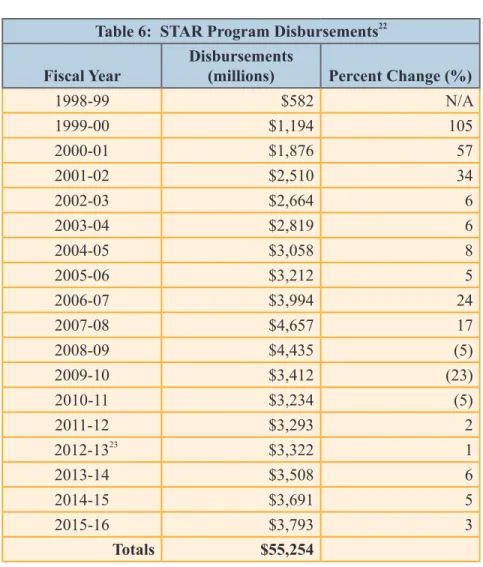
Table 6: STAR Program Disbursements22
Fiscal Year Disbursements (millions) Percent Change (%)
1998-99 $582 N/A 1999-00 $1,194 105 2000-01 $1,876 57 2001-02 $2,510 34 2002-03 $2,664 6 2003-04 $2,819 6 2004-05 $3,058 8 2005-06 $3,212 5 2006-07 $3,994 24 2007-08 $4,657 17 2008-09 $4,435 (5) 2009-10 $3,412 (23) 2010-11 $3,234 (5) 2011-12 $3,293 2 2012-1323 $3,322 1 2013-14 $3,508 6 2014-15 $3,691 5 2015-16 $3,793 3 Totals $55,254
From the STAR program’s inception in the 1998-99 fiscal year until the 2015-16 fiscal year,
disbursements will have increased by 552 percent.
22 These are multiyear projections and disbursement forecast as determined in the fiscal year 2013 Executive Budget
Financial Plan issued by the Governor’s Office dated February 17, 2012.
APPENDIX E
HOW TO OBTAIN ADDITIONAL COPIES OF THE REPORT
To obtain copies of this report, write or visit our web page:
Office of the State Comptroller Public Information Office 110 State Street, 15th Floor Albany, New York 12236
(518) 474-4015
APPENDIX F
OFFICE OF THE STATE COMPTROLLER
DIVISION OF LOCAL GOVERNMENT
AND SCHOOL ACCOUNTABILITY
Andrew A. SanFilippo, Executive Deputy Comptroller Steven J. Hancox, Deputy Comptroller Nathaalie N. Carey, Assistant Comptroller
LOCAL REGIONAL OFFICE LISTING
NEWBURGH REGIONAL OFFICE
Tenneh Blamah, Chief Examiner Office of the State Comptroller 33 Airport Center Drive, Suite 103 New Windsor, New York 12553-4725
(845) 567-0858 Fax (845) 567-0080
Email: [email protected]
Serving: Columbia, Dutchess, Greene, Orange, Putnam, Rockland, Ulster, Westchester Counties
ROCHESTER REGIONAL OFFICE
Edward V. Grant, Jr., Chief Examiner Office of the State Comptroller
The Powers Building
16 West Main Street – Suite 522
Rochester, New York 14614-1608
(585) 454-2460 Fax (585) 454-3545
Email: [email protected]
Serving: Cayuga, Chemung, Livingston, Monroe,
Ontario, Schuyler, Seneca, Steuben, Wayne, Yates Counties
SYRACUSE REGIONAL OFFICE
Rebecca Wilcox, Chief Examiner Office of the State Comptroller State Office Building, Room 409
333 E. Washington Street
Syracuse, New York 13202-1428
(315) 428-4192 Fax (315) 426-2119
Email: [email protected]
Serving: Herkimer, Jefferson, Lewis, Madison, Oneida, Onondaga, Oswego, St. Lawrence Counties
STATEWIDE AND REGIONAL PROJECTS
Ann C. Singer, Chief Examiner State Office Building - Suite 1702
44 Hawley Street
Binghamton, New York 13901-4417
(607) 721-8306 Fax (607) 721-8313
BINGHAMTON REGIONAL OFFICE
H. Todd Eames, Chief Examiner Office of the State Comptroller State Office Building - Suite 1702
44 Hawley Street
Binghamton, New York 13901-4417
(607) 721-8306 Fax (607) 721-8313
Email: [email protected]
Serving: Broome, Chenango, Cortland, Delaware, Otsego, Schoharie, Sullivan, Tioga, Tompkins Counties
BUFFALO REGIONAL OFFICE
Robert Meller, Chief Examiner Office of the State Comptroller 295 Main Street, Suite 1032 Buffalo, New York 14203-2510
(716) 847-3647 Fax (716) 847-3643
Email: [email protected]
Serving: Allegany, Cattaraugus, Chautauqua, Erie, Genesee, Niagara, Orleans, Wyoming Counties
GLENS FALLS REGIONAL OFFICE
Jeffrey P. Leonard, Chief Examiner Office of the State Comptroller
One Broad Street Plaza
Glens Falls, New York 12801-4396
(518) 793-0057 Fax (518) 793-5797
Email: [email protected]
Serving: Albany, Clinton, Essex, Franklin, Fulton, Hamilton, Montgomery, Rensselaer, Saratoga, Schenectady, Warren, Washington Counties
HAUPPAUGE REGIONAL OFFICE
Ira McCracken, Chief Examiner Office of the State Comptroller NYS Office Building, Room 3A10
Veterans Memorial Highway
Hauppauge, New York 11788-5533
(631) 952-6534 Fax (631) 952-6530
Email: [email protected]