Binghamton University
Binghamton University
The Open Repository @ Binghamton (The ORB)
The Open Repository @ Binghamton (The ORB)
Anthropology Faculty Scholarship
Anthropology
Winter 2-6-2020
A model-based approach to the tempo of “collapse”: The case of
A model-based approach to the tempo of “collapse”: The case of
Rapa Nui (Easter Island)
Rapa Nui (Easter Island)
Robert J. Dinapoli
Timothy M. Reith
Carl P. Lipo
Terry L. Hunt
Follow this and additional works at:
https://orb.binghamton.edu/anthropology_fac
Part of the
Anthropology Commons
Journal of Archaeological Science xxx (xxxx) xxx
Please cite this article as: Robert J. DiNapoli,Journal of Archaeological Science, https://doi.org/10.1016/j.jas.2020.105094 0305-4403/© 2020 Elsevier Ltd. All rights reserved.
A model-based approach to the tempo of
“
collapse
”
: The case of Rapa Nui
(Easter Island)
Robert J. DiNapoli
a,*, Timothy M. Rieth
b, Carl P. Lipo
c, Terry L. Hunt
d aDepartment of Anthropology, University of Oregon, 308 Condon Hall, 1218 University of Oregon, Eugene, OR 97403, USA bInternational Archaeological Research Institute, Inc., 2081 Young St, Honolulu, HI 96826, USAcDepartment of Anthropology, Binghamton University, 4400 Vestal Parkway, Binghamton, NY 13902, USA dHonors College and School of Anthropology, University of Arizona, 1101 E. Mabel Street, Tucson, AZ 85719, USA
A R T I C L E I N F O Keywords: Collapse Bayesian analysis East Polynesia Monumental architecture Tempo plots A B S T R A C T
Rapa Nui (Easter Island, Chile) presents a quintessential case where the tempo of investment in monumentality is central to debates regarding societal collapse, with the common narrative positing that statue platform (ahu) construction ceased sometime around AD 1600 following an ecological, cultural, and demographic catastrophe. This narrative remains especially popular in fields outside archaeology that treat collapse as historical fact and use Rapa Nui as a model for collapse more generally. Resolving the tempo of “collapse” events, however, is often
fraught with ambiguity given a lack of formal modeling, uncritical use of radiocarbon estimates, and inattention to information embedded in stratigraphic features. Here, we use a Bayesian model-based approach to examine the tempo of events associated with arguments about collapse on Rapa Nui. We integrate radiocarbon dates, relative architectural stratigraphy, and ethnohistoric accounts to quantify the onset, rate, and end of monument construction as a means of testing the collapse hypothesis. We demonstrate that ahu construction began soon after colonization and increased rapidly, sometime between the early-14th and mid-15th centuries AD, with a steady rate of construction events that continued beyond European contact in 1722. Our results demonstrate a lack of evidence for a pre-contact ‘collapse’ and instead offer strong support for a new emerging model of
resilient communities that continued their long-term traditions despite the impacts of European arrival. Meth-odologically, our model-based approach to testing hypotheses regarding the chronology of collapse can be extended to other case studies around the world where similar debates remain difficult to resolve.
1. Introduction
Monumental architecture, such as earthen mounds, massive stone circles, burial complexes, and temples trace the history of collaborative achievements by human communities over the last ca. 10,000 years. Because building these structures necessarily required group-level cooperation, their appearance, elaboration, and cessation at different times and places around the world are useful as archaeological evidence for changes in social organization and complexity (Abrams, 1989;
DeMarrais et al., 1996; Kirch, 1990; Marcus and Flannery, 2004;
Trigger, 1990). Yet, given the wide range of environmental and social conditions under which these phenomena emerge, explaining the dy-namics of monument construction in different world regions remains a central challenge to archaeologists (DiNapoli et al., 2019; Howey et al.,
2016). One step toward progress in this effort requires the establishment of reliable chronologies that provide probabilistic estimates for when monumentality begins, the timing of investments in these features made over the duration of their use, and the point at which construction ac-tivities cease. It is through such information that archaeologists can document events associated with increases in organizational complexity, cultural resilience in the face of environmental or de-mographic changes, or societal collapse.
Though the definition and process of ‘collapse’ have long been
debated (e.g., Butzer and Endfield, 2012; Kirch and Rallu, 2007; McA-nany and Yoffee, 2010; Middleton, 2012; Scheffer et al., 2012; Schwartz and Nichols, 2006; Strunz et al., 2019; Tainter, 1988, 2006; Yoffee and Cowgill, 1988), most scholars agree that these kinds of events commonly involve the end or decline in some kind of activity, whether it be changes
* Corresponding author.
E-mail addresses: [email protected] (R.J. DiNapoli), [email protected] (T.M. Rieth), [email protected] (C.P. Lipo), [email protected]
(T.L. Hunt).
Contents lists available at ScienceDirect
Journal of Archaeological Science
journal homepage: http://www.elsevier.com/locate/jas
https://doi.org/10.1016/j.jas.2020.105094
in settlement patterns, like depopulation of political centers, declines in focal aspects of religious and social activity, such as the end of monu-ment construction, or other factors (e.g., Dunnell and Greenlee, 1999;
Middleton, 2017; Turner and Sabloff, 2012). In a recently proposed series of ‘grand challenges’ for archaeology, Kintigh et al. (2014a, 2014b) highlight collapse as a central issue in the discipline and stress the need for broadly applicable ways of characterizing societal declines or transitions. One basic, but critical, component for resolving these issues concerns the chronology of these events in absolute and relative terms (Butzer and Endfield, 2012; Scheffer, 2016; Scheffer et al., 2012). Some recent studies have approached this issue using summed proba-bility distributions of radiocarbon dates (e.g., Downey et al., 2016;
Hoggarth et al., 2016; Shennan et al., 2013). Here, using the hypothe-sized ‘collapse’ of Rapa Nui (Easter Island) monument construction as a
case study, we present an alternative approach that makes use of Bayesian model-based testing of hypotheses for collapse that considers the onset, tempo, and cessation of archaeological events. Our Bayesian approach combines radiocarbon determinations, relative chronological information from architectural stratigraphy, and ethnohistoric accounts with the recently developed ‘tempo plot’ technique (Dye, 2016) to
provide rigorous, model-based estimates for when monument con-struction begins, the rate of change in monument concon-struction events, and the most likely timing for the cessation of these activities.
Our results provide a key line of evidence contradicting the collapse narrative for Rapa Nui and thus calls into question a broad range of interdisciplinary research that uses the island as a model for societal decline more generally. Though we approach the issue of collapse on Rapa Nui with reference to chronologies of monument construction, we discuss how our methodological approach to testing hypotheses regarding the chronology of collapse can be extended to other case studies around the world where similar debates remain difficult to resolve.
2. Background: Rapa Nui (Easter Island)
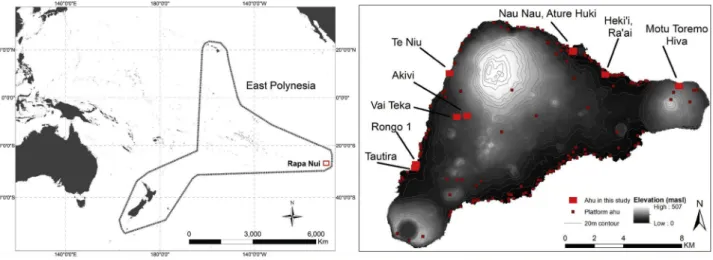
Rapa Nui (Easter Island, Chile, Fig. 1) presents a quintessential case in world history where the tempo of intensified monument construction is central to debates regarding societal collapse. This small (164 km2)
and isolated island is situated in the southeastern margin of East Poly-nesia, some 3000 km from South America and nearly 2000 km from the nearest inhabited island. Current estimates suggest that Polynesian voyagers initially colonized the island around the 13th century AD (e.g.,
Hunt and Lipo, 2008, 2006; Lipo and Hunt, 2016; Wilmshurst et al., 2011). At some point after this event, islanders began constructing megalithic platforms (ahu) and carving and transporting multi-ton
statues (moai). These monuments subsequently served as a major focal point for social and ritual activity of Rapa Nui’s pre-contact
commu-nities (Martinsson-Wallin, 1994; M�etraux, 1940; Morrison, 2012; Ste-venson, 2002). Despite its size and remote location, the present archaeological record of Rapa Nui boasts hundreds of ahu and nearly 1000 moai.
The role of monument construction over the course of Rapa Nui’s
culture history has been the subject of prolonged speculation and debate. Ahu construction and elaboration are commonly used as evi-dence for increasing social complexity and fission-fusion patterns among Rapa Nui’s social groups (Stevenson, 2002, 1997; 1986; Wallin and Martinsson-Wallin, 2008). In addition, numerous archaeological narra-tives for the island posit that an accelerated pace of monument con-struction, during the “Ahu Moai” phase, led to an environmental and
demographic collapse around the 17th century. A core component of this narrative is the rapid destruction of monuments and end of ahu and
moai construction, a time period termed the “Huri Moai,” literally ‘statue
toppling,’ phase (Bahn and Flenley, 1992, 2017; Diamond, 2005; Flen-ley and Bahn, 2003; Kirch, 1984, 2017; Smith, 1961a). While a popular account, the lack of empirical evidence for many aspects of this narrative (Hunt, 2007; Hunt and Lipo, 2011; Mulrooney, 2013; Mulrooney et al., 2010, 2009) has led some to argue that monument construction was instead a key factor in the long-term persistence of pre-contact com-munities that only terminated as a consequence of changes following the arrival of Europeans (Boersema, 2015; DiNapoli et al., 2019, 2018; Hunt and Lipo, 2018, 2011; Lipo et al., 2018; Mulrooney et al., 2010; Peiser, 2005). Despite these criticisms, the notion that the late pre-contact period on Rapa Nui was a time of severe cultural and demographic changes remains popular (e.g., Bahn and Flenley, 2017; Kirch, 2017;
Puleston et al., 2017; Rull, 2018, 2016; Rull et al., 2018; Scheffer, 2016). Indeed, the narrative of collapse on Rapa Nui is still persistently used in fields outside archaeology as a model for societal collapse, treating the supposed events of the ‘Huri Moai’ phase as historical fact (e.g., Akha-van and Yorke, 2019; Anderies, 2000; Basener and Ross, 2004; Basener and Basener, 2019; Bologna and Flores, 2008; Brander and Taylor, 1998;
Brandt and Merico, 2015; Cazalis et al., 2018; D’Alessandro, 2007;
Dalton et al., 2005; Dalton and Coats, 2000; de la Croix and Dottori, 2008; Dockstader et al., 2019; Erickson and Gowdy, 2000; Pezzey and Anderies, 2003; Reuveny, 2012; Reuveny and Decker, 2000; Roman et al., 2017; Tak�acs et al., 2019; Uehara et al., 2010).
Monumental architecture is central to explanations of Rapa Nui culture history and the proposed collapse of its pre-contact society. Yet, the chronology of ahu construction remains poorly resolved, leading to uncertainty in evidence such that debates are difficult to settle. For example, while we can currently say that monument construction was
Fig. 1. Rapa Nui and East Polynesia. East Polynesia (left), and Rapa Nui showing the locations of all documented platform ahu as well as those analyzed in this
Journal of Archaeological Science xxx (xxxx) xxx
3
widespread during some component of Rapa Nui’s history, further
de-tails about the onset, rate, and duration of these activities are ambig-uous. Moving past this generalization requires developing chronological models for these events involved in monument construction activities. Like with many chronological issues in archaeology, formal Bayesian models provide a useful tool to better resolve temporal patterns of monument construction (e.g., Carter et al., 2019; Chirikure et al., 2013;
Culleton et al., 2012; Dye, 2016, 2012; Schulz Paulsson, 2019).
2.1. Previous chronologies for ahu construction
Heyerdahl and Ferdon’s (Heyerdahl and Ferdon, 1961) Norwegian
archaeological expedition to Rapa Nui in the 1950s provided the first modern attempts to build an absolute chronology for ahu construction. They built their chronology based on stratigraphic evidence derived from the excavation of numerous ahu complexes as well as 14C dates
from ahu Vinapu, Te Peu, and several other important sites on the island. Based on this evidence, they argued that the island experienced an early period of ahu construction around ca. AD 800 and that this activity continued until AD 1600s (Smith, 1961b). Following Heyerdahl and Ferdon, Ayres (1971) offered the next absolute chronology based on 14C dates from excavations at ahu Tahai and Ko te Riku. Evidence from his excavations suggested that initial ahu construction activities began around AD 700. Mulloy and Figueroa (1978) later proposed that the initial construction of ahu Akivi and Vai Teka did not begin until ca. AD 1450. Using a large suite of obsidian hydration dates from several south coast ahu, Stevenson (1986, pp. 74–76) argued that the initial
con-struction of ahu Vaihu, Akahanga, and Ura Uranga te Mahina took place between AD 1301–1400, with additional platform ahu construction and
rebuilding episodes continuing into the late 1600s. Stevenson (1997, pp. 8–13) later altered this chronology using a different hydration rate
constant to argue that initial construction occurred as early as ca. AD 1000, with platform construction limited after ca. AD 1500–1600. In
their reviews of early 14C dates from several ahu across the island,
including ahu Nau Nau and Ature Huki (Skjølsvold, 1994), Heki’i
(Martinsson-Wallin, 1998; Martinsson-Wallin and Wallin, 1998), Ra’ai
(Martinsson-Wallin and Wallin, 2000), Viri o Tuki (Huyge and Cauwe, 2005), Motu Toremo Hiva (Cauwe et al., 2010, 2006), Vinapu ( Mar-tinsson Wallin, 2004), Rongo (Huyge and Cauwe, 2002), and Tautira (Martinsson-Wallin and Crockford, 2002), Wallin and colleagues (Wallin et al., 2010, p. 43; Wallin and Martinsson-Wallin, 2008, p. 154) suggest that initial construction of these complexes likely occurred around AD 1250–1400, but possibly as early as AD 1100–1200. In a later
analysis of a select sample of 14C dates from ahu, Martinsson-Wallin et al. (2013) use summed probability distributions (SPD) to estimate the onset and cessation of ahu construction. In their visual interpretation of the ahu SPD, they suggest that ahu complexes “were securely in place on
Rapa Nui by ca. AD 1300–1400” and claimed that a ‘destruction phase’
for large platform ahu occurred around AD 1600 (Martinsson-Wallin et al., 2013, pp. 417, Figure 7). This argument for a “[d]egeneration of
ceremonial sites” (Wallin and Martinsson-Wallin, 2008, p. 154) during a
destruction phase for platform ahu around AD 1600 assumes a transition from the “Ahu Moai” phase to the “Huri Moai” phase in Rapa Nui culture
history (Kirch, 1984, 2017; Smith, 1961a; cf. Mulrooney et al., 2009;
Lipo and Hunt, 2009).
These previous dating programs have provided valuable data and working hypotheses for monument construction and testing the collapse narrative on Rapa Nui. These estimates for initial ahu construction are limited, however, given that they are not based on formal statistical models but on ad hoc visual approximations of the calibrated date lists, or in the case of Martinsson-Wallin et al. (2013), visual approximations of an SPD. Given contemporary concerns over choices of samples for generating radiocarbon dates (Hunt and Lipo, 2006; Wilmshurst et al., 2011; Allen and Huebert, 2014; Rieth and Athens, 2013; Spriggs and Anderson, 1993; cf. Schmid et al., 2018), the now well-understood un-certainties with visual interpretations of dates, and a multitude of issues
with simple visual inspection of SPD curves (Bayliss et al., 2007; Con-treras and Meadows, 2014; Crema et al., 2016; Dye, 2016; Timpson et al., 2014), these chronologies for initial ahu construction are in need of re-evaluation. Previous syntheses of 14C data from ahu have also not
included the rigorous dating program by Wozniak (2003) at ahu Te Niu. Furthermore, the timing of the cessation of platform ahu construction is poorly understood, given the lack of formal modeling and sporadic and limited historical accounts from the 18th century. Bayesian chronolog-ical modeling provides a promising alternative for examining the chro-nology of ahu on Rapa Nui given the island’s short chronology and
highly overlapping radiocarbon probability distributions, as well as the approach’s explicit aim of incorporating prior information about
rela-tive construction components from the dated sequences and ability to formally model the timing of events that are otherwise not directly dated (Dye, 2016, 2012; Schulz Paulsson, 2019).
3. Materials and methods
3.1. Objectives
Here, we use a sample of previously published 14C determinations in concert with relative ahu construction events to build a series of Bayesian models to estimate the onset and later tempo of ahu con-struction. We construct these models using OxCal v.4.3.2 (Bronk Ram-sey, 2017). For clarity, we capitalize and italicize OxCal commands (e.g.,
Phase, Sequence, etc.). We use the ArchaeoPhases package (Philippe et al., 2019) to create a tempo plots of ahu construction activity. Our primary objectives are: (1) to estimate how soon after the colonization of Rapa Nui initial monument construction began; and (2) to estimate the duration of ahu construction events, including initial platform con-struction and the timing of later investments, such as how far they extend into the pre-contact and/or early historic eras as a means of testing the claim that ahu construction ceased following a pre-contact collapse. These objectives require that we have a reliable estimate for initial colonization and select samples that most closely relate to ahu
construction and use.
3.2. Colonization models
We use existing radiocarbon determinations from the published literature to provide refined Bayesian estimates for Rapa Nui coloniza-tion. We start by using 14C samples with a conventional radiocarbon age (CRA) �650 BP not from ahu contexts (see Supplementary Materials; Table S1). Our use of a �650 BP threshold provides a focus on samples
that conceptually relate to the early pre-contact/colonization era, such that the colonization estimate is not biased by younger 14C samples that
are unrelated to colonization (Mulrooney et al., 2011). We do not include samples from monumental architecture contexts in the coloni-zation models as these determinations are included in the ahu models. We group the 14C samples into a single Phase, with the start Boundary
providing the colonization estimate. We built two colonization models using 14C samples from archaeological contexts: one with only short-lived plant remains (n ¼ 9), and a second with these nine
short-lived samples and 19 unidentified charcoal samples. For the sec-ond model, we apply a Charcoal Outlier parameter to assess the influence of unidentified charcoal samples on the precision of our colonization estimate (Bronk Ramsey, 2009; Dee and Bronk Ramsey, 2014; Schmid et al., 2018).
3.3. Relative construction model for platform ahu
Rapa Nui islanders constructed multiple classes of ritual stone structures that are collectively referred to as ahu. Here, we focus our study on the ca. 150 known platform ahu, also called ‘image-ahu’ or ahu moai, which are the largest and most common form of pre-contact ahu
(Martinsson-Wallin, 1994). The term image-ahu denotes that many of
these monuments have one or more moai statues, though this is not al-ways the case. Their central architectural feature is a rectangular plat-form with a dressed stone or closely aligned back wall. These central platforms typically contain combinations of auxiliary features, such as linear alignments of stacked stone projecting laterally from the platform (termed ‘wings’), a ramp descending from the front of the platform that
is paved with water-worn boulders (poro), a pavement/plaza of poro
stone in front of the ramp, a rectangular embankment enclosing the plaza, and a crematorium (which generally is attached to the back side of the platform). Ahu also often contain burial features within different components of the structure. Lastly, their visible attributes and strati-graphic information from archaeological excavations have shown that most platform ahu were continually added to over the years with mul-tiple building events (Martinsson-Wallin, 1994; Skjølsvold, 1994; Smith,
1961a). These different architectural features allow for building relative chronologies of ahu construction that can be used as informative priors in Bayesian models. Specifically, if we consider the different construc-tion elements as deposiconstruc-tional events (Dye, 2016, 2010), then the central platform is logically the initial construction component, as the other components are built off of it and, therefore, wings, ramps, crematoria, etc., must logically post-date platform construction (See Fig. 2 for a model schematic of a typical platform ahu). In most instances the stratigraphic relationships between different architectural elements confirm this generalized sequence (e.g., wing structures that abut the central platform).
3.4. Models for ahu construction
To build a chronology for events associated with ahu construction, we create a series of multi-phase Bayesian models designed to estimate initial platform construction, the timing of later additions, and end of construction for several ahu. These models incorporate radiocarbon determinations, relative architectural stratigraphy, and ethnohistoric accounts as informative priors. Using published contextual information from excavations at ahu, we group 14C determinations into Phases
related to the construction of the central ahu platform using three classes of events: (1) samples related to events from contexts below the platform are treated as termini post quos (TPQs), which we term ‘pre-platform construction’ phases; (2) samples contextually associated with our
target event of platform construction are classified as ‘platform con-struction’ phases; and (3) samples from any of the auxiliary features (e.
g., ramps, wings) that post-date platform construction are termini ante quos (TAQs), which we term ‘post-platform’ phases. In these models, the
determinations from pre-platform, platform, and post-platform events are grouped into unordered Phases within an ordered Sequence. We also use the Boundary start estimate from the colonization model to constrain the estimates for platform construction, as initial ahu construction must logically post-date colonization. Lastly, for the end of the Sequence we input a uniform calendar date range (of AD 1838–1868 (Date(U(1838, 1868)) in OxCal) to serve as a cutoff point for the construction estimates. This choice of AD 1838–1868 is based on historic European accounts of
the last time a moai statue was recorded as still standing upright on an
ahu platform, which serves as a conservative estimate for the time period after which we assume no platform ahu were built (see section 3 of Supplementary Materials for an extended discussion of this rationale). This final parameter simply serves to constrain the right side of the calibrations in the post-platform phase. The general form of these ahu
models is: Colonization >TPQ (pre-platform) >Target (platform
con-struction) >TAQ (post-platform) >AD 1838–1868.
We construct multi-phase models for each individual ahu with 14C
determinations from either (a) TPQ, target, and TAQ; (b) TPQ and target, (c) target and TAQ, or (d) TPQ and TAQ events. Models of types (a), (b), and (c) are constructed as Contiguous Sequences, and the start of the target event Boundary provides the estimate for initial ahu con-struction, the start Boundary for the post-platform phase provides the estimate for later construction events, and the end Boundary estimates the end of ahu construction activities. Models of type (d) are constructed as Sequential Sequences, and we insert a Date command between the end
Boundary of the pre-platform Phase and the start Boundary of the post- platform Phase to estimate the start of platform construction. We use the Difference query to estimate the temporal lag between the coloni-zation Boundary and the start of construction for each ahu.
3.5. Model-based estimates for the duration of ahu construction
To explore the duration of ahu construction activities, we implement
Dye’s (2016) ‘tempo plot’ procedure as a means for examining the
temporal patterns of ahu construction events. Tempo plots utilize the raw output of OxCal’s Markov-Chain-Monte Carlo (MCMC) procedure
(using the MCMC_Sample query) to summarize the joint posteriors of multiple estimated events and to visualize the Bayes estimate and credible interval of the cumulative temporal distribution of the specified events (Dye, 2016, p. 2). Thus, the tempo plot is a summary of “how
many events took place before each date in a specified range of dates”
(Dye, 2016, p. 2), where the slope of the curve relates to the rate at which events occur: steeper and flatter shapes of the curve indicate more rapid or slower frequency of events, respectively. In our tempo plot, we treat the timing of initial platform construction and construction of later
ahu components, such as plazas, ramps, and wings, as a single class of events related to ahu construction activities. These events encompass both initial ahu construction and further investments made through subsequent additions and modifications to these monuments overtime. In OxCal terms, these are the Boundaries for initial platform construction and start and end of TAQ phases. We also use the ‘TempoActivityPlot’
function of the ArchaeoPhases package (Philippe et al., 2019) to examine the patterns of ahu construction activity. The tempo-activity plot is similar to the normal tempo plot, but instead of plotting the cu-mulative number of events, it graphically displays the first derivative of the tempo plot curve. As such, the tempo activity plot shows the changing rate of construction events. The results of both analyses pro-vide a model-based depiction of the patterns in ahu construction activity over time.
The later estimates in the tempo plot may be sensitive to the choice of a calendar date cutoff after which we assume no platform ahu were built (e.g., McCoy et al., 2012). To examine the influence of our preferred calendar date range of AD 1838–1868 on the results, we also run the
tempo and tempo-activity plots with a cutoff of AD 1771 to examine whether there is a notable change in construction associated with the profound impacts of European contact (see Supplementary Materials
Fig. 2. Model schematic of a platform ahu. Schematic of a typical platform
ahu showing a plan view (top) and cross-section (bottom). Figure adapted from
Journal of Archaeological Science xxx (xxxx) xxx
5
sections 3 and 4 for rationale).
3.6. Sample selection
In these ahu models, we exclude 14C samples from bulk soil, those
with unclear stratigraphic relationships with ahu features, those from the Gakushuin lab (GaK) (e.g., Ayres, 1971; Esen-Baur, 1983) known to be problematic (Blakeslee, 1994; Spriggs, 1989; Spriggs and Anderson, 1993) and samples with unknown relations between the target and dated events. For example, we exclude a number of 14C determinations
on abraded coral artifacts from Ahu Nau Nau at Anakena given the unknown time lag between coral harvesting and deposition at the ahu
(Beck et al., 2003, p. 100). We also exclude obsidian hydration dates given long-standing, unresolved issues with the method (see Supple-mentary Materials, Section 5, Table S3). Given the general lack of short-lived samples from ahu contexts, we must rely on unidentified charcoal samples, which may have inbuilt age (Allen and Huebert, 2014). We apply a Charcoal Outlier parameter to these unidentified charcoal samples whereby all samples have a 100% probability of being outliers, which can help produce more accurate results in simulated and real-world case studies, especially when paired with multiple Phases
(Bronk Ramsey, 2009; Dee and Bronk Ramsey, 2014). We also apply a
General “t” type Outlier parameter to all identified charcoal samples to
statistically assess potential poor fit between the model and radiocarbon determinations, using an outlier probability ¼ 0.05 (Bronk Ramsey, 2009). With these uncertainties and potential issues in mind, the ma-jority of our models for ahu construction are best described as TPQs for initial construction.
We present modeled results as 95.4% highest posterior density (HPD) estimates in calibrated years AD. Estimates are rounded out to nearest 5 years. 14C samples used in the colonization models are
included in Table S1 and samples for the ahu models are in Table S2. We created tempo plots in R (R Core Team, 2019) using the ArchaeoPhases package (Philippe et al., 2019). Full descriptions for each model and tempo plot, including calibration procedures, contextual information, OxCal and R code necessary for reproducing this analysis are available in Supplementary Materials.
4. Results
4.1. Rapa Nui colonization
The single-phase colonization model using only short-lived samples estimates initial colonization of Rapa Nui in the range 1150-1290 cal. AD
(Amodel ¼105.6, Aoverall ¼101). Our second model that incorporates
unidentified charcoal samples and a Charcoal Outlier parameter suggests a slightly more precise colonization estimate of 1150-1280 cal. AD
(Amodel ¼121, Aoverall ¼120.5). Given the negligible difference between
these two results, we opted for the more precise estimate with higher agreement indices provided by the outlier model for use in the ahu
models and tempo plots.
4.2. Ahu construction estimates
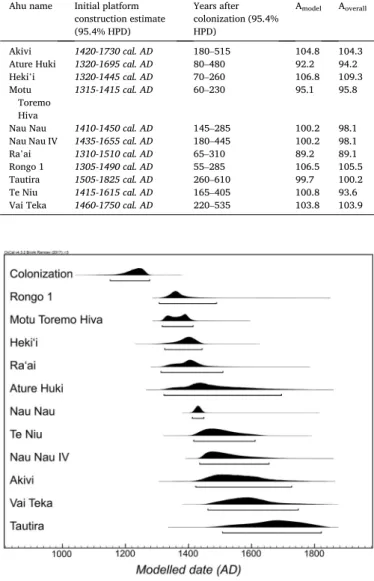
Based on the available data, we were able to create Bayesian models for 11 ahu. Results for the time lag following colonization until the estimated timing of initial ahu construction are presented in Table 1.
Fig. 3 shows the modeled distributions for these estimates. Full discus-sion of 14C samples from ahu contexts and Bayesian models is provided
in Supplementary Materials.
Samples within the models for ahu Rongo 1, Motu Toremo Hiva, Ra’ai, Ature Huki, Akivi, Vai Teka, and Tautira are comprised of
un-identified charcoal, and as such these estimates may be affected by inbuilt age. Models for Ahu Heki’i, Nau Nau, and Te Niu contain both
short-lived and unidentified charcoal samples in their TPQ (pre-plat-form) and TAQ (post-plat(pre-plat-form) Phases and thus their results are more
accurate estimates for the timing of platform construction.
4.3. Tempo of ahu construction activities
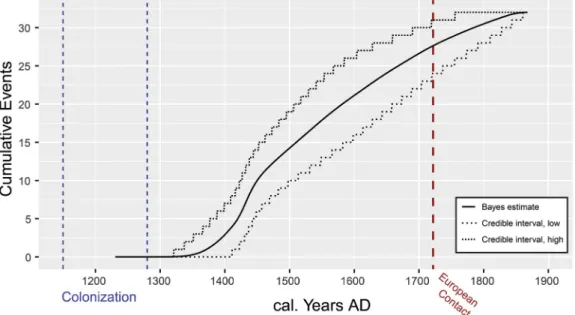
Tempo and tempo-activity plot results are shown in Figs. 4 and 5. The 11 ahu in our study have multiple construction elements (see Sup-plemental Materials), and these plots include estimated boundaries for initial platform construction, boundaries for the start of later construc-tion episodes (TAQ Phases), and boundary end estimates for non- platform components. Results of the sensitivity analysis examining the effect of different calendar date cutoffs for the likely end of ahu con-struction can be found in Section 4 and Figs. S14–S17 of Supplementary
Materials. For our sample of 11 ahu, the shape of the tempo plots using an AD 1838–1868 cutoff point indicate a fairly rapid period of ahu
construction from ca. AD 1350–1450, followed by a steady tempo of ahu
construction that continues beyond European contact in AD 1722. The results indicate that ahu construction activities continue into post- contact times, with a flattening of the upper bound of 95% credible interval at ca. 1750. The shape of tempo activity plot in Fig. 5 suggests that the rate of activity begins to slowly decline beginning around AD
Table 1
Initial ahu construction. Estimates for initial platform construction for 11 ahu
sites found across Rapa Nui and the estimated time lag between initial human colonization and construction of each ahu. All models have agreement indices
>60. Full results and code are in Supplementary Materials. Ahu name Initial platform
construction estimate (95.4% HPD) Years after colonization (95.4% HPD) Amodel Aoverall Akivi 1420-1730 cal. AD 180–515 104.8 104.3 Ature Huki 1320-1695 cal. AD 80–480 92.2 94.2 Heki’i 1320-1445 cal. AD 70–260 106.8 109.3 Motu
Toremo Hiva
1315-1415 cal. AD 60–230 95.1 95.8
Nau Nau 1410-1450 cal. AD 145–285 100.2 98.1 Nau Nau IV 1435-1655 cal. AD 180–445 100.2 98.1 Ra’ai 1310-1510 cal. AD 65–310 89.2 89.1 Rongo 1 1305-1490 cal. AD 55–285 106.5 105.5 Tautira 1505-1825 cal. AD 260–610 99.7 100.2 Te Niu 1415-1615 cal. AD 165–405 100.8 93.6 Vai Teka 1460-1750 cal. AD 220–535 103.8 103.9
Fig. 3. Rapa Nui colonization and ahu construction estimates. Bayesian
estimates for colonization and initial platform construction for 11 ahu.
1550 through the 18th century.
Using an AD 1771 cutoff produces results that are essentially iden-tical for time periods before AD 1700, but suggests a possible cessation of construction activities around the time of initial European contact in AD 1722 (based on the flattening of the upper bound of the 95% credible interval envelope, Fig. S15). The greatest difference between the results using the different cutoff dates is shown in the tempo-activity plots in the latter part of the 18th century (Figs. S16 and S17). Using an AD 1838–1868 cutoff suggests possible construction activities continuing
just prior to this date, whereas the AD 1771 cutoff appears to artificially truncate the activity. Based on the available historical evidence and the results presented here, we suggest that ca. AD 1838–1868 is a more
reasonable and conservative cutoff point. However, both iterations of the tempo plots suggest that ahu construction activities likely continued at least until European contact in AD 1722.
5. Discussion
5.1. Colonization estimates
Our Bayesian colonization estimate of 1150-1280 cal. AD is in broad
agreement with previous estimates based on short-lived samples (Hunt and Lipo, 2006; Lipo and Hunt, 2016; Wilmshurst et al., 2011). How-ever, our estimate is both broader and potentially earlier than the esti-mate of 1200–1253 cal. AD presented in Wilmshurst et al. (2011) and Schmid et al.’s (2018) Bayesian estimate of 1245-1280 cal. AD (68.2%
HPD). The difference between our results and those recently published by Schmid et al. (2018) is potentially explained by their use of several younger 14C samples that are unrelated to colonization, some samples not derived from archaeological contexts (e.g., those samples from Mann et al. (2008)), and their presentation of 68.2% HPD rather than 95.4% estimates. Given the available radiocarbon data, our results provide currently the most accurate, if somewhat less precise, colonization es-timate for the island and add to a growing corpus of analyses suggesting initial Polynesian colonization of Rapa Nui between the late 12th and early 13th centuries AD.
5.2. The onset, tempo, and end of ahu construction activities
Our earliest estimate comes from ahu Rongo 1, which has an initial construction estimate of 1305-1490 cal. AD, estimated at some 55–285
years after colonization. The latest initial construction estimate is from
Fig. 4. Tempo of ahu construction events. Tempo plot for the cumulative number of ahu construction events, including initial construction and later building
activities. Dashed lines are the upper and lower bounds of the 95% Bayesian credible intervals.
Fig. 5. Rate of change in ahu construction events. Tempo-activity plot showing the first derivative of the tempo plot Bayesian estimate, or rate of change over
Journal of Archaeological Science xxx (xxxx) xxx
7 ahu Tautira, estimated at 1505–1825 cal. AD, some 260–610 years after
colonization. Each of these estimates, however, are derived from un-identified charcoal samples with potential inbuilt age, and as such should be treated as TPQs for initial construction. The most secure es-timates come from ahu Nau Nau (1410–1450 cal. AD, 145–285 years
after colonization), Heki’i (1320–1445 cal. AD, 70–260 years after
colonization), and Te Niu (1415–1615 cal. AD, 165–405 years after
colonization). Hence, given the models and available data from 11 ahu, what we can confidently state is that initial platform ahu construction began sometime between the early-14th and mid-15th centuries AD. These model-based estimates for initial ahu construction are later than previous ad hoc interpretations of 14C samples (Martinsson-Wallin et al., 2013; Wallin et al., 2010, p. 43; Wallin and Martinsson-Wallin, 2008, p. 154), which suggested initial construction potentially as early as 1100–1250 AD. These results have implications for monumentality in
the wider region, as they call for a reassessment of previous claims that megalithic construction began on Rapa Nui prior to elsewhere in East Polynesia (Martinsson-Wallin et al., 2013). Specifically, our revised es-timates for initial ahu construction may be penecontemporaneous with temple (marae) construction in central East Polynesia.
While our results are based on 11 of ca. 150 known platform ahu on Rapa Nui, this represents the largest possible sample of features with reliable chronological data and thus our results provide the most com-plete island-wide synthesis currently possible. It is possible, however, that initial ahu construction began earlier at locations not covered by our sample. In addition, the tempo-activity plot in Fig. 5 suggests a relatively slow decrease in the rate of ahu construction events from ca. AD 1550 through the 18th century, though we stress that this result should serve as a hypothesis in need of further testing as additional radiocarbon dates from ahu contexts become available. In particular, our analysis lacks samples from Rapa Nui’s south coast, which contains some of the highest
densities of large platform ahu on the island (Martinsson-Wallin, 1994).
Ahu on Rapa Nui’s south coast have been intensively studied by Ste-venson (1986), whose work yielded a large corpus of obsidian hydration dates. Given uncertainties with obsidian hydration dating on Rapa Nui and elsewhere (see section 4 in Supplementary Materials), these dates could not be included in our Bayesian models. While Stevenson’s (1986)
original obsidian hydration chronology for south coast ahu is consistent with the results of our Bayesian models, Stevenson’s (1997) later efforts
that include a revised hydration rate are incompatible with both our estimate for initial colonization of Rapa Nui and the timing of ahu
construction. This inconsistency is due to the lack of a secure clock mechanism for obsidian hydration dating (Anovitz et al., 1999), and for this reason we exclude these dates.
The most significant results from our Bayesian analyses are the tempo plots for the duration of ahu construction activities (Figs. 4 and 5), which provide important falsifying evidence that directly challenges core components of Rapa Nui’s collapse narrative. Previous
chronolo-gies for platform ahu have hypothesized that their construction ceased in the 17th century (e.g., Martinsson-Wallin et al., 2013; Stevenson, 1997;
Wallin and Martinsson-Wallin, 2008). The claim of a pre-contact end to platform ahu construction stems from assumptions about a transition in Rapa Nui culture history from an “Ahu Moai” phase, during which
platform ahu were constructed and moai statues erected upon them, to a period of cultural and demographic collapse termed the “Huri Moai”
phase that saw the toppling of moai and destruction of platform ahu
(Kirch, 2017, 1984; Martinsson-Wallin et al., 2013). The occurrence and chronology of the Huri Moai phase are largelyconstruction activities based upon Englert’s (1948) conjecture of AD 1680 as the timing for the
outbreak of a war described in oral traditions collected in the late 19th and early 20th centuries; however, archaeological evidence in support of this event is either lacking or has been debunked (Lipo and Hunt, 2009;
Mulrooney et al., 2009). The results of our Bayesian chronology add to these previous studies questioning the empirical sufficiency of the ‘Huri Moai’ phase or a cultural collapse in late pre-contact Rapa Nui. Our
results also question recent claims by Rull (2016) and colleagues (Rull
et al., 2018) that a major drought ca. AD 1600 caused an end to
moai/ahu construction The results of our tempo plots indicate a rapid period of ahu construction between ca. AD 1350–1450 with a steady
period of construction events that continue into the early historic era. In this regard, given that many of the 14C dates from our sample of 11 ahu
are from unidentified charcoal only strengthen this result, as their po-tential for inbuilt age may indicate that these activities occurred even more recently.
These results suggest that the activities of the so-called “Ahu Moai”
phase that included statue platform construction and use likely continued up to and beyond European contact. This conclusion is bolstered by the fact that in AD 1722 the Dutch captain Jacob Rog-geveen observed rituals being performed by islanders in front of statue platforms, and in 1770 the Spanish also observed that statue platforms were still being used for ritual activity (Corney et al., 1967). For example, Roggeveen (Corney et al., 1967, p. 15) states “what the form of
worship of these people comprises we were not able to gather any full knowledge of, owing to the shortness of our stay among them; we noticed only that they kindle fire in front of certain remarkably tall stone figures they set up; and, thereafter squatting on their heels with heads bowed down, they bring the palms of their hands together and alter-nately raise and lower them.” As others have argued (Boersema, 2015; Mulrooney et al., 2010), this direct observation suggests that platform
ahu were still the focus of ritual activity at the point of, and following, European contact. This conclusion suggests that the observations made by the Dutch in AD 1722, and likely the Spanish in AD 1770, were relatively accurate depictions of Rapa Nui communities and their tra-ditions. These findings are significant as they highlight the resilience of Rapa Nui communities following the devastating demographic impacts following European arrival (e.g., Fischer, 2005; Hunt and Lipo, 2011;
Peiser, 2005; Rainbird, 2002). Indeed, the steady continuous nature of construction of ahu features in the history of Rapa Nui strongly supports an emerging model in which this group-level activity served as a vital component of communities necessary for long term sustainability on this tiny and remote island (DiNapoli et al., 2019, 2018; Hunt and Lipo, 2018, 2011).
6. Conclusion
In 1979, Carl Sagan popularized the aphorism “extraordinary claims
require extraordinary evidence.” This aphorism has become “a
funda-mental principle of scientific skepticism” (Voss et al., 2014, p. 893).
Dramatic claims about societal collapse events require methods that are capable of linking expectations about collapse to the archaeological record. Our approach, and that of Dye (2016, 2012, 2010) offers one means of addressing this need. Here, we have provided a template for model-based approaches that address questions related to the tempo of collapse in other regions. In particular, our results highlight the utility of the tempo plot technique for quantifying the timing and rate of change in archaeological events within a Bayesian framework. To date, there have been few applications of the method beyond Dye’s (2016) original
formulation, which include Banks et al.’s (2019) study of the tempo of
change in Upper Paleolithic lithic typologies and Marsh et al.’s (2017)
examination of the expansion of the Inca Empire. Our results demon-strate that the tempo plot technique has wide applicability for quanti-fying the timing and rate of change of archaeological processes, in particular declines or cessation of activities associated with purported ‘collapse’ events and provides a viable alternative to the more common
approach of using summed probability distributions of radiocarbon dates. Tempo plots can also provide a useful extension of more common Bayesian approaches and offer ways to better characterize and quantify similar case studies around the world, such as the rate of decline at various Maya political centers (e.g., Ebert et al., 2017, 2016; Hoggarth et al., 2016) and other areas (e.g., Bar-Oz et al., 2019; Carter et al., 2019;
O’Shea et al., 2019).
Rapa Nui remains one of the most popular accounts of a society that
self-destructed and is persistently used as a paragon of societal collapse. In particular, there are numerous recent non-archaeological studies that treat this collapse event as fact, and which attempt to use Rapa Nui to validate and calibrate general-purpose economic and demographic models (e.g., Akhavan and Yorke, 2019; Anderies, 2000; Basener and Ross, 2004; Basener and Basener, 2019; Bologna and Flores, 2008;
Brander and Taylor, 1998; Brandt and Merico, 2015; Cazalis et al., 2018;
D’Alessandro, 2007; Dalton et al., 2005; Dalton and Coats, 2000; de la
Croix and Dottori, 2008; Dockstader et al., 2019; Erickson and Gowdy, 2000; Pezzey and Anderies, 2003; Reuveny, 2012; Reuveny and Decker, 2000; Roman et al., 2017; Tak�acs et al., 2019; Uehara et al., 2010). The
results of our Bayesian models, along with recent dates from the Rano Raraku statue quarry (Sherwood et al., 2019; Simpson et al., 2018), indicate there was not a pre-contact ‘collapse’ in ahu or moai
construc-tion, but that monument activity continued into the post-contact era. These findings add to the growing corpus of independent lines of evi-dence contradicting the traditional ‘collapse’ narrative for Rapa Nui
(Hunt and Lipo, 2011; Lipo et al., 2016; Mulrooney, 2013; Mulrooney et al., 2010; Simpson and Dussubieux, 2018), and thus question the results of a broad range of interdisciplinary research on societal collapse that assume the occurrence of this event with certainty.
Declaration of competing interest
The authors declare no competing interests. Acknowledgments
We thank Tom Dye, Scott Fitzpatrick, J. Stephen Athens, Robin Torrence, and four anonymous reviewers for their critical comments on previous versions of the manuscript. Catrine Jarman and John Dudgeon provided helpful information on human bone dates. This research was supported by National Science Foundation Doctoral Dissertation Improvement Grant Award #1841420 “Factors Influencing the
Devel-opment of Monumental Architecture” to R.J.D. and T.L.H.
Appendix A. Supplementary data
Supplementary data to this article can be found online at https://doi. org/10.1016/j.jas.2020.105094.
References
Abrams, E.M., 1989. Architecture and energy: an evolutionary perspective. Archaeol.
Method Theor. 1, 47–87.
Akhavan, N., Yorke, J.A., 2019. Population Collapse in Elite-Dominated Societies: A Differential Equations Model without Differential Equations. ArXiv190802870 Phys. Q-Bio.
Allen, M.S., Huebert, J.M., 2014. Short-lived plant materials, long-lived trees, and Polynesian 14 C dating: considerations for 14 C sample selection and documentation.
Radiocarbon 56, 257–276.
Anderies, J.M., 2000. On modeling human behavior and institutions in simple ecological economic systems. Ecol. Econ. 35, 393–412. https://doi.org/10.1016/S0921-8009
(00)00221-4.
Anovitz, L.M., Elam, J.M., Riciputi, L.R., Cole, D.R., 1999. The failure of obsidian hydration dating: sources, implications, and new directions. J. Archaeol. Sci. 26,
735–752.
Ayres, W.S., 1971. Radiocarbon dates from Easter island. J. Polyn. Soc. 80, 497–504.
Bahn, P., Flenley, J., 2017. Easter Island, Earth Island: the Enigmas of Rapa Nui, fourth
ed. Rowman & Littlefield, Lanham, MD.
Bahn, P., Flenley, J., 1992. Easter Island, Earth Island. Thames, London.
Banks, W.E., Bertran, P., Ducasse, S., Klaric, L., Lanos, P., Renard, C., Mesa, M., 2019. An application of hierarchical Bayesian modeling to better constrain the chronologies of Upper Paleolithic archaeological cultures in France between ca. 32,000–21,000 calibrated years before present. Quat. Sci. Rev. 220, 188–214. https://doi.org/
10.1016/j.quascirev.2019.07.025.
Bar-Oz, G., Weissbrod, L., Erickson-Gini, T., Tepper, Y., Malkinson, D., Benzaquen, M., Langgut, D., Dunseth, Z.C., Butler, D.H., Shahack-Gross, R., Roskin, J., Fuks, D., Weiss, E., Marom, N., Ktalav, I., Blevis, R., Zohar, I., Farhi, Y., Filatova, A., Gorin- Rosen, Y., Yan, X., Boaretto, E., 2019. Ancient trash mounds unravel urban collapse a century before the end of Byzantine hegemony in the southern Levant. Proc. Natl. Acad. Sci. 116, 8239–8248. https://doi.org/10.1073/pnas.1900233116.
Basener, B., Ross, D., 2004. Booming and crashing populations and Easter island. SIAM J. Appl. Math. 65, 684–701. https://doi.org/10.1137/S0036139903426952. Basener, W.F., Basener, W.J., 2019. Ecological collapse of Easter Island and the role of
price fixing. Eur. J. Math. 5, 646–655. https://doi.org/10.1007/s40879-019-00352- 5.
Bayliss, A., Ramsey, C.B., van der Plicht, J., Whittle, A., 2007. Bradshaw and Bayes: towards a timetable for the Neolithic. Camb. Archaeol. J. 17, 1–28. https://doi.org/
10.1017/S0959774307000145.
Beck, J.W., Hewitt, L., Burr, G.S., Loret, J., Hochstetter, F.T., 2003. Mata Ki Te Rangi: eyes towards the heavens. In: Loret, John, Tanacredi, J.T. (Eds.), Easter Island:
Scientific Exploration into the World’s Environmental Problems in Microcosm.
Kluwer Academic/Plenum Publishers, New York, pp. 93–112.
Blakeslee, D.J., 1994. Reassessment of some radiocarbon dates from the central plains. Plains Anthropol. 39, 103–210. https://doi.org/10.1080/2052546.1994.11931727.
Boersema, J.J., 2015. The Survival of Easter Island. Cambridge University Press.
Bologna, M., Flores, J.C., 2008. A simple mathematical model of society collapse applied to Easter Island. EPL Europhys. Lett. 81, 48006. https://doi.org/10.1209/0295-
5075/81/48006.
Brander, J.A., Taylor, M.S., 1998. The simple economics of Easter island: a Ricardo-
Malthus model of renewable resource use. Am. Econ. Rev. 88, 119–138.
Brandt, G., Merico, A., 2015. The slow demise of Easter Island: insights from a modeling investigation. Front. Ecol. Evol. 3 https://doi.org/10.3389/fevo.2015.00013.
Bronk Ramsey, C., 2017. OxCal Project, Version 4.3.
Bronk Ramsey, C., 2009. Dealing with outliers and offsets in radiocarbon dating.
Radiocarbon 51, 1023–1045.
Butzer, K.W., Endfield, G.H., 2012. Critical perspectives on historical collapse. Proc. Natl. Acad. Sci. 109, 3628–3631. https://doi.org/10.1073/pnas.1114772109. Carter, A.K., Stark, M.T., Quintus, S., Zhuang, Y., Wang, H., Heng, P., Chhay, R., 2019.
Temple occupation and the tempo of collapse at Angkor Wat, Cambodia. Proc. Natl. Acad. Sci. 116, 12226–12231. https://doi.org/10.1073/pnas.1821879116. Cauwe, N., Huyge, D., Coupe, D., De Poorter, A., Lemaitre, S., Claes, W., De Dapper, M.,
Meulemeester, J.D., al-Shqour, R., 2010. Ahu Motu Toremo Hiva (Poike Peninsula, Easter island): dynamic architecture of a series of ahu. In: Wallin, P., Martinsson Wallin, H. (Eds.), The Gotland Papers: Selected Papers from the VII International Conference on Easter Island and the Pacific. Gotland University Press, Gotland,
pp. 47–56.
Cauwe, N., Huyge, D., De Meulemeester, J., De Dapper, M., Coupe, D., Claes, W., De Poorter, A., 2006. New data from Poike (Rapa Nui-Easter island): dynamic
architecture of a series of ahu. Rapa Nui J. 20, 31–36.
Cazalis, V., Loreau, M., Henderson, K., 2018. Do we have to choose between feeding the human population and conserving nature? Modelling the global dependence of people on ecosystem services. Sci. Total Environ. 634, 1463–1474. https://doi.org/
10.1016/j.scitotenv.2018.03.360.
Chirikure, S., Pollard, M., Manyanga, M., Bandama, F., 2013. A Bayesian chronology for Great Zimbabwe: re-threading the sequence of a vandalised monument. Antiquity 87, 854–872. https://doi.org/10.1017/S0003598X00049516.
Contreras, D.A., Meadows, J., 2014. Summed radiocarbon calibrations as a population proxy: a critical evaluation using a realistic simulation approach. J. Archaeol. Sci. 52, 591–608. https://doi.org/10.1016/j.jas.2014.05.030.
Corney, B.G., Gonz�alez de Haedo, F., Roggeveen, J., 1967. The Voyage of Captain Don
Felipe Gonz�alez : in the Ship of the Line San Lorenzo, with the Frigate Santa Rosalia
in Company, to Easter Island in 1770-1. Preceded by an Extract from Mynheer Jacob
Roggeveen’s Official Log of His Discovery of and Visit to Easter Island in 1722. Kraus
Reprint, Nendeln, Liechtenstein.
Crema, E.R., Habu, J., Kobayashi, K., Madella, M., 2016. Summed probability distribution of 14 C dates suggests regional divergences in the population dynamics of the Jomon period in Eastern Japan. PloS One 11, e0154809. https://doi.org/
10.1371/journal.pone.0154809.
Culleton, B.J., Prufer, K.M., Kennett, D.J., 2012. A Bayesian AMS 14C chronology of the classic Maya center of Uxbenk�a, Belize. J. Archaeol. Sci. 39, 1572–1586. https://doi.
org/10.1016/j.jas.2011.12.015.
D’Alessandro, S., 2007. Non-linear dynamics of population and natural resources: the emergence of different patterns of development. Ecol. Econ. 62, 473–481. https://
doi.org/10.1016/j.ecolecon.2006.07.008.
Dalton, T.R., Coats, R.M., 2000. Could institutional reform have saved Easter Island?
J. Evol. Econ. 10, 489–505.
Dalton, T.R., Coats, R.M., Asrabadi, B.R., 2005. Renewable resources, property-rights regimes and endogenous growth. Ecol. Econ. 52, 31–41. https://doi.org/10.1016/j.
ecolecon.2004.03.033.
de la Croix, D., Dottori, D., 2008. Easter Island’s collapse: a tale of a population race. J. Econ. Growth 13, 27–55. https://doi.org/10.1007/s10887-007-9025-z. Dee, M.W., Bronk Ramsey, C., 2014. High-precision Bayesian modeling of samples
susceptible to inbuilt age. Radiocarbon 56, 83–94. https://doi.org/10.2458/
56.16685.
DeMarrais, E., Castillo, L.J., Earle, T., 1996. Ideology, materialization, and power strategies. Curr. Anthropol. 37, 15–31. https://doi.org/10.1086/204472.
Diamond, J., 2005. Collapse: How Societies Choose to Fail or Succeed. Viking, New York.
DiNapoli, R.J., Lipo, C.P., Brosnan, T., Hunt, T.L., Hixon, S., Morrison, A.E., Becker, M., 2019. Rapa Nui (Easter Island) monument (ahu) locations explained by freshwater sources. PloS One 14, e0210409. https://doi.org/10.1371/journal.pone.0210409. DiNapoli, R.J., Morrison, A.E., Lipo, C.P., Hunt, T.L., Lane, B.G., 2018. East Polynesian
islands as models of cultural divergence: the case of Rapa Nui and Rapa Iti. J. Isl. Coast. Archaeol. 13, 206–223. https://doi.org/10.1080/15564894.2016.1276490. Dockstader, Z., Bauch, C.T., Anand, M., 2019. Interconnections accelerate collapse in a
socio-ecological metapopulation. Sustainability 11, 1852. https://doi.org/10.3390/
Journal of Archaeological Science xxx (xxxx) xxx
9 Downey, S.S., Haas, W.R., Shennan, S.J., 2016. European Neolithic societies showed
early warning signals of population collapse. Proc. Natl. Acad. Sci. 113, 9751–9756.
https://doi.org/10.1073/pnas.1602504113.
Dunnell, R.C., Greenlee, D.M., 1999. Late woodland period “waste” reduction in the Ohio
river valley. J. Anthropol. Archaeol. 18, 376–395.
Dye, T.S., 2016. Long-term rhythms in the development of Hawaiian social stratification.
J. Archaeol. Sci. 71, 1–9.
Dye, T.S., 2012. Hawaiian temples and Bayesian chronology. Antiquity 86, 1202–1206.
Dye, T.S., 2010. Traditional Hawaiian surface architecture: absolute and relative dating. In: Dye, T.S. (Ed.), Research Designs for Hawaiian Archaeology: Agriculture, Architecture, Methodology. Society for Hawaiian Archaeology, Honolulu,
pp. 93–155.
Ebert, C.E., Culleton, B.J., Awe, J.J., Kennett, D.J., 2016. AMS 14C dating of preclassic to classic period household construction in the ancient Maya community of Cahal Pech, Belize. Radiocarbon 58, 69–87. https://doi.org/10.1017/RDC.2015.7.
Ebert, C.E., Peniche May, N., Culleton, B.J., Awe, J.J., Kennett, D.J., 2017. Regional response to drought during the formation and decline of Preclassic Maya societies. Quat. Sci. Rev. 173, 211–235. https://doi.org/10.1016/j.quascirev.2017.08.020.
Englert, S., 1948. La Tierra de Hotu Matu’a: Historia, Etnologia. y Lengua de Isla de
Pascua, San Francisco.
Erickson, J.D., Gowdy, J.M., 2000. Resource use, institutions, and sustainability: a tale of two Pacific island cultures. Land Econ. 76, 345–354. https://doi.org/10.2307/
3147033.
Esen-Baur, H.-M., 1983. Untersuchungen über den Vogelmann-Kult auf der Osterinsel.
Wiesbaden, Frankfurt.
Fischer, S.R., 2005. Island at the End of the World: the Turbulent History of Easter Island.
Reaktion Books Ltd, London.
Flenley, J., Bahn, P., 2003. The Enigmas of Easter Island: Island on the Edge. Oxford
University Press, New York.
Heyerdahl, T., Ferdon, E.N., 1961. Archaeology of Easter Island. Forum Publishing
House, Stockholm.
Hoggarth, J.A., Breitenbach, S.F.M., Culleton, B.J., Ebert, C.E., Masson, M.A., Kennett, D. J., 2016. The political collapse of Chich�en Itz�a in climatic and cultural context. Glob. Planet. Change, Climate Change Archaeol. Mesoam.: Mirror Anthropocene 138,
25–42. https://doi.org/10.1016/j.gloplacha.2015.12.007.
Howey, M.C.L., Palace, M.W., McMichael, C.H., 2016. Geospatial modeling approach to monument construction using Michigan from A.D. 1000–1600 as a case study. Proc. Natl. Acad. Sci. 113, 7443–7448. https://doi.org/10.1073/pnas.1603450113.
Hunt, T.L., 2007. Rethinking Easter Island’s ecological catastrophe. J. Archaeol. Sci. 34,
485–502.
Hunt, T.L., Lipo, C., 2018. The archaeology of Rapa Nui (Easter island). In: Cochrane, E. E., Hunt, T.L. (Eds.), The Oxford Handbook of Prehistoric Oceania. Oxford University
Press, New York, pp. 416–449.
Hunt, T.L., Lipo, C.P., 2011. The Statues that Walked: Unraveling the Mystery of Easter
Island. Free Press, New York.
Hunt, T.L., Lipo, C.P., 2008. Evidence for a shorter chronology on Rapa Nui (Easter island). J. Isl. Coast. Archaeol. 3, 140–148. https://doi.org/10.1080/
15564890801990797.
Hunt, T.L., Lipo, C.P., 2006. Late colonization of Easter island. Science 311, 1603–1606.
https://doi.org/10.1126/science.1121879.
Huyge, D., Cauwe, N., 2005. Preliminary report on the discovery of an unknown ahu at
Viri o Tuki (Ko Te Aheru), south coast, Easter island. Rapa Nui J. 19, 7–9.
Huyge, D., Cauwe, N., 2002. The Ahu o Rongo project: archaeological research on Rapa
Nui. Rapa Nui J. 16, 11–16.
Kintigh, K.W., Altschul, J.H., Beaudry, M.C., Drennan, R.D., Kinzig, A.P., Kohler, T.A., Limp, W.F., Maschner, H.D.G., Michener, W.K., Pauketat, T.R., Peregrine, P., Sabloff, J.A., Wilkinson, T.J., Wright, H.T., Zeder, M.A., 2014a. Grand challenges for archaeology. Am. Antiq. 79, 5–24. https://doi.org/10.7183/0002-7316.79.1.5. Kintigh, K.W., Altschul, J.H., Beaudry, M.C., Drennan, R.D., Kinzig, A.P., Kohler, T.A.,
Limp, W.F., Maschner, H.D.G., Michener, W.K., Pauketat, T.R., Peregrine, P., Sabloff, J.A., Wilkinson, T.J., Wright, H.T., Zeder, M.A., 2014b. Grand challenges for archaeology. Proc. Natl. Acad. Sci. 111, 879–880. https://doi.org/10.1073/
pnas.1324000111.
Kirch, P.V., 2017. On the Road of the Winds: an Archaeological History of the Pacific
Islands before European Contact. University of California Press, Oakland.
Kirch, P.V., 1990. Monumental architecture and power in Polynesian chiefdoms: a
comparison of Tonga and Hawaii. World Archaeol. 22, 206–222.
Kirch, P.V., 1984. The Evolution of the Polynesian Chiefdoms. Cambridge University
Press, Cambridge.
Kirch, P.V., Rallu, J.-L. (Eds.), 2007. The Growth and Collapse of Pacific Island Societies:
Archaeological and Demographic Perspectives. University of Hawai’i Press,
Honolulu.
Lipo, C.P., DiNapoli, R.J., Hunt, T.L., 2018. Commentary: rain, sun, soil, and sweat: a consideration of population limits on Rapa Nui (Easter island) before European contact. Front. Ecol. Evol. 6 https://doi.org/10.3389/fevo.2018.00025. Lipo, C.P., Hunt, T.L., 2016. Chronology and Easter island prehistory. In: Stefan, V.H.,
Gill, G.W. (Eds.), Skeletal Biology of the Ancient Rapanui (Easter Islanders).
Cambridge University Press, Cambridge, pp. 39–65.
Lipo, C.P., Hunt, T.L., 2009. AD 1680 and Rapa Nui prehistory. Asian Perspect. 48,
309–317.
Lipo, C.P., Hunt, T.L., Horneman, R., Bonhomme, V., 2016. Weapons of war? Rapa Nui
mata’a morphometric analyses. Antiquity 90, 172–187.
Mann, D., Edwards, J., Chase, J., Beck, W., Reanier, R., Mass, M., Finney, B., Loret, J., 2008. Drought, vegetation change, and human history on Rapa Nui (Isla de Pascua, Easter island). Quat. Res. 69, 16–28. https://doi.org/10.1016/j.yqres.2007.10.009.
Marcus, J., Flannery, K.V., 2004. The coevolution of ritual and society: new 14C dates from ancient Mexico. Proc. Natl. Acad. Sci. 101, 18257–18261. https://doi.org/
10.1073/pnas.0408551102.
Marsh, E.J., Kidd, R., Ogburn, D., Dur�an, V., 2017. Dating the expansion of the Inca Empire: Bayesian models from Ecuador and Argentina. Radiocarbon 59, 117–140.
https://doi.org/10.1017/RDC.2016.118.
Martinsson Wallin, H., 2004. Archaeological excavation at Vinapu (Rapa Nui). Rapa Nui
J. 18, 7–9.
Martinsson-Wallin, H., 1998. Excavations at ahu Heki’i, La Perouse, Easter island. In:
Stevenson, C.M., Lee, G., Morin, F.J. (Eds.), Easter Island in Pacific Context: South
Seas Symposium. Bearsville Press, Los Osos, pp. 171–177.
Martinsson-Wallin, H., 1994. Ahu - the Ceremonial Stone Structures of Easter Island.
Societas Archaeologica Upsaliensis, Uppsala.
Martinsson-Wallin, H., Crockford, S.J., 2002. Early settlement of Rapa Nui (Easter
island). Asian Perspect. 40, 243–278.
Martinsson-Wallin, H., Wallin, P., 2000. Ahu and settlement: archaeological excavations
at ’Anakena and La Perouse. In: Stevenson, C.M., Ayres, W.S. (Eds.), Easter Island
Archaeology: Research on Early Rapanui Culture. Bearsville Press, Los Osos,
pp. 27–43.
Martinsson-Wallin, H., Wallin, P., 1998. Dating of ahu structures within the La Perouse
area. Rapa Nui J. 12, 85.
Martinsson-Wallin, H., Wallin, P., Anderson, A., Solsvik, R., 2013. Chronogeographic variation in initial East Polynesian construction of monumental ceremonial sites.
J. Isl. Coast. Archaeol. 8, 405–421.
McAnany, P.A., Yoffee, N., 2010. Questioning Collapse: Human Resilience, Ecological
Vulnerability, and the Aftermath of Empire. Cambridge University Press, Cambridge.
McCoy, M.D., Ladefoged, T.N., Bickler, S.H., Stephen, J.W., Graves, M.W., 2012. The value of an" eclectic and pragmatic" approach to chronology building. Antiquity 86,
1206.
M�etraux, A., 1940. Ethnology of Easter Island. Bishop Museum Press, Honolulu.
Middleton, G., 2012. Nothing lasts forever: environmental discourses on the collapse of past societies. J. Archaeol. Res. 20, 257–307. https://doi.org/10.1007/s10814-011-
9054-1.
Middleton, G.D., 2017. Understanding Collapse: Ancient History and Modern Myths.
Cambridge University Press, New York.
Morrison, A., 2012. An Archaeological Analysis of Rapa Nui Settlement Structure: a Multi-Scalar Approach (Unpublished PhD Dissertation). University of Hawaii,
Manoa, Honolulu, Hi.
Mulloy, W.T., Figueroa, G., 1978. The A Kivi-Vai Teka Complex and its Relationship to Easter Island Architectural Prehistory. Social Science Research Institute, University
of Hawaii.
Mulrooney, M.A., 2013. An island-wide assessment of the chronology of settlement and land use on Rapa Nui (Easter Island) based on radiocarbon data. J. Archaeol. Sci. 40,
4377–4399.
Mulrooney, M.A., Bickler, S.H., Allen, M.S., Ladefoged, T.N., 2011. High-precision dating of colonization and settlement in East Polynesia. Proc. Natl. Acad. Sci. 108,
E192–E194.
Mulrooney, M.A., Ladefoged, T.N., Stevenson, C., Haoa, S., 2009. The myth of AD 1680:
new evidence from Hanga Ho’onu, Rapa Nui (Easter island). Rapa Nui J. 23, 94–105.
Mulrooney, M.A., Ladefoged, T.N., Stevenson, C.M., 2010. Empirical assessment of a pre- European societal collapse on Rapa Nui (Easter island). In: Wallin, P., Martinsson- Wallin, H. (Eds.), The Gotland Papers: Selected Papers from the VII International Conference on Easter Island and the Pacific. Gotland University Press, Gotland
University, Sweden, pp. 141–153.
O’Shea, J.M., Parditka, G., Nicodemus, A., Kristiansen, K., Sj€ogren, K.-G., Paja, L., P�alfi, G., Mila�sinovi�c, L., 2019. Social formation and collapse in the Tisza-Maros region: dating the Maros group and its late bronze age successors. Antiquity 93, 604–623. https://doi.org/10.15184/aqy.2019.40.
Peiser, B., 2005. From genocide to ecocide: the Rape of Rapa Nui. Energy Environ. 16, 513–539. https://doi.org/10.1260/0958305054672385.
Pezzey, J.C.V., Anderies, J.M., 2003. The effect of subsistence on collapse and institutional adaptation in population–resource societies. J. Dev. Econ. 72, 299–320.
https://doi.org/10.1016/S0304-3878(03)00078-6.
Philippe, A., Vibet, M.-A., Dye, T.S., 2019. ArchaeoPhases: Post-processing of the Markov
Chain Simulated by “ChronoModel”, “Oxcal” or “BCal”.
Puleston, C.O., Ladefoged, T.N., Haoa, S., Chadwick, O.A., Vitousek, P.M., Stevenson, C. M., 2017. Rain, sun, soil, and sweat: a consideration of population limits on Rapa Nui (Easter island) before European contact. Front. Ecol. Evol. 5, 1–14. https://doi.
org/10.3389/fevo.2017.00069.
R Core Team, 2019. R: a Language and Environment for Statistical Computing. R
Foundation for Statistical Computing, Vienna, Austria.
Rainbird, P., 2002. A message for our future? The Rapa Nui (Easter Island) ecodisaster and Pacific island environments. World Archaeol. 33, 436–451. https://doi.org/
10.1080/00438240120107468.
Reuveny, R., 2012. Taking stock of Malthus: modeling the collapse of historical civilizations. Annu. Rev. Resour. Econ. 4, 303–329. https://doi.org/10.1146/
annurev-resource-110811-114537.
Reuveny, R., Decker, C.S., 2000. Easter Island: historical anecdote or warning for the future? Ecol. Econ. 35, 271–287. https://doi.org/10.1016/S0921-8009(00)00202-0. Rieth, T.M., Athens, J.S., 2013. Suggested best practices for the application of
radiocarbon dating to Hawaiian archaeology. Hawaii. Archaeol. 13, 3–29.
Roman, S., Bullock, S., Brede, M., 2017. Coupled societies are more robust against collapse: a hypothetical look at Easter island. Ecol. Econ. 132, 264–278. https://doi.
org/10.1016/j.ecolecon.2016.11.003.