79
Power Transmission Devices
UNIT 3 POWER TRANSMISSION DEVICES
Structure
3.1 Introduction
Objectives
3.2 Power Transmission Devices
3.2.1 Belts 3.2.2 Chain 3.2.3 Gears
3.3 Transmission Screw
3.4 Power Transmission by Belts
3.4.1 Law of Belting 3.4.2 Length of the Belt 3.4.3 Cone Pulleys 3.4.4 Ratio of Tensions
3.4.5 Power Transmitted by Belt Drive 3.4.6 Tension due to Centrifugal Forces 3.4.7 Initial Tension
3.4.8 Maximum Power Transmitted
3.5 Kinematics of Chain Drive
3.6 Classification of Gears 3.6.1 Parallel Shafts 3.6.2 Intersecting Shafts 3.6.3 Skew Shafts 3.7 Gear Terminology 3.8 Gear Train
3.8.1 Simple Gear Train 3.8.2 Compound Gear Train
3.8.3 Power Transmitted by Simple Spur Gear
3.9 Summary
3.10 Key Words
3.11 Answers to SAQs
3.1 INTRODUCTION
The power is transmitted from one shaft to the other by means of belts, chains and gears. The belts and ropes are flexible members which are used where distance between the two shafts is large. The chains also have flexibility but they are preferred for
intermediate distances. The gears are used when the shafts are very close with each other. This type of drive is also called positive drive because there is no slip. If the distance is slightly larger, chain drive can be used for making it a positive drive. Belts and ropes transmit power due to the friction between the belt or rope and the pulley. There is a possibility of slip and creep and that is why, this drive is not a positive drive. A gear train is a combination of gears which are used for transmitting motion from one shaft to another.
80
Theory of Machines
Objectives
After studying this unit, you should be able to understand power transmission derives, understand law of belting,
determine power transmitted by belt drive and gear,
determine dimensions of belt for given power to be transmitted, understand kinematics of chain drive,
determine gear ratio for different type of gear trains, classify gears, and
understand gear terminology.
3.2 POWER TRANSMISSION DEVICES
Power transmission devices are very commonly used to transmit power from one shaft to another. Belts, chains and gears are used for this purpose. When the distance between the shafts is large, belts or ropes are used and for intermediate distance chains can be used. For belt drive distance can be maximum but this should not be more than ten metres for good results. Gear drive is used for short distances.
3.2.1 Belts
In case of belts, friction between the belt and pulley is used to transmit power. In practice, there is always some amount of slip between belt and pulleys, therefore, exact velocity ratio cannot be obtained. That is why, belt drive is not a positive drive.
Therefore, the belt drive is used where exact velocity ratio is not required. The following types of belts shown in Figure 3.1 are most commonly used :
(a) Flat Belt and Pulley (b) V-belt and Pulley (c) Circular Belt or Rope Pulley Figure 3.1 : Types of Belt and Pulley
The flat belt is rectangular in cross-section as shown in Figure 3.1(a). The pulley for this belt is slightly crowned to prevent slip of the belt to one side. It utilises the friction between the flat surface of the belt and pulley.
The V-belt is trapezoidal in section as shown in Figure 3.1(b). It utilizes the force of friction between the inclined sides of the belt and pulley. They are preferred when distance is comparative shorter. Several V-belts can also be used together if power transmitted is more.
The circular belt or rope is circular in section as shown in Figure 8.1(c). Several ropes also can be used together to transmit more power.
The belt drives are of the following types : (a) open belt drive, and
(b) cross belt drive. Open Belt Drive
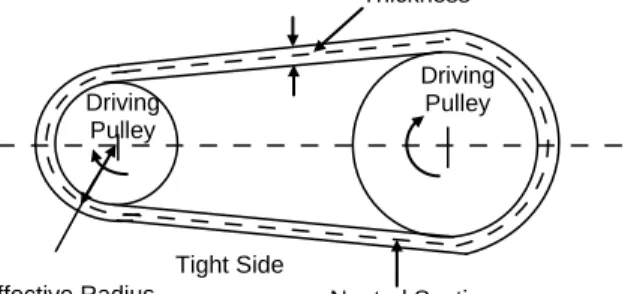
Open belt drive is used when sense of rotation of both the pulleys is same. It is desirable to keep the tight side of the belt on the lower side and slack side at the
81
Power Transmission Devices
top to increase the angle of contact on the pulleys. This type of drive is shown in Figure 3.2.
Figure 3.2 : Open Belt Derive
Cross Belt Drive
In case of cross belt drive, the pulleys rotate in the opposite direction. The angle of contact of belt on both the pulleys is equal. This drive is shown in Figure 3.3. As shown in the figure, the belt has to bend in two different planes. As a result of this, belt wears very fast and therefore, this type of drive is not preferred for power transmission. This can be used for transmission of speed at low power.
Figure 3.3 : Cross Belt Drive
Since power transmitted by a belt drive is due to the friction, belt drive is subjected to slip and creep.
Let d1 and d2 be the diameters of driving and driven pulleys, respectively. N1 and
N2 be the corresponding speeds of driving and driven pulleys, respectively.
The velocity of the belt passing over the driver
1 1 1
60 d N
V
If there is no slip between the belt and pulley
2 2 1 2 60 d N V V or, 1 1 2 2 60 60 d N d N or, 1 2 2 1 N d N d
If thickness of the belt is ‘t’, and it is not negligible in comparison to the diameter,
1 2 2 1 N d t N d t
Let there be total percentage slip ‘S’ in the belt drive which can be taken into account as follows : 2 1 1 100 S V V or 2 2 1 1 1 60 60 100 d N d N S Driving Pulley
Slack Side Thickness
Effective Radius
Driving Pulley
Neutral Section Tight Side
82
Theory of Machines If the thickness of belt is also to be considered
or 1 2 2 1 ( ) 1 ( ) 1 100 N d t S N d t or, 2 1 1 2 ( ) 1 ( ) 100 N d t S N d t
The belt moves from the tight side to the slack side and vice-versa, there is some loss of power because the length of belt continuously extends on tight side and contracts on loose side. Thus, there is relative motion between the belt and pulley due to body slip. This is known as creep.
3.2.2 Chain
The belt drive is not a positive drive because of creep and slip. The chain drive is a positive drive. Like belts, chains can be used for larger centre distances. They are made of metal and due to this chain is heavier than the belt but they are flexible like belts. It also requires lubrication from time to time. The lubricant prevents chain from rusting and reduces wear.
The chain and chain drive are shown in Figure 3.4. The sprockets are used in place of pulleys. The projected teeth of sprockets fit in the recesses of the chain. The distance between roller centers of two adjacent links is known as pitch. The circle passing through the pitch centers is called pitch circle.
(a) (b)
(c) (d) Figure 3.4 : Chain and Chain Drive
Let ‘’ be the angle made by the pitch of the chain, and ‘r’ be the pitch circle radius, then
pitch, 2 sin 2 p r or, cosec 2 2 p r
The power transmission chains are made of steel and hardened to reduce wear. These chains are classified into three categories
(a) Block chain (b) Roller chain
(c) Inverted tooth chain (silent chain)
Pin Pitch Pitch Roller Bushing Sprocket r φ p
83
Power Transmission Devices
Out of these three categories roller chain shown in Figure 3.4(b) is most commonly used. The construction of this type of chain is shown in the figure. The roller is made of steel and then hardened to reduce the wear. A good roller chain is quiter in operation as compared to the block chain and it has lesser wear. The block chain is shown in Figure 3.4(a). It is used for low speed drive. The inverted tooth chain is shown in
Figures 3.4(c) and (d). It is also called as silent chain because it runs very quietly even at higher speeds.
3.2.3 Gears
Gears are also used for power transmission. This is accomplished by the successive engagement of teeth. The two gears transmit motion by the direct contact like chain drive. Gears also provide positive drive.
The drive between the two gears can be represented by using plain cylinders or discs 1 and 2 having diameters equal to their pitch circles as shown in Figure 3.5. The point of contact of the two pitch surfaces shell have velocity along the common tangent. Because there is no slip, definite motion of gear 1 can be transmitted to gear 2 or vice-versa.
The tangential velocity ‘Vp’ = 1r1 = 2r2
where r1 and r2 are pitch circle radii of gears 1 and 2, respectively.
Figure 3.5 : Gear Drive
or, 2 1 1 2 2 2 60 60 N N r r or, N r1 1 N r2 2 or, 1 2 2 1 N r N r
Since, pitch circle radius of a gear is proportional to its number of teeth (t).
1 2
2 1
N t
N t
where t1 and t2 are the number of teeth on gears 1 and 2, respectively.
SAQ 1
In which type of drive centre distance between the shafts is lowest? Give reason for this?
3.3 TRANSMISSION SCREW
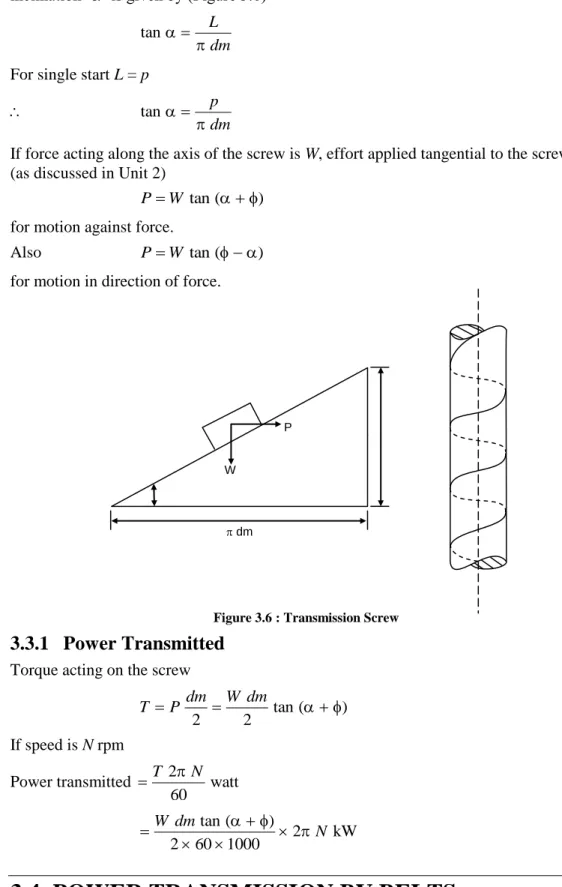
In a screw, teeth are cut around its circular periphery which form helical path. A nut has similar internal helix in its bore. When nut is turned on the screw with a force applied tangentially, screw moves forward. For one turn, movement is equal to one lead. In case of lead screw, screw rotates and nut moves along the axis over which tool post is mounted. N1 N2 2 1 VP
84
Theory of Machines Let dm be the mean diameter of the screw,
be angle of friction, and p be the pitch.
If one helix is unwound, it will be similar to an inclined plane for which the angle of inclination ‘’ is given by (Figure 3.6)
tan
L dm For single start L = p
tan
p dm
If force acting along the axis of the screw is W, effort applied tangential to the screw (as discussed in Unit 2)
tan ( )
P W
for motion against force.
Also PW tan ( )
for motion in direction of force.
Figure 3.6 : Transmission Screw
3.3.1 Power Transmitted
Torque acting on the screw
tan ( )
2 2
dm W dm
T P
If speed is N rpm
Power transmitted 2 watt
60 T N tan ( ) 2 kW 2 60 1000 W dm N
3.4 POWER TRANSMISSION BY BELTS
In this section, we shall discuss how power is transmitted by a belt drive. The belts are used to transmit very small power to the high amount of power. In some cases magnitude of the power is negligible but the transmission of speed only may be important. In such cases the axes of the two shafts may not be parallel. In some cases to increase the angle
L = p W
P
85
Power Transmission Devices
of lap on the smaller pulley, the idler pulley is used. The angle of lap may be defined as the angle of contact between the belt and the pulley. With the increase in angle of lap, the belt drive can transmit more power. Along with the increase in angle of lap, the idler pulley also does not allow reduction in the initial tension in the belt. The use of idler pulley is shown in Figure 3.7.
Figure 3.7 : Use of Idler in Belt Drive
SAQ 2
(a) What is the main advantage of idler pulley?
(b) A prime mover drives a dc generator by belt drive. The speeds of prime mover and generator are 300 rpm and 500 rpm, respectively. The diameter of the driver pulley is 600 mm. The slip in the drive is 3%. Determine diameter of the generator pulley if belt is 6 mm thick.
3.4.1 Law of Belting
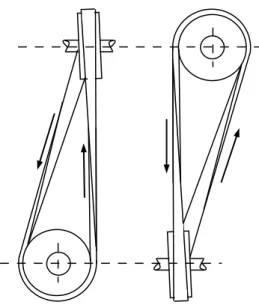
The law of belting states that the centre line of the belt as it approaches the pulley, must lie in plane perpendicular to the axis of the pulley in the mid plane of the pulley
otherwise the belt will run off the pulley. However, the point at which the belt leaves the other pulley must lie in the plane of a pulley.
The Figure 3.8 below shows the belt drive in which two pulleys are at right angle to each other. It can be seen that the centre line of the belt approaching larger or smaller pulley lies in its plane. The point at which the belt leaves is contained in the plane of the other pulley.
If motion of the belt is reversed, the law of the belting will be violated. Therefore, motion is possible in one direction in case of non-parallel shafts as shown in Figure 3.8.
Figure 3.8 : Law of Belting
86
Theory of Machines
3.4.2 Length of the Belt
For any type of the belt drive it is always desirable to know the length of belt required. It will be required in the selection of the belt. The length can be determined by the
geometric considerations. However, actual length is slightly shorter than the theoretically determined value.
Open Belt Drive
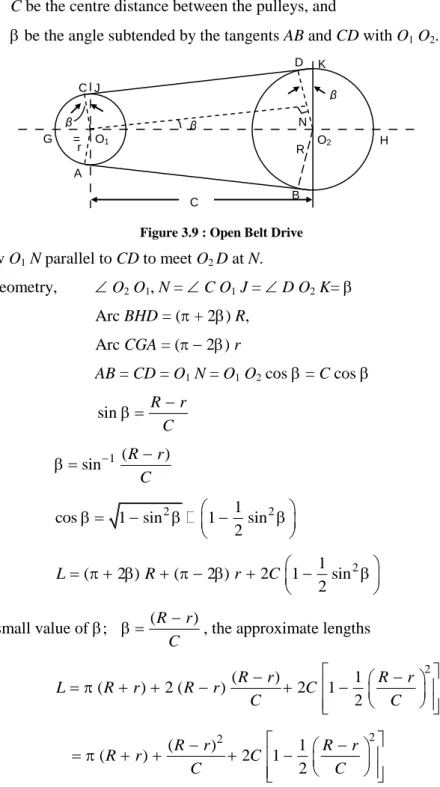
The open belt drive is shown in Figure 3.9. Let O1 and O2 be the pulley centers
and AB and CD be the common tangents on the circles representing the two pulleys. The total length of the belt ‘L’ is given by
L = AB + Arc BHD + DC + Arc CGA Let r be the radius of the smaller pulley,
R be the radius of the larger pulley,
C be the centre distance between the pulleys, and
be the angle subtended by the tangents AB and CD with O1O2.
Figure 3.9 : Open Belt Drive
Draw O1N parallel to CD to meet O2 D at N.
By geometry, O2O1, N = C O1J = D O2K= Arc BHD = ( + 2) R, Arc CGA = ( 2) r AB = CD = O1N = O1O2 cos = C cos sin R r C or, sin 1 (R r) C 2 1 2
cos 1 sin 1 sin
2 ( 2 ) ( 2 ) 2 1 1 sin2 2 L R r C
For small value of ; (R r) C
, the approximate lengths
2 ( ) 1 ( ) 2 ( ) 2 1 2 R r R r L R r R r C C C 2 2 ( ) 1 ( ) 2 1 2 R r R r R r C C C
This provides approximate length because of the approximation taken earlier.
D K C A B G C J β = r β O1 O2 R N H β
87
Power Transmission Devices
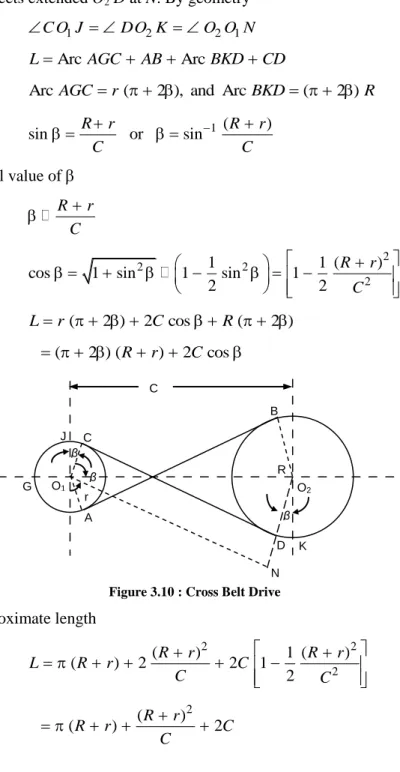
Crossed-Belt Drive
The crossed-belt drive is shown in Figure 3.10. Draw O1N parallel to the line CD
which meets extended O2D at N. By geometry
1 2 2 1
C O J DO K O O N
Arc Arc
L AGCAB BKDCD
Arc AGCr( 2 ), and ArcBKD ( 2 )R
1 ( ) sin R r or sin R r C C
For small value of
R r C 2 2 2 2 1 1 ( )
cos 1 sin 1 sin 1
2 2 R r C ( 2 ) 2 cos ( 2 ) Lr C R ( 2 ) (Rr)2Ccos
Figure 3.10 : Cross Belt Drive
For approximate length
2 2 2 ( ) 1 ( ) ( ) 2 2 1 2 R r R r L R r C C C 2 ( ) (R r) R r 2C C
SAQ 3
Which type of drive requires longer length for same centre distance and size of pulleys?
3.4.3 Cone Pulleys
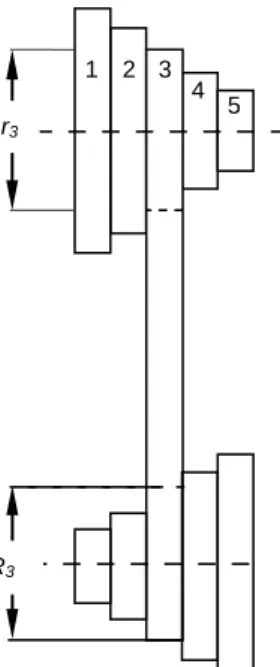
Sometimes the driving shaft is driven by the motor which rotates at constant speed but the driven shaft is designed to be driven at different speeds. This can be easily done by using stepped or cone pulleys as shown in Figure 3.11. The cone pulley has different sets of radii and they are selected such that the same belt can be used at different sets of the cone pulleys. A G C J β r D K β O1 O2 R N C β B
88
Theory of Machines
Figure 3.11 : Cone Pulleys
Let Nd be the speed of the driving shaft which is constant.
Nn be the speed of the driven shaft when the belt is on nth step. rn be the radius of the nth step of driving pulley.
Rn be the radius of the nth step of the driven pulley.
where n is an integer, 1, 2, . . .
The speed ratio is inversely proportional to the pulley radii
1 1
1 d
N r
N R . . . (3.1)
For this first step radii r1 and R1 can be chosen conveniently.
For second pair 2 2 2 d N r N R , and similarly n n d n N r N R .
In order to use same belt on all the steps, the length of the belt should be same
i.e. L1L2 . . .Ln . . . (3.2)
Thus, two equations are available – one provided by the speed ratio and other provided by the length relation and for selected speed ratio, the two radii can be calculated. Also it has to be kept in mind that the two pulleys are same. It is desirable that the speed ratios should be in geometric progression.
Let k be the ratio of progression of speed.
2 3 1 2 1 . . . n n N N N k N N N 2 2 1 and 3 1 N k N N k N 1 1 1 1 1 n n n d r N k N k N R 2 1 3 2 1 2 1 3 1 and r r r r k k R R R R
Since, both the pulleys are made similar.
1 r3 R3 2 3 4 5
89 Power Transmission Devices 1 1 1 1 1 1 1 or n n n r R r R k R r R r or, 1 1 1 n R k r . . . (3.3)
If radii R1 and r1 have been chosen, the above equations provides value of k or
vice-versa.
SAQ 4
How the speed ratios are selected for cone pulleys?
3.4.4 Ratio of Tensions
The belt drive is used to transmit power from one shaft to the another. Due to the friction between the pulley and the belt one side of the belt becomes tight side and other
becomes slack side. We have to first determine ratio of tensions. Flat Belt
Let tension on the tight side be ‘T1’ and the tension on the slack side be ‘T2’. Let
‘’ be the angle of lap and let ‘’ be the coefficient of friction between the belt and the pulley. Consider an infinitesimal length of the belt PQ which subtend an angle at the centre of the pulley. Let ‘R’ be the reaction between the element and the pulley. Let ‘T’ be tension on the slack side of the element, i.e. at point P and let ‘(T + T)’ be the tension on the tight side of the element.
The tensions T and (T + T) shall be acting tangential to the pulley and thereby normal to the radii OP and OQ. The friction force shall be equal to ‘R’ and its action will be to prevent slipping of the belt. The friction force will act
tangentially to the pulley at the point S.
Figure 3.12 : Ratio of Tensions in Flat Belt
Considering equilibrium of the element at S and equating it to zero. Resolving all the forces in the tangential direction
cos ( ) cos 0 2 2 R T T T or, cos 2 R T . . . (3.4) T + ST R R S Q P δ θ O T2 T T1 θ δ θ 2 δθ 2
90
Theory of Machines Resolving all the forces in the radial direction at S and equating it to zero.
sin ( ) sin 0 2 2 RT T T or, (2 ) sin 2 R T T
Since is very small, taking limits
cos 1 and sin
2 2 2 (2 ) 2 2 R T T T T
Neglecting the product of the two infinitesimal quantities 2
T
which is negligible in comparison to other quantities :
R T
Substituting the value of R and cos 1 2 in Eq. (3.4), we get T T or, T T
Taking limits on both sides as 0 dT
d
T
Integrating between limits, it becomes
1 2 0 T T dT d T
or, 1 2 ln T T or, 1 2 T e T . . . (3.5) V-belt or RopeThe V-belt or rope makes contact on the two sides of the groove as shown in Figure 3.13.
(a) (b) Figure 3.13 : Ratio of Tension in V-Belt
T + δ T 2 Rn sinα S Q δ θ/2 2μ Rn P O T2 T T1 θ δ θ/2 α 2α Rn α Rn
91
Power Transmission Devices
Let the reaction be ‘Rn’ on each of the two sides of the groove. The resultant
reaction will be 2Rn sin at point S.
Resolving all the forces tangentially in the Figure 3.13(b), we get
2 cos ( ) cos 0 2 2 n R T T T or, 2 cos 2 n R T . . . (3.6)
Resolving all the forces radially, we get
2 sin sin ( ) sin
2 2 n R T T T (2 ) sin 2 T T
Since is very small sin 2 2 2 sin (2 ) 2 2 n R T T T T Neglecting the product of the two infinitesimal quantities
2Rn sin T or, 2sin n T R
Substituting the value of Rn and using the approximation cos 1
2 , in Eq. (3.6), we get sin T T or, sin T T
Taking the limits and integrating between limits, we get
1 2 0 sin T T dT d T
or, 1 2 ln sin T T or, 1 sin 2 T e T . . . (3.7)SAQ 5
(a) If a rope makes two full turn and one quarter turn how much will be angle of lap?
(b) If smaller pulley has coefficient of friction 0.3 and larger pulley has
coefficient of friction 0.2. The angle of lap on smaller and larger pulleys are 160o and 200o which value of () should be used for ratio of tensions?
92
Theory of Machines
3.4.5 Power Transmitted by Belt Drive
The power transmitted by the belt depends on the tension on the two sides and the belt speed.
Let T1 be the tension on the tight side in ‘N’
T2 be the tension on the slack side in ‘N’, and
V be the speed of the belt in m/sec.
Then power transmitted by the belt is given by
Power P(T1T2)V Watt ( 1 2) kW 1000 T T V . . . (3.8) or, 2 1 1 1 kW 1000 T T V T P
If belt is on the point of slipping.
1 2 T e T 1(1 ) kW 1000 T e V P . . . (3.9)
The maximum tension T1 depends on the capacity of the belt to withstand force. If
allowable stress in the belt is ‘t’ in ‘Pa’, i.e. N/m
2
, then
1 ( t ) N
T t b . . . (3.10)
where t is thickness of the belt in ‘m’ and b is width of the belt also in m.
The above equations can also be used to determine ‘b’ for given power and speed.
3.4.6 Tension due to Centrifugal Forces
The belt has mass and as it rotates along with the pulley it is subjected to centrifugal forces. If we assume that no power is being transmitted and pulleys are rotating, the centrifugal force will tend to pull the belt as shown in Figure 3.14(b) and, thereby, a tension in the belt called centrifugal tension will be introduced.
(a) (b) Figure 3.14 : Tension due to Centrifugal Foces
Let ‘TC’ be the centrifugal tension due to centrifugal force.
Let us consider a small element which subtends an angle at the centre of the pulley. Let ‘m’ be the mass of the belt per unit length of the belt in ‘kg/m’.
TC TC δ θ/2 r δ θ/2 FC TC TC δ θ
93
Power Transmission Devices
The centrifugal force ‘Fc’ on the element will be given by
2 ( ) C V F r m r
where V is speed of the belt in m/sec. and r is the radius of pulley in ‘m’.
Resolving the forces on the element normal to the tangent
2 sin 0
2
C C
F T
Since is very small.
sin 2 2 or, 2 0 2 C C F T or, FC TC Substituting for FC 2 C m V r T r or, TC m V2 . . . (3.11)
Therefore, considering the effect of the centrifugal tension, the belt tension on the tight side when power is transmitted is given by
Tension of tight side Tt T1 TC and tension on the slack side Ts T2 TC.
The centrifugal tension has an effect on the power transmitted because maximum tension can be only Tt which is
t t T t b 2 1 t T t b m V
SAQ 6
What will be the centrifugal tension if mass of belt is zero?
3.4.7 Initial Tension
When a belt is mounted on the pulley some amount of initial tension say ‘T0’ is provided
in the belt, otherwise power transmission is not possible because a loose belt cannot sustain difference in the tension and no power can be transmitted.
When the drive is stationary the total tension on both sides will be ‘2 T0’.
When belt drive is transmitting power the total tension on both sides will be (T1 + T2),
where T1 is tension on tight side, and T2 is tension on the slack side.
If effect of centrifugal tension is neglected.
0 1 2
94 Theory of Machines or, 0 1 2 2 T T T
If effect of centrifugal tension is considered, then
0 t s 1 2 2 C T T T T T T or, 0 1 2 2 C T T T T . . . (3.12)
3.4.8 Maximum Power Transmitted
The power transmitted depends on the tension ‘T1’, angle of lap , coefficient of friction
‘’ and belt speed ‘V’. For a given belt drive, the maximum tension (Tt), angle of lap and
coefficient of friction shall remain constant provided that
(a) the tension on tight side, i.e. maximum tension should be equal to the maximum permissible value for the belt, and
(b) the belt should be on the point of slipping.
Therefore, Power P T1 (1e) V Since, T1 Tt Tc
or, P(Tt Tc) (1e)V or, P(Tt m V2) (1e)V For maximum power transmitted
( 3 2) (1 ) t dP T m V e dV or, Tt 3m V2 0 or, Tt 3Tc 0 or, 3 t c T T or, 2 3 Tt m V Also, 3 t T V m . . . (3.13)
At the belt speed given by the Eq. (3.13) the power transmitted by the belt drive shall be maximum.
SAQ 7
What is the value of centrifugal tension corresponding to the maximum power transmitted?
95
Power Transmission Devices
3.5 KINEMATICS OF CHAIN DRIVE
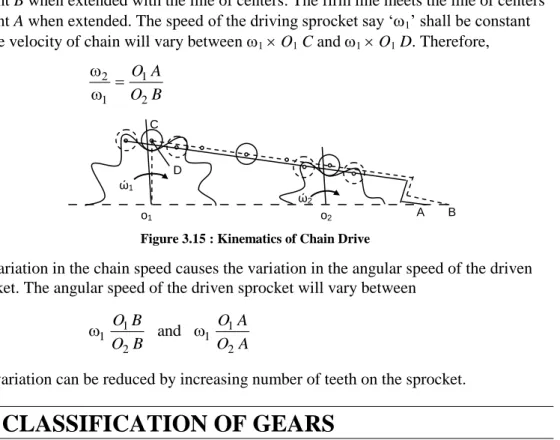
The chain is wrapped round the sprocket as shown in Figure 3.4(d). The chain in motion is shown in Figure 3.15. It may be observed that the position of axial line changes between the two position as shown by the dotted line and full line. The dotted line meets at point B when extended with the line of centers. The firm line meets the line of centers at point A when extended. The speed of the driving sprocket say ‘1’ shall be constant
but the velocity of chain will vary between 1O1C and 1O1D. Therefore,
2 1 1 2 O A O B
Figure 3.15 : Kinematics of Chain Drive
The variation in the chain speed causes the variation in the angular speed of the driven sprocket. The angular speed of the driven sprocket will vary between
1 1 1 1 2 2 and O B O A O B O A
This variation can be reduced by increasing number of teeth on the sprocket.
3.6 CLASSIFICATION OF GEARS
There are different types of arrangement of shafts which are used in practice. According to the relative positions of shaft axes, different types of gears are used.
3.6.1 Parallel Shafts
In this arrangement, the shaft axes lie in parallel planes and remain parallel to one another. The following type of gears are used on these shafts :
Spur Gears
These gears have straight teeth with their alignment parallel to the axes. These gears are shown in mesh in Figures 3.16(a) and (b). The contact between the two meshing teeth is along a line whose length is equal to entire length of teeth. It may be observed that in external meshing, the two shafts rotate opposite to each other whereas in internal meshing the shafts rotate in the same sense.
(a) External Meshing (b) Internal Meshing Figure 3.16 : Spur Gears
If the gears mesh externally and diameter of one gear becomes infinite, the arrangement becomes ‘Spur Rack and Pinion’. This is shown in Figure 3.17. It converts rotary motion into translatory motion, or vice-versa.
ώ1 ώ2 o1 o2 D C A B Line Contact Line Contact
96
Theory of Machines
Figure 3.17 : Spur Rack and Pinion
Helical Gears or Helical Spur Gears
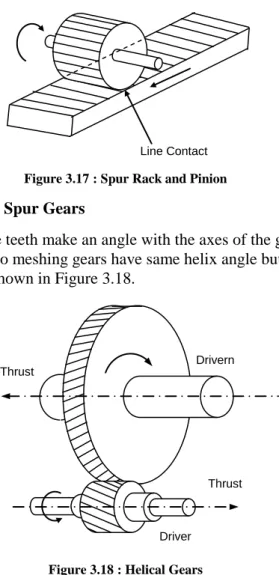
In helical gears, the teeth make an angle with the axes of the gears which is called helix angle. The two meshing gears have same helix angle but its layout is in opposite sense as shown in Figure 3.18.
Figure 3.18 : Helical Gears
The contact between two teeth occurs at a point of the leading edge. The point moves along a diagonal line across the teeth. This results in gradual transfer of load and reduction in impact load and thereby reduction in noise. Unlike spur gears the helical gears introduce thrust along the axis of the shaft which is to be borne by thrust bearings.
Double-Helical or Herringbone Gears
A double-helical gear is equivalent to a pair of helical gears having equal helix angle secured together, one having a right-hand helix and the other a left-hand helix. The teeth of two rows are separated by a groove which is required for tool run out. The axial thrust which occurs in case of single-helical gears is eliminated in double helical gears. If the left and right inclinations of a double helical gear meet at a common apex and groove is eliminated in it, the gear is known as herringbone gear as shown in Figure 3.19.
Figure 3.19 : Herringbone Gears
Line Contact
Drivern Thrust
Thrust
97
Power Transmission Devices
3.6.2 Intersecting Shafts
The motion between two intersecting shafts is equivalent to rolling of two conical frustums from kinematical point of view.
Straight Bevel Gears
These gears have straight teeth which are radial to the point of intersection of the shaft axes. Their teeth vary in cross section through out their length. Generally, they are used to connect shafts at right angles. These gears are shown in Figure 3.20. The teeth make line contact like spur gears.
Figure 3.20 : Straight Bevel Gears
As a special case, gears of the same size and connecting two shafts at right angle to each other are known as mitre gears.
Spiral Bevel Gears
When the teeth of a bevel gear are inclined at an angle to the face of the bevel, these gears are known as spiral bevel gears or helical bevel gears. A gear of this type is shown in Figure 3.21(a). They run quiter in action and have point contact. If spiral bevel gear has curved teeth but with zero degree spiral angle, it is known as zerol bevel gear.
(a) Spiral Bevel Gear (b) Zerol Bevel Gear Figure 3.21 : Spiral Bevel Gears
3.6.3 Skew Shafts
These shafts are non-parallel and non-intersecting. The motion of the two mating gears is equivalent to motion of two hyperboloids in contact as shown in Figure 3.22. The angle between the two shafts is equal to the sum of the angles of the two hyperboloids. That is
1 2
The minimum perpendicular distance between the two shafts is equal to the sum of the throat radii.
Figure 3.22 : Hyperboloids in Contact
Ψ2 Ψ1 θ B 1 2 A Line of contact
98
Theory of Machines Crossed-Helical Gears or Spiral Gears
They can be used for any two shafts at any angle as shown in Figure 3.23 by a suitable choice of helix angle. These gears are used to drive feed mechanisms on machine tool.
Figure 3.23 : Spiral Gears in Contact
Worm Gears
It is a special case of spiral gears in which angle between the two axes is generally right angle. The smaller of the two gears is called worm which has large spiral angle. These are shown in Figure 3.24.
(a) (b)
(c) (d)
Figure 3.24 : Worm Gears
Hypoid Gears
These gears are approximations of hyperboloids though look like spiral bevel gears. The hypoid pinion is larger and stronger than a spiral bevel pinion. They have quit and smooth action and have larger number of teeth is contact as compared to straight bevel gears. These gears are used in final drive of vehicles. They are shown in Figure 3.25.
Figure 3.25 : Hypoid Gears
1
99
Power Transmission Devices
3.7 GEAR TERMINOLOGY
Before considering kinematics of gears we shall define the terms used for describing the shape, size and geometry of a gear tooth. The definitions given here are with respect to a straight spur gear.
Pitch Circle or Pitch Curve
It is the theoretical curve along which the gear rolls without slipping on the corresponding pitch curve of other gear for transmitting equivalent motion.
Pitch Point
It is the point of contact of two pitch circles.
Pinion
It is the smaller of the two mating gears. It is usually the driving gear.
Rack
It is type of the gear which has infinite pitch circle diameter.
Circular Pitch
It is the distance along the pitch circle circumference between the corresponding points on the consecutive teeth. It is shown in Figure 3.26.
Figure 3.26 : Gear Terminology
If d is diameter of the pitch circle and ‘T’ be number of teeth, the circular pitch (pc) is given by c d p T . . . (3.14) Diamental Pitch
It is defined as the number of teeth per unit pitch circle diameter. Therefore, diamental pitch (pd) can be expressed as
d
T p
d
. . . (3.15)
From Eqs. (3.14) and (3.15)
c d d p T p d or, p pc d . . . (3.16) Circular Pitch Top Land Face Flank Addendu mm Working Depth Clearance Dedendum Bottom Land Dedendum (Root) Circle Pitch Circle Addendum Circle Face Width Space
Width ThicknesTooth s
100
Theory of Machines Module
It is the ratio of the pitch circle diameter to the number of teeth. Therefore, the module (m) can be expressed as
d m T . . . (3.17) From Eqs. (8.14) c p m . . . (3.18)
Addendum Circle and Addendum
It is the circle passing through the tips of gear teeth and addendum is the radial distance between pitch circle and the addendum circle.
Dedendum Circle and Dedendum
It is the circle passing through the roots of the teeth and the dedendum is the radial distance between root circle and pitch circle.
Full Depth of Teeth and Working Depth
Full depth is sum of addendum and dedendum and working depth is sum of addendums of the two gears which are in mesh.
Tooth Thickness and Space Width
Tooth thickness is the thickness of tooth measured along the pitch circle and space width is the space between two consecutive teeth measured along the pitch circle. They are equal to each other and measure half of circular pitch.
Top Land and Bottom Land
Top land is the top surface of the tooth and the bottom land is the bottom surface between the adjacent fillets.
Face and Flank
Tooth surface between the pitch surface and the top land is called face whereas flank is tooth surface between pitch surface and the bottom land.
Pressure Line and Pressure Angle
The driving tooth exerts a force on the driven tooth along the common normal. This line is called pressure line. The angle between the pressure line and the common tangent to the pitch circles is known as pressure angle.
Path of Contact
The path of contact is the locus of a point of contact of two mating teeth from the beginning of engagement to the end of engagement.
Arc of Approach and Arc of Recess
Arc of approach is the locus of a point on the pitch circle from the beginning of engagement to the pitch point. The arc of recess is the locus of a point from pitch point upto the end of engagement of two mating gears.
Arc of Contact
It is the locus of a point on the pitch circle from the beginning of engagement to the end of engagement of two mating gears.
Arc of Contact = Arc of Approach + Arc of Recess Angle of Action
It is the angle turned by a gear from beginning of engagement to the end of engagement of a pair of teeth.
Angle of action = Angle turned during arc of approach + Angle turned during arc
101
Power Transmission Devices
Contact Ratio
It is equal to the number of teeth in contact and it is the ratio of arc of contact to the circular pitch. It is also equal to the ratio of angle of action to pitch angle.
Figure 3.27 : Gear Terminology
3.8 GEAR TRAIN
A gear train is combination of gears that is used for transmitting motion from one shaft to another.
There are several types of gear trains. In some cases, the axes of rotation of the gears are fixed in space. In one case, gears revolve about axes which are not fixed in space.
3.8.1 Simple Gear Train
In this gear train, there are series of gears which are capable of receiving and
transmitting motion from one gear to another. They may mesh externally or internally. Each gear rotates about separate axis fixed to the frame. Figure 3.28 shows two gears in external meshing and internal meshing.
Let t1, t2 be number of teeth on gears 1 and 2.
(a) External Meshing (b) Internal Meshing Figure 3.28 : Simple Gear Train
B Dedendum Circle Path of Contact Drivers Ψ Pressure Angle Pitch Circle Base Circle Dedendum Circle Angle of Action F P C E A D Pitch Circle + 1 2 + 1 2 P
102
Theory of Machines Let N1, N2 be speed in rpm for gears 1 and 2. The velocity of P,
1 1 2 2 2 2 60 60 P N d N d V 1 2 2 2 1 1 N d t N d t
Referring Figure 3.28, the two meshing gears in external meshing rotate in opposite sense whereas in internal meshing they rotate in same sense. In simple gear train, there can be more than two gears also as shown in Figure 3.29.
Figure 3.29 : Gear Train
Let N1, N2, N3, . . . be speed in rpm of gears 1, 2, 3, . . . etc., and t1, t2, t3, . . . be number
of teeth of respective gears 1, 2, 3, . . . , etc.
In this gear train, gear 1 is input gear, gear 4 is output gear and gears 2, 3 are intermediate gears. The gear ratio of the gear train is give by
Gear Ratio 1 1 2 3 4 2 3 4 N N N N N N N N 1 2 2 3 3 4 2 1 3 2 4 3 ; t and N N t N t N t N t N t Therefore, 1 2 3 4 4 4 1 2 3 1 t N t t t N t t t t
This expression indicates that the intermediate gears have no effect on gear ratio. These intermediate gears fill the space between input and output gears and have effect on the sense of rotation of output gear.
SAQ 8
(a) There are six gears meshing externally and input gear is rotating in clockwise sense. Determine sense of rotation of the output gear. (b) Determine sense of rotation of output gear in relation to input gear if a
simple gear train has four gears in which gears 2 and 3 mesh internally whereas other gears have external meshing.
3.8.2 Compound Gear Train
In this type of gear train, at least two gears are mounted on the same shaft and they rotate at the same speed. This gear train is shown in Figure 3.30 where gears 2 and 3 are mounted on same shaft and they rotate at the same speed, i.e.
2 3
N N
1 2
3
103
Power Transmission Devices
Figure 3.30 : Compound Gear Train
Let N1, N2, N3, . . . be speed in rpm of gears 1, 2, 3, . . . , etc. and t1, t2, t3, . . . , etc. be
number of teeth of respective gears 1, 2, 3, . . . , etc.
Gear Ratio 1 1 2 1 3 4 2 4 2 4 N N N N N N N N N N 2 4 1 3 t t t t
Therefore, unlike simple gear train the gear ratio is contributed by all the gears. This gear train is used in conventional automobile gear box.
Conventional Automobile Gear Box
A conventional gear box of an automobile uses compound gear train. For different gear engagement, it may use sliding mesh arrangement, constant mesh
arrangement or synchromesh arrangement. Discussion of these arrangements is beyond the scope of this course. We shall restrict ourselves to the gear train. It can be explained better with the help of an example.
Example 3.1
A sliding mesh type gear box with four forward speeds has following gear ratios : Top gear = 1
Third gear = 1.38 Second gear = 2.24 First gear = 4
Determine number of teeth on various gears. The minimum number of teeth on the pinion should not be less than 18. The gear box should have minimum size and variation in the ratios should be as small as possible.
Solution
The gears in the gear box are shown in Figure 3.31 below :
Figure 3.31 : Conventional Gear Box
1 2 4 3 A B C E G D F H Dog Clutch Engine Shaft Input Shaft Main Splined Shaft (Output Shaft) Lay Shaft
104
Theory of Machines For providing first gear ratio, gear A meshes with gear B and gear H meshes with
gear G.
Speed of engine shaft First gear ratio =
Speed of output shaft
A A H A H G H G B G N N N N N N N N N N [i.e. NB = NH] B G A H t t t t
For smallest size of gear box B G
A H t t t t B G 4.0 2.0 A H t t t t If tA = 20 teeth tH = 20
tB = 2 20 = 40 teeth and tG = 20 2 = 40 teeth
Since centre distance should be same
tAtB tC tD tE tF tH tG 40 20 60 C D t t . . . (3.19) 60 E F t t . . . (3.20)
For second gear, gear A meshes with gear B and gear E meshes with gear F.
A 2.24 G N N or, A F 2.24 B E N N N N B E 2.24 A F t t t t or, 2 F 2.24 G t t or, 2.24 1.12 2 E F t t . . . (3.21)
From Eqs. (10.2) and (10.3) 1.12tF tF 60 or, 60 28.3 60 2.12 F E F t t t or, tE 6028.331.7
Since number of teeth have to be in full number. Therefore, tF can be either 28 or
29 and tE can be either 31 or 32. If tF = 28 and tE = 32.
Second gear ratio 40 32 2.286
20 28 A E B F t t t t
105
Power Transmission Devices
If tF = 29 and tE = 31.
Second gear ratio 40 31 2.138
20 29
From these two values of gear ratios, 2.286 is closer to 2.24 than 2.138. For third gear, gear A meshes with gear B and gear D meshes with gear C.
A 1.38 C N N or, A D 1.38 B C N N N N or, B C 1.38 A D t t t t or, 40 1.38 20 C D t t 2 C 1.38 D t t or, 1.38 0.69 2 C D t t . . . (3.22)
From Eqs. (3.19) and (3.20) tC = 0.69 tD tD + 0.69 tD = 60 or, 60 35.503 1.69 D t tC 60tD 60.35.50324.497 Either tC = 24 and tD = 36 or tC = 25 and tD = 35.
If tC = 25 and tD = 35.
Third gear ratio 40 25 1.4286
20 35 B C A D t t t t If tC = 24 and tD = 36
Third gear ratio 40 24 1.333
20 36
Since 1.333 is closer to 1.38 as compared to 1.4286. Therefore, tC = 24 and tD = 36
The top gear requires direct connection between input shaft and output shaft.
3.8.3 Power Transmitted by Simple Spur Gear
When power is bring transmitted by a spur gear, tooth load Fn acts normal to the profile.
It can be resolved into two components Fn cos and Fn sin . Fn cos acts tangentially
to the pitch circle and it is responsible for transmission of power Power transmitted (P) = Fn cos . V
106 Theory of Machines Since 2 60 2 N tm V cos 2 60 2 n N tm P F
where t is number of teeth and m is module.
Figure 3.32
Example 3.2
An open flat belt drive is required to transmit 20 kW. The diameter of one of the pulleys is 150 cm having speed equal to 300 rpm. The minimum angle of contact may be taken as 170o. The permissible stress in the belt may be taken as
300 N/cm2. The coefficient of friction between belt and pulley surface is 0.3. Determine
(a) width of the belt neglecting effect of centrifugal tension for belt thickness equal to 8 mm.
(b) width of belt considering the effect of centrifugal tension for the thickness equal to that in (a). The density of the belt material is 1.0 gm/cm3.
Solution
Given that Power transmitted (p) = 20 kW
Diameter of pulley (d) = 150 cm = 1.5 m Speed of the belt (N) = 300 rpm
Angle of lap () 170o 170 2.387 radian 180
Coefficient of friction () = 0.3 Permissible stress () = 300 N/cm2 (a) Thickness of the belt (t) = 8 mm = 0.8 cm
Let higher tension be ‘T1’ and lower tension be ‘T2’.
1 0.3 2.387 2 2.53 T e e T
The maximum tension ‘T1’ is controlled by the permissible stress. Fn
Pressure angle
107 Power Transmission Devices 1 300 0.8 24 N 10 b T b t b Here b is in mm Therefore, 2 1 24 N 2.53 2.53 T b T Velocity of belt 2 2 300 1.5 23.5 m/s 60 2 60 2 N d V Power transmitted ( 1 2) 24 24 23.5 kW 2.53 1000 b p T T V b 1 23.5 347.3 24 1 2.53 1000 1000 b b Since P = 20 kW 347.3 20 1000 b or, 20 1000 36.4 mm 347.3 b
(b) The density of the belt material = 1 gm/cm3 Mass of the belt material/length, m = b t 1 metre
2 1 0.8 100 0.8 10 kg/m 1000 10 b b 3 8b 10 kg/m Centrifugal tension ‘TC’ = m V 2 or, TC 8b103(23.5) = 4.418 N2 b Maximum tension (Tmax) = 24b N
T1Tmax TC 24b4.418b19.58b Power transmitted P T1 1 1 V e 19.58 1 1 23.5 460.177 2.53 1000 1000 b b Also P = 20 kW 460.177 20 1000 b or, b = 45.4 mm
The effect of the centrifugal tension increases the width of the belt required. Example 3.3
An open belt drive is required to transmit 15 kW from a motor running at 740 rpm. The diameter of the motor pulley is 30 cm. The driven pulley runs at 300 rpm and is mounted on a shaft which is 3 metres away from the driving shaft. Density of the leather belt is 0.1 gm/cm3. Allowable stress for the belt material is 250 N/cm2. If coefficient of friction between the belt and pulley is 0.3, determine width of the belt required. The thickness of the belt is 9.75 mm.
108
Theory of Machines Solution
Given data :
Power transmitted (P) = 15 kW
Speed of motor pulley (N1) = 740 rpm
Diameter of motor pulley (d1) = 30 cm
Speed of driven pulley (N2) = 300 rpm
Distance between shaft axes (C) = 3 m
Density of the belt material () = 0.1 gm/cm3 Allowable stress () = 250 N/cm2
Coefficient of friction () = 0.3
Let the diameter of the driven pulley be ‘d2’ N1d1 = N2d2 1 1 2 2 740 30 74 cm 300 N d d N 1 2 1 74 30 sin sin 2 2 300 d d C or, = 0.0734 radian 2 2.94 rad
Mass of belt ‘m’ = b t one metre length
0.1 9.75 100
1000 10 10
b
where ‘b’ is width of the belt in ‘mm’ or, m0.975 10 3bkg/m max 9.75 250 24.375 N 10 10 b T b
Active tension ‘T’ = Tmax – TC
Velocity of belt 2 1 1 60 2 N d V 740 30 60 100 or, V = 11.62 m/s 2 0.975 10 3 (11.62)2 C T m V b = 0.132 b N T124.375b0.132b24.243b Power transmitted P T1 1 1 V e
109 Power Transmission Devices 0.3 2.94 2.47 e e 1 11.62 165 24.243 1 2.47 1000 1000 b P 165 15 or 91 mm 100 b b Example 3.4
An open belt drive has two pulleys having diameters 1.2 m and 0.5 m. The pulley shafts are parallel to each other with axes 4 m apart. The mass of the belt is 1 kg per metre length. The tension is not allowed to exceed 2000 N. The larger pulley is driving pulley and it rotates at 200 rpm. Speed of the driven pulley is 450 rpm due to the belt slip. The coefficient of the friction is 0.3. Determine
(a) power transmitted, (b) power lost in friction, and (c) efficiency of the drive.
Solution
Data given :
Diameter of driver pulley (d1) = 1.2 m
Diameter of driven pulley (d2) = 0.5 m
Centre distance (C) = 4 m Mass of belt (m) = 1 kg/m
Maximum tension (Tmax) = 2000 N
Speed of driver pulley (N1) = 200 rpm
Speed of driven pulley (N2) = 450 rpm
Coefficient of friction () = 0.3 (a) 1 2 1 2 200 20.93 r/s 60 60 N 2 2 2 2 450 47.1 r/s 60 60 N
Velocity of the belt (V) 20.93 1.2 12.56 m/s 2
Centrifugal tension (TC) = m V
2
= 1 (12.56)2 = 157.75 N Active tension on tight side (T1) = Tmax – TC
or, T1 = 2000 – 157.75 = 1842.25 N 1 2 1.2 0.5 sin 0.0875 2 2 4 d d C or, = 5.015o o 180 2 180 2 5.015 169.985 or, 169.985 0.3 1 180 2 2.43 T e e T
110 Theory of Machines Power transmitted ( ) 1 1 1 12.56 2.43 P T 1842.25 1 1 12.56 kW 2.43 1000 = 13.67 kW (b) Power output 1 1 1 2 2 W 2.43 2 d T 1842.25 1 1 47.1 0.5 12.2 kW 2.43 2 1000
Power lost in friction = 13.67 – 12.2 = 1.47 kW
(c) Efficiency of the drive Power transmitted 12.2 0.89 or 89%
Power input 13.67
.
Example 3.5
A leather belt is mounted on two pulleys. The larger pulley has diameter equal to 1.2 m and rotates at speed equal to 25 rad/s. The angle of lap is 150o. The maximum permissible tension in the belt is 1200 N. The coefficient of friction between the belt and pulley is 0.25. Determine the maximum power which can be transmitted by the belt if initial tension in the belt lies between 800 N and 960 N. Solution
Given data :
Diameter of larger pulley (d1) = 1.2 m
Speed of larger pulley 1 = 25 rad/s
Speed of smaller pulley 2 = 50 rad/s
Angle of lap () = 150o
Initial tension (T0) = 800 to 960 N
Let the effect of centrifugal tension be negligible. The maximum tension (T1) = 1200 N
150 0.25 1 180 2 1.924 T e e T 1 2 1200 623.6 N 1.924 1.924 T T 1 2 0 1200 623.6 911.8 N 2 2 T T T
Maximum power transmitted (Pmax) = (T1 – T2) V
Velocity of belt (V) 1 1 1.2 25 2 2 d V = 15 m/s Pmax (1200623.6)V (1200623.6) 15 8646 W or 8.646 kW
111
Power Transmission Devices
Example 3.6
A shaft carries pulley of 100 cm diameter which rotates at 500 rpm. The ropes drive another pulley with a speed reduction of 2 : 1. The drive transmits 190 kW. The groove angle is 40o. The distance between pulley centers is 2.0 m. The coefficient of friction between ropes and pulley is 0.20. The rope weighs 0.12 kg/m. The allowable stress for the rope is 175 N/cm2. The initial tension in the rope is limited to 800 N. Determine :
(a) number of ropes and rope diameter, and (b) length of each rope.
Solution
Given data :
Diameter of driving pulley (d1) = 100 cm = 1 m
Speed of the driving pulley (N1) = 500 rpm
Speed of the driven pulley (N2) = 250 rpm
Power transmitted (P) = 190 kW Groove angle () = 40o Centre distance (C) = 2 m Coefficient of friction () = 0.2 Mass of rope = 0.12 kg/m Allowable stress () = 175 N/cm2 Initial tension (T0) = 800 N
The velocity of rope 1 1 1 500 26.18 m/s
60 60 d N Centrifugal tension (TC) = 0.12 (26.18) 2 = 82.25 N 2 1 ( ) 2 1 sin 0.25 2 2 2 d d C or, = sin 0.25– 1 = 14.18
Angle of lap () = 2 = 151o or 2.636 radian
o 0.2 2.636 sin 20 1 2 4.67 T e T or, T1 = 4.67 T2 Initial tension (T0) 1 2 2 800 2 C T T T T1 T2 1600 2 82.251600164.51435.5 N 4.67T2 T2 1435.5 or, T2 = 253.1 N T1 = 4.67 T2 = 1182.0 N (1 2) (1182.0 253.1) 26.18 24.32 kW 1000 1000 V P T T
Numbers of ropes required (n) 190 7.81 24.32
112
Theory of Machines Maximum tension (Tmax) = T1 + TC
= 1182 + 82.25 = 1264.25 N 2 max 1264.25 4 T d or, 2 1264.25 4 9.2 175 d or, d = 3.03 cm
This is open belt drive, therefore, formula for length of rope is given by
2 2 ( ) 1 ( ) 2 1 2 R r R r L R r C C C 2 2 1 m, 1 1 0.5 m 2 2 2 2 d d R r (1 0.5) (1 0.5)2 2 2 1 1 1 0.5 2 2 2 2 L 1.5 0.25 4 (1 0.5 0.0625) 8.72 m 2 .
3.9 SUMMARY
The power transmission devices are belt drive, chain drive and gear drive. The belt drive is used when distance between the shaft axes is large and there is no effect of slip on power transmission. Chain drive is used for intermediate distance. Gear drive is used for short centre distance. The gear drive and chain drive are positive drives but they are comparatively costlier than belt drive.
Similarly, belt drive should satisfy law of belting otherwise it will slip to the side and drive cannot be performed. When belt drive transmits power, one side will become tight side and other side will become loose side. The ratio of tension depends on the angle of lap and coefficient of friction. If coefficient of friction is same on both the pulleys smaller angle of lap will be used in the formula. If coefficient of friction is different, the minimum value of product of coefficient of friction and angle of lap will decide the ratio of tension, i.e. power transmitted. Due to the mass of belt, centrifugal tension acts and reduces power transmitted. For a given belt drive the power transmitted will be maximum at a speed for which centrifugal tension is one third of maximum possible tension.
The gears can be classified according to the layout of their shafts. For parallel shafts spur or helical gears are used and bevel gears are uded for intersecting shafts. For skew shafts when angle between the axes is 90o worm and worm gears are used. When distance between the axes of shaft is larger and positive drive is required, chain drive is used. We can see the use of chain drive in case of tanks, motorcycles, etc.
3.10 KEY WORDS
Spur Gears : They have straight teeth with teeth layout is parallel to the axis of shaft.
Helical Gears : They have curved or straight teeth and its inclination with shaft axis is called helix angle.
113
Power Transmission Devices
Herringbone Gears : It is a double helical gear having left and right inclinations which meet at a common apex and there is no groove in between them.
Bevel Gear : They have teeth radial to the point of intersection of the shaft axes and they vary in cross-section throughout their length.
Spiral Gears : They have curved teeth which are inclined to the shaft axis. They are used for skew shafts. Worm Gears : It is special case of spiral gears where angle
between axes of skew shafts is 90o.
Rack and Pinion : Rack is special case of a spur gear whose pitch circle diameter is infinite and it meshes with a pinion.
Hypoid Gears : These gears are approximations of hyperboloids but they look like spiral gears.
Pitch Cylinders : A pair of gears in mesh can be replaced by a pair of imaginary friction cylinders which by pure rolling motion transmit the same motion as pair of gears.
Pitch Diameter : It is diameter of pitch cylinders.
Circular Pitch : It is the distance between corresponding points of the consecutive teeth along pitch cylinder.
Diametral Pitch : It is the ratio of number of teeth to the diameter of the pitch cylinders.
Module : It is the ratio of diameter of pitch cylinder to the number of teeth.
Addendum : It is the radial height of tooth above pitch cylinder. Dedendum : It is the radial depth of tooth below pitch cylinder. Pressure Angle : It is the angle between common tangent to the two pitch cylinders and common normal at the point of contact between teeth (pressure line).
3.11 ANSWERS TO SAQs
SAQ 1
Available in text. SAQ 2
(a) Available in text. (b) Available in text. SAQ 3
(a) Available in text. (b) Data given :
Speed of prime mover (N1) = 300 rpm
Speed of generator (N2) = 500 rpm
Diameter of driver pulley (d1) = 600 mm
Slip in the drive (s) = 3% Thickness of belt (t) = 6 mm
114 Theory of Machines If there is no slip 2 1 1 2 N d N d .
If thickness of belt is appreciable and no slip
2 1 1 2 N d t N d t
If thickness of belt is appreciable and slip is ‘S’ in the drive
2 1 1 2 1 100 N d t S N d t 2 500 600 6 3 1 300 d t 100 or, ( 2 6) 606 300 0.97 352.692 500 d or, d2 352.692 6 346.692 mm SAQ 4 Available in text. SAQ 5 Available in text. SAQ 6 Available in text. SAQ 7 Available in text. SAQ 8 Available in text.