Care plan implementation involves an array of care management activities through which the care plan is put into effect. These activities may include providing information about available services, as well as educating clients and family members about how to access services or perform specific care activities themselves. It may also entail “service coordination,” which we define as the active involvement of a person or persons, such as clients, family members, or case managers, in arranging for or
maintaining specific services.
Geron & Chassler (1994) state that care plan implementation should be timely and cost-effective, with the goal of maximizing “client independence and choice while using the least intensive, least intrusive, most cost effective, and highest quality interventions.” Information and education are also seen as important components of the process, since many consumers are not knowledgeable about the long-term care system and require specific instruction about how to maximize their access to and utilization of needed health and social services (Seltzer et al., 1987; Quinn, 1993; Geron & Chassler, 1994). There is also recognition that implementation involves a variety of considerations, such as the services and goals identified in the care plan, funding limits and authority to purchase services, availability of local providers, and size of caseload (Quinn, 1993; GAO, 1993; Geron & Chassler, 1994).
It is widely recognized that not all clients need or want help with implementing their care plans. For example, they may not need information about services when the care plan is simply a replication of services already in place, or they may wish to coordi-nate services themselves or have family members who are capable and willing to do this. On the other hand, some clients do not have the capacity or desire to implement their own
care plans due to factors such as lack of family support or cognitive or physical impair-ment. Under these circumstances, assistance with implementation of care plans for these clients, including service coordination, may be desired by them or required to ensure safety.
In this chapter, we review care management activities related to the implementa-tion of the care plans. Case records and policyholder reports of implementaimplementa-tion activities are examined in light of Partnership regulations and established practice standards. Areas examined include: documentation of implementation activities, information and educa-tion, service coordinaeduca-tion, system coordinaeduca-tion, client participaeduca-tion, and, consumer satisfaction.
Documentation of Implementation Activities
The three CMPAs vary considerably in the details provided in their manuals regarding their definitions of care plan implementation. One includes it in a description of the role of the care manager: “Contact client and direct service providers and arrange for . . . service delivery.” Another CMPA refers to “coordination and implementation” following the development of the care plan, stating that it will be “. . . scheduled on a case by case basis, mostly by telephone.” The third CMPA’s description originally included two distinct levels of implementation, one which was primarily involved in assisting the client or family to implement the care plan themselves by providing information or education, and another in which the care manager assumed full responsibility for all service
arrangements. This policy was subsequently replaced with a new care management schema, which includes a uniform “care planning and implementation” phase that is specifically authorized and ordered in writing by the insurer’s agent for all clients.
According to this new policy, implementation entails identifying, arranging, and coordi-nating needed services by the care manager, as agreed upon by the policyholder or official designee, and begins immediately after the care plan is finalized with the policyholder.
Analysis of Case Records
Of the 33 case records reviewed, 19 contained documentation that at least one care plan implementation activity was performed by the case manager. Fourteen case records had no evidence of any implementation activities; 11 of these had no progress notes, and the 3 case records that contained progress notes lacked any specific documentation related to implementation activities (Table 22).
Table 22. Documented Evidence of Care Plan Implementation
Data Source Frequency
Case records Evidence of implementation No evidence of implementation 19 14 Note: n=33
Of the 19 cases reviewed, 7 included explicit orders to institute the “care planning and implementation” phase. Another 10 cases contained progress notes reflecting various implementation activities immediately after the care plan was finalized, but lacked any official orders for care plan implementation. The remaining two cases were administered by another CMPA, which labeled these activities as implementation, although they occurred during the first few weeks after development of the care plan (Table 23).
Table 23. Care Plan Implementation Delineated Implementation phase delineated
Phase ordered (7)
Phase not ordered but apparent in notes (10)
17
Implementation phase not delineated 2
Note:n=19
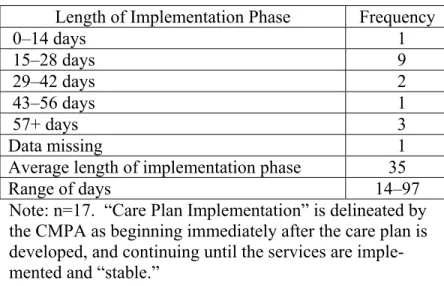
Two of the CMPAs do not appear to have placed a specific timeframe on imple-mentation activities. In the case of the third CMPA, the “care planning and implementa-tion” phase appears to be a start-up activity rather than an ongoing activity. This is rein-forced by the CMPA’s description of its next case management phase, the “ongoing case management” phase, which was ordered after care plan implementation when services were in place and “stable.” Case records for this ongoing care management phase were distinct, and characterized by structured monthly monitoring progress notes, typically extending for several months. For 16 of the 17 cases administered by this CMPA, the average time span for care plan implementation was 35 days, with a low of 14 days and a high of 97 days, even in those cases in which orders indicated that the implementation phase was to extend for only 7 days (Table 24).
Table 24. Time Span for Care Plan Implementation Phase Length of Implementation Phase Frequency
0–14 days 1 15–28 days 9 29–42 days 2 43–56 days 1 57+ days 3 Data missing 1
Average length of implementation phase 35
Range of days 14–97
Note: n=17. “Care Plan Implementation” is delineated by the CMPA as beginning immediately after the care plan is developed, and continuing until the services are imple- mented and “stable.”
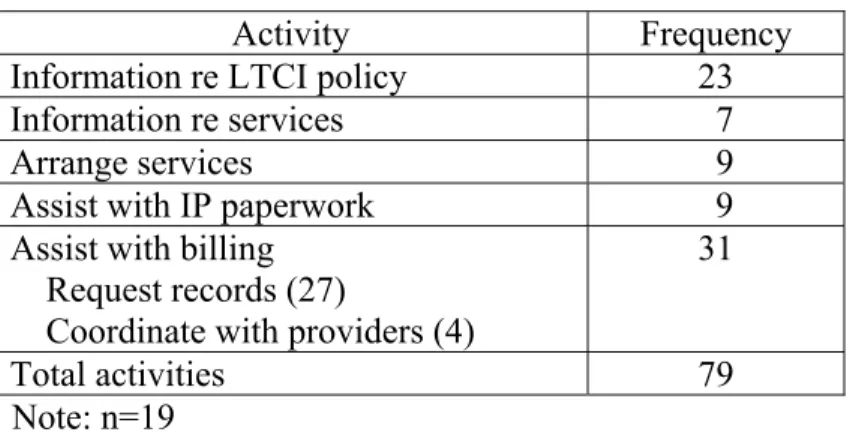
Case records revealed that a variety of implementation activities were performed. A total of 79 separate implementation activities were noted in the 19 cases in which implementation activities were documented. These activities fell into five general categories: general education/information about available services, information about policy coverage, arrangement of services, assistance with paperwork for independent providers (IP), and assistance with billing/payment. The first two items regarding infor-mation and education will be discussed separately from the three latter items, which fall under our definition of “service coordination” (Table 25).
Table 25. Types/Instances of Implementation Activities
Activity Frequency
Information re LTCI policy 23
Information re services 7
Arrange services 9
Assist with IP paperwork 9
Assist with billing Request records (27)
Coordinate with providers (4)
31
Total activities 79
Note: n=19
Information and Education
Providing information about available services, and educating clients and their families about how to access these services, is a basic component of implementing care plans. Most consumers are unaware of the full array of available services or how to contact services they may have heard about. Provision of prepared lists and brochures describing specific services that might meet their needs and instruction about how to obtain such information for themselves is an essential role of care managers. Once appropriate serv-ices have been identified, many clients need further assistance in understanding the complexities of eligibility requirements and application procedures in order to
success-fully negotiate service systems. This information is particularly important when clients implement their own plans. In addition, some clients may need tips on hiring and super-vising in-home workers, and may also benefit from education about specific health conditions and self-management.
Analysis of Case Records
Of the 79 separate implementation activities documented, 7 involved providing informa-tion about available services. The most common type of informainforma-tion provided related to home-care agencies; assisted living and skilled nursing facilities were the second most common type of information provided. In several instances, the type of material provided was noted (i.e., list or directory), although no mention was made in any of the case notes about whether these materials were prepared by the care managers or obtained from other sources, or whether they were comprehensive listings of all available services or selective listings.
An additional type of information that is typically needed by policyholders of long-term care insurance policies relates to their policy coverage. Twelve of the 19 case records that documented implementation activities noted 23 separate conversations related to policy information between policyholders or family members and care advisors or insurer’s agents. The most common questions related specifically to the deductible or “elimination” period, including what services would meet it, how was it calculated, what paperwork was required to verify expenditures made, and how would they know when it was met. These questions were generally asked during the first several weeks following the initial claim, and then tapered off.
Service Coordination
Service coordination differs from information and education in that it entails the active involvement of individuals, such as clients themselves, their family members, or care managers, in arranging for or maintaining specific services.
Although CPLTC regulations do not define service coordination, the following statute reflects this variability in need for service coordination by specifying a decision- making process that involves two distinct, but linked processes:
CPLTC 1993, § 58004; 1999, § 58005. “Care Management/Care Coordination” includes, but is not limited to the following:
(d) when desired by the individual and determined necessary by the Care Management Provider Agency, coordination of appropriate services and ongoing monitoring of the delivery of such services.
Regulations also specify that these services, when elected, can be considered a “claim cost:”
CPLTC 1993 and 1999, § 58059(f). Care management services by a Care Management Provider Agency .Charges for the initial assessment and individual Plan of Care provided by a Care Management Provider Agency shall not be considered as a claim cost. Charges for coordinating the provision of care and monitoring services can be considered as a claim cost.
Most Partnership insurers administer service coordination as an optional claim cost that is billed under policyholders’ policies. One insurer includes service coordination as an administrative expense during its care plan implementation phase, and makes these services available to all of their policyholders for at least seven days.
According to Weil (1985), the heart of service coordination is getting all the pieces of the care plan into place so that they are carried out in a logical sequence. Specific service coordination activities may include working with providers to assure service availability; locating other providers, and developing substitute services when necessary (Capitman, Haskins, & Bernstein, 1986); sending written service requests to
appropriate service providers; establishing a minimum response time between ordering services and the first monitoring contact to determine whether the service has been provided in a timely manner (NCOA, 1994); contacting service providers; assisting with paperwork related to services; coordinating payment sources; and handling bills. Other activities include identifying, negotiating with, and coordinating service providers (Quinn, 1993), and informing the consumer’s family, service providers, and health and social service providers of relevant information from the assessment and care plan (Applebaum & Austin, 1990; Brubaker, 1987). These activities may involve distributing written requests for services, and possibly copies of the care plan, to the involved formal service providers.
Coordination of services for persons who have disabilities and chronic conditions poses special challenges. These services are likely to be provided by a number of
different formal and informal providers in acute and long-term care service systems having different payors with diverse policies and procedural requirements. Therefore, coordination requires that the care manager be knowledgeable about these funding
sources in order to ensure the “continuity and complementarity” of the range of necessary interventions (NASW, 1992). Coordination of payment sources is particularly important under private long-term care insurance policies such as Partnership policies. CPLTC regulations require that the care manager link the person to a full range of services using all available funding sources, and integrates acute care with chronic care to avoid service duplication. Moreover, Partnership policies will only reimburse for long-term care services after all other funding sources, such as Medicare, have paid. Therefore, an important part of the service coordination process under the Partnership involves
coordinating with other payors such as Medicare, acute care health plans, and supplemental insurance plans.
Analysis of Case Records
Of the 33 case records reviewed, care manager progress notes indicated that service coor-dination was provided in 19 cases; in 4 of these cases, service coorcoor-dination was provided directly by the insurer rather than by a local care manager. UDS data indicated that “coordination” was reported for only 8 of the 33 cases. Moreover, it is unclear whether this category was interpreted as meaning “service coordination” only, or if it was used for all implementation activity including service coordination. Of these eight cases reported in the UDS, only three cases also showed evidence in progress notes of service coordination (Table 26).
Table 26. Policyholders Receiving Service Coordination
Data Source Yes No
Case records 19 24
UDS 8 25
Note: n=33
Of the 19 case records documenting service coordination, only 1 contained docu-mentation that the policyholder expressed a desire for it and that there was a determina-tion of its necessity. This determinadetermina-tion was done by an insurance agent, not a care manager or CMPA as specified in regulations, who also stated incorrectly in a file note that coordination was “required” since it was a Partnership case. Also of interest is that the insurance agent contacted an agency directly rather than referring the case to the CMPA. An entry for service coordination did not appear on the UDS for this case.
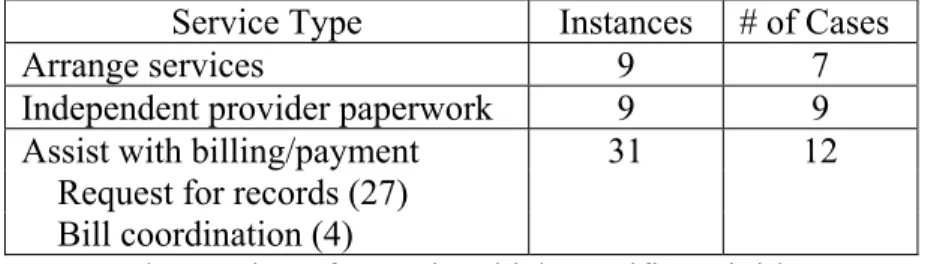
Detailed analysis of the 19 cases documenting service coordination revealed 47 separate instances of service coordination. These activities fell into three general types:
assistance with billing/payment, arranging services, and assistance with paperwork related to independent home-care providers. Assistance with billing and payment for services, especially during the deductible period, was the most common coordination activity, accounting for over two-thirds of all instances. This included requests for medical records to verify service provision used to count against the deductible, and coordinating bill payment with service providers. All of these activities were provided by the insurer’s in-house care managers, not local field care managers contracted by the CMPA. The second most common coordination activity was assisting with paperwork related to hiring independent providers and documenting work provided. This included sending out release of liability forms and timesheets, and explaining how to complete timesheets. These activities were also generally performed by the insurer’s in-house care managers rather than local field care managers. Nine instances of arranging for services were noted. These included seven specific instances in progress notes (e.g., ordering medical supplies, arranging for examinations, and making referrals for specific services such as home care and friendly visitation), and two additional instances that were identified in policyholder interviews, including obtaining medications and arranging for services. Seven of these activities were performed by local field care managers, and two were performed directly by insurers.
An analysis of services actually utilized, as reported to the UDS, revealed gaps in care plan implementation, perhaps reflecting inadequate or incomplete service coordi-nation. Of the 32 policyholders whose care plans were reviewed, only 10 reportedly utilized all of the services authorized in their care plan (Table 27).
Table 27. Types of Service Coordination Provided
Note: The number of cases in which specific activities were noted exceeds n=19 since many cases noted multiple service coordination activities.
System Coordination
Two Partnership regulations contain guidelines for coordinating services across systems:
CPLTC 1993, § 58004; 1999, § 58005. . . . Care Management/Care Coordination takes an all-inclusive look at a person’s total needs and resources, and links the person to a full range of appropriate services using all available funding sources.
CPLTC 1993 and 1999, § 58073(a)(2). . . . Each record review shall be documented on a record review form and shall include, but not be limited to, verification that:
(E) the provision of services is coordinated with those provided by other agencies to avoid duplication of services, and to integrate acute care with chronic care.
Analysis of Case Records
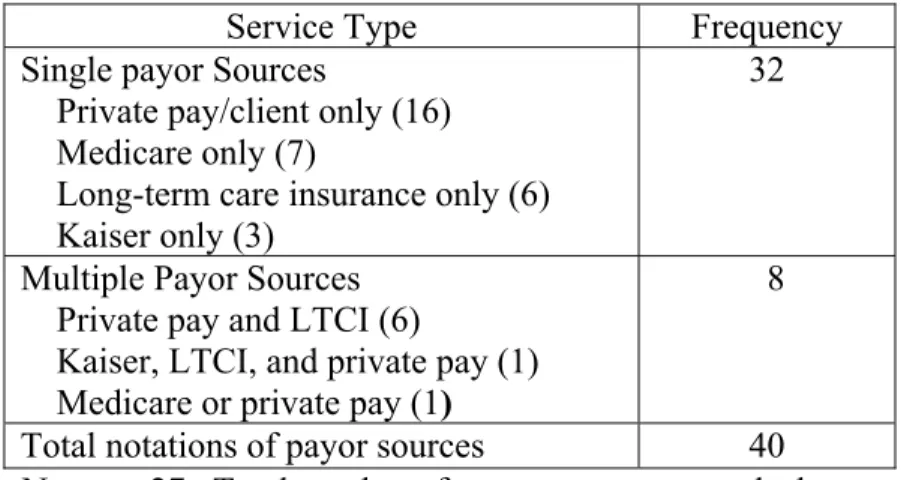
These stipulations require knowledge of available services and alternate payor sources, as well as direct coordination of these sources by the care manager. Awareness of other payor sources was evident in 27 of the 32 care plans, all of which included at least one payor source. In all, 40 separate notations of payor sources were listed, including private pay, long-term care insurance, Medicare, and Kaiser. Most of these notations consisted of a single payor for each recommended service; private pay was the most common notation (16), and Kaiser was the least common (3). Of the seven Medicare notations, only one specified Part A or Part B. Long-term care insurance was noted in only six instances.
Service Type Instances # of Cases
Arrange services 9 7
Independent provider paperwork 9 9
Assist with billing/payment 31 12
Request for records (27) Bill coordination (4)
Multiple payors for recommended services were noted in eight instances. A unique example of multiple payor sources for home health care listed “private pay until 30 day deductible met, then [long-term care insurance].” Only five plans did not include payor information; this information was missing in four plans, and was not relevant in one case or because the family provided all of the care.
Progress notes were also reviewed for evidence of active coordination and integration of acute and long-term care services. Of the 20 case records that included progress notes, 9 specifically identified other insurance coverage, such as Kaiser, Medicare, and Blue Shield. Of these, four case records explicitly mentioned active coordination of benefits, including “consultation and follow-up with Kaiser”; one indicated coordination of payment for services with other insurance carriers; one indicated coordination with workers’ compensation; and one indicated that a Medicare provider had been asked to verify care. Progress notes in five other cases documented the status of billing by other payors, but did not indicate active coordination with them (Table 28).
Table 28. Service Payor Sources Listed in Initial Care Plan
Service Type Frequency
Single payor Sources
Private pay/client only (16) Medicare only (7)
Long-term care insurance only (6) Kaiser only (3)
32
Multiple Payor Sources Private pay and LTCI (6)
Kaiser, LTCI, and private pay (1) Medicare or private pay (1)
8
Total notations of payor sources 40
Note: n=27. Total number of payor sources exceeds the number of care plans reviewed, since some care plans included several service recommendations.
These data suggest that while most case records included information about services and payor sources, little active coordination or integration of acute and chronic care was actually done. This may be due to the ambiguity of the regulatory phrase
“integration of acute and chronic care” and the resulting confusion about what this should entail. It may also be due to the difficulty in coordinating with care systems that are outside of local field care managers’ jurisdictions, and consequently are not viewed as legitimate or practical aspects of the care manager’s role.
Policyholder Experience
Interviews with 19 policyholders provided other perspectives on service coordination activities. In the initial in-person interviews, conducted 30 to 180 days after the date of the care plan, 7 policyholders reported some involvement of their care manager in coordinating services. Policyholders’ reports of specific coordination activities generally reflected care managers’ progress notes in the areas of arranging services, assistance with IP paperwork, and billing. Monthly telephone interviews indicated that much of the assistance they required related to understanding their long-term care insurance policies and negotiating insurers’ paperwork requirements. Of the 12 policyholders who reported in the in-person interview that their care managers were not involved in coordinating services, 3 policyholders reported that they coordinated services themselves, and family or friends performed this role in the other nine cases.
A particularly interesting finding from these interviews was the apparent lack of understanding of the care manager’s role by seven of the policyholders. Two reported specifically that they were confused about service coordination, stating, “. . . I did not know I could use the care manager for [service coordination] and didn’t know what her
job is and what she can do,” and “I did all the arrangement myself. If I had known about this care manager, I would have called.” Five other policyholders also indicated that they were not clear about the role of the care manager in general, perhaps resulting in an underutilization of service coordination. A representative comment was, “I really don’t know what to expect of her.”
Client Participation
Partnership regulations give policyholders the right to actively participate in the imple-mentation of their care plans; this right is implied for their representatives:
CPLTC 1993 and 1999, § 58072(a). A Care Management Provider Agency shall have a written list of rights and legal responsibilities which shall be presented to each client or his or her representative at the time of assessment or as soon as possible thereafter. This list shall include:
(5) a right for active client participation in the development and implementation of the Plan of Care.
Analysis of Case Records
Nine case records contained documentation in progress notes that these policyholders participated in the implementation of their plans. In 24 cases, no documentation was present to indicate this. In four of these cases, progress notes indicate that policyholders were incapacitated and not able to participate. Twenty-one case records contained
evidence that policyholders’ designated representatives or family members were involved in implementing their care plans; 12 case records contained no such documentation (Table 29).
Table 29. Policyholder/Family Participation in Care Plan Implementation
Yes No
Policyholders 9 24
Representatives/family members 21 12
Consumer Satisfaction
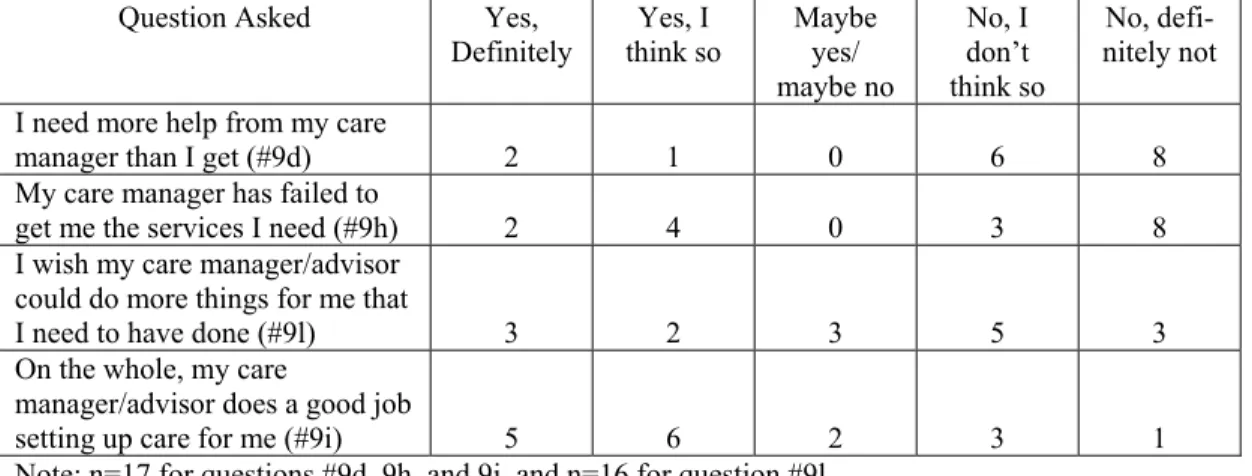
As part of in-person exit interviews, policyholders were asked to respond to four ques-tions relating to whether or not they were satisfied with service coordination. While most policyholders were satisfied with services, three respondents stated that they needed more help than they received from their care manager, six indicated that their care manager had failed to get services they needed, five wished that their care manager could have done more, and four did not think that their care manager had done a good job in setting up care for them. When these responses were analyzed for patterns, the same two
policyholders consistently expressed dissatisfaction in all four domains, indicating a comparatively negative experience with service coordination (Table 30).
Table 30. Policyholder Satisfaction with Service Coordination
Question Asked Yes,
Definitely think so Yes, I Maybe yes/ maybe no No, I don’t think so No, defi-nitely not I need more help from my care
manager than I get (#9d) 2 1 0 6 8
My care manager has failed to
get me the services I need (#9h) 2 4 0 3 8 I wish my care manager/advisor
could do more things for me that
I need to have done (#9l) 3 2 3 5 3
On the whole, my care
manager/advisor does a good job
setting up care for me (#9i) 5 6 2 3 1
Note: n=17 for questions #9d, 9h, and 9i, and n=16 for question #9l.
Policyholders made a number of recommendations regarding how care managers could better help them. Five policyholders stated that they would have liked their care managers to provide more liaison with the insurance company or agencies, three wanted specific recommendations of services, and two would have liked more help finding or hiring providers (Table 31).
Table 11. Policyholder Recommendations Regarding Service Coordination
Type of Recommendation Frequency
More liaison with insurance company or agencies 5
More specific service recommendations 3
More helpful finding/hiring independent providers 2 Note: n=10
The following are sample responses:
“Could have helped him more in obtaining an aide originally by recom- mending someone. Provided him with a list and he had to interview. Could have provided him with assistance with the interview process . . . at least the first few.”
“The initial care manager could have helped to get workers who were a good match; we went through several who did not work out. The second care manager did assist with hiring appropriate workers.”
“If the care manager has been involved sooner, she would have saved us a lot of time. Perhaps the care manager could spend time to investigate [providers] locally so that she could recommend agencies. All we ever got was a list of providers.”
“The case manager could have helped collect the necessary paperwork from Kaiser and the convalescent home to process [the policyholder’s] file quicker. [The policyholder] could have lost her aide because she couldn’t pay for her entire amount.”
“Care manager is not knowledgeable about services in this area, what insurance will cover, or how to get services covered. Perhaps insurer can provide training in this area.” “It is difficult to get itemization from the SNF and submit it to the insurer. Perhaps the care manager could help and perhaps check into SNF quality of care.”
Summary of Findings Regarding Care Plan Implementation
“Care plan implementation” and “service coordination” are not clearly defined in regula-tions or in the care management literature. This is reflected in the variability evidenced by CMPAs in their own definitions, in the inconsistent UDS reporting of these activities, and in the considerable differences in how these activities are organized and administered by the CMPAs. It is especially striking that these services appeared to be underutilized, since 20 of the 33 cases reviewed provided them as an administrative expense for all policyholders. While the low utilization level may be partially due to policyholders’ own
preferences or the lack of need for this service, we were not able to determine any definitive explanation for this. This was due to the lack of evidence that policyholders and care managers engaged in a mutual decision-making process about the desire or need for it, as required by regulation. What we did identify was that a number of policyholders were not entirely satisfied with the process, and many were confused about the role of care managers. This may have been related to the finding that much of the documented implementation/service coordination was provided by insurer agents or their in-house care managers rather than by local field care managers.
Information collected through questionnaires and interviews with local field care managers and CMPA staff also revealed several other factors that may impact care implementation activities. Local field care managers appear to have limited responsi-bility and decision-making aresponsi-bility regarding what services are provided. Rather, their role is to collect information and make recommendations to the CMPAs, which then decide how much service will be provided and for how long. Level of reimbursement for local field care managers’ time also appeared to be a factor. Local field care managers for one CMPA are paid a capitated monthly fee, regardless of how much assistance their clients required. This may have had a limiting effect on the amount of implementation and service coordination actually provided. One care manager’s comment in this regard is illustrative: “There have been some cases where I thought it was important to see the client more than once, and if I happened to be in their area, I might drop by to talk to them. But I do this on my own time since I don’t really get paid for it.”
Recommendations Regarding Care Plan Implementation
Based on these findings, we recommend that care managers assess whether policyholders need information and education about services, and whether there is a need for service
coordination. Documentation should appear in case records reflecting the discussion between care manager and policyholder about the availability of service coordination, whether or not the policyholder desires it, and whether or not the Care Management Provider Agency determines that it is necessary, along with the rationale for this determi-nation. If service coordination if not elected, documentation should be included identify-ing who will be responsible for coordinatidentify-ing services. If service coordination is elected, it should appear as a separate item in the care plan, and should be described fully in terms of frequency, cost, specific types of coordination activities, and who is responsible for providing these activities.
We also recommend that a written description of the care manager’s role be given to the policyholder, specifically outlining what service coordination is, and how it can be obtained. This is intended to address the confusion among policyholders about what to expect from care managers, and may also improve consumer satisfaction ratings.
Finally, we recommend that the wording of regulation § 58072(a)(5) be changed, deleting the italicized words: “. . . a right for active client participation in the develop-ment and implementation of the Plan of Care.” Our rationale is that whereas the right of clients to actively participate in care planning is an established standard of good care management, “implementation” of the care plan is not well defined. Consequently, it is subject to varied interpretation, is not consistently administered, and is difficult to measure. In addition, it is an unnecessary mandate, since many policyholders do not receive implementation or service coordination under Partnership policies, and may prefer to implement their own care plans without the assistance of care managers.