Deutsches Institut für Wirtschaftsforschung
www.diw.de
Maren Lurweg
Perceived Job Insecurity, Unemployment Risk
and International Trade
–
A Micro-Level Analysi
s of
Employees in German Service Industries
300
SOEPpapers
on Multidisciplinary Panel Data Research
SOEPpapers on Multidisciplinary Panel Data Research
at DIW Berlin
This series presents research findings based either directly on data from the German Socio-Economic Panel Study (SOEP) or using SOEP data as part of an internationally comparable data set (e.g. CNEF, ECHP, LIS, LWS, CHER/PACO). SOEP is a truly multidisciplinary household panel study covering a wide range of social and behavioral sciences: economics, sociology, psychology, survey methodology, econometrics and applied statistics, educational science, political science, public health, behavioral genetics, demography, geography, and sport science.
The decision to publish a submission in SOEPpapers is made by a board of editors chosen by the DIW Berlin to represent the wide range of disciplines covered by SOEP. There is no external referee process and papers are either accepted or rejected without revision. Papers appear in this series as works in progress and may also appear elsewhere. They often represent preliminary studies and are circulated to encourage discussion. Citation of such a paper should account for its provisional character. A revised version may be requested from the author directly.
Any opinions expressed in this series are those of the author(s) and not those of DIW Berlin. Research disseminated by DIW Berlin may include views on public policy issues, but the institute itself takes no institutional policy positions.
The SOEPpapers are available at
http://www.diw.de/soeppapers Editors:
Georg Meran (Dean DIW Graduate Center) Gert G. Wagner (Social Sciences)
Joachim R. Frick (Empirical Economics) Jürgen Schupp (Sociology)
Conchita D’Ambrosio (Public Economics)
Christoph Breuer (Sport Science, DIW Research Professor) Anita I. Drever (Geography)
Elke Holst (Gender Studies)
Martin Kroh (Political Science and Survey Methodology) Frieder R. Lang (Psychology, DIW Research Professor) Jörg-Peter Schräpler (Survey Methodology)
C. Katharina Spieß (Educational Science)
Martin Spieß (Survey Methodology, DIW Research Professor) ISSN: 1864-6689 (online)
German Socio-Economic Panel Study (SOEP) DIW Berlin
Mohrenstrasse 58 10117 Berlin, Germany
Perceived Job Insecurity, Unemployment Risk and International Trade –
A Micro-Level Analysis of Employees in German Service Industries
Maren Lurweg*
Abstract
The present paper investigates the impact of international trade on individual labour market outcomes in the German service sector for the period 1995-2006. Combining micro-level data from the German Socio-Economic Panel (SOEP) and industry-level trade data from input-output tables, we examine the impacts of international trade on (1) the individually reported fear of job loss and (2) job-to-unemployment transitions. We therefore apply both a “subjective” and a more “objective” measure of job insecurity. Our results indicate that international trade does indeed affect labour market outcomes in German service industries. Employees in trading service sectors face both a higher subjective and objective unemployment risk, regardless of their skill level. Moreover, growth in real net exports is positively correlated with perceived job insecurity and in-dividual unemployment risk.
JEL codes: F16, C23, J63
Keywords: International trade, perceived job insecurity, employment status
*
Dipl.-Vw. Maren Lurweg, Westfälische Wilhelms-Universität Münster, Faculty of Economics, Am Stadtgraben 9, D-48143 Münster. Germany. Fon.: +49 251 83 22 983, email: [email protected]. The
1 Introduction
Compared to trade in goods, trade in services is a comparatively new phenomenon. Rapid technological advances in information and communication technologies increasingly facili-tate trade in services. Therefore, jobs in the service sector, which dominates the economic structure of the highly industrialised economies, due to the ongoing process of tertiarisation, are increasingly at risk of being relocated to countries with lower unit labour costs.
During the American election campaign of 2004, the labour market effects of increased ser-vice offshoring were discussed intensively. The theoretical debate was dominated by Paul Samuelson and Jagdish Bhagwati. Samuelson (2004) bases his arguments on a Ricardian model, demonstrating that the labour market effects of offshoring can be negative, if the trade partner were able to realise productivity gains in a formerly non-competitive sector. A share of the comparative advantage that was previously limited to the home economy could thus be sacrificed.
Bhagwati (2004) uses a specific-factor model, indicating that service offshoring is always advantageous for the country of origin and leads to welfare gains. This is due to the fact that imported service goods are essential for the production of final goods. If the production fac-tors which initially lose from trade, are compensated financially for their losses, all produc-tion factors can win.
There are quite a few empirical studies on the effects of service offshoring on the U.S. labour market. Blinder (2009) suggests that between 22 per cent and 29 per cent of all U.S. jobs could potentially be affected by an increased international sourcing of IT and ICT-enabled services. According to Jensen and Kletzer (2006), 38 per cent of U.S. workers are in tradable occupations. They estimate that the share of workers in tradable professional and business service industries even exceeds the share of workers in tradable manufacturing industries.1 Initially, public and political debate on service offshoring was concentrated in the Anglo-Saxon countries. The geographical and cultural proximity to the central and eastern European countries, which are now part of the European Union, is the main reason why the increased tradability of services is now also discussed intensively in Germany. Moreover, data shows how important both the offshoring and “inshoring” of services has become for the country.
1
For further studies on the U.S. labour market, see e.g. Bardhan/Kroll (2003) and Van Welsum/Vickery (2005).
Between 1995 and 2006, real gross imports and exports of services increased by around 85 per cent and 132 per cent, respectively. The increase in real gross imports and exports was most pronounced in the sector “Professional, scientific and technical services” with 219 per cent and 264 per cent, respectively.2
Schrader and Laaser (2009) estimate that around 42 per cent of German jobs are at risk of being offshored. Due to the almost unrestricted tradability of manufacturing goods, the share is even higher in the secondary sector (63 per cent). In the service sector, around 35 per cent of all jobs are classified as potentially offshorable. Comparing the results for Germany with those for the United States shows that the potential for job relocation is relatively high in Germany.
The present paper investigates the impact of international trade on individual labour market outcomes in the German service sector for the period 1995-2006. Combining micro-level data from the German Socio-Economic Panel (SOEP)3 and industry-level trade data from input-output tables, we examine the impacts on (1) individually reported fear of job loss and on (2) job-to-unemployment transitions. We therefore apply a “subjective” as well as a more “objec-tive” measure of job insecurity. The underlying notion is that the intensification of interna-tional trade could raise firms’ elasticity of labour demand, making wages and employment more volatile.4 This could be a reason for employees to feel more insecure about their future employment perspectives.
We group service industries by their level of trade exposure, taking into account their import penetration ratio, export share and trade openness index. The “trading service sectors” have a relatively high value of imports and exports. Conversely, the “non-trading service sectors” are only marginally involved in international trade and therefore have low import and export levels. We examine whether individual labour market outcomes in the German service sector differ for these two groups of industries.
It is often argued that the risk of becoming unemployed declines for employees with a higher skill level. Quantitative analyses indicate a causal relationship between the increasing use of
2
Authors’ calculations are based on data from input-output tables (Federal Statistical Office, Fachserie 18, Reihe 2).
3
The German Socio-Economic Panel is a yearly conducted survey of the “Deutsches Institut für Wirtschafts-forschung (DIW)”. For a detailed discussion of the German Socio-Economic Panel Study, see Wag-ner/Frick/Schupp (2007).
4
See, for example, Rodrik (1997), Slaughter (2001), Senses (2006) and Molnar/Pain/Taglioni (2007). How-ever, it is quite evident that the impact of international economic integration on labour demand elasticities is a contentious issue.
computers or computer-based technologies and rising demand for high-skilled labour. Tech-nological progress therefore substitutes for low-skilled labour and is complementary to high-skilled labour.5
However, according to a relatively new theoretical approach, taking into account the effects of globalisation, the sustainability of jobs does not depend primarily on the skill level of em-ployees. Blinder (2009) argues that the “more personal a service is, or the more closely tied to a specific geographical location, the harder it is to offshore”. An increasing share of high-skill jobs that require expert thinking and/or complex communication but not physical presence, will surely be deliverable remotely in the future. Employees who currently perform these tasks in industrial countries, would have to compete with qualified employees in developing or emerging economies in the future. According to Blinder, there is almost no correlation between the offshorability of a specific task and the qualification of employees, as measured by the level of education. Consequently, we estimate the impact of trade openness both on the probability of a job-to-unemployment transition and on individually reported fear of job loss separately for high-skilled, medium-skilled and low-skilled employees.
Our study deals with the impact of international trade on labour market outcomes, using a worker-flow approach and combining micro and macro data. Whereas job flow studies as-sume a “direct connection between international factors and the total demand for labour at particular production sites or establishments” (Klein/Schuh/Triest 2003a, p. 73), studies of
worker flows postulate a “direct connection between international factors and the demand for
individual workers at particular establishments” (Klein/Schuh/Triest 2003a, p. 78).6 Accord-ing to the OECD (2009), worker flows in the form of hires and separations are more than twice as large as job flows in the form of job creation and job destruction in the German la-bour market. Job and worker reallocation rates reached a level of 16.6 per cent and 34.0 per cent of dependent employment in the period 1997-2004, respectively.7
5
See, for example, Bartel/Lichtenberg (1987), Berman/Bound/Griliches (1994), Berman/Bound/Machin (1998), Machin/van Reenen (1998) and Kölling/Schank (2003).
6
The particular advantages of worker-flow and job-flow approaches are discussed in Klein/Schuh/Triest (2003a), Goldberg/Tracy/Aaronson (1999) and Munch (2005). Prominent examples of job-flow studies are Davis/Haltiwanger/Schuh (1996), Gourinchas (1998), Klein/Schuh/Triest (2003b) and Davidson and Matusz (2001).
7
Job and worker flows differ enormously across countries. In the United States, for example, annual job and worker reallocation rates are as large as 28.3 per cent and 49.7 per cent of dependent employment, respec-tively. See OECD (2009), Chapter 2.
The combination of micro and macro data enables controlling for a large part of unobserved individual heterogeneity, thus reducing the potential endogeneity bias.
There are some researchers who choose a similar strategy. Scheve and Slaughter (2004) are, to the best of our knowledge, the only ones to combine industry-level trade data with person-level data on perceived job insecurity. They find that international economic integration, measured by a binary indicator for the presence of foreign direct investment on industry-level, is negatively correlated with individual perceptions of job security. The analysis is based on individual-level panel data from the British Household Panel Survey over the period 1991-1999. The result also holds when specifying a dynamic panel model.
Geishecker (2008) analyses to what extent international outsourcing affects the individual employment security of German manufacturing workers. In contrast to the approach chosen by Scheve and Slaughter (2004), Geishecker decides on an “objective” measure of employment security, rather than a subjective one. His finding is that narrow outsourcing8 significantly raises the individual unemployment risk. Interestingly, the effect does not differ with regard to skill level, but increases with employment duration.
Egger, Pfaffermayr and Weber (2007) investigate whether and how growth in goods imports and exports, a change in the terms of trade, and the intensification of outsourcing affect indi-vidual transition probabilities between six different states of employment and unemploy-ment/out of labour force for Austrian male workers. Their results show that international fac-tors are important determinants of labour market turnover, especially for net importing indus-tries with a comparative disadvantage.
Munch (2005) studies the effects of international outsourcing on individual transitions out of jobs in the Danish manufacturing sector. Outsourcing is found to be positively correlated with unemployment risk for workers, in particular low-skilled workers. Moreover, outsourcing increases the job-change hazard rate, mainly for high-skill workers.9
In this present paper, we examine the impact of trade on German labour-market outcomes by combining information on perceived job insecurity, employment status (employed versus
8
Narrow outsourcing is defined as the value of the industry’s imported intermediate inputs from the same industry abroad, as a share of the domestic industry’s production value. See also Feenstra/Hanson (1996, 1999).
9
Further studies which combine industry-level trade data with person-level data include Goldberg/Tracy (2003), Liu/Trefler (2008), Geishecker/Görg (2008), Ebenstein et al. (2009) and Geishecker/Görg/Munch (2010).
registered unemployed) and worker characteristics from the German Socio-Economic Panel, with data on trade volumes across industries and over time, derived from input-output tables from the Federal Statistical Office. We investigate whether belonging to a trading service industry raises the probability of a job-to-unemployment transition. Furthermore, we estimate the impact on individually reported fear of job loss. Our data on the trade exposure of Ger-man service industries was obtained from the Federal Statistical Office and provides compre-hensive coverage of the trade activities of firms. We include a rich set of control variables; in particular, we control for growth in real net exports, technological change (investments in R&D as a share of value added), growth in gross value added, employment growth and per-sonal characteristics of employees.
The results indicate that trade does affect labour market outcomes in German service indus-tries. Employees in trading service sectors face both a higher subjective and objective unem-ployment risk, regardless of their skill level. Moreover, growth in real net exports not only has a positive impact on the subjective feeling of job insecurity of service employees, but also on their objective unemployment risk. Furthermore, the personal characteristics of employees seem to exert a substantial effect on labour market outcomes.
The paper is organized as follows. Section 2 categorises German service sectors according to their trade exposure und presents some descriptive statistics on the personal characteristics of employees in trading and non-trading service industries. Moreover, trends in employment and perceived job insecurity of employees in the two trade-exposed industry groups are docu-mented in this section. The empirical approach is introduced in Section 3. Section 4 gives a detailed description of the empirical results. Section 5 concludes.
2 Definition of trade patterns and data description
2.1 The definition of trade patterns
In order to examine the impact of international trade on labour-market transitions and the individually reported fear of job loss, we use data on various German service industries. The classification of industries is based on the European industry classification standard NACE,
at a two-digit level. The original 24 NACE categories were aggregated into 12 service sectors to secure a sufficient number of observations per group.10
The labour-market effects of trade depend heavily on the level of “trade exposure” of service industries. Therefore, we categorize the 12 service sectors according to their openness to trade. The categorization was conducted on the basis of three trade parameters, namely the
import penetration ratio, export ratio and trade openness index, as suggested by Faberman
(2004) and the United Nations (2007). Each ratio is calculated at the industry-level.11 The export ratio or export propensity shows “the overall degree of reliance of domestic producers on foreign markets” (United Nations 2007) and is defined as the ratio of exports to GDP. At the industry-level, the export ratio can be measured by the following equation:
(1)
The export ratio index is biased upwards by re-exports, if not corrected for, and tends to be negatively correlated with economic size. Therefore, we subtracted the re-exports from the value of exports.
The import penetration ratio indicates the degree to which domestic demand is satisfied by imports and is calculated as follows:
(2)
Again, we did not consider the imports that are re-exported directly. Domestic demand for goods of industry i was calculated by subtracting gross exports from the value of final uses of goods of industry i.
The trade openness index is defined as follows:
(3) .
The measure of trade openness reflects the importance of international trade for each particu-lar service sector.12
10
The aggregation scheme is presented in the statistical annex.
11
The input-output tables which include data on German imports and exports, classified by sectors, can be downloaded free of charge at www.destatis.de (Federal Statistical Office, Fachserie 18, Reihe 2).
12
The values of imports were adjusted to the prices of 2005 using the price index for imported goods. The values of exports were adjusted to the prices of 2005 using the price index for exported goods (Federal Sta-tistical Office, Fachserie 17, Reihe 8).
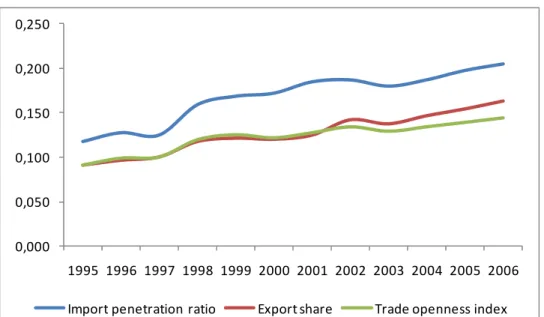
Figure 1 shows that the average export ratio, import penetration ratio and trade openness in-dex over all 12 service sectors have increased continuously between 1995 and 2006. Even if the average index values for the manufacturing industries are sharply higher (Lurweg/Uhde 2010), trade in services yields an upward trend. Rapid technological advances in information and communication technologies increasingly facilitate trade in services; this process has not yet come to an end. Interestingly, the import penetration ratio exceeds the export share and the trade openness index in each reporting year. In 2006, around 20.5 per cent of domestic demand was satisfied by imports, compared to 11.7 per cent in 1995.
Figure 1: Trade linkages of service sectors
Notes: Calculations are based on input-output tables of the Federal Statistical Office.
In order to categorize the 12 service sectors according to their trade exposure, we form two groups. The “trading service sectors” have a relatively high value of imports and exports. Conversely, the “non-trading service sectors” are only marginally involved in international trade and therefore have low import and export levels. Table 1 reports to which of the two trade-exposed groups the 12 NACE industries are assigned.13
13
The categorization is largely consistent with the aggregation of Kalmbach et al. (2005), who distinguish between “market-determined services” and “other services”. The only difference lies in the categorization of the sector “real estate activities”. According to Kalmbach et al. (2005), the sector produces market-determined services. Due to a relatively low import penetration ratio, export ratio and trade openness index, we classify the sector as a non-trading service sector.
0,000 0,050 0,100 0,150 0,200 0,250 1995 1996 1997 1998 1999 2000 2001 2002 2003 2004 2005 2006
Table 1: Categorization of NACE industries with respect to trade exposure
Trading Service Sectors Non-Trading Service Sectors
G Wholesale and retail trade services; repair services of motor vehicles and motorcycles
L Real estate services
H Accomodation and food services O Public administration and defence services; Com-pulsory social security services
I Transportation and storage services P Education services
J Information and communication services Q Human health and social work services
K Financial and insurance services R Other community, social and personal service ac-tivities
M Professional, scientific and technical services N Administrative and support services
In the following table, we show the average import penetration ratio, export ratio and trade openness index for each group of trade-exposed industries and for all service industries. The values demonstrate that the trade exposure of service industries varies substantially. While economic development in non-trading industries is almost independent of international trade, changes in international trade patterns should impact on outcomes in trading industries.
Table 2: Trade linkages of the two trade-exposed groups
Group Export ratio Import penetration
ratio
Trade openness index
Trading
industries 0.214 0.275 0.202
Non-Trading
industries 0.004 0.014 0.010
All service industries 0.127 0.168 0.122
Notes: Calculations are based on input-output tables of the Federal Statistical Office.
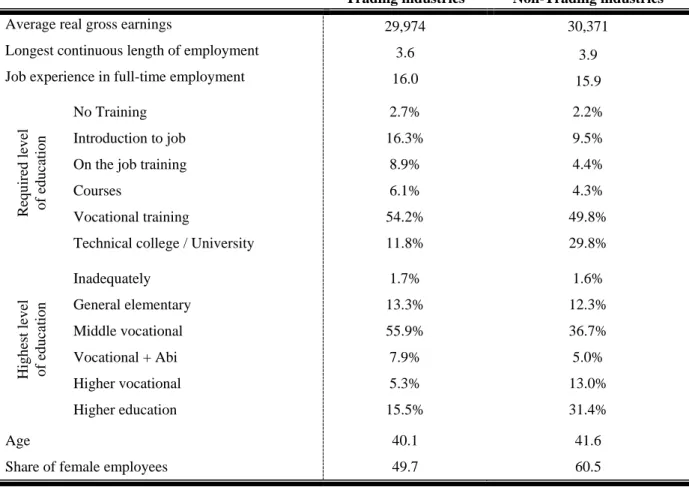
The next table presents the personal characteristics of employees in our two trade-exposed industry groups. The selected variables refer to labour market and educational aspects, as well as to the age and gender of respondents who completed valid interviews in the observa-tion period from 1995 to 2006.
Employees in trading and non-trading service industries do not differ significantly with re-spect to actual earnings. Average real gross annual earnings in trading and non-trading indus-tries reach a level of 29,974 euros and 30,371 euros, respectively. This could be an indication
that openness to trade does not exert a substantial influence on the wage level of service em-ployees.
Employees in non-trading service industries are employed in this group of industries for 3.9 years on average without interruption, compared to 3.6 years for employees in trading indus-tries. This means that these employees face fewer job-to-unemployment transitions than em-ployees in trading service industries and thus may have a lower risk of becoming unem-ployed. Conversely, employees in the trading service industries have a higher rate of job tran-sitions, indicating that their employment situation is slightly more precarious. However, em-ployees in the two trade-exposed groups of industries do not differ with regard to their job experience in full-time employment (16.0 years on average for employees in trading indus-tries and 15.9 years for employees in non-trading indusindus-tries).
Employees in trading and non-trading service industries seem to be quite different regarding required and actual levels of education. Interestingly, employees in the first group have both a lower average required and actual level of education. The share of jobs that require no train-ing, training on the job or an introduction to the job is considerably higher in trading indus-tries than in non-trading indusindus-tries (27.9 per cent versus 16.1 per cent). Similarly, vocational training or a college/university degree is required for a higher share of employees in non-trading service industries (79.6 per cent versus 66.0 per cent).
The average age of employees in the two industry groups does not differ to a great extent. However, the share of female employees is much higher in non-trading service industries than in trading service industries, reaching a level of 60.5 per cent, compared to 49.7 per cent in trading industries. This can be explained by the fact that many services in the non-trading category are personally-delivered and social services, where the share of women is tradition-ally higher. This applies especitradition-ally to the sectors “Human health and social work services” (share of female employees: 76.7 per cent) and “Education services” (63.4 per cent).
Table 3: Worker characteristics in the two trade-exposed groups
Trading industries Non-Trading industries
Average real gross earnings 29,974 30,371
Longest continuous length of employment 3.6 3.9
Job experience in full-time employment 16.0 15.9
R equi re d l evel of education No Training Introduction to job On the job training Courses
Vocational training
Technical college / University
2.7% 16.3% 8.9% 6.1% 54.2% 11.8% 2.2% 9.5% 4.4% 4.3% 49.8% 29.8% High est lev el of education Inadequately General elementary Middle vocational Vocational + Abi Higher vocational Higher education 1.7% 13.3% 55.9% 7.9% 5.3% 15.5% 1.6% 12.3% 36.7% 5.0% 13.0% 31.4% Age 40.1 41.6
Share of female employees 49.7 60.5
Notes: Calculations are based on SOEP data. Data were weighted in order to control for non-random selection due to sampling design and attrition.
In summary, our data indicates that employment in trading service industries is less stable than in non-trading service industries, because the longest continuous length of stay is shorter. Therefore, employees in non-trading service industries face fewer labour-market transitions than employees in the trading sectors. Moreover, both the required and highest level of education is significantly higher in non-trading service industries, indicating that production processes are more skill-intensive in this group of industries.
2.2 Description of worker outcomes and predictor variables
In order to determine the effects of international trade on labour market outcomes, we applied
fear of job loss and employment status as outcome measures. Figure 2 shows how the
Figure 2: Fear of job loss of German service employees
Notes: Calculations are based on SOEP data. Data were weighted in order to control for non-random selection, due to sampling design and attrition.
In the SOEP, respondents are asked each year how concerned they are about job security. Figure 2 reveals that the share of employees in non-trading as well as in trading service in-dustries, who are concerned about losing their job, has not increased significantly over the period 1995-2006. However, the share of respondents who are “somewhat” or “very con-cerned” about job security was higher in trading service industries compared to non-trading service industries in each reporting year. In 1995, around 41.9 per cent of employees in non-trading service industries were “somewhat” or “very concerned” about job security. The share of concerned respondents reached its maximum in 1997 (48.3 per cent) and its mini-mum in 2002 (40.3 per cent). In 2006, around 43.4 per cent of employees in non-trading ser-vice industries were worried about losing their present job. In trading serser-vice industries, the share of employees who are concerned about losing their job reached its maximum in 2004 (61.1 per cent) and its minimum in 1996 (52.0 per cent).
The differences in individually reported fear of job loss can be explained by two factors. Firstly, the increase in the trade exposure of service industries, as demonstrated in Figure 1, is based mainly on the increasing trade openness of the trading service industries. The real gross imports of this group of industries increased from around 45.4 billion euros in 1995 to around
0 10 20 30 40 50 60 70 1995 1996 1997 1998 1999 2000 2001 2002 2003 2004 2005 2006 in pe r ce n t
81.4 billion euros in 2006. The increase in real gross exports was even more pronounced; they increased from around 65.5 billion euros in 1995 to around 152.9 billion euros in 2006. The increasing tradability of services surely has an impact on domestic labour markets. The share of employees in tradable professional and business service industries is now higher than it was 15 years ago. Therefore, an increasing share of total employment in advanced econo-mies could potentially be affected by international sourcing of IT and ICT-enabled services. Secondly, jobs in non-trading service industries tend to be more secure than those in trading service industries, because the share of public service personnel is higher in these sectors, especially in the following three: “Public administration and defence services; compulsory social security services”, “Education services” and “Human health and social work services”. Even if the number of public service personnel has declined considerably (from around 5.4 million employees in 1995 to around 4.6 million in 2006)14, employment in these sectors does not tend to be subject to cyclical fluctuations. Politicians expressing their will to reduce pub-lic employment have to fear pubpub-lic pressure. Trade union representatives argue that job cuts put downward pressure on private consumption and therefore jeopardise economic growth. Moreover, civil servants possess an employment guarantee; they can’t be dismissed from work.
We therefore assume that the individually reported fear of job loss is significantly higher in trading than in non-trading service industries.
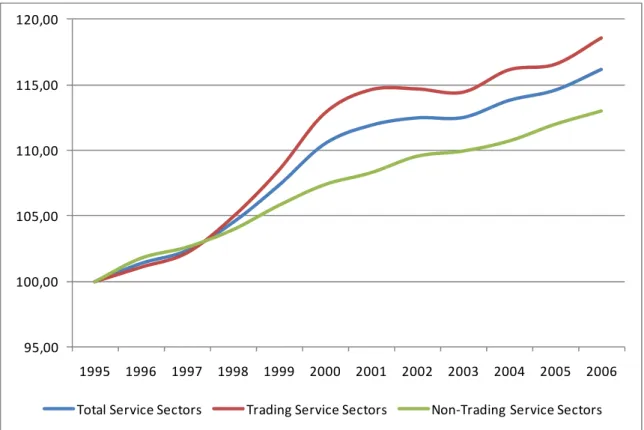
The second worker outcome is respondents’ current employment status. Answers are either 0 = employed or 1 = registered unemployed. In the original survey question, all employees and unemployed persons who did not register as unemployed (e.g. students or retirees) were pooled in one group. Those respondents who are voluntarily unemployed, rather than as a result of international trade or other factors, were excluded from the data set. Respondents with an employment status of “full-time” or “regular part-time employment” were classified as employed. Employment trends in the two trade-exposed groups of industries, based on information from input-output tables, are presented in Figure 3.
14
Figure 3: Employment trends in the two trade-exposed groups
Notes: Calculations are based on input-output tables of the Federal Statistical Office.
The employment trends are measured by changes in the number of employees in specific ser-vice industries (1995=100). The number of jobholders in the serser-vice sector has increased by 16.2 per cent from 1995 to 2006, in comparison to the overall national employment trend of +4.0 per cent (Federal Statistical Office 2009). However, labour-market perspectives vary between the two trade-exposed industry-groups. Trading service industries yield the best la-bour-market performance. Between 1995 and 2006, trading service industries had an em-ployment growth of 18.6 per cent and the number of jobs in these industries increased from 14.0 to 16.6 million. Employment growth was highest in the two sectors “Professional, scien-tific and technical services” (+78.5 per cent) and “Administrative and support services” (+69.5 per cent). However, two trading service industries also faced job losses. Employment in the sectors “Information and communication services” and “Financial and insurance ser-vices” decreased by 18.1 per cent and 2.1 per cent, respectively. The employment decline in the sector “Information and communication services” can surely be attributed to increasing international competition, because 20.3 per cent of domestic demand was satisfied by imports in 2006, compared to 15.8 per cent in 1995. Moreover, the export share of this service sector was far below average in each reporting year.
95,00 100,00 105,00 110,00 115,00 120,00 1995 1996 1997 1998 1999 2000 2001 2002 2003 2004 2005 2006
Non-trading service industries also encounter continued job creation, but at a lower level. From 1995 to 2006, the number of employees increased from 10.3 million to 11.7 million, which corresponds to an employment growth of 13.0 per cent. Employment growth was highest in the two sectors “Real estate services” (+34.9 per cent) and “Human health and so-cial work services” (+26.4 per cent). By contrast, employment in the sector “Public admini-stration and defence services; compulsory social security services” decreased by 11.8 per cent.
Due to the above-average employment trend reported in Figure 3, the individual unemploy-ment probability for employees in trading service industries should be lower than for ployees in non-trading service industries. However, one has to keep in mind that the net em-ployment changes conceal an enormous amount of job churning – there is a continuous proc-ess of job creation and job destruction. Therefore, the unemployment risk of an individual employee does not automatically decline when he is employed in one of the sectors within this group of industries. Furthermore, our data indicates that employment in trading service industries is less stable than in non-trading service industries, because the longest continuous length of stay is shorter.
Employment status and fear of job loss are influenced not only by international trade and increasing competition among employees, but also by the effects of business cycles, overall employment trends, technological progress and the personal characteristics of respondents. To control for these aspects, we included a rich set of control variables in our estimations.15 To capture the effects of business cycles on current employment status and on fear of job loss, growth rates of real gross value added of each sector are included in the model. The business cycle not only affects the current employment status, but also individual concerns about job security, as described above. Our data indicates that people tend to be more con-cerned in periods of economic recession.
The individual employment status and the fear of job loss also depend on the industry’s em-ployment trend. Positive long-term emem-ployment trends should reduce the unemem-ployment risk of individual employees and the fear of job loss. Therefore, growth rates of sectoral
employ-ment are applied to the estimation.
15
Furthermore, it is necessary to include a proxy for technological change, because technologi-cal change is often found to affect labour demand and could thus influence employment tran-sitions and fear of job loss. On the one hand, technological progress fosters economic growth and consequently, leads to an increase in the demand for labour. On the other hand, this might rationalise work processes, causing job destruction. Technological progress is meas-ured by real industry expenditures for research and development as a share of real gross
value added. Even if this measure is far from perfect, it is commonly used in the literature
(Berman/Bound/Griliches 1994, Machin/van Reenen 1998 and Munch 2005).16
Another industry-specific variable is the capital coefficient, which is defined as the capital stock of an industry in relation to its real gross value added. The capital stock is measured in terms of real gross fixed assets. The capital coefficient is a critical factor for industry-level economic growth and provides information on the quantity of capital, which is required to produce a particular amount of output.
Growth rates of real net exports are employed in the estimation, because they contain
infor-mation about business cycles in international trade and the competitiveness of German ser-vice industries. Growing net exports can be the result of rising international trade volumes or of improved sectoral competitiveness. Therefore, an increase in real net exports may influ-ence the labour-market situation of German employees. Furthermore, the export or import orientation of German service industries is reflected in the data.17
It is important to control for worker-specific characteristics, otherwise there would be a high risk of unobserved factors which could be correlated with the right-hand-side variables. This endogeneity-problem would lead to biased estimation coefficients. We control for the follow-ing personal characteristics: highest level of education, work experience in full-time
employ-ment, health status, gender, marital status and region.
The level of education is based on the ISCED-1997-classification and refers to education and
further training at time of survey. The predefined categories range from “Inadequately com-pleted schooling” to “Higher education”, but were re-arranged in three dummy-variables,
16
Alternative measures of technological change include computer intensity (Haskel/Heden 1999) or a measure of technological adoption (Doms/Dunne/Troske 1997), but data for these measures is not available to us.
17
Data for real net exports contains an extremely large range of values. To mitigate the biasing effect of out-liers, observations were eliminated from the sample if they fell into either the top or bottom 1 percent of the real net exports distribution.
which describe a low, medium and high level of education.18 The omitted category is “Low level of education”.
Work experience in full-time employment provides information on the entire period of
full-time employment in the respondent’s career up to the point of completing the questionnaire. As Farber (1994) points out, increasing time spent at the job helps to gain firm-specific capi-tal and lowers the risk of job turnover. Unfortunately, firm-specific human capicapi-tal cannot be measured directly. Therefore, we approximate the variable through work experience in full-time employment. The variable is coded in 11 categories, ranging from “less than one year” to “more than 40 years” of work experience.
The individually reported health status is coded in five categories, ranging from “very good” to “bad”. A one-unit increase in the variable should deteriorate individual employment per-spectives and increase perceived job insecurity. The omitted category is “very good”.
Royalty (1998) highlights the importance of gender for the transition from job to unemploy-ment. We therefore apply a dummy for female respondents and an additional dummy for
sin-gles and married respondents19in our estimation.
Unemployment rates vary substantially between East and West Germany, because there are still enormous structural differences between the labour markets which can be ascribed to the ongoing catching-up process of East Germany. We control for such regional heterogeneity by including a dummy variable for the location of the respondent’s household at the time of the survey.
Furthermore, we control for unobserved time-specific heterogeneity by including a set of
time-dummies. The omitted category is the year 2006.
3 Methodology
In order to analyse the impact of international trade on worker outcomes, we examine fear of
job loss and current employment status as dependent variables. A dummy variable for
non-trading and non-trading service industries is used as the main predictor variable.
18
Low level of education: primary education + lower secondary education; medium level of education: secon-dary + post-seconsecon-dary non-tertiary education; high level of education: tertiary education.
19
Both independent variables are qualitative. Firstly, current employment status is a dichoto-mous variable. Secondly, concerns about job security are a categorical variable with three ordered categories. The estimation of an OLS Model would require ordinally scaled depend-ent variables. However, by implication the variables cannot be treated as ordinally scaled, because it is not known whether distances between the response categories are similar. In this study, the authors subscribe to the view that the variables on worker outcomes are ordinally scaled. These special attributes of the regressands require the application of a Binary and a Multinomial Response Model, as discussed in Amemiya (1981) and McFadden (1981). The statistical reasons for this choice can be attributed to the fact that some of the assumptions of the “standard” OLS Regression are not tenable if the dependent variable is not metric. Two problems are that the disturbances (ui) are not normally distributed20 and that they are
het-eroskedastic. Furthermore, the predicted values of the regressand ( ) may be outside the 0/1 range. Another important aspect is that the marginal effect of a one-unit increase in the ex-plaining variables does not necessarily mean a constant, linear increase in the dependent vari-able (Gujarati 2003, pp. 584-593).21 These problems can be solved using a Logit Regression (for the binary variable of employment status) and an Ordered Logit Regression (for the mul-tinomial variable of concerns about job security), respectively. In both models, the predicted probabilities of the dependent variable range between 0 and 1, and the relationship between the explanatory variables and the regressand is non-linear.22
In order to analyse the effects of international trade on the probability of becoming unem-ployed, a Pooled Logit Regression was conducted. In principle, the panel structure of our data implies that a Logit Model with individual fixed effects would be appropriate. Unfortunately, there is minimal variability in the employment status, leading to a relatively high number of cases with (only) positive or negative outcomes.23 The estimation of a Fixed Effects Model is not appropriate under these conditions, so that a Pooled Logit Regression was conducted. In the Logistic Regression of the impact of international trade on employment status, the
20
Only for the purpose of statistical inference (but not for the estimation of coefficients) are the disturbances (ui) assumed to be normally distributed.
21
With the exception of the last point, all problems can be solved by mathematical programming techniques or transformations.
22
The relationship is assumed to have the shape of a sigmoid curve. This means that, for low and high values of the explaining variable, a one-unit increase will have little effect on the probability of becoming unem-ployed. However, the Logistic Regression requires that the independent variables, be linearly related to the log odds.
23
The method of within transformation that is used to eliminate the time-invariant effects, leads to the omis-sion of those cases with no variation in expressed employment status.
cients present probabilities of the event of becoming unemployed. The Pooled Logistic Re-gression equation is given by:
(4) Li= ln ,
where are Maximum Likelihood estimates of the Logistic Regression coefficients and X1 to Xk are column vectors of the set of predictor variables. Li is the natural log of the
probability ratio of becoming unemployed, to the probability that the respondent is employed. For ease of interpretation, we have computed the odds ratios as described by Cornfield (1951). The relationship between the odds ratio (OR) and the estimation coefficient is OR = , which is the antilog of the estimated logit. If the odds ratio is greater than one for a one-unit increase in X, the odds of becoming unemployed increase.24 Similarly, an odds ratio smaller than one means that the probability of becoming unemployed is less than the prob-ability of being employed.
To analyse the effects of international trade on concerns about job security, a Pooled Ordered Logit Model was applied. Estimates are calculated by Maximum Likelihood Estimation. The Ordered Logit Estimation is an extension of the “standard” Logit Model and required if the latent dependent variable has ordered categorical values. As mentioned before, concerns about job security are measured on a scale of one to three and the three categories are in as-cending order. A potential shortfall of the Ordered Logit Model is the fact that person-specific fixed effects cannot be implemented (Maddala 1983). However, the consideration of fixed effects is advisable, because of their potential impact on the dependent variable. It is conceivable, for example, that the cultural background of a respondent affects his or her an-swering behaviour. If some groups of respondents avoid expressing their concern about job security, because they fear sounding too pessimistic, the average level of concerns seems to be lower in these groups and thus, the estimation results will be biased. Another serious prob-lem is caused by the correlation of unobserved personal characteristics with the right-hand-side variables of the model. This relationship will exert biased coefficient estimates, because the statistically detected relation between the independent and depend variable is overlaid with the impact of the unobserved variable. To sum it up, it is particularly important to con-trol for specific effects as far as possible. We do so by including a rich set of person-specific (control) variables. Even if these observable characteristics cannot completely
24
ture person-specific effects, it is the best possible way to control for respondent heterogene-ity.
In both the Logistic and the Ordered Logistic Regression, robust variance estimators were applied. The estimators are robust with respect to the assumptions that the Logistic Function is linear and that all necessary right-hand-side variables are included in the model. Further-more, standard errors were clustered at the industry-level. This means that data need not nec-essarily be independent within groups, but must be independent across groups. A cluster technique should be used if error terms are serially correlated, e.g. if a random shock affects the outcome of an industry in the current and subsequent periods.
4 Effects on worker outcomes: Empirical results
The estimations presented in this section are based on 40,000-60,000 observations, compris-ing 12,600-15,700 cross-sections, namely the respondents of the SOEP, in a time period of 12 years (1995-2006). Respondents need not have answered the questionnaire over the entire period. This means that respondents who completed the questionnaire for only a few years and provided valid answers, are included in the data set. Participants of the present panel data set answered for between 4.1 and 4.3 years on average. According to our data, on average 50.8 per cent of the respondents are employed in a trading service sector and 49.2 per cent in a non-trading service industry, respectively. We restricted our sample to employees in service industries who are either registered unemployed or employed in “full-time” or “regular part-time employment”.
Table 4 reports the coefficient estimates of Equation (4). We report the odds ratios for all the coefficients. Column 1 shows that employees in trading service industries are more con-cerned about job security than those in non-trading service industries. The coefficient indi-cates that the odds of being very concerned about job security versus the combined lower categories (“not concerned” and “somewhat concerned”) are 1.738 times higher for employ-ees in trading service industries than for those in non-trading service industries, given that the other variables are held constant. This result is not surprising, because as Figure 2 reveals, the share of respondents who are “somewhat” or “very concerned” about job security was higher in trading industries compared to non-trading industries in each reporting year. Column 2 reveals that the effect does not decrease for high-skilled employees. In fact, the effect is strongest for high-skilled employees and weakest for low-skilled employees, which is quite
surprising. This may indicate that the sustainability of jobs does not depend primarily on the skill level of employees, as Blinder (2009) argues. Employees seem to be aware that a high skill level does not protect their job from relocation to countries with lower unit labour costs. The second trade-related variable employed in the estimation, the growth in real net exports, confirms the hypothesis that increasing trade volumes make employees feel more insecure, possibly due to more elastic labour demands which, in turn, raise the volatility of employ-ment. For a one-unit increase in real net exports, the odds of being very concerned about job security are 1.251 times greater than the odds of the combined lower categories.
In our model, the set of industry-specific control variables, except for growth in real net ex-ports, does not exert a significant influence on perceived job insecurity. The coefficient esti-mates for the capital coefficient, employment as well as output growth and technological change are imprecise in the first estimation. In the second estimation, controlling for different skill levels of employees, the capital coefficient is significant at the 10 per cent level, but its positive effect on perceived job insecurity is rather marginal.
In contrast to the macroeconomic variables, most of the personal characteristics of employees significantly affect the individually reported fear of job loss. Our estimations reveal that a one-unit increase in the average level of education and work experience in full-time employ-ment significantly lowers the probability of being concerned about job security. By contrast, East German households, employees with a poorer state of health, as well as those who are divorced, separated or widowed, have a greater fear of job loss. However, we cannot prove that the job insecurity perceived by female employees is significantly higher than that of male employees.
The result for the level of education seems unequivocal. Employees with a higher level of education have better employment perspectives due to lower unemployment rates.25 Conse-quently, perceived job insecurity declines, the higher the skill level.26 Work experience in full-time employment lowers the individually reported fear of job loss because, due to the accumulation of human capital which is a crucial factor for the competitiveness of firms, the risk of job turnover decreases. Employees in East German households report a greater fear of
25
According to the OECD Employment Outlook 2009, the unemployment rate was 3.8 per cent for employees with a tertiary education, 8.3 per cent for employees with an upper secondary education and 18.0 per cent for employees with less than an upper secondary education in Germany in 2007. See OECD (2009).
26
Our results are in line with Fullerton/Wallace (2007) and Böckerman (2004), who also find that perceived job insecurity is negatively related to education.
job loss, due to substantially higher unemployment rates in East Germany. A relatively poor health status increases perceived job insecurity because employees are concerned about their future employment perspectives. The marital-status effect may be due to a less constructive attitude to life of persons who are divorced, separated or widowed.
Table 4: Trade exposure and fear of job loss
Variables Odds ratios and p-values
(1) (2)
Trading Service Sectors 1.738
(0.002)***
Trading * ED: high 1.929
(0.000)***
Trading * ED: medium 1.688
(0.004)***
Trading * ED: low 1.572
(0.039)**
Capital Coefficient 1.006 1.006
(0.104) (0.090)*
Employment Growth 107.937 108.130
(0.153) (0.158)
Growth Rates of Gross Value Added 1.673 1.677
(0.376) (0.371)
R&D Expenditures /
Gross Value Added 0.000 0.000
(0.640) (0.562)
Growth in Real Net Exports 1.251 1.258
(0.002)*** (0.001)***
Divorced /Separated/Widowed 1.137 1.136
(0.000)*** (0.000)***
East German Household 2.767 2.784
(0.000)*** (0.000)*** Level of Education 0.901 0.878 (0.002)*** (0.007)*** Female 1.120 1.117 (0.125) (0.138) Health Status 1.260 1.260 (0.000)*** (0.000)*** Work Experience 0.972 0.970 (0.007)*** (0.002)*** Observations 60,053 59,871 R2 0.0489 0.0496
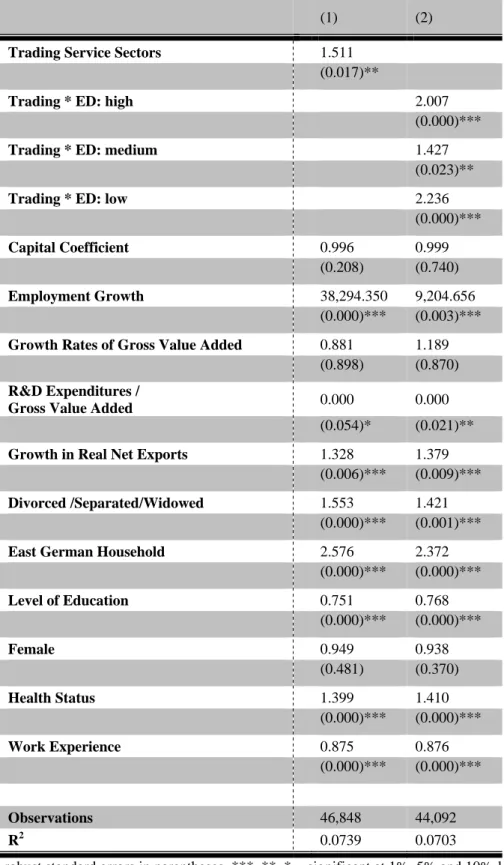
We now analyse whether the subjective feeling of job insecurity of employees in trading ser-vice industries is also reflected in a higher objective unemployment risk of these workers. Column 1 shows that employees in trading service industries have a greater probability of a job-to-unemployment transition than those in non-trading service industries. Column 1 re-ports an odds ratio of 1.511, which means that employees in a trading service industry have a 1.511 greater probability of becoming unemployed than other employees. This result is somewhat surprising, because the employment trend shown in Figure 3 is better for trading service industries than for non-trading service industries. However, the net employment changes, which are documented using input-output data for sectoral employment, conceal an enormous amount of job churning – many jobs are created and destroyed in all sectors of the economy. Consequently, the relatively positive employment trend in the trading service in-dustries does not mean that the unemployment risk of an individual employee automatically declines when he is employed in one of the sectors in this group of industries. As Table 3 reveals, the average length of stay without interruption in a trading service industry is indeed shorter than in non-trading service industries (3.6 years versus 3.9 years), indicating that em-ployees in trading service industries have a higher rate of individual labour market transition (job-to-job as well as job-to-unemployment transition). This may be a reason for the positive coefficient.
The effect of trade openness on individual unemployment probability could vary with the skill level. Consequently, we estimate separately the impact of being employed in a trading service sector on the probability of a job-to-unemployment transition for high-skilled, me-dium-skilled and low-skilled employees (see Column 2), using interaction terms. The results show that employees in trading service industries face a higher risk of unemployment than those in non-trading service industries, regardless of their skill level. The effect is strongest for low-skilled employees and weakest for medium-skilled employees. Again, this can be explained by the hypothesis of Blinder (2009), that there is almost no correlation between the offshorability of a specific task and employee qualifications, as measured by the level of edu-cation. Blinders’ theory is confirmed by Schrader and Laaser (2009), who find that around 53 per cent of German high-skill jobs can potentially be offshored, compared to around 43 per cent of low-skill jobs. An equal proportion of low-skill jobs seems not to be offshorable at all, supporting the assumption that low-skill jobs are not primarily offshorable. Especially in the service sector, many tasks that are performed by low-skilled employees, are delivered per-sonally and therefore not tradable.
In our model, three of five industry-specific macroeconomic control variables exert a signifi-cant influence on the individual unemployment risk. Employment growth and growth in real net exports increase the unemployment risk of service employees, whereas technological change decreases the risk of becoming unemployed. At first glance, the impact of sectoral employment growth on the individual unemployment risk does not seem plausible. Due to positive net employment changes, the unemployment risk of an individual employee in-creases. However, net employment trends do not necessarily reflect developments at the mi-cro-level. As stated by the OECD, worker flows, defined as hirings and separations, are driven “by a continuous process of labour reallocation and not necessarily by net employment growth” (OECD 2009, p. 120). Moreover, worker reallocation would appear to be larger in expanding industries. This shows that the unemployment risk of an individual worker does not need to decline, due to employment growth at the industry-level.
Growth in real net exports not only exerts a positive impact on the subjective feeling of job insecurity of employees in service industries, but also on their objective unemployment risk. The positive impact of trade on individual unemployment risk can possibly be explained by increasing labour demand elasticities, due to an intensification of economic integration. In-ternational trade enables firms to adjust the mix of domestic workers and foreign value-added in production processes, due to changes in relative factor prices.
By contrast, industry-specific technological progress significantly decreases the individual unemployment risk. This shows that employment prospects in sectors investing in research and development are better, possibly due to an increase in competitiveness.
The personal characteristics of employees affect individually reported fears of job loss and individual unemployment risk in an identical manner. Our estimation reveals that a one-unit increase in the average level of education and work experience in full-time employment sig-nificantly lowers the probability of becoming unemployed. By contrast, East German house-holds, employees with a poorer state of health, as well as those who are divorced, separated or widowed, face a higher individual unemployment risk. However, we cannot prove that the employment perspectives of female employees are significantly worse than those of male employees.27
27
The estimations of Geishecker (2008) also reveal that the unemployment risk decreases with higher educa-tional attainment. However, in contrast to our results, he finds that women face a significantly higher risk of losing employment than men.
Table 5: Trade exposure and unemployment probability
Variables Odds ratios and p-values
(1) (2)
Trading Service Sectors 1.511
(0.017)**
Trading * ED: high 2.007
(0.000)***
Trading * ED: medium 1.427
(0.023)**
Trading * ED: low 2.236
(0.000)***
Capital Coefficient 0.996 0.999
(0.208) (0.740)
Employment Growth 38,294.350 9,204.656
(0.000)*** (0.003)***
Growth Rates of Gross Value Added 0.881 1.189
(0.898) (0.870)
R&D Expenditures /
Gross Value Added 0.000 0.000
(0.054)* (0.021)**
Growth in Real Net Exports 1.328 1.379
(0.006)*** (0.009)***
Divorced /Separated/Widowed 1.553 1.421
(0.000)*** (0.001)***
East German Household 2.576 2.372
(0.000)*** (0.000)*** Level of Education 0.751 0.768 (0.000)*** (0.000)*** Female 0.949 0.938 (0.481) (0.370) Health Status 1.399 1.410 (0.000)*** (0.000)*** Work Experience 0.875 0.876 (0.000)*** (0.000)*** Observations 46,848 44,092 R2 0.0739 0.0703
5 Conclusion
The present paper investigates the impact of international trade on both the perceived and actual employment prospects of employees in the German service sector. The analysis is based on individual-level data, which enables us to control for the major proportion of unob-served individual heterogeneity, thus reducing the potential endogeneity bias.
Using a worker-flow approach and applying both a subjective and an objective measure of individual unemployment risk, to the best of our knowledge, we are the first to report that employees in trading service industries face a higher level of perceived and actual job insecu-rity. The negative impact of trade on the two outcome measures can possibly be explained by increasing labour-demand elasticities. We argue that international trade enables firms to ad-just their mix of domestic workers and foreign value-added in production processes, thus making employment more volatile.
Our results hold for all employees in trading service sectors, irrespective of their skill level. Thus, we support Blinder (2009), who argues that there is almost no correlation between the offshorability of a specific task and employee qualifications, as measured by the level of edu-cation. According to Blinder, an increasing share of high-skill jobs that require expert think-ing and/or complex communication, but not physical presence, will be deliverable remotely in the future.
The second trade-related variable employed in the estimation, the growth in real net exports, confirms the hypothesis that increasing trade volumes make employees feel less secure and also tend to raise their objective unemployment risk. Furthermore, the personal characteristics of employees seem to exert a substantial effect on both perceived job security and objective unemployment risk. In both regressions, worker characteristics have an almost identical in-fluence on the two outcome measures.
Further research on perceived job insecurity and objective unemployment risk is essential to enhance our understanding of the impact of international trade on individual employment prospects, especially for service employees.
BIBLIOGRAPHY
Amemyia, T. (1981): Qualitative Response Models: A Survey. Journal of Economic Litera-ture, XIX, pp. 1483-1536.
Bardhan, A. D., Kroll, C. (2003): The New Wave of Outsourcing. Fisher Center for Real Es-tate & Urban Economics Research Report Series No. 1103.
Bartel, A. P., Lichtenberg, F. R. (1987): The Comparative Advantage of Educated Workers in Implementing New Technology. The Review of Economics and Statistics, 69(1), pp. 1-11.
Bhagwati, J., Panagariya, A. and Srinivasan, T. N. (2004): The Muddles over Outsourcing.
Journal of Economic Perspectives, 18(4), pp. 93-114.
Berman, E., Bound, J., Griliches, Z. (1994): Changes in the Demand for Skilled Labor within US Manufacturing: Evidence from the Annual Survey of Manufactures. The
Quar-terly Journal of Economics, 109(2), pp. 367-397.
Berman, E., Bound, J., Machin, S. (1998): Implications of Skill-Biased Technological Change: International Evidence. The Quarterly Journal of Economics, 113(4), pp. 1245-1279.
Blinder, A. S. (2009): How Many US Jobs Might Be Offshorable? World Economics, 10(2), pp. 41-78.
Böckerman, P. (2004): Perceptions of Job Instability in Europe. Social Indicators Research, 67(3), pp. 283-314.
Cornfield, J. (1951): A method of estimating comparative rates from clinical data. Applica-tions to cancer of the lung, breast and cervix. Journal of the National Cancer Institute,
11, 1269-1275.
Davidson, C., Matusz, S. J. (2001): On adjustment costs. Leverhulme Centre for Research on Globalisation and Economic Policy (ed.), Research Paper 2001/24.
Davis, S. J., Haltiwanger, J. C., Schuh, S. (1996): Job Creation and Destruction. Cambridge: MIT Press.
Doms, M., Dunne, T., Troske, K. R. (1997): Workers, wages and technology. Quarterly
Journal of Economics, 112, pp. 253-290.
Ebenstein, A., Harrison, A., McMillan, M., Phillips, S. (2009): Estimating the Impact of Trade and Offshoring on American Workers Using the Current Population Surveys. National Bureau of Economic Research NBER, NBER Working Paper Series, no. 15107.
Egger, P., Pfaffermayr, M., Weber, A. (2007): Sectoral Adjustment of Employment to Shifts in Outsourcing and Trade: Evidence from a Dynamic Fixed Effects Multinominal Logit Model. Journal of Applied Econometrics, 22(3), pp. 559-580.
Faberman, R. J. (2004): Gross Job Flows over the Past Two Business Cycles: Not all “Re-coveries” are Created Equal. U. S. Bureau of Labor Statistics (ed.), BLS Working Pa-per No. 372.
Farber, H. S. (1994): The Analysis of Interfirm Worker Mobility. Journal of Labor Econom-ics, 12(4), pp. 554-593.
Feenstra, R. C., Hanson, G. H. (1996): Globalization, Outsourcing, and Wage Inequality. The
American Economic Review, 86(2), pp. 240-245.
Feenstra, R. C., Hanson, G. H. (1999): The Impact of Outsourcing and High-Technology Capital on Wages: Estimates for the United States, 1979-1990. The Quarterly Journal
of Economics, 114(3), pp. 907-940.
Fullerton, A. S., Wallace, M. (2007): Traversing the flexible turn: US workers’ perceptions of job security, 1977-2002. Social Science Research, 36(1), pp. 201-221.
Geishecker, I. (2008): The Impact of International Outsourcing on Individual Employment Security: A Micro-Level Analysis. Labour Economics, 15(3), pp. 291-314.
Geishecker, I., Görg, H. (2008): Winners and losers: A micro-level analysis of international outsourcing and wages. Canadian Journal of Economics, 41(1), pp. 243-270.
Geishecker, I., Görg, H., Munch, J. (2010): Do labour market institutions matter? Micro-level wage effects of international outsourcing in three European countries. Review of
World Economics, 146(1), pp. 179-198.
Goldberg, L. S., Tracy, J. S. (2003): Exchange Rates and Wages. Mimeo, Federal Reserve Bank of New York.
Goldberg, L. S., Tracy, J., Aaronson, S. (1999): Exchange Rates and Employment Instability: Evidence from Matched CPS Data. The American Economic Review, 89(2), pp. 204-210.
Gourinchas, P.-O. (1998): Exchange Rates and Jobs: What Do We Learn from Job Flows?
NBER Macroeconomics Annual, 13, pp. 153-207.
Gujarati, D. N. (2003): Basic Econometrics. New York.
Haskel, J. E., Heden, Y. (1999): Computers and the Demand for Skilled Labour: Industry- and establishment-level Panel Evidence for the UK. Economic Journal, 109(454), pp. C68-C79.
Jensen, J. B. and Kletzer, L. G. (2006): Tradable Services: Understanding the Scope and Im-pact of Services Offshoring. In: Collins, S. M./Brainard, L. (eds.): Brookings Trade Forum 2005, Offshoring White-Collar Work. Brookings Institution: Washington D.C., pp. 75-133.
Kalmbach, P., Franke, R., Knottenbauer, K., Krämer, H. (2005): Die Interdependenz von Industrie und Dienstleistungen: Zur Dynamik eines komplexen Beziehungsgeflechts. Edition sigma: Berlin.
Klein, M. W., Schuh, S., Triest, R. K. (2003a): Job Creation, Job Destruction, and Interna-tional Competition. W.E. Upjohn Institute for Employment Research, Kalamazoo, Michigan.
Klein, M. W., Schuh, S., Triest, R. K. (2003b): Job Creation, Job Destruction, and the Real Exchange Rate. Journal of International Economics, 59, pp. 239-265.
Kölling, A., Schank, T. (2003): Skill-Biased Technological Change, International Trade and the Wage Structure – New evidence on the determinants of the employment structure from linked employer-employee panel data for Germany. In: Lutz Bellmann/Reinhard Hujer (ed.): Betriebliche Innovationen im Spiegel von Betriebsbefragungen. Beiträge zur Arbeitsmarkt- und Berufsforschung Nr. 277, Nürnberg.
Liu, R., Trefler, D. (2008): Much Ado About Nothing: American Jobs and the Rise of Service Outsourcing to China and India. National Bureau of Economic Research NBER, NBER Working Paper Series, no. 14061.
Lurweg, M., Uhde, N. (2010): International Trade and Individual Labour Market Perspectives – A Micro-Level Analysis of German Manufacturing Workers. SOEPpapers on Mul-tidisciplinary Panel Data Research No. 297.
Machin, S., Van Reenen, J. (1998): Technology and Changes in Skill Structure: Evidence from Seven OECD Countries. The Quarterly Journal of Economics, 113(4), pp. 1212-1244.
Maddala, G. S. (1983): Limited-Dependent and Qualitative Variables in Economics. Cam-bridge University Press, New York.
McFadden, D. (1981): Econometric Models of Probabilistic Choice. In: Manski, C. F., McFadden, D. (eds.): Structural Analysis of Discrete Data. Cambridge: MIT Press. Molnar, M., Pain, N., Taglioni, D. (2007): The internationalisation of production,
interna-tional outsourcing and employment in the OECD. OECD Economics Department Working Paper No. 561.
Munch, J. R. (2005): International outsourcing and individual job separations. University of Copenhagen, Department of Economics (ed.), Discussion paper 05-11.
OECD (2009): OECD Employment Outlook 2009 – Tackling the Jobs Crisis.
Rodrik, D. (1997): Has globalisation gone too far? Washington, D.C.: Institute for Interna-tional Economics.
Royalty, A. B. (1998): Job-to-Job and Job-to-Nonemployment Turnover by Gender and Edu-cation Level. Journal of Labor Economics, 16(2), pp. 392-443.
Samuelson, P. A. (2004): Where Ricardo and Mill Rebut and Confirm Arguments of Main-stream Economists Supporting Globalization. Journal of Economic Perspectives, 18(3), pp. 135-146.
Scheve, K. F., Slaughter, M. J. (2004): Economic Insecurity and the Globalization of Produc-tion. American Journal of Political Science, 48(4), pp. 662-674.
Schrader, K., Laaser, C.-F. (2009): Globalisierung in der Wirtschaftskrise: Wie sicher sind die Jobs in Deutschland? Kieler Diskussionsbeiträge Nr. 465, Institut für Welt-wirtschaft Kiel.
Senses, M. Z. (2006): The Effects of Outsourcing on the Elasticity of Labor Demand. CES Working Paper No. 06-07.
Slaughter, M. (2001): International Trade and Labor-Demand Elasticities. Journal of
Interna-tional Economics, 54(1), pp. 27-56.
United Nations (2007): Trade Statistics in Policy-Making – A Handbook of Commonly Used Trade Indices and Indicators.
Van Welsum, D., Vickery, G. (2005): Potential Offshoring of ICT-intensive using occupa-tions. DSTI Information Economy Working Paper, DSTI/ICCP/IE(2004)19/Final, OECD, Paris.
Wagner, G. G., Frick, J. R., Schupp, J. (2007): The German Socio-Economic Panel Study (SOEP) – Scope, Evolution and Enhancements. Schmollers Jahrbuch, 127(1), pp. 139-169.