c
MULTI-DIMENSIONAL MINING OF UNSTRUCTURED DATA WITH LIMITED SUPERVISION
BY CHAO ZHANG
DISSERTATION
Submitted in partial fulfillment of the requirements for the degree of Doctor of Philosophy in Computer Science
in the Graduate College of the
University of Illinois at Urbana-Champaign, 2018
Urbana, Illinois Doctoral Committee:
Professor Jiawei Han, Chair Professor ChengXiang Zhai Professor Tarek Abdelzaher Professor Qiaozhu Mei
ABSTRACT
As one of the most important data forms, unstructured text data plays a crucial role in data-driven decision making in domains ranging from social networking and informa-tion retrieval to healthcare and scientific research. In many emerging applicainforma-tions, people’s information needs from text data are becoming multi-dimensional—they demand useful in-sights for multiple aspects from the given text corpus. However, turning massive text data into multi-dimensional knowledge remains a challenge that cannot be readily addressed by existing data mining techniques.
In this thesis, we propose algorithms that turn unstructured text data into multi-dimensional knowledge with limited supervision. We investigate two core questions:
1. How to identify task-relevant data with declarative queries in multiple dimensions? 2. How to distill knowledge from data in a multi-dimensional space?
To address the above questions, we propose an integrated cube construction and exploita-tion framework. First, we develop acube constructionmodule that organizes unstructured data into a cube structure, by discovering latent multi-dimensional and multi-granular struc-ture from the unstrucstruc-tured text corpus and allocating documents into the strucstruc-ture. Sec-ond, we develop a cube exploitationmodule that models multiple dimensions in the cube space, thereby distilling multi-dimensional knowledge from data to provide insights along multiple dimensions. Together, these two modules constitute an integrated pipeline: lever-aging the cube structure, users can perform multi-dimensional, multi-granular data selection with declarative queries; and with cube exploitation algorithms, users can make accurate cross-dimension predictions or extract multi-dimensional patterns for decision making.
The proposed framework has two distinctive advantages when turning text data into multi-dimensional knowledge: flexibility and label-efficiency. First, it enables acquir-ing multi-dimensional knowledge flexibly, as the cube structure allows users to easily iden-tify task-relevant data along multiple dimensions at varied granularities and further distill multi-dimensional knowledge. Second, the algorithms for cube construction and exploitation require little supervision; this makes the framework appealing for many applications where labeled data are expensive to obtain.
ACKNOWLEDGMENTS
First and foremost, I want to thank Professor Jiawei Han—the most ideal advisor one can hope for. As an advisor, Jiawei has provided tremendous support and guidance to train me into a researcher throughout my Ph.D. study. He has taught me essential skills to become a mature researcher, from identifying and formulating important problems, to developing solutions critically and rigorously, to collaborating with other researchers, and to communicating ideas clearly. The influence of Jiawei is beyond the role of advior—he is also a life-long role model to me. I have learned from him the courage to take challenges, the positive attitude in front of setbacks, the diligence and self-discipline, and many other characteristics. Such influences will be a forever treasure in my life.
I would like to thank my thesis committee members, Professor ChengXiang Zhai, Professor Tarek F. Abdelzaher, and Professor Qiaozhu Mei. They have provided not only careful commentary on this document, but also tremendous help in my job search process and invaluable advice for crafting a successful academic career.
I have been fortunate to interact with and learn from many wonderful researchers in academia: Dr. Jessie Zhenhui Li, Dr. Yizhou Sun, Dr. Xifeng Yan, Dr. Feida Zhu, Dr. Jian Pei, Dr. Quanquan Gu, Dr. Lu Su, Dr. Jing Gao, Dr. Yu Zheng, Dr. Shaowen Wang, Dr. Phillip Yu, Dr. Hong Cheng, Dr. Jimeng Sun, Dr. Anthony K. H. Tung. As experienced researchers, they have given me a lot of help and advice both on my research and on career development. Special thanks to Jessie, it is because of our conversation in KDD 2016 that I finally decided to join academia after graduation.
Many thanks to my dear friends in the DMG and DAIS family! Alphabetically, they are: Xiusi Chen, Joe Chen, Yucheng Chen, Ahmed El-Kishky, Xiaotao Gu, Huan Gui, Meng Jiang, Shan Jiang, Dongming Lei, Min Li, Ji Li, Qi Li, Zoey Li, De Liao, Liyuan Liu, Mengxiong Liu, Jialu Liu, Yuning Mao, Yu Meng, Meng Qu, Xiang Ren, Jingbo Shang, Jiaming Shen, Yu Shi, Fangbo Tao, Wenzhu Tong, Frank Xu, Chenguang Wang, Chi Wang, Qi Wang, Jingjing Wang, Xuan Wang, Ellen Wu, Carl Yang, Hongkun Yu, Xiao Yu, Quan Yuan, Keyang Zhang, Yu Zhang, Shi Zhi, Qi Zhu, Wanzheng Zhu, and Honglei Zhuang. Because of them, Ph.D. life at UIUC has been so much fun. I am indebted to many of them who took great care of me during my achilles tendon injury. It is their care and encouragement that helped me through the recovery process. I wish all of them a successful career and a happy life.
Hanratty, Lance Kaplan, Shuochao Yao, Huajie Shao, Wei Zhang, Wei Feng, Yong Li, Di Yao, Jie Feng, Julie Yixuan Zhu, and Luming Zhang. The collaborations with them are always enjoyable—I love working together in idea brainstorming, coding, paper writing, and catching up with conference deadlines. Our collaborations have been so fruitful. I look foward to future opportunities in collaborating with them and meeting them at conferences. I also want express my deep gratitude to my M.S. advisors at Zhejiang University: Profes-sor Gang Chen, ProfesProfes-sor Lidan Shou, and ProfesProfes-sor Ke Chen. They guided me to step into Computer Science research and realize its beauty in an early stage. Their hands-on mentor-ing in research methodology, intellectual audacity, writmentor-ing, and presentation prepared me so well for starting my Ph.D. at UIUC. And over time, I have realized how important these skills are to my academic career.
Finally, my deepest gratitude to my family! I thank my parents and sister for their endless love and constant support in every aspect of my life. Special thanks to Shili—my dear sunshine lighting up my world. Without you I would not have made it this far and been so happy every day. I am so fortunate to have you around, and want to thank you for your love, encouragement, and support in this wonderful journey.
TABLE OF CONTENTS CHAPTER 1 INTRODUCTION . . . 1 1.1 Overview . . . 1 1.2 Main Modules . . . 3 1.3 Technical Contributions . . . 7 1.4 Organization . . . 11
CHAPTER 2 TAXONOMY GENERATION FOR CUBE SCHEMA DISCOVERY . 12 2.1 Overview . . . 12
2.2 Related Work . . . 16
2.3 Preliminaries . . . 18
2.4 Adaptive Term Clustering . . . 19
2.5 Adaptive Term Embedding . . . 22
2.6 Experimental Evaluation . . . 24
2.7 Summary . . . 31
CHAPTER 3 DOCUMENT ALLOCATION WITHOUT LABELED DATA . . . 32
3.1 Overview . . . 32
3.2 Related Work . . . 35
3.3 Preliminaries . . . 36
3.4 Graph-Based Joint Embedding . . . 38
3.5 Dimension-Aware Embedding Learning . . . 40
3.6 The OverallDoc2Cube Algorithm . . . 43
3.7 Experimental Evaluation . . . 45
3.8 Summary . . . 53
CHAPTER 4 CROSS-DIMENSION PREDICTION IN CUBE SPACE . . . 54
4.1 Overview . . . 54
4.2 Related Work . . . 57
4.3 Preliminaries . . . 57
4.4 Semi-Supervised Multimodal Embedding . . . 59
4.5 Online Updating of Multimodal Embedding . . . 63
4.6 Experiments . . . 68
4.7 Summary . . . 80
CHAPTER 5 EVENT DETECTION IN CUBE SPACE . . . 82
5.1 Overview . . . 82
5.2 Related Work . . . 84
5.6 Supporting Continuous Event Detection . . . 94 5.7 Complexity Analysis . . . 94 5.8 Experiments . . . 95 5.9 Summary . . . 103 CHAPTER 6 CONCLUSION . . . 104 6.1 Summary . . . 104 6.2 Future Work . . . 105 REFERENCES . . . 107
CHAPTER 1: INTRODUCTION
1.1 OVERVIEW
Text is one of the most important data forms for the human to record and communicate information. In a wide spectrum of domains, hundreds of millions of textual contents are being created, shared, and analyzed every single day—examples including tweets, news ar-ticles, Google searches, and medical notes. It is estimated that more than 80% of human knowledge is encoded in the form of unstructured text [29]. Due to such ubiquity, extracting useful insights from text data is crucial to decision making in various applications, rang-ing from automated medical diagnosis [12, 90] and disaster management [52, 75] to fraud detection [80, 50] and personalized recommendation [53, 51].
In many newly emerged applications, people’s information needs from text data are becom-ing multi-dimensional. That is, people can demand useful insights formultiple aspects
from the given text corpus. Consider an analyst who wants to use news corpora for disaster analytics. Upon identifying all disaster-related news articles, she needs to understand what disaster each article is about,where andwhenis the disaster, andwhoare involved. She may even need to explore the multi-dimensionalwhat-where-when-who space at varied granulari-ties, so as to answer questions like ‘what are all the hurricanes happened in the US in 2018’ or ‘what are all the disasters happened in California in June’. Disaster analytics is only one of the many applications where multi-dimensional knowledge is required. To name a few other examples, (1) analyzing a biomedical research corpus often requires digging out what genes, proteins, and diseases each paper is about and uncover their inter-correlations; (2) leveraging the medical notes of diabetes patients for automatic diagnosis requires correlat-ing symptoms with genders, ages, and even geographical regions; (3) analyzing Twitter data for an presidential election event requires understanding people’s sentiments about various political aspects in different geographical regions and time periods.
Acquiring such multi-dimensional knowledge is made possible due to the rich context information in text data. Such context information can arrive in the form of explicit meta-data, such as geographical locations and timestamps alongside Google searches, creating time and geo-tags associated with tweets, and patients’ meta-data linked with medical notes. Alternatively, they can arrive in the form of implicit information mentioned in the text itself, such as various entity information (location, person, time, etc.) in news articles, point-of-interest names in tweets, and various typed concepts in biomedical papers. It is
multiple dimensions and extracting multi-dimensional knowledge for decision making. In this thesis, our goal is to develop algorithms that facilitate turning massive un-structured text data into multi-dimensional knowledge for decision making. We investigate two core questions for this goal:
1. How to identify task-relevant data with declarative queries in multiple dimensions? 2. How to distill knowledge from data in a multi-dimensional space?
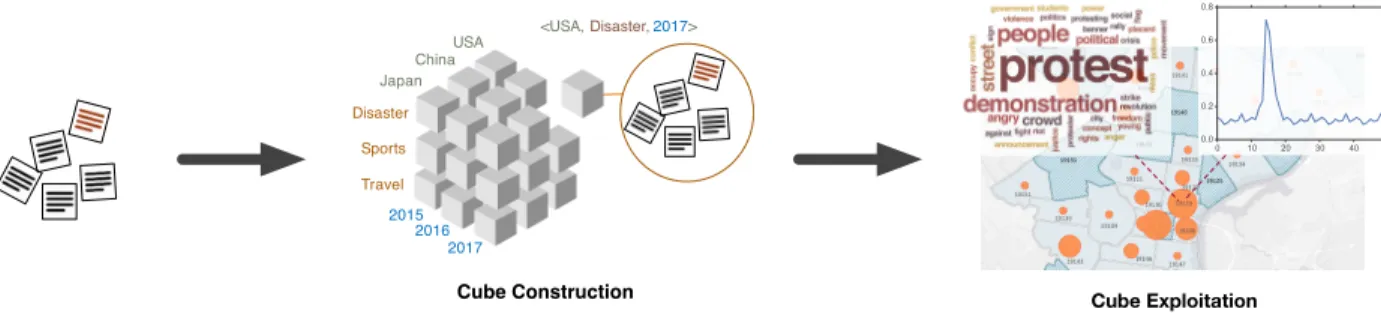
We propose a cube-based framework that approaches the above two questions with min-imal supervision. As shown in Figure 1.1, our proposed framework consists of two key modules. First, the cube construction module organizes unstructured data into a multi-dimensional andmulti-granular cube structure. With the cube structure, users can identify task-relevant data by specifying query clauses along multiple dimensions at varied granular-ities. Second, the cube exploitation module consists of a set of algorithms that extract useful patterns by jointly modeling multiple dimensions in the cube space. Specifically, it offers algorithms that make predictions across different dimensions or identify unusual events in the cube space. Together, these two modules constitute an integrated pipeline: (1) lever-aging the cube structure, users can perform multi-dimensional, multi-granular data selection with declarative queries; and (2) with cube exploitation algorithms, users can make accurate cross-dimension predictions or extract multi-dimensional patterns for decision making.
China USA Japan Disaster Sports Travel 2015 2016 2017 <USA, Disaster, 2017> Cube Construction 0 10 20 30 40 50 0.0 0.2 0.4 0.6 0.8 Cube Exploitation
Figure 1.1: Our proposed framework consists of two key modules: (1) a cube construc-tion module that organizes the input data into a multi-dimensional, multi-granular cube structure; (2) a cube exploitation module that discovers interesting patterns in the multi-dimensional space.
Our work has two distinctive advantages when turning text data into multi-dimensional knowledge: flexibility and label-efficiency. First, it enables acquiring multi-dimensional knowledge flexibly by virtue of the cube structure. Notably, users can use concise declara-tive queries to identify relevant data along multiple dimensions at varied granularities, e.g.,
htopic=‘disaster’, location = ‘US’, time=‘2018’i, or htopic=‘earthquake’, location = ‘Cal-ifornia’, time=‘June’i1, and then apply any data mining primitives (e.g., event detection, sentiment analysis, summarization, visualization) for subsequent analysis. Second, it is label-efficient and thus applicable to many real-life scenarios where labeled data are unavailable. For both cube construction and exploitation, our proposed algorithms all require no or little supervision. This property breaks the bottleneck of lacking labeled data and makes our framework attractive in applications where acquiring labeled data is expensive.
Our framework represents a departure from existing techniques for multi-dimensional data analysis. Data warehouse and online analytical processing techniques [34, 15] have been successful in multi-dimensional analysis of structured data. They allow end users to per-form ad-hoc analysis of structured data along multiple dimensions to acquire task-specific insights. Unfortunately, the task of extracting multi-dimensional knowledge from text chal-lenges conventional data warehousing techniques. It is not only because the schema of the cube structure remains unknown, but also allocating the text documents into different cells in the cube space is difficult. Thus, our proposed algorithms bridge the gap between data warehousing and multi-dimensional analysis of unstructured text data.
Along with another line, our work is closely related to text mining. Nevertheless, the success stories of existing text mining techniques still largely rely on the supervised learning paradigm. For instance, our document allocation problem is related to multi-dimensional text classification, yet existing text classification models use massive amounts of labeled documents to learn classification models. Event detection is another example: event ex-traction techniques in the natural language processing community rely on human-curated sentences to train discriminative models that determine whether a specific type of event has occurred; but if we are to build an event alarm system, it is hardly possible to enumerate all event types and manually curate enough training data for each type. Our work complements existing text mining techniques with unsupervised or weakly-supervised algorithms, which distill knowledge from the given text data with limited supervision.
1.2 MAIN MODULES
We propose an integrated framework that turns unstructured data into multi-dimensional knowledge with limited supervision. As aforementioned, there are two main modules in our proposed framework: (1) acube construction module that organizes unstructured data a multi-dimensional, multi-granular structure; and (2) acube exploitationmodule that extracts
multi-dimensional knowledge in the cube space. In this section, we provide a more detailed overview of these two modules, and then illustrate a number of example applications of our framework.
1.2.1 Module I: Cube Construction
Extracting multi-dimensional knowledge from the unstructured text for decision making necessarily begins with identifying task-relevant data. When an analyst exploits the Twitter stream for sentiment analysis of the 2016 Presidential Election, she may want to retrieve all tweets discussing this event by California users in 2016. Such information needs are often structured and multi-dimensional, yet the input data are unstructured text. Naturally, the first critical question is,can we use declarative queries along multiple dimensions to identify task-relevant data for on-demand analytics?
June July August
Champaign Chicago New York City San Francisco Los Angeles Moscow Beijing Illinois New York California Russia China US Football Basketball Hurricane Disaster Earthquake Protest Politics Sports Time Dimension Topic Dimension Location Dimension Query =
<Disaster, US, June & July> <Unrest, Illinois, *>Query = <Sports, Illinois, *>Query =
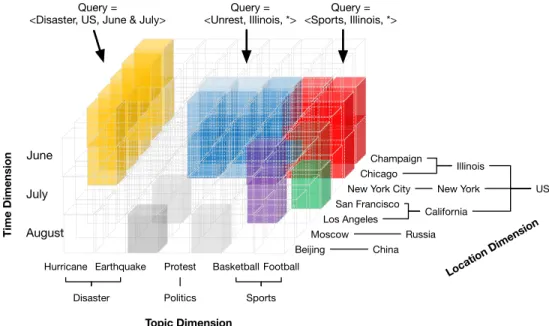
Figure 1.2: An example three-dimensional (topic, location, time) cube structure constructed for social media data. Each dimension has a taxonomic structure, and the three dimensions partition the whole data space into a three-dimensional, multi-granular structure with social media records residing in. End users can use flexible queries to retrieve relevant data for on-demand data analysis.
We approach this question by organizing massive unstructured data into a neat text cube structure, with minimum supervision. For example, Figure 1.2 shows a three-dimensional topic-location-time cube, where each dimension has a taxonomic structure automatically discovered from the input text corpus. With the multi-dimensional, multi-granular cube
structure, users can easily explore the data space and select relevant data with struc-tured and declarative queries, e.g., htopic=‘hurricane’, location=‘Florida’, time=‘2017’i, htopic=‘disaster’, location=‘Florida’, time=‘*’i. Better still, they can subsequently apply any statistical primitives (e.g., sum, count, mean) or machine learning tools (e.g., sentiment analysis, text summarization) on the selected data to facilitate on-the-fly exploration.
To turn the unstructured data into such a multi-dimensional, multi-granular cube, there are two central subtasks: (1) taxonomy generation; and (2) document allocation. The first task aims at automatically defining the cube schema from data by discovering the taxonomic structure for each dimension; the second aims at allocating documents into proper cells in the cube. While the two subtasks are closely related to existing literature on taxonomy generation and document classification, most existing methods are inapplicable because they rely on excessive training data. Later, we will propose methods that require no labeled data by learning task-specific text embeddings for cube construction.
1.2.2 Module II: Cube Exploitation
Raw unstructured text data (e.g., social media, SMS messages) are often noisy. Identifying relevant data is merely the first step of the multi-dimensional analytics pipeline. Upon identifying relevant data, next question is to distill interesting multi-dimensional patterns in the cube space to aid decision making. Continue the example in Figure 1.2: Can we detect abnormal activities happened in the New York City in 2017—this translates to the task of finding abnormal patterns in the cube cell h*, New York City, 2017i? Can we predict where traffic jams are most likely to take place in Los Angeles around 5pm—this translates to the task of making predictions with data residing in the cube cell hTravel, Los Angeles, 5pmi. Can we find out how the earthquake hotspots evolve in the US—this translates to the task of finding evolving patterns across a series of cube cells matching the query hEarthquake, US, *i.
The cube exploitation module answers the above questions by offering a set of algorithms that discover multi-dimensional knowledge in the cube space. The unique characteristic here is that it is necessary to jointly model multiple factors and uncover their collective patterns in the multi-dimensional space. Under this principle, we investigate two essential tasks in the cube exploitation module: (1) We first study the cross-dimension prediction problem, which aims at modeling the correlations among multiple dimensions (e.g., topic, location, time) for predictive analytics. This leads to the development of a cross-dimension prediction model
We then study the abnormal pattern discovery problem, which aims at detecting abnormal patterns in any cube cell. The discovered patterns reflect abnormal behaviors with respect to the concrete contexts of the user-selected cell, e.g.,hLos Angeles, *, 2018i,hProtest, US, 2018i, providing context-aware insights that help with decision making.
1.2.3 Example Applications
Together, the cube construction module and the cube exploitation module serve as an integrated framework for many applications that demand multi-dimensional knowledge. The modules can be either used by themselves or combined with other existing data mining primitives for the end task. In the following, we provide several examples to illustrate the applications of our proposed framework.
Example Application I: Disaster Detection and Relief
Social media has shown to be an important source for detecting disastrous events (e.g., wildfire, hurricane) in real time. When an emergent disaster outbreaks, social media websites can be instantly filled with reports from witnesses long before the event is covered by tradi-tional news sources. With our work, it is possible to structure massive social media streams into awhat-where-when-who cube for disaster analytics. With the cube structure, an analyst can easily find out not only what is happening, but also where it is, who are involved, and how it is evolving. She can further visualize the information in the multi-dimensional cube space or identify abnormal disaster occurring patterns. Such multi-dimensional knowledge is highly useful for taking effective disaster-relief actions.
Example Application II: Biomedical Literature Mining
PubMed hosts as many as 27.3 million research articles and serves as an indispensable database for biomedical research. As such a massive amount of biomedical papers are too enormous for the human to analyze, automated analysis of such a large biomedical literature corpus is becoming a pressing need. Consider a system that can automatically organize all the papers according to multiple facets (e.g., diseases, genes, proteins and chemicals). This results in a disease-gene-protein-chemical cube, which enables quick retrieval of relevant biomedical papers with simple queries (e.g., hdisease = ‘breast cancer’, gene = ‘BRCA1’, *, * i). It is also possible to model gene-disease correlations in the multi-dimensional space and make predictions for inspiring new biomedical research.
Example Application III: Contextual Sentiment Analysis
Suppose a smartphone company (e.g., Apple) wants to understand their users’ attitudes towards a product (e.g., iPhone X) from massive customer reviews. To design most effective advertising and product-upgrading strategies, it is critical for analysts to understand sen-timents for different user groups (e.g., partitioned by gender, age, location) about different aspects (e.g., price, size, battery, speed) of the product. For this purpose, it is feasible to apply our work on the review corpus to construct a product review cube. With such a cube structure, the analyst can select data along multiple dimensions at varied granularities, make predictions across dimensions, and apply sentiment analysis tools for context-dependent opinions.
1.3 TECHNICAL CONTRIBUTIONS
Towards the goal of turning unstructured data into multi-dimensional knowledge, our tech-nical contributions are unsupervised or weakly supervisedmethods that perform cube construction and exploitation. Specifically, we develop a set of embedding-based techniques for cube construction and exploitation with limited supervision. In the first part, we pro-pose unsupervised algorithms that learn task-specific embeddings for cube construction. In the second part, we present algorithms that leverage multimodal embeddings for extracting multi-dimensional knowledge in the cube space.
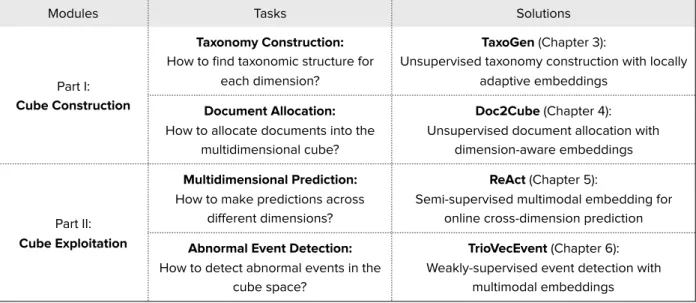
Figure 1.3 gives an overview of our proposed methods. In the cube construction part, we propose (1) TaxoGen, an unsupervised method that constructs topic taxonomy from a text corpus by learning locally adaptive embeddings[102]; and (2) Doc2Cube, an un-supervised method that performs multi-dimensional document classification by learning dimension-aware embeddings [85]. In the cube exploitation part, we propose (1)CrossMap, a semi-supervised method that learns multimodal embeddings for cross-dimension predic-tion [103, 104]; and (2)TrioVecEvent, a weakly-supervised method that detects abnormal events based on multimodal embeddings [105, 101]. In the remainder of this section, we de-scribe the main technical novelty for each of these methods and summarize our contributions.
1.3.1 Cube Construction Task 1: Taxonomy Generation
As mentioned earlier, to turn the unstructured data into a dimensional and multi-granular cube, the first central task is taxonomy generation. This task aims at
automat-Modules Tasks Solutions
Part I: Cube Construction
Taxonomy Construction: How to find taxonomic structure for
each dimension?
TaxoGen (Chapter 3):
Unsupervised taxonomy construction with locally adaptive embeddings
Document Allocation: How to allocate documents into the
multidimensional cube?
Doc2Cube (Chapter 4): Unsupervised document allocation with
dimension-aware embeddings
Part II: Cube Exploitation
Multidimensional Prediction: How to make predictions across
different dimensions?
ReAct (Chapter 5):
Semi-supervised multimodal embedding for online cross-dimension prediction Abnormal Event Detection:
How to detect abnormal events in the cube space?
TrioVecEvent (Chapter 6): Weakly-supervised event detection with
multimodal embeddings
Figure 1.3: An overview of our main algorithms for cube construction and exploitation. In the cube construction part, we propose (1) an unsupervised method (TaxoGen) that constructs topic taxonomy from a text corpus by learning locally adaptive embeddings; and (2) an unsupervised method (Doc2Cube) that performs multi-dimensional document classification without labeled data, by learning dimension-aware document representations. In the cube exploitation part, we propose (1) a semi-supervised method (CrossMap) that learns multimodal embeddings for cross-dimension prediction; and (2) a weakly-supervised method (TrioVecEvent) that detects abnormal events based on multimodal embeddings. from text.
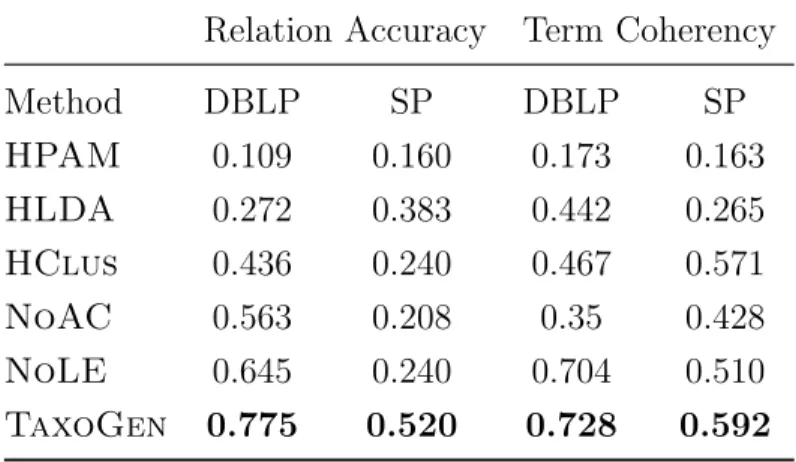
For this task, we propose TaxoGen [102], which organizes a given collection of concept terms into a topic taxonomy in an unsupervised way. To generate quality taxonomies, TaxoGen learns locally adaptive embeddings that achieve high discriminative power, and features an adaptive spherical clustering procedure that can assign terms to proper levels during a hierarchical clustering process. TaxoGen demonstrates, for the first time, that word embeddings can be exploited for topic taxonomy construction even without supervision. Compared with state-of-the-art hierarchical topic modeling methods, TaxoGen improves the parent-child relation accuracy from 27.2% to 77.5% and the topical coherency from 44.2% to 72.8%.
1.3.2 Cube Construction Task 2: Document Allocation
Following taxonomy generation, the second task of cube construction isdocument allo-cation, which aims at allocating documents into proper cells in the cube by choosing the most appropriate label along each dimension. Document allocation is essentially a
multi-dimensional document classification task. But the key challenge that prevents existing text classification techniques from being applied is the lack of labeled training data.
For document allocation, we develop a method that requires only label surface names for multi-dimensional classification. Our method, named Doc2Cube [85], achieves unsu-pervised classification by learning dimension-aware embeddings for documents with a joint embedding framework. It iteratively learns dimension-aware document representations, by selectively focusing on discriminative terms for different dimensions and propagating the information from the seeds to other terms. Doc2Cubeoutperforms state-of-the-art weakly supervised methods by more than 35% in terms of F1 score.
1.3.3 Cube Exploitation Task 1: Cross-Dimension Prediction
In the cube exploitation part, we first study an essential problem of cube-based multi-dimensional analysis: can we predict the value of any one dimension given observations of other dimensions? Consider Figure 1.2 as an example. Using data from the cube cell hLos Angeles, *, 2017 i, can we predict where do protest usually occur, or what are the typical activities around UCLA at8pm?
In our study, we approach the cross-dimension prediction problem with multimodal embedding. Different from many existing studies based on latent variable models, our method CrossMap directly maps elements from different dimensions into a latent space. To learn high-quality multimodal embeddings, our method incorporates information from external knowledge sources (e.g., Wikipedia, geographical gazetteer), by linking text with entity type information in such external knowledge sources and automatically labeling the linked records. This leads to a semi-supervised multimodal embedding framework, which leverages distant supervision to guide the embedding learning process. By instantiating our method for spatiotemporal activity prediction, we found that CrossMap leads to inspir-ing results: it outperforms existinspir-ing latent variable models by more than 84% for activity prediction. Furthermore, the learned representations are broadly applicable and useful for downstream applications such as activity classification.
1.3.4 Cube Exploitation Task 2: Abnormal Event Detection
In the second subtask of cube exploitation, we study the abnormal event detection prob-lem: given any ad-hoc cube cell, can we identify any abnormal events from the given
in-Existing event detection methods often require excessive human-curated training data to learn discriminative models for a set of specific event types. Further, they do not explicitly model the correlations among different modalities to uncover abnormal event in the multi-dimensional space. Our proposedTrioVecEventmethod combines two powerful machine learning techniques: representation learning and latent variable model. The former can well encode the semantics of unstructured text, while the latter is good at expressing the complex structural correlations among different factors. TrioVecEventcombines the two with a novel Bayesian mixture model, which generates locations with Gaussian distributions and text embeddings with von-Mishes Fisher distributions. The Bayesian mixture model is able to cluster records into geo-topic clusters as candidate events, then true spatiotemporal events are identified with a concise set of features. TrioVecEventimproves the precision of state-of-the-art methods from 32% to 80% and the pseudo recall from 40% to 58% — such performance makes it feasible to be deployed for real-world event detection and alarm systems.
1.3.5 Summary of Contributions
Our main contributions in this thesis are summarized as follows:
• We propose an integral cube construction and exploitation framework for turning un-structured data into multi-dimensional knowledge. The cube construction module neatly organizes unstructured data into a cube structure, from which users can flex-ibly perform multi-dimensional, multi-granular exploration with declarative queries. The cube exploitation module offers algorithms to extract useful multi-dimensional knowledge in the cube space for task support and decision making.
• We propose unsupervised methods for cube construction, which learn task-specific em-beddings and leverage the emem-beddings in an unsupervised way. Specifically, our pro-posed method TaxoGen learns locally adaptive embeddings and combine them with hierarchical spherical clustering for generating topical taxonomies; while our method Doc2Cubelearns dimension-aware joint embeddings to perform document allocation without labeled data.
• We propose multimodal embedding techniques for extracting multi-dimensional knowl-edge in the cube exploitation part. Our method CrossMap is capable of making cross-dimension predictions in the cube space, by incorporating external knowledge
into a semi-supervised multimodal embedding process. Based on multimodal embed-ding, our proposed method TrioVecEvent can detect abnormal events in the cube space, by combining the power of multimodal embedding and latent variable models.
1.4 ORGANIZATION
The remainder of the thesis is organized as follows. Chapter 2 to 5 describe our proposed algorithms for cube construction and exploitation. In the first part, we present algorithms for cube construction, introducing our methods for taxonomy generation (Chapter 2) and document classification (Chapter 3). In the second part, we present algorithms for cube exploitation, including our methods for cross-dimension prediction (Chapter 4) and abnormal event detection (Chapter 5). Finally, we conclude the thesis in Chapter 6 by summarizing our work and pointing out several future directions.
CHAPTER 2: TAXONOMY GENERATION FOR CUBE SCHEMA DISCOVERY
In the first part of the thesis, we describe the cube construction module, which organizes unstructured text data into a multi-dimensional, multi-granular cube structure, such that users can explore and retrieve relevant data with declarative queries easily. Recall Figure 1.2, the cube structure partitions the entire data space with multiple dimensions, each defined as an automatically discovered taxonomic structure. The documents in the entire corpus are allocated into one cell of the cube structure, thereby enabling users to select task-relevant data for on-demand analysis.
The cube construction process mainly involves two subtasks: (1) taxonomy generation— how to discover the taxonomic structure for each dimension? (2) document allocation—how to allocate all the documents into the cube by choosing the most appropriate label in each dimension? Answering these two questions is easy when the desired dimensions naturally inherit from explicit contexts associated with text,e.g., meta-data such as patient age, tweet creating time, and GPS coordinates. However, when the dimensions are implicitly hidden in the text corpus and need to be inferred, these two tasks become nontrivial. In the following two chapters, we will describe unsupervised methods that discover hidden dimension schemas for the given corpus and allocate documents into the cube. Specifically, in this chapter, we introduceTaxoGen, an unsupervised method for taxonomy construction from text corpora; in next chapter, we introduceDoc2Cube, an unsupervised method for document allocation.
2.1 OVERVIEW
Taxonomy generation is essential to automatically defining the schema of a cube dimen-sion. Given a collection of concept terms (e.g., entities, noun phrases) related to a cube dimension, the task of taxonomy generation generally aims at at organizing the given terms into a concept hierarchy that reflect the parent-child relationships among these concepts. There are two major types of taxonomies in literature: term-level and topic-level. The for-mer defines each node as a single term to represent a concept; and the latter defines each node as a group of topically coherent terms.
For the purpose of discovering the schema of each dimension, we focus on topic-level tax-onomy construction. In contrast to term-level taxonomies, each node in our topic taxtax-onomy is defined as a cluster of semantically coherent concept terms. This leads to a more concise taxonomy and less ambiguity of each node. Figure 2.1 shows a concrete example of topic taxonomy construction. Given a collection of computer science research papers, we build
Computer Science computer_science computation_time algorithm computation computation_approach Information Retrieval information_retrieval ir information_filtering text_retrieval retrieval_effectiveness … … Machine Learning machine_learning learning_algorithms clustering reinforcement_learning classification
Figure 2.1: An illustration of topic taxonomy generation. Given a text corpus and a collection of concept terms, we aim to organize the concept terms into a topic taxonomy. Each node is a cluster of semantically coherent concept terms representing a conceptual topic.
a tree-structured hierarchy. The root node is the general topic ‘computer science’, which is further split into sub-topics like ‘machine learning’ and ‘information retrieval’. For ev-ery topical node, we describe it with multiple concept terms that are semantically relevant. For instance, for the ‘information retrieval’ node, its associated terms include not only syn-onyms of ‘information retrieval’ (e.g., ‘ir’), but also different facets of the IR area (e.g., ‘text retrieval’ and ‘retrieval effectiveness’).
Automatically organizing a set of concept terms into a topic hierarchy is not a trivial task. There have been many supervised learning methods for taxonomy construction [47, 45] in the natural language processing community. Basically these methods extract lexical features and learn a classifier that categorizes term pairs into relations or non-relations, based on curated training data of hypernym-hyponym pairs [95, 79, 19, 55], or syntactic contextual information harvested from NLP tools [94, 57]. However, these methods require excessive amount of training data and cannot be applied to cube construction in applications where curated pairs are unavailable. Along another line, hierarchical topic models [10, 64, 24] have been proposed to generate topic taxonomies in an unsupervised way. Nevertheless, these models rely on strong assumptions of document-topic and topic-term distributions, which can produce poor topic taxonomies when real data do not match well with such assumptions. Furthermore, the learning process of such hierarchical topic models is typically time-consuming, making them unscalable to large text corpora.
We propose an unsupervised method namedTaxoGenfor constructing topic taxonomies. It is based on the recent success of word embedding techniques [63] that encode text
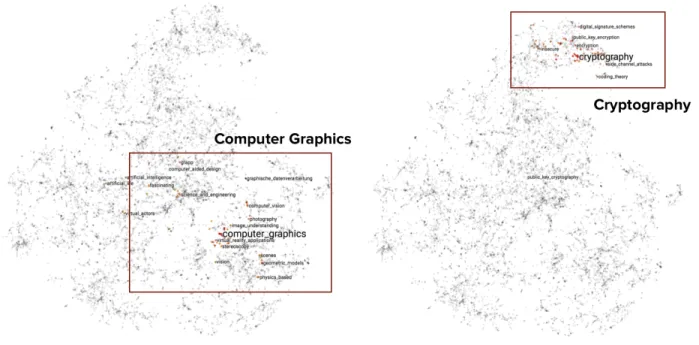
seman-semantically relevant terms—which share similar contexts—tend to be pushed towards each other in the latent vector space. Take Figure 2.2 as a real-life example. After training the embeddings for computer science concept terms with a DBLP title corpus, one can observe the terms for the concepts ‘computer graphics’ and ‘cryptography’ are well clustered in the embedding space. The key idea behind TaxoGen is that: can we leverage such clustering structures of term embeddings to build topic taxonomies in a recursive way?
Figure 2.2: Visualizations of word embeddings trained on a DBLP corpus. Left: the embed-dings of a set of terms in the ‘computer graphics’ area. Right: the embedembed-dings of a set of terms in the ‘cryptography’ area.
While the idea of combining term embedding and hierarchical clustering is intuitive by itself, two key challenges need to be addressed for building high-quality taxonomies. First, it is nontrivial to determine the proper granularity levels for different concept terms. When splitting a coarse topical node into fine-grained ones, not all the concept terms should be pushed down to the child level. For example, when splitting the computer science topic in Figure 2.1, general terms like ‘cs’ and ‘computer science’ should remain in the parent instead of being allocated into any child topics. Therefore, it is problematic to directly group parent terms to form child topics, but necessary to allocate different terms to different levels. Second, global embeddings have limited discriminative power at lower levels. Term embeddings are typically learned by collecting the context evidence from the corpus, such that terms sharing similar contexts tend to have close embeddings. However, as we move down in the hierarchy, the term embeddings learned based on the entire corpus have limited
power in capturing subtle semantics. For example, when splitting the machine learning topic, we find the terms ‘machine learning’ and ‘reinforcement learning’ have close global embeddings, and it is hard to discover quality sub-topics for the machine learning topic.
TaxoGenconsists of two novel modules for tackling the above challenges. The first is an adaptive spherical clustering module for allocating terms to proper levels when splitting a coarse topic. Relying on a ranking function that measures the representativeness of different terms to each child topic, the clustering module iteratively detects general terms that should remain in the parent topic and keeps refining the clustering boundaries of the child topics. The second is a local term embedding module. To enhance the discriminative power of term embeddings at lower levels, TaxoGen uses topic-relevant documents to learn local embeddings for the terms in each topic. The local embeddings capture term semantics at a finer granularity and are less constrained by the terms irrelevant to the topic. As such, they are discriminative enough to separate the terms with different semantics even at lower levels of the taxonomy.
We perform extensive experiments on two real data sets. Our qualitative results show that TaxoGen can generate high-quality topic taxonomies, and our quantitative analysis based on user study shows that TaxoGen outperforms baseline methods significantly.
To summarize, our contributions in this chapter include:
1. We propose a method that combines word embeddings and hierarchical clustering for generating topic taxonomies in an unsupervised way. To the best of our knowledge, this is the first work that exploits word embeddings for topic taxonomy generation. 2. We propose an adaptive hierarchical spherical clustering procedure for topic splitting.
It is capable of allocating terms into proper levels in the recursive taxonomy generation process.
3. We propose a local embedding module for learning locally adaptive term embeddings. Such locally adaptive term embeddings are tailored for topic taxonomy generation and can maintain strong discriminative power even at lower levels of the taxonomy; 4. We have performed extensive experiments on two real-life datasets. The results show
that our TaxoGenoutperforms state-of-the-art hierarchical topic models and hierar-chical clustering methods both quantitatively and qualitatively.
2.2 RELATED WORK
In this section, we review existing taxonomy construction methods, including (1) super-vised methods, (2) pattern-based methods, and (3) clustering-based methods.
2.2.1 Supervised Taxonomy Learning
Many existing taxonomy construction methods rely on the supervised learning paradigm [47, 45]. Basically these methods extract lexical features and learn a classifier that catego-rizes term pairs into relations or non-relations, based on curated training data of hypernym-hyponym pairs [95, 79, 19, 55], or syntactic contextual information harvested from NLP tools [94, 57]. Recent techniques [92, 98, 58, 27, 7] in this category leverage pre-trained word embeddings and then use curated hypernymy relation datasets to learn a relation clas-sifier. However, the training data for all these methods are limited to extracting hypernym-hyponym relations and cannot be easily adapted for constructing a topic taxonomy. Fur-thermore, for massive domain-specific text data, it is hardly possible to collect a rich set of supervised information from experts. Therefore, we focus on technical developments in unsupervised taxonomy construction.
2.2.2 Pattern-Based Extraction
A considerable number of pattern-based methods have been proposed to construct hypernym-hyponym taxonomies wherein each node in the tree is an entity, and each parent-child pair expresses the “is-a” relation. Typically, these works first use pre-defined lexical patterns to extract hypernym-hyponym pairs from the corpus, and then organize all the extracted pairs into a taxonomy tree. In pioneering studies, Hearst patterns like “NP such as NP, NP, and NP” were proposed to automatically acquire hyponymy relations from text data [37]. Then more kinds of lexical patterns have been manually designed and used to extract relations from the web corpus [78, 68] or Wikipedia [70, 32]. With the development of the Snowball framework, researchers teach machines how to propagate knowledge among the massive text corpora using statistical approaches [5, 111]; Carlson et al. proposed a learning architec-ture for Never-Ending Language Learning (NELL) in 2010 [13]. PATTY leveraged parsing structures to derive relational patterns with semantic types and organizes the patterns into a taxonomy [66]. The recent MetaPAD [40] used context-aware phrasal segmentation to generate quality patterns and group synonymous patterns together for a large collection of facts. Pattern-based methods have demonstrated their effectiveness in finding particular
relations based on hand-crafted rules or generated patterns. However, they are not suitable for constructing a topic taxonomy because of two reasons. First, different from hypernym-hyponym taxonomies, each node in a topic taxonomy can be a group of terms representing a conceptual topic. Second, pattern-based methods often suffer from low recall due to the large variation of expressions in natural language on parent-child relations.
2.2.3 Clustering-Based Taxonomy Construction
Clustering methods have been proposed for constructing taxonomy from text corpus [8, 20, 89, 87, 58, 27]. These methods are more closely related to our problem of constructing a topic taxonomy. Generally, the clustering approaches first learn the representation of words or terms and then organize them into a structure based on their representation similarity [8] and cluster separation measures [20]. Fu et al. identified whether a candidate word pair has hypernym-hyponym (“is-a”) relation by using the word-embedding-based semantic projections between words and their hypernyms [27]. Luu et al. proposed to use dynamic weighting neural network to identify taxonomic relations via learning term embeddings [58]. Our local term embedding inTaxoGen is quite different from the existing methods. First, we do not need labeled hypernym-hyponym pairs as supervision for learning either semantic projections or dynamic weighting neural network. Second, we learn local embeddings for each topic using only topic-relevant documents. The local embeddings capture fine-grained term semantics and thus well separate terms with subtle semantic differences. On the term organizing end, Ciniano et al. used a comparative measure to perform conceptual, divisive, and agglomerative clustering for taxonomy learning [18]. Yang et al. also used an ontology metric, a score indicating semantic distance, to induce taxonomy [95]. Liu et al. used Bayesian rose tree to hierarchically cluster a given set of keywords into a taxonomy [55]. Wang et al. adopted a recursive way to construct topic hierarchies by clustering domain keyphrases [89, 87]. Also, quite a number of hierarchical topic models have been proposed for term organization [10, 64, 24]. In our TaxoGen, we develop an adaptive spherical clustering module to allocate terms into proper levels when we split a coarse topic. The module well groups terms of the same topic together and separates child topics (as term clusters) with significant distances.
2.3 PRELIMINARIES 2.3.1 Problem Definition
The input for constructing a topic taxonomy includes two parts: (1) a corpusD of docu-ments; and (2) a setT of concept terms related to a dimension. The terms in T are the key terms extracted from D, representing the terms of interest for taxonomy construction. The term set can be either specified by end users or extracted from the corpus. For example, they can be all the named entities related to the dimension of interest extracted from D.
Given the corpus D and the term set T, we aim to build a tree-structured hierarchy H. Each node C ∈ H denotes a conceptual topic, which is described by a set of terms TC ∈ T that are semantically coherent. Suppose a node C has a set of children SC =
{S1, S2, . . . , SN}, then each Sn(1 ≤n ≤ N) should be a sub-topic of C, and have the same
semantic granularity with its siblings in SC. Each parent-child pair hC, Sni represents a
semantically subsuming relationship. That is, anything semantically related to the child topic Sn should be related to the parent C.
2.3.2 TaxoGen: Unsupervised Taxonomy Generation with Term Embeddings
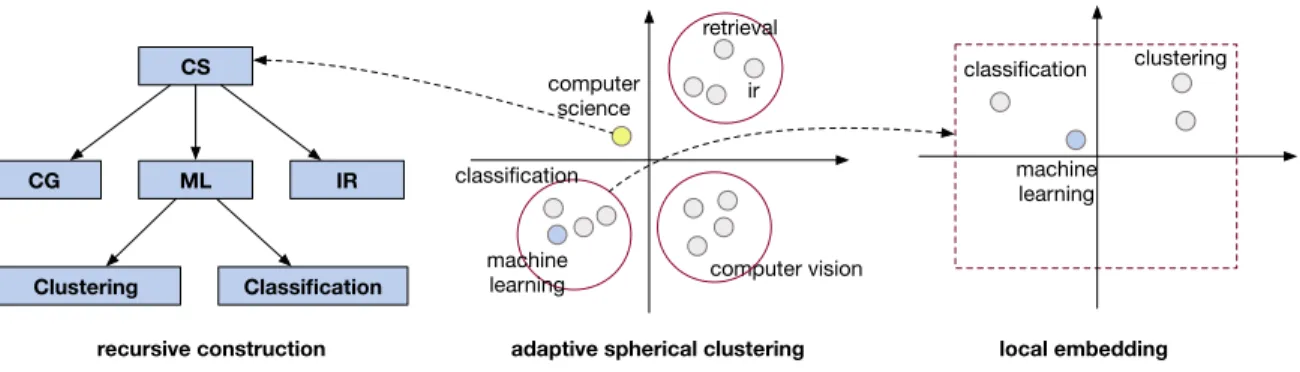
In a nutshell,TaxoGenembeds all the concept terms into a latent space to capture their semantics, and uses the term embeddings to build the taxonomy recursively. As shown in Figure 2.3, at the top level, we initialize a root node containing all the terms from T, which represents the most general topic for the given corpus D. Starting from the root node, we generate fine-grained topics level by level via top-down spherical clustering. The top-down construction process continues until a maximum number of levels Lmax is reached.
Given a topic C, we use spherical clustering to split C into a set of fine-grained topics SC = {S1, S2, . . . , SN}. As mentioned earlier, there are two challenges that need to be
addressed in the resursive construction process: (1) when splitting a topicC, it is problematic to directly divide the terms in C into sub-topics, because general terms should remain in the parent topic C instead of being allocated to any sub-topics; (2) when we move down to lower levels, global term embeddings learned on the entire corpus are inadequate for capturing subtle term semantics. In the following, we introduce the adaptive clustering and local embedding modules in TaxoGenfor addressing these two challenges.
machine learning classification computer science computer vision ir retrieval CS CG ML IR
recursive construction adaptive spherical clustering Clustering Classification
local embedding machine learning
classification clustering
Figure 2.3: An overview of TaxoGen. It uses term embeddings to construct the taxonomy in a top-down manner, with two novel components for ensuring the quality of the resursive process: (1) an adaptive clustering module that allocates terms to proper topic nodes; and (2) a local embedding module for learning term embeddings on topic-relevant documents. 2.4 ADAPTIVE TERM CLUSTERING
The adaptive clustering module in TaxoGen is designed to split a coarse topic C into fine-grained ones. It is based on the spherical K-means algorithm [21], which groups a given set of term embeddings into K clusters such that the terms in the same cluster have similar embedding directions. Our choice of the spherical K-means algorithm is motivated by the effectiveness of the cosine similarity [63] in quantifying the similarities between word embeddings. The center direction of a topic acts as a semantic focus on the unit sphere, and the member terms of that topic falls around the center direction to represent a coherent semantic meaning.
2.4.1 Spherical Clustering for Topic Splitting
Given a coarse topic C, a straightforward idea for generating the sub-topics of C is to directly apply spherical K-means toC, such that the terms inC are grouped intoK clusters to formC’s sub-topics. Nevertheless, such a straightforward strategy is problematic because not all the terms in C should be allocated into the child topics. For example, in Figure 2.3, when splitting the root topic of computer science, terms like ‘computer science’ and ‘cs’ are general — they do not belong to any specific child topics but instead should remain in the parent. Furthermore, the existence of such general terms makes the clustering process more challenging. As such general terms can co-occur with various contexts in the corpus, their embeddings tend to fall on the boundaries of different sub-topics. Thus, the clustering structure for the sub-topics is blurred, making it harder to discover clear sub-topics.
shown in Figure 2.3, the key idea is to iteratively identify general terms and refine the sub-topics after pushing general terms back to the parent. Identifying general terms and refining child topics are two operations that can mutually enhance each other: excluding the general terms in the clustering process can make the boundaries of the sub-topics clearer; while the refined sub-topics boundaries enable detecting additional general terms.
Algorithm 2.1 shows the process for adaptive spherical clustering. As shown, given a parent topic C, it first puts all the terms of C into the sub-topic term set Csub. Then it
iteratively identifies general terms and refines the sub-topics. In each iteration, it computes the representativeness score of a term t for the sub-topic Sk, and excludes t if its
represen-tativeness is smaller than a threshold δ. After pushing up general terms, it re-forms the sub-topic term set Csub and prepares for the next spherical clustering operation. The
iter-ative process terminates when no more general terms can be detected, and the final set of sub-topics S1, S2, . . . , SK are returned.
Algorithm 2.1: Adaptive clustering for topic splitting.
Input: A parent topic C; the number of sub-topics K; the term representativeness threshold δ. Output: K sub-topics of C. 1 Csub←C; 2 while True do 3 S1, S2, . . . , SK ←Spherical-Kmeans(Csub, K); 4 for k from 1 to K do 5 for t∈Sk do
6 r(t, Sk)← representativeness of term t for Sk; 7 if r(t, Sk)< δ then
8 Sk ←Sk− {t};
9 Csub0 ←S1∪S2∪. . .∪SK; 10 if Csub0 =Csub then
11 Break;
12 Csub←Csub0 ; 13 Return S1, S2, . . . , SK;
2.4.2 Identifying Representative Terms
In Algorithm 2.1, the key question is how to measure the representativeness of a termtfor a sub-topicSk. While it is tempting to measure the representativeness oftby its closeness to
the center of Sk in the embedding space, we find such a strategy is unreliable: general terms
may also fall close to the cluster center of Sk, which renders the embedding-based detector
inaccurate.
Our insight for addressing this problem is that, a representative term forSkshould appear
frequently in Sk but not in the sibling topics of Sk. We hence measure term
representative-ness using the documents that belong to Sk. Based on the cluster memberships of terms,
we first use the TF-IDF scheme to obtain the documents belonging to each topic Sk. With
these Sk-related documents, we consider the following two factors for computing the
repre-sentativeness of a term t for topic Sk:
• Popularity: A representative term for Sk should appear frequently in the documents
of Sk.
• Concentration: A representative term for Sk should be much more relevant to Sk
compared to the sibling topics of Sk.
To combine the above two factors, we notice that they should have conjunctive conditions, namely a representative term should be both popular and concentrated for Sk. Thus we
define the representativeness of term t for topic Sk as
r(t, Sk) = p
pop(t, Sk)·con(t, Sk) (2.1)
where pop(t, Sk) and con(t, Sk) are the popularity and concentration scores of t for Sk. Let
Dk denotes the documents belonging toSk, we definepop(t, Sk) as the normalized frequency
of t in Dk:
pop(t, Sk) =
log(tf(t,Dk) + 1)
logtf(Dk)
,
wheretf(t,Dk) is number of occurrences of termt in Dk, andtf(Dk) is the total number of
tokens in Dk.
To compute the concentration score, we first form a pseudo document Dk for each
sub-topic Sk by concatenating all the documents in Dk. Then we define the concentration of
term t on Sk based on its relevance to the pseudo document Dk:
con(t, Sk) = exp(rel(t, Dk)) 1 + P 1≤j≤K exp(rel(t, Dj)) ,
Example 2.1. Figure 2.3 shows the adaptive clustering process for splitting the computer science topic into three sub-topics: computer graphics (CG), machine learning (ML), and information retrieval (IR). Given a sub-topic, for example ML, terms (e.g., ‘clustering’, ‘classificiation’) that are popular and concentrated in this cluster receive high representative-ness scores. In contrast, terms (e.g., ‘computer science’) that are not representative for any sub-topics are considered as general terms and pushed back to the parent.
2.5 ADAPTIVE TERM EMBEDDING 2.5.1 Distributed Term Representations
The recursive taxonomy construction process of TaxoGen relies on term embeddings, which encode term semantics by learning fixed-size vector representations for the terms. We use the SkipGram model [63] for learning term embeddings. Given a corpus, SkipGram models the relationship between a term and its context terms in a sliding window, such that the terms that share similar contexts tend to have close embeddings in the latent space. The result embeddings can well capture the semantics of different terms and been demonstrated useful for various NLP tasks.
Formally, given a corpus D, for any token t, we consider a sliding window centered at
t and use Wt to denote the tokens appearing in the context window. Then we define the
log-probability of observing the contextual terms as logp(Wt|t) = X w∈Wt logp(w|t) = X w∈Wt log vtv 0 w P w0∈V vtv0w0
where vt is the embedding for term t, vw0 is the contextual embedding for the termw, and
V is the vocabulary of the corpus D. Then the overall objective function of SkipGram is defined over all the tokens in D, namely
L=X
t∈D
X w∈Wt
logp(w|t),
and the term embeddings can be learned by maximizing the objective with stochastic gra-dient descent and negative sampling [63].
2.5.2 Learning Local Term Embeddings
However, when we use the term embeddings trained on the entire corpusD for taxonomy construction, one drawback is that these global embeddings have limited discriminative power at lower levels. Let us consider the term ‘reinforcement learning’ in Figure 2.3. In the entire corpusD, it shares a lot of similar contexts with the term ‘machine learning’, and thus has an embedding close to ‘machine learning’ in the latent space. The proximity with ‘machine learning’ makes it successfully assigned into the machine learning topic when we are splitting the root topic. Nevertheless, as we move down to split the machine learning topic, the embeddings of ‘reinforcement learning’ and other machine learning terms are entangled together, making it difficult to discover sub-topics for machine learning.
Therefore, we propose the local embedding module to enhance the discriminative power of term embeddings at lower levels of the taxonomy. For any topicCthat is not the root topic, we learn local term embeddings for splittingC. Specifically, we first create a sub-corpusDC
fromDthat is relevant to the topicC. To obtain the sub-corpusDC, we employ the following
two strategies: (1) Clustering-based. We derive the cluster membership of each document
d ∈ D by aggregating the cluster memberships of the terms in d using TF-IDF weight. The documents that are clustered into topicC are collected to form the sub-corpusDC. (2)
Retrieval-based. We compute the embedding of any documentd∈ Dusing TF-IDF weighted average of the term embeddings ind. Based on the obtained document embeddings, we use the mean direction of the topic C as a query vector to retrieve the top-M closest documents and form the sub-corpusDC. In practice, we use the first strategy as the main one to obtain
DC, and apply the second strategy for expansion if the clustering-based subcorpus is not
large enough. Once the sub-corpus DC is retrieved, we apply the SkipGram model to the
sub-corpus DC to obtain term embeddings that are tailored for splitting the topic C.
Example 2.2. Consider Figure 2.3 as an example, when splitting the machine learning topic, we first obtain a sub-corpus Dml that is relevant to machine learning. Within Dml, terms
reflecting general machine learning topics such as ‘machine learning’ and ‘ml’ appear in a large number of documents. They become similar to stopwords and can be easily separated from more specific terms. Meanwhile, for those terms that reflect different machine learning sub-topics (e.g., ‘classifcation’ and ‘clustering’), they are also better separated in the local embedding space. Since the local embeddings are trained to preserve the semantic information for topic-related documents, different terms have more freedom to span in the embedding space to reflect their subtle semantic differences.
2.6 EXPERIMENTAL EVALUATION
In this section, we evaluate the empirical performance of TaxoGen.
2.6.1 Experimental Setup Datasets
We use two real-life corpora in our experiments1:
1. DBLP contains around 1,889,656 titles of computer science papers from the areas of information retrieval, computer vision, robotics, security & network, and machine learning. From those paper titles, we use an existing NP chunker to extract all the noun phrases and then remove infrequent ones to form the term set, resulting in 13,345 distinct terms;
2. SP contains 94,476 paper abstracts from the area of signal processing. Similarly, we extract all the noun phrases in those abstracts to form the term set and obtain 6,982 different terms.
Compared Methods
We compare TaxoGen with the following methods that are capable of generating topic taxonomies in an unsupervised way:
1. HLDA(hierarchical Latent Dirichlet Allocation) [10] is a non-parametric hierarchical topic model. It models the probability of generating a document as choosing a path from the root to a leaf and sampling words along the path. We apply HLDA for topic-level taxonomy construction by regarding each topic in HLDA as a topic. 2. HPAM(hierarchical Pachinko Allocation Model) is a state-of-the-art hierarchical topic
model [64]. Different fromTaxoGenthat generates the taxonomy recursively,HPAM takes all the documents as its input and outputs a pre-defined number of topics at different levels based on the Pachinko Allocation Model.
3. HClus(hierarchical clustering) uses hierarchical clustering for taxonomy construction. We first apply the SkipGram model on the entire corpus to learn term embeddings, and then use spherical k-means to cluster those embeddings in a top-down manner.
4. NoAC is a variant of TaxoGen without the adaptive clustering module. In other words, when splitting one coarse topic into fine-grained ones, it simply performs spher-ical clustering to group parent terms into child topics.
5. NoLE is a variant of TaxoGen without the local embedding module. During the recursive construction process, it uses the global embeddings that are learned on the entire corpus throughout the construction process.
Parameter Settings
We use the methods to generate a four-level taxonomy on DBLP and a three-level tax-onomy on SP. There are two key parameters in TaxoGen: the number K for splitting a coarse topic and the representativeness threshold δ for identifying general terms. We set
K = 5 as we found such a setting matches the intrinsic taxonomy structures well on both DBLP and SP. For δ, we set it to 0.25 onDBLP and 0.15 onSP after tuning, because we observed such a setting can robustly detect general terms that belong to parent topics at different levels in the construction process.
ForHLDA, it involves three hyper-parameters: (1) the smoothing parameterα over level distributions; (2) the smoothing parameter γ for the Chinese Restaurant Process; and (3) the smoothing parameter η over topic-word distributions. We set α = 0.1, γ = 1.0, η = 1.0. Under such a setting, HLDA generates a comparable number of topics withTaxoGen on both datasets. The method HPAM requires to set the mixture priors for super- and sub-topics. We find that the best values for these two priors are 1.5 and 1.0 on DBLP and SP, respectively. The remaining three methods (HClus, NoAC, and NoLE) have a subset of the parameters of TaxoGen, and we set them to the same values as TaxoGen.
2.6.2 Qualitative Results
In this subsection, we demonstrate the topic taxonomies generated by different methods on DBLP. We apply each method to generate a four-level taxonomy on DBLP, and each parent topic is split into five child topics by default (except for HLDA, which automatically determines the number of child topics based on the Chinese Restaurant Process).
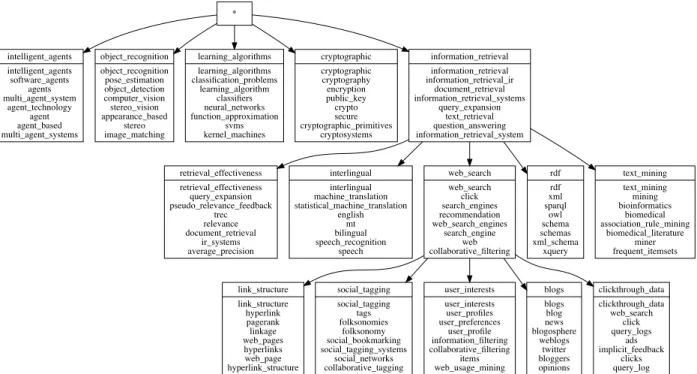
retrieval_effectiveness retrieval_effectiveness query_expansion pseudo_relevance_feedback trec relevance document_retrieval ir_systems average_precision intelligent_agents intelligent_agents software_agents agents multi_agent_system agent_technology agent agent_based multi_agent_systems interlingual interlingual machine_translation statistical_machine_translation english mt bilingual speech_recognition speech object_recognition object_recognition pose_estimation object_detection computer_vision stereo_vision appearance_based stereo image_matching web_search web_search click search_engines recommendation web_search_engines search_engine web collaborative_filtering link_structure link_structure hyperlink pagerank linkage web_pages hyperlinks web_page hyperlink_structure social_tagging social_tagging tags folksonomies folksonomy social_bookmarking social_tagging_systems social_networks collaborative_tagging user_interests user_interests user_profiles user_preferences user_profile information_filtering collaborative_filtering items web_usage_mining blogs blogs blog news blogosphere weblogs twitter bloggers opinions clickthrough_data clickthrough_data web_search click query_logs ads implicit_feedback clicks query_log learning_algorithms learning_algorithms classification_problems learning_algorithm classifiers neural_networks function_approximation svms kernel_machines rdf rdf xml sparql owl schema schemas xml_schema xquery * cryptographic cryptographic cryptography encryption public_key crypto secure cryptographic_primitives cryptosystems information_retrieval information_retrieval information_retrieval_ir document_retrieval information_retrieval_systems query_expansion text_retrieval question_answering information_retrieval_system text_mining text_mining mining bioinformatics biomedical association_rule_mining biomedical_literature miner frequent_itemsets
(a) The sub-topics generated byTaxoGenunder the topics ‘*’ (level 1), ‘information retrieval’ (level 2), and ‘Web search’ (level 3).
neural_network neural_network neural_networks artificial_neural_network feedforward multilayer neural recurrent_neural_network neuron recurrent_networks recurrent_networks recurrent_neural_networks synapses associative_memory dynamical attractor spiking_neurons spiking som som self_organizing_maps self_organizing_map kohonen neural_gas self_organizing_map_som soms unsupervised_classification tsk_fuzzy tsk_fuzzy genetic_algorithms fuzzy_controller fuzzy_controllers takagi_sugeno membership_functions tsk fuzzy_rules forecasting forecasting forecast time_series forecasting_model stock_market time_series_forecasting forecasting_models regression_analysis back_propagation_bp back_propagation_bp rbf rbf_network backpropagation_algorithm rbf_neural_networks mlp back_propagation_algorithm backpropagation kernel_discriminant_analysis kernel_discriminant_analysis dimensionality_reduction discriminant dimension_reduction discriminant_analysis high_dimensional_data linear_discriminant_analysis low_rank learning_algorithms reinforcement_learning reinforcement_learning markov_decision_processes reinforcement_learning_rl optimal_control reinforcement_learning_algorithms rl stochastic_control stochastic_games classifiers classifiers base_classifiers classifier majority_voting ensemble_methods multiple_classifiers individual_classifiers decision_tree bayesian bayesian maximum_likelihood bayesian_inference maximum_likelihood_estimation bayesian_framework parametric dirichlet bayesian_networks
(b) The sub-topics generated byTaxoGenunder the topics ‘learning algorithms’ (level 2) and ‘neural network’ (level 3).
Figure 2.4: Parts of the taxonomy generated by TaxoGenon theDBLPdataset. For each topic, we show its label and the top-eight representative terms generated by the ranking function of TaxoGen. All the labels and terms are returned by TaxoGen automatically without manual selection or filtering.
Figure 2.4 shows parts of the taxonomy generated by TaxoGen. As shown in Figure 2.4(a), given the DBLP corpus, TaxoGensplits the root topic into five sub-topics: ‘intel-ligent agents’, ‘object recognition’, ‘learning algorithms’, ‘cryptographic’, and ‘information
retrieval’. The labels for those topics are generated automatically by selecting the term that is most representative for a topic (Equation 2.1). We find those labels are of good quality and precisely summarize the major research areas covered by the DBLP corpus. The only minor flaw for the five labels is ‘object recognition’, which is too specific for the computer vision area. The reason is probably because the term ‘object recognition’ is too popular in the titles of computer vision papers, thus attracting the center of the spherical cluster towards itself.
In Figure 2.4(a) and 2.4(b), we also show how TaxoGensplits level-two topics ‘informa-tion retrieval’ and ‘learning algorithms’ into more fine-grained topics. Taking ‘informa‘informa-tion retrieval’ as an example: (1) at level three, TaxoGen can successfully find major areas in information retrieval: retrieval effectiveness, interlingual, Web search, rdf & xml query, and text mining; (2) at level four, TaxoGen splits the Web search topic into more fine-grained problems: link analysis, social tagging, recommender systems & user profiling, blog search, and clickthrough models. Similarly for the machine learning topic (Figure 2.4(b)), Taxo-Gen can discover level-three topics like ‘neural network’ and level-four topic like ‘recurrent neural network’. Moreover, the top terms for each topic are of good quality — they are semantically coherent and cover different aspects and expressions of the same topic.
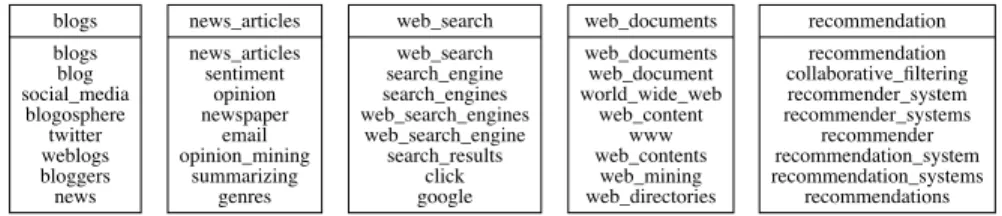
We have also compared the taxonomies generated byTaxoGenand other baseline meth-ods, and found thatTaxoGenoffers clearly better taxonomies from the qualitative perspec-tive. Due to the space limit, we only show parts of the taxonomies generated byNoAC and NoLE to demonstrate the effectiveness of TaxoGen. As shown in Figure 2.5(a), NoLE can also find several sensible child topics for the parent topic (e.g., ‘blogs’ and ‘recommender system’ under ‘Web search’), but the major disadvantage is that a considerable number of the child topics are false positives. Specifically, a number of parent-child pairs (‘web search’ and ‘web search’, ‘neural networks’ and ‘neural networks’) actually represent the same topic instead of true hypernym-hyponym relations. The reason behind is that NoLE uses global term embeddings at all levels, and thus the terms for different semantic granularities have close embeddings and hard to be separated at lower levels. Such a problem also exists for NoAC, but with a different reason: NoAC does not leverage adaptive clustering to push up the terms that belong to the parent topic. Consequently, at fine-grained levels, terms that have different granularities are all involved in the clustering step, making the cluster-ing boundaries less clear compared to TaxoGen. Such qualitative results clearly show the advantages of TaxoGenover the baseline methods, which are the key factors that leads to the performance gaps between them in our quantitative evaluation.
blogs blogs blog social_media blogosphere twitter weblogs bloggers news news_articles news_articles sentiment opinion newspaper email opinion_mining summarizing genres web_search web_search search_engine search_engines web_search_engines web_search_engine search_results click google web_documents web_documents web_document world_wide_web web_content www web_contents web_mining web_directories recommendation recommendation collaborative_filtering recommender_system recommender_systems recommender recommendation_system recommendation_systems recommendations (a) The sub-topics generated byNoLEunder the topic ‘web search’ (level 3). bit_parity_problem bit_parity_problem hopfield_neural_network single_layer hopfield neat symbolic_regression hnn l