Management and Innovation for a Sustainable Built Environment ISBN: 9789052693958 20 – 23 June 2011, Amsterdam, The Netherlands
CONSTRUCTION PROJECT SCHEDULING WITH IMPRECISELY DEFINED CONSTRAINTS
JANUSZ KULEJEWSKI Warsaw University of Technology Pl. Politechniki 1
00-661 Warsaw, Poland [email protected]
Abstract
This paper regards to the scheduling of a construction project under ill-defined constraints of time and resources for the execution of works. Fuzzy numbers are used for modelling the imprecision of constraints. Two methods of the measurement of fuzzy constraints satisfaction are presented. The first method uses the possibility measures based strictly on the assumptions of the fuzzy sets theory. The second method uses the measure based upon the concept of the α-cuts of a fuzzy number and the probability theory. The numerical examples are given for the comparison of both methods. The results confirm that the use of the probabilistic measure provides the neutralization of the assessment of the fuzzy constraints meeting and improves the construction schedule.
Keywords: construction schedule, imprecision, possibility measure, probability measure. INTRODUCTION
The planning data used in the scheduling of construction projects are often imprecisely defined with regard to the required project completion time and the availability of renewable resources (key personnel and construction equipment) required for the project execution. This is caused by the various circumstances, e.g.:
– the uniqueness of the any given construction project makes it difficult or even impossible to use the statistical methods for the assessment of the project makespan;
– the acquisition of contracts in the tendering procedure does not allow for the precise planning of the owned renewable resources distribution to the individual projects; – conditions of contract provide for a time interval between the completion time preferred
by the client (due-to date) and the completion time required by the client under the penalty of the contract termination of contractor’s fault (deadline); the existence of such a time interval allows the contractor for the flexible planning of the sufficient time for the completion of the works.
As a result, the planning data for the planner are often defined imprecisely [3], with the use of a natural language, e.g.: "about two weeks", "abouttwo to three weeks," “a little over two weeks”, "about fifteen to twenty workers" and alike [14]. In the literature dealing with the problems of project scheduling on the basis of imprecisely defined planning data, there is a common approach to use the fuzzy sets theory for modelling the imprecision of project data, in conjunction with the various schedule optimization methods, as for example the branch-and-bound method, e.g. [16], priority heuristics, e.g. [4], [15], [18] and metaheuristic methods, e.g. [5], [11], [15], [18]. However, the most of the literature under
consideration take into account only the imprecision of durations of works and the imprecision of time available for the execution of works. The availability of any renewable resource is treated as well-known, which in the case of a real construction project rarely holds true. The assessment of the fulfilment of imprecisely defined time constraints is done with the use of possibility measure for the comparison of two fuzzy numbers or the real number and the fuzzy number, one representing the planned project makespan and the other representing the project makespan limit. The comparison is done with the Hurwicz criterion, e.g. [8], [17], [18] and the result is highly affected by the specific risk attitude of the assessor. In result, two or more persons may express different opinions about the degree of meeting the fuzzy limit of the project makespan.
In this paper, the principles of the fuzzy modelling of imprecisely defined planning constraints and the principles of the assessment of the fuzzy constraints satisfaction are presented. The problem of the neutralisation of the assessment of meeting the fuzzy time and resource constraints is resolved with the use of the α-cuts of a fuzzy number and the probability theory. The paper also presents a numerical example showing the advantages of the use of probability measure for the optimization of the construction schedule with regard to the imprecisely defined time and resource constraints.
THE MODELING OF THE PROJECT CONSTRAINTS USING FUZZY SETS
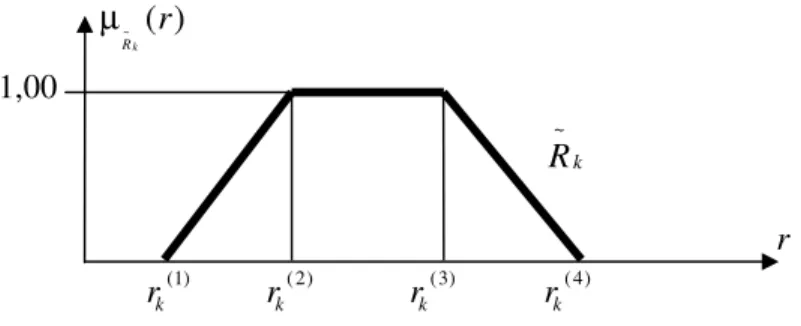
To model the imprecision of the availability of the k-th resource, a planner can use a trapezoidal fuzzy number Rk
~
in the form of the ordered four ( (1), (2), (3), (4)) ~ k k k k k r r r r R = ,
where real numbers rk(i)(i = 1, …, 4) should satisfy the condition:0≤rk(1) ≤rk(2) ≤rk(3) ≤rk(4). Fig. 1 shows an example of a trapezoidal fuzzy number modelling imprecisely defined resource constraints, expressed as “from about rk(2)to aboutrk(3), but not less than rk(1)and not more thanrk(4)”.
Figure 1: An example of using a trapezoidal fuzzy number for modelling the imprecisely
defined availability of the renewable resource constraints. Source: Own
In the more specific case, a planner is able to narrow the area of imprecision and to express his opinion about resource constraints as “aboutrk(2), but not less than rk(1)and not more thanrk(3)”. To express this imprecision mathematically, a planner can use a triangular
) 4 ( k r ) 3 ( k r ) 2 ( k r ) 1 ( k r k R ~ 1,00 ) ( ~ r k R µ r
fuzzy number Rk ~
in the form of the ordered three ( (1), (2), (3)) ~ k k k k r r r R = or a trapezoidal fuzzy number Rk ~
in the form of the ordered four ( (1), (2), (2), (3)) ~ k k k k k r r r r R = .
Similarly, to model the imprecision of the project makespan limitation one can use a trapezoidal fuzzy number ( (1), (2), (3), (4))
~ d d d d d t t t t
T = , where real numbers td(i)(i=1, …, 4) satisfy the condition:0≤td(1) ≤td(2) ≤td(3) ≤td(4). One can determine the components of this ordered four, assuming for example:
– as the real number td(1): the shortest feasible project makespan, determined as the result of the network model analysis without the renewable resource availability constraints; – as the real number td(2): the lower limit of the project makespan, evaluated by the
scheduler as having the greatest chance under the given circumstances;
– as the real number td(3): the upper limit of the project makespan, evaluated by the planner as having the greatest chance under the given circumstances;
– as the real numbertd(4): the project completion time required by the client.
ASSESSMENT OF THE PROJECT FUZZY CONSTRAINTS SATISFACTION
Application of the possibility measures
If the maximum consumption of the k-th renewable resource must not exceed the imprecisely defined resource availability limitation, the schedule must satisfy the following relation: k k R r ~ max ≤ (1)
The satisfaction of the relation (1) means that the maximum consumption of the k-th renewable resource, expressed by the real numberrkmax, should not exceed the limit, which is the unknown (yet) output of the fuzzy number Rk
~ .
Similarly, if the works must be completed within the imprecisely prescribed time period, the schedule must satisfy the following relation:
d
T t
~
≤ . (2)
The satisfaction of the relation (2) means that the planned project makespan expressed by the real number t, will not be longer than the time limit, which is the unknown (yet) output of the fuzzy number Td
~ .
Using the theory of possibility [1], one should assess the degree of fulfilment of the relation rk Rk
~ max
≤ and evaluate of the veracity of the statement: "the real number rkmax will not be greater than the unknown (yet) output of the fuzzy number Rk
~
” using the necessity
measureN( )
~ max
k
k R
r ≤ and the possibility measure ( ) ~ max
k
k R
r ≤
Π . The necessity measure is used to assess how much the occurrence of the relation rk Rk
~ max
state of the knowledge of the planner of the circumstances which are limiting the availability of the k-th renewable resource. The possibility measure is used to assess how much the occurrence of the relation rk Rk
~ max
≤ remains in compliance with the state of knowledge of the planner of the circumstances which are limiting the availability of the k-th renewable resource. According to [1] and [8], the appropriate formulas are as follows:
) ( sup ) ( ~ max ~ max r R r k k R r r k k ≤ = µ Π ≥ , (3) ) ( sup ) ( ~ max ~ max r R r k k R r r k k ≥ = µ Π ≤ , (4) ) ( 1 ) N( ~ max ~ max k k k k R r R r ≤ = −Π ≥ , (5) where ~ (r) k R
µ is the membership coefficient of the fuzzy setRk
~ .
It should be noted that the possibility measure ( ) ~ max
k
k R
r ≤
Π does not have the property of complementarity, i.e. ( )
~ max
k
k R
r ≤
Π does not have to be equal to1 ( )
~ max k k R r ≥ Π − .
Using the necessity measure and the possibility measure for assessing the credibility of the statements given above, one should consider the cases shown in Fig. 2.
Figure 2: The alternative schemes of relations between the fuzzy number Rk
~
and the real numberrkmax. Source: Own
On the basis of the formulas (3), (4) and (5), one can conclude that: ) ( ~ r k R µ ) 4 ( k r ) 3 ( k r ) 2 ( k r ) 1 ( k r r a) α 1,00 Rk ~ max k r max k r b) ~ (r) k R µ 1,00 ) ( ~ r k R µ ) 4 ( k r ) 3 ( k r ) 2 ( k r ) 1 ( k r k R ~ α r k R ~ 1,00 c) ~ (r) k R µ ) 4 ( k r ) 3 ( k r ) 2 ( k r ) 1 ( k r max k r r
1) For the case shown in Fig. 2a: ( ) ~ max k k R r ≤ Π = α, N( ) ~ max k k R r ≤ = 0; the evaluated statement may be true to a degree of α, but the obvious truth of this statement is zero; 2) For the case shown in Fig. 2b: ( )
~ max k k R r ≤ Π = 1, N( ) ~ max k k R r ≤ = 1 – α; the evaluated statement is possibly true, but the obvious truth of this statement is 1 – α,
3) For the case shown in Fig. 2c: ( ) ~ max k k R r ≤ Π = 1, N( ) ~ max k k R r ≤ = 0; the evaluated statement is possibly true, but the obvious truth of this statement is zero.
The meaning of the assessment presented above may be sometimes difficult to understand for the planner. Therefore, for the assessment of the degree of fulfilment of the relationrk Rk
~ max
≤ , there is a sought after the synthetic measure (marked here as ST), having – in line with the intuition of the planner – the property of complementarity:
) ST( 1 ) ST( ~ max ~ max k k k k R r R r ≤ = − ≥ . (6)
Using the approach shown in [4], [17] and [18], one can implement the Hurwicz criterion for the assessment of the degree of domination of the fuzzy numberRk
~
over the real number max k r : ) N( β) 1 ( ) ( β ) ST( ~ max ~ max ~ max k k k k k k R r R r R r ≤ = Π ≤ + − ≤ , (7)
where β∈(0.0; 1.0) is the coefficient of optimism, which characterizes the risk attitude of the planner. For example, assuming the neutral risk attitude of the planner (β= 0.5), one can obtain: ≥ ≤ ≤ ≤ ≤ ≤ ≤ − + ≤ = ≤ . 0 , 0 , 5 , 0 , 5 , 0 , ) 1 ( 5 , 0 5 , 0 , 0 , 1 ) ST( ) 4 ( max ) 4 ( max ) 3 ( ) 3 ( max ) 2 ( ) 2 ( max ) 1 ( ) 1 ( max ~ max k k k k k k k k k k k k k k k r r or f r r r or f α r r r or f r r r or f α r r or f R r (8)
In a similar way one can assess the degree of fulfilment of the relationt Td ~
≤ .
As can be seen from the formula (7), the result of the assessment of the degree of fulfilment of the relationsrk Rk
~ max
≤ and t Td ~
≤ strongly depends on the value of coefficient
β, which characterizes the risk attitude of the planner.
Application of the probabilistic measure
It should be noted, after [2], that the necessity measure and the possibility measure determinate the lower bound and the upper bound of the probability:
), ( ) P( ) N( ~ max ~ max ~ max k k k k k k R r R r R r ≤ ≤ ≤ ≤Π ≤ (9) ). ( ) P( ) N( ~ ~ ~ d d d t T t T T t≤ ≤ ≤ ≤Π ≤ (10)
This arises the question whether it is feasible to neutralize the assessment of the fulfilment of relations rk Rk ~ max ≤ and t Td ~
≤ , through the direct use of the probabilistic measure. The resulting problem can be described as follows:
– there are two numbers given: (1) a real number m, representing the maximum consumption of some renewable resource or the planned project makespan, and (2) a fuzzy number
~
N , modelling the limit of resource availability or the limit of the project
makespan;
– assess the probability P( ) ~
N
m≤ that a real number m, resulting from the construction project schedule, will be not greater than the unknown (yet) output of a fuzzy number
~
N .
The idea of the assessment of the probability P( ) ~
N
m≤ presented below is based upon the use of the α-cuts of a fuzzy number
~
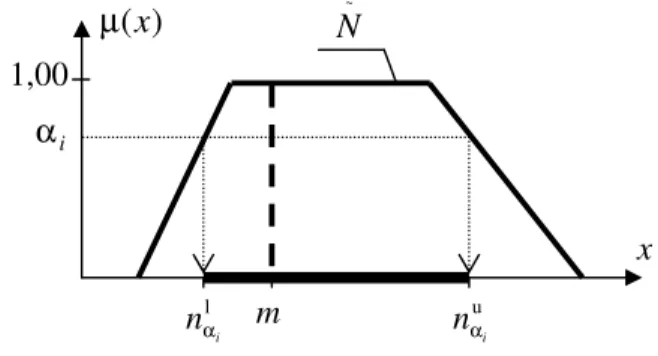
N for a finite number of levels of certainty of the imprecise estimation of the given constraint. For the any given α-cut of a fuzzy number ~ N, an interval number [ l u] i i i n ,n
Nα = α α is obtained. Symbol i is an index of a sequent
α-cut. An example of an interval
i
Nα is shown in Fig. 6.3.
Figure 3: An example of an interval
i
Nα . Source: Own.
On the basis of Fig. 3 one can conclude that if l u
i
i m n
nα < < α , then an interval
i Nα is
divided further into subintervals [ αl ] i,m
n and [ αu] i
n ,
m . The probability that a real number m
will be not greater than the unknown (yet) output of an interval number
i
Nα can be determined geometrically as:
l α u α u α i i i ) P( n n m n N m i − − = ≤ α . (11) If αl i n m≤ then P(m≤Nαi)=1and if u αi n
m≥ then P(m≤Nαi)=0. The aggregation of probabilitiesP(m≤Nαi) for the finite number of α-cuts of a number
~ N , leads to the following formula:
∑
∑
α ≤ α = ≤ α i i i i m N i N m ) P( ) P( ~ , (12) ~ N 1,00 ) (x µ i α x l i nα u i nα mwhere i = 1,…, I is an index of sequentα-cut of a number ~
N . SCHEDULE OPTIMIZATION PROBLEMS FORMULATION
In this paper, an activity–on–node network model with finish–to–start relations between activities is adopted to represent the construction project. The start date of the project is set to zero. Only the imprecision of the schedule constraints is considered. Therefore, the formula for calculating the scheduled project makespan can be expressed as:
, ,..., 2 , 1 }, { max s d i n t= i + i =
where siis the start date of activity i, di is the duration of activity i, and n is the total number of activities.
The following two alternative optimization problems can be formulated, based upon the two alternative measures of the compliance with the fuzzy limit of the project makespan: – find the start dates of activities so as to maximize the degree of compliance with the fuzzy
limit of the project makespan:
) ST( ST : ST max ~ d T t≤ = , (13)
– find the start dates of activities so as to maximize the probability of compliance with the fuzzy limit of the project makespan:
) P( P : P max ~ d T t≤ = , (14)
where t is the real number, representing the planned project makespan, and Td
~
is the fuzzy number, modelling the imprecisely specified constraint for the project makespan.
Taking into account the relations of type finish–to–start between the activities, the solution of the problem (14) or of the problem (15) must fulfil the following condition:
)}, ( {Prec j i d s sj≥ i+ i ∈ (15)
where Prec(j) is the set of predecessors of an activity j in the project network model.
The solution of the problem (14) or of the problem (15) must also take into account the fuzzy constraints of the renewable resources availability. The maximum consumption of the k-thresource can be determined as:
} max{ )} ( { max
∑
∈ = τ A p kpτ k r r , (16)where {A (τ)} is the set of operations executed in a time period τ, τ = 1,...,t, rkpτ is the consumption of the k-th renewable resource for the execution of an activity p in a time period τ, and t is the planned project makespan. According to the two alternative measures of the compliance with the fuzzy resource constraints, the planner should assess the required degree STkr of compliance with the fuzzy constraint of k-th resource availability or the required probability Pkr of compliance with the fuzzy constraint of k-th resource availability. This leads to the following conditions:
– for the solutions of the problem (14): the condition of meeting the required degree of compliance (STkr ) with the fuzzy limit of availability of the k–th renewable resource:
, ST ) ST( ~ max kr k k R r < ≥ (17)
– for the solutions of the problem (15): the condition of meeting the required probability of compliance (Pkr) with the fuzzy limit of availability of the k–th renewable resource:
. P ) P( ~ max kr k k R r < ≥ (18)
SCHEDULE OPTIMIZATION PROBLEMS SOLVING
Despite the specific measure adopted for the assessment of the fuzzy constraints satisfaction, optimization problems presented above are the resource – constrained project scheduling problems, which belong to the class of NP-hard problems [4]. For solving such problems, the use of heuristic or metaheuristic methods is well justified. Their detailed description is omitted here. The surveys appropriate for the construction project scheduling has been done by the others, e.g. [6], [7], [9] – [13], [16]. In this paper, the considered schedule optimization problems were translated into numerical optimization problems solved with the use of Genetic Algorithm (GA). To preserve the required technological precedence relationships among activities in the project network model, the general idea was to use the GA technique to establish the additional resource relationships among some activities. Those additional relationships were based upon the selected priority rules. On the basis of the solution presented by the m-th chromosome, the start dates sj of each activity were calculated using the following formula:
} ) ( { max ) ( )} ( {Prec j i i i j m s m d s = + ∈ . (19)
The following fitness functions were used to assess the resulting construction schedule:
1) for the problem of maximization the degree of compliance with the fuzzy limit of the project makespan:
∑
= − = K k k F m m f 1 ) ST( ) ( , (20)2) for the problem of maximization the probability of compliance with the fuzzy limit of the project makespan:
∑
= − = K k k F m m f 1 ) P( ) ( , (21) where:f(m) – the value of fitness function for the solution presented by the m-th chromosome;
ST(m) – the degree of compliance with the fuzzy limit of the project makespan, resulting from the schedule drawn upon the solution presented by the m-th chromosome:
) ) ( ST( ) ST( ~ d T m t m = ≤ ; (22)
P(m)– the probability of compliance with the fuzzy limit of the project makespan, resulting from the schedule drawn upon the solution presented by the m-th chromosome:
) ) ( P( ) P( ~ d T m t m = ≤ ; (23)
t(m) – the planned project makespan, resulting from the schedule drawn upon the solution presented by the m-th chromosome;
Fk – the penalty (large enough positive real number) for the failure to meet the required degree of compliance with the fuzzy limit of availability of the k-th renewable resource;
Gk – the penalty (large enough positive real number) for the failure to meet the required probability of compliance with the fuzzy limit of availability of the k-th renewable resource;
NUMERICAL EXAMPLES
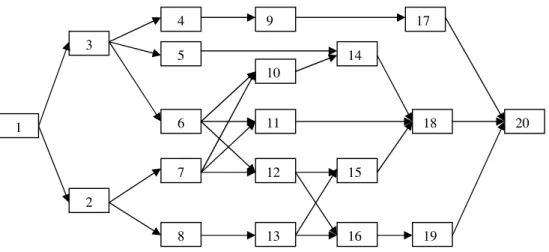
The scope of the exemplary construction project covers modernization of an existing housing estate. This includes the renovation of existing buildings A and B, the renovation of the existing estate road, car parking, and the construction of new buildings C and D with the ancillary facilities. The network of the project activities is shown in Fig.4. The network data are given in Table 1.
Figure 4: An example of a construction project network model. Source: Own
Neglecting the limit of workforce availability, the shortest feasible project makespan is ts = 37 weeks, with the maximum employment of rmax = 49 workers per week. The contractor assumes that the number of available workers will be probably limited to 30 – 35 workers. In any case it will be not less than 25 and not more than 40 workers. The imprecisely specified limit of workforce availability can be modeled by the fuzzy trapezoidal number
~
R = (25, 30, 35, 40).
The client requires that the project has to be completed within a maximum period of 50 weeks from the date of commencement. On the basis of his past experience, the contractor assumes that he should be technically able to execute the works within about 40 – 42 weeks. Due to the commitments of the contractor to the other clients, the project makespan should not exceed 45 weeks, and the owner of this project will absolutely not accept the project makespan exceeding the period of 50 weeks. The imprecisely specified limit of time available for the execution of the works can be modeled by the trapezoidal fuzzy number Td
~
= (37, 40, 45, 50).
Table 1. Data for the project network model shown in Fig. 4. Source: Own
1 3 2 4 5 6 7 8 9 10 11 12 13 14 15 16 17 18 19 20
Earliest feasible Activity No Description Dura-tion (weeks) Required number of workers start
date finish date
1 Construction site
preparation 4 8 0 4
2 Earthworks for buildings
C and D 4 17 4 8
3 Renovation of
foundations of building A 3 12 4 7
4 Renovation of an existing
estate road 3 8 7 10
5 Renovation of the roof of
building A 4 10 7 11 6 Renovation of internal services in building B 5 11 7 12 7 Foundation of building C 6 9 8 14 8 Foundation of building D 6 11 8 14 9 Renovation of the existing parking 3 6 10 13 10 Renovation of internal services in building A 6 9 14 20 11 Redecoration of building B 5 10 14 19 12 Superstructure of building C 4 12 14 18 13 Superstructure of building D 6 7 14 20 14 Redecoration of building A 4 9 20 24 15 Internal services in building C 5 10 20 25 16 Internal services in building D 5 11 20 25 17 Repair of auxiliary facilities 3 6 13 16 18 Finishing works in building C 7 6 25 32 19 Finishing works in building D 4 8 25 29
20 Construction site removal 5 9 32 37
In the first example, the planner is obliged to schedule the project to the highest degree of compliance with the imprecisely specified time limit for the execution of the works.
The planner is risk–neutral (β= 0,5). Moreover, the schedule should guarantee the degree of compliance with the fuzzy limit of workforce availabilitynot less than STwr= 0,50.
The problem given above is described by the formula (13): ) ST( ST : ST max ~ d T t≤ = ,
with the condition (15), concerning the finish–to–start relations among the activities in the project network model:
)}, ( {Prec j i d s sj≥ i+ i ∈
and with the condition (17), concerning the required degree of compliance with the fuzzy limit of workforce availability:
. 50 , 0 ) ST( ~ max ≥ ≤R r
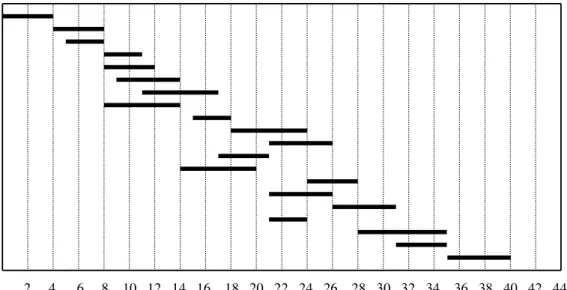
The resulting construction schedule is presented in Fig. 5. The planned project makespan is t = 44 weeks and the degree of compliance with the fuzzy limit of time available for the execution of the works is ST( )
~ d
T
t≤ = 0,50. The maximum workforce employment is 35 workers per week and the resulting degree of compliance with the fuzzy limit of workforce availability is ST( ) 0,50.
~ max
=
≤ R
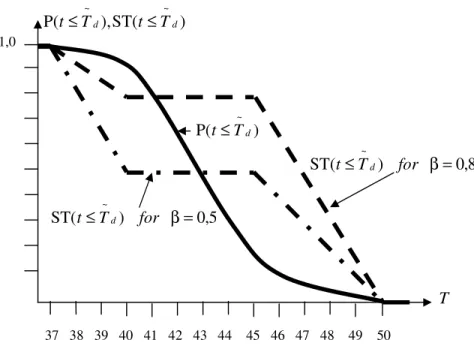
r It should be noted that the resulting degree of compliance with the fuzzy limit of time available for the execution of the works is rated significantly higher by the more optimistic planner (see Fig. 7). It should be also noted, that the shortening of the planned project makespan to the level of 40 weeks does not change the resulting degree of compliance with the fuzzy limit of time available for the execution of the works (see Fig. 7). Similarly, the reduction of the maximum workforce employment to the level of 30 workers per week does not change the resulting degree of compliance with the fuzzy limit of workforce availability.
2 4 6 8 10 12 14 16 18 20 22 24 26 28 30 32 34 36 38 40 42 44
Figure 5: Construction schedule ensuring the highest degree of compliance with the
imprecisely specified time limit for the execution of the works.Source: Own
In the second example, the planner is obliged to schedule the project to the highest probability of compliance with the imprecisely specified limit of time available for the
execution of the works. Moreover, the schedule should guarantee the probability of compliance with the fuzzy limit of workforce availability not less than Pwr = 0,50. This problem is described by the formula (14):
) P( P : P max ~ d T t≤ = ,
with the condition (15), concerning the finish–to–start relations among the activities in the project network model:
)}, ( {Prec j i d s sj≥ i+ i ∈
and with the condition (18), concerning the required probability of compliance with the fuzzy limit of workforce availability:
. 50 , 0 ) P( ~ max ≥ ≤R r
The resulting construction schedule is presented in Fig. 6. The planned project makespan is t = 41 weeks and the probability of compliance with the fuzzy limit of time available for the execution of the works is P( )
~ d
T
t≤ = 0,70. The maximum workforce employment is 32 workers per week and the resulting probability of compliance with the fuzzy limit of workforce availability is P( )
~ max
R
r ≤ = 0,56. It should be noted that any shortening of the planned project makespan improves the probability of compliance with the fuzzy limit of time available for the execution of the works (Fig. 7), regardless the risk attitude of the planner. Similarly, any reduction of the maximum workforce employment improves the probability of compliance with the fuzzy limit of workforce availability.
2 4 6 8 10 12 14 16 18 20 22 24 26 28 30 32 34 36 38 40 42 44
Figure 6: Construction schedule ensuring the highest probability of compliance with the
P( ),ST( ) ~ ~ d d t T T t≤ ≤ 1,0 P( ) ~ d T t≤ ST( ) 0,8 ~ = β ≤T for t d ST( ) 0,5 ~ = β ≤T for t d T 37 38 39 40 41 42 43 44 45 46 47 48 49 50
Figure 7: Comparison of the functions ( )
~ d T t ST ≤ and ( ) ~ d T t P ≤ . Source: Own
Suppose now that the workforce is divided into two main trades: construction workers (Trade I) for items 1 – 5, 7 – 9, 11 – 14, 17 – 20 and installers (Trade II) for items 6, 10, 15, 16.
The imprecisely specified limit of construction workers availability is “about 30”, but not less than 28 and not more than 32 workers. This limit can be modelled by the fuzzy trapezoidal number I
~
R = (28, 30, 30, 32). Furthemore, the imprecisely specified limit of installers availability is “about 20”, but not less than 18 and not more than 22 workers. This limit can be modelled by the fuzzy trapezoidal number II
~
R = (18, 20, 20, 22). The imprecisely specified limit of time available for the execution of the works remains as before: Td
~
= (37, 40, 45, 50).
The planner is obliged to schedule the project to the highest probability of compliance with the imprecisely specified limit of time available for the execution of the works. Moreover, the schedule should guarantee the probability of compliance with the fuzzy limit of construction workers availability not less than PIr = 0,50 and the probability of compliance with the fuzzy limit of installers availability not less than PIIr = 0,50. This problem is described by the formula (14):
) P( P : P max ~ d T t≤ = ,
with the condition (15), concerning the finish–to–start relations among the activities in the project network model:
)}, ( {Prec j i d s sj≥ i+ i ∈
and with the conditions (18), concerning the required probability of compliance with the fuzzy limits of construction workers and installers availability:
, 50 , 0 ) P( I ~ max I ≤R ≥ r
. 50 , 0 ) P( II ~ max I I ≤R ≥ r
The resulting construction schedule is presented in Fig. 8.
2 4 6 8 10 12 14 16 18 20 22 24 26 28 30 32 34 36 38 40 42 44
Figure 8: Construction schedule ensuring the highest probability of compliance with the
imprecisely specified time limit for the execution of the works in the case of two trades with limited availability. Source: Own
In this case, the planned project makespan is t = 40 weeks and the probability of compliance with the fuzzy limit of time available for the execution of the works is
) P(
~ d
T
t≤ = 0,84. The maximum employment of construction workers is 30 workers per week and the resulting probability of compliance with the fuzzy limit of workforce availability is
)
P( I
~ max
I R
r ≤ = 0,50. The maximum employment of installers is 19 workers per week and the resulting probability of compliance with the fuzzy limit of workforce availability is
) P( II ~ max I I R r ≤ = 0,97. CONCLUSIONS
The theory of possibility allows for the modelling of imprecisely defined planning constrains by means of trapezoidal or triangular fuzzy numbers. If trapezoidal fuzzy numbers are used, some difficulties arise in determining the proper numerical value of coefficient
βcharacterizing the risk attitude of the assessor. This may cause the different assessments of the degree of satisfaction of fuzzy planning constraints, formulated by planner and by the decision maker. In addition, the result of evaluation remains constant when the planned project makespan or the planned resource consumption takes the value from the core of the trapezoidal fuzzy number, modelling the given planning constraint. This adversely affects the optimality of solutions to scheduling problems with imprecisely defined constraints. If triangular fuzzy numbers are used, there still remain difficulties in the numerical
characteristics of the attitude towards risk. The approach presented in this paper combines the elements of the theory of possibility and the elements of theory of probability. The imprecision of project constraints is modelled by fuzzy numbers, while the level of satisfaction of fuzzy planning constraints is assessed by the use of probability measure. It has been demonstrated that the use of probability measure neutralize the assessment of compliance with the fuzzy constrains. Moreover, the results of the optimization of construction schedule are improved. The approach presented in this paper can be adopted when also the uncertainties of project activity durations are modelled by fuzzy numbers.
LITERATURE
[1] Dubois D., Prade H., Possibility theory, Plenum Press, New York 1988.
[2] Dubois D., Prade H., ‘When upper probabilities are possibility measures’, Fuzzy Sets and Systems, 49 (1), 1992, pp. 65–74.
[3] Dubois, D., Fargier, H., Fortemps, F., ‘Fuzzy scheduling: Modelling flexible constraints vs. coping with incomplete knowledge’, European Journal of Operational Research, 147(2), 2003, pp. 231-252.
[4] Hapke M., Słowiński R., ‘Fuzzy priority heuristics for project scheduling’, Fuzzy Sets and Systems 83, 1996, pp. 291-299.
[5] Hapke M., Słowiński R., ‘Fuzzy set approach to multi-objective and multi-mode project scheduling under uncertainty’ in: Hapke M., Słowiński R. (ed.), Scheduling Under Fuziness, Physica-Verlag, Heidelberg, 2000, pp. 197-221.
[6] Hegazy T., ‘Optimization of resource allocation and leveling using genetic algorithms’,
Journal of Construction Engineering and Management, 125 (3), 1999, pp. 167–175.
[7] Jaśkowski P., Sobotka A., ‘Scheduling construction projects using evolutionary algorithm’, Journal of Construction Engineering and Management, 132 (8), 2006,pp. 861-870.
[8] Kuchta D., Soft mathematics in management. The application of interval and fuzzy
numbers in management accounting (in Polish). Oficyna Wydawnicza Politechniki
Wrocławskiej, Wrocław 2001.
[9] Lee Z.J., Su S.F., Lee C.Y., Hung Y.S., ‘A heuristic genetic algorithm for solving resource allocation problems’, Knowledge and Information Systems, 5, 2003, pp. 503–511. [10] Leu S.S.,Yang C.H: ’GA-based multicriteria optimal model for construction scheduling’,
Journal of Construction Engineering and Management, 125 (6), 1999, pp. 420–427.
[11] Leu S.S., Chen A.T.,Yang C.H., ‘A GA-based fuzzy optimal model for construction time-cost trade-off’, International Journal of Project Management, 19, 2001, pp. 47-58. [12] Li H., Love P.E.D., ‘Using improved genetic algorithms to facilitate time–cost optimization’, Journal of Construction Engineering and Management, 123 (3), 1997, pp. 233–237.
[13] Li H., Cao J.N., Love P.E.D., ‘Using machine learning and GA to solve time–cost trade–off problems’, Journal of Construction Engineering and Management, 125 (5), 1999, pp. 347–353.
[14] Lorterapong P., Moselhi O., ‘Project–network analysis using fuzzy sets theory’, Journal
of Construction Engineering and Management, ASCE, 122 (4), 1996, pp. 308–318.
[15] Pan H., Yeh C.H., ‘Fuzzy project scheduling’, Proceedings of the IEEE International Conference on Fuzzy Systems, 2003, pp. 755-760.
[16] Senouci A.B., Eldin N.N., ‘Use of genetic algorithms in resource scheduling of construction projects’, Journal of Construction Engineering and Management, 130 (6), 2004, pp. 869–877.
[17] Wang J., ‘A fuzzy project scheduling approach to minimize schedule risk for product development’, Fuzzy Sets and Systems, 127, 2002, pp. 99-116.
[18] Wang J., ‘A fuzzy robust scheduling approach for product development projects’,