A Cost-Effective Virtual Reference Service:
Are Users Satisfied?
Arthur Hendricks
Reference Librarian and System Support Specialist
Branford Price Millar Library, Portland State University, USA E-mail:[email protected]
Keywords(關鍵詞):Chinese American Librarians; User Satisfaction Survey; Academic Library
【Abstract】
While a number of articles about electronic reference have been written, most are from the point of view of the librarian. Very few, if any, deal with user feedback regarding electronic reference. This article offers a review of the feedback received from surveying users of the Portland State University (PSU) Library’s email-based electronic reference service, and discusses the current status and future trends of virtual reference.
INTRODUCTION
Reference work in the traditional sense is personal assistance given by the librarian to people in search of information. This is typified by a librarian sitting behind a desk and helping a patron find a book or offering directions, either in person or over the phone. These are examples of synchronous reference, which occurs in real time and in which there is immediate feedback between the two parties.
Though not as common, some libraries, notably special libraries, receive letters asking reference questions. The librarian writes back or send material, but may not receive any
feedback. This is as an asynchronous interaction. Email reference is similar to reference by correspondence, but it lends itself to obtaining user feedback. This article reviews the feedback from a survey received from users of the Portland State University Library’s (Portland, Oregon) email-based electronic reference service, examines users’ satisfaction with local virtual reference, and concludes with a discussion of more recent developments in virtual reference.
LITERATURE REVIEW
Assessment of services is an important aspect of traditional librarianship as well as the offering of new services. “Evaluation of the virtual library is important in determining user satisfaction. Technology is useless if it does not meet the user’s needs” (Strom, 2002). Until a few years ago there was a lack of articles dealing with actual user surveys of electronic reference. However, as electronic reference has grown in popularity, more user studies are being published. A digital reference services bibliography list compiled by Bernie Sloan is available at http://www.lis.uiuc.edu/~b-sloan/digiref.html. How-to books are also appearing, such as The Virtual Reference Librarian’s Handbook, which
covers user evaluation: “Provide an easy-to-use, short evaluation form. The form should fit within the boundaries of one screen, and should encourage users to tell what they liked and didn’t like about using your service” (Lipow 2003).
The creators of the Internet Public Library (IPL), inaugurated on March 17, 1995, did an indirect survey of their users. Their research focused on a three-month period in 1999 in which they received 3,022 questions (Carter and Janes, 2000). The closest to user satisfaction in the analysis, however, is the “thank you” rate from users. In the period covered by the study, 19.7 percent of questions received unsolicited thanks from users (Carter and Janes, 2000). In their conclusion, Carter and Janes state, “Armed with such knowledge we can now dive into other avenues of exploration – such as content analysis of the questions, a patron satisfaction survey, librarian attitudes, and so on” (Carter and Janes, 2000).
Rowena Cullen has written about user satisfaction surveys, pointing out the phenomenon of the false positive emotional satisfaction whereby libraries generally do well in satisfaction ratings (Cullen, 2001). However, her article just touches on virtual reference. She cites the Western Kentucky University (WKU) Libraries Satisfaction Survey, reported by Perkins and Yuan (2000), which gathered usable responses from 247 participants. Respondents overall seem to have been satisfied with access to databases both within and from outside the library but not as satisfied with the library's home page in terms of phone and e-mail assistance and with access to CD-ROM products (Cullen, 2001). She also cites a survey conducted by the University of Illinois at Urbana-Champaign: “In the UIUC study, some electronic resources (e-mail reference services and the library Web pages) appear satisfactory to users. Overall electronic resources appear to be accepted as part of the library's system of information delivery, and some are well regarded. However, the few service quality surveys that cover some of the issues relating to service quality in relation to
electronic resources and services do not provide enough information about the service quality issues in this area” (Cullen, 2001).
Marianne Foley conducted a user survey about her library’s use of America Online’s Instant Messenger (IM) as a tool for virtual reference (Foley, 2002). Users were asked, via an online questionnaire, to specify their age range, gender; the location from which they sent their message, whether they were affiliated with the university, and their degree of satisfaction with IM reference. Also, they were asked to briefly explain why they chose to send an instant message instead of visiting, calling, or e-mailing a library. “As for satisfaction level, 45 percent of respondents reported being very satisfied with the service. In fact, 79 percent declared themselves satisfied or better compared to 10 percent who registered some level of dissatisfaction. Most of the unhappy patrons had tried to access the service when it was closed” (Foley, 2002).
Margie Ruppel and Jody Condit Fagan have surveyed users of their library’s instant messenger-based service (Ruppel and Fagan, 2002). They used two different surveys to assess user satisfaction, a short one conducted via their chat system and a paper-based one with 15 questions delivered to students in bibliographic instruction classes. 340 people responded to their electronic survey and 82% rated the service as “very good” and 82% rated the help received as “very helpful.” They also asked for comments. “The most frequent type of comment on the short survey (33 of the 115 respondents) was a general acclamation of the service” (Ruppel and Fagan, 2002). This is in line with the types of comments we received from our survey.
Bruce Stoffel and Toni Tucker of the Milner Library at Illinois State University have written about their library’s experience with chat and email reference and report on a user satisfaction survey (Stoffel and Tucker, 2004). Their survey team emailed patrons and invited them to complete a web-based survey form. They asked about satisfaction with response time, the quality
of the response, the ease of use, the knowledge of the librarian, the ease in finding the service, the instructions for using the service, and overall service. They also asked for any additional comments. The demographics of those who responded closely resemble what our survey indicated although their level of satisfaction was slightly higher than ours. “The heart of the survey was the set of questions related to patron satisfaction. In virtually every category probed, satisfaction levels exceeded 90 percent (i.e. patrons were satisfied of very satisfied)” (Stoffel and Tucker, 2004). They, too, had a low response rate to their survey. “The response rate in connection with the e-mail reference survey is lower than recently reported response rates for other e-mail reference surveys, such as the 43-46 percent response rates achieved by the University of California at Irvine” (Stoffel and Tucker, 2004). In the University of California at Irvine survey, 28 surveys were sent and 13 responses were received with nine ranking the service highly and the rest ranking it at lower levels of satisfaction (Horn and Kjaer, 2000).
BACKGROUND
The PSU Library is a large academic library serving a student population of 26,000 in the metropolitan Portland, Oregon area. PSU did not inaugurate email reference until May, 2001. Several factors account for our late arrival into the virtual reference arena. In 1996, when email reference was new, only one reference librarian was interested in trying to implement it. The general sentiment was that email reference would overwhelm librarians’ workload. Furthermore, the library at that time did not have a very robust server running its home page.
It was not until 2001 that the PSU Library once again contemplated electronic reference. As part of a building remodeling, the library’s reference services were reorganized. Rather than being housed on different floors, catering to specific subject areas, the library collapsed four access points into one general reference desk. In the spirit of change, along with the hiring of a
new head of public services, the library explored the possibility of offering electronic reference.
PLANNING
In January of 2001, a workgroup, called the PSU Electronic Reference (EREF) group, was formed to look into offering virtual reference at the library. I was invited to serve as a technology consultant. Due to the cost of the software and given the fact that the library has access to a UNIX server and PERL, the EREF group decided to rely on the library’s own resources and adopt a cost effective way to provide electronic reference service. The decision was made to create a majordomo discussion list and a PERL script that would email the reference questions to the group. In this way the staff and librarians in the EREF group could all see the questions, and when a question was answered, all could receive the answer. Librarians determined that they could follow a schedule to take turns answering the questions on a given day and forward specific questions to subject specialists.
During the time the script was being developed, the EREF co-chairs investigated various urban universities to see if they offered virtual reference and what their interface looked like. As a result, I discovered that most urban university libraries (the Urban 13) already implemented some sort of virtual reference. (See Appendix A). The group determined that using email-based electronic reference service was the best choice at the time, given limited budgetary resources of the library.
IMPLEMENTATION
To implement this virtual service, a web form was designed and mounted on the library’s web site. The form requested that patrons provide the following information: name, email address, status (e.g., undergraduate, faculty, etc.) the subject area of the question, and their question. They were also able to give a deadline for when they wanted a response. Over the course of
offering this service, several changes have been made to our form. To ensure privacy, it is no longer necessary for patrons to give their name, nor are they asked for the subject area of their questions.
During our initial implementation, most of the questions we received were about remote access (to our proxy server), which prompted the EREF group to add a hyperlink to an instruction page on how to configure a browser to use the proxy. Adding the link did not entirely fix the problem, however. No matter how we worded it, users still asked why they were prompted for a password from Ebscohost or how they could obtain a password.
SURVEY
To better serve our virtual users and understand their needs, a survey was created using WebSurveyor Desktop, version 4.1. The survey requested a variety of information, including the patron’s status, zip code, what subject area their question was in, and how many times they had used the service. In addition, they were asked three yes/no questions: Did you receive a response in a timely manner? Was the site easy to read? Was the site easy to use? They were also asked to rank our service from 0 to 5 with 0 being not applicable, 1 fair, and 5 excellent. Finally, they were given the option of making comments. The survey was then sent via e-mail to previous users of the service for whom addresses were available.
RESULTS
The total number of completed surveys was 84 out of approximately 800 emails sent. This is a response rate of 10.5%, which is low. However, some of the email messages bounced, and a few people replied to the email stating they did not wish to complete the survey. In the Foley survey, respondents were offered a chance to win a $25 gift certificate (Foley, 2002). There was no such incentive for our users. In keeping with
our promise of anonymity, there would have been no easy way to pick a winner.
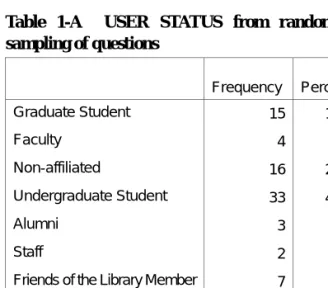
Table 1 shows the percentage of survey responses from each status group. Graduate students and faculty accounted for over half of the 84 responses. Out of a random sampling of 10% of saved questions, which included status, 18.8% of those who submitted questions were graduate students, 5% faculty, 20% non-affiliated users, 41.3% undergraduate students, 3.8% alumni, 2.5% staff, and 8.8% members of the Friends of the Library. See Table 1-A. Although comparatively few undergraduates responded to the survey, they emerged as the heaviest users of e-mail reference.
Table 1 USER STATUS from survey
Frequency Percent Graduate Student 34 40.5 Faculty 14 16.7 Non-affiliated 12 14.3 Undergraduate Student 10 11.9 Alumni 9 10.7 Staff 3 3.6
Friends of the Library Member 2 2.4
Total 84 100.0
Table 1-A USER STATUS from random sampling of questions Frequency Percent Graduate Student 15 18.8 Faculty 4 5.0 Non-affiliated 16 20.0 Undergraduate Student 33 41.3 Alumni 3 3.8 Staff 2 2.5
Friends of the Library Member 7 8.8
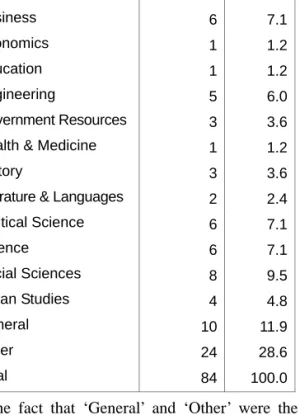
Table 2 shows the range of responses that users gave as the subject of the questions they had posed.
Table 2 SUBJECT AREAS from survey
Frequency Percent
Art & Architecture 4 4.8
Business 6 7.1
Economics 1 1.2
Education 1 1.2
Engineering 5 6.0
Government Resources 3 3.6
Health & Medicine 1 1.2
History 3 3.6
Literature & Languages 2 2.4
Political Science 6 7.1 Science 6 7.1 Social Sciences 8 9.5 Urban Studies 4 4.8 General 10 11.9 Other 24 28.6 Total 84 100.0
The fact that ‘General’ and ‘Other’ were the two most frequent responses perhaps indicates the difficulty some users had in classifying the subject matter of their queries.
Table 3 shows the number of times survey respondents indicated that they had used our service.
Table 3 FREQUENCY OF USAGE
No. of times Frequency Percent
1 50 59.5 2 16 19.0 3 6 7.1 4 3 3.6 5 5 6.0 6 1 1.2 7 1 1.2 8 1 1.2 50 1 1.2 Total 84 100.0
Clearly the majority of survey respondents (59.5%) used our e-mail reference service only once. One person’s claim of using our service 50 times seems unrealistically high, but since, due to privacy concerns, we don’t keep the name of the patron associated with the question, we have no way of verifying it.
Those on the EREF team were given one day to answer questions. It was up to the individual librarian or staff member to answer all the questions for that day. A very large percentage of respondents, 86.9%, indicated that they received a response within the promised time; only 7.1% said no, and 6% chose Other. While it is troubling that we are rated at less than 90% on timeliness, it could be that those who received their answer in a timely fashion and were happy did not bother to respond to the survey. Those who indicated that they received a reply in a timely manner also found the web page easy to use and the service easy to read.
As for user satisfaction with our service, 44% rated it as Excellent, 39.3% as Good. Only 6% rated it either So-so or Poor, while only 1.2% found our service to be Fair. The few (3.6%) who chose “Not Applicable” did not remember using our service. The mean for most users, especially those who use the service the most (undergraduate and graduate students), is over 4, which is somewhere between Good and Excellent. It would seem from the data that most of our users are happy with our service. Very few staff use our service (2.5%) and only 3.6% of survey respondents were staff, but apparently the few who did had a bad experience.
Next, I asked for the patrons’ zip codes to see who was using our virtual service. The most frequent zip code was 97201, which is that of Portland State University (West Portland). While PSU is mainly a commuter, urban school, there is campus housing for undergraduate students. I had expected more distance education students to take advantage of this service, so this finding was somewhat surprising to us.
Only 45.2% of the survey respondents left comments. One graduate student wrote, “Service was prompt and the key response was detailed. My main question was quite technical, and the response showed that it was perfectly understood and the appropriate help was offered.” An undergraduate wrote, “The problem I had with the service was that I really needed help ’right now‘. It was not helpful to wait 'til the next day for an answer. The answer was helpful, just not timely.” A few couldn’t recall what they had asked: (“Sorry I can't be more helpful, but can't remember what question I asked”). A non-affiliated user wrote, “Please retain this valuable service. I live in Boise, ID where the local university library is lacking in my research fields of South Asia, Islamic studies, Bengal studies, etc.”
The comments reveal the strengths and weaknesses of email-based reference. It works well for those who do not need an immediate response. It also is convenient when there is a complex question. Geographic boundaries are also reduced. On the other hand, if someone needs help right at that moment or if the subject specialist is on vacation at the moment, then the service is not as useful to patrons.
The script worked successfully on the first day of our email reference implementation and three questions were received. The use of the service has increased from year one to year two and three. In 2001, from May to December, we answered a total of 351 questions. In 2002, we answered 589 questions, and in 2003 we received 564. It is interesting to note that the fears of being
overworked were unfounded, as we were not inundated with questions – about three questions a day on average.
By 2001, email reference was old by technology standards, and real-time chat was the latest and greatest virtual reference that libraries had to offer. However, our survey indicates that users are generally satisfied with our email-based virtual reference service. Most comments about the service were positive and encouraging. Students seem happy to be able to get help from librarians in a virtual manner within a short amount of time.
CURRENT STATUS
Today, most libraries offer email reference services in addition to their traditional reference services. See Appendix A for the list of Urban 13 libraries that offer chat and email services. Many libraries are using virtual chat. Some of the products include Virtual Reference (Tutor.com), LivePerson, OnDemand, LiveAssistance, LiveHelper, NetAgent, and 24/7 Reference. OCLC also offers QuestionPoint. LSSI (Tutor.com) is one of the costliest, but it offers many features, such as chat, pushing pages, sending URLs, sending an email transcript complete with URLs, scripted messages, and users do not load any special software, they just use their normal web browser. LivePerson has similar features and costs a little less. One can go to http://www.public.iastate.edu/~CYBERSTACKS/ LiveRef.htm, a registry of real-time digital reference services, for up-to-date information about various institutions and what services they offer.
There are also open source options, such as RAKIM, which allow a library to have the base functionality of chat. (see http://sourceforge.net/ projects/rakim/) RAKIM, according to the website, is an attempt to provide web-based reference service. It is very similar to standard chat room scripts, but it also has rudimentary escorted browsing like that offered by LSSI. Because it is open source, it is free. On the other hand, one needs to have access not only to a
web server, but also a SQL database server and know how to install software on a UNIX machine. One also needs the correct permissions on the UNIX server to install these programs and configure the SQL database.
CONCLUSION
Libraries can never be satisfied with what they currently offer. Librarians are expected to act aggressively in providing the best service to their users. The adoption of an email-based reference service proved to be a favorable approach to our local users and a cost effective solution to the library at the time. However, users’ expectations and library services continue to change in today’s networked environment. Our next goal for the library is to provide virtual reference beyond our current status while balancing technology with the library’s stretched budget.
Since January, 2003, our EREF group has been participating in the state-wide consortium for virtual reference (formerly Answerland and currently L-Net) with the (formerly) LSSI software (now Tutor.com). This software lets librarians chat via typed messages with users and also guide users through web pages. A feature called Ref Tracker allows the librarian to save a patron’s query and treat it as an asynchronous reference question. It is hoped that this will enhance the virtual reference service and meet the changing needs of our virtual users. It will also be interesting to see if this new innovation may curtail the use of our service or whether our users will stay loyal to a local service versus a more anonymous service. So far, our usage has not changed that much since we began participating in L-Net.
REFERENCES
Carter, D., & Janes, J. (2000, Fall). Unobtrusive Data Analysis of Digital Reference Questions and Service at the Internet Public Library: An Exploratory Study. Library Trends, 49(2), 251-65. Cullen, R. (2001, Spring). Perspectives on User
Satisfaction Surveys. Library Trends, 49(4), 662-686.
Foley, M. (2002, January). Instant Messaging Reference in an Academic Library: A Case Study.
College and Research Libraries, 63(1), 36-45.
Horn, J. & Kjaer, K (2000). Evaluating the “Ask a Question” Service at the University of California, Irvine. In R. D. Lankes, J. W. Collins III, & A. S. Kasowitz (Eds.), Digital Reference Service in the New Millennium:
Planning, Management, and Evaluation.
New York: Neal-Schuman.
Lipow, A. G. (2003). The Virtual Reference
Librarian’s Handbook. New York:
Neal-Schuman.
Perkins, G., & Yuan, H. (2000, Summer). Genesis of a Web-based satisfaction survey in an academic library: the Western Kentucky University Libraries' experience. Library
Administration & Management, 14(3), 159-66.
Ruppel, M., & Fagan, J. (2002). Instant messaging reference: users’ evaluation of library chat.
Reference Services Review, 30(3), 183-197.
Sloan, B. (2003), “Digital reference services bibliography” available at: http://www.lis.uiuc.edu/ ~b-sloan/digiref.html (accessed 22/08/04). Stoffel, B., & Tucker, T. (2004). E-mail and
chat reference: assessing patron satisfaction.
Reference Services Review, 32(2), 120-140.
Strom, L. (2002, Fall). The Emerging Virtual Reference Desk. Mississippi Libraries, 66(3), 71-3.
Appendix A
Urban 13 Universities Information as of 4/14/03
1. U of Alabama at Birmingham Sterne Library chat coming soon 2. U of Cincinnati Libraries OhioLINK Chat Reference 3. Cleveland State U Libraries and Research OhioLINK 4. Florida Agricultural & Mechanical U Coleman Library no chat, email ref 5. Georgia State U Libraries no chat, email ref 6. U of Houston Libraries no chat, email ref 7. U of Illinois at Chicago Library chat and email 8. Indiana U Purdue U, Indianapolis Libraries email
9. U of Massachusetts at Boston Healey Library chat (24/7)
10. U of Memphis Libraries email
11. U of Missouri-St. Louis Libraries email ref 12. U of Missouri-Kansas City Libraries email ref
13. U of New Orleans Long Library email and LSSI 14. City College of New York Libraries nothing
15. U of Pittsburgh Libraries email only 16. Temple U Libraries TalkNow chat and email
17. U of Toledo Libraries email (but part of Ohiolink) 18. Virginia Commonwealth U Libraries LiveHelp
19. Wayne State U Library System chat and email 20. U of Wisconsin-Milwaukie Golda Meir Library email and chat