Current Density Impedance Imaging with
Complete Electrode Model
Alexandru Tamasan
jointly with A. Nachman & J. Veras
University of Central Florida Work supported by NSF
Outline
In motivation
Hybrid methods in Inverse Problems Current density based EIT
Acquiring the interior data
The forward problem
The Complete Electrode Model
The Inverse Problem
Characterization of non-uniqueness Phase retrieval
Restoring uniqueness
A numerical algorithm and experiment Conclusions
Coupled Physics Imaging Methods
Combine high contrast & high resolution
I Elastography: elastic waves & ultrasound/MRI⇒stiffness
I Thermo/PhotoAcoustic: UV light & sound⇒embedded acoustic sources
I AcoustoOptics: light & sound⇒absorption and scattering
I Coupled Physics Electrical Impedance Tomography
I Current density impedance imagingCDII: Joy& Nachman since 2002, Seo et al. 2002
I MREIT (Bz-methods): Seo et al. since 2003
I Ultrasound modulated EIT: Capdebosq et at. 2008, Bal et al. 2009
I Impedance acoustic: Scherzer et al. 2009
I Lorentz force driven EIT: Ammari et al. since 2013 I ...
Current density tracing inside an object
Magnetic resonance data:
M
: Ω
→
C
Aquiring the interior data
One MR scan⇒longitudinal componentBz (along gantry) of
the magnetic fieldB= (Bx,By,Bz)
Bz(x,y,z0) = 1 2γT Imlog M+(x,y,z0) M−(x,y,z0)
I MREIT (Seo at al. since 2003): DoesBz uniquely
determine the electrical conductivity? In general, not known.
I CDII (Nachman et al since 2002, Seo (2002)) : + two rotation of the object
⇒B⇒J= 1
µ0 ∇ ×B I Anisotropic case: Bal & Monard (2013), unique
determination Hoell-Moradifam-Nachman (2014, within conformal class)
Outline
In motivation
Hybrid methods in Inverse Problems Current density based EIT
Acquiring the interior data
The forward problem
The Complete Electrode Model
The Inverse Problem
Characterization of non-uniqueness Phase retrieval
Restoring uniqueness
A numerical algorithm and experiment Conclusions
Complete Electrode Model
(Somersalo-Cheney-Isaacson ’92)
Ω⊂Rnbounded with Lipschitz boundary∂Ω,N+1 electrodes:ek ⊂∂Ω,k =0, ...,N, ≤Re{σ} ≤1/, ≤Re{zk} ≤1/,k =0,1, ...,N, ∇ ·σ∇u=0, inΩ, u+zkσ ∂u ∂ν ≡const =Uk onek, fork =0, ...,N, Z ek σ∂u ∂νds=Ik, fork =0, ...,N, ∂u ∂ν =0, on∂Ω\ N [ k=0 ek,
Forward problem (CEM) is well posed
Based on Lax-Milgram lemma:
Theorem(Somersalo- Cheney- Isaacson ’92) Provided
N
X
k=0
Ik =0,
there is a unique solutionhu(x),(U0, ....,UN)i ∈H1(Ω)×CN+1
Normalization
Uniqueness up to a constant: hu(x) +c,(U0+c, ....,UN+c)ialso a solution. ∇ ·σ∇(u+c) =0, inΩ, (u+c) +zkσ ∂(u+c) ∂ν ≡const =Uk +c onek, fork =0, ...,N, Z ek σ∂(u+c) ∂ν ds =Ik, fork =0, ...,N, ∂(u+c) ∂ν =0, on∂Ω\ N [ k=0 ek,Normalization:fix a constant by seekingU= (U0, ...,UN)with
PN
New properties in the real valued case
σ(x),z0(x), ...,zN(x)∈R U∈Π :={(U0, ...UN)∈RN+1: N X k=0 Uk =0}I Maximum Principle for CEM: The maximum and minimum of the voltage potentialuoccur on the electrodes.
I A Poicar ´e Inequality (not necessarily connected with CEM):∃C >0 dependent only onΩandek ⊂∂Ωsuch that ∀u ∈H1(Ω)and∀U= (U0, ...,UN)∈Π : Z Ω u2+ N X k=0 Uk2≤C Z Ω |∇u|2dx + N X k=0 Z ek (u−Uk)2ds !
The Dirichlet principle for the CEM
Consider the functional
Fσ(u,U) := 1 2 Z ∂Ω σ|∇u|2dx +1 2 N X k=0 Z ek 1 zk (u−Uk)2ds− N X k=0 IkUk.
RecallΩ,Π,ek ⊂∂Ω,zk, fork =0, ...,N,σ, and
N X k=0 Ik =0 (?) Theorem(Nachman-T-Veras ’14) (i) Independently of(?): ∃! (u,U) =argminH1(Ω)×ΠFσ (ii) If(?)holds:
Formulation of an Inverse Problem
Given:Ω,ek ⊂∂Ωwithzk >0, andI1, ....,IN,
(thenI0:=−PNk=1Ik),
and|J|=σ|∇u|insideΩ,
Formulation of an Inverse Problem
Given:Ω,ek ⊂∂Ωwithzk >0, andIk,k=1, ...,N (then
I0:=−PNk=1Ik), and|J|=σ|∇u|inside, Findσ.
Not possible: Ω = (0,1)×(0,1),
Top side:e1withz1>0, injectI1=1
Bottom side:e0withz0=z1+1, extractI0=−1
Measure the magnitude|J| ≡1 inside.
Arbitraryϕ: [0,1]→[ϕ(0), ϕ(1)]increasing, Lipschitz with
ϕ(0) +ϕ(1) =1.
Then:uϕ(x,y) :=ϕ(y)voltage forσϕ(x,y) =1/ϕ0(y). Yet for all suchϕ,
Generic non-uniqueness
Let(u,U)∈H1(Ω)×Πbe the solution of CEM for someσ.
ϕ∈Lip(u(Ω))be an increasing function of one variable,
ϕ(t) =t+ck whenevert ∈u(ek), for eachk =0, ...,N, and
constantsck satisfying
PN
k=0ck =0. Then
uϕ :=ϕ◦u (1)
is a voltage potential for CEM with
σϕ :=
σ
ϕ0◦u, (2)
and has the same interior data
Characterization of Non-uniqueness
Theorem(Nachman-T-Veras ’14) Recall assumptions on
Ω⊂Rd be bounded, connectedC1,α,e
k ⊂∂Ω,zk >0,Ik,
k =0, ...,N.
Let(u,U),(v,V)∈H1(Ω)×Π, be the CEM solutions for unknown conductivitiesσ,σ˜ ∈Cα(Ω)with
|J|:=σ|∇u|= ˜σ|∇v|>0a.e.inΩ.
Then∃ϕ∈C1(u(Ω)), withϕ0(t)>0 a.e. inΩ, such that
v =ϕ◦u, inΩ,
˜
σ = σ
ϕ0◦u, a.e. inΩ.
Moreover, for eachk =0, ...,N andt∈v(ek),
Idea: reduction to a minimization problem
Inverse hybrid problem: Consider
G|J|(v,V) = Z Ω |J| |∇v|dx+1 2 N X k=0 Z ek 1 zk(v−Vk) 2ds− N X k=0 IkVk,
I solutions of CEM are global minimizers ofG|J|over
H1(Ω)×Π.
I Geometry of the equipotential sets are uniquely determined! Contrast with Dirichlet
Contrast with functional in the forward model
Fσ(v,V) := 1 2 Z ∂Ω σ|∇v|2dx+1 2 N X k=0 Z ek 1 zk (v−Vk)2ds− N X k=0 IkVk.
Corollaries
I Phase retrieval(Nachman-T-Veras’14) Same hypotheses (recall).
|J|=|˜J| ⇒J= ˜J.
I There is uniqueness (and a reconstruction method) from the magnitudes oftwocurrents via a local formula (Nachman et al., Lee 2004)
I TheJ-substitution algorithm via magnitudes oftwo
Knowledge of the potential on a boundary curve
joining the electrodes restores uniqueness
Theorem(Nachman-T-Veras ’14) In addition to the hypotheses of the characterization theorem if
u|Γ= ˜u|Γ+C,
for someC, andΓa curve joining the electrodes, then
u= ˜u+C inΩ, σ= ˜σinΩ.
A minimization algorithm for
G
G|J|(v,V) = Z Ω |J| |∇v|dx+ N X k=0 Z ek 1 2zk (v −Vk)2ds− N X k=0 IkVk,LemmaAssume thatv ∈H1(Ω)satisfies
≤ a
|∇v|≤
1
,
for some >0, and let(u,U)∈H1(Ω)×Πbe the unique solution for CEM withσ :=a/|∇v|. Then
Ga(u,U)≤Ga(v,V), for allV ∈Π.
A minimization algorithm
I Withσngiven: Solve CEM for the unique solution(un,Un); I If essinfk∇un− ∇un−1k> δ essinf|J|, update σn+1:=min max |J| |∇un| , ,1 and repeat; I else STOP.
Enough for the phase retrieval:
J≈ |J| ∇un |∇un|
Using the voltage on
Γ
Letnbe the last iteration and set
σn+1:= |J| ∇un
.
The Characterization Theorem
⇒u(x)≈f(un(x)).
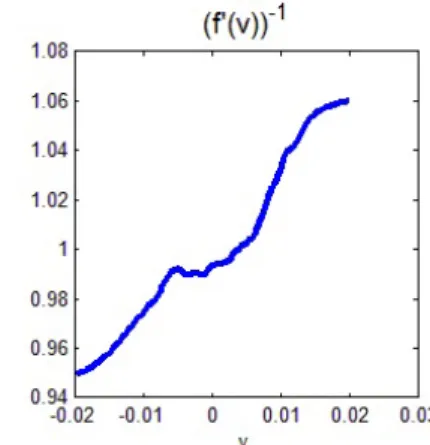
Read off the measured data onΓto determine the scaling functionf :u(Γ)→un(Γ). Then σ(x)≈ 1 f0(u n(x)) σn+1(x).
Reconstruction results in a numerical experiment
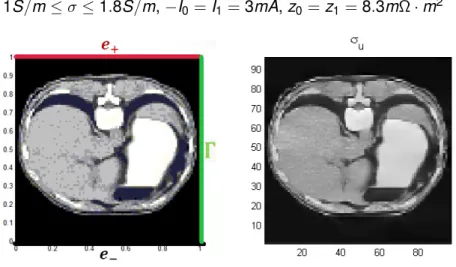
1S/m≤σ ≤1.8S/m,−I0=I1=3mA,z0=z1=8.3mΩ·m2
Voltage potential scaling along
Γ
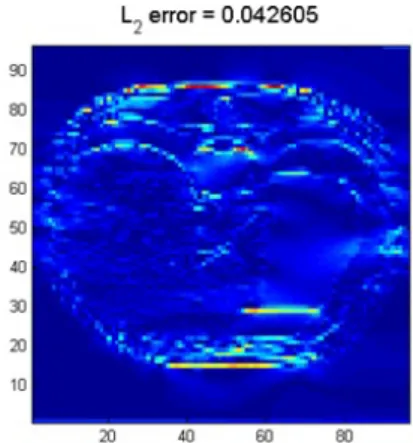
Figure :L2-Error: Understood from the stability in the linearized case
Some learnings
I in the more realistic CEM. the magnitude of one current density by itself cannot determine an isotropic conductivity
I the magnitude of two currents uniquely determine the conductivity (up to an additive constant)
I in the isotropic case: the phase of the current is uniquely determined from its magnitude (not known in the
anisotropic case)
I knowledge of the voltage potential along a curve restores uniqueness
I the method is constructive