SARA ABDALLA
AN E-GOVERNMENT ADOPTION FRAMEWORK FOR
DEVELOPING COUNTRIES: A CASE STUDY FROM SUDAN
SCHOOL OF APPLIED SCIENCES
PhD
Academic Year: 2007 - 2012
Supervisor: Dr Ip-Shing Fan
February 2012
SCHOOL OF APPLIED SCIENCES
PhD
Academic Year 2007 - 2012
SARA ABDALLA
An e-government adoption framework for developing countries: A case
study from Sudan
Supervisor: Dr Ip-Shing Fan
February 2012
This thesis is submitted in partial fulfilment of the requirements for the
degree of PhD
© Cranfield University 2012. All rights reserved. No part of this
publication may be reproduced without the written permission of the
Over the past decade, rapid progress in ICT has encouraged many governments to incorporate new technology into their national economic development strategies. E-government is an important application within ICT and has become more significant in the agenda of policy and decision makers the world over.
E-government created a new medium that changed the nature of the whole public sector and its relationship with its constituencies. It has had a profound effect on various socio-economic and political aspects of society. E-government provides delivery of public services in a much more convenient and cost-effective way, offering huge opportunities to improve public sector efficiency. However, the process of change also gives rise to new challenges and difficulties, especially in developing countries, where many initiatives have not been successful. This is as a result of the massive deficiencies in basic infrastructure, human capacity and financial resources, along with the attendant political and cultural constraints. These factors are crucial and impede the adoption of e-government and the building of an information based society and economy. E-government initiatives must therefore account for the specific E-government systems, technological infrastructure and environmental conditions of the host country.
Many of the models and frameworks built to assist in the adoption process in developing countries have been adapted from e-government implementation experiences in Western developed countries. While there are important lessons to be learnt, these frameworks have limited application in Africa and developing countries in other regions.
Previously it was difficult to investigate e-government in developing countries due to their low levels of development. Recent advances in e-government in these countries have made it possible to conduct studies and analyse their experiences and practices.
This research empirically examined the adoption of e-government at a national and organisational level, taking the public sector in Sudan as a case study. A qualitative approach was followed and data was collected from Sudan using interviews with key
The findings of the research contributed to the identification of the critical factors in Sudan, and to the development of an e-government adoption framework. The framework combines elements from the Technological, Organisational and Environmental (TOE) model; guiding decision makers to better manage issues related to the adoption process regarding the development of the technical infrastructure, management systems, values and strategies.
The use of the proposed framework can help integrate e-government into the public sector in order to accelerate social and economic progress in developing countries.
Keywords:
ِّبَر ِﮫـﱠﻠِﻟ ﻲِﺗﺎَﻤَﻣَو َيﺎَﯿْﺤَﻣَو ﻲِﻜُﺴُﻧَو ﻲِﺗﺎَﻠَﺻ ﱠنِإ ْﻞُﻗ
َﻦﯿِﻤَﻟﺎَﻌْﻟا
{Say, Indeed, my prayer, my rites of sacrifice, my living and my dying are for Allah, Lord of the worlds.} and prayers and blessing upon his prophet Mohammad, the seal of all prophets. This thesis would not have been possible without the guidance and help of several individuals who assisted in the preparation and completion of this study.
Firstly, my sincere thanks and deep gratitude goes to my supervisor, Dr Ip-Shing Fan. His wide knowledge, constructive comments and logical way of thinking have been of great value. Without his understanding, patience, and continuous support this piece of work would never have been completed.
I am indebted to my previous supervisor, Dr Mark Lemon, who accepted me as a PhD student. I gratefully acknowledge his enthusiastic supervision and invaluable feedback throughout my research time.
Deborah from IT and the staff in the library assisted me greatly with practical support.
I would like to thank people in Sudan for their cooperation in providing valuable information. Without giving me the opportunity to conduct interviews, this study could not have achieved its goals.
I am grateful to Dr Sultan and sister Hania for attracting me to Cranfield and for their endless support and help. During this work I collaborated with many friends for whom I have great regard. My gratitude to Mushtaha, Mohammad Alhassan, Tagreed, Mohammad, Nagwa, Mustafa, Shihab and Faisal. Special thanks for Waseem, Salwa and Johannes for their extensive discussion around my work.
I owe my most sincere for my colleague and friend Simon Potter, for his detailed review, constructive criticism and reading of this thesis. During my work with Simon, his generosity and kindness were beyond imagination. It was an honour to know someone like him.
I am heartily thankful to my sisters, whose encouragement, support and prayers from start to finish encouraged me to complete this work. I would like to thank my Husband for sponsoring this study; his financial support is much appreciated.
My deepest love to Akif & Amr, my beloved sons who suffered a lot during this journey and complained very little. They give me nothing but pleasure and love.
Finally, I acknowledge my truly inspirational father and late mother, Professor Dafa Allah Abdalla and Dr Zakia Awad Satti, who made me who I am. Their shining example guided me to the way of knowledge in my life and it is through their devotion that I am in this position. Their love and encouragement carried me through.
in Developing Countries. She graduated from the School of Mathematical Sciences at the University of Khartoum with a Master’s degree in Cryptography. Sara is employed in the Information Technology and Networks Administration and is involved in providing high quality technology services and ICT solutions to develop the academic and management operations.
List of Publications
Abdallah, S. and Fan, I.S. (2012) ‘Framework for e-government assessment in developing countries: case study from Sudan’, Electronic Government, An International Journal, Vol. 9, No. 2, pp.158–177.
Abdallah, S. and Fan, I.S. (2012) ‘"E-government Adoption Framework for Developing Countries: The Case of Sudan". IST-Africa 2012 Conference & Exhibition Dar es Salaam, Tanzania, 09 - 11 May 2012 (Accepted).
ABSTRACT ... i
ACKNOWLEDGEMENTS ... iii
LIST OF FIGURES ... x
LIST OF TABLES ... xi
LIST OF ABRREVIATIONS ... xiii
1 INTRODUCTION ... 1
1.1 Research Background ... 1
1.2 Statement of the Problem ... 3
1.3 Research Aim ... 4
1.4 Research Questions... 4
1.5 Research Scope... 5
1.6 Research Objectives ... 5
1.7 Overview of the Research Methodology ... 5
1.8 Significance of the Research ... 6
1.8.1 Add to research in contextual factors ... 7
1.8.2 Add to research in Africa and the Arab World... 7
1.8.3 Add to research in Sudan... 7
1.8.4 Contextualise in the trends in Sudan ... 7
1.9 Contribution to knowledge ... 8 1.10 Thesis Outline... 8 1.11 Summary... 10 2 E-GOVERNMENT CHARACTERISTICS ... 13 2.1 E-Government Overview... 13 2.1.1 Concepts of E-government ... 15
2.2 E-government Definitions, Perspectives and Domains ... 16
2.2.1 E-government Definitions and Perspectives ... 16
2.2.2 E-government Domains... 18
2.3 E-government Around the World ... 19
2.3.1 Developed Countries versus Developing Countries... 22
2.3.2 E-government in the Arab World ... 23
2.3.3 E-government in Africa ... 26
2.4 Benefits of E-government Transformation... 28
2.5 Barriers and Challenges of E-government Transformation... 31
2.6 E-government Maturity Assessment ... 33
2.7 E-government Models ... 36
2.8 Critique of the Literature Review ... 41
2.9 Summary... 44
3 FRAMEWORK DEVELOPMENT... 45
3.1 E-government Adoption ... 45
3.1.1 Adoption Models and Frameworks ... 46
3.2 TOE Framework ... 48
3.2.1 TOE Contextual Elements ... 50
3.3 E-government Critical Factors in the Technology Context... 51
3.3.1 ICT Strategy ... 52
3.4.1 Organisational Culture... 62
3.4.2 Human Capacity ... 65
3.4.3 Top Management... 66
3.4.4 Change Management ... 67
3.5 E-government Critical Factors in the Environment Context ... 69
3.5.1 Political Environment ... 70 3.5.2 Cultural Environment ... 71 3.5.3 Economic Environment ... 74 3.5.4 Regulatory Environment ... 76 3.6 Summary... 77 4 Research Methodology ... 79
4.1 Research Methodology Overview ... 79
4.1.1 Research Design ... 81
4.1.2 Research Philosophy ... 81
4.1.3 Research Approach... 82
4.1.4 Research Strategy ... 84
4.1.5 Research Methods ... 85
4.1.6 Validity & Reliability ... 87
4.1.7 Generalizability/Transferability ... 88
4.2 The Rationale of Research Methodology Selection ... 88
4.2.1 Constructivism Research Philosophy ... 88
4.2.2 Qualitative Research Approach ... 89
4.2.3 Case Study Research Strategy ... 90
4.3 Empirical Research Design ... 95
4.3.1 Data Collection ... 100
4.3.2 Data Analysis... 105
4.3.3 Validity, Reliability, Transferability ... 106
4.4 Summary... 110
5 SUDAN CASE STUDY... 111
5.1 Sudan History, Location and Area ... 111
5.1.1 History ... 111
5.1.2 Location and Area ... 112
5.2 System of Governance... 113
5.3 Sudan Demography and Economy ... 114
5.3.1 Sudan Demography ... 114
5.3.2 Sudan Economy... 114
5.4 ICT in Sudan... 116
5.4.1 ICT Projects and Applications... 119
5.5 Sudan E-government ... 121
5.5.1 Motivation ... 122
5.5.2 Sudan e-readiness ... 124
5.5.3 Risks of e-government adoption... 125
5.6 Preliminary Study ... 125
6.1 Data Analysis Procedure ... 136
6.2 Technology Factors Analysis ... 139
6.2.1 ICT Strategy ... 139
6.2.2 IT Infrastructure... 143
6.2.3 Information and Data... 146
6.2.4 Interoperability ... 147 6.3 Organisational Factors ... 150 6.3.1 Organisational Culture... 150 6.3.2 Human Capacity ... 153 6.3.3 Top Management... 156 6.3.4 Change Management ... 158 6.4 Environmental Factors... 160 6.4.1 Political Environment ... 160 6.4.2 Cultural Environment ... 162 6.4.3 Economic Environment ... 168 6.4.4 Regulatory Environment ... 170
6.5 Sudan E-government: Critical factors and holistic picture... 172
6.6 Revision of Framework ... 180
6.6.1 Technology Factors ... 180
6.6.2 Organisation factors... 181
6.6.3 Environment Factors ... 181
6.7 Summary... 183
7 E-GOVERNMENT INITIATIVES IN SUDAN – ORGANISATIONAL LEVEL.. 185
7.1 Within Case Study Analysis ... 186
7.2 Higher Education (HED) ... 187
7.2.1 HED Objectives... 187
7.2.2 HED E-government Initiatives ... 188
7.2.3 HED Initiatives Analysis ... 190
7.2.4 HED Ministry case study summary... 190
7.3 Electronic Banking System (EBS) ... 190
7.3.1 EBS Objectives... 191
7.3.2 EBS E-government Initiatives ... 191
7.3.3 EBS initiatives analysis ... 193
7.3.4 EBS case study summary ... 193
7.4 National Electricity Corporation (NEC)... 194
7.4.1 NEC Objectives ... 194
7.4.2 NEC E-government Initiatives ... 195
7.4.3 NEC initiatives analysis ... 195
7.4.4 NEC case study summary... 196
7.5 Interior Ministry (IM)... 196
7.5.1 IM Objectives ... 196
7.5.2 IM E-government Initiatives ... 197
7.5.3 IM Initiatives Analysis ... 198
7.5.4 IM case study summary... 198
7.7 Development of e-government adoption framework... 207 7.7.1 Technology Factors ... 207 7.7.2 Organisational Factor ... 207 7.7.3 Environmental Factors... 207 7.8 Summary... 209 8 FRAMEWORK ILLUSTRATION ... 211
8.1 How to use the adoption framework... 211
8.2 Case context illustration ... 213
8.3 Review of current status ... 213
8.3.1 Technology factors ... 214
8.3.2 Organisational factors... 215
8.3.3 Environmental factors ... 216
8.3.4 Categorisation of the factors critical level... 217
8.4 Adapt the framework ... 221
8.4.1 Technology factors ... 221
8.4.2 Organisational factors... 222
8.4.3 Environmental factors ... 222
8.5 Prioritise future plans and initiatives ... 223
8.6 Summary... 226
9 DISCUSSION... 227
9.1 Research Key Results ... 227
9.2 Add to research in contextual factors ... 228
9.2.1 Technology Context Discussion... 229
9.2.2 Organisational Context Discussion ... 234
9.2.3 Environmental Context Discussion ... 239
9.3 Add to research in Africa and the Arab World... 242
9.4 Add to research in Sudan... 243
9.5 Contextualise in the trends in Sudan ... 243
9.6 Summary... 244
10 CONCLUSION ... 247
10.1 Summary of Research Process ... 247
10.2 Summary of Research Findings... 248
10.3 Contribution to Knowledge and Research Novelty... 249
10.3.1 Contribution to Theoretical Knowledge ... 249
10.3.2 Novelty of Identified Critical Factors... 250
10.3.3 Novelty of Developed E-government Adoption Framework ... 250
10.4 Research Limitations ... 251
10.4.1 Limitations of research methodology... 251
10.4.2 Limitations of research findings ... 251
10.5 Opportunities for Future Work ... 252
10.6 Research Conclusion ... 253
REFERENCES ... 255
APPENDICES ... 275
Figure 1-1: Thesis structure outline... 11
Figure 2-1: Available static online forms ... 19
Figure 2-2: ICT access: developed vs. developing countries ... 20
Figure 2-3: E-readiness in the Arab World ... 24
Figure 2-4: E-government Layne and Lee Maturity Model ... 35
Figure 2-5: Design-reality gap in e-government projects... 38
Figure 2-6: E-government critical factors ... 40
Figure 2-7: E-government challenges... 43
Figure 5-1: Contextual elements of technology adoption ... 51
Figure 5-2: Technology factors for e-government adoption ... 61
Figure 5-3: Organisation factors for e-government adoption... 69
Figure 5-4: ICT investment across the world ... 75
Figure 5-5: Environment factors for e-government adoption... 77
Figure 3-1: Empirical research design steps... 99
Figure 3-2: Research methodology selection ... 105
Figure 4-1: Map of Sudan... 113
Figure 4-2: Government areas of responsibilities... 114
Figure 4-3: E-government service delivery - selected countries ... 125
Figure 6-1: Government Websites... 145
Figure 6-2: Standards framework ... 148
Figure 6-3: E-government concepts in Sudan ... 180
Figure 6-4: Sudan e-government adoption framework at national level ... 182
Figure 7-1: Steering plan terms ... 188
Figure 7-2: HED network across Sudan ... 189
Figure 7-3: Radar diagram for technological factors... 201
Figure 7-4: Radar diagram for organisational factors ... 203
Figure 7-5: Diagram for Hofstede dimensions ... 204
Figure 7-6: Radar diagram for environmental factors ... 206
Figure 7-7: E-government adoption framework ... 208
Figure 8-1: NS initiatives current status ... 220
Table 2-1: E-government Definitions... 17
Table 2-2: E-government domains provided services ... 18
Table 2-3: E-government growth across regions –... 21
Table 2-4: Developed vs. developing countries ... 23
Table 2-5: E-government service delivery capabilities ... 25
Table 2-6: E-government level of assessment ... 26
Table 2-7: E-readiness - selected countries in Africa... 28
Table 2-8: E-government benefits ... 29
Table 2-9: E-government maturity stage models ... 35
Table 2-10: Dimensions of e-government adoption ... 38
Table 2-11: Frameworks for e-government adoption... 40
Table 3-1: Studies using TOE framework ... 49
Table 3-2: E-government Strategy in selected developed and developing countries... 56
Table 3-3: Technology statistics per 100 inhabitants ... 58
Table 4-1: Research philosophy paradigms ... 82
Table 4-2: Qualitative approach - Strengths and weaknesses ... 83
Table 4-3: Qualitative approach vs. Quantitative approach. ... 84
Table 4-4: Research Strategies ... 84
Table 4-5: Data resource evidences... 86
Table 4-6: Criteria of case study selection ... 95
Table 4-7: Round (1) - National level - open-ended interviews... 101
Table 4-8: Round (2) - Organisational level - semi-structured interviews... 102
Table 4-9: National level - state documents collection ... 103
Table 4-10: Organisational level - case studies documents collection... 104
Table 4-11: Triangulations ... 107
Table 5-1: Sudan Information... 115
Table 5-2: ICT institution bodies... 117
Table 5-3: Selected ICT projects in Sudan... 120
Table 5-4: Preliminary study open interviewees ... 127
Table 5-5: Summary of Preliminary study SWOT analysis ... 132
Table 6-1: Analysis steps... 137
Table 6-2: Coding steps ... 138
Table 6-3: UN e-readiness, Telecommunication index - selected countries ... 144
Table 6-4: ICT education projects ... 155
Table 6-5: Legislation pertaining to e-government ... 171
Table 6-6: Sudan e-government critical factors ... 176
Table 6-7: Conceptual Matrix... 179
Table 7-1: Technology factors across cases ... 200
Table 7-2: Organisational factors across-cases ... 202
Table 7-3: Hofstede dimensions across cases... 204
Table 7-4: Environmental factors across-cases ... 205
Table 8-1: Group members NS senior managers ... 213
Table 8-2: Categorisation of factors critical level ... 218
Table 8-3: List of NS critical factors ... 218
ATM ……… Automated Teller Machine
BPR ……… Business Process Re-engineering
CBOS ……… Central Bank of Sudan
DDS ……… Decision Support System
E-government ……… Electronic Government
ERP ……… Enterprise Resource Planning
GDP ……… Gross Domestic Product
ICT ……… Information and Communication Technology
IS ……… Information Systems
IT ……… Information Technology
ITU ……… International Telecommunication Union
IVR ……… Interactive Voice Response
NIC ……… National Information Centre
NTC ……… National Telecommunication Corporation
OECD ……… Organisation for Economic Co-operation and
Development
POS ……… Point of Sale
PPP ……… Public Private Partnership
ROI ……… Return On Investment
SMS ……… Short Message Service
SUST ……… Sudan University of Science and Technology
TQM ……… Total Quality Management
UN ……… United Nations
U of K ……… University of Khartoum
T
he first chapter gives a background of the research (section 1.1); describes the research problem(section 1.2); the research aim, objectives and questions(section 1.3); the significance of conducting this study (section 1.4); the contribution made by the research(section 1.5); overview of the research methodology(section 1.6); outlines the structure of the thesis (section 1.7); finally, the chapter is concluded with a summary(section 1.8).
1.1 Research Background
Rapid advances in Information and Communication Technology (ICT) have enabled the development of applications such as: commerce, learning, health and e-government. The phenomenon of e-government started in the early 1990s and refers to the use of Information and Communication Technologies (ICTs) to improve the activities of public sector organisations. In 2001 the UN endorsed the World Summit on the Information Society (WSIS), which encouraged governments to establish, before the year 2010: “Comprehensive, forward-looking and sustainable national strategies, including ICT strategies and sector strategies, as an integral part of national development plans and poverty reduction strategies” (ITU, 2010b). 84% of the 161 countries in the ITU have already met the WSIS target of having a national ICT strategy in place (ITU, 2010b). E-government innovation has been a central focus for the public sector; with national and local governments around the world aware of the potential of utilising ICT to enhance their efficiency through access to information and providing public services electronically.
In the current information age, ICT has a profound effect on most socio-economic, political and cultural aspects of society and is a necessary tool for the implementation of national development plans in many countries. However, inadequate infrastructure and poor standards in health and education in most developing countries is impeding progress towards the realisation of a digital society.
E-government is now attracting significant research interest and it is expected to become one of the most investigated applications of ICT in the coming years (Pudjianto and Hangjung, 2009). Research already conducted highlights the benefits that e-government offers to citizens, businesses and e-governments. In fact, the promise of efficiency in the provision of governmental services, reduction in paper work and corruption alleviation (Ndou, 2004), has inspired many researchers to examine e-government adoption and implementation in public sector organisations.
There is currently a mixture of research into e-government. One important area of research deals with values and goals to be set and results that can be achieved through the implementation of e-government initiatives; such as efficiency, transparency, accountability, as well as free access to information and democratic responsiveness (Nour et al., 2008). However, Riley (2001) argues that e-government is a tool that has limited value in itself; its value comes from the ability to apply it to specific goals and objectives. Another aspect deals with the factors facilitating or hindering the adoption of e-government (Nour et al., 2008; Kumar et al., 2007), where models combining factors of influence have been developed and factors explained, in order to help in the adoption process at organisational, local or national level. This research is motivated by this particular aspect of adoption, as it is a crucial issue for developing countries.
The literature suggests that many e-government initiatives have not been completed successfully, especially in the developing world. 60%-80% of e-government projects fail or do not achieve their goals (Heeks, 2003; UN, 2008a). Many researchers found that e-government initiatives must take into account the diversity of government systems, technological infrastructure, culture, and political and economic conditions. They argue that the adopted values have to match the context within which the e-government is carried out. Some suggest that the incompatibility between the context and the targeted goals and values (whether political, economic or even technical) can easily lead to failure. There is an inadequate context-based framework developed for the purpose of better adopting e-government and identifying the key issues and factors affecting the adoption process, in a developing country context.
as a powerful tool to improve the quality and efficiency of the services provided to citizens. Real achievements started in the telecommunication sector in 1993 by establishing a modern digitalised national telecommunication network, and in 2004 the government established the National Information Centre (NIC) as the formal body to coordinate e-government in Sudan. The foundation for this was the formulation of the National Strategy for ICT in 2001 (Rayis, 2008). They followed a policy of privatising the telecommunications sector, which took place in 2005. The aim of the new policy was to decrease telecommunications costs, increase the rate of development in the field of information technology and narrow the digital divide between the rural and urban areas. As a result, various e-government initiatives have been conducted across the country.
E-government has recently emerged in Sudan and other developing countries, so many issues remain problematic. Identifying the precise problem is important in order to overcome the inherent challenges.
1.2 Statement of the Problem
Although the e-government phenomenon can be witnessed widely in the public sector, many problems still surround its diffusion and adoption. The research problem in this study is identified through two main sources:
The literature examined; in order to build the research background of e-government, understand the problems facing developing countries and identify the literature gap.
The preliminary study conducted in Sudan at the beginning of the research in 2007. The researcher conducted eight interviews with key executives to understand Sudan’s motivations to adopt e-government and what issues and factors influence the adoption process, see Chapter 4.
The findings from the literature review and the analysed data from the primary study highlighted several issues which led to the identification of the following problems:
1. E-government is more than a technological project. It is a reengineering process affecting humans, organizations, the economy, business and politics. Therefore, the social, political and cultural factors are fundamental in this massive change. These factors received less attention when setting the strategic agenda, although they have greater impact in developing countries and in particular, Arab and African countries. In Sudan as the focus of this research, these factors have a significant role in shaping the way of life and even the decision making process. Therefore, better adoption can be achieved by directing the efforts and decisions to make the right choices and actions.
2. Heeks & Bailur (2007), stated that: “there have been few, if any, analytical studies of e-government success and failure in Africa. In seeking models, we therefore turn initially to the broader literature on success and failure of ICT projects in developed countries”. The problem in using existing models is that they might not be applicable for developing countries, due to their different context and hence their different set of requirements. Therefore, there is a strong need for developing a conceptual framework that maps out a clearer picture of the specific needs and requirements in developing countries.
1.3 Research Aim
This research aims to develop an adoption framework that identifies the critical factors influencing e-government adoption in Sudan. This will provide guidance to policy makers to take appropriate decisions for e-government adoption in the public sector in Sudan.
1.4 Research Questions
1. What are the main elements and factors affecting e-government adoption in Sudan?
2. How can the identified critical factors help to build the holistic picture of e-government in Sudan?
1.5 Research Scope
This research is examining the e-government adoption in the public sector of Sudan. The research focuses on the government-to-government domain and not the government-to-business (G2B) or the government-to-citizen (G2C) domains.
1.6 Research Objectives
To meet the specific aim of this study the following objectives are formulated:
1. To establish the state of art in e-government and identify the key characteristics of the e-government concept across various contexts and perspectives.
2. To understand the challenges, barriers and opportunities hindering or supporting the adoption of e-government in developing countries, with particular focus on the Arab world and African countries.
3. To examine the models and frameworks used for technology and e-government adoption especially in the context of developing countries
4. To identify the critical factors influencing e-government adoption in the public sector in Sudan.
5. To develop an e-government adoption framework to guide policy makers in developing countries in the decision making process, using initiatives from public organisations in Sudan.
1.7 Overview of the Research Methodology
The objectives in the previous section were achieved through conducting the designed research methodology described in Chapter 3 and illustrated in Figure 3-3. Next is a brief summary of the main Phases of the methodology.
Phase one: addresses objectives 1, 2 & 3. This phase established the research background and reviewed the literature which helped to identify the literature gap (Chapter 2 & 5). In this stage a preliminary study was conducted (Chapter 4) and the
initial conceptual framework (Chapter 5) was developed according to the findings of the preliminary study and literature review.
Phase two:addresses objective 4. In this phase the author gathered data from Sudan at a national level through conducting 13 open-ended interviews with key executives (Table 3-7) and collecting white papers and official documents (Appendix A). The data display, content analysis and key findings in Chapter 6 led to the refinement of the conceptual framework and the identification of the critical factors influencing the e-government adoption process in Sudan.
Phase three: addresses objective 5. The data gathering in this phase took place at the organisational level. Four case studies have been conducted in public organisations in Sudan, using 22 semi-structured interviews (Table 3-8) and collecting organisations documents and studies. The outcome of the analysed data (within and cross case analysis) in Chapter 7 made the final revision of the framework. Consequently this led to the achievement of the research aim by proposing an e-government adoption framework for developing countries.
Phase four: addresses objective 5. The illustration of how to use the framework was illustrated in Chapter 8 using one case study from Sudan. The significance of this step was to show how the framework helped to guide the decision making process. Finally, a discussion was conducted around the key results and research conclusions were drawn in Chapter 9 & 10 respectively.
1.8 Significance of the Research
This research investigates the adoption of e-government in developing countries. It is an important theme for researchers, professionals, politicians and decision makers in developing countries, which are characterized by low levels of diffusion and adoption. The findings and conclusions of this study will be useful for policy makers at both the national and organisational level; to guide them towards taking correct decisions, enhance their environments and prepare the public sector for the process of change. The significance of this research can be seen through the following:
1.8.1 Add to research in contextual factors
In previous e-governments studies, much of conducted research, surveys, assessments and even training programmes focussed on technical factors (Chowdhury et al., 2006; Edington and Shin, 2006; AL-Shehry et al., 2006; Esteves and Joseph, 2008). This research takes a holistic view by addressing the contextual issues, both technical and non-technical, that contribute to e-government adoption.
1.8.2 Add to research in Africa and the Arab World
Many governments in the Arab World and in Africa are embracing digital knowledge. However, there is relatively little research related to e-government in either region. There needs to be significantly more examination, testing and modification to suit the context of these countries.
1.8.3 Add to research in Sudan
This research highlights the importance of e-government adoption in Sudan as a significant issue for academics and professionals. E-government is at an early stage in Sudan and there has been very little research examining this topic. The importance of this research is to help identify the challenges facing, and opportunities for assisting, the adoption process. Further, the analysis and findings from this research are expected to provide valuable information and guidelines for use in decision-making, regarding the adoption of e-government in Sudan.
1.8.4 Contextualise in the trends in Sudan
Commencement of oil production in 1990s and recent rapid Telecommunications developments have transformed the economy of Sudan into one of the fastest growing in Africa. The Sudanese government also approved new investment legislation; meaning the country has stepped further towards liberalization, structural changes and privatisation. The huge investment is helping Sudan join global networks. This investigation is timely as e-government will assist Sudan build a knowledge-based economy.
1.9 Contribution to knowledge
This research attempts to add significantly to knowledge and practice of e-government in the Arab/African region by shedding light on technical, organisational and environmental factors. It examined the literature in e-government experiences around the world in order to understand both the drivers as well as the specific factors that may constrain e-government adoption in Sudan. The study proposed an adoption framework that is believed to help Sudan, as well as other countries with a similar context, in the decision-making process for planning and implementing effective e-government. In conclusion, this research is novel and demonstrates a contribution to knowledge through:
Generation of new knowledge to the field of e-government
Identification of the critical factors influencing the adoption of e-government in the public sector in Sudan
Developing a framework for e-government adoption in the public sector in developing countries
1.10 Thesis Outline
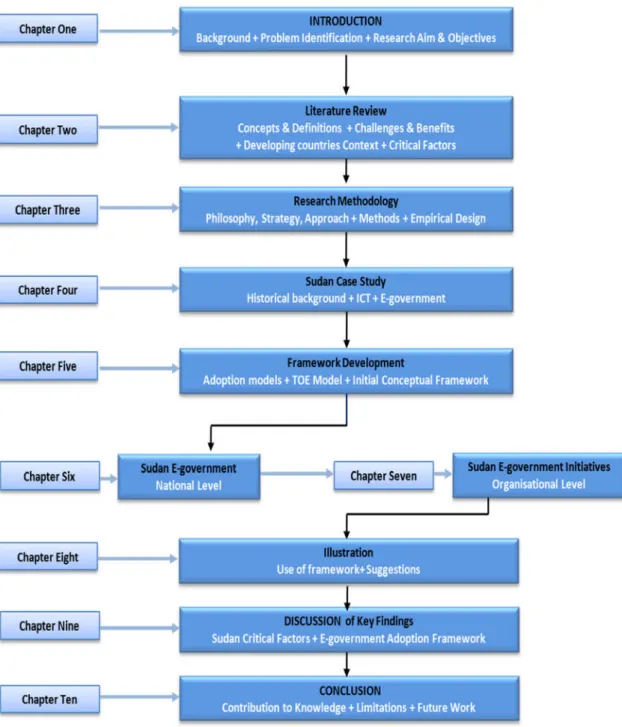
The study presents a detailed examination of the subject background, research methodology, data analysis, findings and discussion of the critical factors of e-government adoption; and the contribution to both knowledge and practice. The flow of the research is illustrated in Figure 1-1. The next section summarises the content of the chapters:
Chapter One: Introduction
Overview of the research with clear statement of: the research problem, aim, objectives and research questions. The chapter highlights the significance of the research and contribution to knowledge. Finally, the outline of this study is provided.
The state of art in e-government in terms of: concepts, definitions and perspectives. The literature reviewed in this chapter is an attempt to better understand the challenges and benefits of adopting e-government. Thereafter, the literature covered the current situation of e-government around the world and the critical factors influencing its adoption within the context of developing countries.
Chapter Three: Research Methodology
The methodology adopted for the execution of the current research. The discussion includes: an overview of the various research designs available; their philosophical assumptions and the rationale behind the researcher choices; the selection of the case study qualitative approach; and the adopted strategies of validity and reliability. The empirical design illustrates how the research was conducted in two successive phases representing the national level and organisational level.
Chapter Four: Sudan Case Study
The historical and social background of Sudan, including: demography, politics, economy and culture. The chapter details the unique context existing in Sudan as an Arab/African country. Next, the chapter highlights the objectives and main achievements of ICT in Sudan. Finally, the chapter addresses e-government in Sudan (motivations, e-readiness and risks).
Chapter Five: Framework Development
Development of the initial conceptual framework. The chapter discusses the current frameworks available in the literature and justifies the selection of the Technology, Organisational; Environmental (TOE) model as a base for the development of the initial framework. The chapter intensively reviewed each of the identified critical factors associated with the three elements of the TOE model.
Chapter Six: E-government in Sudan – National level
The first phase of the research methodology and the findings and analysis of the data gathered at the national level in Sudan. The chapter analysed each factor and the initial
level. The chapter concludes with listing the critical factors of e-government adoption in Sudan.
Chapter Seven: E-government initiatives in Sudan – Organisational level
The second phase of the research methodology and the main findings and analysis of the data collected at the organisational level. The chapter analysed each case study. The framework is revised again according to the new findings and the chapter concludes with the development of the e-government adoption framework.
Chapter Eight: Illustration of Framework
How the framework helps and guides policy makers in the decision making process regarding e-government adoption. This was illustrated through the use of one of the public organisations in Sudan. The applicability of the framework and the potential to be transferred to similar contexts was confirmed.
Chapter Nine: Discussion
The results and findings of e-government adoption in Sudan brought together. The chapter shows how the research findings answered the main research question and achieved the aim and objectives of the research. The chapter also provide the author’s views on the research findings and conclusions.
Chapter Ten: Conclusion
A Summary of the entire work, including: the novelty of the developed framework and the identified critical factors; and the contribution to knowledge in research and practice. In addition, the chapter presents the limitations of the research and details future work that can guide research into areas where there is potential for practical and academic development.
1.11 Summary
This chapter presents the background of the subject of this study and explains the research problem, aim, objectives and main research questions to be answered. The
chapter also highlighted the importance of this research and the way it is adding to knowledge.
The following chapters describe the practical implementation of the steps detailed in the thesis outline. Next is the literature review of the areas relevant to the research topic.
T
he aim of this chapter is to review the literature in order to provide a clear view of the e-government concept and its key characteristics; including: definitions, benefits, challenges and stages of e-government maturity. The chapter also aims to demonstrate the features of e-government development in developing countries, with a focus on the Arab World and Africa. The structure of this chapter is as follows:1. Sections (2.1 & 2.2):A general overview of the main features of e-government; concepts, definitions and perspectives
2. Section (2.3):A description of the current situation of e-government around the world with greater focus in the Arab World and Africa.
3. Section (2.4 & 2.5): An investigation of the benefits and challenges that facilitate or hinder e-government adoption in developing countries’ environments.
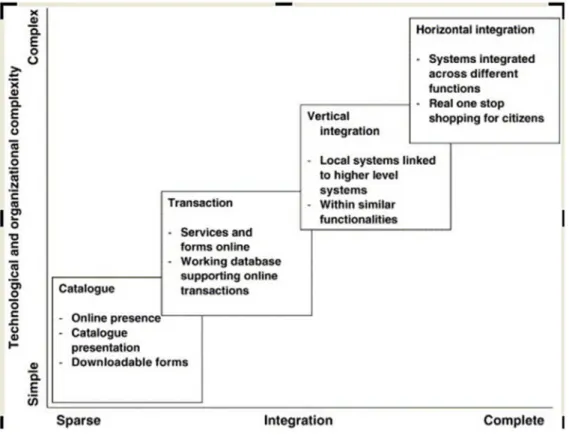
4. Section (2.6): An illustration of e-government maturity assessment models and their stages of growth.
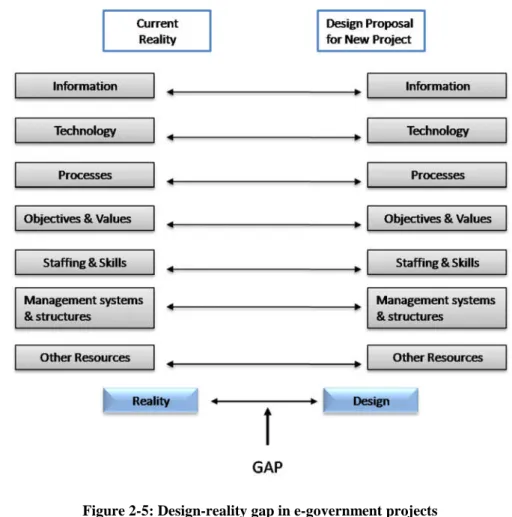
5. Section (2.7): A demonstration of the e-government framework and models incorporating critical factors of adoption.
6. Section (2.8):An analysis and critique of the literature review.
7. Section (2.9):A summary of the chapter.
2.1 E-Government Overview
The former U.S. Presidential candidate (Al Gore) raised the issue of e-government, with a vision of linking citizens to the various agencies of government in order to receive services electronically (Almarabeh and AbuAli, 2010). The idea has attracted interest from other politicians, policy makers, and individuals in countries that can be either: developed or developing; capitalist or communist; democratic or authoritarian (Grant
and Chau, 2005; Stoltzfus, 2005). Unlike other concepts (such as, globalisation and privatization) which are still considered controversial (Stoltzfus, 2005; Kraemer et al., 2002), e-government is perceived as a good thing and it is rapidly developing and spreading across all levels of government (Gulati and Yates, 2011). Indeed, governments are making massive financial and political commitments in order to establish e-government systems (Stoltzfus, 2005). However, the goal and objectives of these systems vary from: a developed to a developing country; public to private sector; as well as from citizen to business or organisation.
E-government primarily refers to the use of Information Technology in governmental organisation processes, even though the use of IT tools in the public sector is not a new practice. Some countries have been using IT in their governmental processes and procedures since the 1950s (Heeks, 2002). The difference is that IT was used to automate the internal work of government by processing data, whereas now, the use of ICT is transforming the external work of government by processing and communicating data (Heeks, 2002). E-government is therefore to be seen as an evolutionary rather than a revolutionary phenomenon (Gupta and Jana, 2003). Recently there has been pressure and demand from citizens to provide services online, due to growing technological maturity lowering the risk of adopting new technologies (Accenture, 2004). There is also international pressure to participate in the e-economy and be part of the global economic network (Ndou, 2004; Ifinedo, 2005). This pressure forced policy and decision makers, including those in poor and less developed countries, to facilitate the transformation to e-government systems. Unfortunately, the transformation has often been associated with complexity and difficulty (Ifinedo, 2005) due to the multiple dimensions and perspectives involved (Alshawi and Alalwany, 2009; Veenstra et al., 2011). E-government is surrounded by political, economic, cultural, technological and organizational factors; and these factors greatly influence the various sectors and stages of e-government progress (Ndou, 2004; Edington and Shin, 2006; AL-Shehry et al., 2006; Al-Adawi et al., 2005). The socio-technical nature of e-government suggests that these issues will need to be addressed with careful attention to context (Seifert, 2003), as the contextual nature of a country can lead to e-government difficulties. The complexity of e-government as a socio-technical system (Lau et al., 2008) challenges
e-government it is important to successfully introduce technology into the specific context (Heeks, 2003; Gupta and Jana, 2003).
On one hand, e-government offers great opportunities for governments to enhance efficiency and increase productivity, but it also raises new challenges; including the re-engineering of processes and funding and management responsibilities. The potential of e-government can be seen as a: “paradigm shift that improves how government operates and how society views, understands and interacts with government” (Parisopoulos et al., 2007).
2.1.1 Concepts of E-government
E-government is relatively new and ideas are yet to mature and be well defined (Young-Jin and Seang-Tae, 2007). The concept is currently still without a universally agreed standard definition and it can mean different things to different people. Some see e-government as a goal in itself; some view it as a tool for achieving broader public sector reform goals (Yildiz, 2007). Nonetheless, there are some commonly agreed notions, including: government efficiency and effectiveness; empowering citizens, organisations and communities through access to information; strengthening levels of democracy; citizen-participation; and transparency (Oyomno, 2004). These concepts have fundamentally transformed the way of thinking and working in the public sector (Wimmer, 2002; Fountain, 2001). E-government is reforming the way governments provide services electronically and revitalising the relationship with citizens and business (Metaxiotis and Psarras, 2004). This reform process is not simply about computerising a government system; rather it is the ability to use technology: “to achieve levels of improvement in various areas of government” (Dada, 2006).
Tracing the development of e-government, Oyomno (2004) identified three distinct phases:
Phase I: Governments target the use of ICT (mainly Web Technology), to deliver public services electronically, in order to: “improve government efficiency, meet citizen expectations and facilitate economic development”.
Phase II:Governments started to do business through delivering services electronically. This was considered as a reinvention of government. Governmental organisations also began to have new features, such as: being community-owned; showing increased competitiveness; being more decentralised and market-oriented.
Phase III: This represents the current situation in e-government; it is about the reengineering processes needed to change the existing design of government organisations. Centralized, vertical and hierarchical structures were previously developed for the industrial economy and society, but now the aim is to build new management paradigms appropriate for the transformation to the information-based economy and society.
Key Concepts in E-government
An e-government does not represent a political ideology or philosophy, nor does it aim to give power to the government. It aims to empower individuals through access to information and knowledge (Oyomno, 2004; Jain and Kesar, 2011).
E-government is neither about the technology nor about the “e”. It is about the “government” and the transformation of relationships with its constituents, citizens, businesses and government agencies (OECD, 2003; Shin, 2008).
E-government is a paradigm shift that has changed the way governments and public administrations operate. It is an invention that linked public organisations with the external world and restructured the organisations’ functioning, integrating, and delivering of services (Peristeras et al., 2002).
2.2 E-government Definitions, Perspectives and Domains
2.2.1 E-government Definitions and Perspectives
There are many elements which comprise the e-government concept (Moon, 2002). Grant (2005) states that e-government is: “more than a pure technological phenomenon”; therefore, it requires a broad definition and understanding (Ndou, 2004).
multiple meanings. These meanings might depend on the specific context, regulatory environment, dominance of a group of actors in a given situation, or the different priorities in government strategies (Heeks, 2003).
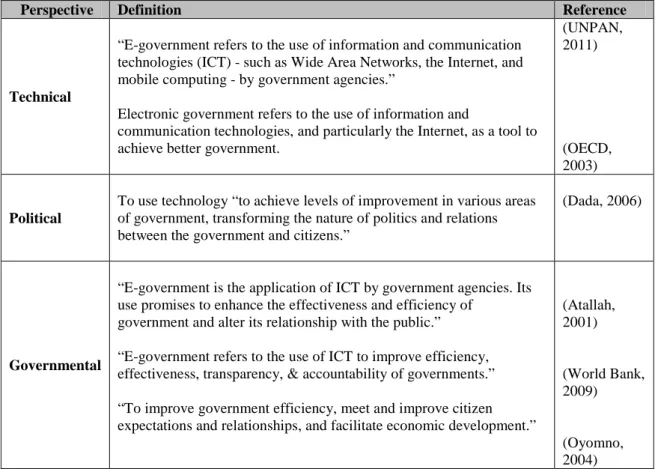
E-government can be viewed within a number of disciplines; such as, Information Systems (IS), computer science, public administration and political science (Heeks and Bailur, 2007). Seifert and Petersen (2002), define two perspectives from which to identify government: the technical level and the political level. Some identify e-government from a technological perspective and from a business perspective (Tambouris, 2001). Lenk (2000), identifies four different perspectives of e-government: citizen, process, cooperation and knowledge management. Thus, it is more appropriate to define e-government based on its stakeholders’ perspective and their aims and objectives. This is because the meaning of e-government and its adopted values and goals will largely depend on the stakeholders’ interests (Stoltzfus, 2005; Yildiz, 2007). Table 2-1 lists some of the definitions grouped according to different perspectives.
Table 2-1: E-government Definitions
Perspective Definition Reference
Technical
“E-government refers to the use of information and communication technologies (ICT) - such as Wide Area Networks, the Internet, and mobile computing - by government agencies.”
Electronic government refers to the use of information and
communication technologies, and particularly the Internet, as a tool to achieve better government.
(UNPAN, 2011)
(OECD, 2003)
Political
To use technology “to achieve levels of improvement in various areas of government, transforming the nature of politics and relations between the government and citizens.”
(Dada, 2006)
Governmental
“E-government is the application of ICT by government agencies. Its use promises to enhance the effectiveness and efficiency of
government and alter its relationship with the public.” “E-government refers to the use of ICT to improve efficiency, effectiveness, transparency, & accountability of governments.” “To improve government efficiency, meet and improve citizen expectations and relationships, and facilitate economic development.”
(Atallah, 2001) (World Bank, 2009) (Oyomno, 2004)
2.2.2 E-government Domains
E-government involves various activities and stakeholders and also serves different groups of people, sectors, and organizations in a variety of domains. The World Bank (World Bank, 2007) identified three distinct domains for e-government interaction:
1. Government-to-citizens (G2C): government aims to interact with citizens.
2. Government-to-business (G2B): government aims to interact with business enterprises.
3. Government-to-government (G2G): government aims to make services more friendly, convenient, transparent, and inexpensive.
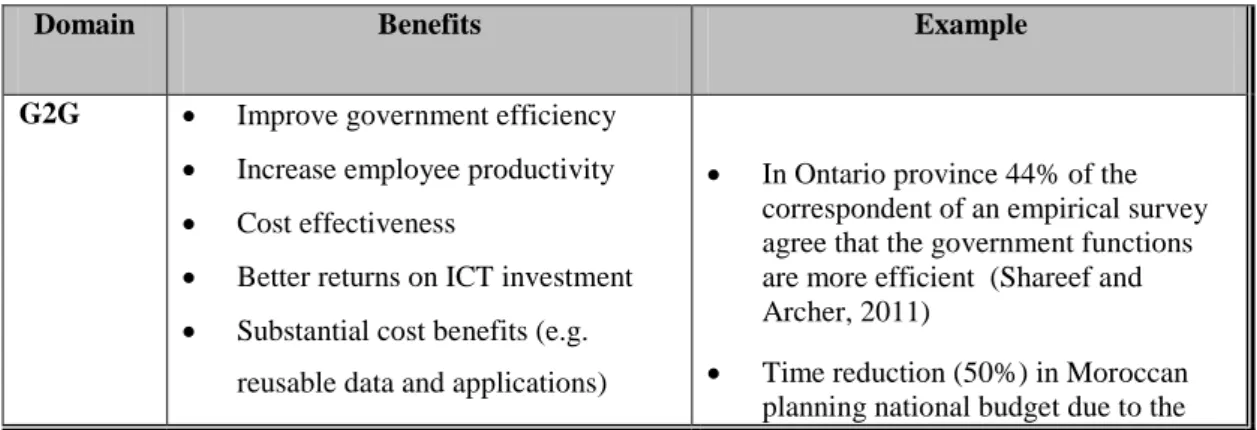
The G2G domain is seen as the backbone of e-government implementation, as it paves the way for e-government use in the country as a whole (Chen et al., 2006). Examples of the services offered in the three domains are shown in Table 2-2.
Table 2-2: E-government domains provided services
G2G G2C G2B
US e-Grants: providing
a single, online portal for all federal grant customers to access and apply for grants.
GovBenefits.gov: providing a single point of access for citizens to locate and determine potential eligibility for Government benefits and services.
Federal Asset Sales: creating a single, one-stop access point for businesses to find and buy government assets.
EU Interchange of
data between administrations (the IDA program): networking of public administrative units.
Single Point of Access for Citizens of Europe (an EU-project): supporting citizens' travel within Europe. The Net-Enterprises Project (France): allowing enterprises, through Internet, to send standardized notifications to government agencies.
Singapore GeBIZ Enterprise: coordinating the purchasing needs of the public sector procurement officers. e-citizen Portal: providing a single access point to government information and services, which are organized and integrated in intuitive categories.
G2B Portal: the entry point for all local and international businesses to access a full suite of aggregated and integrated G2B information and services. Source: (Lee et al., 2005)
2.3 E-government Around the World
Growing access to ICT has encouraged many governments to integrate new technology into their national economic development strategies (Tahrani, 2010). It is becoming an increasingly important public service tool for many governmental departments around the world (Nour et al., 2008), and the scale of activity on the part of public sectors in leveraging IT has increased in volume (Smith, 2008). The vast majority of public organisations around the world have established websites and provide public information to citizens (98% with website – 2% without websites) (UN, 2010). In addition, many transactions are now conducted online; these include, applying for jobs, completing tax returns and renewing drivers’ licenses (West, 2004), Figure 2-1. However, financial transactions and opportunities for interactive political and policy participation are still limited (Holden, 2003).
Figure 2-1: Available static online forms Adopted,(UN, 2010)
Countries and regions vary in their overall performance in e-government uptake (West, 2008); for example, 40% of people using the Internet are in North America, 49% are in Japan and Western Europe, leaving only 11% from the rest of the world. The digital divide report (2006) shows that a person from a high-income, developed country is over 22 times more likely to be an Internet user than someone from a low income,
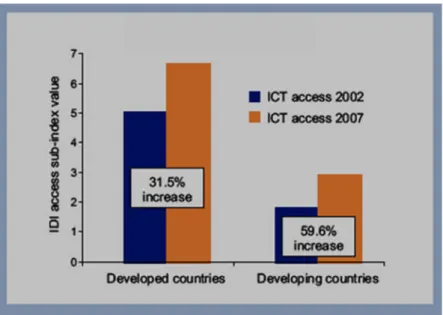
developing country. This is significant as 37% of the world’s population live in low-income countries. In the least developed nations the divide is even greater, with access 10 times less than that in developing countries (Brown and Thompson, 2011). Figure 2-2 shows differences between developed and developing countries in terms of ICT access.
Figure 2-2: ICT access: developed vs. developing countries Adopted,(ITU, 2010a)
Yasin and Yavas (2007) stated that the level of diffusion and dissemination of e-government has been neither homogeneous, nor has e-e-government evolution influenced all cultural settings equally. The statistical results from many surveys conducted by international and national organisations (UN, 2008b; EIU, 2008; Bridges.org, 2008; Kirkman et al., 2002) show that the rich, developed and westernised countries are more likely to have advanced and mature e-government systems (Kim, 2007); while developing countries lag behind the rest of the world in terms of e-government adoption and dissemination. The EIU annual ranking report (EIU, 2009) classifies this geographically, with North America at the top of the list, followed by Europe, Asia, the Middle East, Africa, and the Caribbean & Latin America. Table 2-3 shows the figures of e-government growth in some regions of the world.
Table 2-3: E-government growth across regions – Region 2001 2002 2003 2004 2005 2006 2007 2008 North America 51.0% 60.4% 40.2% 39.2% 47.3% 43.1% 45.3% 53.1 Western Europe 34.1% 47.6% 33.1% 30.0% 29.6% 35.2% 36.8% 37.2% Middle East 31.1% 43.2% 32.1% 28.% 27.4% 29/4% 33.5% 32.3% Asia 34.0% 48.7% 34.3% 31.6% 37.3% 35.9% 39.5% 39.7% South America 30.7% 42.0% 29.5% 24.3% 25.9% 28.0% 32.1% 33.3% Africa 23.5% 36.8% 27.6% 22.0% 22.0% 24.3% 26.0% 26.3% Source: (West, 2008)
There can be difficulties comparing countries because of their “sheer heterogeneity in terms of economic development, regime type, cultural patterns, telecommunications infrastructure and Internet usage” (West, 2004). Researchers (Khalil, 2011; AlShihi, 2006; Kovačić, 2005; Bolgherini, 2007; Al-Fakhri et al., 2008), argue that these factors result in considerable differences between states, societies and organizations.
Previously it has been difficult to examine e-government in developing countries as they were at the beginning of the process. Recent advances in e-government in these countries have now made it possible to conduct studies and analyse their experiences and practices. The reviewed literature regarding e-government implementation in developing countries reveals two groups with opposite opinions.
The first group highlight growth and development witnessed in developing countries in terms of ICT diffusion and dissemination, as well as the successful initiatives in many governmental sectors and organisations. This is evidenced by increases in ranking of developing countries in several e-readiness assessment reports; for example, UAE, Egypt, Saudi Arabia, Kuwait and Jordan rose 7 to 10 positions in their e-readiness assessment between the years 2005 and 2008 (UN, 2008b; UNPAN, 2005). West (2005) recognised that there has been success achieved in these countries, even though they are governed by non-democratic and dictatorial regimes.
The second group takes a contrary position in the literature and argue that the implementation in developing countries is still in an early stage of growth (Chowdhury et al., 2006; Chen et al., 2006; Schuppan, 2009; Basu, 2004). Progress of e-government is criticised for not being coupled with economic diversification and cultural change. In
fact, some contend that the gap between developed and developing countries is getting wider, especially in terms of Internet technology and its usage (Chen et al., 2006). This group points to inadequate infrastructure, poor financial resources and lack of technological adaptation (Brown and Thompson, 2011).
According to the ITU, the sector that has had the strongest impact in developing countries so far is the mobile telephone sector; particularly since mobiles are not just a different or complementary way of communication, but have opened up entirely new communication means in many parts of the developing world. The boom of the mobile industry has created new jobs and revenues and also contributed to economic growth by widening markets, creating better information flow, lowering transaction costs, and substituting for costly physical transport (ITU, 2010a).
Nonetheless, it is important to realise that the e-government applications around the world are not usually successful. In fact, the international failure rates are high and range between 60%-85% (World Bank, 2007; Heeks, 2006). Heeks’ survey estimated that 35% of the e-government initiatives are a total failure and only 15% can be considered as a success. Moreover, only 17 countries have reached advanced levels of maturity according to the UN (UNPAN, 2005). It is argued that e-government initiatives are failing due to a lack of understanding regarding effective planning, development and deployment, (Gupta and Jana, 2003), while others assert that the project goals are too ambitious given existing capacity. (Heeks, 2002), argues that the problem in developing countries often arises due to dissimilarities in the physical, cultural, economic, and various contextual factors.
2.3.1 Developed Countries versus Developing Countries
The United Nations classify countries as either developed or developing based upon the GDP per capita, human assets, and degree of economic vulnerability (UNCTAD, 2002). Current research interest lies in the contextual differences that may affect the e-government implementation process. Table 2-4 summarises some of these differences.
Table 2-4: Developed vs. developing countries
Differences Developed Developing History &
Culture
Government and economy developed early, immediately after independence Economy growing at a constant rate, productivity increasing,
High standard of living relatively long history of democracy and more transparent government policy
Government usually not specifically defined
Economy not increasing in productivity Low standard of living relatively short history of democracy and
less transparent government policy
Technical Staff
Has a current staff, needs to increase technical abilities and hire younger professionals
Has outsourcing abilities and financial resources to outsource; Current staff would be able to define requirements for development
Does not have a staff, or has very limited in-house staff
Does not have local outsourcing abilities and
rarely has the financial ability to outsource;
Current staff may be unable to define specific requirement
Infrastructure Good current infrastructure
High Internet access for employees and citizens
Bad current infrastructure
Low Internet access for employees and citizens
Citizens High Internet access and computer literacy; still has digital divide and privacy issues
Relatively more experienced in democratic system and more actively participate in governmental policy-making process
Low Internet access and citizens are reluctant to trust online services; few citizens know how to operate computers Relatively less experienced in democratic system and less active participation in governmental policy-making process
Government Officers
Decent computer literacy and
dedication of resources; many do not place e-government as a high priority
Low computer literacy and dedication of resources; many do not place
e-government
at a high priority due to lack of knowledge on the issue Source: (Chen et al., 2006)
2.3.2 E-government in the Arab World
The majority of Arab leaders have acknowledged the necessity of utilising ICT in their governmental operations. Although it is still early for e-government to take root in most Arab states (Pons, 2004), e-government projects have been widely endorsed as a solution to a variety of concerns in public sectors in the Arab World (Salem, 2006).
The Arab World constitutes 10% of the world’s landmass and 5% of global population. However, most Arab countries are considered less developed economically, socially, and politically. The Arab region in general is characterised by a high percentage of illiteracy (23%), high of unemployment (15%), poverty (except in Gulf Countries), soaring inflation rates and a lack of support for citizens’ basic needs. So, while western
Arab world have no access to clean water; and while the west plans to provide e-health, 10% in the Arab world have no access to health services (UNDP, 2009; Abdallah and Fan, 2012).
In terms of e-readiness, Arab countries vary widely. UAE and Bahrain, for example, are progressing well and enjoy relatively high levels of ranking in the UN e-readiness assessment; whereas countries from east Africa are at the bottom of the list. Figure 2-3 illustrates e-readiness across the Arab World. Thus, Arab decision-makers need to take the necessary practical steps to make their countries realize the benefits of adopting ICT technologies. This requires more research in all aspects of e-government adoption. Although many research studies have contributed to the analysis of e-government introduction and implementation in the Arab World, it is much less than required and minimal compared to research conducted in developed countries.
Figure 2-3: E-readiness in the Arab World Adapted,(UN, 2008b)
The countries in the Arab world share many similarities on social, political and cultural levels. In terms of public administration, they are characterised by large public sectors,
0 0.1 0.2 0.3 0.4 0.5 0.6 0.7 U ni te d Ar ab Em ira te s Eg yp t Ba hr ai n Jo rd an Q at ar Ku w ai t Sa ud iA ra bi a Le ba no n So m al ia O m an Li by a Al ge ria Tu ni si a M or oc co Sy ria Ira q M au rit an ia Ye m en Su da n
However, it is difficult to characterize the region as a whole. Each country stands at a different point in economic development, political stability, ICT infrastructure and ICT utilization. This makes the experience of e-government practices and initiatives unique in each state. Table 2-5 summarise online service delivery in some Arab countries.
Table 2-5: E-government service delivery capabilities
One-Way Information Flows Two-Way Interaction Payment Transaction E-Democracy World E-government Leaders (top six)
USA √ √ √ √ Denmark √ √ √ √ Sweden √ √ √ √ UK √ √ √ √ South Korea √ √ √ √ Australia √ √ √ √
Arab E-government Leaders
UAE √ √ √ √
Bahrain √ √ √ √
Qatar √ √ √ √
Arab E-government Up-and-Comers
Jordan √ √ √ Lebanon √ √ Kuwait √ √ √ Egypt √ √ √ Saudi Arabia √ Oman √ Tunisia √ Algeria √ Morocco √ Syria √
Arab E-government Laggards
Sudan √
Yemen √
Iraq √
Source: (DSG and OECD, 2007)
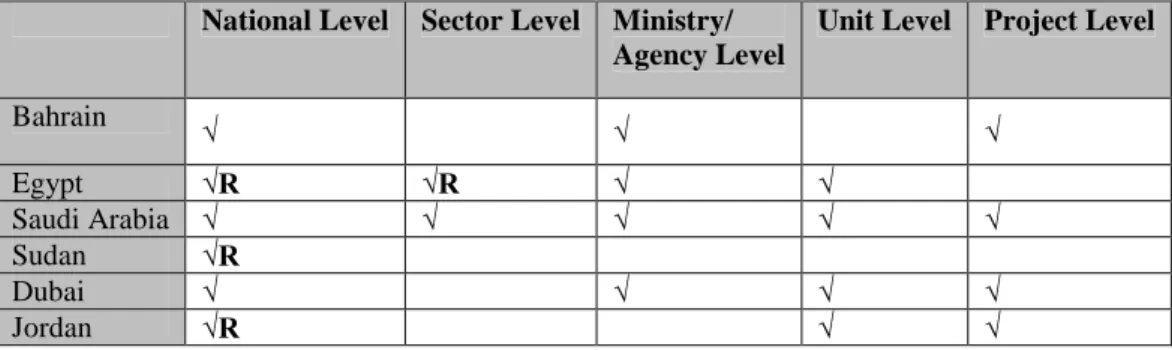
Evaluation of e-government in the Arab World, like in many developing regions, has mainly focused on technology e-readiness assessments of public institutions (DSG and OECD, 2007). The lack of assessment at the ministerial or organisational level could be explained by the limited institutionalisation of e-government across government sectors (DSG and OECD, 2007). Table 2-6 shows the levels of assessments in some Arab countries.
Table 2-6: E-government level of assessment
National Level Sector Level Ministry/ Agency Level
Unit Level Project Level
Bahrain √ √ √ Egypt √R √R √ √ Saudi Arabia √ √ √ √ √ Sudan √R Dubai √ √ √ √ Jordan √R √ √
Source: (DSG and OECD, 2007) R: readiness stage
Although e-government can improve the competitive advantages of Arab nations (Ndou, 2004), each Arab country is operating independently in ICT and not benefiting from Internet capabilities (El-Naggar, 2004). Moreover, all ICT efforts are running in a parallel without intersection. According to (DSG and OECD, 2007) the problem facing governments in the Arab World is the absence of a vision of a unified “whole-of-government” system of e-government.
2.3.3 E-government in Africa
The continent of Africa constitutes two distinct regions: North Africa and Sub-Saharan Africa (SSA). All countries in the North are part of the Arab World, with different cultural and economic characteristics from the rest of Africa (Ifinedo, 2005). The region of SSA (excluding South Africa) faces massive political and socio-economic challenges, in addition to the existing under developed human resources, deficient infrastructure, and cultural and funding constraints. The public sector also has its problems. It is based on manual filing systems, burdened by enormous movements of correspondence, duplication of files, wastage of paper, difficulty in accessing information in files, loss of data and general inefficiency of operations (Mutula, 2008).
In the ICT context, the SSA countries have critical deficiencies (Maumbe et al., 2008). In terms of ICT adoption there is:
1. Lack of ICT policy and champions
2. Weak political and budgetary commitment 3. Resistance to change
Nonetheless, many governments in Africa believe there to be enormous potential for e-government to help their countries improve the quality of life for citizens, increase government efficiency and help achieve sustainable socio-economic development (Maumbe et al., 2008).
There are two main issues that frame the discussion in this section; firstly, the policy and direction of e-government in Africa; and secondly, the e-readiness of e-government in the region.
Africa is starting to embrace the concept of digital, knowledge-based economies in preparation for being part of the global economic value chain (Bwalya and Healy, 2010). Although this paradigm has encouraged the escalation and adoption of ICT applications, such as e-learning and e-government (Bwalya and Healy, 2010), poor conditions on the continent are constraining the efficient use of these applications. Hence the WSIS, under the Tunis agenda (WSIS, 2005), specified that ICT plans need to be an integral part of national development strategies. Many emphasised that developing countries should work for the interaction of financial, technical, managerial and social factors in delivering government transformation through e-government (Ndou, 2004; Grant and Chau, 2005; Brown and Thompson, 2011). Others suggest a context-oriented approach as a more promising route for e-government adoption (Heeks, 2002; Dada, 2006; Schuppan, 2009). Countries including South Africa, Mauritius, Senegal and Mozambique have already shown serious commitment, by putting in place the institutional and regulatory policy frameworks for e-government development (Maumbe et al., 2008; Bwalya and Healy, 2010). A number of policies addressed the liberalization of the telecommunications sector and the ICT-based economic growth. Coleman (Coleman, 2003) suggests that an effective strategy for African e-governance should avoid three key pitfalls:
1. The adoption of technologies without developing human skills and capacities to manage, integrate and sustain them.
2. The centralized use of technologies by national government departments, without disseminating the benefit of the technology to intermediary institutions;
such as national parliaments, local governments, political parties, civil society organizations and independent media.
3. A failure to link better governance to broader and more inclusive democracy, which gives a voice to those who cannot afford technologies, but have needs and ideas to express.
In e-readiness ranking surveys conducted by international organisations (UN, 2010; Bridges.org, 2008; EIU, 2009) Africa lags behind the rest of the world in terms of technology, human capacity and e-participation. In terms of internet usage and penetration rate, no country from Africa appears among the top thirty six (Internet World Statistics, 2009). The African continent was estimated in 2007 to be home to 14.2% of the world’s population, but had only 3.6% internet penetration and 2.9% of internet usage. In comparison Europe had 12.3% of world population, 11.8% penetration and 37.2% Internet usage (Internet World Statistics, 2009). However, there has been some improvement in the region according to the latest UN e-readiness’ report (UN, 2010) Table 2-7.
Table 2-7: E-readiness - selected countries in Africa Country
E-government
development index value
World e-government development ranking 2010 2008 2010 2008 South Africa 0.4306 0.5115 97 61 Botswana 0.3637 0.3647 117 118 Ghana 0.2754 0.2997 147 138 Senegal 0.2241 0.2531 163 153 Nigeria 0.2687 0.3063 150 136 Congo 0.3019 0.2737 135 148 Kenya 0.3338 0.3474 124 122 Mauritius 0.4645 0.5086 77 63 World average 0.4406 0.4514 Source:(UN, 2010)
2.4 Benefits of E-government Transformation
There are a wide range of choices and opportunities available for developed as well as developing countries by enabling ICT tools. ICT can play a profound role as part of an overall national strategy for development. The utilization of ICT in many developed