1
Armand Brice Kouadio|Yves Emery|EGPA 2017|Milan|Study group III: Personnel policies
Workplace commitment as an exchange of
commitments: exploring public managers'
practices to secure employees' commitment
EGPA Study Group III: Public Personnel Policies
(People management and public service performance in different contexts)
Armand Brice KOUADIO (PhD candidate) [email protected]
Prof. Yves EMERY
Institut de hautes études en administration publique
IDHEAP (Graduate School of Public Administration), Switzerland Quartier UNIL Mouline
CH - 1015 Lausanne T +41 21 692 68 73
http://www.unil.ch/idheap/MPRH
Abstract
While discussion of workplace commitment is not quite new, the (public) Management, HR and Organization behavior literature has largely been about commitment on the employee side. Less so on how organizations express their commitment to their employees, and particularly on the role public managers therein. In line with the exchange theory, workplace commitment may be conceive as an exchange of commitments: a perspective rarely adopted in the literature. Using a qualitative methodology, this study aims to dive into the very practices set up by public sector managers to secure their collaborators' loyalty. The 8 managers and 11 employees theoretically sampled, work within hybrid organizations (public corporations, education, health sector etc.), where the culture combines public and private management values and practices. Our analyses of the digitally recorded and transcribed interviews provide insights on organizations' commitment to their employees, thus complementing previous scholarship on organizational support, leader support and psychological contracts, in relation to workplace commitment. Specifically, this work highlights the participation of public managers in the very mechanism of organizations' commitment to their employees, by identifying key “bundles” of employer’ commitment practices.
Keywords: Organization's commitment to employees, exchange theory, hybrid organizations, public HRM, leader support
2
Introduction
Commitment is a durable and dynamic relationship requiring moves from both sides, according to the social exchange theory. In a game-theoretical vision of "Tit for Tat" then (Nowak and Sigmund 1993, Nowak 2006), a [commitment] move from the employer encourages one of the same kind on the employee side, thus reinforcing the employee-organization link. Yet, commitment coming from organizations is rarely mentioned in the literature as something the latter could be mindful of in their willingness to secure their employees' loyalty. Indeed, many organizations communicate on their need of motivated and committed employees, albeit less on how they are themselves committed to their employees.
In post-bureaucratic public workplaces, the evolving employment relation between public employees and their newly reformed organizations demands further investigation (Emery and Giauque, 2014; Simonet, 2014; Stoker, 2006; Osborne, 2006), mainly because the cultural hybridization in action is supposed to dilute employee commitment. Being embedded in a mix of public and private logics and practices, public employees now need to recompose a sense of belonging, duty and loyalty for themselves (Meyer, Becker et al. 2006, Buffat 2014). In fact, under the effects of NPM reforms, workplaces in the OECD public sectors have undergone profound transformations, while less effort has been consecrated to the enhancement of public employees' motivation and commitment (Demmke and Moilanen 2010). Moreover, post-bureaucratic hybrid organizations regroup an important number of generic jobs, mainly devoted to support processes like finance, HR, IT or more generally administrative tasks which do not require public-specific knowledge. Employees occupying generic jobs (within hybrid environments), because they are far removed from the public organization's core business, may feel differently committed at work, thus demanding managerial intervention. Yet, the bulk of scholarly work in this domain has been oriented towards a better understanding of employee organizational (or workplace) commitment (Becker and Billings 1993, Bentein, Stinglhamber et al. 2000, Meyer, Stanley et al. 2002, Morin, Morizot et al. 2010, Meyer and Morin 2016), less so on organizations' commitment to their employees. This latter concept is embedded in social exchange (Blau 1964, Colquitt, Baer et al. 2014) and specifically related to perceived organizational support and leader support. It is also related to the Psychological contract between organizations and their employees (Castaing 2006, Rousseau, De Rozario et al. 2014), another theoretical concept which is mainly analyzed from the employee's perspective, rarely from the organization point of view, i.e. expectations from the organization toward its employees. In the likeness of Workplace commitment, researches remain stuck at the individual level of employee expectations towards their organizations (Lemire and Saba 2005, Lemire and Martel 2007).
Employee commitment mainly develops, supported by a Person-environment congruence (Fit), within an exchange mechanism not always involving financial or tangible elements (Blau 1964, Rousseau 1989, Solinger, van Olffen et al. 2013). Whereas Fit is attained with congruence between personal and organizational values, culture or traits (read individual traits shared with workgroup members), Exchange develops in an inducement-contribution logic whereby both parties expect a stable equilibrium (Coyle-Shapiro and Kessler 2002, Sun and Pan 2011, Gao-Urhahn, Biemann et al. 2016). For workplace exchanges to be balanced though, public employees need to be committed to organizations that are also committed to them. For instance, organizational justice, organizational support, and varied reward schemes, all possibly stand as expressions of the employer's commitment to its employees (Eisenberger, Fasolo et al. 1990, Eisenberger and Cameron 1996, Coyle-Shapiro and Shore 2007). But more surprisingly High commitment work practices (HCWP) are often proposed to elicit employee commitment without being framed as expressions of the organization's commitment to its employees (Boxall and Macky 2009). The current paper intends to fill this scholarly void, by focusing on public sector organizations embedded in hybrid settings.
3
The scholarship on this kind of reversed commitment has hitherto been limited by its prescriptive or normative nature. Indeed, rooted in the Resource-based-view and Strategic human resource management paradigms (Nishii and Wright 2007, Guthrie, Flood et al. 2009), research on High commitment practices (HCWPs) proposes numerous recommendations meant to enhance employee commitment (Boxall and Macky 2009, McClean and Collins 2011). Globally, these recommendations are related to fostering employee empowerment, autonomy, well-being, and participation (Chenevert and Tremblay 2009, Boxall and Macky 2014). Despite their incontestable usefulness, such practices have hardly been studied as an expression of the organization's commitment to its employees. And even if it's readily accepted that organizational support, justice or equity would positively affect employee attitudes and behaviors (Tremblay, Cloutier et al. 2010, Heffernan and Dundon 2016), organizational behavior scholars seldom go as far as to dive in the very practices involved, not to mention their underlying intentionality. In fact, the management practices explicitly mobilized (by managers) to convey the organization's commitment to its employees are not frequently researched, except for the literature on "leadership support" and that on managers' implementation of HR practices - mainly at the business unit level (Tremblay, Cloutier et al. 2010, Kim, Eisenberger et al. 2016).
Here, the role played by managers is worth recalling (Gould-Williams, Ziderman et al. 2016). For most employees, managers (and particularly “their” manager”) represent the organization. Indeed, the latter bear the assignation to translate organizational policies, strategies and prescribed practices at the shop floor level. Many managers therefore partially assume HR responsibilities, of which the basic examples concern the reporting of presences and absences, the evaluation of performance and determination of related incentives. Managerial role in personnel policies has thus been abundantly studied (Desmarais and Abord de Chatillon 2010, Latorre, Guest et al. 2016). Along with managers' roles, research pertaining to leadership in the public sector has remained focused on how it could be effective in ensuring organizational conformity to new reform principles, for instance by mobilizing public managers' transformational leadership skills, let alone their own organizational commitment (Van Wart 2003, Ashikali and Groeneveld 2015). On the latter point, managers' workplace commitment is known to affect the type of HR practices implemented (Gong, Law et al. 2009). It could therefore stand in the way from the organization's expression of commitment towards its employees and the very practices developed at the strategic level and implemented by managers. Here it is conceivable that managers' own workplace commitment possibly contaminates employee commitment. Of the latter, evidence needs to be gathered, as will be attempted in the current work.
As mentioned above, managerial influence on workplace commitment also depends on the leadership skills. Leadership styles in the public sector have principally been viewed as an instrument for maintaining organizational continuity under NPM reforms. (Gruening 2001, Berry 2007, Bordogna 2008, Pichault and Schoenaers 2011, Hudon and Mazouz 2014). Surprisingly, how this maintaining of the organization could be done while showing or demonstrating commitment to their collaborators has received scant attention (Noordegraaf and Abma 2003, Noordegraaf 2007, Vakkuri 2007).
Likewise, employee perception of HRM practices (implemented by their manager) remains crucial to their success. Thus, understanding employee attribution, that is how management practices are received (Boxall, Guthrie et al. 2016), on the way they consider their organization's commitment is another objective of the present study (Whitener 2001, Snape and Redman 2010) (Boselie and Van der Wiele 2002, Sanders, Dorenbosch et al. 2008). Such a confrontation of managerial practices to employee perception is founded by the fact that no clear or commonly agreed-upon rules exist for specifying what practices will get a favorable echo on the employee side. This kind of perception exemplifies the important psychological dimension of the employee-organization contract (Rousseau, De Rozario et al. 2014, Gardody 2016). If being committed is embedded in an exchange mechanism, then the perception of the
4
value of what is exchanged is primordial (Mendelson, Turner et al. 2011).
Elsewhere, public employees are credited to enjoy good working conditions (especially in Switzerland where the empirical part of this research will take place). Not only are their employment relations generally stable, but also because the paternalistic approach to management commonly adopted in public administrations privileges individuals' welfare (Farnham, Horton et al. 1996). Following a social exchange perspective the well-being prone HR practices developed in public organizations should result employees reciprocating with attitudes or behavior aligned with their employer's goals. One of such attitudes is workplace commitment (Spycher, Margraf et al. 2005). If that is seldom the case, it might be that whereas such practices are meant to elicit commitment from employees, they do not themselves sufficiently convey the organizations' own commitment to their employees. Specifically, the way managers implement organizational policies might not convince collaborators of the value placed in them by their employer.
In an era of heavy precariousness (Biétry 2012), imagination and craft is expected from organizations to elicit their employees' commitment. And despite important work on its antecedents, the very mechanisms or workplace commitment are yet to be better understood (Morrow and Wirth 1989, Fornes and Rocco 2013, Becker, Kernan et al. 2015, Klein 2016). The current study reverses the reasoning in conceptually considering workplace commitment as involving commitment from the organization too.
This paper is articulated as follows: we first review the literature on Organization support, Leadership and Leader-member exchange, especially on how they try to resolve the conundrum of organizations' commitment to their employees. A second part pertains to employee attributions of organizational policies in the light of signaling theory. Our qualitative exploratory method, consisting in the analysis of a dozen of dyadic relationship (employee-manager), is then presented, followed by the results of our analyses. A discussion of the main contributions and managerial implications for researchers and practitioners closes up the paper.
Literature review
Organization support and commitment to employees
High Performance Work Systems
Even if specific work on organizations' commitment to their employees is scant in the management literature, it remains possible to approximate the latter using two main theoretical frameworks. First we explore work on HPWPs. While High performance systems are meant to arouse employee satisfaction, motivation, and commitment, they possibly express organization's own commitment. The second set of scholarly work concerns Perceived organizational support (POS) which is deemed to provide the necessary tools and environment to ensure better employee and organizational outcomes. Together with Trust, abundant literature finds that Perceived justice (PJ) and Perceived organizational support (POS) mediate the relation from HPWPs to organizational outcomes and employee extra-role behaviors (Chang 2005, Giauque, Resenterra et al. 2010, Tremblay, Cloutier et al. 2010, Gavino, Wayne et al. 2012, Shantz, Alfes et al. 2014, Latorre, Guest et al. 2016). It follows that HRM practices that foster procedural justice for instance convey the signal that the organization strives to treat its employees fairly (Paré and Tremblay 2007). The success of the practices implemented at the organizational level thus heavily depend of the kind of social exchanges, for instance of justice or support, entertained.
5
High performance work systems are a set of work practices and conditions designed to facilitate everyday operational activities. High performance work systems (HPWS), sometimes also known as High commitment work practices (HCWP), thus serve to design the conduct of organizational activities so as to ameliorate employees' performances. This also alludes to eliciting the latter's commitment based with the reasoning that a committed employee performs much better (Meyer, Allen et al. 1990, Wood and De Menezes 1998, Guerrero 2004, McClean and Collins 2011, Zhang, Di Fan et al. 2014). But also, HPWS generate shared mental models by influencing the social structure and strengthening social ties within the organization, which favors employee commitment. These HR systems, alike the employees to whom there are intended, are considered to add value to the organization and to generate a competitive advantage. A resource that is unique and inimitable in the Resource-based view perspective (Huselid 1995, Bowen and Ostroff 2004, Evans and Davis 2005). In particular, the following practices belongs to HPWS : extensive staffing procedures evaluating relevant skills (knowledge and abilities); redistributing power through self-managed teams; empowering employees by means of decentralized decision making that place more responsibility on them; extensive training programs of competence development; Open communication providing opportunities of individual expression; efficient pay policies combining performance-contingent and group-based rewards (Evans and Davis 2005). In sum, the use of flexible work and team designs creates more job-embeddedness and encourages individual proactive role-making, frequent and open communication, thus helping employees deliver greater performance (Lee, Mitchell et al. 2004).
By means of HPWs, organization-level expression of commitment becomes more visible to employees, who (may) perceive them as evidence of respect and willingness to invest in them (Koys 1988, Chuang and Liao 2010). Thenceforth, internal social structures and ties can be altered in a way that drive employees to make positive attributions of organizational action. This happens when weak ties are bridged, norms of reciprocity strengthened, and mental models shared among an important proportion of organization's members (Evans and Davis 2005, Nishii, Lepak et al. 2008). In such instances the HR system sends a clear message of support and reward. That's why Nishii (2008) makes the following statement: « In one of the most comprehensive theoretical models on the topic to date, Bowen and Ostroff (2004) argue that in order for a HR system to link to performance in desired ways, it must elicit unambiguous and shared perceptions of climate, or the behaviors that management expects, supports, and rewards. » (Nishii, Lepak et al. 2008) p.53). Besides, organizational support has been found to mitigate the influence of negative attribution coming from other employees, thus preserving employee motivation and commitment (Cook 2009).
In the same vein, HPWs facilitate the construction of social networks and exchange relationships (Blau 1964, Katz and Kahn 1966, Granovetter 1985). They convey messages to employees whereby the latter come to get a shared perception of the behaviors that are expected and rewarded by their employing organization (Bowen and Ostroff 2004). Such messages are possibly also received as commitment on the part of the organization in so far as they empower employees via such policies as decentralized decision making (Lawler 1992, Pfeffer 1998). As Gould-Williams puts it, exchange relationships, equitable rewards and organizational morale are antecedents of employee trust in managers (Gould-Williams 2007). Indeed, the practices that are mostly valued by employees are those promoting trust, team work and equitable behavior. This contention is supported by more recent work by Tremblay and al. (2010).
6
Perceived Organizational Support
Perceived organizational support (POS) is one of the most dominant perspectives of social exchange theory (Gouldner 1960, Blau 1989, Kim, Eisenberger et al. 2016). POS is defined as "The global belief held by an employee that the organization values his/her contributions and cares about their well-being" (Rhoades and Eisenberger 2002). It holds a fundamental assumption that employee tend to form beliefs on the extent to which their employing organization appreciates their valued-added. For when that is the case, chances are that the organization will provide its employees with good and secure working conditions (Rhoades and Eisenberger 2002). For Eisenberger and al., this is a demonstration that the organization is committed to its employees.
Despite the important scholarship in that field, Organizational support is surprisingly seldom portrayed as an expression of the organizations' own commitment to their employees. Given that reciprocity is a dynamic mechanism involving both the organization and its employees, researching organizational commitment from the employer's perspective appears like the other side of a coin. One that has not been sufficiently explored yet. Of particular interest here are the discretionary choices made by the organizations to support and create the conditions of their employees' well-being (Gouldner 1960, Eisenberger, Fasolo et al. 1990, Coyle-Shapiro and Shore 2007). A kind of support which would hardly be possible without manager's participation.
The role of manager intervention and leadership in organization's commitment
For most employees, managers are the organization's most salient representative. Whatever their formal prerogatives (frontline, middle, or top), managers extend organizational actions either as mere transmitters of corporate decisions, and/or by developing their own leadership craft (Bass 1985, Avolio, Zhu et al. 2004, Currie, Grubnic et al. 2011). For Purcell and Hutchinson (2007) "Satisfaction with HR practices coupled with FLM1 leadership will foster a stronger relationship with employee attitudes to their job and their organization than either by itself." p.8. HRM policies and practices need then to be associated with effective leadership. In some instances employees go as far as to attribute humanlike characteristics to their employing organization. This is undoubtedly the case because of the human interface represented by the supervisory layer, composed of managers or supervisors holding frontline, middle, or top positions, in fact the primary transmitters of their organization's strategic and operational objectives (Knies and Leisink 2014). Organizations as such are not actors, they are made of actors at different levels (Mintzberg 1983). Two main possibilities exist for them to implement the organization's policies and strategic decisions at the shop floor level. Firstly by applying the corporate HRM practices. Managers bear, among others things, the responsibility to set objectives, evaluate employee performance and attribute corresponding rewards or training opportunities. This could well appear as an indication of organizational support from the individual's perspective (in case that evaluation was positive). Managers also offer career guidance, professional and personal development opportunities. In some cases, they may even demonstrate concern when their employees express personal needs (Greenhaus, Parasuraman et al. 1990).
Secondly, by using their own leadership craft and style. Different dimensions of leadership have been studied in the management literature (Avolio, Zhu et al. 2004, Currie and Lockett 2007, Antonakis and House 2013). Among them, Transformational leadership is portrayed as a must in the public-sector context for its fostering of organizational values and culture. Given the importance of ethic and values in the public sector, besides the tremendous managerial
7
transformations of the late decades (Pollitt and Bouckaert 2000, Bouckaert and Talbot 2004), public administration are by excellence, the venues where Transformational leadership is utmost appropriate (Van Wart 2014). Transformational leadership furthermore fosters a collaborative culture within the workplace. Employees thus enjoy opportunities to communicate their needs. Another interesting feature of Transformational leadership is its contribution to employee awareness of collective outcomes and inducements, whereby they can look beyond self-interests. For instance, "By allowing employees to express different views and share ideas, and by giving them the discretion to experiment with new approaches, leaders create a climate where failure and mistakes are part of the learning process" p.4. This collaborative culture, reinforces desirable social exchanges and heightens perceived organizational support (Ferres, Connell et al. 2004, Cropanzano and Mitchell 2005). In a study involving 6,253 employees of Dutch municipalities, Vermeeren, Kuipers and Steijn (2014) find that supervisors' stimulating leadership style positively affects employee satisfaction with HRM practices (Vermeeren, Kuipers et al. 2014). Besides, employees may feel that their Transformational leader is, in the likeness of their organization, committed to them (Avolio, Zhu et al. 2004), for instance in maintaining unique relationships (of different quality and intensity) with subordinates (Liao, Wayne et al. 2017).
Managers as brokers and enablers of the promises emanating from the Psychological contract Elsewhere, the manager is very important in defining who fits the organization, or what kind of relation the organization must entertain with the employees, even if public managers may not enjoy the same room of discretion as their private counterpart because of government structures, regulations and directives (HR statutes) (Coyle-Shapiro and Kessler 2000, Knies and Leisink 2014). In line with the Psychological contract perspective of organizational social exchanges, employees form a number of implicit expectations towards their employing organizations, especially in contemporary public organizations where employment statuses have been importantly revised (Lemire and Martel 2007). In that sense, managerial attitudes and behaviors play a paramount role in the exchange mechanism within the workplace, because the organization's interests are generally pursued by its representatives, especially the middle or frontline managers (Wayne, Shore et al. 1997). Proponents of i-deal theories have it that negotiations can happen at some point of relation between managers and their subordinates, for instance when it goes on schedule i-deals. I-deals are "voluntary, personalized agreements of a non-standard nature negotiated between individual employees and their employers regarding terms that benefit each party" (Rousseau 2005). Those bargains appear under two main forms: one is flexibility i-deals which comprise schedule i-deals. The other concerns developmental i-deals. These are i-deals intended to negotiate the modalities of knowledge and skills development. Of course, the employee's success in negotiating i-deals depend on whether his/her manager is considerate of his well-being or not. In fact, an expression of humanity and the expression of the latter's willingness to entertain long-term, positive and quality relations with the employee (Las Heras, Van der Heijden et al. 2017). It should be retained that i-deal are not favoritism since their development operate in a formal framework supported by explicit HR policies (Rousseau, Tomprou et al. 2016). Indeed they send a signal of procedural justice which favors employee commitment (Liao, Wayne et al. 2017). Yet, once again, the underlying idea behind i-deals, not to mention managerial action and leadership, is to boost employee motivation and commitment (Guerrero, Bentein et al. 2014, Liao, Wayne et al. 2017). But the openness to i-deals within the organization could also stand as commitment to the employee, in a mechanism possibly mediated by employee attribution since he/she is the one who qualifies the HRM practices developed within the workplace as fair or unfair, just or unjust, a manifestation of commitment or not.
Far from being mere conduits, line managers or supervisors often make a difference in the way HR policies are enacted, which seems to determine the latter's potential performance (Boxall and Macky 2007). HR policy success furthermore depends on managers' own sense of motivation and commitment which may be communicated to their collaborators (Purcell and
8
Hutchinson 2007). Elsewhere, the way managers' own commitment affects the practices deployed at the shop-floor level is straight forward. We could think of those practices as all the volitional actions undertaken by managers so as to advance organizational goals. Managers do so in preserving their employer's human capital assets, either by ensuring that employees evolve in a collaborative and supportive work environment, or by engaging in such extra-role behaviors as helping around when needed. Hence, managers' own workplace commitment is known to affect the type of HR practices implemented. Surveying 2'148 managers from around 500 Chinese firms, Gong and al. (2009) reveal that performance-oriented HR subsystems are more efficient when middle managers are also affectively committed to their organization (Gong, Law et al. 2009). In a recent study examining a concept proximal to commitment (motivation), Gould-Williams and al. (2016) show that like practices may be implemented differently depending on managers' motivation to implement them.
These findings are in line with the idea that people holding managerial positions' commitment to their employer might well also affect the organization's expression of commitment towards its employees, especially with respect to the practices implemented at the shop floor level, provided employees make the right attributions on them. Indeed the way employees perceive HPWS, leadership style and support of theirs managers is probably the most decisive (mediating) variable in influencing employees' commitment, and then should be considered as key indicator of employer commitment toward its employees.
Employee attributions of organizational (manager) signaling
Communication theories have it that it takes at least a sender, a receiver and a media to convey a message. The receiver understands and interprets the sender's message via the communication media. Which means that the way the message is concretely conveyed is of importance and determines how it may be received (Craig 1999, Lammers and Barbour 2006). The same happen with HRM and leadership practices. Here, the employer uses a certain type of HR practices to signal its intention to create positive exchange relationships, which in the perspective of social exchange will ripe reciprocation from the employee side (Bowen and Ostroff 2004). Employee attribution alludes to the process by which he/she gives value to the message behind the enacted HR practices, and entertains the idea that what really matters for the success of HR practices is the way employees perceive them: whether as a manifestation of trust and consideration, or as the willingness to instigate enhanced control over individual performances (Van De Voorde and Beijer 2015). Some practices, for instance, are potentially plagued with employees' negative attributions of their employer's underlying rationality. Thus, certain policies implying supervisors' intervention may be regarded as controlling measures to ensure better performances instead of organization's goodwill to support its employees. As a matter of consequence, there might be a long way to go from managerial practices to employee outcome. The theories of attribution mend the gap by unveiling the dependence of organization and employee outcome on employee attributions/perception of the measures enacted at the organizational level.
In the absence of perfect information, signaling theories explain how employees make inferences in the work context, especially during recruitment phases (Rynes 1989). Indeed, employee attributions can either be positive or negative (Nishii, Lepak et al. 2008, Shantz, Alfes et al. 2014, Shantz, Alfes et al. 2016). In particular, employees make positive attribution on practices which contribute to consolidating their Psychological contract with their employer. Abiding to the Psychological contract signals the employer's commitment, since the organization then stick to its employees beyond written rules (Suazo, Martínez et al. 2009, Rousseau, De Rozario et al. 2014). Also, employee outcomes will vary whether they makes performance or cost attributions of the intension beneath HR policies. For instance, cost attributions may be interpreted as the employer's perception of people, not as human capital,
9
but as spending to be minimized (Shantz, Alfes et al. 2016). Attributions can also be made about service quality or employee wellbeing (Nishii, Lepak et al. 2008). Using survey data collected from 180 employees of a construction and consultancy organization at two time periods, Shantz and al. (2016) recently came to the conclusion that employee who perceived that their organization's HRM practices were intended to their professional development and improvement of their job performance, experienced higher levels of job involvement. Conversely, employee attributing organizational policies to intentions to reduce cost displayed higher levels of emotional exhaustion (Shantz, Arevshatian et al. 2016).
In addition, beliefs about the intentionality of the organization's practices are developed because individuals usually personify their employing organization, which they hope will reciprocate their performance with sticking to them among other types of rewards in the likeness salary. It should be mentioned that the beliefs formed by employees are perceptual in nature and subject to variations. They furthermore depend on what employees consider a fair treatment, supervisor support or organizational rewards beyond the classical wage (Rhoades and Eisenberger 2002). Hence, the bulk of the reciprocity norm, rooted in the social exchange approach of management dwells in how employees perceive the exchange (Gould-Williams 2007). Organizational support can thus be used to approximate the extent to which employers value and consider their employees. According to the signaling theories (Suazo, Martínez et al. 2009, Connelly, Certo et al. 2011, Van De Voorde and Beijer 2015), organizations send multiple signals, among which some are interpreted as evidence that their value their employees' contributions and would therefore like to establish long-term exchange relationships with them. Employees in such cases are deemed to reciprocate with positive work attitudes and behaviors (Sun, Aryee et al. 2007, Tremblay, Cloutier et al. 2010). For some authors, such signals are embedded in "soft" top-down and bottom-up HRM practices related to information sharing, skills development, feedback on performance and non-monetary rewards (Wayne, Shore et al. 1997, Allen, Shore et al. 2003). Here, HRM practices are considered the employer's "personalized" commitment to them. This broader conception of organization's HR policies is paramount to the strength of most HR system (Hannah and Iverson 2004). Overall, one of the main outcomes of POS besides Job satisfaction (Wittmer 1991, Aziri 2011), job involvement (Cropanzano, Howes et al. 1997), performance and desire to remain (Alutto, Hrebiniak et al. 1973), is organizational commitment (Meyer, Allen et al. 1990, Meyer 2004).
Given that employees' response to exchanges with their organizations is contingent to their perceptions and attributions of those exchanges, it is necessary to investigate how employees perceive organizations actions (Gould-Williams 2007). We are particularly interested, in this study, in puzzling out how the organization's commitment empirically looks like. To sum up this literature review, the next chapter attempts a conceptual and analytical model of the organization's commitment to its employee.
10
Organization's commitment to its employees: a conceptual and analytical model
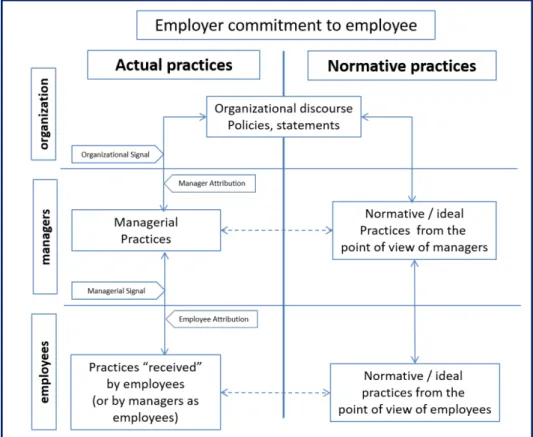
The following model, drawn from our literature review, will be used to classify and discuss the main results emanating from the interviews:
Figure 1: Employer commitment to its employee: actual and normative practices
This model differentiates between ideal/normative practices (on the right) and implemented practices (on the left), by considering three level of analysis: the organization, managers, and employees. Organizations' commitment to their employees is first perceivable in the official discourses of its leaders (which are also to be found in official reports and publications). In making official statements, organizations are bound to fulfill their promises by designing their HRM policies accordingly, meant to be implemented by managers at the shop floor level. Based on what they believe are the organizations' intentions; that is the attribution they make of the signals conveyed by their employer, managers deploy HRM practices with an endeavor as a function of their own motivations and commitment. In turn, managerial practices (signals) intended to employees may be perceived differently given the type of attributions made at the subordinate level. Dotted lines illustrate potential discrepancies between expected and actual practices.
In sum, studying workplace commitment only from the individual employee side, scholars have overlooked the inherent complexity and dynamism of a relation involving both employees, managers, and their organizations. A gap to be mended by the current paper in trying to answer the following research questions:
• How do public organizations, through managerial/HR practices, commit to their employees? What is the specific contribution of public managers in the process?
• Does the managers' own workplace commitment translates into the way they express the organization's commitment towards their collaborators?
11
• How are these commitment practices perceived by employees?
Methods
The approach used in this paper is qualitative-exploratory as it aims at unveiling the peculiar managerial practices of public managers (Kaufmann 2011, Miles, Huberman et al. 2013), as expression of employer’s commitment, and then contrasts this information to the perception thereof of employees. Ideally, managers and employees, as key informants, should form pairs of individuals working for the same organizations, and in the same business unit. But collecting information from managers and collaborators employed in different venues would not hamper the validity of the qualitative material. That said, we privileged the manager-collaborator dyadic relationship whenever possible. Besides, a better understanding of public organizations' commitment to their employees requires examining their practices, especially those intended to arouse employee commitment. Here, we rely on the experience of managers since they somewhat represent the organization. We were furthermore particularly careful to separate actual from expected or normative commitment practices. In fact, what our respondents imagined as ideal was not always possible in their immediate work context.
Concretely, the present work tries to investigate how public organizations and hence managers contribute in the potential expressions of public organizations' commitment to their employees, by using face-to-face interviews as our main research instrument. In this logic, our respondents were asked about their managerial practices, especially those intended to reinforce employee commitment. We furthermore examined whether some specific managerial practices (for instance related to performance management, resource administration, relations management) infused HRM practices or additional practices not specifically planned or decided by the HR department. Since our intention was to unveil the organization's commitment (or more specifically managers' commitment as a proxy) to its employees, the information collected from managers was continually contrasted to employees' perception, because managers themselves oftentimes are eventually the recipient of organizational policies. Alike their collaborators, they tend to attribute some underlying reasons to certain managerial standards. This enabled us to check if positive or negative intentionality was attributed to them by our employee respondents, our own objective being to evaluate when practices were perceived as the expression of organizational commitment to them or not. Specifically, the practices retained are those mentioned by managers as a signal of their commitment to their employees, and/or considered by employees as the expression of their organization or manager's attachment or commitment to them. Here, the following three possibilities are worth mentioning: first of all, practices intended to demonstrate organizations' commitment that are perceived as such. Then, practices with no intention to express commitment but which are nonetheless perceived as such. Finally, some practices happen to be hardly perceived as the organization's willingness to commit to its employees, whereas they are meant as such.
Our semi-structured interviews were coded and analyzed with the logic of identifying and reducing the themes emerging from the verbatim corpus. Using a constant comparison approach (Creswell 2008), managerial practices and employee perceptions thereof provide useful insights for the comprehension of Organizational commitment to employees. It should be recalled that our manager-collaborator dyads were not always hierarchically related. This is not an issue since what imported to us, above all, was to discover how people holding different, albeit related, position in the organization, perceived and defined their organization's commitment to its employees.
12
During the interviews, such questions as: [to employees] "How do you perceive that your organization/managers is attached to you?"; "What would you change if you were given the means to decide of how work should be managed here?" - [to managers] "What is a good manager/employee for you?"; "How would you manage to keep a good employee?"; "How do you handle internal organizational conflicts as a manager?" together with their probes helped us to qualify accounts made by managers and employees on what their organization's commitment to them really meant. Another interesting feature of our approach is that managers also could account of their own relation to their hierarchy. Thus, there are instances where they reported about their own practices of commitment to their employees, and other times when they informed us about what they could take for their organization's commitment themselves. Accounts of managers reporting the commitment management practices of their own hierarchies are analyzed together with employees' accounts.
Also, results pertaining to employees' accounts of what they would do as managers are compared to the manager group. Tables 2 gathers an exhaustive list of our respondents with their respective organization and hierarchical positions.
Tableau 1 : List of respondents per position and organization
Position Resp. Codes2 Manager Collaborator Organization
Manager AUTO_PC01 • Automotive and navigation agency
Collaborator AUTO_SR02 • Automotive and navigation agency
Manager RAIL_JDA01 • Railway company
Collaborator RAIL_CB02 • Railway company
Manager RAIL_FC01 • Railway company
Collaborator RAIL_VF02 • Railway company
Manager TOWN_KL01 • Town hall
Collaborator TOWN_FA02 • Town hall
Manager TRIB_SI01 • Cantonal tribunal
Collaborator TRIB_HE02 • Cantonal tribunal
Manager TRIB_TP01 • Cantonal tribunal
Collaborator TRIB_ST02 • Cantonal tribunal
Manager UNI_VG01 • University
Collaborator UNI_SB02 • University
Collaborator UNI_JP02 • University
Manager HOME_CB01 • Retirement home
Collaborator HOME_JB02 • Retirement home
Collaborator HOME_BY02 • Retirement home
Collaborator SOCIAL_EL02 • Social insurance
Attributions and perceptions were collected by means of such probes as "What does this mean to you?", "What do such deeds from your manager send you as signal?", "Why, according to you, does your manager or your organization do that?"
13
Results
Organization's commitment: a multidimensional set of practices
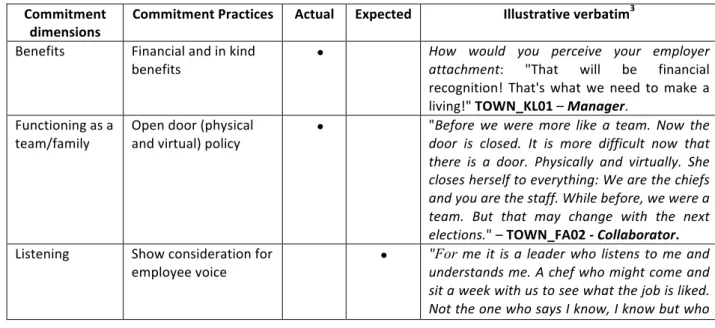
Table 2 below presents the organization's commitment practices reported by the employees and managers interviewed. Those practices can be distinguished between practices that are actually implemented within the workplace, and practices that our respondents long to, as the expression of the employer's commitment to its employees. Illustrative verbatim are also presented in the last column to catch our respondents' view of the organization's commitment in their own words. In order to illustrate Defense for instance, one of the employees resorts to the metaphor of the Lightning rod whenever work delivery is delayed beyond their control. This exemplifies the type of support public employees would like to receive more often from their organization. Indeed the committed organization is one which listens, backs and defend its employees. In one organization this tryptic was particularly verified empirically. The yearly surveys conducted in this organization were quite clear about this core features of the employer's commitment: "[We conduct every year a satisfaction survey] and 80% of the employees tell us that yes he is listening, he supports us, he defends us. Of course, there is always the part that will say no but it is really very low." (SRSCAN02 – Manager). For this other manager, employee organizations show their commitment by involving, allowing autonomous time management, and giving their employees greater rooms for maneuver wherever possible. Above all, managers provide for a pleasant work environment. This comprises renovating offices and renewing the work equipment: "What can we do to make employees stay longer?" We try to keep them loyal, to give them an interesting working environment, to try to involve them, to get them interested." An interesting environment is, for instance, the possibility to develop a number of things. We have working schedules that are quite interesting compared to other sectors, some schedules are free, and employees can adjust their working time as they wish, with a lot of room for maneuver. To improve the working environment, there are building renovations every time, and we are even building new premises." (CHSCAN01. Manager). These are only few examples of the organization's expression of commitment. Systematic presentation thereof it provided in Table 2 hereafter:
Tableau 2: Workplace commitment – the organization's part Commitment
dimensions Commitment Practices Actual Expected Illustrative verbatim
3
Benefits Financial and in kind
benefits • How would you perceive your employer attachment: "That will be financial recognition! That's what we need to make a living!" TOWN_KL01 – Manager.
Functioning as a
team/family Open door (physical and virtual) policy • "door is closed. It is more difficult now that Before we were more like a team. Now the there is a door. Physically and virtually. She closes herself to everything: We are the chiefs and you are the staff. While before, we were a team. But that may change with the next elections." – TOWN_FA02 - Collaborator.
Listening Show consideration for
employee voice • "
For me it is a leader who listens to me and understands me. A chef who might come and sit a week with us to see what the job is liked. Not the one who says I know, I know but who
14 Commitment
dimensions
Commitment Practices Actual Expected Illustrative verbatim3
knows nothing because precisely it is not his job." - TOWN_FA02 – Collaborator.
Defense Back and defend
employee action when confronted to criticism
• "For me a good leader is first of all someone who knows what I tell him about. A person you trust because you can talk to him about private concerns. He is a person who can defend us in case of conflict. Here we are actually doing work that leads us to remove trains or to delay them while our objective would be to ensure that the trains arrive on time. So, we have objectives that are sometimes antonymic one will say. Confronted with this, there are people who have no perspective on this and think that everything can be settled like music paper, and who make a lot of criticisms, most of them unfounded. And there must be a leader who stands like a lightning rod for us." FCSBB02 –
Collaborator. Means for doing
one's job properly
Lean processes • To show to these people that we hold to them:
"(...) It is also simplifying their work, give them the possibility to work with procedures and Improve their work comfort, listen to them as much as possible. –AUTO_SR02 – Manager.
Justice, fairness and conflict management capacities
Fair attitudes and
behaviors •
"A good leader is someone who has a neutral opinion, who is impartial, I would say who is equitable with his employees as well, and he does not take part for one or the other. He tries to manage things in a neutral manner in the event of a conflict, discuss with everyone and make the tensions diminish." TRIB_TP01 –
Manager.
Development Give more
responsibilities and train employees for needed organizational skills and knowledge
• [To better assist our employees in managing
emotional situations] "A two-day seminar was conducted during which experts tested their personalities. Rather relational, sociable, directive, procedural and so on, and then we showed them how to manage clients with another personality so that they adapt to them. Some were initially reluctant but then all went well. Eventually they realized that they too had a personality that could be misinterpreted." AUTO_PC01 – Manager.
Autonomy The greatest freedom
possible in the concrete conduct of operational tasks
• "Everyone makes his decisions, his responsibilities, we do not have to automatically submit all the files to the chief, we must of course submit if we are not sure, but (...) I am close to retirement but with this way of seeing things that my new chief brought, I might even imagine staying for another ten years. This new way of seeing things is to empower people, show them where we are going, and then let people have the
15 Commitment
dimensions
Commitment Practices Actual Expected Illustrative verbatim3
freedom to take responsibility too. (...) there is also the fact that now errors are allowed." SOCIAL_EL02 - Collaborator.
Participation and
empowerment
Consult and involve employees in the decision-making process
• "Let's say that if I were the boss, before I put in place new strategies, new deadlines, new milestones, who does what and when, I might discuss more with those who do the job If what I want to set up as a new way of working is realistic." RAIL_VF02 - Collaborator
I-deals Windows of
opportunity for i-deals negotiation
• "With the rules and directives, we cannot negotiate much, but I managed to get a little bonus for someone who worked very well when it was not normally possible. In fact I talked to my boss saying that this person worked pretty well. That she's been there for a long time now, and in spite of the fact that she was at the top of the pay scale, we should understand that the person was likely to get demotivated and leave if nothing was done to encourage her. That's how I managed to get something and that collaborator was like wow!" TRIB_SI01 - Manager.
Trust Respect of the
employee-organization psychological contract
• "I say what I do and I do what I say, which I think is important in terms of trust, but this trust must be reciprocal because there is a tendency to believe that it must only come from the employer. "AUTO_PC01 - Manager
Transparency and
communication
Sufficient information on organizational plans and strategies, and employee role therein.
• • "So maybe more communication and
transparency, although my current chief communicates quite well, you can sometimes see a few hiccups in communication, for example I had to replace one of my colleagues, but I learnt it from other colleagues. Maybe it's nothing but communication went wrong there. We got to know things by other means, and then we come to tell them afterwards, for me it's something important because I like honesty" UNI_SB02 – Collaborator.
Environment Socialize employees and provide a collaborative and supporting
organizational climate
• "What really gives me a sense of
accomplishment is to make people feel happy to come and work, to bring something together so that it can always be?"RAIL_FC01
- Manager
People
orientation Placing the human being at the center of the administrative machine
• "If you do not like working with people, you have to stay in your office, you have to appreciate people, you have to appreciate that people are different, they have different expectations So we have to give them different things, we find men who work differently, there are people who work very fast and very well, and there are people who work less quickly and very well, and also people who work less quickly ... we cannot all put them in the same mold." AUTO_PC01 - Manager
16 Commitment
dimensions
Commitment Practices Actual Expected Illustrative verbatim3
Acknowledge-ment Give more visibility to employee contribution, value and personality
• • "Recognition is about daring and knowing how to say thank you, but to say thank means what? Does it mean to say thank you every morning when you get back in the office - Thank you for being there - or from time to time offer something to give him the opportunity to manage a project, or even by offer him a training that he would have liked, or support a project?" AUTO_PC01 - Manager
Valuing employees
Care about employee well-being as an asset for organizational overall performance
• "You have to value the employees, that is to say, to stop bringing everything back to yourself ... What I tend to do is if we have a big project which needs to be presented to someone, I would encourage one of my collaborators who took part in to present it (...). It is necessary to know how to say thank you to these people. You must also know from time to time to say Well, we've done a great job, we're going to have a beer in the evening!
That's what it is, trying to attract everyone. Find time to take an afternoon with the team for something special that has nothing to do with the job or indirectly related. When you have the impression of not getting there anymore, this is important. And when you see that things do not function in a team it is what must be done: Get out with your people, recharge batteries, encourage them - Guys, we need you! You are à good team!" RAIL_JDA01
-Manager
Among our respondents' accounts of what they perceive or consider as commitment emanating from their employing organization, a number of practices describe ideally expected situations. This is the case when employees evoke commitment practices intended to render their voice audible (listen), defend employees of promote equity and justice within the workplace. Employees' mentioning transparency and communication practices, as well as participation and empowerment policies also see them as "ought to be" situations. The remaining practices are those, actually experienced at work in the investigated organizations. A couple of practices, namely those devoted to ensure transparency through enhanced communication, and those related to acknowledging employee contribution are at the same time expected by employees whereas they actually exist in the practices portfolio of their organization. Such situations (marked with an asterix in Table 3 below) might denote the fact that employees desire more of those practices at work, but also signal a kind of congruence between actual and ideal practices.
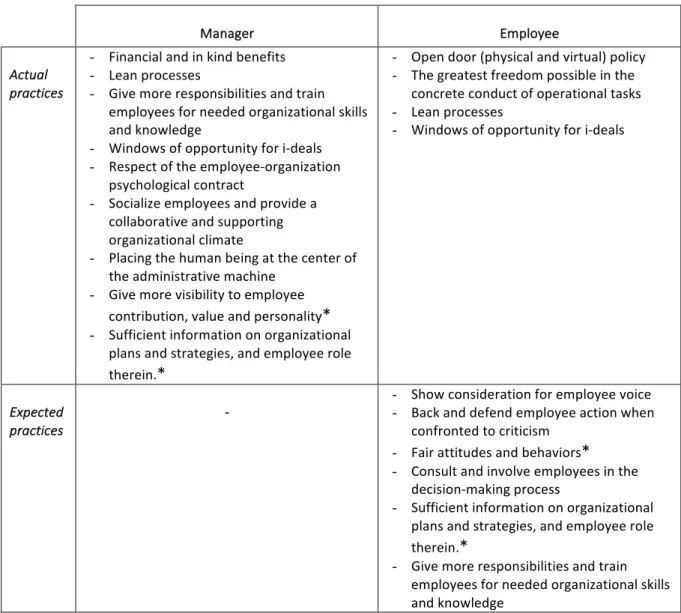
The 2X2 grid below (see Table 3) synthetizes the actual an expected commitment practices reported by managers and the public employees interviewed. It can be noticed that managers seem to make no expectation as per the commitment of their organization. This is because whenever they expressed such views, they did so not as managers, but as employees themselves. Since no manager in our sample accounted of expected practices or policies for his own managerial work, that space, left empty in Table 3 hereafter, does not mean that managers do not have expectations about normative/ideal practices of their employers'
17
commitment to them. A hypothesis would be that ideal practices in their eyes are those that they (try to) implement as managers. Finally managers and employees seem to agree on the fact that committed organizations provide lean processes to their collaborators, and windows of opportunity when it comes to negotiating i-deals.
Table 3: Actual and expected commitment practices - a synthesis
Managerial intervention in the mechanism of organization's commitment
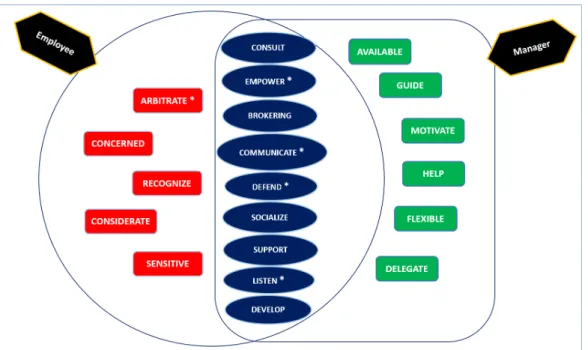
As the main communication channel with employees, managers' role in signaling organization's commitment is far from being trivial. We hereby present our findings by first reporting employee perception of managerial role, and then managers' own perception of their role. It appears that employees and managers agree on nine dimensions of the organization's commitment to its employees: Consult, Empower, Brokering, Communicate, Defend, Socialize, Support, Listen, and Develop. Besides the latter different perceptions are noticeable.
Employee perception of managerial role
Our respondents' view of managerial role in organization's commitment is dominated by their needs to be listened to and given consideration. Employees here mostly portray situations they perceive as ideally expressing the organization's commitment, albeit not always. Thus, be it at work or for some aspects of their well-being more or less related to their private life, the public
Manager Employee
Actual practices
- Financial and in kind benefits - Lean processes
- Give more responsibilities and train employees for needed organizational skills and knowledge
- Windows of opportunity for i-deals
- Respect of the employee-organization psychological contract
- Socialize employees and provide a collaborative and supporting organizational climate
- Placing the human being at the center of the administrative machine
- Give more visibility to employee contribution, value and personality
*
- Sufficient information on organizational plans and strategies, and employee role therein.
*
- Open door (physical and virtual) policy
- The greatest freedom possible in the concrete conduct of operational tasks
- Lean processes
- Windows of opportunity for i-deals
Expected practices
-
- Show consideration for employee voice
- Back and defend employee action when confronted to criticism
- Fair attitudes and behaviors
*
- Consult and involve employees in the decision-making process
- Sufficient information on organizational plans and strategies, and employee role therein.
*
- Give more responsibilities and train employees for needed organizational skills and knowledge
18
employees interviewed think of committed managers as ones who are concerned, considerate and sensitive to their contribution, not to mention themselves as people. FAFECO2, a collaborator in a Town hall insists for instance that "[a good manager] is one that listens to me and gets me". Another responsibility attributed to managers is to defend his collaborator and protect his/her work from demotivating criticism. Defense is necessary for instance when deliverables are delayed. This is justly explained by this collaborator from a Railway company who thinks the manager should act as a "lightning rod for us" in face of fierce criticism stemming from peers of coming from outside (RAIL_FC02). Here, a good manager is one who defends his collaborator in difficult times.
Overall, managers are expected to assume their organization's commitment responsibility by treating their human capital well, but also by ensuring a workplace environment where neutrality and impartiality reign as the privileged mode of interaction and conflict management. This is what perspires from the words of one collaborator of a Cantonal tribunal. According to him the committed manager "has a neutral opinion, who is impartial, I would say who is just with his employees as well, he does not side with one person or another, he tries to manage things in a neutral manner in the event of a conflict. Discuss with everyone and calm tensions down." (TPTC02). Furthermore, managers are the ones having the capacity to truly negotiate i-deals with their employees. His/her openness to i-deals thus plays an important role in employee perception of organization's commitment to them. In extreme cases, changing the manager automatically changes employee motivation and commitment. The typical example it this collaborator from a social insurance agency who, despite being on the eve of his retirement, would likely remain 10 more years on account of the new managing style brought by his new supervisor : "Everyone makes his decisions, his responsibilities, we do not have to automatically submit all the files to the chief, we must of course submit if we are not sure, but (...) I am close to retirement but with this way of seeing things that my new chief brought, I might even imagine staying for another ten years. This new way of seeing things is to empower people, show them where we are going, and then let people have the freedom to take responsibility too. (...) there is also the fact that now errors are allowed." (ELECAS02).
Sometimes contrasting with employees' portrayals, managers too have a say on their own role concerning their employer's commitment to its employees.
Manager's perception of their (own) role
The ultimate role for managers pertains to their capacity to create the conditions and environments of quality work. This alludes to a supportive attitude aimed at motivating and helping their collaborators when needed in their operational tasks. Nevertheless, their feeling is that employee mostly need to be autonomous for them to have a "grip" on the way they perform. By experience, many supervisors are aware that bridled employees are unhappy and unwilling to perform. This is why they tend to see themselves as brokers and facilitators on one hand between collaborators themselves, and between collaborators and the upper hierarchy on the other. In particular, a committed manager (in the eyes of managers) is expected to listen, support and behave transparently in his managerial practices and decision making processes. Since having a very good knowledge of operational activities is not always deemed necessary, good managers compensate this by cultivating a craft for delegation and guidance while rendering themselves available through an open-door policy. Furthermore, being as flexible as possible to adapt to their collaborators is positively perceived by employees. Indeed, such an effort is attributed to the manager's dedication to his collaborators. Where employees consider their manager as representing the organization, such a behavior is automatically seen as the organization's discretionary decision to commit to its employees by trying to satisfy their needs. When TPTC01, one manager from a Tribunal says: "My job is to ensure that employees are happy to come to work, to support them and to ensure that everything works." he certainly means to create a collaborative work climate void of conflicts, since well-being and happiness mean quality work. Paradoxically the employer's commitment
19
seems to be more salient in non-professional social events. Thus, if we are to believe KLFE01, a manager employed in Town hall, non-professional social events are a proxy of the organization's dedication: "We will see it [the organization's attachment] in small moments when we go out together for a drink. (…) Then I say to myself "This manager loves us very much. He is considerate and concerned by our well-being or ill-being". But above all this, managerial expression of organization's commitment can be derived out of their capacity demonstrate enough flexibility to adapt to their collaborator and the situations at hand. Hence, their openness to i-deals might be seen as an evidence of flexible management attitude. CHILSBB01 a manager from a Railway company sums up the organization's commitment to its employees well when affirming that "a good leader is one who listens and supports when it is worth supporting, and especially if he does not support he must explain why he does not support. ( ...) And then a good chef is also someone who knows how to surround himself. I feel lucky today to have a chief who corresponds to my needs and who adapts to people or situations. My leader is not someone who knows exactly all the tasks, but he is always someone who understands what is going on, why he is not going to support, and what solution to bring. For me, it is also necessary to integrate collaborators in the decision-making process. This delegation must make it possible to place the right skills at the right places and in no way be used to assign unpleasant tasks to people". Yet, employee and manager attributions of organizational policies sometimes overlap, sometimes are divergent.
Employee point of view vs managers' about organization’s commitment practices
Figure 1 illustrates the differences and convergences in perception of the manager's role between employees and their supervisors. The Venn diagram displays practices upon which employee and managers' views converge (ovals in blue), those that are particularly important for employees to consider their employer is committed to them (ovals in red), and finally the practices described by managers as demonstrating their commitment to their employees. The practices with an asterix (*) are the normative ones as compared to those actually implemented in the organizations surveyed. Together with Communication, Socialization participates in the manager's endeavor to provide a positive workplace environment and organizational climate (see Table 2 for details).Figure 1: Perceptions of managerial role in organization’s commitment
20
dimensions reflecting organizations' commitment, some notions still remain differently understood. For instance, some managers consider that recognition is a vague concept, since it is not always easy to determine when enough is enough: "Recognition is daring and knowing how to say thanks. But what does Thanks you really means? Thank you every morning when you get back in the office - Thank you for being there - or from time to time offer something to someone in recognition of his performances, like two days off or even a bonus. Or is it by to give him the opportunity to manage a project, or a training he wished. As you can see, recognition is vague!" (AUTO_PC01 - Manage). Besides (as illustrated by Table 3), in the Results section, diverging attributions can still happen between the organization's intentions and how the latter's commitment "attitudes and behaviors" are perceived in fine by employees. This is an issue and source of important workplace conflicts, the understanding of which signaling theories provide some insights (Connelly, Certo et al. 2011).
Table 4 compares managerial and employee attributions of some of the dimensions of organization's commitment revealed by our study. The difference between how employees and managers make those attributions vary from one subject to another. We only retained those that were particularly puzzling in terms of misunderstanding. For instance, whereas some manager may consider that keeping employees inside the organization represent a way to acknowledge their contribution at work, collaborators may simply need a mere "Than you"! This discrepancy merits deeper analysis since managers might perceive employees as demanding too much where employees would be sensible to trivial deeds like receiving a "Than you". Another example is that of so-called open-door policies, which the managers encountered oftentimes mobilize as an evidence of their attention to their collaborators. In reality, there might be a gulf from being available via an open-door policy to truly listening to one's collaborators. An open door policy means that "employees can come whenever they want to see the boss" (AUTO_SR02). Yet this does not necessarily lead to employees' voice being taken into account. Other such discrepancies exist with organization's commitment dimensions like I-deals, Transparency and practices designed to give employees more means for doing their job properly as illustrated in Table 4.
Tableau 4: Divergent attributions made by employees and managers
Organization's commitment dimension Managerial perspective Employee perspective Acknowledgement Keeping employee in the job "Thank you"
Open door policy Listening Availability
i-deals Trust and loyalty Support
Transparency Trust Loyalty
Means for doing one's job properly Control Care
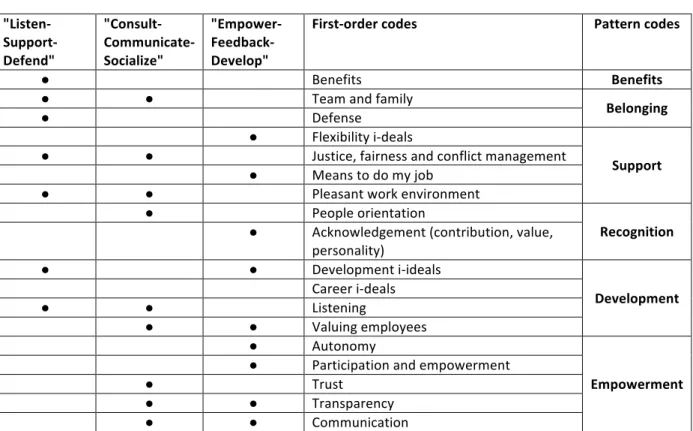
Our systematic coding, regrouping, and categories borne out of constant qualitative comparison unveiled the most salient features of public organizations' commitment to their employees. These features can be gathered in broader patterns/dimensions (See Table 5). Overall, organizations demonstrate their commitment in exchanging benefits, belonging, support, recognition, development and empowerment. Associated with transparent and trustworthy communication, the organization's expressions of commitment send credible signals to employees of their employer's consideration and respect.
In the Discussion to follow, we first put the above findings into perspective for answering our research questions, before discussing their main theoretical and managerial implications.