XXX-X-XXXX-XXXX-X/XX/$XX.00 ©20XX IEEE
Solving Multi Objectives Team Orienteering
Problem with Time Windows using Multi Integer
Linear Programming
1st Indri Hapsari Industrial Engineering Universitas Indonesia Depok, Indonesia [email protected] 2nd Isti Surjandari Industrial Engineering Universitas Indonesia Depok, Indonesia [email protected] 3rd Komarudin Industrial Engineering Universitas Indonesia Depok, Indonesia [email protected]Abstract— This study solves tourist trip planning using team orienteering problem with time windows with more than one objective. In MO-TOPTW, besides maximum score, there is minimum time that must be achieved to make sure tourist get effective and efficient routing. Score represent priority to visit the destinations, while time consist of visiting time and traveling time between destinations. Number of routing is determined and the goal is giving the tourist the best routing that fulfill all the constraints. The constraints are time windows and tourist’s budget time. Modification of mathematical programming will be done.
We used small case to compare between heuristic procedure to develop the route with optimization. Optimization is implemented using Multi Integer Linear Programming using Lingo. The global optimum of optimization method gives better result than heuristic, with total score higher as 12% and total time lower 7.3%. Because this is NP-hard problem, the running time is 45 minutes 24 seconds, very long time for tourist to wait the result. Further research must be done to faster the process with preserving the best result.
Keywords—Team Orienteering Problem, Time Window, Linear Programming, Multi Objective, tourist trip, scheduling
I. INTRODUCTION
Tourist trip planning is more complex to do with the increasing number of needs and limitations that must be met to make the results are feasible to apply. In the beginning, trip planning only pay attention to the shortest distance and shortest time, but now the travel routing must be able to accommodate different favourable destinations. For example, visiting a place is associated with how important that place
for the tourist and how big the tourist’s desire to include it in
the itinerary.
Orienteering Problem (OP) is a model that represents a travel planning that based on the level of importance or favourable destination and it is referred as weight. This model was created by Tsiligirides (1984) for sport exploring in the forest and there are various posts with different values. The winner is the participant who collects the most value within the specified time limit, even though he or she may not visit all the posts. In its development, the OP is part of the Tourist Trip Design Problem (TTDP) or travel planning for tourists. It is also possible for OP to be used for other needs such as distribution logistics to disaster’s posts. The
point is that all who need priority in planning their trip can use the OP.
Research using the OP model as a TTDP problem solving began with Vansteenwegen's research in 2006 on train scheduling (Vansteenwegen & Oudheusden, 2006a) followed by electronic guidance for tourists to visit selected destinations (Vansteenwegen & Oudheusden, 2006b). In 2009, Vansteenwegen and other researchers continued research on travel plan using private cars (Vansteenwegen,
Souffriau, & Sӧrensen, 2009), followed by electronic guidance research for public transportation (Vansteenwegen, 2009) which was the result of his dissertation (Vansteenwegen, 2008). In the same year the development of the OP model became a Team Orienteering Problem (TOP) using the Guided Local Search metaheuristic method to obtain optimal results. The TOP model appears to meet the needs of visiting many places in limited time. The result is a number of routes between one place and another. The TOP model can also be applied to the OP model. Furthermore, Vansteenwegen and other researchers (Vansteenwegen, Souffriau, Berghe, & Oudheusden, 2009) used the metaheuristic Iterated Local Search (ILS) method to complete the Team Orienteering Problem with Time Windows (TOPTW) model.
Furthermore, Vansteenwegen's research and other researchers are around designing models such as Time Dependent Orienteering Problem with Time Windows (TDOPTW) to adapt to the various modes of public transportation that will be used (Verbeeck, Vansteenwegen, & Aghezzaf, 2015) and (Garcia, Arbelaitz, Vansteenwegen, Souffriau , & Linaza, 2010). The development of metaheuristic methods developed into Variable Neighborhood Search (Divsalar, Vansteenwegen, & Cattrysse, 2013b) and Memetic Algorithm (Divsalar, Vansteenwegen, & Cattrysse, 2013a). Several surveys were conducted to get novelty in this study of the TTDP, for example, as in 2010 (Vansteenwegen & Souffriau, 2010) to find out the state-of-the-art from existing studies in 2010 (Souffriau & Vansteenwegen , 2010) and 2011 (Vansteenwegen, Souffriau, & Oudheusden, 2011) which conducted a survey for OP. The last survey was conducted in 2016 with Gunawan (Gunawan, Lau, & Vansteenwegen, 2016) who also studied the same field. Vansteenwegen and other researchers produced an internet-based recommendation system called City Trip Planner (Vansteenwegen, Souffriau, Berghe, & Oudheusden, 2011).
Gunawan et al. (2015a) who researched the TTDP developed more researches in the field of metaheuristics, especially in the Time Dependent Orienteering Problem (TDOP) model that is related to the use of public transportation. The basis is ILS, which was developed by
Vansteenwegen for TTDP, to be a well-tuned Iterated Local Search (Gunawan, Lau, & Kun, 2015a) as a solution to the Extended Team Orienteering Problem With Time Windows model. Gunawan and other researchers also developed SAILS or Simulated Annealing and Iterated Local Search (Gunawan, Lau, & Kun, 2015b).
Other researcher who based their research on the results of the Vansteenwegen study was Gavalas. In some of his research results, Gavalas discussed the Cluster Based method used for the TOPTW model (Gavalas, Konstantopoulos, Mastakas, Pantziou, & Tasoulas, 2013), then developed efficient algorithms for TDTOPTW (Gavalas, Konstantopoulos, Mastakas, Pantziou, & Vathis, 2014) then conducted a survey for TTDP (Gavalas, Konstantopoulos, Daminaos, Mastakas, & Pantziou, 2014). Gavalas developed an internet-based recommendation system, using the site (Gavalas & Kenteris, 2011) or an application on the or mobile application. Initially, Gavalas developed efficient algorithms and became practical solutions for users (Gavalas, Kenteris, & Konstantopoulus, 2012a), then tried to apply to a device based on surveys in 2009 (Kenteris, Gavalas, & Economou, 2009), 2012 (Gavalas, Kenteris, Konstantopoulus, & Pantziou, 2012) and 2013 (Gavalas, Kasapakis, Konstantopoulus, Mastakas, & Pantziou, 2013). The need of recommendation system was the focus on research on 2014 (Gavalas, Kasapakis, Konstantopoulus, Pantziou, Vathis, Zaroliagis, 2014, and Gavalas, Konstantopoulus, Damianos, Mastakas, & Pantziou, 2014). The result was some recommendation systems such as e-COMPASS (Gavalas, Kasapakis, Konstantopoulus, Pantziou, Vathis, & Zaroliagis, 2015) and Scenic Athens as a guide for tourists using bicycle (Gavalas, et al., 2016).
Related to previous research, there is a research gap that is the state-of-the-art of this paper. Tourism in Indonesia, especially in East Java, will be the case study in this study. The topic is chosen because Indonesia’s tourism position
according to the 2016 Travel and Tourism Competitiveness Index of the World Economic Forum (Ministry of Tourism of the Republic of Indonesia, 2015) was ranked 50th in the world. The Ministry of Tourism targeted to reach rank 30 in 2019, that will be increasing tourism contribution until 5% in the national economy. The prediction of the Ministry of Tourism of the Republic of Indonesia in the third quarter of 2016 (Ministry of Tourism of the Republic of Indonesia, 2016) stated that the spending of domestic tourists as many as 217 million is greater than the spending of foreign tourists. This proves that domestic tourists have an important role in increasing tourism's contribution to the foreign exchange. Improvements that will be made include management institutions, infrastructure, management of regional promotions, availability of public facilities, structuring of traders and the environment, and community acceptance. The number of domestic tourists visiting East Java Province was the highest with the number of domestic tourists was 17.22% of the total travel of Indonesian tourists (Barudin, Fitriyani, & Indriati, 2016). The East Java Provincial Government sets out four pillars of tourism development including tourism destinations, tourism marketing, tourism and institutional industries. To support the government program, this research is intended to facilitate domestic tourists planning their sightseeing trips in East Java. It is expected for the tourists to explore more attractive destinations in East Java, because it can increase their residing time and expense while they are in East Java.
Based on the previous research, the TOPTW model only accommodated the maximum score, but not considered minimum time. Thus the research objectives to be achieved in this study are development of the TOPTW model for multi-objective using data related to tourist destinations in East Java. Actually, there are 31 cities, 612 tourist destinations, 122 hotels, and 42 terminals/stations/airports. But we used small case to test the optimization program using Multi Integer Linear Programming because usually it takes longer time to reach global optimum. The transportation is using rental or private car, considering that it is still difficult to use interconnected public transportation in East Java. For traveling time, we use Google Map to determine the time between destinations with the fastest route selection and the usual density ("fastest route, usual traffic"). The visiting time, operational hours and rating are on the Google Map too and will be used as input data.
II. LITERATURE REVIEW
Tourist Trip Design Problem (TTDP) is developed into various models and becomes interesting topic, because it is more specific, the method varies and the model boundaries can continue to be developed to suit the conditions in the field. TTDP try to find a route that can maximize profits and minimize travel costs. What is meant by profit is rating of tourists in certain tourist destinations.
There are models that use Orienteering Problem (OP) algorithms like in previous chapter, and there are algorithm beside OP that builds routes gradually like Li, Zhou, & Zhao (2016) and Angskun, Korbua, & Angskun (2016). Because the research did not proceed to a more optimal and faster process time, the model that is developed in this study was based on the OP model. Orienteering Problem is the most developed basic model because it can be adapted to the conditions faced and proceed with the metaheuristic method for more optimal results, especially for situations with many limitations, and faster processing time.
Orienteering (Tsiligirides, 1984) was first created as an outdoor sport that has a number of places with certain advantages or values. Players try to maximize their value in a limited time, by visiting each place that has greater value. Distance and travel time are quantitative, so that is why this game requires good route planning. The Orienteering Problem Model (OP) is a continuation of the Traveling Salesman Problem (TSP) with the difference in this method tourists do not need to visit each destination point and consider the value, not the closest distance.
Herzӧg & Wörndl (2014) explains that OP is a scoring
system based on the collection of values in selected locations while still considering existing constraints. Apart from being known as selective TSP, OP can also be associated with Knapsack Problem, The Maximum Collection Problem and The Bank Robber Problem (Li & Fu, 2012). Orienteering Problems can be formulated as follows (Gunawan, Lau, and Vansteenwegen, 2016): there are locations i = {1, ..., | N |} with each location i∈N having a non-negative value Si. The starting location is 1 and the final location is |N|. The goal is to determine the route that is limited by the time budget Tmax. who will visit a subset of N and maximize the total value obtained. It is assumed that the collected values can increase by most visiting these locations once. The non-negative travel time between
location i and location j is denoted by tij. OP which continues to be TOP with the aim of determining m routes, each route is limited by Tmax which maximizes the total value. OP can be formulated as an integer programming model with the decision variable xij= 1 if there is a visit to location i followed by a visit to location j and 0 if vice versa. Variable ui will be used to reduce the subtour limit and allow the positioning of the locations visited on the route.
(2.1) (2.2) (2.3) (2.4) (2.5) (2.6) The purpose of solving the OP problem according to (Vansteenwegen, Souffriau, Berghe, & Oudheusden, 2011a) is to maximize the collection of values (2.1). Limitation (2.2) guarantees the route starts from location 1 and ends at location |N|. Limitations (2.3) assures the relationship between routes and each location visited at most once. Limitation (2.4) limits the total travel time of Tmax. Combined boundaries (2.5) and (2.6) prevent subtour.
Team Orienteering Problem (TOP) is the development of OP which becomes multiple routes. The Orienteering Problem With Time Windows (TOPTW) team considers visiting a location with a certain time limit, while the TOPTW Time-Dependent (TDTOPTW) considers time dependence in predicting the time needed to move from one location to another and according to the multi-route model - transportation mode.
Orienteering Problem with Time Windows (OPTW) and Orienteering Problem with Time Windows (TOPTW) Teams have been the topic of many previous studies because of their flexibility (Vansteenwegen, Souffriau, & Oudheusden, 2011). A 2-opt displacement is needed to get high-quality results for the OP, but over time, it cannot be applied efficiently to solve OPTW (T). The OPTW (T) solution approach can also be applied to (T) OP. This is evidenced by Tricoire, Romauch, Doerner, & Hartl (2010) who modified the problem solving (T) OP with a time limit to get better results.
Vansteenwegen, Souffriau, & Sӧrensen (2009) explain
about the TOPTW model in general such as OP with m-route. For m-route TOP it is necessary to specify the trip m, where each trip starts from point 1 and ends at point n which maximizes the total value of the team (all routes). Each point has a value of Sik since the first route and the total time is obtained from visiting each point on route m which cannot exceed the specified time or Tmax.
(2.7) (2.8) (2.9) (2.10) (2.11) (2.12) (2.13) (2.14) (2.15)
yij is worth 1 if location i is visited on route k, if not yij = 0; xijk is worth 1 if there is a trip from location i to location j on route k and is worth 0 if vice versa. The objective function (2.7) maximizes the total value obtained. Limitation (2.8) guarantees that routes starting at location 1 will end at location n. Limits (2.9) and (2.10) determine the relationship and sequence of each route. sik is the arrival time at location i on route k. Tiis the time of visit at location
i, cij is the time of travel from location i to location j. Limitation (2.11) guarantees that each location is visited at most once and the limit (2.12) guarantees that each route is completed within the specified time limit. Limits (2.13) and (2.14) guarantee the arrival time is still operational [Oi, Ci]. Limitation (2.15) prevents the planning of the same route.
III. METHODOLOGY
The methodology is started with literature study, followed by data collection and processing, the development phase of the TOPTW model that consist of modify the existing mathematical model and transform it into heuristic procedure and optimization using computer program by Lingo 17.0. In order to solve the real problems in the field, a case study in East Java is chosen. The development model will help domestic tourists in arranging their tour routes. Data was obtained from internet research, especially Google Map. The data needed for the FTOPTW model is the visiting time and traveling time. Related to traveling time, the situation on the road will be considered which affect to the speed of the vehicle resulting in different traveling time between two different destinations. The mean test was done first and the result is there is difference between the time of trip A to B and the time of trip B to A.
The model development step starts with validating the initial model or called conceptual validation, the travel route model using the Team Orienteering Problem with Time Windows. This validation was done to make sure the model runs expected, and able to provide a feasible travel route, achieve optimal results without breaking the constraints. After the initial model is valid, the next is developing a Multi Objectives Team Orienteering Problem with Time Windows algorithm. The model will be run heuristic and by optimization to compare the differences between the results.
IV. RESULTS AND DISCUSSION
There are 31 cities in East Java and 612 tourist destinations. The category per tourist destination will follow the division set by the Ministry of Tourism which is to be 9 categories like marine tourism, ecotourism, adventure tourism, cultural and historical heritage tourism, shopping
and culinary tourism, city and village tourism, MICE tourism, sports tourism, and integrated tourism destination like theme park. Majority of tourism in East Java is 168 cultural and historical heritage tourism destinations, followed by 165 ecotourism destinations, and 138 marine tourism destinations.
For the starting location, the location can be hotel or any public transportation. Hotels included in the database are the top 5 hotels recommended by Agoda by popularity. The list of public transportation facilities in the database is obtained from a list of the main terminals in each city or district, a list of the main stations in some cities or districts, and a list of airports in several cities or districts. There are 42 public transportation facilities listed.
Traveling time is obtained from data on the Google API as a database from Google Map. The traveling time considers the flow of travel with all its variations (turning, turning back, etc). The time data taken is from the usual conditions and the fastest route. Visiting time was tried to be obtained from respondents through previous research (Cahyadi, Hapsari, Iswadi, 2016). But after processing the data, it only provides a few information because the data is varying greatly. Thus, the data from the Google Map is considered more representative for the expansive population. Google Map has information that is more accurate because it is based on information tracked from each user's device, and includes more respondents. Weight is needed to represent the level of desire of tourists to visit the destination. This weight can be represented by the average rating given by Google Map users in each tourist destination. The given scale of weight ranges from 1.0 to 5.0.
To solve the problem of tourist travel routes, the model that will be developed is the Team Orienteering Problem with Time Window (TOPTW) from the research of Vansteenwegen, Souffriau, & Sorensen (2009). The addition of objective and subjective functions to better suit the conditions of tourism in East Java and the desires of domestic tourists. The proposed model is called Flexible Team Orienteering Problem with Time Window (FTOPTW). The original objective function is the maximum weight (Si) of the destination, for the proposed algorithm the objective function is added with the minimum time. The new algorithm will guarantee the tourist schedule will
accommodate the tourist’s priority and efficient time,
because the model will choose the favourite destinations with the shortest traveling time (Tij). As we can see in equation (3.1) the added minimum time will complete the objective function.
(3.1)
The added constraints are allowance for the start and finish time of the tourist will conform with opening and closing time destination. For example, tourists accept waiting for a half hour in the destination that has not been opened yet, and tourists accept if they must reduce the visiting time because the destination will be closed. Thus, it is hard time window for the destination and tourist will flexible with their time. For how long they can tolerate it are dependent of the tourist willingness. Equation (3.2) describes tourist will wait until 0.5 hour before the destination is open. Equation (3.3) explains tourist will dispose to reduce their visiting time until
0.5 hour before closing time. But because 0.5 hour has not proof to support it, we assume the tolerance time is 0.
(3.2) (3.3) The following is a mathematical formulation that was changed with the Lingo 17.0 programming language. Some adjustment will be done to make the program more real. For example, the tourist departure time is 8.00, then the time will be worth 1. When the tourist hour ends after 10 hours or 600 minutes, the time limit or Tmax will be worth 600. If the opening hours and closing hours of a tourist place are 8:00 AM and 6:00 PM, then the load time will be 0 (less than 1) and the closing time is worth 600 (minutes).
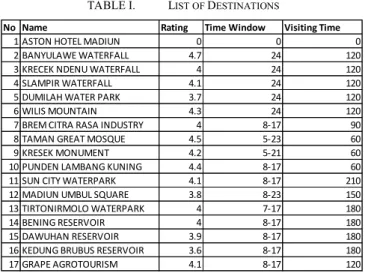
To get results from this MILP formulation, a small case of tourism data in East Java was used. Table 1 shows data in Excel file that is connected with Lingo 17.0 as input and output media. There are 16 tourist destinations in Madiun and Magetan as we see on table 1, with location 1 being the departure location so that there is a total of 17 locations. Each destination has rating from 1 to 5, with 5 is the highest favorable destination. Time window of every destination give information about opening and closing time. Visiting time is in minutes, represent information how long a visitor spends the time on average in that destination. There is traveling time matrix to connect two locations. For assumption we will plan journey for two days or two routes. The trip is from 8:00 to 18:00 or 10 hours.
TABLE I. LIST OF DESTINATIONS
No Name Rating Time Window Visiting Time
1 ASTON HOTEL MADIUN 0 0 0
2 BANYULAWE WATERFALL 4.7 24 120
3 KRECEK NDENU WATERFALL 4 24 120
4 SLAMPIR WATERFALL 4.1 24 120
5 DUMILAH WATER PARK 3.7 24 120
6 WILIS MOUNTAIN 4.3 24 120
7 BREM CITRA RASA INDUSTRY 4 8-17 90
8 TAMAN GREAT MOSQUE 4.5 5-23 60
9 KRESEK MONUMENT 4.2 5-21 60
10 PUNDEN LAMBANG KUNING 4.4 8-17 60
11 SUN CITY WATERPARK 4.1 8-17 210
12 MADIUN UMBUL SQUARE 3.8 8-23 150
13 TIRTONIRMOLO WATERPARK 4 7-17 180
14 BENING RESERVOIR 4 8-17 180
15 DAWUHAN RESERVOIR 3.9 8-17 180
16 KEDUNG BRUBUS RESERVOIR 3.6 8-17 180
17 GRAPE AGROTOURISM 4.1 8-17 120
The procedure of arranging journey start with sorting the rating from the highest. From that list, every destination will be arranged in each route with minimum total time. If there are more than one route have the same minimum time, it can be chosen arbitrary. Time window constraints [Oi, Ci] will be checked to make sure there is no violation. For every destination that is returned to the list, and there is still some time remaining in a route, it could be replaced with another destination that has a visiting time which is less than the remaining time. Every time a new destination is inserted, the process to check Tmax and [Oi, Ci] will be repeated. The process will do sequentially until there is no destination can be put again because the total between traveling time and visiting time will exceed the Tmax.. From this procedure, the result can be seen in Table 2. The journey is stopped
because the remain time from Tmax subtraction with total time is less than visiting time any destination. The minimum time or TT for both routes is 18 hours 25 minutes, with maximum score or TS is 30.3
TABLE II. HEURISTIC RESULT
ROUTE 1 DESTINATION Rating Time Window Visiting time Total Time Traveling time 1 ASTON HOTEL MADIUN 0 0 0 8:00 0:52 2 BANYULAWE WATERFALL 4.7 24 2:00 10:52 0:48 9 KRESEK MONUMENT 4.2 5-21 1:00 12:40 0:25 11 SUN CITY WATERPARK 4.1 8-17 3:30 16:35
ROUTE 2 DESTINATION Rating Time Window Visiting time Total Time Traveling time 1 ASTON HOTEL MADIUN 0 0 0 8:00 0:04 8 TAMAN GREAT MOSQUE 4.5 5-23 1:00 9:04 0:19 10 PUNDEN LAMBANG KUNING 4.4 8-17 1:00 10:23 1:42 6 WILIS MONUMENT 4.3 24 2:00 14:05 1:45 4 SLAMPIR WATERFALL 4.1 24 2:00 17:50
Then we continued with transforming mathematical model into programming language in Lingo 17.0. Because Lingo cannot running more than one objective function, so it is started with the Total Score (TS). If it is reached the global optimum it means the Total Time (TT) also the optimal too, because we put the TT as the second priority. As we can see in previous explanation, we achieved the TS first then continue with feasible and minimum time for the route. But if the program running more than two hours and it still does not reach the global optimum, we will stop it after it reaches feasible TS, and use the value as the minimum score the TT program must be completed. Running for TT will stop it is find the feasible solution. Result using Lingo 17.0 can be seen in Figure 1, running for 45 minutes 24 seconds, and getting global optimal.
Fig.1. Lingo 17.0 Result
Table 3 shows the Lingo result. There is a travel time of 52 minutes to reach destination 2 from destination 1 as the initial location. It takes a 120-minute visit at destination 2. Continue the journey to destination 9 which requires a 32-minutes journey. The total time at destination 2 is total time in previous destination, destination number 1 for 8:00 AM, adding by traveling time from destination 1 to 2 for 52 minutes, and visiting time at destination number 2 for 120 minutes. Total time for destination 2 is 10:52, or 2 hours 52 minutes. Next destination will do the same, and every starting and finishing time must suitable with time window in each destination. At the end TS gave result 34 and TT 17 hours 9 minutes. This result is better than heuristic method for 3.7 point higher (12%) for the TS and 76 minutes lower (7.3%) for TT.
TABLE III. OPTIMIZATION RESULT
ROUTE 1 DESTINATION Rating Time Window Visiting time Total Time Traveling time 1 ASTON HOTEL MADIUN 0 0 0 8:00 0:52 2 BANYULAWE WATERFALL 4.7 24 120 10:52 0:32 9 KRESEK MONUMENT 4.2 5-21 60 12:24 0:56 7 BREM CITRA RASA INDUSTRY 4 8-17 90 14:50 0:39 8 TAMAN GREAT MOSQUE 4.5 5-23 60 16:29
ROUTE 2 DESTINATION Rating Time Window Visiting time Total Time Traveling time 1 ASTON HOTEL MADIUN 0 0 0 8:00 0:36 3 KRECEK NDENU WATERFALL 4 24 120 10:36 0:05 17 GRAPE AGROTOURISM 4.1 8-17 120 12:41 0:22 4 SLAMPIR WATERFALL 4.1 24 120 15:03 0:37 10 PUNDEN LAMBANG KUNING 4.4 8-17 60 16:40
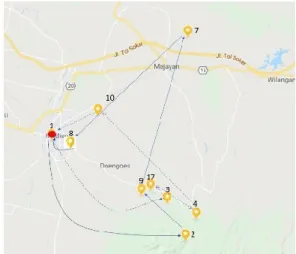
Although the results are globally optimal, the time taken is too long, so a faster program is needed. This is related to the utilization of the program for tourists who need faster results. Figure 2 show how the route will be implemented.
Fig.2. Tourist Trip for Two Days V. CONCLUSION
The main contribution of this paper is a mathematical model that will be solved the Team Orienteering Problem with Time Windows (TOPTW) with multi objective. Beside maximum total score, minimum time is must be achieved to guarantee tourist has effective and efficient schedule trip.
Small case in East Java’s tourism is used to represents the
condition, with some of assumptions like number of routes and time budget from the tourist. This formula also considers constraints like time window that has opening and closing time for each destination. Rating, visiting time and traveling time are obtained from Google Map
The heuristic method gives the feasible route with validation result for two routes that are determined before. The total time for both routes is 18 hours 25 minutes, with total score is 30.3. Routing will start and end in the same location. For optimization method, we use Lingo 17.0 that ha Multi Integer Linear Programming on it that guarantees the best result. The result is obtained after the program running for 45 minutes 24 seconds and give global optimal. The total time for both routes is 17 hours 9 minutes, with total score is 34. The difference between heuristic method and optimization method is 12% for score and 7.3% for time.
For future research, it needs faster method to get the best result. Tourist cannot wait very long time for the result while they need it immediately. Another concern is this research only for small case, if it is used bigger case it will need more process time. Another challenge is not destination pair has the traveling time. Data from Google API has
coordinate that must be transform into traveling time to plan the schedule.
REFERENCES
[1] Angskun, J., Korbua, S., & Angskun, T. (2016). Time-related factors influencing on an itinerary planning system. Journal of Hospitality and Tourism Technology, 7 (1), pp. 2 – 15.
[2] Cahyadi, Y., Hapsari, I., Iswadi, H. (2016) Perencanaan rute perjalanan pariwisata dengan orienteering problem with time windows berdasarkan tipe wisatawan domestik di Karesidenan Besuki, Tugas Akhir Teknik Industri Universitas Surabaya.
[3] Divsalar, A., Vansteenwegen, P., & Cattrysse, D. (2013a). A memetic algorithm for the orienteering problem with intermediate facilities. Proceedings The 27th Annual Conference of the Belgian Operations Research Society.
[4] Divsalar, A., Vansteenwegen, P., & Cattrysse, D. (2013b). A variable neighborhood search method for the orienteering problem with hotel selection. International Journal of Production Economics, 145(1), 150–160.
[5] Garcia, A., Arbelaitz, O., Vansteenwegen, P., Souffriau, W., & Linaza, M. T. (2010). Hybrid approach for the public transportation time dependent orienteering problem with time windows. Hybrid Artificial Intelligence Systems, 151–158.
[6] Gavalas, D., & Kenteris, M. (2011). A web-based pervasive recommendation system for mobile tourist guides. Personal and Ubiquitous Computing, 15(7), 759–770.
[7] Gavalas, D., & Kenteris, M. (2012). Evaluation of a web recommender system in electronic and mobile tourism. International Journal of Web Engineering and Technology, 7(1), 4–21.
[8] Gavalas, D., Kasapakis, V., Konstantopoulos, C., Mastakas, K., & Pantziou, G. (2013a). A survey on mobile tourism recommender systems. Proceedings 3rd International Conference on Communications and Information Technology, 131–135.
[9] Gavalas, D., Kasapakis, V., Konstantopoulos, C., Pantziou, G., Vathis, N., & Zaroliagis, C. (2014a). A personalized multimodal tourist tour planner. Proceedings The 13th International Conference on Mobile and Ubiquitous Multimedia, 73–80.
[10] Gavalas, D., Kasapakis, V., Konstantopoulos, C., Pantziou, G., Vathis, N., & Zaroliagis, C. (2015). The eCOMPASS multimodal tourist tour planner. Expert Systems with Applications, 42(21), 7303– 7316.
[11] Gavalas, D., Kasapakis, V., Pantziou, G., Konstantopoulos, C., Vathis, N., Mastakas, K., & Zaroliagis, C. (2016). Scenic Athens: A personalized scenic route planner for tourists. Proceedings of IEEE Symposium on Computers and Communication, 1151–1156. [12] Gavalas, D., Kenteris, M., Konstantopoulos, C., & Pantziou, G.
(2012a). An efficient algorithm for recommending personalized mobile tourist routes. IET Software, 1–15.
[13] Gavalas, D., Kenteris, M., Konstantopoulos, C., & Pantziou, G. (2012b). Web application for recommending personalised mobile tourist routes. IET Software, 6(4), 313.
[14] Gavalas, D., Konstantopoulos, C., Damianos, V. K., Mastakas, K., & Pantziou, G. (2014b). A survey on algorithmic approaches for solving tourist trip design problems. Journal of Heuristics, 20(3), 291-328. [15] Gavalas, D., Konstantopoulos, C., Mastakas, K., & Pantziou, G.
(2014c). Mobile recommender systems in tourism. Journal of Network and Computer Applications, 39, 319–333.
[16] Gavalas, D., Konstantopoulos, C., Mastakas, K., Pantziou, G., & Tasoulas, Y. (2013b). Cluster-based heuristics for the team orienteering problem with time windows. Experimental Algorithms, Lecture Notes in Computer Science, 7933, 390-401
[17] Gavalas, D., Konstantopoulos, C., Mastakas, K., Pantziou, G., & Vathis, N. (2014d). Efficient heuristics for the time dependent team orienteering problem with time windows. Proceedings 1st International Conference on Applied Algorithms, 8321, 152–163. [18] Gunawan, A., Chuin, H., & Kun, L. (2015a). SAILS: Hybrid
algorithm for the team orienteering problem with time windows. Proceedings 7th Multidisciplinary International Scheduling Conference, pp. 276–295.
[19] Gunawan, A., Lau, H. C., & Lu, K. (2015b). Well-tuned ILS for extended team orienteering problem with time windows. LARC Technical Report Series: http://smu.edu/sg/centres/larc/larc-technical-reports-series.
[20] Gunawan, A., Lau, H., Vansteenwegen, P. (2016). Orienteering problem: A survey of recent variants, solution approaches and applications. European Journal of Operational Research, May, 1–18. [21] Gunawan, A., Yuan, Z., & Lau, H. C. (2014). A mathematical model
and metaheuristics for time dependent orienteering problem. Proceedings International Conference on Practice and Theory of Automated Timetabling.
[22] Kementerian Pariwisata Republik Indonesia (2015). Laporan Kinerja Kementerian Pariwisata 2014
[23] Kementerian Pariwisata Republik Indonesia (2016). Laporan Akuntabilitas Kinerja Kementerian Pariwisata 2015.
[24] Kenteris, M., Gavalas, D., & Economou, D. (2009). An innovative mobile electronic tourist guide application. Personal and Ubiquitous Computing, 13 no 2, 103–118.
[25] Kenteris, M., Gavalas, D., Pantziou, G., & Konstantopoulos, C. (2010). Near-optimal personalized daily itineraries for a mobile tourist guide. Proceedings IEEE Symposium on Computers and Communications, 862–864.
[26] Li, J., & Fu, P. (2012). A label correcting algorithm for dynamic tourist trip planning. Journal of Software, 7(12), 2899–2905. [27] Souffriau, W., & Vansteenwegen, P. (2010). Tourist trip planning
functionalities: state–of–the–art and future. Proceedings International Conference on Web Engineering, 475–485.
[28] Souffriau, W., Vansteenwegen, P., Vertommen, J., Berghe, G. V., Oudheusden, D. V. (2008). A personalized tourist trip design algorithm for mobile tourist guides. Applied Artificial Intelligence, 22(10), 964-985.
[29] Tricoire, F., Romauch, M., Doerner, K. F., & Hartl, R. F. (2010). Heuristics for the multi-period orienteering problem with multiple time windows. Computers and Operations Research, 37(2), 351–367. [30] Tsiligirides, T. (1984). Heuristic methods applied to orienteering. The
Journal of the Operational Research Society, 35(9), 797–809. [31] Vansteenwegen, P. (2008). Planning in tourism and public
transportation - attraction selection by means of a personalised electronic tourist guide and train transfer scheduling. Ph.D Thesis, Katholieke Universiteit Leuven.
[32] Vansteenwegen, P. (2009). Planning in tourism and public transportation: Attraction selection by means of a personalised electronic tourist guide and train transfer scheduling. 4or, 7(3), 293– 296.
[33] Vansteenwegen, P., & Oudheusden, D. Van. (2006a). Developing railway timetables which guarantee a better service. European Journal of Operational Research, 173(1), 337–350.
[34] Vansteenwegen, P., & Oudheusden, D. V. (2006b). Selection of tourist attractions and routing using personalised electronic guides. Information and Communication Technologies in Tourism, 55. [35] Vansteenwegen, P., & Souffriau, W. (2010). Trip planning
functionalities: State of the art and future. Information Technology & Tourism, 12(4), 305–315.
[36] Vansteenwegen, P., Souffriau, W., Berghe, G., & Oudheusden, D. V. (2009a). A guided local search metaheuristic for the team orienteering problem. European Journal of Operational Research, 196(1), 118– 127.
[37] Vansteenwegen, P., Souffriau, W., Berghe, G. V., & Oudheusden, D. V. (2011a). The City Trip Planner, an expert system for tourist. Expert Systems with Applications, 38, 6540–6546.
[38] Vansteenwegen, P., Souffriau, W., Berghe, G. V., & Oudheusden, D. V. (2009b). Iterated Local Search for the Team Orienteering Problem with Time Windows. Computers and Operations Research, 36(12), 3281–3290.
[39] Vansteenwegen, P., Souffriau, W., & Oudheusden, D. V. (2011b). The Orienteering Problem: A survey. European Journal of Operational Research, 209(1), 1–10.
[40] Vansteenwegen, P., Souffriau, W., & Sörensen, K. (2009c). The mobile mapping van problem: A matheuristic for capacitated arc routing with soft time windows and depot selection. Proceedings 13th Information Control Problem in Manufacturing, 1119-1124.