Open Research Online
The Open University’s repository of research publications
and other research outputs
Understanding the Process of Knowledge Spillovers:
Learning to Become Social Enterprises
Journal Item
How to cite:
Ko, Wai Wai and Liu, Gordon (2015). Understanding the Process of Knowledge Spillovers: Learning to Become Social Enterprises. Strategic Entrepreneurship Journal, 9(3) pp. 263–285.
For guidance on citations see FAQs.
c
2015 Strategic Management Society Version: Accepted Manuscript
Link(s) to article on publisher’s website: http://dx.doi.org/doi:10.1002/sej.1198
Copyright and Moral Rights for the articles on this site are retained by the individual authors and/or other copyright owners. For more information on Open Research Online’s data policy on reuse of materials please consult the policies page.
1
Understanding the Process of Knowledge Spillover: Learning to become Social Enterprises
Abstract
Through analysing in-depth interview data obtained from representatives of UK-based social enterprises, we explore how traditional third sector organizations acquire entrepreneurial knowledge via knowledge spillover and use this to transform themselves into more market-driven, business-like social enterprises. An integrated framework for knowledge spillover is developed to highlight the connection with organizational efforts at each stage of the knowledge spillover process to assist organizations to collect leaked knowledge and turn it into both organizational action and specific social and human capital that can play an important role in facilitating these connections. This research contributes toward our further understanding of the knowledge spillover phenomenon.
Keywords: Learning; Knowledge Spillover; Social Enterprise; Entrepreneurial Knowledge, Knowledge Flow
2
Introduction
Knowledge spillover, that refers to the unintentional flow of knowledge from one network party to another, has received much academic attention (e.g. Audretsch and
Lehmann, 2006; Agarwal et al., 2007; Audretsch and Keilbach, 2007; Agarwal et al., 2010; Kotha, 2010). Unlike knowledge transfer, that involves cross-party collaboration and compensation due to the exchange, the external benefits of the creation of knowledge via knowledge spillover accrues to the network parties other than the creator (Agarwal et al., 2007; Audretsch and Keilbach, 2007; Acs et al., 2009). Despite this well-documented research, we still have little understanding of the process of knowledge spillover. In this research, we will attempt to address this knowledge gap in the literature by studying the knowledge spillover phenomenon among UK-based third sector organizations, whereby they acquire and implement entrepreneurial knowledge to transform themselves into more market-driven, business-like social enterprises (SEs).
In developing our argument, we make several important contributions. First, we extend the current understanding of knowledge spillover by identifying organizations’ efforts to access, collect, and implement the knowledge that is available in the network environment. In so doing, we seek to understand what organizations can do to improve their chance of reaping the benefits from knowledge spillover. Second, prior research has paid little attention to the factors that may potentially speed up the process of knowledge spillover. By identifying these factors (SEs’ social and human capital), we will be able to gain a more comprehensive picture of what may influence the flow of knowledge during the process of knowledge spillover. Thirdly, we develop an integrated framework for knowledge spillover to highlight the connections between an organization’s efforts to access and collect leaked knowledge and turn it into organizational action, and how SEs’ social and human capital play an important role in facilitating these connections. Currently, most of the frameworks for the knowledge
3
spillover process are based on conceptual discussions (Agarwal et al., 2007; Agarwal et al., 2010). In this research, we provide empirical support for our integrated framework. Finally, we contribute to the knowledge spillover literature from the industry study aspect. To the best of our knowledge, we are the first to explore the knowledge spillover phenomenon in the third sector. We highlight the role of knowledge spillover in helping traditional third sector organizations to transform themselves into more market-driven, business-like SEs. In doing so, we show how SEs can manage their efforts to take advantage of the benefits of knowledge spillover.
Theoretical Context
Knowledge is a critical resource for business success because it is closely related to the development of organizations’ intellectual advantage, especially in tacit form. Tacit
knowledge is the task-oriented know-how, usually embedded within the operational routines (Nelson and Winter, 1982) and networks (Nahapiet and Ghoshal, 1998), which is difficult to formalize and communicate (Lam, 2000; Acs et al., 2009). Because of this, tacit knowledge is difficult to imitate and usually leads to organizations’ competitiveness (Lam, 2000; Acs et al., 2009). In order for organizations to obtain tacit knowledge, they (i.e. the managers or employees) usually engage in close interaction with the knowledge holders within their internal and external network in order to learn about the relevant context through practical experience (Yang et al., 2010; Phelps et al., 2012).
A network refers to the collection of relationships which provide an environment that fosters the flow of knowledge among its members (Nahapiet and Ghoshal, 1998; Phelps et al., 2012), consisting of the relationships at both the organizational and individual levels. In this research, we focus on the knowledge sharing that takes place at the individual level but is encouraged by the organization, based on the following three reasons. First, knowledge
4
spillover, in comparison to collaborative knowledge sharing (such as knowledge transfer), represents a type of knowledge sharing that occurs when no collaborative arrangements (i.e. strategic alliance) between organizations have been made (Audretsch and Keilbach, 2007; Agarwal et al., 2010). Thus, we argue that most of the knowledge flow is happening at the individual level. Secondly, Argote and colleagues (Argote and Ingram, 2000; Argote et al., 2000) suggest that the building blocks of knowledge sharing are often formed through interpersonal interactions between individuals from the same or different organizations, considering that an organization can be viewed as an aggregation of individuals. Finally, the previous research on knowledge spillover highlights the important role of organizations in acting deliberately to encourage their employees to access (learn) the knowledge flow from the network (Kotha, 2010; Oldroyd and Gulati, 2010).
The research on knowledge sharing in the network environment is well established and can be divided into several key areas. First, there is the content of the network. This stream of the study explores the availability (or richness) of the specific knowledge in certain network environments, such as professional networks (e.g. Tagliaventi and Mattarelli, 2006; Ynalvez and Shrum, 2011) or industrial clusters (e.g. Saxenian and Hsu, 2001; Bell, 2005). Second, there is a network structure that dictates the flow of knowledge. For example, Granovetter (1973) indicates that the strength of the network ties influence the knowledge flow between individuals - a smaller, tighter network provides fewer opportunities to introduce new ideas, while a more open network, with many weak ties and social connections, offers greater diversity in terms of a knowledge base. Burt (1992) suggests that the absence of a link between two individuals in the network (i.e. structural holes) restricts an individual’s ability to acquire and access knowledge, and so a third party can act as a middleman to broker the transactions between them and benefit from this act. Tsai (2001) argues that the position of the social network will influence the knowledge that individuals can access, and individuals
5
who place themselves in a central position in the network (centrality) tend to access more knowledge than others do. Thirdly, there is the context that facilitates the flow of knowledge in networks. Scholars point out the importance of the overlapping knowledge sets and contexts between the source (senders) and recipient with regard to the assimilation of the knowledge received into the recipient’s knowledge base (Cohen and Levinthal, 1990; Van Baalen et al., 2005). Fourthly, there is the organization’s ability to acquire knowledge and implement the knowledge from its network (e.g. Nahapiet and Ghoshal, 1998; Argote et al., 2000; Saxenian and Hsu, 2001). In this research, we focus specifically on extending this last stream of literature in relation to the phenomenon of knowledge spillover.
The concept of knowledge spillover emphasizes the presence of the externalities of knowledge flow. More specifically, knowledge spillover represents the flow of knowledge from one organization to another and, unlike collaborative forms of knowledge sharing (i.e. knowledge transfer), that involve cross-party compensation due to the exchange, the external benefits from the creation of knowledge in knowledge spillover accrue to the knowledge receivers rather than the creator (Audretsch and Lehmann, 2006; Audretsch and Keilbach, 2007; Kotha, 2010). Hence, knowledge spillover relates to knowledge flows that are either uncompensated or undercompensated (Agarwal et al., 2010). This happens for a variety of reasons. For example, the knowledge originating organization (i.e. a firm) may have
undervalued or unvalued a specific type of knowledge, due to a lack of knowledge about how to use it practically to realize its full potential (Agarwal et al., 2007). This reinforces Arrow’s point that the value of the knowledge can only be determined during use (Arrow, 1962a; Arrow, 1962b). Other research on entrepreneurial bricolage also reveals that much of the innovation has to do with picking up scraps from others and recombining them to meet needs seen only by the bricoleur (e.g. Baker and Nelson, 2005; Stinchfield et al., 2013). When organizations cannot fully use the knowledge, it may be seen as less valuable. Thus, the
6
knowledge originating organization may be less likely to protect it from leaking out. Other reasons include the fact that the knowledge investment made by the organization is for the sole purpose of creating knowledge for the public good, such as universities, and it wants to share this knowledge with others (Agarwal et al., 2010). In some cases, the knowledge originating organization may unintentionally share its knowledge with others because it shares the “thing” that embodies that knowledge. For example, Wei and Liu (2006) suggest that an organization may engage in reverse engineering its competitor’s product design, reinterpreting and repurposing what it has learned, and implementing it into its own product design in a way that is beneficial. Generally speaking, when scholars attempt to explore the knowledge spillover phenomenon, they often adopt the perspective that knowledge is meant to be free and unbounded (i.e. for the public good), and will always leak it to create
opportunities for third parties to access it and use it for other purposes (e.g. Audretsch and Keilbach, 2007; Acs et al., 2009; Banerjee and Campbell, 2009; Agarwal et al., 2010).
Under a collaborative knowledge sharing scheme (i.e. knowledge transfer), the flow of knowledge is dictated by the mutual agreement between the knowledge senders and receivers regarding what, where, how and when the knowledge will be shared and implemented
(Argote and Ingram, 2000; Argote et al., 2000). In contrast, the flow of knowledge during knowledge spillover cannot be easily controlled. This is because no collaborative
arrangement exists between the knowledge sender and receiver. As a result, the knowledge receiver can only unilaterally make efforts to absorb and implement the knowledge
(Audretsch and Lehmann, 2006; Yang et al., 2010). As a result, we also argue that the flow of knowledge during knowledge spillover is more likely to be influenced by different factors, as the parties involved in the knowledge sharing have greater freedom to adjust their actions. In this research, we seek to develop a greater understanding of this phenomenon by exploring the process of knowledge spillover. More specifically, we attempt to understand the process
7
of how organizations collect leaked knowledge and transform it into organizational action, as well as the potential factors that may influence this process. Since the flow of knowledge is unintentional from one network party to another (difficult to control), managers should employ a different process to capture and use such knowledge, in comparison to the usual organizational learning procedures. It is this process that forms the focus of our study.
Research Context
There is increasing political and economic pressure to encourage traditional third sector organizations to transform themselves into a more market-driven, business-liked hybrid form, known as SEs (Dees, 1998; Liu and Ko, 2012; Weerawardena and Mort, 2012). Such
transformation provides excellent settings to study the process of knowledge spillover for following reasons. First, the cornerstone of this type of transformation requires SEs to acquire entrepreneurial knowledge. Foster and Bradach (2005) indicate that it is important to possess entrepreneurial knowledge because one of the key reasons why SEs fail to generate revenue from commercial activities is their lack of knowledge about operating a business. The
entrepreneurial knowledge in this context consists of two components. The first component is the technical know-how related to innovation and new product development (e.g.
MacPherson, 1992), and the second is understanding the business operations, such as
exploiting business opportunities, making strategic decisions, and assembling resources (e.g., Shane, 2000; Foss et al., 2008). In relation to SEs, entrepreneurial knowledge enables SEs to find more innovative ways to create social values and venture into commercial trading activities in order to generate sufficient revenue to be self-sustainable. As Chell (2007) put it, it is important for SEs to develop an innovative social service to solve social problems and recognize and seize commercial opportunities in order to generate sufficient revenue to support their social mission. The focus of this research is to study the process whereby an
8
organization accesses and collects leaked knowledge and turns it into organizational actions in this context.
Second, learning through interacting with network partners appears to be common in this sector. In order to complete this transformation, previous research has pointed out the
important role that networks play in helping SEs to acquire entrepreneurial knowledge. For example, a study conducted by Liu and Ko (2012) found that SEs are able to acquire business knowledge through their external networks and then use this to develop the marketing
capability of their charity retailing operations. Austin (2000) points out that SEs can learn and adopt their business management systems through their connections with others. The practice of transformation into an SE thus presents a context in which knowledge sharing among one’s network during this practice is common and important for success.
Thirdly, compared with for-profit organizations, the setting of SEs’ operational practices may promote knowledge spillover. To begin with, voluntary staff play important roles in SEs’ operations (Farmer and Fedor, 2001; Peloza and Hassay, 2006). Prior studies have suggested that volunteers often move from one SEs to another or contribute their time to multiple SEs simultaneously (Farmer and Fedor, 2001; Garner and Garner, 2011). We can assume that such behaviors may increase the likelihood of entrepreneurial knowledge flowing from one organization to another unintentionally, as volunteers share what they have seen or done in their prior organizations (Liu and Ko, 2012). Furthermore, SEs’ often take advantage of corporate volunteerism by accepting the donation of corporate employees’ time from the companies. Prior studies suggest that corporate employees are willing to share their business expertise and experience with the SEs’ staff during the period of volunteering (Peloza and Hassay, 2006; Liu and Ko, 2011b). We believe that such acts may also increase the
9
Finally, the formal strategic alliance, which prior studies refer to as the foundation of knowledge exchange (e.g. Inkpen and Tsang, 2005; Muthusamy and White, 2005), is common in the for-profit sector, but rare in this sector. Guo and Acar (2005) point out that intensive collaboration (i.e. strategic alliances) remains relatively rare among third sector organisations. Even though strategic alliances between SEs and for-profit sector
organizations appear more popular, however, a large portion of the arrangements are related to collaborative business or marketing activities other than knowledge sharing (Berger et al., 2004; Liu and Ko, 2011a). Nevertheless, this does not mean that collaboration does not exist between third sector organizations. Several studies have reported that many collaborative activities are still taking place, but the nature of the interactions during such collaboration appears informal and highly grounded on personal ties among individuals (leaders and staff) in this sector (Snavely and Tracy, 2000; Eng et al., 2012; Liu and Ko, 2012). Given that knowledge spillover often occurs when formal collaboration between organizations is rare and the informal personal interactions among the staff are high (e.g. Audretsch and Feldman, 1996; Kotha, 2010; Yang et al., 2010), the third sector organizations (such as SEs) provide a powerful, interesting context for the study of knowledge spillover.
Research Method
This study forms part of a wider project based on the UK third sector that was carried out between January 2008 and August 2010. We employed an interpretive approach in this research in order to attempt to understand phenomena by accessing the meanings that the individual participants assign to them (Denzin and Lincoln, 1994). Although an interpretive approach emphasizes the informants’ understanding of the situation, however, we as
researchers also assumed the task of further interpreting and structuring the statements of the informants in order to develop an inductive model (Strauss and Corbin, 2008). Elite
10
interviews were the method chosen for this study, which involved gaining access to the key decision-makers in the field of interest and asking them a series of open or semi-structured questions, supported by probes, to obtain information about administrative practices and their interpretations of such practices to build theory (Aberbach and Rockman, 2002; Goldstein, 2002). In line with our interpretive research approach, we relied primarily on the key
decision-makers in the SEs (see Appendix 1) to describe their experience of how they obtain knowledge through knowledge spillover to help them to transform their organization into a more market-driven, business-like entity
We choose the SEs based on three criteria: a) they were a registered charity in the UK; b) they generated revenue from sources other than private donations and government funding; and c) they had attempted to adopt a market driven, business-like operating style for at least the past five years, so that the representatives would have more experience of how to acquire and implement knowledge and be able to comment critically on their experience. Having come up with a list of 86 charities using the UK Charity Commission website database (Charity Commision UK, 2013), we proceeded to contact them. A formal letter was sent to the contact person, identified via the organization’s website, explaining the academic purpose of the study and providing confidentiality assurance. By the end of the sampling period, we had received 52 positive responses from various SEs, yielding a response rate of 60.47%. Having a large number of participants enabled us to allow our informants to discuss related matters or focus on a particular issue if they preferred. Moreover, it enabled us to compare the responses of the informants regarding a particular issue to enhance the triangulation of the findings. Depending on each informant’s availability, the interviews lasted between 30 and 75 minutes, and were digitally recorded with the prior consent of each interviewee.
Additionally, we offered second interview opportunities to enable the informants to comment on the points raised by other informants. Eight informants accepted this offer. Second, we use
11
prior academic work and industry reports relating to SE transformation. These works were identified using EBSCO and Google Search. Finally, we also analyzed the information collected from the SEs’ website and relevant documents such as their annual reports,
newsletters and news about SEs in the media. We compared our interview findings with the information gathered from these three additional sources to further triangulate our interview findings.
Our interview protocol included three broadly defined sections. The interviews began with a conversation about the informant’s background information and job responsibilities. They then proceeded to explore the management team’s attitude, the overall strategy for transforming a traditional third sector organization into an SE, and the reasons behind this strategic move. Third, we asked the informants about their experience of how organizations try to acquire the necessary knowledge and implement it to achieve their objective. More specifically, we asked the informants to provide detailed information about how their organization uses the knowledge acquired to implement changes, how their organization attempts to reinterpret knowledge that may not fit perfectly with its current situation by combining it with its existing knowledge and making the necessary adjustments, and what resources had been invested to support the above activities. We asked the informants to provide concrete examples to support their explanations, if possible. We used the first seven interviews (one from each SE sector) as a pilot test. Based on the suggestions of several of the pilot test participants, we also provided brief instructions at the beginning of the interview by discussing the concept of transforming traditional third sector organizations into more market-driven, business-like entities and how this relates to the informant’s organization. The pilot test participants also asked us to provide brief definitions of what we refer to as
“entrepreneurial knowledge” by providing some examples (i.e. setting-up a charity retail operation). These instructions proved important in helping the informants to grasp the theme
12
of our interview questions quickly. In general, these early pilots did not suggest any obvious response bias of any kind, although there was a marked preoccupation with confidentiality.
Our analysis of the data began with a full transcription of the interviews, which was then analysed using what is essentially a grounded theory approach (Strauss and Corbin, 1998; Locke, 2001). We started with a set of general questions and allowed the theory and findings to emerge from the data. First, we identified the relevant conditions, managerial functions and operations that allow and encourage the flow of information within the organization’s
network, then used these to develop a set of narratives. We then coded each passage
according to the narratives. These formed out first-order codes. We then looked for first-order themes that could be collapsed into higher-level second order themes, and organized them into the overarching dimensions. This list was subsequently refined by deleting and
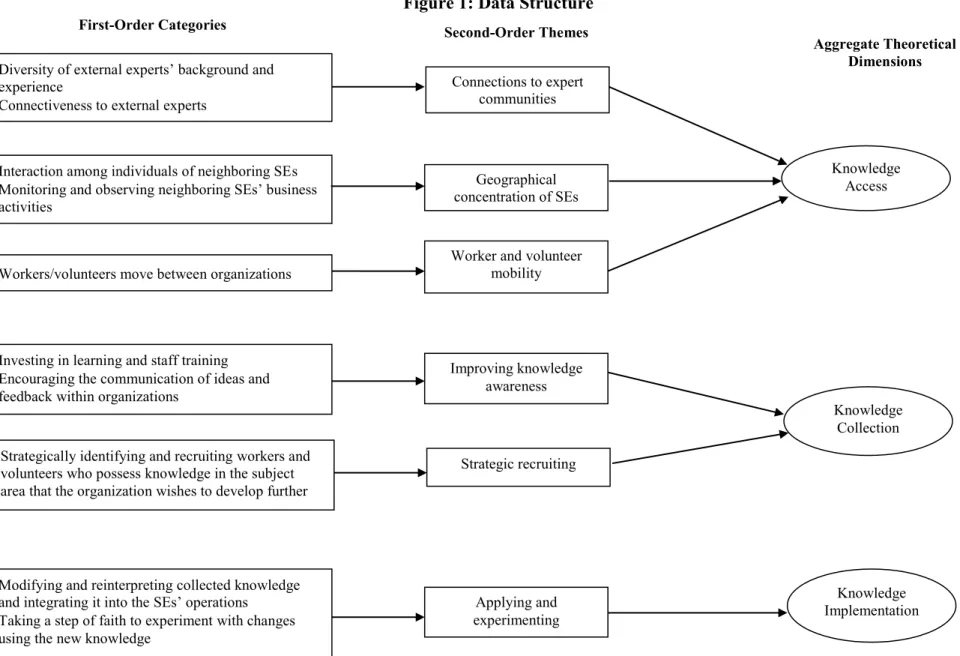
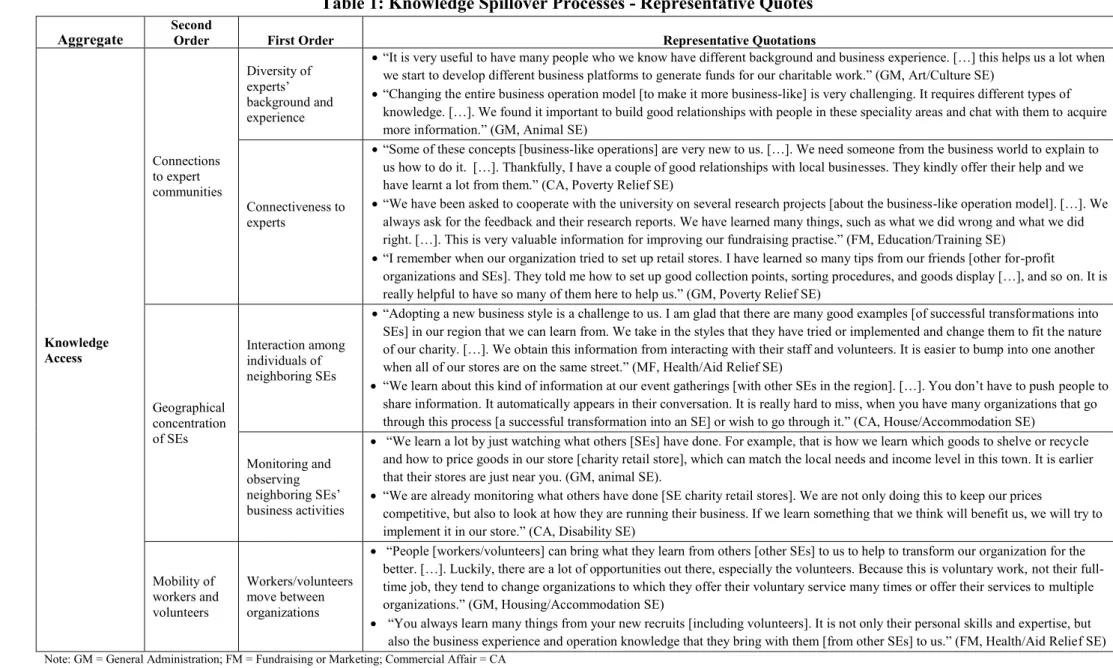
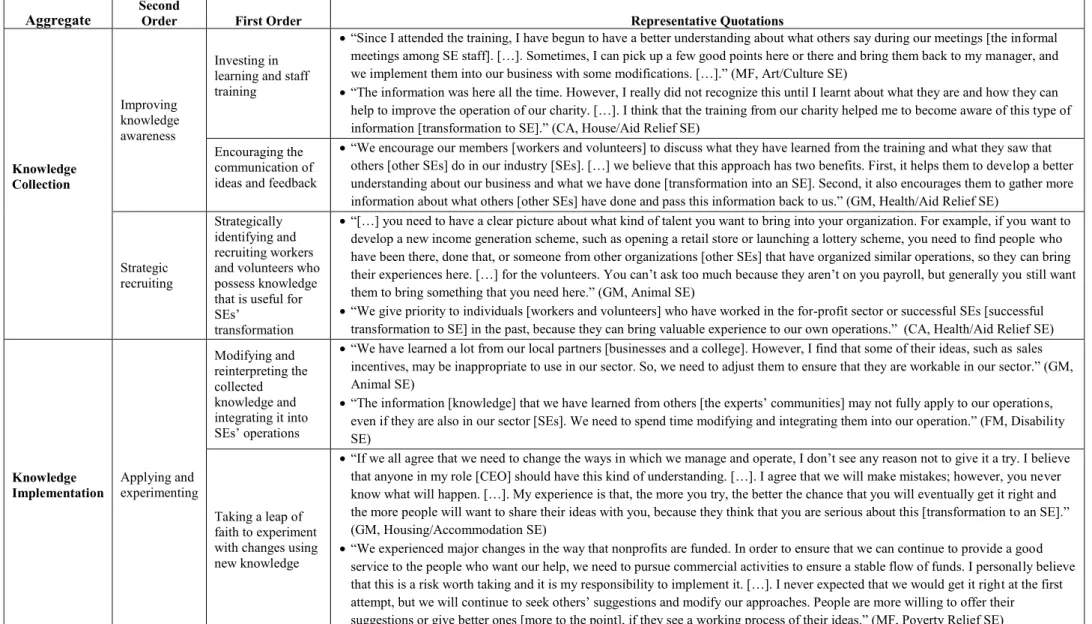
combining certain categories and then establishing the links between them. These formed our second-order themes. We then organized the second-order themes and developed ground theory for the factors related to knowledge spillover. Finally, we adopted the suggestion of Corley and Gioia (2011) to identify the linkages among those constitutive elements in order to develop an integrated framework for knowledge spillover. In the last stage of our data analysis, we drew connections between our interpretations of the interview answers, the parallel literature, and our theoretical framework model. NVIVO software was used throughout the analysis process. Figure 1 illustrates our final data structure and Table 1 shows the first-order data that led to the development of all of the second-order themes and aggregate dimensions in the data.
“Insert Figure 1 Here” “Insert Table 1 Here”
13
According to the final data structure (see Figure 1), the emergent theoretical model comprises three core constitutive elements (aggregate theoretical dimensions) – knowledge access, knowledge collection, and knowledge implementation – in relation to the knowledge spillover phenomenon.
Knowledge access
Knowledge access represents the significance of the potential opportunities for organizations that are in contact with the knowledge holders. Three second-order themes emerged from our data that suggest what SEs can do to improve their knowledge access with regard to knowledge spillover. The first second-order theme describes SEs’ efforts to
establish connections with expert communities which, in this context, refer to pools of knowledge holders who possess the necessary entrepreneurial knowledge to help SEs to adopt more market-driven, business-like operations. We found that the managers of SEs need actively to seek to contact the knowledge holders because no collaborative arrangement has been made between them about knowledge sharing. According to our data, two elements are revealed by the representatives of SEs as the evaluation criteria for the quality of the expert communities that can increase the SEs’ chance to obtain important entrepreneurial knowledge. The first element is the diversity of the experts’ background and experience. Having a large number of knowledge holders from diverse backgrounds in the same expert community provides SEs with more opportunities to find and obtain specific knowledge from them (i.e. knowledge about business operations). The second element, connectiveness to experts, reflects the significance of the representation of the knowledge holders from the private sector, education institution and other SEs in a given expert community. Our findings suggest that SEs often seek help or advice from these three groups of knowledge holders from the expert communities. More specifically, knowledge holders from the private sector and education institutions can provide knowledge about the business operations while knowledge
14
holders from other SEs can provide knowledge about their experience of making the existing operation more market-driven and business-like.
The second second-order theme is the geographical concentration of SEs. This theme describes why the geographical proximity of SEs is likely to enhance the opportunities to access knowledge via knowledge spillover. In relation to our first second-order theme, we acknowledge that the other SEs that are located geographically close to the focal SE are likely to be included as the members of expert communities for the focal SE. However, we consider, in the following analysis, that the impact of the geographical concentration of SEs on knowledge spillover is independent of whether neighboring SEs are be included within the focal SE’s expert communities. This is because geographical concentration offers unique benefits for knowledge to flow from one organization to another, such as low transportation costs, easy dialogue, and so on (Bell, 2005; Saxenian, 2006).
There are two elements in this theme. The first element is interaction among individuals who have the necessary expertise and experience of the business operations of neighboring SEs. From the interview data, we found that the SEs can have more opportunities to obtain important knowledge by interacting with staff from other SEs in the same geographical area. Such proximity increases the likelihood of chance encounters, during which knowledge sharing will take place during the conversations and discussions among individuals who possess important experience and expertise (Saxenian and Hsu, 2001; Saxenian, 2006). The second element is monitoring and observing neighboring SEs’ business activities. Our findings reveal that geographical proximity also increase the likelihood for a focal SE to remain informed about what the other SEs in the local area have done to tailor their business activities to respond to the needs of this specific region. As a result, a focal SE can attempt to imitate their “good practices” as a way to improve its own business activities. Generally speaking, our findings for this second-order theme are in line with prior research that
15
suggests that geographical concentration can give rise to knowledge spillover due to the increasing opportunities to access more exclusive sources of knowledge (Saxenian, 1996; Tallman et al., 2004; Bell, 2005). More specifically, unlike the general knowledge about business operations that SEs can access via expert communities (the first second-order theme), SEs can access more relevant and localized knowledge regarding how to engage in
commercial activities from the perspective of the third sector organizations in a specific region from other SEs located in that same geographical area, as well as observing their implementation at close hand.
The third second-order theme is the SEs’ efforts to take advantage of workers and volunteers’ mobility in order to improve their chance of coming into contact with the knowledge holders. We found that SEs are acutely aware that experienced workers and volunteers who have been working for other SEs that have undergone a transformation to adopt a more market-driven, business-like operating style can draw knowledge from these other SEs and take advantage of it. In particular, several of our informants pointed out that this is especially true for the voluntary workforce, as they tend to offer their voluntary
services to several SEs and change job frequently. Farmer and Fedor (2001) have pointed out that the voluntary workforce is important for SEs’ operations because they can help to reduce the average cost per unit of the workforce to below the market price and enjoy some
intellectual contribution from them. In this research, we found that the SEs’ voluntary workforce also serves as important agents for bringing entrepreneurial knowledge from one organization to another, given the voluntary nature of the job.
Knowledge collection
A second theoretical dimension is knowledge collection. The first second-order theme is the SEs’ commitment to improving knowledge awareness. In the situation of knowledge spillover, where no collaborative knowledge sharing arrangement exists, we found that SEs
16
cannot count on the specific aspects of entrepreneurial knowledge (i.e. the business operation model), that is useful for their transformation, being delivered to their doorstep. Instead, the SEs need to rely on their staff’s ability to detect these specific aspects of entrepreneurial knowledge, and then absorb and share them with other individuals within the organization. Our findings suggest that SEs’ workers and volunteers have started to pay attention to the relevant aspect of entrepreneurial knowledge that can assist their organizations’
transformation from their network contacts because their organizations invest in learning and staff training to make them more aware of this information, and encourage them to
communicate what they have learned to others in the organization. This notion of knowledge awareness is similar to Audretsch and Keilbach (2007)’s suggestion about entrepreneurial opportunities recognition, whereby the individual entrepreneur is required to possess the cognitive process to recognize the knowledge created by a third party but that has been left uncommercialized and use it to create a new venture. In other words, the awareness of particular knowledge plays an important role in knowledge spillover. This cognitive process (knowledge awareness) can be viewed as a knowledge filter. As Audretsch and Keilbach (2007) suggest, the greater the knowledge filter, the greater the divergence between the evaluation of new ideas. In the context of our study, the SEs’ efforts to invest in staff training and encourage individuals to share their ideas with each other give them a greater awareness of entrepreneurial knowledge and the ability to distinguish those ideas that can be used to assist SEs’ transformation and collect important entrepreneurial knowledge from the expert communities that the SEs have accessed.
Another second-order theme that emerged from our data with regard to knowledge collection is strategic recruitment. We find that, in addition to improving individuals’ awareness about what specific aspects of entrepreneurial knowledge the SEs require to initiate or continue their transformation process, and encouraging them to collect this
17
knowledge from the expert communities that the SEs have accessed, SEs can also collect entrepreneurial knowledge directly through strategically identifying and recruiting workers and volunteers who possess knowledge that is useful for the SEs’ transformation. This echoes the findings of previous studies: that many SEs attempt tactically to recruit staff with relevant knowledge and experience to undertake specific commercial projects, such as retail store management, fundraising, communication, and so on (e.g. Broadbridge and Parsons, 2003; Hart et al., 2005). Furthermore, SEs’ strategic recruitment of workers and volunteers from expert communities shows that they are taking a more active role in collecting important knowledge via knowledge spillover. SEs’ actions toward improving the knowledge
awareness of their staff show that they still rely to some degree on their staff’s willingness to collect entrepreneurial knowledge from the expert communities that the SEs have accessed.
Knowledge implementation
The third theoretical dimension that emerged from our data is knowledge
implementation, that reflects the SEs’ efforts to apply and experiment the entrepreneurial knowledge they have collected via knowledge spillover in their business operations. In keeping with the existing understanding about knowledge spillover in the literature (e.g. Audretsch and Feldman, 1996; Agarwal et al., 2007), our data affirm the importance of modifying and reinterpreting the collected entrepreneurial knowledge and integrating it into the SEs’ operations. Our data show that the SEs are able to combine what they have learned from the entrepreneurial knowledge that they have collected with their own experience about the appropriate operation approaches in their sector to develop new knowledge that is more suitable for specific SEs’ situations. When the collected entrepreneurial knowledge has been adjusted and translated for the SEs to use, our data reveal the critical role that the SEs’ managers played in taking a leap of faith to experiment with changes using the new
18
assume risk failure, in order truly to absorb the entrepreneurial knowledge they have collected and use it to develop a more competitive business model, as they sense that it is vital to adopt a flexible business model, and organizations need to adopt a new way to generate revenue in order to fund their social services. This is in line with the change management literature, that has recommended that managers should take the leading role in implementing changes and making adjustments that suit the organizations’ needs, when they sense that change is necessary (e.g. Sirkin et al., 2005; Todnem By, 2005). Interestingly, we found that this managerial attitude of willingness not only allows the organization to apply new knowledge but also enhances the flow of entrepreneurial knowledge from external sources to the SEs and internal knowledge interchange. According to our data, the greater the show of willingness regarding the SEs’ commitment to transformation, the more ideas,
suggestions, and feedback they will receive along the way via knowledge spillover. We found that this is because people are more willing to share their ideas if they feel a sense of
contribution through their input.
Integrated framework for knowledge spillover
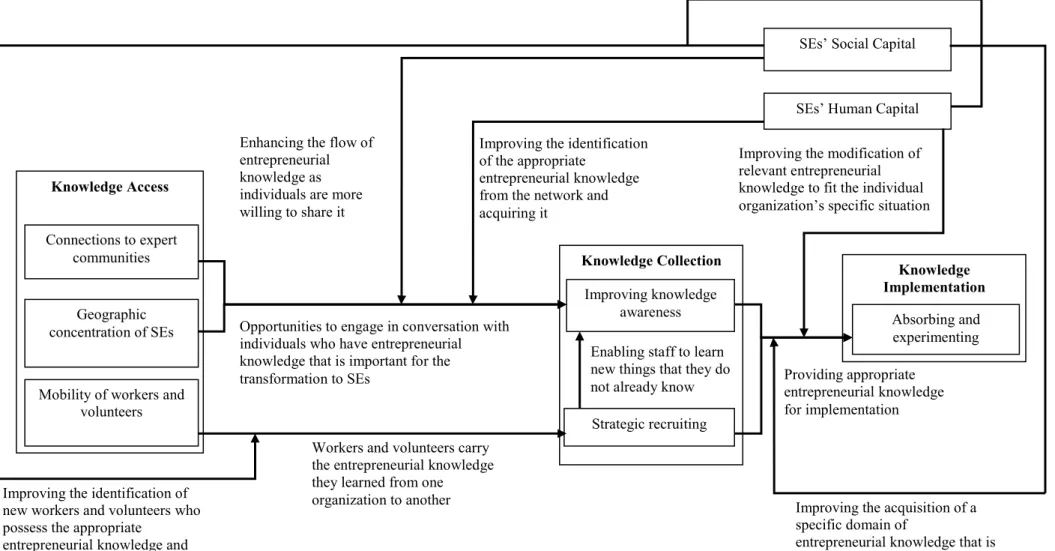
So far, our results have helped us to identify three core constitutive elements of knowledge spillover. Adopting the suggestion of Corley and Gioia (2011), we further assimilate the dimensions and themes from these elements to develop an integrated framework for knowledge spillover (see Figure 2). The framework describes the process whereby SEs access and collect leaked entrepreneurial knowledge from their network and put it into practice.
“Insert Figure 2 Here”
Through our further analysis of their connections, we found that the SEs’ earlier efforts to establish connections with the expert communities reinforce their later efforts to
19
improve the knowledge awareness of their staff. A commercial affair executive from an animal SE provided the following explanation about this linkage:
“[…], another important reason for us to provide training for our staff is the hope that they can better engage in conversation with others [individuals from for-profit organizations, education institutions, and other SEs] during events or at [casual] gatherings. So, they many bring more information [entrepreneurial knowledge] that they think is important for improving our business back to us. […]. Our team [a commercial affair] has been working hard to build good relationships with them [for-profit organizations, education institutions, and other SEs]. This is the one thing we can do [improve knowledge awareness] in the hope that we can learn something from these relationships.”
A commercial affair manager from an aid relief SE further illustrates this point:
“A staff member told me yesterday, after the training, that he wishes he has learning about this [e-commerce training] earlier. […]. He said that, a few weeks ago, he was at a meeting where several attendees were chatting about set up an online store. He was unable to join in the conversion, or he would have attempted to pick their brains about this issue.”
The informants pointed out that the training that SEs offer their staff can improve their awareness of entrepreneurial knowledge. This enables them to take an advantage of SEs’ connections with expert communities by detecting and collecting useful information from them when participating in conversations with the members of such communities. Those SEs that fail to provide efficient training to develop their staff awareness of entrepreneurial knowledge are less likely to benefit from such connections. Similarly, we found that the geographical concentration of SEs can also provide more opportunities for staff in different SEs to engage in conversation with each other, which also reinforce SEs’ efforts to improve the knowledge awareness of their staff. For example, a marketing manager from a poverty relief SE suggests:
“We encourage our people [focal SE’s staff] to network with them [neighboring SEs’ staff] or have a conversation with each other. We [charity retail stores] are located on the same high street. There is no point ignoring each other. Plus, you can always learn something useful from them that may help us to improve our business later on. […]. The key here is to be aware what [entrepreneurial knowledge] is important and what is not. That is one of the reasons we invest in their training programs.”
20
Nahapiet and Ghoshal (1998) suggest that having a common language and codes between individuals in the network environment improves their ability to obtain more information from each other. In the context of our study, it was found that the SEs’ efforts to improve their staff’s entrepreneurial knowledge awareness subsequently allowed them to develop a common language and codes with individuals in the expert communities to which the SEs have access or the staff of neighboring SEs. Therefore, SEs can make the most of their connections with the expert communities, as well as their location, where this is in close proximity to each other, to access entrepreneurial knowledge via knowledge spillover.
At the same time, we also found a linkage between SEs’ efforts to take advantage of this, the mobility of workers and volunteers, and strategic recruitment. The following
testimonial by a general manager from a health/aid relief SE reflects this relationship:
“We are now actively looking for signing workers and volunteers who have business experience or work experience with other nonprofit organizations that have
successful commercial operations. […] they can immediately apply what they know to our projects [in the process of establishing a number of commercial training schemes], given that only a few of us [the current staff] have had this kind of experience in the past.”
Our findings suggest that workers and volunteers take the important entrepreneurial
knowledge that they have learned from one organization to another and that SEs should take advantage of their mobility. A general manager from a poverty relief SE further illustrate this point by suggesting that SEs may fail to access important knowledge if they are unable to recruit staff who possess such knowledge:
“We always want to recruit someone from the private sector who has relevant experience of wholesaling or retailing in charge of our charity retail operation and recycling. I can see other charity retailers benefit from their [staff with relative industry experience] input. However, after many years, we are still unable to do so.”
In contrast to collecting leaked knowledge only through conversations with experts or other SEs’ staff members, the approach of strategic recruitment is more in line with knowledge spillover due to worker or volunteer mobility. It also means that, if SEs fail to recruit workers
21
or volunteers who bring with them entrepreneurial knowledge, they will be unable to collect knowledge by taking advantage of their mobility. Combining the above two findings, we conclude that the process of knowledge spillover starts with SEs taking the initiative in establishing access to sources of entrepreneurial knowledge such as connections to expert communities, the geographical concentration of other SEs and the mobility of workers and volunteers, then proceeding to collect the leaked entrepreneurial knowledge from them by improving their knowledge awareness and strategically recruitment.
We also identified the connections between improving knowledge awareness and strategic recruitment with regard to knowledge collection. An administration manager from a poverty relief SE indicated:
“Every few weeks, we will get together to share what everyone thinks about our current retail operation [charity retailing] and what we can do to improve it. […] every time we bring in new members [recruiting] to our organization, we always learn something new from them at our meetings. This is important to us all, because it improves our understanding of how to run retail stores, so we can have more sophisticated conversations with each other and people from outside our organization.”
In our earlier analysis, we found that, in an effort to improve the knowledge awareness of their staff, SEs encourage them to share what they know and what they have learned from external experts with each other. In the above quotation, the informant suggests that there is another way to improve staff’s entrepreneurial knowledge awareness without involving external encounters. That is to encourage conversation among existing staff and new recruits who already possess some aspects of entrepreneurial knowledge. More specifically, when SEs take advantage of the mobility of workers and volunteers by strategically recruiting them, this means not only asking new staff, who possess the knowledge and experience that the existing staff lack, to take on the commercial side of SEs’ operations, but also about
developing an organizational environment in which the existing staff can learn from the new staff. By encouraging new recruits to communicate with the existing staff, SEs can enhance
22
their existing staff’s understanding of more market-driven, business-like operating styles. This also subsequently improves the staff’s awareness of entrepreneurial knowledge overall, which further enhances their ability to recognize and absorb it when they participate in conversation with external experts.
Thirdly, we find the linkages between the element of knowledge collection and knowledge implementation from two aspects. First, our data suggest that the SEs’ effort to improve their staff’s knowledge awareness allows them to collect leaked entrepreneurial knowledge from the expert communities, which contributes to the SEs’ efforts to apply and experiment with it. A marketing manager from a disability SE provided the following quote to highlight this linkage:
“Although I am happy to try anything to improve the commercial trading side of the business, without knowing what we should try, I still can’t do anything here. […]. I rely on my colleagues to constantly feed me new ideas [which they have learned from others] about what we can do to improve our business, so I can test them.”
The informant points out that, in order to take a leap of faith by turning entrepreneurial knowledge into organizational action, he needs to rely on his colleagues to provide him with new ideas. In this situation, the SEs’ efforts towards improving the knowledge awareness of their staff actually enhance their opportunities to identify, collect and pass on appropriate entrepreneurial knowledge for the managers to implement. Second, our data suggest that strategic recruiting workers and volunteers who possess the appropriate entrepreneurial knowledge also contributes toward the SEs’ efforts to apply and experiment with it. A commercial affairs manager from an art/culture SE explained:
“We have learned many things from them [new workers and volunteers]. […]. In the beginning, we were new to the idea of running a charity like a business. When we first started, nobody had any idea how to do it. So we brought in many people who do. […]. Over the past few years, we have tried to implement many changes to our business operation. I cannot imagine what will happen to us without their help.”
The quotation implicitly highlights the importance of strategically bringing in individuals with appropriate entrepreneurial knowledge because their possession can compensate for
23
what the organizations are currently lacking which prevents them from transforming into SEs. By having knowledgeable workers and volunteers within the organization, the SE enhances its opportunities to learn entrepreneurial knowledge from them and put it into practice.
Furthermore, our model also implicitly suggests that knowledge collection is somewhat distinct from attempts to implement that knowledge. More specifically, the practices of knowledge collection, in the situation of knowledge spillover, usually have a general rather than specific purpose. That is, when SEs engage in knowledge collection, they have a general purpose of obtaining all types of entrepreneurial knowledge, instead of looking for a
particular type. This is different from the usual organizational learning procedures, whereby managers search and absorb a particular type of knowledge to solve specific problems or address specific weaknesses (Argote et al., 2000; Muthusamy and White, 2005; Liu and Ko, 2012). We believe that there are three possible explanations for this outcome. First, as implied in the earlier quotation, even though the managers have a clear objective in that they want to obtain knowledge and use it to make their organizations more market-driven,
business-like entities, however they have limited experience of running SEs. Therefore, they have very little idea about what particular types of entrepreneurial knowledge help to
promote SE transformation. Second, the transformation process is very complex, and usually involves making changes to every aspect of the business operation (Dees, 1998; Brooks, 2008; Weerawardena and Mort, 2012). As a result, it is less likely for managers to have a full
understanding about the exact types of entrepreneurial knowledge that they need to effect such a transformation. Thirdly, knowledge spillover represents the unintentional flow of knowledge from one network party to another (Audretsch and Lehmann, 2006; Audretsch and Keilbach, 2007; Agarwal et al., 2010). Following this logic, we argue that it is less likely that the particular types of entrepreneurial knowledge will always appear via knowledge spillover for managers to use, when problems related to SE transformation arise. Thus, in
24
order to take advantage of the flow of entrepreneurial knowledge in the situation of
knowledge spillover, managers choose to collect all types of entrepreneurial knowledge with no specific agenda through attempts to use such knowledge in the immediate future. Based on the above reasons, the knowledge collection activities, in the situation of knowledge spillover, focus on improving SE members’ knowledge awareness or recruiting people who may
possess knowledge that is useful for SEs’ transformation, rather than engaging in the usual organizational learning procedures.
So far, we have identified the connections among the SEs’ efforts regarding knowledge access, knowledge collection, and knowledge implementation. Besides showing how the SEs’ efforts can influence the acquisition and implementation of entrepreneurial knowledge in the situation of knowledge spillover, our data also suggest that SEs’ social and human capital resources play an important role in facilitating the knowledge spillover process.
“Insert Table 2 about here”
Human capital is defined as the skills and knowledge residing in individual staff which can be used to create value for the organization (Davidsson and Honig, 2003; Hayton, 2003). Our data show that, if the SEs’ staff has rich experience of managing commercial activities, this will help to attract, identify, interpret, and modify the entrepreneurial knowledge collected via knowledge spillover (see Table 2). This is in line with the observation of Broadbridge and Parsons (2003) that SEs will often recruit individuals with higher educational qualifications, more professional and interpersonal skills, and experience of working for for-profit
organizations to help them to change their business model. We suspect that this will
contribute considerably toward helping SEs to translate this entrepreneurial knowledge into the third sector context for their own use. Moreover, our data report that the SEs’ staff members who have rich commercial business experience also brought their connections with the for-profit business world to the SEs. These connections can attract a stronger flow of
25
entrepreneurial knowledge from the for-profit business community. Similarly, our data suggest that SEs’ staff with experience of managing commercial trading activities with other SEs can also help to enhance the chance of future collaboration as well as the flow of
knowledge among SEs. Furthermore, employing these individuals also improves the chance that the ideas and knowledge developed by other SEs, which fits the context of third sector organizations, and has been left unused for specific reasons, can become a source of
opportunities for SEs. At the same time, these staff members who already have experience of helping their previous employers (other SEs) to modify and implement their entrepreneurial knowledge for the purpose of SEs’ transformation can bring their experience to assist their current SEs’ transformation.
According to our data analysis, we found that the SEs’ human capital plays several important roles in the knowledge spillovers process (see Figure 2). To begin with, SEs’ human capital improves their ability to identify the entrepreneurial knowledge that they need to effect the transformation. This has two aspects. First, when an SE possesses greater human capital, its staffs are more likely to identify the appropriate entrepreneurial knowledge during interactions with the members of its expert communities and the staff of neighboring SEs. For example, a manager from an education/training SE in charge of commercial affairs explained:
“I am from the business world and have been working in this sector [the third sector] for many years now. […]. Looking back, I really feel that my earlier experience
helped me a lot in my current job of managing several [commercial] trading
practices that we have developed over the years. I know what will work and what will not…just like running a business. If I run into something that I am not familiar with, I know exactly where I should look for the answers and who I should talk to.”
Second, when a SE possesses greater human capital, its staffs are more likely to identify the persons (new workers and volunteers) who possess the appropriate entrepreneurial
knowledge through recruitment activities. For example, a general manager from a health/aid relief SE suggests:
26
“I feel more confident if some of our colleagues who have worked in private companies earlier in their career are involved in our recruitment process when we want to hire people to work on the commercial side of our business. […]. They know better what kind of skill sets are required by different positions, such as marketing, purchasing and so on.”
Both aspects reflect the same fact; that is, when the staff of an SE have either rich
commercial business experience or rich experience of managing commercial trading activities in other SEs, they are more likely to collect the appropriate knowledge from the sources to which they have access. This is unsurprising, as the relevant research points out that, in order for organizations to obtain knowledge, their staff need to identify in the first place whether it is embedded within abstract conversations (Boland and Tenkasi, 1995; Nahapiet and Ghoshal, 1998) or possessed by the knowledge holders (Lam, 2000; Davidsson and Honig, 2003). In other words, having staff with experience of commercial activities improves the SEs’ overall ability to recognize the useful knowledge that they wish to obtain. This ultimately improves the likelihood that SEs will collect appropriate entrepreneurial knowledge from the
knowledge network to which they have access, as well as recruit workers and volunteers who possess the entrepreneurial knowledge that is needed by the SEs.
Moreover, we found that SEs’ human capital can also improve the possibility of SEs translating the collected entrepreneurial knowledge into organizational action. A commercial affairs manager from a disability SE explained:
“In the end, we are still a nonprofit organization. So, some of the ideas we learn cannot be put to use directly. For example, running a charity shop is not like running a regular local retail store. A lot of things that we learn need to be changed to fit our needs […]. So, this is how you find that colleagues who have worked in both the private and nonprofit sectors are useful. They know how to make the necessary changes.”
Prior research highlights the importance of having staff with relevant business experience who can contribute to the process of transforming SEs (e.g. Broadbridge and Parsons, 2003; Liu and Ko, 2012). Our findings reveal that SEs’ staff will combine their knowledge and experience in both the private and third sectors to make the necessary modification to the
27
relevant entrepreneurial knowledge to fit the SEs’ current situation. This is consistent with Liu and Ko (2012)’s findings that SEs need to make some adjustments to the entrepreneurial knowledge that they have learned from experts to make it fit better with the practice of third sector organizations before implementing it. In this research, we extend this current
understanding by pointing out that the presence of staff with experience of commercial activities can help SEs to engage in such modification by allowing them to distinguish between what knowledge is useful for their transformation and what is not during the process of knowledge spillover. According to our data, this is because these staff members have a better chance of recognizing useful knowledge if they come across it, due to their knowledge and prior experience. Thus, we conclude that, when an SE possesses greater human capital, its staff members are more likely to identify the usefulness of the knowledge that has been collected via knowledge spillover for SE’s transformation.
Social capital, on the other hand, represents both the networks and the resources (i.e. knowledge) that can be accessed via those networks (Nahapiet and Ghoshal, 1998; Adler and Kwon, 2002), and can be further divided into three aspects: relational, cognitive and
structural. The relational aspect of social capital influences the acquisition of knowledge by forming a trust that binds the network parties together (Nahapiet and Ghoshal, 1998; Inkpen and Tsang, 2005). From our interview data, we found that individuals from different SEs are interested in sharing entrepreneurial knowledge with each other via knowledge spillover when they feel that they can trust the other parties and learn new business skills from them in order to improve their own business operations (see Table 2). According to our data,
individuals from different SEs often actively build trust through referrals or associations. Gulati (1995) suggests that a referral mechanism with network ties can enhance the mutual confidence between the network parties because they are aware of the possible negative reputational consequences of their own or others’ opportunistic behaviour from a common
28
third party. Similarly, when organizations organize themselves into an association, they always give it some authority to ensure the provision of collective goods and provide the conditions for acceptable behaviour, such as a membership qualification (Crouch, 2005). Our findings suggest that these two mechanisms allow individuals from different SEs actively to build up trust in each other that will lead to the flow of knowledge between them. When trust has been established, we found that individuals from different SEs often organize informal gatherings in order openly to share their knowledge with one another.
The cognitive aspect of social capital influences the acquisition of knowledge by establishing common goals and approaches to accomplish network tasks and outcomes (Inkpen and Tsang, 2005). In our study, we found that SEs are fully aware of the potential risk that knowledge sharing may pose for their organization because they are still competing with one another to obtain revenue and resources. However, in most cases, they are still willing to share entrepreneurial knowledge with each other because they believe that, by helping each other, they can create greater social benefits for society as a whole. In other words, the SEs are more willing to share entrepreneurial knowledge with each other when they recognize that they are working toward a common objective of providing support to individuals or groups within society, and that the use and implementation of entrepreneurial knowledge is a means to an end.
Finally, the structural aspect of social capital influences the acquisition of knowledge by creating access to more information or knowledge from a variety of network parties
(Nahapiet and Ghoshal, 1998). Our analysis suggests that, for SEs to have continuous, easy access to the knowledge flow from their network, they need to demonstrate that they belong to that network. This is in line with Lin et al. (1981)’s suggestion that, when other parties within the network consider a particular individual actor “one of us”, they will start sharing resources (i.e. knowledge) with this actor. In order to achieve this status, SEs need constantly
29
to signal their “social organization” status to others by exhibiting appropriate behaviors. We found that individuals are less willing to share entrepreneurial knowledge with SEs, if these other SEs do not behave like third sector organizations. This finding indicates that SEs that behave more like social organizations tend to attract more entrepreneurial knowledge flows via their networks than those that do not. Despite the fact that the ultimate purpose of acquiring entrepreneurial knowledge is to transform third sector organizations into more market-driven, business-like SEs, our data suggest that, if organizations appear to be “over-transformed”, they may lose the opportunity to access knowledge from their networks in the future. Thus, it is important for managers to maintain this balance to demonstrate the SEs’ membership of the network to ensure their continued access and absorption of entrepreneurial knowledge via knowledge spillover. Although differences exist among the three aspects of SEs’ social capital in relation to their impact on knowledge spillover, however they are also likely to be interrelated in important, complex ways. For example, SEs’ willingness to trust each other when sharing entrepreneurial knowledge may depend on each party’s motives in creating social benefits and behaving like third sector organizations. Thus, in this research, we view different aspects of SEs’ social capital as a whole, which represents a specific type of resource that resides in the relationship and can be used to create value.
According to our data, we found that the SEs’ social capital causes individuals who are either from expert communities or from neighboring SEs to be more willing to share knowledge with each other (see Figure 2). A general manager from a disability SE provided the following quote:
“We found that businesspeople like to share their ideas with us because they feel that we can be trusted and they are doing a good thing for society.”
A general manager from a housing/accommodation SE provided a different perspective:
“Yes, we do. We share information with people from other charities that are also interested in running charity shops. […]. We think that’s the right thing to do, unless they have a bad reputation for only caring about money, not charitable work.”
30
These patterns in our data suggest that, during knowledge spillover, when individuals feel that they 1) are willing to be open and trust each other, and 2) are working together to achieve a common objective, the flow of knowledge is more likely to increase as individuals become more willing to share it. Similarly, we also found that SEs have a better chance to absorb entrepreneurial knowledge from others when they behave like third sector rather than commercial organizations. For example, a general manager from an art/culture SE suggests:
“A group of us [other SEs] will meet regularly to discuss issues related to our business operations. This group is very selective. We do not want someone who we do not trust attending our meetings. We all find these meetings very valuable since we can learn from each other because organizing business activities is relatively new to some of us. We can learn a lot of things from them, from donation collection to marketing techniques […].”
In general, SEs with greater social capital find it easier to access and so collect more
entrepreneurial knowledge from the expert communities or other SEs in the local area. This is because the senders are more likely to feel that, by sharing their entrepreneurial knowledge with receivers, they are contributing to society as a whole. Previous studies on exchange ideology suggest that individuals will evaluate their exchange relationships (with other individuals, organizations and so on) based on their pre-existing general belief system about what to give and receive (Witt, 1991; Lin, 2007). Individuals with a high exchange ideology are more concerned about what they receives from the exchange and what to give others, in return (Eisenberger et al., 2001; Witt et al., 2001). In the context of our study, our data suggest that individuals in both expert communities and the staff of neighboring SEs appear to have a high exchange ideology to reciprocate with more willingness to share
entrepreneurial knowledge when they think that SEs can be trusted to use such knowledge for altruistic purposes. This is evidenced by the fact that the senders are concerned about whether the receivers (and the organization to which they belong) will use the entrepreneurial
31
suggests that SEs’ investment in relationship building with expert communities does not always lead to knowledge access. In other words, our findings suggest that knowledge access involves having not only a close connection with the other parties within networks, but also the status or reputation of the SE among the individuals within such communities, which grants the SE access to knowledge. Adler and Kwon (2002) refer to such status or reputation as an organization (or individual’s) “goodwill” which can mobilize the resources within networks and make them available for the organization (or individual actors).
Besides improving the knowledge absorbed from the networks, we also found that the SEs’ social capital is able to strengthen the relationship between knowledge access and knowledge collection through recruiting skilful workers and volunteers. For example, a marketing manager from an education/training SE suggests:
“We always ask our staff to stay in contact and develop a good relationship with the people they meet at any of the events, especially when they have special knowledge that our charity needs such as e-commerce and so on. […]. We will try to ask them to do some voluntary work for us and show them how our work can make society a better place to live in, as our reputation precedes us. […]. If they are planning to leave their current job, we will try to persuade them to join us.”
As the example above demonstrates, SEs’ social capital improves their chance of taking advantage of the mobility of their workers and volunteers. This is similar to the situation in the private sector. For example, Leung (2003) suggests that private small and medium sized enterprises use social capital to identify and recruit talented individuals from their network to offset their lack of resources. What we found interesting here is that the SEs’ social capital also carries a persuasive power that derives from the SEs’ goodwill as organizations that have done great things for society as a whole. To demonstrate this point further, a fundraising manager from a housing SE provided the following example:
“I know that some charities operate like a business and focus on profit. […]. They may attract many people from charities or even the private sector to work for them, because the pay is good. However, they will never attract someone like me or anyone I know, who believe that our social mission should come before our economic
32
The above quotation illustrates that SEs may fail to attract and recruit certain workers and volunteers, if they do not behave like organizations in the third sector. In general, SEs’ social capital cannot only improve the identification of new workers and volunteers who possess the appropriate entrepreneurial knowledge but also persuade them to join the SEs by highlighting the SEs’ goodwill as contributors to society.
Finally, we found that SEs’ social capital can also enhance the connection between knowledge collection and knowledge implementation. A CEO from a poverty relief SE commented:
“When we try to apply and implement what we have learned [entrepreneurial
knowledge] in our commercial side of operation, there are always some missing links. […]. That’s why we want to build and maintain good relationships with people in different fields. So, if we need help, we can always find someone who you can take your problem to in a very short period of time.”
In the situation of knowledge exchange, both sides agree on the content of the knowledge that will be exchanged (Inkpen and Tsang, 2005; Walter et al., 2007). Thus, the quality of
knowledge that the organization has received through knowledge exchange is predictable and comprehensive. In comparison, the quality of knowledge acquired through knowledge
spillover is less predictable because the flow of knowledge is unintentional (Agarwal et al., 2007; Audretsch and Keilbach, 2007). In other words, there is a limit to the degree of comprehensiveness regarding the knowledge that can be acquired via knowledge spillover. As a result, the SE needs to collect supplementary knowledge to compensate for this. As one informant noted, SEs, in such a situation, can use their social capital to influence the
individuals in their network to share with them the additional entrepreneurial knowledge that the SEs are unable to collect via knowledge spillover alone. Once the SEs have collected more comprehensive knowledge, they are more likely to implement this within their operations. In sum, our above analyses show how SEs’ social and human capital can
33
influence the process of knowledge spillover that enables organizations to acquire leaked knowledge and implement it in practice to transform themselves.
Concluding Remarks
Our objective in this study was to understand the process of knowledge spillover by studying the critical role that it plays in enabling third sector organizations to collect leaked entrepreneurial knowledge and turn it into organizational knowledge. We develop a model of how managers intentionally mine or make use of the possibility of knowledge spillover to transform traditional third sector organizations to become more market-driven, more
business-like SEs. This study contributes to the extant knowledge spillover literature in many ways. Firstly, we identify organizations’ efforts to access, collect, and implement knowledge during knowledge spillover. More specifically, we find that SEs can have a better chance of accessing important entrepreneurial knowledge by establishing connections with expert communities and taking advantage of the mobility of their workers and volunteers, to collect it by improving the knowledge awareness of their staff, recruiting knowledgeable individuals strategically to their organization, and implementing it by taking action with regard to
applying and experimenting with it. In comparison with previous research that focuses on the learning aspect of knowledge spillover (e.g. Audretsch and Lehmann, 2006; Kotha, 2010; Oldroyd and Gulati, 2010; Yang et al., 2010), our findings provide a clearer picture of what organizations can do to improve their opportunities to access, collect, and implement the knowledge that flows from one party to another without any collaborative arrangement existing between the parties.
Second, we identify the factors that can influence the flow of knowledge from one party to another during knowledge spillover. Knowledge flow is more easily influenced by various potential factors during knowledge spillover because, in comparison to collaborative