Privacy Management
Dissertation
zur Erlangung des akademischen Grades
Doktoringenieur (Dr.-Ing.)
vorgelegt an der
Technischen Universität Dresden
Fakultät Informatik
eingereicht von
Adrian Nuradiansyah, M.Sc.
geboren am 29. August 1992 in Jakarta, Indonesien
eingereicht am 20. September 2019
verteidigt am 25. November 2019
Gutachter:
Prof. Dr.-Ing. Franz Baader
Technische Universität Dresden
Prof. Piero A. Bonatti
Universita’ di Napoli Federico II
I would like to present my first gratitude to my wife, BERLIANPRAWIRO, and my little son, CEDRICATHALLANURADIANSYAHfor the happiness and cheerfulness they always share every day.
During the work on my thesis for 3 years, I am indebted to my supervisor, FRANZBAADER, very much for his supports, insightful comments, as well as his patience. I would also like to thank THORSTENSTRUFEfor being the subject expert of my thesis, which shared many privacy scenarios that are relevant to my thesis. Furthermore, I would like to express my gratitude to PIEROBONATTIfor conducting a review on my thesis.
I am also thankful to ANNI-YASMINTURHANthat has become my first lecturer in Description Logics since I studied in Dresden 5 years ago. My sincere appreciations are also sent to RAFAEL PENALOZA that has kindly advised me for the study ofontology repairduring my 3-months visit to Free-University of Bozen-Bolzano last year as well as to BERNARDOCUENCA GRAUand EGORKOSTYLEVthat also has generously supported me in understanding the study ofprivacy-preserving ontology publishingduring my 3-months visit to the University of Oxford this year.
I highly appreciate KERSTINACHTRUTHand ULRIKESCHÖBELfor their help in adminis-trative works and their encouraging and positive words. I also share my gratitude to the ‘Graduiertenkolleg’ RoSI that has supported me in terms of facilities, lectures, workshops, and finance. Moreover, I also thank my colleagues in the Chair of Automata and RoSI as well as to my friends for the joy and the exciting time.
Last, but not least, I thank my families in Depok and Samarinda that always support me via video call almost every day :)
1 Introduction 1
1.1 Description Logics . . . 5
1.2 Detecting Privacy Breaches in Information Systems . . . 6
1.3 Repairing Information Systems . . . 8
1.4 Privacy-Preserving Data Publishing . . . 10
1.5 Outline and Contributions of the Thesis . . . 11
2 Preliminaries 15 2.1 Description LogicALC . . . 15
2.1.1 Reasoning inALCOntologies . . . 17
2.1.2 Relationship with First-Order Logic . . . 23
2.1.3 Fragments ofALC . . . 24
2.2 Description LogicEL . . . 25
2.3 The Complexity of Reasoning Problems in DLs . . . 26
3 The Identity Problem and Its Variants in Description Logic Ontologies 29 3.1 The Identity Problem . . . 30
3.1.1 Description Logics with Equality Power . . . 30
3.1.2 The Complexity of the Identity Problem . . . 34
3.2 The View-Based Identity Problem . . . 40
3.3 Thek-Hiding Problem . . . 45
3.3.1 Upper Bounds . . . 46
3.3.2 Lower Bounds . . . 50
4 Repairing Description Logic Ontologies 53 4.1 Repairing Ontologies . . . 54
4.2 Gentle Repairs . . . 56
4.3 Weakening Relations . . . 60
4.4 Weakening Relations forELAxioms . . . 63
4.4.1 Generalizing the Right-Hand Sides of GCIs . . . 64
4.4.2 Syntactic Generalizations . . . 68
4.5 Weakening Relations forALC Axioms . . . 73
4.5.1 Generalizations and Specializations inALC w.r.t. Role Depth . . . 73
4.5.2 Syntactical Generalizations and Specializations inALC . . . 74
5 Privacy-Preserving Ontology Publishing forELInstance Stores 77 5.1 Formalizing Sensitive Information inELInstance Stores . . . 79
5.2 Computing Optimal Compliant Generalizations . . . 81
5.3 Computing Optimal Safe∃Generalizations . . . 85
5.4 Deciding Optimality∃inELInstance Stores . . . 87
5.5 Characterizing Safety∀ . . . 91
5.6 OptimalP-safe∀Generalizations . . . 93
5.7 Characterizing Safety∀∃and Optimality∀∃ . . . 97
6 Privacy-Preserving Ontology Publishing forELABoxes 99 6.1 Logical Entailments inELABoxes with Anonymous Individuals . . . 101
6.2 AnonymizingEL-ABoxes . . . 103
6.3 Formalizing Sensitive Information inELABoxes . . . 108
6.4 Compliance and Safety forEL-ABoxes . . . 109
6.5 Optimal Anonymizers . . . 120
7 Conclusions 127 7.1 Main Results . . . 127
7.2 Future Work . . . 128
Introduction
Living in an era that enables us to collect and disseminate any form of data provides us with various impacts. On the positive side, governments, companies, or individuals may employ all these data for knowledge-based decision making, which then prompt them to make own significant business or individual decisions. Notwithstanding these promising benefits, this sort of data transaction activity may cause the sacrifice of the privacy value of the data. For example, in a very famous study from Sweeney in[Swe00], it was found that 87% of the US population can be uniquely identified by gender, ZIP code, and full date of birth within an experiment using 1990 US Census summary data. In medical area, research from[Wes76] stated that the necessity of patients data dissemination may infer sensitive or personal information of the patients, such as their job status, their types of insurance, or even an information about whether the patients are permitted to drive cars or not due to the serious illnesses they suffer from. These concerns also arise in workplaces where employers’ actions aimed to protect company assets or safeguard proprietary information may violate confidential data of employees if these data are used for inappropriate purposes[FR07].
Realizing all these privacy matters, one needs to understand avenues and methods of producing a sort of anonymous data that preserves privacy policies, but keep a high utility value when it is released publicly. In databases, the study of data privacy itself has been a long-standing research area. This ranges from the studies of privacy detection in data-bases (e.g., [MS07; DP05]), enforcement for controlled query evaluation (e.g.,[BB04]), database anonymizations (e.g.,[Swe02a]), to the study of attack models in databases (e.g.,
[FWC+10]).
That being said, all such existing works on privacy in databases mainly assume that the information in databases iscomplete. When we shift to another more expressive data representation, such asontologies, then they are mainly assumed to deal withincomplete information. The term incompleteness in this context means that we can infer additional facts from the ontologies, which are not explicitly stated there. Furthermore, in contrast to complete databases, during query evaluations, all these inferred facts are derived by taking allmodels of the ontologies into account, which intuitively may involve complex interactions with other pieces of information within the ontologies.
It should be realized that incomplete databases[Lev96; MHS09] also exist in the area of databases and ontologies are strongly related with them. Moreover, researches on data privacy in the context of incomplete DBs have also been investigated in some literature, such as[BTW10; BW08]. However, ontologies itself are formulated using languages that are much more expressive than database schema languages. One of the most common languages formalizing ontology is the Web Ontology Language (OWL)1that has been standardized in
1See https://www.w3.org/TR/owl-features/
Ontology
Engineer
Data Collection
−−−−−−−−−−−→
Data Owner
Data Publishing
−−−−−−−−−−−→
Data
Receiver
Figure 1.1: A scenario for data transactions within organizations
2004 and frequently used in many application domains. This standardization also resulted in a connection with a family of knowledge representation (KR) languages, called Description Logics (DLs)[BCM+03; BHL+17], that are more known as a logic-based semantics which, up to some different notations, are a fragment of first-order logic. This connection provides more promising features for ontologies to not only be used for giving well-defined and understandable reasons why a statement is entailed by the ontologies, but also be extensively integrated with other automated reasoning technologies, e.g., DL reasoners2.
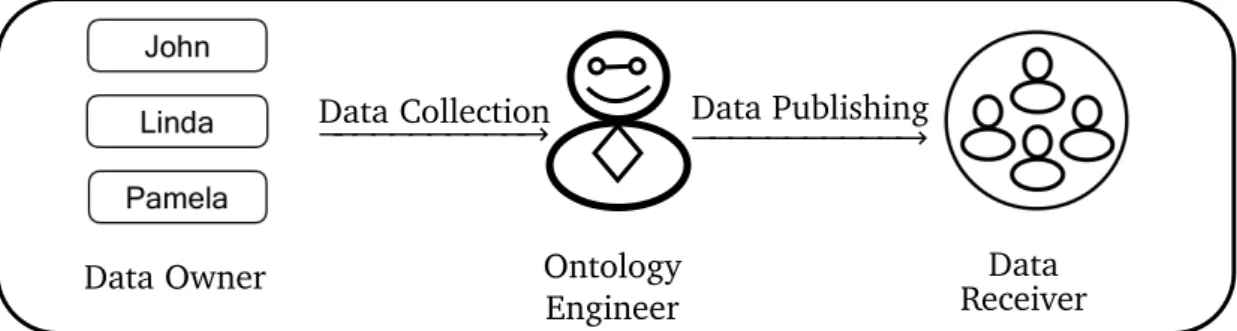
However, the capacity of ontologies to infer new facts is still prone to privacy violations in general. To come up with reasonable actions that can be used for privacy management in ontologies, we start with a scenario of data transactions depicted in Figure 1.1. Taking a look at the figure, a typical scenario for data transactions in some (government) organizations consists of the data collection phaseand thedata publication phase. In the former phase, the ontology engineer collects the data from data owners, e.g., John and Linda, and then stores them in a database that has been augmented with an ontology. Meanwhile, in the data publication phase, the ontology engineer releases the whole or some parts of the ontology to (possibly unknown) data receivers. As an example, an IT division of a hospital, acting as an ontology engineer, collects the data about medical information of patients and then share parts or the whole of the data to a data receiver, e.g., a medical center, that wants to build a cyclical pattern of some diseases based on the patient data by integrating it with other external ontologies. Nevertheless, a privacy leak is very susceptible to occur in the publication phase. For instance, it might be the case that information about patients are disclosed unauthorizedly to users or data receivers who have no access to the information. This means that the ontology engineer needs to be at least guided with the following anticipation steps:
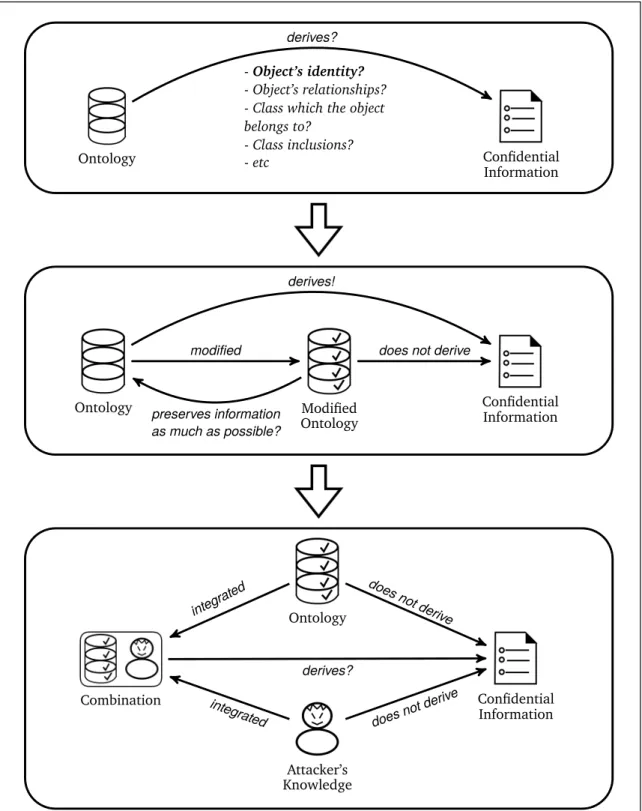
1. Asking if the confidential information of objects is kept hidden or not w.r.t. the ontology. In particular, as mentioned by[Gra10], the identity of an (anonymous) object is a critical asset that needs to be protected in many application domains, e.g., medical or insurance.
2. Repairing the ontology in a minimal way such that the identity or other sensitive properties of individuals cannot be inferred from any user, but at the same time, the utility value of the ontology is still preserved.
3. The two above steps only assume that the users’ knowledge is a part of the ontology in the data publication phase. However, according to[FWC+10; Gra10], when the ontology is ready to be published on the Web or to be integrated with other external applications, the solution for ontology repairs should be featured with a provable logic-based guarantee against a linkage attack from other possible users (attackers) that may have extra knowledge from different sources. In particular, this sort of attacks may occur when the combination of the repaired ontology with background knowledge of external users (atackers) still violates a privacy policy.
In the context of privacy in OWL or DL ontologies, to the best of our knowledge, the studies of preserving identity or reckoning linkage attacks during the publication phase are still unexplored, whereas the studies of ontology repairs have been carried out by e.g.,[Hor11; DQF14; LSP+08; TCG+18]with different settings and motivations. In this thesis, we only focus on ontologies written in Description Logics and, in general, we deal with the following tasks inspired by the three anticipation steps above:
1. We formulate various new reasoning problems in DLs aimed at preserving the identity of individuals. We present algorithms to solve the problems and provide complexity results for each problem.
2. Then, in case the identity or other properties of some object is not preserved, we build a general framework forrepairing ontologiesin a minimal way based oninformation weakeningthat can be used to get rid of unwanted consequences, e.g., to hide secret consequences.
3. Last, we studyprivacy-preserving ontology publishingwhere the ontology is ready to be published on the Web. Since information linkage may happen and violate privacy of individuals in this case, we specifically provide a logical mechanism against such matters.
Relating the three main tasks above with the studies on privacy in general, we realize that what we focus on this thesis is more about the confidentiality aspects of privacy and then build mechanisms to achieve those confidentiality goals. Some other privacy aspects, such as controlling personal data usage after disclosure[FAK+16] or the right to be forgotten
[Ros11]are beyond the scope of this thesis.
Figure 1.2 represents a general illustration of how the tasks mentioned above will be explained in detail sequentially throughout chapters within this thesis, in particular from Chapter 3 to Chapter 6. The remaining parts of this chapter are described as follows. In Section 1.1, we give a brief introduction to Description Logics. In Section 1.2, we explain existing work on detecting whether confidential information about individuals is protected or not in some form of information systems, such as databases or ontologies. In Section 1.3, we present existing methods to repair the systems in a way that the unwanted consequences can be removed. Then, in Section 1.4, we discuss the state-of-the-art of the research on privacy-preserving data publishing, which motivates the study onprivacy-preserving ontology publishingin this thesis. Last, in Section 1.5, we give an outline of the thesis as well as the list of related publications.
Ontology
-Object’s identity?
-Object’s relationships?
-Class which the object belongs to? -Class inclusions? -etc Confidential Information derives? Ontology Confidential Information Modified Ontology derives!
does not derive modified preserves information as much as possible? Ontology Combination Confidential Information Attacker’s Knowledge does not deriv e doesnot derive integrat ed integ rated derives?
1.1 Description Logics
Description logics (DLs) are a family of knowledge representation languages which can represent conceptual knowledge of an application domain in a formally structured and well-understood way[BCM+03; BHL+17]. Due to the prominent adoption of the DL-based language OWL[HPH03], which has become the standard ontology language, many important application areas use DLs as the definition of their ontologies, for instance, in the biology and medical areas[HSG15]. Prominent ontologies that have been used for many different purposes in these two areas are, such as SNOMED CT3, GALEN4, or GENEONTOLOGY5.
In terms of the syntactical features DLs have, the building blocks of these logics areconcept namesexpressing the set of elements that can be viewed as unary predicates,role names denoting a relation between elements that can be seen as binary predicates, andindividual namesthat point to single elements. From these blocks, the notion of DLconceptsare formed using the constructors that the DL has. For example, in a workplace application domain, EmployeeandTechTeamare concept names expressing the set of all employees and the set of all technical teams, respectively, whileworksAtis a role name denoting a binary relation between employees and the divisions where the employee is working. For instance, the DL concept
Employeeu ∃worksAt.TechTeam
defines the set of all employees working at a technical team. When we want to construct DL ontologies, it should be considered what sort of information or axioms we want to include in the ontologies. Normally, DL ontologies consist of two different types of knowledge. First, it has a terminological knowledge (TBox) consisting of axioms, calledGeneral Concept Inclusions (GCIs), stating hierarchical relationships between concepts. For example, in the medical area, we may have an axiom
Patientu ∃suffer.BloodCancer v ∃symptom.Coughu
∃symptom.Fatigueu ∃symptom.(Rashu ∃feels.Itchy). In addition to TBoxes, DL ontologies also consist of assertional knowledge (ABox), where instances of concepts and the relationships between these instances are stated. For example, the assertions
Patient(JOHN),suffer(JOHN,BC),BloodCancer(BC)
say that John is a patient suffering from a blood cancer. DL ontologies provide their users with abilities to infer implicit knowledge from the stated explicit axioms. One may wonder whether there is an implicit contradiction within an ontology by asking if the ontology has a model (satisfiability problem). Another typical question is to ask whether a concept is more specific than another concept w.r.t. an ontology (subsumption problem) or whether an individual is an instance of a given concept w.r.t. an ontology (instance problem). For example, the combination of the terminological and assertional axioms above may derive
(∃symptom.(Rashu ∃feels.Itchy))(JOHN)saying that John has a symptom which is a rash that feels itchy.
3See http://www.snomed.org/
4See https://bioportal.bioontology.org/ontologies/GALEN 5See http://geneontology.org/
A main concern occurring in many works on DLs is to develop expressive DLs that have decidable inference problems that can be solved by practical reasoning procedures. For instance, the DLALCis the smallest DL closed under Boolean operator[Sch91; SS91]and the reasoning is already EXPTIME-complete in this logic. Furthermore, for a DL that is more expressive thanALC, such asSROIQknown as the underlying logic for the full version of the second generation of OWL, called OWL 2[HKS06; GHM+08], the reasoning here becomes N2EXPTIME-complete. This intractability issues brought motivations to DL communities to find out DLs that are tractable in practice. For instance, in the Description logicEL, which is a sub-logic ofALC and only has conjunctions (u), existential restrictions (∃r.C), and the top concept (>) as its constructor, reasoning can be done in polynomial time[BBL05].
In addition to answer yes/no questions for the reasoning problems mentioned above, DL ontologies can also be viewed as collections of information used to derive answers, which are generally tuples of individuals, for queries. Commonly, many application use conjunctive queries (CQs) as a form of querying in the context of DL ontologies. A CQ is essentially a first-order formula of the form of conjunctions of atoms over unary or binary predicates with existentially quantified variables. Complexity-wise, answering conjunctive queries is already intractable for all aforementioned DLs, e.g., it is NP-complete in the Description LogicEL[Ros07]. However, if the complexity is measured in the size of the data only, i.e., in the size of ABox, which is calleddata complexity, then the complexity of CQ answering inELbecomes PTIME-complete[Ros07]. Even, most members of theDL-Litefamily, which is a family of tractable DLs mainly used in ontologies with very large ABoxes associated to relational databases, enjoy the very low data complexity AC0 for CQ answering[CDL+13].
1.2 Detecting Privacy Breaches in Information Systems
Tracing back to very early history of philosophical discussions, we cite a concept of ‘privacy’ in one of the well-known Aristotle’s arguments:
There is a distinction between two spheres of life, which are the public one associated to political activity and the private one that concerns with domestic life.6 (Aristotle) Having said that, any single object in this world has their own assumptions on the notion of privacy in their domestic life. In information systems, the term sensitive data itself varies from one work to another and is also protected differently depending on the settings that are being considered. One of the early protections against unintended disclosures was introduced by the concept ofrole-based access controlin[SCF+96]where every user of a system is labeled with a role that defines which information can be accessed by the user. In this privacy scheme, the main focus is to design a security mechanism to predefine role-permission relationship, instead of detecting whether some secret data is protected or not w.r.t. a given information system.
The work by Samarati and Sweeney in[SS98]was arguably the first one, at least in the database area, addressing the problem of releasing individual-specific data while, at the same time, safeguarding the anonymity of the individuals. In their well-defined confidentiality criteria, called k-anonymity, a secret is violated if there is an attempt to distinguish the
information for each database tuple from at leastk-1 tuples whose information also appears in the released table.
A different means of shielding the secret information is also captured in the notion of Controlled Query Evaluation(CQE) that was studied in[BB04]for databases. The correct answer of the user queries w.r.t. the given database is judged by some censor. If the censor notices that the query answer violates one of the policies, then amodifierthat may distort the form of the answer, either aslyingorrefusal, is applied. In databases, a privacy leak may occur due to a set of materialized views over the database, which is actually intended only to be an accessible layer for users to query, rather than to store the data. The various studies of checking whether a confidential query is entailed by a set of database views were investigated thoroughly in, for instance,[DP05; MS07].
Motivated by the long-standing research of privacy in databases, the concern of preserving confidential information in ontologies becomes a critical requirement in numerous applica-tions. Deciding what can be told to a user without revealing secrets from an ontology in an access-control manner has been investigated in[BKP12], where the axioms of the ontology are labeled with access restrictions, and users can only see the (consequences of the) axioms for which they have right of access. Instead of restricting the access only on the side of the axioms, the works from[GH08; SS09; CDL+12; GMK09; GM12; GKK+15]restrict the user access on the side of the ontology consequences.
A first attempt to restrict the user access on the consequences side is by adapting the CQE paradigm over ontologies that were done by[TSH10; BS13; GKK+15]. This approach is performed by using a confidentiality-preserving layer such that any finite set of answers for the query w.r.t. this layer will not disclose any secret. Depending on the context, this layer is called complement of a secrecy envelope in[TSH10], viewin[BS13], orcensor in
[GKK+15]. Moreover, in the context of ontology reuse, it might be the case that such an external ontology-based applicationEwants to reuse an ontologyOwhose content is not available due to privacy concerns. To avoid any leak of sensitive data during the reuse phase,
[GMK09; GM12]proposed such an oracle that can be used to access the content ofOsuch that, by using a, so-called,import-by-queryalgorithm, any answer for user queries about
E∪Oare based on the union ofE and the oracle only. In another case, the practice of view-based query answering studied in[GH08; SS09; CDL+12]only allowed the user to access the ontologyOvia a query interface that only enable them to ask permissible queries. These sort of queries, together with their answers, are represented as a setV of views over
Oand the data to be protected is defined as a queryq.
In[SS09], the ontologies were written inALC and the queries were limited to either a subsumption querywhich asks whether a conceptC is subsumed by another conceptDw.r.t.
Oora retrieval querywhich computes all individuals that belong to a given concept w.r.t.O. Their privacy problem asks whether the data privacy is preserved forqw.r.t. the combination ofV and additional background knowledge of the user. In contrast to the latter problem that only concentrates on standard semantics in DLs, the privacy problem considered in
[CDL+12]provides additional semantics for view-based query answering, each one capturing additional properties for the answers of the queries. Then, applying these various semantics in their framework, they ask whether the secret facts captured as answers ofqlogically follow fromOw.r.t.V. They apply this framework, in particular, to theDL-Litefamily[CDL+07; ACK+09]. Differing from[SS09; CDL+12]that principally only use classical semantics in their logics,[GH08]also takes additional background knowledge of attackers captured as
a probabilistic distribution into account. They consider the notion ofperfect privacywhich guarantees that the attackers should not learn anything about the possible answer ofqw.r.t. V whenever their knowledge is increased.
Nevertheless, as argued by[Gra10], among the confidential information about individuals, that should be commonly protected, is theiridentity. However, none of the works mentioned above explicitly considers the notion of identity of an object and provides a mechanism to detect whether the identity is hidden or not. In their works, properties of individuals, i.e., the memberships of an individual (or a tuple of individuals) are the common information they try to hide in their settings. For instance, in the medical example we had in Section 1.1, if it is secret to know that John has a symptom of the form itchy rash, then the property ‘symptom’ of John is not protected w.r.t. the combination of axioms written in Section 1.1. In the context of DL ontologies, however, the formal term of identity itself is also not defined yet. In Chapter 3, we define the notion ofidentityof individuals formulated in DLs and then study various reasoning problems related to identity preservation.
1.3 Repairing Information Systems
In the previous section, we described several works identifying whether a secret is deduced from either databases, ontologies, a set of views, or a combination of a protected system with an oracle. Some of the works complement this identification process with some censors that may twist the real answers of user queries or pointing the users to other subsets of real answers that do not disclose any secret. Alternatively, another possible action that can also save sensitive valuable data from unintended disclosures is by directly modifying or repairing a given information system in a way that the modified one does not entail any sensitive data. Indeed, as long as the secret is not a tautology, one may easily modify the system by emptying its information, and obviously the secret will not be deduced. However, one also needs to take care of the utility of the modified system whose data still can be learned by other parties. Thus, the modification needs to ensure that the modified ones remain maximally informative to users. Similar to previous sections, for literature study, we focus on such information systems in the structure of database and ontologies.
In database studies, two common approaches that are used to modify the data are by applying either aperturbation or ananonymizationtechnique. A popular instance of the former technique is called differential privacy introduced by Dwork in [Dwo06]. Being commonly used in statistical databases for survey of population, this approach introduces noise in each of the numeric quantities of personal data in a way that the modified database will be used for further statistical analysis. However, in other cases, it is more necessary to release actual data, and not just statistical information. To this end, an anonymization approach, namelyk-anonymity[SS98; Swe02b], is more suitable for this demand. To realize this approach,[Swe02a] provided ageneralization technique which involves replacing a value with a less specific but semantically consistent value, and asuppressiontechnique which decides to not release the sensitive data at all. The work on data suppression as well as complexity of optimalk-anonymity was investigated further in[MW04].
The notion ofrepairin DL ontologies initially did not come from a privacy scenario, but from a more general situation where engineers of DL-based ontologies have problems to understand why an ontology is inconsistent or why a consequence (subsumption or instance
relationships) computed by the DL reasoner actually follows from the ontology. This leads to the question on how to repair the ontology in case the consequence is not intended. This question becomes more challenging since the size of DL-based ontologies grows and the tools that support improving the quality of such ontologies are highly demanded, which imply that the need for an ontology maintenance in the sense of repairing ontologies becomes important.
Axiom pinpointing[SC03]was introduced to help developers or users of DL-based onto-logies to understand the reasons why a certain consequence holds by computing so-called justifications, i.e., minimal subsets of the ontology that have the consequence in question. Black-box approaches for computing justifications such as[SHC+07; KPH+07; BS08]use repeated calls of existing highly-optimized DL reasoners for this purpose, but it may be necessary to call the reasoner an exponential number of times. In contrast, glass-box ap-proaches such as[BH95; SC03; PSK05; MLB+06]compute all justifications by a single run of a modified, but usually less efficient reasoner.
Given all justifications of an unwanted consequence, one can then repair the ontology by removing one axiom from each justification. This approach gives a close connection with the well-known model-based diagnosis from[Rei87]. In[KPS+06a], this approach is extended to the very expressive DLSHOIN and the authors consider a ranking of axioms that can be used to select preferred repairs. An implementation of this approach was made available in the ontology editor SWOOP[KPS+06b]. However, removing complete axioms may also eliminate consequences that are actually wanted.
Approaches for repairing ontologies while keeping more consequences than the classical approach based on completely removing axioms have already been considered in the literat-ure. On the one hand, there are approaches that first modify the given ontology, and then repair this modified ontology using the classical approach. In[Hor11], a specific syntactic structural transformation is applied to the axioms in an ontology, which replaces them by sets of logically weaker axioms. More recently, the authors of[DQF14]have generalized this idea by allowing for different specifications of the structural transformation of axioms. They also introduced a specific structural transformation that is based on specializing left-hand sides and generalizing right-hand sides of axioms in a way that ensures finiteness of the obtained set of axioms. However, it is inevitable that such an approach replacing a single axiom with several axioms might blow up the size of the ontology.
Using a different strategy, the approach in[LSP+08]adapts the tracing technique from
[BH95]to identify not only the axioms that cause a consequence, but also the parts of these axioms that are actively involved in deriving the consequence. This provides them with information for how to weaken these axioms. In[TCG+18], repairs are computed via axiom weakening with the help of refinement operators that were originally introduced for the purpose of concept learning[LH10].
However, we show later in Chapter 4 that the approach in[LSP+08]does not necessarily yield a repair since, in general, computing such an optimal repair needs iterations. The authors of[TCG+18]had already realized that this iteration is needed, but they did not give an example explicitly demonstrating their iterative algorithm, and they had no termination proof of the algorithm. To this end, we also provide the termination proof in Chapter 4. This investigation supports our main purpose in Chapter 4 that actually wants to build agentle repair frameworkwhich repairs the ontology based on axiom weakening with the help of the
notion ofweakening relations. We will apply this framework to the Description LogicsEL andALC.
1.4 Privacy-Preserving Data Publishing
Repairing information systems, such as ontologies, can be an effective way to get rid of unwanted consequences, e.g., the consequences we want to keep hidden in the context of privacy. However, it may only work if we assume that the users’ knowledge is a part of the input ontology we want to repair. In the context of ontology publishing, it becomes sensible to deal with users that have extra knowledge which they obtain from different sources. In this case, this additional knowledge may not violate any privacy policy, but if it is combined with our input ontology, then the privacy of an individual can be revealed. This vigilant assumption somehow reminds us to a very stringent definition of privacy protection in statistical databases provided by Dalenius in[Dal77]. He enunciated the following desideratum:
Nothing about an individual should be learnable from the database that cannot be learned without access to the database. (Dalenius)
This ideal aim was, however, smashed by Dwork in[Dwo06]saying that such absolute privacy protection is impossible due to the presence of background knowledge of the attacker. If we lift up Dwork’s argument to any type of information system, then the background knowledge of an attacker is indeed something that needs to be carefully considered. Suppose that the attacker only knows that John lives in the same apartment room with his wife, Pamela. At the same time, the attacker is given access to an ontology disclosing the address information of Pamela. Using this access in conjunction with his background knowledge, the attacker can infer the address information of John, too. In many literatures of Privacy-Preserving Data Publishing(PPDP), this sort of unintended disclosure is calledlinkage attack. In fact, some popular privacy protections in database, such ask-anonymity, was initially designated to not only publish informative individual-specific data in the anonymized table, but also to secure the data from possible attacks in the type ofrecord linkage. However, as investigated thoroughly by [FWC+10], some possible linkage attacks in databases, such asattribute linkage,table linkage, orprobabilistic attack, still can attack the privacy of an individual, even though the database has satisfied thek-anonymity criteria. This argument was also firmly supported by[MKM+07]showing a formal study of worst-case background knowledge for PPDP, and was furthermore confirmed by several confidentiality criteria in the setting of linkage attacks, such as`-diversity[MKG+07] ort-closeness[LLV07], that strengthen and refine the notion ofk-anonymity.
More recently, the study of PPDP and linkage attack was applied in the context of Linked Data [GK16; GK19]. In [GK16; GK19], PPDP was investigated in a setting where the information to be published is given as a relational dataset with (labeled) null values, and the privacy policy is given by a conjunctive query whose answer is not allowed to be disclosed publicly. The notion ofcompliantis introduced to make sure that the published information (dataset) does not entail the privacy policy (query) and the notion ofsafetyensuring that for any information compliant with the query, the combination of this information with our published information is again compliant. In order to make a given dataset compliant or safe, one is basically allowed to replace constants or null values by new null values. The
paper investigates the complexity of deciding compliance (Is a given modification of a dataset policy compliant?), safety (Is a given modification of a dataset safe w.r.t. a policy?), and optimality (Is a given modification of a dataset safe w.r.t. a policy and does it change the dataset in a minimal way?). The obtained complexity results depend on whethercombined ordatacomplexity is considered, and whether closed- or open-world semantics are used.
In the context of DL ontologies, the study of linkage attacks is rather unexplored. To this end, we initiate the study ofPrivacy-Preserving Ontology Publishing(PPOP) in Chapter 5 and 6. In general, the setting we design for this study is composed of published information that is given either byELinstance stores orELABoxes, background knowledge of attackers ranging from the form of concepts in Description LogicsEL,FL0,FLE, to the form ofELABoxes, and privacy policies in the form ofELconcepts or a conjunctive query. We adopt similar decision problems defined in[GK16; GK19], which arecompliance,safety, andoptimality. Additionally, we will provide algorithms for computing optimal compliant (safe) generalizations ofEL concepts and introduce an anonymization function forELABoxes.
1.5 Outline and Contributions of the Thesis
In the following, we will briefly give an outline of the remainder of the thesis.
In Chapter 2, we study basic notions in Description Logics, ontologies, and computational complexities. Initially, we discuss a basic Description Logic, calledALC in terms of its syntax and semantics. This will be followed by a discussion on DL ontologies together with reasoning problems in DLs that are commonly investigated in the literature. Then, we see a relationship between DLs and first-order logic and look at fragments ofALC that will be used in this thesis. One fragment ofALCthat we concentrate on is the DLELthat is known for its limited, but sufficient expressiveness and its tractability for most of the classical reasoning problems in DLs. Finally, we end this chapter with the discussion on complexity of reasoning problems in DLs.
As mentioned in Section 1.2, the type of confidential information we first investigate is the one aiming at hiding the identity of individuals. Accordingly, in Chapter 3, we introduce theidentity problemthat asks whether two individuals are equal w.r.t. a given ontology. We investigate which DLs that are non-trivial to this problem and analyze its complexity, both upper bounds and lower bounds. We move to the extended problem called theview-based identity problemwhere users can only learn information about individuals of the ontology through views which they are permitted to access or store. The question is then whether the identity of anonymous individuals are hidden w.r.t. to this collection of views. Then, we look at another privacy problem that is violated if the identity of anonymous individuals belongs to a set of known individual of cardinality smaller thank. This problem is called the k-anonymity problem. Contents, notions, and results written in Chapter 3 particularly on the identity problem and the view-based identity problem are mainly based on the following publications[BBN17a; BBN17b].
• Franz Baader, Daniel Borchmann, and Adrian Nuradiansyah. ‘Preliminary Results on the Identity Problem in Description Logic Ontologies’. InProceedings of the 30th International Workshop on Description Logics, Montpellier, France, 2017.
• Franz Baader, Daniel Borchmann, and Adrian Nuradiansyah. ‘The Identity Problem in Description Logic Ontologies and Its Application to View-Based Information Hiding’, InProceedings of Semantic Technology - 7th Joint International Conference(JIST), Gold Coast, QLD, Australia, 2017.
In Chapter 4, we present an approach for modifying DL ontologies in order to eliminate hidden or unwanted consequences in general. We introduce agentle repair frameworkthat repairs ontologies based on weakening axioms. Then, instead of allowing arbitrarily many ways to weaken axioms, we propose the notion of aweakening relationrestricting the way in which axioms should be weakened. We then introduce two weakening relations for EL axioms, especially forELGCIs, that are based on generalizing the right-hand side of GCIs semantically and syntactically. Likewise, we present two weakening relations forALC GCIs, where right-hand side and left-hand side of GCIs are generalized and specialized, respectively. The first one generalizes and specializes concept w.r.t. a finite signature and a fixed role-depth, while the second one performs the generalizations and specializations syntactically. All notions and results on the gentle repair framework, weakening relations and its application toELaxioms are mainly based on the following publications[BKN+18a; BKN+18b; BKN+18c]
• Franz Baader, Francesco Kriegel, Adrian Nuradiansyah, and Rafael Peñaloza. ‘Making Repairs in Description Logics More Gentle’. InProceedings of the Sixteenth International Conference(KR), Tempe, Arizona, US, 2018.
• Franz Baader, Francesco Kriegel, Adrian Nuradiansyah, and Rafael Peñaloza. ‘Making Repairs in Description Logics More Gentle (Extended Abstract)’. InProceedings of the 31st International Workshop on Description Logics, Tempe, Arizona, US, 2018.
• Franz Baader, Francesco Kriegel, Adrian Nuradiansyah, and Rafael Peñaloza. ‘Repairing Description Logic Ontologies by Weakening Axioms’. CoRR, 2018.
Next, we discuss a study on handling ontologies in the context of privacy-preserving data publishing in Chapter 5. All sections within this chapter are set with the goal of investigating three properties, namelycompliance,safety, andoptimalityin different settings. We begin with a quite restricted setting where information about individuals are contained in EL Instance Stores without TBoxes, which implies that information to be published about an individual is given as anELconcept. In addition, privacy policies are encoded as a finite set ofELconcepts whereas the knowledge of possible attackers are written as anELconcept. We shift this setting to a condition where the way of encoding information about individuals and privacy policies remains the same, but knowledge of possible attackers is now written as FL0 andFLE concepts. All contents, notions, and results on privacy-preserving ontology publishing for EL instance stores that are written in Chapter 5 are mainly based on the following publications[BN18; BKN19; BN19].
• Franz Baader and Adrian Nuradiansyah. ‘Towards Privacy-Preserving Ontology Pub-lishing’. InProceedings of the 31st International Workshop in Description Logics, Tempe, Arizona, US, 2018.
• Franz Baader, Francesco Kriegel, and Adrian Nuradiansyah. ‘Privacy-Preserving Onto-logy Publishing forELInstance Stores’. InProceedings of the 16th European Conference on Logics in Artifical Intelligence(JELIA), Rende, Italy, 2019.
• Franz Baader and Adrian Nuradiansyah. ‘Mixing Description Logics in Privacy-Preserving Ontology Publishing’. InProceedings of Künstliche Intelligenz (KI) - the 42nd German Conference on AI, Kassel, Germany, 2019.
In Chapter 6, we extend the problem setting formulated in Chapter 5. Here, the infomation about individuals as well as the knowledge of attackers are given byELABoxes consisting of concept and role assertions. Then, the privacy policies are given either as anELconcept or a conjunctive query. If one policy is violated, then we provide an anonymization approach by using a function, called ananonymizerthat is applied to the givenELABox, which either generalizesELconcepts or renames individuals with a new anonymous individual in ABox assertions. We present algorithms to decide whether an anonymization of the ABox fulfills compliance and safety properties and then check whether the anonymizer we perform over the ABox is alsooptimalin the sense that it keeps information from the original ABox as much as possible. The complexity of checking such properties are also analyzed within this chapter.
Preliminaries
In this chapter, we begin with the basic definition for the Description Logic (DL) ALC containing all Boolean operators and being the basis of many more expressive Description Logics. After discussing the syntactical representations and the semantics of ALC, we describe Description Logic ontologies that are built overALC concept descriptions and then it is continued with an introduction of reasoning problems that are relevant for this thesis and have been well investigated. Following this, we look at fragments ofALC that will be considered in this thesis. Most notably, we dedicate one section to discuss one fragment of ALC, calledEL, forming the basis of Chapter 4, 5, and 6. This chapter is closed with a brief summary of the foundation foundation of computational complexity and its applications in Description Logics.
2.1 Description Logic
ALC
As mentioned in Section 1.1, Description Logics (DLs) are useful to represent the conceptual knowledge of an application domain in a well-understood way. DLs allow their user to define important notions in an application domains asconceptsby stating sufficient and necessary conditions for individuals to belong to a concept. In general, the building block for the notion of DL concepts consists of three disjoint setsNC,NR,NI, which are sets ofconcept names,role names, andindividual names, respectively. For more detail explanations about Description Logics, readers may refer to[BCM+03; BHL+17].
In this section, we focus on the Description LogicALC since it is the most widely used in many DL reasoning services and a very basic one in the sense of containing all Boolean oper-ators (conjunction,disjunction, andnegation). The name ofALC itself stands for ‘Attributive concept Language with Complement’, which was first introduced in[SS91].
Definition 2.1. LetNCandNRbe sets of concepts names and role names, respectively. The set
ofALCconcepts is the smallest set satisfying the following conditions:
• >(Top),⊥(Bottom), and every concept name A∈NCareALC concepts.
• if C,D are concepts, then CuD(conjunction), CtD(disjunction), and¬C (negation) are alsoALC concepts.
• if C is a concept and r∈NR, then∀r.C (value restriction)and∃r.C (existential
restric-tion)are alsoALC concepts. ♦
For any DLL, in the following we often use to write ‘complex’ concept of the DLL to distinguish this notion from concept names. If it is clear from the context, we drop the word
‘complex’. The semantics of Description Logic concepts is defined in a model-theoretic way using a Tarsky-style set theoreticinterpretationI= (∆I,·I), consisting of a non-empty set
∆I of domain elements and theinterpretation function
·I, which maps
• everya∈NIto an elementaI ∈∆I,
• everyA∈NCto a setAI⊆∆I, and
• everyr∈NRto a binary relationrI ⊆∆I
×∆I.
Definition 2.2. LetNCandNRbe sets of concept names and role names, respectively, and let I =(∆I,·I)be an interpretation. This interpretation function is defined recursively forALC concepts as follows. • (CuD)I :=CI∩DI, • (CtD)I :=CI∪DI • (¬C)I :=∆I\CI, • (∃r.C)I :={d∈∆I | ∃e∈∆I.(d,e) ∈rI∧e∈CI}, and • (∀r.C)I :={d∈∆I| ∀e∈∆I.(d,e)∈rI →e∈CI} ♦ The following example illustrates anALC concept together with its interpretations. Example 2.3. We write anALCconcept C as follows:
C =¬Germanu ∃worksAt.(IT_Deptu ∀located.(GermanytAustria)).
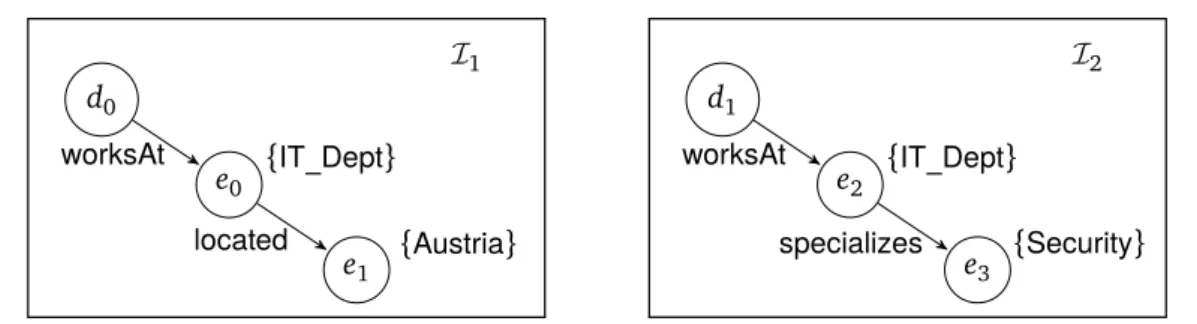
The concept above expresses elements who are not German and work at an IT Department which is only located in either Germany or Austria. In Figure 2.4, a graphical representation for interpretationsI1 andI2 of C are illustrated. If we take a closer look atI1, all elements in I1 are in the extension of > and none of them are in the extension of ⊥. For instance, the element e0 is in the extension ofIT_Dept, whereas the element e1 is in the extension of Austria. Thus, these elements are labeled byIT_DeptandAustria, respectively. Now, if we extend I1 to complex concepts, we may see that d0 is in the extension of the concept C since d0 is not in the extension ofGermanand connected via a role nameworksAtto e0, which is in the extension ofIT_Deptand has a relationship ‘located’ to e1which is in the extension of at least one of disjuncts in GermanytAustria. Likewise, in the other picture, the element d1 is also an element of C underI2, which is justified with the same argument for d0, except that the worksAt-successor e2 of d1, which is an element ofIT_DeptunderI2, is also in the extension of ∀located.(GermanytAustria). This is due to the fact that e2does not have anylocated-successors and hencealltheirlocated-fillers vacuously satisfy any imposed condition.
One may call the union of NC, NR, and NI the signature. This notion is extended to Description Logic concepts by collecting all concept names, role names, and individual names occurring in the concepts. Besides this notion, one might be interested in counting the sizeof concepts that is obtained by counting the number of occurrences of concept names,
d0 e0 { IT_Dept} e1 { Austria} I1 worksAt located d1 e2 { IT_Dept} e3 { Security} I2 worksAt specializes
Figure 2.4: A graphical representation of interpretations of the conceptC defined in example 2.3
role names, individual names, and Boolean operators in the concepts 1. In addition to those two notions, we also define the notion ofsubconceptsthat are intuitively concepts that syntactically occur in a given concept. ForALC concepts, the formal definitions ofsignature, size, andsubconceptsare defined as follows.
Definition 2.5. Let C be anALCconcept. Thesignatureof C, denoted by sig(C)is the set of all concept names and role names occurring in C, while thesizeand the set of subconcepts of C, denoted by|C |and sub(C), are defined inductively as follows:
• if C =A∈NC, then|C |:=1and sub(C) ={A};
• if C =C1uC2or C =C1tC2, then|C |:=1+|C1|+|C2|and sub(C) ={C} ∪sub(C1)∪sub(C2);
• if C =¬D or C=∃r.D or C=∀r.D, then|C|:=1+|D|and
sub(C) ={C} ∪sub(D). ♦
For example, the concept C that is defined in Example 2.3 has the following signature sig(C):={German,Germany,Austria,IT_Dept,worksAt,located}and the size that is counted as follows|C|:= 1+1+1+1+ (1+1+1+ (1+1+1)) =10.
2.1.1 Reasoning inALCOntologies
Mainly, Description Logic ontologies consist of two parts, which are terminological know-ledge, calledTBoxes, and assertional knowledge, calledABoxes. Intuitively,TBoxesprovide constraints on the interpretation of concepts and define how concepts are related each other, whileABoxesformulate knowledge about instances of concepts and relationship between individuals. We start with the definition ofALCTBoxes.
Definition 2.6. Let C,D beALC concepts. We call the following axiom C v D a general concept inclusion(GCI). AnALC TBoxT is a finite set of GCIs. ♦ If there are two GCI axioms C v Dand Dv C inT, then we may abbreviate them with an equivalence axiom C ≡ D. We will sometimes use the word axiom to refer to a GCI 1There are also Description Logics that has individual names as one of their constructors that will be introduced
Te x = {Diseasev ¬Patient, CancervDisease, ∃suffer.DiseasevPerson,
PatientvPersonu ∃seen_by.Doctor, OncologistvDoctor}
Figure 2.8: The example TBoxTex1
or an equivalence axiom. The semantics of TBoxes is also defined using the notion of interpretations.
Definition 2.7. LetI be an interpretation. Isatisfiesa GCI CvD iff CI⊆DI. I is amodel
of a TBoxT iffIsatisfies all GCIs inT. ♦
In another sense, one may also perceive TBoxes as knowledge consisting of hierarchical relationships between concepts. Given Cv D, we say thatC is more specific thanD, and vice versa,Dis more general thanC. We may alternatively call the notion of TBox above with the namegeneral TBox. This is due to the fact that there is also another type of TBox, defined as terminologies, whose axioms are of the formA≡C, called aconcept definition, whereA∈NCandC is a complex concept. However, in this thesis we just focus on general
TBoxes and sometimes we drop the word ‘general’ if it is already clear from the context. Next, we illustrate an interpretationIex1 that interprets all concept names and role names in a TBoxTex1 presented in Figure 2.8.
∆Iex 1 = {cn1,cn2,ds1,dt1,on1,pt 1,pt2}, PatientIex1 = {pt 1,pt2}, DoctorIex1 = {dt1,on1}, OncologistIex1 = {on 1}, PersonIex1 = {dt1,on1,pt 1,pt2}, CancerIex1 = {cn 1,cn2}, DiseaseIex1 = {cn1,cn2,ds1}, sufferIex1 = {(pt 1,cn1),(pt1,cn2),(pt2,ds1)}, seen_byIex1 = {(pt 1,dt1),(pt2,dt1)}
To confirm thatIex1 is a model ofTex1, we check whether for each GCIC vD∈Tex1, we haveCIex1⊆DIex1. For the GCIDiseasev ¬Patient, we have
DiseaseIex1={cn1,cn2,ds1} 6⊆ {pt
1,pt2}=Patient Iex
1. Then, for the second GCICancervDisease, it holds that
CancerIex1 ={cn
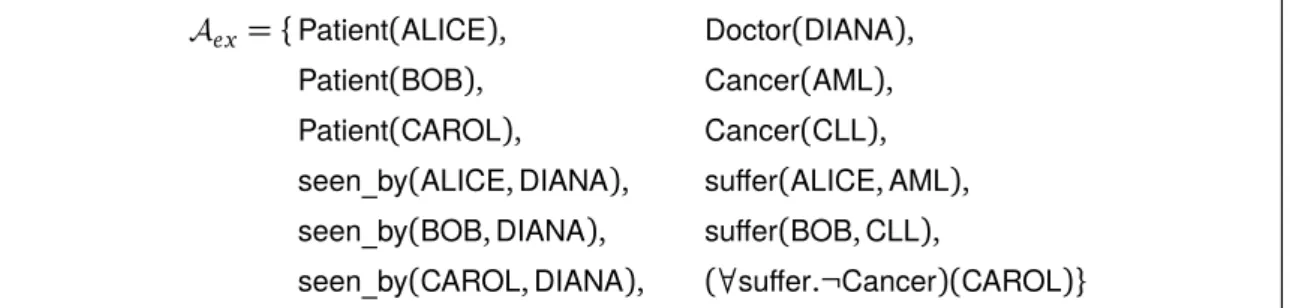
Ae x ={Patient(ALICE), Doctor(DIANA), Patient(BOB), Cancer(AML), Patient(CAROL), Cancer(CLL), seen_by(ALICE,DIANA), suffer(ALICE,AML), seen_by(BOB,DIANA), suffer(BOB,CLL),
seen_by(CAROL,DIANA), (∀suffer.¬Cancer)(CAROL)} Figure 2.11: The example ABoxAe x
For the concept(∃suffer.Disease)Iex
1, we know that the elementspt1,pt2belong to the exten-sion of this concept, since theirsuffer-successorscn1,cn2, andds1 belong toDiseaseIex1, and thus it is verified that
(∃suffer.Disease)Iex1={pt1,pt2} ⊆ {dt1,on1,pt1,pt2}=Person Iex
1. The fourth GCI that contains an existential restriction, too, is also true underIex
1 such that PatientIex1 ={pt
1,pt2} ⊆ {pt1,pt2}= (Personu ∃seen_by.Doctor) Iex
1
since the only elements belong to the intersection ofPersonIex1 and (∃seen_by.Doctor)Iex1 arept1andpt2. Last but not least, it obviously holds that
OncologistIex1 ={on
1} ⊆ {dt1,on1}=Doctor Iex
1.
Next, we introduce how information about individuals and their relationships are stored inABoxes
Definition 2.9. Let C be anALC concept, r∈NR, and a,b∈NI. We call C(a)and r(a,b)a concept assertion and a role assertion, respectively. AnABoxAis a finite set of concept assertions
and role assertions. ♦
Likewise, we will sometimes use the wordaxiomto refer a concept assertion or a role assertion. We also define the semantics of ABoxes with the use of interpretations.
Definition 2.10. LetI be an interpretation. I satisfies a concept assertion C(a)and a role assertion r(a,b)iff aI ∈CI and(aI,bI)∈rI, respectively. I is amodel of an ABoxAiffI satisfies all concept assertions and role assertion inA. ♦ As an illustration, we have presented an ABox Ae x in Figure 2.11. According to Ae x, we may say that Alice, Bob, and Carol are patients, while Dan is a doctor. Then, we have Acute Myeloid Leukemia(AML) andChronic Lymphocytic Leukemia(CLL) as names of cancer diseases from which Alice and Bob suffer, respectively. Further, it is stated that everything from which Alice suffers is not an instance of cancer. Additionally, the ABox also explicitly states that Dan examines Alice, Bob, and Carol.
Now, we construct an interpretationIex10 which coincides withIex1on its domain elements as well as all concept and role names occurring inTex1, but it interprets all individual names inAex 1 as follows: ALICEIe x0 = pt 1, DIANAI 0 e x = dt1, BOBIe x0 = pt 1, AML I0 e x = cn1, CAROLIe x0 = pt 2, CLLI 0 e x = cn 2.
According to this construction, it is clear to see thatIex10 is also a model ofTex
1. Observe that the individual namesALICEandBOBare interpreted to the same elementpt1. This is due to the fact that we do not assumeUnique Name Assumption(UNA) in this thesis. In many literatures, UNA is enforced to their semantics such that it requiresaI 6=bI in the casea6=b.
Now, we verify whetherIex0
1 is also a model of Aex1 by checking if a
Iex0 1 ∈ CI 0 ex1 for all concept assertionC(a)∈Aex 1and(a Iex0 1,bI 0
ex1)∈rIex01 for all role assertionsr(a,b)∈A ex1. It clearly holds that for all concept assertions whose all the concepts are concept names, they are satisfied byIex10 . Then, for each role assertion inAex1, it is also trivial to see thatIex10 satisfies them. Now, we see that CAROLIex01 =pt
2 has asuffer-successords1 that is not in extension of any concept name inIex10 . Then, since the universal restriction∀suffer.¬Cancer propagates the concept¬Cancerto anysuffer-successor ofpt2, we haveds1∈(¬Cancer)Iex01. Thus,Iex0
1satisfies(∀suffer.¬Cancer)(CAROL)and it concludes thatI
0
ex1is a model ofAex1. Finally, we arrived at the notion of DL ontologies that are formed by the combination of TBoxes and ABoxes.
Definition 2.12. ADescription Logic ontologyO=(T,A) consists of a TBoxT and an ABox A. An interpretationI is amodel ofOiffI is a model of bothT andA. ♦ Now, we introduce the notions ofsignatureandsizethat are extended to Description Logic ontologies, in particular toALC ontologies, that are defined in the following
Definition 2.13. LetO=(T,A) be anALC ontology. The signatures ofT andAare defined as follows
sig(T) = [ CvD∈T
sig(C)∪sig(D) and sig(A) = [ C(a)∈A
sig(C)∪ {a} ∪ [ r(a1,a2)∈A
{r,a1,a2}. ThesignatureofO, written sig (O), is simply defined as sig(O) =sig(T)∪sig(A). Then, the sizeof eachT andAis defined as follows
|T |= X CvD∈T |C |+|D| and |A|= X C(a)∈A |C|+1+ X r(a1,a2) 3.
Finally, thesizeofO, denoted by|O|, is obtained by adding|T |with|A|. ♦ Note that the number 1 used to define|A|above is considered in the summation to indicate one occurrence of the individual ain an assertion C(a)∈A, while the number 3 is used to indicate three occurences of the role namer and the individual namesa1and a2in an assertion r(a1,a2)∈A.
Further, we discuss reasoning problems in DL ontologies that have been well-investigated. They are theconsistency problem,satisfiability problem,subsumption problem, and theinstance problem. We start with the first problem.
Definition 2.14. LetO be an ontology. O isconsistentif it has a model. Theconsistency
problemasks whether there is a model forO. ♦
Now, if we construct anALC ontologyOe x1= (Te x1,Ae x1), thenOe x1 is consistent since it has a modelIe x0
1 that satisfiesTex1andAex1. However, if we add the following axioms to
Oex1:
α1=∃seen_by.Oncologistv ∃suffer.Cancer,
α2=Oncologist(DIANA)
such thatO0ex1 = (Tex1∪ {α1},Aex1∪ {α2}), thenIex10 is not a model ofO0ex1. This is due to the fact that
DIANAIex01={dt1} 6∈ {on1}=OncologistI 0 ex1.
Nevertheless, the ontologyO0ex1 itself is also inconsistent since in every modelJ ofO0ex1, we haveDIANAJ ∈OncologistJ and this implies thatALICE,BOB, andCAROLare seen by an oncology, which means that all of them suffer from Cancer. This implication however contradicts the assertion (∀suffer.¬Cancer)(CAROL) and thus the inconsistency of O0ex1
follows.
Next, we define thesatisfiability problemthat asks whether a given conceptC has a model w.r.t. a given TBox.
Definition 2.15. Let C be a concept andT be an ontology. C issatisfiablew.r.t.T iff there is a modelIofT such that CI 6=;. Thesatisfiability problemasks whether C is satisfiable w.r.t.T The subsequent problem asks whether one concept is more specific than another concept w.r.t. a given TBox.
Definition 2.16. LetT be a TBox, and C,D be DL concepts. C is subsumed by D w.r.t.T (denoted by CvT D) iff for all modelsIofT, CI ⊆D. If CvD, but D6vD, then we say that
C isstrictly subsumedby D w.r.t.T. The(strict) subsumptionproblems asks whether C is
subsumed by D w.r.t.T. ♦
Last, we introducethe instance problem involving not only TBoxes, but also the use of ABoxes, to ask whether an individual is aninstanceof a given concept w.r.t. an ontology. Definition 2.17. LetO=(T,A) be an ontology, C be a DL concept, and a∈NI. The individual
a is aninstance ofC w.r.t.O(denoted byO|=C(a)) iff for all modelsI ofO, aI ∈CI. The instance problemasks whether a is an instance of C w.r.t.O. ♦ If the last two reasoning problems above do not take TBoxes as input into account, then the subsumption problem will only ask whetherC vDand the instance problem asks whether A|=C(a). Next, we introduce implicit relationships between the aforementioned reasoning problems.
Theorem 2.18 ([BHL+17]). LetO=(T,A) be anALContology, C,D beALC concepts and a be an individual name.
(i.) C≡T D if and only if CvT D and DvT C.
(ii.) CvT D if and only if Cu ¬D is not satisfiable w.r.t.T. (iii.) C is satisfiable w.r.t.T if and only if C6vT ⊥.
(iv.) C is satisfiable w.r.t.T if and only if(T,{C(a)})is consistent. (v.) O|=C(a)if and only if(T,A∪ {¬C(a)})is inconsistent.
Note that the relationships above do not only hold forALC ontologies but also for all ontologies which are formulated in DLs that have conjunction and negation of complex concepts. As a consequence of the theorem above, we can see that all reasoning problems can bereducedto the consistency problem, i.e., we can use an algorithm for ontology consistency to decide all reasoning problems mentioned above.
As mentioned in Chapter 1, an ontology can also be viewed as a collection of information that is used to derive answers for given queries. For instance, one basic query inherited from the definition of the instance problem is called theinstance query. This query asks which individuals inNIthat are instances of a given conceptC w.r.t. an ontologyO. Using first-order
logic representation, we view that this kind of query only consists of one free variables (called answer variablesin the following) with some existentially quantified variables. The following notion is a class of query calledconjunctive query, that may consist of more than one answer variables and quantified variables as well as is constructed over the conjunction of unary and binary predicates only.
Definition 2.19. Aconjunctive query (CQ)q is a first-order formula with the following ex-pression:
q(~v)← ∃w~.conj(~v,w~),
where~v are answer variables,w are existentially quantified variables, and~ the bodyconj(~v,w~)is a conjunction of query atoms, each of the form A(z)or r(z,z0)where z,z0are either individuals names or variables over ~v∪w and A and r are unary (concept names) and binary (role names)~ predicates, respectively. A CQ isBooleanif it has no answer variables. Thesizeof q, written |q|, is the number of all occurrences of conjunction symbols (∧), concept names, role names,
and individual names in q. ♦
To emphasize thatqhas answer variables~v, we particularly writeq(~v). Next, we write how answers to CQs are defined in two steps: first on the level of interpretations and then on the level of knowledge bases.
Definition 2.20. Let q(~v)be a conjunctive query having n answer variables, a1, . . . ,an∈NI andI an interpretation. We call a tuple~t=a1, . . . ,an of individuals ananswerto q onI if I|=q(~t), i.e., q(~v)evaluates to true inI under the valuation that maps ~v to the tuple~t. We use ans(q,I)to denote theset of all answers toqonI.
Now, given an ontologyOand a CQ q, a tuple~t∈(NI)nof individuals is ananswer toqw.r.t.
O, written asO|=q(~t)iff all individual names from~t occur inAand~t∈ans(q,I)for allIof
O. We write ans(q,O) = T Imodel ofO
Let us consider the following ontologyOex2= (Tex2,Aex2), where Tex2 :={Patientv ∃seen_by.Doctor}
Aex2 :={Doctor(DIANA),Patient(ALICE),Patient(BOB),Patient(CAROL) seen_by(ALICE,DIANA),seen_by(BOB,DIANA)}.
Then, we consider the following samples expressing conjunctive queries:
a.) Return all pairs of individual names(a,b)such thatais a doctor who sees a patientb: q1(v1,v2) =Doctor(v1)∧seen_by(v2,v1)∧Patient(v2).
b.) Return all individual namesasuch thatais a patient who is seen by a doctor: q2(v) =∃w.(Doctor(w)∧seen_by(v,w)∧Patient(v).
The answers for the first queryq1 are {(ALICE,DIANA),(BOB,DIANA)}. Note that the individualCAROLis not included in any answer since it may be that there is a model ofOex2, whereCAROLis seen by another doctor who is notDIANA. For the other queryq2, we have the answers for it, which are{ALICE,BOB,CAROL}. Now, the individualCAROLis included sinceCAROLis a patient and the GCI inTex2 enforcesCAROLto be seen by a doctor. 2.1.2 Relationship with First-Order Logic
It has been mentioned briefly in Chapter 1 that Description Logics can be seen as decidable fragments of first-order logic. Concept names can be interpreted as unary predicates, role names can be represented as binary predicates, while individual names can be viewed as constants. Let us consider the following example
∃leads.> v Boss,
Employee ≡ Personu ∃worksAt.>, Employee(JIM).
The axioms above can be translated to the following first-order logic formulas ∀x.(∃y.leads(x,y)⇒Boss(x)),
∀x.(Employee(x)⇔Person(x)∧ ∃y.(worksAt(x,y))), and Employee(JIM).
To translate formally Description Logic concepts and axioms, we need at least two transla-tion functransla-tionsπv andπw, wherevandware free variables. For this translation, we again focus on the DLALCthat are inductively defined as follows.
πv(A) = A(v) πv(CuD) = πv(C)∧πv(D) πv(CtD) = πv(C)∨πv(D) πv(∃r.C) = ∃w.(r(v,w))∧πw(C), πv(∀r.C) = ∀w.r(v,w)⇒πw(C), πv(¬C) = ¬πv(C)