Business Performance Analytics: Exploring the Potential for Performance Management Systems
Dr Anna Raffoni
School of Business and Economics Loughborough University Loughborough, UK LE11 3TU
(Corresponding Author) [email protected]
Dr Franco Visani
Department of Management Studies University of Bologna
P.le della Vittoria, 15, 47121, Forlì (FC), Italy
Dr Monica Bartolini
Department of Management Studies University of Bologna
P.le della Vittoria, 15, 47121, Forlì (FC), Italy
Prof. Riccardo Silvi
Department of Management Studies University of Bologna
P.le della Vittoria, 15, 47121, Forlì (FC), Italy
ABSTRACT
Business Performance Analytics (BPA) entails the systematic use of data and analytical methods (mathematical, econometric, statistical) for performance measurement and management. Although potentially overcoming some traditional diagnostic issues related to Performance Management Systems (PMS), such as information overload, absence of cause-effect relationships, lack of a holistic view of the organization, research in the field is still in its infancy. A comprehensive model for operationalising analytics for diagnostic and interactive PMS is still lacking. Adopting an action research approach, this paper addresses this gap and develops a five-step framework applied to a company operating in the construction industry. The results show that in addition to encouraging dialogue, BPA can contribute to identifying critical performance variables, potential sources of risk and related interdependencies. A number of critical issues in implementing data-based approaches are also highlighted including data quality, organizational competences and cultural shifts.
Keywords: Business Performance Analytics; Performance Management; Action research;
1. Introduction
In the era of digitisation, companies worldwide have access to an unprecedented amount of data and to previously unimaginable opportunities to analyse these. The term Business Analytics (BA) was coined to describe mathematical, statistical and econometric analyses of business data able to support operational and strategic decisions (Davenport and Harris 2007). The growing consensus that BA also has huge potential for performance management purposes (Bhimani and Willcocks 2014; Warren, Moffitt and Byrnes 2015) is rooted in Performance Management Systems (PMS) literature. Studies point out that strategic data analysis is as important as understanding the organization’s strategic objectives, allocating resources and defining the formal aspects of PMS (Ittner and Larcker 2005; Kaplan and Norton 1996; Schreyögg and Steinmann 1987). BA can inform the decision-making process and improve business performance through improved strategy (re)formulation and implementation (CIMA 2014). Although this potential is generally acknowledged, organizations experience significant difficulties in extracting strategically valuable insights from data (CIMA 2014; Economist Intelligence Unit 2013). The focus is often on the collection, cleansing and storing of all possible data (Zhang, Yang, and Appelbaum 2015) while less attention is paid to understanding what the data can actually deliver and what is relevant to supporting the management of organizational performance (Economist Intelligent Unit 2013; Klatt, Schläfke, and Möller 2011). This lack of strategic focus is now considered a major cause of failure in developing evidence-based approaches to strategic control (LaValle et al. 2011).
In this context, an emerging field of research aims to analyse the ways of strengthening the role of analytical approaches to performance management. The term ‘Business Performance Analytics’ (BPA) refers to the management and control of the firm’s strategic dynamics and performance through the systematic use of internal and external data and analytical methods (Silvi, Möller, Schläfke 2010). Research in this area is still in its infancy and little is known about how data analysis mechanisms influence strategy control (Ittner and Larcker 2005; Nudurupati et al. 2011). As an example, Silvi et al. (2012) survey a group of large and middle-sized Italian firms and observe a relationship between the use of BPA and more advanced and effective PMS. However, extant research mainly focuses on the discussion of the potential macro-level benefits of adopting BPA (Nudurupati, Tebboune, and Hardman 2016) without considering how BPA could actually be used to manage and control
(diagnostically or interactively) organisational performance. Furthermore, empirical evidence is still lacking.
Adopting an action research approach (Kasanen, Lukka, and Siitonen 1993), this paper explores the use of BPA in the performance management process in a company operating in the construction industry. A preliminary framework grounded in performance management literature is developed and used to guide the action process (Jönsson and Lukka 2007) by applying abductive reasoning (Dubois and Gadde 2002). The actual intervention allowed questioning some of the initial assumptions as well as identifying some complexities associated with the BPA design and application. The findings support the idea that valuable insights ensue from approaching the development of BPA through an initial strategic and performance model assessment. They also suggest that the results of the analytical application can be used both diagnostically and interactively when integrated in the existing PMS system. A framework discussing a series of issues to be considered when using analytical methods for performance management purposes was then developed. The paper extends previous research exploring the role of data analysis in the context of performance management (Bititci et al. 2012; Ittner and Larcker 2005; Nudurupati et al. 2011) by actually implementing an innovative solution in the case company. The study explores how data analysis can be shaped and used to test existing assumptions on the organisations’ performance model and eventually lead to a more intensive use of quantitative methods in monitoring strategy delivery and (re)formulation.
From a practice perspective, the study contributes to understanding how BPA could be operationalized in a performance management context by providing a general framework and specific practical evidence.
The paper is structured as follows. Section 2 outlines the theoretical foundations while Section 3 presents the rationale for adopting an action research design and the preliminary BPA framework used to guide this process. Section 4 describes the research methods and data collection process. The empirical findings are reported in Section 5. Section 6 presents the post-intervention reflections discussing the findings in light of the preliminary framework. To conclude, Section 7 presents the theoretical and managerial implications and highlights future research avenues.
2. Theoretical background
2.1. From intuition- to data-based Performance Measurement Systems (PMS)
PMS play an important role in supporting management by providing key information for strategic and operational decision-making. PMS literature underlines the importance of data acquisition and analyses to identify the primary success factors and the potential benefits of specific strategies. Data analysis can reveal the underlying drivers of strategic results and the reasons why these deviate from strategic targets (Ittner and Larcker 2005; Julian and Scifres 2002; Silvestro 2016). The ability to store, aggregate, combine and analyse such data is then crucial to confirm management assumptions and develop performance measures anchored in the key success factors. The more fine-grained and updated the information, the greater the emphasis decision-makers can place on such data, thereby improving the overall quality of decisions and moving from intuitive to more evidence-based management (Ittner and Larcker 2005, Davenport and Harris 2007).
From a study involving 607 executives, the Economist Intelligence Unit (2012) reports that management decisions based purely on intuition or experience are increasingly regarded as suspect and that such decisions are increasingly based on ‘hard analytic information’. On the other hand, the study shows that organizations lack structured data for decision support, a widespread data culture and skilled analysts.
In the midst of what is reported as a ‘data race’, emphasis is often placed on the collection, cleansing and storing of all possible data (Zhang, Yang, and Appelbaum 2015). Less attention is paid to understanding what data can actually deliver and which data may be relevant to supporting the management of organizational performance (Economist Intelligent Unit 2013; Klatt, Schläfke, and Möller 2011). This awareness has generated the Business Analytics (BA) phenomenon. BA refers to the iterative, methodical exploration of analytical data (deriving from Enterprise Resource Planning (ERP), Customer Relationship Management (CRM), social media generated Big Data, Open Access Databases, etc.) for operational and strategic purposes (Davenport, Harris and Morison 2010). In particular, Chen, Chiang, and Storey (2012, 1166-1168) point out BA’s potential of processing abundant data through domain-specific analysis.
Data processing to obtain information from data, knowledge from information and wisdom from knowledge involves four steps: (1) acquisition, from different data sources; (2) access, in terms of indexing, storage, sharing and archiving, enabled by integrated IT systems; (3) analytics, i.e., data analysis and manipulation; (4) application in decision-making. With
reference to steps 1 and 2, to take advantage of data potential and to leverage it to create value, in the last two decades companies have made significant investments in their IT systems in the form of ERP, inter-organizational sharing mechanism, databases and web-based software packages, etc. The diffusion of On Line Transaction Process (OLTP) tools (ERPs amongst others) has increased the amount, heterogeneity and reliability of data collected. They enhance decision-making and management control through the integration of internal databases (Chapman and Kihn 2009), the exchange of information with business partners (Choe 2008) or through offering new information (Hyvönen 2007). Chae et al. (2014) and Davenport, Harris, and Morison (2010) also emphasize the role of data accuracy as a key complementary resource to reinforce the acquisition step.
With reference to steps 3 and 4, On Line Analytical Process (OLAP) tools (such as Business Intelligence tools and Social Media Competitive Intelligence solutions) have improved the data analysis, visualization and reporting potential (He et al. 2015). However, the strategic value of such IT solutions is often questioned. While their potential is generally acknowledged, organizations report significant difficulties in extracting strategically valuable insights from data (CIMA 2014; Economist Intelligence Unit 2013). Nudurupati et al. (2011) focus on the inability of IT systems to provide adequate information flows. Specifically, PMS are not dynamic or sensitive to changes in the firm’s internal and external environment (Marchant and Raymond 2008) and, as such, the information is often not relevant, up-to-date or accurate and does not facilitate fast and confident decisions. Understanding how extended IT capabilities can be best used constitutes a major performance measurement and management challenge. In this sense, Bititci et al. (2012) point out that the relationships between PMS and IT systems are still theoretically and practically underdeveloped. In this context, the recent development of further data sources and analysis capabilities enhanced BA diffusion and implementations, representing a huge opportunity to introduce and develop more data-based performance management systems.
2.2. The Business Analytics phenomenon
Academic and practitioner literature pays much attention to the value creation potential of BA and Big Data (Gillon et al. 2012; Mithas et al. 2012). According to the IDC (2014) report, the worldwide business analytics software market is forecast to grow at a 9.4% compound annual growth rate through 2018 (reaching 21,420,9 $M in the Business Intelligence and Analytics Tools market and 18,648.0 $M in the Data Warehousing Platform market).
Analysing 18 different BA definitions, Holsapple, Lee-Post, and Pakath (2014) summarize the core characteristics as ‘concerned with evidence-based problem recognition and solving that happen within the context of business situations’ (p. 134). McAfee et al. (2012) argue that BA enables better forecasting and smarter decisions in areas that were previously dominated by intuition rather than data and rigour. Growing evidence suggests that leading BA users achieve higher returns compared to their competitors (Brynjolfsson, Hitt, and Kim 2011) through innovation, competition and productivity. Mello, Leite, and Martins (2014) specifically focus on the potential and valuable effects of BA on PMS, but also highlight the need for further research in this area. Also according to Harford (2014) and Watson (2011) some criticisms remain on the real effectiveness of BA.
First, achieving competitive advantage with analytics requires a change in the role of data in decision-making entailing information management and cultural norms (Ransbotham, Kiron, and Kirk Prentice 2016).
A second issue concerns analytics skills. According to the Ransbotham, Kiron, and Kirk Prentice (2015, p. 3) survey, ‘deriving business value from analytics depends in important ways on building strong internal capabilities that link insights with business outcomes’. Brown, Court, and McGuire (2014, 4) highlight the threefold strategic role of ‘translators’ (referring to people able to bridge IT and data issues with decision-making) in the ‘design and execution of the overall data-analytics strategy while linking IT, analytics, and business-unit teams’. First, ‘data strategists’ link IT knowledge and experience in making business decisions, defining the key data requirements. Second, ‘data scientists’ combine strong analytics skills with IT know-how to derive sophisticated models and algorithms. Finally, ‘analytic consultants’ profit from their practical business knowledge and analytics experience to enhance analytics opportunities (Brown, Court and McGuire 2014, 4).
Finally, the real success of BA is often limited, particularly when the technical aspects of the analysis prevail over strategic understanding of the business aspects on which analytics should focus (Stubbs 2011). LaValle et al. (2011) state, ‘[…] don’t start doing analytics without strategic business direction, as the efforts are likely to stall’ (p. 26). In the International Institute for Analytics (IIA 2015) report on the prediction and priorities for 2016, (a) aligning analytics and business strategies and (b) utilizing analytics in the strategy development process are listed as priorities for analytics leaders and practitioners.
As such, combining the huge data analysis potential of BA with the strategy-shaping capability of PMS may prove significantly valuable.
2.3. From Business Analytics to Business Performance Analytics
Although the analysis of the BA potential for performance management purposes is still in its infancy, some studies on the contribution of BA to PMS emphasise this potential. Davenport, Harris and Morison (2010) highlight the importance of basing Key Performance Indicators (KPIs) on analytics to improve key decisions. Mello, Leite and Martins (2014) and Warren, Moffitt and Byrnes (2015, 400) focus on BA based on Big Data and underline how this could enrich control systems, particularly in terms of performance evaluation, goal communication and strategy formulation. Klatt, Schläfke, and Möller (2011) report the performance effects associated with BA and state that appropriately integrating BA in PMS is key to decision-making success. However, they also point out that no approach provides guidelines for the systematic coupling of analytics and performance management elements in a comprehensive and application-oriented framework. They suggest a multi-layer performance management approach by injecting information from analytics into multiple layers. Similarly, Appelbaum et al. 2017 propose a management accounting data analytics framework based on the balanced scorecard. However, their models are conceptual in nature and remains at a generic level, without a specific operationalisation. Similarly, Nudurupati, Tebboune and Hardman (2016), Nãstase and Stoica (2010), Schläfke, Silvi, and Möller (2012), and Silvi et al. (2010) analyse the BA potential for performance management purposes as promising instruments to address the current PMS challenges. The authors categorize different types of analytics and present specific cases of successful adoption. Lacking however is a framework able to support the practical application of BA for performance management purposes. The lack of practical models has also led to the limited diffusion of these approaches to performance management. Silvi et al.’s (2012) survey of 43 Italian companies shows the generally simplistic use of analytical tools for performance management initiatives, even if finding a relationship between the adoption of advanced PMS and the use of BA.
Based on these considerations, we propose introducing Business Performance Analytics (BPA) as a framework to support PMS (Silvi et al. 2012). We define BPA as the control of business dynamics and performance through the systematic use of data (including micro-level data) and analytical methods. BPA emphasises the use of multiple analytical methods related to mathematics, statistics and econometrics to support the control of business dynamics. BPA
provides insights on the critical variables underlying the organization’s performance model, as well as the opportunities/threats emerging from strategic uncertainties, such as market and competitor dynamics, R&D and innovation (May 2009), human resources (Davenport, Harris and Shapiro 2010; Lanzarone, Matta, and Scaccabarozzi 2010), marketing and supply chain management (Trkman et al. 2010; Visani et al. 2016; Wang et al. 2016).
In theorising the role of BPA in supporting PMS, we also argue that their roles may differ according to their use. Indeed, it is now well established that PMS have different roles within organizations (Atkinsons, Waterhouse, and Wells 1997; Broadbent and Loughlin 2009) and that the use of control information can be more significant than the design of such systems (Ferreira 2002). Drawing on Simons’ (1995) framework of levers of control, a different contribution of BPA is hypothesised with reference to diagnostic use or interactive use. PMS and any other control could be used diagnostically or interactively (Simons 1995, Tessier and Otley 2012). The ‘diagnostic’ role of control focuses on controlling the ‘critical performance variables’ or those key factors a firm should pay attention to in order to succeed in implementing its deliberate strategy (Dixon, Nanni, and Vollmann 1990; Martinez, Pavlov, and Bourne 2010; Micheli and Manzoni 2010; Tessier and Otley 2012). In this context, since managers are frequently not in a condition to justify with data the assumptions underlying their organization’s competitive strategy (Buytendijk, Hatch, and Micheli 2010; Silvestro 2016), BPA should enable identifying the causal effects between impact factors - expressed in qualitative/non-financial terms - and strategic target measures. Hence, BPA could enrich strategic and operational planning and measurement through empirically establishing the underlying cause-effect relationships in dashboards of measures to support day-to-day decision-making.
However, for PMS to be effective, a more active, feed-forward role is also required, together with their ability to be used ‘interactively’, to question the strategic assumptions, promote emergent strategies and review current strategies (Mintzberg 1978). From an interactive standpoint, two distinctive functions characterise this type of use (Tessier and Otley 2012; Ferreira and Otley 2009). On one side is the notion of ‘interactive use of controls’ or how intensively managers use controls. On the other side is the concept referring to the adequacy of an organisation’s strategy or ‘strategic validity controls’. In the discussion on interactive control, there is still limited understanding of the underlying information flow (Bititci et al. 2012; Ittner and Larcker 2005). BPA are expected to contribute to interactive control by fostering the understanding of how organisations may actually identify strategic uncertainties. In this sense, the more intense focus that evidence-based approaches stimulate
is likely to support the greater information processing required in uncertain conditions (Galbraith 1977). Further, interactive control takes the form of frequent face-to-face meetings where data generated by the system are debated and challenged. This process allows information to travel bottom-up and across (Abernethy and Bromwell 1999; Bisbe, Batista-Foguet, and Chenhall 2007; Henri 2006; Simons 1995), thus promoting the discussion of current strategy effectiveness, new action plans and eventually the emergence of new strategies in response to changes in the organization’s environment (Bisbe and Otley 2004). From this point of view, the collection of multiple and differing sources of data - mostly in digital formats - that BPA forces is expected to favour information sharing and the related debate across different organizational levels and departments.
3. Developing a Business Performance Analytics framework
This section presents a preliminary conceptual framework for the use of BPA in performance management that is further developed through an action research design. Presenting the framework before the empirical evidence does not imply pure deductive reasoning; rather, the researchers’ intent is to help with the iterative confrontation of theoretical and practical insights at the core of action research. Our ‘systematic combining’ (Dubois and Gadde 2002) research approach is situated between the two extremes of a ‘tight and pre-structured’ framework, typical of deductive reasoning, and a highly ‘inductive, loose’ design (Miles and Huberman 1994). This could be described as a ‘tight and emerging’ framework where the degree of tightness reflects the articulation of the researchers’ preconceptions as shaped by literature and the evolution is the result of the changes fostered by the empirical observations. Therefore, a preliminary conceptual framework was developed based on an extensive literature review that guided the action process throughout the research. As empirical observations and participation inspire changes in how the theory is viewed and vice versa (Dubois and Gadde 2014), the initial design progressively evolved and led to the development of a revised framework. The next section discusses the reasons for adopting an action research approach and the subsequent section illustrates the preliminary conceptual framework that guided the study. The revised framework is presented in the discussion.
3.1 Research approach
Action research entails the deliberate use of active participant observation as a research asset and, as such, creates the opportunity for researchers to become fully immersed in the
phenomenon under study (Jönsson and Lukka 2007). This enables obtaining penetrative insights (Parker 2012) and accessing more ‘subtle and significant data’ (Jönsson and Lukka 2007). Argyris, Putnam and McLain Smith (1985) suggest that the best way to learn about the world is to set it into change, since ‘change processes force issues to surface and people involved tend to need to explicate their interests and agendas, as well as mobilise their resources’ (Suomala, Lyly-Yrjänäinen, and Lukka 2014, 305).
These distinguishing aspects of action research are considered to best address the research problem: theory building on an as-yet undeveloped approach in company practice. The newness of the topic analysed suggests that a more complete understanding could be achieved through direct interaction with the organization and its members (Anderson and Widener 2007). In this context, researchers specifically seek to make an impact on the real world by addressing a relevant practical problem and thus playing an important part in developing and applying the proposed BPA framework.
However, the distinctive nature of action research enables researchers to continuously cross the boundary between the realm of practical reasoning and that of theoretical significance. As such, it offers the possibility of experimenting with a new practical solution in collaboration with the host organization and observing, analysing and interpreting the outcomes through the relevant literature (Argyris, Putnam and McLain Smith 1985; Jönsson and Lukka 2007; Van Aken 2004). Moreover, collaboration between the researcher and the organization facilitates greater access to the company and the data, as well as promoting engagement between practitioners and researchers. This can lead to the development of innovative knowledge in collaboration (Van de Ven 2007; Van de Ven and Johnson 2006) and the construction of new realities.
In sum, the selected research approach is intended to identify interesting questions and issues in the field, highlighting aspects that may otherwise be overlooked.
3.2 Preliminary framework development
In the attempt to understand the contribution of BPA to performance management, we initially drew on contributions exploring the links between PMS and ICT (e.g. Bititci et al. 2002; Dechow and Mouritsen 2005; Nudurupati and Bititci 2005) and how ICT can contribute to improving the strategic role of PMS. This provided an initial understanding of both the potential and related issues, some of which would possibly resonate in the more advanced context of BPA. In particular, the benefits of data analysis to support performance
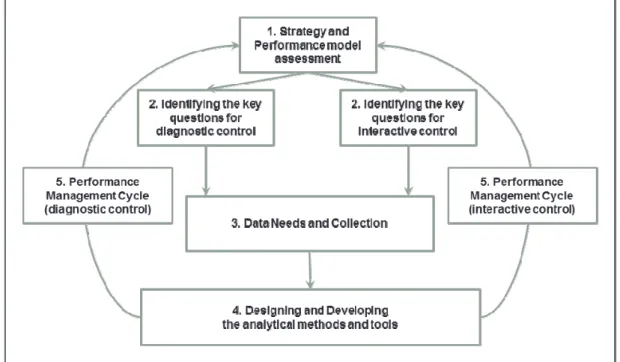
management (Ittner and Larcker 2005; Bititci et al. 2012; CIMA 2013) and the difficulty of extracting strategically valuable insights from data (Stubbs 2011; McAfee at al. 2012) emerged as key and recurring themes. This paired with the criticality of understanding which variables drive performance (Simons 1995) suggested the importance of linking analytics to strategy and to the business performance model from an early stage in the analysis. Literature also indicated the risks of adopting technical approaches (Stubbs 2011; Bititci et al. 2012) and disregarding skills and organisational responsibilities when adopting analytical approaches (Ransbotham, Kiron, and Kirk Prentice 2015; Brown, Court, and McGuire 2014). In approaching the field investigation, the work of Otley (1999) and Ferreira and Otley (2009) and their identification of potential issues (questions) to be considered when developing PMS provided the initial guidelines. In so doing, the notion of ‘use’ of controls (Simons 1995) played an important role in shaping the research, allowing moving from BPA macro-level benefits and problems to a more specific and contextualised interpretation. In fact, Simons’ (1995) research and subsequent contributions (Abernethy and Browell 1999; Bisbe, Batista-Foguet, and Chenhall 2007; Tessier and Otley 2012) show that the two uses of controls have distinctive features and information is mobilised in different ways. The preliminary framework included five main steps to consider when using BPA for performance management (see Figure 1).
These areas are here sequentially listed for descriptive purposes only. Indeed, the fieldwork was critical to understanding how the different elements are mobilised from a diagnostic and interactive perspective. In other words, while the preliminary areas of investigation proved relevant to initially addressing the research objectives, the actual understanding of their flow and combination in the performance management process derived from the empirical analysis. This is in line with the theory development purpose of abductive reasoning and its contribution in refining rather than discovering new theories (Dubois and Gadde 2002). The following subsections present the theoretical foundations of our preliminary reasoning while the contribution of the action research process and its implications are later discussed in the case development and discussion sections.
Step 1: Strategy and performance model assessment
It is widely acknowledged that the existence of objectives is a requirement to manage performance and that understanding ‘which’ strategic objectives organizations should pursue constitutes a key control strategy issue (Simons 1995; Ferreira and Otley 2009). Strategic objectives define what an organisation wants to achieve and set the goals to be measured and managed. However, such view should not suggest a neutral role of control in respect of strategy formulation merely consisting of monitoring the degree of implementation of predetermined strategic objectives. Rather, strategic objectives should be considered as “ingredients” for any strategic view of control (Simons 1995; Ferreira and Otley 2009), which, when mobilized by PMSs, allow other strategy interpretations to emerge (Hansen and Mouritsen 2005). For many observers, lack of strategic focus is a major cause of failure when developing analytics (LaValle et al. 2011). Whilst these can aid the decision making process, they are no substitute for corporate values and a vision of what an organization intends to achieve (McAfee et al. 2012).
Organizations have multiple and often conflicting objectives (Cyert and March 1963; Freeman 1983), and their management requires understanding the causal model that describes how today’s actions may influence future results (Lebas and Euske 2002). Causal performance maps have become a common approach in describing the organization’s performance model (Kaplan and Norton 1996; Ittner and Larcker 2001). Inputs, processes and outcomes are typically linked with arrows and provide support for the development of PMS (Abernethy et al. 2005). However, such representations of the performance model tend to be based on a top-down imposition of ‘desirable’ key success factors and interrelations
(Malina and Selto 2001). As a consequence, while beneficial to framing the strategic context, they are expected to form only the initial basis to guide the BPA discussion.
Step 2: Identifying the key questions
To guide the development of the PMS, the broad definition of the strategic context needs to be translated into more concrete terms (Ferreira and Otley 2009) and the development of the analytical approaches requires the formulation of clear and specific questions to be tested, not just generic “strategic issues”. A first set of questions for diagnostic purposes should focus on the critical performance variables, representing ‘what an organization must do well to achieve its intended strategy’ (Simons 1995). A second set of questions related to interactive control should investigate the strategic uncertainties regarding the ‘assumptions or shocks that could derail the achievement of the organization’s vision for the future’ (Simons 1995).
At this stage, the senior management’s future vision is deemed a key input in identifying the critical performance variables and strategic uncertainties. This preliminary understanding of ‘which questions’ need to be answered by PMS is expected to guide the selection, if not the collection, of relevant data with the aim of fully exploiting the value that the data may generate (Davenport, Harris, and Morison 2010; Neely 2013; Nudurupati et al. 2011).
Step 3: Data needs and collection
This stage concerns the analysis of data sources and availability. Sources can be internal (company ICT, Internet of Things, digital and social) or external (social and digital open data), structured through proper IT systems - such as ERP and BI tools - or not (Big Data alone).
The wide variety of data that organizations can access entails a number of issues. First, large datasets and ample, unstructured, real-time information generates significant challenges in terms of collection, cleansing and storage (Zhang, Yang, and Appelbaum 2015). Although not considered a key barrier when embracing data-based approaches, such issues should be accounted for when adopting BPA. Second, quantity and variety lead to additional concerns in terms of data quality and relevance (IFAC 2011; Bhimani and Willcocks 2014). Bigger datasets are not synonymous with better data and may suffer from biases, errors and missing information in the same way as smaller datasets. Furthermore, the avalanche of data pouring in creates a situation of information overload that challenges the ability of managers to understand what data are relevant to them (Economist Intelligent Unit 2013; Klatt, Schläfke,
and Möller 2011; Neely 1999). Indeed, most data originating from external sources (e.g., Facebook, Twitter, blogs) are constituted of haphazard and user-generated content captured without a cognitive plan under the assumption that they will have some a posteriori use and will follow a ‘sorting in the way out’ rather than a conventional ‘sorting in the way in’ logic (Weinberger 2007).
Ideally, identifying the data needs and the related collection should logically follow the specification of strategic objectives and key questions. However, this entails considering that the sequential logic is likely to provide only a partial representation of reality. Therefore, the relationship between data and strategy may also take a more inductive form. In other words, data first and then the search for any potential use (Anderson 2008; Constantiou and Kallinikos 2015).
Step 4: Designing and developing the analytical methods and tools
To be valuable, data need to be transformed into knowledgeable information to support the performance management process. Here the use of BPA is expected to favour the understanding of the causal-effect relationships between performance variables, overcoming a common criticism affecting the implementation of PMS (Silvestro 2016; Smith and Goddarb 2002). This is considered an enabling characteristic of ‘strategic’ PMS (Chenhall 2005; Gimbert, Bisbe, and Mendoza 2010) but is often overlooked in practice. Interdependences between performance variables are either ignored or simply hypothesised, without justifying the assumptions underlying the performance model (Buytendijk, Hatch, and Micheli 2010).
Literature (Gartner Report 2012) identifies four types of analytics that can aid businesses:
‐ Descriptive analytics. These are typically based on past and current data and are often considered a preliminary step to the successful application of subsequent types. They address questions such as ‘what happened’, ‘what is happening now’, ‘how does it compare to our plan’, exploring issues such as ‘how often does a certain event occur’, ‘how many’ and ‘where’.
‐ Diagnostic analytics. These provide a look at past performance to determine what happened and why through analysis/query/drill-down to solve dilemmas such as ‘why does this happen’ and ‘what exactly is the problem’.
‐ Predictive analytics. These provide scenarios of what may happen. The deliverables are usually predictive forecasts. Managers can conduct active experiments, testing new
business ideas/models and then follow an evidence-based decision-making approach. Examples of techniques include Monte-Carlo simulation, data mining examining scenarios in time series, pattern recognition and alerts, forecasting, root cause analysis.
‐ Prescriptive analytics.These aim to show what actions should be taken and constitute the most valuable kind of analyses, thanks to robust techniques that facilitate understanding what may happen in the future. This usually results in performance management rules and recommendations.
The choice of ‘which’ analytics is contingent on the objectives and type of data available to an organization.
Step 5: Performance management cycle
Providing knowledgeable information is a pre-requisite for managing organisational performance, but is not sufficient. Action needs to be taken on performance data to actually influence performance (Bourne 2005; Sharma, Mithas, and Kankanhalli 2014). People’s use of information has long been considered as critical as the information itself (Orlikowski 2000; Prahalad and Krishnan 2002) and, to many observers, a major cause of short-lived performance management initiatives (Bititci et al. 2002; Marchand, Kettinger, and Rollins 2000). Literature investigating the success (and failure) of performance management initiatives is extensive and indicates that effectiveness depends on the complex balance of different aspects. These include (1) the organisational structure of the business and the roles and accountability of the organisational participants, (2) communication and target setting, (3) the evaluation of actual performance, and (4) a coherent reward system (Ferreira and Otley 2009).
In this context, the integration of BPA with the existing performance management system is expected to be a key issue for analytical information to become actionable. However, how such information will be mobilised in the performance management cycle is likely to depend on its diagnostic or interactive purpose. Diagnostic control is typically characterized by low uncertainty where the related information flows tend to follow predefined channels (Simons 1995; Widener 2007). Here BPA are expected to play a role in supporting the identification of the key success factors and related indicators, providing data-based evidence of the hypothesised links among the factors underlying the causal performance model. Once the targets have been identified and communicated, the actual results can be measured, reported, and analysed, leading to possible rewards and corrective actions.
The use of BPA for interactive control is expected to be less structured since the higher level of uncertainty generates the need for more flexible information processing. The demand for prompt and timely information implies the exchange of low-coded information as well as a high level of diffusion (Simons 1995). Here the data-strategy relationship is likely to be more nuanced with data mainly following a ‘sorting in the way out’ approach (Weinberger 2007) where the senior management’s expertise and interactions at different organizational levels shape the process. Digitisation of most data is expected to favour sharing and communicating information throughout the organisation, thus fostering the debate, questioning and analysis that constitute the core of interactive PMS. In other words, the emphasis on data and analysis generated through BPA could support the greater information processing required in uncertain conditions (Galbraith 1977).
4. Case development 4.1. Research site
Building Consortium (BC henceforth) is an Italian consortium of over 300 cooperatives operating in the construction industry. Founded in 1911, its core activity is acquiring construction contracts on behalf of its associates. BC’s role is to study and select potential bids for its associates, prepare the bidding strategy and submit the relevant documentation. When BC wins a tender, it assigns the work to one or more of its associates while remaining in charge of the project’s coordination and general administration. BC’s organization is based on 5 departments (accounting, sales, project management, commercial relations and direction) and 147 employees. When the researchers first contacted BC, its financial performance was deteriorating. From 2012 to 2013, the revenues generated from the 1.5% commission on acquired contracts dropped from 10.2 to 8.6 million € and pre-tax profit from 1.3 to 0.5 million €.
At the time, the general manager (GM) was attending an MBA course and was completing the strategic management accounting module led by one of the authors. Some of BC’s issues naturally emerged during a BPA lecture. This initial contact led to a number of calls and meetings with the researchers to discuss the possibility of creating a long-term research project. There was a perception that a broader approach to measuring BC’s performance was needed to support the organization’s information needs and the GM recognized the potential of exploiting the large and varied amount of data available at BC. All
these factors played an important role in the researchers’ decision to select BC as an appropriate case company to support the development of the BPA framework.
4.2. Data collection and analysis
The research was conducted between September 2013 and December 2014. The GM was the project sponsor and gatekeeper. The project team involved four academics (the authors) and the company’s controller or ‘go-to’ person.
Data were collected through a number of methods in the context of action research. During the project, the research team frequently visited BC and qualitative data were gathered onsite through interviews, observation, focus groups, company documents and participation in management meetings (Denzin and Lincoln 2008; Yin 2008).
Semi-structured interviews were mainly used in the initial stage of the project. These were aimed at capturing interviewees’ views of BC’s strategy, their perceptions of the critical performance variables and risks, their understanding of the company’s performance management system. Some of the ideas generated through the interviews were then fed back to the subsequently organized focus groups to describe BC’s strategy and performance model assessment (Step 1) and identify the key questions to be addressed (Step 2). The data for running the analytical methods (Steps 3 and 4) were partially obtained from existing databases and partially hand collected by the researchers starting from original documents related to the bids presented and managed by BC. Again, focus groups with the management were used in the last part of the analysis where the revision of the performance management system was discussed (Step 5).
Table 1 shows the people involved (researchers and employees) in each research activity, the time needed and the company documents collected and analysed. Overall, the case study engaged the research team for over 420 hours and lasted around 16 months. Further details are reported in the next section describing the research activities undertaken.
Data were analysed through template analysis (TA, King, 2012) due to its high flexibility and capability of adapting the research protocol based on the information emerging from the analysis. TA is particularly suitable when the research approaches new fields with the aim of developing innovative frameworks and views.
For confidentiality reasons, the company did not allow the researchers to record the interviews and the focus groups. However, at least two researchers participated in each meeting (see the second column of Table 1) and the information collected was immediately
transcribed and analysed. Similarly, the documents collected (see the last column of Table 1) were separately coded by two researchers and inter- and intra-coder reliability checks were implemented. The coding activity was based on the five steps of the initial framework and from the analysis a series of new subthemes emerged for each step. When a piece of information could not be related to existing steps and subthemes, it was included in a transitory “work in progress” (WIP) category. The research team later discussed the data included in the WIP categories to understand whether new subtheme should be introduced. The emergence of new subthemes prompted revisions of the research protocol to support the subsequent stages of the research. Links between different steps and subthemes were also discussed and coded to enrich the data analysis and support the framework development.
At various stages, the outcomes of the analyses were then reported and discussed with the organizations' managers in numerous meetings to verify the findings obtained.
Table 1. Details of research activities
5. Results
At the time of the first meeting with the GM, the company’s strategy was mainly targeted at increasing operational efficiency. BC responded to the recent profit and revenue decline by investigating potential sources of inefficiency and considered reorganizing its operations. The main processes (market analysis, bid definition, project development and management of customer relationships) were mapped and analysed and a number of indicators were included in the PMS to control operational efficiency: number of hours dedicated to the preliminary analyses, cost related to each bid, hours dedicated to non-value-adding activities, etc. The
project identified several issues in the current processes due to poor IT systems, inefficient procedures and limited employee capabilities. Consequently, a number of projects were launched to reduce the waste embedded in each process.
In this context, the team initiated the research project. A description of each project phase is provided in the next section detailing the data collected, how the analyses were carried out, which issues emerged and the outcomes obtained.
5.1. Strategy and performance model assessment
The first part of the research project was aimed at understanding whether the analytical approach should be focused on the actual efficiency-based strategy. The research team collected data through 15 semi-structured interviews and 2 focus groups involving the GM, the controller, 2 area leaders (one dedicated to public administrations and one to private customers) and all 11 project managers. These interactions offered the opportunity to share ideas and experiences and also became a way of intervening rather than just collecting data (Dumay 2010, 61-62). The researchers facilitated the discussion by asking the participants to reflect on BC’s strategic focus, the perceived challenges for the business and their role in this context. This was followed by an in-depth investigation with the area leaders of the archival data related to the bids presented in the last two years.
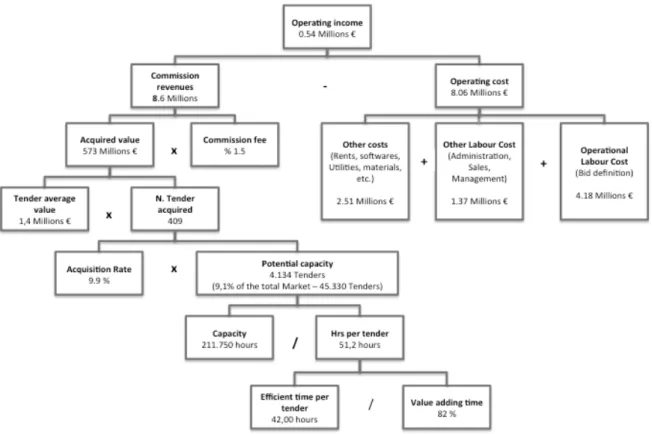
To help make sense of BC’s strategy and performance model, the researchers developed an in-depth analysis of the financial performance and related key drivers. Figure 2 shows the breakdown of operational costs and the drivers of actual revenues.
Figure 2. Breakdown of BC’s 2013 financial performance
It emerged that in 2013, BC participated in only 9.1% of potential tenders and the average acquisition rate (AR, the ratio between the number of tenders won and the total amount) was only 9.9%. The forecasted efficiency improvement, increasing the value added time from 82% to 86%, showed a potential additional profit of around 420,000 €, not even close to regaining the past level of profitability (1.3 million €).
During the interviews, 9 out of 11 project managers highlighted the higher potential of increasing the AR instead of process efficiency. In their opinion, the very low AR was mainly due to the incorrect selection of tenders to bid for. The scheduling of jobs was mainly chronological, without an adequate evaluation of the available project team’s competencies. A simple simulation, run starting from the numerical performance breakdown (Figure 2), showed that an increase in the AR of less than 1% would allow reaching the same profitability as the efficiency projects defined by the company. A meeting with the GM was held to discuss the data collected. It was agreed that a strategy focused on effectiveness rather than efficiency would benefit BC but would require specific attention to the factors affecting the ability to win profitable tenders. While a number of tenders could be described as ‘high-value, easy-to-manage’, ‘low-‘high-value, high-complexity’ bids were not unusual. This discussion led to the definition of a ‘profitability index’ obtained by dividing the revenue generated from
each bid by the time used. This ratio was named ‘Revenue Per Hour’ (RPH). Consequently, the extant efficiency-related indicators would ideally be replaced with two measures representing two relevant strategic macro-factors: the ability to acquire new bids (the AR) and their profitability (the RPH). This decision prompted some initial resistance from the controller. He had 25 years’ experience as a controller in several organizations and his work had always been focused on cost accounting and control. In his opinion, performance measurement and management should mainly focus on cost control, while revenue analysis was ‘something funny done by the marketing people’. The researchers provided additional simulations and analyses based on the numerical performance breakdown to show the controller the higher impact of an increase in AR and RPH compared to cost reduction.
5.2. Identifying the key questions
A second focus group was held with the GM, the controller, the area leaders and the project managers to define the key questions on which to focus the analytical methods to increase BC’s effectiveness. This phase proved somewhat difficult as the design of analytical methods required a high degree of specification in terms of identifying the dependent and independent variables and, more in general, what to expect from the data. To focus the discussion, the researchers guided the participants in developing two separate sets of questions to support either the diagnostic or interactive function of the PMS (Simons 1995) through analytical methods. This was achieved by encouraging the participants to reflect on the variables that seemed more important for the success of the business and those that may challenge such outcome (the model represented in Figure 2 was especially useful in supporting this discussion). From this emerged that different types of bids (in terms of project/task, customer characteristics, specific project manager) were very likely to influence the two target variables (AR and RPH). Market dynamics also appeared to be the main source of risk. Specifically, around 50% of revenue came from public administrations operating in BC’s geographic region and the problematic financial situation of many of these administrations could lead to a huge decrease in total revenue and profit.
At the end of the focus group, four key questions were identified:
1. What is the AR and RPH of the different types of tenders (large vs. small, in BC’s geographic region vs. outside its territory or even abroad, related to public or private customers)?
2. What drivers affect the AR and RPH? Do they mostly relate to the tender characteristics (geographic area, size, type of customer) or to the internal organization (project owners)?
3. What is the effect of a change in each of these factors on AR and RPH? Consequently, which factors are more critical (internally manageable variables) or risky (external variables)?
4. Which types of tenders should BC focus on to maximize financial performance and mitigate the operational risk? Which project owner should be dedicated to each kind of tender?
These four questions show the growing level of complexity from merely descriptive analyses (different AR and RPH of different groups of tenders) to diagnostic and predictive evaluations of the impact of the different variables and, finally, to prescriptions of the most effective behaviours. The questions also indicate the relevant role of either the diagnostic or interactive use of PMS. From a diagnostic standpoint, the objective is to highlight which variables are more relevant to focusing PMS accordingly and quantify the cause-effect relationships. From an interactive point of view, these key questions enable identifying the potential sources of risk.
The focus group proved difficult to manage, especially in relation to the question on project manager performance. Although the project managers were not reluctant to admit a varied level of effectiveness for different types of bids, they were averse to measuring and reporting this specific data. In their opinion, many contingent factors affected their performance (specific bid issues, financial problems of customers, particular payment conditions, etc.), thus making it difficult to isolate, if not arbitrarily, their specific contributions.
5.3. Data collection
A number of issues emerged during data collection to recover the data needed to answer the four key questions. BC’s data were not stored in one single database. Some information was unstructured and recorded in Excel and Access files provided by the sales department (all the bids the company had participated in, their size, the project manager in charge). Some information was provided by the accounts department (for the bids won this included customer details, job classification, payment conditions). Finally, the project management department provided a database including the number of hours dedicated to managing each
bid won. A huge amount of work was undertaken, particularly on the less reliable commercial information, to assess the data, evaluate mistakes or missing information, as well as searching external databases to integrate internal data where possible. While the long experience in academic research enabled the research team to deal with partial information (incomplete or not entirely reliable databases), this phase absorbed a significant amount of time and effort.
5.4. Design and development of the analytical methods
The development of the analytical methods was highly favoured by the quantitative analysis experience of some of the members of the research group. First, some descriptive analyses (mainly frequencies, crosstabs, correlations and graphical analyses) were run to explore the performance measures, the distributions of these variables, the relationship between the potential drivers and the final outcome.
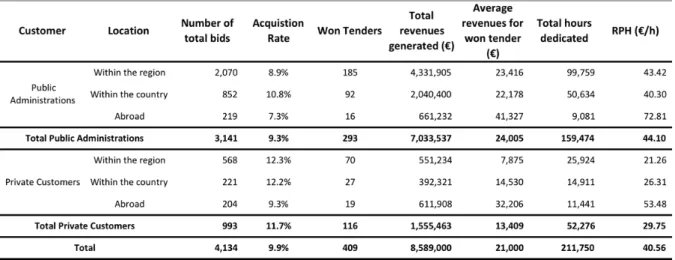
The first key question called for descriptive analyses related to the AR and RPH for different types of bids. The analysis showed very different performances linked to geographic factors, contract size and different customers (see Table 2).
Table 2. Analysis of the AR and the RPH by geographic region and customers
Thereafter, a hierarchical cluster analysis was conducted including as clustering procedure variables the relevant dimensions obtained from the first descriptive analyses (bid size, geographic area, private/public customer) and the two effectiveness-related measures emerging from the focus groups (RPH, AR). The analysis provided evidence for three clusters of bids with completely different characteristics. Based on the prevalent type of customers and the geographic region, these were respectively labelled ‘Italian Public Administration Tenders’ (60% of the total bids, average effectiveness), ‘Private Customer
Small Tenders’ (25% of total bids, high AR, low RPH) and ‘Foreign Customer Tenders’ (15% of total bids, very low AR, huge RPH).
Thereafter, a generalized linear model (logistic regression) was run defining the acquisition of the bid as the dependent variable and the characteristics of the bid (size and customer) as the independent variables1. The result showed a statistically significant role of both variables affecting the success of the bid and led to a model able to predict the probability of winning a bid with an acceptable known error level. While the previous analysis was targeted at measuring the drivers of AR, a multivariate regression was intended to explain the impact of the same independent variables on RPH. In this case, bid size showed a predominant explanatory role, highlighting a significant positive effect on profitability.
Finally, for each cluster, the performance of bids managed by each project manager was analysed (both AR and RPH). For about 40% of project managers, the performance obtained in the different clusters of tenders was statistically different, supporting the notion of the ‘specialization’ of project managers.
5.5. Revising the performance management cycle
The GM was particularly keen to translate the BPA results into tangible changes. He intended to revise the Performance Management Cycle (PMC) and invited the research team, the controller and the two area leaders to join a project team with this objective. The following PMC initiatives were then discussed and defined by the team:
a. The company was currently not exploiting the potential (low AR) of this very profitable market (high RPH). A third area leader would be selected and put in charge of the foreign market.
b. At the beginning of the year, the number of tenders to bid for would be budgeted taking into consideration the AR and the RPH. The objective was to maximize performance while keeping the operational and financial risks under control. Knowledge of the past AR and RPH of each market and the impact of each driver would support the definition of new targets.
c. The data on AR and RPH would be continuously updated and made available not only to the GM and area leaders, but also to all the project managers and employees, to support communication and dialogue on the actions needed to further increase
1 Customer was represented with two dummy variables: type (private vs. public) and geographic location (Italy
effectiveness. In each office, big screens would display the most recent data on effectiveness and the company would promote dialogue on the initiatives able to increase performance.
d. The allocation of the project manager and team to a new bid would be based on the analysis of past effectiveness for the same cluster of tenders.
e. The terms used in running the system would be kept as simple as possible and a training program would explain these and the rationales of the system to all BC employees.
f. The statistical analysis of the drivers affecting the effectiveness of the operational processes would be repeated every year to identify potentially emergent strategies. These six key points became the backbone of the new PMC to be implemented over the following months.
6. Discussion
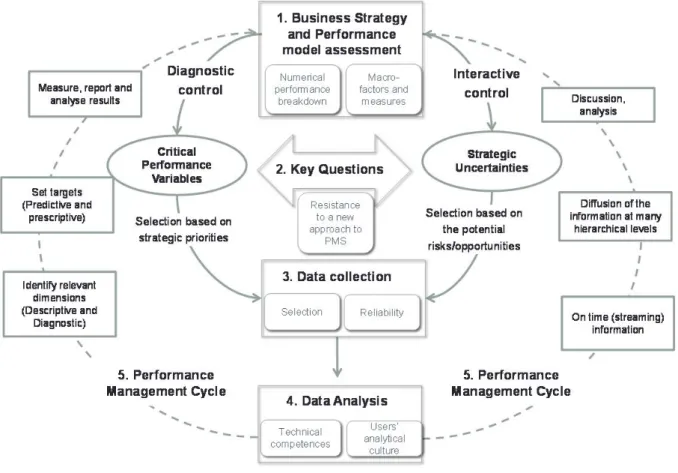
This paper employed an action research design to explore the role of BA for performance management purposes and operationalising BPA. As the researchers’ intent was to make a theoretical contribution in a currently undeveloped research area, a preliminary theoretical framework grounded in performance management literature was developed (see Figure 1). As an ex ante road map, it indicated how the intervention was intended to work (Jönsson and Lukka 2007) and which variables were initially deemed critical to delivering the intended effects. However, as part of the post-intervention reflection and repositioning of the findings in the theoretical realm, a comparison with the ex-post results helped the researchers question some of the initial assumptions, as well as unbundling complexities not initially perceived. This section focuses on the discussion of the insights from the intervention at BC and their implications for the final development of the BPA framework presented in Figure 3.
Figure 3. The final BPA framework
The comparison between Figure 1 and Figure 3 shows that the main structure of the initial framework based on five sequential but interrelated steps was substantially confirmed by the results of the case study. The evolutions of the initial framework mainly concern the identification of one or more critical issues for each step (represented in the small boxes within each step in Figure 3) and a more fine-grained development of each step (e.g., step 5 “Performance Management Cycle” in Figure 3).
First, the findings confirmed the relevance of the business strategy and performance model assessment as the starting point of the BPA development (step 1 in Figure 3). From the first round of interviews and focus groups, the prominent role of effectiveness enhancement vs. efficiency improvement emerged as a perceived key driver of BC’s performance. This initial perception provided a clearer view of the critical performance variables and proved decisive in framing the context for developing the analytical models. For this purpose it was really useful the numerical breakdown of BC’s financial performance (Figure 2), because it easily allowed showing the much higher effect of effectiveness increase compared to efficiency improvement. This result reflects a well-established approach in performance management literature whereby PMS should be clearly linked to organisational objectives to enable their
strategic role (Chenhall 2005; Ferreira and Otley 2009; Simons 1995). However, in the context of introducing BPA in the PMS, the importance emerged of linking analytical methods to the organization’s objective to provide valuable insights (LaValle et al. 2011; Stubbs 2011). In fact, while the specific development and application of BPA required a more detailed discussion and analysis, the identification of which macro-factors to investigate (namely, the acquisition rate and the profitability of bids) derived from the initial mapping of the performance model. Although these findings require further investigation, they diverge from the notion that in the ‘Petabyte Era’, no expertise, insight or theory is needed, since ‘with enough data, the numbers speak for themselves’ (Anderson 2008, 2; Mayer-Schönberger and Cukier 2013). However, data without a theory risks providing useless, partial or even distorted and misleading information. As Harford (2014, 3) suggests, ‘[…] a theory-free analysis of mere correlations is inevitably fragile. If you have no idea what is behind a correlation, you have no idea what might cause that correlation to break down’.
Second, the actual intervention revealed the criticality of translating the strategy assessment into a set of specific questions that BPA should address (step 2 in Figure 3). The idea of codifying general organisational objectives in more concrete terms has long been considered a necessary step in the definition of the PMS (Ferreira and Otley 2009; Simons 1995), leading to the subsequent identification of KPIs, and the reason behind considering this a separate aspect in the research design. However, in the process of developing BPA, this phase was particularly critical. To choose which data to use, which analytical methods to employ and which dependent and independent variables to select required a high level of specification as well as clearly framing the questions (LaValle et al. 2011), which proved difficult in the case company concerned. On one side, the GM, area leaders, controller and project managers were forced to enter into deep discussions on which elements should be investigated, challenging the tendency to measure everything and considering all variables important (Neely 1999; Thompson and Strickland 2001). Here the researchers’ intervention and the attempt to develop a separate set of questions to support either the diagnostic or interactive function of PMS (Simons 1995) proved very helpful in directing the participants’ efforts. However, this only partially led to framing two clear-cut groups of questions contrarily to the initial assumptions (Figure 1). As the actual analysis later indicated, the same information could be used in both a diagnostic and interactive way (Simons 1995; Tessier and Otley 2012). In other words, distinguishing questions on the basis of their purpose appeared not to be relevant (Figure 3) as it is the consequent analyses that can address both the critical performance variables (diagnostic control) and the strategic uncertainties (interactive control).
On the other side, the potential addition of a statistical element seemed to increase awareness of the potential consequences of embedding new data in the performance management process. Data are not neutral and once they become embedded in the performance management process, they create new calculative spaces (Miller and O’Leary 1994) rendering previously unexplored phenomena visible. For instance, participants had some perception of potentially different levels of project managers’ performance in relation to the type of bids managed. However, there was an initial resistance to the idea of statistically investigating and reporting such information due to increased visibility of individual outcomes, as well as a potential redistribution of responsibilities. In the same way the controller initially resisted to the idea of analytically investigate the determinants of revenues, instead of cost drivers.
The results also indicated the complexity of selecting and collecting data (step 3 in Figure 3). In a context where extended IT system capabilities have significantly eased data collection, information overload is a frequently reported issue that literature considers a key impediment to the effective use of data to support PMS (Nudurupati et al. 2011). BC had no shortage of data, yet the data lacked strategic alignment and were spread over a number of databases set up for different purposes. As a result, some of the data were duplicated whilst others were incomplete, calling their validity into question. On different occasions, those involved in the project reported the difficulty of identifying what data to use to support their decisions (Economic Intelligent Unit 2013; Klatt et al. 2011). These issues confirmed a more general problem whereby organisations select which data to collect without a cognitive plan and invest significant time and resources in analysing, selecting and cleaning the relevant data ex-post (Zhang, Yang, and Appelbaum 2015). The BC intervention suggested that organisations would benefit from a reverse approach to data, where the initial strategic assessment and subsequent specification of key questions shape data selection and collection (LaValle et al. 2011). Moreover, this shed further light on the issue of data quality when developing BPA, as volume, completeness and reliability of data are critical (Bhimani and Willcocks 2014). Data richness and the presence of structured and unstructured data may increase such problems (Harford 2014). This raises concerns over using BPA to support performance management, since data collection and processing bias could undermine the managers’ trust in the analytical evidence (Bose 2008; Ittner and Larcker 2005).
When developing the preliminary framework, the design and development of the analytical methods were largely interpreted from a ‘technical’ perspective. At this stage, statistics and mathematical models were applied to answer the key questions and the results
could be employed to manage organisational performance (see step 4 in Figure 3). This view only partly mirrored reality and a number of problems emerged in the case development. On the one hand, the four types of analytics reflected different degrees of complexity and highlighted a lack of technical competences as the analysis moved along the descriptive-prescriptive spectrum. On the other hand, the intervention indicated significant challenges for those expected to use the information. First, the controller, area leaders and project managers had limited understanding of the statistical and econometric language. Second, they lacked a broader analytical culture where decision-making is based on rationality and the comprehensive analysis of information (Popovič et al. 2012). For instance, BC’s controller had an accounting and auditing background and his traditional view of the control function was significantly challenged by the ideas generated by the use of BPA. These results confirm that lack of analytical competences is one of the main constrains in the development and effective use of BPA (Economic Intelligent Unit 2012; Popovič et al. 2012; Ransbotham, Kiron, and Kirk Prentice. 2015, 2016). Thus, staff training and skill development may be as important as data and statistics (Brands and Holtzblatt 2015; Brown, Court, and McGuire 2014, 4;Nudurupati et al. 2011; Orlikowski 2000).
Conversely, the application of the analytical methods can provide relevant support in measuring the causal interdependencies between the strategic variables (Klatt, Schläfke, and Möller 2011) and manage performance accordingly. Our findings support this point: the cluster analysis, logistic and multivariate regressions clarified and measured the causal link between specific bid features (size, geographic location, customer, PM selected) and the AR and RPH. This is a key contribution of BPA to PMS where the poor definition of causal effect links is considered a major issue in PMS implementation (Brignall 2002; Economist Intelligence Unit 2012), albeit a crucial element in ensuring its strategic role (Chenhall 2005; Gimbert, Bisbe, and Mendoza 2010). Some of the most common assumptions about what drives financial performance have become so widely accepted that they are often considered as fact, but in reality, managers are frequently not in a condition to justify the assumptions underlying their organization’s competitive strategy with the relevant data (Buytendijk, Hatch, and Micheli 2010; Silvestro 2016).
The results of the analytical application indicated that BPA could be used both diagnostically and interactively (step 5 in Figure 3). They also highlighted the criticality of integrating such information in the PMS system to make it actionable (Ferreira and Otley 2009). From a diagnostic perspective, BPA played a role in making previously unidentified critical performance variables visible. The magnitude of the relationships between the AR
and RPH with specific bid features prompted redefining the budgeting system around these variables, as well as the allocation of project managers according to their past performance in managing specific types of bids. As such, the BPA information would be used to set and communicate targets and report on actual performance. The BPA diagnostic function appeared not to modify the conventional performance management cycle, but played a more encompassing and ‘enabling’ role (Ferreira and Otley 2009) by increasing PMS effectiveness through improved, evidence-based information. From an interactive standpoint, our findings indicated that BPA could fulfil the two distinct functions that characterise this type of use (Tessier and Otley 2012; Ferreira and Otley 2009). On one side, BPA supported the notion of ‘interactive use of controls’. Given their critical role in driving BC’s current performance, the AR and RPH became the two key measures to be continuously updated, communicated and used by the GM, area leaders and project managers to promote dialogue and monitor the planned objectives. On the other side, the analytical models indicated that BPA could be used as ‘strategic validity controls’. For instance, the results of the logistic regression allowed forecasting the expected consequences of external shocks on AR and RPH. As such, the statistical analysis of the drivers of BC’s performance would be run periodically to verify the underlying assumptions and possibly identify new emerging patterns. From a broader perspective, the results confirmed the idea that ‘any control’ can be used for diagnostic or interactive purposes (Simons 1995; Tessier and Otley 2012). As previously suggested, the same measures and relationships can be employed for different purposes.
7. Conclusions
The idea that data analysis can support the development and use of PMS has long been discussed in literature (Ittner and Larcker 2005; Schreyögg and Steinman 1987, Simons 1995). A number of studies investigate its potential in revealing and quantifying the relationships between value drivers and firm performance through the connection between ICT and PMS (Nudurupati and Bititci 2005; Nudurupati et al. 2011). However, the diffusion of data-based PMS remains limited, with a low number of applications and low relevance within PMS (Bititci et al. 2012; Ittner, Larcker, and Meyer 2003; Ittner and Larcker 2005; Silvi et al. 2015). The growing importance of Big Data and BA has generated a renewed interest in this research area and several contributions claim their potential role for performance management purposes (CIMA 2014; Economist Intelligent Unit 2013; Nudurupati, Tebboune and Hardman 2016).