P E R S P E C T I V E
First steps in experimental cancer evolution
Tiffany B. Taylor,1Louise J. Johnson,1Robert W. Jackson,1Michael A. Brockhurst2and Philip R. Dash1
1 University of Reading, Whiteknights, Reading, Berkshire 2 Department of Biology, University of York, York, UK
Keywords
carcinogenesis, evolutionary trade-offs, kin competition, metastasis, resistance, resource competition, social evolution
Correspondence
Tiffany B. Taylor, University of Reading Whiteknights, Reading, Berkshire. Tel.: +44 (0)118 3785049; fax: +44 (0)118 378 5224; e-mail: [email protected] Received: 5 October 2012 Accepted: 23 November 2012 doi:10.1111/eva.12041 Abstract
Evolutionary processes play a central role in the development, progression and response to treatment of cancers. The current challenge facing researchers is to harness evolutionary theory to further our understanding of the clinical progres-sion of cancers. Central to this endeavour will be the development of experimen-tal systems and approaches by which theories of cancer evolution can be effectively tested. We argue here that the experimental evolution approach – whereby evolution is observed in real time and which has typically employed microorganisms–can be usefully applied to cancer. This approach allows us to disentangle the ecological causes of natural selection, identify the genetic basis of evolutionary changes and determine their repeatability. Cell cultures used in can-cer research share many of the desirable traits that make microorganisms ideal for studying evolution. As such, experimental cancer evolution is feasible and likely to give great insight into the selective pressures driving the evolution of clinically destructive cancer traits. We highlight three areas of evolutionary theory with importance to cancer biology that are amenable to experimental evolution: drug resistance, social evolution and resource competition. Understanding the diversity, persistence and evolution of cancers is vital for treatment and drug development, and an experimental evolution approach could provide strategic directions and focus for future research.
Introduction
Recently, there has been a shift in current thinking among cancer researchers that acknowledges the importance of evolution in understanding cancer progression within a host. This movement has been guided by an increasing body of seminal work (e.g. Vogelstein and Kinzler 1993; Leroi et al. 2003; Merlo et al. 2006; Attolini and Michor 2009; Sequist et al. 2011; Gerlinger et al. 2012; Greaves and Maley 2012) reinvigorating old ideas (Nowell 1976) regard-ing the evolution and ecology of cancers. Recent studies have detected rapid evolution and spatially structured genotypic and phenotypic diversity both within tumours and between primary and secondary tumours (Frumkin et al. 2008; Stoecklein et al. 2008; Sequist et al. 2011; Gerlinger et al. 2012). The consideration of evolutionary progression of cancers is therefore not just desirable it is essential. Cells become cancerous when mutations arise which increase their replication rate and survival advantage
compared with neighbouring cells; subsequently, natural selection will act on these cells and ultimately ensure the proliferation of the mutant lineage (for reviews, see Crespi and Summers 2005; Merlo et al. 2006; Greaves and Maley 2012). Once cancerous traits have evolved, an elevated mutation rate and metastatic potential may facilitate diver-sification and persistence of the cancerous cells (Bielas et al. 2006). Moreover, aggressive drug treatment of can-cers will unavoidably select for resistant lineages, which become increasingly difficult to treat. However, by under-standing how the environment shapes the evolution of can-cerous traits, we can begin to anticipate evolutionary trajectories and apply a more proactive treatment strategy (Cairns 1975; Aktipis et al. 2012; Yap et al. 2012).
There are a number of factors that will determine the fit-ness of cancerous cells within a host. The immediate micro-environment will present challenges for space and resources, and the extended microenvironment will pro-vide further challenges in the form of vascularization and Evolutionary Applications ISSN 1752-4571
the realization of metastatic potential (that is the migration and colonization of cancer cells to secondary sites within the host). Although substantial effort has been conducted into understanding mechanistic consequences of cell–cell and cell–environment interactions, the evolutionary and ecological outcomes have not been explicitly tested. These have left fundamental questions regarding cancerous behaviours unanswered, such as: How do competitive interactions between cells determine disease progression? What are the fitness costs of drug resistance? How do the selective pressures between different environments effect disease progression (e.g. liquid versus solid cancers)? Answering these and other pressing questions in cancer biology will require carefully designed experiments that explicitly test competing evolutionary hypotheses of cancer progression, which are led by observational data from clini-cians highlighting the medically important traits.
In this article, we propose that to answer some of the fundamental questions regarding the evolutionary progres-sion of cancers, cancer biologists should adopt the powerful techniques of experimental evolution. Seminal experimen-tal evolution studies have fundamenexperimen-tally changed our understanding of evolution in terms of adaptation (Lenski et al. 1991), diversification (Rainey and Travisano 1998), social evolution (Turner and Chao 1999; Velicer et al. 2000), evolutionary trade-offs and constraints (Novak et al. 2006; Blount et al. 2008), repeatability (Lenski et al. 1991; Lenski and Travisano 1994; Cooper et al. 2003; Woods et al. 2006; Barrick et al. 2009) and more besides; there is strong potential for similar advancements in cancer biol-ogy. Experimental evolution uses replicate populations of organisms with fast generation times (typically microor-ganisms) to study evolutionary processes in real time (for
review see, Elena and Lenski 2003). The experimenter con-trols the environmental conditions under which evolution occurs and monitors the effect of specific selective pressures on traits of interest (Buckling et al. 2009). One major bene-fit of this system is that evolved and ancestral lines, or mul-tiple evolved lines, can be competed against each other to measure fitness under defined ecological conditions, and the accumulation of mutations can be followed in a rigor-ously defined and time-directional manner over numerous generations.
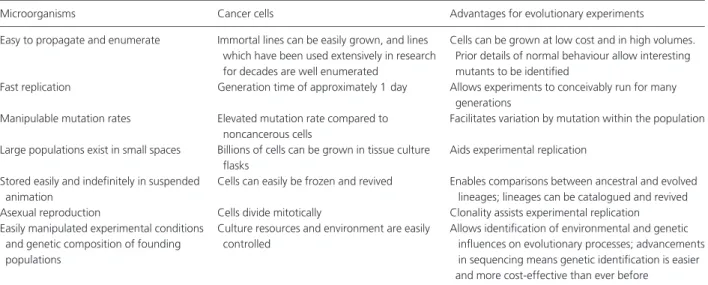
Cancer cells can conveniently be grown in vitro, and these cancerous tissue cultures share many beneficial char-acteristics with microbial model systems used for experi-mental evolution studies (Table 1). A promising new area of research therefore suggests itself: experimental cancer evolution, which could provide new insights into disease progression and aid the strategic development of new drug therapies and treatment regimes.
Here, we discuss three general evolutionary problems that have the potential to dramatically influence the evolu-tion of cancerous traits, but remain to be rigorously explored empirically: the evolution of drug resistance and associated costs, cooperation and conflict between cancer-ous and noncancercancer-ous cells, and resource competition as a driver for the evolution of metastasis. Although all three have already been successfully addressed using experimen-tal evolution in microbes, cancers provide a new challenge to understand how predictions derived from simpler bio-logical systems translate to a more complex one. Cancers have a comparably larger molecular ‘tool kit’ and a com-plex relationship within the ‘cell community’. Noncancer-ous cells are programmed for a multicellular lifestyle and will thus act altruistically for the benefit of the host, but Table 1.Features of microorganisms which make them an ideal model system for studying evolution experimentally (Elena and Lenski 2003) and parallels in cancer cells.
Microorganisms Cancer cells Advantages for evolutionary experiments
Easy to propagate and enumerate Immortal lines can be easily grown, and lines which have been used extensively in research for decades are well enumerated
Cells can be grown at low cost and in high volumes. Prior details of normal behaviour allow interesting mutants to be identified
Fast replication Generation time of approximately 1 day Allows experiments to conceivably run for many generations
Manipulable mutation rates Elevated mutation rate compared to noncancerous cells
Facilitates variation by mutation within the population Large populations exist in small spaces Billions of cells can be grown in tissue culture
flasks
Aids experimental replication Stored easily and indefinitely in suspended
animation
Cells can easily be frozen and revived Enables comparisons between ancestral and evolved lineages; lineages can be catalogued and revived Asexual reproduction Cells divide mitotically Clonality assists experimental replication Easily manipulated experimental conditions
and genetic composition of founding populations
Culture resources and environment are easily controlled
Allows identification of environmental and genetic influences on evolutionary processes; advancements in sequencing means genetic identification is easier and more cost-effective than ever before
cancer cells (which share the same signalling pathways) have the ability to manipulate these altruistic cells for selfish objectives. These factors have the potential to alter standard predictions made from unicellular models, but importantly will help to identify major issues which are likely to be key in the context of disease progression. To account for these differences between microbes and cancers (thus resulting in more accurate predictions regarding evolutionary trajec-tory), experimental evolution studies need to be conducted which explicitly test evolutionary theory within the context of cancer. A glossary is provided for definitions which might not be familiar to both fields (Box 1).
Costs of resistance and trade-offs
The evolution of drug resistance is a process of adaptation by natural selection and has been well described by popula-tion genetics models (reviewed in, Levin et al. 2000; but see also Read and Huijben 2009). In particular, the relationship between mutation rate and the fitness effects of mutations is key. Genetic instability is a trait which is considered a hallmark behaviour (Hanahan and Weinberg 2011) of can-cer. A high mutation rate is usually associated with a fitness cost, because most mutations are deleterious. However, a heterogeneous and frequently changing environment pro-vides selection for phenotypes with elevated mutation rates, because increased genetic variation allows faster adaptation (Sniegowski et al. 1997). An accurate estimate of mutation rates of cancerous cellsin vivois yet to be determined; how-ever, this information is key if we hope to better understand the predictability of resistance evolution. In particular, a newly developed approach by Wielgoss et al. (2011) uses whole genome sequencing combined with experimental evolution to provide a highly accurate measure of bacterial base-substitution rates– by sequencing severalE. coli ge-nomes after a 40 000 generation evolution experiment, they were able to directly infer the point mutation rate based accumulation of synonymous mutations. A similar approach could be adopted using cancer cells to try and identify why different cancers appear to vary in their muta-tion rate, and what impact mutagenic chemotherapy drugs have on baseline mutation rates (Loeb 2001).
Fitness effects of mutations are also crucial in determin-ing their fate: resistance mutations are generally associated with a reduced fitness in the absence of the drug – this trade-off is termed the cost of resistance. Costs occur because resistance is typically achieved through alteration of the trait(s) targeted by the drug leading to impaired or lost function. If resistant lines carry a fitness cost but are still allowed to evolve in the presence of the drug, natural selection will act to counterbalance the cost while preserv-ing the resistance, and as such resistant mutants will acquire new mutations which compensate for the fitness
decline. These compensatory mutations are important in determining the probability of loss of resistance in a drug-free environment, because the fitness of mutants which have fixed compensatory mutations is conditional on the presence of the resistant mutations for which they compen-sate, thus in the absence of the resistance mutation, the compensatory mutations may carry a fitness cost, therefore reducing the likelihood of reversion (Schrag et al. 1997; Maisnier-Patin and Andersson 2004).
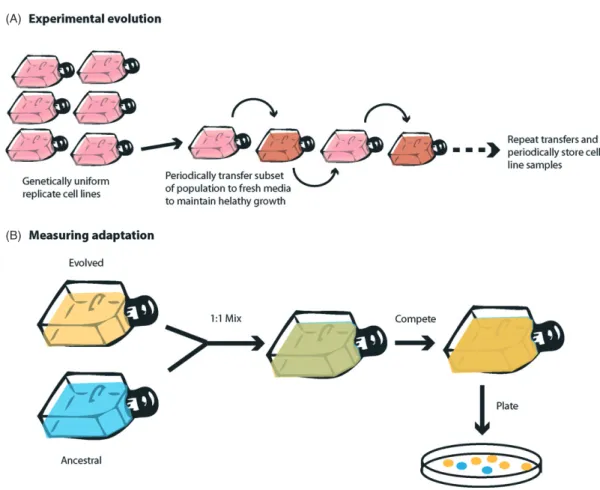
Recent studies have seen rapid evolution of drug resis-tance in cancers which occur due to mutations in the epi-dermal growth factor receptors (EGFR), including non-small-cell lung cancer (NSCLC) and colorectal cancers (Kobayashi et al. 2005; Turke et al. 2010; Sequist et al. 2011; Diaz et al. 2012). EGFRs are essential for cell growth and development, and highly conserved across all animals (Bogdan and Kl€ambt 2001); for this reason, they are a com-mon target site for cancer drugs, because by blocking the EGFRs, it is possible to slow cell growth. Sequist et al. (2011) found patients whose NSCLC had been treated with an EGFR blocker (tyrosine kinase inhibitor; TKI) evolved resistance within 12 months. To investigate the mechanism of resistance, genetic and histological testing was carried out on 37 patients with NSCLC treated with TKIs. It was discovered that all 37 samples had acquired new mutations related to the disruption of EGFR function, in addition to the original EGFR mutations which had triggered cancer-ous behaviour. This study clearly demonstrates that cancer cells which modified their EGFRs to disrupt binding of TKIs acquired resistance. However, changes to these recep-tors are likely to have large negative fitness effects on the cell, because they will be associated with less efficient cell growth, but the actual costs of these fitness effects remain to be explicitly measured. Competition experiments (Fig-ure 1) could be used to quantify these costs and as such, improve the predictive power of the evolution of resistance to drugs which target EGFRs. Competition experiments involve directly competing ancestral and evolved (i.e. sus-ceptible and resistant) populations of cells in order to esti-mate the relative fitness of each cell type. The likely large costs associated with changes to the EGFR are further exemplified in this study, because after some patients with resistant cancers stopped treatment with TKIs, the resis-tance mutations were lost, and their tumours once again became sensitive to treatment by either the same or a dif-ferent EGFR inhibitor. Reversion may occur if the cost of the mutation conferring resistance is very high, but is unli-kely if compensatory mutations have negated this cost. Therefore, in this specific study, the cost of resistance appears to be very high, and the effect of compensatory mutations, low–a promising observation in terms of man-aging drug resistance, and a measurable effect within vitro testing.
Similarly, rapid evolved resistance to TKIs is seen in chronic myeloid leukaemia (CML) (Blagosklonny 2002; Shannon 2002; Shah et al. 2007). Resistance is acquired via point mutations toBCR-ABL(a gene responsible for con-stitutive tyrosine kinase activity) that cause structural changes which perturb binding of the drug (Gorre et al. 2001). Population genetics have been applied to clinical data to try and gain an insight into how TKIs exert its ther-apeutic effect in CML (Michor et al. 2005), finding that TKIs dramatically reduces the rate at which cancer progeni-tors are produced from the stem cells, but does not lead to a decline of stem cells themselves. In addition, they found the probability of evolving resistance increased with disease progression, as a consequence of increased stem cell abun-dance. This combined molecular and mathematical approach shows promising and informative direction for future development.
When resistance occurs, multiple drugs are commonly administered in the hope that bombarding the cells will
mean full resistance is impossible (or at least improbable). However, the success of such an approach requires a detailed understanding of drug interactions: antagonistic interactions between drugs (i.e. drugs which inhibit each other’s effects) will most likely lead to a low rate of evolu-tion of multidrug resistance, because a mutaevolu-tion that con-fers resistance to one drug will be associated with only a marginal benefit; however, when interactions between drugs are synergistic (i.e. enhance each other’s effects), resistance mutations will be associated with large benefits, and rapid multidrug resistance is expected (Hegreness et al. 2008; MacLean et al. 2010). There has been much research showing the importance of the microenvironment in deter-mining cancer behaviour, and it is likely to be central in the context of evolution of drug resistance. By administering different drug strategies in the lab, which are known to be antagonistic or synergistic in their actions, under different environmental conditions (such as nutrient content, tissue type or genetic variability of tumour mass) we can test
pre-(A)
(B)
Figure 1The simple competition experiment is one of the most powerful tools in experimental evolution. It allows ancestral and evolved populations to be directly competed to provide an estimate of relative fitness between populations under defined ecological conditions. Ancestral and evolved populations are grown separately, and then mixed at a 1:1 frequency. They are allowed to grow and compete, after which the frequency of each population is estimated by plating a subset of cells onto a hard media and counting each colony type (cells may need to be tagged to allow differenti-ation). After Elena and Lenski (2003) and Buckling et al. (2009).
dictions regarding the evolution of drug resistance and gain a greater understanding as to what extent evolutionary tra-jectories are predictable.
In microbes, there has been a drive to understand the evolution of resistance due to the misuse of antibiotics leading to widespread antibiotic resistance. As such many techniques have been developed which measure the key components of the evolution of resistance, such as muta-tion rates, costs of resistance, compensatory evolumuta-tion, multidrug resistance, and selection gradients. For instance, costs of resistance have been accurately measured using competition experiments (Figure 1) whereby the ancestral strain (which is susceptible to the antibiotic) and the resis-tant strain are grown together in the absence of the antibi-otic. A subset of the population is then plated onto agar plates to allow growth of each strain type to be determined. Comparing the ratio of ancestral and resistant colonies enables fitness estimates to be made. This information allows one to determine the effect of antibiotic use under ideal conditions for microbial growth and predict conse-quences forin vivouse, enabling calculated risk assessment in antibiotic treatment. These experiments are all quick and simple to conduct and cheap to run – and similar experiments could be conducted using a cancer system.
In addition, a theoretical approach using adaptive walks allows predictions to be made regarding the likelihood of reversion of a resistance mutation to its susceptible ances-tral genotype given a certain selection gradient and fitness landscape. Microbial data suggest that compensatory muta-tions are more likely than reversions, because there are sev-eral possible compensatory mutations for each resistance mutation (Poon et al. 2005). Moreover, compensatory mutations may be harmful in the absence of the original resistance mutation, further decreasing the chance of rever-sion (Schrag et al. 1997; Maisnier-Patin and Andersson 2004; Andersson 2006). Current research suggests that microbes cannot be relied on to lose resistance to an antibi-otic if its use is discontinued (Andersson 2006; although see, Andersson and Hughes 2010), and therefore, we might predict that the rate of cancer cells losing resistance will depend on the type of drug used, the strength of selection and the degree of competition within the tissue (Komarova and Wodarz 2005; Szakacs et al. 2006). However, evidence from cancer research seems more promising. Several rever-sions to susceptible phenotypes were observed in one study (Sequist et al. 2011): but, how can we account for these apparent differences?
We suggest that this difference is due to disparities in drug action. Antibiotics can rapidly kill bacteria without destroying human cells because they exploit the differences between bacterial and eukaryotic cells. The differences between cancerous and healthy human cells are, by con-trast, subtle, involving quantitative differences in gene
expression (Zhang et al. 1997). Cancer treatment is there-fore a more sensitive compromise between efficacy and toxic side effects, involving longer courses of treatment, typically several months. This means selection for drug resistance in cancer cells is weaker, but more prolonged, than selection for antibiotic resistance; mutations confer-ring resistance will be favoured, but any pleiotropic delete-rious effects on fitness must be minimal. When bacteria are challenged with an antibiotic, however, selection pressures are strong, so mutations conferring resistance can fix even if they have considerably deleterious pleiotropic effects. Potential compensatory mutations are therefore more advantageous, and fix more rapidly. This hypothesis is test-able using microbes and cancer cell lines.
Social evolution: conflict and cooperation
The social environment – the behaviour of an organism’s neighbours – can have a direct impact on fitness. These interactions are often thought of as negative: for instance, individuals that are competing for scarce resources will reduce each other’s fitness. However, social interactions can also provide benefits if, for example, mutually secreted enzymes free up nutrients for neighbouring cells (Lee and Schneewind 2001; Nadell et al. 2010). Under these circum-stances, the behaviour can be considered cooperative because the action benefits both the actor and the recipient (West et al. 2007). Cooperation can be split into two sub-groups: mutualism, whereby both individuals contribute to a behaviour to which both gain benefit; and altruism, whereby an action benefits the recipient but comes at a cost to the actor. Altruism in particular posed a problem for evolutionary biology: how can a behaviour evolve which appears costly to the individual but beneficial to others (Maynard Smith and Szathmary 1995; Hamilton 1996)? Hamilton (1964) explained the evolution and maintenance of altruistic behaviours through relatedness, whereby coop-erative interactions can evolve if the benefit from such an interaction is most likely received by a kin member. This is because improving the fitness of a kin member helps to propagate the shared genes between the helper and the helped–thus an indirect benefit is gained. Mutual benefit cooperation on the other hand provides a direct benefit to all contributors, and therefore can evolve in the absence of high relatedness.
The evolution of multicellularity is considered one of the major evolutionary transitions in the history of life on earth (Maynard Smith and Szathmary 1995). For multicellularity to evolve, cells are required to transition from unicellular individuals acting selfishly to proliferate their own survival, to being part of a group where survival is maximized between many cooperating individuals. For this to occur, competition between selfish entities must be repressed, and
individual cell fitness aligned with group cell fitness (Leigh 1977), otherwise there will be a selective drive to defect from a multicellular lifestyle in favour of a solitary one (Frank 2003; Kummerli et al. 2010). In our own bodies,€ individual somatic cells cooperate to maximize lifetime reproductive success, and thus transmission of the genes which are shared by every cell in our body. Cancer cells undergo this major transition in reverse, and abandon a cooperative existence to selfishly outgrow normal cells. At this point, the focused level of selection (in terms of under-standing disease progression) shifts from the group to the individual cell (Klein 2003; Gardner and Grafen 2009).
However, this transition poses some interesting ques-tions as to how these rogue cells interact with their social environment given that they possess the machinery to manipulate their competitors. Cell–cell interactions are vital in disease progression, resulting in complex hetero-typic interactions where tumour cells interact with each other in addition to the normal stromal cells within the tis-sue microenvironment and vice versa(Weaver and Gilbert 2004; Axelrod et al. 2006). Noncancerous cells use signal-ling networks and mutually secreted enzymes in normal cell growth; however, cancer cells use these same pathways and signals for abnormal cell growth. Cancer cells are known to interact with each other and with cells from the tumour microenvironment–recruiting noncancerous cells to facili-tate proliferation (Hanahan and Coussens 2012), and
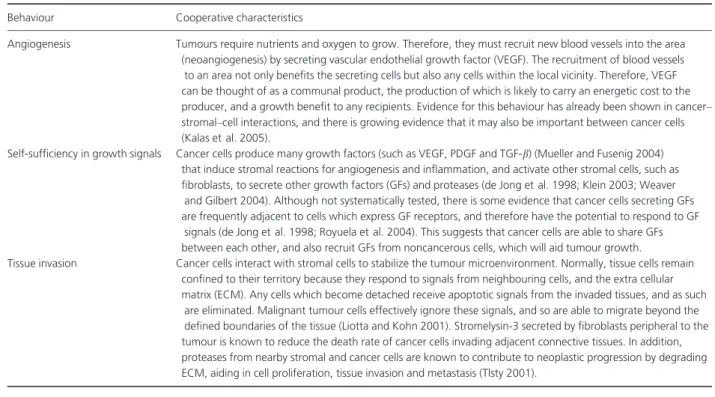
recent research has noted the conceptual similarities between cancer and bacteria in terms of social behaviours (for review see Ben-Jacob et al. 2012). There is evidence that certain hallmark behaviours (Hanahan and Weinberg 2011) of cancer cells require the excretion of products (sharable resources) which will be beneficial to other cancer cells within the vicinity (Stetler-Stevenson et al. 1993; Coussens et al. 2002; Egeblad and Werb 2002): this is coop-erative behaviour. Coopcoop-erative behaviours are intrinsically involved in several steps of tumour progression, such as angiogenesis, self-sufficiency in growth signals and tissue invasion (Table 2). This leads to a scenario of both cooper-ation and conflict, whereby cancer cells are regarded as cooperators in terms of the disease, but create conflict (i.e. behave as cheats) in the eyes of the host.
The tensions between cooperation and conflict over shared resources has been extensively researched in micro-bial systems, and some seminal papers have fundamentally changed our view of the social world microbes live in (Chao and Levin 1981; Turner and Chao 1999; Strassman et al. 2000; Velicer et al. 2000; Queller et al. 2003; Fiegna et al. 2006). Bacteria produce numerous extracellular mole-cules, such as tissue degrading enzymes, iron-scavenging siderophores and sticky polymers to protect surface grow-ing bacteria (biofilms), which are individually costly but benefit the group as a whole (West et al. 2007). Using tech-niques from experimental evolution on microbial systems
Table 2.Examples of ‘mass action cooperation’ (Heckathorn 1996) in cancers, where mutualisms form between different clones and cells within the microenvironment
Behaviour Cooperative characteristics
Angiogenesis Tumours require nutrients and oxygen to grow. Therefore, they must recruit new blood vessels into the area (neoangiogenesis) by secreting vascular endothelial growth factor (VEGF). The recruitment of blood vessels to an area not only benefits the secreting cells but also any cells within the local vicinity. Therefore, VEGF can be thought of as a communal product, the production of which is likely to carry an energetic cost to the producer, and a growth benefit to any recipients. Evidence for this behaviour has already been shown in cancer– stromal–cell interactions, and there is growing evidence that it may also be important between cancer cells (Kalas et al. 2005).
Self-sufficiency in growth signals Cancer cells produce many growth factors (such as VEGF, PDGF and TGF-b) (Mueller and Fusenig 2004) that induce stromal reactions for angiogenesis and inflammation, and activate other stromal cells, such as fibroblasts, to secrete other growth factors (GFs) and proteases (de Jong et al. 1998; Klein 2003; Weaver
and Gilbert 2004). Although not systematically tested, there is some evidence that cancer cells secreting GFs are frequently adjacent to cells which express GF receptors, and therefore have the potential to respond to GF
signals (de Jong et al. 1998; Royuela et al. 2004). This suggests that cancer cells are able to share GFs between each other, and also recruit GFs from noncancerous cells, which will aid tumour growth.
Tissue invasion Cancer cells interact with stromal cells to stabilize the tumour microenvironment. Normally, tissue cells remain confined to their territory because they respond to signals from neighbouring cells, and the extra cellular matrix (ECM). Any cells which become detached receive apoptotic signals from the invaded tissues, and as such
are eliminated. Malignant tumour cells effectively ignore these signals, and so are able to migrate beyond the defined boundaries of the tissue (Liotta and Kohn 2001). Stromelysin-3 secreted by fibroblasts peripheral to the tumour is known to reduce the death rate of cancer cells invading adjacent connective tissues. In addition, proteases from nearby stromal and cancer cells are known to contribute to neoplastic progression by degrading ECM, aiding in cell proliferation, tissue invasion and metastasis (Tlsty 2001).
has enabled us to explore theories regarding the evolution of cooperative behaviours, and gain a better understanding for how they might be maintained within a population.
Evidence suggests cooperation will be maintained through indirect and direct fitness benefits (Griffin and West 2002). Indirect fitness benefits require high related-ness within the population, ensuring cooperative behav-iours benefit local kin members. Direct fitness benefits can occur if individuals have a shared selfish interest in cooper-ating, for example, in the case of cross-feeding (where the waste product of one species is an energy source for another; Bull and Harcombe 2009). Moreover, it has been successfully established, using microbes, that social behav-iours often involve frequency-dependent selection (Queller 1984). This is because a ‘cheating behaviour’, that is letting those around you contribute to a public good so you don’t have to, is only a successful strategy if it is rare. This is likely to be important in the context of cancers because these factors will limit the size at which tumours can suc-cessfully function. The influence of such factors is easily addressed using competition assays (Figure 1) which vary in the initial frequencies of altruists and cheats (Ross-Gil-lespie et al. 2007).
Bringing social evolution research into the context of cancer will give new insights into the levels of selection and transitions to multicellularity. The experiments can start simple: spheroids (artificial masses of cancer cells), which are made up from cells of varying genetic diversity, are exposed to a range of environments which alter the com-petitiveness between cells (e.g. varying nutrient condi-tions). Here, we can look to see whether the predictions made by social evolution theory are fulfilled, and build on this knowledge with more complex experiments. Due to the easy manipulation of spheroid diversity, it gives the potential for cancer to make an elegant system on which some important questions can be answered: How does relatedness influence relative competition between cells? Is competition beneficial (because it encourages cooperative behaviours and metastasis) or disadvantageous (because cells have less individual resources) for tumour growth? Resource competition: dispersal and metastasis Metastasis in cancer is conceptually equivalent to dispersal in ecology. As disease progresses, cells detach from the pri-mary tumour and circulate in the bloodstream, where some go on to colonize new tissues and establish metastatic tumours (Friedl and Wolf 2003). Likewise, dispersal is the relocation of individuals from a natal site, a behaviour which provides the opportunity for population expansion via colonization events. It is therefore essential to apply the well-established evolutionary theories of dispersal to under-stand metastasis.
Dispersal is a risky strategy: a dispersing individual may die, settle in an unsuitable habitat or find itself in competi-tion with locally adapted rivals, and for many organisms, the probability that dispersal will pay off is extremely low. Yet dispersal is ubiquitous across the spectrum of life: from microbes, to plants, to birds. To understand how dispersal strategies evolve, one must understand the costs and bene-fits which will determine when and how dispersal is favoured, and the ecological subtleties which shape the behaviour. Fundamentally, the benefit of dispersal is that it allows an individual to escape local competition (providing an indirect fitness benefit) and gain access to resources (providing a direct fitness benefit) (Bowler and Benton 2005; Wei et al. 2011). A crucial breakthrough was the rec-ognition that dispersal is often a social trait such that organisms might pay high costs for dispersal if they are sur-rounded by kin. When individuals within the population are genetically similar (termed related), the overall benefit of dispersal is maintained, even when individual costs of dispersing are high (Hamilton and May 1977; Comins et al. 1980; Taylor and Frank 1996; Gandon and Michalakis 1999; Taylor and Buckling 2010). This is because the inclu-sive fitness of an individual is determined not only by how many genes it directly passes onto the next generation but also by how many genes shared with related individuals are also passed on (termed indirect fitness). This social consid-eration in terms of dispersal supports the paradoxical observation of how dispersal might evolve even when most dispersing individuals themselves die: a dispersing individ-ual can increase the chances that related individindivid-uals, who forego dispersal to compete for resources, will benefit from decreased competition and consequently the disperser will benefit indirectly.
Limited dispersal will increase relatedness (favouring the evolution of altruistic traits), but increase local competition among relatives (disfavouring altruism). Theoretically, in the simplest scenario, these two factors exactly cancel each other out, such that the level of dispersal has no effect of the evolution of altruism (Taylor 1992). However, the con-sideration of more complex scenarios provides mechanisms for ways in which limited dispersal can still favour altruism (Lehmann and Keller 2006; Alizon and Taylor 2008). One such mechanism which can provide a solution to the main-tenance of social traits with dispersal is the process of bud-ding dispersal. Experimental evolution has shown that this trade-off between limited dispersal and increased local competition can be circumvented when cooperators dis-perse in small aggregated groups (K€ummerli et al. 2009), thus keeping relatedness high and allowing the colonization of new patches where competition is low. There is evidence that cancer cells do not only migrate individually, but also collectively, in a behaviour comparative to budding dis-persal (Friedl and Wolf 2003). This behaviour increases
tumour invasion efficiency and survival probability through the maintenance of social behaviours, for example: the larger cell mass maintains high endocrine concentra-tions, protects inner cells from risks encountered during dispersal, and also promotes invasion of cells which are less mobile. It is yet to be determined how common metastatic secondary tumours are established via collective-cell move-ment, but evolutionary theory would predict that the dis-ruption of group migration would decrease metastatic formation under this scenario.
One theoretical finding of particular relevance is that population processes and the evolution of dispersal are highly interdependent. Specifically, demographic features of the population will determine dispersal rate, and dis-persal rate will alter population demography (Ronce 2007). To understand the maintenance and stability of dispersal strategies, it is vital to consider feedbacks between evolu-tionary and ecological processes associated with dispersal. In cancers, for example, the increasing cell density in a growing tumour will alter the local environment (especially the intratumour microenvironment), rapidly reducing nutrient levels and oxygen availability; this, in turn, will feedback into the population demography–increasing rel-ative competition between cells for a dwindling pool of resources. This competition may change relative selective pressures: decreasing the benefit gained from associating with nearby cells, and increasing the benefit of dispersing, which will provide the opportunity to escape competition and potentially colonize new empty patches.
Metastatic cancers are the most aggressive and have the poorest outcomes in terms of patient survival (Liotta et al. 1991). However, only a vanishingly small proportion of metastatic cells establish a new tumour (Butler et al. 2000), and metastatic cells are at a significant disadvantage in competition for space and resources (Chen et al. 2011). The problem of explaining how metastasis evolves despite high apparent costs was identified by Bernards and Wein-berg (2002): ‘(T)here is no reason to think that a metastatic phenotype enables cells to proliferate more effectively within the primary representation in the overall tumour-cell population’. In other words, metastasis should only exist as a rare trait, overwhelmingly dominated by static phenotypes which do not pay the cost of dispersal. Unfor-tunately, this does not describe the observed patterns of metastatic progression (Liotta and Kohn 2003), with an estimated 106–107cells emigrating daily from a developed neoplasm (Butler et al. 2000).
Dispersal ecology theory was recently applied to this problem, and metabolic rate, determined by resource heter-ogeneity within primary tumours, was considered a selec-tive agent for high cell motility (Anderson et al. 2006; Chen et al. 2011; Aktipis et al. 2012). The microenviron-ment surrounding a growing neoplasm can quickly change
over small distances, becoming hypoxic (Harris 2002; Brur-berg et al. 2003, 2005; Vaupel and Harrison 2004; C arde-nas-Navia et al. 2008) due to poorly regulated angiogenesis, changes in vascular architecture, or tempo-rary obstruction or interruption of blood flow by neoplas-tic cells (Boucher and Jain 1992; Araujo and McElwain 2004; Vaupel and Harrison 2004). The effect of spatial and temporal resource availability was modelled mathemati-cally with the conclusion that resource heterogeneity selects for cell motility, and cell dispersal is an evolutionary conse-quence of that selection (Chen et al. 2011).
Insights from experimental evolution using microbial model systems show that kin competition can indeed drive the evolution of dispersal behaviour. Taylor and Buckling (2010) found that the benefit of dispersal was much higher in clonal (highly related, or kin based) bacterial popula-tions, and these clonal populations were more likely to dis-perse under very high resource-dependent costs than mixed dispersal strategy populations. In addition, Wei et al. (2011) found bacterial motility provided large bene-fits to a bacterial population by allowing individuals to move away from each other and thereby obtain a greater share of resources in physically structured environments. These types of studies provide a framework to develop sim-ilar experiments in a cancer cell system (Box 2), which will provide vital data on basic questions concerning metastatic behaviour, for example: Is metastasis a heritable trait? To what extent does environment determine metastatic behav-iour over genetics? and What role does the cost of dispersal play in determining the success of new tissue invasion, and how does the social environment alter these costs?
Crucially, cancer cells do differ from microbes, and their own natural history must be considered. Even including transmission in utero, there are extremely few known instances in which a human cancer has dispersed outside its original host, and no known outbreaks of repeated host-to-host transmission (Dingli and Nowak 2006). Of the three transmissible tumours known from other mammals, only canine transmissible venereal tumour (CTVT) has spread through a typical host population. Devil facial tumour disease (DFTD) infects Tasmanian devils, a criti-cally endangered species with low genetic diversity, and transmissible hamster sarcoma spread via a vector through laboratory animals which shared sufficient genetic identity (Banfield et al. 1965).
We posit that in the long run, a cancerous cell line is doomed, because they have not evolved a long-term strat-egy to promote vertical or horizontal transmission. Of course, evolution has no foresight, so this ultimate futility does not in itself affect the progress of disease. However, selection for colonization ability can only occur at coloni-zation events; even where selection is very strong, it must also be iterative to build up complex adaptations. Cancers
undergo relatively few colonization/dispersal cycles, and consequently cannot build up the intricate adaptations for dispersal and establishment found in independent organ-isms; instead, they may crudely redeploy existing motility pathways, such as those used in development and wound healing. This may result in maladaptive or suboptimal behaviours that could be exploited in cancer treatment. Concluding remarks
In this article we have discussed how methods from experimental evolution can be applied to help understand the evolution of cancers. Considering cancers from an ecological and evolutionary perspective should lead to innovative approaches to disease control and drug treat-ment. There are many lessons to be learnt from evolu-tionary theory, and a cancer tissue model system shares many of the advantages of a microbial model system, providing great potential for addressing evolutionary questions regarding disease progression in a biologically relevant system. In cancers, this model system has the advantage of direct applicability to the disease model. In particular, understanding the repeatability of evolutionary processes would have significant clinical applications for cancer biology, as currently, cancer types are often treated as distinct from each other, requiring independent ave-nues of research in order to understand their differences. However, by focusing on the similarities between cancers rather than the differences, universal treatment strategies may be identified.
We must, however, consider the limitations of experi-mental evolution and despite its proven success in micro-bial models – the methods have also received criticism (Buckling et al. 2009), namely concerning its realism to more natural settings. The laboratory is not a natural envi-ronment, and therefore some argue the results are not applicable to the ‘real-world’. However, during the course of an experimental study, an organism will adapt to its lab-oratory environment (in fact, many commonly used cancer cell lineages have been maintained in laboratory conditions already for many generations). Therefore, these organisms will be adapted to the environment in which they are assayed – the alternative is to take organisms out of the environment to which they are adapted and measure them under laboratory conditions. This will likely mask the effects of the selective agent being considered, as expression
of the trait of interest may be modified by unfamiliar sur-roundings. Furthermore, the approach has been criticized for being too simplistic in comparison to real-world com-plexity. However, the simplicity of design is the exact bene-fit of this method–using a simple model system captures the influence of certain identified selective factors on a trait of interest – thus improving overall generality of the results.
Identifying mechanisms that directly influence the evolu-tionary progression of a disease requires in depth under-standing of the genetic, behavioural and physiological components within a phenotypic context. The first step in this process is the development of evolutionary theory in a mathematical model to identify and quantify the selective factors which determine evolutionary processes. Evolution-ary models are now being used to explore the evolutionEvolution-ary progression of cancers, and opening the door for commu-nication between disciplines in the process (Nunney 2003; Anderson et al. 2006; Chen et al. 2011). However, without empirical synergy, the true applicability of these models is difficult to determine. Empirical systems bridge the gap from theory to clinical reality, which enables the translation of ideas and evolutionary risk analysis of drug treatment and disease progression.
The three examples of relevant evolutionary questions discussed above are by no means an exhaustive list. The first step for these experimental evolution studies should be to identify the population dynamics which will influence evolutionary processes, such as measurement of mutation rates, fitness effects of mutations, generation times, popula-tion structure, the frequency of selective sweeps and the selective effects of drug therapies (Merlo et al. 2006). The second step should be to identify the ecological effects dif-ferent environmental conditions have on such processes. The third step should be to identify the genetic mecha-nisms underlying the evolution of disease-related behavio-ural changes. Finally, we should be able to apply such knowledge to patient-specific cases, with the hope of pre-empting progression of the disease with personalized treat-ment strategies.
Acknowledgements
We thank Britt Koskella and two anonymous reviewers for critical reading and helpful comments on the manuscript. We declare no conflicts of interest exist.
Box 1:Glossary
Adaptive walks Sequences of beneficial mutations
Altruistic An action directed towards another individual which results in a cost to the helper and a benefit to the helped Angiogenesis The physiological recruit of new blood vessels
Compensatory mutations Mutations which offset the negative fitness effects imposed by another mutation Cooperative An action which benefits both the helper and any helped
Demographic features Characteristic features of a population
Direct fitness An individual’s own genetic contribution to the next generation Epidermal growth factor receptors Surface growth factor receptors
Fitness landscape A multidimensional space where an artificial landscape comprised peaks and valleys represents a genotype or phenotype fitness value
Hallmark behaviours Common traits of cancer cells
Hypoxic Oxygen depleted environment
Inclusive fitness The sum of an individual’s direct and indirect fitness
Indirect fitness The genetic contribution to the next generation gained from the reproduction of relatives Kin member Genetically related individual
Metastatic (metastasis) Secondary tumours caused by the migration of cells from the primary tumour to other tissues within the body Mutualism Ecological relationship beneficial to both partners
Neoplasm An abnormal tissue mass
Phenotype Observable characteristics of an individual resulting from the interaction of its genotype with the environment Reversion Back mutation of a point mutation to its ancestral state
Relatedness The level of consanguinity between two given individuals Selection gradient The slope of a regression of fitness on trait value
Somatic cells Cells which make up the tissues of the body (i.e. not the germ cells)
Stromal The supporting tissue of an organ
Tyrosine kinase inhibitor (TKI) A drug that interferes with cell communication and growth and may prevent tumour growth
Box 2:A Thought Experiment
Usingin vitrotechniques to understand how resource competition between cells can drive metastasis in cancers–an experimental evo-lution approach
Metastasis–the progressive spread of malignant cells away from its origin to colonise new tissues–is the most deadly aspect of can-cer, and therefore, understanding the processes which encourage cell movement is of integral interest to the field. From the cancer’s perspective, metastasis offers the opportunity to escape deteriorated patches and colonise unexploited, healthy tissue. Dispersal theory has been applied to cancer research, giving evolutionary explanations for trends in cell motility via a Darwinian fitness approach. Such theory predicts that increased competition between cells, via factors such as resource depletion, should promote dispersal and thus encourage metastasis.
Prediction:More motile cells will be fitter when competition between cells is greater Methods:
a)Set up replicate cell lines of non-metastatic spheroids under two media conditions: (i) high nutrient media and (ii) low nutrient media.
c)Transfer a subset of the population to new media (within the same media treatment conditions) periodically to main-tain population growth. Continue for a number of generations, until a phenotypic difference between cell lines is detected.
d)Measure difference in motility between cell lines, and compete evolved lines with ancestral lines under different nutri-ent conditions to see whether evolved lines have a fitness advantage.
Predicted Results:
(A) (B)
A qualitative prediction showing: (a) cells which are evolved in a low-nutrient environment will become more motile than those evolved in a high-nutrient environment over time, and (b) when evolved and ancestral cell lines are competed in high- and low-nutri-ent conditions, the relative fitness (proportion of the evolved compared to the ancestral cells) of cell lines evolved in a low-nutrilow-nutri-ent environment will be higher than those evolved in high nutrients as they are able to escape competition and access more resources than those evolved in high nutrient. Under high-nutrient conditions, there is no benefit to dispersal and therefore cell lines are equally fit.
Literature Cited
Aktipis, C. A., C. C. Maley, and J. W. Pepper 2012. Dispersal Evolution in Neoplasms: The Role of Disregulated Metabolism in the Evolution of Cell Motility. Cancer Prevention Research5(2):266–275.
Alizon, S., and P. Taylor 2008. Empty sites can promote altruistic behav-ior. Evolution62(6):1335–1344.
Anderson, A. R., A. M. Weaver, P. T. Cummings, and V. Quaranta 2006. Tumor Morphology and Phenotypic Evolution Driven by Selective Pressure from the Microenvironment. Cell127(5):905–915. Andersson, D. I. 2006. The biological cost of mutational antibiotic
resis-tance: any practical conclusions? Current Opinion in Microbiology9 (5):461–465.
Andersson, D. I., and D. Hughes 2010. Antibiotic resistance and its cost: is it possible to reverse resistance? Nature Reviews Microbiology8 (4):260–271.
Araujo, R. P., and D. L. S. McElwain 2004. New insights into vascular collapse and growth dynamics in solid tumors. Journal of Theoretical Biology228(3):335–346.
Attolini, C. S. O., and F. Michor 2009. Evolutionary Theory of Cancer. Annals of the New York Academy of Sciences1168(1):23–51. Axelrod, R., D. E. Axelrod, and K. J. Pienta 2006. Evolution of
coopera-tion among tumor cells. Proceedings of the Nacoopera-tional Academy of Sci-ences103(36):13474–13479.
Banfield, W. G., P. A. Woke, C. M. MacKay, and H. L. Cooper 1965. Mosquito Transmission of a Reticulum Cell Sarcoma of Hamsters. Sci-ence148(3674):1239–1240.
Barrick, J. E., D. S. Yu, S. H. Yoon, H. Jeong, T. K. Oh, D. Schneider, R. E. Lenski et al. 2009. Genome evolution and adaptation in a long-term experiment with Escherichia coli. Nature461(7268):1243–1247. Ben-Jacob, E., D. S. Coffey, and H. Levine 2012. Bacterial survival
strate-gies suggest rethinking cancer cooperativity. Trends in microbiology 20(9):403–410.
Bernards, R., and R. A. Weinberg 2002. Metastasis genes: A progression puzzle. Nature418(6900):823–823.
Bielas, J. H., K. R. Loeb, B. P. Rubin, L. D. True, and L. A. Loeb 2006. From the Cover: Human cancers express a mutator phenotype. Pro-ceedings of the National Academy of Sciences103(48):18238–18242. Blagosklonny, M. V. 2002. STI-571 must select for drug-resistant cells
but ‘no cell breathes fire out of its nostrils like a dragon’. Leukemia 16:570–572.
Blount, Z. D., C. Z. Borland, and R. E. Lenski 2008. Historical contin-gency and the evolution of a key innovation in an experimental popu-lation of Escherichia coli. Proceedings of the National Academy of Sciences105(23):7899–7906.
Bogdan, S., and C. Kl€ambt 2001. Epidermal growth factor receptor sig-naling. Current Biology11(8):R292–R295.
Boucher, Y., and R. K. Jain 1992. Microvascular Pressure Is the Principal Driving Force for Interstitial Hypertension in Solid Tumors: Implica-tions for Vascular Collapse. Cancer Research52(18):5110–5114. Bowler, D. E., and T. G. Benton 2005. Causes and consequences of
ani-mal dispersal strategies: relating individual behaviour to spatial dynamics. Biological Reviews80(02):205–225.
Brurberg, K. G., B. A. Graff, and E. K. Rofstad 2003. Temporal heteroge-neity in oxygen tension in human melanoma xenografts. British Jour-nal of Cancer89(2):350–356.
Brurberg, K. G., H. K. Skogmo, B. A. Graff, D. R. Olsen, and E. K. Rofs-tad 2005. Fluctuations in pO2 in poorly and well-oxygenated sponta-neous canine tumors before and during fractionated radiation therapy. Radiotherapy and Oncology77(2):220–226.
Buckling, A., R. C. Maclean, M. A. Brockhurst, and N. Colegrave 2009. The Beagle in a bottle. Nature457(7231):824–829.
Bull, J. J., and W. R. Harcombe 2009. Population Dynamics Constrain the Cooperative Evolution of Cross-Feeding. PLoS ONE4(1):e4115. Butler, L. M., D. B. Agus, H. I. Scher, B. Higgins, A. Rose, C.
Cordon-Cardo, H. T. Thaler et al. 2000. Suberoylanilide Hydroxamic Acid, an Inhibitor of Histone Deacetylase, Suppresses the Growth of Prostate Cancer Cells in Vitro and in Vivo. Cancer Research60(18):5165–
5170.
Cairns, J. 1975. Mutation selection and the natural history of cancer. Nature255(5505):197–200.
Cardenas-Navia, L. I., D. Mace, R. A. Richardson, D. F. Wilson, S. Shan, and M. W. Dewhirst 2008. The Pervasive Presence of Fluctuating Oxy-genation in Tumors. Cancer Research68(14):5812–5819.
Chao, L., and B. R. Levin 1981. Structured habitats and the evolution of anticompetitor toxins in bacteria. Proceedings of the National Acad-emy of Sciences78(10):6324–6328.
Chen, J., K. Sprouffske, Q. Huang, and C. C. Maley 2011. Solving the Puzzle of Metastasis: The Evolution of Cell Migration in Neoplasms. PLoS ONE6(4):e17933.
Comins, H. N., W. D. Hamilton, and R. M. May 1980. Evolutionarily stable dispersal strategies. Journal of Theoretical Biology82(2):205– 230.
Cooper, T. F., D. E. Rozen, and R. E. Lenski 2003. Parallel changes in gene expression after 20,000 generations of evolution in Escherichia coli. Proceedings of the National Academy of Sciences100(3):1072– 1077.
Coussens, L. M., B. Fingleton, and L. M. Matrisian 2002. Matrix Metallo-proteinase Inhibitors and Cancer—Trials and Tribulations. Science 295(5564):2387–2392.
Crespi, B., and K. Summers 2005. Evolutionary biology of cancer. Trends in Ecology & Evolution20(10):545–552.
Diaz Jr, L. A., R. T. Williams, J. Wu, I. Kinde, J. R. Hecht, J. Berlin, B. Allen et al. 2012. The molecular evolution of acquired resistance to targeted EGFR blockade in colorectal cancers. Nature486(7404):537– 540.
Dingli, D., and M. A. Nowak 2006. Cancer biology: Infectious tumour cells. Nature443(7107):35–36.
Egeblad, M., and Z. Werb 2002. New functions for the matrix metallopro-teinases in cancer progression. Nature Reviews Cancer2(3):161–174. Elena, S. F., and R. E. Lenski 2003. Evolution experiments with
microor-ganisms: the dynamics and genetic bases of adaptation. Nature Reviews Genetics4(6):457–469.
Fiegna, F., Y.-T. N. Yu, S. V. Kadam, and G. J. Velicer 2006. Evolution of an obligate social cheater to a superior cooperator. Nature441 (7094):310–314.
Frank, S. A. 2003. Repression of competition and the evolution of coop-eration. Evolution57(4):693–705.
Friedl, P., and K. Wolf 2003. Tumour-cell invasion and migration: diver-sity and escape mechanisms. Nature Reviews Cancer3(5):362–374. Frumkin, D., A. Wasserstrom, S. Itzkovitz, T. Stern, A. Harmelin, R.
Ei-lam, G. Rechavi et al. 2008. Cell Lineage Analysis of a Mouse Tumor. Cancer Research68(14):5924–5931.
Gandon, S., and Y. Michalakis 1999. Evolutionarily Stable Dispersal Rate in a Metapopulation with Extinctions and Kin Competition. Journal of Theoretical Biology199(3):275–290.
Gardner, A., and A. Grafen 2009. Capturing the superorganism: a formal theory of group adaptation. Journal of Evolutionary Biology22 (4):659–671.
Gerlinger, M., A. J. Rowan, S. Horswell, J. Larkin, D. Endesfelder, E. Gronroos, P. Martinez et al. 2012. Intratumor Heterogeneity and Branched Evolution Revealed by Multiregion Sequencing. New Eng-land Journal of Medicine366(10):883–892.
Gorre, M. E., M. Mohammed, K. Ellwood, N. Hsu, R. Paquette, P. N. Rao, and C. L. Sawyers 2001. Clinical Resistance to STI-571 Cancer Therapy Caused by BCR-ABL Gene Mutation or Amplification. Sci-ence293(5531):876–880.
Greaves, M., and C. C. Maley 2012. Clonal evolution in cancer. Nature 481(7381):306–313.
Griffin, A. S., and S. A. West 2002. Kin selection: fact and fiction. Trends in Ecology & Evolution17(1):15–21.
Hamilton, W. D. 1964. The genetical evolution of social behaviour I & II. Journal of Theoretical Biology7:1–52.
Hamilton, W. D. 1996.Narrow roads of gene land. Vol 1. Evolution of social behaviour. W. H. Freeman, Oxford.
Hamilton, W. D., and R. M. May 1977. Dispersal in stable habitats. Nat-ure269(5629):578–581.
Hanahan, D., and L. M. Coussens 2012. Accessories to the Crime: Func-tions of Cells Recruited to the Tumor Microenvironment. Cancer Cell 21(3):309–322.
Hanahan, D., and R. A. Weinberg 2011. Hallmarks of Cancer: The Next Generation. Cell144(5):646–674.
Harris, A. L. 2002. Hypoxia - a key regulatory factor in tumour growth. Nature Reviews Cancer2(1):38–47.
Heckathorn, D. D. 1996. The Dynamics and Dilemmas of Collective Action. American Sociological Review61(2):250–277.
Hegreness, M., N. Shoresh, D. Damian, D. Hartl, and R. Kishony 2008. Accelerated evolution of resistance in multidrug environments. Proceedings of the National Academy of Sciences105(37):13977– 13981.
de Jong, J. S., P. J. van Diest, P. van der Valk, and J. P. A. Baak 1998. Expression of growth factors, growth-inhibiting factors, and their receptors in invasive breast cancer. II: Correlations with proliferation and angiogenesis. The Journal of Pathology184(1): 53–57.
Kalas, W., J. L. Yu, C. Milsom, J. Rosenfeld, R. Benezra, P. Bornstein, and J. Rak 2005. Oncogenes and Angiogenesis: Down-regulation of Thrombospondin-1 in Normal Fibroblasts Exposed to Factors from Cancer Cells Harboring Mutant Ras. Cancer Research65(19):8878– 8886.
Klein, C. A. 2003. The Systemic Progression of Human Cancer: A Focus on the Individual Disseminated Cancer Cell—The Unit of Selection. Advances in Cancer Research,89:35–67.
Kobayashi, S., T. J. Boggon, T. Dayaram, P. A. J€anne, O. Kocher, M. Meyerson, B. E. Johnson et al. 2005. EGFR Mutation and Resistance of Non–Small-Cell Lung Cancer to Gefitinib. New England Journal of Medicine352(8):786–792.
Komarova, N. L., and D. Wodarz. 2005. Drug resistance in cancer: Prin-ciples of emergence and prevention. Proceedings of the National Academy of Sciences102(27):9714–9719.
K€ummerli, R., A. Gardner, S. A. West, and A. S. Griffin 2009. Limited dispersal, budding dispersal, and cooperation: an experimental study. Evolution63(4):939–949.
Kummerli, R., P. van den Berg, A. S. Griffin, S. A. West, and A. Gardner€ 2010. Repression of competition favours cooperation: experimental evidence from bacteria. Journal of Evolutionary Biology23(4):699– 706.
Lee, V. T., and O. Schneewind 2001. Protein secretion and the pathogen-esis of bacterial infections. Genes & Development15(14):1725–1752. Lehmann, L., and L. Keller 2006. The evolution of cooperation and
altru-ism–a general framework and a classification of models. Journal of Evolutionary Biology19(5):1365–1376.
Leigh, E. G. 1977. How does selection reconcile individual advantage with the good of the group? Proceedings of the National Academy of Sciences of the United States of America74(10):4542–4546.
Lenski, R. E., and M. Travisano 1994. Dynamics of adaptation and diver-sification: a 10,000-generation experiment with bacterial populations. Proceedings of the National Academy of Sciences91(15):6808–6814. Lenski, R. E., M. R. Rose, S. C. Simpson, and S. C. Tadler 1991.
Long-Term Experimental Evolution in Escherichia coli. I. Adaptation and Divergence During 2,000 Generations.. The American Naturalist138 (6):1315–1341.
Leroi, A. M., V. Koufopanou, and A. Burt 2003. Cancer selection. Nature Reviews Cancer3(3):226–231.
Levin, B. R., V. Perrot, and N. Walker 2000. Compensatory Mutations, Antibiotic Resistance and the Population Genetics of Adaptive Evolu-tion in Bacteria. Genetics154(3):985–997.
Liotta, L. A., and E. C. Kohn 2001. The microenvironment of the tumour-host interface. Nature411(6835):375–379.
Liotta, L. A., and E. C. Kohn 2003. Cancer’s deadly signature. Nature Genetics33(1):10–11.
Liotta, L. A., P. S. Steeg, and W. G. Stetler-Stevenson 1991. Cancer metastasis and angiogenesis: An imbalance of positive and negative regulation. Cell64(2):327–336.
Loeb, L. A. 2001. A Mutator Phenotype in Cancer. Cancer Research61 (8):3230–3239.
MacLean, R. C., A. R. Hall, G. G. Perron, and A. Buckling 2010. The population genetics of antibiotic resistance: integrating molecular mechanisms and treatment contexts. Nature Reviews Genetics11 (6):405–414.
Maisnier-Patin, S., and D. I. Andersson 2004. Adaptation to the deleteri-ous effects of antimicrobial drug resistance mutations by compensa-tory evolution. Research in Microbiology155(5):360–369. Maynard Smith, J., and E. Szathmary 1995. The Major Transitions in
Evolution. Freeman, Oxford.
Merlo, L. M. F., J. W. Pepper, B. J. Reid, and C. C. Maley 2006. Cancer as an evolutionary and ecological process. Nature Reviews Cancer6 (12):924–935.
Michor, F., T. P. Hughes, Y. Iwasa, S. Branford, N. P. Shah, C. L. Saw-yers, and M. A. Nowak 2005. Dynamics of chronic myeloid leukaemia. Nature435(7046):1267–1270.
Mueller, M. M., and N. E. Fusenig 2004. Friends or foes - bipolar effects of the tumour stroma in cancer. Nature Reviews Cancer4(11):839– 849.
Nadell, C. D., K. R. Foster, and J. B. Xavier 2010. Emergence of Spatial Structure in Cell Groups and the Evolution of Cooperation. PLoS Computational Biology6(3):e1000716.
Novak, M., T. Pfeiffer, R. E. Lenski, U. Sauer, and S. Bonhoeffer 2006. Experimental Tests for an Evolutionary Trade-Off between Growth Rate and Yield in E. coli. The American Naturalist168(2):242–251. Nowell, P. C. 1976. The clonal evolution of tumor cell populations.
Sci-ence194(4260):23–28.
Nunney, L 2003. The population genetics of multistage carcinogenesis. Proceedings of the Royal Society of London. Series B: Biological Sci-ences270(1520):1183–1191.
Poon, A., B. H. Davis, and L. Chao 2005. The Coupon Collector and the Suppressor Mutation. Genetics170(3):1323–1332.
Queller, D. C. 1984. Kin selection and frequency dependence: a game theoretic approach. Biological Journal of the Linnean Society23(2– 3):133–143.
Queller, D. C., E. Ponte, S. Bozzaro, and J. E. Strassmann 2003. Single-Gene Greenbeard Effects in the Social Amoeba Dictyostelium discoid-eum. Science299(5603):105–106.
Rainey, P., and M. Travisano 1998. Adaptive radiation in a heteroge-neous environment. Nature394(6688):69–72.
Read, A. F., and S. Huijben 2009. PERSPECTIVE: Evolutionary biology and the avoidance of antimicrobial resistance. Evolutionary Applica-tions2(1):40–51.
Ronce, O 2007. How Does It Feel to Be Like a Rolling Stone? Ten Ques-tions About Dispersal Evolution. Annual Review of Ecology, Evolu-tion, and Systematics38(1):231–253.
Ross-Gillespie, A., A. Gardner, S. A. West, and A. S. Griffin 2007. Fre-quency Dependence and Cooperation: Theory and a Test with Bacte-ria. The American Naturalist170(3):331–342.
Royuela, M., M. Ricote, M. S. Parsons, I. Garcıa-Tu~non, R. Paniagua, and M. P. de Miguel 2004. Immunohistochemical analysis of the IL-6 family of cytokines and their receptors in benign, hyperplasic, and malignant human prostate. The Journal of Pathology202(1):41–49. Schrag, S. J., V. Perrot, and B. R. Levin 1997. Adaptation to the fitness costs of antibiotic resistance in Escherichia coli. Proceedings of the Royal Society of London. Series B: Biological Sciences264(1386):1287
–1291.
Sequist, L. V., B. A. Waltman, D. Dias-Santagata, S. Digumarthy, A.B. Turke, P. Fidias, K. Bergethon et al. 2011. Genotypic and Histological Evolution of Lung Cancers Acquiring Resistance to EGFR Inhibitors. Science Translational Medicine3(75):75ra26.
Shah, N. P., B. J. Skaggs, S. Branford, T. P. Hughes, J. M. Nicoll, R. L. Pa-quette, and C. L. Sawyers. 2007. Sequential ABL kinase inhibitor ther-apy selects for compound drug-resistant BCR-ABL mutations with altered oncogenic potency. The Journal of Clinical Investigation117 (9):2562–2569.
Shannon, K. M. 2002. Resistance in the land of molecular cancer thera-peutics. Cancer Cell2(2):99–102.
Sniegowski, P. D., P. J. Gerrish, and R. E. Lenski 1997. Evolution of high mutation rates in experimental populations of E. coli. Nature387 (6634):703–705.
Stetler-Stevenson, W. G., S. Aznavoorian, and L. A. Liotta 1993. Tumor Cell Interactions with the Extracellular Matrix During Invasion and Metastasis. Annual Review of Cell Biology9(1):541–573.
Stoecklein, N. H., S. B. Hosch, M. Bezler, F. Stern, C. H. Hartmann, C. Vay, A. Siegmund et al. 2008. Direct Genetic Analysis of Single Dis-seminated Cancer Cells for Prediction of Outcome and Therapy Selec-tion in Esophageal Cancer. Cancer Cell13(5):441–453.
Strassman, J. E., Y. Zhu, and D. C. Queller 2000. Altruism and social cheating in the social amoebaDictyostelium discoideum. Nature408 (6815):965.
Szakacs, G., J. K. Paterson, J. A. Ludwig, C. Booth-Genthe, and M. M. Gottesman 2006. Targeting multidrug resistance in cancer. Nature Reviews Drug Discovery5(3):219–234.
Taylor, P 1992. Altruism in viscous populations—an inclusive fitness model. Evolutionary Ecology6(4):352–356.
Taylor, T. B., and A. Buckling 2010. Competition and Dispersal in Pseu-domonas aeruginosa. The American Naturalist176(1):83–89. Taylor, P. D., and S. A. Frank 1996. How to Make a Kin Selection Model.
Journal of Theoretical Biology180(1):27–37.
Tlsty, T. D. 2001. Stromal cells can contribute oncogenic signals. Semi-nars in Cancer Biology11(2):97–104.
Turke, A. B., K. Zejnullahu, Y. Wu, Y. Song, D. Dias-Santagata, E. Lifsh-its, L. Toschi et al. 2010. Preexistence and Clonal Selection of MET Amplification in EGFR Mutant NSCLC. Cancer Cell17(1):77–88. Turner, P. E., and L. Chao 1999. Prisoner’s dilemma in an RNA virus.
Nature398(6726):441–443.
Vaupel, P., and L. Harrison 2004. Tumor Hypoxia: Causative Factors, Compensatory Mechanisms, and Cellular Response. The Oncologist9 (suppl 5):4–9.
Velicer, G. J., L. Kroos, and R. E. Lenski 2000. Developmental cheating in the social bacteriumMyxococcus xanthus. Nature404(6778):598–601. Vogelstein, B., and K. W. Kinzler 1993. The multistep nature of cancer.
Trends in Genetics9(4):138–141.
Weaver, V. M., and P. Gilbert 2004. Watch thy neighbor: cancer is a communal affair. Journal of Cell Science117(8):1287–1290. Wei, Y., X. Wang, J. Liu, I. Nememan, A. H. Singh, H. Weiss, and B.
R. Levin 2011. The population dynamics of bacteria in physically
structured habitats and the adaptive virtue of random motility. Proceedings of the National Academy of Sciences108(10):4047–
4052.
West, S. A., S. P. Diggle, A. Buckling, A. Gardner, and A. S. Griffin 2007. The Social Lives of Microbes. Annual Review of Ecology, Evolution, and Systematics38(1):53–77.
Wielgoss, S., J. E. Barrick, O. Tenaillon, S. Cruveiller, B. Chane-Woon-Ming, C. Medigue, R. E. Lenski et al. 2011. Mutation Rate Inferred From Synonymous Substitutions in a Long-Term Evolution Experi-ment With Escherichia coli. G3: Genes, Genomes, Genetics1(3):183– 186.
Woods, R., D. Schneider, C. L. Winkworth, M. A. Riley, and R. E. Lenski 2006. Tests of parallel molecular evolution in a long-term experiment with Escherichia coli. Proceedings of the National Academy of Sci-ences103(24):9107–9112.
Yap, T., C. Swanton, and J. de Bono 2012. Personalization of prostate cancer prevention and therapy: are clinically qualified biomarkers in the horizon? The EPMA Journal3(1):1–7.
Zhang, L., W. Zhou, V. E. Velculescu, S. E. Kern, R. H. Hruban, S. R. Hamilton, B. Vogelstein et al. 1997. Gene expression profiles in nor-mal and cancer cells. Science,276(5316):1268–1272.