Multi-Stakeholder Partnerships for Community Sustainability Plan
Implementation: Understanding Structures and Outcomes at the Partner and
Partnership Levels
by
Adriane MacDonald
A thesis
presented to the University of Waterloo
in fulfilment of the
thesis requirement for the degree of
Doctor of Philosophy
in
Social and Ecological Sustainability
Waterloo, Ontario, Canada, 2016
© Adriane MacDonald 2016
Author’s Declaration
This thesis consists of material all of which I authored or co-authored: see Statement of Contributions included in the thesis. This is a true copy of the thesis, including any required final revisions, as accepted by my examiners.
Statement of Contributions
I am the sole author of Chapters 1, 2, 3, 4 and 8 of this dissertation. Chapters 5-7 are based on papers that were co-authored with other contributors. I am the lead author on the papers that Chapters 6 and 7 are based on, and the second author on the paper in Chapter 5. Chapter 5 is based on a paper co-authored with Amelia Clarke. Chapter 6 is based on a paper co-authored with Amelia Clarke, Lei Huang, and May Seitanidi. Finally, Chapter 7 is based on a paper co-authored with Amelia Clarke and Lei Huang. Bibliographic citations for the papers the co-authored
chapters are based on are below.
Chapter 5 – Multi-Stakeholder Partnerships for Sustainability: A Resource-Based View of Partner Outcomes
Clarke, A. & MacDonald, A. (2013). A Resource-Based View on Partner Outcomes from Cross-Sector Social Partnerships. Paper presented at Administrative Sciences Association of Canada; June 1, 2013.
Chapter 6 – Multi-Stakeholder Partnerships for Sustainability: A Resource-Based View of Partner Implementation and Outcomes
MacDonald, A.,Clarke, A., Huang, L., & Seitanidi, M. (2014). Exploring Large Cross-sector Social Partnerships: A Study on Implementation Structure and Outcome Using an Extended Resource-based View. Paper presented at Symposium on Cross-sector Social Interactions, Boston, Massachusetts; May 30, 2014.
Chapter 7 - Multi-Stakeholder Partnerships for Sustainability: A Relational View of Partnership Implementation and Outcomes
MacDonald, A., Clarke, A., & Huang, L. (2015). A Relational View of Structure and Outcomes in Social Partnerships. Paper presented at International Symposium on Corporate Responsibility and Sustainable Development, Toronto, Ontario; June 7-11, 2015.
Abstract
Worldwide, the prevalence and complexity of sustainable development challenges require coordinated action from actors in the private, public, and civil society sectors.
Partnerships that embody inclusivity and heterogeneity are emerging as a way forward. Such partnerships build capacity by developing and leveraging the diverse perspectives and resources of the multiple stakeholders that represent all three sectors.
Multi-stakeholder partnerships are designed to address and prioritize social problems and due to the number of partners, do not have the resources to negotiate the strategic interests of individual partners. Thus, it can be problematic to define the value proposition for partners involved in multi-stakeholder partnerships. Moreover, multi-stakeholder
partnerships address social problems by building and leveraging the collective capacity of the partnering stakeholders; however, there are significant issues related to accessing the necessary resources at the partnership level.
This dissertation uses resource-oriented theories to examine how resources are gained at both the partner and partnership levels of analysis. At the partner level, resource-based view theory is used to, i) identify which partnership resources are valuable, rare, and costly for competitors to imitate, and ii) identify how partners can organize to capture value by creating internal implementation structures. Specifically, this study examines the relationship between individual implementation structure and four types of partner capital: physical/financial, human, organizational, and shared. At the partnership level, relational view theory is used to understand how the processes of knowledge-sharing and collaborative decision making work together as subcomponents of structures to develop partnership capital.
Two separate surveys were used to collect data for this dissertation: the partner survey and the partnership survey. The partner survey collected data about partner-level implementation and outcomes. It surveyed 42 partners involved in multi-stakeholder partnerships implementing community sustainability plans across Canada. Findings from the partner survey indicate that partners prefer outcomes related to building relationships and gaining knowledge. The survey also found that partners who implement by creating internal structures for implementation, such as creating new sustainability-related positions or teams, experienced more learning and gained further knowledge, better relationships, and more cost savings than partners who did not implement in this way. The partnership survey collected data about partnership-level implementation and outcomes. It surveyed 94 local authorities leading the implementation of community sustainability plans through partnerships from around the world. Findings from the partnership survey indicate that collaborative decision making has a positive effect on communication and renewal systems, which has a positive influence on a partnership’s capacity in the areas of knowledge and learning, relationships, and adaptability.
The findings in this dissertation contribute to the social partnership literature by indicating that plan implementation can occur concurrently at two levels: the partner and the partnership level. Moreover, it finds that based on partner perceptions different approaches to implementation at each level may result in varying outcomes for partners and the partnership. The overarching implication of this research is that while multi-stakeholder partnerships and local sustainable development challenges are embedded in complex social, ecological and economic systems, and are themselves complex, there
may be aspects within the control of the partners that can contribute to realizing desirable outcomes.
Acknowledgements
Writing a dissertation will teach you a lot about yourself if you are willing to let it or if such teachings are thrust onto you, as in my experience. It left no stone unturned in its commitment to revealing my weaknesses. For this reason, writing my dissertation was an intensely humbling experience brimming with self-discovery, whether I liked what was discovered or not. I wish I could say that I have come to this point gracefully, but the truth is that it has been an ongoing struggle. I could not have made it to this point without the mentorship, advice, support, and love of so many people. It seems hardly enough to simply acknowledge them here.
Dr. Amelia Clarke thank you for years of patience with me as I grew through this process. Thank you for countless revisions, honest advice, attention to detail, professional development
opportunities, and mentorship. Your generosity and willingness to provide me with endless opportunities has always been profoundly appreciated. I am so fortunate to have apprenticed under your supervision.
Thank you to my committee members. I feel privileged to have worked with each of you. Dr. Robert Gibson, thank you for your kindness and support throughout the entirety of this process. Your guidance with navigating the ERS PhD program has been invaluable and your comments always kept me contemplating the wider implications of my work. Dr. Lei Huang, thank you for your patience as I fumbled my way through my data analyses. Your attention to detail and helpful suggestions along the way were always greatly appreciated. Dr. Tara Vinodrai, your counsel throughout this process has been deeply respected. You have provided me with valuable mentorship well beyond the pages of this dissertation. Thank you to Dr. Barry Colbert for your insightful comments. Your suggestions have improved the overall quality of this dissertation. The work in this dissertation would not have been made possible without the Sustainable
Communities Research Team. Dr. M. May Seitanidi, whether reading your work, listening to you present, or speaking with you personally your passion and energy has revived me at the most critical points over the last four years. Dr. Mark Roseland, your passion for community sustainability inspires me to care as much as you do. Ewa Jackson and Megan Meaney, I am indebted to you both. Your help with developing the survey and collecting the data was critical to this research. Ewa and Megan, I also want to thank you for warmly welcoming me during my residency at ICLEI Canada. Thank you to ICLEI Canada and ICLEI Global for supporting this research from day one.
I could not have done this PhD without the generous support of several funders. Dr. Amelia Clarke has generously and consistently supported me throughout the entirety of this PhD. The University of Waterloo’s School of Environment, Enterprise, and Development provided me with several teaching opportunities, which both gave me the necessary funding and helped me realize my passion and love for teaching. Other funders who have made this research possible through grants and other contributions include: the Government of Ontario, CIGI, Sustainable Prosperity, Mitacs, and the University of Waterloo.
There have been many people who have provided research assistance, editing help, and other support during this project. Thank you to each and every one of you. Eryn Stewart and Aisha Stewart for research support. Johanne Roberge, ICLEI, and Cristobal for translation services. Catherine Bernard, Melissa MacAulay, Dr. Amelia Clarke, Dr. Tara Vinodrai, Dr. Lei Huang, Dr. Robert Gibson, and Matt Quick for editing and formatting. Mark Groulx, thank you for setting me up with AMOS. I also want to thank Jennifer Nicholson for showing me empathy when I needed it most and for making it look easy to run a graduate program.
Thank you to my incredible family. You have been amazingly supportive in every way possible. Mom, Dad and Nicole the best thing that has ever happened to me is being able to call you mine. Without you I could not have made it.
I am also incredibly fortunate to be embedded in a community of fearless people who have consistently supported me emotionally and intellectually throughout this entire process. Matt, you have been my rock. You have kept me focused and on track every day. Michelle, you have provided me with a life time’s worth of emotional support. You are an incredible cheerleader. To Emily, Brock, Ryan, Emma, Anny, Emily A., Tina, Simron, Jason, Stephanie, QSY and all the other remarkable people that have been by my side, thank you for the laughs, tears, hugs, support, SU&W, lunches, dinners, drinks, and love. You made the last 5 years rich, meaningful, and memorable.
I also need to thank my poets for their nourishing words that both lifted me out of darkness and gently lowered me into it, always knowing exactly what I needed most. Rainer Maria Rilke, John O’Donohue, Mary Oliver, and Wendell Berry, thank you for gifting me poems which do not disturb the silence from which they came (Berry, 1998).
Finally, thank you to my colleagues at the University of Lethbridge for taking a chance on me and for supporting me in my final days of writing.
Through the empty branches the sky remains. It is what you have.
Be earth now, and evensong. Be the ground lying under that sky. Be modest now, like a thing ripened until it is real, so that (s)he who began it all
can feel you when (s)he reaches for you.
Table of Contents
Author’s Declaration ... ii
Statement of Contributions ... iii
Abstract ... iv
Acknowledgements ... vii
List of Figures ... xiii
List of Tables ...xiv
Chapter 1: Introduction ... 1
1.1 Background ... 2
1.1.1 Local Agenda 21s and Multi-Stakeholder Partnerships ... 2
1.1.2 Applying Management Strategy Theory to Multi-Stakeholder Partnerships ... 4
1.2 Research Questions ... 5
1.3 Dissertation Outline ... 6
Chapter 2: Background: Local Agenda 21 Multi-Stakeholder Partnerships ... 9
2.1 Local Sustainable Development: The International Landscape ... 9
2.2 Local Sustainable Development: The Canadian Landscape ... 15
Chapter 3: Theoretical Positioning ... 17
3.1 Social Partnerships ... 23
3.2 Multi-Stakeholder Partnerships ... 26
3.3 Dominant Theories of Social Partnerships ... 31
3.4 Structure in a Partnership Context ... 34
3.5 Social Partnership Outcomes ... 37
3.5.1 Partner Capital ...39
3.5.2 Partnership Capital ...42
Chapter 4: ... 46
Research Design ... 46
4.1 Ethical Considerations ... 47
4.2 Partner Survey Overview ... 47
4.2.1 Partner Survey Instrument Design ...49
4.2.2 Partner Survey Data Collection ...51
4.3 Partnership Survey Overview ... 55
4.3.1 Partnership Survey Instrument Design ...56
4.3.2 Partnership Survey Data Collection: Phase 1 ...57
4.3.3 Partnership Survey Data Collection: Phase 2 ...61
Chapter 5: Multi-Stakeholder Partnerships for Sustainability: A Resource-Based View of Partner Outcomes ... 63
5.1 Introduction ... 63
5.2 Theoretical Background ... 66
5.2.1 Partner Outcomes of Social Partnerships ...66
5.3 Methodology... 72
5.3.1 Part I – Choosing Research Sites ...73
5.3.2 Part I – Introduction to the Four Case Sites ...73
5.3.3 Part I – Data Collection for In-Depth Cases ...74
5.3.4 Part I – Analysis ...75
5.3.5 Part II – Online Survey ...75
5.3.6 Part II – Survey Data Collection and Analysis ...76
5.4 Results ... 77
5.4.1 Part I Results – Partner Capital/ Gained Resources ...77
5.4.2 Clustering of Partner Outcomes ...77
5.4.3 Part II Results – Online Survey ...79
5.5 Results – Resource-Based View of Partner Outcomes ... 80
5.5.1 Physical/Financial Capital ...80
5.5.2 Organizational Capital ...81
5.5.3 Human Capital ...90
5.6 Discussion ... 92
5.6.1 Multi-Stakeholder Partnerships: Partner Resources Gained ...92
5.6.2 Contributions to Literature: New Insights into Multi-Stakeholder Partnerships ...96
5.6.3 Implications for Practice: New Partner Resources from Multi-Stakeholder Partnerships ...99
5.6.4 Direction for Future Research ...100
Chapter 6: Multi-Stakeholder Partnerships for Sustainability: A Resource-Based View of Partner Implementation and Outcomes ... 103
6.1 Introduction ... 103
6.2 Theoretical Background ... 106
6.2.1 A Strategic Perspective of Partner Outcomes ...106
6.2.2 Capturing Value from Partner Outcomes ...108
6.2.3 Hypotheses ...112
6.2.4 Control Variables ...112
6.3 Methodology... 113
6.3.1 Data Analysis ...114
6.3.2 Reliability and Validity ...115
6.3.3 Limitation ...117
6.4 Results ... 118
6.4.1 Hypothesis Testing ...119
6.5 Discussion ... 120
6.5.1 Contributions to Literature ...121
6.5.2 Implications for Practice ...122
6.5.3 Direction for Future Research ...123
6.6 Conclusion ... 124
Chapter 7: Multi-Stakeholder Partnerships for Sustainability: A Relational View of Partnership Implementation and Outcomes ... 126
7.1 Introduction: An Interorganizational Perspective... 126
7.2 Theoretical Background ... 130
7.2.1 What is Valuable at the Partnership Level? ...130
7.2.2 Partnership Capital ...131
7.2.3 A Relational View of Partnership Processes ...132
7.2.4 Relational Process: Collaborative Decision Making (Effective Governance) ...133
7.2.5 Relational Processes: Knowledge-Sharing Routines ...136
7.2.6 Communication Systems ...138
7.2.7 Renewal Systems ...139
7.2.8 Control Variables ...140
7.3 Methodology... 141
7.3.1 Data Analysis ...143
7.3.2 Reliability and Validity ...146
7.3.3 Limitations ...150
7.4 Results: New Relational Insights at the Partnership Level ... 152
7.4.1 Hypothesis Testing: Collaborative Decision Making Relational Process ...153
7.4.2 Exploratory Factor Analysis for Hypothesis 2...154
7.4.3 Confirmatory Factors Analysis for Hypothesis 2 ...156
7.4.4 Hypothesis Testing: Communication Systems Relational Structure ...156
7.4.5 Exploratory Factor Analysis for Hypothesis 3...157
7.4.6 Confirmatory Factor Analysis for Hypothesis 3 ...159
7.4.7 Hypothesis Testing: Renewal Systems Relational Structure ...160
7.5 Discussion: A Partnership Perspective ... 161
7.5.1 Contributions to Literature ...163
7.5.2 Implications for Practice ...165
7.5.3 Direction for Future Research ...166
7.6 Conclusion: A New Generation of Cross-Sector Partnership Research ... 168
Chapter 8: Conclusion ... 170
8.1 Summary of Research Findings ... 173
8.1.1 Chapter 5: Multi-Stakeholder Partnerships for Sustainability: A Resource-Based View of Partner Outcomes ...173
8.1.2 Chapter 6: Multi-Stakeholder Partnerships for Sustainability: A Resource-Based View of Partner Implementation and Outcomes ...174
8.1.3 Chapter 7: Multi-Stakeholder Partnerships for Sustainability: A Relational View of Partnership Implementation and Outcomes ...175
8.2 Contributions to Literature ... 176
8.2.1 Contribution 1: Understanding Partner Outcomes of Multi-Stakeholder Partnerships ...176
8.2.2 Contribution 2: Understanding How Partner-Level Implementation Influences Partner Capital ...178
8.2.3 Contribution 3: Understanding How Partnership-Level Implementation Influences Partnership Capital ...183
8.3 Contributions to Practice ... 189
8.4 Limitations ... 194
8.5 Conclusion and Directions for Future Research ... 198
References ... 202
Appendices ... 218
Appendix I: Ethics procedure ... 218
Appendix II: Consent letter for partner survey (EN) ... 219
Appendix III: Consent letter for partner survey (FR) ... 220
Appendix IV: Partner Survey (EN) ... 222
Appendix V: Partner Survey (FR) ... 230
Appendix VI: Outreach email sent from ICLEI to their network ... 241
Appendix VII: ICLEI news: Canadian study webpage ... 242
Appendix VIII: Outreach email sent to partners ... 243
Appendix IX: Consent letter partnership survey (EN) ... 244
Appendix X: Consent letter partnership survey (FR) ... 245
Appendix XI: Consent letter partnership survey (ES) ... 246
Appendix XII: Consent letter partnership survey (KO) ... 247
Appendix XIII: Partnership Survey (EN) ... 248
Appendix XIV: Partnership Survey (FR) ... 260
Appendix XV: Partnership Survey (ES) ... 274
Appendix XVI: Partnership Survey (KO) ... 287
Appendix XVII: Outreach email sent from ICLEI to their international network .... 298
Appendix XVIII: ICLEI news: International study webpage... 299
Appendix XIX: Outreach email sent to local authorities (EN) ... 302
Appendix XX: Outreach email sent to local authorities (FR) ... 303
Appendix XXI: Skewness, Kurtosis, and Cronbach’s Alpha (Chapter 6) ... 304
Appendix XXII: Internal reliability and descriptive statistics of variables (Chapter 6) . 305 Appendix XXIII: Demographic data (Chapter 7)... 306
Appendix XXIV: Information about the plans and partnerships (Chapter 7) ... 307
Appendix XXV: Items and variables used to measure theoretical constructs (Chapter 7) ... 309
Appendix XXVI: Skewness and Kurtosis for variables (Chapter 7) ... 311
Appendix XXVII: Common latent factor included in confirmatory factor analysis for model with communication systems ... 313
Appendix XXVIII: Common latent factor included in confirmatory factor analysis for model with renewal systems ... 314
Appendix XXIX: SPSS Syntax for PROCESS ... 315
Appendix XXX: Scree Plot for Hypothesis 2 ... 316
Appendix XXXI: Scree Plot for Hypothesis 3 ... 317
Appendix XXXII: Hypothesis 2 Complementary Mediation Results ... 318
Appendix XXXIII: Hypothesis 3 Complementary Mediation Results ... 321
List of Figures
Figure 1: Structure and contents of Chapters 5, 6, and 7 ... 8
Figure 2: Local Agenda 21 system: implementing through multi-stakeholder partnership ...17
Figure 3: Focus of this dissertation ...23
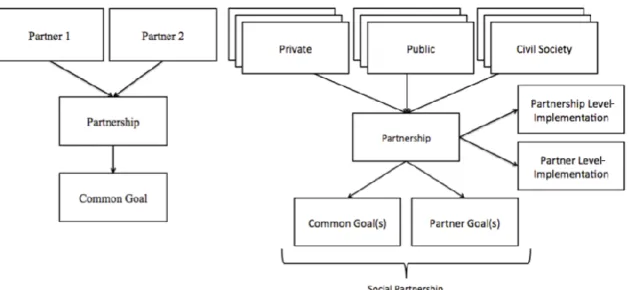
Figure 4: Dyad partnership versus multi-stakeholder partnership ...31
Figure 5: Individual implementation structure for value capture ...110
Figure 6: Resource transformation ...111
Figure 7: A framework for structure to partnership capital ...137
Figure 8: Model of collaboration decision making as a predictor of partnership capital, mediated by communication systems. The confidence interval for the indirect effect is a BCa CI based on 1000, constructed through a resampling process called bootstrapping. ...157
Figure 9: Model of collaborative decision making as a predictor of partnership capital, mediated by renewal systems. The confidence interval for the indirect effect is a BCa CI based on 1000, constructed through a resampling process called bootstrapping ...161
Figure 10: Connections between Chapters 5, 6 and 7 ...172
Figure 11: Partner-level assumption prior to research in this dissertation ...179
Figure 12: Contributions to the partner-level in the LA21 system ...180
Figure 13: Partnership-level assumption prior to research in this dissertation ...184
List of Tables
Table 1: A summary of important international events and guiding documents ...10
Table 2: Example of partners in Local Agenda 21 multi-stakeholder partnerships ...12
Table 3: Emerging research on multi-stakeholder partnerships focused on structure and subcomponent processes during the implementation phase ...20
Table 4: Summary of partnership types ...24
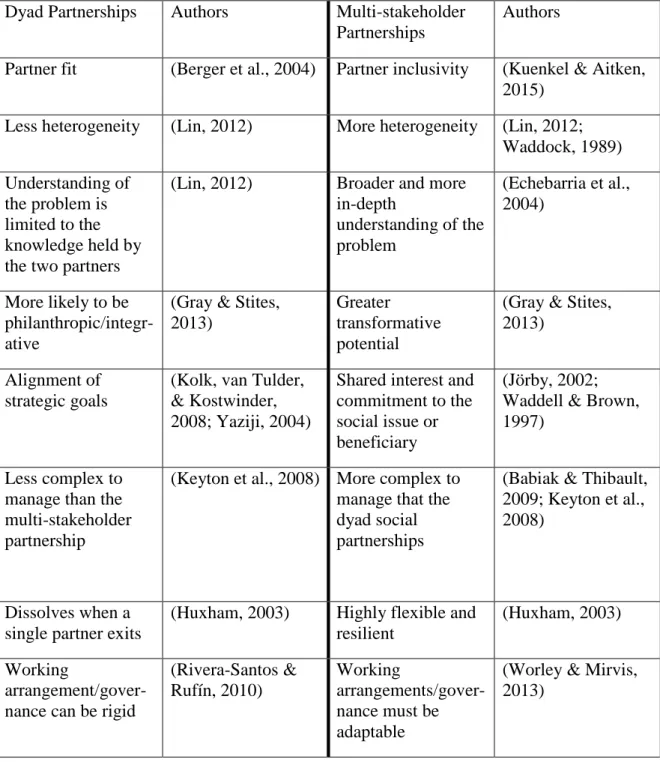
Table 5: A comparison of dyad versus multi-stakeholder partnerships ...29
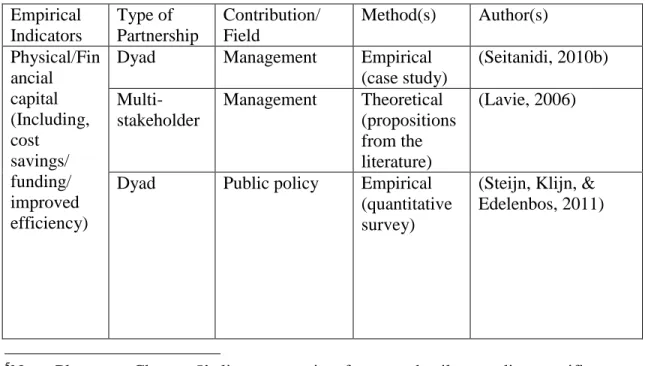
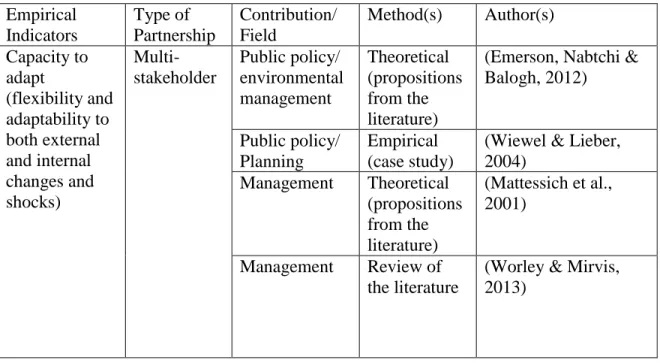
Table 6: Summary of literature on partner capital ...39
Table 7: Summary of literature on partnership capital ...43
Table 8: Data collection timeline ...61
Table 9: Partner outcomes from the social partnership and RBV partnership literatures ...71
Table 10: Resource gained from case study language to survey terminology ...76
Table 11: A RBV of gained resources from partner engagement ...77
Table 12: Outcomes partners value ...80
Table 13: Comparison of the empirical findings with the literature ...93
Table 14: Bivariate correlations ...119
Table 15: Bivariate correlations with control variable residuals ...119
Table 16: Independent sample t-tests on high and low IIS ...120
Table 17: Summary of partnership survey instrument ...150
Table 18: Bivariate correlations ...153
Table 19: Bivariate correlations with control variable residuals ...153
Table 20: Results of independent sample t-test showing the difference in means for partnership capital between high and low CDM groups ...154
Table 21: Results of exploratory factor analysis with communication systems ...155
Table 22: Results of confirmatory factor analysis communication systems and Cronbach’s Alpha ...156
Table 23: Results of exploratory factor analysis renewal systems ...159
Chapter 1:
Introduction
Cross-sector partnerships are formed when at least two organizations from public, private, or civil society sectors agree to work together to achieve mutual goals or to address a shared problem (Parmigiani & Rivera-Santos, 2011). Cross-sector partnerships specifically focused on social issues (including ecological and economic) are termed cross-sector social partnerships (social partnerships), where the actors collaborate to tackle a social problem of mutual interest (Selsky & Parker, 2005). Social partnerships are an increasingly popular partnership approach because they address social problems that are beyond the capacity and jurisdiction of any single organization or sector (Googins & Rochlin, 2000; Trist, 1983; Waddock, 1989) and make progress where governments are unwilling or unable to impose regulations (Crane, 2010; Skelcher, 2000).
A type of social partnership with more than one partner from each of the three sectors that has a stake in the social problem of interest, is a multi-stakeholder
partnership. This type of partnership is increasingly becoming a popular form of social partnership for tackling complex social problems (Kolk, 2014). Compared to a
partnership with 2-3 partners, multi-stakeholder partnerships are more inclusive (Kuenkel & Aitken, 2015). Partnerships that have multiple stakeholders from a diversity of
organizations tend to have broader knowledge of the problem and greater capacity to overcome limitations of a single organization or sector (Echebarria, Barrutia, & Aguado, 2004). Where multi-stakeholder partnerships are highly inclusive they provide those who are directly affected by the problem with an opportunity to participate in the solution (Kuenkel & Aitken, 2015). When the partners are also the beneficiary of the partnership
efforts, there can be reduced conflict between the strategic goals of the partners and the goals of the partnership because the two overlap (Jörby, 2002; Waddell & Brown, 1997). A major challenge with multi-stakeholder partnerships is that coordinating participation of many partners is more complex than in a cross-sector partnership with fewer partners (Babiak & Thibault, 2009; Keyton et al., 2008). The complexity of managing the day-to-day operations of a multi-stakeholder partnership requires more sophisticated structures than in dyad social partnership (Butler, 2001).
1.1 Background
1.1.1 Local Agenda 21s and Multi-Stakeholder Partnerships
This dissertation focuses on Local Agenda 21 (LA21) multi-stakeholder partnerships1. LA21 is rooted in United Nations programs, involving a local government initiated process that includes a community sustainability plan. Briefly a community sustainability plan includes the sustainability vision of a local or regional community. The plan takes into account the goals and actions needed to overcome community social, environmental, and economic challenges to achieve the sustainability vision. It is common that
community stakeholders at the organization level will collaboratively develop the sustainability plan. In the process, a multi-stakeholder partnership is formed and tasked with implementing the actions and goals described in the plan.
A major challenge for local governments and partners wishing to implement community sustainability plans through multi-stakeholder partnerships is that individually the partners, including the local government, often lack the appropriate
1 Chapter 2 provides additional detail about the context for the LA21 multi-stakeholder
sustainability and collaborative capacity (Worley & Mirvis, 2013). The multi-stakeholder partnership implementation process can be transformative for partners (Gray & Stites, 2013), helping them to individually and collectively develop the sustainability and collaborative capacity required to tackle their communities’ sustainable development challenges and achieve their own organizational goals (Kveton, Louda, Slavik, & Pelucha, 2014).
Past research on multi-stakeholder partnerships in the LA21 context has found that structurally there are two levels of implementation in multi-stakeholder partnerships: the partner level (Huxham, 1993) and the partnership level (Brinkerhoff, 1999). Whereby at the partner level, partners reallocate resources inside their organizations to make internal changes, such as hiring a sustainability coordinator or implementing a waste reduction policy to support partnerships’ goals. At the partnership level is where implementation external to the partner organizations occurs. At these two levels of implementation, the structures vary in degree of collaboration at the partnership level and intensity at the partner level (Clarke, 2014). In addition, some studies have researched how certain aspects of the partnership contribute to the advancement of LA21 policy development and initiatives. For instance, Evans, Joas, Sundback, and Theobald (2006) found that where dynamic governing (i.e., institutional and social capacity-building from the partnering process) was higher, so too was the prospect of sustainable development policy success. Garcia-Sanchez and Prado-Lorenzo (2008), found that where there was human, technical and financial support for the partnership and integration of LA21s in the municipal system, there was also greater advancement of LA21s.
The purpose of this dissertation is to build on past research on LA21 multi-stakeholder partnerships by combining the theoretical strengths of management strategy literature with the empirical insights from social partnership literature. Specifically, this dissertation considers how structures for plan implementation at the partner and
partnership levels affect desired outcomes, such as partner and partnership capital. This research has theoretical implications for the social partnership literature as it improves understanding of how structure can impact outcomes in multi-stakeholder partnerships. The practical implications are that the capacity built for partners and partnerships through obtaining capital are important for addressing complex social (including ecological and economic) challenges. In other words, when a partnership can build capacity through its operational design, it is better equipped to tackle complex social challenges.
1.1.2 Applying Management Strategy Theory to Multi-Stakeholder Partnerships This dissertation does not draw exclusively from any one discipline to develop its arguments and ideas, but a management strategy perspective is used to positon the core arguments. Theories from the management strategy literature have been used extensively to study structure and how it contributes to organizational performance (Meyer, Tsui, & Hinings, 1993; Mintzberg, 1998). Theories such as resource based view (Barney, 1995) and relational view (Dyer & Singh, 1998) have been used to explain the role of resources in sustaining a firm’s competitive advantage. Less so has the management strategy literature been used to understand multi-stakeholder partnership structure and outcomes (Clarke, 2011).
This dissertation uses management strategy literature in two ways. First it uses it to conceptualize the influence of structure on outcomes. Broadly it builds on the work of
Clarke (2011; 2014) and Clarke and Fuller (2010) by using their argument that
partnership structures shape outcomes. More specifically this dissertation draws on the work of Barney (1995) to understand how partners can create internal structures that organize them to capture value from the partnership. In this dissertation value is
discussed in terms of partner capital, which includes human, organizational, shared, and financial/physical capitals. It also uses the work of Kale, Dyer, & Singh, (2002) to understand how relational processes, such as collaborative decision making, renewal systems, and communication systems can form structures that build partnership capital. Partnership capital includes the knowledge, learning, strength of relationships within the partnership and the adaptability of the partnership. Second, it uses management strategy literature to explain what makes resources valuable (Barney, 1995; Dyer & Singh, 1998).
1.2 Research Questions
This dissertation is structured around answering the following three research questions: RQ1: Based on partner perceptions, what resources can partner organizations gain during their involvement in implementing community sustainability plans as members of multi-stakeholder partnerships in the Canadian context and of those resources what do they value most?
RQ2: Based on partner perceptions, does internal implementation structure that results from participation in the partnership, influence partner capital, including resources such as physical/financial, human, organizational and shared capital, at the partner level? RQ3: Based on partner perceptions, how does plan implementation structure influence partnership capital, at the partnership level?
1.3 Dissertation Outline
This dissertation explores how organizations learn and grow together through the Local Agenda 21 process. It is about understanding how partners can gain partner capital by reallocating resources inside their organizations to create internal implementation structures. It is about how multi-stakeholder partnerships build partnership capital through plan implementation structures. Chapter 1 provides the necessary background and context to frame the research questions asked in this dissertation.
Chapter 2 provides background information for Local Agenda 21s (LA21s), the institutional and environmental drivers behind the global initiative, and how LA21 has influenced the rapid growth of multi-stakeholder partnerships working on local
sustainability issues in communities around the world.
Chapter 3 introduces the Local Agenda 21 system, which includes key factors that affect and are affected by Local Agenda 21s processes. It also provides an overview of social partnerships, contrasting different types of partnerships, and honing in on the opportunities and challenges associated with multi-stakeholder partnerships. In addition, Chapter 3 reviews and compares theoretical and empirical research findings for multi-stakeholder partnerships, structure, and outcomes.
Chapter 4 gives a detailed account of the research design and data collection processes for this dissertation. Developing the data collection tools and collecting the data was an ongoing and iterative process that lasted three years. It involved developing relationships and collaborating with academic and practitioner experts in the sustainable development and partnership fields from around the world, and several tests and
Chapter 5 explores partners’ experiences in Canadian multi-stakeholder
partnerships implementing community sustainability plans. Interviews with 47 partners explored how partners implemented the community sustainability plan and the outcomes they experienced. A survey of 42 partners, called the Partner Survey, assessed what outcomes are most valued by partners. The findings in Chapter 5 answer research
question one (RQ1), which is based on partner perceptions , revealing that implementing the plan in part by making internal changes to their organization, also improved
relationships, increased knowledge, and increased impact on community sustainability. Chapter 5 also indicates that partners in multi-stakeholder partnerships most value knowledge exchange and learning as outcomes from the process.
Chapter 6, based on partner perceptions, builds on key findings from Chapter 5 by testing for relationships between internal implementation processes and of improved partner capital (e.g., positive outcomes). The findings in Chapter 6 are based on the Partner Survey of 42 partners in Canadian multi-stakeholder partnerships implementing community sustainability plans. Chapter 6 answers research question two (RQ2), indicating among other things that partners with internal implementation structures are more likely experience an increase in sustainability knowledge, improvements in relationships, and an impact on community sustainability than partners that don’t have internal implementation structures.
Chapter 7, also based on partner perceptions, builds on findings from Chapters 5 and 6, but extends its scope to the partnership level. It examines partnership level
implementation structures and their relationship to the capacity of partnerships. Findings in Chapter 7 are informed by the Partnership Survey of 94 multi-stakeholder partnerships
implementing community sustainability plans worldwide. Chapter 7 answers research question three (RQ3), with the findings that collaborative decision making paired with communication and/or renewal systems contribute to the partnerships’ collective level of sustainability knowledge, quality of partner relationships, and adaptability of
partnerships. Together Chapters 5, 6, and 7 demonstrate that structure at both the partner and partnership-levels of plan implementation influence the ability of the partnership to build important capital resources.
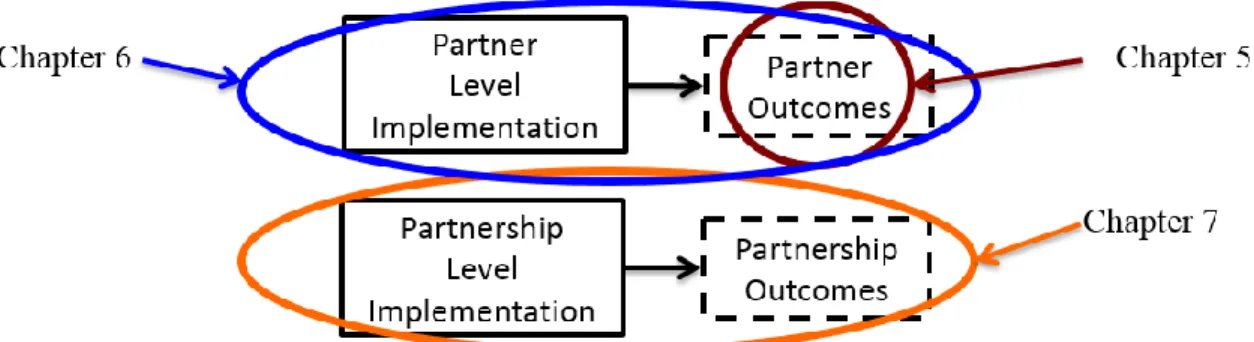
Figure 1 illustrates how Chapters 5, 6, and 7 complement each other.
Figure 1: Structure and contents of Chapters 5, 6, and 7
Finally, Chapter 8 summarizes the findings from Chapters 5, 6 and 7, discusses the theoretical and practical contributions, and presents directions for future research.
Chapter 2:
Background: Local Agenda 21 Multi-Stakeholder Partnerships
2.1 Local Sustainable Development: The International LandscapeToday the term sustainable development is ubiquitous. This was not always the case; at one time, the notion of sustainable development was revolutionary. Our Common Future, also known as the Brundtland Report, is responsible for the promulgation of the term and idea (Dresner, 2008). In Our Common Future, sustainable development is defined as “development that meets the needs of the present without compromising the ability of future generations to meet their own needs”(WCED, 1987, p. 43). Our Common Future, by the World Commission on Environment and Development was written following the United Nations Conference on the Human Environment held in Stockholm, Sweden in 1972 (Mebratu, 1998).
The ideas underpinning sustainable development from the Stockholm conference and Our Common Future heavily influenced the agenda for the 1992 United Nations Conference on Environment and Development (Earth Summit) (Mebratu, 1998). It was at this conference in Rio de Janeiro that the influential Agenda 21 outcome document was created (United Nations, 1992). Agenda 21 opens, in Chapter 1, 1.1 with the following quote:
Humanity stands at a defining moment in history. We are confronted with a perpetuation of disparities between and within nations, a worsening of poverty, hunger, ill health and illiteracy, and the continuing deterioration of the ecosystems on which we depend for our well-being. However, integration of environment and development concerns and greater attention to them will lead to the fulfillment of basic needs, improved living standards for all, better protected and managed ecosystems and a safer, more prosperous future. No nation can achieve this on its own; but together we can - in a global partnership for sustainable development (United Nations, 1992, p.1).
This quote embodies the global sustainable development challenges as they are now and as they were in 1992. It highlights the urgency of global environmental and social disparities that underpin the world’s environmental and development challenges. It also charts a path forward, identifying partnerships as a way to sustainable development. Table 1 provides a summary of important international events and documents that drive the global sustainability agenda. In 2015, forty-three years after the Stockholm
conference, twenty-eight years after Our Common Future, twenty-three years after Agenda 21, and three years after The Future We Want2, seventeen Sustainable
Development Goals have been adopted (United Nations, 2014). These goals are meant to address the seventeen most pressing global sustainable development challenges faced by our world today. Among them are to end poverty, to ensure the sustainable management of water, to make human settlements inclusive, safe, resilient, and sustainable, to ensure sustainable consumption and production, and to strengthen implementation by reviving global partnerships for sustainable development (United Nations, 2014). The global problems that stand between where humanity is today and the future we want, are the key macro drivers behind the sustainable development goals of countries around the world (United Nations, 2015).
Table 1: A summary of important international events and guiding documents
Important Event Date Selected Policy Document(s) United Nations Conference
on the Human and Environment
1972 United Nations Environment Programme
2 The Future We Want is the outcome document of the 2012 United Nations Conference
World Commission on Environment and Development formed
1983 Our Common Future -1987
United Nations Conference on Environment and Development
1992 Agenda 21: A Programme of Action for
Sustainable Development
Chapter 28 basis for Local Agenda 21 World Summit on
Sustainable Development
2002 Johannesburg Plan of Implementation
United Nations Conference on Sustainable Development
2012 The Future We Want
United Nations Conference on Sustainable Development
2015 Sustainable Development Goals
As mentioned previously, Agenda 21 was the primary outcome document of Earth Summit; it called on the world’s nations to partner in a global pursuit for SD (United Nations, 1992). Agenda 21 outlines a plan of action for sustainable development at the global, national, and local levels (UNCED, 1992). 178 governments that attended the Earth Summit adopted Agenda 21 (UNCED, 1992). The problems addressed in Agenda 21 span the globe, and so the recommended policies and plans are broad in scope. To make Agenda 21 meaningful, a local approach that addresses the specific needs of individual local authorities was recommended (Bond, Mortimer, & Cherry, 1998).
Based on the guiding principles laid out in Chapter 28 of Agenda 21, local governments were tasked with developing their own locally relevant version of Agenda 21, called Local Agenda 21 (LA21) (Bond et al., 1998). The idea for Local Agenda 21 was first introduced by the International Council for Local Environmental Initiatives (ICLEI) (Devuyst & Hens, 2000). ICLEI, a non-governmental organization with a worldwide reach, has a membership of approximately 1200 local governments from 70
countries, representing 570 million people (Rok & Kuhn, 2012).
ICLEI defines LA21 as, “a participatory, multi-sectoral process to achieve the goals of Agenda 21 at the local level through the preparation and implementation of a long-term, strategic action plan that addresses priority local sustainable development concerns”(Rok & Kuhn, 2012, p.12). Given the long-term nature of the goals in LA21 plans it is recommended that there are processes for monitoring and reporting (Dresner, 2008; ICLEI, 2002). Participatory processes that involve stakeholders as partners throughout the development, implementation, and oversight of LA21 plans are also encouraged by the United Nations and ICLEI (ICLEI, 2002). Table 2 provides examples of the types of partners who participate in a LA21 multi-stakeholder partnership. Table 2 illustrates the variety and breadth of partners that could be involved in implementing LA21 plans, demonstrating the complexity of managing such a diverse group of stakeholders.
Table 2: Example of partners in Local Agenda 21 multi-stakeholder partnerships
Civil Society Private Public
Neighborhood associations Chamber of commerce Local authorities
Community groups Industry associations Health authorities/hospitals
Non-profit organizations Local businesses Energy utilities
Local environmental groups
Board of trade Training and enterprise
councils Volunteer support
organizations
International business with local operations
Schools/colleges/universities
Housing associations Development agencies
LA21 plans can include a wide range of topics, depending on what the community stakeholders (i.e., partners) decide to prioritize. A study that reviewed LA21 plans in Canada found that there are 17 dominant topic areas (Taylor, 2012). Such topic areas include energy, land use, transportation, waste, air, water, education, health, safety, employment, and local economy (Taylor, 2012). As illustrated in Table 2 (above), the types of partners involved in implementing LA21 include representatives from local small, medium, and large business, local environmental non-governmental agencies, local governments, local schools and universities, local hospitals and other organizations (Freeman, Littlewood, & Whitney, 1996).
Over the past twenty years, ICLEI has commissioned three studies of LA21 progress (Rok & Kuhn, 2012). The first two studies were quantitative and were done to identify the number of LA21s and the topic areas of focus. The third study was a smaller scale, qualitative study, comprising of 26 interviews aimed at understanding local
sustainability processes. The first study, completed in 1997, found 1800 local
governments in 64 countries around the world were implementing LA21, with 80% of the activity taking place where national level polices were supportive of LA21 (Bond et al., 1998; Rok & Kuhn, 2012). The second survey, completed in 2002, found that over 6400 local governments in 113 countries around the world were implementing LA21 (Devuyst & Hens, 2000; ICLEI, 2002). The second survey was completed by ICLEI with UN World Summit for Sustainable Development and the United National Development Programme Capacity 21 Programme (Bond et al., 1998; ICLEI, 2002). It also found that some of the most common areas of focus included water and natural resource
study examined different levels of governance for local sustainability implementation and found that processes exist at five levels: (1) local government strategy, (2) civil society initiative, (3) concerted action, (4) national policy, and (5) international cooperation (Rok & Kuhn, 2012).
There have also been a number of academic studies on LA21 activity. Some studies have observed LA21 implementation specifically in the European Union (Garcia-Sanchez & Prado-Lorenzo, 2008). Other studies have examined local sustainable
development policy success resulting from the LA21 process (Evans et al., 2006; Jörby, 2002). Some studies have taken a more normative approach, proposing frameworks for assessing LA21 actions (Corbiere-Nicollier, Ferrari, Jemelin, & Jolliet, 2003). Studies that examined outcomes found the biggest gains were made in waste reduction, public awareness, water quality, and city beautification (Carmin, Nadkarni, & Rhin, 2012).
While each of these studies is important in our understanding of LA21 activity, none has examined questions of structures to outcomes at the partner and partnership level of plan implementation. Assessing LA21 partnerships is incredibly challenging because data are limited and the partnerships are constantly evolving and changing (ICLEI, 2002; Kolk, 2014). There is a need to better understand the role of partnerships in Local Agenda 21 implementation. Without this understanding the effectiveness of the partnership approach cannot be assessed, thus it is impossible to know whether this approach to addressing local sustainable development challenges is helping or hindering with these problems.
2.2 Local Sustainable Development: The Canadian Landscape
LA21s did not gain traction in Canada throughout the 1990’s as had been the case in the European Union (Devuyst & Hens, 2000). As mentioned above, national policies
influence municipal or regional LA21 activity (Rok & Kuhn, 2012). Canada did not have a national LA21 policy, and the uptake of LA21 lagged behind the European movement. Moreover, with the exception of the province of Quebec, Canadian municipalities did not adopt the term LA21 plan (Rok & Kuhn, 2012), rather the terminology used in Canada is Integrated Community Sustainability Plan (ICSP).
It was not until the 2000s that sustainable development concepts began to be taken more seriously by the Canadian government. From 2005 to 2010, the federal government department Infrastructure Canada ran a program called the New Deal for Cities, whereby municipalities could gain access to federal gas tax revenues through their respective provincial government for infrastructure projects (Infrastructure Canada, 2005). Over the five years, the New Deal initiative distributed $5 billion among Canadian municipalities (Infrastructure Canada, 2005). A prerequisite for receiving gas tax money was that the municipality needed to develop an Integrated Community Sustainability Plan (ICSP) (Infrastructure Canada, 2005). This led to an increase of ICSPs in Canadian municipalities, many of which were developed collaboratively by community
stakeholders. According to the Canadian Sustainability Plan Inventory developed by the University of Alberta, today there are 1052 sustainability plans in Canadian
municipalities across the country.
Finally, in 2010, Canada adopted a national level sustainable development policy, called Planning for a Sustainable Future: A Federal Sustainable Development Strategy for Canada (Environment Canada, 2010). The national strategy was prepared in response
to the Federal Sustainable Development Act, passed in 2008 (Environment Canada, 2010).
Chapter 2 outlined a brief history of Local Agenda 21s from an international and Canadian perspective, demonstrating that around the world, there is a need for sustainable development, and realizing that sustainable development can be linked to local initiatives and partnerships. This dissertation examines partnerships that are implementing
community sustainability plans in Canada and around the world. Chapter 3 introduces concepts, theories, and research from the partnership literature.
Chapter 3:
Theoretical Positioning
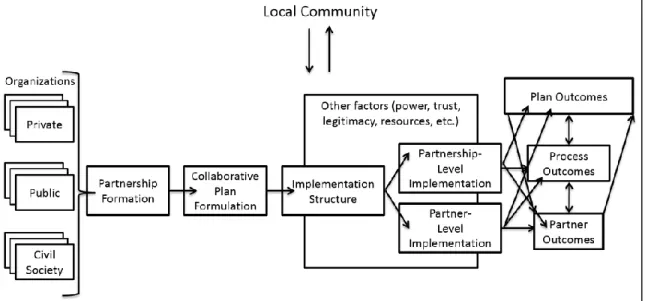
Chapter 2 introduced sustainable development action at the local level. This chapter introduces the theoretical background for multi-stakeholder partnerships, which - discussed in Chapter 2 - often implement plans developed through the Local Agenda 21 process. Figure 2 (below) extends Clarke and Fuller’s (2010) Process Model of
Collaborative Strategic Management by applying it to a Local Agenda 21 system. Figure 2 shows that the local community creates the conditions for the formation of the
partnership and plan and is also affected by the implementation and outcomes of the plan and partnership.
Figure 2: Local Agenda 21 system: implementing through multi-stakeholder partnership
As is captured in Figure 2, even at the local level, multi-stakeholder partnerships can be complex (Seitanidi, 2008). As is mentioned in Chapter 1, multi-stakeholder
partnerships are from a class of partnerships called cross-sector social partnerships (social partnerships). This chapter first discusses the theoretical background of social
partnerships and then delves into specific details related to multi-stakeholder partnerships.
Researchers studying social partnerships examine them and the relationships within them from several different perspectives. Although not necessarily discrete or mutually exclusive, there are two broad approaches that characterize social partnership research areas: research on external factors and research on internal factors. The research that examines external factors studies the conditions that influence the formation of social partnerships, including the political, cultural, and environmental conditions or
institutional failures that precede them (Kolk, 2014; Trist, 1983; Waddock, 1989). Theories used to explain external phenomena include institutional theory (Vurro, Dacin, & Perrini, 2011) and social network theories (Hibbert et al., 2008).
The research that focuses on internal factors examines aspects that influence the relationships between partners, the partnership’s purpose, and the internal activity of the partnership (Selsky & Parker, 2005; 2010). Partner relationships and the purpose of the partnership are shaped by aspects such as sector roles and actors and/or conflict and power dynamics (Ansell & Gash, 2007). Theories used to explain these internal phenomena are generally rooted in political science, sociology, and/or psychology (Hibbert et al., 2008).
Internal activities within the partnership involve what partners do and what the partnership does, why, and when. These activities are often examined using classification systems such as life-cycles, phases, and stages (Hibbert et al., 2008). Some classification systems determine the partnership’s capacity to create value by measuring relationship-intensity (Googins & Rochlin, 2000; Rondinelli & London, 2003), whereby resource
exchange and input indicate partner commitment (Austin, 2000; Austin & Seitanidi, 2012a; 2012b). For instance, Austin and Seitanidi's (2012b) collaboration continuum classifies social partnership relationships into four categories: philanthropic,
transactional, integrative, and transformational. Rondinelli and London (2003) classify relationships as being low, medium, or high intensity.
Perhaps the most dominant classification systems are the partnership life-cycles whereby the partnerships are studied on a linear timescale (Vurro et al., 2011).
Researchers studying partnership life-cycles examine managerial challenges, opportunities, and processes at the different stages of the partnership (Hibbert et al., 2008). The life-cycle typically includes a varied number of stages such as pre-formation, formation, implementation, evaluation, and sometimes exit strategy (Austin, 2000; Seitanidi & Crane, 2009). For instance, Waddock’s (1989) Evolutionary Model of Social Partnership Development involves five stages: initiation, issue crystallization, coalition-building, purpose, formulation, and evolution over time. Seitanidi and Crane (2009) identify four stages: partnership selection, partnership design, partnership
institutionalization, and exit strategy. Questions related to internal activity are also explored through theories such as resource dependency, resource-based view, relational-view, collaboration theory, and transaction cost theory (Branzei & Le Ber, 2014).
Over the past thirty years, social partnership researchers have done a considerable amount of work to understand the early stages of the partnership life-cycle; for instance, Gray’s (1989) collaboration process model (problem setting, direction setting, and implementation) and Waddock’s 1989 Evolutionary Model, both place emphasis on the early stages of the partnership or collaboration. With a strong foundation in the early
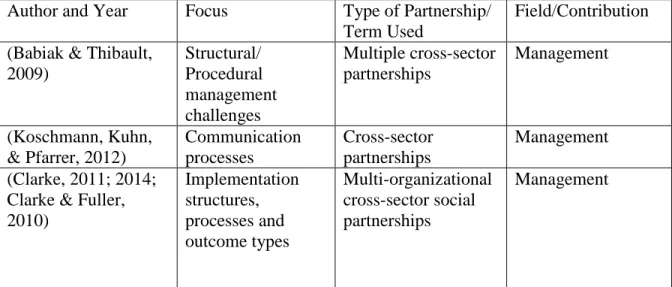
life-cycle stages, researchers today emphasize the need to understand the mid-stages of the partnership life-cycle. This is evidenced through the recent work of researchers who are examining processes and outcomes specific to the implementation phase. For instance, Kuenkel and Aitken's (2015) findings from a case study of the African Cashew initiative identified and unpacked eight key factors of implementation for sustainable development partnerships. Kihl, Tainsky, Babiak, and Bang (2014) used a mixed-methods approach to examine the implementation processes of a corporate community initiative in recreation and leisure. Ruhli, Sachs, Schmitt, and Schneider (2015), through a case study method, studied the role of evaluation, the processes behind stakeholder interactions, and the related outcomes of multi-stakeholder partnerships. These three studies demonstrate another trend, which is the increase in studies of implementation in the context of multi-stakeholder partnerships. More specifically, there is a drive in social partnership research to better understand the structures that facilitate implementation. Table 3 summarizes the current state-of-the-art in research on multi-stakeholder partnerships studied at the
implementation phase.
Table 3: Emerging research on multi-stakeholder partnerships focused on structure and subcomponent processes during the implementation phase
Author and Year Focus Type of Partnership/
Term Used
Field/Contribution (Babiak & Thibault,
2009) Structural/ Procedural management challenges Multiple cross-sector partnerships Management (Koschmann, Kuhn, & Pfarrer, 2012) Communication processes Cross-sector partnerships Management (Clarke, 2011; 2014;
Clarke & Fuller, 2010) Implementation structures, processes and outcome types Multi-organizational cross-sector social partnerships Management
(Worley & Mirvis, 2013) Governance structure and processes Multi-organizational partnerships Public policy
(Kuenkel & Aitken, 2015)
Process clarity and management cohesion Stakeholder partnerships Management/ Public policy
(Kihl et al., 2014) Evaluation
processes
Cross-sector
community initiative partnerships
Public policy
(Ruhli et al., 2015) Evaluation dimensions and processes for partner interaction Multi-stakeholder settings/collaborative partnerships Management
Discussed several times throughout this dissertation is how it builds on and extends the work of Clarke (2011), Clarke and Fuller (2010), and Koschmann et al. (2012). The research in Table 3 that was published after 2013 could not be used to develop the surveys in this dissertation, but there are encouraging areas of overlap and complementary findings. In their review of seven cases studies of multi-stakeholder partnerships, Worley and Mirvis (2013) argue that organizing for sustainability requires two capabilities (1) internally oriented sustainability capabilities and (2) externally oriented collaborative capabilities. The internal sustainability capabilities are needed to help the partner organization learn about and understand their respective problem domain (Worley & Mirvis, 2013). For instance, partners implementing community sustainability plans might need to learn about greenhouse gases and develop internal processes and policies to work toward reducing them. Worley and Mirvis (2013) call for more research on how internal sustainability capabilities are developed and initiated. This dissertation answers that call by examining implementation structure and the resulting outcomes at the partner level.
how to and successfully collaborate (Worley & Mirvis, 2013). For instance, important capabilities in this area include joint-problem solving skills and flexibility and
adaptability (Worley & Mirvis, 2013). Again Worley and Mirvis (2013) indicate that more research is needed to understand how external collaborative capabilities are
developed and initiated. This dissertation answers that call by examining implementation structure and outcomes at the partnership level.
Kuenkel and Aitken (2015), focus their analysis on the partnership level. The implementation phase discussed in their paper involves subcomponents of structure such as “formal steering, reporting, communications, and learning structures” (Kuenkel & Aitken, 2015, p. 187). These subcomponents overlap with the subcomponents of the partnership-level implementation structure examined in Chapter 7 of this dissertation. Whereby communication and learning structures overlap conceptually with
communication and renewal systems. In this paper Kuenkel and Aitken (2015) identify eight key factors of success such as knowledge/competence and credibility. While Kuenkel and Aitken (2015) identify subcomponents of implementation structure and success factors, they do not examine the connections between implementation structures and factors of success.
Ruhli et al (2015) examine the partnership level of a multi-stakeholder partnership working on preventing cardiovascular disease. Ruhli et al (2015) found that bottom up development of the governance structure improves the legitimacy of the
multi-stakeholder partnership. This finding is similar to the structural subcomponent
collaborative decision making examined in Chapter 7. Moreover, Ruhli et al (2015) also found that frequent contact among partners helped partners to form relationships, which
overlaps with the structural subcomponent communication systems also examined in Chapter 7. Ruhli et al (2015) examined the relationships between structural
subcomponents and process outcomes, but did not examine how the subcomponents of structure work together to influence outcomes. In contrast, this dissertation seeks to understand how subcomponents of structure interact to realize outcomes.
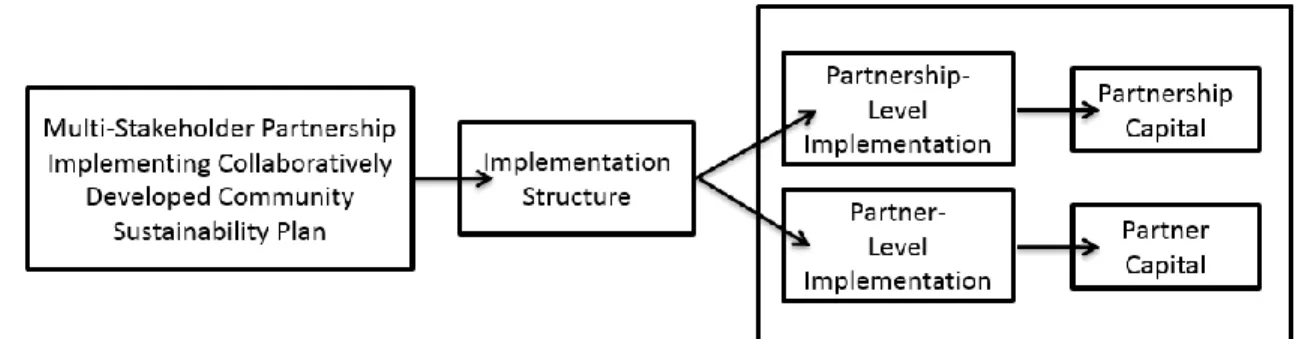
The focus of this dissertation is on multi-stakeholder partnerships in the context of community sustainability plan implementation. Specific attention is given to the
following: two levels of plan implementation, the structures within each level, and the resulting outcomes for the partners and the partnerships. See Figure 3 for an overview. The remainder of this chapter will unpack each box shown in Figure 3. As a preface to the multi-stakeholder partnership literature, the next section provides important
definitions and other background for social partnerships.
Figure 3: Focus of this dissertation
3.1 Social Partnerships
Social partnerships are widely used to deliver social change and implement corporate social responsibility (Babiak & Thibault, 2009; Googins, Mirvis, & Rochlin, 2007). Social partnerships are voluntary collaborations among organizations that come from two or more sectors (i.e., private, public, or civil society) with a mandate to address mutually prioritized social issues (Babiak & Thibault, 2009; Selsky & Parker, 2005; Waddock,
1991). In social partnerships, partner resources can be pooled together and the partners can learn from each other as they work together to address the social issue of mutual interest (Crane & Seitanidi, 2014). For instance, partners can experience and understand the focal social-issue differently through joint learning among stakeholders who would not traditionally collaborate (Clarke, 2011; 2014; Clarke & Fuller, 2010; Selsky & Parker, 2010).
There are four types of cross-sector partnerships: private-civil society (Le Ber & Branzei, 2010a; Seitanidi & Crane, 2009), private-public (Pattberg, Biermann, & Chan, 2012), public-civil society (Brinkerhoff, 2002a), and tri-sector (Geddes, 2008; Ruhli et al., 2015; Selsky & Parker, 2005; 2010). The type of partnership can influence the type of projects worked on. For instance, private-public partnerships generally focus on
infrastructure development and public services, whereas tri-sector partnerships address a wider array of issues, including economic and community development, environmental management, and healthcare (Googins et al., 2007; Selsky & Parker, 2005). Table 4 identifies the problem focus and examples for each type of partnership.
Table 4: Summary of partnership types
Partnership Type
Problem Focus Example
Private-Public Public services and infrastructure (Selsky & Parker, 2005)
United Nations Public-Private Partnerships for Sustainable Development (Bäckstrand & Kylsäter, 2014)
Private-Civil Society
Diverse range of issues often driven by CSR (environmental, health, poverty alleviation, education) (Selsky & Parker, 2005)
CARE-Starbucks Alliance (Austin, 2000)
Public-Civil Society
Public policy development and
contracting out public services (Selsky & Parker, 2005)
Community Futures- Canada’s Regional Development Agencies (Community Futures Network of Canada, 2015)
Tri-sector Economic development, community development, sustainable
development, climate change, resource conservation, education, health, and poverty alleviation (Selsky & Parker, 2005)
Whistler2020 (Clarke, 2014)
Social partnerships have been almost exclusively studied using qualitative methods (Branzei & Le Ber, 2014; Gray & Wood, 1991). The most popular approach is the use of in-depth case studies (Clarke & Fuller, 2010; Hardy, Phillips, & Lawrence, 2003; Seitanidi & Crane, 2009) where data collection is done through retrospective interviews (Arya & Lin, 2007), ethnographies (Branzei & Le Ber, 2014), and document analysis (Babiak & Thibault, 2009). These studies have made theoretical contributions helping researchers to understand why social partnerships exist (Googins & Rochlin, 2000), what social partnerships are and what they do (Selsky & Parker, 2005; 2010), how they are formed (Gray, 1989; Waddock, 1989), the potential of social partnership and types of outcomes (Arya & Lin, 2007; Austin & Seitanidi, 2012a; Clarke & Fuller, 2010; Innes & Booher, 1999; Kolk et al., 2008), and partner relationship management and challenges (Huxham & Vangen, 2005; Rivera-Santos & Rufín, 2010).
Some management researchers studying social partnerships have used quantitative methods to analyze data collected from surveys or databases outcomes. Lin (2012) used a database on alliances and cross-sector partnerships to determine the effects of partner heterogeneity on innovation. This study found that higher partner heterogeneity was linked to higher levels of innovation as measured by patents (Lin, 2012). den Hond, de
Bakker, and Doh (2012) studied firm-NGO interactions in the Netherlands through a quantitative mail survey sent to five-hundred firms. The authors found that firms with a stronger commitment to corporate social responsibility, a strategic fit with an NGO, and frequent contact with NGOs are more likely to collaborate with an NGO (den Hond et al., 2012).
While some researchers have proposed theoretical frameworks connecting partnership structure and specific outcomes, there has been little empirical testing of these assumptions (Arya & Lin, 2007; Brinkerhoff, 2002a; Koontz & Thomas, 2006; Clarke, 2011). For example, Bryson et al. (2006) provides a theoretical framework and proposes that mechanisms for neutralizing power-asymmetries contribute to the ability of partnerships to create public value and build effective management systems (Bryson et al., 2006). In addition, Koschmann et al. (2012) argue that communication practices play an important role in building the capacity of the partnership for collective agency
(Koschmann et al., 2012). The research in this dissertation builds on past theoretical developments as well as Clarke’s (2011; 2014) early empirical research, by using quantitative methods to test assumptions of structure to outcome relationships in multi-stakeholder partnerships.
3.2 Multi-Stakeholder Partnerships
Multi-stakeholder partnerships have multiple members from all three sectors (i.e., large tri-sector partnerships). There are two broad types of multi-stakeholder partnerships: those that have high task specificity and those with low task specificity (Waddell & Brown, 1997). Where there is low specificity, the multi-stakeholder group forms a loosely coordinated network to address a broad social movement (Waddell & Brown,
1997). Where there is high specificity, the multi-stakeholder group forms a coordinated partnership where specific problems and actions are defined, and tasks and resources are allocated among the group (Waddell & Brown, 1997). This dissertation studies multi-stakeholder partnerships with high task specificity, where all partnerships examined are coordinating efforts based on a shared strategic document (i.e., the community
sustainability plan).
In terms of outcomes, there is more literature for dyad partnerships than for multi-stakeholder partnerships. While there are some similarities between the two types of partnerships, there are also important distinctions that could influence outcomes. For instance, in a dyad partnership selecting the ‘right’ partner (Berger, Cunningham, & Drumwright, 2004; Seitanidi, Koufopoulos, & Palmer, 2010; Selsky & Parker, 2005) is considered critical to the partnership’s success, whereas, multi-stakeholder partnerships thrive on partner diversity, creating incentives to include as many relevant members as possible, hence pursuing a highly inclusive model (Bäckstrand & Kylsäter, 2014; Waddock, 1989).
Partnerships that are inclusive and have a diversity of partners are more dynamic and resilient (Huxham, 2003). For instance, multi-stakeholder partnerships do not
dissolve when a single partner exits, as they do in a dyad relationship. They have a wider range and more in-depth understanding of the social problem than is possible for a dyad partnership (Echebarria et al., 2004). This understanding is derived from broad
stakeholder involvement that contributes to the collective understanding of the common challenge (Gray & Stites, 2013).
Some argue that multi-stakeholder partnerships have greater transformative potential than do dyad social partnerships (Gray, 1989; Gray & Stites, 2013; Worley & Mirvis, 2013). This could be because the goals for a dyad social partnerships are directly and strategically aligned with partners’ organizational goals, thus making any
transformative goals secondary. For instance, in private-civil society partnerships, the civil society partner can leverage the financial resources of the business to achieve its goals, and the business can use the reputation of the non-profit to gain legitimacy (Yaziji, 2004). Where there is a multi-stakeholder partnership with high specificity, the goals of the partnership are directly and strategically aligned with the partnership’s co-created strategic plan, thus making the partner goals secondary (Jörby, 2002). For instance, in Local Agenda 21 partnerships, the partners collaboratively develop a community
sustainability plan, and the partnership efforts are directed at realizing the goals outlined in the plan (Clarke & Fuller, 2010). In the LA21 process, the purpose of the partnership is not to be a strategic vehicle for the partners, though that can be a positive by-product of partner involvement (Clarke & Fuller, 2010). Worley and Mirvis (2013) explain that “in the sustainability context, organizations interested in and committed to shared value creation may need to forgo maximization of its primary objective function at the risk of offending key stakeholders in order to create sustainable effectiveness at the issue or domain level”(p. 283).
At the same time, others caution that large numbers of partners could result in unwieldy processes and ineffective collaboration (Babiak & Thibault, 2009; Butler, 2001; Keyton, Ford, & Smith, 2008). Some challenges identified by researchers studying multi-stakeholder partnerships include problems assigning responsibilities (Babiak & Thibault,