Optimal Allocation for Display Advertising
Huaxia Rui
∗, De Liu
†, and Andrew Whinston
‡April 1, 2012
Working Paper: Please do not circulate without permission Abstract
The spread of real-time targeting technologies in mobile and Internet display ad-vertising creates a new challenge: how to eciently allocate countless categories of impressions in real time. We argue that existing options for allocating advertising impressions, namely via long-term guaranteed contracts and real-time spot markets, are inecient. We propose a new contingent contract based approach, in which a provider can oer each ad buyer variable quantities contingent on the realized number of impressions. The key advantages of this approach include: (1) it accommodates a wide range of risk preferences, (2) one can compute global optimal contingent contracts ahead of time to achieve better allocation eciency, and (3) it optimizes the allocation of multiple related impression categories jointly. We rst solve the optimal contingent contracts for a single type of impressions and then for multiple categories. We show that a multi-type problem can be converted to many single-type ones, thus allowing ecient computation of optimal contingent contracts. We also present the algorithms for our approach and ways of implementing the optimal allocation in an online environment.
Keywords: display advertising, contingent contracts
1 Introduction
Display advertising is a form of online advertising embedded into a web page, typically in-clude image, text, video, and/or interactive elements designed to convey a marketing message
∗University of Texas at Austin, McCombs School of Business, Austin, T e-mail: [email protected] †University of Kentucky, Department of Marketing and Supply Chain, Gatton College of Business and
Economics, Lexington, KY 40506, e-mail: [email protected]
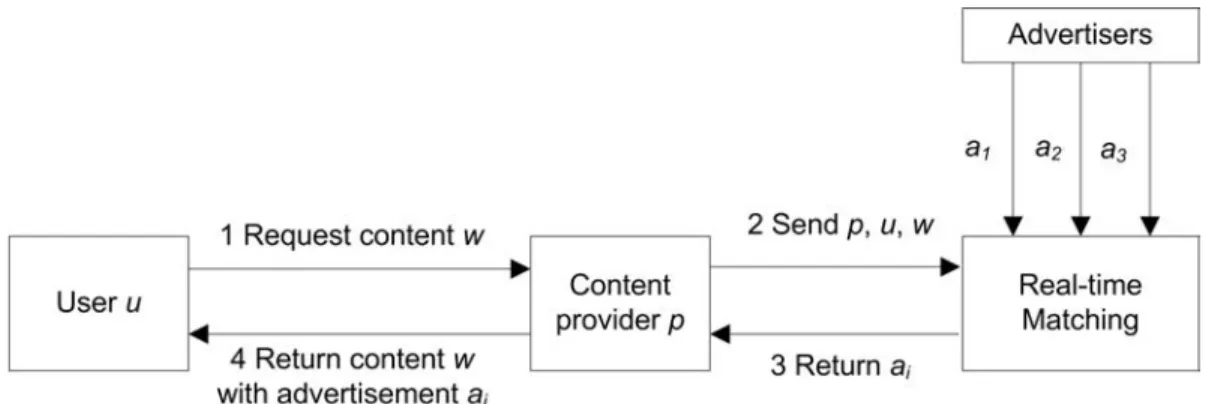
Figure 1: Real-time Targeting in Display Advertising
A userurequests contentcfrom providerp. Providerpforwards information about the user u, content c, and provider p to a matching mechanism. The matching mechanism returns a
chosen ad a, which is then served to the user u together with the requested contentc.
or cause the user to take an action. Display advertising has seen a dramatic growth in the last 5 years, fueled in part by the popularity of social media, online video, and mobile In-ternet. A recent forecast suggests that Internet and mobile display advertising will become the largest segment of online advertising by 2015 (EMarketer, 2011).
The market for display advertisement has gone through dramtical changes in the last several years. The most fundamental change is that the industry is moving away from static display ads toward dynamic, hyper-targeted display ads based on real-time infor-mation (see Figure 1 for a process sketch). Because of availability of real-time inforinfor-mation, advertisers can now target users in much smaller granularity, resulting in an explosive num-ber of targetable categories. Facebook, for example, allows display advertisers to target ads based on user's location, age, gender, relationship status, social network connection types, and interests. McAfee and Papineni (2010) estimated that that there are over a trillion distinct categories in display advertising. Contributing to this trend of hyper-targeting is the increasing availability of ne location information: most smart phones are equipped with GPS; indoor mapping technology allows one to pinpoint the location of a mobile user within a building, such as a shopping mall. These new location capabilities enable innovative location-based services as well as location-based display advertisements. Also contributing to this trend of hyper-targeting is the capacity and desire to target users in real time. Cloud computing makes it possible to predict user interests moment by moment and to sni time-sensitive advertising opportunities based on accumulated data on user behavorial patterns and location information.
Hyper-targeting posts new challenges for the design of display advertising markets. Tra-ditionally, display advertising is sold in bulk via long-term guaranteed contracts that are
negotiated ahead of time (e.g., a year in advance). A typical contract species the amount of guaranteed impressions and targeting requirements (e.g., front page, male users, and New York region). If the realized amount of impressions falls below the guaranteed amount, the advertising provider will pay a penalty. This manual, infrequent approach clearly is not scalable to the explosive number of targetable categories we have today; nor does it allow advertisers to take advantage of real-time opportunities. More important, this approach of-fers undierentiated guarantees to heterogenous buyers who may have more or less tolerance for risks. At time of shortage or surplus, it provides no guidance on how resources should be eciently rationed.
A newer approach relies on real-time spot markets for allocating ad impressions. Face-book, for example, runs a real-time auction for display advertising on its website. The industry is also promoting real-time ad exchanges that are open to multiple buyers and sellers. Yahoo!'s RightMedia Exchange, Google's DoubleClick Exchange, and Microsoft's AdECN are examples of such ad exchanges (see McAfee 2011 for a discussion). In these spot markets, ad buyers can bid on impressions in real time; an automated auction or exchange house allocates the impressions based on the bids submitted by the market participants. In theory, spot markets can eciently allocate display advertising, as long as the market prices vary continuously to balance supply and demand. In practice, however, this approach may incur several ineciencies.
• First, advertising opportunities are nonstorable. This means that the spot market will
operate ineciently before it nds an ecient market clearing price for the current market condition.
• Second, as argued by Wilson (1989), spot markets are expensive to operate. As the
select of advertisement must be completed in a fraction of a second, the spot market and its participants must rely on high-performance computing and networking facility to function. It is also expensive for market participants to continuously monitor prices, adapt their bidding strategies, and execute those strategies in timely fashion.
• A third source of ineciency may caused by lack of coordination across correlated
auctions. Most spot markets hold a separate auction for each category of advertising impressions. In many cases, however, the demand for dierent categories are correlated. Consider the following example: both an insurance retailer and local restaurant wish to advertise to a smart phone user who is walking from A to B. The restaurant is willing to pay $4 only if the user is at A. The insurance retailer is willing to pay $5 regardless of the location of the user. The insurance retailer would win a bid at A (for a price of 4) and the restaurant would end up nothing an inecient allocation. Such
allocative ineciencies can also happen when bidders are imperfectly informed about others bidders preferences for correlated categories (as dened by location, time, type of users, or other conceivable dimensions).
Due to the limitation of existing approaches, we propose an alternative contingent-contract based approach for allocating display advertising resources. A contingent contract is a type of forward contract that species the number of impressions allocated contingent on the total realized supply. For example, a contingent contract may allocate 100% of the portion of total realized supply below 10,000 and 25% of the portion above. Another contingent contract may allocate 75% of the portion above 10,000. In this way, we can use contingent contracts to prioritize the allocation of impressions across ad buyers.
A contingent contract approach gathers buyer preferences in advance and determine an optimal contingent contract to oer to each buyer and the corresponding prices. Because the contingent contract approach distinguishes impressions by priorities, an opportunistic buyer will be given low-priority impressions at a discount price. This approach improves allocative eciency compared to the guaranteed contract approach because now each buyer gets a customized bundle of impressions at dierent priority levels that closely matches his preference.
The contingent contract approach is less expensive. For ad buyers, they only need to make periodical choices over holistic contingent contracts rather than to engage in contin-uous monitoring of spot market prices and bid management. For market operators, the calculation of optimal contingent contracts is done oine, which is less expensive than real-time computation.
Perhaps the most important advantage of the contingency contract approach comes from the allocative eciency gains. The contingent contract approach learns buyer preferences across dierent categories of impressions in advance. A global optimization can avoids the pitfalls of the spot market approach as illustrated by the insurance and restaurant example. Moreover, it also avoids the costly price discovery process in spot markets since the optimal allocation is determined oine in advance.
A signicant feature of our approach is that it explicitly accommodates preferences across multiple categories. Aside from the eciency gains from jointly allocating multiple cate-gories, this feature also brings about a few additional benets. One benet is that we now allow ad buyers to explicitly express the substitutability (or lack of) across multiple cate-gories of impressions, which is not part of the guaranteed contracts or spot markets. Another benet is that, as a byproduct of solving the optimal allocation problem, we produce reports on which categories should be allocated together and how they should be priced in relation to one another. Such reports provide useful feedback to buyers and help them discover values
of existing or new categories over time.
The contingent contract approach is based on the suppositions that buyers have het-erogeneous risk tolerance and substitutiability across dierent categories, and that there is signicant eciency gains by considering these heterogeneities in a joint allocation problem. When these suppositions hold true and preferences are suciently persistent, then the con-tingent contract approach may be a more ecient form of market organization than spot markets and guaranteed contracts.
The notion of contingent contract is not new. Wilson (1989) proposes a priority-based contract for eciently rationing electricity. Contingent contracts have been used in insurance policies, nancial security and derivatives. Economics and nance literatures have extensive discussions on contingent contracts and their designs (Raviv, 1979; Allen and Gale, 1989). But they mostly focus on single category of resources, cash. This paper departs from pre-vious studies by studying optimal contingent contract design for heterogeneous resources. An important contribution of this paper is the development of theory and algorithm for contingent contract design when the uncertain resources are heterogeneous.
We expect the contingent contract approach to be useful in two scenarios. First, it may be used by an advertising provider a publisher or a publisher network to sell its advertising inventories directly to ad buyers. Second, it may be used by intermediaries who buy advertising inventories in the spot markets on behalf of their advertising buyer clients. In the former scenario, contingent contract is a substitute for a real-time spot market which may be too expensive or inecient. In the latter scenario, contingent contract is a complement of the spot market as it allows smaller, less sophisticated buyers to buy impressions through contingent contracts instead of continuous bidding.
This paper focuses on formulating and solving the optimal contingent contract problem for displaying advertising. We structure the rest of our paper as follows: next we review the related literature, followed by a description of our research problem. We solve the optimal contingent contracts for a single category in Section 4. With mild assumption on valuation functions for impressions, we can completely solve the single-category case. In section 5, we extend our analysis to the multiple-category case. We show that, for any given total supply, the optimal allocation problem can be solved as a series of constrained problems each of wich is bounded by an indicator matrix. Using the special structure of the indicator matrices, we can decompose the constrained problem into several subproblems, each of which can be converted into a standard single-category problem. In this way, we turn the original optimal allocation problem into a problem of matrix search. Based on our theoretical results, we describe and implement a novel algorithm for solving the multi-category case; we also demonstrate its eectiveness with numerical experiments. In section 7, we discuss problems
associated with implementing the optimal contingent contracts in a real time environment. Section 8 concludes the paper.
2
Related Literature
Display Advertising. Although display advertising is not new, the real-time allocation of display advertising slots has emerged only in the last few years. Thus, the literature on display advertising is still very nascent. One issue introduced by the real-time spot market is how ad sellers should allocate the resources between guaranteed contracts and spot markets. McAfee and his colleagues (McAfee and Papineni, 2010; Ghosh et al., 2009; McAfee, 2011) at Yahoo! noted potential cherry-picking concernsthat ad providers would be tempted to sell high quality impressions in the spot market and leave guaranteed contract buyers with low quality impressions. To address such a concern, they proposed maximal representativenessthe idea that if spot market prices are indicators of quality, insisting on a representative sample of impressions at all price levels will prevent ad sellers from selling low-quality impressions to guaranteed contract buyers. Chen (2009) examined the ad seller's dynamic trade-o between extracting revenue from spot markets and avoiding paying penalty on guaranteed contracts. The researchers in the aforementioned studies did not attempt to optimize risk allocation; rather they took the current selling mechanisms (i.e., guaranteed contracts and spot markets) as given. In contrast, the approach we take in this paper can accommodate a wide range of risk preferences. We also consider the multi-category allocation to further enhance the allocation eciency.
Sponsored Search Auctions. Our research is closely related to research on spon-sored search. Previous research in sponspon-sored search has examined the design of sponspon-sored search auctions for ranking advertisers and determining payments (e.g., Edelman et al., 2007; Varian, 2007; Liu and Chen, 2006; Liu et al., 2010; Athey and Ellison, 2011), and bidding behavior in such auctions (e.g.,Ghose and Yang, 2009; Animesh et al., 2009). Although researchers in these studies looked at optimal allocation, most of them assumed unit (or lin-ear) demand and thus did not consider risk preferences. One exception is Chen et al. (2009), which modeled ad buyers' demand for impressions using a concave function (thus buyers demonstrate risk aversion) and solved the optimal allocation problem under an incomplete information setting. In this paper, we extend Chen et al. (2009) in two signicant ways: First, we allow the ad buyers to have dierent risk preferences. Second, we also consider optimal allocation of multiple categories of impressions.
Ad Allocation with Budget Constraints. Our research is also related to studies dealing with ad allocation problems with budget constraints (Mehta et al., 2007; Aggarwal
et al., 2010). Although this literature does not model risk preference, budget constraints may be used as an (imperfect) instrument for risk management. For example, Mehta et al. (2007) considered an online matching problem in which a stream of heterogeneous impressions were assigned to n advertisers with the goal of maximizing revenue while respecting advertisers'
bids and budgets. Because bidders with budgets can be viewed as a special case of risk-averse utility functions, insights obtained from this paper may also have implications for allocation with budgets.
3 Model Setup
We follow the optimize-and-dispatch approach (Parkes and Sandholm, 2005) for the alloca-tion of heterogeneous impressions among market agents. First, the seller solicits informaalloca-tion from buyers regarding their willingness to pay for each category of impression. Then, the seller performs oine global optimization, taking into account of all agents' preferences. This global optimization module generates a contingent contract for each agent and a correspond-ing price. Then a dispatch module dynamically allocates the available impressions to each agent according to the allocation rule and the supply of impressions.
The main purpose of this paper is to solve the optimization allocation problem. We achieve this in two steps: rst by looking at the problem in a single-category setting. Building on that, we develop a theory and algorithm to optimally allocate multi-category impressions. Let N ={1,2, ..N}be a set of N agents, including one seller, s, and N−1buyers. The
seller can be interpreted as a large publisher, a publisher network (e.g. Google's DoubleClick for Publishers network), or an agent who buys impressions on behalf of a set of advertisers. The buyers are advertisers or advertising networks. In each case the seller faces the problem of allocating impressions among multiple buyers.
LetM ≡ {1,2,· · · , M}denote the set ofM distinct impression categories and wdenote
a realized supply vector with element wm being the realized supply of category m within a
given planning horizon. Denote ξi =
ξi1 ξi2 ... ξim
as a contingent contract for agent
i with element ξim being a functional mapping from the supply vector to the quantity of
category m allocated to agenti.
Letxim=ξim(w)denote the quantity of categorymallocated to agentiwhen the supply
vector is w. We require that
X
i∈N
xim≤wm, ∀m∈ M (1)
Denotexi = xi1 xi2 ... xiM andx= x1 x2 ... xN respectively. We assume that the von Neumann-Morgenstern utility function for each agent takes the following form.
Ui(xi, pi) = ui(xi)−pi =Qi M X m=1 αimxim ! −pi, ∀i∈ N (3)
where Qi is the agent i's valuation function, pi is his payment, andαim ≥0is his valuation
coecient for category m. We assume Qi is continuously dierentiable, strictly increasing,
and strictly concave.1 We also assume Q
i(0) ≥ 0 for all i ∈ N.2 Qi(0) is interpreted as
agent i's reservation utility that is, the utility i can get if he does not participate in this
market.
Before continuing, we have a few remarks on this specication of the utility function.
• The concavity of the valuation function captures an agent's risk tolerance: As the
concavity of Qi increases, agent i becomes less tolerant to uncertainty in the number
of impressions allocated.
• If coecientαim>0, then category m is desirable for agent i.
• Each agent views all desirable categories as substitutes. The ratio between coecients
corresponds to the marginal rate of substitution. This may seem a limitation, as one can argue that an agent may prefer an assortment of categories. The preference for assortments can be easily captured by an extension of this specication: as illustrated by (4), instead of having one set of substitutiable categories, an agent can have k sets
of them: categories within each set are substitutes, but categtories across sets are not.
Ui(xi, pi) =Qi1 X m∈M1 αimxim ! +Qi2 X m∈M2 αimxim ! ...+Qik X m∈Mk αimxim ! −pi, ∀i∈ N (4) The more substitution sets an agent has, the stronger the agent's preference for assort-ment. Hence the utility function specication (4) captures both substitutability and assortment preferences. Technically, we may treat an agent with k substitution sets
as k separate agents and the remainder of our analysis will apply.3 For expositional
simplicity, we maintain (3) as the utility function.
1Our model can be extended to the situation where Qi is linear for some agents at the cost of messier
notations. We do not pursue this generality for readers' convenience. One may also argue that linear forms ofQi can be approximated by strictly concaveQi with very small concavity.
2The seller's valuation may be derived from self-use, selling the impressions in a spot market, or simply
leaving the advertising slots empty.
3The optimal allocation problem is scalable in the number of agents. So this extension neither changes
• pi can take the form of a lumpsum payment or a stream of per-impression payments.
We assume that agents only care about the total expected payment within a given planning horizon.
• pi can be positive (for buyers) or negative (for the seller). A negative payment means
that an agent receives instead of pays money.
We are interested in solving the optimal allocation under each contingency, i.e., for each realized supply vector w, we are interested in x∗ that solves
(P) max x X i∈N ui(xi) (5) s.t. (1) and (2)
Combining the optimal allocation for all contingencies, we can obtain the optimal contingent contracts ξ∗.
There are several reasons for us to focus on maximizing total social surplus. First, maximizing social surplus is a good long-term strategy that is useful for maintaining a good long-term business relationship with buyers and for fending o competition. Second, solving the ecient allocation problem is also a key step in designing incentive compatible mechanisms, as we discuss in Section 6.
The following result provides a way of determining whether an allocation xis optimal.
Proposition 1. An allocation x is optimal if and only ifx satises constraints (1) and (2),
and there exists a shadow price vector λ= (λ1, λ2, ..., λM) such that
xim>0⇒ ∂Q∂xi(xi) im =λm xim= 0 ⇒ ∂Q∂xi(xi) im ≤λm , ∀i, m (6)
λ contains the Lagrange multipliers for constraints (1) in problem (P).
The optimal allocation problem (P) is a nonlinear optimization problem involvingM×N
decision variables and M ×N +M constraints. In display advertising both the number of
categoriesM and the number of agentsN are large. The former could be in tens of thousands
and the latter can be easily in hundreds. Because of the scale of the problem and potentially complex valuation functions, a brutal force attack of the problem (P) may not be feasible.
To address this problem, we rst solve the single-category case (i.e.,M = 1) , which serves
both as an illustration of our contingent contract approach and as the basis for solving the multi-category case (i.e., M ≥2) in Section 5.
4 Optimal Allocation of A Single Category
With one category, we simplify the notation by replacing ximwith xi, ξim with ξi, αim with
αi, and wim with wi. We denote
Vi ≡Q0i(0), ∀i
as agenti's dropout price. Intuitively, agentiwould drop out if price per impression is higher
than Vi. Without loss of generality, we assume
V1 ≥V2 ≥ · · · ≥Vs≥ · · · ≥VN ≥0 (7)
We denote di(y) as agent i's induced demand, i.e., the quantity demanded by agent i if
impressions were sold at a price y. Formally, di(y) = Q0−i 1(y), if y ≤Vi 0, otherwise (8)
Clearly, when the price exceeds Vi, agent i demand 0 unit. Also, beause the valuation
function is strictly concave, the induced demand is monotone decreasing in price. Proposition 2. The optimal allocation x∗ is uniquely determined via
xi = di(λ) (9)
where the shadow price λ >0 is the unique solution to
w =
N
X
i=1
di(λ). (10)
To facilitate understanding, we introduce the concept of oors. Floors are chucks of total supply ordered by risk levels, with the lowest oor being least risky. Formally, we denote w¯k
as the aggregate demand at agent k's dropout price; that is,
¯
wk =
X
i∈N
di(Vk), 1≤k ≤N (11)
We assume the upper bound of total supply exceeds w¯N and denote this upper bound asw¯N+1.
By construction,
0 = ¯w1 ≤w2¯ ≤...≤w¯N ≤w¯N+1.
fk= 0, w <w¯k w−w¯k, w¯k ≤w≤w¯k+1 ¯ wk+1−w¯k, w >w¯k+1 ,
and we say agentiparticipates in thek-th oor ifξi(w)>0forw ∈( ¯wk,w¯k+1]. By denition,
the total supply can be split into N oors, i.e., w=
N
X
k=1 fk
and higher oors are riskier because they are more likely to be empty.
Proposition 2 implies the following properties about the optimal allocation:
• When the total supply is at the level of k-th oor (i.e., w ∈ [ ¯wk,w¯k+1]), the shadow
price is between Vk+1 and Vk.
• The agent k participates only in the k-th oor or above. This is because if the total
supply is less than w¯k, the shadow price is above Vk, agent k's drop out price. By
implication, the sellersretains some impressions if and only if the total supply exceeds
¯
ws.
• The quantity oered to each agent is continuous and weakly monotone increasing in
the total supply w, as shown by the following corollary.
Corollary 1. For any w∈[ ¯wk,w¯k+1] and i ≤ k dξi∗ dw = τi(xi) Pk j=1 τj(xj) >0 where τi(x)≡ − Q0i(x) Q00i(x) (12)
measures agent i's absolute risk tolerance.4
Corollary 1 suggests that the marginal supply is divided among eligible agents in proportion to their instantaneous absolute risk tolerance: the higher the absolute risk tolerance, the higher the proportion.
Algorithm 1 Optimal Single-category Allocation Input:
• Valuation functions {Qi} and marginal valuation functions {Q0i} in either functional
or numerical form. Steps:
1. Compute dropout prices Vi, i∈ N and reindex agents according to (7).
2. Compute the quantity thresholds w¯k, k∈ N which are dened in (11).
3. For w from 0to w¯ by step∆w do
(a) For w∈[ ¯wk,w¯k+1], compute λ as the solution to (10) on the interval [Vk+1, Vk].
(b) Output the optimal allocation x∗ as dened by (9)
With CARA valuation functions,
Qi(x) = Viα−i 1 1−e
−αix (13)
, all agents have constant risk tolerance
τi =α−i 1,
so agent i owns xed proportions of the ith oor and above and the optimal allocation is
simply, x∗i = N X k=i α−i 1 Pk j=1α −1 j fk ! (14) This optimal allocation is extremely easy to implement.
Based on Proposition 2, we develop Algorithm 1 for calculating the optimal contingent contracts under general utility functions. It should be noted that our algorithm does not place any restriction on the form of valuation functions as long as they are strictly increasing and strictly concave. These valuation functions do not have to take any explicit functional form and could be numerically derived from empirical data.
It is straightforward to extend our one-period results to multi-period settings. In partic-ular, if valuation functions and the supply distribution remain the same in each period, we may solve the optimal contingent contracts once and apply the solution repeatedly. If the environment changes, we just have to resolve the optimal contingent contracts.
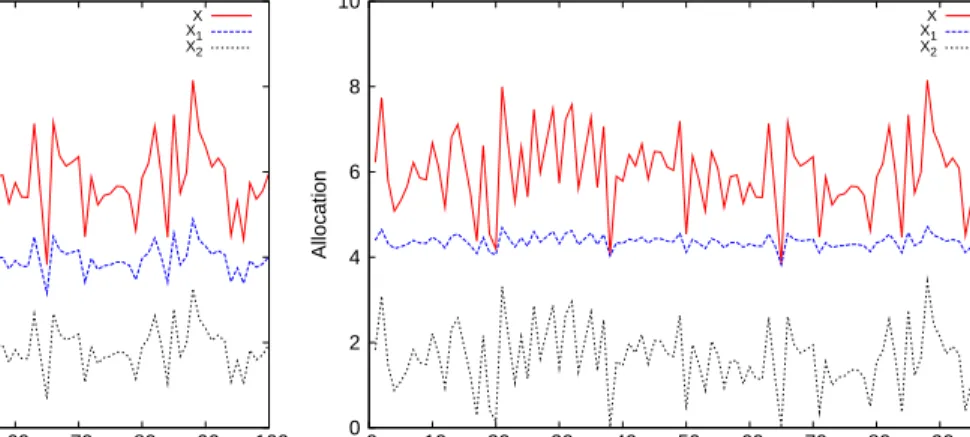
i = 1,2 over 100 periods (Figure 2). In these simulations, the total supply is normally
distributed with mean 10 and variance 1, and the valuation functions take the CARA form (13). 0 2 4 6 8 10 0 10 20 30 40 50 60 70 80 90 100 Allocation Period (V1,A1)=(0.1,0.15), (V2,A2)=(0.1,0.1) X X1 X2 0 2 4 6 8 10 0 10 20 30 40 50 60 70 80 90 100 Allocation Period (V1,A1)=(0.15,0.5), (V2,A2)=(0.1,0.1) X X1 X2
Figure 2: Optimal Allocation Over Time
Figure 2 shows the total impressions (solid red line), and the impressions allocated to agents 1 (dashed blue line) and 2 (dotted black line). In Simulation 2 (a), we letV = (0.3,0.1)
and α = (0.5,0.1) so that agent 1 has lower risk tolerance than agent 2 and also higher
dropout price. As expected, agent 1's allocation is less volatile. Agent 2's allocation is higher than 1's when the supply is ample but smaller than 1's when the supply is insucient In Simulation 2 (b), we let V= (0.9,0.1) and α= (0.5,0.1)so that agent 1's dropout price
is even higher. . As a result, 2's allocation is sometimes zero and is always less than 1's allocation.. In both simulations, agent 1's allocation is less volatile, which is a direct result of her low risk tolerance.
5 Optimal Allocation of Multiple Categories
When the demand for one category of impressions is independent of that for other categories, we can still apply the approach in Section 4 for each category.5 Furthermore, if the demand
for any two categories are related but the rate of substitution is the same across all agents, we may convert all categories into one and solve the optimal single-category allocation problem. In this section, we focus on the nontrivial case in which demand for dierent categories are related and the rates of substitutions are not the same.
5Note that our approach is applicable even if attributes are revealed in real time, such as in the case of
a web user's browsing history. The dierence in the realized number of certain impressions amounts to the uncertainty in the supply.
To eciently solve the multi-category allocation problem, we exploit two special features of the problem. First, a necessary condition for an allocation to be optimal is that it is Pareto optimal. Second, even though agents have nonlinear valuation functions, the marginal rates of substitution between categories are constant. The two special features allow us to decompose the multi-category allocation problem and convert each sub-problem to a standardized single-category allocation problem.
5.1 A Motivating Example
Example 1. We consider the following 4×4 example with CARA valuation functions
Qi(x) =Vi
1−e−P4m=1αimxim
, i= 1..4
and demand/supply prole
V= 2 1 1.5 1.2 , α= 0.30 0.16 0.10 0.20 0.20 0.50 0.12 0.05 0.13 0.10 0.40 0.08 0.06 0.10 0.20 0.30 , w = 12 8 6 6
We rst consider a naive approach that allocates each category independedly. We obtain the following allocation and social surplus (S).
x0 = 5.4368 5.0289 1.3382 3.8107 2.6622 2.5018 0 0 3.9009 0.4693 3.0811 0 0 0 1.5807 2.1893 , S = 4.7556.
The above allocation is not optimal as there are many opportunities for Pareto improvements. For example, if agent 1 gives one unit of category 2 to agent 2 in exchange of one unit of category 1, then both will be better o and the social surplus will increase to 4.8085. This Pareto-improving trade between agents 1 and 2 can continue until agent 1 runs out of category 2 or agent 2 runs out of category 1. After all such Pareto-improving trades are carried out, we will arrive at a Pareto optimal allocation.
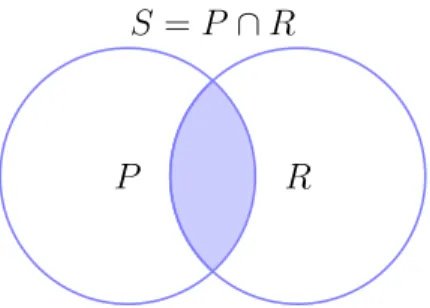
P R S=P ∩R
Figure 3: P is the set of allocations that are Pareto optimal and R is the set of allocations
that are regular. At least one optimal allocation resides in S.
The optimal allocation and social surplus for this example are
x∗ = 11.823 0 0 0 0 6.7119 0 0 0.177 0 6 0 0 1.2881 0 6 , S = 5.3001.
As this example shows, joint allocation of multiple categories may result in signicant eciency gains, compared with the naive approach. The optimal allocation matrix above is considerably more sparse because of the Pareto optimality requirement and an additional requirement call regularity. We dene these two concepts and study their implications in Sections 5.2 and 5.3 respectively. A crucial result we will obtain, as is illustrated in Figure 1, is that at least one optimal allocation resides in the intersection of the set of Pareto optimal allocations and the set of regular allocations. This result is the foundation of our approach for solving the original problem (P).
5.2
Pareto Optimality
As we have seen in Example 1, Pareto optimality is closely related to pareto-improving trading among agents. Hence, we will dene and study Pareto optimality through the notion of trading.
5.2.1 Dening Pareto Optimality
A trade is a reallocation of impressions among agents. A trade T can be represented by a
weighted directed graph in which,
• each arc (i, m) → (j, n) with weight > 0 represents a ow of units of category m
from agent ito agent j.6
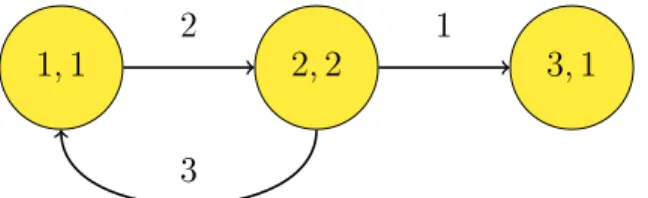
Figure 4 shows a graphical representation of a trade.
1,1 2,2 3,1
2 1
3
Figure 4: This trade graph represents that agent 1 gives agent 2 two units of category 1; agent 2 gives agent 3 one unit of category 2; agent 2 gives agent 1 three units of category 2.
Let T (x) denote the allocation after a trade T is executed on allocation x.
Denition 1. A trade T is feasible on allocation xif and only if T (x)is nonnegative.
Denition 2. A trade T is protable if ui(T (x)) ≥ ui(x),∀i ∈ N and at least one strict
inequality holds.
Denition 3. A trade T is prot neutral if ui(T(x)) =ui(x),∀i∈ N.
Denition 4. A tradeT is unprotable if there exists i∈ N such that ui(T(x))< ui(x).
Denition 5. An allocation x is Pareto optimal if none of the feasible trades on x is
prof-itable.
5.2.2 Circular Trades and Trading Cycles
We argue that in order to check Pareto optimality, we only need to look at the structural aspect of a trade and we can focus on a special kind of trades, circular trades. The former is straightforward: if a trade T with weight vector is feasible (protable), a scaled verion
of the trade T with weight vector β (β ≤1) is also feasible (protable). We will focus on
the second argument next.
A circular trade is a trade with a circular pattern: i1 gives 1 units of category m1 toi2, i2 gives 2 units of category m2 to i3, ..., and iK gives K units of category mK to i1. We
may concisely denote a circular trade as (C, ) where
C = (i1, m1) (i2, m2) ... (iK, mK)
(15) 6We requirei6=j and m6=nto avoid trivialty. Trade between nodes of the same category can always
captures the structural aspect of the trade and = 1 2 ... K
captures the trading quantities. We call C a trading cycle.
We say a trading cycleC is feasible (protable, prot neutral, unprotable) if there exists
a trading quantity vector such that the circular trade (C, ) is feasible (protable, prot
neutral, unprotable). Clearly, C is feasible on xif and only if
xikmk >0,∀k = 1..K (16)
This suggests that feasible cycles can only consist of non-zero elements of an allocation ma-trix. The following results provide a criteron for judging whether a trade cycle is protable. Proposition 3. A trading cycle C = ((i1, m1) (i2, m2) ... (iK, mK)) is protable (prot
neutral, unprotable) if and only if 7
K Y k=1 αikmk <(=, >) K Y k=1 αikmk−1 (17)
By reversing the direction of all ows on trading cycle C, we can get a counter cycle,
denoted asC−1. Intuitively, a circular trade followed by its counter circular trade will leave
each agent involved in the trade exactly the same.
Example 2. Continue with Example 1. Under the initial allocation x0, the trading cycle C = (1,2) (2,1)
is both feasible and protable. The former is because x12 > 0 and x21>0. The latter is because α12α21= 0.032 <0.15 =α11α22 by Proposition 3.
Proposition 4. If a trading cycle C is protable (prot neutral, unprotable), then its
counter cycle C−1 is unprotable (prot neutral, protable).
The following proposition implies that we only need to check all trading cycles to know whether an allocation is Pareto optimal.
Proposition 5. An allocation is Pareto optimal if and only if none of the feasible trading cycles is protable.
Example 3. Continue with Example 1. Under the optimal allocation x∗, the trading cycle C−1 =
(1,1) (1,2)
is feasible but not protable because α11α22 = 0.15 < 0.032 =
α12α21. One can go on to verify that none of the feasible cycles in x∗ is protable.8 So, by
Proposition 5, x∗ is Pareto optimal.
7Throughout the paperi0, m0, iK+1, mK+1 meaniK, mK, i1, m1, respectively.
8We leave this verication to interested readers. To enumerate all feasible cycles, we may follow three
rules: (a) A cycle can only consist of none-zero elements of the allocation matrix (by (16)). (b) Neighbouring nodes should dier in both row numbers and column numbers (see footnote (6)). (3) No two nodes in the cycle should have the same row number (otherwise, we can split the cycle into two smaller cycles).
5.2.3 Pareto Optimal Indicator Matrices and Constrained Problems
Because feasible trading cycles can only consist of non-zero elements of an allocation matrix, it is useful to dene the indicator matrix.
Denition 6. A binary matrix D with typical element δim is an indicator matrix for
allo-cation xif
xim = 0 whenever δim= 0. (18)
We also denote χ(D) as all allocations indicated by D.
It shall be notated that, by our denition, an allocation indicated by D can have either
a positive value or zero whenever δim = 1. For this reason, each D can indicate multiple
allocations.
Denition 7. An indicator matrix Dis Pareto optimal if all allocations indicated byD are
Pareto optimal.
Proposition 6 below provides a sucient condition for the Pareto-optimality of an indi-cator matrix.
Proposition 6. An indicator matrix D is Pareto optimal if there exists a strictly positive
vector r= (r1, r2, ..., rM) such that for any i∈ N, m, n ∈ M,
αim
αin
≥ rm
rn
, whenever δim= 1 (19)
We interpret r as an exchange rate vector. Condition (19) states that agent i can own
category m only when her valuation for the cateogry relative to other categories is at least
as high as the market's valuation, as dened by the exchange rate vector r. Otherwise, she
can protably trades her category m with others for some other category, as shown in the
proof.
Example 4. Continue with Example 1. x∗ is indicated by the following binary matrix
D= 1 0 0 0 0 1 0 0 1 0 1 0 0 1 0 1 .
We nd that any vectorr = (13, b,40,3b)with10≤b≤20satises (19). Hence, Dis Pareto
We dene a constrained problem with indicator matrix as: (CP) max x π = X i∈N Qi(xi) s.t. (1),(2), and x∈χ(D)
We further denote D as the set of Pareto optimal indicator matrices. Clearly, D has a
nite number of elements.
Because an optimal allocation is necessarily Pareto optimal, the original problem (P) can be solved by solving a series of constrained problems (CP) for each D ∈ D, until we
nd one Pareto optimal indicator matrix that yields the optimal allocation for the original problem. The advantage of this approach is the separation of the discrete component (i.e, what categories should be made available to each agent) and the continuous component (i.e., how many units to allocate for each agent and each category) of the problem.
There are three remaining issues:
• First, how do we solve a constrained problem (CP)?
• Second, how do we know whether the solution to a constrained problem (CP) is a
solution to the original problem (P)?
• Finally, how do we nd an optimal indicator matrix eciently?
With Proposition 1, the second issue is easy. The remaining two issues can be challenging. To address the rst issue, we present a technique for solving the problem (CP) when the optimal indicator matrix is both connected and regular (Section 5.3) and a complementary decomposition method when the optimal indicator matrix is not connected (Section 5.4). To address the last issue, we present some heuristics for matrix search in Section 5.5 (see Appendix B and C for a complete algorithm).
5.3 Regularity
When an agent owns two cateogries simultaneously, the two categories can be traded at the rate consistent with the agent's marginal rate of substitution, which is determined by her valuation coecients. When a second agent also owns the same two categories, the two categories can be traded at the second agent's marginal rate of substitution, which causes protable or prot-neutral trading cycles between the two agents, as shown by the following example.
Example 5. Consider a 2×2 example and an allocation x = 2 2 2 2
!
. If α11/α12 < α21/α22, then there exists a protable cycle C =
(1,2) (2,1)
by Proposition 3. Thus the allocation is not Pareto optimal. Ifα11/α12=α21/α22, then the cycleC is prot neutral,
implying that agents are indierent between x and allocation x0 = 2−t 2 + 2t 2 +t 2−2t
!
for any 0≤t≤1. This suggests that ifx is optimal so is x0.
If we allow only one agent to own both categories in above example, we can avoid the two kinds of cycles. This requirement is generalized to the multi-category case as the regularity condition. Note though, when there are multiple categories, two categories may be indirectly connected via a series of agents instead of directly connected via a single agent.
Denition 8. In an indicator matrix D, two categories, m and n, are connected via agent i if δim=δin = 1.
Based on the connectivity information inD, we can construct an undirected connectivity
graph Gin which
• each node represents a category, and
• a labeled edgem ↔i n represents m and n are connected through i.
We say Dis connected if its corresponding connectivity graph is connected.
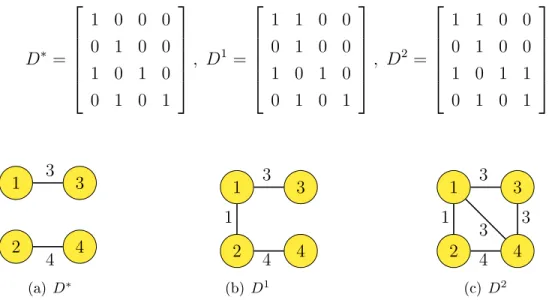
Example 6. Figure 5 shows the connectivity graphs corresponding toD∗,D1 andD2 where
D∗ = 1 0 0 0 0 1 0 0 1 0 1 0 0 1 0 1 , D1 = 1 1 0 0 0 1 0 0 1 0 1 0 0 1 0 1 , D2 = 1 1 0 0 0 1 0 0 1 0 1 1 0 1 0 1 1 3 3 2 4 4 (a) D∗ 1 3 2 4 3 4 1 (b) D1 1 3 2 4 3 3 3 4 1 (c) D2
Denition 9. A category m is connected to a set of other categories S via agent i if m is
connected to at least one category in S via agent i.
Denition 10. The connection between a categorym and a set of categoriesS is regular if m is connected to S via a single agent.
In above denition, the connection between a category m and a set S is regular does
not necessarily mean that m has a single connection with S. In fact, m can have many
connections with S, as long as they are all via the same agent. For example, inD2 (Figure
5), category 3's connection with{1,2,4} is regular, as it is via a single agent 3.
Denition 11. A connected componentSis regular if the connection between any category m∈S to any connected component among the remaining categories is regular.
Note that the remaining categories may form a connected component or several compo-nents. The former case occurs with categories 3 and 4 in D1 (Figure 5) and the latter, with
categories 1 and 2. In the latter case, m must be connected to each component via a single
agent (though these agents need not to be the same).
Denition 12. An indicator matrix D is regular if each of its components is regular.
We denote the set of regular indicator matrices as R. In Figure 5, D∗ is regular because
each component of D∗ is regular. D1 is regular. D2 is not regular because connections
between 1, 2, and 4 and the rest are not regular.
Proposition 7. If a Pareto optimal allocation x is not indicated by any regular indicator
matrix, then there must be a prot neutral trade T such that x0 = T (x) is indicated by a
regular indicator matrix.
Proposition 7 suggests that we can focus on regular Pareto-optimal indicator matrices without loss of eciency. We only consider regular indicator matrices from now on. Also, for the purpose of solving (CP), we assume without loss of generality that each row in the indicator matrix D has at least one nonzero element.
Proposition 8. Consider an allocation problem dened by a connected and regular indicator matrix D that has L connections, m1
i1
↔ n1, m2
i2
↔n2, ..., mL iL
↔nL. Then the following L
equations determine a vector r = (r1, r2,· · · , rM), which is unique up to a scale factor,
rml
rnl
= αilml
αilnl
Note that the number of equations L may exceed the number of decision variables. Yet,
Proposition 8 suggests that there will still be a unique exchange vector (up to a scale factor). The fact that we can always calculate a unique exchange rate vector for a connected and regular problem is crucial for the following standardization procedure.
Given a connected and regular indicator matrixDand an associated exchange rate vector r as dened by (20), we let
´
w= X
m∈M
wmrm (21)
be the total number of standardized impressions and
´ ui(´xi) = Qi αim rmx´i , if ∃m, s.t., δim= 1 0, otherwise ,∀i∈ N (22)
be the valuation functions for standardized impressions.9
A standardized problem is dened as:
(SP) max ´ x X i∈N ´ ui(´xi) s.t. X i∈N ´ xi ≤w and´ x´i ≥0,∀i∈ N
The next two results ensure that we can actually recover a solution of the constrained problem (CP) from solving the corresponding standardized problem (SP).
Lemma 1. If an indicator matrix D of size N ×M is connected and regular, then it has
exactly N +M −1 1 elements.
Letx´∗denote the optimal solution to the standardized problem (SP). Let an allocation x
be dened by the following system of linear equations:
P m∈Mrmximδim= ´x∗i,∀i∈ N P i∈Nxim=wm,∀m ∈ M (23) Proposition 9. Given a constrained problem (CP) dened by a connected and regular matrix
D and the corresponding standardized subproblem (SP). The system of linear equations in
(23) always has a unique solution x. Moreover, if x is non-negative, then x is the solution
to the constrained problem (CP).
9u´i(´x)is uniquely dened because ifδim=δin= 1, we must have αim
rm =
αin
5.4 Decomposition and Aggregation
We now discuss the case where the indicator matrix that denes a constrained problem (CP) is not connected. Suppose the connectivity graph hasJ (1≤J ≤M)connected components.
We let Mj be the nodes in the jth component, Nj be the set of aliated agents that is,
agents who may hold at least one category in Mj, and Dj be the submatrix of D dened
by rows Nj and columns Mj. By construction, each agent is aliated with at most one
component. In this way, we decompose the constrained problem (CP) into J subproblems.
In the j-th sub problem, we allocate categories Mj among agents Nj, subject to indicator
matrix Dj that is connected.
Once we solve each subproblem, we can easily form a candidate solution for the whole problem. To check whether the candidate solution is optimal, we use the following result. Proposition 10. Let x be the candidate solution assembled from solving J subproblems and λm be the Lagrange multiplier for category m∈ M1 ∪ M2...∪ MJ. x is the solution to the
original problem (P) if x is non-negative and for each m ∈ Mj and i /∈ Nj,
∂Qi
∂xim
≤λm (24)
Propositions (9) and (10) together ensure the validity of our approach. We use an example to illustrate the whole process for solving a multi-category allocation problem.
Example 7. Continue with Example (4). We illustrate the decomposition and standardiza-tion techniques using the following Pareto optimal indicator matrix,
D∗ = 1 0 0 0 0 1 0 0 1 0 1 0 0 1 0 1 .
The rst step is to decompose D into two submatrices.
D1 : Category 1 Category 3 Agent 1 1 0 Agent 3 1 1 , D2 : Category 2 Category 4 Agent 2 1 0 Agent 4 1 1
The second step is standardization. We use D2 to illustrate this step. Note that agent 4
has both category 2 and category 4. The exchange rate between the two categories can be caculated as α42/α44 = 1/3. Let r2 r4 = 1 3
of impressions is w´ = 8r2 + 6r4 = 26. Agents 2 and 4's utility functions for standardized impressions are ´ u2(´x2) = 1−e−0.5´x2, u´4(´x4) = 1.2 1−e−0.1´x4 .
The optimal allocation for this single-category problem is
´
x∗2 = 6.7119, x´∗4 = 19.2881.
To recover the original allocation, we solve the following system of linear equations.
1 0 0 0 1 3 1 1 0 x22 x42 x44 = 6.7119 19.2881 8
where the rst two equations are allocative constraints for each agent respectively. The third equation is the allocative constraint for category 2 impressions. The solution to the above system of linear equations is:
x22 x24 x42 x44 ! = 6.7119 0 1.2881 6 ! .
For subproblem D1, a similar procedure yields x11 x13 x31 x33 ! = 11.823 0 0.177 6 ! .
Both are nonnegative and the combined allocation is
x= 11.823 0 0 0 0 6.7119 0 0 0.177 0 6 0 0 1.2881 0 6
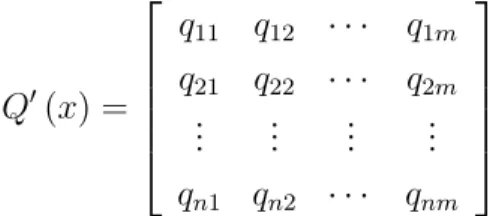
which meets the condition in (24), and thus is optimal. To further check this, we may compute the marginal utility matrix Q0(x) below
Q0(x) = 0.017288 0.0092202 0.0057626 0.011525 0.0069754 0.017438 0.0041852 0.0017438 0.017288 0.013298 0.053193 0.010639 0.010463 0.017438 0.034877 0.052315 .
For category-mimpression, the value of the Lagrange multiplierλmcan be found in them-th
column ofQ0(x)where the corresponding xis nonnegative (highlighted in bold). The vector
of Lagrange multipliers is summarized below:
λ= (0.017288, 0.017438, 0.053193, 0.052315)0.
It's easy to verify that the conditions in Proposition 1 are all satised.
5.5 Computational Method
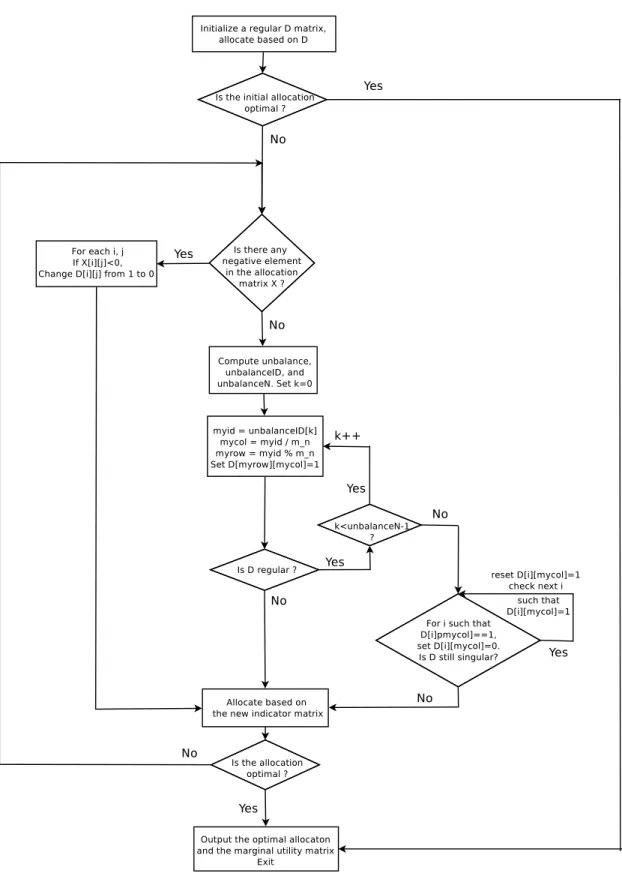
Based on the theory derived in this section, we develope the following algorithm for solving the multi-category optimal allocation problem.
Algorithm 2 Optimal Multi-category Allocation 1. Initialize the indicator matrix D∈R.
2. Construct the connectivity graph corresponding toDand divide the graph into several
connected components.
3. For each connected component, solve a subproblem by (a) computing the unique exchange rate vector, (b) solving the standardized problem, and
(c) backing up the solution for the original subproblem.
4. Determine whether the candidate solution assembled from solutions of subproblems satises the non-negative condition and the optimality condition stated in Proposition 10.
(a) If yes, then we have found an optimal allocation. (b) If no, nd another D∈R and go back to Step 2.
In Step 1, we may choose any regular Pareto optimal indicator matrix as the initial matrix. For example, one may choose D0 according to the following rule:
δij = 1 if Viαij > Vkαkj, ∀k ∈ N 0 otherwise ,
assuming equality does not occur. Step 2 can be easily achieved using a depth-rst search algorithm commonly used in graph theory, and Step 3 can be done using the results in
Section 5.4. There might be many approaches for picking the next D for Step 4 and it is
beyond the scope of this paper to evalute the merits of each approach. Here, we briey describe the approach we currently use.
Each time after we solve for the constrained problem using the current Dmatrix, we rst
check whether there are any negative elements in the allocation matrix. For each negative element xim,we adjust D by setting δim = 0. After this step, we solve the constrained
problem again based on the adjusted D. If all elements inDare nonnegative, then we check
the marginal utility of each agent for each category of impression. If for all i and m, the
marginal utility ∂Qi
∂xim is no larger than λm, then we have obtained the optimal allocation.
Otherwise, we adjust D by setting δim = 1 where the ratio ∂x∂Qi
im/λm is the highest. The
ratio, which we call the unbalance level, captures the increase in marginal valuation, had we reallocate the resource to xim. In choosing the next element to adjust, we also need
to consider whether the new D will be still regular. If not, we shall pick the next highest
unbalance element, and so on. Once we pick one element to adjust, we solve the constrained problem again based on the adjusted D. This iteration goes on until we nd an optimal
allocation.
For detailed description of the described algorithm, please see Appendix B. Our prelimi-nary numerical experiments suggest that this heuristic search algorithm can nd the optimal allocation very quickly.
Example 8. We illustrate the steps of searching for the optimal D using Example 1. For
convenience, we list the demand and the supply parameters below:
V= 2 1 1.5 1.2 , α= 0.30 0.16 0.10 0.20 0.20 0.50 0.12 0.05 0.13 0.10 0.40 0.08 0.06 0.10 0.20 0.30 , w = 12 8 6 6 .
1. Set the initial indicator matrix D such that δij = 1 if and only if Viαij ≥ Vkαkj,
∀k ∈ N. D0 = 1 0 0 1 0 1 0 0 0 0 1 0 0 0 0 0 ,
By solving the constrained problem dened by D0 as in Example 7, we have x0 = 12 0 0 6 0 8 0 0 0 0 6 0 0 0 0 0 , Q0 x0= 0.0049378 0.0026335 0.0016459 0.0032919 0.0036631 0.0091578 0.0021979 0.00091578 0.017690 0.013608 0.054431 0.010886 0.072000 0.12000 0.24000 0.36000 .
2. According to Proposition 10, because some elements of Q0(x0)exceeds the
correspond-ing λm in the same column (shown in bold), x0 is not optimal. The most unbalanced
of all elements is at column 4, row 4, with the ratio 0.36000
0.0032919 = 109.36 (recall the
un-balance levels are caculated as elements of Q0(x0) divided by the Lagrange multiplier,
in bold, at the same column). So D0 is adjusted to
D1 = 1 0 0 1 0 1 0 0 0 0 1 0 0 0 0 1 , and we have x1 = 12 0 0 −3.3893 0 8 0 0 0 0 6 0 0 0 0 9.3893 , Q0 x1= 0.032291 0.017222 0.010764 0.021527 0.0036631 0.0091578 0.0021979 0.00091578 0.017690 0.013608 0.054431 0.010886 0.0043055 0.0071758 0.014352 0.021527
3. Because x14<0, we ip δ14 and obtain
D2 = 1 0 0 0 0 1 0 0 0 0 1 0 0 0 0 1 , and we have x2 = 12 0 0 0 0 8 0 0 0 0 6 0 0 0 0 6 , Q0 x2= 0.016394 0.0087436 0.0054647 0.010929 0.0036631 0.0091578 0.0021979 0.00091578 0.017690 0.013608 0.054431 0.010886 0.011902 0.019836 0.039672 0.059508
4. The most unbalanced element of Q0(x2) is at column 2, row 4, with ratio 0.019836 0.0091578 = 2.166. So D2 is adjusted to D3 = 1 0 0 0 0 1 0 0 0 0 1 0 0 1 0 1 , and we have x3 = 12 0 0 0 0 6.7119 0 0 0 0 6 0 0 1.2881 0 6 , Q0 x3 = 0.016394 0.0087436 0.0054647 0.010929 0.0069754 0.017438 0.0041852 0.0017438 0.017690 0.013608 0.054431 0.010886 0.010463 0.017438 0.034877 0.052315
5. The most unbalanced element ofQ0(x3)is at column 1, row 3, with ratio 00.016394.01769 = 1.08.
SoD3 is adjusted to D4 = 1 0 0 0 0 1 0 0 1 0 1 0 0 1 0 1 , and we have x4 = 11.823 0 0 0 0 6.7119 0 0 0.177 0 6 0 0 1.2881 0 6 , Q0 x4= 0.017288 0.0092202 0.0057626 0.011525 0.0069754 0.017438 0.0041852 0.0017438 0.017288 0.013298 0.053193 0.010639 0.010463 0.017438 0.034877 0.052315 ,
Because x4 is nonnegative and Q0(x4) satises the optimality condition, the above
allocation is optimal and we are done.
For a slightly more complicated example, see Appendix C.
6 Private Information and Incentive Compatible
Pay-ments
So far we have examined the optimal allocation problem assuming the planner has complete information about the agents' valuation functions. In this section, we examine the problem
of private information and payments that induce agents to truthfully reveal their preferences. We assume each agent is characterized by ak-dimensional type vectorti = (ti1, ti2, ..., tik).
For example, a type vector may include valuation coecients, reserve valuation, and other parameters of the valuation function. We use t−i and t to denote the types of all but i, and
types of all agents respectively.
We denote ui(xi|ti) as the agent i's valuation of allocation xi when her type is ti. We
assume ui is known to the planner butti is not.
We apply the well-known VCG mechanism to our settings. In this mechanism, each agent reports his type vector, si, to the planner. The planner allocates the impressions by
maximizing the total social suplus based on the reported types s and charges each agent µi(s)as dened below.
We denote x∗(s) as the solution to
max x π = X i∈N ui(xi|si) (25) s.t.(1) and (2)
and x∗−i(s)as the solution to
max x π = X j∈N uj(xj|sj) (26) s.t. (1) and (2) xi = 0
In other words,x∗(s)andx∗−i(s)are the optimal allocations with and withoutirespectively.
The VCG mechnism charges agent i a payment of µi(s) = X j∈N, j6=i uj(x∗−j i(s)|sj)− X j∈N, j6=i uj(x∗j(s)|sj) (27)
which is the externalityi imposes on other agents by her presence.
Proposition 11. The multi-dimensional VCG mechanism as dened by the allocation rule (5) and payment rule (27) is truthful in dominant strategies.
By Krishna and Perry (2000), the multi-dimensional VCG mechanism also maximizes the revenue of the planner among all the ecient mechanisms.
If the seller is the planner, the seller's type is known and the seller's total revenue is given byP
i6=sµi(t). So the seller's payo is
Us(x∗s(t)|ts) =us(x∗s(t)|ts) +
X
i6=s
µi(t)
7 Online Allocation and Category Aggregation
We consider the implementation of the optimal allocation in an online environment, where impressions arrive in real time and must be allocated right away. In the optimize-and-dispatch framework, our previous discussion is on oine optimization module whereas our next discussion is on online dispatching module. We also discuss the benets of category aggregation.
7.1 Online allocation
We denote w(t) and y(t) as the total realized impressions and the total corresponding
allocation at discrete time t ∈ {0,1, ..., T}. The new allocation in period t is thus y(t)−
y(t−1). We look for an allocation pathy(t) such that
yim(0) = 0,∀i, m, t
yim(t)−yim(t−1) ≥ 0,∀i, m, t
X
i
(yim(t)−yim(t−1)) ≤ wm(t)−wm(t−1)
We denoteξ∗(t) ={xj∗(t), j = 1,2, ...O}as the set of optimal oine allocations as of timet,
i.e., ξ∗(t)is the set of optimal oine allocations if t were the end of the allocation duration.
We say y(t)is an optimal online allocation if it satises the above conditions and
y(T)∈ξ∗(T).
It is easy to see that optimal online allocations are generally not unique, even in the case when the optimal oine allocation is unique.
Next we describe an online allocation algorithm that is close to the oine optimal al-location. We rst denote Cm(t) as an Eligible Set for a category m at time t. An agent i
belongs toCm(t) if there exists an optimal oine allocation x∗(t)∈ξ∗(t) such that
When an impression of category m comes, we allocate it randomly to any agent in Cm(t).
Then we update Cm(t) toCm(t+ 1), i.e., remove an agent from Cm(t) if the condition (28)
is violated. Intuitively, this process approaches an optimal oine allocation when t reaches T. Note that sometimes multiple impressions of same category may arrive simultaneously.
In such a case the consistency of the Eligible Set must be preserved to ensure a valid im-plementation of the optimal allocation. Many existing database techniques can be used for that.
As a further renement of the online allocation, instead of picking randomly from the Eligible Set, we may also use additional external information to guide the choice. One example of such information is Internet users' preferences, which are often produced by online matching algorithms. By incorporating user preferences, we can better satisfy Internet users while implementing an optimal allocation. More specically, suppose an online matching algorithm estimates a user's valuation for advertisements as {ui, i= 1..N}. Everything else
being equal, the seller prefers to assign the impression to the user's most preferred agent. We suppose the seller's concern for advertisers dominates that for Internet users so that the optimal allocation derived in the previous section remains optimal. Thus a real-time renement can simply be: when an impression of categorymarrives, we rst ndCm(t)and
then pick among Cm(t) that produces the highest user valuation.
7.2 Category aggregation and its implications for computation and
privacy
In our main results, all the optimization is done in advance, leaving little to be gured out in real time. In order for such an allocation to be optimal, we need the most detailed demand information in advance, which is not always feasible. Moreover, the global optimization problem can be challenging when the number of categories becomes very large.
To balance between oine and online allocation, we may aggregate the categories to reduce the dimensionality of the global optimization. By doing so, we may lose some in-formation from ad buyers at the oine stage, and the optimal allocation will be in terms of aggregated categories. But at the online stage, we will take into account the detailed preferences within aggregate categories and use them as external information as discussed in Section 7.1.
By reducing the number of categories, the computation cost of the optimization problem can be greatly reduced. At the same time, the size of each eligible set will increase, which means more computation for the online allocation. So this balance of oine optimization and online allocation needs to be tuned carefully to achieve a good tradeo.
The optimize-and-dispatch framework for allocation, together with category aggrega-tion, can also help protect consumer privacy. The online matching, which involves the most detailed Internet user preferences, can be partly carried out in a distributed fashion on Inter-net user devices such as smart phones. A distributed matching allows InterInter-net users to hold on to their preferences information locally, thus better protecting their privacy. Guha et al. (2011) describes such an online advertising architecture that is considerably more private than current systems, while allowing reasonable ads targeting ads.
With category aggregation, we can limit the advertising providers' access to the detailed preference information. But the oine optimization based on the coarse information and further renement by distributed online matching can still provide a reasonable approxima-tion to the optimal allocaapproxima-tion. Of course, the computaapproxima-tion on user devices should not be too heavy, as the computing power and battery life on smartphones are still very limited. Fortunately there are already some works on these problems in the literature (Guha et al., 2011; Dong et al., 2011). Dong et al. (2011) design a general secure matching algorithm and shows that it is practical, both in terms of computation and energy consumption, with real implementation on smartphones.
8 Summary and Future Research
As more people spend their time online, the demand for ecient allocation of display ad-vertising impressions is unprecedented. We have proposed a contingent contract approach that is exible enough to accommodate dierent risk preferences and multiple categories. Although our approach is motivated by the practices of display advertising and is discussed within its context, it is also applicable to sponsored search advertising.
We have shown that with single-category impressions, agents with lower marginal valua-tion will participate in riskier oors of realized impressions. The higher an agent's absolute risk tolerance, the greater the share he or she will obtain in a oor. An algorithm has been proposed that completely solves the problem of allocating uncertain single-category impres-sions to multiple agents who have concave valuation functions for impresimpres-sions.
Our theoretical results on the optimal multi-category allocation shed light on the char-acteristics of the problem and provides several practical implications. First, our theoretical results ensures the validity of a decomposition and standardization procedure. This proce-dure suggests a viable algorithm for computing the optimal solution for multiple category allocations. Such a theory-driven algorithm, combined with appropriate matrix search proce-dure, has potential of achieving superior performance. The byproducts of the decomposition and standardization are also valuable. The result of decomposition informs ad sellers and
buyers which categories of impressions should be considered together. The standardization yields the exchange rates across dierent categories that can further guide buyers in terms of correctly specifying their preferences.
The categories in our framework can capture both the time and location. Therefore, our approach is especially suitable for location- and time-sensitive advertising contexts such as mobile and location-based advertising. The optimize-and-dispatch architecture can not only help strike a computational balance between oine optimization and online matching but also lends several additional benets including better consumer privacy protection. As we have discussed in Section 7, by delegating some matching to online algorithm, one can accommodate consumers' preference on advertisements, which arrives in real time. Having a distributed online matching can also help preserve consumer privacy, though developing details framework for consumer privacy protection is beyond the scope of this paper.
As a rst attack of an inherently challenging problem, we have made several simplifying assumptions. We have assumed that agents know their preferences and assume a VCG type mechanism for solicitating truthful preferences. Other types of preference solicitation mechanisms shall be explored. It will also be valuable to examine in greater detail how to implement optimal allocation in real time. The performance of our approach shall be tested and compared with other approaches in empirical or experimental settings. Despite these assumptions, we believe our existing results show great promise.
References
Gagan Aggarwal, G. Goel, C. Karande, and A. Mehta. Online vertex-weighted bipartite matching and single-bid budgeted allocations. CoRR, 2010.
Franklin Allen and Douglas Gale. Optimal Security Design. Review of Financial Studies, 1 (3):229263, 1989.
Animesh Animesh, Vandana Ramachandran, and Siva Viswanathan. Quality Uncertainty and the Performance of Online Sponsored Search Markets: An Empirical Investigation. Information Systems Research, 21(1):190201, June 2009.
S. Athey and G. Ellison. Position auctions with consumer search. Quarterly Journal of Economics, 126(3):12131270, 2011.
Jianqing Chen, De Liu, and Andrew B Whinston. Auctioning Keywords in Online Search. Journal of Marketing, 73(4):125141, July 2009.
Y.J. Chen. Optimal dynamic auctions for display advertising. UC Berkeley Working Paper, 2009.
Wei Dong, Vacha Dave, Lili Qiu, and Yin Zhang. Secure friend discovery in mobile social networks. In 2011 Proceedings IEEE INFOCOM, pages 16471655. IEEE, April 2011. Benjamin Edelman, Michael Ostrovsky, and Michael Schwarz. Internet Advertising and
the Generalized Second-Price Auction: Selling Billions of Dollars Worth of Keywords. American Economic Review, 97(1):242259, March 2007.
EMarketer. Online Advertising Market Poised to Grow 20% in 2011. Technical report, 2011. A. Ghose and S. Yang. An Empirical Analysis of Search Engine Advertising: Sponsored
Search in Electronic Markets. Management Science, 55(10):16051622, July 2009.
Arpita Ghosh, P. McAfee, Kishore Papineni, and Sergei Vassilvitskii. Bidding for represen-tative allocations for display advertising. Internet and Network Economics, (July 2009): 208219, 2009.
Saikat Guha, Bin Cheng, and Paul Francis. Privad: practical privacy in online advertising. In Proceedings of the 8th Symposium on Networked Systems Design and Implementation (NSDI), Boston, MA, 2011.
D Liu and J Chen. Designing online auctions with past performance information. Decision Support Systems, 42(3):13071320, December 2006.
D. Liu, J. Chen, and A. B. Whinston. Ex Ante Information and the Design of Keyword Auctions. Information Systems Research, 21(1):133153, November 2010.
P. McAfee and K. Papineni. Maximally representative allocation for guaranteed delivery advertising campaigns. Manuscript, 2010.
R.P. McAfee. The Design of Advertising Exchanges. Review of Industrial Organization, 39: 169185, 2011.
Aranyak Mehta, Amin Saberi, Umesh Vazirani, and Vijay Vazirani. AdWords and generalized online matching. Journal of the ACM, 54(5):22es, October 2007.
D Parkes and T. Sandholm. Optimize-and-dispatch architecture for expressive ad auctions. In First Workshop on Sponsored Search Auctions, Vancouver, Canada. Citeseer, 2005. A Raviv. The design of an optimal insurance policy. The American Economic Review, 69
H Varian. Position auctions. International Journal of Industrial Organization, 25(6):1163 1178, December 2007.
R Wilson. Ecient and competitive rationing. Econometrica, 57(1):140, 1989.
Appendix A
Proof of Proposition 1
Proof. We form the Lagrangian as follows:
L=X i∈N Qi( X m∈M αimxim) + X m∈M λm(w) wm− X i∈N xim ! + X m∈M X i∈N µixim.
The rst order condition for xim is
∂Qi ∂xim −λm(w) +µim = 0 Because µim≥0, ∂Qi ∂xim =λm if xim>0, and ∂Qi ∂xim ≤λm
if xim= 0. It should be noted thatλm depends on the vector w.
Proof of Proposition 2
Proof. We need to show that ∀k = 1,· · · , N, ∀w ∈ [ ¯wk, w¯k+1], the allocation determined
by (9) and (10) satises the condition in Proposition 1. By construction, the conjectured optimal allocation is feasible provided that the solution to (10) exists. So we rst check that (10) indeed has a solution λ(w). By the denition of w¯k and the fact that w ∈ [ ¯wk, w¯k+1],
we have N X i=1 di(Vk)≤w≤ N X i=1 di(Vk+1). Now becausePN
i=1di(·)is a monotone decreasing function, by continuity, there existsVk+1 ≤ λ(w)≤Vk such that w=
PN