No 10
Calling Party Pays or
Receiving Party Pays?
The Diffusion of Mobile
Telephony with Endogenous
Regulation
Ralf Dewenter,
Jörn Kruse
IMPRINT
DICE DISCUSSION PAPER
Published by
Heinrich‐Heine‐Universität Düsseldorf, Department of Economics, Düsseldorf Institute for Competition Economics (DICE), Universitätsstraße 1, 40225 Düsseldorf, Germany
Editor:
Prof. Dr. Hans‐Theo Normann
Düsseldorf Institute for Competition Economics (DICE)
Phone: +49(0) 211‐81‐15009, e‐mail: [email protected]‐duesseldorf.de
DICE DISCUSSION PAPER
All rights reserved. Düsseldorf, Germany, 2010
ISSN 2190‐9938 (online) – ISBN 978‐3‐86304‐009‐3
The working papers published in the Series constitute work in progress circulated to stimulate discussion and critical comments. Views expressed represent exclusively the authors’ own opinions and do not necessarily reflect those of the editor.
Calling Party Pays or Receiving Party Pays?
The Diffusion of Mobile Telephony with Endogenous Regulation
Ralf Dewenter
∗J¨orn Kruse
†Abstract
This paper analyzes the impact on mobile telephony diffusion patterns of the two predominant payment regimes, calling party pays (CPP) and receiving party pays (RPP), for mobile termination services. By applying instrumental variable techniques to panel data we account for a possible interdependency of penetration rates and regulatory interventions. For this purpose we use data on political and institutional factors to instrument endogenous regulatory decisions. We conclude from our empirical analysis that there is no significant impact of either RPP or CPP on penetration rates. Therefore an application of RPP in order to obviate regulation of termination fees would be feasible.
Keywords: Mobile telephony markets, calling-party-pays, mobile termination fees, endogenous regulation.
JEL-Classification: L1, L5, L96.
∗University of Duesseldorf, DICE, Universitaetsstr. 1, 40225 Duesseldorf,
†Helmut-Schmidt-University Hamburg, Institute for Economic Policy, Holstenhofweg 85,
1
Introduction
European mobile telephony markets have, with few exceptions, largely dispensed without much regulation until the end of the 1990s. However, in recent years most European and many other countries have introduced additional regulatory interventions. Particularly price regulation of wholesale mobile termination mar-kets has become a relevant regulatory issue. Nowadays, regulation of mobile (M2M) termination rates is a widespread practice in many countries worldwide. The reasoning for regulating M2M terminations fees is closely connected with the underlying payment regime for termination services. While under the so-called “receiving party pays” (RPP) regime terminating mobile networks charge their own customers for termination services, under the “calling party pays” (CPP) regime terminating operators charge the originating network instead. The CPP regime, however, gives rise to market power in termination markets and is widely accepted as justification for regulatory interventions (see Armstrong, 1998, Laf-font, Rey and Tirole, 1998a).
A potential alternative to price regulation is to apply the receiving party pays payment regime for M2M termination services (see e.g. Doyle and Smith, 1998, Laffont, Rey and Tirole, 1998a, Littlechild, 2006). In case that a RPP system is applied, subscribers are able to compare the entire price ranges. That is, customers are able to compare prices for on-net calls, subscription fees, handset subsidies as well as for termination services, before joining a network. Hence, mobile networks are able to compete over the whole price basket and termination rates are expected to fall. For this reason, a changeover of the payment system from CPP to RPP seems to be an adequate solution to obviate regulation.
However, since under receiving party pays the termination networks charge their own consumer for incoming calls there are also some reservations about RPP. The most important apprehension is that customers are likely to switch off their mobile phones since they have only limited cost control under RPP. Since under RPP the caller is charged less, he might place calls for which his willingness to pay is less than marginal costs. The number of calls initiated by callers could therefore be inefficiently high (including nuisance calls). Depending on the recipients’s marginal willingness to pay, these calls can be solicited or unsolicited. However, in order to avoid unwanted calls, recipients are likely to switch off their mobiles phones. As a consequence, mobile telephony usage could probably be much lower in comparison to CPP countries. This could induce an inefficient amount of minutes-of-use and also an inefficient number of calls under RPP (for a discussion see, e.g., OFTEL, 2002). However, one could also counter that recipients are either able to identify callers (i.e. by calling numbers) or simply stop unwanted calls. Overall, since there is only limited empirical evidence (see e.g. Littlechild, 2006, for an exception) there is still room for empirical research. In case of consumers anticipating that they have only limited cost control and are likely to switch off their phones under RPP, they might refuse to join a mobile
network. Penetration rates might therefore be much lower than in markets where CPP is applied. Indeed, anecdotal evidence for such behavior could be observed and especially in the early days of mobile telephony in some RPP countries such as the United States. For this reason, reduced penetration has always been an important argument against RPP. Since there is only little statistical evidence on the impact of the underlying payment regime on penetration rates (exceptions are Littlechild, 2006, and Cunningham et al., 2010), the aim of this paper is to fill this gap to some degree.
For this purpose, we use data on 77 countries over a time span of 23 years. Our sample consists of three types of countries: original CPP (RPP) countries using CPP (RPP) over the whole sample and switching countries. By this means, we are able to identify the impact of CPP and RPP over time as well as between different countries using panel data techniques. A major difficulty resides in the fact that the decision for a changeover of the payment regime and also other reg-ulatory interventions are possibly endogenous - which is commonly referred to as “endogenous regulation” (see e.g. Persson and Tabellini, 2000, Duso and R¨oller, 2003). That is, decisions of regulatory authorities are possibly not independent of market outcomes and political or institutional factors. Ignoring this endogeneity could, however, lead to seriously biased results. We take this into account by us-ing instrumental variables such as relative market performance, democracy scores and measures of political stability in order to identify the impacts of regulatory actions.
The remainder of the paper is now organized as follows. Section 2 discusses possible needs for regulatory intervention in mobile termination markets and the two predominant payment regimes. In Section 3 we offer a detailed empirical analysis on the impact of CPP and RPP on mobile telephony penetration rates. Finally, Section 4 concludes.
2
Mobile termination and penetration rates
This section provides a brief discussion of mobile termination and the role of the underlying payment regime (CPP or RPP) with respect to regulation. Moreover, we discuss possible impacts of the payment regimes on adoption patterns.
2.1
Mobile termination under CPP and RPP
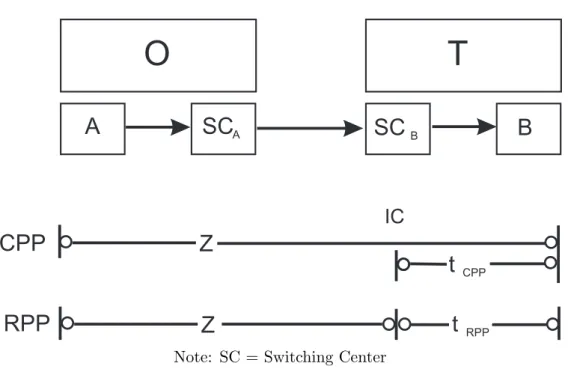
Suppose that a customerAof a mobile network, say networkO, intends to reach a subscriberB from a different mobile network,T. For this purpose both networks have to be interconnected. While in the case assumed, networkO has to provide an origination service, network T terminates the call. Both operators usually charge fees for their services, namely the call charge (Z) and the termination rate (t) in order to cover costs. Under the calling party pays regime, mobile operator
T charges networkO a termination fee whichO completely passes on to his own subscriber in addition to the call charge. Under RPP, in contrast, subscribers of networkO have to pay for origination services only while the recipient in network
T is charged (by T) for the termination service (see Figure 1).1
Figure 1: CPP and RPP
O
T
A
SC
ASC
BB
Z
CPP
t
CPPIC
Z
t
RPPRPP
Note: SC = Switching Center
Given that there is no substitute for a termination service, the terminating net-work (T) enjoys a monopoly position for this service under the CPP regime. T is thus able to exploit the originating networkO by setting monopolistic termina-tion rates. Of course, this holds for each terminatermina-tion of mobile calls under CPP as long as termination can be realized by only one single network. Thus, there is al-ways an incentive for terminating networks to set monopolistic termination rates, independently of which network (hereT orO) serves as the originating or termi-nating network. Moreover, since termination fees can be considered as part of the marginal costs of calls, originating networks have the incentive to pass high ter-mination rates along to their own customers. As Armstrong (1998) and Laffont, Rey and Tirole (1998a) put it, bargaining of network operators over termination 1It is worthwhile to note that there is a difference between the end-user payment regimes
on the one hand and the network payment regimes on the other. The end-user regimes (CPP and RPP) are typically initialized by a corresponding network payment regime. While under calling party network pays (CPNP) regime the originating network pays a per-minute charge to the terminating network, under a receiving party network pays (RPNP) regime the receiving network pays a charge to the originating network. In the case of networks passing their costs on to their customers, a CPP or RPP regime, respectively, results. In case that a bill and keep regime is applied, calls from other networks are terminated at no extra charges.
fees results in some kind of tacit collusion and therefore in high termination fees (see also Carter and Wright, 1999).2 For these reasons, the European
Commis-sion (and also other regulatory authorities) define own relevant M2M termination markets in order to analyze possible anticompetitive outcomes. As a consequence of the terminating networks’ monopolistic positions and also because of a lack of substitutes for mobile telephony, mobile termination services can be seen as non-contestable monopolistic bottlenecks (when CPP is applied) and regulation of mobile termination fees is assumed to be inevitable. Consequently, today most European regulatory authorities regulate the mobile networks’ termination fees (see European Commission, 2009).
The application of the receiving party pays regime, however, leads to differ-ent outcomes. Following, e.g., DeGraba (2000), Quigley and Vogelsang (2003), Valletti and Houpis (2005), Berger (2005) and Littlechild (2006), under the RPP regime mobile network operators have no incentives for charging monopolistic ter-mination rates (for opposite assessments see Gans and King, 2001 and Wright, 2002).3 Since terminating networks charge their own customers for the
termina-tion services, customers are able to compare the networks’ price baskets (includ-ing, for example, prices for on-net and off-net calls, data services as well as for termination services) before signing up to a network. Mobile network operators then compete over a complete bundle of prices and have no incentive to charge their own customers high termination rates. Competitive pressure should lead to much lower termination fees under RPP. With competitive termination fees, there is, however, no need for regulation. Receiving party pays can therefore be (among other solutions, such as mobile termination carrier selection; see Kruse, 2009) regarded as a possible way to obviate regulation of mobile termination fees.4
Despite of the seemingly superior characteristics of RPP there is no serious initiative of CPP countries to change the payment regime in favor of RPP. The initial choice of the payment system is likely to be caused for historical reasons. Most countries have presumably adopted the system from fixed-line telephony. However, to our knowledge, only the UK Competition Commission considered RPP as an alternative to the calling party pays regime when deciding on the regulation of termination fees in 2002 (see Littlechild, 2006). Quite a number of countries switched from RPP to CPP instead (see Section 3.2). One reason for this could be consumer resistance against RPP. Oftel (2002), for example, argued that a strong reaction of consumers against being charged for incoming calls can 2However, this outcome strongly depends on factors such as the firms’ symmetry and the
pricing structure (see, e.g., Laffont, Rey and Tirole, 1998b and Dessein, 2003). For further discussion see, e.g., Crandall and Sidak (2004) and Haucap (2004). See also Gabrielsen and Vagstad, 2008, for a review of the literature.
3See Harbord and Pagnozzi (2010) for a survey of the related literature.
4There is also strong empirical evidence for this outcome. In countries where RPP is applied,
be expected and that “Oftel would have a hard job explaining that overall it was in their [the consumers] interests to pay for such calls when previously they received them for free.”
A major concern against RPP is, however, that a changeover from CPP to RPP would involve a completely different calling behavior and therefore lead to lower penetration rates (see, e.g., OECD, 2000, Oftel, 2002).5 As termination
rates–and therefore also prices for off-net calls – presumably fall under RPP, such lower prices could lead to a higher number of undesired calls, such as junk or marketing calls. Moreover, as consumers are not aware whether or not they would benefit from an incoming call and have therefore only limited cost control, they might switch off their mobile phones in order to reduce costs. This in turn leads to an overall reduced number of call minutes (in terms of on-net as well as off-net traffic). Furthermore, when consumers anticipate that they are not aware whether they would benefit from incoming calls or not (and would therefore turn off their handsets), they might refuse to sign mobile contracts in advance. This effect should be especially relevant for prepaid contracts. Because of higher call charges, prepaid cards are especially interesting for customers who prefer to be reachable by their mobile phone. Prepaid cards are, however, important drivers for mobile telephony diffusion in many countries (see OECD, 2000). Countries with a high share of prepaid contracts would probably suffer from the introduction of RPP in terms of lower penetration rates.
Another argument in favor of CPP and against RPP is connected with fixed to mobile termination. Typically under a calling party pays regimes fixed to mobile termination rates have always been about as high as mobile to mobile fees. High profits from fixed to mobile calls have therefore potentially been used to subsidize mobile networks. Due to the waterbed effect (see Cunningham et al., 2010, and Genakos and Valletti, 2010, for empirical evidence on the waterbed effect) networks have been able to set lower subscription rates and similar prices for mobile telephony. Lower prices for mobile telephony have probably led to higher mobile penetration rates under CPP (see, e.g., Littlechild, 2006, Genakos and Valletti, 2010). Thus, in a way this paper also studies the effects of fixed to mobile pricing on mobile telephony penetration.6
2.2
Empirical studies on diffusion of mobile telephony
Even though there is some empirical evidence that CPP generates a more intense calling behavior, therefore leading to higher penetration rates, broad statistical evidence is still lacking. Most empirical studies are, in contrast, based on anec-5There are also some minor advantages and disadvantages of RPP compared to CPP.How-ever, a detailed consideration is beyond the scope of this paper. For some discussions of the pros and cons of both payment regimes see, e.g., DeGraba, 2003, Crandall and Sidak, 2004, Haucap, 2004 or Littlechild, 2006).
dotal evidence or case studies (see Littlechild, 2006, for an overview): The US, for example, have long been regarded as a typical RPP country with low pene-tration rates (see Crandal and Sidak, 2004).7 Apparently, some countries could
considerably improve their diffusion rates after re-regulating the payment regime from RPP to CPP. This is commonly referred to as an argument against receiv-ing party pays. Samajariva and Melody (2000) find a positive impact induced by a change from RPP to CPP in their case study for Mexico. Zehle (1998, 2003) provides case studies on countries from Central and South America and the Caribbean, finding also that countries switching to CPP enjoy positive im-pact. To our knowledge, Littlechild (2006) is the only study explicitly providing statistical evidence on CPP and RPP on (inter alia) penetration rates. Using cross-section data he finds no evidence that RPP lowers mobile telephony pene-tration. Moreover, receiving party pays regimes are found to be correlated with lower average revenues (per minute) as well as higher average usage (measured by call minutes).
More general empirical studies on mobile telephony diffusion (see, e.g., Gru-ber, 2001, Gruber and Verboven, 2001, Koski and Kretschmer, 2004, Massini, 2004, Michalakelis et al., 2008, Chu et al., 2009, Cunningham et al., 2010) iden-tify a number of factors to be crucial for the diffusion process. According to these studies, the introduction of the digital GSM standard is responsible for an early acceleration of mobile telephony diffusion. Increased competition is also a factor for penetration rates, however, the impact seems to be relatively small. There is also a convergence between late and early adopters (at least considering EU countries). The effects of prices on penetration rates are ambiguous. While most price variables have no significant impact, monthly charges are statistically significant in most of these studies. Massini (2004) found also an impact of de-creasing handset prices. Income, measured by GDP per capita, also seems to have an impact on diffusion rates.
As payment systems for termination services are expected to affect competi-tion, prices as well as the customers’ calling behavior and also penetration rates are possibly affected by the choice between RPP and CPP. Therefore, the next section aims at exploring the impact of CPP and RPP on diffusion patterns.
3
Empirical Evidence
3.1
Modelling diffusion processes and specification
An analysis of the impact of the two payment regimes on the growth rates of mobile telephony diffusion requires an adequate econometric strategy. Economic literature on both technology and product penetration provides a wide range 7Meanwhile, the US have caught up with many European countries showing high mobile
of models to analyze the diffusion patterns. The most prominent deterministic models used are the Gompertz function, the Bass model (see Bass, 1969) and the logistic model (for a discussion of various models see e.g. Mahajan, Muller and Bass, 1990, Maede and Islam, 1998, Geroski, 2000). Since the S-shaped logistic curve has proved to be well-suited for the analysis of several mobile telephony markets across the world (see e.g. Gruber and Verboven 2000, 2001, Gruber 2001), we have also adopted this model to analyze the impact of the payment regimes on diffusion processes.
Starting from a three-parametric logistic function
yit = ˆ yit 1 + exp(−Ai(t−Bi)) , (1)
whereyit is the number of subscribers to mobile telephony in countryi at timet,
ˆ
yi is the ceiling of the diffusion process or, i.e., the number of potential adopters,
the parameter Ai measures the average growth rate, t is a linear trend andBi is
the turning point of the S-shaped function (period with highest growth).
In order to keep the model as simple as possible, we use a linear version of equation (1).8 For this purpose we first have to estimate the maximum number
of potential adopters, assuming that the ceiling of the diffusion process can be described by a function of total population (P OPit) in countryi at time t as:
ˆ
yit = ˆλP OPit,
(2)
where ˆλ is the saturation rate of this process.9 In case that the saturation rate
has been determined, the three-parametric logistic model can be linearized as ln È λP OPit yit −1 ! =AiBi−Ait. (3)
Adding an error term and assuming that ai = AiBi, bi = −Ai and yit∗ =
ln³ˆλP OPit
yit −1
´
, a linear estimation equation
y∗
it =ai+bit+εit
(4) results.
8At a first step we have used non-linear least squares to estimate equation (1) directly,
however, because of a high number of observations and a high number of explanatory variables (described below), global maxima have hardly been reached.
9To estimate the saturation rate, we have assumed different functional forms and
specifica-tions: (i) the original non-linear version of a three-parametric function using 2SLS techniques and a linearized version using a first difference approach. Furthermore, we have calculated dif-ferent types of saturation rate, namely identical saturation rates for all countries and country-specific parameters. Interestingly, the results from analyzing the underlying diffusion process have been proved to be relatively robust against using different types of estimatedλ’s.
Because of the heterogeneity of the countries in our sample, we do not re-strict our analysis to constant parameters Ai and Bi over cross-sections. Rather,
following Gruber and Verboven (2000), we assume that both parameters are af-fected by country-specific fixed effects. Furthermore, we assume that the average growth rate is also influenced by a number of exogenous variables. Therefore, ai
and bi can be specified as
ai =αi and bi =βi+δ0xit,
(5)
whereasαi and βi are country-specific fixed effects,δ is a vector of coefficients to
be estimated and xit is a vector of explanatory variables. Combining equations
(4) and (5) yields then
y∗
it=αi+ (βi+δ0xit)t+εit,
(6)
which can simply be estimated using fixed effects panel techniques. In our analysis the vector xit consists of different country-specific variables, such as income or
population density, variables identifying sector-specific peculiarities, such as the introduction of prepaid cards, and of course variables indicating the payment regime.
3.2
Data
The data used in this study is annual and initially covered 84 countries. Our earliest observations are from 1980 and the most recent ones from 2003. Our panel is unbalanced. The data set includes information on countries under both regimes, where 39 countries have applied CPP from the beginning of mobile tele-phony, 31 have switched from RPP to CPP, and 14 countries have applied RPP from the introduction of mobile telephony up to 2003 (see Table 1 in the ap-pendix for details). As mentioned above, none of the countries has switched from CPP to RPP. The variables have been extracted from various databases: the
ITU World Telecommunication Indicators 2004, the World Development Indica-tors, published by the Worldbank, and from various publications of regulatory authorities. The most important right- hand-side variable is, of course, CP P, which is a dummy equal to one if a country applies calling party pays at time t
and, conversely, zero, either when it is a switching country or when this country has always applied CPP. Hence, this variable varies over time as well as over cross-sections.
The country-specific variables used in this study are GDP C, which is the real GDP per capita, P OP, which is the population of each country over time, and P OP AREA, which is the average population density (population divided by km2). Given that (a) richer countries are more likely to adopt mobile
mobile networks, we expect GDP C to have a positive influence on penetration. Population is also expected to have a positive impact, since the potential market size increases with population. On the other hand, population might to some degree be correlated with the size of a country, in this case POP is also a mea-sure for costs. However, not only the absolute number of inhabitants but, more significantly, population density is a measure of costs. If, to take an example, a small population is distributed over a huge country (in terms of the area of that country), per capita costs to built an area-wide network are extremely high in comparison to small and dense countries.10
In order to account for telecommunication-specific effects we have used a num-ber of variables: the numnum-ber of fixed telephony lines per capita (F IXEDSU BS),
P REP AID, a dummy which is equal to one if prepaid cards are available in country i at time t, and COMP, which is also a dummy variable indicating competition.11 COMP is equal to one if there are at least two competitors in a
specific market at timet. Of course, this is only a crude measure for competition since independently of the number of players, competition can be either harsh or soft. However, COM P can at least be seen as a measure for liberalization of the markets. Moreover, there is also some evidence that market entry of a second firm (i.e. a first competitor) has the strongest effect on competition (see e.g., Crandall and Hausman, 2000). We expect both P REP AID and COMP
to have a positive influence on penetration rates. The effect of the number of subscribers to fixed line telephony instead is apriori not clear. In case of mobile telephony being regarded as a substitute to fixed lines, the influence should be negative, however, in case that fixed and mobile telephony are complementary products, a positive influence should be detectable.
Of course, prices too (e.g., for on-net and off-net calls or price baskets) are possible drivers towards the adoption of mobile telephony. However, we have neglected to use price variables in our estimations for two reasons. First, data limitations would lead to significantly smaller samples. Prices are available only for some of the countries over a relatively short time span. Second, prices should be affected by quantities and by network size. Prices are therefore likely to be endogenous which would result in biased estimates. Since prices being only available on a highly aggregated level for small samples, we omitted to use such variables.12
10Not only average population density but also other variables could be further proxies for
networks’ set-up costs. These are for example the percentage of people that live in (larger) cities or territorial coverage. For this reason, we have also included both variables as explanatory variables, however, because of a lower number of observations of our disposition regarding these variables, our sample has been noticeably reduced. This specification has therefore not been used in the following.
11We have also introduced a dummy variable GSM indicating the application of the GSM
standard. However, GSM and P REP AID were so highly correlated such that we were not able to identify both effects. We therefore skippedGSM from our sample.
Figures 2–4 (in the appendix) depict the diffusion processes for three countries in exemplarily fashion: while the US have always applied RPP and Germany is a typical CPP country, the Czech Republic switched from RPP to CPP in 1996. The curves show some varieties in maximum numbers of adopters and the shape of the functions. While diffusion of mobile technology in Germany follows a distinctive S-shaped curve, the process in the US is relatively flat. On the other hand, nearly 100% of customers in the Czech Republic have already adopted mobile telephony at the end of 2003, whereas in Germany (about 80%) and the United States (about 55%) this number was considerably lower. Of course, this simple comparison does not warrant any judgement on the impact of different payment regimes.
3.3
Results
3.3.1 Estimation of the saturation rate
Recall that the left-hand-side variable in our study is not simply the penetration rate but an artificial variable given as the endogenous variable in equation (2). To calculate the left-hand- side variable for each country, country-specific ˆλi’s have
to be determined as well.13 For this purpose, we have applied a first-difference
approach. Taking the first difference of a three-parametric logistic function and simple algebra leads to a linear function in parameters as:
∆yit =γyit−µyit2,
(7)
where the saturation rate is ˆλ = ˆγ ˆ
µ. Using country- specific dummy variables
leads to individual estimates for each ˆλi = γˆi
ˆ µi: ∆yit=γi N X i=1 Diyit−µi N X i=1 Diy2it. (8)
Overall, this method has led to more conclusive results for individual saturation points, ranging from about 65% to about 120%, than assuming an average rate for all countries. Therefore, all of the following results have been derived using these country-specific saturation rates.14
fixed effects as well as in country-specific trends.
13We also estimated average saturation points for all 192 countries in our sample. However,
these estimates hade to be dropped because of inconclusive results.
14We have also tested whether the results are robust against varying λ’s and have used
various magnitudes to calculate the left-hand-side variable. Overall, the results did not change qualitatively and only gradually quantitatively.
3.3.2 Diffusion processes with exogenous regulation
At first stage, we have ignored a possible dependency of regulatory interventions from market outcomes. To analyze the impact of CPP on diffusion processes (pro-ceeding from the assumption of exogenous regulation) we have therefore started with equation (6) using the whole sample (see regression I in Table 2).15 In
comparison to periods where RPP payment regimes have been applied, a higher growth by about 2.01 basic points can be found with CPP regimes. Hence, pool-ing switchpool-ing countries with countries uspool-ing CPP over the whole time span as well as countries which relied on RPP provides some evidence in favor of a positive impact of calling party pays on diffusion rates.
By restricting our analysis to switching countries (regression II) a comparison of the penetration rates before and after the introduction of CPP is possible. Analyzing only non-switching countries instead, a comparison between different countries can be addressed. By these means both variations over time as well as variations between countries can be analyzed separately. As can be seen from regression II (switching countries), there is a slightly higher influence of CPP on average growth rates in contrast to periods under the RPP payment regime. Growth rates increase by 2.17 basic points under CPP.
When analyzing CPP countries and comparing them with RPP countries instead (regression III), the CPP dummy is statistically insignificant. Hence, there seem to be no differences in diffusion processes comparing CPP and RPP countries. Merely, when countries have changed their payment regime, a positive effect is detectable.
Table 2: Diffusion processes
15Note that the coefficients in the tables carry the reverse sign. The estimation results have
been multiplied by -1 for a more comfortable interpretation. Because of missing observations the number of countries has been reduced to 77.
I II III
y∗
it all obs switching non-switching
countries countries CP P 0.0201 0.0217 0.2531 (3.75) (3.92) (0.70) COMP 0.0256 0.0179 0.0286 (5.23) (2.39) (4.79) P REP AID 0.0157 0.0113 0.0171 (3.98) (1.49) (3.75) F IXEDSUBS 0.0038 0.0305 -0.0074 (0.18) (1.20) (-0.25)
P OP -4.90e-09 -7.12e-09 -4.08e-09 (-7.73) (-3.88) (-5.19)
P OP AREA 1.84e-06 3.35e-06 -7.13e-06 (0.04) (0.00) (-0.16)
GDP C -6.82e-07 -5.41e-07 -6.64e-06 (-4.91) (-4.41) (-14.29)
βi 0.499 0.7333 0.5169
(1.48) (2.41) (1.48)
F E,F E·t YES YES YES
adj. R2 0.97 0.97 0.97
Nobs 925 269 656
No. of groups 77 26 51
Note: Robust t-statistics are given in parentheses. Coefficients have been multiplied by -1 for a more comfortable interpretation.
Moreover, competition as well as the availability of prepaid cards is found to have a positive impact on diffusion processes. WhileF IXEDSUBS andP OP AREA
are statistically insignificant, population and real GDP per capita seem to have a negative impact.16,17
3.3.3 Diffusion processes with endogenous regulation
The preceding analysis has neglected so far to consider a possible endogeneity in regulatory decisions. However as, e.g., Duso (2001, 2002) and Duso and R¨oller (2003) have pointed out in their work on telecommunication deregulation, both 16Given the previous analysis, a specification bias could arise due to neglecting a possible
influence of the explanatory variables onai. However, the assumption that xit also affectsai
has led to an extremely high degree of multicollinearity.
17To test the robustness of our results we have also run a regression in first differences:
∆y∗
political and institutional factors systematically influence the decisions to dereg-ulate. Neglecting the endogeneity of policy factors would therefore lead to biased results when analyzing the effects of regime switching.18 We therefore account
for a possible dependency of regulatory interventions on market outcomes and political institutions in the following.
There are good reasons for regulatory regimes, to depend on (i) the market outcome and (ii) external factors such as political stability and democratization. In the case of market outcome affecting the probability of changing regulatory regimes a negative bias should be discernible. Since regulatory bodies tend to change regulation rather with low than with high penetration rates, one would expect the results to be biased towards too low a coefficient. That is, in the case that the impact of CPP on penetration rates being inseparable from the impact of market penetration on regulation (of the payment system), both effects interfere.19
In case that political factors affect the probability of changing regulatory regimes (such as switching the payment regime and introducing competition), positive as well as negative effects possibly come into play. As Duso (2003) shows, especially politically stable and democratic countries should be less de-pendent upon lobbying and exertion of the influence of firms. On the other hand, one might argue that autocratic systems are less dependent on the voters’ favor. Since political agents in democratic systems other than their counterparts from autocratic systems, naturally strive for re-election, they may also be more vul-nerable to lobbying and the pressure to come to popular decisions. However, it can hardly be predicted what kind of regime prefers re-regulation of a specific kind.
Moreover, there is a number of reasons why and how firms and interest groups tend to influence regulation (see Kroszner and Strahan, 1999, Potters and Sloof, 1996, for the influence of interest groups on regulatory interventions). Monopolis-tic mobile telephony providers, for example, should have an incentive to prevent liberalization and deregulation in order to safeguard their profits. It is arguable whether democratic or autocratic systems are more vulnerable to lobbying of monopolists or networks with significant market power.
One might also argue that competitors have an incentive to advocate CPP regimes. Since under calling party pays tacit collusion (and therefore higher profits) is very likely, firms are able to maximize profits when they achieve a regime switching. Mobile network operators therefore might have an incentive to exert influence on political decisions on regulatory issues.
Last but not least, regulatory authorities are also likely to aim at self-preservation. 18See also Kaserman et al., 1993, Donald and Sappington, 1995, 1997, Ros, 2003 for further
work on telecommunications markets, see also Persson and Tabellini, 1999, 2000, Boylaud and Nicoletti, 2000
19To put it differently: while the effect of CPP on penetration is unclear, a reverse effect is
Regulation and re-regulation can, of course, be used to ensure future regulatory actions. Regulatory bodies might therefore have incentives to overregulate mar-kets in order to ensure future regulatory interventions. A more or less independent regulatory authority might be more powerful in doing so.
Instrumental Variables
A solution to the problem of endogeneity is to find adequate instrumental vari-ables which are capable of explaining regulatory interventions but must not be correlated with the error term. Rather than telecommunication-specific variables which are presumably closely connected with the diffusion process and therefore not the first choice for instrumenting policy decisions, it would be worthwhile to find different kinds of variables.
For this purpose Duso (2001, 2002) and Duso and R¨oller (2003) use politi-cal and institutional variables such as information on the electoral system, the political system and information on regulatory authorities to instrument policy decisions. Using different models for either the interdependency or independency of market outcome and policy decisions, the authors are able to evaluate a possible simultaneity bias. Overall, strong evidence is provided for both the endogeneity of political decisions as well as for considerably biased results when neglecting this endogeneity.
However, as our panel consists of a maximum time span of 23 years and 77 countries, it is hard to find adequate instrumental variables for policy decisions. Most of the existing studies by Duso (2001, 2002), Duso and R¨oller (2003), and others rely on OECD countries or carry out cross-section analyses. An exception to these relatively restrictive databases is provided by the Center for Interna-tional Development and Conflict Management at the University of Maryland. The so-called Polity IV Project consists of information on political regime char-acteristics and transitions and covers data on the period from 1800 to 2003 for all independent states with more than 500,000 inhabitants. The data is available online at no costs.20
Interestingly, the database does not only include indicators of democracy, e.g., a democracy score or the durability of political regimes, but also some features concerning the exercise of authority, such as a measure on the regulation of re-cruitment requirements, executive constraints or political competition (for a short description of the data used in this study see Table 5 in the appendix). Alto-gether these variables are acknowledged to be good proxies for the stability of a democratic environment and the independency of regulatory authorities. In case that political and institutional variables are well-suited to explain (de-)regulation decisions, the Polity IV variables should also be good instrumental variables for our purposes.21
20See http://www.cidcm.umd.edu/inscr/polity/index.htm.
21Of course, information on regulatory agencies would specifically constitute a perfect
Moreover, the huge diversity in diffusion patterns could also have imposed pressure on some (less successful) countries to adopt a different regulatory sys-tem. This might be evident especially when neighboring countries which underlie similar political and economic conditions show a much better performance (i.e., higher penetration rates). Many of the countries which have switched from RPP to CPP are located on the American continent and especially in South Amer-ica. A possible explanation for regime switching could be a dependency on the performance in countries located in the same region. To account for possible dependencies we have introduced two new variables lnY REG and lnY REG2. lnY REG is the natural logarithm of the difference of the average penetration rate over the region where the country is located and the country’s own penetra-tion rate. The second variable, lnY REG2 = [lnY REG]2, is built to account for
possible non-linear effects.22
Results – Logit regressions
To analyze the performance of the instrumental variables we first regressed both possibly endogenous variables (CPP and COMP dummies) on a number of po-litical variables (see Table 5 for a description of the variables), on lnY REG1 as well as on lnY REG2.23
Table 3 summarizes the results derived from logit analyses. A positive and statistically significant coefficient of lnY REG in both regressions indicates that countries with (relative to their neighbors) low penetration rates are more likely to change the payment system as well as liberalizing markets. Put differently, countries with a low relative market outcome seem to be more likely to change regulation. Estimates of lnY REGindicate non-linear effects, at least in the CPP regression.
While the autocracy index (AUT OC) is found to be statistically significant in both regressions,DEM OC has a significant impact exclusively onCOMP. This result is possibly caused by high correlation between DEM OC and AUT OC.24
Regarding the CPP regression,AUT OC has a negative impact on the probability for a switch to CPP. More democratically structures countries seem to switch the payment system with higher probability. At the same time, a more stable system (DU RABLE) is less likely to switch the payments systems. Especially former transition countries such as the Czech Republic and Romania and also politically less stable countries such as Guatemala, Mexico and Mongolia are more likely
countries and especially over time.
22Regional definitions have been adopted by the ITU database as follows: East Asia and
Pacific, South Asia, Europe and Central Asia, Latin America and Caribbean, North America, Middle East and North Africa, Sub-Saharan Africa.
23We also included other explanatory variables from regression I–III as further instrumental
variables (not reported here).
24Unfortunately, both logit regressions suffer from high degrees of multicollinearity, since
most of the political variables are found to be highly correlated with each other. However, F-tests indicate that the instrumental variables are appropriate.
to change their payment systems than other countries. Regarding the COMP
regression opposite results can be observed. Surprisingly, a positive coefficient of (AUT OC) as well as a negative value of DEM OC suggest a negative impact of the level of democracy on the introduction of competition. However, closer inspection of this outcome has revealed that a slightly non-linear influence does exist (not reported). IntroducingDEMOC2as a second democracy score leads to
a definitely positive (but non-linear) impact ofDEM OC on liberalization. Over and above this aspect, more stable political systems (DU RABLE) are positively related to COMP. That is, democratic and stable countries are more inclined to introduce competition in mobile telephony markets.
The other instrumental variables such as regulation of executive recruitment (XRREG) and openness of executive recruitment (XROP EN) are somewhat ambiguous with respect to statistical significance. However, overall the remain-ing instrumental variables support the outcomes of democracy scores, autocracy scores and polity durability. Both regressions show a good performance. χ2-tests
as well as F-statistics support the validity of the instrumental variables.
Altogether, both regressions provide evidence for the hypothesis that reg-ulation of mobile markets is endogenous. Moreover, variables indicating the democratic and political situation within a country are well suited to explain transitions in regulatory behavior. A key aspect, at least for introducing compe-tition to mobile markets, is that countries do not act in isolation but with an eye to developments in neighboring countries.
Table 3: Logit analysis CPP COMP lnY REG 0.7060 0.4321 (7.31) (7.02) lnY REG2 0.0931 0.0826 (5.25) (0.44) DEM OC -0.1105 -0.3211 (-1.43) (-3.18) AU T OC -0.8718 0.3176 (-2.95) (2.31) DU RABLE -0.0243 0.0120 (-8.44) (4.35) XRREG 1.6177 1.0281 (3.27) (2.24) XROP EN -0.8682 -0.8433 (-2.04) (-4.02) XCON ST 0.5045 0.4362 (3.13) (2.71) P ARCOM P 4.6630 -1.1682 (7.05) (-2.34) EXREG -0.1661 0.1410 (-0.83) (0.95) P LOCOM P -2.4036 0.4637 (-6.37) (1.78) Constant 2.5618 0.4313 (5.37) (1.49) PseudoR2 0.37 0.25 χ2 259.73 199.19 (Prob.) (0.00) (0.00) F 17.31 13.27 (Prob.) (0.00) (0.00) Nobs 993 993
Note: Robust t-statistics are given in parentheses.
Note that logit regressions in Table 3 are only used exemplarily as a measure of performance of the instrumental variables. Of course, first stage regressions have been conducted using panel instrumental variable techniques for each (sub-)sample (for switching and non-switching countries as well as for all countries). Overall, there is only little variation when analyzing the performance of the in-strumental variables with sub-samples. Results for switching countries (i.e., for the effects of a regime change) do not differ qualitatively from those in Table 3. However, DEMOC as well as DURABLE show reverse signs in the CPP regression when focussing on non-switching countries alone. The initial decision between CPP and RPP seems to affected by political factors in a manner different
from the decision to change the payment system.25
Results – IVFE regressions
Having controlled the validity of our instrumental variables, we then have run instrumental variable fixed effects regressions to account for possible endogeneity ofCP P andCOMP (see Wooldridge, 2007). By this means CP P has now been found to be statistically insignificant in all of the regressions (see Table 4). Taking into account the endogeneity of CPP therefore leads to a complete reverse result. The assumed positive impact of calling party pays on diffusion patterns of mobile telephony cannot be supported. Quite the contrary: neither a changeover to CPP nor a primary choice of CPP influences the average growth rate. Independent from a possible influence of the calling party pays regime on the traffic in mobile networks, there isnoevidence at all for higher penetration under CPP. Therefore, a change of the payment regime to RPP would in all probability not lead to reduced or lower penetration rates. Durbin–Wu–Hausman tests suggest that standard OLS estimates are not consistent and suffer from endogeneity bias. Instrumental variable methods seem to provide consistent results.
Table 4: Instrumental variable (2SLS) regression of diffusion processes 25Because of the relatively large size of our sample with respect to both time and the
het-erogeneity of countries, the results should interpreted very carefully. It would be nevertheless worthwhile to take a closer look at this issue using more detailed information on variables such as, e.g., independency of regulatory authorities. However, this would be beyond the scope of this paper.
all obs switching non-switching countries countries CP P -0.0148 -0.0265 -0.3511 (-0.54) (-1.41) (-0.54) COMP -0.0691 0.0280 0.0640 (-1.29) (2.43) (1.90) P REP AID 0.0227 0.0131 0.0103 (2.01) (1.62) (1.59)
P OP -4.96e-09 -5.80e-09 -3.71e-09
(-6.37) (-3.29) (-4.32)
P OP AREA 0.0002 0.0007 -0.0001
(1.44) (0.62) (-1.13)
F IXEDSUBS 0.0416 0.0690 -0.0099
(1.55) (1.32) (-0.32)
GDP C 5.47e-09 -6.64e-07 -7.66e-06
(0.62) (-3.64) (-6.95)
βi 6.8760 7.87 1.1341
(6.07) (3.68) (1.86)
F E, F E·t YES YES YES
adj. R2 0.96 0.96 0.96
Nobs 883 240 643
No. of groups 77 26 51
Durbin-Wu-Hausman χ2 12.44 14.10 9.91
(Prob.) (0.00) (0.01) (0.01)
Note: Robust t-statistics are given in parentheses. Coefficients have been multiplied by -1 for a more comfortable interpretation.
The results concerning the impact of competition are ambiguous. Using the whole sampleCOM P is now no longer statistically significant. With switching countries only, however, IV estimates suggest a stronger impact in comparison to usual fixed effects regression. Finally, the third sample, too, shows a higher impact of
COM P, though the significance level is rather low. We carefully interpret this result as some slight evidence for a tendency of underestimating the impact of competition when not controlling for endogeneity. Nevertheless, we are of course aware that using a dummy variable to identify the impact of competition on diffusion can only be a crude measure. The results should therefore be interpreted with circumspection.
While the introduction of prepaid cards has either a positive or an insignifi-cant influence on the diffusion of mobile telephony, the coefficients of P OP and
a seemingly negative impact of GDP C is that population numbers are also in-cluded in P OP AREA and P OP. The variables P OP AREA and P REP AID
are insignificant in the majority of the regressions. Possible explanations for this insignificance must be sought in the existence of multicollinearity, in the hetero-geneity of the countries and different sizes of the sub-samples.
To sum up, accounting for endogenous regulation yields completely different results regarding a possible impact of the payment regime on diffusion patterns. While using instrumental variables measuring the influence of market outcomes and political factors on regulatory interventions helps to identify the mere effect of CPP on penetration rates a statistically significant impact of CPP, however, cannot be ascertained. In contrary to concerns expressed by regulatory authori-ties and the OECD, there is no empirical evidence for a negative impact of RPP on penetration rates.
4
Conclusion
Most regulatory bodies regard mobile termination markets under calling party pays payment system as monopolistic bottlenecks requiring regulatory interven-tions. However, turning away from the calling party pays payment system to a receiving party pays regime could possibly be an adequate way to obviate regu-lation of termination fees. Unfortunately, receiving party pays also exhibits some possible drawbacks, whereas the major apprehension concerning RPP aims at a possible negative impact on mobile telephony penetration rates. Since statistical evidence on the impact of CPP and RPP is poor, this paper analyzes the impact of the two predominant payment regimes for M2M termination on the diffusion of mobile telephony.
While in a first step a positive impact of CPP on penetration rates is found using simple panel data techniques, a second set of regressions leads to differ-ent results by accounting for possible endogeneity of regulatory intervdiffer-entions. Endogenous regulation in this context is assumed to arise from a dependency of regulatory interventions from relative market outcomes as well as from po-litical and institutional factors and is also proved by the data. To address this endogeneity issue, we use a set of instrumental variables such as a measure for relative performance (in comparison to neighboring countries), democracy scores and measures for stability of political systems.
By the use of instrumental variable methods we then find that CPP has no statistically significant impact on subscriber penetration. Countries that switched the payment system or countries that used CPP over the whole sample do not exhibit significantly higher penetration rates. We therefore assume that RPP instead of CPP would not reduce penetration rates, irrespective of whether a country’s penetration process has just begun or has nearly reached saturation levels. Moreover, we expect that adopting RPP instead of CPP seems to be a
possible way to reduce market power of terminating networks as well as of mobile termination rates and, additionally, to obviate regulation of M2M termination fees.
Furthermore, competition (liberalization of mobile telephony markets) is also found to have a stronger impact on penetration rates when accounting for en-dogenous regulation. Since regulatory bodies tend to change regulations with poor market outcomes, effects of competition on diffusion patterns tend to be underestimated. Again, using instrumental variables techniques eliminates this bias.
Finally, this study (consistent with others) has ascertained that it is impor-tant to understand to which extent regulatory interventions cannot be treated as independent decisions by regulatory authorities but must rather be interpreted as endogenous. Regulatory bodies are potentially influenced by political and in-stitutional factors as well as by economic concerns. Measuring the impact of such interventions will by all probability lead to biased results when ignoring a possible endogeneity.
Overall, the instrumental variables used in this study show a good perfor-mance with respect to endogeneity. Stability of political systems as well as a country’s relative performance, in particular, are found to have impact on regu-latory interventions. However, open questions remain, concerning, e.g., the exact kinds of biases induced by endogenous regulation. A detailed analysis of these kinds of questions is beyond the scope of this paper and should be objective of future studies.
References
Armstrong, M., 1998. Network interconnection in telecommunications, Eco-nomic Journal 108, 545–564.
Bass, F.M., 1969. A new product growth model for consumer durables, Manage-ment Science 15, 215–217.
Boylaud, O., Nicoletti, G., 2000. Regulation, market structure and performance in telecommunications, OECD Economic Department Working Papers No. 237.
Buehler, S., Haucap, J., 2003. Mobile number portability, Journal of Industry, Competition and Trade 4, 223-238.
Berger, U., 2005. Bill-and-keep vs. cost-based access pricing Revisited, Eco-nomics Letters 86, 107-112.
Carter, M., Wright, J., 1999. Interconnection in network industries, Review of Industrial Organization, 14, 1-25.
Chu, W.L., Wu, F.S., Kao, K.S., Yen, D.C., 2009. Diffusion of mobile telephony: an empirical study in Taiwan, Telecommunications Policy 33, 506-520. Crandall, R.W., Hausman, J., 2004. Competition in U.S. telecommunications
services: effects of the 1996 legislation, in: Peltzman, S., Whinston, C. (Eds.), Deregulation of network industries: what’s next?, Washington DC,: AEI-Brookings Joint Center for Regulation Studies.
Crandall, R.W., Sidak, J.G., 2004. Should regulators set rates to terminate calls in mobile networks?, Yale Journal of Economics 21, 1-46.
Cunningham, B., Alexander, P., Candeub, A., 2010. Network growth: theory and evidence from the mobile industry, Information Economics and Policy 22, 91-102.
DeGraba, P., 2000. Bill and keep at the central office as the efficient intercon-nection regime, FCC, Wahington, OPP Working Paper 33.
DeGraba, P., 2003. Efficient intercarrier compensation for competing networks when customers share the value of a call, Journal of Economics, Manage-ment Strategy 12, 207–230.
Dessein, W., 2003. Network competition in nonlinear pricing, The RAND Jour-nal of Economics 34, 1-19.
Dewenter, R., Haucap, J., 2005. The effects of regulating mobile termination rates for asymmetric networks, European Journal of Law and Economics 20, 185–197.
Donald, S., Sappington, D., 1995. Explaining the choice among regulatory plans in the U.S. telecommunications industry, Journal of Economics and Management Strategy 4, 237-65.
Donald, S., Sappington, D., 1997. Choosing among regulatory options in the United States telecommunications industry, Journal of Regulatory Eco-nomics 12, 227-243.
Doyle, C., Smith, J.C., 1998. Market structure in mobile telecoms: qualified indirect access and the receiver pays principle, Information Economics and Policy 10, 471–488.
Duso, T., 2001. On the politics of the regulatory reform: evidence from the OECD countries, WZB Discussion Paper FS IV 02-07.
Duso, T., 2002. The Political Economy of the Regulatory Process: an empirical approach, Berlin, Dissertation.
Duso, T., R¨oller, L.-H., 2003. Endogenous deregulation: evidence from OECD countries, Economics Letters 81, 67–71.
European Commission, 2009. 14th report on the implementation of the telecom-munications regulatory package 2008. Commission Staff Working Docu-ment.
Gabrielsen, T., Vagstad, S., 2008. M2M call termination - regulation or compe-tition?, Applied Economic Quarterly 54, 203-215.
Gans, J.S., King, S.P., 2000. Mobile network competition, customer ignorance and fixed to mobile call prices, Information Economics and Policy 12, 301– 328.
Gans, J. S., King, S.P., 2001. Using “bill and keep” interconnect arrangements to soften network competition, Economics Letters 71, 413-420.
Genakos, C., Valletti, T., 2010. Test the “waterbed” effect in mobile telephony, forthcoming in: Journal of the European Economic Association.
Geroski, P.A., 2000. models of technology diffusion, Research Policy 29, 603– 625.
Gruber, H., 2001. competition and innovation: the diffusion of mobile telecom-munications in central and eastern europe, Information Economics and Pol-icy 13, 19–34.
Gruber, H., Verboven, F., 2000. The diffusion of mobile telecommunications services in the european union, European Economic Review 45, 577–588. Gruber, H., Verboven, F., 2001. The evolution of markets under entry and
standards regulation: the case of global mobile telecommunications, Inter-national Journal of Industrial Organization 19, 1189–1212.
Guiterrez, L.H., 2003. The effects of endogenous regulation on telecommuni-cations expansion and efficiency in Latin America, Journal of Regulatory Economics 23, 257–286.
Harbord, D., Pagnozzi, M., 2010. Network-based price discrimination and ‘bill-and-keep’ vs. ‘cost-based’ regulation of mobile termination rates, Review of Network Economics 9, Article 1.
Haucap, J., 2004. Wettbewerb und Regulierung im Mobilfunk aus Sicht der ¨okonomischen Theorie, in: Kruse, J. Haucap, J., Mobilfunk zwischen Wett-bewerb und Regulierung, Verlag Reinhard Fischer, M¨unchen, 2004.
Hausman, J. 2000. Mobile telephony, in: Cave, M., Majumdar, S., Vogelsang, I., Handbook of Telecommunications Economics, Elsevier, Amsterdam. Heckman, J., 1978. Dummy endogenous variables in a simultaneous equation
system, Econometrica 46, 931–959.
Kaserman, D., Mayo, J., Pacey, P., 1993. The political economy of deregulation: the case of intrastate long distance, Journal of Regulatory Economics 5, 49– 63.
Koski, H., Kretschmer, T., 2004. Entry, standards and competition: firm strate-gies and the diffusion of mobile telephony, Review of Industrial Organization 26, 89-113.
Kroszner, R.S., Strahan, P., 1999. What drives deregulation? Economics and politics of the relaxation of bank branching restrictions, Quarterly Journal of Economics 114, 1437-1467.
Kruse, J, 2004. Entwicklung des Mobilfunk-Wettbewerbs und Regulierungs-Perspektiven, in: Kruse, J. Haucap, J., Mobilfunk zwischen Wettbewerb und Regulierung, Verlag Reinhard Fischer, M¨unchen, 2004.
Kruse, J., 2009. Mobile termination carrier selection, in: Preissl, B. , Haucap, J., Curwen, P. (eds.), Telecommunication markets – Drivers and impediments, Springer-Physica Verlag, Heidelberg, New York, 223-235.
Laffont, J.-J., Rey, P., Tirole, J., 1998a. Network competition I : overview and non-discriminatory pricing, RAND Journal of Economics, 29, 1–37.
Laffont, J.J., Rey, P., Tirole, J., 1998b. Network competition: II. price discrim-ination, RAND Journal of Economics 29, 38-56.
Littlechild, S.C., 2006. Mobile termination charges: calling party pays versus receiving party pays, Telecommunications Policy 30, 242-277.
Mahajan, V., Muller, E., Bass, F.M., 1990. New product diffusion models in marketing: a review and directions for research, Journal of Marketing 54, 1–26.
Marshall, M.G., Jaggers, K., 2002. Polity IV project: political regime char-acteristics and transitions, 1800–2002, Dataset users’ manual, Integrated Network for Societal Conflict Research (INSCR) Program Center for Inter-national Development and Conflict Management (CIDCM) University of Maryland.
Massini, S., 2004. The diffusion of mobile telephony in Italy and the UK: an empirical investigation, Economics of Innovation and New Technology 13, 251 - 277.
Meade, N., Islam, T., 1998. Technological forecasting: model selection, model stability, and combining models, Management Science 44, 1115–1130. Michalakelis, C., Varoutas, D., Sphicopoulos, T., 2008. Diffusion models of
mobile telephony in Greece, Telecommunications Policy 32, 234-245 , OECD, 2000. Mobile phones: pricing structure and trends, Paris.
Oftel, 2002. Receiving party pays compared to calling party pays, Oftel 19.4.02-02.
Persson, T., Tabellini, G., 1999. The size and scope of government: comparative politics with rational politicians, European Economic Review 43, 699–735. Persson, T., Tabellini, G., 2000. Political economics. Explaining economic
policy, Cambridge MA, MIT Press.
Potters, J., Sloof, R., 1996. Interest groups: a survey of empirical models that try to assess their influence,European Journal of Political Economy 12, 403-442.
Ramsey, F., 1927, A contribution to the theory of taxation, Economic Journal 37, 47–61.
Quigley, N., Vogelsang, I., 2003. Interconnection pricing: bill and keep compared to TSLRIC, Charles River Associates (Asia Pacific)Ltd.
Ros, A., 2003. The impact of the regulatory process and price cap regulation in Latin American telecommunications markets, Review of Network Eco-nomics 2, 270–286.
Samajariva, R., Melody, W., 2000, Briefing Paper, in ITU (2000).
Valletti, T., Houpis, G., 2005. Mobile termination: what is the ærightÆ charge?, Journal of Regulatory Economics 28, 235-258.
Wooldridge, J., 2007. Econometric analysis of cross section and panel data, 2nd Edition, MIT Press.
Wright, J., 2002. Bill and keep as the efficient interconnection regime?, Review of Network Economics 1.
Zehle, S., 1998. Customer acceptance of CPP and effect on wireless market growth, Coleago, London.
A
Tables
Table 1: CPP, RPP and switching countries
CPP countries Switching countries RPP countries Australia Venezuela (1991) Albania Austria Brazil (1994) Barbados Belgium Colombia (1994) Cameroon Belize Israel (1994) Canada Botswana Dominican Republic (1995) China Cyprus Uruguay (1995) Croatia Denmark Costa Rica (1996) Hongkong Estonia Czech Republic (1996) Mauritius Finland Mongolia (1996) Russia France Peru (1996) Singapore
Germany Cambodia (1997) St. Kitts and Nevis Gibraltar Panama (1997) Ukraine
Greece Ecuador (1998) USA
Hungary Romania (1998) Sri Lanka Iceland Argentina (1999)
Ireland Bolivia (1999) Italy Chile (1999) Japan El Salvador (1999) Korea (Rep.) Guatemala (1999) Lithuania Mexico (1999)
Luxembourg Antigua and Barbuda (2000) Madagascar Honduras (2000)
Malaysia Jamaica (2000)
Malta Cayman Islands (2001) Moldova Pakistan (2001)
Netherlands Trinidad and Tobago (2001) New Zealand Dominica (2002)
Norway Grenada (2002) Philippines Saint Lucia (2002)
Poland St. Vincent (Grenad.) (2002) Portugal India (2003) Slovak Republic Slovenia Spain Sweden Switzerland Turkey UK Zimbabwe
Table 5: Instrumental variables from Polity IV database
Variable Description
DEMOC Democracy Score: general openness of political institutions. Institutional-ized Democracy: Democracy is conceived as three essential, interdependent elements. One is the presence of institutions and procedures through which citizens can express effective preferences about alternative policies and lead-ers. Second is the existence of institutionalized constraints on the exercise of power by the executive. Third is the guarantee of civil liberties to all citizens in their daily lives and in acts of political participation. Other aspects of plural democracy, such as the rule of law, systems of checks and balances, freedom of the press, and so on are means to, or specific manifestations of, these general principles. We do not include coded data on civil liberties. The 11-point Democracy scale is constructed additively. The operational indicator is derived from codings of authority characteristics, Range = 0-10 (0 = low, 10 = high).
AUTOC Autocracy Score: general closeness of political institutions. Institutionalized Autocracy: ”Authoritarian regime” in Western political discourse is a pejo-rative term for some very diverse kinds of political systems whose common properties are a lack of regularized political competition and concern for po-litical freedoms. We use the more neutral term Autocracy and define it opera-tionally in terms of the presence of a distinctive set of political characteristics. In mature form, autocracies sharply restrict or suppress competitive political participation. Their chief executives are chosen in a regularized process of selection within the political elite, and once in office they exercise power with few institutional constraints.
The 11-point Autocracy scale is constructed additively. The operational in-dicator is derived from codings of authority characteristics, Range = 0-10 (0 = low, 10 = high)
DURABLE Indicator of polity durability based on the number of years since the last (3-point or greater change in DEMOC-AUTOC) regime transition. The DURABLE variable is coded from the year of the first regime transition or the first year of independence.
XRREG Regulation of Executive Recruitment: institutionalized procedures regarding the transfer of executive power.
XROPEN Openness of Executive Recruitment: opportunity for non-elites to attain ex-ecutive office.
XCONST Executive Constraints: operational (de facto) independence of chief executive. PARCOMP Competitiveness of Participation: extent to which non-elites are able to access
institutional structures for political expression.
EXREC Executive Recruitment: Concept variable combines information presented in three component variables: XRREG, XRCOMP, and XROPEN.
PLOCOMP Political Competition: Concept variable combines information presented in two component variables: PARREG (not included here) and PARCOMP.
Figure 2: Diffusion of mobile telephony in the United States 0 .2 .4 .6 penetration 1985 1990 1995 2000 2005 time USA
Diffusion of Mobile Telephony
Figure 3: Diffusion of mobile telephony in Germany
0 .2 .4 .6 .8 penetration 1985 1990 1995 2000 2005 time Germany
Figure 4: Diffusion of mobile telephony in the Czech Republic 0 .2 .4 .6 .8 1 penetration 1990 1995 2000 2005 time Czech Republic (1996)
PREVIOUS DISCUSSION PAPERS
10 Dewenter, Ralf and Kruse, Jörn, Calling Party Pays or Receiving Party Pays? The Diffusion of Mobile Telephony with Endogenous Regulation, October 2010.
09 Hauck, Achim and Neyer, Ulrike, The Euro Area Interbank Market and the Liquidity Management of the Eurosystem in the Financial Crisis, September 2010.
08 Haucap, Justus, Heimeshoff, Ulrich and Luis Manuel Schultz, Legal and Illegal Cartels in Germany between 1958 and 2004, September 2010.
07 Herr, Annika, Quality and welfare in a mixed duopoly with regulated prices: The case of a public and a private hospital, September 2010.
06 Blanco, Mariana, Engelmann, Dirk and Normann, Hans-Theo, A Within-Subject Analysis of Other-Regarding Preferences, September 2010.
05 Normann, Hans-Theo, Vertical Mergers, Foreclosure and Raising Rivals’ Costs – Experimental Evidence, September 2010.
04 Gu, Yiquan and Wenzel, Tobias, Transparency, Price-Dependent Demand and Product Variety, September 2010.
03 Wenzel, Tobias, Deregulation of Shopping Hours: The Impact on Independent Retailers and Chain Stores, September 2010.
02 Stühmeier, Torben and Wenzel, Tobias, Getting Beer During Commercials: Adverse Effects of Ad-Avoidance, September 2010.
01 Inderst, Roman and Wey, Christian, Countervailing Power and Dynamic Efficiency, September 2010.
ISSN 2190-9938 (online) ISBN 978-3-86304-009-3