PROGRAMME GUIDE
FOR
MASTER OF COMPUTER APPLICATIONS
(MCA)
SCHOOL OF COMPUTER AND INFORMATION SCIENCES
INDIRA GANDHI NATIONAL OPEN UNIVERSITY
MAIDANGARHI,NEWDELHI-110068
CONTENTS
Message from the MCA Programme Coordinator
31.
Basic Information
41.1 MCA Programme Objectives 4
1.2 Duration of the Programme 4
1.3 Medium of Instruction 4
1.4 Credit System 4
1.5 MCA Programme Structure 5
1.6 Recognition 5
1.7 Completion of CS-60 6 1.8 Associate Studentship Scheme 6 1.9 Student Support Services 6
1.10 Newsletter 6
1.11 How to contact the MCA Programme Coordinator 7
2.
Instructional System
82.1 Print Material 8
2.2 AudioVideo Material and CDs 8
2.3 Counselling Sessions 9
2.4 Web Based Support 26
3.
Browsing IGNOU’s Website
263.1 Navigation from Home Page 27
3.2 Navigation from SOCIS Page 28
3.3 Procedure to Browse Through MCA pages 29
4.
MCA Syllabus
305.
Evaluation Scheme
73
5.1 Assignments and Term – End Examination 73
5.2 Guidelines for Mini Project (MCS-044) 76 5.3 Instructions for Assignments 77 5.4 Guidelines Regarding the Submission of Assignments 78 5.5 General Guidelines Regarding the Term-End Examination 79
6.
Other Useful Information
836.1 Reservation of Seats 83 6.2 Scholarships and Reimbursement of Fee 83 6.3 Change / Correction of Address 83 6.4 Change of Regional centre and Study Centre 83 6.5 Disputes on Admission and Other University Matters 83
7.
Some Useful Addresses
848.
Model Question Papers
859.
Forms and Enclosures
103 Assignments Remittance-Cum-Acknowledgement Card (Form No.1)
Non receipt of Study Material(s )/ Assignment(s) (Form No.2)
Application Form for obtaining Duplicate Grade Card / Mark-sheet (Form No.3)
Change of Address / Study Centre (Form No. 4)
Re-Registration Form for MCA (Form No. 5)
Re-evaluation of Answer script (Form No.6)
Re-admission form for MCA programme (Form No.7)
Application form for improvement in Division/Class (Form No.8)
Application Form for obtaining photocopy of the answer script (Form No.9)
Application/Registration form for appearing Term End Examination (Form 10)
Application form for early declaration of result or Term-End Examination (Form 11)
Application form for issue of Official Transcript (Form 12)
Page No.
MESSAGE FROM THE PROGRAMME CO-ORDINATOR
Dear student,
Welcome to the family of distance learners and IGNOU’s Master of Computer Applications
Programme. It is a 3-year programme during which you will study a wide range of topics in
computer science and applications. You will receive support from IGNOU through the regional
centre, study centre to which you will be allotted and also from IGNOU’s website. We expect you
to be directly in contact with us and your peers through the Internet also, at the email address given
below.
Along with this Programme Guide, you would have received the entire course material and the
assignments booklet for the first semester. This consists of 7 courses: 011, 012,
MCS-013, MCS-014, MCS-015, MCSL-016 and MCSL-017. Each course contains
only one assignment
that will be assessed by a counsellor at your study centre. All these assignments are to be submitted
at your study centre within the stipulated time mentioned against last date of submission.
At your study centre you will be able to avail the counselling for all the courses. You need to have a
minimum of 70% attendance for practical counselling sessions to be eligible for appearing for the
Term-end Practical Examinations. Also must submit the assignments of any course before the due
date to be eligible to appear for the related Term-end Examinations.
It is to be noted that the payments that are mentioned in various proformas/formats are as on date
and may be subject to revision from time to time. You are advised to keep checking with the
website/study centre/regional centre for any revision/modification.
Some useful forms and
formats are also given at the end of this booklet. You may use the photocopies of them.
The
programme guide, forms and formats are also available on the website.
Please confirm the fees
with the Regional Centre / Study Centre / website before you pay.
In case a student needs the assignments, s/he can obtain a copy of the same from the Study centre
or Regional centre or may download them from the IGNOU’s website with URL
www.ignou.ac.in
.
As a distance learner, you may have several queries. Many of them would be answered in this
booklet.
This booklet is a very important guide for you. Read it and preserve it until, you
successfully complete the MCA programme.
This Programme Guide contains all the information
and forms related to the MCA programme. However, during your studies, if you have any
feedback, suggestions and comments to make, please write to us immediately.
Learners are advised to be in touch with their Study centres for advice / timely / day-to-day
information or visit the website with URL
www.ignou.ac.in
.
I wish you all the success in pursuing the MCA programme.
DR. NAVEEN KUMAR
MCA Programme Coordinator
Email: [email protected]
1.
BASIC INFORMATION
1.1
MCA Programme Objectives
The broad objective of the MCA programme is to prepare graduate students for productive careers
in software industry and academia by providing an outstanding environment for teaching and
research in the core and emerging areas of the discipline. The programme’s thrust is on giving the
students a thorough and sound background in theoretical and application-oriented courses relevant
to the latest computer software development. The programme emphasizes the application of
software technology to solve mathematical, computing, communications / networking and
commercial problems.
This Master’s Degree Programme has been designed with a semester approach in mind. The first
year courses are aimed at skills development in computers using various technologies, the second
year is more focused on core courses providing conceptual framework and the third year provides
the specialisation and the project work.
1.2
Duration of the Programme
(Minimum - 3 Years, Maximum - 6 Years)
To fulfil the requirements for acquiring the MCA, a student may clear all the courses in a minimum
of three years and a maximum of 6 years. In case the student is unable to pass all the courses of the
MCA programme in 6 years, s/he can continue for another two years by seeking Re-admission to
the courses which s/he is unable to successfully complete. For the re-admission rules and paying
the requisite fee, you may contact the Regional Centre for further information. But, you are advised
to pass all the courses successfully in 3 years
.1.3
Medium of Instruction
The medium of instruction is only in
English.
The course material is also in English.
1.4
Credit System
The University follows the ‘Credit System’ for its programmes. Each credit is worth 30 hours of
student study time, comprising all the learning activities. Thus, a four-credit course involves 120
study hours. This helps the student to understand the academic effort one has to put into
successfully complete a course.
Completion of the programme requires successful completion
of both assignments and the Term End Examination of each course in the programme.
1.5
MCA Programme Structure
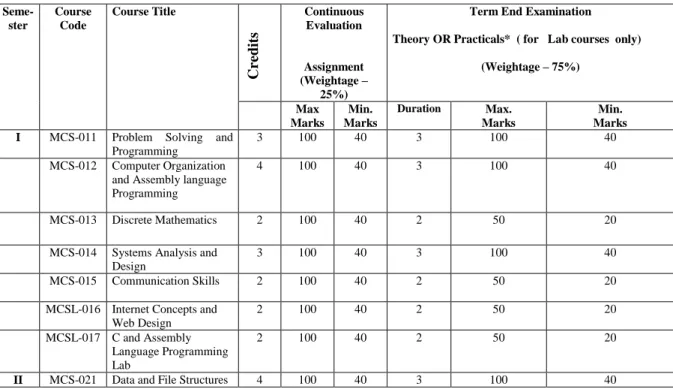
The programme has been divided into two semesters per year (January to June and July to
December). Consequently, there will be two examinations every year - one in the month of June
for the January to June semester courses and the other in December for the July to December
semester courses. The students are at liberty to appear for any of the examinations schedule
conducted by the University during the year subject to completing the minimum time framework
other formalities prescribed for the programme.
MCA Programme Structure
I SEMESTER II SEMESTER
Year Course Code
Course Title Credits Course
Code
Course Title Credits
I MCS-011 Problem Solving and Programming
3 MCS-021 Data and File Structures 4 MCS-012 Computer Organization
and Assembly language Programming
4 MCS-022 Operating System Concepts and Networking Management
4
MCS-013 Discrete Mathematics 2 MCS-023 Introduction to Database Management Systems
3 MCS-014 Systems Analysis and
Design
3 MCS-024 Object Oriented Technologies and Java Programming
3 MCS-015 Communication Skills 2 MCSL-025 Lab (based on MCS-021, 022, 023
& 024)
4
MCSL-016
Internet Concepts and Web Design
2
MCSL-017
C and Assembly Language Programming Lab
2
III SEMESTER IV SEMESTER
II MCS-031 Design and Analysis of Algorithms
4 MCS-041 Operating Systems 4 MCS-032 Object Oriented Analysis
and Design
3 MCS-042 Data Communication and Computer Networks
4 MCS-033 Advanced Discrete
Mathematics
2 MCS-043 Advanced Database Management Systems
4 MCS-034 Software Engineering 3 MCS-044 Mini Project 4 MCS-035 Accountancy and Financial
Management
3 MCSL-045 Lab (UNIX & Oracle) 2 MCSL-036 Lab (based on MCS-032, 034 and 035) 3 V SEMESTER VI SEMESTER
III MCS-051 Advanced Internet Technologies
3 MCSP-060 Project 16
MCS-052 Principles of Management and Information Systems
2 MCS-053 Computer Graphics and
Multimedia
4
MCSL-054
Lab (based on MCS-051 &
053) 2 MCSE- 003 MCSE-004 MCSE-011 Elective Courses*
Artificial Intelligence and Knowledge Management Numerical and Statistical Computing
Parallel Computing
3
3 3
* Presently, only 3 elective courses are on offer and student should needs to select all of them. As and when we design the new courses we will inform.
Total number of Courses are 31 Total number of Credits are 108.
1.6
Recognition
IGNOU is a Central University established by an Act of Parliament in 1985 (Act No.50 of
1985) IGNOU Degrees/Diplomas/Certificates are recognized by all member Universities of
Association of Indian Universities (AIU) and are at par with Degrees/Diplomas/Certificates
of all Indian Universities/Deemed Universities/Institutions vide UGC Circular No.
F1-52/2000 (CPP-II) dated 5 May, 2004 & AIU Circular No. EV/B (449)/94/177115 dated
January 14, 1994.
1.7
Completion of CS-60
The students who don’t have Mathematics at 10+2 level and opted for CS-60 are advised to clear
them along with the first year of MCA courses. However, all students have to successfully
complete the CS-60 (wherever applicable) before re-registering for MCA 5
thsemester.
1.8
Associate Studentship Scheme
There is a provision of Associate Studentship scheme in MCA wherein the student can register for
a minimum of 8 credits and a maximum of 32 credits. This scheme is permissible for any course(s)
of any programme offered by IGNOU, subject to the conditions that the students fulfill the
minimum eligibility requirements for the respective programme and also should undertake the
minimum and maximum credits specified.
Students are not eligible for admission under Associate Studentship scheme to the course(s) of the
programme(s) where clearance of an entrance test is mandatory and also to the programmes where
the intake is to a limited number of seats.
1.9
Student Support Services
In order to provide individualised support to its learners, the University has created a number of
Study Centres throughout the country for this Programme. These are administratively coordinated
by the Regional Centres. The Study Centres are the contact points for the students on all major
aspects of the Programme. These include counselling sessions, practicals, reference library
facilities, disseminating information and advice, facilities for audio-visual training aids and
teleconferencing.
The University may not always be able to communicate to all the students individually. All the
important communications are sent to the Regional Directors who in turn will intimate them to the
Study centre coordinators. The coordinators display such circulars / notifications on their notice
boards for the benefit of the students. You are, therefore, advised to be in touch with your Study
Centre Coordinator on a more regular basis so as to get the latest information about assignments,
submission schedules (assignments and examination forms), declaration of results, etc.
1.10
Newsletter
The IGNOU Newsletter is published twice in a year (April and October) in English and Hindi. This
periodical communication is delivered by post to all the students of IGNOU along with course
material. Information regarding the examination schedule, new courses to be launched, admissions,
telecast schedule, teleconferencing schedule etc., is also provided through the IGNOU newsletter.
It covers various activities at IGNOU Headquarters, Regional Centres and Study Centres. It also
carries important notifications from time to time.
1.11 How to contact the MCA Programme Coordinator?
Students may contact the MCA Programme Coordinator by sending a communication through post
to The MCA Programme Coordinator, SOCIS, Vishveswaraiah Bhavan, C-Block, IGNOU
Academic Complex, IGNOU, Maidangarhi, New Delhi – 110068, or can send an Email to
2.
INSTRUCTIONAL SYSTEM
The methodology of instruction in this university is different from that of the conventional
universities. The Open University system is more learner-oriented, and the student has to be an
active participant in the teaching-learning process. Most of the instruction is imparted through a
distance with only a small component of face-to-face communication. The University follows a
multi-channel approach for instruction. It comprises a suitable mix of:
self-instructional printed material
audio / video cassettes and CDs
audio-video programmes transmitted through AIR and Doordarshan, and at study centre
face-to-face counselling at Study Centres by academic counsellors
reference library at study centre
web based academic support
assignments
practicals
Gyan Darshan Channel, including teleconferencing, Eklavya exclusively for Technology
programmes
Gyan Vani.
2.1
Print Material
Printed materials are the primary form of instructional materials. These are supplied to the learners
in the form of several booklets called blocks. Each block consists of several units. The size of a
unit is such that the material given therein may be expected to be studied by a student in a session
of about 4 to 6 hours of study. Therefore, you have to concentrate mainly on the print materials,
which we send to you. However, the fast pace of computer industry necessitates that students must
do some additional readings. Students are advised to study reference books without fail. Studying
the printed material alone may not be sufficient to write assignments and prepare for the term-end
Examinations. Some reference books are available at your study centre.
2.2
Audio-Video Material and CDs
These are video-cassettes meant for clarification and enhancement of understanding. However,
audio / video are supplementary material and would not be available in all the courses. The
audio-video material supplements the print material. Hence, we advise you to make use of it as that will
help you to understand the subject better. However, audio-video material will normally not be
supplied to the students individually but will be made available at the Study Centres. You can
watch these programmes during counselling sessions. The schedule for screening these films has
been synchronised with the progress of relevant written material. Students desirous of buying the
audio-video tapes can procure them from:
The Director
EMPC, Sanchar Kendra IGNOU, Maidan Garhi New Delhi-110068
Ph. 91-11- 29532163, 29532164, 29533065
The programmes of SOCIS are also telecast on DD-1(National Channel). The telecast schedule of
transmission of programmes is communicated through a monthly booklet called
Gyan Darshan
.
You can contact your Study Centre Coordinator to go through it. You may write to the
above-mentioned address for a copy of the same or see the schedule on the IGNOU’s website.
2.3
Counselling Sessions
The details of the theory and practical counselling sessions are given in the following sections.
2.3.1 Theory Sessions
In distance education, face-to-face contact between the learners and their tutors/counsellors is
relatively less. The purpose of such a contact is to answer some of your questions and clarify your
doubts that may not be possible through any other means of communication. It also provides you
with an opportunity to meet your fellow students.
There are academic counsellors at the Study Centres to provide counselling and guidance to you in
the courses that you have chosen for study. Normally, these sessions will be held at the study
centres on Saturdays and Sundays.
You should note that the counselling sessions would be very different from the classroom teaching
or lectures. Counsellors will not be delivering lectures as in conventional teaching. They will try
to help you to overcome difficulties that you face while studying for the MCA programme. In
these sessions, you must try to resolve your subject-based difficulties and any other related
problems.
Before attending the counselling session for each course, please go
through your course material as per the session schedule and make a
plan of the points to be discussed. Unless you have gone through the
Units, there may not be much to discuss and may not be fruitful.
2.3.2 Practical Sessions and Compulsory Attendance
The practical sessions will be held in the computer centres / labs of the Study Centres. In these
computer labs, the participants will have the facility to use the computer and software packages
relevant to the syllabus. The following points regarding the practical attendance must be noted:
(i)
70% attendance is compulsory for each lab course.
However, this condition is not
applicable for the computer time given for assignment implementation.
(ii)
This is a pre-requisite for taking the term-end practical examination in the respective lab
courses.
(iii)
A student who fails to fulfil the 70% attendance requirements will be allowed to re-register
for that lab course. For fee details and the application form, please contact your Regional
Centre.
(iv)
Students are required to prepare a separate lab record for each lab course. The practical
counsellor should duly sign this lab record after each session.
(v)
Student attendance will be recorded coursewise at the study centre.
(vi)
Strictly follow the guidelines given in the Lab manuals for the respective lab courses.
2.3.3
Counselling Schedule
I SEMESTER II SEMESTER Year Course Code Course Title Cr ed it s No. of Theory sessions (2 hrs each) No. of Practical sessions (3 hrs each) Course Code Course Title Cr ed it s No. of Theory sessions (2 hrs each) No. of Practical sessions (3 hrs each)I MCS-011 Problem Solving and Programming
3 5 2^ MCS-021 Data and File
Structures 4 8 MCS-012 Computer Organization and Assembly language Programming 4 8 2^ MCS-022 Operating System Concepts and Networking Management 4 8 2^ MCS-013 Discrete Mathematics 2 3 MCS-023 Introduction to Database Management Systems 3 5 2^ MCS-014 Systems Analysis and Design 3 5 MCS-024 Object Oriented Technologies and Java Programming 3 5 2^ MCS-015 Communication Skills 2 2 MCSL-025 Lab (based on MCS-021, 022, 023 & 024) 4 (10+10+10+ 10) MCSL-016 Internet Concepts and Web Design
2 20
MCSL-017 C and Assembly Language Programming Lab
2 (10+10)
III SEMESTER IV SEMESTER
II MCS-031 Design and Analysis of Algorithms
4 8 MCS-041 Operating Systems 4 8
MCS-032 Object Oriented Analysis and Design
3 5 2^ MCS-042 Data Communication and Computer Networks 4 8 2^ MCS-033 Advanced Discrete Mathematics 2 3 MCS-043 Advanced Database Management Systems 4 8 2^ MCS-034 Software Engineering 3 5 MCS-044 Mini Project 4 10 MCS-035 Accountancy and Financial Management
3 8 MCSL-045 Lab (UNIX &
Oracle) 2 (10+10) MCSL-036 Lab (based on MCS-032, 034 and 035) 3 (10+10+10) V SEMESTER VI SEMESTER
III MCS-051 Advanced Internet Technologies 3 5 2^ MCSP-060 Project 16 2# MCS-052 Principles of Management and Information Systems 2 3 MCS-053 Computer Graphics and Multimedia 4 8 2^ MCSL-054 Lab (based on MCS-051 & 053) 2 (10+10) MCSE-003 MCSE-004 MCSE-011 Elective Courses* Artificial Intelligence and Knowledge Management Numerical and Statistical Computing Parallel Computing 3 3 3 5 5 5
* Presently, only 3 elective courses are on offer and student should needs to select all of them. As and when we design the new courses we will inform.
# These sessions should be conducted in the 5th semester.
Semesters and the Number of Sessions:
Semester No. of Sessions No. of Hours
Theory Practical Assignment implementation
Theory Practical Assignment
implementation I 23 40 4 46 120 12 II 26 40 6 52 120 18 III 29 30 2 58 60 6 IV 24 30 4 48 90 12 V 31 20 4 62 60 12 VI 2* - - 4 TOTAL 135 160 20 270 480 60
These sessions should be conducted in the 5th semester.
Total Computer time = Practical time + Assignment implementation time = 160 Sessions + 20 Sessions
= 480 hours + 60 hours = 540 hours
Note: 70% attendance is compulsory in Practical Lab Sessions. However, this condition is not applicable for the time given for assignment implementation.
2.3.4
Detailed Counselling Schedule for MCA 1
stto 6
thSemesters
The following is the detailed counselling schedules for 1
stto 6
thSemesters of MCA. The Schedule
is applicable for all the students of MCA 1
styear, 2
ndyear and 3
rdyear.
The respective study
centres will communicate you the exact dates of the Schedule.
MCA 1
stSemester Schedule
MCS-011: Problem Solving and Programming
S. No. Counselling Sessions Number of Sessions Comments
1. Theory Sessions 5 One Session on Block -1
Two sessions each on Block-2 and Block - 3
2. Practical Sessions 2 These two practical sessions are not compulsory Session Details Sessions Session Number Block to be Covered Topics to be covered Theory Counselling 1 Block-1 (Units 1, 2 3 & 4)
Problem Solving, Basics of C, Variables and Constants, Expressions and Operators
2 Block-2
(Units 5 & 6)
Decision and Loop Control Statements in C and Arrays
3 Block-2,
(Units 7 & 8)
Strings and Functions in C
4 Block-3,
(Units 9 & 10)
Structures & Unions, Pointers 5 Block-3, Unit
11 & 12
C Preprocessor and Files
Practical Sessions
MCS-012: Computer Organisation and Assembly Language Programming Counselling Sessions
S. No. Counselling Sessions Number of Sessions Comments
1. Theory Sessions 8 Two sessions each on each Block
2. Practical Sessions 2 These two practical sessions may be
used for solving assignment problems.
These are not compulsory. Session Details
Session Type Session Number Block to be Covered Topics to be covered Theory Counselling 1 Block 1, Unit 1, 2 & 3
von Neumann Architecture, Instruction execution, concept of Interrupts, Fixed point and floating point arithmetic, error detection and other codes, concepts of Gates and Logic Circuits
2 Block 1, Unit 3 & 4
The Combinational and Sequential circuits, Design of Combinational circuits, examples of combinational circuits, flip flops, sequential circuit design, examples of sequential circuits
3 Block 2, Unit 1 & 2
The memory hierarchy, Cache, RAM, ROM, DRAM, Flash Memory, secondary storage technologies and Characteristics, RAID and its levels, Cache Organisation, The Memory System of Micro-Computer, Input output interfaces, the concepts of device controllers, Input output techniques, DMA, Device drivers, Input output processors, Interrupt Processing
4 Block 2, Unit 3 & 4
Hard Drives: Partitioning and Formatting: FAT, Inodes, Drive Speed, Access Time, Rotation Speeds, Hard Drive Interfaces, Removable Storage Options, Video Cards, Liquid Crystal Display (LCD), Modems, Print Resolution, Scanners, Keyboards, Mouse, Power supply 5 Block 3, Unit
1 & 2
The Instruction format, The Instruction set architecture, The types of Instructions, The types of operands, Addressing modes and their importance, Description of Various types of Registers, Need and importance of registers, The Micro-operation concepts, The Instruction execution and micro-operations
6 Block 3, Unit 3, 4 &5
The organization of Arithmetic logic unit, The characteristics of ALU, Design of simple units of ALU, Pipelining, The hardwired control, Wilkes control, The Micro-programmed control, the microinstructions, the execution of micro-program, RISC principles, Large Register file in RISC, RISC pipelining
7 Block 4, Unit 1, 2& 3
8086 microprocessor, The Instruction format, The addressing modes, The types of Instructions, The need and use of assembly language, Input output in assembly Language Program, Sample Assembly Programs including Arrays, Counters, Dealing with various simple statements, Use of various addressing modes
8 Block 4, Unit 4
Modular Programming, Interfacing assembly with HLL, Device drivers in assembly, Interrupts in assembly
Practical Sessions
1&2 Assignment Problem
MCS-013: Discrete Mathematics Counselling Sessions
S. No. Counselling Sessions Number of Sessions Comments
1. Theory Sessions 3 One Session on Block -1
Two sessions on Block-2 Session Details Sessions Session Number Block to be Covered Topics to be covered Theory Counselling 1 Block-1 (Units 1, 2 & 3)
Propositional Calculus, Methods of Proof & Boolean Algebra and Circuits
2 Block-2
(Units 1,2)
Sets, Relations and Functions & Combinatorics – An Introduction
3 Block-2
(Units 3, 4)
Some more Counting Principles, Partitions and Distributions
MCS-014: Systems Analysis and Design Counselling Sessions
S. No. Counselling Sessions Number of Sessions Comments
1. Theory Sessions 5 One Session each on Block -1
and 2.Two sessions on Block-3 and one session on Block-4.
Session Details Sessions Session Number Block to be Covered Topics to be covered Theory Counselling 1 Block-1 (Units 1, 2 3 & 4)
Introduction to Systems Analysis and Design, Profession of a Systems Analyst, Process of Systems Development and Documentation of systems
2 Block-2
(Units 5,6 &7)
Process of Systems planning, Modular and Structured Design and System Design and Modeling
3 Block-3
(Units 8 & 9)
Forms and Reports Design, Physical File Design and Database Design
4 Block-3
(Unit 10)
CASE tools for systems development
5 Block-4
(Units 11, 12 & 13)
Implementation and Maintenance of systems, Audit and Security of Computer systems, Management Information Systems
MCS-015: Communication Skills Counselling Sessions
S. No. Counselling Sessions Number of Sessions Comments
1. Theory Sessions 2 One Session on Block -1
Session Details Sessions Session Number Block to be Covered Topics to be covered Theory Counselling 1 Block-1 (Units 1 to 5)
Process of Communication, Telephonic Techniques, Job Applications and Interviews, Group Discussions & Managing Organizational Structure
2 Block-2
(Units 6 to 10)
Meetings, Taking notes and preparing minutes, Presentation Skills I & II and Negotiation skills. MCSL-016: Internet Concepts and Web Design
Counselling Sessions
Sessions Number of Sessions Comments
Practical Sessions 20 Internet Concepts and web design
Session Details Sessions Session Number Block to be Covered Topics to be covered Practical Sessions 1 Block -2, Lab Manual (Section -1)
All the problems given in the session - 1, session - 2 and session - 3 of Section -1 of the lab manual are to be executed.
2 Block -2, Lab Manual (Section -1)
All the problems given in the session - 4, session - 5 and session - 6 of Section - 1 of the lab manual are to be executed.
3 Block -2, Lab Manual (Section -1)
All the problems given in the session - 7 and session - 8 of Section - 1 of the lab manual are to be executed. 4 Block -2, Lab
Manual (Section -1)
All the problems given in the session - 9 and session -10 of Section - 1 of the lab manual are to be executed. 5 Block -2, Lab
Manual (Section - 2)
All the problems given in the session - 1, session - 2 and session - 3 of Section - 2 of the lab manual are to be executed.
6 Block -2, Lab Manual (Section -2)
All the problems given in the session - 4, session -5 and session-6 of Section - 2 of the lab manual are to be executed.
7 Block -2, Lab Manual (Section -2)
All the problems given in the session - 7, session - 8 of Section - 2 of the lab manual are to be executed. 8 Block -2, Lab
Manual (Section -2)
All the problems given in the session - 9 and session -10 of Section - 2 of the lab manual are to be executed. 9 Block -2 ,Lab
Manual (Section -3)
All the problems given in the session - 1, session - 2 and session - 3 of Section - 3 of the lab manual are to be executed.
10 Block -2, Lab Manual (Section -3)
All the problems given in the session - 4, session - 5 and session - 6 of Section - 3 of the lab manual are to be executed.
11 Block -2, Lab Manual (Section -3)
All the problems given in the session - 7, session - 8 and session - 9 of Section - 3 of the lab manual are to be executed.
12 Block -2, Lab Manual (Section -3)
All the problems given in the session - 10, session - 11 and session - 12 of Section - 3 of the lab manual are to be executed.
13 Block -2, Lab Manual (Section -3)
All the problems given in the session - 13, session - 14 and session - 15 of Section - 3 of the lab manual are to be executed.
14 Block -2, Lab Manual (Section - 4)
All the problems given in the session - 1, session - 2 and session - 3 of Section - 4 of the lab manual are to be executed.
15 Block -2, Lab Manual (Section - 4)
All the problems given in the session - 4, session -5 and session - 6 of Section - 4 of the lab manual are to be executed.
16 Block -2, Lab Manual (Section - 4)
All the problems given in the session - 7 and session - 8 of Section - 4 of the lab manual are to be executed. 17 Block -2, Lab
Manual (Section - 4)
All the problems given in the session - 9 and session -10 of Section - 4 of the lab manual are to be executed. 18 Block -2, Lab
Manual (Section -5)
All the problems given in the session - 1, session - 2, session - 3 and session - 4 of Section - 5 of the lab manual are to be executed.
19 Block -2, Lab Manual (Section -5)
All the problems given in the session - 5, session - 6 and session - 7 of Section - 5 of the lab manual are to be executed.
20 Block -2, Lab Manual (Section -5)
All the problems given in the session - 8, session - 9 and session -10 of Section - 5 of the lab manual are to be executed.
MCSL-017: C and Assembly Language Programming Counselling Sessions
Sessions Number of Sessions Comments
Practical Sessions 10 Problem Solving and C programming
Practical Sessions 10 Digital Logic Circuits and Assembly
Language Programming Session Details Sessions Session Number Block to be Covered Topics to be covered Practical Sessions 1 to 10 Lab Manual (Section -1)
All the problems given in the Section - 1 (session- wise) of the lab manual are to be executed.
11 to 20 Lab Manual (Section -2 & Section-3)
All the problems given in the Section - 2 and Section - 3 (session- wise) of the lab manual are to be executed.
MCA 2
ndSemester Schedule
MCS-021: Data and File Structures Counselling Sessions
S. No. Counselling Sessions Number of Sessions Comments
1. Theory Sessions 8 Two sessions on each block
Session Details Sessions Session Number Block to be Covered Topics to be covered Theory Counselling
1 Block-1 All topics of Unit-1 and Unit-2 2 Block-1 All topics of Unit-3
3 Block-2 All topics of Unit-4 and Unit-5 4 Block-2 All topics of Unit-6
5 Block-3 All topics of Unit-7
7 Block-4 All topics of Unit-10 and Unit-11 8 Block-4 All topics of Unit-12
MCS-022: Operating System Concepts and Networking Management Counselling Sessions
S. No. Counselling Sessions Number of Sessions Comments
1. Theory Sessions 8 Two sessions on each Block
2. Practical Sessions 2 These two practical sessions may be
used for solving assignment problems. These sessions are not compulsory.
Session Details
Session Type Session Number Block to be Covered Topics to be covered Theory Counselling 1 Block 1, Unit 1 and Unit 2
Graphical User Interface and Introduction to Operating System
2 Block 1, Unit 3 and Unit 4
Introduction to Networking concept and Internetworking: Concept, Architecture and Protocols
3 Block 2, Unit 1, Unit2 and Unit 3
Introduction to Linux OS, Linux Commands and Utilities, Editor
4 Block 2, Unit 4 and Unit 5
User to User Communication and Unix System Administration
5 Block 3, Unit 1 and Unit 2
Windows 2000 Networking and Managing Windows 2000 Server
6 Block 3, Unit 3 and Unit 4
Advanced Windows 2000 Networking and Windows Xp Networking
7 Block 4, Unit 1 and Unit 2
Security Concepts and Computer Security 8 Block 4, Unit 3
and Unit 4
Security and Management
Practical Sessions
1&2 Assignment Problems
Design, Implement and test the MCS-022 assignment problem. These sessions are not compulsory.
MCS-023: Introduction to Database Management Systems Counselling Sessions
S. No. Counselling Sessions Number of Sessions Comments
1. Theory Sessions 5 Two sessions each on first two
Blocks and one session on Block 3 & 4
2. Practical Sessions 2 These two practical sessions may be
used for solving assignment problems. These sessions are not compulsory.
Session Details
Session Type Session Number Block to be Covered Topics to be covered Theory Counselling 1 Block 1: Unit 1 and Unit 2
The Database system, structure of a database, three level Architecture of databases and its importance, the relational model, the entity relationship model, conversion of ER diagrams to Relational Database.
2 Block 1: Unit 3 and Unit 4
The concepts of integrity, referential integrity, functional dependency, the normal forms till BCNF, sequential file organization, indexes, index and B tree, multi key file organization.
3 Block2: Unit 1
The Structured Query Language: data definition and manipulation commands, views, nested queries, examples 4 Block2: Unit
2, Unit 3 and Unit 4
Transactions, concurrency related problems and control, locks, two phase locking, deadlock. Database recovery techniques, security and integrity, authorization, data access control, The need and advantages of the distributed and client server database systems, data replication and fragmentation, distributed queries.
5 Block3 and
Block 4
Discuss the various issues on the case studies of these blocks. Suggest how these studies can be improved.
Practical Sessions
1&2 Assignment Problem
Design, implement and test the MCS 023 assignment problem.
MCS-024: Object Oriented Technologies and Java Programming Counselling Sessions
S. No. Counselling Sessions Number of Sessions Comments
1. Theory Sessions 5 One Session on Block -1.Three
sessions on Block-2 and Block-3 and one session on Block-4
2. Practical Sessions 2 These two practical sessions may be
used for solving assignment problems. These sessions are not compulsory. Session Details Sessions Session Number Block to be Covered Topics to be covered Theory Counselling
1 Block-1 Object oriented concepts, JVM, basics of Java, data types, arrays etc.
2 Block-2 Concept of object, class, inheritance, polymorphism etc.
3 Block-2,
Block-3
Exceptions Handling and Multithreading
4 Block-3 Different types of I/O operations in java including files handling. String and StringBuffer classes and their methods.
5 Block-4 Applets programming, GUI components, Layouts and their management, Networking features, Introduction to JDBC, RMI, Java Beans.
Practical Sessions
1&2 Assignment Problem
Design, implement and test the MCS 024 assignment problems.
MCSL-025: Data Structures, Networking, DBMS and Java Programming Counselling Sessions
Sessions Number of Sessions Comments
Practical Sessions 10 Data and File Structures Lab
Practical Sessions 10 Operating System and Networking Lab
Practical Sessions 10 DBMS Lab
Session Details
Sessions Session Number
Block to be Covered Topics to be covered Practical
Sessions
1 to 10 Lab Manual (Section - 1)
Data and File Structures Lab Manual
All the problems given in the Section – 1 (session- wise) of the lab manual are to be executed.
11 to 20 Lab Manual (Section -2)
Operating Systems and Networking Lab
All the problems given in the Section – 2 (session- wise) of the lab manual are to be executed.
21 to 30 Lab Manual (Section -3) DBMS Lab
All the problems given in the Section – 3 (session- wise) of the lab manual are to be executed.
31 to 40 Lab Manual (Section - 4)
Java Programming Lab
All the problems given in the Section – 4 (session- wise) of the lab manual are to be executed.
MCA 3
rdSemester Schedule
MCS-031: Design and Analysis of Algorithms Counselling Sessions
S. No. Couselling Sessions Number of Sessions Comments
1. Theory Sessions 8 Session Details Sessions Session Number Block to be Covered Topics to be covered Theory Counselling
1 Block-1 All topics of Unit-1 2 Block-1 All topics of Unit-2 3 Block-1 All topics of Unit-3
4 Block-2 All topics of Unit-1 and Unit-2 5 Block-3 All topics of Unit-1 and Unit-2 6 Block-3 All topics of Unit-3 and Unit 4 7 Block-4 All topics of Unit-1
8 Block-4 All topics of Unit-2 and Unit-3
MCS-032: Object Oriented Analysis and Design Counselling Sessions
S. No. Couselling Sessions Number of Sessions Comments
1. Theory Sessions 5 Two Session on Block -1.One sessions
each on 2 and 3 and Block-4
2. Practical Sessions 2 These two practical sessions may be used for solving assignment problems. These sessions are not compulsory.
Session Details Sessions Session Number Block to be Covered Topics to be covered Theory Counselling
1 Block-1 Unit 1 and Unit 2
3 Block-2 Unit 1, Unit2, and Unit 3 4 Block-3 Unit 1, Unit2, and Unit 3 5 Block-4 Unit 1, Unit2, and Unit 3
Practical Sessions
1&2 Assignment Problem
Design different diagrams discussed in MCS032
MCS-033: Advanced Discrete Mathematics Counselling Sessions
S. No. Counselling Sessions Number of Sessions Comments
1. Theory Sessions 3 Session Details Sessions Session Number Block to be Covered Topics to be covered Theory Counselling 1 - Overview of MCS-013
2 Block-1 All Units
3 Block-2 All Units
MCS-034: Software Engineering Counselling Sessions
S. No. Couselling Sessions Number of Sessions Comments
1. Theory Sessions 5 Session Details Sessions Session Number Block(s) to be Covered Topics to be covered Theory Counselling
1 Block-1 All topics of Unit-1 , Unit-2 and Unit-3
2 Block-1, 2 All topics of Unit-4 of Block-1 and Units-1,2 of Block-2 3 Block-2 All topics of Unit-3and Unit-4
4 Block-3 All topics of Unit-1and Unit-2 5 Block-3 All topics of Unit-3 and Unit-4
MCS-035: Accountancy and Financial Management Counselling Sessions
S. No. Couselling Sessions Number of Sessions Comments
1. Theory Sessions 8 Session Details Sessions Session Number Block to be Covered Topics to be covered Theory Counselling
1 Block-1 All topics of Unit-1 , Unit-2 and Unit-3
2 Block-1
3 Block-2 All topics of Unit-1 and Unit 2 and Unit-3
4 Block-2
6 Block-3 All topics of Unit-3 and Unit-4 7 Block-4 All topics of Unit-1 and Unit 2
and Unit-3
8 Block-4
MCSL-036: Laboratory Course (For Object Oriented Analysis and Design, Software Engineering and Accountancy and Financial Management)
Counselling Sessions
Sessions Number of Sessions Comments
Practical Sessions 10 Object Oriented Analysis and Design Lab
Practical Sessions 10 Software Engineering Lab
Practical Sessions 10 Accountancy and Financial Management
Lab
Session Details
Sessions Session Number
Block to be Covered Topics to be covered Practical
Sessions
1 to 10 Lab Manual (Section -1)
Object Oriented Analysis and Design Lab
All the problems given in the Section – 1 (session- wise) of the lab manual are to be performed in the lab.
11 to 20 Lab Manual (Section -2)
Software Engineering Lab
All the problems given in the Section – 2 (session- wise) of the lab manual are to be performed in the lab.
21 to 30 Lab Manual (Section -3) Accountancy and Financial Management Lab
All the problems given in the Section – 3 (session- wise) of the lab manual are to be performed in the lab.
MCA 4
thSemester Schedule
MCS-041: Operating Systems Counselling Sessions
S. No. Couselling Sessions Number of Sessions Comments
1. Theory Sessions 8 Session Details Sessions Session Number Block to be Covered Topics to be covered Theory Counselling
1 Block-1 All topics of Unit-1 and Unit-2 2 Block-1 All topics of Unit-3 and Unit - 4 3 Block-2 All topics of Unit-1 and Unit -2 4 Block-2 All topics of Unit-3
5 Block-2 All topics of Unit-4 6 Block-3 All topics of Unit - 1 7 Block-3 All topics of Unit - 2
MCS-042: Data Communication and Computer Networks Counselling Sessions
S. No. Couselling Sessions Number of Sessions Comments
1. Theory Sessions 8
2. Practical Sessions 2 These two practical sessions may be
used for solving assignment problems. These sessions are not compulsory.
Session Details
Session Type Session Number Block to be Covered Topics to be covered Theory Counselling
1 Block-1 All topics of Unit-1 and Unit-2 2 Block-1 All topics of Unit-3 and Unit-4 3 Block-2 All topics of Unit-1 and Unit-2 4 Block-2 All topics of Unit-3 and Unit-4 5 Block-3 All topics of Unit-1 and Unit-2 6 Block-3 All topics of Unit-3 and Unit-4 7 Block-4 All topics of Unit-1 and Unit-2 8 Block-4 All topics of Unit-3 and Unit-4
Practical Sessions
1&2 Assignment Problems
These two practical sessions may be used for solving assignment problems. These sessions are not compulsory.
MCS-043: Advanced Database Management Systems Counselling Sessions
S. No. Couselling Sessions Number of Sessions Comments
1. Theory Sessions 8
2. Practical Sessions 2 These two practical sessions may be
used for solving assignment problems. These sessions are not compulsory.
Session Details
Session Type Session Number Block to be Covered Topics to be covered Theory Counselling
1 Block-1 All topics of Unit-1 and Unit-2 2 Block-1 All topics of Unit-3 and Unit - 4
3 Block-2 All topics of Unit-1 and Topics relating to transactions management of Unit –2.
4 Block-2 All topics of Unit-3 and Unit - 4 and topics relating to recovery in Unit 2.
5 Block-3 All topics of Unit-1 and Unit - 2 6 Block-3 All topics of Unit – 3 and Unit - 4 7 Block-4 All topics of Unit – 1 and Unit -2 8 Block-4 All topics of Unit - 3 and Unit - 4
Practical Sessions
1&2 Assignment Problems
These two practical sessions may be used for solving assignment problems. These sessions are not compulsory.
MCS-044: Mini Project Counselling Sessions
S. No. Couselling Sessions Number of Sessions Comments
1. Practical Sessions 10
Session Details
Name of the Topic No. of Practical Sessions
(3 hrs each)
Project specification 1
Coding / Implementation 5
Testing 2
Documentation 2
MCSL-045: UNIX and DBMS LAB Counselling Sessions
Sessions Number of Sessions Comments
Practical Sessions 10 UNIX lab
Practical Sessions 10 DMBS Lab
Session Details
Sessions Session Number
Block to be Covered Topics to be covered Practical
Sessions
1 to 10 Lab Manual (Section -1) UNIX Lab
All the problems given in the Section – 1 (session- wise) of the lab manual are to be executed.
11 to 20 Lab Manual (Section -2) DBMS Lab
All the problems given in the Section – 2 (session- wise) of the lab manual are to be executed.
MCA 5
thSemester Schedule
MCS-051: Advanced Interned Technologies Counselling Sessions
S. No. Couselling Sessions Number of Sessions Comments
1. Theory Sessions 5 Two sessions each on Block – 1 and
Block – 2 and one session on Block – 3.
2 Practical Sessions 2 These two practical sessions may be
used for solving assignment problems. These sessions are not compulsory. Session Details Sessions Session Number Block to be Covered Topics to be covered Theory Counselling
1 Block-1 All the topics of Unit – 1 and Unit - 2 2 Block-1 All the topics of Unit – 3 and Unit - 4
3 Block-2 All the topics of Unit – 1 and Unit - 2 4 Block-2 All the topics of Unit-3 and Unit - 4 5 Block - 3 All the topics of Unit –1, 2 and 3
Practical Sessions 1&2 Assignment Problems
To solve MCS-051 assignment problems
MCS-052: Principles of Management and Information Systems Counselling Sessions
S. No. Couselling Sessions Number of Sessions Comments
1. Theory Sessions 3 Session Details Sessions Session Number Block to be Covered Topics to be covered Theory Counselling 1 Block-1: Management Systems
All topics of unit 1: Organisational overview and Unit 2: management functions and business processes
2 Block-1:
Management Systems
All topics of unit 3: management systems and Unit 4: business values of information system Block-2:
Information Management
All topics of unit 1: portfolio management and it applications.
3 Block-2:
Information Management
All topics of unit 2: enterprise resource planning system, unit 3: intelligence information systems and unit 4: social, ethical and legal aspects
MCS-053: Computer Graphics and Multimedia Counselling Sessions
S. No. Couselling Sessions Number of Sessions Comments
1. Theory Sessions 8
2 Practical Sessions 2 These two practical sessions may be
used for solving assignment problems. These sessions are not compulsory. Session Details Sessions Session Number Block to be Covered Topics to be covered Theory Counselling
1 Block-1 All the topics of Unit – 1
Upto Line Drawing Algorithms of Unit -2 2 Block-1 Rest of the topics of Unit –2 are to be covered
All the topics of Unit - 3 3 Block-2 All the topics of Unit - 1 4 Block-2 All the topics of Unit-2 5 Block - 3 All the topics of Unit-1
6 Block - 3 Rest of the topics of Unit 2
All the topics upto Shading of Unit 3
7 Block – 3
Block - 4
Rest of the topics of Unit 3
All the topics upto Simulating Accelerations of Unit -1 8 Block –4 Rest of the topics of Unit – 1
All the topics of Unit – 2
Practical Sessions 1&2 Assignment Problems
To solve MCS-053 assignment problems
MCSL-054: Laboratory Course
(Advanced Internet Technologies & Computer Graphics and Multimedia) Counselling Sessions
Sessions Number of Sessions Comments
Practical Sessions 10 Advanced Internet Technologies Lab
Practical Sessions 10 Computer Graphics and Multimedia Lab
Session Details
Sessions Session Number
Block to be Covered Topics to be covered Practical Sessions 1 to 10 Lab Manual (Section -1) Advanced Internet Technologies Lab
All the problems given in the Section – 1 (session- wise) of the lab manual are to be executed.
11 to 20 Lab Manual (Section -2)
Computer Graphics and Multimedia
All the problems given in the Section – 2 (session- wise) of the lab manual are to be executed.
MCSE-003: Artificial Intelligence and Knowledge Management Counselling Sessions
S. No. Couselling Sessions Number of Sessions Comments
1. Theory Sessions 5 Two Units per session
Session Details Sessions Session Number Block to be Covered Topics to be covered Theory Counselling
1 Block -1 All the topics of Unit – 1 and 2
2 Block - 1
Block - 2
All the topics of Unit – 3 All the topics of Unit -1
3 Block - 2 All the topics of Unit-2 and Unit-3 4 Block - 3 All the topics of Unit-1 and Unit-2 5 Block – 4 All the topics of Unit- 1 and Unit - 2
MCSE-004: Numerical and Statistical Computing
Counselling Sessions
S. No. Couselling Sessions Number of Sessions Comments
1. Theory Sessions 5 One session on Block – 1 and
two sessions each on Block – 2 and Block - 3 Session Details Sessions Session Number Block to be Covered Topics to be covered Theory Counselling
1 Block-1 All the topics of Unit – 1, 2 and 3 2 Block-2 All the topics of Unit – 1
Upto Newton’s Cotes formulae of Unit-2 3 Block-2 Rest of the topics of Unit – 2
All the topics of Unit-3 4 Block-3 All the topics of Unit-1
Upto Inversion Method of Unit-2 5 Block - 3 Rest of the topics of Unit-2
All the topics of Unit-3
MCSE-011: Parallel Computing Counselling Sessions
S. No. Couselling Sessions Number of Sessions Comments
1. Theory Sessions 5 Two Units per session
Session Details Sessions Session Number Block to be Covered Topics to be covered Theory Counselling
1 Block-1 All the topics of Unit – 1 and Unit - 2 2 Block-1 All the topics of Unit – 3 and Unit - 4 3 Block-2 All the topics of Unit-1 and Unit-2
4 Block-2
Block -3
All the topics of Unit-3 All the topics of Unit - 1
MCA 6
thSemester Schedule
MCSP-060: ProjectCounselling Sessions
S. No. Couselling Sessions Number of Sessions Comments
1. Theory Sessions * 2 One session on the project proposal
formulation and one session on the project report formulation
Sessions Session
Number
Topics to be covered
Theory Counselling* 1 Detailed discussion on the project proposal formulation 2 Detailed discussion on the project report formulation
* These sessions need to be completed during the 5th semester (during Jan-March) of MCA programme as the student needs to submit the project proposal during 1st April to 30th June in the first slot.
2.4
Web Based Support
The learners can have access to IGNOU’s website at the following address (URL):
http://www.ignou.ac.in
.
You can download assignments, old question papers, circulars etc. from the
website. The Programme guide is also available at the website. The following section gives you
how to browse the IGNOU’s website.
3.
BROWSING IGNOU’S WEBSITE
The IGNOU’s website is a dynamic source of latest information and will be undergoing continuous
updates. IGNOU itself is continuously changing to bring about improvement in quality of its
services. There are contents on the site which are open to all, but then there are also areas of
restricted access. For example, course materials, FAQs, assignments and related contents are
available only to those who have registered for and paid fees for the said course. Some sample
courses are open to visitors to have a feel of them, before taking the decision to register with
IGNOU.
3.1 Navigation from Home Page
The learners can have access to IGNOU’s website at the following address (URL)
http://www.ignou.ac.in
.
As students get connected to this site, the following page displays the
Home Page of IGNOU’s web site (Figure 1). Students need to click on various options to get the
related information.
Figure 1
The
For Students
option on the left side menu provides you the latest information such as
results,
downloads (assignments and question papers), details of catalogues, queries, submission of
examination form online, term end examination date sheet, Special announcements etc..
Upon clicking on the
Schools
option the page related to the links of various schools is displayed as
shown in the Figure 2. From this page students can access the required information as described,
briefly, in subsequent pages of School of Computer and Information Sciences.
SOCIS
School of Computer and Information Sciences offers the Computer Programmes
Figure 2
3.2 Navigation from SOCIS Page
School of Computer and Information Sciences provides Computer Education Programmes. As soon
as School of Computer and Information Sciences link is selected, a page introducing the school is
displayed as shown in the Figure 3. The page of School of Computer and Information Sciences
looks like this:
3.3
Procedure to Browse Through MCA Pages
By clicking on the Programmes option, you can views the list of SOCIS Programmes, under the
Master’s Degree option click on
Master of Computer Applications (MCA)
Link. The follow
page as shown in the Figure 4 will appear.
Figure 4
After selecting the Master of Computer Applications link, a page introducing the MCA programme
is displayed. At the page various links are provided to get information related to MCA Programme
like Courses, Study Centre, Related Information, Programme Guide, Forms, and Apply Now.
Students need to click on these to get the related information.
4.
MCA SYLLABUS
The following is the syllabus for first to fifth semesters of MCA programme. The 6th semester is completely spared for project work.
MCS - 011: Problem Solving and Programming 3 Credits
Objectives
The course is aimed to develop problem-solving strategies, techniques and skills that can be applied to computers and problems in other areas which give students an introduction to computer and analytical skills to use in their subsequent course work and professional development. Emphasis of this course is to act as an introduction to the thinking world of computers, to help students develop the logic, ability to solve the problems efficiently using C programming. Knowledge in a programming language is prerequisite to the study of most of computer science courses. This knowledge area consists of those skills and concepts that are essential to problem solving and programming practice independent of the underlying paradigm. The student will learn various concepts and techniques for problem solving and will implement those ideas using C programs.
Syllabus
BLOCK 1: An Introduction to C Unit 1: Problem Solving
Problem - Solving Techniques o Steps for Problem - Solving o Using Computer as a
Problem-Solving Tool Design of Algorithms o Definition o Features of Algorithm o Criteria to be followed by an Algorithm
o Top Down Design
Analysis of Algorithm Efficiency o Redundant Computations o Referencing Array Elements
o Inefficiency Due to Late Termination o Early Detection of Desired Output
Condition
o Trading Storage for Efficient Gains
Analysis of Algorithm Complexity o Computational Complexity o The Order of Notation
o Rules for using the Big - O Notation o Worst and Average Case Behavior
Flowcharts
o Basic Symbols used in Flowchart Design
Unit 2: Basics of C
What is a Program and what is a Programming Language? C Language o History of C o Salient Features of C Structure of a C Program o A Simple C Program Writing a C Program Compiling a C Program o The C Compiler
o Syntax and Semantic Errors
Link and Run the C Program
o Run the C Program through the Menu
o Run from an Executable File o Linker Errors
o Logical and Runtime Errors
Diagrammatic Representation of Program Execution Process
Unit 3: Variables and Constants
Character Set
Identifiers and Keywords
o Rules for Forming Identifiers o Keywords
Data Types and Storage
Data Type Qualifiers
Variables
Declaring Variables
Initialising Variables
Constants
o Integer Constants o Floating Point Constants
o Character Constants o String Constants o Symbolic Constants
Unit 4: Expressions and Operators
Assignment Statements
Arithmetic Operators
Relational Operators
Logical Operators
Comma and Conditional Operators
Type Cast Operator
Size of Operator
C Shorthand
Priority of Operators
BLOCK 2: Control Statements, Arrays and Functions
Unit 5: Decision and Loop Control Statements
Decision Control Statements o The if Statement
o The switch Statement
Loop Control Statements
o The while Loop
o The do-while Statement
o The for Loop o The Nested Loop
The Goto Statement
The Break Statement
The Continue Statement
Unit 6: Arrays
Array Declaration
o Syntax of Array Declaration o Size Specification
Array Initialization
o Initialization of Array Elements in the Declaration
o Character Array Initialization
Subscript
Processing the Arrays
Multi-Dimensional Arrays o Multi-Dimensional Array Declaration o Initialization of Two-Dimensional Arrays Unit 7: Strings
Declaration and Initialization of Strings
Display of Strings Using Different Formatting Techniques
Array of Strings
Built-in String Functions and Applications
o Strlen Function o Strcpy Function o Strcmp Function o Strcat Function o Strlwr Function o Strrev Function o Strspn Function
Other String Functions Unit 8: Functions
Definition of a Function
Declaration of a Function
Function Prototypes
The Return Statement
Types of Variables and Storage Classes o Automatic Variables
o External Variables o Static Variables o Register Variables
Types of Function Invoking
Call by Value
Recursion
BLOCK 3: Structures, Pointers and File Handling
Unit 9: Structures and Unions
Declaration of Structures
Accessing the Members of a Structure
Initializing Structures
Structures as Function Arguments
Structures and Arrays
Unions
Initializing an Union
Accessing the Members of an Union Unit 10: Pointers
Pointers and their Characteristics
Address and Indirection Operators
Pointer Type Declaration and Assignment o Pointer to a Pointer
o Null Pointer Assignment
Pointer Arithmetic
Passing Pointers to Functions
o A Function Returning More than One Value
o Function Returning a Pointer
Arrays and Pointers
Array of Pointers
Pointers and Strings Unit 11: The C Preprocessor
# define to Create Functional Macros
Reading from Other Files using # include
Conditional Selection of Code using #ifdef
o Using #ifdef for different computer types
o Using #ifdef to temporarily remove program statements
Other Preprocessor Commands
Predefined Names Defined by Preprocessor
Macros Vs Functions Unit 12: Files
File Handling in C Using File Pointers
o Open a file using the function fopen
( )
o Close a file using the function
fclose( )
Input and Output using file pointers o Character Input and Output in Files o String Input / Output Functions o Formatted Input / Output Functions o Block Input / Output Functions
Sequential Vs Random Access Files
Positioning the File Pointer
The Unbufferred I/O - The UNIX like File Routines
MCS-012: Computer Organisation and Assembly Language Programming 4 Credits Objectives
In the modern era, Computer system is used in most aspects of life. You may use many different types of software on a computer system for particular applications ranging from simple document creation to space data processing. But, how does the Software is executed by the Computer Hardware? The answer to this basic question is contained in this Course. This course presents an overview of the Computer Organisation. After going through this course, you will not only acquire the conceptual framework of Computer Organisation and Architecture but also would be able to use the concepts in the domain of Personal Computers. In specific, you will be able to design digital circuits; describe the functions of various components of computers and their construction; and write simple assembly programs.
Structure
BLOCK 1: Introduction to Digital Circuits UNIT 1: The Basic Computer
The von Neumann Architecture
Instruction Execution: An Example
Instruction Cycle o Interrupts
o Interrupts and Instruction Cycle
Computers: Then and Now o The Beginning
o First Generation Computers o Second Generation Computers o Third Generation Computers o Later Generations
Unit 2: The Data Representation
Data Representation
Number Systems
Decimal Representation in Computers
Alphanumeric Representation
Data Representation For Computation o Fixed Point Representation
o Decimal Fixed Point Representation o Floating Point Representation
o Error Detection And Correction Codes
Unit 3: Principles of Logic Circuits I
Logic Gates
Logic Circuits
Combinational Circuits
o Canonical and Standard Forms o Minimization of Gates
Design of Combinational Circuits
Examples of Logic Combinational Circuits o Adders
o Decoders o Multiplexer o Encoder
o Programmable Logic Array o Read Only Memory ROM Unit 4: Principles of Logic Circuits I
Sequential Circuits: The Definition
Flip Flops
o Basic Flip-Flops o Excitation Tables o Master Slave Flip Flops o Edge Triggered Flip-flops
Sequential Circuit Design
Examples of Sequential Circuits o Registers
o Counters – Asynchronous Counters o Synchronous Counters
o RAM
Design of a Sample Counter
BLOCK 2: Basic Computer Organisation Unit 1: The Memory System
The Memory Hierarchy
RAM, ROM, DRAM, Flash Memory Secondary Memory and Characteristics Hard Disk Drives
o Optical Memories
o CCDs, Bubble Memories
RAID and its Levels
The Concepts of High Speed Memories o Cache Memory
o Cache Organisation o Memory Interleaving o Associative Memory
Virtual Memory
The Memory System of Micro-Computer o S