Lee, GM and Shone, N
BAT: block analytics tool integrated with blockchain based IoT platform
http://researchonline.ljmu.ac.uk/id/eprint/13654/
Article
LJMU has developed LJMU Research Online for users to access the research output of the University more effectively. Copyright © and Moral Rights for the papers on this site are retained by the individual authors and/or other copyright owners. Users may download and/or print one copy of any article(s) in LJMU Research Online to facilitate their private study or for non-commercial research. You may not engage in further distribution of the material or use it for any profit-making activities or any commercial gain.
The version presented here may differ from the published version or from the version of the record. Please see the repository URL above for details on accessing the published version and note that access may require a subscription.
For more information please contact [email protected]
http://researchonline.ljmu.ac.uk/
Citation
(please note it is advisable to refer to the publisher’s version if you
intend to cite from this work)
Lee, GM and Shone, N BAT: block analytics tool integrated with blockchain
based IoT platform. Electronics. ISSN 2079-9292 (Accepted)
BAT: Block Analytics Tool Integrated with Blockchain
Based IoT Platform
Chathurangi Edussuriya1, Kasun Vithanage1, Namila Bandara1, Janaka Alawatugoda1, Manjula Sandirigama1, Upul Jayasinghe1, Nathan Shone2and Gyu Myoung Lee2,*
1 Department. of Computer Engineering, University of Peradeniya, Peradeniya, LK. {edussuriya.c, kas.vith,
namilad, alawatugoda, manjula.sandirigama, upuljm}@eng.pdn.ac.lk
2 Department of Computer Science, Liverpool John Moores University, Liverpool, UK. {n.shone,
g.m.lee}@ljmu.ac.uk
* Correspondence: [email protected]
Abstract:The Internet of Things (IoT) is currently the paradigm of connectivity and driving force 1
behind the state-of-art applications and services. However, the exponential growth of the number 2
of IoT devices and services, their distributed nature, and scarcity of resources has increased the 3
number of security and privacy concerns ranging from the risks of unauthorized data alterations 4
to the potential discrimination enabled by data analytics over sensitive information. A blockchain 5
based IoT-platform is introduced to address these issues. Built upon the tamper-proof architecture, 6
the access management mechanisms ensure the authenticity and integrity of data. Moreover, a novel 7
approach called Block Analytics Tool (BAT), integrated with the platform is proposed to analyze and 8
make predictions on data stored on blockchain. BAT enables the data-analysis applications to be 9
developed using the data stored in the platform in an optimized manner acting as an interface to 10
off-chain processing. A pharmaceutical supply chain is the use case scenario to show the functionality 11
of the proposed platform. Furthermore, a model to forecast the demand of the pharmaceutical 12
drugs is investigated using a real-world data set to demonstrate the functionality of BAT. Finally, the 13
performance of BAT integrated with the platform is evaluated. 14
Keywords:IoT, blockchain, data analytics, smart contracts, access management 15
. 16
1. Introduction
17
The Internet of Things (IoT) plays a significant role in the convenience of human daily life at 18
present through various innovative applications and services. Further, it empowers the concept of 19
autonomous systems creating a new social paradigm. The enormous amount of data generated by 20
these services and systems are usually stored in on-premises servers and cloud servers depending on 21
the context. However, these types of systems are vulnerable to several issues, including single point of 22
failure, scalability problems, and Quality of Service (QoS) deficits due to its centralized architecture. 23
Nevertheless, it is predicted that there will be 21 billion IoT devices at the end of 2020 [1]. Due to the 24
above mentioned reasons, traditional storage systems built upon the client-server architecture may not 25
be able to withstand the growing large number of IoT devices and heterogeneous services. On the 26
other hand, these systems are used to communicate and store generic as well as application-critical 27
and privacy-sensitive data such as medical and financial records, Personally Identifiable Information 28
(PII), etc [2]. Unauthorized access to these data could be result in aggressive advertisements to identity 29
thefts to national security. 30
Users of IoT services provide personal information to service providers, intentionally or 31
unintentionally and the use of this data is often decided by the service providers while users have little, 32
or no control over the access, or management of the data. For example, the data could be modified, or 33
deleted from the systems without the concern of the users who have raised issues in many business 34
models built upon IoT-platforms such as counterfeit of medicine in pharmaceutical supply chains. 35
Owing to such data protection issues, GDPR (General Data Protection Regulations) [3] came into effect 36
in the EU region trying to protect the data of the citizens with rights and regulations. 37
This paper presents an IoT-platform that uses blockchain with other state of the art technologies in 38
solving the above identified problems. The decentralized and peer-to-peer architecture of blockchain 39
addresses problems related to centralized architectures and the tamper-proof mechanisms of blockchain 40
provide data integrity making the system resistant to unapproved modifications. Smart contracts are 41
used to invoke the communication between IoT-devices verifying the authenticity of data sources and 42
a new access control mechanism is proposed to protect data and prevent unauthorized access. A smart 43
contract [4] is a special code or program where there are few conditions mentioned related to a specific 44
transaction. When the conditions are met by a specific user or a device, mutual authentication, or 45
access can be granted. 46
The data produced by IoT-platforms can be used to derive useful information. However, still 47
there is no proper mechanism to verify the origin of the data, or the fact that the data have not been 48
modified by unauthorized parties. We introduce a novel approach to create data-analysis applications 49
using the data stored in the platform with the Block Analytics Tool (BAT). Hence, the data analysis 50
applications can ensure the integrity, credibility, and authenticity of data that are used, for analysis. 51
Furthermore, the access control and authentication mechanisms of BAT ensures the security of the 52
data. 53
The main role of blockchain-based IoT-platform is transaction processing. The performance of 54
transaction processing should not be affected with additional services provided by the platform. There 55
must be a proper trade off between the analytical processing and transaction processing. Analytical 56
processing is the processing and manipulation of stored data to obtain useful information. Hence, 57
BAT is designed to process and acquire blockchain data in an optimized manner without decreasing 58
the performance of the transaction processing in the platform. Additionally, an index system called 59
Block Index that is specifically designed for transactions is introduced to acquire data from blockchain 60
that reduces the cost associated with data retrieval. BAT facilitates decision making and predicting 61
the future on trusted, and secured data produced by systems integrated with IoT devices without the 62
involvement of third parties. We apply the proposed solutions on a real-life use case of a pharmaceutical 63
supply chain to show the functionality of the proposed platform. Using BAT, a model to forecast the 64
demand of pharmaceutical drugs is implemented using the data stored in the platform. Finally, we 65
evaluate the performance of BAT integrated with our platform. 66
The main goals of the research can be summarized as follows. A blockchain-based IoT-platform is 67
developed that provides countermeasures to scalability, security and privacy related concerns in IoT. 68
A novel approach is proposed to perform data-analytics with the data stored in platform addressing 69
the drawbacks such as the adverse effects on the transaction processing by the analytical processing, of 70
the current state-of-the-art methods. The functionality of the proposed platform is presented through 71
a use case scenario of a pharmaceutical supply chain and the functionality of BAT is shown through 72
a development of a model to forecast the demand of pharmaceutical drugs using the data stored on 73
the platform. A performance analysis is conducted to show the performance of the study through the 74
use case scenario. The analysis of the results shows that countermeasures applied by the platform 75
address the most of the concerns related to security, scalability and privacy. The experimental results 76
show that BAT is able to maintain a proper trade off between transaction processing and analytical 77
processing compared with the state-of-the-art approaches. Furthermore, the introduction of the Block 78
Index increases the efficiency of acquiring data from the platform substantially. 79
The rest of the paper is organized as follows. Section2presents a literature review of the related 80
work and the introduction of the use case scenario. The architecture overview of the proposed platform 81
is explained in Section3and the design of BAT is explained in Section4. The implementation of the use 82
case scenario is presented in Section5and the results of the performance analysis of BAT integrated 83
with the platform are elaborated in Section6. Section7concludes the paper with the future directions 84
of the study. 85
2. Related work
86
Blockchain technology is a computing paradigm that is based on the distributed architecture 87
for different parties to build trust in a trustless environment without third party involvement [5]. 88
Bitcoin was introduced by Satoshi Nakamoto as a pure decentralized peer-to-peer electronic cash in 89
2008 that marked the initial implementation of blockchain [5]. Blockchain is a distributed database 90
or a ledger that contains timestamped records. These records are known as blocks protected by 91
cryptography and linked to the previous block [6]. A transaction in blockchain is verified by peers in 92
the network. Without knowing the identity, a peer can verify a transaction and add it to blockchain 93
using the cryptographic hash of the block. The history of transactions is visible via public keys but 94
participants are anonymous. Peers need to verify a block before adding a transaction to blockchain 95
and distributed peers should agree on the order of the transactions before the block is added into 96
blockchain to maintain the integrity. This is known as the consensus mechanism. This ensures blocks 97
are valid within the network. There are different types of consensus mechanisms used by blockchain 98
technologies such as Proof-of-Work (PoW) [7], Proof-of-Stake (PoS) [7], voting-based consensus [8]. 99
Development of IoT-platforms using blockchain technology has been attracted by many 100
researchers and developers due to many reasons. The existing IoT-platform architectures are highly 101
centralized and with the rapidly developing IoT services and applications, the centralized architectures 102
will not be efficient, or scalable to embrace the growing number of IoT devices [9]. The decentralized 103
architecture of blockchain will be efficient and it will be able to manage the increasing number of 104
IoT devices and resist a single point of failure [10]. Jiang S. et al [11] have focused on increasing the 105
privacy of the users through multi-keyword search over blockchain data on blockchain. Access control 106
is the selective restriction of access to the data [12]. There were data breaches when using apple fitbit 107
[13] where the data of the users were accessed by third parties without the consent of the users. With 108
blockchain technology the user can be sure that their data are not used without proper authorization 109
[9]. The data become tamper proof that secures the integrity of data. FairAccess [14] is one of the 110
platforms that improve access control by using a novel type of blockchain. Seyoung H. et al [10] has 111
also proposed a platform using blockchain technology for the access management of IoT devices. The 112
device acts as a node in blockchain network in these studies [14], [10]. However, when the device acts 113
as a node, the performance of blockchain reduces due to the power and performance constraints in 114
the devices. Lei H. et al introduced a blockchain platform [15] with a novel method of access control. 115
The performance of the platform is comparatively high with the optimized execution procedure of the 116
system. However, the data storage system and the querying mechanism of data are not optimized in 117
this study. 118
Researchers have shown interests in utilizing blockchain technology specifically for the industrial 119
IoT (IIoT). BPIIoT [6] is a blockchain platform for IIoT that can be used to create distributed applications 120
(DApps) for manufacturing. Using the DApps provided by the BPIIoT-platform, a machine can perform 121
transactions with another machine, or a consumer without a third-party control. However, the focus is 122
less towards the data management of the platform. There are numerous studies conducted to explore 123
the data storage management of blockchain technology. BeeKeeper [16] is an IoT-platform that is used 124
for homomorphic computation [17] and secure storage. Homomorphic computation is the performance 125
of computations on encrypted data [17]. The architecture of BeeKeeper is based on a beehive. The 126
devices are considered as bees and blockchain network together with the servers act as the beehive. 127
The system creates more beehives with the addition of more devices to the network. Sapphire [18] 128
is an IoT-platform that is proposed for data-storage management. The hashing mechanism used by 129
the system is Location and Type Sensitive (LTS). Hence, this architecture is not suitable to be used in 130
instances where geographical location is not particular. IoTA [19] uses a blockchain called Tangle and 131
the performance of this platform is high. IoTA uses PoW as the consensus mechanism, that reduces 132
the overall performance of the platform. 133
However, the studies conducted to build data-analytics applications using the data stored in 134
blockchain, still have many constraints and drawbacks. Studies have been conducted to improve 135
the data analytics application of blockchain [20]. The storage system of a blockchain is specifically 136
designed to handle blocks of data and store the transactions as objects. The storage system is specially 137
optimized to increase the efficiency of transactions in blockchain. It is neither optimized to perform 138
complex queries, nor as an efficient data retrieval schema. Hence, in most of the studies, off-chain 139
database that contains the same data stored in blockchain is used instead of using an on-chain database. 140
As recommended by the Hyperledger Fabric developers [21], mirror storage facilities can be used to 141
run concurrently with a blockchain storage system that replicates all the data in both locations for the 142
data analysis. It is a wastage, as it doubles of all of the resources used to store and analyze data. The 143
mirror storage stores redundant data that is not useful for any future reference. Moreover, updating the 144
storage system at two locations concurrently reduces the processing time of a transaction that reduces 145
the performance of the platform. In some studies, the on-chain network is used to store the security 146
key and the data is stored in the off-chain database [22]. Hossein S. et al [23] uses the basic cloud 147
architecture and decouples the data plane and control plane of the architecture and restructured the 148
architecture to be used as an IoT-platform. Data plane has the data storage system whereas the control 149
plane, manages the data stored on the data plane [23]. The usage of blockchain technology in the 150
control plane has enabled the control of data and access control by the proposed system itself without 151
a centralized authority. The data is stored in a separate storage and the hash pointer is stored on 152
blockchain. In this mechanism, every time a transaction is processed, the data stored on the off-chain 153
network has to be retrieved to identify the state of the block. For instance, in supply-chain transactions, 154
the current owner of a specific object has to be identified to perform the transaction between the current 155
owner and the new owner of the object. For this purpose, the off-chain database has to be queried. 156
Hence, the performance of transaction processing is reduced drastically. In our study, we introduce a 157
new approach to mitigate these constraints and drawbacks called BAT. 158
2.1. Introduction of the use case scenario
159
A pharmaceutical supply chain is used as the use case scenario in the study. Drug counterfeit 160
is a severe problem in pharmaceutical supply chains. This occurs due to the lack of transparency 161
in the transportation of drugs through the supply chain. Certain medicines require to have proper 162
conditions maintained. These details remain hidden and there is no trusted method to monitor these 163
conditions. According to the World Health Organization, more than 10% of medicines worldwide are 164
counterfeited [24]. Manipulating the expire date, producing drugs with no active chemical ingredients 165
[25] are some instances where drug counterfeiting occurs. After distributing these ill-treated drugs, 166
users are unable to identify these counterfeit medicines. There is no proper mechanism to verify the 167
integrity of whether the original package is distributed by the third party logistics company [24]. Most 168
of the above-mentioned problems can be addressed by establishing trust between the parties in the 169
supply chain. A blockchain based IoT-platform can be used to process transactions that occur in the 170
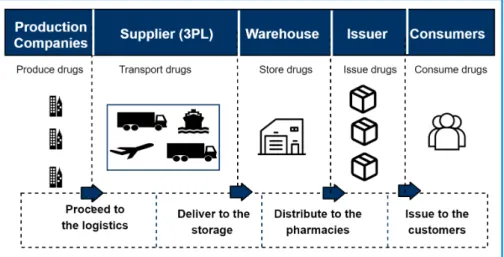
supply chain and the implementation is presented in the Section5. Figure1shows the scenario of the 171
use case chosen. In the use case, the production companies produce medicine, Third Party Logistics 172
(3PL) supply the medicine to the warehouse. Through the warehouse, the medicine is distributed to 173
the pharmacies or the issuers. Most of the time drug counterfeiting occurs through the suppliers and 174
the warehouse. 175
Figure 1.Use case scenario.
Blockchain acts as a data storage system for transactions as all the transactions occured in the 176
supply chain are recorded in blockchain. These data can be used for data analytics of the supply 177
chain. Maintaining the supply and demand in pharmaceutical supply chains is very important. 178
Demand forecasting in the pharmaceutical industry is critical as the availability of drugs at the needed 179
time impacts on patient’s life [26]. Furthermore, the demand for drugs by different pharmaceutical 180
companies is a complex combination of the necessity of drugs, shelf life, regulations and the cost 181
associated with drugs. The consumption method [27] of forecasting of drugs is the usage of historical 182
data of past consumption of drugs. As the data is recorded in blockchain in a well-ordered manner, it 183
can be used to predict future requirements of drugs. Functionality of the BAT was experimented with 184
the use case scenario of developing a demand forecasting model for pharmaceutical drugs as shown in 185
Section5.2. 186
3. Architecture overview of the proposed platform
187
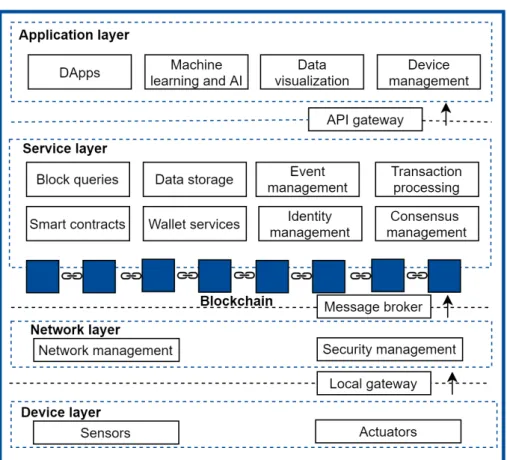
Figure2shows the architecture overview of the platform. A modular architecture is adopted with 188
a layered structure that ensures that each layer could be designed separately without altering the other 189
layers. The architecture is divided into 4 layers. Each layer is interfaced with the other layer through a 190
communication medium. 191
The device layer that consists of the sensors and actuators, is connected through a local gateway 192
to the network layer. The network management of the sensors and actuators in the device layer is 193
performed by the network layer. Basic security protocols are implemented for the transmission of data 194
and control between the device layer and blockchain such as data encryption to prevent unauthorized 195
listening and understanding of the content. In the proposed system, MQ Telemetry Transport or 196
Message Queuing Telemetry Transport (MQTT) [28] can be used as the protocol for communication of 197
IoT devices as it is lightweight and more suitable for the communication between constrained devices 198
as it has a small header [29]. Furthermore, the network layer uses Transport Layer Security (TLS) [30] 199
for the encryption of data. The network layer is connected with blockchain network through a message 200
broker. In our implementation, MQTT broker is used as the message broker. 201
Blockchain is the main actor in the platform. The service layer is interconnected with blockchain. 202
Wallet services help the platform in the process of identity management. Wallets are produced by 203
each certification authority of blockchain network. A wallet contains digital certificates and security 204
keys that can be used for the identification of a component connected to the network. The particular 205
organization that issued the certificates to a user validates the certificates upon request. This ensures 206
that the identity management service of the platform is decentralized between the organizations of 207
blockchain. Furthermore, each component connected to the platform can be granted with levels of 208
privileges and access control. A user can have privileges of an admin, writer, or a reader [31]. Hence, a 209
Figure 2.The architecture overview of the proposed blockchain based IoT-platform.
user can have only the essential set of permissions, i.e., a client user (reader) of the platform can not be 210
able to alter the configurations of the platform. 211
The transaction processing is one of the major functions of the platform. A consensus mechanism 212
is used for the ordering and validation of transactions. The platform uses a permissioned voting-based 213
consensus mechanism as explained in Section2. An endorsement process [32] is performed for the 214
validation of the blocks. The endorsement policy defines that organization needs to approve the 215
transaction. In our proposed platform, all the organizations connected to the network should validate 216
the transaction. Event management resides inside the service layer. In the proposed platform, the data 217
are requested from the device layer with a triggering of an event. 218
Blockchain stores data of all the transactions processed in the platform. Data related to peer to 219
peer communication are stored as blocks without the control of a central authority in the data storage. 220
Hence, blockchain acts as a data warehouse [33] that stores data from different sources (e.g., IoT 221
devices, DApps data, management data, etc.). These data are very useful especially for industries and 222
business. With the proposed system, data can be retrieved and visualized easily specially for business 223
analytics. A novel approach to query blockchain is introduced in Section4. On top of the services 224
provided by blockchain, the application layer is visible that exposes these services to the external users. 225
This layer is interfaced with the service layer using an API gateway. The transaction processing and 226
interacting with front-end applications are developed through DApps. 227
In the study, a special tool called BAT facilitates the development of Machine Learning (ML) and 228
Artificial Intelligence (AI) applications using the data stored in blockchain, as explained in Section 229
4. Each IoT-device is registered before data transmission in the platform. Device management in the 230
application layer is used to handle IoT devices. The registration and management is performed through 231
a smart contract specifically created for that purpose. Each device is also provided with a wallet to 232
prove its identity. Hence, this mechanism ensures that unauthorized devices cannot communicate in 233
the system. This provides a solution to the problem of integrity of IoT-devices. 234
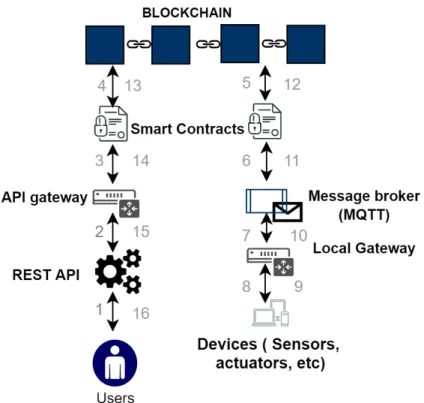
Figure3shows how the different services of the layers in the architecture collaborate together to 235
perform a transaction. First of all, when a user wants to interact with the proposed platform, the user 236
should first provide the identification certificates that are stored in the wallet of the user to blockchain 237
network. The wallet is issued to a user by a specific organization established in the platform. This 238
process is done through the Application Programmable Interface (API) gateway connected to the 239
REpresentational State Transfer (REST) API [21]. If the user fails to produce the wallet containing 240
proper certificates, the users can not have access to the platform. 241
Figure 3.Transaction execution procedure.
After the authentication, the request for the specific transaction, or the process is submitted to 242
the API gateway through the application. The smart contract is invoked once the request is received 243
by blockchain network. From one smart contract to the other the specific logic function is changed. 244
The use of a smart contract removes the necessity of a centralized control, or a third-party access 245
of the system. If the necessary conditions that are specified by a smart contract, are fulfilled, the 246
endorsement peer approve the transaction and commit the transaction. The other entities of the 247
network are informed about the transaction through the Orderer [21] of the network and all the 248
peers update their ledgers about the transaction. Orderer is the entity that is responsible to maintain 249
consistency between blockchain organizations (e.g., peers, ledgers) [21]. Then, the response of the 250
transaction is sent back to the application through the gateway. If the particular smart contract requires 251
data readings of the IoT-devices connected to the network, an event is triggered through the chaincode 252
and the network subscribes to the message broker (MQTT broker) of the system. Through the local 253
gateway, the sensors and actuators publish the encrypted data. 254
4. Block Analytics Tool (BAT)
255
We are proposing a novel approach called BAT for the analytical processing of the data stored in 256
blockchain while overcoming the drawbacks in the state-of-the art approaches in this section. 257
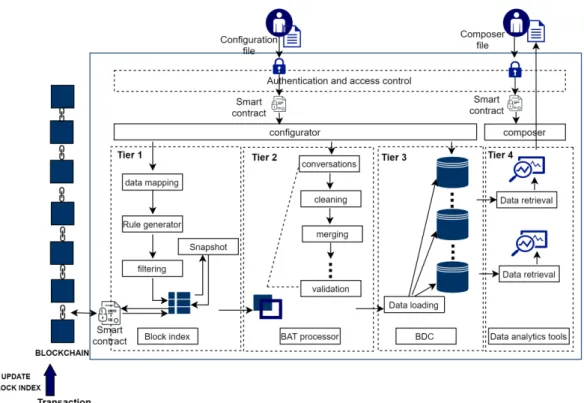
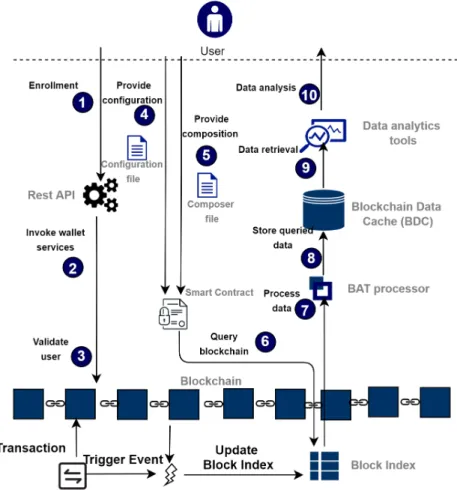
Figure 4.Overview of the Block Analytics Tool (BAT) integrated with blockchain.
We aim to ensure the privacy and security of the data that is being used for that analysis. Hence, 258
all communications that take place through BAT also adopts the secure features used in blockchain 259
based IoT-platform. Smart contracts are used to establish the communication between the platform and 260
BAT. Wallet services and identity-management policies are used to ensure that the unauthorized parties 261
cannot use BAT for analysis. BAT acts as an Extraction Transfer Load (ETL) [34] tool for blockchain. A 262
system administrator provides a configuration file to BAT that specifies the data required as well as 263
about the components of the BAT such as the type of Blockchain Data Cache (BDC) required. Only the 264
data requested by the user are retrieved, reducing the cost associated with storing redundant data. 265
The overall execution procedure of BAT is shown in the Figure5. 266
There are four main tiers in BAT that have separate functionalities and these are explained in detail 267
along with the execution procedure. Tier 1 is the extraction of data from blockchain. Extracting data 268
from blockchain acts as a bottleneck due to the effect of data extraction on the transaction processing. 269
As mentioned earlier rich queries can degrade the performance of blockchain system. Furthermore, to 270
query a single block, all the blocks in blockchain have to be searched. Hence we use a novel approach 271
to extract data from blockchain through an index specifically created for transactions occurring on 272
blockchain. A special index called Block Index is proposed to increase the efficiency of the data 273
extraction process. Block Index acts as a filtering process for the data. 274
blockchain technology is used to handle transactions between two parties. A unique ID is given 275
for all the transactions recorded in blockchain. In a transaction the ownership of this specific object 276
changes while the other details about the object remain the same. For example, in vehicle trading 277
between two parties, the ownership of the vehicle changes while specifications about the vehicle, such 278
as dimensions, engine capacity, fuel capacity remain the same. Moreover, if we want to get the details 279
about a particular object, the search pointer goes through many blocks that contain the same details 280
that increase the search time to a large extent. To address these drawbacks, we propose the Block Index 281
system. 282
Figure 5.Overall execution procedure of BAT integrated with blockchain.
Objects(Bx) =B1,B2, . . . ,Bm
Parties(pm,pn) =P1,2,P2,3, ..,Pn−1,n
Transactions(t) =B1P1,2,B2P2,3...,BnPn−1,n
In here, the transactions occur related to object 1 between party 1 and party 2 is represented asB1P1,2. 283
When object 1’s transaction occur between party 2 and party 3 the details about the object remain the 284
same where as the current owner changes from party 2 to party 3. This relationship is considered and 285
the Block Index is created as a matrix representation of the transactions. Each row in the Block Index 286
represents the transactions related to one particular object. The columns represent the transactions 287
between different parties. The chain of transactions related to the objects between different parties is 288
mapped into a matrix representation. 289 P1,2 P2,3. . . Pn−1,n B1 B1P1,2 B1P2,3. . . B1Pn−1,n B2 B2P1,2 B2P2,3. . . B2Pn−1,n . . . Bm BmP1,2 BmP2,3. . . BmPn−1,n 290 291
blockchain records the data of a transaction as soon as it occurs. The details about the transaction 292
is mapped into the Block Index easily. The implementation of the addition of one block in to the Block 293
Index is shown in the algorithm1.Through this representation, the data extraction processed can be 294
performed more efficiently. If we assume that blockchain recorded the data about transactions as below: 295 296 B1P1,2⇒B2P1,2 ⇒B2P2,3⇒B1P2,3⇒B3P1,2 ⇒B4P1,2⇒B3P2,3⇒B3P3,4 ⇒B4P2,3⇒B1P3,4 297 298 P1,2 P2,3 P3,4 B1 B1P1,2 B1P2,3 B1P3,4 B2 B2P1,2 B2P2,3 B3 B3P1,2 B3P2,3 B3P3,4 B4 B4P1,2 B4P2,3 299
If the details about the object related to the 10thtransactiont10. Then, instead of searching through 10 300
transactions, the Block Index gets the required details by only searching the first column (P1,2) as all the 301
other column have the replication of the same details. In the worst case scenario, this reduces the data 302
extraction time fromO(mn)toO(m)wheremis the number of objects andnis the number of parties. 303
Through the configuration file, a user can provide the necessary data to be extracted. Then the 304
specified data are mapped to be used by the Block Index architecture. For instance, if the user wants the 305
data about the transactions between partyPmandPnthe data from thePm,nhas to be retrieved. After
306
mapping the data, rules are created to retrieve data from blockchain. These rules are the queries that 307
are used to get data from blockchain storage system. Through the Block Index the data are extracted. 308
The communication between the platform and BAT takes place through a smart contract. 309
The extraction process takes place through pagination to ensure the consistency of data and to 310
avoid the overflow of memory. After the initial extraction, BAT keeps track of the last set of data that 311
has been queried from the platform and this is kept as a snapshot of the data retrieved. For instance, if 312
the details about the blockk(Bk) were queried in the last extraction, BAT keeps a tag stored to assure
313
that in the next data extraction time, the same data is not copied that reduces the data extraction 314
time. As soon as a transaction occurs in the platform, an event is triggered to update the Block Index. 315
Updating the Block Index takes a small amount of time, whereas in the current approaches of analytical 316
processing, the latency associated with the transaction processing is very high. The performances are 317
compared in the Section6. 318
Algorithm 1Pseudo code to add a block to the Block Index. Input: x[ID] - ID of new block
Output: column of the index, row of the index
Initialization:
nRows0 = number of rows in column 0 nColumnsi = number of columns in row i IndexColumn = 0
fori=0 tonRows0do if(i[ID] =x[ID])then
forIndexRow=0 tonColumnsido IndexColumn = IndexColumn+1; end for
end if end for
Algorithm1shows the pseudo code of the Block Index. When a transaction occurs, the Block 319
Index is updated through the chaincode. If the block contains the details about a newly created object, 320
the Block Index stores the transaction of the object under the column 0. When the object undergoes 321
another transaction, the transaction is recorded in the second column through the chaincode. The 322
querying process uses this Block Index created to retrieve the information. 323
Tier 2 is the data-transformation phase. After the data-retrieval phase, the queried data are 324
transformed to be stored in the BDC. The process of transformation of data to the user required 325
data-type that is termed as the Object Relational Mapping (ORM) [35], is conducted by the BAT 326
Processor. Furthermore, BAT processor performs transformation functions on the data for the data 327
standardization as explained below. These transformations are taken place in the processor as separate 328
operations. One object is considered as an entity, or a column where the fields are considered as rows 329
in the transformation. These operations can mainly be categorized into two as column wise operations 330
and row wise operations. The semantic representation of the data set can be shown as follows. Data 331
set = D, Entity object (row) = e, Field (column) = f, attribute value =vale,f
332
Following shows few of the operations that are carried out by the BAT processor. Column wise 333
operations such as Conversations (Unit conversations...): ∀vale,f ∈ f,c = constant ⇒ vale,f ×c,
334
Merging fields (join):∀vale,fx ∈ fx,∀vale,fy ∈ fy⇒vale,fx,y =vale,fx ./vale,fy and Row wise operations 335
such as cleaning (removing null rows):∀e=∅,e∈D⇒D=D−e, cleaning (removing duplicate 336
rows):rx,ry∈D,rx=ry⇒D=D−rx.
337
The user can explicitly mention the operations and conditions that the data set must go through 338
to transform the data. BAT creates a precedence process of operations must be followed to ensure that 339
the data is processed in linear time. The column wise operations are taken place first followed by the 340
row wise operations. Functions such as merging functions are at the end of the process. The algorithm 341
of how BAT processor transform the data is shown in Algorithm2 342
Algorithm 2Algorithm for operational precedence process of BAT processor. Input: D(Data set), Operations
Output: ProcessedD - processed data set
Initialization:
OpcolF = Operations and columns where operations needed to be performed Oprows = Operations on rows
ProcessedD = D
foropcol=0 toOpcolFdo
ProcessedD = opcol(ProcessedD) foroprow=0 toOprowsdo
ProcessedD = oprow(ProcessedD) end for
end for
return ProcessedD
Tier 3 is the data storage phase. After processing the data, it is loaded in to the BDC and it acts as 343
a data warehouse for blockchain data. The user has the capability to determine the type of database to 344
be used by BAT between relational and non-relational databases. After the initial loading of data to the 345
BDC, the data can be extracted in incremental phases to BAT. BAT make sure about the maintainance 346
of the Atomicity, Consistency, Isolation, and Durability (ACID) properties [36] between the BDC and 347
blockchain. 348
Tier 4 is the data analysis phase. The data analytics tools and frameworks (Tensorflow [29], 349
Pytorch [30], etc.) as specified by the user through the configuration files, can be integrated with BDC. 350
Unlike blockchain data storage system, the tools can perform rich queries, preprocess data stored in 351
BDC. For ML developments, latency and throughput plays a critical role. Usage of BDC instead of 352
acquiring data directly from blockchain reduces the latency and increases throughput. Different users 353
can make use of the same BAT instance. The users can provide a composer file that specifies the type of 354
data required by different users and they are available at the data analysis tools specified by the user. 355
All communication between the tool and the users take place through the access control and 356
authentication process of BAT. The users should have a valid wallet issued by blockchain to use BAT. 357
Furthermore, the access control policies ensure that only the users who have the read privileges can 358
use BAT tool. Smart contracts are used when interacting with different users. These smart contracts 359
validate the configuration files and the composer files provided by the users and develop the instance 360
of BAT or data acquisition process as needed. The communication with blockchain takes place through 361
a smart contract. This smart contract ensures the authenticity and integrity of data that is being used 362
for the analysis. The smart contract checks whether the data are generated or stored in the platform 363
and the it also makes sure that the data have not been modified by any unauthorized parties. 364
5. Case study
365
This section explains about the implementation of blockchain-based IoT-platform as well as the 366
integration of BAT to the platform through the use case scenario of the pharmaceutical supply chain 367
as explained in Section2. For this study Hyperledger [21] is chosen as the candidate blockchain 368
technology as it is the most suitable type of blockchain for handling business logic currently [31]. RFID 369
tags are used to prevent tampering of the expire date, manipulation of the dosage information in the 370
medicine package. Drug manufacturers add initial package data into blockchain and RFID tags that 371
can be used to verify the details at any given point using the proposed platform. Sensors can be used 372
to ensure that the drugs were transported in the correct condition. For example, temperature sensors 373
are used to check whether the temperature of drugs was maintained. 374
5.1. System Architecture of the case study
375
The implementation and analysis of the proposed system was performed in the gcloud virtual 376
machine instance (configuration of Name- c2-standard-4, Zone- us-central1-f, vCPUs- 8, Memory-377
30GB) [37]. RFID tags resides in the device layer of blockchain-based IoT-platform. Through a gateway 378
it is connected to the network layer. MQTT broker is used to transfer data from the RFID tags as 379
explained in Section3. The architecture of blockchain used in the use case scenario are explained as 380
follows. The main actors of the scenario are the supplier, warehouse and the issuer organizations. The 381
network is initiated by the warehouse organization and the initial configuration of the network is 382
configured by the warehouse entity. The network is controlled according to the rules imposed by the 383
network configuration. The channel order is maintained by the orderer connected to the channel. The 384
channel is governed by the channel configuration that has the policies related to all 3 entities. Separate 385
certificate authorities are maintained by each entity for the validation of the transactions processed in 386
blockchain. Each organization consists of 2 peers and 1 peer is used as the anchor peer that is used to 387
communicate with the other entities. In each peer, a copy of ledger containing details about all the 388
transactions is installed. 389
The service layer consists of services such as smart contracts, data storage management, 390
transaction processing, identity management. The peers contain copies of smart contracts installed in 391
the platform. There are 2 smart contracts called create-batch and transfer-batch, that are utilized by the 392
applications in the platform. A manufacturing company uses create-batch smart contract to create a 393
batch to be delivered to one issuer company. The details about batch of drugs such as name, dosage, 394
quantity, manufactured and expiry date are added as a block to blockchain. An RFID tag is assigned 395
for this particular batch. Transfer-batch smart contract is used when a batch is transferred from one 396
entity to the other. 397
Application layer consists of DApps and Data visualization and Device management. Four 398
different applications are created as DApps that are used by different organizations for transactions 399
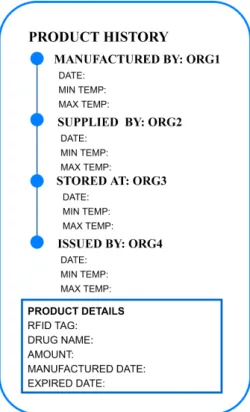
Figure 6.User output of product history at the end of transferring a batch through the supply chain.
and processing of data. They are used by production companies, suppliers, warehouse and issuers 400
for the transactions. Through another application, an end user can examine where a specific batch 401
is located on that occasion. Eventually, the end user at the issuer can see how the batch has been 402
transported, stored and issued by the organizations while maintaining the favorable conditions for 403
batches with complete transparency. Figure6shows the user interface of the application at the end of 404
transferring a batch through the supply chain. 405
5.2. Demand forecasting of pharmaceutical drugs
406
With the help of hospital prescribing dispensed in the community data set [38], batches of drugs 407
were created. The data about hospital prescribing data related to the Manchester University NHS 408
Foundation [38] were used for the study. Batches were added in a manner where batches being 409
transferred through the supply chain at different stages. 410
411
The transactions between different organizations can be shown as follows. production to supplier 412
=Ppr,s, supplier to warehouse =Ps,w, warehouse to issuer =Pw,i, issuer to patients =Pi,p, Different
413
batches = B1,B2, ... In the representation, number of columns = number of transactions between 414
different organizations, row = history of a batch,Pi,pcolumn = batches utilized by the end users.
415 Ppr,s Ps,w Pw,i Pi,p B1 B1Ppr,s B1Ps,w B1Pw,i B1Pi,p B2 B2Ppr,s B2Ps,w B3 B3Ppr,s B3Ps,w B3Pw,i B3Pi,p B4 B4Ppr,s B4Ps,w B4Pw,i B5 B5Ppr,s 416 417
A block contains details about RFID tags, drug name, dosage, quantity, cost, organization (e.g., 418
production, supplier, etc.), temperature sensor readings, transaction time, manufactured and expired 419
dates. During a transaction the organization, temperature sensor readings change while the other 420
details remain the same. The Block Index was updated with the addition of batches to the platform. The 421
above matrix representation shows part of the Block Index that shows the state of transfer of batches 422
through the supply chain. According to the Block Index, batchB2is now stored at the warehouse. The 423
transaction ID is used to map the Block Index to blockchain. 424
For the demand forecasting analysis, the details about issued drugs such as drug name, quantity, 425
cost and issued date of batches are required for the analysis. According to the Block Index designed, 426
the details about issued batches to the patients are available in the 4th column. Using the Block Index, 427
the specific batches could be extracted without querying the full blockchain. If the Block Index was not 428
used for this purpose, the querying is more complicated with more functions and algorithms. In the 429
implementation, CouchDB [39] database is used as the state database. CouchDB has a default indexing 430
system that can be used to query the database easily. The proposed Block Index makes use of this 431
system. 432
After retrieving data from blockchain, the data are processed by BAT processor. The data are 433
cleaned, and validated according to the operational-precedence process. In the Hyperledger, data are 434
stored as json objects. If the user requests the data to be stored in a relational database such as MySQL, 435
the ORM process has to be performed where data is transformed from json objects in to tabular schema. 436
The BDC stores the processed data. BAT supports both on-premise and cloud-storage systems. In 437
the use case scenario, non-relational database MongoDB [40] was used as the candidate on-premise 438
database for BDC. For the data analysis application, the cumulative quantity and costs of drugs in 439
a monthly basis are required. If the data from blockchain are directly extracted, the performance of 440
the platform is reduced drastically with the complex query as the transaction processing is effected. 441
However, with the BDC, the query can be performed easily without effecting the performance of the 442
platform. 443
In the case study, Tensorflow was used as the ML tool. The demand analysis of supply chain 444
data is a time series analysis as the seasonal weather patterns, average price is affected by the time. 445
Pharmaceutical drugs show correlations between each other as many drugs are prescribed as a set 446
for a specific disease. While preserving these correlations, the time series model was built using ML 447
algorithms, xgboost regressor [41] with SVR (Support Vector Regression) [42] as the base estimator. 448
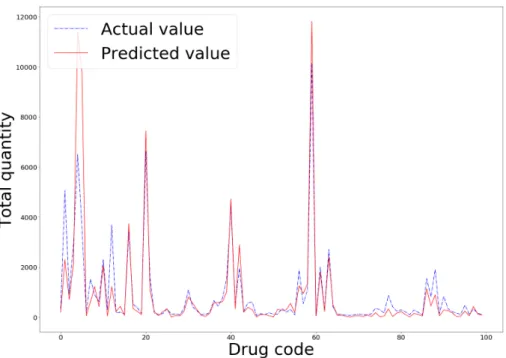
Figure7shows the demand prediction and actual values of total quantity of certain types of drugs 449
for the month October of 2019 for the hospitals in Manchester University NHS Foundation [38]. The 450
model was built with the an average accuracy of Root Mean Square Error (RMSE) value of 0.5213. 451
The model utilizes previous 12 months of data while analyzing the correlations of the drugs and the 452
demand of drugs for the next month can be predicted. For an instance, the drug quantity needed by 453
"Amlodipine-Tab 5mg" of drug code "0206020A0" can be predicted with an RMSE of 0.3134. 454
The status of the model built is saved and when the model is required again, the composer file 455
can be given to BAT in the same manner and the analysis could be conducted with the newly added 456
blocks. Hence, the new data added will also be included in the learning process of the model, that 457
increases the performance of the model built. 458
Figure 7.Predicted and actual value comparison for the demand forecasting.
6. Performance analysis
459
In this section, we present the analysis of the performance of BAT integrated with the platform. 460
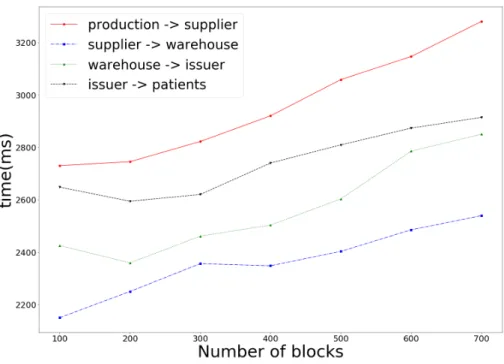
Figure8shows the total transaction processing time taken by different applications for creating and 461
transferring batches with IoT-devices connected. The transaction processing time increases when the 462
number of blocks in blockchain increases and highest transaction time is taken for the creation of 463
the new batch that is the transaction between production and supplier companies. This is due to the 464
additional device registration time related to RFID and temperature sensors. 465
The following are few mechanisms that ensure the authenticity and integrity of batches while 466
assuring the quality. 467
• Add counterfeit batches, or change the details (e.g., expiration date, dosage, etc.):Counterfeit batches 468
cannot be added as the RFID tag is cross checked with the first block of batch (production 469
to supplier transaction). Furthermore, the smart contract rejects the transaction if the details 470
produced does not match with the details of the first block of batch. 471
• Replace contents of batch: The RFID tags are attached to the boxes in a way that the system is 472
alarmed, if batch is broken/damaged. Hence batch is accepted. 473
• Impersonate the authorities while processing transactions: Every person performing a specific 474
transaction owns a wallet issued by the particular organization. If the person does not own a 475
legitimate wallet, the transaction is rejected. 476
• Unauthorized access of data: In device management, usage of BAT and other applications are 477
performed through smart contracts, wallet services and the access management policies of the 478
platform make sure that only authorized parties are allowed to access data. 479
• Modify, or add data while using BAT:BAT only accesses one ledger in blockchain and other peers 480
and ledgers are not notified about the transaction. Hence, the endorsement fails rejecting the 481
modification. 482
Figure 8.Total transaction processing time
The implementation of the demand forecasting of pharmaceutical drugs in Section5.2shows the 483
basic functionality of BAT integrated with the platform. BAT uses authentication and access control 484
mechanisms when interacting with users and while communication between blockchain. Owing to 485
these reasons, developers can ensure the privacy and security of the data as well as the authenticity of 486
the data used in the analysis. The conventional method of the usage of the off-chain database and the 487
introduced novel-approach is compared to present the performance between the two methods. The 488
main usage of blockchain based IoT-platform is the transaction processing. Hence, the performance of 489
the transaction processing should not decrease with the addition of other services in to the platform. 490
When BAT is used for analytics, the overall performance of the platform related to transaction should 491
not be effected. 492
Figure 10.Throughput of transactions.
Figure9shows the comparison of the effect of event processing on transaction processing when 493
using BAT and the conventional method of usage of an off-chain DB. 494
When transactions take place, the total processing time of the transaction is the addition of the 495
transaction-processing time and the event processing time. In BAT, only the Block Index is needed to 496
be updated whereas the data is duplicated into an external database in the conventional method. This 497
increases the event processing time exponentially. On the other hand, a constant time between 0-5ms 498
is used to update the Block Index. Hence, the effect of the analytical processing on the transaction 499
processing remains constant at almost 0ms when using BAT whereas in the conventional method, the 500
effect on the transaction processing increased exponentially with the increase of the size. 501
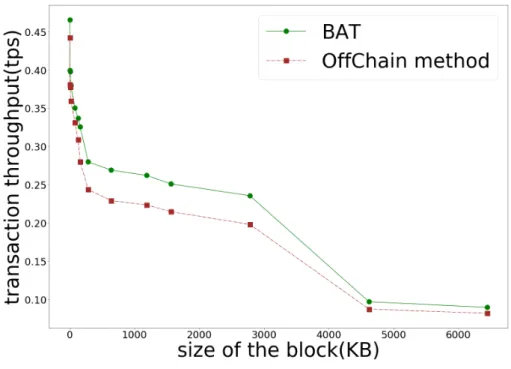
Transaction throughput is the number of transactions that can be processed in a second. Even 502
though the total throughput decreases with the increase of the block size, the throughput of the 503
conventional method is comparatively low compared with BAT as shown in Figure10. Furthermore, 504
the off-chain database duplicates all the data in blockchain creating redundant data whereas the size of 505
the Block Index remains less than 1MB most of the time. The storage cost associated with the current 506
approach is drastically high as it stores lot of redundant data. 507
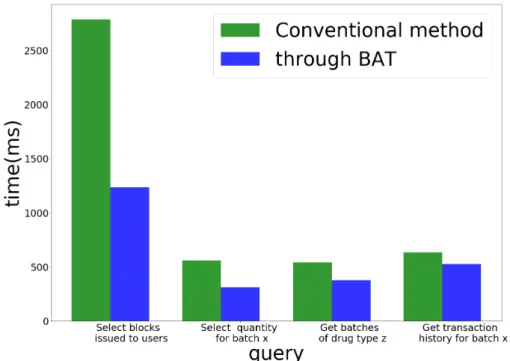
The comparison of the data acquiring process using BAT and the conventional process is compared 508
in Figure11. BAT utilize the Block Index in the process of acquiring data whereas in the conventional 509
process, the normal querying architecture is used. In the figure, batches issued to the users mean 510
retrieving data of the 4thcolumn of the Block Index. Selecting quantity for the batch x is getting data 511
about a batch as the ownership is the only variable that changes through a row. Hence, data can be 512
retrieved by querying through the first column without reading all the blocks. Data related to one 513
organization or transaction can be retrieved through the Block Index that increases the efficiency by 514
almost 100% as shown in Figure11. The search pointer reads only the first column and check for the 515
blocks where drug type is z. The search pointer has no special exploitation in using the Block Index to 516
obtain the transaction history for a batch, as it has to read all the columns to retrieve the transaction 517
history. 518
Figure 11.Acquiring data from blockchain
7. Conclusions and future work
519
In this paper, we design and implement a blockchain-based IoT-platform that addresses 520
centralized control, scalability, data security and access control problems found in the current IoT 521
systems. Furthermore, we propose a novel approach called BAT, integrated with the platform that 522
ensures the integrity and authenticity of data used for data-analytics applications. The smart contracts, 523
authentication and access control mechanisms of the platform as well as the BAT ensure about the 524
security and integrity of the data. We present the functionality of blockchain-based IoT-platform and 525
the integration of BAT with the platform through the use case scenario of the pharmaceutical supply 526
chain. 527
According to our implementation and evaluation, the novel approach of BAT utilizing BDC saves 528
resources such as storage facilities compared to the conventional approaches of creating a mirror 529
storage that duplicates resources. Furthermore, the total transaction processing time with BAT is 530
considerably low due to the minimal event processing time related to the creation of Block Index 531
compared with the conventional approach of creating off-chain database. The costs associated with 532
data retrieval from the platform are reduced by the usage of Block Index. Currently, batch processing 533
is conducted in the BAT. In the future, we will mainly focus to bring the platform towards edge 534
computing with the optimization of BAT for real-time processing. 535
Author Contributions: conceptualization, C.E., K.V. and N.B.; methodology, C.E., K.V., N.B.; software, C.E., 536
K.V., N.B.; validation, C.E., J.A., M.S., U.J., N.S., and G.M.L.; writing–original draft preparation, C.E., U.J. and 537
G.M.L.; writing–review and editing, C.E., U.J., and G.M.L.; supervision, J.A., M.S., U.J., N.S. and G.M.L.; project 538
administration, J.A., M.S., U.J.; funding acquisition, G.M.L. 539
Funding:This work was supported by the Institute for Information Communications Technology Promotion 540
(IITP) grant funded by the Korea government (MSIT). [2018-0-00261, GDPR Compliant Personally Identifiable 541
Information Management Technology for IoT Environment]. 542
Conflicts of Interest:The authors declare no conflict of interest. 543
References
544
1. Lee, I.; Lee, K. The Internet of Things (IoT): Applications, investments, and challenges for enterprises. 545
Business Horizons2015,58, 431–440. doi:10.1016/j.bushor.2015.03.008. 546
2. Panarello, A.; Tapas, N.; Merlino, G.; Longo, F.; Puliafito, A. Blockchain and IoT Integration: A Systematic 547
Survey. Sensors2018,18, 2575. doi:10.3390/s18082575. 548
3. Voigt, P.; Von dem Bussche, A. The eu general data protection regulation (gdpr). A Practical Guide, 1st Ed., 549
Cham: Springer International Publishing2017. 550
4. Buterin, V.; others. A next-generation smart contract and decentralized application platform. white paper 551
2014,3. 552
5. Nakamoto, S. Bitcoin: A Peer-to-Peer Electronic Cash System. Journal for General Philosophy of Science2008, 553
39, 53–67. doi:10.1007/s10838-008-9062-0. 554
6. Bahga, A.; Madisetti, V.K. Blockchain Platform for Industrial Internet of Things. Journal of Software 555
Engineering and Applications2016,09, 533–546. doi:10.4236/jsea.2016.910036. 556
7. Gramoli, V. From blockchain consensus back to Byzantine consensus.Future Generation Computer Systems 557
2017. Accessed: Jan. 22, 2020, doi:10.1016/j.future.2017.09.023. 558
8. Nguyen, G.T.; Kim, K. A Survey about Consensus Algorithms Used in Blockchain. Journal of Information 559
processing systems2018,14. 560
9. Novo, O. Blockchain Meets IoT: An Architecture for Scalable Access Management in IoT.IEEE Internet of 561
Things Journal2018,5, 1184–1195. doi:10.1109/JIOT.2018.2812239. 562
10. Huh, S.; Cho, S.; Kim, S. Managing IoT devices using blockchain platform. 2017, pp. 464–467. 563
doi:10.23919/ICACT.2017.7890132. 564
11. Jiang, S.; Cao, J.; McCann, J.A.; Yang, Y.; Liu, Y.; Wang, X.; Deng, Y. Privacy-Preserving and Efficient 565
Multi-Keyword Search over Encrypted Data on Blockchain. 2019 IEEE International Conference on 566
Blockchain (Blockchain), 2019, pp. 405–410. 567
12. Sandhu, R.S.; Samarati, P. Access control: principle and practice. IEEE communications magazine1994, 568
32, 40–48. 569
13. Bhuiyan, M.Z.A.; Zaman, A.; Wang, T.; Wang, G.; Tao, H.; Hassan, M.M. Blockchain and Big Data to 570
Transform the Healthcare. Proc. Int. Conf. Data Processing and Applications; ACM: New York, NY, USA, 571
2018; ICDPA 2018, p. 62–68. Accessed: Jan. 22, 2020, doi:10.1145/3224207.3224220. 572
14. Ouaddah, A.; Abou Elkalam, A.; Ait Ouahman, A. FairAccess: a new Blockchain-based access 573
control framework for the Internet of Things. Security and Communication Networks2016,9, 5943–5964. 574
doi:10.1002/sec.1748. 575
15. Hang, L.; Kim, D.H. Design and implementation of an integrated iot blockchain platform for sensing data 576
integrity. Sensors (Switzerland)2019,19. doi:10.3390/s19102228. 577
16. Zhou, L.; Wang, L.; Sun, Y.; Lv, P. BeeKeeper: A Blockchain-Based IoT System with Secure Storage and 578
Homomorphic Computation. IEEE Access2018,6, 43472–43488. doi:10.1109/ACCESS.2018.2847632. 579
17. Gentry, C. Fully Homomorphic Encryption Using Ideal Lattices. Proc. 41st ACM Symp. on Theory of 580
Computing; ACM: New York, NY, USA, 2009; STOC ’09, p. 169–178. doi:10.1145/1536414.1536440. 581
18. Xu, Q.; Mi, K.; Aung, M.; Zhu, Y.; Yong, K.L. New Advances in the Internet of Things. Studies in 582
Computational Intelligence2018,715, 119–138. doi:10.1007/978-3-319-58190-3. 583
19. Popov, S. The tangle. ABA Journal2016, pp. 1–25. Accessed: Jan. 23, 2020. 584
20. Akcora, C.G.; Kantarcioglu, M.; Gel, Y.R. Blockchain Data Analytics. Proc. - IEEE Int. Conf. on Data Mining, 585
2018, Vol. 2018-November, p. 6. doi:10.1109/ICDM.2018.00013. 586
21. Hyperledger. Hyperledger – Open Source Blockchain Technologies, 2019. Available online: 587
https://www.hyperledger.org/ (accessed on Jan. 23, 2020). 588
22. Bai, L.; Hu, M.; Liu, M.; Wang, J. BPIIoT: A Light-Weighted Blockchain-Based Platform for Industrial IoT. 589
IEEE Access2019,7, 58381–58393. doi:10.1109/ACCESS.2019.2914223. 590
23. Shafagh, H.; Burkhalter, L.; Hithnawi, A.; Duquennoy, S. Towards Blockchain-Based Auditable Storage 591
and Sharing of IoT Data. Proc. 2017 Cloud Comput. Security Workshop; ACM: New York, NY, USA, 2017; 592
CCSW ’17, p. 45–50. Accessed: Jan. 23, 2020, doi:10.1145/3140649.3140656. 593
24. Campbell, H. Dangers of drug importation: a case of counterfeit cancer drugs, 2016. Available online: 594
https://catalyst.phrma.org/dangers-of-drug-importation-a-case-of-counterfeit-cancer-drugs (accessed 595
on Jan. 22, 2020). 596
25. Bayer. Background Information on Counterfeit Drugs, 2014. Available online: 597
https://www.bayer.com/en/background-information-on-counterfeit-drugs.aspx (accessed on Jan. 20, 598
2020). 599
26. Rachmania, I.N.; Basri, M.H. Pharmaceutical inventory management issues in hospital supply chains. 600
Management2013,3, 1–5. doi:10.5923/j.mm.20130301.01. 601
27. Candan, G.; Taskin, M.; Yazgan, H.R. Demand Forecasting In Pharmaceutical Industry Using Neuro-Fuzzy 602
Approach.Journal of Military and Information Science2014,2, 41. doi:10.17858/jmisci.06816. 603
28. Hunkeler, U.; Truong, H.L.; Stanford-Clark, A. MQTT-S—A publish/subscribe protocol for Wireless Sensor 604
Networks. 3rd Int. Conf. on Communication Systems Software and Middleware and Workshops, 2008, pp. 605
791–798. 606
29. Naik, N. Choice of effective messaging protocols for IoT systems: MQTT, CoAP, AMQP and HTTP.IEEE 607
int. systems engineering symposium, 2017, pp. 1–7. 608
30. Dierks, T.; Rescorla, E. The transport layer security (TLS) protocol version 1.22008. 609
31. Androulaki, E.; Barger, A.; Bortnikov, V.; Cachin, C.; Christidis, K.; De Caro, A.; Enyeart, D.; Ferris, C.; 610
Laventman, G.; Manevich, Y.; others. Hyperledger fabric: a distributed operating system for permissioned 611
blockchains. Proceedings of the Thirteenth EuroSys Conference, 2018, pp. 1–15. 612
32. Thakkar, P.; Nathan, S.; Viswanathan, B. Performance benchmarking and optimizing hyperledger 613
fabric blockchain platform. IEEE 26th Int. Symp. on Modeling, Analysis, and Simulation of Computer 614
and Telecommunication Systems, 2018, pp. 264–276. 615
33. Devlin, B.; Barry/Cote.; Doran, L. Data warehouse : from architecture to implementation; Addison-Wesley 616
Longman Publishing Co., Inc., 1997; p. 432. 617
34. Galici, R.; Ordile, L.; Marchesi, M.; Pinna, A.; Tonelli, R. Applying the ETL Process to Blockchain Data. 618
Prospect and Findings. Information2020,11, 204. 619
35. Dipina Damodaran, B.; Salim, S.; Vargese, S.M. Performance evaluation of MySQL and MongoDB databases. 620
International Journal on Cybernetics & Informatics (IJCI) Vol2016,5. 621
36. Han, J.; Haihong, E.; Le, G.; Du, J. Survey on NoSQL database. 6th int. conf. on pervasive computing and 622
applications, 2011, pp. 363–366. 623
37. Virtual machine instances. Available online: https://cloud.google.com/compute/docs/instances(accessed 624
on Feb. 24, 2020). 625
38. NHS. Hospital prescribing dispensed in the community | NHSBSA, 2019. Available online: 626
https://www.nhsbsa.nhs.uk/prescription-data/prescribing-data/hospital-prescribing-dispensed-community 627
(accessed on Jan. 21, 2020). 628
39. Apache. Apache CouchDB - About, 2019. Available online:https://couchdb.apache.org/ (accessed on Jan. 629
21, 2020). 630
40. MongoDB. Available online: https://www.mongodb.com/ (accessed on Jan. 21, 2020). 631
41. Schapire, R.E.; Singer, Y. Improved boosting algorithms using confidence-rated predictions. Machine 632
Learning1999,37, 297–336. Accessed: Jan. 23, 2020, doi:10.1023/A:1007614523901. 633
42. Huang, X.; Maier, A.; Hornegger, J.; Suykens, J.A. Indefinite kernels in least squares support vector 634
machines and principal component analysis.Applied and Computational Harmonic Analysis2017,43, 162–172. 635
doi:10.1016/j.acha.2016.09.001. 636