An intelligent hybrid multi-criteria hotel recommender system
using explicit and implicit feedbacks
Ashkan Ebadi
A Thesis in
The Department of
Computer Science and Software Engineering
Presented in Partial Fulfillment of the Requirements for the Degree of Master of Computer Science
Concordia University Montréal, Québec, Canada
April 2016 © Ashkan Ebadi, 2016
CONCORDIA UNIVERSITY SCHOOL OF GRADUATE STUDIES
This is to certify that the thesis prepared
By: Ashkan Ebadi
Entitled: An intelligent hybrid multi-criteria hotel recommender system using explicit and implicit feedbacks
and submitted in partial fulfillment of the requirements for the degree of Master of Computer Science
complies with the regulations of the University and meets the accepted standards with respect to originality and quality.
Signed by the final examining committee:
Chair
Examiner Examiner Supervisor Approved by
Chair of Department or Graduate Program Director
Dean of Faculty Date Dr. Yuhong Yan Dr. Thomas Fevens Dr. Olga Ormandjieva Dr. Adam Krzyzak
iii ABSTRACT
An intelligent hybrid multi-criteria hotel recommender system using explicit and implicit feedbacks
Ashkan Ebadi
Concordia University, 2016
Recommender systems, also known as recommender engines, have become an important research area and are now being applied in various fields. In addition, the techniques behind the recommender systems have been improved over the time. In general, such systems help users to find their required products or services (e.g. books, music) through analyzing and aggregating other users’ activities and behavior, mainly in form of reviews, and making the best recommendations. The recommendations can facilitate user’s decision making process. Despite wide literature on the topic, using multiple data sources of different types as the input has not been widely studied. Recommender systems can benefit from the high availability of digital data to collect the input data of different types which implicitly or explicitly help the system to improve its accuracy. Moreover, most of the existing research in this area is based on single rating measures in which a single rating is used to link users to items.
This dissertation aims to design a highly accurate hotel recommender system, implemented in various layers and tailored for the subject problem. Using multi-rating system and benefitting from large-scale data of different types, the recommender system suggests hotels that are personalized and tailored for the given user. The system employs natural language processing techniques to assess the sentiment of the users’ reviews and extract implicit features. The entire recommender engine contains multiple sub-systems, namely users clustering, matrix factorization module, and hybrid recommender system. Each sub-system contributes to the final composite set of recommendations through covering a specific aspect of the problem. The accuracy of the proposed recommender system has been tested intensively where the results confirm the high performance of the system.
iv ACKNOWLEDGMENT
First and foremost, I would like to express my sincere gratitude to my supervisor, Professor Adam Krzyzak, for his continuous support, valuable guidance, and consistent encouragement throughout my research. This work was possible only because of your unconditional support, understanding, and immense knowledge. Thank you for providing me with the opportunity to learn. I would also like to thank my committee members for the brilliant comments and insightful suggestions. This last word of acknowledgment I have saved for my wonderful family for their endless support, encouragement, and love.
v
Contents
1. INTRODUCTION ... 1
2. LITERATURE REVIEW ... 3
2.1 Recommender Systems, Applications and Examples ... 3
2.1.1 Amazon ... 4
2.1.2 Lifetrak ... 5
2.1.3 Last.fm ... 5
2.2 Recommender Systems, Requirements ... 5
2.2.1 Multiple Data Sources ... 6
2.2.2 The Cold-Start Problem ... 6
2.2.3 Robustness ... 6
2.2.4 Scalability ... 7
2.2.5 Transparency ... 7
2.3 Recommender Systems Topologies ... 7
2.3.1 Classical Categorization ... 7
2.3.2 Su and Khoshgoftar Categorization ... 8
2.3.3 Rao Categorization ... 8
2.4 Recommender Systems Approaches ... 8
2.4.1 Collaborative Filtering ... 9
2.4.2 Content-Based Filtering ... 10
2.4.3 Knowledge-Based Recommender Systems ... 11
2.4.4 Demographic Recommender Systems ... 11
2.4.5 Hybrid Recommender Systems ... 11
2.5 Recommender Systems - Data Sources and Targets ... 13
2.6 Recommender Systems - Common Algorithms ... 13
2.6.1 Association Rules ... 13 2.6.2 Bayesian Classifiers ... 14 2.6.3 Neural Networks ... 14 2.6.4 K-Nearest Neighbors... 15 2.6.5 Matrix Factorization ... 15 2.6.6 Other Algorithms ... 15
vi
2.7.1 Offline Evaluation ... 16
2.7.2 User-Based Evaluation ... 17
2.7.3 More Discussion on Evaluation ... 18
2.8 Travel Recommender Systems ... 18
2.9 Research Open Problems in Recommender Systems ... 21
3 RESEARCH OBJECTIVES ... 23
4 DATA AND METHODOLOGY ... 24
4.1 Data ... 24
4.1.1 Twitter Dataset ... 24
4.1.1.1 Preprocessing of Twitter Dataset ... 24
4.1.2 Travel Dataset ... 25
4.1.2.1 Integrated Travel Data, Preprocessing ... 26
4.2 Methodology ... 27
4.2.1 Sentiment Analysis Module ... 28
4.2.2 Keyword Extraction Module ... 31
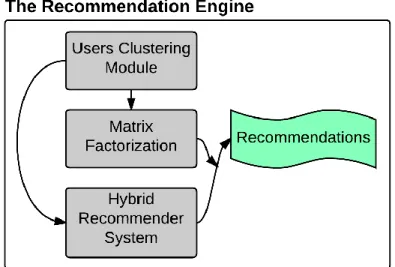
4.2.3 The Recommender Engine ... 35
4.2.3.1 Users Clustering Module ... 36
4.2.3.2 Matrix Factorization Module ... 40
4.2.3.3 Hybrid Recommender System ... 43
4.2.3.3.1 User-Based Collaborative Filtering Module ... 45
4.2.3.3.2 Item-Based Collaborative Filtering Module ... 45
4.2.3.3.3 Multi-Criteria Recommender Module... 46
4.2.4 Performance Evaluation ... 47
5 RESULTS ... 51
5.1 User-Based Collaborative Filtering ... 51
5.2 Item-Based Collaborative Filtering ... 54
5.3 Matrix Factorization ... 55
5.4 Multi-Criteria Recommender ... 58
5.4.1 Scenario-1, Implicit and Explicit Ratings ... 59
5.4.2 Scenario-2, Multi-Aspect Explicit Ratings ... 61
5.5 The Composite Set of Recommendations ... 63
6 CONCLUSIONS ... 65
vii REFERENCES ... 69
viii
List of Figures
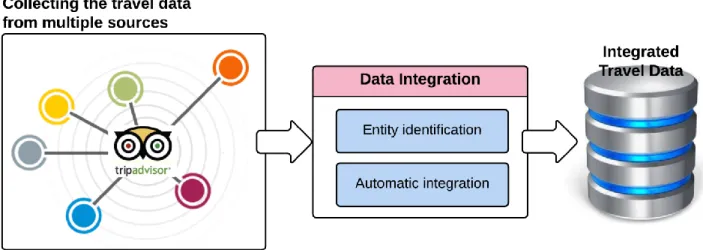
Figure 1. Twitter dataset, preprocessing procedure. The raw Twitter dataset, containing a corpus of 1.6 million tweets, is preprocessed through several modules. The hash tags and hyperlinks are removed from the tweets. And, the target users are eliminated. The preprocessed clean data are stored in Tweets Database. ... 25 Figure 2. The travel data collection and integration procedure. TripAdvisor was selected as the target
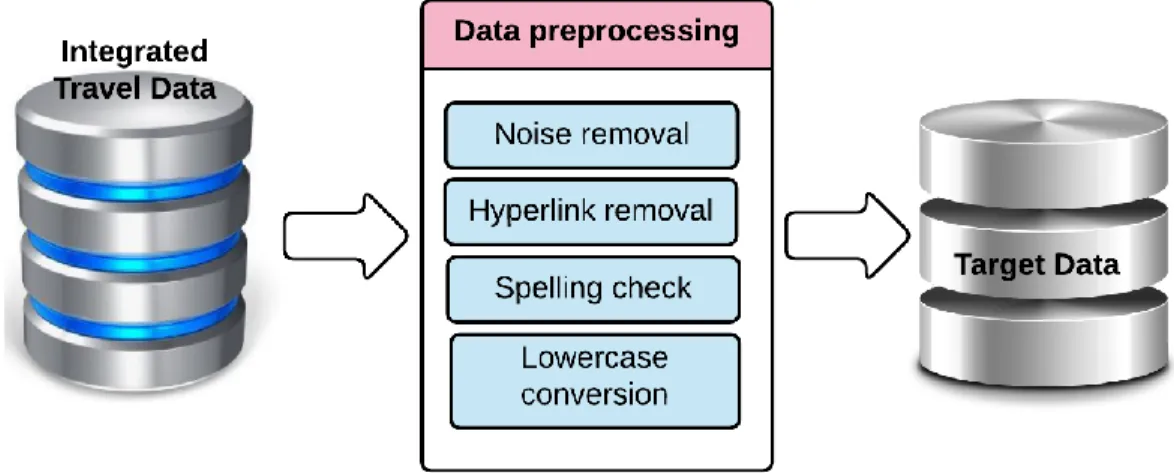
data source. The required data were collected from multiple sources, each covering different aspects of TripAdvisor. The collected data was then automatically integrated into a single MySQL database, named Integrated Travel Data. ... 26 Figure 3. Integrated Travel Data, preprocessing procedure. Further cleaning and preprocessing were
performed on the Integrated Travel Data through removing noisy data, checking for the spelling errors, eliminating the hyperlinks, and converting the data to the lowercase. The processed travel data were stored in another dataset named, the Target Data. ... 27 Figure 4. The intelligent sentiment analysis sub-system. The model is first trained and built using the
Tweets Database. A text mining engine was designed and implemented to preprocess the data, and to transform the textual data to feature vectors that are appropriate for the machine learning classifier. The transformed data were used to train the machine learning classifier, and to build the sentiment analysis model. The trained model was stored and then used to detect the polarity of users’ reviews and to extract the implicit features. For this purpose, a polarity score is calculated, reflecting the polarity of a given review, along with its intensity. ... 29 Figure 5. The 10-fold cross validation design of the sentiment analysis module. The data is split into
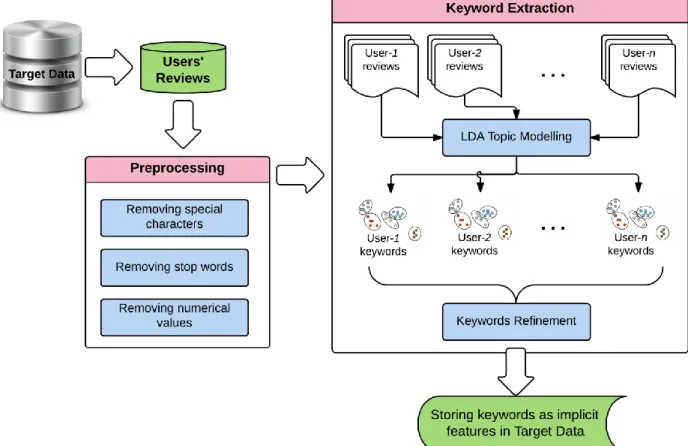
10 equal size sets, named as folds. The process is run 10 times. In each run, one set is fold aside for validation and the other 9 folds are used for training the model. The accuracy of the model is calculated on the test fold. ... 31 Figure 6. The keyword extraction sub-system. Users’ reviews are first extracted from the Target Data
and are then preprocessed. The special characters and stop words are removed from the data, and numerical values are also eliminated. The preprocessed data are then fed into the keyword extraction module where machine learning LDA topic modelling technique is used for extracting the keywords for each user based on their reviews. The detected keywords list is then manually refined. The final result is stored in the Target Data. ... 33 Figure 7. The rough design of the recommender engine. The system contains three main modules,
namely user clustering, matrix factorization, and the hybrid recommender system. Users are first clustered based on various features. The selected cluster is then fed into the matrix factorization module and the hybrid recommender system. The output of the mentioned two modules forms the final recommendations of the system. ... 35 Figure 8. Clustering the users. Two main sources of users’ data are applied for the clustering, i.e.
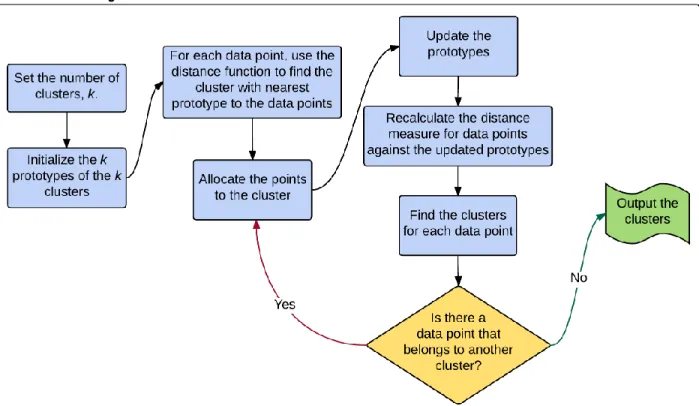
users’ demographics and the detected keywords. Employing these explicit and implicit features, the users are then clustered using a K-Means based clustering approach. ... 36 Figure 9. Internal design of the Users Clustering Module. The module implements K-Prototypes
clustering algorithm. The algorithm is similar to K-Means but it works with both numerical and categorical features. K prototypes are first randomly initiated, and using a distance function, data points are placed in the nearest prototype. The prototypes are then updated,
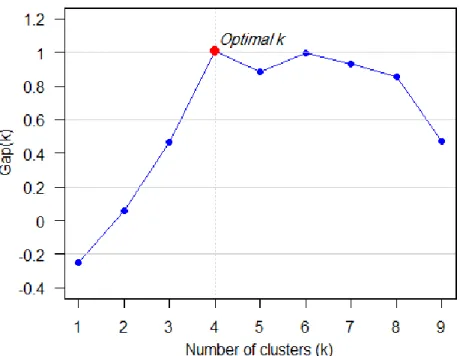
ix and the procedure is repeated until no further movement of data points between the clusters is possible. ... 37 Figure 10. Gap statistic vs. various number of clusters. The statistic is maximized at k = 4, indicating
the estimated optimal number of clusters... 40 Figure 11. The trend of 𝐷𝐺𝑘 = 𝐺𝑎𝑝𝑘 − (𝐺𝑎𝑝𝑘 + 1 − 𝑆𝑘 + 1) vs. various numbers of clusters. 𝑫𝑮𝒌
becomes positive for the first time at k = 4, which confirms that the data contains 4 different clusters. ... 40 Figure 12. The matrix factorization module. The module takes the selected user cluster as the input
and decomposes the users-hotels matrix into a product of two matrices. ... 43 Figure 13. The hybrid recommender system design. The system contains of three main sub-modules:
(1) user-based collaborative filtering module, (2) item-based collaborative filtering module, and (3) multi-criteria recommender. The user-based collaborative filtering module recommends items based on users similarities, whereas the item-based module makes recommendations based on the items similarities. The multi-criteria recommender considers various multi-aspect ratings on hotels for making the recommendations. The hybrid recommender system produces four different outputs, i.e. recommendations made by each of the mentioned sub-modules along with an integrated composite set of recommendations which is made by combining all the three previously stated recommendations. ... 44 Figure 14. Leave-one-out cross validation design used for testing the performance of the proposed
recommender system and validating the results... 48 Figure 15. Prediction-based metrics for the user-based collaborative filtering module. According to
the measures, the user-based CF module is able to predict the ratings for user-hotel pairs with high accuracy. The small difference between RMSE and MAE measures also indicates that the variance in the individual errors is relatively small. ... 53 Figure 16. Decision-based performance metrics, calculated for the user-based collaborative filtering
module. The module is highly accurate (83.6%) in predicting the user-hotel preferences and recommending correct hotels to the users. According to the specificity and sensitivity measures, the model is effectively learning user preferences, capturing both true positives and true negatives. The informedness measure also shows that the system is making informed decisions in recommending hotels to the users. ... 54 Figure 17. NMF module root mean square error (RMSE) versus number of components. As
highlighted by a blue dot on the figure, RMSE is minimized when the user-hotel rating matrix is factorized into two matrices. ... 56 Figure 18. NMF module root mean square error versus number of iterations. As seen, RMSE remains
constant after ~24 iterations. ... 57 Figure 19. Prediction-based metrics for NMF module. According to the measures, the NMF module is
able to generate the original matrix and predict the ratings for (unseen) user-hotel pairs with very high accuracy. ... 58 Figure 20. Prediction-based metrics for the MCR module, using implicit and explicit ratings.
According to the measures, the MCR module is able to incorporate all the given aspects for ratings and to predict the ratings for user-hotel pairs with high accuracy. The small difference between RMSE and MAE measures also indicates that the variance in the individual errors is considerably small. ... 60
x Figure 21. Decision-based performance metrics, calculated for the multi-criteria recommender
module. The accuracy of the module in predicting the user-hotel preferences and recommending correct hotels to the users exceeds 90%. According to the specificity and sensitivity measures, the model is highly potential in learning user preferences, capturing both true positives and true negatives. The informedness measure also indicates the high ability of the system in making informed decisions. ... 61 Figure 22. Prediction-based metrics for the MCR module, using only implicit multi-aspect ratings.
According to the measures, the second scenario shows lower performance in comparison with the first one where the implicit rating was also included. The difference between RMSE and MAE measures indicates that the variance in the individual errors is not very small. ... 62 Figure 23. Decision-based performance metrics, calculated for the MCR module, using only explicit
multi-aspect ratings. The accuracy of the module in predicting the user-hotel preferences and recommending correct hotels to the users is ~ 89%. According to the specificity and sensitivity measures, the model is very potential in learning user preferences, capturing both true positives and true negatives. But, it performs slightly lower than the first scenario where implicit and explicit ratings were used. The informedness measure also indicates the high ability of the system in making informed decisions... 63 Figure 24. Prediction-based metrics calculated for the composite set of recommendations. The results
again confirm the high performance of the proposed system. The relatively small difference between RMSE and MAE measures indicates that the variance in the individual errors is small. However, the difference itself declares that there is some variation in the magnitude of the errors, although large errors are very unlikely to have occurred. ... 64
xi
List of Tables
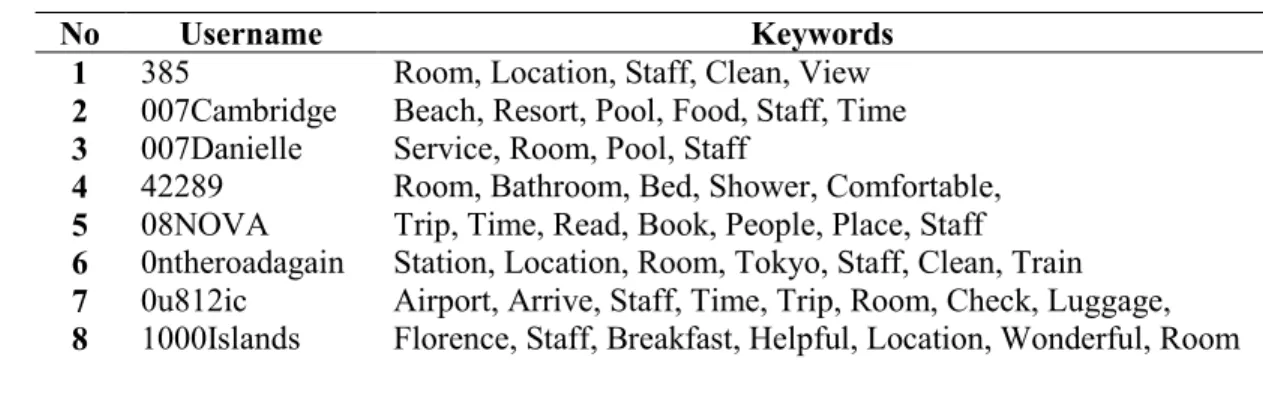
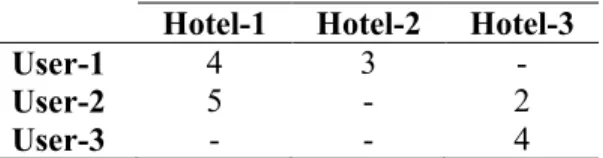
Table 1. List of detected keywords for 10 randomly selected users... 34 Table 2. A sample dataset of user-hotel ratings ... 41 Table 3. Comparing the performance of the proposed hotel recommender system with similar existing
1
1.
INTRODUCTION
Recent progress in information technology has provided us with various sources of data about almost everything. Although the availability of large-scale data can be beneficial, it can also make the decision making process more difficult. Users and customers have a lot of options to choose from which might make them confused in selecting the best possible and/or the most suitable item. In this sense, it is important to filter the information and personalize it for the use of each specific user. Recommender systems are one of the means for making personalized suggestions of items to the users based on their needs and preferences.
Nowadays, recommender systems are being widely used in different services covering vast area of applications. Following the boom in tourism industry and data technology during the past decade, the travel recommender systems have attracted considerable attention of researchers. As a tourist, most of the times, it is really confusing to decide where to go and to select among a large number of possible destinations, especially for unseen and unfamiliar places (Ricci, 2002). Hence, information retrieval and decision support systems are widely recognized as valuable tools in this context. In this respect, tourism and travel recommender systems have become a hot topic recently and attracted the attention of both researchers and companies.
However, most of the existing recommender systems in tourism employ a simple method which, in general, compares the profile of a given tourist with certain features of the available items (e.g. destination) and use them to predict the tourist’s preferences (Ricci 2002; Gavalas & Kenteris, 2011). This is especially true about mobile recommender systems (Yang & Hwang, 2013). In such systems, a given tourist, i.e. the user, is asked to provide the system with a set of parameters that represent his/her interests, needs or limitations which are used by the system to make the recommendation by correlating the user’s responses with the available destinations/packages. These methods are also called content-based recommendations (Gavalas & Kenteris, 2011).
Another approach is obtaining useful information from other tourists who have common or similar interests to the given user. In addition, systems can also benefit from the fact that travelers who are in close proximity might share common needs or interests (de Spindler et al., 2006). Despite the recent advances in travel recommender systems, most existing recommender
2
systems have been unsuccessful in exploiting the information, reviews, or ratings that are being provided by similar tourists (Yang & Hwang, 2013).
In this thesis, an intelligent hybrid travel recommender solution is proposed. The proposed recommender engine is based on both the content data and similarities among users, exploiting implicit and explicit users’ feedbacks. In addition, using data sources of different types, it employs multi-criteria rating approach to better capture users’ preferences and augment the accuracy of the recommendations. The system is designed in different layers, using multiple sub-recommender systems each addressing specific aspect of the subject problem, aiming to increase efficiency and effectiveness of recommendations by considering. The proposed system is trained with TripAdvisor data collected from multiple sources and integrated into a single database. The final solution is verified and tested in different settings and scenarios to confirm and validate its accuracy.
The remainder of the document is organized as follows. The next chapter presents the background of the subject and reviews the respective literature. In Chapter 3, the objectives of the research are stated while Chapter 4 discusses data and methodologies used for the analysis. Chapter 5 reports the evaluation results while the conclusions are presented in Chapter 6. Chapter 7 suggests some directions for the future research and addresses the limitations.
3
2.
LITERATURE REVIEW
The first papers on collaborative filtering recommenders were published in mid 1990s (e.g. Resnick et al., 1994; Shardanand & Maes, 1995). Since then recommender systems have always been an important research field in machine learning. Recommender systems can be regarded as tools that directly help users to find their required products, services or contents (e.g. book, music, movie, web site, etc.) through aggregating and analyzing the activities and suggestions obtained from other users in terms of reviews and ratings (Frias-Martinez et al., 2006; Frias-Martinez, Chen, & Liu, 2009). In general, such systems are created on computed probabilities for users versus items or the similarity between users.
In a broader context, recommender systems are categorized into content-based filtering (CB) and collaborative filtering (CF). CF systems employ information filtering techniques on users’ purchase history or users’ previous reviews/ratings on the items. Although this technique has been widely used in various applications, it suffers from at least two major issues: 1) sparsity, and 2) scalability (Claypool et al., 1999; Sarwar et al., 2000). In CB method, the contents of the user’s reviews are being analyzed to infer the user profile which can be used to predict and recommend further items (Basu, Hirsh, & Cohen, 1998). However, CB recommender systems mainly propose items that are very similar to what user has bought before or the user is well aware of. The reason is that such method measures similarities between items which share same features or characteristics (Blanco-Fernández et al., 2008). The relevant literature is reviewed in more detail in the rest of this section. In addition, a number of applications of recommender systems are discussed.
2.1
Recommender Systems, Applications and Examples
Recommender systems have several applications and are being used in a wide variety of fields and contexts ranging from online shopping and social networks to even intelligent health solutions. Although they were traditionally introduced in the World Wide Web applications, we can now see them even on mobile devices. Therefore, due to the availability of large-scale data, the use of recommender systems in data-intensive fields or applications where a given user should choose from a variety of options seems inevitable. Such systems facilitate the decision making process by providing the users/customers with personalized items/products which fit
4
their expectations and preferences. Moreover, recommender systems can provide users with a wide range of items to compare which will result in a better decision. They can also provide the user with the ability to explore the products, discover the interesting items (according to the given user), through a personalized recommendation system. Due to the mentioned reasons, recommender systems have become extremely common especially in recent years.
Four common functionalities can be considered for recommender systems: 1) To predict rating that a user u might give to an item i. This is one of the most studied areas in recommender systems literature, which attracted the attention of researchers especially right after the Netflix challenge (Bennett & Lanning, 2007). 2) To predict the ordering of items according to a measure, this is called the ranking prediction problem. In this context, the system focuses on the fact that the items with the highest predicted ratings are not necessarily the best items for a user. Thus, system distinguishes among the items that the user likes and the items that the user already know about them (Herlocker et al., 2004). 3) Contextual non-personalized item-to-item recommendation in which for an item i a list of similar items is generated. This is being widely used by Amazon. 4) Personalized recommendation of items, which also called item-based top-n recommendation (Karypis, 2001; Deshpande & Karypis, 2004).
Some of the most popular applications of recommender systems are found in recommending commercial products (Schafer, Konstan, & Riedl, 2001) such as movies, music, books, or suggesting a research paper or partner, and even friend suggestion in social media. In the rest of this section, Amazon, a well-established commercial recommender system, Lifetrak, a well-documented academic project developed at the University of California, and Last.fm a social music platform are discussed in detail.
2.1.1
Amazon
Amazon1, an American e-commerce and cloud computing giant, is one of the biggest online stores in the entire world and is the largest online retailer in the United States (Jopson, 2011). Started as an online bookstore in 1994, it now sells a wide variety of goods such as books, CDs, DVDs, MP3 downloads and streaming, etc. Recently, they offered new and slightly
1 http://www.amazon.com
5
different categories of products such as electronics, furniture and even food. Meanwhile, it is ranked as one of the world’s largest providers of cloud infrastructure services.
Amazon has one of the most famous recommender systems which is mostly used as an example of a recommender system to non-technical people. The algorithm is mainly based on item-based collaborative filtering and it tracks the items that a customer has bought before making similar recommendations. Customers can rate back their purchases using a 5-star rating scale, which helps the recommender system to improve its recommendations. More interestingly, Amazon follows the products that a customer is currently looking for to propose complementary items (named better together) or suggest other items that previous customers have bought in combination with the target product (called customers who bought this also bought).
2.1.2
Lifetrak
Lifetrak is a music player which provides the user with a context-aware music experience (Reddy & Mascia, 2006). The context-aware music engine is influenced by several factors such as user’s location, time of operation, and the environment information like weather and traffic. The system is also using users’ feedbacks on the recommended songs to assess whether the suggested music was appropriate for that particular context. The song rating is relatively simple and uses some forms of content-based approach. Lifetrak was designed for mobile devices.
2.1.3
Last.fm
Last.fm2, launched in 2002, is a British music platform which uses a music recommender system called Audioscrobbler. Audioscrobbler is a personalized recommender system which tracks the musical interests of the users. The user can explicitly rate music tracks in a binary-scale rating, i.e. love it or hate it. In addition, an implicit rating approach is also implemented which takes the listening time as a measure of satisfaction and uses it to improve the recommendations. Audioscrobbler is also based on collaborative filtering algorithm through creating a detailed record for each user. It not only analyzes the songs that a user has listened to but also uses its huge social network data to make the recommendations.
2.2
Recommender Systems, Requirements
6
In order to have an operational and functional recommender system, a number of requirements or mandatory operational functions should be considered. In this section, such requirements are briefly discussed.
2.2.1
Multiple Data Sources
A highly operational recommender system should be able to use multiple data sources, since in most of the cases, especially in industrial applications, the designed system might be used in different contexts. For example, it might be working with or without accessing the items’ metadata. Another reason is due to the evolution and change of the context over time. This ability and flexibility of the system can be also useful for overcoming the cold-start problem (Burke, 2007), which will be discussed in the next section.
2.2.2
The Cold-Start Problem
The cold-start problem refers to the beginning stage of launching the recommendation system within which the system might not be able to provide useful recommendations, mainly due to the lack of enough data (Su & Khoshgoftar, 2009). Thus, an operational recommender system should be able to manage the cold-start problem. Several approaches are available for dealing with the cold-start problem. One of the approaches for managing the cold-start problem is using metadata or socio-demographic data to infer the profiles (Nguyen, Denos, & Berrut, 2007). Another way would be employing external data, e.g. other usages of the items that are better known, to make the recommendations (Poirier, Fessant, & Tellier, 2010). The external data can be used until the system gathers enough data about the objects. Another related problem is about new items or new users for which the system again does not have enough data (Adomavicius & Tuzhilin, 2005).
2.2.3
Robustness
The recommender system is needed to be robust against noisy or corrupted data. This becomes even more important if the system uses multiple data sources. For example, if in a collaborative recommender, rating logs are corrupted it can highly affect the performance of the system. Thus, the robustness is an important issue which is linked with the system performance (Lam & Riedl, 2004), and some measurements should be taken before using the data. Another
7
example is in social networks where a lot of fake users might exist, hence, their profiles and ratings should be filtered out before applying the recommendation process.
2.2.4
Scalability
Like all the computer systems, scalability is a key factor for recommenders. The system should have been designed to work efficiently and effectively, even if the number of users or items increase unexpectedly (Takács et al., 2009). That is the quality of systems and its performance should not suffer from increased number of users or items.
2.2.5
Transparency
The recommender system design should be easy to explain and a confidence index should be provided for its recommendation (Basu, Hirsh, & Cohen, 1998). This plays an important role for a recommender system to be accepted by the users (Bilgic, Mooney, & Rich, 2004).
2.3
Recommender Systems Topologies
Several topologies exist for recommender system and a number of classifications of recommender systems can be found in the literature. In this section, three main categories of recommender systems are discussed.
2.3.1
Classical Categorization
According to the classical categorization, recommender systems can be divided into three types as: 1) collaborative filtering, 2) content-based filtering, and 3) the hybrid systems. This classification has been widely used in the literature (e.g. Adomavicius & Tuzhilin, 2005). This classification is mainly based on the type of the input which is used in recommender systems. In collaborative filtering, users’ logs along with users’ ratings on items are used. In content-based filtering items’ metadata are mainly used. In collaborative filtering users’ logs are compared based on some similarity measure, where in content-based filtering the metadata are compared to find users’ preferences on items. Hybrid recommenders are a combination of the both mentioned methods. These methods will be discussed in more detail in Section 2.4.
8
2.3.2
Su and Khoshgoftar Categorization
Su and Khoshgoftar (2009) proposed a classification of purely collaborative systems, thus it can be considered as a sub-classification of recommender systems which is limited to the collaborative methods and hybrid techniques. They classified the collaborative systems into three sub-categories: 1) memory-based collaborative techniques which are mainly based on the nearest-neighbors algorithm, 2) model-based collaborative systems which covers a wide range of techniques such as clustering, matrix factorization, Bayesian networks, and Markov decision process, and 3) hybrid collaborative filtering systems in which a collaborative filtering approach is combined with other collaborative methods.
2.3.3
Rao Categorization
Rao (2010) focuses on the source of information which is used in the recommender system and proposes another classification of recommender systems as follows: 1) content-based filtering methods in which the system uses correlations among items, or matches item features with users’ profiles to make the recommendation, 2) collaborative filtering which focuses on users and the items that they have used, 3) demographic filtering in which a priori knowledge is available on the groups of users and can be used to build stereotypes to be linked with the list of items, 4) hybrid filtering methods which are a combination of collaborative filtering and content-based filtering, 5) knowledge-content-based recommender systems where a priori knowledge about the relationships between users and items are available, and 6) utility-based recommenders in which a utility measure is calculated for a user and an item.
2.4
Recommender Systems Approaches
The root of modern recommendation techniques is traced back to information filtering where the irrelevant data to a given user is filtered out (Huang, Chung, & Chen, 2004; Kantor et al., 2011). Different algorithms have been used for designing and implementing the recommender systems. Each approach has its own advantages and drawbacks. In this section, the state-of-the-art is presented and some common approaches which were briefly presented in the previous section are discussed in detail.
9
2.4.1
Collaborative Filtering
Collaborative filtering is based on the nature of humans, that is people share ideas and opinions and explicitly or implicitly influence each other’s decisions. In collaborative filtering, the opinions of other (similar) people are evaluated to infer the required information (Schafer et al., 2007). For this purpose, the interests of users are predicted through collecting related information from a large number of similar users. This method is based on the assumption that those people who agreed in the past will more likely continue to agree in the future. In real-life problems (e.g. e-commerce), systems that are based on the collaborative filtering method should process a huge amount of information which apart from being resource-consuming, it might also harm the systems’ responsiveness. However, since collaborative filtering method has been in the core of researchers’ attention during the last decade, it is now considered as one of the prominent personalization techniques in the field.
As one of the fundamental approaches to recommendation, collaborative filtering has several forms. In user-based collaborative filtering, the recommendation is made to a user through finding other similar users and suggesting the things that they like (Resnick et al., 1994; Herlocker et al., 1999). In another approach, named as item-based collaborative filtering, the system finds and recommends similar items to those the user has already bought or liked (Sarwar et al., 2001; Deshpande & Karypis, 2004). Hence, item-based algorithms can be considered as the transpose of the user-based ones.
To find the similarity between users, a user-item preference matrix should be created. Such matrix can be of huge size in complex problems. Matrix factorization methods take the user-item matrix and decompose it into a more compact representation which is used to predict the preference of the items that a given user has not seen yet or to prioritize among a set of seen items. One of the common techniques in matrix factorization is called singular value decomposition or SVD (Deerwester et al., 1990; Sarwar et al., 2002). Gradient descent is mainly used for factorizing the matrix in a computationally efficient way; however, it does not contain all the properties of proper singular value decomposition (Funk, 2006). Other common techniques include factor analysis (Canny, 2002) and eigenvalue decomposition (Goldberg, 2001). After creating the preference matrix, collaborative filtering method calculates a similarity measure between the given user’s profile and the other users. Various distance-based or
10
correlation-based metrics can be used to calculate the profile similarity measure, e.g. Euclidean distance, Pearson correlation and cosine similarity to name the few. The final output will be a single item or a list of items (top n recommended items) which the given user will most likely be interested (Cosley, 2003).
Collaborative filtering techniques suffer from two main problems, namely sparsity and the first-rater problem. Sparsity problem arises as most users only rate a very small portion of the available items, making it very difficult to find similar users. The second problem is caused by the fact that an item cannot be recommended unless it has received a user’s rating. A special case would be newly added items which will be biased by such recommendation method (Melville, Mooney, & Nagarajan, 2001). Despite the mentioned drawbacks, collaborative filtering can provide the user with fitting recommendations which do not share almost anything with the items previously rated by the user. Thus, this method has been proven successful in a wide variety of domains and applications (McLaughlin & Herlocker, 2004).
2.4.2
Content-Based Filtering
Content-based filtering is another common approach for designing recommender systems which are based on items’ descriptions and users’ preferences (Brusilovsky, Kobsa, & Nejdl, 2007). Such systems mainly use a set of keywords to describe the items while in parallel a profile is built for users indicating the type of items they prefer. Hence, content-based filtering recommends items to a given user similar to the ones the user liked in the past. Content-based methods have been proven to perform well in text-intensive domains/applications where there is enough content associated with the items. However, this approach requires significant knowledge engineering efforts to provide/collect the needed metadata about the items (Melville, Mooney, & Nagarajan, 2001, Cosley, 2003; O'Donovan & Smyth, 2005). In content-based systems, users’ profiles are made independently from each other. For example, even if two categories of items are frequently agreed together by users, the system will never recommend items from a category if the user has not rated any items from that category. Therefore, a critical issue with content-based filtering is their ability to learn user preferences from users’ actions and behavior.
11
2.4.3
Knowledge-Based Recommender Systems
Knowledge-based recommender systems incorporate inferences about users’ preferences and needs to make the recommendation. The knowledge may sometimes contain explicit information about how certain characteristics of a product meets user’s requirements (Felfernig & Burke, 2008). In other words, such systems are based on the knowledge about user preferences, item groupings, and recommendation criteria and are applied in situations where other approaches (e.g. collaborative or content-based filtering) cannot be employed.
2.4.4
Demographic Recommender Systems
This type of recommender systems employs demographic profile of users/items for making recommendations (Krulwich, 1997; Pazzani, 1999). Collecting the accurate data in large-scale is one of the issues in the mentioned recommender systems where data are mainly collected and integrated manually from the users or from the product catalogues. Sometimes, such systems also employ a pre-generated demographic clustering of users/items (Vozalis & Margaritis, 2004).
2.4.5
Hybrid Recommender Systems
In hybrid recommender systems, two or more different recommender algorithms/techniques/approaches are combined, creating a composite recommender (Burke, 2002). The main purpose in applications is to use hybrid recommenders (of various types) which outperform the individual algorithms (e.g. Torres et al., 2004). One of the most important advantages of the hybrid recommender systems is the inclusion of algorithms that cover different aspects of the data and the subject problem in order to produce improved recommendations. For example, as seen before, one of the limitations of the item-based recommender systems is when there is no rating for an item. A hybrid recommender system can use text similarity measures to relate the new item with the existing items and increase the accuracy of the collaborative filtering method as users start rating the item.
Combining collaborative and content-based filtering methods in a hybrid framework has been considered by researchers recently where various approaches have been applied. Some examples are: using collaborative and content-based filtering separately and then combining their predictions, using collaborative filtering as the basis and adding content-based capabilities to the system, or incorporating both approaches in one model (Adomavicius & Tuzhilin, 2005). Netflix,
12
an American provider of Internet streaming media, is a famous example of the success of hybrid systems (Bennett & Lanning, 2007). Netflix analyzes the searching and watching preferences and habits of similar users (collaborative filtering) and recommends movies which have similar features as the ones the user has already highly rated (content-based filtering).
There exist a variety of studies combining various techniques to design a hybrid recommender system for different applications (e.g. Balabanović & Shoham, 1997; Melville, Mooney, & Nagarajan, 2001; Claypool et al., 1999). For example, Melville and his colleagues proposed a hybrid system, named content-boosted collaborative filtering (Melville, Mooney, & Nagarajan, 2001). They first employ content-based predictions and convert a sparse user rating matrix to a full user rating matrix. Collaborative filtering is then applied on the created matrix to make the recommendations. Their results show that the performance of the content-boosted collaborative filtering overcomes the recommender systems which use either content-based or collaborative filtering approaches.
According to Burke (2002), hybrid recommender systems can be divided into seven categories:
1. Weighted systems, in which the scores are generated by a variety of recommenders and are combined to make the final recommendation(s) to the users.
2. Switching recommenders, in which the system switches between different algorithms to choose the best possible solution in a particular context.
3. Mixed recommenders. They are slightly similar to the weighted systems and present the results of a number of different recommenders. The difference is mixed recommenders do not necessarily combine the results into a single list of recommendations.
4. Feature-combining systems, in which several data sources are employed as inputs to a single recommender algorithm.
5. Cascading recommenders, where a chain of several (mostly simple) different algorithms is used, feeding the output of a recommender to the input of the other one.
6. Feature-augmenting recommenders, in which the output of an algorithm is used as one of the input sources (features) of another algorithm.
7. Meta-level recommenders, which use an algorithm to train a model and then feed that model as an input to another algorithm.
13
Although hybrid recommender systems can often improve the accuracy, sometimes they incur considerable computational costs (Amatriain & Basilico, 2012). They are also useful for offering personalized recommendations by taking the requirements of different users or characteristics of different items into the account. In addition, in more complicated frameworks/applications, hybrid systems can be also implemented through integrating feature-based methods with collaborative filtering and forming a single learning model, which is often in the form of a matrix factorization model (e.g. Shan & Banerjee, 2010; Chen et al., 2012).
2.5
Recommender Systems - Data Sources and Targets
In general, four basic objects are used in recommender systems, namely users, items, users’ features such as age (range), and items’ metadata, where data can be about any meaningful two pairs of the mentioned objects, in any meaningful format such as Boolean or an integer. For example, if we consider users and items objects, the created matrix can contain users’ ratings on different items. Another example can be items and their metadata, which might provide us with an array of the catalog items. In this thesis, an example of item and metadata would be the case of users’ reviews about hotels and the extracted keywords (metadata) out of them. One should note that in most of the applications binary data sources are preferred, and the other data sources are sometimes converted to binary values (if required), based on the problem characteristics. Based on the objective of the recommender system, the target might differ. However, most of the recommender systems mainly focus on recommending items to users. There exist other targets for recommender systems, such as metadata or socio-demographic recommendations.
2.6
Recommender Systems - Common Algorithms
In this section a number of common algorithms that are widely used in recommender systems are discussed. Among those k-Nearest-Neighbors and Matrix Factorization are ones of the most common the methods which have been used in both academia and industry.
2.6.1
Association Rules
Association rules are a well-known technique in data mining, e.g. the Apriori algorithm (Agrawal & Srikant, 1994). Such techniques learn from the data and extract rules which predict
14
the occurrence of an item based on the other items’ occurrences. There are also a number of studies which employed association rules in the context of recommender systems (e.g. Mobasher et al., 2001; Lin, Alvarez, & Ruiz, 2002). However, association rules need to be adopted according to the application of the recommender system. That is in recommender systems any item can be recommended, thus the association rules should be able to capture the associations among any items, even if the support is small. Here, it becomes challenging since setting a small threshold for the support can lead to a large set of associations! There exist some heuristic approaches, such as adaptive support (Mobasher et al., 2001) and sliding windows (Davidson et al., 2010), to overcome the mentioned problem.
2.6.2
Bayesian Classifiers
In Bayesian network classifiers all features are considered as random continuous or discrete variables (Friedman, Geiger, & Goldszmidt, 1997). In particular, Bayes theorem and conditional probabilities are used in Bayesian classifiers to classify the given data through maximizing the posterior probability of the items’ class. In recommenders’ context, ratings can be considered as classes and the Bayesian classifier can be applied on the real-valued ratings. It is assumed that given a class (e.g. rating), users (or items) are independent, and thus the probability of the class is calculated. However, it is obvious that such assumption is not satisfied in collaborative filtering where it is assumed that users and/or items are related. For this reason, Bayesian classifiers are mostly coupled with another algorithm in recommender systems. For example, Candillier, Meyer, and Boullé (2007) coupled a Bayesian model with a k-Nearest-Neighbors algorithm.
2.6.3
Neural Networks
Neural Networks (NN) are widely used in computer science in a variety of applications (Bishop, 2006). Despite the large coverage of NN algorithms in machine learning, they are not so common in recommender systems due to several reasons such as their low convergence speed in high dimensional problems, or the fact that most of the time there is no need to employ NN as complex non-linear classifiers in recommenders (Pazzani & Billsus, 1997). Another drawback is about the black box effect of NN algorithms such that the output of the system might be hard to
15
interpret. However, some instances of NN algorithms were successfully used in recommender systems, e.g. fast matrix factorization techniques (Takács et al., 2008).
2.6.4
K-Nearest Neighbors
K-Nearest-Neighbor (KNN) based algorithms, also called memory-based algorithms, are widely used in the context of recommender systems (Su & Khoshgoftar, 2009). They can be considered as a generalization to the association rules as they go over all the items and/or users in the corpus. One of the serious limitations KNN approaches is their lack of scalability. Moreover, they might be time consuming in large-scale real-life applications as the time needed for building the model is quadratic, i.e. a function of squared number of objects in the corpus.
2.6.5
Matrix Factorization
It was in Netflix challenge when matrix factorization techniques became very popular (Bell & Koren, 2007). Matrix factorization algorithms are not only fast and accurate but also relatively easy to implement. However, they might be difficult to be adopted for item-item recommendations. In general, such techniques transform a given matrix into typically three simpler matrices. In recommender systems, matrix factorization techniques should deal with the missing values problem. The first matrix factorization approaches handled the missing value problem through replacing the missing values of the rating matrix (Sarwar et al., 2000), which was not an effective way since it resulted in large dense matrices. Another more effective approach is to use parameters and regularization (Takács et al., 2008).
2.6.6
Other Algorithms
There exists a wide range of machine learning algorithms and techniques that are being used in data mining projects and recommender systems. For example, Latent Semantic Analysis (Deerwester et al., 1990) is closely related to matrix factorization technique and is used for document representation. Other techniques that are worth mentioning include: Markov Decision Process (Shani, Brafman, & Heckerman, 2002), Boltzmann machines (Salakhutdinov, Mnih, & Hinton, 2002), and random walk systems (Jamali & Ester, 2009).
16
As discussed, there exist various approaches/algorithms towards designing the recommendation systems. Moreover, recommendation systems are being used in a wide area of applications/tasks. Hence, it is crucial to have some measures in hand to evaluate different techniques and designs in order to select the best possible solution for a given problem. Therefore, the final goal of the evaluation procedure would be to determine a recommender system’s capability and ability in a given context to meet the main objectives. This can be a difficult task since trying different algorithms to see which one is performing better on a given dataset can be very costly. In this section, several evaluation methods are presented and discussed.
2.7.1
Offline Evaluation
Offline evaluation method has been widely used for analyzing recommender systems (e.g. Breese, Heckerman, & Kadie, 1998; Gunawardana & Shani, 2009). Although offline evaluations suffer from some limitations, they are mostly used as a single measure of evaluation. In addition, offline evaluation is mainly used to evaluate a target algorithm behavior before its final deployment or to select a set of algorithms/designs from a larger set of the potential designs, to be tested by users. However, it is better to determine the best performing algorithms for a given problem prior to having them tested by users since user trials might be an expensive procedure.
Using separate training and test datasets in a cross validation module is a basic and common approach in offline evaluation. The data is split into two disjoint sets, namely training and test datasets, and a recommender model is built on the training dataset. Then, the test set is also split into two parts, named query and target sets. The query set is used by the recommender system to predict ratings for the items in the target set or to recommend items where the performance of the system is evaluated. The whole process is performed as a part of a k-fold cross validation module where the data is divided into k equal sets named as folds. Each fold is used once as the test set while the other folds are considered as the training set within an iterative process. The overall performance of the recommender system is then evaluated through aggregating the results of each run. This approach is useful in mitigating the effects of undesired variations in the test set (Gunawardana & Shani, 2009).
17
Various metrics can be used in offline evaluation approach for measuring the performance of the recommender systems. For example, mean absolute error (e.g. Shardanand & Maes, 1995; Herlocker, Konstan, & Riedl, 2002), or root mean squared error (e.g. Herlocker et al., 2004; Bennett & Lanning, 2007) are used as accuracy proxies. The accuracy proxies are good where explicit users’ ratings are available which makes it possible to compare the predicted rating with the exact values. Some other metrics such as precision/recall (Salton, 1992), F1 (Van Rijsbergen, 1979), ROC curves (Swets, 1963) can be also used to analyze the ability of the recommender system in distinguishing between relevant and irrelevant items. There exist other measures, e.g. mean reciprocal rank, that check how good is the recommender system in including at least one relevant item near the top of the list of recommendations. Discounted cumulative gain (Järvelin & Kekäläinen, 2002) is another similar measure which evaluates how good the recommender is in putting relevant items at the top and irrelevant items at the bottom of the list.
2.7.2
User-Based Evaluation
Offline evaluation method is relatively easy to implement and effective approach for examining recommender systems performance. However, one can make sure about the exact accuracy of a designed recommender system when it starts being used by real users of the system. If the recommender system succeeds to satisfy its users’ requirements, it will be highly rated. Hence, in some applications, it is crucial to test the recommender systems with real users, which is called user-based evaluation.
The tests might include field trials in which users are provided with the real recommender system and their satisfaction is measured against the proposed new system. A/B testing is one of the common approaches in field trials where users are split into two different sets, one set is being provided with the new recommender system while the other set uses the existing old approach, and then users’ satisfaction are compared. Apart from the field trials, another approach is performing qualitative statistical analysis. For example, surveys can be used to evaluate customers’ satisfaction. Qualitative analysis is quite common in evaluating the usefulness of a proposed system (e.g. McNee et al., 2002), or to asses users’ interactions with a particular system (e.g. Bollen et al., 2010).
18
2.7.3
More Discussion on Evaluation
Research on recommender systems mainly focuses on accuracy as a measure of higher performance (Herlocker et al., 2004). However, other aspects should be also taken into consideration while evaluating the recommender systems. In other words, accurate recommendations are not necessarily the most useful recommendations. In an interesting paper, McNee and his colleagues argue that the recommender systems community should go beyond the traditional accuracy measures and propose new user-centric directions for evaluating the performance of recommender systems (McNee, Riedl, & Konstan, 2006). Moreover, different algorithms with the same accuracy level might influence users and their satisfaction differently (McNee et al., 2002; Torres et al., 2004).
Recently, several studies have focused on non-accuracy metrics for evaluating the performance of recommender systems (e.g. Ziegler et al., 2005; Vargas & Castells, 2011; Willemsen et al., 2014). One of the factors that is being considered in these new methods is diversity of recommendations, meaning that if the user is provided with diverse sets of items to select from. Diversity has been already recognized in information retrieval (Carbonell & Goldstein, 1998; Clarke et al., 2008). Apart from diversity, novelty of recommendations has also attracted the attention of researchers (Vargas & Castells, 2011; Zhang & Hurley, 2008). Novelty focuses on the ability of the recommender system to suggest items that are completely new to the user. This idea is highly useful in entertainment industry (e.g. movies) where the aim is to suggest new unseen items to the user which turn out to be good. Other measures exist which target the stability of the recommender system in terms of recommendation rate changes over time (Burke, 2002; Adomavicius & Zhang, 2012). This measure deals with a trade-off since although stable recommender system might be more robust against unexpected changes (Lam & Riedl, 2004), the recommendations might be very predictable.
2.8
Travel Recommender Systems
Tourism is now considered as one of the largest industries in the world. According to the World Travel and Tourism Council (WTTC)3, the share of tourism industry of the global Gross
3 http://www.wttc.org
19
Domestic Product (GDP)4 will rise from 9.1% in 2011 to 9.6% in 2021. Nowadays, people can travel easier than before thanks to the advances in the overall living standards as well as progress in information technology which provides travelers with fitted and tailored information. A considerable number of travel agents and companies, e.g. TripAdvisor5 and Expedia6, are now providing online services to the potential tourists.
Although the booming tourism industry along with the rapid growth of online travel data have provided tourists with new opportunities and have made the travel easier, the availability of large-scale (digital) travel data and the diversity of the service providers have imposed new challenges to the travelers. As a tourist, it is sometimes very difficult to choose from a large number of available travel options. Moreover, the travel companies have also faced with new issues due to the tighter competition and the need to provide the customers with the best fitted package. Thus, the demand for highly intelligent travel recommender systems is increasing.
Recommender systems have been long used in online shopping, providing customers with a set of recommended items. However, travel recommendation is a more complex issue as tourists take both budget and time limitations into consideration (Herzog & Wörndl, 2014). In addition, things can become even more complicated if the system aims to analyze the trip routes as well and propose the best possible options according to the available money and preferred time frame. This is referred to as the tourist trip design problem (Souffriau et al., 2008) which is an extension of the orienteering problem where the objective is to maximize the sum of the scores of the location candidates while satisfying all the limitations (Vansteenwegen & Van Oudheusden, 2007).
As discussed earlier, a variety of algorithms exists for designing and implementing the recommendation systems in different applications and areas. Focusing on different aspects of tourism industry, researchers have recently concentrated more on travel recommendation systems. Using online travel information, Liu et al. (2011) proposed a personalized travel package recommender. They developed a Tourist-Area-Season Topic model (TAST) which considered tourists’ interests along with a number of extracted features such as region, location
4 GDP can be thought as the size of economy. It represents the total value of all goods and services produced within a specific time period.
5 World’s largest travel site. For more information, see: http://www.tripadvisor.com 6 http://www.expedia.com
20
and season of the travel. The TAST model was then used in a cocktail approach to make the final personalized recommendations.
Case-based systems can be regarded as a sub-category of the content-based algorithms where the items are structured as different cases based on their features, and the created cases are compared to a given user’s profile and interests to recommend the most similar cases (Smyth, 2007). Such recommender systems have been already applied for travel recommendations. A specific example is when the cases are grouped together in order to recommend a longer trip while still satisfying the user’s limitations. However, in most of the implemented recommenders in this area, the dependencies between different parts of the case are not considered. In addition, calculating the score (rating) for all the possible combinations is not always computationally feasible (Herzog & Wörndl, 2014).
Therefore, heuristics are mostly applied here which recommend a local optimum. Xie et al. (2010) developed a composite recommender system which can leverage from one or more internal smaller recommenders, focusing on both the quality of recommendations and run time, to suggest the top-n packages. In another study, Angel et al. (2009) proposed an algorithm which provides the best recommendations, using a set of keywords. The approach is based on bundling the recommendation packages through analyzing the relationships and associations among different entities in the system. They also employed early pruning techniques and termination strategies to increase the efficiency of the algorithm. In another work, Souffriau et al. (2008) tackled the tourist trip design problem (TTDP) and analyzed its relation with the orienteering problem and presented an algorithm which is based on the guided local search meta-heuristic approach. Yang et al. (2011) also focused on TTDP and designed a cost-aware travel recommender system. In a similar study, Lu and his colleagues (2011) proposed an optimal trip recommender and planning system, named Trip-Mine, which mainly concentrates on travelers’ time limitations.
Ricci et al. (2006) proposed a trip recommendation methodology, named Trip@dvice, which builds a case-based recommender that supports the selection of the travel products, e.g. hotels, and also suggests a travel plan. The systems stores recommendation sessions and uses them as cases. To improve the recommendations, users can give direct feedback and make changes on queries during the recommendation process. Schumacher and Rey (2011) analyzed
21
recommender systems for dynamic packaging of tourism services and claimed that case-based recommenders and association rules are the best solutions for tourism recommender systems. In a recent study, Chen and his colleagues (2013) build a hybrid recommender system which uses item-based collaborative filtering to predict the interests of a given tourist through collecting information from other tourists. Their proposed system uses genetic algorithm and minimizes a cost function to find the best traveling route out of a set of candidates. Tan et al. (2014) proposed an object-oriented recommender system as a framework for developers for designing personalized travel package recommender systems. The additional context information can be also imported to the framework, where different types of the additional information are considered as features. The object is next defined as a set of features and topic modelling approach or Bayesian networks are used to extract the implicit relationships among the objects. In the next section, research gaps are discussed.
2.9
Research Open Problems in Recommender Systems
As discussed, recommender systems have been studied before. Recently, a new wave of interest in travel recommender systems has been observed in computer science community. Although a number of works has been done in this area, the problem of exploiting unique and case-specific features to design highly accurate personalized travel recommender system is still open (Liu et al., 2011). In other words, there exists no general best approach which outperforms all the available algorithms in all situations. The design of the travel recommender system is highly dependent on the available data, the explicit and implicit data features, and the target market and application. Several studies focused on the mentioned drawbacks of recommender systems, mainly CB and CF methods, during the last decade trying to improve the techniques. Although it is widely accepted that recommender systems can be regarded as useful tools for providing users with tailored information and recommendations, due to the broad range of applications more effort is needed to design well-established solutions for real-life problems (Park et al., 2012).
The design and implementation of personalized hotel recommenders face several challenges. The first challenge is the sparsity of customers’ travel information in comparison with other products such as books or movies. One reason might be the higher cost of travel in comparison with other entertainments, e.g. going to the cinema, which has led to fewer travel
22
data. In addition, it is quite common to watch several movies in a month or even watch a brilliant movie a number of times, however, it rarely happens that an average customer goes on a trip more than two times per year. Thus, the feedbacks that are used in travel recommender systems are also sparser than other traditional recommenders, calling for a better feature engineering and exploiting both implicit and explicit feedbacks.
As mentioned, a lot of work has been done on improving the algorithms used in recommender systems. However, more research should be done in real-life specific problems/situations, as the field of recommender systems is less mature than other research areas (Park et al., 2012). In addition, using multiple-source data types for extracting implicit and explicit domain-specific features is rarely seen in similar studies. To address the mentioned gaps and weaknesses and to tackle the challenges, a personalized highly intelligent hybrid hotel recommender system is designed and implemented in this thesis. The system uses multiple sources of data for feature extraction. In particular, a sentiment analysis module is implemented which goes through the users’ reviews, in form of textual data, and extracts implicit features and scores which are used in the recommendation engine. To the best of our knowledge, this is the first time that an automatic comprehensive sentiment detection module is used inside a hybrid hotel recommender system. A huge Twitter dataset is used to train the sentiment analysis module. In addition, an automatic keyword extraction module is designed to analyze the users’ reviews on each hotel and extract complementary implicit data features on hotels for users as well. Moreover, to improve the accuracy and the speed of the recommender system, users are divided into different clusters based on their interests and similarities which are further used to provide the recommendations for a given user. Finally, multiple-criteria rating system is also embedded into the recommender engine to select the best possible hotel candidate(s) for a user. This is also rarely seen in hotel recommender systems where most of the approaches are based on single-rating system. The data collection procedure and design of the proposed system are discussed in detail in Section 4.
23
3
RESEARCH OBJECTIVES
The general objective of this research is to design and implement a personalized, highly intelligent multi-criteria hybrid hotel recommender system. The system will use a number of machine learning techniques and technologies to propose a tailored recommender system, to be used in a Montreal-based Startup Company. For the first time in the field, a comprehensive sentiment analysis and topic modeling (keyword extraction) will be applied on users’ reviews to extract implicit features about users and hotels, to be used in a hybrid recommender engine along with a number of explicit data features of different types. The specific objectives of the research are:
Extract and collect required data for training the sentiment analysis module to be applied on users’ reviews. Data should be labelled reflecting the positivity and negativity of sentences.
Automatically extract keywords out of users’ reviews for each hotel and user, and use them as implicit features in the recommender engine, reflecting implicit interests and highlights for each hotel as well as a user.
Extract the required travel data from multiple online sources and integrate them into a single dataset. The data will be used for training and building the models.
Build a multi-criteria data tensor which covers ratings on several aspects of the hotels (and as a result the travel package) such as the overall rating, location rating, value rating, cleanness rating, etc. The multi-criteria recommender model will be built on the data tensor.
Design and implement highly accurate well-tailored hybrid