computing for vehicular message dissemination
Article (Accepted Version)
http://sro.sussex.ac.uk
Ayaz, Ferheen, Sheng, Zhengguo, Tian, Daxin and Guan, Yong Liang (2020) A
Proof-of-Quality-Factor (PoQF) based blockchain and edge computing for vehicular message dissemination. IEEE
Internet of Things. ISSN 2327-4662
This version is available from Sussex Research Online: http://sro.sussex.ac.uk/id/eprint/93995/
This document is made available in accordance with publisher policies and may differ from the
published version or from the version of record. If you wish to cite this item you are advised to
consult the publisher’s version. Please see the URL above for details on accessing the published
version.
Copyright and reuse:
Sussex Research Online is a digital repository of the research output of the University.
Copyright and all moral rights to the version of the paper presented here belong to the individual
author(s) and/or other copyright owners. To the extent reasonable and practicable, the material
made available in SRO has been checked for eligibility before being made available.
Copies of full text items generally can be reproduced, displayed or performed and given to third
parties in any format or medium for personal research or study, educational, or not-for-profit
purposes without prior permission or charge, provided that the authors, title and full bibliographic
details are credited, a hyperlink and/or URL is given for the original metadata page and the
content is not changed in any way.
A Proof-of-Quality-Factor (PoQF) based Blockchain
and Edge Computing for Vehicular Message
Dissemination
Ferheen Ayaz,
Student Member, IEEE,
Zhengguo Sheng,
Senior Member, IEEE,
Daxin Tian,
Senior
Member, IEEE
and Yong Liang Guan,
Senior Member, IEEE
Abstract—Blockchain applications in vehicular networks can offer many advantages including decentralization and improved security. However, most of consensus algorithms in blockchain are difficult to be implemented in a Vehicular Ad-Hoc Networks (VANET) without the help of edge computing services. For example, the connectivity in VANET only remains for a short period of time, which is not sufficient for highly time consuming consensus algorithms, e.g., Proof-of-Work, running on mobile edge nodes (vehicles). Other consensus algorithms also have some drawbacks, e.g. Proof-of-Stake (PoS) is biased towards nodes with higher amount of stakes and Proof-of-Elapsed-Time (PoET) is not highly secure against malicious nodes. For these reasons, we propose a voting blockchain based on Proof-of-Quality-Factor (PoQF) consensus algorithm, where threshold number of votes is controlled by edge computing servers. Specifically, PoQF includes voting for message validation and a competitive relay selection process based on probabilistic prediction of channel quality between transmitter and receiver. The performance bounds of failure and latency in message validation are obtained. The paper also analyzes the throughput of block generation, as well as the asymptotic latency, security and communication complexity of PoQF. An incentive distribution mechanism to reward honest nodes and punish malicious nodes is further presented and its effectiveness against collusion of nodes is proved using game theory. Simulation results show that PoQF reduces failure in validation by 11% and 15% as compared to PoS and PoET, respectively, and is 68 ms faster than PoET.
Index Terms—blockchain, PoS, PoET, PBFT, edge computing.
I. INTRODUCTION
V
EHICLES equipped with on-board computers offer lim-ited computing and storage capabilities. However, in a vehicular edge computing (VEC) network, the mobile edge nodes (vehicles) with limited resources are able to offload heavy computational tasks to nearby Road Side Units (RSUs). One of the main objectives of VEC is to support infotainmentThis research was sponsored by H2020-MSCA-RISE (101006411 — SEEDS), National Natural Science Foundation of China under Grant No. 61822101, Beijing Municipal Natural Science Foundation No. L191001 and 4181002 and A*STAR under its RIE2020 Advanced Manufacturing and En-gineering (AME) Industry Alignment Fund–Pre Positioning (IAF-PP) (Grant No. A19D6a0053).(Corresponding author: Daxin Tian.)
F. Ayaz and Z. Sheng are with the Department of Engineering and Design, University of Sussex, Brighton, BN1 9RH, U.K. e-mail: ([email protected], [email protected]).
D. Tian is with the School of Transportation Science and Engineering, Beihang University, Beijing, 100191, China. e-mail: ([email protected])
Y. L. Guan is with the School of Electrical and Electronic Engineer-ing, Nanyang Technological University, 639798, Singapore. e-mail: ([email protected])
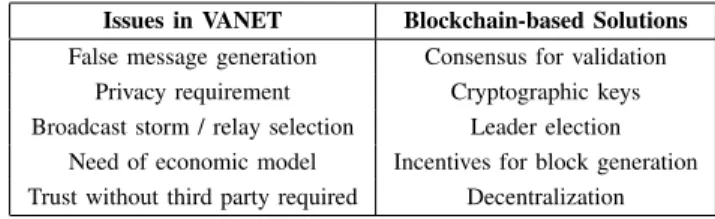
TABLE I: VANET issues & opportunities using blockchain. Issues in VANET Blockchain-based Solutions
False message generation Consensus for validation Privacy requirement Cryptographic keys Broadcast storm / relay selection Leader election
Need of economic model Incentives for block generation Trust without third party required Decentralization
applications and ensure road safety. However, due to high mobility of nodes and changing transmission rates, there are a large number of communications failures and delays between mobile nodes and RSUs [1]. For delay-sensitive applications, such as, emergency message dissemination, VEC allows nodes to exchange messages among themselves in a decentralized manner, forming a Vehicular Ad-Hoc Network (VANET). On the other hand, a blockchain is a distributed ledger which can record transactions in a trusted and credible environment without the requirement of a central authority. The fea-tures of blockchain, such as distributed nature, independence from third party and consensus to validate transactions, are some of the essential requirements of message dissemination in VANET. Therefore, the combination of blockchain and VANET can potentially result in secure and reliable vehicle-to-vehicle (V2V) communications [2]. Table I summarizes challenges associated with message dissemination in VANETs and corresponding solutions provided by blockchain. However, the dynamic network nature of VANET limits the connectivity between two nodes to a short period of time. Moreover, technical challenges, such as broadcast storm, packet collision and computing complexity need to be addressed in VANET environment while implementing blockchain [3]. Therefore, new blockchain solutions need to be developed using VEC networks for fully utilizing blockchain framework.
The consensus algorithm in a blockchain is used for trusting a transaction. Nodes undergo a validation process, termed as consensus, before recording a transaction in a block. The nodes participating in a consensus are mining nodes and the node which successfully generates a block is known as leader [4]. One of the most popular consensus algorithms is Proof-of-Work (PoW), in which all nodes attempt to find a solution to a hash puzzle. The node which finds the solution first is elected as a leader, it will add next block to the blockchain and earn mining incentive. The computation cost to find a solution of a hash puzzle takes around ten minutes [5]. Distribution
of huge computation load of PoW over the edge system is recommended as a solution but evaluation of cost and contri-bution of individual edge device in a heterogeneous network is still unexplored [6]. A number of time-saving alternatives to PoW have also been proposed. One of the most commonly used consensus algorithms with connected vehicles is Proof-of-Stake (PoS), where the reputation of a node is considered as stake [7], [8]. PoS reduces the latency of a consensus but does not provide a fair competition to elect a leader. It is biased towards nodes with higher amount of stakes. The fairness with less computation workload is achieved by another consensus algorithm, known as Proof-of-Elapsed-Time (PoET), in which each node generates a random number to determine the waiting time after which it can generate a block. However, existing literature proves its weakness in security and vulnerability in the presence of malicious nodes [9]. The Practical Byzantine Fault Tolerant (PBFT) consensus algorithm which requires at least 2f + 1 votes to validate a transaction, where f is the number of faulty nodes [10], is suggested to be suitable for vehicular applications because of its high throughput and ability to negotiate message validity [11], [12]. It is analogous to threshold based message validation in which a message is considered valid only if it is confirmed by a threshold number of nodes located in a close proximity of a sender [13]. The threshold value is crucial in such validation. A low threshold value may lead to false validation, whereas a high threshold value can result in increased latency. However, a threshold based message validation can be made efficient if the threshold value is adaptable to network conditions and requirements and can be varied using edge computing resources. It can be summarized that the measurements required to evaluate the performance of a consensus algorithm are
• Security: number of malicious nodes it can control with-out altering the original validity status of a transaction and its ability to resolve forks and prevent cheating.
• Validation latency: time required to validate a transaction.
• Throughput: number of blocks generated per second. This paper proposes a Proof-of-Quality-Factor (PoQF) con-sensus algorithm for vehicular networks, where the message validation and Quality Factor in determining multi-hop re-laying can be run efficiently on mobile edge nodes in a decentralized manner. For a successful packet transmission, Signal to Interference Noise Ratio (SINR) plays a crucial role [14], [15]. Therefore, SINR is considered as a metric in relay node selection. As SINR depends on the distances among nodes which vary with time in vehicular networks, the proba-bility that SINR exceeds a certain threshold is predicted using mobility models in which positions or distances are regarded as random variables following some probability distribution [16]. The main contributions of the paper are
• We propose a PoQF consensus, where mobile edge nodes serve as mining nodes. Instead of solving a hash puzzle, they select relays along with validating a message.
• We derive the bounds of failure and latency in validating a message as well as the throughput of block genera-tion. The asymptotic latency, security and communication complexity of PoQF are also discussed.
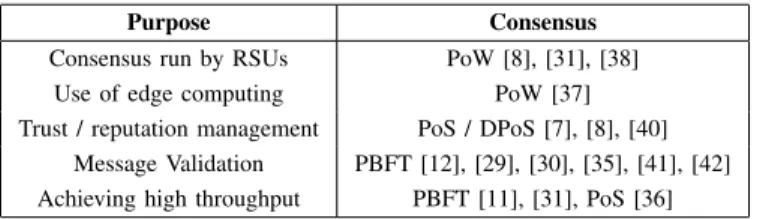
TABLE II: Consensus algorithms used in VANETs.
Purpose Consensus
Consensus run by RSUs PoW [8], [31], [38] Use of edge computing PoW [37] Trust / reputation management PoS / DPoS [7], [8], [40]
Message Validation PBFT [12], [29], [30], [35], [41], [42] Achieving high throughput PBFT [11], [31], PoS [36]
• We propose an incentive distribution mechanism to re-ward honest nodes and punish malicious mining nodes and analyze its performance using game theory.
The rest of the paper is organized as follows. Section II describes the related work. Section III explains the proposed blockchain design. The theoretical performance of our work is analyzed in Section IV. Simulation results are discussed in Section V and Section VI concludes the paper.
II. RELATEDWORK
A. Vehicular Edge Computing (VEC)
In [1], the challenges in VEC such as transmission failures and delays during offloading are addressed and a context-aware opportunistic offloading scheme utilizing fog computing is proposed. VEC is recommended as an efficient support to emerging applications such as Artificial Intelligence (AI), Software Define Network (SDN) and blockchain in [17]. The advantages of combining mobile edge computing, Internet of Vehicles (IoV) and AI are highlighted in [18] and [19]. Both of them suggest Deep Reinforcement Learning (DRL) as the key technique to bring intelligence in VEC networks. Collo-cating edge computing servers with radio access networks for satisfying latency requirements of message dissemination in IoV is proposed in [20]. In [21], the problem of inappropriate utilization of resources is resolved by blockchain.
B. Collective Mining
Existing literature aims to achieve a better performance of blockchain consensus, at the same time retaining its feature of decentralization. One of the solutions to improve validation latency and throughput in block generation is to introduce collective mining. In this scheme, multiple mining nodes collectively decide whether a transaction is valid and should be added to a blockchain [22]. Byzcoin is an example of collective mining [23]. It leads to parallel blockchain extension and the mining incentive is shared among all mining nodes. Bitcoin-NG [24] divides time into multiple slots. In each slot, a leader can append transactions until a new leader is elected. There are two types of blocks in Bitcoin-NG: keyblock and microblock. The leader is elected by solving a cryptographic puzzle. The keyblock stores the solution of hash puzzle and the microblock contains ledger entries. Another approach of collective mining is called sharding in which mining nodes are grouped into committees and work in parallel. Each committee runs PBFT consensus on different set of transactions (shards) at the same time for achieving a high throughput [25].
C. Blockchain based Incentive Distribution
Blockchain based economic model for incentive distribution in federated learning utilizing edge computing framework is recommended in [6]. Secure blockchain based incentive mechanisms are also proposed in literature to encourage coop-erative message delivery and data sharing in distributed peer-to-peer (P2P) applications. In [26], a pricing strategy to ensure successful message delivery using blockchain is presented and proved to be secure against collusion of intermediate nodes and receiver using game theory. It is proposed to verify transactions of incentives distributed among relay nodes by mining nodes. Similarly, in [27], P2P data sharing using public blockchain is proposed. Its incentive mechanism is analyzed by evolutionary game model and the cooperative behavior of nodes is analyzed by repeated game model. In both [26] and [27], the incentive mechanism is proved to encourage cooperation among nodes by including a charge mandatory to be paid by transmitting nodes. Incentive based message relaying in distributed P2P applications using blockchain is also proposed in [28] and proved to be secure against selfish behavior. In [26] - [28], the incentive distribution among relay nodes is proposed, but the incentive for mining nodes to promote participation and the type of consensus algorithm to be processed are not discussed. In [29] and [30], the incentive based message delivery in wireless ad-hoc networks for smart cities and Intelligent Transportation Systems (ITS) is presented, where message is validated using PBFT, and the incentives and privacy are controlled using blockchain. In [31], a blockchain based data sharing in VANETs is proposed. PoW is used by Road Side Units (RSUs) to add a data block, whereas PBFT is used by vehicle nodes for block announcement.
D. Blockchain based Vehicular Communications
In [32], blockchain is proposed for decentralization, data security and privacy in IoV and technical difficulties to im-plement blokchchain in IoV, such as, high speed of moving vehicles and error-prone wireless transmission links, are dis-cussed. In [33], these technical difficulties are suggested to be solved using DRL for altering block size and interval. Blockchain is also recommended for privacy preserving and efficient database management in railway vehicles [34].
Selection of blockchain consensus suited to IoV is widely discussed in literature. PBFT is recommended as a suitable consensus for message validation among connected vehicles in [12], [33] and [35]. Meanwhile, PoS is also compared with PoW and suggested as a promising consensus for IoV because of its low energy consumption and reduced time delay in [36]. A blockchain based message dissemination in VANETs utilizing edge computing is proposed in [37]. It uses PoW and achieves latency reduction in block generation by offloading complex computations to capable edge devices. Its blockchain is used to store trust values of nodes, which is updated according to the validity of message initiated by the individual node. Similarly, [38] also proposes a blockchain to store trust values and message ratings, where hash computations are performed by RSUs. On the contrary, [39] shows that a completely distributed P2P blockchain in VANETs with least
possible reliance on RSU and infrastructure is not possible to be implemented with PoW, but an RSU-dependent network will be a costly solution. A joint PoW and PoS consensus managed by RSUs is proposed in [8] to store trust values of nodes and evaluate the credibility of message based on trust value of senders. Delegated Proof-of-Stake (DPoS) is proposed in [7], where only selected nodes take part in consensus. The mining nodes are selected on the basis of reputation. This approach is based on the assumption that RSUs with edge computing infrastructures have sufficient computation and storage resources to process and store reputation of all nodes. DPoS is also used for blockchain-enabled data sharing during rescue missions in disaster-affected areas, where IoV is assisted by Unmanned Aerial Vehicles (UAVs) [40].
The prior work related to blockchain in VANETs mostly focus on credibility based message validation. In [2], the impact of high mobility on blockchain based VANETs is eval-uated, but a cost-effective solution to overcome this challenge is still needed. A consolidated solution integrating message validation and dissemination using PBFT based consensus, blockchain based incentives and reputation management is presented in [41] and [42], but a detailed performance analysis is required so as to evaluate its practical feasibility. This paper analyzes both theoretical and simulation based performance of the voting blockchain incorporating relay node selection and incentive mechanism supported by edge computing server. In addition to the mobility constraint in VANETs, the perfor-mance analysis also examines the practical feasibility of the proposed solution with varying number of mining and mali-cious nodes. Based on existing literature, Table II summarizes different consensus algorithms used for various purposes in VANETs and indicates multiple advantages of PBFT including message validation by voting, high throughput and ability to finalize transactions independently without relying RSU.
III. SYSTEMMODELING AND THEPROPOSED
BLOCKCHAINDESIGN
This section describes PoQF consensus including relay node selection, QFi calculations, adversary model and incentive
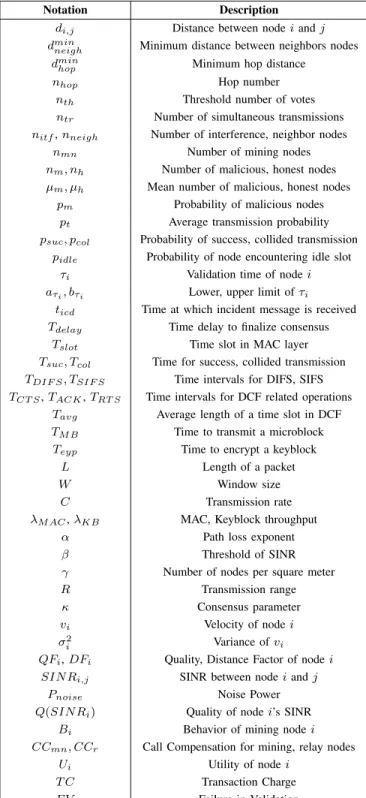
distribution mechanism. Key notations used in this paper are listed in Table III. As categorized in [43], we define edge devices present in the network into two types: the mobile edge “nodes”, i.e., vehicles and “edge computing servers”, i.e., RSUs. Before joining the blockchain network, a node needs to register itself and acquire a wallet address and a pair of pub-lic and private keys for privacy-preserving communications. This can be accomplished by Vehicle-to-Infrastructure (V2I) communications with regulation authorities via a nearby edge computing server. Each node updates its copy of blockchain through edge caching, as described in [44]. The regulation au-thorities control the expiration of idle keys, thereby preventing long-range attacks in which attackers use old accounts [45].
A. The Proposed PoQF Consensus
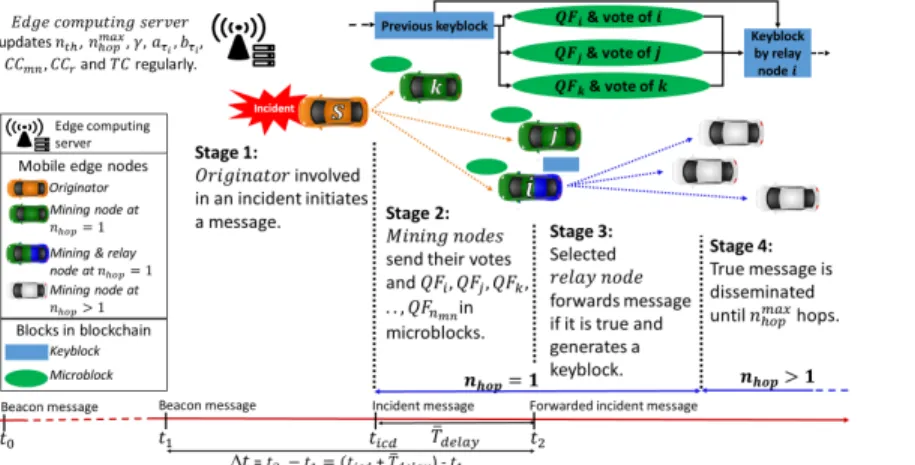
The proposed PoQF consists of four stages, as illustrated in Fig. 1. At the first stage, an incident occurs and a message is initiated byoriginator involved in the incident. An originator
TABLE III: Key Notations.
Notation Description
di,j Distance between nodeiandj dminneigh Minimum distance between neighbors nodes
dmin
hop Minimum hop distance nhop Hop number
nth Threshold number of votes ntr Number of simultaneous transmissions nitf,nneigh Number of interference, neighbor nodes
nmn Number of mining nodes nm, nh Number of malicious, honest nodes µm, µh Mean number of malicious, honest nodes
pm Probability of malicious nodes pt Average transmission probability psuc, pcol Probability of success, collided transmission
pidle Probability of node encountering idle slot τi Validation time of nodei aτi, bτi Lower, upper limit ofτi
ticd Time at which incident message is received Tdelay Time delay to finalize consensus
Tslot Time slot in MAC layer Tsuc, Tcol Time for success, collided transmission TDIF S, TSIF S Time intervals for DIFS, SIFS TCT S,TACK,TRT S Time intervals for DCF related operations
Tavg Average length of a time slot in DCF TM B Time to transmit a microblock Teyp Time to encrypt a keyblock
L Length of a packet
W Window size
C Transmission rate
λM AC,λKB MAC, Keyblock throughput α Path loss exponent
β Threshold of SINR
γ Number of nodes per square meter
R Transmission range
κ Consensus parameter
vi Velocity of nodei σ2
i Variance ofvi QFi,DFi Quality, Distance Factor of nodei
SIN Ri,j SINR between nodeiandj
Pnoise Noise Power
Q(SIN Ri) Quality of nodei’s SINR Bi Behavior of mining nodei CCmn, CCr Call Compensation for mining, relay nodes
Ui Utility of nodei T C Transaction Charge
F V Failure in Validation
is the sendersof the message at first hop, i.e., whennhop= 1,
wherenhop is the hop number. The message is analogous to
atransaction proposalin a consensus that requires validation. At the second stage, a node which receives and responds to the message performs the role of mining node. Each mining node i generates a microblock, in which it records its vote towards validity of the message and its Quality Factor,QFi,
to become a potentialrelay node. A nodeiwaits for timeτi
before it announces a microblock.τi is a randomly generated
number following uniform distribution, i.e.,τi ∼ U(aτi, bτi),
whereaτiandbτiare lower and upper limits ofτi, respectively,
which are dependent onQFi. The motivation behind usingτi
is three fold: one is to prevent all nodes from transmitting at the same time and causing packet collision, second is to introduce fairness by giving less waiting time to nodes with higher QFi and the third is to ensure randomization if node i and node j have QFi = QFj. Using uniform distribution
to randomize scheduling of messages so as to avoid packet collision has been previously used in literature [46].
At the third stage, node i is selected as a relay node if it fulfills two conditions. First, it has received at least nth
microblocks with the same votes as its own. Second, itsQFi
is the highest among all microblocks with the same votes as its own. The motivation behind these two conditions instead of QFi only is to enhance security of PoQF. For example, if
a malicious node i with the highest QFi among all mining
nodes votes false for an originally true message and receives
nth microblocks with true votes, it cannot become a relay
node and earn incentive. Similarly, if an honest nodeiwith the highest QFi votes false for an originally false message, but
receives nth microblocks with true votes, it cannot become
a relay node to forward a false message. A relay node will forward the message only if it is validated as true but always generate a keyblock to record message validity after PoQF and transactions, which are related to incentive distribution. As shown in Fig. 2, if no node receives at leastnth microblocks
with the same votes as its own until 1s, i.e. the maximum allowable latency for emergency message dissemination [47], the message is considered as false and a keyblock to record such transaction will be generated by the mining node i
with highestQFi, which voted false. If two relay nodes with
opposing votes are selected (one with true vote and another with false vote), the message is considered true so that the cooperation may not be stopped in case of a true incident. The value of nth corresponding to real traffic conditions is
communicated to nodes by an edge computing server. The fourth stage is continuation of message dissemination. If the message is validated as true, it is disseminated after a new relay node selection by PoQF at each hop until
nhop≤nmaxhop, where nmaxhop is the maximum number of hops
up to which a message is required to be forwarded and is updated by an edge computing server. It is noted that votes to validate a message are not required fornhop>1. It is simply
because the validation of message has been done by adjacent witness nodes (mining nodes at nhop= 1) through a camera
or location/speed verification [48]. All other nodes beyond the first hop may not have access to validate the originator.
Fig. 1: The proposed PoQF consensus.
B. QFi Calculations
QFi determines the quality of mining node i at the time
when it forwards the message as a relay node. Each node regularly shares its position and velocity via beacon message. As shown in Fig. 1, two consecutive beacons messages are exchanged at t0 andt1 before the occurrence of incident. To
compute QFi, node imakes probability based predictions of
distances with its neighbor nodes at time t2=ticd+Tdelay,
whereticdis the time at which the incident message is received
from the sender s (originator or previous relay node) and
Tdelay is the mean time delay to finalize consensus and is
described in details in Section IV. As QFi decides the relay
node, it is governed by two factors [49]: the probability of success that a node’s transmission can reach to all of its neighbor nodes, i.e., Quality of SINR at t2, Q(SIN Rti2),
and the probability that its distance to the sender s is larger than a threshold for ensuring successful transmission over longer distances, i.e., Distance Factor at t2, DFit2. Hence, QFi=Q(SIN Rti2)·DF
t2
i .
1) Q(SIN Rt2
i ): If nodeibecomes a relay node, the SINR
of a signal received at nodej from nodei att2 is
SIN Ri,j= (di,j)−α Pnoise+ Σ nitf k=1,k6=i(dj,k)−α , (1)
where α is the path loss exponent and its value depends on fading environment [16], di,j is the distance between node i
and nodej,dj,kis the distance between nodejand interfering
node k, nitf is the number of interference nodes and Pnoise
is the noise power. For a successful message transmission, it is required that the SINR exceeds a certain threshold β, i.e.,
SIN Ri,j ≥β. The probability thatSIN Ri,j ≥β at t2, i.e.,
P r(SIN Rt2 i,j≥β)is given as P r(SIN Rt2 i,j≥β) =P r (d t2 i,j) −α Pnoise+ Σ nitf k=1,k6=i(d t2 j,k)−α ≥β =P rdt2 i,j≤ β(Pnoise+ Σ nitf k=1,k6=i(d t2 j,k) −α)−α1, (2) wheredt2 i,j=d t1 i,j+ ∆d ∆t
i,j is the distance between nodeiand
nodejatt2and∆d∆i,jtis the relative distance change between
Fig. 2: Flowchart of actions by mining node at nhop= 1.
nodei and nodej during ∆t=t2−t1.dti,j1 can be obtained
from the beacon message received att1and the expected value
of ∆d∆t
i,j can be found using Probability Density Function
(PDF) of standard Gaussian distribution. Referring to the results in [16], [50] and [51], the velocity of a nodeifollows a standard Gaussian distribution, i.e., vi ∼ N(0, σi2t), where σ2 i = (vt1 i −v t0 i ) 2 t1−t0 is variance ofvi andv t0 i ,v t1 i denotevi att0
and t1, respectively, which are shared by node i via beacon
messages.∆d∆t i,j is defined as ∆d∆i,jt= (vt1 i −v t1 j + ∆v ∆t i −∆v ∆t j )∆t, (3)
where ∆v∆t is the change in velocity during ∆t. By the
principle of linear combination of Gaussian variables,∆v∆t i ∼ N(0, σ2 i∆t),∆vi∆t−∆vj∆t∼ N(0,(σi2+σj2)∆t)and hence, ∆d∆t i,j ∼ N(0,(σ2i +σ2j)∆t3). Ifv t2
i is not known, (2) can be
calculated by assuming∆d∆t
i,j as a standard Gaussian variable.
Each node i calculates (2) with respect to its neighbor node j. As nitf is the number of neighbors of node j
except node i, nitf and dtj,k2 are unknown to node i. It can
estimate the expected values to find P r(SIN Rt2
i,j ≥ β). Hence β(Pnoise + Σ nitf k=1,k6=i(d t2 j,k) −α)−α1 in (2) can be rewritten as
βPnoise + E(nitf)E(dtj,k2 )− α
−α1
, where
E(.) denotes expected value. The location of nodes on road is assumed to follow an independent homogeneous spatial Poisson distribution with density parameter γ nodes / m2 on
a two dimensional road segment with no separation of lanes in order to make it general and allow dynamic movement of nodes [2]. Therefore, E(nitf) can be estimated as the
number of vehicles within the transmission range of node j. Assuming that transmission range of each node is a uniform circular area with radius R, E(nitf) can be calculated as
the number of nodes inside the area excluding node i, i.e., E(nitf) = P πR2γ k=1 (πR2γ)k k! e −πR2γ −1, where γ is pre-defined and known to each node. It is noted that an adaptive
γ corresponding to real traffic conditions is out of the scope of this paper, but can be locally estimated by calculating the number of received beacons [52] or with the use of edge computing servers [53]. Lemma 1:E(dt2 j,k) = 2 3R2(R 3−dmin neigh 3
), where dminneigh is the minimum allowed distance between two neighbor nodes.
Proof: See Appendix A.1.
Theorem 1: P r(SIN Rt2 i,j≥β) = 1 2 erf ∆d∆t i,j √ 2(σ2 i+σ2j)∆t3 ! −erf −∆d ∆t i,j √ 2(σ2 i+σ2j)∆t3 !! , if dt1 i,j≤dx, 1−1 2 erf ∆d∆t i,j √ 2(σ2 i+σ2j)∆t3 ! −erf −∆d ∆t i,j √ 2(σ2 i+σ2j)∆t3 !! , otherwise, wheredx=
βPnoise+E(nitf)E(dtj,k2 )
−α
−α1
.
Proof: See Appendix A.2.
Q(SIN Rt2
i ) =
Pj=nneigh
j=1 P r(SIN R
t2
i,j ≥β), wherenneigh
is the number of neighbors of node i whose position and velocities are exchanged through beacon messages.
2) DFt2
i : It is the probability that one hop distance
be-tween node i and the sender s is larger than a minimum threshold, dmin
hop, and is defined as DFt2 i =P r(d t2 i,s > d min hop) = 1−P r(d t2 i,s≤d min hop), (4) where P r(dt2 i,s ≤ d min
hop) can be found by using the same
calculation as described in Appendix A.2.
Proposition 1:The range of QFi is 0≤QFi≤nneigh.
Proof: Q(SIN Rt2
i ) is a sum of P r(SIN R t2
i,j), for
all neighbor nodes of i. Therefore, the possible range of
Q(SIN Rt2
i ) is 0 ≤ Q(SIN R t2
i ) ≤ nneigh. According
to (4), the possible range of DFt2
i is 0 ≤ DF t2
i ≤ 1.
As QFi = Q(SIN Rti2)·DF t2
i , it can be concluded that 0≤QFi≤nneigh.
C. Adversary Model
It is assumed that all edge computing servers in VEC network are honest. Let nmn be the number of mobile edge
nodes taking part as mining nodes in a PoQF consensus out of whichnmnodes are malicious andnhnodes are honest when nhop= 1. A malicious node in the proposed blockchain design
is defined as the node voting against the original validity of a message, that is, if a message is true, the malicious node will vote false and vice-versa. Let Bi be the behavior of
mining node i. Bi = 1 when it is malicious and Bi = 0
when it is honest and nm =Pnmni=1 Bi. Bi follows Binomial
distribution, i.e., Bi ∼ B(nmn, pm), where pm[0,1] is the
probability that Bi= 1. The reason for considering Binomial
distribution is because it has only two possible outcomes for a discrete random number [54]. So, we can define one of the outcomes as malicious and another as honest. µm=pmnmn
and µh = (1 −pm)nmn represent the mean number of
malicious and honest nodes, respectively.
Fig. 3: Distribution of Call Compensation.
D. Incentive Distribution Mechanism
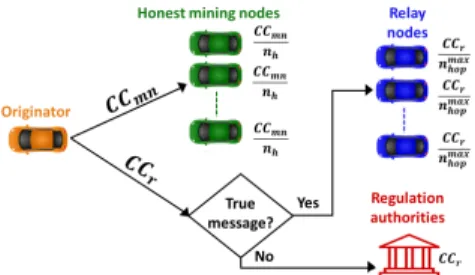
As a compensation of causing an incident, the originator pays a credit known as Call Compensation. Assuming that a message is successfully validated, as shown in Fig. 3, Call Compensation, at each direction, consists ofCCmn, which is
equally distributed among honest mining nodes at nhop = 1,
andCCr, which is equally distributed among relay nodes at nhop={1,2, .., nmaxhop }, in case a message is validated as true.
Otherwise, CCr is transferred to regulation authorities as a
penalty charge. If the message is successfully validated, the utility of a mining node i,Uimn, after taking part in a PoQF consensus atnhop= 1is given as
Uimn= CCmn
nh , if Bi= 0 and message is true, CCmn
nh −T C, if Bi= 0 and message is false,
−T C, if Bi= 1 and message is true, 0, if Bi= 1 and message is false,
(5) where T C > 0 is the Transaction Charge paid by mining node i only when it votes that a message is false. It is later paid to the relay node which generates the last keyblock related to a particular incident. The motivation of introducing
T C is to discourage malicious false votes and promote fast dissemination of true message in case of emergency. The values ofCCmn,CCrandT Care updated by edge computing
servers. The utility of a relay node,Uir, is given as
Uir= CCr nmax hop
, ifnhop≤nmaxhop and message is true, nmT C, ifnhop> nmaxhop and message is true, nhT C, ifnhop= 1and message is false,
(6)
It is worth noting that a mining node i atnhop = 1selected
as relay will earn a cumulative utility ofUmn
i +Uir. A relay
node records transactions related to Umn
i in the keyblock at nhop= 1. Fornhop>1, the corresponding relay node records
transaction related to Ur
i of previous hop. The message is
disseminated until nhop ≤nmaxhop and PoQF is repeated until nhop ≤nmaxhop + 1, because the last relay node at n
max hop + 1
records Uir of relay node at nmaxhop. As an incentive, it gains the reward of nmT C and records this transaction itself. The
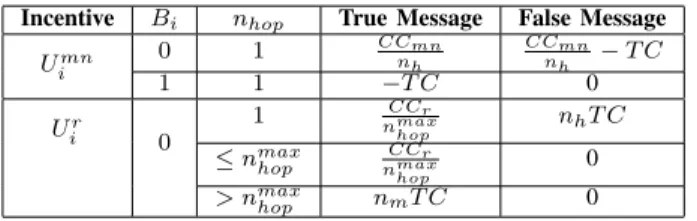
summary of incentive distribution among mining and relay nodes is shown in Table IV.
IV. THEORETICALPERFORMANCEANALYSIS
A. Security
1) Failure in Validation: We define the term Failure in Validation, F V, as the probability that the original validity
TABLE IV: Incentives distribution among nodes when mes-sage is successfully validated.
Incentive Bi nhop True Message False Message Umn i 0 1 CCmn nh CCmn nh −T C 1 1 −T C 0 Ur i 0 1 CCr nmax hop nhT C ≤nmax hop CCr nmax hop 0 > nmax hop nmT C 0
of a message is inverted after PoQF consensus at nhop = 1.
Without loss of generality, we assume the probability that an originator generates a false message, i.e., the originator is malicious, ispmand the probability of true message generation
is 1−pm. Therefore,F V can be expressed as
F V =pmF Vf alse+ (1−pm)F Vtrue, (7)
where F Vf alse and F Vtrue denote Failure in Validation of
false and true message, respectively. F Vf alse occurs when a
malicious mining node receives at least nthmicroblocks with
malicious votes to mark an originally false message as true. Therefore,F Vf alsecan be given as
F Vf alse=pmP r(nm≥nth). (8) F Vtrue occurs when an honest mining node does not receive nth microblocks with honest votes to validate an originally
true message and can be expressed as
F Vtrue= 1−(1−pm)P r(nh≥nth). (9)
Bringing (8) and (9) into (7) gives
F V = 1−pm+p2mP r(nm≥nth)−(1−pm)2P r(nh≥nth).
(10) Using tail inequalities for Binomial distribution [55], we have the following propositions.
Proposition 2: The upper bound ofP r(nx≥nth), where x=mor hcan be given as P r(nx≥nth)U B= ( e− (nth−µx)2 µx+nth , if nth≥µx, 1, otherwise, Proof: See Appendix B.1.
Proposition 3: The lower bound of P r(nx≥nth), where x=mor hcan be given as P r(nx≥nth)LB= ( 1−e− (µx−nth)2 2µx , if 0≤nth≤µx, 0, otherwise, Proof: See Appendix B.2.
By applying Proposition 2 and 3 in (10), the upper and lower bounds ofF V,F VU B andF VLB can be derived as
F VU B = 1−pm+p2mP r(nm≥nth)U B −(1−pm)2P r(nh≥nth)LB, (11) F VLB = 1−pm+p2mP r(nm≥nth)LB −(1−pm)2P r(nh≥nth)U B. (12) The expanded forms of (11) and (12) under a varying range of
nthcan be seen in Appendix B.3.The role ofnthin decreasing
Fig. 4: Potential fork situation.
Fig. 5: Flowchart of actions to resolve fork.
F V is described in Appendix B.4. Edge computing servers optimize the value ofnthfor minimizingF V.
2) Resolving forks: In the proposed blockchchain, a fork may be created as shown in Fig. 4 when two keyblocks are generated by different relay nodes at the same hop. Forks occur when two or more nodes fulfill both conditions of becoming a relay node, which are defined in Section III. The flowchart of actions by a node in case of fork occurrence is shown in Fig. 5. If the keyblock by relay node i marks the message as false and the keyblock by relay nodej marks the message as true, then the message dissemination is continued and new blocks are linked with the keyblock generated by relay node j. If both nodes show the same validity and
QFi = QFj, the timestamps of both keyblocks are checked
and the keyblock with the earlier timestamp is considered valid. However, if QFi > QFj, then new blocks are added
in continuation with the keyblock generated by relay node i, regardless of the timestamp of relay node j. The motivation behind selecting the keyblock on the basis of QFi instead of
timestamp for blockchain extension is to discourage a possible cheating attempt by mining node j to become a relay node despite having QFj < QFi. Cheating by manipulating QFi
is difficult, as it is based on position and velocity of nodes which are shared through regular beacon message exchange and a cheating attempt can be easily detected and reported to concerned authority. In presence of forks, edge computing servers store the longest chain only.
3) Game Theory Analysis of Incentive Distribution Mech-anism: We apply the game theory to analyze the impact of the proposed incentive distribution mechanism on actions of mining nodes atnhop= 1and evaluate the security of PoQF
against nothing-at-stake and colluding attack by mining nodes.
a) Players: This game hasnmnplayers out of whichnh
are honest and nm are malicious. All players follow PoQF
consensus as mining nodes and are located atnhop= 1.
b) Action: Every player has two possible actions, honest,
H, or malicious,M.
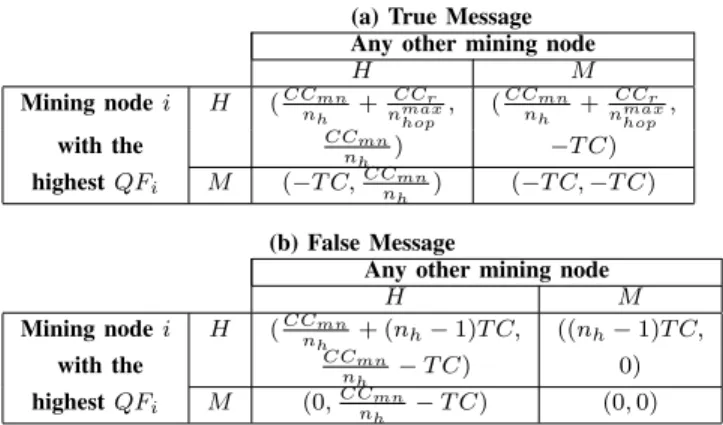
c) Utilities: The payoff matrix in Table V shows
TABLE V: Payoff Matrix(Ui, Uy), where Ui=Utility of
min-ing node i with the highestQFi andUy=Utility of any other
mining node atnhop= 1.
(a) True Message Any other mining node
H M Mining nodei H (CCmn nh + CCr nmax hop , ( CCmn nh + CCr nmax hop , with the CCmn nh ) −T C) highestQFi M (−T C,CCnmn h ) (−T C,−T C) (b) False Message
Any other mining node
H M Mining nodei H (CCmn nh + (nh−1)T C, ((nh−1)T C, with the CCmn nh −T C) 0) highestQFi M (0,CCnmn h −T C) (0,0)
We present the following analysis of our incentive distribution mechanism.
Lemma 2: Playing honest is the best response action of a mining node, ifCCmn≥nhT C.
Proof: As shown in Table V, if T C ≥ CCmn
nh and the
message is false, playing honest will result in Uy ≤0 which
will be motivated to play maliciously. On the contrary, if
T C ≤ CCmn
nh , it makes Uy ≥ 0 which will motivate the
mining nodes to play honestly. Therefore, to make honest as the best response action of mining nodes, it is required that
T C ≤ CCmn
nh or CCmn≥nhT C.
Proposition 4:The action set(H, H)is both Pareto-optimal and Nash equilibrium and prevents nothing-at-stake attack.
Proof: From the payoff matrix in Table V, we can see that no player can get the maximum utility by deviating from the action set (H, H), provided that Lemma 2 is fulfilled. In both true and false message cases, all mining nodes can get the highest payoff by playing honestly only. Therefore, the action set (H, H) is both Pareto-optimal and Nash equilibrium of this game. The utilities of players will be at risk by playing maliciously, and therefore they will not be motivated to generate a keyblock without message validation which happens in nothing-at-stake attack [45].
Theorem 2: A mining node cannot increase its expected utility sum by colluding with its malicious neighbors if
nhT C ≤CCmn≤ nmaxnmCCr
hop(nh−nm) andpm≤0.5.
Proof: See Appendix C.
Thus the incentive distribution mechanism is collusion resis-tant if edge computing servers adjust the values of CCmn, CCr andnmaxhop such that Theorem 2 is fulfilled.
B. Validation Latency and Throughput
The MAC throughput in bit/second is defined in [56] as
λM AC = pt·psuc · TavgL , where pt = W2+2 is the average
transmission probability of a node, W is the contention window size,psucis the probability of success transmission,L
is the average length of a packet andTavgis the average length
of a time slot in Distributed Coordination Function (DCF).
psuc = ntr·pt·(1−pt)ntr−1, where ntr is the number of
nodes contending the channel for transmission. According to IEEE 802.11 standard [56], Tavg is
Tavg=pidle·Tslot+psuc·Tsuc+pcol·Tcol, (13)
where Tslot is the unit time slot in DCF scheme, pidle = (1−pt)ntr andpcol = 1−pidle−psuc are the probabilities
of a node encountering an idle slot and collided transmission respectively, Tsuc andTcol are average time for success and
collided transmission respectively and are given as
Tcol=TRT S+TDIF S+Tslot, (14) Tsuc=TRT S+TDIF S+TCT S+TACK
+3TSIF S+ 4T slot+ L C,
(15)
where TDIF S and TSIF S are time intervals for DCF
In-terframe space (DIFS) and Short InIn-terframe Space (SIFS) respectively, TRT S, TCT S and TACK are pre-specified time
intervals reserved for DCF related operations and C is the average transmission rate among nodes. As λM AC is defined
in bit/second, the average time consumption,TM B, to
success-fully transmit a vote in a microblock of lengthL bits is
TM B= L(bits) λM AC(bit/second) = Tavg pt·psuc . (16)
TM B varies with ntr only if W,L, Tslot, Tcol andTsuc are
considered as fixed value for all transmitting mining nodes. As
1 ≤ntr ≤nmn, we consider two boundaries forTM B, i.e., T1
M B with ntr = 1 and TM Bnmn with ntr = nmn. Therefore, Tmin M B =min(T 1 M B, T nmn M B) andT max M B =max(T 1 M B, T nmn M B).
Considering a fixed transmission range and a homogeneous distribution for all nodes, we can assume that nneigh is
statistically the same for every node. According to Propo-sition 1, nneigh −QFi can be considered as the ranking
of mining node i to announce its microblock. In this way, nodei with a largeQFi can have less validation time before
announcing a microblock. An edge computing server provides
τi bounds to be followed by mining nodes by considering TM B as the time required by a mining node to successfully
transmit a microblock. The lower bound of τi is given as aτi = TM Bmin(nneigh −QFi) and the upper bound of τi is
given asbτi =TM Bmax(nneigh−QFi).
For nmn microblocks, the total time consumption
(or validation latency), Tdelay, can be in the range TM Bmin · nmn ≤ Tdelay ≤ TM Bmax · nmn. A mining node i
with the highest QFi becomes a relay node as soon as
it receives at least nth microblocks and does not need to
wait for receiving all nmn microblocks. Therefore, Tdelay
is reduced for small nth and we can find lower and upper
bounds of Tdelay when a message is successfully validated
by an honest node atnhop= 1.
Proposition 5:TLB delay=T
min M B ·nth.
Proof: Tdelay is the minimum when a relay node receives
firstnthconsecutive microblocks with same votes immediately
Proposition 6:TU B delay =T
max
M B ·(nth+pmnmn).
Proof: The maximum number of microblocks with malicious votes is pmnmn. Tdelay will be the maximum if
an honest relay node receives all pmnmn microblocks before
receiving nthhonest microblocks.
A keyblock is generated by a relay node after the message validation. Therefore, the throughput in terms of number of keyblocks generated per second can be estimated as
λKB=
1 Tdelay+Teyp
, (17)
whereTeyp is the time required to encrypt a keyblock.
C. Asymptotic Complexities
In this subsection, we compare the scalability of various consensus algorithms by analyzing latency complexity, i.e., the time consumption required to confirm a transaction, security complexity, i.e., the minimum number of malicious nodes to control consensus, and communication complexity, i.e., the number of exchange messages required to validate a trans-action. Without loss of generality, we derive the asymptotic latency, security and communication complexity of various consensus algorithms in Table VI in terms of number of nodes participating in mining competition,nmnand consensus
parameter, κ, which is unique to each algorithm. κrefers to the difficulty level of hash puzzle in PoW, synchronization level in PoS, waiting time in PoET and number of minimum votes required in voting based algorithms (PBFT and PoQF). Standard mathematical notations are used in Table VI, i.e.,
Ω(.),O(.)andΘ(.)denote the order ofat least,at mostand
exactlyrespectively. Table VI shows thatκaffects the latency in PoW, PoS and PoET. Despite the fast consensus of PoS, a strong synchronization among edge computing resources is needed for efficient running [58]. Latency of PoET depends on the length of waiting time which follows a fixed probability distribution. PoQF has to wait for a threshold number of votes, which has an impact on latency but its scalability does not rely on large computation power or storage capacity of mobile edge nodes. Similar to PoS, synchronization among edge computing servers and mobile edge nodes is needed in PoQF, but the requirement is independent of nmn. PoET offers the least
security and can be controlled by only a small fraction of malicious nodes [9]. According to Theorem 3, PoQF is secure against the collusion attack when pm ≤ 0.5. It provides the
same security as PoW which is better than PBFT but worse than PoS [59]. In communication complexity, PoW, PoS and PoET are more efficient than PoQF, since they do not require multiple message exchanges. Despite the voting nature of PoQF, it has lower communication complexity than PBFT. Moreover, in VANETs, nmn cannot be increased beyond a
certain threshold due to limited number of nodes within a transmission rangeRanddneighmin , which makes PoQF scalable and applicable in V2V communications.
V. SIMULATIONRESULTS
In this section, we analyze the performance of the proposed blockchain and PoQF consensus using OMNeT++ integrated
TABLE VI: Comparison of Asymptotic Complexities.
Consensus Latency Security Communication
PoW Θ(κ)[58] Ω nmn 2 [60] Θ(1)[58] PoS Ω(κ)[58] Ω2nmn 3 [59] Θ(1)[58] PoET Ω(κ)[9] Ω loglognmn lognmn [9] Θ(1)[9] PBFT nmnO(1)[58] Ω nmn−1 2 [35] O(n2 mn)[10] PoQF κO(1) Ω nmn 2 O(nmn) TABLE VII: Simulation Parameters.
Parameters Values Parameters Values
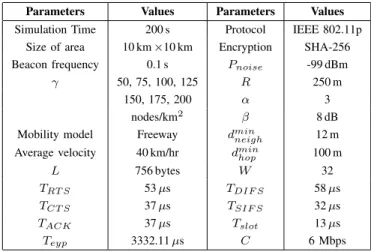
Simulation Time 200 s Protocol IEEE 802.11p Size of area 10 km×10 km Encryption SHA-256 Beacon frequency 0.1 s Pnoise -99 dBm γ 50, 75, 100, 125 R 250 m
150, 175, 200 α 3 nodes/km2 β 8 dB Mobility model Freeway dmin
neigh 12 m
Average velocity 40 km/hr dmin
hop 100 m L 756 bytes W 32 TRT S 53µs TDIF S 58µs TCT S 37µs TSIF S 32µs TACK 37µs Tslot 13µs Teyp 3332.11µs C 6 Mbps
with SUMO (Simulation of Urban Mobility)1. The simulation
parameters listed in Table VII align with other VANET appli-cations [15], [56], [57], [61]. Since nmn are neighbor nodes
of a sender s,nmn ≤40 will be considered when nodes are
homogeneously distributed with a maximum of 200 nodes/km2
and it is a reasonable assumption of maximum number of vehicles within a transmission range when the safe distance between nodes are maintained on road [62]. Evaluation results are averaged over 100 simulation runs.
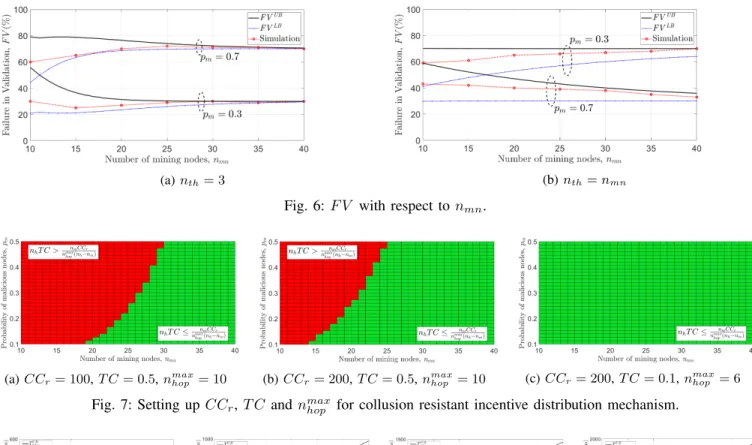
Fig. 6 showsF V with respect to nmn at different pm and nth. Two different values ofpmare chosen to show the results
at both low (pm < 0.5) and high (pm > 0.5) densities of
malicious mining nodes presented in the network. As shown in Fig. 6 (a), F V with pm = 0.3 is lower than F V with pm = 0.7 when nth = 3, i.e., nth ≤ µm. It shows that
a low nth is suitable only for low pm when honest nodes
are in majority. On the contrary, as shown in Fig. 6 (b), F V
with pm = 0.3 is higher than F V with pm = 0.7 when nth=nmn, i.e.,nth> µm. This is because whennth=nmn
both malicious and honest mining nodes are unable to finalize consensus within the maximum allowable latency of 1s and the message is marked as false. Withpm= 0.3, the probability of
false message occurrence is lower than that of true message occurrence and it is hard to collect nth=nmn honest votes
to validate a true message. In this case, F VU B ≈ 1−p m
depicts the worst case scenario of maximum probability of true message generation which will be marked as false. With
pm= 0.7, the probability of true message occurrence is lower
than that of false message occurrence. F V does not occur when both honest and malicious nodes are unable to collect
(a)nth= 3 (b)nth=nmn Fig. 6:F V with respect tonmn.
(a)CCr= 100,T C= 0.5,nmaxhop = 10 (b)CCr = 200,T C= 0.5,nmaxhop = 10 (c)CCr= 200,T C= 0.1,nmaxhop = 6 Fig. 7: Setting up CCr,T C andnmaxhop for collusion resistant incentive distribution mechanism.
(a)pm= 0.2 (b)pm= 0.4 (c)pm= 0.6 (d)pm= 0.8
Fig. 8:Tdelay with respect tonmn.
Fig. 9:λKB with respect topm.
votes for a false message. It only occurs when a true message is not validated. As shown in Fig. 6 (b),F VLB ≈1−p
mwith pm= 0.7, depicts the percentage of true messages which are
not validated by PoQF. The dependence ofnthonpmis further
discussed in Appendix B.4. If pm in the network is known,
VEC technique can achieve a low F V even with high values of pmby adjustingnth accordingly.
Fig. 7 shows the impact of parameters:CCr,T Candnmaxhop,
on the collusion resistance feature of incentive distribution mechanism. According to Theorem 3, the incentive distribu-tion mechanism is collusion resistant if nhT C ≤ CCmn ≤
nmCCr nmax
hop(nh−nm) andpm≤0.5. As Bi follows Binomial
distri-bution, it can be assumed thatnm≈µmandnh≈µh. Based
on this assumption, Fig. 7 (a) and (b) show that the incentive distribution mechanism cannot be collusion resistant for every
nmn, pm under the fixed CCr, T C andnmaxhop . However, in
Fig. 7 (c), when CCr = 200, T C = 0.1 and nmaxhop = 6, nhT C ≤ nmaxnmCCr
hop(nh−nm) is satisfied for every nmn(10,40)
andpm(0,0.5). Therefore, for a collusion resistant incentive
distribution mechanism, it is required that the edge computing servers should adjust the combination of these parameters with varyingnmnandpm, such that it is possible to chooseCCmn
within the boundaries defined by Theorem 3. Apart from the security reason, a low nmax
hop is also favorable for successful
message delivery, as the failure of multi-hop connectivity in VANETs increases with the number of hops [63].
Fig. 8 shows Tdelay of successful message validation with
respect tonmn at different values ofpm withnth=µm+ 1.
It can be seen that Tdelay increases with pm because of
more frequent generation of microblocks by malicious nodes. Fig. 8 (c) and (d) show that TdelayU B exceeds the maximum allowable latency requirement of 1s [47] when pm ≥ 0.6
and nmn ≥ 30. At pm = 0.8 and nmn > 35, the mining
nodes are unable to finalize consensus within 1s. Fig. 9 shows
(a)F V (b) Number of forks (c)Tdelay Fig. 10: Comparison of PoQF with PoS and PoET with nth=µm+ 1.
Fig. 11: Values ofaτi andbτi.
λKB achieved is 11 keyblock/s at pm = 0.1 and nmn = 15
and the lowest is 0.9 keyblock/s at pm≥0.8 andnmn= 35,
which means that at highernmnandpm, PoQF withλKB<1
keyblock/s may not be able to generate block within the limit of maximum allowable latency of 1s. This shows that our proposed blockchain exhibits better performance specifically at lower values of pm and nmn. λKB can be improved by
offloading computations required for encrypting a keyblock to a nearby edge computing server which have high computation power, thereby reducingTeyp, as suggested in [64].
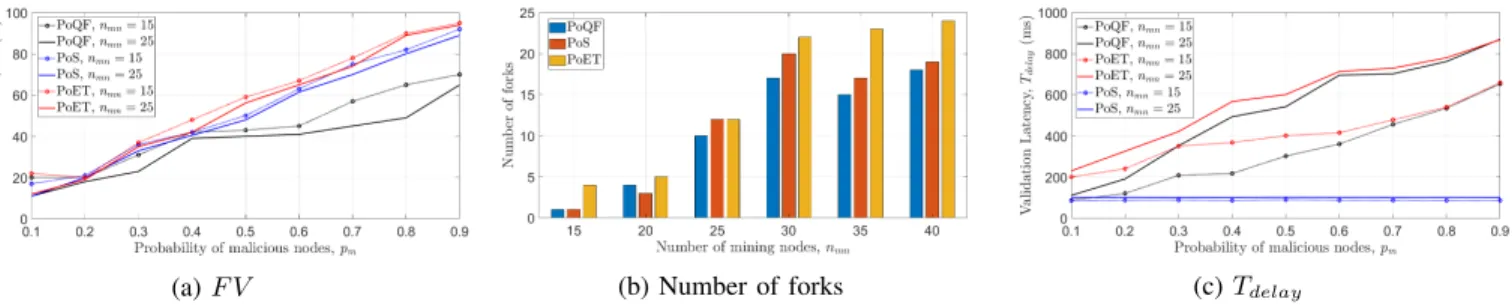
Fig. 10 compares the performance of PoQF with PoET and PoS. In Fig. 10 (a),F V of PoQF is compared with PoET and PoS at different values of pm and nmn, while nth is fixed
at µm+ 1, as it results in low F V for all values ofpm. We
implement PoET such that its waiting time is uncontrolled by VEC. Each node generates a random number between 0 to 1 s to determine its waiting time for collecting microblocks. It shows that F V of PoQF and PoET are closing to each other at low pm. For high values of pm, an honest node i with
the highest QFi is unable to collect sufficient microblocks
from honest mining nodes within a random waiting time of PoET and therefore itsF V rises withpmat a higher rate than
PoQF. In the reputation based PoS, a node is considered honest if its reputation exceeds a certain threshold. We randomly assign a reputation value to nodes on a scale of 0 to 100, thus the probability of reputation falling below a threshold of 50 is defined aspm. We implement PoS such that a malicious
relay node only forwards the message from a malicious sender and an honest relay node only forwards the message from an honest sender. On an average, PoQF reduces F V by 11% and 15%, as compared to PoS and PoET, respectively. Fig. 10 (b) compares the number of forks created by PoQF, PoS and PoET consensus. Although solutions to resolve forks are discussed in Section IV, a blockchain consensus should be
able to avoid creation of forks in order to control discrepancies. In PoQF, node i with the highest QFi is most likely to
announce its microblock prior to other mining nodes. In this way, node j withQFj < QFi cannot become a relay node,
if votes of both nodes are the same. This is how creation of forks is reduced in the proposed consensus. We implement PoS consensus by selecting a relay node on the basis of the highest reputation which is randomly generated from 0 to 100 in the simulation. A fork appears when two nodes with same reputation simultaneously become relay node. In PoET, the time to announce microblock is not controlled by VEC. Therefore, node j with lower QFj becomes a relay
node before receiving a microblock from nodeieven though
QFi > QFj. In that case, a fork appears if both node i and
nodejgenerate keyblocks. It is noted that the number of forks in PoS is equal or lower than PoQF when nmn ≤ 20. Due
to unreliable nature of vehicle connectivity, there remains a possibility of fork occurrence when an announced microblock by nodeiis not received by nodej. It usually happens when mining nodes are in distance and beyond the transmission range of each other. This is why a low node density, ultimately leading to lownmn, may result in a higher or equal number
of forks created by PoQF as compared to PoS. Fig. 10 (c) compares Tdelay of successful message validation consumed
by PoQF, PoET and PoS. By using PoET, the mining node
i is allowed to announce its microblock at a random time irrespective of itsQFi. On an average,Tdelayof PoET is 68 ms
higher than PoQF. However, the difference is larger at lower
pm. Since τi is independent of QFi in PoET, node j with
lower QFj may announce its microblock earlier than node i with QFi > QFj and node i might have to wait longer.
This waiting time is reduced in PoQF by utilization of VEC. However, with large pm, an honest mining node i with the
highest QFi has to wait longer in PoQF for receiving nth
honest microblocks. It is because the frequency of malicious microblocks generation is increased with a largepm. Hence the Tdelay difference between PoQF and PoET becomes smaller. Tdelay of PoS is independent of pmand increases withnmn.
It is the smallest because it only consumes time in relay node selection, while the voting time is eliminated by the reputation based message validation.
Fig. 11 displays aτi and bτi which are governed by edge
computing servers to regulateτi, generated by a mining node i. It shows that aτi and bτi reduce with an increasing QFi
and thereforeτi leads to less waiting time for potential relay
Fig. 12: Average success rate with respect to speed.
the same for every node in a network. Therefore, deliberately reducingτiby nodeiis bounded by the limit ofaτi, which is
known to every node in a network. Such attempt can be easily detected and reported to concerned authority.
Fig. 12 shows the success rate of transmitting a true message under different maximum speeds of a mining node. For nhop > 1, PoQF consensus is only used for relay node
selection since the message is already validated at nhop = 1,
and therefore, the transmission success rate is independent of
pm. It shows that the success rate is falling with increasing
speed, specifically for small nmn. This is because a small nmn depicts a low traffic density, so the nodes are likely
to attain their maximum speeds and may lose connectivity before finalizing a consensus to select a relay node. In order to speed up consensus, a possible solution is that the edge computing servers reduce nth when nhop >1. At nhop>1,
the consensus only depends on the highestQFi and does not
require message validation. Since the mining node isends its microblock earlier than the mining nodej withQFj < QFi,
it is not necessary for the mining node ito wait untilQFj is
received. It is noted that in case of an incident or traffic jam, a high speed is not likely to be attained in the affected area and therefore, it is not recommended to reduce nth atnhop = 1,
as it may result in large F V.
VI. CONCLUSION
In this paper, we have proposed a blockchain based on PoQF consensus algorithm for message dissemination in VEC networks. The theoretical performance of proposed consen-sus is evaluated by deriving bounds on failure and latency in message validation, throughput of block generation and asymptotic latency, security and communication complexity. Moreover, an incentive distribution mechanism to promote positive cooperation and discourage malicious behavior of nodes has been presented and analyzed using game theory.
From the simulation analysis, the proposed blockchain shows 11% reduction inF V by PoQF as compared to reputa-tion based PoS. As a trade-off, it results in increased validareputa-tion latency. Specifically due to VEC, PoQF is 15% more secure and 68 ms faster in validating a message as compared to PoET. Furthermore, PoQF results in less number of forks than PoET and PoS. Similar to PoW, PoQF is vulnerable to malicious nodes if they compose more than 50% of mining group but its performance is not dependent on the presence of at least
2f+ 1 mining nodes as in PBFT.
In the future work, we aim to reduce latency by proposing an alternative to voting solution for message validation. An adaptive and intelligent blockchain can be designed to achieve higher throughput with varying number of mining nodes.
APPENDIXA
1) Appendix A.1: The PDF of interference nodes at location
(X, Y) within the area πR2 is defined in [14] as πR12.
Therefore,E(dt2 j,k)can be calculated as E(dt2 j,k) = Z (X2+Y2)f(X,Y)dXdY. (18)
BringingX =zcosφandY =zsinφinto (18) leads to
E(dt2 j,k) = Z R dmin neigh Z 2π 0 z2 πR2dφdz= 2 3R2(R 3−dmin neigh 3 ). (19)
2) Appendix A.2: Since dt2
i,j = d t1
i,j + ∆d∆i,jt, we find the
probability of ∆d∆t
i,j ≤ dx−dti,j1. If d t1
i,j ≤ dx, the actual
required communication distance, ∆d∆t
i,j can be calculated as
in [50] ∆d∆i,jt= ( dx+dti,j1, Case 1 dx−dti,j1, Case 2 (20)
whereCase 1is either of the following
• nodei and nodej are moving towards each other • node i is in front of node j, both moving in same
direction, andvi< vj
• node j is in front of node i, both moving in same direction, andvi> vj
andCase 2is either of the following
• nodei and nodej are moving away from each other
• node i is in front of node j, both moving in same direction, andvi> vj
• node j is in front of node i, both moving in same
direction, andvi< vj
Therefore, PDF of∆d∆t
i,j can be defined as
f(∆d∆i,jt) = 1 q 2π(σ2 i +σ2j)∆t3 e− (∆d∆i,jt)2 2(σi2+σj2)∆t3 . (21)
Consider both acceleration and deceleration, Cumulative Den-sity Function (CDF) can be calculated as
F(∆d∆i,jt) = Z ∆d∆i,jt −∆d∆t i,j f(∆d∆i,jt)d(∆d∆i,jt), (22) AsF(∆d∆i,jt) =P r(dt2
i,j≤dx) =P r(SIN Rti,j2 ≥β),
P r(SIN Rt2 i,j≥β) = 1 2 " erf ∆d ∆t i,j q 2(σ2 i +σj2)∆t3 ! −erf −∆d ∆t i,j q 2(σ2 i +σ 2 j)∆t3 !# . (23)
Otherwise, if dt1
i,j > dx, the actual required communication
distance ∆d∆t
i,j can be calculated as ∆d∆i,jt= ( dt1 i,j−dx, Case 1 dt1 i,j+dx, Case 2 (24) where Case 1 and Case 2 are the same as defined in (20). As dt1
i,j > dx, for dti,j2 ≤dx, we need∆d∆i,jt <0. Therefore,
we calculate 1−f(∆d∆t
i,j) and ultimately P r(d t2 i,j ≤ dx) = P r(SIN Rt2 i,j≥β)is expressed as P r(SIN Rt2 i,j≥β) = 1− 1 2 " erf ∆d ∆t i,j q 2(σ2 i +σ 2 j)∆t3 ! −erf −∆d ∆t i,j q 2(σ2 i +σ2j)∆t3 !# . (25) APPENDIXB
1) Appendix B.1: According to the multiplicative form of Chernoff bound [55], P r(X≥(1 +δ)µ)≤e−δ
2µ
2+δ, whereX
is a sum of independent Binomial variables with meanµand
δ >0. Bringingµ=µx and(1 +δ)µ=nth, gives
P r(nx≥nth)≤ ( e− (nth−µx)2 µx+nth , if nth≥µx, 1, otherwise. (26)
2) Appendix B.2: For 0 ≤ δ ≤ 1, Chernoff bound [55] states thatP r(X ≤(1−δ)µ)≤e−δ
2µ
2 , which can be rewritten
as P r(X≥(1−δ)µ)≥1−e−δ 2µ 2 . Therefore, P r(nx≥nth)≥ ( 1−e− (µx−nth)2 2µx , if0 ≤nth≤µx, 0, otherwise. (27)
3) Appendix B.3: Using (10), (26) and (27), we get
F V ≤ 1−pm+p2m−(1−pm)2(1−e −(µh−2nth)2 µh ), if nth< min(µm, µh), 1−pm+p2me −(nthµm−+µmnth)2 −(1−pm)2(1−e −(µh−2µhnth)2 ), if µm≤nth≤µh, 1−pm+p2m, if µh< nth< µm, 1−pm+p2me −(nthµm−+µmnth)2 , if nth> max(µm, µh). (28) andF V ≥ 1−pm+p2m(1−e −(µm2−µmnth)2)−(1−p m)2, if nth< min(µm, µh), pm−p2m, if µm≤nth≤µh, 1−pm+p2m(1−e −(µm2−µmnth)2)−(1−p m)2e −(nthµh+−nthµh)2 , if µh< nth< µm, 1−pm−(1−pm)2e− (nth−µh)2 µh+nth ,if nth> max(µm, µh). (29)
4) Appendix B.4: As we know that, 0 < e−x ≤ 1 for
any real valuedxandpm[0,1], it can be deduced from (29)
that F VLB is the minimum when µ
m ≤ nth ≤ µh, which
is only possible for pm ≤0.5. For pm >0.5, the minimum F VLBcan be obtained whenn
th> µm. To find the minimum F VU B, we compare its value at two conditions of (28), i.e., nth> max(µm, µh)andnth< min(µm, µh).
1−pm+p2me −(nthµm−+µmnth)2 <1−pm +p2m−(1−pm)2(1−e− (µh−nth−1)2 2µh ), (30) Assuming that p2 me −(nthµm−+µmnth)2 ≈ (1 − pm)2(1 − e− (µh−nth−1)2 2µh ) ≈ 0, (30) leads to pm > 1 2. It proves that
nth> µm results in the minimumF VU B for pm>12.
APPENDIXC
Let ncp colluding players form a group to mark a true
message as false or a false message as true with a probability
pcp. The expected utility sum of colluding players as mining
nodes,E(Ucpmn), if they mark a true message as false is
E(Ucpmn) =pcp CCmn nm ncp−ncpT C ! +(1−pcp) CCmn nh ncp ! . (31) The probability that one of the colluding players is selected as a relay node if the colluding attack is successful isncp/nm
and if colluding players play honestly is ncp/nh. Therefore,
the total expected utility sumE(Ucp)is given as
E(Ucp) =pcp CCmn nm ncp−ncpT C+ ncp nm nmT C ! + (1−pcp) CCmn nh ncp+ ncp nh CCr nmax hop ! , (32) To prevent collusion, we wantE(Ucp)≤E(Ucp0 ), whereUcp0
represents the utility of colluding players playing honestly, i.e.,
pcp CCmn nm ncp ! + (1−pcp) CCmn nh ncp+ ncp nh CCr nmax hop ! ≤CCmn nh ncp+ ncp nh CCr nmax hop , (33) which leads towards the condition, CCmn ≤ nmaxnmCCr
hop(nh−nm).
If CCmn ≥ 0, this condition can only be fulfilled when nh≥nm, i.e., whenpm≤0.5. Similarly, if colluding players
attempt to mark a false message as true, thenE(Ucp)is given
as, E(Ucp) =pcp CCmn nm ncp+ ncp nm CCr nmax hop ! + (1−pcp) CCmn nh ncp−ncpT C+ ncp nh nhT C ! . (34)